

IEC 61724-1:2021
(Main)Photovoltaic system performance - Part 1: Monitoring
General Information
- Abstract
IEC 61724-1:2021 outlines terminology, equipment, and methods for performance monitoring and analysis of photovoltaic (PV) systems. It also serves as a basis for other standards which rely upon the data collected. This document defines classes of photovoltaic (PV) performance monitoring systems and serves as guidance for monitoring system choices. This second edition cancels and replaces the first edition, published in 2017. This edition includes the following significant technical changes with respect to the previous edition:
- Monitoring of bifacial systems is introduced.
- Irradiance sensor requirements are updated.
- Soiling measurement is updated based on new technology.
- Class C monitoring systems are eliminated.
- Various requirements, recommendations and explanatory notes are updated.
- Status
- Published
- Publication Date
- 20-Jul-2021
- Technical Committee
- TC 82 - Solar photovoltaic energy systems
- Drafting Committee
- WG 3 - TC 82/WG 3
- Current Stage
- PPUB - Publication issued
- Start Date
- 21-Jul-2021
- Completion Date
- 13-Aug-2021
Buy Documents

IEC 61724-1:2021 RLV - Photovoltaic system performance - Part 1: Monitoring Released:7/21/2021


IEC 61724-1:2021 - Photovoltaic system performance - Part 1: Monitoring Released:7/21/2021
Overview
IEC 61724-1:2021 - Photovoltaic system performance - Part 1: Monitoring specifies terminology, equipment, measurement methods, and monitoring-system classes for performance monitoring and analysis of photovoltaic (PV) systems. This second edition (2021) updates sensor and measurement requirements, introduces monitoring for bifacial systems, updates irradiance sensor and soiling measurement guidance, removes Class C monitoring systems, and refines requirements, recommendations and explanatory notes. The standard forms a normative basis for other standards and for consistent PV performance data collection.
Key Topics and Technical Requirements
- Monitoring system classification: Defines classes of PV performance monitoring systems and guidance for choosing an appropriate class for a project or asset.
- Measured parameters: Required electrical, irradiance and environmental measurements, and recommended sensor types and placements.
- Irradiance sensors: Updated requirements for global, in-plane and spectrally matched sensors; alignment, recalibration and maintenance guidance.
- Bifacial systems: New provisions for measuring rear-side irradiance, in-plane rear-side irradiance ratio and bifacial reference yields.
- Soiling measurement: Updated methods and annexed normative procedures (e.g., clean/soiled reference device pair) to quantify soiling losses using new techniques.
- Environmental monitoring: Module/backsheet temperature, ambient air temperature, wind, humidity, rainfall, snow, and soiling ratio measurement best practices.
- Tracker and concentrator systems: Monitoring and pointing-error considerations for single- and dual-axis trackers and concentrator systems.
- Electrical measurements: Inverter-level and plant-level measurement guidance to capture DC/AC energy and power for yield calculations.
- Data acquisition & quality: Sampling, timestamping, data validation, handling missing data, and quality checks to ensure trustworthy datasets.
- Calculated parameters & performance metrics: Methods for irradiation sums, energy yields, performance ratios (including temperature-corrected and bifacial PR), efficiencies, losses and indices.
- Annexes: Practical guidance on sensor attachment, soiling measurement methods, derate factors, and systems with local loads or storage.
Practical Applications and Who Uses This Standard
IEC 61724-1:2021 is essential for:
- PV asset owners and operators for consistent performance monitoring, O&M, and warranty validation.
- EPCs and system designers for selecting monitoring systems and sensor layouts.
- Monitoring equipment manufacturers to design compliant data acquisition and sensor solutions.
- Grid operators and regulators who rely on standardized performance data.
- Researchers and consulting engineers performing PV yield analysis and performance benchmarking.
Practical uses include performance verification, fault detection, estimating soiling losses, validating bifacial gains, and producing comparable performance reports.
Related Standards
- IEC 61724 series (performance monitoring and analysis) and other IEC/ISO standards that depend on reliable PV monitoring data. For full context and normative references, consult the IEC webstore for IEC 61724-1:2021.
Relations
- Effective Date
- 05-Sep-2023
Buy Documents
IEC 61724-1:2021 RLV - Photovoltaic system performance - Part 1: Monitoring Released:7/21/2021
IEC 61724-1:2021 - Photovoltaic system performance - Part 1: Monitoring Released:7/21/2021
Get Certified
Connect with accredited certification bodies for this standard

DNV
DNV is an independent assurance and risk management provider.

Lloyd's Register
Lloyd's Register is a global professional services organisation specialising in engineering and technology.
DNV Energy Systems
Energy and renewable energy certification.
Sponsored listings
Frequently Asked Questions
IEC 61724-1:2021 is a standard published by the International Electrotechnical Commission (IEC). Its full title is "Photovoltaic system performance - Part 1: Monitoring". This standard covers: IEC 61724-1:2021 outlines terminology, equipment, and methods for performance monitoring and analysis of photovoltaic (PV) systems. It also serves as a basis for other standards which rely upon the data collected. This document defines classes of photovoltaic (PV) performance monitoring systems and serves as guidance for monitoring system choices. This second edition cancels and replaces the first edition, published in 2017. This edition includes the following significant technical changes with respect to the previous edition: - Monitoring of bifacial systems is introduced. - Irradiance sensor requirements are updated. - Soiling measurement is updated based on new technology. - Class C monitoring systems are eliminated. - Various requirements, recommendations and explanatory notes are updated.
IEC 61724-1:2021 outlines terminology, equipment, and methods for performance monitoring and analysis of photovoltaic (PV) systems. It also serves as a basis for other standards which rely upon the data collected. This document defines classes of photovoltaic (PV) performance monitoring systems and serves as guidance for monitoring system choices. This second edition cancels and replaces the first edition, published in 2017. This edition includes the following significant technical changes with respect to the previous edition: - Monitoring of bifacial systems is introduced. - Irradiance sensor requirements are updated. - Soiling measurement is updated based on new technology. - Class C monitoring systems are eliminated. - Various requirements, recommendations and explanatory notes are updated.
IEC 61724-1:2021 is classified under the following ICS (International Classification for Standards) categories: 27.160 - Solar energy engineering. The ICS classification helps identify the subject area and facilitates finding related standards.
IEC 61724-1:2021 has the following relationships with other standards: It is inter standard links to IEC 61724-1:2017. Understanding these relationships helps ensure you are using the most current and applicable version of the standard.
IEC 61724-1:2021 is available in PDF format for immediate download after purchase. The document can be added to your cart and obtained through the secure checkout process. Digital delivery ensures instant access to the complete standard document.
Standards Content (Sample)
IEC 61724-1 ®
Edition 2.0 2021-07
REDLINE VERSION
INTERNATIONAL
STANDARD
colour
inside
Photovoltaic system performance –
Part 1: Monitoring
All rights reserved. Unless otherwise specified, no part of this publication may be reproduced or utilized in any form
or by any means, electronic or mechanical, including photocopying and microfilm, without permission in writing from
either IEC or IEC's member National Committee in the country of the requester. If you have any questions about IEC
copyright or have an enquiry about obtaining additional rights to this publication, please contact the address below or
your local IEC member National Committee for further information.
IEC Central Office Tel.: +41 22 919 02 11
3, rue de Varembé info@iec.ch
CH-1211 Geneva 20 www.iec.ch
Switzerland
About the IEC
The International Electrotechnical Commission (IEC) is the leading global organization that prepares and publishes
International Standards for all electrical, electronic and related technologies.
About IEC publications
The technical content of IEC publications is kept under constant review by the IEC. Please make sure that you have the
latest edition, a corrigendum or an amendment might have been published.
IEC publications search - webstore.iec.ch/advsearchform IEC online collection - oc.iec.ch
The advanced search enables to find IEC publications by a Discover our powerful search engine and read freely all the
variety of criteria (reference number, text, technical publications previews. With a subscription you will always
committee, …). It also gives information on projects, replaced have access to up to date content tailored to your needs.
and withdrawn publications.
Electropedia - www.electropedia.org
IEC Just Published - webstore.iec.ch/justpublished
The world's leading online dictionary on electrotechnology,
Stay up to date on all new IEC publications. Just Published
containing more than 22 000 terminological entries in English
details all new publications released. Available online and
and French, with equivalent terms in 18 additional languages.
once a month by email.
Also known as the International Electrotechnical Vocabulary
(IEV) online.
IEC Customer Service Centre - webstore.iec.ch/csc
If you wish to give us your feedback on this publication or
need further assistance, please contact the Customer Service
Centre: sales@iec.ch.
IEC 61724-1 ®
Edition 2.0 2021-07
REDLINE VERSION
INTERNATIONAL
STANDARD
colour
inside
Photovoltaic system performance –
Part 1: Monitoring
INTERNATIONAL
ELECTROTECHNICAL
COMMISSION
ICS 27.160 ISBN 978-2-8322-5086-0
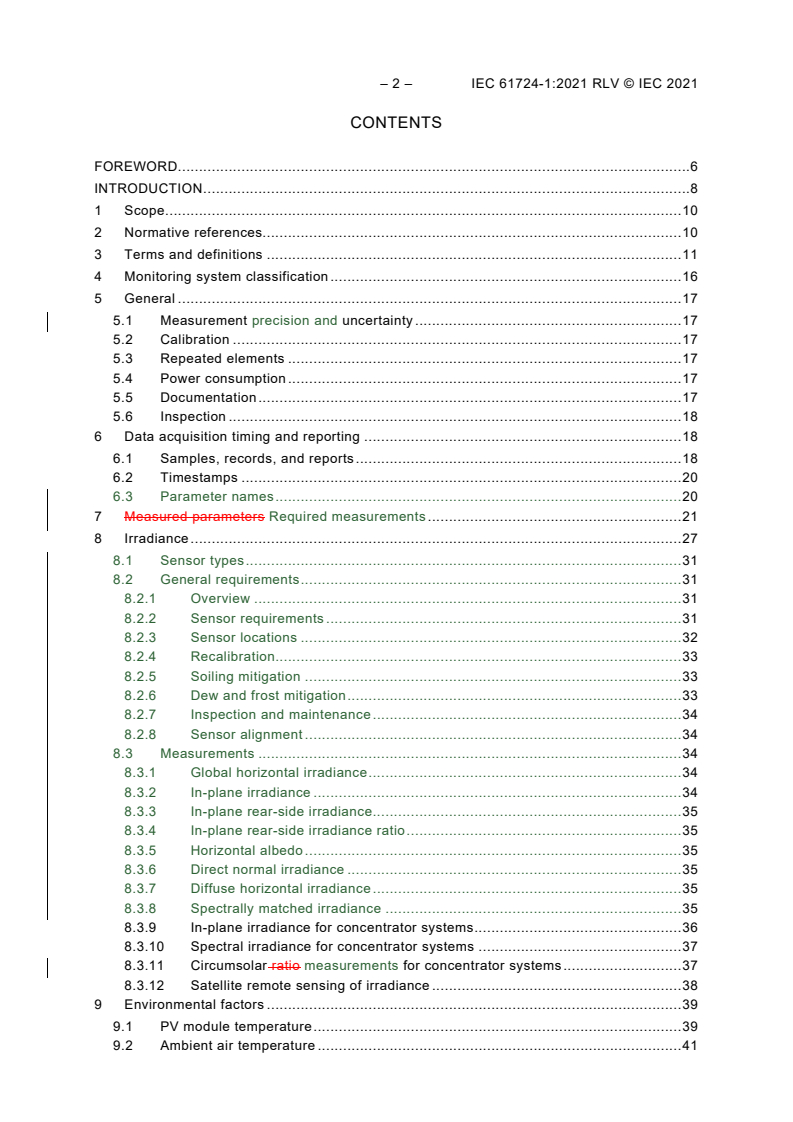
– 2 – IEC 61724-1:2021 RLV © IEC 2021
CONTENTS
FOREWORD . 6
INTRODUCTION . 8
1 Scope . 10
2 Normative references. 10
3 Terms and definitions . 11
4 Monitoring system classification . 16
5 General . 17
5.1 Measurement precision and uncertainty . 17
5.2 Calibration . 17
5.3 Repeated elements . 17
5.4 Power consumption . 17
5.5 Documentation . 17
5.6 Inspection . 18
6 Data acquisition timing and reporting . 18
6.1 Samples, records, and reports . 18
6.2 Timestamps . 20
6.3 Parameter names . 20
7 Measured parameters Required measurements . 21
8 Irradiance . 27
8.1 Sensor types . 31
8.2 General requirements . 31
8.2.1 Overview . 31
8.2.2 Sensor requirements . 31
8.2.3 Sensor locations . 32
8.2.4 Recalibration. 33
8.2.5 Soiling mitigation . 33
8.2.6 Dew and frost mitigation . 33
8.2.7 Inspection and maintenance . 34
8.2.8 Sensor alignment . 34
8.3 Measurements . 34
8.3.1 Global horizontal irradiance . 34
8.3.2 In-plane irradiance . 34
8.3.3 In-plane rear-side irradiance . 35
8.3.4 In-plane rear-side irradiance ratio . 35
8.3.5 Horizontal albedo . 35
8.3.6 Direct normal irradiance . 35
8.3.7 Diffuse horizontal irradiance . 35
8.3.8 Spectrally matched irradiance . 35
8.3.9 In-plane irradiance for concentrator systems . 36
8.3.10 Spectral irradiance for concentrator systems . 37
8.3.11 Circumsolar ratio measurements for concentrator systems . 37
8.3.12 Satellite remote sensing of irradiance . 38
9 Environmental factors . 39
9.1 PV module temperature . 39
9.2 Ambient air temperature . 41
9.3 Wind speed and direction . 42
9.4 Soiling ratio . 42
9.5 Rainfall . 45
9.6 Snow . 45
9.7 Humidity . 45
10 Tracker system . 45
10.1 Single-axis trackers . 45
10.2 Dual-axis trackers for >20x systems . 45
10.2.1 Monitoring . 45
10.2.2 Pointing error sensor alignment . 45
11 Electrical measurements . 46
11.1 Inverter-level measurements . 46
11.2 Plant-level measurements . 47
12 Data processing and quality check . 48
12.1 Daylight hours Night . 48
12.2 Quality check . 48
12.2.1 Removing invalid readings . 48
12.2.2 Treatment of missing data . 49
13 Calculated parameters . 49
13.1 Overview. 49
13.2 Summations . 50
13.3 Irradiation . 50
13.4 Electrical energy . 51
13.4.1 General . 51
13.4.2 DC output energy . 51
13.4.3 AC output energy . 51
13.5 Array power rating . 51
13.5.1 DC power rating . 51
13.5.2 AC power rating . 52
13.6 Yields . 52
13.6.1 General . 52
13.6.2 PV array energy yield . 52
13.6.3 Final system yield . 52
13.6.4 Reference yield . 52
13.6.5 Bifacial reference yield . 53
13.7 Yield losses . 53
13.7.1 General . 53
13.7.2 Array capture loss . 53
13.7.3 Balance of systems (BOS) loss. 53
13.8 Efficiencies . 54
13.8.1 Array (DC) efficiency . 54
13.8.2 System (AC) efficiency . 54
13.8.3 BOS efficiency . 54
14 Performance metrics . 54
14.1 Overview. 54
14.2 Summations . 55
14.3 Performance ratios . 55
14.3.1 Performance ratio . 55
– 4 – IEC 61724-1:2021 RLV © IEC 2021
14.3.2 Temperature-corrected performance ratios . 56
14.3.3 Bifacial performance ratios . 58
14.4 Performance indices . 59
15 Data filtering . 59
15.1 Use of available data . 59
15.2 Filtering data to specific conditions . 59
15.3 Reduced inverter, grid, or load availability . 59
Annex A (informative) Sampling interval . 61
A.1 General considerations . 61
A.2 Time constants . 61
A.3 Aliasing error . 61
A.4 Example. 62
Annex B (informative) Module backsheet temperature sensor selection and attachment . 63
B.1 Objective . 63
B.2 Sensor and material selection . 63
B.2.1 Optimal sensor types . 63
B.2.2 Optimal tapes . 63
B.2.3 Cyanoacrylate adhesives and backsheet integrity . 64
B.3 Sensor attachment method . 64
B.3.1 Permanent versus temporary . 64
B.3.2 Attachment location . 64
B.3.3 Sensor attachment Bifacial modules . 64
B.3.4 Method . 64
Annex C (normative) Soiling measurement using clean and soiled PV reference device
pair . 67
C.1 Overview. 67
C.2 Equipment . 67
C.3 Normalization . 67
C.4 Measurement method 1 – max power reduction due to soiling . 68
C.5 Measurement method 2 – short-circuit current reduction due to soiling . 68
C.6 Non-uniform soiling . 68
C.7 Daily average value . 69
C.8 Renormalization . 69
Annex D (informative) Derate factors . 70
Annex E (normative) Systems with local loads, storage, or auxiliary sources . 72
E.1 System types . 72
E.2 Parameters and formulas . 74
Bibliography . 81
Figure 1 – Possible elements of PV systems . 8
Figure 2 – Samples, records and reports . 19
Figure B.1 – Sensor attachment, permanent . 65
Figure B.2 – Sensor attachment, temporary . 65
Figure B.3 – Sensor element wire strain relief . 66
Figure E.1 – Energy flow between possible elements of different PV system types . 72
Table 1 – Monitoring system classifications and suggested applications .
Table 1 – Sampling and recording interval requirements . 20
Table 2 – Measured parameters and requirements for each monitoring system class . 22
Table 3 – Relation between system size (AC) and number of sensors for specific
sensors Multiplier referenced in Table 2 . 27
Table 4 – Irradiance sensor requirements . 32
Table 5 – Sensor choices and requirements for in-plane and global irradiance .
Table 6 – Irradiance sensor alignment accuracy .
Table 7 – Irradiance sensor maintenance requirements .
Table 5 – Inverter-level electrical measurement requirements . 46
Table 6 – Plant-level AC electrical output measurement requirements . 47
Table 7 – Calculated parameters . 50
Table 8 – PV module temperature sensor maintenance requirements .
Table 8 – Performance metrics . 55
Table 9 – Ambient air temperature sensor maintenance requirements .
Table 11 – Inverter-level electrical measurement requirements .
Table 12 – Plant-level AC electrical output measurement requirements .
Table 13 – Calculated parameters .
Table 14 – Performance metrics .
Table E.1 – Elements of different PV system types . 73
Table E.2 – Parameters and formulas for different system types . 74
– 6 – IEC 61724-1:2021 RLV © IEC 2021
INTERNATIONAL ELECTROTECHNICAL COMMISSION
____________
PHOTOVOLTAIC SYSTEM PERFORMANCE –
Part 1: Monitoring
FOREWORD
1) The International Electrotechnical Commission (IEC) is a worldwide organization for standardization comprising
all national electrotechnical committees (IEC National Committees). The object of IEC is to promote international
co-operation on all questions concerning standardization in the electrical and electronic fields. To this end and
in addition to other activities, IEC publishes International Standards, Technical Specifications, Technical Reports,
Publicly Available Specifications (PAS) and Guides (hereafter referred to as “IEC Publication(s)”). Their
preparation is entrusted to technical committees; any IEC National Committee interested in the subject dealt with
may participate in this preparatory work. International, governmental and non-governmental organizations liaising
with the IEC also participate in this preparation. IEC collaborates closely with the International Organization for
Standardization (ISO) in accordance with conditions determined by agreement between the two organizations.
2) The formal decisions or agreements of IEC on technical matters express, as nearly as possible, an international
consensus of opinion on the relevant subjects since each technical committee has representation from all
interested IEC National Committees.
3) IEC Publications have the form of recommendations for international use and are accepted by IEC National
Committees in that sense. While all reasonable efforts are made to ensure that the technical content of IEC
Publications is accurate, IEC cannot be held responsible for the way in which they are used or for any
misinterpretation by any end user.
4) In order to promote international uniformity, IEC National Committees undertake to apply IEC Publications
transparently to the maximum extent possible in their national and regional publications. Any divergence between
any IEC Publication and the corresponding national or regional publication shall be clearly indicated in the latter.
5) IEC itself does not provide any attestation of conformity. Independent certification bodies provide conformity
assessment services and, in some areas, access to IEC marks of conformity. IEC is not responsible for any
services carried out by independent certification bodies.
6) All users should ensure that they have the latest edition of this publication.
7) No liability shall attach to IEC or its directors, employees, servants or agents including individual experts and
members of its technical committees and IEC National Committees for any personal injury, property damage or
other damage of any nature whatsoever, whether direct or indirect, or for costs (including legal fees) and
expenses arising out of the publication, use of, or reliance upon, this IEC Publication or any other IEC
Publications.
8) Attention is drawn to the Normative references cited in this publication. Use of the referenced publications is
indispensable for the correct application of this publication.
9) Attention is drawn to the possibility that some of the elements of this IEC Publication may be the subject of patent
rights. IEC shall not be held responsible for identifying any or all such patent rights.
This redline version of the official IEC Standard allows the user to identify the changes made to
the previous edition IEC 61724-1:2017. A vertical bar appears in the margin wherever a change
has been made. Additions are in green text, deletions are in strikethrough red text.
International Standard IEC 61724-1 has been prepared by IEC technical committee 82: Solar
photovoltaic energy systems.
This second edition cancels and replaces the first edition, published in 2017. This edition
constitutes a technical revision.
This edition includes the following significant technical changes with respect to the previous
edition:
• Monitoring of bifacial systems is introduced.
• Irradiance sensor requirements are updated.
• Soiling measurement is updated based on new technology.
• Class C monitoring systems are eliminated.
• Various requirements, recommendations and explanatory notes are updated.
The text of this standard is based on the following documents:
FDIS Report on voting
82/1904/FDIS 82/1925/RVD
Full information on the voting for its approval can be found in the report on voting indicated in
the above table.
The language used for the development of this International Standard is English.
This document was drafted in accordance with ISO/IEC Directives, Part 2, and developed in
accordance with ISO/IEC Directives, Part 1 and ISO/IEC Directives, IEC Supplement, available
at www.iec.ch/members_experts/refdocs. The main document types developed by IEC are
described in greater detail at www.iec.ch/standardsdev/publications.
A list of all parts in the IEC 61724 series, published under the general title Photovoltaic system
performance, can be found on the IEC website.
The committee has decided that the contents of this document will remain unchanged until the
stability date indicated on the IEC website under webstore.iec.ch in the data related to the
specific document. At this date, the document will be
• reconfirmed,
• withdrawn,
• replaced by a revised edition, or
• amended.
IMPORTANT – The 'colour inside' logo on the cover page of this publication indicates that it
contains colours which are considered to be useful for the correct understanding of its
contents. Users should therefore print this document using a colour printer.
– 8 – IEC 61724-1:2021 RLV © IEC 2021
INTRODUCTION
This document defines classes of photovoltaic (PV) performance monitoring systems and
serves as guidance for various monitoring system choices.
Figure 1 illustrates possible major elements comprising different PV system types.
The main clauses of this document are written for grid-connected systems without local loads,
energy storage, or auxiliary sources, as shown by the bold lines in Figure 1. Annex E includes
some details for systems with additional components.
The PV array may include both fixed-axis and tracking tracker systems and both flat-plate and
concentrator systems. Module-level electronics, if present, may be a component of the
monitoring system.
Key
RNE: renewable energy
PCE: power conditioning equipment
BDI: bi-directional inverter
GCI: grid-connected inverter
Bold lines denote simple grid-connected system without local loads, energy storage, or auxiliary sources.
Figure 1 – Possible elements of PV systems
The purposes of a performance monitoring system are diverse and can could include the
following:
• identification of performance trends in an individual PV system;
• localization of potential faults in a PV system;
• comparison of PV system performance to design expectations and guarantees;
• comparison of PV systems of different configurations; and
• comparison of PV systems at different locations.
comparing performance to design expectations and guarantees as well as detecting and
localizing faults.
These diverse purposes give rise to a diverse set of requirements, and different sensors and/or
analysis methods may be more or less suited depending on the specific objective. For example,
For comparing performance to design expectations and guarantees, the focus should be on
system-level data and consistency between prediction and test methods, while for analysing
performance trends.
For detecting and localizing faults there may should be a need for greater resolution at sub-
levels of the system and an emphasis on measurement repeatability and correlation metrics
rather than absolute accuracy.
The monitoring system should be adapted to the PV system's size and user requirements. In
general, larger and more expensive PV systems should have more monitoring points and higher
accuracy sensors than smaller and lower-cost PV systems. This document defines three
classifications of monitoring system with differentiated requirements which are appropriate to a
range of purposes.
– 10 – IEC 61724-1:2021 RLV © IEC 2021
PHOTOVOLTAIC SYSTEM PERFORMANCE –
Part 1: Monitoring
1 Scope
This part of IEC 61724 outlines terminology, equipment, and methods for performance
monitoring and analysis of photovoltaic (PV) systems. It addresses sensors, installation, and
accuracy for monitoring equipment in addition to measured parameter data acquisition and
quality checks, calculated parameters, and performance metrics. It also serves as a basis for
other standards which rely upon the data collected.
2 Normative references
The following documents are referred to in the text in such a way that some or all of their content
constitutes requirements of this document. For dated references, only the edition cited applies.
For undated references, the latest edition of the referenced document (including any
amendments) applies.
IEC 60050-131, International Electrotechnical Vocabulary (IEV) – Part 131: Circuit theory
IEC 60904-2, Photovoltaic devices – Part 2: Requirements for photovoltaic reference devices
IEC 60904-3, Photovoltaic devices – Part 3: Measurement principles for terrestrial photovoltaic
(PV) solar devices with reference spectral irradiance data
IEC 60904-5, Photovoltaic devices – Part 5: Determination of the equivalent cell temperature
(ECT) of photovoltaic (PV) devices by the open-circuit voltage method
IEC 60904-7, Photovoltaic devices – Part 7: Computation of the spectral mismatch correction
for measurements of photovoltaic devices
IEC 60904-10, Photovoltaic devices – Part 10: Methods of linearity measurement
IEC 61215 (all parts), Terrestrial photovoltaic (PV) modules – Design qualification and type
approval
IEC 61557-12, Electrical safety in low voltage distribution systems up to 1 000 V AC and
1 500 V DC – Equipment for testing, measuring or monitoring of protective measures – Part 12:
Power metering and monitoring devices (PMD)
IEC TS 61724-2, Photovoltaic system performance – Part 2: Capacity evaluation method
IEC TS 61724-3, Photovoltaic system performance – Part 3: Energy evaluation method
IEC TS 61836, Solar photovoltaic energy systems – Terms, definitions and symbols
IEC 62053-21, Electricity metering equipment (a.c.) – Particular requirements – Part 21: Static
meters for active energy (classes 1 and 2)
IEC 62053-22, Electricity metering equipment – Particular requirements – Part 22: Static meters
for AC active energy (classes 0,1S, 0,2S and 0,5S)
IEC 62670-3, Photovoltaic concentrators (CPV) – Performance testing – Part 3: Performance
measurements and power rating
IEC 62817:2014, Photovoltaic systems – Design qualification of solar trackers
ISO/IEC Guide 98-1, Uncertainty of measurement – Part 1: Introduction to the expression of
uncertainty in measurement
ISO/IEC Guide 98-3, Uncertainty of measurement – Part 3: Guide to the expression of
uncertainty in measurement (GUM:1995)
ISO 9060:2018, Solar energy – Specification and classification of instruments for measuring
hemispherical solar and direct solar radiation
ISO 9488, Solar energy – Vocabulary
ISO 9846, Solar energy – Calibration of a pyranometer using a pyrheliometer
ISO 9847, Solar energy – Calibration of field pyranometers by comparison to a reference
pyranometer
WMO No. 8, Guide to meteorological instruments and methods of observation
ASTM G183, Standard Practice for Field Use of Pyranometers, Pyrheliometers and UV
Radiometers
3 Terms and definitions
For the purposes of this document, the terms and definitions given in IEC 60050-131,
IEC TS 61836, ISO 9488, and the following apply.
ISO and IEC maintain terminological databases for use in standardization at the following
addresses:
• IEC Electropedia: available at http://www.electropedia.org/
• ISO Online browsing platform: available at http://www.iso.org/obp
3.1
sample
data acquired from a sensor or measuring device
3.2
sampling interval
time between samples
3.3
record
data recorded and stored in data log, based on acquired samples
3.4
recording interval
τ
time between records
– 12 – IEC 61724-1:2021 RLV © IEC 2021
3.5
report
aggregate value based on series of records
3.6
reporting period
time between reports
3.7
front side
side of a surface which normally faces the sky
3.8
rear side
side of a surface which normally faces the ground
3.9
monofacial PV device
PV device in which only the front side is used for power generation
3.10
bifacial PV device
PV device in which both front side and rear side are used for power generation
3.11
bifaciality coefficient
𝛗𝛗
ratio between an I-V characteristic of the rear side and the front side of a bifacial device,
typically at Standard Test Conditions (STC), unless otherwise specified
Note 1 to entry: Bifaciality coefficients include the short-circuit current bifaciality coefficient 𝜑𝜑 , the open-circuit
Isc
voltage bifaciality coefficient 𝜑𝜑 and the maximum power bifaciality coefficient 𝜑𝜑 .
Voc Pmax
Note 2 to entry: Bifaciality coefficients are defined in IEC TS 60904-1-2.
3.12
irradiance
G
incident flux of radiant power per unit area
−2
Note 1 to entry: Expressed in units of W·m .
3.13
in-plane irradiance
G or POA
i
sum of direct, diffuse, and ground-reflected irradiance incident upon the front side of an inclined
surface parallel to the plane of the modules in the PV array, also known as plane-of-array (POA)
irradiance
−2
Note 1 to entry: Expressed in units of W·m .
3.14
horizontal albedo
𝜌𝜌
𝐻𝐻
proportion of incident light reflected by a ground surface as measured in a horizontal plane
Note 1 to entry: It is a property of a ground surface and is a dimensionless quantity on a scale from 0 to 1.
3.15
in-plane rear-side irradiance ratio
𝜌𝜌
𝑖𝑖
ratio of the irradiance incident on the rear side of the modules in the PV array to the irradiance
incident on the front side
Note 1 to entry: It is a dimensionless quantity but can exceed a value of 1 since, in addition to reflected light, diffuse
and direct components of the solar resource may also be measured on the rear-side of the plane of array.
3.16
spectrally matched in-plane rear-side irradiance ratio
𝑆𝑆𝑆𝑆
𝜌𝜌
𝑖𝑖
in-plane rear-side irradiance ratio per 3.15 when both irradiance quantities are measured with
a spectrally matched reference device or with the application of spectral correction factors per
IEC 60904-7
3.17
spectrally matched reference device
reference device such as a PV cell or module with spectral response characteristics sufficiently
close to those of the PV modules in the PV array such that spectral mismatch errors are small
under the typical range of incident spectra
3.18
in-plane rear-side irradiance
rear rear
G or POA
i
sum of direct, diffuse, and ground-reflected irradiance incident on the rear side of the modules
in the PV array, also known as rear-side plane-of-array irradiance
−2
Note 1 to entry: Expressed in units of W·m .
𝑟𝑟𝑟𝑟𝑟𝑟𝑟𝑟 𝑟𝑟𝑟𝑟𝑟𝑟𝑟𝑟 𝑆𝑆𝑆𝑆
Note 2 to entry: (If measured via in-plane rear-side irradiance ratio): 𝐺𝐺 = 𝜌𝜌 × 𝐺𝐺 or 𝐺𝐺 = 𝜌𝜌 × 𝐺𝐺 .
𝑖𝑖 𝑖𝑖 𝑖𝑖 𝑖𝑖,𝑆𝑆𝑆𝑆 𝑖𝑖 𝑖𝑖
3.19
bifacial reference device
bifacial PV device, such as a cell or module, having substantially the same properties, with
respect to response to front-side and rear-side irradiance, as bifacial modules to be monitored
3.20
bifacial irradiance factor
BIF
dimensionless factor that can be directly multiplied by the front-side in-plane irradiance (G ) to
i
calculate the “effective” irradiance reaching a bifacial device from both the front and rear side
collectively
𝑆𝑆𝑆𝑆
𝑠𝑠𝑠𝑠
( )
Note 1 to entry: 𝐵𝐵𝐵𝐵𝐵𝐵 = (1 +𝜑𝜑 × 𝜌𝜌 ) or 𝐵𝐵𝐵𝐵𝐵𝐵 = 1 +𝜑𝜑 × 𝜌𝜌 . See 3.11, 3.15, 3.16.
𝑆𝑆𝑃𝑃𝑟𝑟𝑃𝑃 𝑖𝑖 𝑆𝑆𝑃𝑃𝑟𝑟𝑃𝑃 𝑖𝑖
Note 2 to entry: Rear-side POA irradiance can be measured simultaneously with front-side POA irradiance using a
𝐵𝐵𝑖𝑖𝐵𝐵𝑖𝑖 𝑅𝑅𝑟𝑟𝑅𝑅 𝐷𝐷𝑟𝑟𝐷𝐷𝑖𝑖𝐷𝐷𝑟𝑟
bifacial reference device. In that case, 𝐵𝐵𝐵𝐵𝐵𝐵 =𝐺𝐺 ÷𝐺𝐺 . For consistency, the front-side POA irradiance
𝑖𝑖
𝑖𝑖
should be measured with the same or similar type of device as the bifacial reference device.
Note 3 to entry: ”Effective” irradiance may include the effect of inhomogeneities in rear-side irradiance.
3.21
global horizontal irradiance
GHI
direct plus diffuse irradiance incident on the front side of a horizontal surface
−2
Note 1 to entry: Expressed in units of W·m .
Note 2 to entry: 𝐺𝐺𝐺𝐺𝐵𝐵 = 𝐷𝐷𝐷𝐷𝐵𝐵∙ cos𝑍𝑍 +𝐷𝐷𝐺𝐺𝐵𝐵 where Z is the solar zenith angle.
– 14 – IEC 61724-1:2021 RLV © IEC 2021
3.22
circumsolar
immediately surrounding the solar disk
3.23
direct normal irradiance
DNI
irradiance emanating from the solar disk and from the circumsolar region of the sky within a
subtended full angle of 5° falling on a plane surface normal to the sun’s rays
Note 1 to entry: Some DNI measurement instruments have a field of view with a subtended full angle of up to 6°.
−2
Note 2 1 to entry: Expressed in units of W·m .
Note 3 to entry: 𝐺𝐺𝐺𝐺𝐵𝐵 = 𝐷𝐷𝐷𝐷𝐵𝐵∙ cos𝑍𝑍 +𝐷𝐷𝐺𝐺𝐵𝐵 where Z is the solar zenith angle.
3.24
circumsolar contribution
contribution of a specific portion of the circumsolar normal irradiance to the direct normal
irradiance. The circumsolar contribution refers to a specific ring-shaped angular region
described by an inner and the outer angular distance from the centre of the sun (see ISO 9488)
Note 1 to entry: If the inner angle describing this angular region is the half-angle of the sun disk the circumsolar
contribution is also called circumsolar ratio.
Note 2 to entry: Depending on the circumsolar irradiance measurement instrument or the solar technology involved,
different wavelength ranges are included. In order to describe circumsolar irradiance correctly, the wavelength range
or the spectral response of the instrument or the involved technology has to be specified.
3.25
circumsolar ratio
CSR
fraction of measured direct normal irradiance (DNI) emanating from the circumsolar region of
the sky, i.e. within the angular acceptance of the DNI sensor but outside the solar disk
3.26
sunshape
azimuthal average radiance profile as a function of the angular distance from the centre of the
sun, normalized to 1 at the centre of the sun and considering the wavelength range of shortwave
radiation (see ISO 9488)
3.27
diffuse horizontal irradiance
G or DHI
d
global horizontal irradiance on the front side of a horizontal surface excluding the portion
emanating from the solar disk and from the circumsolar region of the sky within a subtended
full angle of 5°
Note 1 to entry: Some diffuse irradiance measurement instruments exclude a circumsolar region within a subtended
full angle of up to 6°.
−2
Note 2 1 to entry: Expressed in units of W·m .
Note 3 to entry: 𝐺𝐺𝐺𝐺𝐵𝐵 = 𝐷𝐷𝐷𝐷𝐵𝐵∙ cos𝑍𝑍 +𝐷𝐷𝐺𝐺𝐵𝐵 where Z is the solar zenith angle.
3.28
in-plane direct beam irradiance
G
i,b
in-plane irradiance incident upon the front side of an inclined surface parallel to the plane of
the modules in the PV array emanating from the solar disk and from the circumsolar region of
the sky within a subtended full angle of 5°, excluding scattering and reflections
Note 1 to entry: The in-plane direct beam irradiance 𝐺𝐺 = cos(𝜃𝜃) ×𝐷𝐷𝐷𝐷𝐵𝐵, where 𝜃𝜃 is the angle between the sun
𝑖𝑖,𝑏𝑏
and the normal to the plane. When the plane of array is normal to the sun, 𝐺𝐺 =𝐷𝐷𝐷𝐷𝐵𝐵.
𝑖𝑖,𝑏𝑏
−2
Note 2 to entry: Expressed in units of W·m .
3.15
in-plane diffuse irradiance
G
i,d
in-plane irradiance excluding the direct beam irradiance
Note 1 to entry: G = G – G .
i,d i i,b
−2
Note 2 to entry: Expressed in units of W·m .
3.29
irradiation
H
irradiance integrated over a specified time interval
−2
Note 1 to entry: Expressed in units of kW-h·m .
3.30
standard test conditions
STC
-2
reference values of in-plane irradiance 1 000 W⋅m , normal incidence, PV cell junction
temperature 25 °C, and the reference spectral irradiance defined in IEC 60904-3
3.31
soiling ratio
SR
ratio of the actual power output of the PV array under given soiling conditions to the power that
would be expected if the PV array were clean and free of soiling
3.32
soiling level
SL
fractional power loss due to soiling, given by 1 – SR
3.33
soiling rate
rate of change of soiling ratio, typically expressed in percent per day
3.34
active power
P
under periodic conditions, mean value, taken over one period, of the instantaneous product of
current and voltage
Note 1 to entry: Under sinusoidal conditions, the active power is the real part of the complex power.
Note 2 to entry: Expressed in units of W.
3.35
apparent power
S
product of the rms voltage between the terminals of a two-terminal element or two-terminal
circuit and the rms electric current in the element or circuit
Note 1 to entry: Under sinusoidal conditions, the apparent power is the modulus of the complex power.
Note 2 to entry: Expressed in units of VA.
– 16 – IEC 61724-1:2021 RLV © IEC 2021
3.36
power factor
λ
under periodic conditions, ratio of the absolute value of the active power P to the apparent
power S:
P
λ =
S
4 Monitoring system classification
The required accuracy and complexity of the monitoring system depends on the PV system size
and user objectives. This document defines three classifications of monitoring systems
providing varying levels of accuracy, as listed in Table 1.
The monitoring system classification shall be stated in any conformity declarations to this
standard. The monitoring system classification may be referenced either by its letter code (A,
B, C) or its name (high accuracy, medium accuracy, basic accuracy) as indicated in Table 1. In
this document, the letter codes are used for convenience.
Class A or Class B would be most appropriate for large PV systems, such as utilit
...
IEC 61724-1 ®
Edition 2.0 2021-07
INTERNATIONAL
STANDARD
NORME
INTERNATIONALE
Photovoltaic system performance –
Part 1: Monitoring
Performances des systèmes photovoltaïques –
Partie 1: Surveillance
All rights reserved. Unless otherwise specified, no part of this publication may be reproduced or utilized in any form
or by any means, electronic or mechanical, including photocopying and microfilm, without permission in writing from
either IEC or IEC's member National Committee in the country of the requester. If you have any questions about IEC
copyright or have an enquiry about obtaining additional rights to this publication, please contact the address below or
your local IEC member National Committee for further information.
Droits de reproduction réservés. Sauf indication contraire, aucune partie de cette publication ne peut être reproduite
ni utilisée sous quelque forme que ce soit et par aucun procédé, électronique ou mécanique, y compris la photocopie
et les microfilms, sans l'accord écrit de l'IEC ou du Comité national de l'IEC du pays du demandeur. Si vous avez des
questions sur le copyright de l'IEC ou si vous désirez obtenir des droits supplémentaires sur cette publication, utilisez
les coordonnées ci-après ou contactez le Comité national de l'IEC de votre pays de résidence.
IEC Central Office Tel.: +41 22 919 02 11
3, rue de Varembé info@iec.ch
CH-1211 Geneva 20 www.iec.ch
Switzerland
About the IEC
The International Electrotechnical Commission (IEC) is the leading global organization that prepares and publishes
International Standards for all electrical, electronic and related technologies.
About IEC publications
The technical content of IEC publications is kept under constant review by the IEC. Please make sure that you have the
latest edition, a corrigendum or an amendment might have been published.
IEC publications search - webstore.iec.ch/advsearchform IEC online collection - oc.iec.ch
The advanced search enables to find IEC publications by a Discover our powerful search engine and read freely all the
variety of criteria (reference number, text, technical publications previews. With a subscription you will always
committee, …). It also gives information on projects, replaced have access to up to date content tailored to your needs.
and withdrawn publications.
Electropedia - www.electropedia.org
IEC Just Published - webstore.iec.ch/justpublished
The world's leading online dictionary on electrotechnology,
Stay up to date on all new IEC publications. Just Published
containing more than 22 000 terminological entries in English
details all new publications released. Available online and
and French, with equivalent terms in 18 additional languages.
once a month by email.
Also known as the International Electrotechnical Vocabulary
(IEV) online.
IEC Customer Service Centre - webstore.iec.ch/csc
If you wish to give us your feedback on this publication or
need further assistance, please contact the Customer Service
Centre: sales@iec.ch.
A propos de l'IEC
La Commission Electrotechnique Internationale (IEC) est la première organisation mondiale qui élabore et publie des
Normes internationales pour tout ce qui a trait à l'électricité, à l'électronique et aux technologies apparentées.
A propos des publications IEC
Le contenu technique des publications IEC est constamment revu. Veuillez vous assurer que vous possédez l’édition la
plus récente, un corrigendum ou amendement peut avoir été publié.
Recherche de publications IEC - IEC online collection - oc.iec.ch
webstore.iec.ch/advsearchform Découvrez notre puissant moteur de recherche et consultez
La recherche avancée permet de trouver des publications IEC gratuitement tous les aperçus des publications. Avec un
en utilisant différents critères (numéro de référence, texte, abonnement, vous aurez toujours accès à un contenu à jour
comité d’études, …). Elle donne aussi des informations sur adapté à vos besoins.
les projets et les publications remplacées ou retirées.
Electropedia - www.electropedia.org
IEC Just Published - webstore.iec.ch/justpublished
Le premier dictionnaire d'électrotechnologie en ligne au
Restez informé sur les nouvelles publications IEC. Just
monde, avec plus de 22 000 articles terminologiques en
Published détaille les nouvelles publications parues.
anglais et en français, ainsi que les termes équivalents dans
Disponible en ligne et une fois par mois par email.
16 langues additionnelles. Egalement appelé Vocabulaire
Electrotechnique International (IEV) en ligne.
Service Clients - webstore.iec.ch/csc
Si vous désirez nous donner des commentaires sur cette
publication ou si vous avez des questions contactez-nous:
sales@iec.ch.
IEC 61724-1 ®
Edition 2.0 2021-07
INTERNATIONAL
STANDARD
NORME
INTERNATIONALE
Photovoltaic system performance –
Part 1: Monitoring
Performances des systèmes photovoltaïques –
Partie 1: Surveillance
INTERNATIONAL
ELECTROTECHNICAL
COMMISSION
COMMISSION
ELECTROTECHNIQUE
INTERNATIONALE
ICS 27.160 ISBN 978-2-8322-1002-5
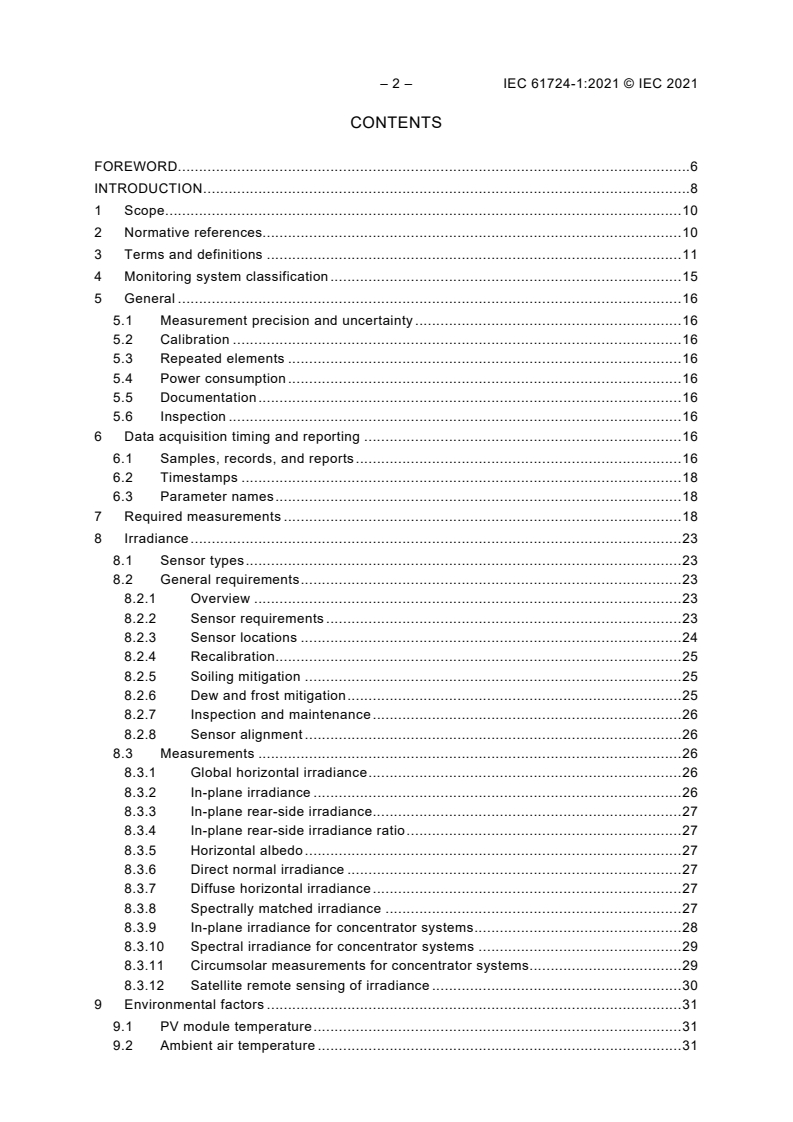
– 2 – IEC 61724-1:2021 © IEC 2021
CONTENTS
FOREWORD . 6
INTRODUCTION . 8
1 Scope . 10
2 Normative references. 10
3 Terms and definitions . 11
4 Monitoring system classification . 15
5 General . 16
5.1 Measurement precision and uncertainty . 16
5.2 Calibration . 16
5.3 Repeated elements . 16
5.4 Power consumption . 16
5.5 Documentation . 16
5.6 Inspection . 16
6 Data acquisition timing and reporting . 16
6.1 Samples, records, and reports . 16
6.2 Timestamps . 18
6.3 Parameter names . 18
7 Required measurements . 18
8 Irradiance . 23
8.1 Sensor types . 23
8.2 General requirements . 23
8.2.1 Overview . 23
8.2.2 Sensor requirements . 23
8.2.3 Sensor locations . 24
8.2.4 Recalibration. 25
8.2.5 Soiling mitigation . 25
8.2.6 Dew and frost mitigation . 25
8.2.7 Inspection and maintenance . 26
8.2.8 Sensor alignment . 26
8.3 Measurements . 26
8.3.1 Global horizontal irradiance . 26
8.3.2 In-plane irradiance . 26
8.3.3 In-plane rear-side irradiance . 27
8.3.4 In-plane rear-side irradiance ratio . 27
8.3.5 Horizontal albedo . 27
8.3.6 Direct normal irradiance . 27
8.3.7 Diffuse horizontal irradiance . 27
8.3.8 Spectrally matched irradiance . 27
8.3.9 In-plane irradiance for concentrator systems . 28
8.3.10 Spectral irradiance for concentrator systems . 29
8.3.11 Circumsolar measurements for concentrator systems . 29
8.3.12 Satellite remote sensing of irradiance . 30
9 Environmental factors . 31
9.1 PV module temperature . 31
9.2 Ambient air temperature . 31
9.3 Wind speed and direction . 32
9.4 Soiling ratio . 32
9.5 Rainfall . 33
9.6 Snow . 33
9.7 Humidity . 33
10 Tracker system . 33
10.1 Single-axis trackers . 33
10.2 Dual-axis trackers . 33
10.2.1 Monitoring . 33
10.2.2 Pointing error sensor alignment . 33
11 Electrical measurements . 34
11.1 Inverter-level measurements . 34
11.2 Plant-level measurements . 34
12 Data processing and quality check . 35
12.1 Night . 35
12.2 Quality check . 35
12.2.1 Removing invalid readings . 35
12.2.2 Treatment of missing data . 35
13 Calculated parameters . 36
13.1 Overview. 36
13.2 Summations . 36
13.3 Irradiation . 36
13.4 Electrical energy . 37
13.4.1 General . 37
13.4.2 DC output energy . 37
13.4.3 AC output energy . 37
13.5 Array power rating . 37
13.5.1 DC power rating . 37
13.5.2 AC power rating . 38
13.6 Yields . 38
13.6.1 General . 38
13.6.2 PV array energy yield . 38
13.6.3 Final system yield . 38
13.6.4 Reference yield . 39
13.6.5 Bifacial reference yield . 39
13.7 Yield losses . 39
13.7.1 General . 39
13.7.2 Array capture loss . 39
13.7.3 Balance of systems (BOS) loss. 40
13.8 Efficiencies . 40
13.8.1 Array (DC) efficiency . 40
13.8.2 System (AC) efficiency . 40
13.8.3 BOS efficiency . 40
14 Performance metrics . 41
14.1 Overview. 41
14.2 Summations . 41
14.3 Performance ratios . 41
14.3.1 Performance ratio . 41
– 4 – IEC 61724-1:2021 © IEC 2021
14.3.2 Temperature-corrected performance ratios . 42
14.3.3 Bifacial performance ratios . 44
14.4 Performance indices . 44
15 Data filtering . 45
15.1 Use of available data . 45
15.2 Filtering data to specific conditions . 45
15.3 Reduced inverter, grid, or load availability . 45
Annex A (informative) Sampling interval . 46
A.1 General considerations . 46
A.2 Time constants . 46
A.3 Aliasing error . 46
A.4 Example. 47
Annex B (informative) Module temperature sensor selection and attachment . 48
B.1 Objective . 48
B.2 Sensor and material selection . 48
B.2.1 Optimal sensor types . 48
B.2.2 Optimal tapes . 48
B.2.3 Cyanoacrylate adhesives and backsheet integrity . 49
B.3 Sensor attachment . 49
B.3.1 Permanent versus temporary . 49
B.3.2 Attachment location . 49
B.3.3 Bifacial modules . 49
B.3.4 Method . 49
Annex C (normative) Soiling measurement using clean and soiled PV reference device
pair . 52
C.1 Overview. 52
C.2 Equipment . 52
C.3 Normalization . 52
C.4 Measurement method 1 – max power reduction due to soiling . 53
C.5 Measurement method 2 – short-circuit current reduction due to soiling . 53
C.6 Non-uniform soiling . 53
C.7 Daily average value . 54
C.8 Renormalization . 54
Annex D (informative) Derate factors . 55
Annex E (normative) Systems with local loads, storage, or auxiliary sources . 57
E.1 System types . 57
E.2 Parameters and formulas . 59
Bibliography . 66
Figure 1 – Possible elements of PV systems . 8
Figure 2 – Samples, records and reports . 17
Figure B.1 – Sensor attachment, permanent . 50
Figure B.2 – Sensor attachment, temporary . 50
Figure B.3 – Sensor element wire strain relief . 51
Figure E.1 – Energy flow between possible elements of different PV system types . 57
Table 1 – Sampling and recording interval requirements . 18
Table 2 – Measured parameters and requirements . 20
Table 3 – Multiplier referenced in Table 2 . 23
Table 4 – Irradiance sensor requirements . 24
Table 5 – Inverter-level electrical measurement requirements . 34
Table 6 – Plant-level AC electrical output measurement requirements . 34
Table 7 – Calculated parameters . 36
Table 8 – Performance metrics . 41
Table E.1 – Elements of different PV system types . 58
Table E.2 – Parameters and formulas for different system types . 59
– 6 – IEC 61724-1:2021 © IEC 2021
INTERNATIONAL ELECTROTECHNICAL COMMISSION
____________
PHOTOVOLTAIC SYSTEM PERFORMANCE –
Part 1: Monitoring
FOREWORD
1) The International Electrotechnical Commission (IEC) is a worldwide organization for standardization comprising
all national electrotechnical committees (IEC National Committees). The object of IEC is to promote international
co-operation on all questions concerning standardization in the electrical and electronic fields. To this end and
in addition to other activities, IEC publishes International Standards, Technical Specifications, Technical Reports,
Publicly Available Specifications (PAS) and Guides (hereafter referred to as “IEC Publication(s)”). Their
preparation is entrusted to technical committees; any IEC National Committee interested in the subject dealt with
may participate in this preparatory work. International, governmental and non-governmental organizations liaising
with the IEC also participate in this preparation. IEC collaborates closely with the International Organization for
Standardization (ISO) in accordance with conditions determined by agreement between the two organizations.
2) The formal decisions or agreements of IEC on technical matters express, as nearly as possible, an international
consensus of opinion on the relevant subjects since each technical committee has representation from all
interested IEC National Committees.
3) IEC Publications have the form of recommendations for international use and are accepted by IEC National
Committees in that sense. While all reasonable efforts are made to ensure that the technical content of IEC
Publications is accurate, IEC cannot be held responsible for the way in which they are used or for any
misinterpretation by any end user.
4) In order to promote international uniformity, IEC National Committees undertake to apply IEC Publications
transparently to the maximum extent possible in their national and regional publications. Any divergence between
any IEC Publication and the corresponding national or regional publication shall be clearly indicated in the latter.
5) IEC itself does not provide any attestation of conformity. Independent certification bodies provide conformity
assessment services and, in some areas, access to IEC marks of conformity. IEC is not responsible for any
services carried out by independent certification bodies.
6) All users should ensure that they have the latest edition of this publication.
7) No liability shall attach to IEC or its directors, employees, servants or agents including individual experts and
members of its technical committees and IEC National Committees for any personal injury, property damage or
other damage of any nature whatsoever, whether direct or indirect, or for costs (including legal fees) and
expenses arising out of the publication, use of, or reliance upon, this IEC Publication or any other IEC
Publications.
8) Attention is drawn to the Normative references cited in this publication. Use of the referenced publications is
indispensable for the correct application of this publication.
9) Attention is drawn to the possibility that some of the elements of this IEC Publication may be the subject of patent
rights. IEC shall not be held responsible for identifying any or all such patent rights.
International Standard IEC 61724-1 has been prepared by IEC technical committee 82: Solar
photovoltaic energy systems.
This second edition cancels and replaces the first edition, published in 2017. This edition
constitutes a technical revision.
This edition includes the following significant technical changes with respect to the previous
edition:
• Monitoring of bifacial systems is introduced.
• Irradiance sensor requirements are updated.
• Soiling measurement is updated based on new technology.
• Class C monitoring systems are eliminated.
• Various requirements, recommendations and explanatory notes are updated.
The text of this standard is based on the following documents:
FDIS Report on voting
82/1904/FDIS 82/1925/RVD
Full information on the voting for its approval can be found in the report on voting indicated in
the above table.
The language used for the development of this International Standard is English.
This document was drafted in accordance with ISO/IEC Directives, Part 2, and developed in
accordance with ISO/IEC Directives, Part 1 and ISO/IEC Directives, IEC Supplement, available
at www.iec.ch/members_experts/refdocs. The main document types developed by IEC are
described in greater detail at www.iec.ch/standardsdev/publications.
A list of all parts in the IEC 61724 series, published under the general title Photovoltaic system
performance, can be found on the IEC website.
The committee has decided that the contents of this document will remain unchanged until the
stability date indicated on the IEC website under webstore.iec.ch in the data related to the
specific document. At this date, the document will be
• reconfirmed,
• withdrawn,
• replaced by a revised edition, or
• amended.
– 8 – IEC 61724-1:2021 © IEC 2021
INTRODUCTION
This document defines classes of photovoltaic (PV) performance monitoring systems and
serves as guidance for monitoring system choices.
Figure 1 illustrates major elements comprising different PV system types. The main clauses of
this document are written for grid-connected systems without local loads, energy storage, or
auxiliary sources, as shown by the bold lines in Figure 1. Annex E includes some details for
systems with additional components.
The PV array may include both fixed-axis and tracker systems and both flat-plate and
concentrator systems.
Key
RNE: renewable energy
PCE: power conditioning equipment
BDI: bi-directional inverter
GCI: grid-connected inverter
Bold lines denote simple grid-connected system without local loads, energy storage, or auxiliary sources.
Figure 1 – Possible elements of PV systems
The purposes of a performance monitoring system are diverse and could include comparing
performance to design expectations and guarantees as well as detecting and localizing faults.
For comparing performance to design expectations and guarantees, the focus should be on
system-level data and consistency between prediction and test methods.
For detecting and localizing faults there should be greater resolution at sub-levels of the system
and an emphasis on measurement repeatability and correlation metrics.
The monitoring system should be adapted to the PV system's size and user requirements. In
general, larger PV systems should have more monitoring points and higher accuracy sensors
than smaller and lower-cost PV systems.
– 10 – IEC 61724-1:2021 © IEC 2021
PHOTOVOLTAIC SYSTEM PERFORMANCE –
Part 1: Monitoring
1 Scope
This part of IEC 61724 outlines terminology, equipment, and methods for performance
monitoring and analysis of photovoltaic (PV) systems. It also serves as a basis for other
standards which rely upon the data collected.
2 Normative references
The following documents are referred to in the text in such a way that some or all of their content
constitutes requirements of this document. For dated references, only the edition cited applies.
For undated references, the latest edition of the referenced document (including any
amendments) applies.
IEC 60050-131, International Electrotechnical Vocabulary (IEV) – Part 131: Circuit theory
IEC 60904-2, Photovoltaic devices – Part 2: Requirements for photovoltaic reference devices
IEC 60904-5, Photovoltaic devices – Part 5: Determination of the equivalent cell temperature
(ECT) of photovoltaic (PV) devices by the open-circuit voltage method
IEC 60904-7, Photovoltaic devices – Part 7: Computation of the spectral mismatch correction
for measurements of photovoltaic devices
IEC 61215 (all parts), Terrestrial photovoltaic (PV) modules – Design qualification and type
approval
IEC 61557-12, Electrical safety in low voltage distribution systems up to 1 000 V AC and
1 500 V DC – Equipment for testing, measuring or monitoring of protective measures – Part 12:
Power metering and monitoring devices (PMD)
IEC TS 61724-2, Photovoltaic system performance – Part 2: Capacity evaluation method
IEC TS 61724-3, Photovoltaic system performance – Part 3: Energy evaluation method
IEC TS 61836, Solar photovoltaic energy systems – Terms, definitions and symbols
IEC 62053-22, Electricity metering equipment – Particular requirements – Part 22: Static meters
for AC active energy (classes 0,1S, 0,2S and 0,5S)
IEC 62670-3, Photovoltaic concentrators (CPV) – Performance testing – Part 3: Performance
measurements and power rating
IEC 62817:2014, Photovoltaic systems – Design qualification of solar trackers
ISO/IEC Guide 98-1, Uncertainty of measurement – Part 1: Introduction to the expression of
uncertainty in measurement
ISO/IEC Guide 98-3, Uncertainty of measurement – Part 3: Guide to the expression of
uncertainty in measurement (GUM:1995)
ISO 9060:2018, Solar energy – Specification and classification of instruments for measuring
hemispherical solar and direct solar radiation
ISO 9488, Solar energy – Vocabulary
3 Terms and definitions
For the purposes of this document, the terms and definitions given in IEC 60050-131,
IEC TS 61836, ISO 9488, and the following apply.
ISO and IEC maintain terminological databases for use in standardization at the following
addresses:
• IEC Electropedia: available at http://www.electropedia.org/
• ISO Online browsing platform: available at http://www.iso.org/obp
3.1
sample
data acquired from a sensor or measuring device
3.2
sampling interval
time between samples
3.3
record
data recorded and stored
3.4
recording interval
τ
time between records
3.5
report
aggregate value based on series of records
3.6
reporting period
time between reports
3.7
front side
side of a surface which normally faces the sky
3.8
rear side
side of a surface which normally faces the ground
3.9
monofacial PV device
PV device in which only the front side is used for power generation
– 12 – IEC 61724-1:2021 © IEC 2021
3.10
bifacial PV device
PV device in which both front side and rear side are used for power generation
3.11
bifaciality coefficient
𝛗𝛗
ratio between an I-V characteristic of the rear side and the front side of a bifacial device,
typically at Standard Test Conditions (STC), unless otherwise specified
Note 1 to entry: Bifaciality coefficients include the short-circuit current bifaciality coefficient 𝜑𝜑 , the open-circuit
Isc
voltage bifaciality coefficient 𝜑𝜑 and the maximum power bifaciality coefficient 𝜑𝜑 .
Voc Pmax
Note 2 to entry: Bifaciality coefficients are defined in IEC TS 60904-1-2.
3.12
irradiance
G
incident flux of radiant power per unit area
−2
Note 1 to entry: Expressed in units of W·m .
3.13
in-plane irradiance
G or POA
i
sum of direct, diffuse, and ground-reflected irradiance incident upon the front side of an inclined
surface parallel to the plane of the modules in the PV array, also known as plane-of-array (POA)
irradiance
−2
Note 1 to entry: Expressed in units of W·m .
3.14
horizontal albedo
𝜌𝜌
𝐻𝐻
proportion of incident light reflected by a ground surface as measured in a horizontal plane
Note 1 to entry: It is a property of a ground surface and is a dimensionless quantity on a scale from 0 to 1.
3.15
in-plane rear-side irradiance ratio
𝜌𝜌
𝑖𝑖
ratio of the irradiance incident on the rear side of the modules in the PV array to the irradiance
incident on the front side
Note 1 to entry: It is a dimensionless quantity but can exceed a value of 1 since, in addition to reflected light, diffuse
and direct components of the solar resource may also be measured on the rear-side of the plane of array.
3.16
spectrally matched in-plane rear-side irradiance ratio
𝑆𝑆𝑆𝑆
𝜌𝜌
𝑖𝑖
in-plane rear-side irradiance ratio per 3.15 when both irradiance quantities are measured with
a spectrally matched reference device or with the application of spectral correction factors per
IEC 60904-7
3.17
spectrally matched reference device
reference device such as a PV cell or module with spectral response characteristics sufficiently
close to those of the PV modules in the PV array such that spectral mismatch errors are small
under the typical range of incident spectra
3.18
in-plane rear-side irradiance
rear
rear
G or POA
i
sum of direct, diffuse, and ground-reflected irradiance incident on the rear side of the modules
in the PV array, also known as rear-side plane-of-array irradiance
−2
Note 1 to entry: Expressed in units of W·m .
𝑟𝑟𝑟𝑟𝑟𝑟𝑟𝑟 𝑟𝑟𝑟𝑟𝑟𝑟𝑟𝑟 𝑆𝑆𝑆𝑆
Note 2 to entry: (If measured via in-plane rear-side irradiance ratio): 𝐺𝐺 = 𝜌𝜌 × 𝐺𝐺 or 𝐺𝐺 = 𝜌𝜌 × 𝐺𝐺 .
𝑖𝑖 𝑖𝑖 𝑖𝑖 𝑖𝑖,𝑆𝑆𝑆𝑆 𝑖𝑖 𝑖𝑖
3.19
bifacial reference device
bifacial PV device, such as a cell or module, having substantially the same properties, with
respect to response to front-side and rear-side irradiance, as bifacial modules to be monitored
3.20
bifacial irradiance factor
BIF
dimensionless factor that can be directly multiplied by the front-side in-plane irradiance (G ) to
i
calculate the “effective” irradiance reaching a bifacial device from both the front and rear side
collectively
𝑠𝑠𝑠𝑠 𝑆𝑆𝑆𝑆
Note 1 to entry: 𝐵𝐵𝐵𝐵𝐵𝐵 = (1 +𝜑𝜑 × 𝜌𝜌 ) or 𝐵𝐵𝐵𝐵𝐵𝐵 = (1 +𝜑𝜑 × 𝜌𝜌 ). See 3.11, 3.15, 3.16.
𝑆𝑆𝑃𝑃𝑟𝑟𝑃𝑃 𝑖𝑖 𝑆𝑆𝑃𝑃𝑟𝑟𝑃𝑃 𝑖𝑖
Note 2 to entry: Rear-side POA irradiance can be measured simultaneously with front-side POA irradiance using a
𝐵𝐵𝑖𝑖𝐵𝐵𝑖𝑖 𝑅𝑅𝑟𝑟𝑅𝑅 𝐷𝐷𝑟𝑟𝐷𝐷𝑖𝑖𝐷𝐷𝑟𝑟
bifacial reference device. In that case, 𝐵𝐵𝐵𝐵𝐵𝐵 =𝐺𝐺 ÷𝐺𝐺 . For consistency, the front-side POA irradiance
𝑖𝑖
𝑖𝑖
should be measured with the same or similar type of device as the bifacial reference device.
Note 3 to entry: ”Effective” irradiance may include the effect of inhomogeneities in rear-side irradiance.
3.21
global horizontal irradiance
GHI
direct plus diffuse irradiance incident on the front side of a horizontal surface
−2
Note 1 to entry: Expressed in units of W·m .
Note 2 to entry: 𝐺𝐺𝐺𝐺𝐵𝐵 = 𝐷𝐷𝐷𝐷𝐵𝐵∙ cos𝑍𝑍 +𝐷𝐷𝐺𝐺𝐵𝐵 where Z is the solar zenith angle.
3.22
circumsolar
immediately surrounding the solar disk
3.23
direct normal irradiance
DNI
irradiance emanating from the solar disk and from the circumsolar region of the sky within a
subtended full angle of 5° falling on a plane surface normal to the sun’s rays
−2
Note 1 to entry: Expressed in units of W·m .
Note 2 to entry: 𝐺𝐺𝐺𝐺𝐵𝐵 = 𝐷𝐷𝐷𝐷𝐵𝐵∙ cos𝑍𝑍 +𝐷𝐷𝐺𝐺𝐵𝐵 where Z is the solar zenith angle.
– 14 – IEC 61724-1:2021 © IEC 2021
3.24
circumsolar contribution
contribution of a specific portion of the circumsolar normal irradiance to the direct normal
irradiance. The circumsolar contribution refers to a specific ring-shaped angular region
described by an inner and the outer angular distance from the centre of the sun (see ISO 9488)
Note 1 to entry: If the inner angle describing this angular region is the half-angle of the sun disk the circumsolar
contribution is also called circumsolar ratio.
Note 2 to entry: Depending on the circumsolar irradiance measurement instrument or the solar technology involved,
different wavelength ranges are included. In order to describe circumsolar irradiance correctly, the wavelength range
or the spectral response of the instrument or the involved technology has to be specified.
3.25
circumsolar ratio
fraction of measured direct normal irradiance (DNI) emanating from the circumsolar region of
the sky, i.e. within the angular acceptance of the DNI sensor but outside the solar disk
3.26
sunshape
azimuthal average radiance profile as a function of the angular distance from the centre of the
sun, normalized to 1 at the centre of the sun and considering the wavelength range of shortwave
radiation (see ISO 9488)
3.27
diffuse horizontal irradiance
G or DHI
d
global irradiance on the front side of a horizontal surface excluding the portion emanating from
the solar disk and from the circumsolar region of the sky within a subtended full angle of 5°
−2
Note 1 to entry: Expressed in units of W·m .
Note 2 to entry: 𝐺𝐺𝐺𝐺𝐵𝐵 = 𝐷𝐷𝐷𝐷𝐵𝐵∙ cos𝑍𝑍 +𝐷𝐷𝐺𝐺𝐵𝐵 where Z is the solar zenith angle.
3.28
in-plane direct beam irradiance
G
i,b
in-plane irradiance incident upon the front side of an inclined surface parallel to the plane of
the modules in the PV array emanating from the solar disk and from the circumsolar region of
the sky within a subtended full angle of 5°
Note 1 to entry: The in-plane direct beam irradiance 𝐺𝐺 = cos(𝜃𝜃) ×𝐷𝐷𝐷𝐷𝐵𝐵, where 𝜃𝜃 is the angle between the sun
𝑖𝑖,𝑏𝑏
and the normal to the plane. When the plane of array is normal to the sun, 𝐺𝐺 =𝐷𝐷𝐷𝐷𝐵𝐵.
𝑖𝑖,𝑏𝑏
−2
Note 2 to entry: Expressed in units of W·m .
3.29
irradiation
H
irradiance integrated over a specified time interval
−2
Note 1 to entry: Expressed in units of kW-h·m .
3.30
standard test conditions
STC
-2
in-plane irradiance 1 000 W⋅m , normal incidence, PV cell junction temperature 25 °C, and the
reference spectral irradiance defined in IEC 60904-3
3.31
soiling ratio
SR
ratio of the actual power output of the PV array under given soiling conditions to the power that
would be expected if the PV array were clean and free of soiling
3.32
soiling level
SL
fractional power loss due to soiling, given by 1 – SR
3.33
soiling rate
rate of change of soiling ratio, typically expressed in percent per day
3.34
active power
P
under periodic conditions, mean value, taken over one period, of the instantaneous product of
current and voltage
Note 1 to entry: Under sinusoidal conditions, the active power is the real part of the complex power.
Note 2 to entry: Expressed in units of W.
3.35
apparent power
S
product of the rms voltage between the terminals of a two-terminal element or two-terminal
circuit and the rms electric current in the element or circuit
Note 1 to entry: Under sinusoidal conditions, the apparent power is the modulus of the complex power.
Note 2 to entry: Expressed in units of VA.
3.36
power factor
λ
under periodic conditions, ratio of the absolute value of the active power P to the apparent
power S:
P
λ =
S
4 Monitoring system classification
This document defines two classifications of monitoring system, Class A and Class B.
Class A is intended for large PV systems such as utility-scale or large commercial installations.
Class B is intended for smaller systems such as rooftop or small to medium-size commercial
installations.
Users of the document may specify whichever classification is most appropriate to their
application, regardless of PV system size.
The monitoring system classification shall be stated in any conformity declarations to this
document.
– 16 – IEC 61724-1:2021 © IEC 2021
Throughout this document, some requirements are designated as applying to a particular
classification. Where no designation is given, the requirements apply to both classifications.
5 General
5.1 Measurement precision and uncertainty
Measurement precision refers to repeatability and resolution, which have the meanings defined
in the IEC Electropedia.
Measurement uncertainty refers to accuracy and otherwise has the meaning defined in the IEC
Electropedia.
Measurement uncertainties can be calculated as outlined in ISO/IEC Guide 98-1 and ISO/IEC
Guide 98-3.
5.2 Calibration
Recalibration of sensors and signal-conditioning electronics is to be performed as
recommended by the manufacturer or at more frequent intervals where specified in the
standard.
It is recommended to perform periodic cross-checks of each sensor against sister sensors or
reference devices in order to identify out-of-calibration sensors.
5.3 Repeated elements
Depending on system size and user requirements, the monitoring system may include
redundancy in sensors and/or repetition of sensor elements for different components or
subsections of the full PV system. Accordingly, the measured and calculated parameters
defined in this document may have multiple instances, each corresponding to a subsection or
subcomponent of the PV system.
5.4 Power consumption
The parasitic power drawn by any systems required for operation of the PV plant shall not be
considered
...