

IEC TS 61850-6-3:2025
(Main)Communication networks and systems for power utility automation - Part 6-3: Format of machine-processable rules for validation of IEC 61850 XML-based files
General Information
- Abstract
IEC TS 61850-6-3:2025, which is a Technical Specification, describes how to use and define formal rules, in a machine-processable format: OCL, that can be imported and interpreted by tools.
The following main use cases are supported:
– Validate SCL files at every stage of the specification and engineering process;
– Verify the conformity of a SCL file after completion of the upgrading/downgrading rules;
– Extend standard OCL rules with private OCL rules
The purpose of this document is limited to the publication of the format and method to write correct and structured rules. The rules themselves are published as code components of the corresponding IEC 61850 parts.
- Status
- Published
- Publication Date
- 07-Jul-2025
- Technical Committee
- TC 57 - Power systems management and associated information exchange
- Drafting Committee
- WG 10 - TC 57/WG 10
- Current Stage
- PPUB - Publication issued
- Start Date
- 08-Jul-2025
- Completion Date
- 18-Jul-2025
Buy Documents
IEC TS 61850-6-3:2025 - Communication networks and systems for power utility automation - Part 6-3: Format of machine-processable rules for validation of IEC 61850 XML-based files Released:7/8/2025
Overview
IEC TS 61850-6-3:2025 is a Technical Specification published by the International Electrotechnical Commission (IEC). This document focuses on improving interoperability and quality assurance for IEC 61850 XML-based files, specifically SCL files, which are vital in power utility automation. The standard defines a formal and machine-processable format for validation rules using the Object Constraint Language (OCL). This approach allows tools to interpret and implement robust validation processes throughout the specification and engineering lifecycle.
Adopting machine-processable validation rules enhances the consistency and reliability of SCL files exchanged during system engineering, configuration, and integration, while also enabling the extension and customization of validation logic with vendor or user-specific requirements.
Key Topics
OCL (Object Constraint Language) for Validation: IEC TS 61850-6-3 details how OCL is used to define precise, machine-processable validation rules that go beyond the capabilities of XML Schema Definitions (XSD). OCL allows for the expression of complex constraints, supporting conditional logic and cross-element dependencies.
Supported Use Cases:
- Validation of SCL files at all stages of the specification and engineering process.
- Verification of SCL file conformity after applying upgrading or downgrading rules (to support backward and forward compatibility).
- Extension of standard validation with private/custom OCL rules for specific organizational or vendor needs.
Role of SCL File Validators: The standard introduces the concept of dedicated validation tools (such as SCL File Validator Tools - FVT), which may be integrated into various engineering and configuration tools (System Specification Tools, System Configurators, or IED Configurators).
Scope of the Document: IEC TS 61850-6-3 primarily describes the format and methodology for writing structured, correct rules in OCL. The actual validation rules are maintained as code components within other parts of the IEC 61850 standard.
Applications
Specification and Engineering of Power Utility Automation Systems: Ensures SCL files (System Configuration description Language files) exchanged among stakeholders-utilities, integrators, and equipment vendors-are validated for structural and logical consistency.
Tool Integration: Engineering tools (such as specification tools, configurators, and IED vendor configurators) can import, interpret, and apply machine-processable rules for automated validation, facilitating efficient project workflows and reducing manual errors.
Conformance and Customization: While standard OCL rules ensure compliance with IEC 61850 parts, private rules allow organizations and vendors to implement additional checks (e.g., naming conventions, device capability limits, specific communication parameters), supporting operational or regulatory requirements unique to their environment.
Quality Assurance Through Lifecycle: By applying OCL-based validation not just at deployment but throughout the project lifecycle-including onboarding, upgrading/downgrading, and maintenance-stakeholders can proactively maintain high data quality and system interoperability.
Related Standards
- IEC 61850-6: Defines the SCL (System Configuration description Language) and provides the underlying XML schema.
- IEC 61850 Series: Broader framework for communication networks and systems in power utility automation.
- IEC 61850-2: Glossary and terminology reference within IEC 61850.
- IEC 61850-7-2: Details the abstract communication service interface (ACSI) relevant for system models.
- IEC TR 61850-80-5: Provides guidelines for mapping information between IEC 61850 and other standards like IEC 61158-15.
- OCL and UML Specifications (by OMG): Fundamental technologies underpinning the machine-processable rule format and system modeling referenced in IEC 61850-6-3.
Keywords: IEC TS 61850-6-3, SCL file validation, OCL rules, power utility automation, IEC 61850, machine-processable rules, XML-based files, System Configuration Language, validation tools, interoperability in substation automation, XML schema, UML, private validation rules.
Buy Documents
IEC TS 61850-6-3:2025 - Communication networks and systems for power utility automation - Part 6-3: Format of machine-processable rules for validation of IEC 61850 XML-based files Released:7/8/2025
Get Certified
Connect with accredited certification bodies for this standard

ANCE
Mexican certification and testing association.

Intertek Slovenia
Intertek testing, inspection, and certification services in Slovenia.

LNE (Laboratoire National de Métrologie et d'Essais)
French national laboratory for metrology and testing.
Sponsored listings
Frequently Asked Questions
IEC TS 61850-6-3:2025 is a technical specification published by the International Electrotechnical Commission (IEC). Its full title is "Communication networks and systems for power utility automation - Part 6-3: Format of machine-processable rules for validation of IEC 61850 XML-based files". This standard covers: IEC TS 61850-6-3:2025, which is a Technical Specification, describes how to use and define formal rules, in a machine-processable format: OCL, that can be imported and interpreted by tools. The following main use cases are supported: – Validate SCL files at every stage of the specification and engineering process; – Verify the conformity of a SCL file after completion of the upgrading/downgrading rules; – Extend standard OCL rules with private OCL rules The purpose of this document is limited to the publication of the format and method to write correct and structured rules. The rules themselves are published as code components of the corresponding IEC 61850 parts.
IEC TS 61850-6-3:2025, which is a Technical Specification, describes how to use and define formal rules, in a machine-processable format: OCL, that can be imported and interpreted by tools. The following main use cases are supported: – Validate SCL files at every stage of the specification and engineering process; – Verify the conformity of a SCL file after completion of the upgrading/downgrading rules; – Extend standard OCL rules with private OCL rules The purpose of this document is limited to the publication of the format and method to write correct and structured rules. The rules themselves are published as code components of the corresponding IEC 61850 parts.
IEC TS 61850-6-3:2025 is classified under the following ICS (International Classification for Standards) categories: 33.200 - Telecontrol. Telemetering. The ICS classification helps identify the subject area and facilitates finding related standards.
IEC TS 61850-6-3:2025 is available in PDF format for immediate download after purchase. The document can be added to your cart and obtained through the secure checkout process. Digital delivery ensures instant access to the complete standard document.
Standards Content (Sample)
IEC TS 61850-6-3 ®
Edition 1.0 2025-07
TECHNICAL
SPECIFICATION
Communication networks and systems for power utility automation -
Part 6-3: Format of machine-processable rules for validation of IEC 61850 XML-
based files
ICS 33.200 ISBN 978-2-8327-0514-8
All rights reserved. Unless otherwise specified, no part of this publication may be reproduced or utilized in any form or
by any means, electronic or mechanical, including photocopying and microfilm, without permission in writing from either
IEC or IEC's member National Committee in the country of the requester. If you have any questions about IEC copyright
or have an enquiry about obtaining additional rights to this publication, please contact the address below or your local
IEC member National Committee for further information.
IEC Secretariat Tel.: +41 22 919 02 11
3, rue de Varembé info@iec.ch
CH-1211 Geneva 20 www.iec.ch
Switzerland
About the IEC
The International Electrotechnical Commission (IEC) is the leading global organization that prepares and publishes
International Standards for all electrical, electronic and related technologies.
About IEC publications
The technical content of IEC publications is kept under constant review by the IEC. Please make sure that you have the
latest edition, a corrigendum or an amendment might have been published.
IEC publications search - IEC Products & Services Portal - products.iec.ch
webstore.iec.ch/advsearchform Discover our powerful search engine and read freely all the
publications previews, graphical symbols and the glossary.
The advanced search enables to find IEC publications by a
variety of criteria (reference number, text, technical With a subscription you will always have access to up to date
committee, …). It also gives information on projects, content tailored to your needs.
replaced and withdrawn publications.
Electropedia - www.electropedia.org
The world's leading online dictionary on electrotechnology,
IEC Just Published - webstore.iec.ch/justpublished
Stay up to date on all new IEC publications. Just Published containing more than 22 500 terminological entries in English
details all new publications released. Available online and and French, with equivalent terms in 25 additional languages.
once a month by email. Also known as the International Electrotechnical Vocabulary
(IEV) online.
IEC Customer Service Centre - webstore.iec.ch/csc
If you wish to give us your feedback on this publication or
need further assistance, please contact the Customer
Service Centre: sales@iec.ch.
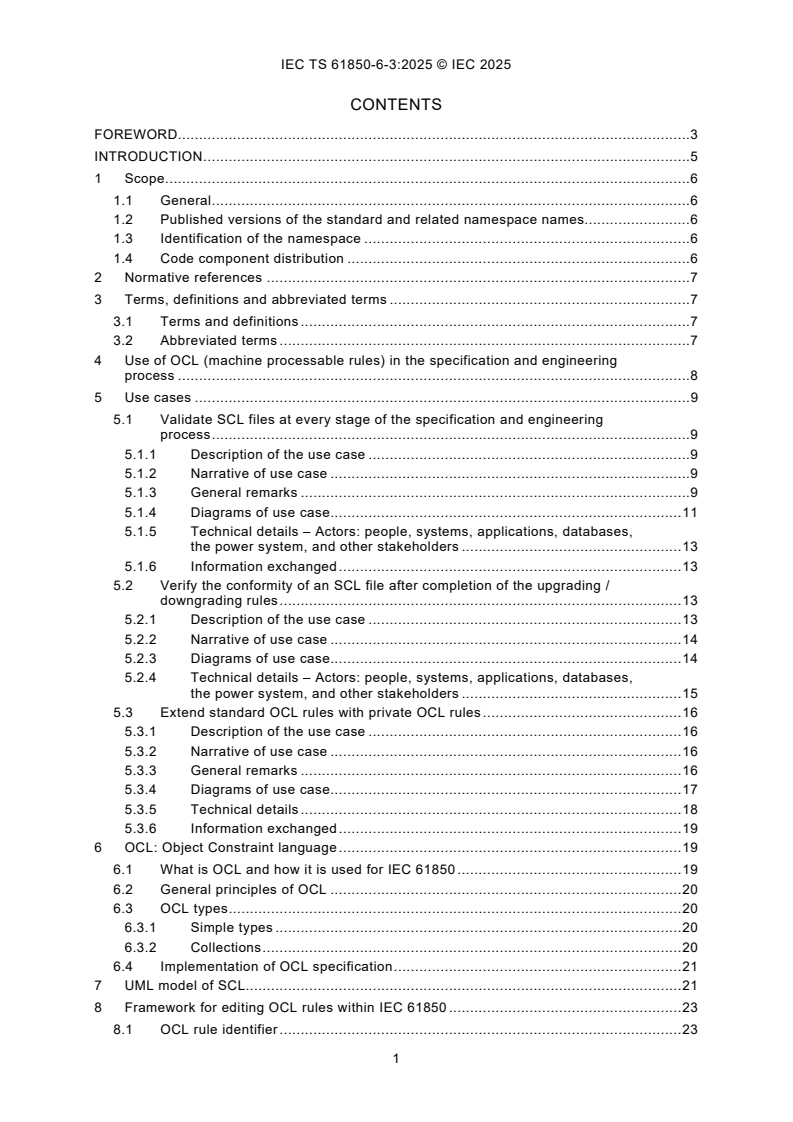
CONTENTS
FOREWORD. 3
INTRODUCTION . 5
1 Scope . 6
1.1 General . 6
1.2 Published versions of the standard and related namespace names. 6
1.3 Identification of the namespace . 6
1.4 Code component distribution . 6
2 Normative references . 7
3 Terms, definitions and abbreviated terms . 7
3.1 Terms and definitions . 7
3.2 Abbreviated terms . 7
4 Use of OCL (machine processable rules) in the specification and engineering
process . 8
5 Use cases . 9
5.1 Validate SCL files at every stage of the specification and engineering
process . 9
5.1.1 Description of the use case . 9
5.1.2 Narrative of use case . 9
5.1.3 General remarks . 9
5.1.4 Diagrams of use case . 11
5.1.5 Technical details – Actors: people, systems, applications, databases,
the power system, and other stakeholders . 13
5.1.6 Information exchanged . 13
5.2 Verify the conformity of an SCL file after completion of the upgrading /
downgrading rules . 13
5.2.1 Description of the use case . 13
5.2.2 Narrative of use case . 14
5.2.3 Diagrams of use case . 14
5.2.4 Technical details – Actors: people, systems, applications, databases,
the power system, and other stakeholders . 15
5.3 Extend standard OCL rules with private OCL rules . 16
5.3.1 Description of the use case . 16
5.3.2 Narrative of use case . 16
5.3.3 General remarks . 16
5.3.4 Diagrams of use case . 17
5.3.5 Technical details . 18
5.3.6 Information exchanged . 19
6 OCL: Object Constraint language . 19
6.1 What is OCL and how it is used for IEC 61850 . 19
6.2 General principles of OCL . 20
6.3 OCL types . 20
6.3.1 Simple types . 20
6.3.2 Collections . 20
6.4 Implementation of OCL specification . 21
7 UML model of SCL. 21
8 Framework for editing OCL rules within IEC 61850 . 23
8.1 OCL rule identifier . 23
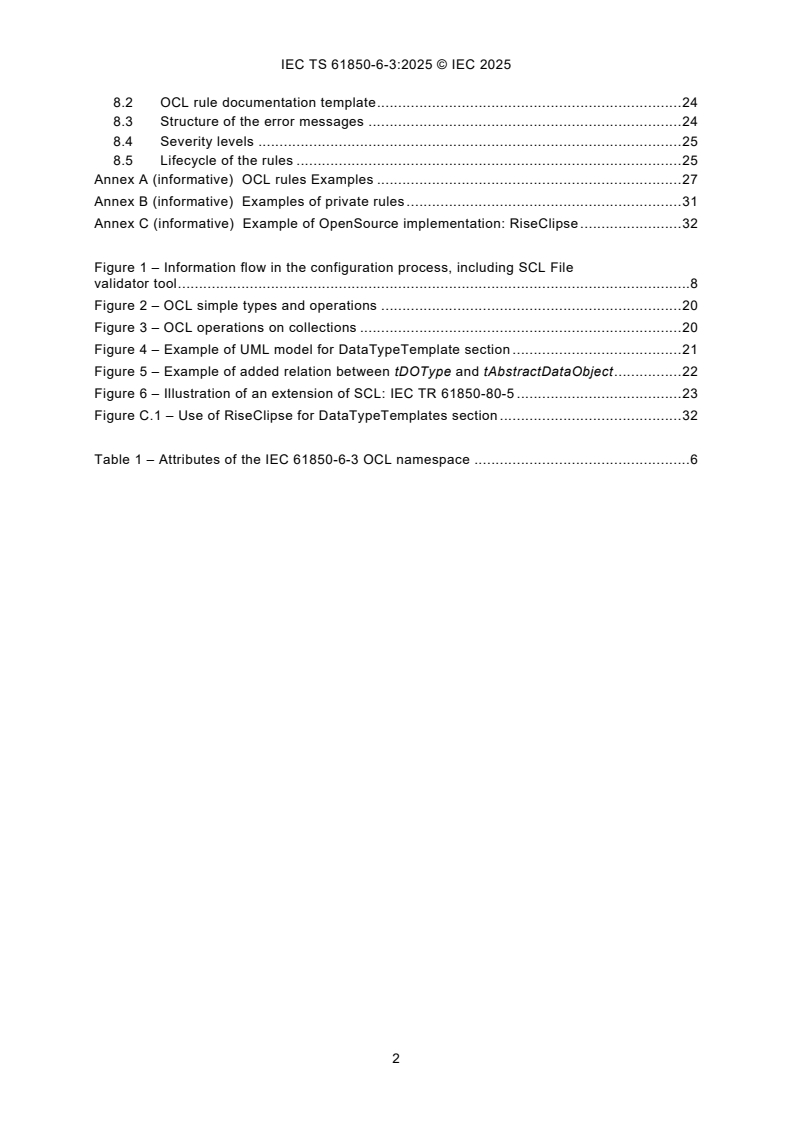
8.2 OCL rule documentation template . 24
8.3 Structure of the error messages . 24
8.4 Severity levels . 25
8.5 Lifecycle of the rules . 25
Annex A (informative) OCL rules Examples . 27
Annex B (informative) Examples of private rules . 31
Annex C (informative) Example of OpenSource implementation: RiseClipse . 32
Figure 1 – Information flow in the configuration process, including SCL File
validator tool . 8
Figure 2 – OCL simple types and operations . 20
Figure 3 – OCL operations on collections . 20
Figure 4 – Example of UML model for DataTypeTemplate section . 21
Figure 5 – Example of added relation between tDOType and tAbstractDataObject . 22
Figure 6 – Illustration of an extension of SCL: IEC TR 61850-80-5 . 23
Figure C.1 – Use of RiseClipse for DataTypeTemplates section . 32
Table 1 – Attributes of the IEC 61850-6-3 OCL namespace . 6
INTERNATIONAL ELECTROTECHNICAL COMMISSION
____________
Communication networks and systems for power utility automation -
Part 6-3: Format of machine-processable rules for
validation of IEC 61850 XML-based files
FOREWORD
1) The International Electrotechnical Commission (IEC) is a worldwide organization for standardization comprising
all national electrotechnical committees (IEC National Committees). The object of IEC is to promote international
co-operation on all questions concerning standardization in the electrical and electronic fields. To this end and
in addition to other activities, IEC publishes International Standards, Technical Specifications, Technical Reports,
Publicly Available Specifications (PAS) and Guides (hereafter referred to as "IEC Publication(s)"). Their
preparation is entrusted to technical committees; any IEC National Committee interested in the subject dealt with
may participate in this preparatory work. International, governmental and non-governmental organizations liaising
with the IEC also participate in this preparation. IEC collaborates closely with the International Organization for
Standardization (ISO) in accordance with conditions determined by agreement between the two organizations.
2) The formal decisions or agreements of IEC on technical matters express, as nearly as possible, an international
consensus of opinion on the relevant subjects since each technical committee has representation from all
interested IEC National Committees.
3) IEC Publications have the form of recommendations for international use and are accepted by IEC National
Committees in that sense. While all reasonable efforts are made to ensure that the technical content of IEC
Publications is accurate, IEC cannot be held responsible for the way in which they are used or for any
misinterpretation by any end user.
4) In order to promote international uniformity, IEC National Committees undertake to apply IEC Publications
transparently to the maximum extent possible in their national and regional publications. Any divergence between
any IEC Publication and the corresponding national or regional publication shall be clearly indicated in the latter.
5) IEC itself does not provide any attestation of conformity. Independent certification bodies provide conformity
assessment services and, in some areas, access to IEC marks of conformity. IEC is not responsible for any
services carried out by independent certification bodies.
6) All users should ensure that they have the latest edition of this publication.
7) No liability shall attach to IEC or its directors, employees, servants or agents including individual experts and
members of its technical committees and IEC National Committees for any personal injury, property damage or
other damage of any nature whatsoever, whether direct or indirect, or for costs (including legal fees) and
expenses arising out of the publication, use of, or reliance upon, this IEC Publication or any other IEC
Publications.
8) Attention is drawn to the Normative references cited in this publication. Use of the referenced publications is
indispensable for the correct application of this publication.
9) IEC draws attention to the possibility that the implementation of this document may involve the use of (a)
patent(s). IEC takes no position concerning the evidence, validity or applicability of any claimed patent rights in
respect thereof. As of the date of publication of this document, IEC had not received notice of (a) patent(s), which
may be required to implement this document. However, implementers are cautioned that this may not represent
the latest information, which may be obtained from the patent database available at https://patents.iec.ch. IEC
shall not be held responsible for identifying any or all such patent rights.
IEC TS 61850-6-3 has been prepared by IEC technical committee TC 57: Power systems
management and associated information exchange. It is a Technical Specification.
The text of this Technical Specification is based on the following documents:
Draft Report on voting
57/2765/DTS 57/2795/RVDTS
Full information on the voting for its approval can be found in the report on voting indicated in
the above table.
The language used for the development of this Technical Specification is English.
This document was drafted in accordance with ISO/IEC Directives, Part 2, and developed in
accordance with ISO/IEC Directives, Part 1 and ISO/IEC Directives, IEC Supplement, available
at www.iec.ch/members_experts/refdocs. The main document types developed by IEC are
described in greater detail at www.iec.ch/publications.
A list of all parts in the IEC 61850 series, published under the general title Communication
networks and systems for power utility automation, can be found on the IEC website.
NOTE The following print types are used:
• italic type represents elements that are defined in the SCL language (see IEC 61850-6);
• green font is used for explanatory text.
The purchase of this IEC standard carries a copyright license for the purchaser to sell software
containing Code Components from this standard directly to end users and to end users via
distributors, subject to IEC software licensing conditions, which can be found at:
http://www.iec.ch/CCv1.
The committee has decided that the contents of this document will remain unchanged until the
stability date indicated on the IEC website under webstore.iec.ch in the data related to the
specific document. At this date, the document will be
• reconfirmed,
• withdrawn, or
• revised.
INTRODUCTION
In order to improve the interoperability of IEC 61850 XML-based files, particularly SCL files
(which are key for an efficient specification and engineering process), this Technical
Specification describes how to use and define formal rules, in a machine-processable format:
OCL. The OCL language (Object Constraint Language), defined by Object Management Group
(OMG) is a declarative language describing rules applying to Unified Modeling Language (UML)
models, and is now part of the UML standard. It allows the description of constraints, much
more precisely than XML schemas, as constraints depending on the value of elements and
attributes can be defined.
Many requirements and recommendations that are written as text in the IEC 61850 documents
could be formally transcribed in OCL rules, limiting the interpretation bias, and enabling an
exhaustive validation of every XML-based files, particularly SCL files, that are exchanged during
the specification and engineering process.
For example, the SCL language is used in different contexts: to describe the capabilities of
IEDs, to describe specifications, or configurations. Dedicated rules can be defined for every
case, as constraints might differ, ending with a specific set of rules for ICD files, another one
for SCD files.
IEC 61850-6 specifies the System Configuration description Language (SCL), which is used to
describe system specifications, system configurations, IED configurations and communication
configurations. SCL files are serialized in XML. An XML schema is provided as a code
component of IEC 61850-6, in order to define the structure of the SCL files in a machine-
processable format. The XML schema enables some first level validations and the OCL rules
complete them.
1 Scope
1.1 General
In order to improve the interoperability of IEC 61850 XML-based files, particularly SCL files
(which are key for an efficient specification and engineering process), this part of IEC 61850,
which is a Technical Specification, describes how to use and define formal rules, in a machine-
processable format: OCL, that can be imported and interpreted by tools.
The following main use cases are supported:
– Validate SCL files at every stage of the specification and engineering process;
– Verify the conformity of a SCL file after completion of the upgrading/downgrading rules;
– Extend standard OCL rules with private OCL rules
The purpose of this document is limited to the publication of the format and method to write
correct and structured rules. The rules themselves are published as code components of the
corresponding IEC 61850 parts.
1.2 Published versions of the standard and related namespace names
The table below provides a reference between all published editions, amendments or corrigenda
of this document and the full name of the namespace.
Edition Publication date Webstore Namespace
Edition 1.0 2024-xx IEC 61850-6-3:2024 IEC 61850-6-3:2022A
1.3 Identification of the namespace
The namespace associated with this document is an OCL format to be used by other documents
related to IEC 61850 SCL or other users to define their rules. The parameters which identify
the namespace are provided in Table 1:
Table 1 – Attributes of the IEC 61850-6-3 OCL namespace
Attribute Content
Namespace nameplate
Version 2022
Revision A
Release 1 (not indicated in the namespace identifier)
XSD version header attribute 2022A
There is no description of this namespace other than the OCL format specification provided by
OMG indicated in Clause 2 of this document.
1.4 Code component distribution
This TS has no code component. This namespace will not be distributed with this document,
but with the different documents that will contain OCL rules.
2 Normative references
The following documents are referred to in the text in such a way that some or all of their content
constitutes requirements of this document. For dated references, only the edition cited applies.
For undated references, the latest edition of the referenced document (including any
amendments) applies.
IEC TS 61850-2, Communication networks and systems in substations – Part 2: Glossary
IEC 61850-6, Communication networks and systems for power utility automation – Part 6:
Configuration description language for communication in electrical substations related to IEDs
IEC 61850-7-2, Communication networks and systems for power utility automation – Part 7-2:
Basic information and communication structure – Abstract communication service interface
(ACSI)
IEC TR 61850-80-5, Communication networks and systems for power utility automation –
Part 80-5: Guideline for mapping information between IEC 61850 and IEC 61158-15 ®
OCL, OMG Specification: Object Constraint Language™ (https://www.omg.org/spec/OCL)
® ®
UML, OMG specification: Unified Modeling Language® (OMG UML )
(https://www.omg.org/spec/UML)
3 Terms, definitions and abbreviated terms
3.1 Terms and definitions
No terms and definitions are listed in this document.
ISO and IEC maintain terminology databases for use in standardization at the following
addresses:
• IEC Electropedia: available at https://www.electropedia.org/
• ISO Online browsing platform: available at https://www.iso.org/obp
3.2 Abbreviated terms
In general, the glossary and abbreviations defined in IEC 61850-2 apply. The following
abbreviations are either exclusive to this standard or particularly useful for understanding this
standard and are repeated here for convenience.
FVT File Validation Tool
NSD Name Space Definition
OCL Object Constraint Language
SCL System Configuration description Language (defined in IEC 61850-6)
UML Unified Modeling Language (https://www.omg.org/spec/UML)
XML Extensible Markup Language (https://www.w3.org/TR/xml/)
XSD XML Schema Definition (https://www.w3.org/TR/xmlschema-0/)
4 Use of OCL (machine processable rules) in the specification and engineering
process
A new role is introduced in the IEC 61850 specification and engineering process: SCL File
validator, which consists in validating a SCL file produced by a tool during the specification or
engineering process.
This role can be implemented by different type of tools, as shown in Figure 1:
– System Specificator (SST): IED independent system level tool that shall be able to import
or export specification files defined by IEC 61850-6.
– System Configurator (SCT): IED independent system level tool that shall be able to import
or export configuration files defined by IEC 61850-6.
– IED Configurator (ICT): manufacturer-specific, may be even IED-specific, tool that shall be
able to import or export the files defined by IEC 61850-6.
– SCL File validator (FVT: file validation Tool): IED independent system level tool that can
validate SCL files during all phases of the specification and engineering process.
This tool uses XSD validation (mandatory), and optionally OCL rules and even private
hardcoded rules, to check SCL files exchanged during the specification and engineering
process.
Figure 1 – Information flow in the configuration process,
including SCL File validator tool
5 Use cases
5.1 Validate SCL files at every stage of the specification and engineering process
5.1.1 Description of the use case
5.1.1.1 Name of use case
Use case identification
ID Domain(s) Name of use case
Administration Validate SCL files at every stage of the specification and engineering process
5.1.1.2 Version Management
Version management
Version Date Name of Domain Area of expertise / Title Approval status
management Committee expert domain / role
draft, for comments,
changes /
for voting, final
Version
1.0 2022 WG10-OCL TF For voting
5.1.2 Narrative of use case
Narrative of use case
Short description – max 3 sentences
The user takes the XSD and can optionally complement it with OCL rules to validate any SCL file exchanged
during the specification or configuration of a system.
Complete description
This use case describes how OCL files can be used to validate the correctness of SCL files.
XSD validation is mandatory, while OCL validation can optionally be added to perform a deeper level of
verification. During the engineering process, many SCL files are exchanged between different stakeholders, and
ensuring their quality is crucial for the efficiency and reliability of the final system configuration.”
5.1.3 General remarks
General remarks
Some simple rules are already declared in SCL XSD code component of IED 61850-6, like:
- Datatype of content (string, int, enumeration…), example:
- Cardinalities of the elements and attributes, example:
General remarks
Pattern and length constraints, example:
References between elements, with keyRefs, example:
Uniqueness, example:
Those rules are kept in the XSD of SCL, but they are not exhaustive.
OCL rules are added in order to express more complex rules (examples can be found in Annex A).
The objective is to formally describe, in OCL, the requirements and recommendations that are written as text in
the standard, and that are not expressible in XSD.
5.1.4 Diagrams of use case
Diagram of use case
The primary use case
Use Case: Validate SCL files at every stage of the engineering process
«SUC»
<>
<>
<>
Validate SCL files at every stage of
<>
Validation tool
the engineering process
Utility or
Integrator
<>
<>
<>
<>
Engineering tool
PACS Vendor
(SST, SCT, ICT)
Diagram of use case
The primary use case
Activity: Validate SCL files at every stage of the engineering process - scenarios flowchart
ActivityInitial
«Scenario» «Scenario»
Generate a SCL file (capability, Validate SCL file to import with
specification, configuration.)
standard XSD of SCL
«Scenario»
Validate generated SCL file
with standard XSD of SCL
Optionnally
«Scenario»
Validate SCL file to import with
standard OCL rules
optionnally
«Scenario»
Import SCL file into an
engineering Tool
«Scenario»
Validate generated SCL file
with standard OCL rules
ActivityFinal
5.1.5 Technical details – Actors: people, systems, applications, databases, the power
system, and other st
...