


IEC 61189-5-503:2017
(Main)Test methods for electrical materials, printed board and other interconnection structures and assemblies - Part 5-503: General test method for materials and assemblies - Conductive anodic filaments (CAF) testing of circuit boards
General Information
- Abstract
IEC 61189-5-503:2017 specifies the conductive anodic filament (hereafter referred to as CAF) and specifies not only the steady-state temperature and humidity test, but also a temperature-humidity cyclic test and an unsaturated pressurized vapour test (HAST).
- Status
- Published
- Publication Date
- 21-May-2017
- Technical Committee
- TC 91 - Electronics assembly technology
- Drafting Committee
- WG 3 - TC 91/WG 3
- Current Stage
- PPUB - Publication issued
- Start Date
- 22-May-2017
- Completion Date
- 02-Jun-2017
Buy Documents
IEC 61189-5-503:2017 - Test methods for electrical materials, printed board and other interconnection structures and assemblies - Part 5-503: General test method for materials and assemblies - Conductive anodic filaments (CAF) testing of circuit boards Released:5/22/2017
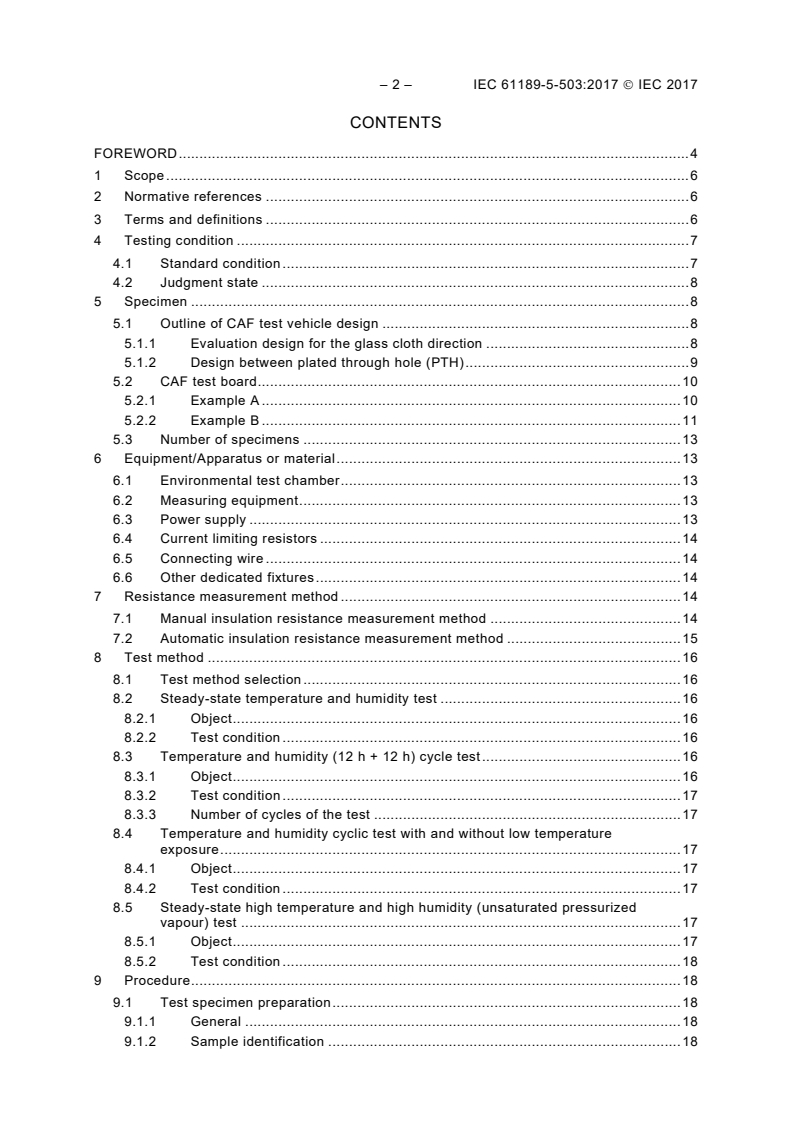
IEC 61189-5-503:2017 - Test methods for electrical materials, printed board and other interconnection structures and assemblies - Part 5-503: General test method for materials and assemblies - Conductive anodic filaments (CAF) testing of circuit boards Released:9/20/2019
Overview
IEC 61189-5-503:2017 - Test methods for electrical materials, printed board and other interconnection structures and assemblies - Part 5-503 defines a general test method for Conductive Anodic Filament (CAF) testing of circuit boards. The standard specifies test types and conditions used to provoke and detect CAF growth in multilayer printed circuit boards (PCBs), including steady-state temperature/humidity, temperature–humidity cyclic tests, and an unsaturated pressurized vapor test (HAST). It provides guidance on test specimen design, measurement methods and test procedures to assess insulation degradation caused by CAF.
Key topics and technical requirements
- CAF definition and scope: Describes conductive anodic filament formation and the environmental stresses that encourage CAF in PCBs.
- Test methods: Specifies three principal tests:
- Steady‑state temperature and humidity
- Temperature–humidity cyclic test (including 12 h + 12 h cycles)
- Steady‑state high temperature and high humidity (unsaturated pressurized vapour / HAST)
- Specimen and test vehicle design: Guidance for CAF test board layouts, including evaluation patterns for glass cloth direction and plated-through via arrangements (examples A and B).
- Measurement and instrumentation: Insulation resistance measurement methods (manual and automatic), required equipment (environmental chambers, power supplies, current‑limiting resistors, wiring and fixtures).
- Test procedure and judgment: Pre-screening (opens/shorts), cleaning, preconditioning, set-up, test voltages, measurement intervals, visual inspection criteria and end-of-test judgment states.
- Documentation and repeatability: Number of specimens, test conditions and cycle counts, and example figures/tables to ensure consistent implementation.
Practical applications
- Qualifying PCB materials and stackups for reliability in humid or high‑temperature environments.
- Identifying susceptibility to CAF for high‑reliability sectors such as automotive, telecommunications, aerospace, medical devices and industrial electronics.
- Supporting failure analysis and root‑cause investigations where insulation breakdown or intermittent electrical leakage is suspected.
- Informing material selection and process controls for PCB laminates, surface treatments and via fabrication.
Who should use this standard
- PCB manufacturers and fabricators performing reliability qualification
- Electronics reliability and quality engineers
- Materials suppliers and laminate manufacturers
- Independent test laboratories and R&D teams conducting CAF susceptibility testing
- Design engineers specifying PCB stackups for harsh environments
Related standards
- IEC 61189 series (other test methods for electrical materials and printed boards)
- Environmental test standards such as IEC 60068‑2‑66 (temperature and humidity test methods)
Keywords: IEC 61189-5-503, Conductive anodic filament, CAF testing, circuit boards, PCB reliability, HAST, temperature-humidity cycling, insulation resistance testing.
Buy Documents
IEC 61189-5-503:2017 - Test methods for electrical materials, printed board and other interconnection structures and assemblies - Part 5-503: General test method for materials and assemblies - Conductive anodic filaments (CAF) testing of circuit boards Released:5/22/2017
IEC 61189-5-503:2017 - Test methods for electrical materials, printed board and other interconnection structures and assemblies - Part 5-503: General test method for materials and assemblies - Conductive anodic filaments (CAF) testing of circuit boards Released:9/20/2019
Get Certified
Connect with accredited certification bodies for this standard

DNV
DNV is an independent assurance and risk management provider.

Lloyd's Register
Lloyd's Register is a global professional services organisation specialising in engineering and technology.
DNV Energy Systems
Energy and renewable energy certification.
Sponsored listings
Frequently Asked Questions
IEC 61189-5-503:2017 is a standard published by the International Electrotechnical Commission (IEC). Its full title is "Test methods for electrical materials, printed board and other interconnection structures and assemblies - Part 5-503: General test method for materials and assemblies - Conductive anodic filaments (CAF) testing of circuit boards". This standard covers: IEC 61189-5-503:2017 specifies the conductive anodic filament (hereafter referred to as CAF) and specifies not only the steady-state temperature and humidity test, but also a temperature-humidity cyclic test and an unsaturated pressurized vapour test (HAST).
IEC 61189-5-503:2017 specifies the conductive anodic filament (hereafter referred to as CAF) and specifies not only the steady-state temperature and humidity test, but also a temperature-humidity cyclic test and an unsaturated pressurized vapour test (HAST).
IEC 61189-5-503:2017 is classified under the following ICS (International Classification for Standards) categories: 27.160 - Solar energy engineering; 31.180 - Printed circuits and boards. The ICS classification helps identify the subject area and facilitates finding related standards.
IEC 61189-5-503:2017 is available in PDF format for immediate download after purchase. The document can be added to your cart and obtained through the secure checkout process. Digital delivery ensures instant access to the complete standard document.
Standards Content (Sample)
IEC 61189-5-503 ®
Edition 1.0 2017-05
INTERNATIONAL
STANDARD
colour
inside
Test methods for electrical materials, printed board and other interconnection
structures and assemblies –
Part 5-503: General test method for materials and assemblies – Conductive
anodic filaments (CAF) testing of circuit boards
All rights reserved. Unless otherwise specified, no part of this publication may be reproduced or utilized in any form
or by any means, electronic or mechanical, including photocopying and microfilm, without permission in writing from
either IEC or IEC's member National Committee in the country of the requester. If you have any questions about IEC
copyright or have an enquiry about obtaining additional rights to this publication, please contact the address below or
your local IEC member National Committee for further information.
IEC Central Office Tel.: +41 22 919 02 11
3, rue de Varembé Fax: +41 22 919 03 00
CH-1211 Geneva 20 info@iec.ch
Switzerland www.iec.ch
About the IEC
The International Electrotechnical Commission (IEC) is the leading global organization that prepares and publishes
International Standards for all electrical, electronic and related technologies.
About IEC publications
The technical content of IEC publications is kept under constant review by the IEC. Please make sure that you have the
latest edition, a corrigenda or an amendment might have been published.
IEC Catalogue - webstore.iec.ch/catalogue Electropedia - www.electropedia.org
The stand-alone application for consulting the entire The world's leading online dictionary of electronic and
bibliographical information on IEC International Standards, electrical terms containing 20 000 terms and definitions in
Technical Specifications, Technical Reports and other English and French, with equivalent terms in 16 additional
documents. Available for PC, Mac OS, Android Tablets and languages. Also known as the International Electrotechnical
iPad. Vocabulary (IEV) online.
IEC publications search - www.iec.ch/searchpub IEC Glossary - std.iec.ch/glossary
The advanced search enables to find IEC publications by a 65 000 electrotechnical terminology entries in English and
variety of criteria (reference number, text, technical French extracted from the Terms and Definitions clause of
committee,…). It also gives information on projects, replaced IEC publications issued since 2002. Some entries have been
and withdrawn publications. collected from earlier publications of IEC TC 37, 77, 86 and
CISPR.
IEC Just Published - webstore.iec.ch/justpublished
Stay up to date on all new IEC publications. Just Published IEC Customer Service Centre - webstore.iec.ch/csc
details all new publications released. Available online and If you wish to give us your feedback on this publication or
also once a month by email. need further assistance, please contact the Customer Service
Centre: csc@iec.ch.
IEC 61189-5-503 ®
Edition 1.0 2017-05
INTERNATIONAL
STANDARD
colour
inside
Test methods for electrical materials, printed board and other interconnection
structures and assemblies –
Part 5-503: General test method for materials and assemblies – Conductive
anodic filaments (CAF) testing of circuit boards
INTERNATIONAL
ELECTROTECHNICAL
COMMISSION
ICS 31.180 ISBN 978-2-8322-4320-6
– 2 – IEC 61189-5-503:2017 IEC 2017
CONTENTS
FOREWORD . 4
1 Scope . 6
2 Normative references . 6
3 Terms and definitions . 6
4 Testing condition . 7
4.1 Standard condition . 7
4.2 Judgment state . 8
5 Specimen . 8
5.1 Outline of CAF test vehicle design . 8
5.1.1 Evaluation design for the glass cloth direction . 8
5.1.2 Design between plated through hole (PTH) . 9
5.2 CAF test board . 10
5.2.1 Example A . 10
5.2.2 Example B . 11
5.3 Number of specimens . 13
6 Equipment/Apparatus or material . 13
6.1 Environmental test chamber . 13
6.2 Measuring equipment . 13
6.3 Power supply . 13
6.4 Current limiting resistors . 14
6.5 Connecting wire . 14
6.6 Other dedicated fixtures . 14
7 Resistance measurement method . 14
7.1 Manual insulation resistance measurement method . 14
7.2 Automatic insulation resistance measurement method . 15
8 Test method . 16
8.1 Test method selection . 16
8.2 Steady-state temperature and humidity test . 16
8.2.1 Object . 16
8.2.2 Test condition . 16
8.3 Temperature and humidity (12 h + 12 h) cycle test . 16
8.3.1 Object . 16
8.3.2 Test condition . 17
8.3.3 Number of cycles of the test . 17
8.4 Temperature and humidity cyclic test with and without low temperature
exposure . 17
8.4.1 Object . 17
8.4.2 Test condition . 17
8.5 Steady-state high temperature and high humidity (unsaturated pressurized
vapour) test . 17
8.5.1 Object . 17
8.5.2 Test condition . 18
9 Procedure . 18
9.1 Test specimen preparation . 18
9.1.1 General . 18
9.1.2 Sample identification . 18
9.1.3 Prescreen for opens and shorts . 18
9.1.4 Cleaning . 19
9.1.5 Connecting wire . 19
9.1.6 Cleaning after attachment . 19
9.1.7 Dry . 19
9.2 Precondition . 19
9.3 Test procedure . 19
9.3.1 Setting of the specimen . 19
9.3.2 Test voltage and measuring voltage . 19
9.3.3 Temperature and humidity condition at the start time of the test . 20
9.3.4 Measurement . 20
9.3.5 Procedure in test interruption . 21
9.3.6 End of test . 21
9.4 Visual inspection . 21
9.4.1 General . 21
9.4.2 Shape of electrochemical migration . 21
Annex A (informative) Forms of electrochemical migration . 22
A.1 Example of dendrite-shaped migration . 22
A.2 CAF (Example of migration along the glass fibre) . 22
Bibliography . 23
Figure 1 – Schematic of in-line test comb, with possible failure site . 8
Figure 2 – Schematic of staggered test comb, with possible failure site . 9
Figure 3 – Manhattan distance . 9
Figure 4 – Schematic section of via pair with bias . 10
Figure 5 – Example of inner layer via pads and layer patterns . 10
Figure 6 – Example of no inner layer via pads and layer patterns . 10
Figure 7 – Insulation evaluation pattern for through-holes and via holes . 11
Figure 8 – Layouts of the two versions of the CAF test boards . 12
Figure 9 – Measurement with insulation resistance meter . 15
Figure 10 – Temperature and humidity in a test . 20
Figure A.1 – Example which is generated on the board surface . 22
Figure A.2 – Example of CAF . 22
Table 1 – Dimension of insulation evaluation pattern for through-holes . 11
Table 2 – Test structures A1 through A4 design rules . 12
Table 3 – Test structures B1 through B4 design rules . 13
Table 4 – Test condition . 16
Table 5 – Number of cycles of the test . 17
Table 6 – Test condition . 17
Table 7 – Test condition (IEC 60068-2-66) . 18
– 4 – IEC 61189-5-503:2017 IEC 2017
INTERNATIONAL ELECTROTECHNICAL COMMISSION
____________
TEST METHODS FOR ELECTRICAL MATERIALS, PRINTED BOARD
AND OTHER INTERCONNECTION STRUCTURES AND ASSEMBLIES –
Part 5-503: General test method for materials and assemblies –
Conductive anodic filaments (CAF) testing of circuit boards
FOREWORD
1) The International Electrotechnical Commission (IEC) is a worldwide organization for standardization comprising
all national electrotechnical committees (IEC National Committees). The object of IEC is to promote
international co-operation on all questions concerning standardization in the electrical and electronic fields. To
this end and in addition to other activities, IEC publishes International Standards, Technical Specifications,
Technical Reports, Publicly Available Specifications (PAS) and Guides (hereafter referred to as "IEC
Publication(s)"). Their preparation is entrusted to technical committees; any IEC National Committee interested
in the subject dealt with may participate in this preparatory work. International, governmental and non-
governmental organizations liaising with the IEC also participate in this preparation. IEC collaborates closely
with the International Organization for Standardization (ISO) in accordance with conditions determined by
agreement between the two organizations.
2) The formal decisions or agreements of IEC on technical matters express, as nearly as possible, an international
consensus of opinion on the relevant subjects since each technical committee has representation from all
interested IEC National Committees.
3) IEC Publications have the form of recommendations for international use and are accepted by IEC National
Committees in that sense. While all reasonable efforts are made to ensure that the technical content of IEC
Publications is accurate, IEC cannot be held responsible for the way in which they are used or for any
misinterpretation by any end user.
4) In order to promote international uniformity, IEC National Committees undertake to apply IEC Publications
transparently to the maximum extent possible in their national and regional publications. Any divergence
between any IEC Publication and the corresponding national or regional publication shall be clearly indicated in
the latter.
5) IEC itself does not provide any attestation of conformity. Independent certification bodies provide conformity
assessment services and, in some areas, access to IEC marks of conformity. IEC is not responsible for any
services carried out by independent certification bodies.
6) All users should ensure that they have the latest edition of this publication.
7) No liability shall attach to IEC or its directors, employees, servants or agents including individual experts and
members of its technical committees and IEC National Committees for any personal injury, property damage or
other damage of any nature whatsoever, whether direct or indirect, or for costs (including legal fees) and
expenses arising out of the publication, use of, or reliance upon, this IEC Publication or any other IEC
Publications.
8) Attention is drawn to the Normative references cited in this publication. Use of the referenced publications is
indispensable for the correct application of this publication.
9) Attention is drawn to the possibility that some of the elements of this IEC Publication may be the subject of
patent rights. IEC shall not be held responsible for identifying any or all such patent rights.
International Standard IEC 61189-5-503 been prepared by IEC technical committee 91:
Electronics assembly technology.
The text of this standard is based on the following documents:
FDIS Report on voting
91/1433/FDIS 91/1443/RVD
Full information on the voting for the approval of this International Standard can be found in
the report on voting indicated in the above table.
This document has been drafted in accordance with the ISO/IEC Directives, Part 2.
A list of all parts in the IEC 61189 series, published under the general title Test methods for
electrical materials, printed boards and other interconnection structures and assemblies, can
be found on the IEC website.
The committee has decided that the contents of this document will remain unchanged until the
stability date indicated on the IEC website under "http://webstore.iec.ch" in the data related to
the specific document. At this date, the document will be
• reconfirmed,
• withdrawn,
• replaced by a revised edition, or
• amended.
A bilingual version of this publication may be issued at a later date.
IMPORTANT – The 'colour inside' logo on the cover page of this publication indicates
that it contains colours which are considered to be useful for the correct
understanding of its contents. Users should therefore print this document using a
colour printer.
– 6 – IEC 61189-5-503:2017 IEC 2017
TEST METHODS FOR ELECTRICAL MATERIALS, PRINTED BOARD
AND OTHER INTERCONNECTION STRUCTURES AND ASSEMBLIES –
Part 5-503: General test method for materials and assemblies –
Conductive anodic filaments (CAF) testing of circuit boards
1 Scope
This part of IEC 61189 specifies the conductive anodic filament (hereafter referred to as CAF)
and specifies not only the steady-state temperature and humidity test, but also a temperature-
humidity cyclic test and an unsaturated pressurized vapour test (HAST).
2 Normative references
The following documents are referred to in the text in such a way that some or all of their
content constitutes requirements of this document. For dated references, only the edition
cited applies. For undated references, the latest edition of the referenced document (including
any amendments) applies.
IEC 60068-1:2013, Environmental testing – Part 1: General and guidance
IEC 60068-2-30, Environmental testing – Part 2-30: Tests – Test Db: Damp heat, cyclic
(12 h + 12 h cycle)
IEC 60068-2-38, Environmental testing – Part 2-38: Tests – Test Z/AD: Composite
temperature/humidity cyclic test
IEC 60068-2-66, Environmental testing – Part 2: Test methods – Test Cx: Damp heat, steady
state (unsaturated pressurized vapour)
IEC 60068-2-67, Environmental testing – Part 2: Tests – Test Cy: Damp heat, steady state,
accelerated test primarily intended for components
IEC 60068-2-78, Environmental testing – Part 2-78: Tests – Test Cab: Damp heat, steady
state
IEC 60194, Printed board design, manufacture and assembly – Terms and definitions
IPC-TM-650 No.2.6.14.1, Electrochemical Migration Resistance Test [viewed 2017-01-31].
Available at: https://www.ipc.org/TM/2-6_2-6-14-1.pdf
IPC-TM-650 No.2.6.25, Conductive Anodic Filament (CAF) Resistance Test: X-Y Axis [viewed
2017-01-31]. Available at: https://www.ipc.org/4.0_Knowledge/4.1_Standards/test/2-6-25.pdf
3 Terms and definitions
For the purposes of this document, the terms and definitions given in IEC 60194 and
IEC 60068-1 as well as the following apply.
ISO and IEC maintain terminological databases for use in standardization at the following
addresses:
• IEC Electropedia: available at http://www.electropedia.org/
• ISO Online browsing platform: available at http://www.iso.org/obp
3.1
electrochemical migration
degradation of insulation characteristics between conductors due to eletrochemical elution of
ions in a humid environment when voltage is applied to conductors of a printed wiring board
Note 1 to entry: In addition, ionic impurities present in the insulations contribute to their degradation.
Note 2 to entry: Electrochemical migration may take the forms of dendrite (3.2) and CAF(3.3).
3.2
dendrite
metal migration
Note 1 to entry: Dendrite is visible in that it creates a branching and tree like structure on the surface, on the
interface between layers, etc. of a printed wiring board.
3.3
CAF
conductive anodic filament
migration which occurs along the monofilament of reinforcing material such as glass cloth in
an inner layer part of a printed wiring board
3.4
HAST
highly accelerated temperature and humidity stress test
stress test under unsaturated pressurized vapour test
Note 1 to entry: See IEC 60068-2-66.
3.5
automatic insulation resistance measurement
measurement to take continuous or predetermined periodic test data using an automatic
measurement system without an operator
3.6
manual insulation resistance measurement
measurement to take predetermined periodic test data using measurement equipment by an
operator
Note 1 to entry: Measurement can be done with or without taking out a specimen from the test chamber.
3.7
test voltage
voltage to apply on the specimen as a stress in the testing environment
3.8
measuring voltage
voltage to apply on the specimen in order to measure the insulation resistance
4 Testing condition
4.1 Standard condition
Measurement is performed under the standard atmospheric condition which is specified in
Clause 4 of IEC 60068-1:2013.
– 8 – IEC 61189-5-503:2017 IEC 2017
It depends on a reference condition stated in 4.2 when an ambiguity is found for the judgment
in the standard atmospheric condition or when it is required in particular.
It may be performed under other conditions than the standard atmospheric condition, when no
doubt about the judgment subsits and when measuring in standard condition proves difficult,
or when specified in particular specifications.
4.2 Judgment state
Reference condition is the standard atmospheric condition for measurement as stated in 4.2
of IEC 60068-1:2013.
5 Specimen
5.1 Outline of CAF test vehicle design
5.1.1 Evaluation design for the glass cloth direction
The in-line test combs are comprised of a series of alternate rows of via holes with a voltage
applied across the comb. They represent the most common failure sites where CAF can occur:
between via hole walls. The via holes are in line with one another and in alignment with the
woven glass fibre reinforcement. The closest point between each via pair is the most likely
point for CAF growth (example highlighted in Figure 1). The black spots represent the drilled
hole, and the copper pads associated with the via holes are in orange.
The construction of staggered combs is similar to that of the in-line combs, however, the via
pairs are arranged at 45°. This means that the most likely route for potential CAF growth is
longer since the orientation of the glass fibres may only permit growth in the horizontal and
vertical directions (as represented by the white ellipses in Figure 2).
Fibre weave
IEC
Figure 1 – Schematic of in-line test comb, with possible failure site
Fibre weave
IEC
Figure 2 – Schematic of staggered test comb, with possible failure site
"Manhattan distance" is the shortest orthogonal distance along the X- and/or Y- axes lines
between adjacent drilled hole features (corresponds to the orthogonal nature of the laminate
material’s woven glass fibre reinforcement (Figure 3).
y
x
b
a
''Manhattan distance" = a + b
IEC
Figure 3 – Manhattan distance
5.1.2 Design between plated through hole (PTH)
a) Without inner layer pattern
Example design between PTH without inner layer pattern is shown in Figure 4, which is a
schematic cross-section of a via pair.
NOTE The gap is taken from the edge of the copper. Copper thickness on the hole wall is approximately
50 μm per side.
– 10 – IEC 61189-5-503:2017 IEC 2017
l
l
l
IEC
Key
l via pitch
l via to via distance
l via diameter
Figure 4 – Schematic section of via pair with bias
b) With inner layer pattern
There are two designs. One is the design of inner layer via pads and layers as shown in
Figure 5. The other is the design of no inner layer via pads and layer patterns as shown in
Figure 6.
IEC
Figure 5 – Example of inner layer via pads and layer patterns
IEC
Figure 6 – Example of no inner layer via pads and layer patterns
5.2 CAF test board
5.2.1 Example A
This design is based on 5.1. Evaluation of insulation between through-holes is made us
...
IEC 61189-5-503 ®
Edition 1.0 2017-05
INTERNATIONAL
STANDARD
NORME
INTERNATIONALE
colour
inside
Test methods for electrical materials, printed board and other interconnection
structures and assemblies –
Part 5-503: General test method for materials and assemblies – Conductive
anodic filaments (CAF) testing of circuit boards
Méthodes d’essai pour les matériaux électriques, les cartes imprimées et autres
structures d’interconnexion et ensembles –
Partie 5-503: Méthode d’essai générale pour les matériaux et les assemblages –
Essais des filaments anodiques conducteurs (CAF) des cartes à circuits
All rights reserved. Unless otherwise specified, no part of this publication may be reproduced or utilized in any form
or by any means, electronic or mechanical, including photocopying and microfilm, without permission in writing from
either IEC or IEC's member National Committee in the country of the requester. If you have any questions about IEC
copyright or have an enquiry about obtaining additional rights to this publication, please contact the address below or
your local IEC member National Committee for further information.
Droits de reproduction réservés. Sauf indication contraire, aucune partie de cette publication ne peut être reproduite
ni utilisée sous quelque forme que ce soit et par aucun procédé, électronique ou mécanique, y compris la photocopie
et les microfilms, sans l'accord écrit de l'IEC ou du Comité national de l'IEC du pays du demandeur. Si vous avez des
questions sur le copyright de l'IEC ou si vous désirez obtenir des droits supplémentaires sur cette publication, utilisez
les coordonnées ci-après ou contactez le Comité national de l'IEC de votre pays de résidence.
IEC Central Office Tel.: +41 22 919 02 11
3, rue de Varembé info@iec.ch
CH-1211 Geneva 20 www.iec.ch
Switzerland
About the IEC
The International Electrotechnical Commission (IEC) is the leading global organization that prepares and publishes
International Standards for all electrical, electronic and related technologies.
About IEC publications
The technical content of IEC publications is kept under constant review by the IEC. Please make sure that you have the
latest edition, a corrigendum or an amendment might have been published.
IEC publications search - webstore.iec.ch/advsearchform Electropedia - www.electropedia.org
The advanced search enables to find IEC publications by a The world's leading online dictionary on electrotechnology,
variety of criteria (reference number, text, technical containing more than 22 000 terminological entries in English
committee,…). It also gives information on projects, replaced and French, with equivalent terms in 16 additional languages.
and withdrawn publications. Also known as the International Electrotechnical Vocabulary
(IEV) online.
IEC Just Published - webstore.iec.ch/justpublished
Stay up to date on all new IEC publications. Just Published IEC Glossary - std.iec.ch/glossary
details all new publications released. Available online and 67 000 electrotechnical terminology entries in English and
once a month by email. French extracted from the Terms and Definitions clause of
IEC publications issued since 2002. Some entries have been
IEC Customer Service Centre - webstore.iec.ch/csc collected from earlier publications of IEC TC 37, 77, 86 and
If you wish to give us your feedback on this publication or CISPR.
need further assistance, please contact the Customer Service
Centre: sales@iec.ch.
A propos de l'IEC
La Commission Electrotechnique Internationale (IEC) est la première organisation mondiale qui élabore et publie des
Normes internationales pour tout ce qui a trait à l'électricité, à l'électronique et aux technologies apparentées.
A propos des publications IEC
Le contenu technique des publications IEC est constamment revu. Veuillez vous assurer que vous possédez l’édition la
plus récente, un corrigendum ou amendement peut avoir été publié.
Recherche de publications IEC - Electropedia - www.electropedia.org
webstore.iec.ch/advsearchform Le premier dictionnaire d'électrotechnologie en ligne au
La recherche avancée permet de trouver des publications IEC monde, avec plus de 22 000 articles terminologiques en
en utilisant différents critères (numéro de référence, texte, anglais et en français, ainsi que les termes équivalents dans
comité d’études,…). Elle donne aussi des informations sur les 16 langues additionnelles. Egalement appelé Vocabulaire
projets et les publications remplacées ou retirées. Electrotechnique International (IEV) en ligne.
IEC Just Published - webstore.iec.ch/justpublished Glossaire IEC - std.iec.ch/glossary
Restez informé sur les nouvelles publications IEC. Just 67 000 entrées terminologiques électrotechniques, en anglais
Published détaille les nouvelles publications parues. et en français, extraites des articles Termes et Définitions des
Disponible en ligne et une fois par mois par email. publications IEC parues depuis 2002. Plus certaines entrées
antérieures extraites des publications des CE 37, 77, 86 et
Service Clients - webstore.iec.ch/csc CISPR de l'IEC.
Si vous désirez nous donner des commentaires sur cette
publication ou si vous avez des questions contactez-nous:
sales@iec.ch.
IEC 61189-5-503 ®
Edition 1.0 2017-05
INTERNATIONAL
STANDARD
NORME
INTERNATIONALE
colour
inside
Test methods for electrical materials, printed board and other interconnection
structures and assemblies –
Part 5-503: General test method for materials and assemblies – Conductive
anodic filaments (CAF) testing of circuit boards
Méthodes d’essai pour les matériaux électriques, les cartes imprimées et autres
structures d’interconnexion et ensembles –
Partie 5-503: Méthode d’essai générale pour les matériaux et les assemblages –
Essais des filaments anodiques conducteurs (CAF) des cartes à circuits
INTERNATIONAL
ELECTROTECHNICAL
COMMISSION
COMMISSION
ELECTROTECHNIQUE
INTERNATIONALE
ICS 31.180 ISBN 978-2-8322-7362-3
– 2 – IEC 61189-5-503:2017 IEC 2017
CONTENTS
FOREWORD . 4
1 Scope . 6
2 Normative references . 6
3 Terms and definitions . 6
4 Testing condition . 7
4.1 Standard condition . 7
4.2 Judgment state . 8
5 Specimen . 8
5.1 Outline of CAF test vehicle design . 8
5.1.1 Evaluation design for the glass cloth direction . 8
5.1.2 Design between plated through hole (PTH) . 9
5.2 CAF test board . 10
5.2.1 Example A . 10
5.2.2 Example B . 11
5.3 Number of specimens . 13
6 Equipment/Apparatus or material . 13
6.1 Environmental test chamber . 13
6.2 Measuring equipment . 13
6.3 Power supply . 13
6.4 Current limiting resistors . 14
6.5 Connecting wire . 14
6.6 Other dedicated fixtures . 14
7 Resistance measurement method . 14
7.1 Manual insulation resistance measurement method . 14
7.2 Automatic insulation resistance measurement method . 15
8 Test method . 16
8.1 Test method selection . 16
8.2 Steady-state temperature and humidity test . 16
8.2.1 Object . 16
8.2.2 Test condition . 16
8.3 Temperature and humidity (12 h + 12 h) cycle test . 16
8.3.1 Object . 16
8.3.2 Test condition . 17
8.3.3 Number of cycles of the test . 17
8.4 Temperature and humidity cyclic test with and without low temperature
exposure . 17
8.4.1 Object . 17
8.4.2 Test condition . 17
8.5 Steady-state high temperature and high humidity (unsaturated pressurized
vapour) test . 17
8.5.1 Object . 17
8.5.2 Test condition . 18
9 Procedure . 18
9.1 Test specimen preparation . 18
9.1.1 General . 18
9.1.2 Sample identification . 18
9.1.3 Prescreen for opens and shorts . 18
9.1.4 Cleaning . 19
9.1.5 Connecting wire . 19
9.1.6 Cleaning after attachment . 19
9.1.7 Dry . 19
9.2 Precondition . 19
9.3 Test procedure . 19
9.3.1 Setting of the specimen . 19
9.3.2 Test voltage and measuring voltage . 19
9.3.3 Temperature and humidity condition at the start time of the test . 20
9.3.4 Measurement . 20
9.3.5 Procedure in test interruption . 21
9.3.6 End of test . 21
9.4 Visual inspection . 21
9.4.1 General . 21
9.4.2 Shape of electrochemical migration . 21
Annex A (informative) Forms of electrochemical migration . 22
A.1 Example of dendrite-shaped migration . 22
A.2 CAF (Example of migration along the glass fibre) . 22
Bibliography . 23
Figure 1 – Schematic of in-line test comb, with possible failure site . 8
Figure 2 – Schematic of staggered test comb, with possible failure site . 9
Figure 3 – Manhattan distance . 9
Figure 4 – Schematic section of via pair with bias . 10
Figure 5 – Example of inner layer via pads and layer patterns . 10
Figure 6 – Example of no inner layer via pads and layer patterns . 10
Figure 7 – Insulation evaluation pattern for through-holes and via holes . 11
Figure 8 – Layouts of the two versions of the CAF test boards . 12
Figure 9 – Measurement with insulation resistance meter . 15
Figure 10 – Temperature and humidity in a test . 20
Figure A.1 – Example which is generated on the board surface . 22
Figure A.2 – Example of CAF . 22
Table 1 – Dimension of insulation evaluation pattern for through-holes . 11
Table 2 – Test structures A1 through A4 design rules . 12
Table 3 – Test structures B1 through B4 design rules . 13
Table 4 – Test condition . 16
Table 5 – Number of cycles of the test . 17
Table 6 – Test condition . 17
Table 7 – Test condition (IEC 60068-2-66) . 18
– 4 – IEC 61189-5-503:2017 IEC 2017
INTERNATIONAL ELECTROTECHNICAL COMMISSION
____________
TEST METHODS FOR ELECTRICAL MATERIALS, PRINTED BOARD
AND OTHER INTERCONNECTION STRUCTURES AND ASSEMBLIES –
Part 5-503: General test method for materials and assemblies –
Conductive anodic filaments (CAF) testing of circuit boards
FOREWORD
1) The International Electrotechnical Commission (IEC) is a worldwide organization for standardization comprising
all national electrotechnical committees (IEC National Committees). The object of IEC is to promote
international co-operation on all questions concerning standardization in the electrical and electronic fields. To
this end and in addition to other activities, IEC publishes International Standards, Technical Specifications,
Technical Reports, Publicly Available Specifications (PAS) and Guides (hereafter referred to as "IEC
Publication(s)"). Their preparation is entrusted to technical committees; any IEC National Committee interested
in the subject dealt with may participate in this preparatory work. International, governmental and non-
governmental organizations liaising with the IEC also participate in this preparation. IEC collaborates closely
with the International Organization for Standardization (ISO) in accordance with conditions determined by
agreement between the two organizations.
2) The formal decisions or agreements of IEC on technical matters express, as nearly as possible, an international
consensus of opinion on the relevant subjects since each technical committee has representation from all
interested IEC National Committees.
3) IEC Publications have the form of recommendations for international use and are accepted by IEC National
Committees in that sense. While all reasonable efforts are made to ensure that the technical content of IEC
Publications is accurate, IEC cannot be held responsible for the way in which they are used or for any
misinterpretation by any end user.
4) In order to promote international uniformity, IEC National Committees undertake to apply IEC Publications
transparently to the maximum extent possible in their national and regional publications. Any divergence
between any IEC Publication and the corresponding national or regional publication shall be clearly indicated in
the latter.
5) IEC itself does not provide any attestation of conformity. Independent certification bodies provide conformity
assessment services and, in some areas, access to IEC marks of conformity. IEC is not responsible for any
services carried out by independent certification bodies.
6) All users should ensure that they have the latest edition of this publication.
7) No liability shall attach to IEC or its directors, employees, servants or agents including individual experts and
members of its technical committees and IEC National Committees for any personal injury, property damage or
other damage of any nature whatsoever, whether direct or indirect, or for costs (including legal fees) and
expenses arising out of the publication, use of, or reliance upon, this IEC Publication or any other IEC
Publications.
8) Attention is drawn to the Normative references cited in this publication. Use of the referenced publications is
indispensable for the correct application of this publication.
9) Attention is drawn to the possibility that some of the elements of this IEC Publication may be the subject of
patent rights. IEC shall not be held responsible for identifying any or all such patent rights.
International Standard IEC 61189-5-503 been prepared by IEC technical committee 91:
Electronics assembly technology.
This bilingual version (2019-09) corresponds to the monolingual English version, published in
2017-05.
The text of this standard is based on the following documents:
FDIS Report on voting
91/1433/FDIS 91/1443/RVD
Full information on the voting for the approval of this International Standard can be found in
the report on voting indicated in the above table.
The French version of this standard has not been voted upon.
This document has been drafted in accordance with the ISO/IEC Directives, Part 2.
A list of all parts in the IEC 61189 series, published under the general title Test methods for
electrical materials, printed boards and other interconnection structures and assemblies, can
be found on the IEC website.
The committee has decided that the contents of this document will remain unchanged until the
stability date indicated on the IEC website under "http://webstore.iec.ch" in the data related to
the specific document. At this date, the document will be
• reconfirmed,
• withdrawn,
• replaced by a revised edition, or
• amended.
IMPORTANT – The 'colour inside' logo on the cover page of this publication indicates
that it contains colours which are considered to be useful for the correct
understanding of its contents. Users should therefore print this document using a
colour printer.
– 6 – IEC 61189-5-503:2017 IEC 2017
TEST METHODS FOR ELECTRICAL MATERIALS, PRINTED BOARD
AND OTHER INTERCONNECTION STRUCTURES AND ASSEMBLIES –
Part 5-503: General test method for materials and assemblies –
Conductive anodic filaments (CAF) testing of circuit boards
1 Scope
This part of IEC 61189 specifies the conductive anodic filament (hereafter referred to as CAF)
and specifies not only the steady-state temperature and humidity test, but also a temperature-
humidity cyclic test and an unsaturated pressurized vapour test (HAST).
2 Normative references
The following documents are referred to in the text in such a way that some or all of their
content constitutes requirements of this document. For dated references, only the edition
cited applies. For undated references, the latest edition of the referenced document (including
any amendments) applies.
IEC 60068-1:2013, Environmental testing – Part 1: General and guidance
IEC 60068-2-30, Environmental testing – Part 2-30: Tests – Test Db: Damp heat, cyclic
(12 h + 12 h cycle)
IEC 60068-2-38, Environmental testing – Part 2-38: Tests – Test Z/AD: Composite
temperature/humidity cyclic test
IEC 60068-2-66, Environmental testing – Part 2: Test methods – Test Cx: Damp heat, steady
state (unsaturated pressurized vapour)
IEC 60068-2-67, Environmental testing – Part 2: Tests – Test Cy: Damp heat, steady state,
accelerated test primarily intended for components
IEC 60068-2-78, Environmental testing – Part 2-78: Tests – Test Cab: Damp heat, steady
state
IEC 60194, Printed board design, manufacture and assembly – Terms and definitions
IPC-TM-650 No.2.6.14.1, Electrochemical Migration Resistance Test [viewed 2017-01-31].
Available at: https://www.ipc.org/TM/2-6_2-6-14-1.pdf
IPC-TM-650 No.2.6.25, Conductive Anodic Filament (CAF) Resistance Test: X-Y Axis [viewed
2017-01-31]. Available at: https://www.ipc.org/4.0_Knowledge/4.1_Standards/test/2-6-25.pdf
3 Terms and definitions
For the purposes of this document, the terms and definitions given in IEC 60194 and
IEC 60068-1 as well as the following apply.
ISO and IEC maintain terminological databases for use in standardization at the following
addresses:
• IEC Electropedia: available at http://www.electropedia.org/
• ISO Online browsing platform: available at http://www.iso.org/obp
3.1
electrochemical migration
degradation of insulation characteristics between conductors due to eletrochemical elution of
ions in a humid environment when voltage is applied to conductors of a printed wiring board
Note 1 to entry: In addition, ionic impurities present in the insulations contribute to their degradation.
Note 2 to entry: Electrochemical migration may take the forms of dendrite (3.2) and CAF(3.3).
3.2
dendrite
metal migration
Note 1 to entry: Dendrite is visible in that it creates a branching and tree like structure on the surface, on the
interface between layers, etc. of a printed wiring board.
3.3
CAF
conductive anodic filament
migration which occurs along the monofilament of reinforcing material such as glass cloth in
an inner layer part of a printed wiring board
3.4
HAST
highly accelerated temperature and humidity stress test
stress test under unsaturated pressurized vapour test
Note 1 to entry: See IEC 60068-2-66.
3.5
automatic insulation resistance measurement
measurement to take continuous or predetermined periodic test data using an automatic
measurement system without an operator
3.6
manual insulation resistance measurement
measurement to take predetermined periodic test data using measurement equipment by an
operator
Note 1 to entry: Measurement can be done with or without taking out a specimen from the test chamber.
3.7
test voltage
voltage to apply on the specimen as a stress in the testing environment
3.8
measuring voltage
voltage to apply on the specimen in order to measure the insulation resistance
4 Testing condition
4.1 Standard condition
Measurement is performed under the standard atmospheric condition which is specified in
Clause 4 of IEC 60068-1:2013.
– 8 – IEC 61189-5-503:2017 IEC 2017
It depends on a reference condition stated in 4.2 when an ambiguity is found for the judgment
in the standard atmospheric condition or when it is required in particular.
It may be performed under other conditions than the standard atmospheric condition, when no
doubt about the judgment subsits and when measuring in standard condition proves difficult,
or when specified in particular specifications.
4.2 Judgment state
Reference condition is the standard atmospheric condition for measurement as stated in 4.2
of IEC 60068-1:2013.
5 Specimen
5.1 Outline of CAF test vehicle design
5.1.1 Evaluation design for the glass cloth direction
The in-line test combs are comprised of a series of alternate rows of via holes with a voltage
applied across the comb. They represent the most common failure sites where CAF can occur:
between via hole walls. The via holes are in line with one another and in alignment with the
woven glass fibre reinforcement. The closest point between each via pair is the most likely
point for CAF growth (example highlighted in Figure 1). The black spots represent the drilled
hole, and the copper pads associated with the via holes are in orange.
The construction of staggered combs is similar to that of the in-line combs, however, the via
pairs are arranged at 45°. This means that the most likely route for potential CAF growth is
longer since the orientation of the glass fibres may only permit growth in the horizontal and
vertical directions (as represented by the white ellipses in Figure 2).
Fibre weave
IEC
Figure 1 – Schematic of in-line test comb, with possible failure site
Fibre weave
IEC
Figure 2 – Schematic of staggered test comb, with possible failure site
"Manhattan distance" is the shortest orthogonal distance along the X- and/or Y- axes lines
between adjacent drilled hole features (corresponds to the orthogonal nature of the laminate
material’s woven glass fibre reinforcement (Figure 3).
y
x
b
a
''Manhattan distance" = a + b
IEC
Figure 3 – Manhattan distance
5.1.2 Design between plated through hole (PTH)
a) Without inner layer pattern
Example design between PTH without inner layer pattern is shown in Figure 4, which is a
schematic cross-section of a via pair.
NOTE The gap is taken from the edge of the copper. Copper thickness on the hole wall is approximately
50 μm per side.
– 10 – IEC 61189-5-503:2017 IEC 2017
l
l
l
IEC
Key
l via pitch
l via to via distance
l via diameter
Figure 4 – Schematic section of via pair with bias
b) With inner layer pattern
There are two designs. One is the design of inner layer via pads and layers as shown in
Figure 5. The other is the design of no inner layer via pads and layer patterns as shown in
Figure 6.
IEC
Figure 5 – Example of inner layer via pads and layer patterns
IEC
Figure 6 – Example of no inner layer via pads and layer patterns
5.2 CAF test board
5.2.1 Example A
This design is based on 5.1. Evaluation of insulation between through-holes is made using the
lattice-like pattern of through-holes as illustrated in Figure 7. The diameter of holes is kept
constant. Dimensions of the holes are specified in Table 1. There should be more than five
holes on a line in the pattern. The number depends on an agreement between the user and
supplier concerned.
l
l
a b
IEC
Key
l via pitch
l via to Via distance
l via diameter
a and b cross-section
Figure 7 – Insulation evaluation pattern for through-holes and via holes
Table 1 – Dimension of insulation evaluation pattern for through-holes
Via diameter (l ) (μm) 300
Via to via distance (l ) (μm) 150 200 250 300 350 400
Via pitch (l ) (μm) 450 500 550 600 650 700
Pattern arrangement n holes × 4 rows (n: ≥ 5)
5.2.2 Example B
The IPC-9253 and IPC-9254 have 10 layers, and dimensions are approximately
125 mm × 175 mm. Test board designs for evaluating CAF resistance shall have varying
drilled hole wall to drilled hole wall distances for plated holes. These distances can range
from as low as 0,15 mm separation for alternate laminate materials expected to have very
high CAF resistance and minimal copper wicking out from the plated-through hole (PTH), to
as high as 0,89 mm separation for evaluating press-fit connector applications. The drilled hole
size, rather than the finished hole size, is specified in the chart on the bare board fabrication
drawing to ensure consistent spacing.
Internal layer thieving may be added to plane layers around the perimeter. Test boards should
be manufactured so that the machine/grain direction of the woven fibre reinforcement is
l
– 12 – IEC 61189-5-503:2017 IEC 2017
perpendicular to the rows of same-net daisy chain vias for A1 to A4 (machine/grain direction
tends to fail first).
Test board designs shall have sufficient minimum spacings on outer layers to ensure that
surface insulation resistance failures do not occur. Layouts of the IPC-9253 and IPC-9254 test
board structures (CAF test boards) are shown in Figure 8. The test board design rules are
listed in Table 2 and Table 3.
A1 B1
A1 B1
A2 B2
A2 B2
A3 B3
A3 B3
A4 B4
A4 B4
C1 C3
C1 C3
C2 C4
C2
C4
D1 D2
D1 D2
Area of PTHs for test wire attachment
Area of PTHs for test wire attachment
IEC
IEC
a) IPC-9253 b) IPC-9254
Figure 8 – Layouts of the two versions of the CAF test boards
Table 2 – Test structures A1 through A4 design rules
A1 A2 A3 A4
Outer layer pad size 0,86 mm 0,81 mm 0,75 mm 0,69 mm
(0,033 9 in) (0,031 9 in) (0,029 5 in) (0,027 2 in)
Inner layer pad size 0,86 mm 0,81 mm 0,75 mm 0,69 mm
(0,033 9 in) (0,031 9 in) (0,029 5 in) (0,027 2 in)
Drilled hole size 0,74 mm 0,63 mm 0,51 mm 0,37 mm
(0,029 1 in) (0,024 8 in) (0,020 1 in) (0,025 6 in)
Via edge to via 0,27 mm 0,38 mm 0,51 mm(0,020 1 in) 0,65 mm
edge (shortest (0,010 6 in) (0,015 0 in) (0,025 6 in)
distance)
Via edge to via 0,27 mm 0,38 mm 0,51 mm 0,65 mm
edge (Manhattan (0,010 6 in) (0,015 0 in) (0,020 1 in) (0,025 6 in)
distance)
On IPC-9254 only, J1, J5 J2, J5 J3, J5 J4, J5
bias applied
between:
Table 3 – Test structures B1 through B4 design rules
B1 B2 B3 B4
Outer layer pad size 0,94 mm 0,89 mm 0,84 mm 0,75 mm
(0,037 0 in) (0,035 0 in) (0,033 0 in) (0,030 0 in)
Inner layer pad size 0,94 mm 0,89 mm 0,84 mm 0,75 mm
(0,037 0 in) (0,035 0 in) (0,033 1 in) (0,029 5 in)
Drilled hole size 0,81 mm 0,71 mm 0,57 mm 0,46 mm
(0,031 9 in) (0,028 0 in) (0,022 4 in) (0,018 1 in)
Via edge to via 0,26 mm 0,37 mm 0,51 mm(0,020 1 in) 0,62 mm
edge (shortest (0,010 2 in) (0,014 6 in) (0,024 4 in)
distance)
Via edge to via 0,37 mm 0,52 mm 0,72 mm 0,88 mm
edge (Manhattan (0,014 6 in) (0,020 5 in) (0,028 3 in) (0,034 6 in)
Distance)
On IPC-9254 only, J7, J11 J8, J11 J9, J11 J10, J11
bias applied
between:
5.3 Number of specimens
Number of specimens, test boards or coupons required in a test depends on the purpose of
the test, for example for prototypes or for mass produced products. For CAF testing of circuit
boards for mass production, a minimum quantity of 25 is needed for statistical reliability
analysis. More than 25 specimens may be needed for a test lot in order to provide at least as
many opportunities-for-failure as a single production board (see IPC-9691B).
6 Equipment/Apparatus or material
6.1 Environmental test chamber
a) A clean test chamber capable of producing and recording an environment of 65 °C ± 2 °C
% RH, and that is equipped with cable access to facilitate
or 85 °C ± 2 °C at 87 °C ± 2
measurement cables to be attached to the specimens under test.
b) The temperature and humidity in the chamber can be continuously supplied and not
reused, and independently controlled to prevent condensation.
c) Humidification water in the chamber can be continuously supplied and not reused.
d) The condensation water does not drop from the wall and the ceiling in the chamber.
e) Impurities and the residual substances of the previous test shall be removed so as to not
affect the test.
f) The chamber should be made of the materials which do not have any influence on the
specimen and humidification water.
6.2 Measuring equipment
A high resistance meter equivalent to that described in ASTM D257, with a range up to 10 Ω
and capable of yielding an accuracy of ±5 % at 10 Ω with a DC applied voltage of
−10
100 V ± 2 V, or an ammeter capable of reading 10 A and capable of yielding an accuracy
of ±5 % in combination with 100 V ± 2 V DC power supply. The values of resistors used shall
be verified by reference resistors traceable to known industry or national standards.
6.3 Power supply
A power supply capable of producing a standing bias potential of 5 V DC up to 100 V DC with
a ±2 % tolerance, and current supply capacity of at least 1 A.
– 14 – IEC 61189-5-503:2017 IEC 2017
6.4 Current limiting resistors
Tight control of the total current limiting resistance value is critical for this test method. 1 MΩ
resistor in series shall be used for each current path. Insert the current limiting resistors in
series with the terminating leads going to each test pattern. Note that some test equipment
has current limiting resistors built into the testing systems. For the purposes of this standard
test, excluding the current limiting resistor and for each CAF test circuit, the total series
resistance of the measuring equipment and wires shall not be more than 200 Ω. A lower total
resistance value will increase potential for damage to the test board when a CAF failure
occurs. A higher total current limiting resistance value for each test net removes test
conditions further from actual field conditions and is not recommended.
6.5 Connecting wire
Use PTFE- or PFE-insulated copper wires and solder the copper wire directly to the board to
connect test points for each test board to the measurement apparatus.
6.6 Other dedicated fixtures
Hard-wiring is the default connection method. Other dedicated fixtures may be used, provided
that the fixture does not change the resistance by more than 0,1 decade compared to a
comparable hard-wired system when measured at the test conditions. These fixtures should
be checked for their resistance values frequently. The colour of the leads connected to plus
and minus electrodes of the measuring equipment should be changed. Usually red is used for
the cable connected to the plus terminal and black to the minus terminal.
7 Resistance measurement method
7.1 Manual insulation resistance measurement method
6 12
The resistance measuring unit can measure the resistance range of 10 Ω to 10 Ω. Figure 9
illustrates an example of a manual measuring system in the chamber, using an insulation
resistance meter. This measuring system has a built-in power source, can select the test
voltage and the measuring voltage arbitrary, and is capable of resistance measurement of up
to 10 Ω using double shielded cables and a shielded test chamber.
IEC
Key
1 guard
2 insulation resistance meter
3 active guard
4 double shield cable
5 power supply
6 chamber
Figure 9 – Measurement with insulation resistance meter
7.2 Automatic insulation resistance measurement method
The insulation resistance generally decreases as temperature and relative humidity increase.
The volume resistance is sensitive to the change of the temperature, but the surface
resistance changes rapidly with the change of the relative humidity. As for both cases, the
change is exponential. Since insulation resistance is dependent on both volume resistance
and surface resistance, it is necessary to hold temperature and humidity to the specified
values as much as possible. For this reason, it is desirable to perform the measurement of
insulation resistance within the chamber (measurement in the chamber). In taking out the
specimen from the chamber to measure, the time to shift to room temperature (measurement
conditions) and leaving time in the room temperature should be decided. In principle, this
measurement shall be made within 24 h. The condition other than stated here should be
provided in an individual specification.
The automatic insulation resistance equipment can control automatically the applied voltage
and measurement by a computer, and generate an alarm when anomaly is generated in the
measurement without taking out the specimen under test from the test chamber. The test
voltage is applied to each specimen and leak electric current is monitored so that the
generation and time of electrochemical migration can be measured precisely. Tests of many
specimens can be carried out efficiently.
A test should be continued when such phenomena as a momentary low resistance state or a
temporary short in the measurement using an automatic insulation resistance measurement
equipment do not occur frequently.
– 16 – IEC 61189-5-503:2017 IEC 2017
8 Test method
8.1 Test method selection
The ECM test method is used as a lifetime evaluation test of substrate materials and
electronic parts and acceptance test at the order source. The former is required to obtain the
time to failure, which is the standard for calculating the useful life. In the latter, the
temperature/humidity condition, the applied voltage, and the test time are determined, and the
process is completed in a predetermined time. Selection of the various ECM test methods
described here is left to the user.
8.2 Steady-state temperature and humidity test
8.2.1 Object
This test is implemented to ensure or verify the ability to maintain the service life if the
specimen is used under constant temperature and humidity conditions. This test is an
accelerated test which is set at a higher temperature and humidity than when the specimen is
used. It is important that linearity can be achieved for the Arrhenius plot obtained from the
fault time to temperature changes to evaluate the lifetime. If the linearity is not obtained, it is
necessary to review the test conditions and to pay sufficient attention to high temperature
conditions. On the basis of the results of the life test, the test conditions of the confirmation
test are determined.
8.2.2 Test condition
The steady-state temperature and humidity test conditions follows in Table 4. These may be
used in the absence of any defined test specification. Test condition of temperature/humidity
is specified in IEC 60068-2-78 and IEC 60068-2-67 except 60 ºC/90 % RH, which is added as
one of the temperature humidity steady-state conditions because it has been used as one of
the standard environmental test conditions for the integrated circuits.
Table 4 – Test condition
Specification Temperature Humidity Test time
°C % RH h
STD 40 ± 2 93 ± 3 500 ± 48 1 000 ± 96 (2 000 ± 192)
168 + 24
−0
60 ± 2 90 ± 3
85 ± 2 85 ± 3
IPC-TM-650 65 ± 2 87+ 3/−2 – Test boards to stabilize for 96 h (±30 min).
(2.6.25)
After the 96 h (±30 min) stabilization period, insulation
85 ± 2
resistance measurements shall be made between each
IPC-TM-650 40 ± 2 93 ± 2
daisy chain net and ground.
(2.6.14.1)
65 ± 2 88,5 ± 3,5
– Additional temperature/humidity/bias conditioning may
be performed after 500 h of bias, sometimes up to
85 ± 2 88,5 ± 3,5
1 000 h or more.
8.3 Temperature and humidity (12 h + 12 h) cycle test
8.3.1 Object
This test examines the insulation degradation, resistance to electrochemical migration, and
other performance degradations for printed wiring boards under the 12 h + 12 h cyclic damp
heat condition with an applied voltage to the specimen in which dew is generated on the
surface.
8.3.2 Test condition
The 12 h + 12 h cyclic damp heat test condition is specified in IEC 60068-2-30.
8.3.3 Number of cycles of the test
The combination of the upper temperature and the number of cycles define the severity of the
test. The upper temperature and the number of cycles shall be chosen from Table 5.
Table 5 – Number of cycles of the test
Condition Upper temperature Number of cycles
a) 40 °C 5, 10, 20, 30, (50)
b) 55 °C 5, 10, 20, (30)
Condition a) or b) shall be selected based on individual specifications.
8.4 Temperature and humidity cyclic test with and without low temperature exposure
8.4.1 Object
This test evaluates the resistance of the board to electrical insulation degradation and
resistance to migration under the temperature and humidity cyclic test with and without low
temperature exposure. It is an effective test to confirm the durability of the products in
environments with varying temperature and humidity.
8.4.2 Test condition
The test condition for the steady-state temperature and humidity test is given in Table 6
unless there is any additional condition.
Table 6 – Test condition
1) The test condition of temperature/humidity is specified in IEC 60068-2-38.
2) Test severities: 10 cycles
3) Tolerance for temperature: ±2 ºC (in chamber)
4) Tolerance for relative humidity:
±3 % RH (during the periods constant or rising temperature)
80 % to 96 % RH (during the falling temperature)
5) Test severities (unless ten cycles): depending on individual specification
6) Measuring time: depending on individual specification
7) Test voltage: depending on individual specification
8) Measuring voltage: depending on individual specification.
8.5 Steady-state high temperature and high humidity (unsaturated pressurized
vapour) test
8.5.1 Object
This test enables an accelerated evaluation of insulation deterioration of material by forced
moisture absorption, resis
...