

IEC 62056-3-2
(Main)Electricity metering data exchange - The DLMS/COSEM suite - Part 3-2: Local interface using twisted pair with carrier signalling
General Information
- Abstract
This publication has the status of a Technical Report - type 3.
- Status
- Published
- Publication Date
- 10-Jun-2013
- Technical Committee
- TC 13 - Electrical energy measurement and control
- Drafting Committee
- WG 14 - TC 13/WG 14
- Current Stage
- CAN - Draft cancelled
- Start Date
- 11-Jun-2013
- Completion Date
- 30-Jun-2012

Overview
IEC 62056-3-2 - Electricity metering data exchange: The DLMS/COSEM suite - Part 3-2 addresses the local interface using twisted pair with carrier signalling. The record provided indicates this item has the status of a Technical Report (type 3). Note: the document extract supplied with the request appears to be from a different IEC technical report (IEC 1000-2-6 on EMC). The summary below is therefore based on the standard’s title, scope and common practice for DLMS/COSEM local-interface documents.
Key Topics
This part of the IEC 62056 (DLMS/COSEM) family typically provides guidance and reference material on:
- Physical and link-layer concepts for a local twisted-pair interface using carrier signalling (power‑line or dedicated twisted-pair carrier).
- Signalling and modem characteristics (modulation, carrier frequency bands, and basic channel behaviour).
- Framing, addressing and medium access considerations for local metering links.
- Interoperability with higher-level DLMS/COSEM application and object models.
- Installation, testing and commissioning recommendations for local twisted‑pair carrier links.
- Coexistence and EMC considerations, ensuring local interface performance in real-world electrical environments.
(These topics reflect the expected technical scope implied by the title; the Technical Report form commonly provides state‑of‑the‑art information, implementation guidance and data rather than prescriptive normative rules.)
Applications
IEC 62056-3-2 is practically useful for:
- Electricity utilities planning local metering access or in‑situ readout over twisted pair.
- Meter manufacturers and modem vendors designing DLMS/COSEM-compliant modems and local interfaces.
- System integrators and installers deploying local meter reading or configuration links using carrier signalling.
- Testing and certification laboratories that validate interoperability and compliance with DLMS/COSEM deployments.
- Network planners assessing coexistence, EMC and installation constraints for local-meter communication.
Typical use cases include local meter interrogation, on-site configuration and diagnostics, in-plant metering networks, and deployments where radio or wired Ethernet is impractical.
Related Standards
- IEC 62056 family (DLMS/COSEM) - application-layer and object models for metering data exchange.
- Power-line and carrier signalling guidance (industry references such as IEC 61334 and relevant IEC 61000 EMC series) - for coexistence and interference mitigation.
Keywords: IEC 62056-3-2, DLMS/COSEM, electricity metering, local interface, twisted pair, carrier signalling, metering communications, metering modem, metering interoperability.
If you’d like, I can prepare a version that maps expected technical sections to implementation tasks (design checklist for modem vendors or test procedures for labs) - or summarize the actual IEC 62056-3-2 text if you can provide the standard’s content.
Get Certified
Connect with accredited certification bodies for this standard

ANCE
Mexican certification and testing association.

Intertek Slovenia
Intertek testing, inspection, and certification services in Slovenia.

LNE (Laboratoire National de Métrologie et d'Essais)
French national laboratory for metrology and testing.
Sponsored listings
Frequently Asked Questions
IEC 62056-3-2 is a technical report published by the International Electrotechnical Commission (IEC). Its full title is "Electricity metering data exchange - The DLMS/COSEM suite - Part 3-2: Local interface using twisted pair with carrier signalling". This standard covers: This publication has the status of a Technical Report - type 3.
This publication has the status of a Technical Report - type 3.
IEC 62056-3-2 is classified under the following ICS (International Classification for Standards) categories: 33.100 - Electromagnetic compatibility (EMC). The ICS classification helps identify the subject area and facilitates finding related standards.
IEC 62056-3-2 is available in PDF format for immediate download after purchase. The document can be added to your cart and obtained through the secure checkout process. Digital delivery ensures instant access to the complete standard document.
Standards Content (Sample)
SLOVENSKI SIST-TP IEC/TR3 61000-2-
6:2004
STANDARD
april 2004
Electromagnetic compatibility (EMC) - Part 2: Environment - Section 6: Assessment
of the emission levels in the power supply of industrial plants as regards low-
frequency conducted disturbances
ICS 33.100.10 Referenčna številka
© Standard je založil in izdal Slovenski inštitut za standardizacijo. Razmnoževanje ali kopiranje celote ali delov tega dokumenta ni dovoljeno
RAPPORT CEI
IEC
TECHNIQUE - TYPE 3
1000-2-6
TECHNICAL
Première édition
REPORT-TYPE 3
First edition
1995-09
Compatibilité électromagnétique (CEM) –
Partie 2:
Environnement –
Section 6: Evaluation des niveaux d'émission
dans l'alimentation des centrales industrielles
tenant compte des perturbations conduites
basse fréquence
à
Electromagnetic compatibility (EMC) –
Part 2:
–
Environment
Section 6: Assessment of the emission levels
in the power supply of industrial plants
as regards low-frequency conducted disturbances
Copyright — all rights reserved
© CEI 1995 Droits de reproduction réservés —
of this publication may be reproduced or utilized in
Aucune partie de cette publication ne peut être reproduite ni No part
any form or by any means, electronic or mechanical,
utilisée sous quelque forme que ce soit et par aucun pro-
ission
cédé, électronique ou mécanique, y compris la photocopie et including photocopying and microfilm, without perm
les microfilms. sans l'accord écrit de l'éditeur. in writing from the publisher.
Bureau Central de la Commission Electrotechnique Internationale 3, rue de Varembé Genève, Suisse
CODE PRIX
Commission Electrotechnique Internationale
International Electrotechnical Commission
PRICE CODE XA
HOMHCCHR
IEC Merf
vigueur
Pour prix, voir catalogue en •
•
For price, see current catalogue
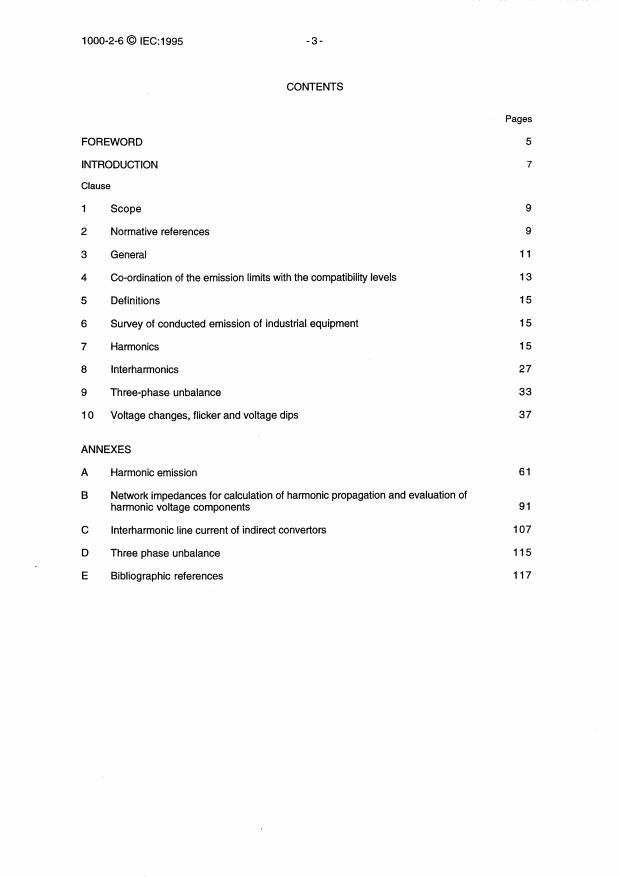
1000-2-6 © IEC:1995 - 3 -
CONTENTS
Pages
FOREWORD
INTRODUCTION
Clause
1 Scope 9
2 Normative references
3 General 11
4 Co-ordination of the emission limits with the compatibility levels 13
5 15
Definitions
6 Survey of conducted emission of industrial equipment
7 15
Harmonics
8 27
Interharmonics
9 33
Three-phase unbalance
10 Voltage changes, flicker and voltage dips 37
ANNEXES
A 61
Harmonic emission
Network impedances for calculation of harmonic propagation and evaluation of
B
harmonic voltage components
C Interharmonic line current of indirect convertors
D Three phase unbalance
E Bibliographic references
1000-2-6 © IEC:1995 - 5 -
INTERNATIONAL ELECTROTECHNICAL COMMISSION
ELECTROMAGNETIC COMPATIBILITY (EMC) —
Part 2: Environment —
Section 6: Assessment of the emission levels in the power supply of industrial plants as
regards low-frequency conducted disturbances
FOREWORD
1)
The IEC (International Electrotechnical Commission) is a world-wide organization for standardization
comprising all national electrotechnical committees (IEC National Committees). The object of the IEC is to
promote international cooperation on all questions concerning standardization in the electrical and
electronic fields. To this end and in addition to other activities, the IEC publishes International Standards.
Their preparation is entrusted to technical committees; any IEC National Committee interested in the
subject dealt with may participate in this preparatory work. International, governmental and non-
governmental organizations liaising with the IEC also participate in this preparation. The IEC collaborates
closely with the International Standardization Organization (ISO) in accordance with conditions
determined by agreement between the two organizations.
2) The formal decisions or agreements of the IEC on technical matters, prepared by technical committees on
which all the National Committees having a special interest therein are represented, express, as nearly as
possible, an international consensus of opinion on the subject dealt with.
3) They have the form of recommendations for international use published in the form of standards, technical
reports or guides and they are accepted by the National Committees in that sense.
4) In order to promote international unification, IEC National Committees undertake to apply IEC
International Standards transparently to the maximum extent possible in their national and regional
standards. Any divergence between the IEC Standard and the corresponding national or regional
standard shall be clearly indicated in the latter.
The main task of IEC technical committees is to prepare International Standards. In exceptional
circumstances, a technical committee may propose the publication of a technical repo
rt of one of the
following types:
• type 1, when the required suppo rt
cannot be obtained for the publication of an International
Standard, despite repeated efforts;
• type 2, when the subject is still under technical development or where for any other reason there is
the future but not immediate possibility of an agreement on an International Standard;
• type 3, when a technical committee has collected data of a different kind from that which is
normally published as an International Standard, for example "state of the a
rt".
Technical reports of types 1 and 2 are subject to review within three years of publication to decide
whether they can be transformed into International Standards. Technical repo
rts of type 3 do not
necessarily have to be reviewed until the data they provide are considered to be no longer valid or
useful.
IEC 1000-2-6, which is a technical repo rt
of type 3, has been prepared by subcommittee 77A: Low
frequency phenomena, of IEC technical committee 77: Electromagnetic compatibility.
The text of this technical repo rt is based upon the following documents:
Committee draft Survey of comments
Report on voting
77A(Secretariat)94 77A(Secretariat)103 77N130
Full information on the voting for the approval of this pa rt can be found in the repo
rt on voting indicated
in the above table.
Annexes A, B, C, D and E are for information only.
1000-2-6 © IEC:1995 - 7 -
INTRODUCTION
IEC 1000 is published in separate pa rt
s according to the following structure:
Part 1: General
General considerations (introduction, fundamental principles)
Definitions, terminology
Part 2: Environment
Description of the environment
Classification of the environment
Compatibility levels
Part 3: Limits
Emission limits
Immunity limits (in so far as they do not fall under responsibility of product committees)
Part 4: Testing and measurement techniques
Measurement techniques
Testing techniques
Part 5: Installation and mitigation guidelines
Installation guidelines
Mitigation methods and devices
Part 9: Miscellaneous
Each part is further subdivided into sections which are to be published either as International
Standards, or as Technical Repo rts.
These standards and repo rts will be published in chronological order and numbered accordingly.
This section is a technical repo rt .
1000-2-6 © IEC:1995 -
9 -
ELECTROMAGNETIC COMPATIBILITY (EMC) —
Part 2: Environment —
Section 6: Assessment of the emission levels in the power supply of industrial plants as
regards low-frequency conducted disturbances
1 Scope
This technical report recommends the procedures to assess the disturbance levels produced by the
emission of the devices, equipment and systems installed in non-public networks in industrial
environment as far as the low-frequency conducted disturbances in the power supply are concerned;
on this basis, the relevant emission limits can be derived. It applies to low and medium voltage a.c.
non-public supply at 50/60 Hz. Networks for ships, aircraft, off-shore platforms, and railways are out of
the scope of this report.
This technical report deals with the low-frequency conducted disturbances emitted by equipment
connected to the power supply. The disturbances considered are:
• harmonics and interharmonics;
• unbalances;
• voltage changes;
• voltage dips.
2 Normative references
The following normative documents contain provisions which, through reference in this text, constitute
provisions of this technical report. At the time of publication, the editions indicated were valid. All
normative documents are subject to revision, and parties to agreements based on this technical repo rt
are encouraged to investigate the possibility of applying the most recent editions of the normative
documents indicated below. Members of IEC and ISO maintain registers of currently valid International
Standards.
IEV 50 (161): 1990, International Electrotechnical Vocabulary (lEV) - Chapter 161: Electromagnetic
compatibility
IEC 146: Semiconductor convertors
IEC 1000-3-3: 1994, Electromagnetic compatibility (EMC) - Pa rt 3: Limits - Section 3: Limitation of
voltage fluctuations and flicker in low-voltage supply systems for equipment with rated current 2 16 A
IEC 1000-3-5: 1994, Electromagnetic compatibility (EMC) - Pa rt 3: Limits - Section 5: Limitation of
voltage fluctuations and flicker in low-voltage power supply systems for equipment with rated current
greater than 16 A
1000-2-6 © IEC:1995 - 11 -
3 General
To achieve electromagnetic compatibility, the total disturbance level at the different points of coupling
should be limited; this implies a control of the emission of the disturbing loads connected to the power
supply.
As far as the LV public networks are concerned, the control of the disturbance level is obtained by
means of a strict limitation of the emission of equipment absorbing up to 16 A to be installed in the
networks. These limitations are fixed on the basis of statistical consideration on:
• wide diffusion of the equipment in the network;
• type of utilization (simultaneity effect);
• characteristics of the network.
Any equipment absorbing up to 16 A can be connected, provided it satisfies the emission limits given
by the relevant standard.
This approach reflects the fact that in the public network, a strict co-ordination between different users
and utility is not possible.
As regards the industrial plants and non-public networks, the compliance of compatibility levels must
be achieved in different locations:
The total emission
A. At the Point of Common Coupling (PCC) to the public network.
of the plant into the public networks is subject to relevant limitation on the basis of the utility's
requirements, and on the network conditions of the power supply.
B. At the Internal Point(s) of Coupling (IPC). The total disturbance level as produced by
the emission of the inplant equipment and the disturbance level of the incoming supply is to be
limited to the selected compatibility levels at the concerned IPCs.
Compliance with the above stated requirements can be achieved by imposing limitations on the
emission of single pieces of equipment, taking into consideration the following:
the actual impedance of the network where the equipment is to be connected;
•
the mix of equipment actually present in the plant;
•
the actual utilization of the equipment in relation to the organization of the production process;
•
the possible control and mitigation of the disturbances obtained by provisions such as filtering or
•
compensating devices, distribution of the loads on different supplies, segregation of disturbing
loads.
This approach reflects the fact that in the industrial plant, the co-ordination of the disturbing loads, both
at the design and at the operation stage, is possible.
To achieve an overall economy, the following facts for the limitation of the emission of each piece of
equipment are impo rtant:
• the actual emission of a piece of equipment can be largely dependent on the characteristics of
the supply network;
• low power equipment, even if incompatible as far as the emission levels are concerned with the
standards of public network, can have globally a negligible impact in industrial plants in the
presence of heavily disturbing equipment;
the pattern of summation of the disturbance caused by various sources depends widely both on
•
the design of the equipment, and on the industrial process involved;
• the user can, to a certain extent, select the applicable electromagnetic compatibility levels at the
IPC. In fact, this choice is a trade-off between the costs to limit the level of the emission, and the
costs to reduce the level of the disturbance by mitigation, or to increase the immunity.
1000-2-6 © IEC:1995 - 13-
4 Co-ordination of the emission limits with the compatibility levels
The allowable emission limit of an equipment can be stated through a three steps procedure:
a) Information between utility and user, and between user and manufacturer.
The utility is asked to provide the user with the minimum information following:
• the total emission limit applicable to the plant;
• the expected present and future disturbance level at the PCC, neglecting the disturbance
produced by the plant under consideration;
• the range of values of the source impedance at the point of coupling as necessary for the
disturbance evaluation; this range is related both to the network configuration and to the
frequency characteristics.
The user is asked to provide the utility with information regarding:
•
the characteristics of the equipment to be installed, and its mode of operation;
• the characteristics of power factor compensation devices;
• the characteristics of possible filters for harmonic current compensation.
The user is asked to provide the manufacturer with the minimum information following:
•
the plan of the installation, and the characteristics of the connected equipment;
• emission levels of the other equipment in the installation, and the disturbance conducted by
the supply network;
•
characteristics of the process.
The manufacturer is asked to provide the user the minimum information following:
• expected emission levels of the concerned equipment or system in the specified operating
conditions;
• the sensitivity of the emission levels to changes such as the supply impedance, the
operating voltage, and so on.
b) Selection of the proper summation rule to account for the presence in the plant of various
disturbance sources.
c) Evaluation of the expected total emission level of the plant at the PCC, and evaluation of the
expected total disturbance level at the IPCs.
If either the total emission of the installation, or the expected disturbance level, exceed the relevant
compatibility level, taking into account also the future network development, and the possible increase
of the number of the disturbance sources in the plant, the following provisions should be considered:
• modification to the network configuration;
• changing the characteristics of the disturbing equipment;
• applying filters or compensating devices;
• tolerating the resulting disturbance and increasing the immunity levels of the involved
equipment (this provision does not apply to PCC but to IPCs only).
The process is repeated until all the requirements are satisfied.
1000-2-6 © IEC:1995 - 15 -
5 Definitions
All terms are according to IEV 161, to IEC 146 and to IEC 1000-3.
6 Survey of conducted emission of industrial equipment
Table 1 presents a survey on the sources of low-frequency conducted emission and their effects on
the mains.
Table 1 — Sources of low-frequency conducted disturbances
Produced
Classification Examples
disturbance
Saturable magnetic
devices, gas-discharge Harmonics
Non-linear lamps
Harmonics,
Arc furnace, a.c. arc
interharmonics,
characteristics welders
voltage changes,
unbalance
Harmonics, voltage
Switching-on
dips
transformers
Convertors,
Electronically switched a.c. controllers Harmonics,
load Multicycle control Interharmonics,
devices voltage changes,
unbalance
Switching-on Interharmonics,
Switched load capacitors, filters, and voltage dips
induction motors
7 Harmonics
7.1 Description of the disturbing phenomena and sources
The harmonic components in the line current are mainly generated in the ways described in the
following subclauses; additional load characteristics are presented in annex A.
7.1.1 Switching the line current with line frequency or its multiple by means of electronic switches
such as in semiconductor convertors
This function may be either controlled, as by thyristors, or uncontrolled as by diodes. The function in
most cases is obtained by switching a series connection of impedance and voltage sources
periodically either on and off, or from phase to phase. In principle, three characteristics for harmonic
generation in convertors may be found:
a) The load is periodically switched on and off , for example an a.c. controller switches its load on at
discrete phase angles, and switches off when the current drops to zero. Figure la shows the
schematic arrangement. Amplitude and phase angle of the harmonic current depends on the
angle at which the line voltage is connected to the load, the difference between line and load
voltage, and the resulting series connection of load and line impedance.
1000-2-6 © IEC:1995 - 17-
Typical applications are:
• conductive heating, welding, melting;
high-voltage d.c. supply for electrostatic precipitators or transmitter valves;
•
• high-current d.c. supply for galvanizing or metal pickling;
• static VAR compensator;
• a.c. motor starter.
b) An impressed current is cyclically switched from phase to phase (high d.c. inductance).
Figure 1 b shows the schematic arrangement.
Typical devices in this category are:
• convertor feeding d.c. load (such as d.c. drive; d.c. supply for traction, for electro-chemical
and electro-thermal processes; d.c. excitation for machines or magnet coils; d.c. welding
convertor);
convertor with direct current link (such as a.c. drive with current source inverter (CSI) or sub-
•
synchronous convertor cascade; d.c. supply for medium-frequency convertor feeding metal
glowing or induction furnace);
• bi-directional convertor, cycloconvertor (such as a.c. drive, low frequency supply for
electrothermal melting and refining) as shown in figure A.7 of annex A.
c) A d.c. voltage is periodically switched on and off into the line via impedances. A convertor
connected to a three-phase line switches the d.c. side at discrete phase angles from phase to
phase with low d.c. inductance. Figure 1 b shows an equivalent circuit. The harmonic current
generation corresponds to that of the a.c. controller. Here the current drop to zero is either
initiated at the latest by closing the switch of the following phase, or occurs previously in cases of
low current or low d.c. inductance, because of current dropping voltage polarity.
Typical devices in this category are:
• convertor with direct voltage link (such as a.c. drive with voltage source inverter (VSI);
uninterruptable power supply (UPS); d.c. voltage supply for resonant convertor applied to
metal heating or soldering);
• self-commutated convertor (convertor type for drives and compensators that do not require
reactive power or compensation for it).
7.1.2
Non-linear impedances such as current dependant resistances
(see figure 1 c)
Typical devices in this category are:
• arc furnace (a.c. arc for melting and refining metal);
• a.c. welding machine (welding arc supplied via high-reactance transformer);
• fluorescent lamp, gas discharge lamp in mass applications for illumination.
1000-2-6 © I EC:1995 - 19 -
7.1.3
Switching on saturable inductance (for example switching on induction motor or transformer)
The magnetic saturation may produce transient current components. Switching on a resonant circuit
with inductance and capacitance oscillating transiently to the mains (for example when switching on
filter or capacitor, a transient oscillations is produced between filter capacitance and inductances of
filter and line).
Figure 1c shows the equivalent circuit.
7.2 Typical emission data
A range of typical emission data is presented in annex A for the most common loads generating
harmonic line currents. They are given for guidance purpose only. Reliable data for the disturbance
evaluation should be obtained by the manufacturer on the basis of the actual design parameters, and
by his experience with similar equipment.
7.3 Influence of operating and installation conditions on emission
For the resulting emission of several loads (such as convertors), the amount and the phase angle of
the harmonic current is to be estimated. The connection of the convertors and transformers (if any), as
well as simultaneous and homogeneous load condition for the convertors, or their operation at
random, have to be taken into consideration; this problem is dealt with in 6.4.
The disturbance in the supply system may be defined by the presence of harmonic components in the
line voltage, resulting from voltage drops of the harmonic currents across the line impedance. This line
impedance is determined by the parallel and series connection of all impedances to the superimposed
high voltage grid, and to all loads, compensating and filter components, considering the values which
apply to the respective frequencies (see figure 2a). Therefore, possible resonances must be identified
and taken into consideration. Further information is given in annex B.
7.4 Summation of harmonics
When several devices producing harmonic currents are present in the same plant, the harmonic
currents in the lines, and the harmonic voltage at the point of concern (IPC or PCC) depends on the
superposition effect caused by the different amplitudes and phase angles of the currents emitted from
different sources.
An exact calculation of the resulting harmonic voltage (vectorial sum) is restricted to a few special
cases. Taking the algebraic sum of the contributions by each harmonic source may represent the worst
case, but this method often leads to unrealisticly high values, especially at high harmonic orders.
An approximate evaluation is sufficient in most of the cases. Several methods exist for the approximate
evaluation of the resulting harmonics; see [4],[5] and [6] in annex E for the relevant literature.
7.4.1 Harmonic voltage at the point of concern
PCC)
The harmonic voltage Uh of order h at the point of concern (IPC or results from the equation
(see figure 2b):
Uh =Uho+ (1)
where
Uho is the harmonic voltage of order h of the supply network not considering the effect of the
sources of concern (background disturbance);
Uhi is the harmonic voltage of order h produced by the injection of the source i.
1000-2-6 © 21 -
IEC:1995 -
Assuming that all the transfer impedances between the point of connection of the disturbing sources
and the point of concern are equal for all the disturbing sources (see figure 2b); LLh results from:
Zh
Uh = Uho+ (2)
where
Z h is the equivalent harmonic impedance as seen from the point of concern.
7.4.2
Summation of harmonic voltages
7.4.2.1 Principles of the evaluation
The summation problem arises when studying the connection of a new industrial load producing
harmonics, because the emission levels which may be allowed are a consequence of the pattern, the
harmonics will add up to the ones generated by other existing and future loads. The lack of
information, and the inherent variability concerning all the individual loads which generate harmonics,
leads to the necessity of using a statistical approach for the evaluation of the resulting harmonic
vectors. In such an approach, each harmonic source is represented by a randomly time-varying vector.
Both magnitude and phase angle of these vectors are modelled by means of distribution laws.
In order to obtain a simple rule for practical applications, the diversity factor K is adopted:
_U l
_ I ^ hi
(3)
K E) U h^)
K is defined as the ratio between the vectorial sum (actual or expected) and the arithmetic sum of the
individual contribution of all harmonic sources. This contribution is caused by the emission relevant to
the design operational characteristic of the equipment concerned.
With the aid of the diversity factor K, the total disturbance U h can be evaluated as:
(4)
141 I ,410 I+ K E I i hi l
The value of the diversity factor is influenced, among others, by:
type of disturbing load, for example in the case of convertors
• controlled or uncontrolled convertor;
• inductive or capacitive smoothing;
• type of load (ohmic, inductive, motor);
• number of convertors operating simultaneously;
the kind of operation of the various disturbance sources (co-ordinate duty cycles, or
independently from each other);
variability of the load;
harmonic order under consideration.
7.4.2.2 Practical application of the evaluation
Two methods for evaluating the diversity factor K are proposed, depending on the knowledge of the
harmonic contribution of all devices in the industrial network, and the required accuracy of the resulting
harmonic voltage at the point of concern. In particular, method 1 refers to special groups of equipment,
while method 2 refers to overall statistical considerations.
1000-2-6 © IEC:1995 - 23 -
Method 1
This method gives applicable diversity factors. It holds good for a first approximation, or for resulting
harmonic voltages at the point of concern, with a considerable safety margin in relation to the
compatibility level. It applies to low order harmonics h <_ 7.
The diversity factor K is obtained by the following:
K
E iI Uhi I
(5)
K =
I
may be applicable in one plant.
Several different Ki
Ki for individual loads and for different harmonic orders
Based on (13] of annex E, the diversity factors
are given in table 2.
K i for various values x and harmonic orders, x being the
Table 2 — Diversity factor
ratio between the load of the device being considered and the total disturbing load
of the plant
>15
5 7 11 13
h 3
0,3 0,2 0,2 0,1
x <0,05 0,6 0,5
0,4 0,4 0,3
x= 0,1 0,7 0,7 0,6
0,6 0,6 0,5
x= 0,2 0,9 0,8 0,7
1,0 1,0 1,0 1,0
x> 0,5 1,0 1,0
NOTE - If the multi-unit installation is made up of several uncontrolled rectifier convertors, Ki = 0,9.
Ki = 1,0.
In addition, if the uncontrolled rectifiers have the same load cycle,
The diversity factors in the table take into consideration the increasing variation of the phase angle A
towards higher harmonics (see figures relevant to method 2).
Method 2
This method is based on a statistical approach, considering that the compatibility level has to be met
with a probability of 95 % or better.
A certain knowledge concerning the variation of magnitude and phase angle of the individual harmonic
contributions is required:
S
^1
(p))
l h'
K .Uhi I (6)
where
i (p)) is the statistical sum vector having 95 % probability of not being exceeded.
S (Uh
1000-2-6 © IEC:1995 - 25 -
Diversity factors K depending on the variation of magnitude and phase angle of the harmonic voltages
and the number of sources N are obtained following the approach [4] of annex E:
1/a
hi
K^IU hi l=b lU^ la) (7)
Typical relevant values for a and b are shown in the following table 3; they are applicable to values
having 95 % probability of not being exceeded:
Table 3 - Values a and b applicable to uniform statistical distribution of amplitudes
and phase angles. Maximum amplitudes are all equal.
Range of Range of
distribution of distribution of N = 2 N > 2
phase angle the amplitude
DU/
U b a b a
max
0 -1 1,0 2,0 1,0 2,0
0 - 360 0,5 -1 1,3 2,0 1,3 2,0
1 1,0 1,0 1,7 2,0
0-1 0,9 1,6 0,9 1,6
0-270 0,5- 1 1,0 1,4 1,0 1,4
1 1,0 1,0 1,3 1,4
0-1 0,8 1,3 0,8 1,3
0-180 0,5-1 0,9 1,2 0,9 1,2
1 1,0 1,0 1,2 1,2
0-1 0,9 1,2 0,9 1,2
0 - 90 0,5 - 1 0,9 1.1 0,9 1,1
1 1,0 1,0 1,0 1,0
NOTE - The equation given above can only be used when no harmonic source provides more than 50 % of
the algebraic sum of the harmonic voltage being considered. Otherwise refer to method 1.
Generally, the following applies:
• harmonic orders 3, 5 and 7 phase angle up to 90°
• harmonic orders 11 and 13 phase angle up to 270°
• harmonic orders above 13 phase angle up to 360°
For vectors with different maximum magnitudes, the factors can be used with sufficient accuracy. If the
result exceeds the arithmetic sum, then the arithmetic sum will be used instead. In special cases, when
the result may be lower than the greatest individual components, then the la tter applies.
1000-2-6 © IEC:1995 - 27 -
If in an installation some convertors are connected via phase-shifting transformers (Y/D group), and
some others via non-phase-shifting transformers (Y/Y or D/D groups); the 5th and 7th harmonic
currents generated tend to cancel, provided that the convertors are operated in similar conditions.
8 Interharmonics
8.1 Sources of interharmonic currents and voltages
The large majority of the interharmonic voltages and currents on the power supply are generated by
static frequency convertors. Rotating machines without convertors may also generate interharmonic
voltages; but, in relation to convertor borne interharmonics, their magnitude is very small, and for to this
reason they are neglected here. Intended injection of interharmonic voltages into the mains, for
example for ripple control, is not discussed here, since the emission is known perfectly.
The mechanism of the generation of interharmonic frequencies is dependent on the type of the
convertor. Table 4 gives an overview of common applications of static frequency convertors acting as
sources of interharmonics.
Table 4 — Overview of interharmonic current generation by convertors
Convertor arrangement Typical applications
Load side
Supply side
Variable speed drive, power exchange
between networks,
Line commutated inverter
sub-synchronous cascade
Line-commutated convertor
and d.c. link
Variable speed drives, UPS
Self-commutated inverter
Resonant inverter Induction heating
Variable speed drive
Self-commutated convertor
and d.c. link Energy storage
Frequency conversion for traction and for
electro-thermal processes,
Direct convertors (cycloconvertors) over-synchronous cascade, variable speed
drive at low rotation speed
AC arc furnaces also are sources of interharmonics. In addition, any convertor or nonlinear device in
non-stationary operating conditions can generate interharmonic currents.
8.2 lnterharmonic line currents of indirect convertors
The indirect convertors are composed of a line-commutated convertor at the a.c. supply connected via
a d.c. link to a second convertor, either motor - or resonance -, or self-commutated.
1000-2-6 © IEC:1995 - 29 -
The following frequencies are present in the ripple current of the d.c. link:
flh=nPLfL
(8)
and
= k
flh PA fA
where
f h is the frequency of the harmonic component in the current of the intermediate link (Hz)
PL is the pulse number of the convertor at the a.c. supply
fL is the line frequency (Hz)
n,k is the integer 0,1,2,3,.
PA is the pulse-number of load side inverter
is the load frequency (Hz); when the load is a motor, this frequency is related to the actual
A
motor speed
In steady state, the following frequencies in the line-current are found:
hh = fL PA fA (9)
f (1 ± n PL) + k
where
is the line current frequency components (Hz)
thh
When 0 (corresponding to the d.c. component in the d.c. link current), the formula gives the
k =
not equal to 0, the formula gives the interharmonic
characteristic harmonic in the line current. With k
frequencies.
The interharmonic frequencies with highest amplitude are:
=
fmh (fL ± PA fA) (10)
Figures 3a and 3b give an overview of the frequency components. The number beneath the
frequency traces is the factor G, that is the ratio between the line current and the corresponding link-
current for each individual harmonic component.
Annex C gives the formulae to be applied in first approximation for the interharmonic current, and also
an example of the application of figure 3b.
The manufacturer can provide more specific information.
8.3 Interharmonic current generated by direct convertors
Direct convertors are frequency changers with no intermediate link and no energy storage device.
They convert the line frequency into a range from zero (d.c.) and up to about 40 % of the line
frequency.
Three-phase to three-phase convertors, called cycloconvertors, control both the frequency and the
voltage amplitude. Their main application is the speed control of large three-phase rotating machines,
either by handling the total energy transfer, or by handling the transfer of the slip energy of the drive. In
the second case, the convertor is connected to the induction motor via slip rings, the speed control is
limited to narrow range close to the synchronous speed (cycloconvertor cascade).
The direct conversion from three-phase to single-phase is used in typical applications such as links
between a public power supply and a single-phase railway supply, or as a.c. supply of some
metallurgical processes which need very low frequencies. The spectrum of the supply current is
dominated by the characteristic harmonics:
fch = PL) fL (11)
(1 + n
Moreover side band frequencies exist.
1000-2-6 © IEC:1995 - 31 -
They are given by:
A in the case of single phase load (see figure 4);
fhh = fch ± 2k f
6k fA in the case of three-phase load (cycloconvertors, see figure 4);
fhh = fch ±
fch characteristic frequencies according to the number of pulses of the supply convertor;
fA output frequency of the cycloconvertor.
Figures 4, 5 and 6 show the influence of different load parameters such as:
- low and high load frequency;
- 6 and 12 pulse arrangement.
The amplitude of interharmonic current is largely dependent on:
- load current;
- load power factor;
motor voltage (dependent on actual speed);
convertor control philosophy, for example sine control, trapezoid control, etc.
8.4 Subsynchronous cascade
This kind of slip control, by a simple indirect convertor, is used for speed adjustment of induction
motors in the medium power range, and within a speed range approximately from 60 % up to nearly the
full synchronous speed. The rotor windings transfer energy (via a rectifier, a d.c. link, and an inverter)
back to the a.c. supply. The harmonic currents generated by the rectifier and by the inverter, flow into
the supply network. In addition, the harmonic currents generated from the rectifiers on the rotor side
are transformed in frequency, by reason of the rotation of the winding.
hh
Figure 7 shows the generated frequencies f in the line current as function of speed.
The following equations hold:
fhh = (1
± k s pr) fL stator contribution
and
fhh = (1 ± n ft rotor contribution
± s pr)
s — uA
S— U (12)
us
where
pL
is the pulse number of the convertor connected at the a.c. supply;
pr is the pulse number of rotor-side rectifier pr = 6;
uS is the synchronous speed;
uA is the actual speed;
s is the slip-factor.
Figure 8 presents an example of a super- and subsynchronous cascade, where the slip energy is
handled by a cycloconvertor.
1000-2-6 © IEC:1995 - 33 -
8.5 Self-commutated convertors on the line side
Interharmonic voltages or currents can be generated if the beat frequency is not an integer multiple of
the line frequency.
8.6 Arc furnaces
AC furnaces generate harmonic and interharmonic frequencies. While convertors generate a discrete
frequency spectrum, arc furnaces generate a continuous spectrum. In that case, the harmonic spectral
density should be considered.
Figure 9 gives an example of it.
8.7 Summation of components of interharmonic frequencies
Only in exceptional cases, and for a short period, interharmonic components have the same
frequency; therefore, a summation of interharmonics is only possible in these exceptional cases.
9 Three-phase unbalance
9.1 Description of the disturbing source
9.1.1 General
Unbalanced three-phase voltage appears when an unbalanced load is connected to a power system.
An unbalanced load takes a current that differs over the three phases in magnitude or phase.
Loads, such as three-phase a.c. motors, generators, and convertors, do not in principle contribute to
the unbalance during normal operation. However, a small unbalance may occur, due to imperfect
design, but this is normally quite negligible, and not possible to calculate by general rules.
Unbalanced voltages can also be caused by symmetrical currents in a power system with unbalanced
line impedances, but this is outside the scope of this repo rt .
In the general case, unbalanced harmonics can appear, but this is not treated here. This pa
rt only deals
with the unbalance in the fundamental voltages and currents.
9.1.2
Examples of unbalanced loads
All single-phase loads, either connected phase-to-neutral or phase-to-phase, are unbalanced.
Typical instances are:
heating equipment;
lighting;
single-phase convertors and rectifiers;
a.c. controllers;
- a.c. traction equipment;
welding machines.
These loads should, as much as possible, be distributed equally over the three phases, to reduce the
overall unbalance. Arc furnaces, even if they are three-phase equipment, present large unbalances.
1000-2-6 © IEC:1995 -35-
9.2 Characteristics of the emission
9.2.1
Symmetrical components
An unbalanced system can, with the use of symmetrical components, be divided into three
components: positive sequence, negative sequence, and zero sequence.
NOTE — The zero sequence components are outside the scope of this Report. They do not affect loads
connected between phases.
The zero sequence components can exist in the line-to-earth voltages of any system. They can exist in
the line currents even if the system has no available neutral point; the current can flow to earth through
the line-to-earth capacitance.
9.2.2 Assessment of negative sequence currents
The calculation of the negative sequence current component is equal for all single-phase loads listed
above, individually or combined. With the no-load voltage of phase A, as reference direction for all
phase angles, the following formulae can be used to determine the resulting negative sequence
current, if the magnitude and phase displacement of the individual currents in the three phases, A,B
and C, are known.
a) Three-phase loads connected phase-to-neutral
+3n
_ 3
^+IlcI I/a l Zwa+IlbI
(13)
Ineg=
b) Three-phase loads connected phase-to-phase
^ 5
n
ab + 6 + l lbc I Z9 bd —
I iia l LAP ca + 6 n
2 + (14)
=
-6 (I'(Z(I) ab I
In the case of a single-phase load connected between two phases:
_
) r /io (15)
ImnI
For more details, see annex D.
9.2.3 Assessment of negative sequence voltage
The contribution to the negative sequence voltage from a load can be calculated as:
(16)
Qneg = lneg Zneg
The negative sequence impedance, Zneg , can be taken as equal to the positive sequence impedance
of the network; this refers to the subtransient impedances of the rotating machines.
The formula can be transformed to:
I ln^
(17)
Uneg =
lsc
1000-2-6 © IEC:1995 - 37 -
where
uneg is the relative negative sequence voltage
Uneg f U:nom
I neg is the negative sequence current;
ISM is the three-phase short-circuit current at the IPC.
9.3 Summation of several sources
The negative sequence current resulting from a number of unbalanced loads under steady state
operation can be calculated using the formulae given in 6.4.
If the loads vary, in magnitude or phase, the same rules of statistical summations as were given for
harmonics can be used. In fact, the negative sequence component can be regarded as a harmonic
component with order number 1. Therefore, if method 1 is used, the approximate values for K are
similar to those of order 3 in table 2.
1 0 Voltage changes, flicker and voltage dips
10.1 Voltage changes
10.1.1 General
Voltage changes are caused by changes in reactive and active current taken by the loads connected
to the network, and thus causing a change of voltage drop in the network impedance (see figure 10).
In certain cases, they may also be caused by changes in the short-circuit power of the network, due to
changes in generation, or due to changes in the network configuration. These changes lead to
changes in network impedance. They will be neglected in this report and the network impedance will
be taken as constant and known.
In general, the voltage remains in a steady state with the mass of existing loads.
The individual changes or emissions are to be limited in such a way that the steady-state operational
voltage Uo remains within the agreed-upon voltage band (figure 11) for proper pe rformance of all the
applications connected to the IPC or PCC.
A relatively large dynamic change Al causing AUc, due to the connection or disconnection of a
relatively large load, or a large change of load impedance, such as with motor starting or arc furnace
operation, even within an agreed voltage band, is considered as a disturbing phenomenon.
This relative voltage change is considered in the following.
10.1.2 Examples of loads causing relatively large voltage changes
Typical examples are:
operation of arc furnaces;
operation of welding machines;
starting of motors;
- switching of capacitors.
Figure 11 shows how the starting of a motor could change the operational voltage. The starting of
several motors may also be represented by the same figure by vectorial sum of the individual starting
currents.
1000-2-6 © IEC:1995 - 39 -
10.1.3 Assessment of dynamic or relative voltage change due to a single load at the point of coupling
A simple assessment of the relative voltage change may be made as follows (see figure 11):
A/=01p-j01q current change
(18)
R jX^ network Impedance
Z1-= +
For single-phase and symmetrical three-phase loads:
AUdyn=A lp + AIq X
L (19)
The emission limit at IPC of class 2 requires a limitation of according to the flicker
U/dynfUnom
assessment procedure.
The emission limit at IPC of class 3 shall consider the actual voltage:
Uo - ollc ± A Udyn (20)
10.1.4 Summation of the voltage fluctuations
The following rules are applied to class 3 IPCs to consider the presence of various disturbing sources:
• the average active and reactive currents of the fluctuating loads are added algebraically, this
provides the equivalent A Uc;
• the largest dynamic change provides the value AUdyn ; in some special case only the coincidence of
disturbance is to be considered.
XL/
L /p Rdi
(21)
(IA k + Alp Rd)
AUdyn = MAX
10.2 Flicker
10.2.1
General
Flicker is the subjective impression of fluctuating luminance, and is caused by rapidly changing loads
from:
arc furnaces;
welding machines;
starting and stopping of motors (if the frequency of relative change of voltage lies between 0,1
-
and 3 000 changes per minute).
Detailed description of the phenomenon is given in UIE guide [15] cited in annex E.
1000-2-6 © IEC:1995 - 41 -
10.2.2 Assessment of flicker emission
IEC 1000-3-3 gives methods of assessment by analytical tools, simulation, and direct measurement.
Limits of IEC 1000-3-3 and IEC 1000-3-5 are valid for IPC class 2 and PCC.
As IPC class 3 has generally no lighting load, no flicker assessment is required. When the contrary
applies, the flicker assessment is to be made according to the rule of IPC class 2.
10.3 Voltage dips
10.3.1 General
Voltage dip is a sudden reduction of the voltage at a point in the power supply system, followed by a
recovery after a short period of time, from half a cycle to a few seconds.
Voltage dips are caused by faults in the network and installations, or by a sudden large change of load.
10.3.2 Assessment of the disturbance
Statistics classified with regard to depth, duration and frequency of occurrence per year for MV public
power supply networks are available for Europe. Statistics from industrial systems are not yet available.
On the basis of the above statistics, it will be possible to assess the magnitude of the disturbance in
industrial systems.
Sudden large changes may be evaluated for any point of coupling as shown in 9.2.
1000-2-6 © I EC:1995 - 43 -
Oz fL
ZL
I
a
Z iLoad
a) a.c. controller, load per
...