

IEC TR 62001-4:2016
(Main)High-voltage direct current (HVDC) systems - Guidance to the specification and design evaluation of AC filters - Part 4: Equipment
General Information
- Abstract
IEC TR 62001-4:2016(E), which is a Technical Report, provides guidance on the basic data of AC side filters for high-voltage direct current (HVDC) systems and their components such as ratings, power losses, design issues and special applications, protection, seismic requirements, equipment design and test parameters. This document covers AC side filtering for the frequency range of interest in terms of harmonic distortion and audible frequency disturbances. It excludes filters designed to be effective in the power line carrier (PLC) and radio interference spectra. It concerns the "conventional" AC filter technology and line-commutated HVDC converters. This first edition of IEC TR 62001-4, together with IEC TR 62001-1, IEC TR 62001-2 and IEC TR 62001-3, cancels and replaces IEC TR 62001 published in 2009. This edition constitutes a technical revision. This edition includes the following significant technical changes with respect to IEC TR 62001:
a) Clauses 10 to 16, 18, Annexes F and G have been expanded and supplemented.
- Status
- Published
- Publication Date
- 12-May-2016
- Drafting Committee
- MT 21 - TC 22/SC 22F/MT 21
- Current Stage
- DELPUB - Deleted Publication
- Start Date
- 07-Sep-2021
- Completion Date
- 30-Jun-2020
Buy Documents
IEC TR 62001-4:2016 - High-voltage direct current (HVDC) systems - Guidance to the specification and design evaluation of AC filters - Part 4: Equipment
IEC TR 62001-4:2016 - High-voltage direct current (HVDC) systems - Guidance to the specification and design evaluation of AC filters - Part 4: Equipment Released:5/13/2016
Overview
IEC TR 62001-4:2016 is a Technical Report from the IEC that gives guidance on the equipment side of AC filters used with high-voltage direct current (HVDC) systems. Focused on conventional AC filter technology for line‑commutated HVDC converters, this report covers basic data for AC side filters and their components - ratings, power losses, design considerations, protection, seismic requirements, audible noise and test parameters. It addresses the frequency range relevant to harmonic distortion and audible disturbances, but explicitly excludes filters targeted at the power line carrier (PLC) and radio‑interference bands.
Key topics and requirements
The report provides practical guidance on:
- Steady‑state rating methods and application of voltage and current ratings for filter equipment.
- Transient stresses and insulation coordination, including switching impulses, fault scenarios and fast‑front waveforms.
- Losses: how to evaluate component and system losses for capacitors, reactors and resistors under realistic harmonic and loading conditions.
- Design issues and special applications, such as tuned and triple‑tuned circuits, high‑pass filters, re‑tunable filters and tertiary‑winding filter arrangements.
- Protection strategies for filter banks and individual components: overcurrent, differential, earth‑fault, thermal and unbalance protection, plus special harmonic measurement functions.
- Audible noise assessment and mitigation for filter components and installations.
- Seismic requirements: load specification, qualification by analysis and mechanical design improvements for seismic resilience.
- Equipment design and test parameters for capacitors, reactors, resistors, arresters and instrument transformers - specifying electrical data and test regimes bidders and manufacturers should provide.
The edition is a technical revision that, together with IEC TR 62001‑1, ‑2 and ‑3, replaces IEC TR 62001 (2009); Clauses 10–16, 18 and Annexes F and G were expanded.
Practical applications and users
Who benefits:
- HVDC project engineers specifying AC filters and defining performance and rating requirements.
- Electrical equipment manufacturers designing capacitors, reactors, resistors, arresters and instrument transformers for HVDC filter service.
- Substation and protection engineers developing protection schemes and insulation coordination studies.
- Utilities, consultants and testing laboratories evaluating harmonic performance, audible noise, loss budgets and seismic qualification. Practical uses include preparing tender specifications, performing steady‑state and transient simulations, selecting filter components, defining test procedures and reducing operational losses.
Related standards
- IEC TR 62001‑1, IEC TR 62001‑2, IEC TR 62001‑3 (companion parts covering other aspects of HVDC AC filtering).
- This edition cancels and replaces IEC TR 62001 (2009).
Keywords: IEC TR 62001-4:2016, HVDC systems, AC filters, harmonic distortion, filter equipment, filter design, seismic requirements, protection, capacitors reactors resistors, audible noise.
Relations
- Effective Date
- 05-Sep-2023
- Effective Date
- 05-Sep-2023
Buy Documents
IEC TR 62001-4:2016 - High-voltage direct current (HVDC) systems - Guidance to the specification and design evaluation of AC filters - Part 4: Equipment
IEC TR 62001-4:2016 - High-voltage direct current (HVDC) systems - Guidance to the specification and design evaluation of AC filters - Part 4: Equipment Released:5/13/2016
Get Certified
Connect with accredited certification bodies for this standard

IMQ S.p.A. (Certification)
Italian electrical product certification.

SLG Prüf- und Zertifizierungs GmbH
German testing and certification body.

UL Solutions
Global safety science company with testing, inspection and certification.
Sponsored listings
Frequently Asked Questions
IEC TR 62001-4:2016 is a technical report published by the International Electrotechnical Commission (IEC). Its full title is "High-voltage direct current (HVDC) systems - Guidance to the specification and design evaluation of AC filters - Part 4: Equipment". This standard covers: IEC TR 62001-4:2016(E), which is a Technical Report, provides guidance on the basic data of AC side filters for high-voltage direct current (HVDC) systems and their components such as ratings, power losses, design issues and special applications, protection, seismic requirements, equipment design and test parameters. This document covers AC side filtering for the frequency range of interest in terms of harmonic distortion and audible frequency disturbances. It excludes filters designed to be effective in the power line carrier (PLC) and radio interference spectra. It concerns the "conventional" AC filter technology and line-commutated HVDC converters. This first edition of IEC TR 62001-4, together with IEC TR 62001-1, IEC TR 62001-2 and IEC TR 62001-3, cancels and replaces IEC TR 62001 published in 2009. This edition constitutes a technical revision. This edition includes the following significant technical changes with respect to IEC TR 62001: a) Clauses 10 to 16, 18, Annexes F and G have been expanded and supplemented.
IEC TR 62001-4:2016(E), which is a Technical Report, provides guidance on the basic data of AC side filters for high-voltage direct current (HVDC) systems and their components such as ratings, power losses, design issues and special applications, protection, seismic requirements, equipment design and test parameters. This document covers AC side filtering for the frequency range of interest in terms of harmonic distortion and audible frequency disturbances. It excludes filters designed to be effective in the power line carrier (PLC) and radio interference spectra. It concerns the "conventional" AC filter technology and line-commutated HVDC converters. This first edition of IEC TR 62001-4, together with IEC TR 62001-1, IEC TR 62001-2 and IEC TR 62001-3, cancels and replaces IEC TR 62001 published in 2009. This edition constitutes a technical revision. This edition includes the following significant technical changes with respect to IEC TR 62001: a) Clauses 10 to 16, 18, Annexes F and G have been expanded and supplemented.
IEC TR 62001-4:2016 is classified under the following ICS (International Classification for Standards) categories: 01 - GENERALITIES. TERMINOLOGY. STANDARDIZATION. DOCUMENTATION; 29.200 - Rectifiers. Convertors. Stabilized power supply. The ICS classification helps identify the subject area and facilitates finding related standards.
IEC TR 62001-4:2016 has the following relationships with other standards: It is inter standard links to IEC TR 62001:2009, IEC TR 62001-4:2021. Understanding these relationships helps ensure you are using the most current and applicable version of the standard.
IEC TR 62001-4:2016 is available in PDF format for immediate download after purchase. The document can be added to your cart and obtained through the secure checkout process. Digital delivery ensures instant access to the complete standard document.
Standards Content (Sample)
IEC TR 62001-4 ®
Edition 1.0 2016-05
TECHNICAL
REPORT
High-voltage direct current (HVDC) systems – Guidance to the specification and
design evaluation of AC filters –
Part 4: Equipment
All rights reserved. Unless otherwise specified, no part of this publication may be reproduced or utilized in any form
or by any means, electronic or mechanical, including photocopying and microfilm, without permission in writing from
either IEC or IEC's member National Committee in the country of the requester. If you have any questions about IEC
copyright or have an enquiry about obtaining additional rights to this publication, please contact the address below or
your local IEC member National Committee for further information.
IEC Central Office Tel.: +41 22 919 02 11
3, rue de Varembé Fax: +41 22 919 03 00
CH-1211 Geneva 20 info@iec.ch
Switzerland www.iec.ch
About the IEC
The International Electrotechnical Commission (IEC) is the leading global organization that prepares and publishes
International Standards for all electrical, electronic and related technologies.
About IEC publications
The technical content of IEC publications is kept under constant review by the IEC. Please make sure that you have the
latest edition, a corrigenda or an amendment might have been published.
IEC Catalogue - webstore.iec.ch/catalogue Electropedia - www.electropedia.org
The stand-alone application for consulting the entire The world's leading online dictionary of electronic and
bibliographical information on IEC International Standards, electrical terms containing 20 000 terms and definitions in
Technical Specifications, Technical Reports and other English and French, with equivalent terms in 15 additional
documents. Available for PC, Mac OS, Android Tablets and languages. Also known as the International Electrotechnical
iPad. Vocabulary (IEV) online.
IEC publications search - www.iec.ch/searchpub IEC Glossary - std.iec.ch/glossary
The advanced search enables to find IEC publications by a 65 000 electrotechnical terminology entries in English and
variety of criteria (reference number, text, technical French extracted from the Terms and Definitions clause of
committee,…). It also gives information on projects, replaced IEC publications issued since 2002. Some entries have been
and withdrawn publications. collected from earlier publications of IEC TC 37, 77, 86 and
CISPR.
IEC Just Published - webstore.iec.ch/justpublished
Stay up to date on all new IEC publications. Just Published IEC Customer Service Centre - webstore.iec.ch/csc
details all new publications released. Available online and If you wish to give us your feedback on this publication or
also once a month by email. need further assistance, please contact the Customer Service
Centre: csc@iec.ch.
IEC TR 62001-4 ®
Edition 1.0 2016-05
TECHNICAL
REPORT
High-voltage direct current (HVDC) systems – Guidance to the specification and
design evaluation of AC filters –
Part 4: Equipment
INTERNATIONAL
ELECTROTECHNICAL
COMMISSION
ICS 29.200 ISBN 978-2-8322-3400-6
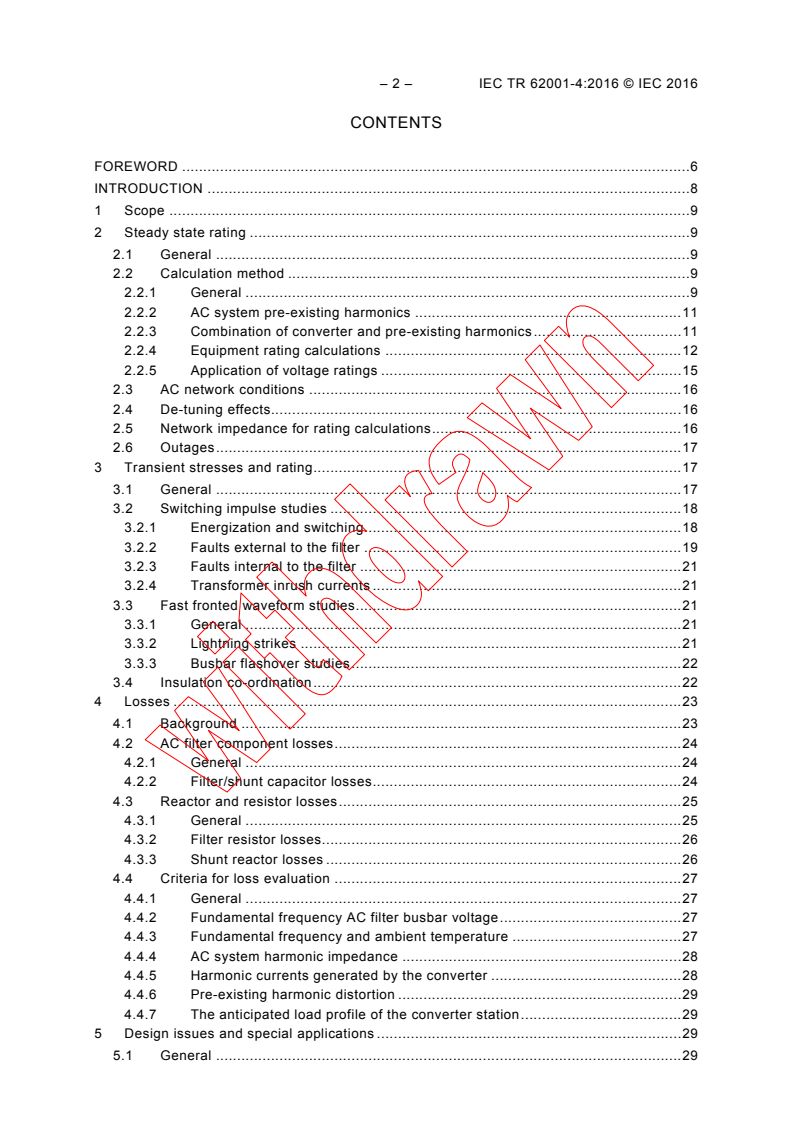
– 2 – IEC TR 62001-4:2016 © IEC 2016
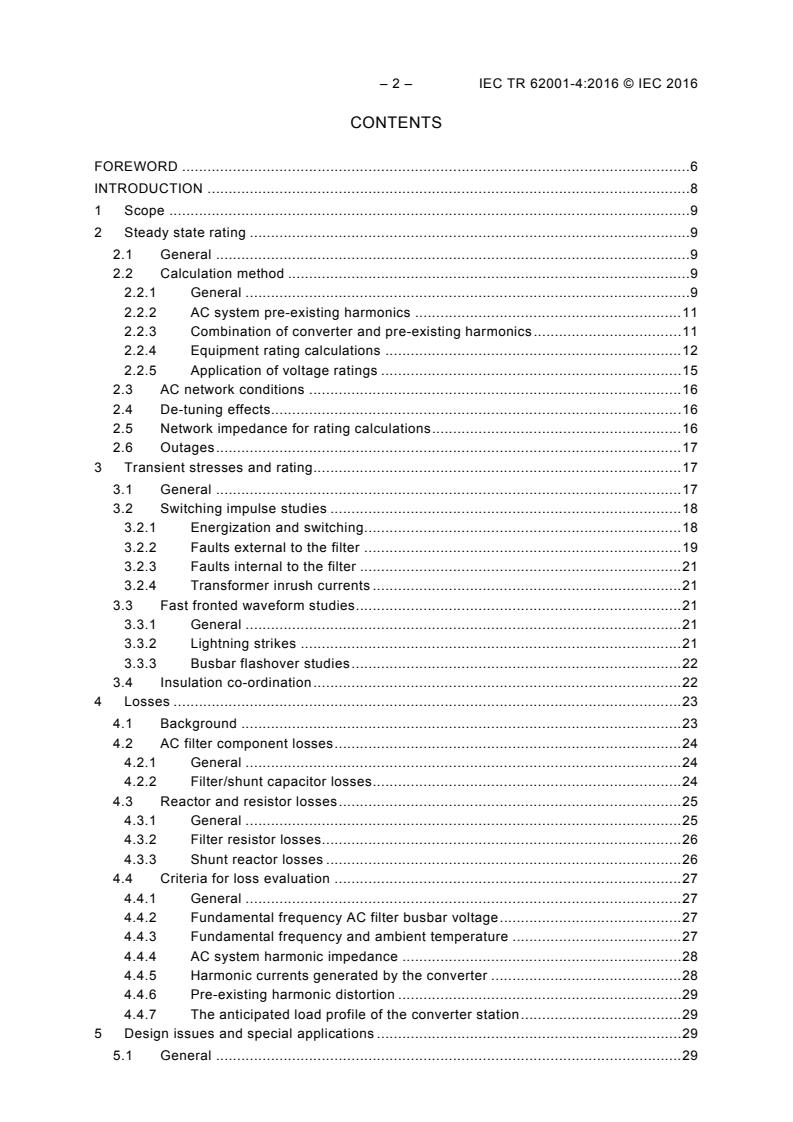
CONTENTS
FOREWORD .6
INTRODUCTION .8
1 Scope .9
2 Steady state rating .9
2.1 General .9
2.2 Calculation method .9
2.2.1 General .9
2.2.2 AC system pre-existing harmonics . 11
2.2.3 Combination of converter and pre-existing harmonics . 11
2.2.4 Equipment rating calculations . 12
2.2.5 Application of voltage ratings . 15
2.3 AC network conditions . 16
2.4 De-tuning effects . 16
2.5 Network impedance for rating calculations . 16
2.6 Outages . 17
3 Transient stresses and rating . 17
3.1 General . 17
3.2 Switching impulse studies . 18
3.2.1 Energization and switching . 18
3.2.2 Faults external to the filter . 19
3.2.3 Faults internal to the filter . 21
3.2.4 Transformer inrush currents . 21
3.3 Fast fronted waveform studies . 21
3.3.1 General . 21
3.3.2 Lightning strikes . 21
3.3.3 Busbar flashover studies . 22
3.4 Insulation co-ordination . 22
4 Losses . 23
4.1 Background . 23
4.2 AC filter component losses . 24
4.2.1 General . 24
4.2.2 Filter/shunt capacitor losses . 24
4.3 Reactor and resistor losses . 25
4.3.1 General . 25
4.3.2 Filter resistor losses . 26
4.3.3 Shunt reactor losses . 26
4.4 Criteria for loss evaluation . 27
4.4.1 General . 27
4.4.2 Fundamental frequency AC filter busbar voltage . 27
4.4.3 Fundamental frequency and ambient temperature . 27
4.4.4 AC system harmonic impedance . 28
4.4.5 Harmonic currents generated by the converter . 28
4.4.6 Pre-existing harmonic distortion . 29
4.4.7 The anticipated load profile of the converter station . 29
5 Design issues and special applications . 29
5.1 General . 29
5.2 Performance aspects . 30
5.2.1 Low order harmonic filtering and resonance conditions with AC system . 30
5.2.2 Definition of interference factors to include harmonics up to 5 kHz . 31
5.2.3 Triple-tuned filter circuits . 31
5.2.4 Harmonic AC filters on tertiary winding of converter transformers . 32
5.3 Rating aspects . 33
5.3.1 Limiting high harmonic currents in parallel-resonant filter circuits . 33
5.3.2 Transient ratings of parallel circuits in multiple tuned filters . 33
5.3.3 Overload protection of high-pass harmonic filter resistors . 34
5.3.4 Back-to-back switching of filters or shunt capacitors . 34
5.3.5 Short time overload – reasonable specification of requirements . 34
5.3.6 Low voltage filter capacitors without fuses . 36
5.4 Filters for special purposes . 36
5.4.1 Harmonic filters for damping transient overvoltages . 36
5.4.2 Non-linear filters for low order harmonics/transient overvoltages . 36
5.4.3 Series filters for HVDC converter stations . 37
5.4.4 Re-tunable AC filters . 40
5.5 Impact of new HVDC station in vicinity of an existing station . 41
5.6 Redundancy issues and spares . 42
5.6.1 Redundancy of filters – savings in ratings and losses . 42
5.6.2 Internal filter redundancy . 43
5.6.3 Spare parts . 43
6 Protection . 44
6.1 Overview . 44
6.2 General . 44
6.3 Bank and sub-bank overall protection . 46
6.3.1 General . 46
6.3.2 Short circuit protection . 46
6.3.3 Overcurrent protection . 46
6.3.4 Thermal overload protection . 46
6.3.5 Differential protection . 47
6.3.6 Earth fault protection . 47
6.3.7 Overvoltage and undervoltage protection . 47
6.3.8 Special protection functions and harmonic measurements . 48
6.3.9 Busbar and breaker failure protection . 48
6.4 Protection of individual filter components. 48
6.4.1 Unbalance protection for filter and shunt capacitors . 48
6.4.2 Protection of low voltage tuning capacitors . 50
6.4.3 Overload protection and detection of filter detuning . 50
6.4.4 Temperature measurement for protection . 50
6.4.5 Measurement of fundamental frequency components . 50
6.4.6 Capacitor fuses . 51
6.4.7 Protection and rating of instrument transformers . 51
6.4.8 Examples of protection arrangements . 52
6.5 Personnel protection . 52
7 Audible noise . 55
7.1 General . 55
7.2 Sound active components of AC filters . 55
7.3 Sound requirements . 56
– 4 – IEC TR 62001-4:2016 © IEC 2016
7.4 Noise reduction . 57
8 Seismic requirements . 58
8.1 General . 58
8.2 Load specification . 59
8.2.1 Seismic loads . 59
8.2.2 Additional loads . 59
8.2.3 Soil quality . 60
8.3 Method of qualification . 60
8.3.1 General . 60
8.3.2 Qualification by analytical methods . 60
8.3.3 Design criteria . 61
8.3.4 Documentation for qualification by analytical methods . 62
8.4 Examples of improvements in the mechanical design . 62
9 Equipment design and test parameters . 62
9.1 General . 62
9.1.1 Technical information and requirements . 62
9.1.2 Technical information to be provided by the customer . 63
9.1.3 Customer requirements . 63
9.1.4 Technical information to be presented by the bidder . 65
9.1.5 Ratings . 65
9.2 Capacitors . 66
9.2.1 General . 66
9.2.2 Design aspects . 66
9.2.3 Electrical data . 67
9.2.4 Tests . 68
9.3 Reactors . 68
9.3.1 General . 68
9.3.2 Design aspects . 69
9.3.3 Electrical data . 70
9.3.4 Tests . 71
9.4 Resistors . 72
9.4.1 General . 72
9.4.2 Design aspects . 72
9.4.3 Electrical data . 73
9.4.4 Tests . 74
9.5 Arresters . 75
9.5.1 General . 75
9.5.2 Design aspects . 76
9.5.3 Electrical data . 76
9.5.4 Arresters: Tests . 77
9.6 Instrument transformers . 77
9.6.1 Voltage transformers . 77
9.6.2 Current transformers . 78
9.7 Filter switching equipment . 80
9.7.1 Filter switching equipment: Introduction . 80
9.7.2 Design aspects . 80
9.7.3 Electrical data . 83
9.7.4 Test requirements . 84
Annex A (informative) Background to loss evaluation . 86
Annex B (informative) Example of response spectra (from IEEE Std 693-2005) . 88
Bibliography . 89
Figure 1 – Circuit for rating evaluation . 10
th
Figure 2 – Inrush current into a 12/24 double-tuned filter . 19
th
Figure 3 – Voltage across the low voltage capacitor of a 12/24 double-tuned filter at
switch-on . 19
th
Figure 4 – Voltage across the HV capacitor bank of a 12/24 double-tuned filter under
fault conditions . 20
Figure 5 – Typical arrangements of surge arresters . 22
Figure 6 – Non-linear low order filter for Vienna Southeast HVDC station . 37
Figure 7 – Single-tuned series filter and impedance plot . 38
Figure 8 – Triple-tuned series filter and impedance plot . 38
Figure 9 – Mixed series and shunt AC filters at Uruguaiana HVDC station . 39
Figure 10 – Re-tunable AC filter branch . 41
Figure 11 – Example of a protection scheme for an unearthed shunt capacitor . 53
Figure 12 – Example of a protection scheme for a C-type filter . 54
Figure 13 – Electrical spectrum . 56
Figure 14 – Force spectrum . 56
Figure B.1 – Response spectra . 88
Table 1 – Typical losses in an all-film capacitor unit . 24
Table 2 – Electrical data for capacitors . 67
Table 3 – Electrical data for reactors . 71
Table 4 – Electrical data for resistors . 73
Table 5 – Electrical data for arresters . 77
Table 6 – Electrical data for current transformers . 79
Table 7 – Electrical data for filter switching equipment . 84
Table A.1 – Capitalized costs of the future losses . 86
– 6 – IEC TR 62001-4:2016 © IEC 2016
INTERNATIONAL ELECTROTECHNICAL COMMISSION
____________
HIGH-VOLTAGE DIRECT CURRENT (HVDC) SYSTEMS –
GUIDANCE TO THE SPECIFICATION AND DESIGN
EVALUATION OF AC FILTERS –
Part 4: Equipment
FOREWORD
1) The International Electrotechnical Commission (IEC) is a worldwide organization for standardization comprising
all national electrotechnical committees (IEC National Committees). The object of IEC is to promote
international co-operation on all questions concerning standardization in the electrical and electronic fields. To
this end and in addition to other activities, IEC publishes International Standards, Technical Specifications,
Technical Reports, Publicly Available Specifications (PAS) and Guides (hereafter referred to as “IEC
Publication(s)”). Their preparation is entrusted to technical committees; any IEC National Committee interested
in the subject dealt with may participate in this preparatory work. International, governmental and non-
governmental organizations liaising with the IEC also participate in this preparation. IEC collaborates closely
with the International Organization for Standardization (ISO) in accordance with conditions determined by
agreement between the two organizations.
2) The formal decisions or agreements of IEC on technical matters express, as nearly as possible, an
international consensus of opinion on the relevant subjects since each technical committee has representation
from all interested IEC National Committees.
3) IEC Publications have the form of recommendations for international use and are accepted by IEC National
Committees in that sense. While all reasonable efforts are made to ensure that the technical content of IEC
Publications is accurate, IEC cannot be held responsible for the way in which they are used or for any
misinterpretation by any end user.
4) In order to promote international uniformity, IEC National Committees undertake to apply IEC Publications
transparently to the maximum extent possible in their national and regional publications. Any divergence
between any IEC Publication and the corresponding national or regional publication shall be clearly indicated in
the latter.
5) IEC itself does not provide any attestation of conformity. Independent certification bodies provide conformity
assessment services and, in some areas, access to IEC marks of conformity. IEC is not responsible for any
services carried out by independent certification bodies.
6) All users should ensure that they have the latest edition of this publication.
7) No liability shall attach to IEC or its directors, employees, servants or agents including individual experts and
members of its technical committees and IEC National Committees for any personal injury, property damage or
other damage of any nature whatsoever, whether direct or indirect, or for costs (including legal fees) and
expenses arising out of the publication, use of, or reliance upon, this IEC Publication or any other IEC
Publications.
8) Attention is drawn to the Normative references cited in this publication. Use of the referenced publications is
indispensable for the correct application of this publication.
9) Attention is drawn to the possibility that some of the elements of this IEC Publication may be the subject of
patent rights. IEC shall not be held responsible for identifying any or all such patent rights.
The main task of IEC technical committees is to prepare International Standards. However, a
technical committee may propose the publication of a technical report when it has collected
data of a different kind from that which is normally published as an International Standard, for
example "state of the art".
IEC TR 62001-4, which is a Technical Report, has been prepared by subcommittee 22F:
Power electronics for electrical transmission and distribution systems, of IEC technical
committee 22: Power electronic systems and equipment.
This first edition of IEC TR 62001-4, together with IEC TR 62001-1, IEC TR 62001-2 and
IEC TR 62001-3 , cancels and replaces IEC TR 62001 published in 2009. This edition
constitutes a technical revision.
This edition includes the following significant technical changes with respect to
IEC TR 62001:
a) Clauses 10 to 16, 18, Annexes F and G have been expanded and supplemented.
The text of this document is based on the following documents:
Enquiry draft Report on voting
22F/379/DTR 22F/385A/RVC
Full information on the voting for the approval of this document can be found in the report on
voting indicated in the above table.
This publication has been drafted in accordance with the ISO/IEC Directives, Part 2.
A list of all parts in the IEC TR 62001 series, published under the general title High-voltage
direct current (HVDC) systems – Guidance to the specification and design evaluation of AC
filters, can be found on the IEC website.
The committee has decided that the contents of this publication will remain unchanged until
the stability date indicated on the IEC website under "http://webstore.iec.ch" in the data
related to the specific publication. At this date, the publication will be
• reconfirmed,
• withdrawn,
• replaced by a revised edition, or
• amended.
A bilingual version of this publication may be issued at a later date.
___________
To be published.
– 8 – IEC TR 62001-4:2016 © IEC 2016
INTRODUCTION
IEC TR 62001 is structured in four parts:
Part 1 – Overview
This part concerns specifications of AC filters for high-voltage direct current (HVDC) systems
with line-commutated converters, permissible distortion limits, harmonic generation, filter
arrangements, filter performance calculation, filter switching and reactive power management
and customer specified parameters and requirements.
Part 2 – Performance
This part deals with current-based interference criteria, design issues and special
applications, field measurements and verification.
Part 3 – Modelling
This part addresses the harmonic interaction across converters, pre-existing harmonics, AC
network impedance modelling, simulation of AC filter performance.
Part 4 – Equipment
This part concerns steady-state and transient ratings of AC filters and their components,
power losses, audible noise, design issues and special applications, filter protection, seismic
requirements, equipment design and test parameters.
HIGH-VOLTAGE DIRECT CURRENT (HVDC) SYSTEMS –
GUIDANCE TO THE SPECIFICATION AND DESIGN
EVALUATION OF AC FILTERS –
Part 4: Equipment
1 Scope
This part of IEC TR 62001, which is a Technical Report, provides guidance on the basic data
of AC side filters for high-voltage direct current (HVDC) systems and their components such
as ratings, power losses, design issues and special applications, protection, seismic
requirements, equipment design and test parameters.
This document covers AC side filtering for the frequency range of interest in terms of
harmonic distortion and audible frequency disturbances. It excludes filters designed to be
effective in the power line carrier (PLC) and radio interference spectra.
It concerns the "conventional" AC filter technology and line-commutated HVDC converters.
2 Steady state rating
2.1 General
The calculation of the steady state ratings of the harmonic filter equipment is the
responsibility of the contractor. Clause 2 gives guidance on the calculation of equipment
rating parameters and the different factors to be considered in the studies. It is the
responsibility of the customer to provide the appropriate system and environmental data and
also to clarify the operational conditions, such as filter outages and network contingencies,
which need to be taken into account.
2.2 Calculation method
2.2.1 General
Steady state rating of filter equipment is based on a solution of the following circuit which
represents the HVDC converter, the filter banks and the AC supply system. See Figure 1.
– 10 – IEC TR 62001-4:2016 © IEC 2016
U
On
Z
Sn
I
Sn
I
fn
Z
fn
I
Cn
IEC
NOTE The symbols used in this figure are explained after Formula (1).
Figure 1 – Circuit for rating evaluation
The harmonic current flowing in the filter is the summation of two components, the
contribution from the HVDC converter and the contribution from the AC supply network.
Using the principle of superposition, Formulae (1) and (2) can be used to evaluate the
contribution to the harmonic filter current of order n from these two sources.
b) HVDC converter:
Z
i sn
II ⋅ (1)
fcn n
ZZ+
sfnn
where
i
I is the filter harmonic current from the converter;
fn
I is the converter harmonic current;
cn
I is the system harmonic current;
sn
Z is the filter harmonic impedance;
fn
Z is the network harmonic impedance.
sn
c) AC supply network:
U
ii
on
I = (2)
fn
ZZ+
sfnn
where
ii
I is the filter harmonic current from the system;
fn
U is the existing system harmonic voltage.
on
The definition of network impedance is described in 2.5.
To solve Formulae (1) and (2), the following independent variables need to be known.
• The harmonic current (I ) produced by the rectifier or inverter of the HVDC station. It is
cn
calculated for all harmonics (see IEC TR 62001-1:2016, Clause 5). This evaluation should
consider the worst-case operating conditions which can occur in steady state conditions,
i.e. for periods in excess of 1 min. The extreme tolerance range of key parameters, for
=
example converter transformer impedances or operating range of the tap changer, needs
to be taken into account. Harmonic interaction phenomena as discussed in IEC TR
62001-3:—, Clause 3, should also be taken into account.
• The pre-existing system harmonic voltage, as discussed in 2.2.2.
), as discussed in IEC TR 62001-1:2016, 7.3.
• The harmonic impedance of AC network (Z
sn
i ii
Note that different values of Z can be defined for the calculation of I and I ,
sn fn fn
depending on how the pre-existing harmonic distortion is specified (see 2.2.3).
The harmonic impedance of the filter (Z ) needs to take account of the de-tuning and
fn
tolerance factors discussed in 2.4.
In the case of an HVDC link connecting two AC systems of different fundamental frequencies,
and particularly if the link is a back-to-back station, both converters may generate currents on
their AC sides at frequencies other than harmonics of the fundamental. The fundamental
frequencies either may be nominally different, for example 50 Hz and 60 Hz, or may be
nominally identical but differ at times by up to 1 Hz or 2 Hz. This additional generated
distortion (interharmonics) will be at frequencies which are harmonics of the fundamental
frequency of the remote AC system, and will be transferred across the link. Interharmonics
may give rise to specific problems not found with true harmonics, such as
a) interference with ripple control systems, and
b) light flicker due to the low frequency amplitude modulation caused by the beating of a
harmonic frequency with an adjacent interharmonic.
th
EXAMPLE A 10 Hz flicker due to the interaction of a 650 Hz 13 harmonic of a 50 Hz system with 660 Hz
th
11 harmonic penetration from a 60 Hz system.
The effect of interharmonics (see IEC TR 62001-1:2016, 4.2.7), although small, should also
be taken into account in the calculation of filter component rating.
2.2.2 AC system pre-existing harmonics
It is important that the effects of pre-existing harmonic distortion on the AC system are
included in the filter rating calculations. Conventionally, this has been accommodated not by
direct calculation as shown above, but by creating an arbitrary margin of a 10 % to 20 %
increase in converter harmonic currents (I ). However, such an approach may not
cn
rd th th
adequately reflect the low order harmonic distortion (typically 3 , 5 and 7 ) which exists on
many power systems. As modern converter stations produce only small amounts of such low
order harmonics, a simple enhancement of the magnitude may not adequately reflect their
potential contribution to filter ratings.
To model a multiplicity of harmonic current sources in a detailed network model is impractical
for the purposes of filter design. Therefore, it is proposed that a Thévenin equivalent voltage
source is modelled behind the AC system impedance, as shown in Figure 1, to create an
open circuit voltage distortion at the filter busbar, i.e. the level of distortion prior to
connection of the filters. The magnitude of the individual harmonic voltages can be based on
measurements or on the performance limits, but limited by a value of total harmonic
distortion. This approach provides a more realistic assessment of the contribution to
equipment rating caused by ambient distortion levels.
2.2.3 Combination of converter and pre-existing harmonics
i ii
As there is no fixed vectorial relationship between I and I , it is proposed that these
fn fn
individual contributions to filter rating are summated on root sum square (RSS) basis at each
harmonic:
i 2 ii 2
I II+ (3)
fn ffnn
=
– 12 – IEC TR 62001-4:2016 © IEC 2016
For pre-existing harmonics, of relatively low magnitude, RSS summation is reasonable, as
some harmonics may be in phase and others not, and as these relationships will vary with
time and operating conditions.
Alternatively, linear addition would provide greater security against the possibility of the
contributions at a significant frequency being approximately in phase, but would entail an
increase in cost, particularly if used for the voltage rating of the high voltage capacitors.
Linear addition should be considered for any pre-existing individual harmonic of such
magnitude that linear addition would significantly affect the current rating of the components.
Otherwise, if in practice the two sources were in phase for a period of time, the filter could
trip on overcurrent protection. If linear addition is to be used, care should be taken to ensure
that the conditions under which the two currents are calculated are consistent, i.e. the
calculated currents can occur simultaneously in practice.
2.2.4 Equipment rating calculations
2.2.4.1 General
nd th
The total filter current is derived as above for each harmonic order from 2 to 50 inclusive.
It is important that this range is covered to ensure that any resonance conditions between the
filters and the AC network and between different filters are inherently considered. Harmonics
th
above the 50 order are unlikely to have a significant impact on the total rating values and
can be ignored.
The calculation of I for each connected filter allows the spectrum of harmonic currents in
fn
each branch of the filter to be evaluated. From this current data, individual element ratings
can be calculated.
2.2.4.2 Capacitors
From the spectrum of currents in the capacitor bank (I ), the total RSS current can be
fcn
calculated as
n=49
II= (4)
( )
∑
c fcn
n−1
This current is used for capacitor fuse design, and both maximum and minimum values are
required.
The magnitudes of the spectrum of most significant harmonic currents should be specified.
As the voltage rating of the high-voltage capacitors is the most significant factor in
determining the total cost of the AC filters, the question of which formula is used to derive
this rating should be carefully considered. There have been many discussions among utilities,
consultants and manufacturers in the past regarding this point. The most conservative
assumption in deriving a total rated voltage would be to assume that AC system resonance
occurs at all harmonics and that all harmonics are in phase. However, the use of this
assumption for an HVDC filter capacitor would result in an expensive design with a large
margin between rated voltage and what would be experienced in reality. In practice,
amplification due to filter-AC system resonance may take place at some harmonic
frequencies, but not at most. Similarly, some harmonics may be in phase under some
operating conditions, but in general the harmonics have an unpredictable phase relationship.
Other approaches have therefore been formulated by HVDC users and manufacturers in an
attempt to ensure an adequate design at a reasonable cost.
The issue is therefore one of perceived risk against cost, and due to the diversity of existing
opinions it is not possible to give a clear recommendation here. Various approaches are
discussed below. All have been used successfully in practice on different HVDC schemes.
In the most conservative approach, the maximum voltage (U ) can be calculated as an
m
arithmetic sum of the individual harmonics and the fundamental, that is
n=49
U IX⋅ (5)
∑
m fcn fcn
n=1
where
X is the harmonic impedance of order n of the capacitor bank.
fcn
However, such an evaluation, especially when based on simultaneous resonance between
the filters and the AC system at all harmonics, is overly pessimistic, as it assumes that all
harmonics are in phase, and will result in an expensive capacitor design.
A more realistic method is to use Formula (5) but to assume that only a limited number of
harmonics are considered to be in resonance (e.g. the two largest contributions) and all other
harmonics are evaluated against an open-circuit system or fixed impedance. However, this
method still assumes that all harmonics are in phase, which will not be the case in practice.
In a further approach, all harmonics are assumed to be in resonance, but Formula (5) is
modified such that only the fundamental and largest harmonic component are summed
arithmetically. All other harmonic components of voltage are summed on an RSS basis and
added arithmetically to the sum of fundamental and largest harmonic components to evaluate
U . This "quasi-quadratic" summation thus takes account of the natural phase angle diversity
m
between individual harmonic components:
n=49
U=UU++ U (6)
∑
m 1 no n
n=2
where
U is the fundamental component;
U is the largest component of all harmonic voltages;
no
U is the individual harmonic components of order n excluding the largest component.
n
The above may be taken a step further by adding only the fundamental component to the
RSS summation of all harmonic components, again assuming resonance at all frequencies.
n=49
UU+ U (7)
m 1 ∑ n
n=2
This is less conservative than the method used in Formulae (5) or (6), but has been
substantially applied in practice and has proved adequate. The assumption of resonance at
all harmonics, and the use of worst-case assumptions regarding tolerances in the
calculations, provide some margin in the capacitor rating, which is assumed to cover the
eventuality of phasor summation being more severe than is implied by Formula (7).
As capacitors manufactured to certain international standards have up to a 10 % prolonged
overvoltage capability, it is permissible to assign a rated voltage (U ) for the capacitor bank
N
up to 10 % below U , i.e.
m
=
=
– 14 – IEC TR 62001-4:2016 © IEC 2016
U = U /(1,0 to 1,1) (8)
N m
However, the value of U calculated from Formula (8) should be at least equal to the
N
maximum fundamental frequency voltage on the capacitor bank. If this is not the case, then
the assigned U should be the maximum fundamental frequency voltage.
N
NOTE In the above definitions, U is used to denote a harmonic component (n = 1 to 49) and U is used to
n N
denote the capacitor bank rated voltage (as per IEC 60871-1).
When low voltage capacitor banks are installed in filters, for example in double or triple
frequency filters, the rated voltages calculated as above may not be suitable. For such banks,
the rated voltage may have to be increased to ensure that the banks can withstand the
transient stresses, as discussed in 3.4.
From the spectrum of harmonic currents the equivalent "thermal" reactive power rating of the
capacitor (single phase) can be calculated as
n=49
Q = IX (9)
c ∑ fcnnfc
n=1
The reactive power rating of the capacitor (single phase) is based on rated voltage (U ) and
N
fundamental frequency impedance (X ) as
fc1
Q '= U /X (10)
c N fc1
Due to the arithmetic or "quasi-quadratic" addition of harmonic voltages in Formula (14), Q′
c
normally exceeds Q . However, in cases where the harmonic currents are large in
c
comparison with the fundamental current, Q
...
IEC TR 62001-4 ®
Edition 1.0 2016-05
TECHNICAL
REPORT
High-voltage direct current (HVDC) systems – Guidance to the specification and
design evaluation of AC filters –
Part 4: Equipment
All rights reserved. Unless otherwise specified, no part of this publication may be reproduced or utilized in any form
or by any means, electronic or mechanical, including photocopying and microfilm, without permission in writing from
either IEC or IEC's member National Committee in the country of the requester. If you have any questions about IEC
copyright or have an enquiry about obtaining additional rights to this publication, please contact the address below or
your local IEC member National Committee for further information.
IEC Central Office Tel.: +41 22 919 02 11
3, rue de Varembé Fax: +41 22 919 03 00
CH-1211 Geneva 20 info@iec.ch
Switzerland www.iec.ch
About the IEC
The International Electrotechnical Commission (IEC) is the leading global organization that prepares and publishes
International Standards for all electrical, electronic and related technologies.
About IEC publications
The technical content of IEC publications is kept under constant review by the IEC. Please make sure that you have the
latest edition, a corrigenda or an amendment might have been published.
IEC Catalogue - webstore.iec.ch/catalogue Electropedia - www.electropedia.org
The stand-alone application for consulting the entire The world's leading online dictionary of electronic and
bibliographical information on IEC International Standards, electrical terms containing 20 000 terms and definitions in
Technical Specifications, Technical Reports and other English and French, with equivalent terms in 15 additional
documents. Available for PC, Mac OS, Android Tablets and languages. Also known as the International Electrotechnical
iPad. Vocabulary (IEV) online.
IEC publications search - www.iec.ch/searchpub IEC Glossary - std.iec.ch/glossary
The advanced search enables to find IEC publications by a 65 000 electrotechnical terminology entries in English and
variety of criteria (reference number, text, technical French extracted from the Terms and Definitions clause of
committee,…). It also gives information on projects, replaced IEC publications issued since 2002. Some entries have been
and withdrawn publications. collected from earlier publications of IEC TC 37, 77, 86 and
CISPR.
IEC Just Published - webstore.iec.ch/justpublished
Stay up to date on all new IEC publications. Just Published IEC Customer Service Centre - webstore.iec.ch/csc
details all new publications released. Available online and If you wish to give us your feedback on this publication or
also once a month by email. need further assistance, please contact the Customer Service
Centre: csc@iec.ch.
IEC TR 62001-4 ®
Edition 1.0 2016-05
TECHNICAL
REPORT
High-voltage direct current (HVDC) systems – Guidance to the specification and
design evaluation of AC filters –
Part 4: Equipment
INTERNATIONAL
ELECTROTECHNICAL
COMMISSION
ICS 29.200 ISBN 978-2-8322-3400-6
– 2 – IEC TR 62001-4:2016 © IEC 2016
CONTENTS
FOREWORD .6
INTRODUCTION .8
1 Scope .9
2 Steady state rating .9
2.1 General .9
2.2 Calculation method .9
2.2.1 General .9
2.2.2 AC system pre-existing harmonics . 11
2.2.3 Combination of converter and pre-existing harmonics . 11
2.2.4 Equipment rating calculations . 12
2.2.5 Application of voltage ratings . 15
2.3 AC network conditions . 16
2.4 De-tuning effects . 16
2.5 Network impedance for rating calculations . 16
2.6 Outages . 17
3 Transient stresses and rating . 17
3.1 General . 17
3.2 Switching impulse studies . 18
3.2.1 Energization and switching . 18
3.2.2 Faults external to the filter . 19
3.2.3 Faults internal to the filter . 21
3.2.4 Transformer inrush currents . 21
3.3 Fast fronted waveform studies . 21
3.3.1 General . 21
3.3.2 Lightning strikes . 21
3.3.3 Busbar flashover studies . 22
3.4 Insulation co-ordination . 22
4 Losses . 23
4.1 Background . 23
4.2 AC filter component losses . 24
4.2.1 General . 24
4.2.2 Filter/shunt capacitor losses . 24
4.3 Reactor and resistor losses . 25
4.3.1 General . 25
4.3.2 Filter resistor losses . 26
4.3.3 Shunt reactor losses . 26
4.4 Criteria for loss evaluation . 27
4.4.1 General . 27
4.4.2 Fundamental frequency AC filter busbar voltage . 27
4.4.3 Fundamental frequency and ambient temperature . 27
4.4.4 AC system harmonic impedance . 28
4.4.5 Harmonic currents generated by the converter . 28
4.4.6 Pre-existing harmonic distortion . 29
4.4.7 The anticipated load profile of the converter station . 29
5 Design issues and special applications . 29
5.1 General . 29
5.2 Performance aspects . 30
5.2.1 Low order harmonic filtering and resonance conditions with AC system . 30
5.2.2 Definition of interference factors to include harmonics up to 5 kHz . 31
5.2.3 Triple-tuned filter circuits . 31
5.2.4 Harmonic AC filters on tertiary winding of converter transformers . 32
5.3 Rating aspects . 33
5.3.1 Limiting high harmonic currents in parallel-resonant filter circuits . 33
5.3.2 Transient ratings of parallel circuits in multiple tuned filters . 33
5.3.3 Overload protection of high-pass harmonic filter resistors . 34
5.3.4 Back-to-back switching of filters or shunt capacitors . 34
5.3.5 Short time overload – reasonable specification of requirements . 34
5.3.6 Low voltage filter capacitors without fuses . 36
5.4 Filters for special purposes . 36
5.4.1 Harmonic filters for damping transient overvoltages . 36
5.4.2 Non-linear filters for low order harmonics/transient overvoltages . 36
5.4.3 Series filters for HVDC converter stations . 37
5.4.4 Re-tunable AC filters . 40
5.5 Impact of new HVDC station in vicinity of an existing station . 41
5.6 Redundancy issues and spares . 42
5.6.1 Redundancy of filters – savings in ratings and losses . 42
5.6.2 Internal filter redundancy . 43
5.6.3 Spare parts . 43
6 Protection . 44
6.1 Overview . 44
6.2 General . 44
6.3 Bank and sub-bank overall protection . 46
6.3.1 General . 46
6.3.2 Short circuit protection . 46
6.3.3 Overcurrent protection . 46
6.3.4 Thermal overload protection . 46
6.3.5 Differential protection . 47
6.3.6 Earth fault protection . 47
6.3.7 Overvoltage and undervoltage protection . 47
6.3.8 Special protection functions and harmonic measurements . 48
6.3.9 Busbar and breaker failure protection . 48
6.4 Protection of individual filter components. 48
6.4.1 Unbalance protection for filter and shunt capacitors . 48
6.4.2 Protection of low voltage tuning capacitors . 50
6.4.3 Overload protection and detection of filter detuning . 50
6.4.4 Temperature measurement for protection . 50
6.4.5 Measurement of fundamental frequency components . 50
6.4.6 Capacitor fuses . 51
6.4.7 Protection and rating of instrument transformers . 51
6.4.8 Examples of protection arrangements . 52
6.5 Personnel protection . 52
7 Audible noise . 55
7.1 General . 55
7.2 Sound active components of AC filters . 55
7.3 Sound requirements . 56
– 4 – IEC TR 62001-4:2016 © IEC 2016
7.4 Noise reduction . 57
8 Seismic requirements . 58
8.1 General . 58
8.2 Load specification . 59
8.2.1 Seismic loads . 59
8.2.2 Additional loads . 59
8.2.3 Soil quality . 60
8.3 Method of qualification . 60
8.3.1 General . 60
8.3.2 Qualification by analytical methods . 60
8.3.3 Design criteria . 61
8.3.4 Documentation for qualification by analytical methods . 62
8.4 Examples of improvements in the mechanical design . 62
9 Equipment design and test parameters . 62
9.1 General . 62
9.1.1 Technical information and requirements . 62
9.1.2 Technical information to be provided by the customer . 63
9.1.3 Customer requirements . 63
9.1.4 Technical information to be presented by the bidder . 65
9.1.5 Ratings . 65
9.2 Capacitors . 66
9.2.1 General . 66
9.2.2 Design aspects . 66
9.2.3 Electrical data . 67
9.2.4 Tests . 68
9.3 Reactors . 68
9.3.1 General . 68
9.3.2 Design aspects . 69
9.3.3 Electrical data . 70
9.3.4 Tests . 71
9.4 Resistors . 72
9.4.1 General . 72
9.4.2 Design aspects . 72
9.4.3 Electrical data . 73
9.4.4 Tests . 74
9.5 Arresters . 75
9.5.1 General . 75
9.5.2 Design aspects . 76
9.5.3 Electrical data . 76
9.5.4 Arresters: Tests . 77
9.6 Instrument transformers . 77
9.6.1 Voltage transformers . 77
9.6.2 Current transformers . 78
9.7 Filter switching equipment . 80
9.7.1 Filter switching equipment: Introduction . 80
9.7.2 Design aspects . 80
9.7.3 Electrical data . 83
9.7.4 Test requirements . 84
Annex A (informative) Background to loss evaluation . 86
Annex B (informative) Example of response spectra (from IEEE Std 693-2005) . 88
Bibliography . 89
Figure 1 – Circuit for rating evaluation . 10
th
Figure 2 – Inrush current into a 12/24 double-tuned filter . 19
th
Figure 3 – Voltage across the low voltage capacitor of a 12/24 double-tuned filter at
switch-on . 19
th
Figure 4 – Voltage across the HV capacitor bank of a 12/24 double-tuned filter under
fault conditions . 20
Figure 5 – Typical arrangements of surge arresters . 22
Figure 6 – Non-linear low order filter for Vienna Southeast HVDC station . 37
Figure 7 – Single-tuned series filter and impedance plot . 38
Figure 8 – Triple-tuned series filter and impedance plot . 38
Figure 9 – Mixed series and shunt AC filters at Uruguaiana HVDC station . 39
Figure 10 – Re-tunable AC filter branch . 41
Figure 11 – Example of a protection scheme for an unearthed shunt capacitor . 53
Figure 12 – Example of a protection scheme for a C-type filter . 54
Figure 13 – Electrical spectrum . 56
Figure 14 – Force spectrum . 56
Figure B.1 – Response spectra . 88
Table 1 – Typical losses in an all-film capacitor unit . 24
Table 2 – Electrical data for capacitors . 67
Table 3 – Electrical data for reactors . 71
Table 4 – Electrical data for resistors . 73
Table 5 – Electrical data for arresters . 77
Table 6 – Electrical data for current transformers . 79
Table 7 – Electrical data for filter switching equipment . 84
Table A.1 – Capitalized costs of the future losses . 86
– 6 – IEC TR 62001-4:2016 © IEC 2016
INTERNATIONAL ELECTROTECHNICAL COMMISSION
____________
HIGH-VOLTAGE DIRECT CURRENT (HVDC) SYSTEMS –
GUIDANCE TO THE SPECIFICATION AND DESIGN
EVALUATION OF AC FILTERS –
Part 4: Equipment
FOREWORD
1) The International Electrotechnical Commission (IEC) is a worldwide organization for standardization comprising
all national electrotechnical committees (IEC National Committees). The object of IEC is to promote
international co-operation on all questions concerning standardization in the electrical and electronic fields. To
this end and in addition to other activities, IEC publishes International Standards, Technical Specifications,
Technical Reports, Publicly Available Specifications (PAS) and Guides (hereafter referred to as “IEC
Publication(s)”). Their preparation is entrusted to technical committees; any IEC National Committee interested
in the subject dealt with may participate in this preparatory work. International, governmental and non-
governmental organizations liaising with the IEC also participate in this preparation. IEC collaborates closely
with the International Organization for Standardization (ISO) in accordance with conditions determined by
agreement between the two organizations.
2) The formal decisions or agreements of IEC on technical matters express, as nearly as possible, an
international consensus of opinion on the relevant subjects since each technical committee has representation
from all interested IEC National Committees.
3) IEC Publications have the form of recommendations for international use and are accepted by IEC National
Committees in that sense. While all reasonable efforts are made to ensure that the technical content of IEC
Publications is accurate, IEC cannot be held responsible for the way in which they are used or for any
misinterpretation by any end user.
4) In order to promote international uniformity, IEC National Committees undertake to apply IEC Publications
transparently to the maximum extent possible in their national and regional publications. Any divergence
between any IEC Publication and the corresponding national or regional publication shall be clearly indicated in
the latter.
5) IEC itself does not provide any attestation of conformity. Independent certification bodies provide conformity
assessment services and, in some areas, access to IEC marks of conformity. IEC is not responsible for any
services carried out by independent certification bodies.
6) All users should ensure that they have the latest edition of this publication.
7) No liability shall attach to IEC or its directors, employees, servants or agents including individual experts and
members of its technical committees and IEC National Committees for any personal injury, property damage or
other damage of any nature whatsoever, whether direct or indirect, or for costs (including legal fees) and
expenses arising out of the publication, use of, or reliance upon, this IEC Publication or any other IEC
Publications.
8) Attention is drawn to the Normative references cited in this publication. Use of the referenced publications is
indispensable for the correct application of this publication.
9) Attention is drawn to the possibility that some of the elements of this IEC Publication may be the subject of
patent rights. IEC shall not be held responsible for identifying any or all such patent rights.
The main task of IEC technical committees is to prepare International Standards. However, a
technical committee may propose the publication of a technical report when it has collected
data of a different kind from that which is normally published as an International Standard, for
example "state of the art".
IEC TR 62001-4, which is a Technical Report, has been prepared by subcommittee 22F:
Power electronics for electrical transmission and distribution systems, of IEC technical
committee 22: Power electronic systems and equipment.
This first edition of IEC TR 62001-4, together with IEC TR 62001-1, IEC TR 62001-2 and
IEC TR 62001-3 , cancels and replaces IEC TR 62001 published in 2009. This edition
constitutes a technical revision.
This edition includes the following significant technical changes with respect to
IEC TR 62001:
a) Clauses 10 to 16, 18, Annexes F and G have been expanded and supplemented.
The text of this document is based on the following documents:
Enquiry draft Report on voting
22F/379/DTR 22F/385A/RVC
Full information on the voting for the approval of this document can be found in the report on
voting indicated in the above table.
This publication has been drafted in accordance with the ISO/IEC Directives, Part 2.
A list of all parts in the IEC TR 62001 series, published under the general title High-voltage
direct current (HVDC) systems – Guidance to the specification and design evaluation of AC
filters, can be found on the IEC website.
The committee has decided that the contents of this publication will remain unchanged until
the stability date indicated on the IEC website under "http://webstore.iec.ch" in the data
related to the specific publication. At this date, the publication will be
• reconfirmed,
• withdrawn,
• replaced by a revised edition, or
• amended.
A bilingual version of this publication may be issued at a later date.
___________
To be published.
– 8 – IEC TR 62001-4:2016 © IEC 2016
INTRODUCTION
IEC TR 62001 is structured in four parts:
Part 1 – Overview
This part concerns specifications of AC filters for high-voltage direct current (HVDC) systems
with line-commutated converters, permissible distortion limits, harmonic generation, filter
arrangements, filter performance calculation, filter switching and reactive power management
and customer specified parameters and requirements.
Part 2 – Performance
This part deals with current-based interference criteria, design issues and special
applications, field measurements and verification.
Part 3 – Modelling
This part addresses the harmonic interaction across converters, pre-existing harmonics, AC
network impedance modelling, simulation of AC filter performance.
Part 4 – Equipment
This part concerns steady-state and transient ratings of AC filters and their components,
power losses, audible noise, design issues and special applications, filter protection, seismic
requirements, equipment design and test parameters.
HIGH-VOLTAGE DIRECT CURRENT (HVDC) SYSTEMS –
GUIDANCE TO THE SPECIFICATION AND DESIGN
EVALUATION OF AC FILTERS –
Part 4: Equipment
1 Scope
This part of IEC TR 62001, which is a Technical Report, provides guidance on the basic data
of AC side filters for high-voltage direct current (HVDC) systems and their components such
as ratings, power losses, design issues and special applications, protection, seismic
requirements, equipment design and test parameters.
This document covers AC side filtering for the frequency range of interest in terms of
harmonic distortion and audible frequency disturbances. It excludes filters designed to be
effective in the power line carrier (PLC) and radio interference spectra.
It concerns the "conventional" AC filter technology and line-commutated HVDC converters.
2 Steady state rating
2.1 General
The calculation of the steady state ratings of the harmonic filter equipment is the
responsibility of the contractor. Clause 2 gives guidance on the calculation of equipment
rating parameters and the different factors to be considered in the studies. It is the
responsibility of the customer to provide the appropriate system and environmental data and
also to clarify the operational conditions, such as filter outages and network contingencies,
which need to be taken into account.
2.2 Calculation method
2.2.1 General
Steady state rating of filter equipment is based on a solution of the following circuit which
represents the HVDC converter, the filter banks and the AC supply system. See Figure 1.
– 10 – IEC TR 62001-4:2016 © IEC 2016
U
On
Z
Sn
I
Sn
I
fn
Z
fn
I
Cn
IEC
NOTE The symbols used in this figure are explained after Formula (1).
Figure 1 – Circuit for rating evaluation
The harmonic current flowing in the filter is the summation of two components, the
contribution from the HVDC converter and the contribution from the AC supply network.
Using the principle of superposition, Formulae (1) and (2) can be used to evaluate the
contribution to the harmonic filter current of order n from these two sources.
b) HVDC converter:
Z
i sn
II ⋅ (1)
fcn n
ZZ+
sfnn
where
i
I is the filter harmonic current from the converter;
fn
I is the converter harmonic current;
cn
I is the system harmonic current;
sn
Z is the filter harmonic impedance;
fn
Z is the network harmonic impedance.
sn
c) AC supply network:
U
ii
on
I = (2)
fn
ZZ+
sfnn
where
ii
I is the filter harmonic current from the system;
fn
U is the existing system harmonic voltage.
on
The definition of network impedance is described in 2.5.
To solve Formulae (1) and (2), the following independent variables need to be known.
• The harmonic current (I ) produced by the rectifier or inverter of the HVDC station. It is
cn
calculated for all harmonics (see IEC TR 62001-1:2016, Clause 5). This evaluation should
consider the worst-case operating conditions which can occur in steady state conditions,
i.e. for periods in excess of 1 min. The extreme tolerance range of key parameters, for
=
example converter transformer impedances or operating range of the tap changer, needs
to be taken into account. Harmonic interaction phenomena as discussed in IEC TR
62001-3:—, Clause 3, should also be taken into account.
• The pre-existing system harmonic voltage, as discussed in 2.2.2.
), as discussed in IEC TR 62001-1:2016, 7.3.
• The harmonic impedance of AC network (Z
sn
i ii
Note that different values of Z can be defined for the calculation of I and I ,
sn fn fn
depending on how the pre-existing harmonic distortion is specified (see 2.2.3).
The harmonic impedance of the filter (Z ) needs to take account of the de-tuning and
fn
tolerance factors discussed in 2.4.
In the case of an HVDC link connecting two AC systems of different fundamental frequencies,
and particularly if the link is a back-to-back station, both converters may generate currents on
their AC sides at frequencies other than harmonics of the fundamental. The fundamental
frequencies either may be nominally different, for example 50 Hz and 60 Hz, or may be
nominally identical but differ at times by up to 1 Hz or 2 Hz. This additional generated
distortion (interharmonics) will be at frequencies which are harmonics of the fundamental
frequency of the remote AC system, and will be transferred across the link. Interharmonics
may give rise to specific problems not found with true harmonics, such as
a) interference with ripple control systems, and
b) light flicker due to the low frequency amplitude modulation caused by the beating of a
harmonic frequency with an adjacent interharmonic.
th
EXAMPLE A 10 Hz flicker due to the interaction of a 650 Hz 13 harmonic of a 50 Hz system with 660 Hz
th
11 harmonic penetration from a 60 Hz system.
The effect of interharmonics (see IEC TR 62001-1:2016, 4.2.7), although small, should also
be taken into account in the calculation of filter component rating.
2.2.2 AC system pre-existing harmonics
It is important that the effects of pre-existing harmonic distortion on the AC system are
included in the filter rating calculations. Conventionally, this has been accommodated not by
direct calculation as shown above, but by creating an arbitrary margin of a 10 % to 20 %
increase in converter harmonic currents (I ). However, such an approach may not
cn
rd th th
adequately reflect the low order harmonic distortion (typically 3 , 5 and 7 ) which exists on
many power systems. As modern converter stations produce only small amounts of such low
order harmonics, a simple enhancement of the magnitude may not adequately reflect their
potential contribution to filter ratings.
To model a multiplicity of harmonic current sources in a detailed network model is impractical
for the purposes of filter design. Therefore, it is proposed that a Thévenin equivalent voltage
source is modelled behind the AC system impedance, as shown in Figure 1, to create an
open circuit voltage distortion at the filter busbar, i.e. the level of distortion prior to
connection of the filters. The magnitude of the individual harmonic voltages can be based on
measurements or on the performance limits, but limited by a value of total harmonic
distortion. This approach provides a more realistic assessment of the contribution to
equipment rating caused by ambient distortion levels.
2.2.3 Combination of converter and pre-existing harmonics
i ii
As there is no fixed vectorial relationship between I and I , it is proposed that these
fn fn
individual contributions to filter rating are summated on root sum square (RSS) basis at each
harmonic:
i 2 ii 2
I II+ (3)
fn ffnn
=
– 12 – IEC TR 62001-4:2016 © IEC 2016
For pre-existing harmonics, of relatively low magnitude, RSS summation is reasonable, as
some harmonics may be in phase and others not, and as these relationships will vary with
time and operating conditions.
Alternatively, linear addition would provide greater security against the possibility of the
contributions at a significant frequency being approximately in phase, but would entail an
increase in cost, particularly if used for the voltage rating of the high voltage capacitors.
Linear addition should be considered for any pre-existing individual harmonic of such
magnitude that linear addition would significantly affect the current rating of the components.
Otherwise, if in practice the two sources were in phase for a period of time, the filter could
trip on overcurrent protection. If linear addition is to be used, care should be taken to ensure
that the conditions under which the two currents are calculated are consistent, i.e. the
calculated currents can occur simultaneously in practice.
2.2.4 Equipment rating calculations
2.2.4.1 General
nd th
The total filter current is derived as above for each harmonic order from 2 to 50 inclusive.
It is important that this range is covered to ensure that any resonance conditions between the
filters and the AC network and between different filters are inherently considered. Harmonics
th
above the 50 order are unlikely to have a significant impact on the total rating values and
can be ignored.
The calculation of I for each connected filter allows the spectrum of harmonic currents in
fn
each branch of the filter to be evaluated. From this current data, individual element ratings
can be calculated.
2.2.4.2 Capacitors
From the spectrum of currents in the capacitor bank (I ), the total RSS current can be
fcn
calculated as
n=49
II= (4)
( )
∑
c fcn
n−1
This current is used for capacitor fuse design, and both maximum and minimum values are
required.
The magnitudes of the spectrum of most significant harmonic currents should be specified.
As the voltage rating of the high-voltage capacitors is the most significant factor in
determining the total cost of the AC filters, the question of which formula is used to derive
this rating should be carefully considered. There have been many discussions among utilities,
consultants and manufacturers in the past regarding this point. The most conservative
assumption in deriving a total rated voltage would be to assume that AC system resonance
occurs at all harmonics and that all harmonics are in phase. However, the use of this
assumption for an HVDC filter capacitor would result in an expensive design with a large
margin between rated voltage and what would be experienced in reality. In practice,
amplification due to filter-AC system resonance may take place at some harmonic
frequencies, but not at most. Similarly, some harmonics may be in phase under some
operating conditions, but in general the harmonics have an unpredictable phase relationship.
Other approaches have therefore been formulated by HVDC users and manufacturers in an
attempt to ensure an adequate design at a reasonable cost.
The issue is therefore one of perceived risk against cost, and due to the diversity of existing
opinions it is not possible to give a clear recommendation here. Various approaches are
discussed below. All have been used successfully in practice on different HVDC schemes.
In the most conservative approach, the maximum voltage (U ) can be calculated as an
m
arithmetic sum of the individual harmonics and the fundamental, that is
n=49
U IX⋅ (5)
∑
m fcn fcn
n=1
where
X is the harmonic impedance of order n of the capacitor bank.
fcn
However, such an evaluation, especially when based on simultaneous resonance between
the filters and the AC system at all harmonics, is overly pessimistic, as it assumes that all
harmonics are in phase, and will result in an expensive capacitor design.
A more realistic method is to use Formula (5) but to assume that only a limited number of
harmonics are considered to be in resonance (e.g. the two largest contributions) and all other
harmonics are evaluated against an open-circuit system or fixed impedance. However, this
method still assumes that all harmonics are in phase, which will not be the case in practice.
In a further approach, all harmonics are assumed to be in resonance, but Formula (5) is
modified such that only the fundamental and largest harmonic component are summed
arithmetically. All other harmonic components of voltage are summed on an RSS basis and
added arithmetically to the sum of fundamental and largest harmonic components to evaluate
U . This "quasi-quadratic" summation thus takes account of the natural phase angle diversity
m
between individual harmonic components:
n=49
U=UU++ U (6)
∑
m 1 no n
n=2
where
U is the fundamental component;
U is the largest component of all harmonic voltages;
no
U is the individual harmonic components of order n excluding the largest component.
n
The above may be taken a step further by adding only the fundamental component to the
RSS summation of all harmonic components, again assuming resonance at all frequencies.
n=49
UU+ U (7)
m 1 ∑ n
n=2
This is less conservative than the method used in Formulae (5) or (6), but has been
substantially applied in practice and has proved adequate. The assumption of resonance at
all harmonics, and the use of worst-case assumptions regarding tolerances in the
calculations, provide some margin in the capacitor rating, which is assumed to cover the
eventuality of phasor summation being more severe than is implied by Formula (7).
As capacitors manufactured to certain international standards have up to a 10 % prolonged
overvoltage capability, it is permissible to assign a rated voltage (U ) for the capacitor bank
N
up to 10 % below U , i.e.
m
=
=
– 14 – IEC TR 62001-4:2016 © IEC 2016
U = U /(1,0 to 1,1) (8)
N m
However, the value of U calculated from Formula (8) should be at least equal to the
N
maximum fundamental frequency voltage on the capacitor bank. If this is not the case, then
the assigned U should be the maximum fundamental frequency voltage.
N
NOTE In the above definitions, U is used to denote a harmonic component (n = 1 to 49) and U is used to
n N
denote the capacitor bank rated voltage (as per IEC 60871-1).
When low voltage capacitor banks are installed in filters, for example in double or triple
frequency filters, the rated voltages calculated as above may not be suitable. For such banks,
the rated voltage may have to be increased to ensure that the banks can withstand the
transient stresses, as discussed in 3.4.
From the spectrum of harmonic currents the equivalent "thermal" reactive power rating of the
capacitor (single phase) can be calculated as
n=49
Q
...