

IEC 61937-3:2007
(Main)Digital audio - Interface for non-linear PCM encoded audio bitstreams applying IEC 60958 - Part 3: Non-linear PCM bitstreams according to the AC-3 and enhanced AC-3 formats
General Information
- Abstract
IEC 61937-3:2007 describes the method used to convey non-linear PCM bitstreams encoded according to the AC-3 and enhanced AC-3 formats. This second edition cancels and replaces the first edition published in 2003. It contains the following significant technical changes. The definition of the audio data-burst required to deliver enhanced AC-3 bitstreams has been added. The definition of the latency of an enhanced AC-3 decoder has been added. The use of pause data-bursts when delivering enhanced AC-3 bitstreams has been added.
- Status
- Published
- Publication Date
- 06-Nov-2007
- Technical Committee
- TC 100 - Audio, video and multimedia systems and equipment
- Drafting Committee
- MT 61937-3 - TC 100/MT 61937-3
- Current Stage
- DELPUB - Deleted Publication
- Start Date
- 28-Jul-2017
- Completion Date
- 28-Aug-2026
Buy Documents
IEC 61937-3:2007 - Digital audio - Interface for non-linear PCM encoded audio bitstreams applying IEC 60958 - Part 3: Non-linear PCM bitstreams according to the AC-3 and enhanced AC-3 formats Released:11/7/2007

IEC 61937-3:2007 - Digital audio - Interface for non-linear PCM encoded audio bitstreams applying IEC 60958 - Part 3: Non-linear PCM bitstreams according to the AC-3 and enhanced AC-3 formats Released:11/7/2007
Overview
IEC 61937-3:2007 specifies how to convey non-linear PCM audio bitstreams encoded in the AC-3 and enhanced AC-3 (E-AC-3) formats over digital audio interfaces that apply IEC 60958 (S/PDIF-style) framing. This second edition (2007) updates the first edition (2003) by adding the enhanced AC-3 audio data-burst definition, a defined latency for E-AC-3 decoders, and guidance on using pause data-bursts for stream gaps. The standard is part of the IEC 61937 series for transporting compressed audio over PCM interfaces.
Key topics and technical requirements
- Mapping and burst-info: AC-3 and E-AC-3 use specific 16-bit burst-info fields (data-type values such as 1 for AC-3 and 21 for E-AC-3) to identify the payload and repetition period when mapped onto IEC 61937-1 framing.
- Data-burst format: Each audio data-burst includes a preamble and a payload. An AC-3 data-burst carries one complete AC-3 frame (1 536 samples per encoded channel). E-AC-3 data-burst structure and parameters are newly defined in this edition.
- Reference point (R): The AC-3 burst reference point (R-AC-3) is located two-thirds of the way through the AC-3 payload (closest integer of 2/3 of frame size in 32-bit words). This reference point is used for timing and synchronization.
- Decoder latency: Latency definitions are provided to allow transmitters to schedule bursts for lip-sync. For AC-3, latency equals one AC-3 block time (256 PCM samples - 5.33 ms at 48 kHz). E-AC-3 decoder latency is also specified in this edition.
- Pause data-bursts and gap handling: Pause bursts are defined for filling stream gaps. Recommended repetition periods are given (e.g., AC-3: 3 IEC 60958 frames; E-AC-3: 4 IEC 60958 frames). A gap-length parameter signals the number of missing decoded PCM samples to the decoder.
- Timing and stuffing: Rules for burst repetition, stuffing, and frame repetition periods are specified to maintain a steady decoded audio output.
Applications and typical users
IEC 61937-3 is used by:
- Consumer and pro audio equipment manufacturers (AV receivers, set-top boxes, Blu-ray players) implementing S/PDIF or other IEC 60958-based outputs.
- Decoder and firmware developers building AC-3 / E-AC-3 decoders and converters.
- Broadcasters and content distributors ensuring compliant digital transport of AC-3/E-AC-3 streams.
- Test labs and compliance engineers validating timing, latency, and burst formatting for interoperability.
Practical benefits include reliable lip-sync, predictable decoder behavior, and interoperable delivery of Dolby Digital and Enhanced Dolby Digital bitstreams over PCM interfaces.
Related standards
- IEC 60958 - Digital audio interface (S/PDIF style)
- IEC 61937-1 - General mapping for non-linear PCM bitstreams
- IEC 61937-2 - Burst-info specification
- ATSC A/52B and ETSI TS 102 366 - AC-3 / E-AC-3 bitstream specifications
Keywords: IEC 61937-3, AC-3, enhanced AC-3, E-AC-3, IEC 60958, digital audio interface, data-burst, burst-info, decoder latency, pause data-burst.
Relations
- Effective Date
- 05-Sep-2023
- Effective Date
- 05-Sep-2023
- Effective Date
- 05-Sep-2023
Buy Documents
IEC 61937-3:2007 - Digital audio - Interface for non-linear PCM encoded audio bitstreams applying IEC 60958 - Part 3: Non-linear PCM bitstreams according to the AC-3 and enhanced AC-3 formats Released:11/7/2007
IEC 61937-3:2007 - Digital audio - Interface for non-linear PCM encoded audio bitstreams applying IEC 60958 - Part 3: Non-linear PCM bitstreams according to the AC-3 and enhanced AC-3 formats Released:11/7/2007
Get Certified
Connect with accredited certification bodies for this standard

ANCE
Mexican certification and testing association.

Intertek Slovenia
Intertek testing, inspection, and certification services in Slovenia.

LNE (Laboratoire National de Métrologie et d'Essais)
French national laboratory for metrology and testing.
Sponsored listings
Frequently Asked Questions
IEC 61937-3:2007 is a standard published by the International Electrotechnical Commission (IEC). Its full title is "Digital audio - Interface for non-linear PCM encoded audio bitstreams applying IEC 60958 - Part 3: Non-linear PCM bitstreams according to the AC-3 and enhanced AC-3 formats". This standard covers: IEC 61937-3:2007 describes the method used to convey non-linear PCM bitstreams encoded according to the AC-3 and enhanced AC-3 formats. This second edition cancels and replaces the first edition published in 2003. It contains the following significant technical changes. The definition of the audio data-burst required to deliver enhanced AC-3 bitstreams has been added. The definition of the latency of an enhanced AC-3 decoder has been added. The use of pause data-bursts when delivering enhanced AC-3 bitstreams has been added.
IEC 61937-3:2007 describes the method used to convey non-linear PCM bitstreams encoded according to the AC-3 and enhanced AC-3 formats. This second edition cancels and replaces the first edition published in 2003. It contains the following significant technical changes. The definition of the audio data-burst required to deliver enhanced AC-3 bitstreams has been added. The definition of the latency of an enhanced AC-3 decoder has been added. The use of pause data-bursts when delivering enhanced AC-3 bitstreams has been added.
IEC 61937-3:2007 is classified under the following ICS (International Classification for Standards) categories: 33.160.30 - Audio systems. The ICS classification helps identify the subject area and facilitates finding related standards.
IEC 61937-3:2007 has the following relationships with other standards: It is inter standard links to IEC 61937-3:2017, IEC 61937-3:2003/COR1:2004, IEC 61937-3:2003. Understanding these relationships helps ensure you are using the most current and applicable version of the standard.
IEC 61937-3:2007 is available in PDF format for immediate download after purchase. The document can be added to your cart and obtained through the secure checkout process. Digital delivery ensures instant access to the complete standard document.
Standards Content (Sample)
IEC 61937-3
Edition 2.0 2007-11
INTERNATIONAL
STANDARD
Digital audio – Interface for non-linear PCM encoded audio bitstreams applying
IEC 60958 –
Part 3: Non-linear PCM bitstreams according to the AC-3 and enhanced AC-3
formats
All rights reserved. Unless otherwise specified, no part of this publication may be reproduced or utilized in any form
or by any means, electronic or mechanical, including photocopying and microfilm, without permission in writing from
either IEC or IEC's member National Committee in the country of the requester.
If you have any questions about IEC copyright or have an enquiry about obtaining additional rights to this publication,
please contact the address below or your local IEC member National Committee for further information.
IEC Central Office
3, rue de Varembé
CH-1211 Geneva 20
Switzerland
Email: inmail@iec.ch
Web: www.iec.ch
About the IEC
The International Electrotechnical Commission (IEC) is the leading global organization that prepares and publishes
International Standards for all electrical, electronic and related technologies.
About IEC publications
The technical content of IEC publications is kept under constant review by the IEC. Please make sure that you have the
latest edition, a corrigenda or an amendment might have been published.
ƒ Catalogue of IEC publications: www.iec.ch/searchpub
The IEC on-line Catalogue enables you to search by a variety of criteria (reference number, text, technical committee,…).
It also gives information on projects, withdrawn and replaced publications.
ƒ IEC Just Published: www.iec.ch/online_news/justpub
Stay up to date on all new IEC publications. Just Published details twice a month all new publications released. Available
on-line and also by email.
ƒ Electropedia: www.electropedia.org
The world's leading online dictionary of electronic and electrical terms containing more than 20 000 terms and definitions
in English and French, with equivalent terms in additional languages. Also known as the International Electrotechnical
Vocabulary online.
ƒ Customer Service Centre: www.iec.ch/webstore/custserv
If you wish to give us your feedback on this publication or need further assistance, please visit the Customer Service
Centre FAQ or contact us:
Email: csc@iec.ch
Tel.: +41 22 919 02 11
Fax: +41 22 919 03 00
IEC 61937-3
Edition 2.0 2007-11
INTERNATIONAL
STANDARD
Digital audio – Interface for non-linear PCM encoded audio bitstreams applying
IEC 60958 –
Part 3: Non-linear PCM bitstreams according to the AC-3 and enhanced AC-3
formats
INTERNATIONAL
ELECTROTECHNICAL
COMMISSION
PRICE CODE
M
ICS 33.160.30 ISBN 2-8318-9360-7
– 2 – 61937-3 © IEC:2007(E)
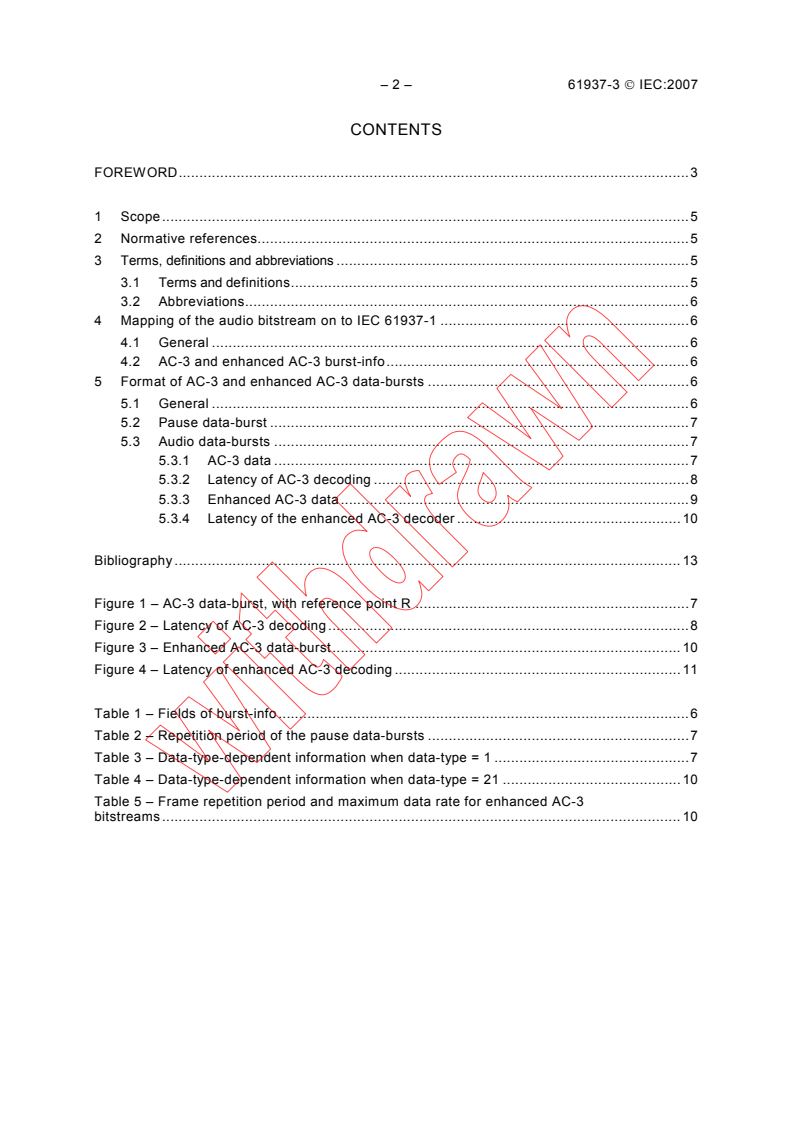
CONTENTS
FOREWORD.3
1 Scope.5
2 Normative references.5
3 Terms, definitions and abbreviations .5
3.1 Terms and definitions.5
3.2 Abbreviations.6
4 Mapping of the audio bitstream on to IEC 61937-1 .6
4.1 General .6
4.2 AC-3 and enhanced AC-3 burst-info.6
5 Format of AC-3 and enhanced AC-3 data-bursts .6
5.1 General .6
5.2 Pause data-burst .7
5.3 Audio data-bursts .7
5.3.1 AC-3 data .7
5.3.2 Latency of AC-3 decoding .8
5.3.3 Enhanced AC-3 data.9
5.3.4 Latency of the enhanced AC-3 decoder .10
Bibliography .13
Figure 1 – AC-3 data-burst, with reference point R .7
Figure 2 – Latency of AC-3 decoding.8
Figure 3 – Enhanced AC-3 data-burst.10
Figure 4 – Latency of enhanced AC-3 decoding .11
Table 1 – Fields of burst-info.6
Table 2 – Repetition period of the pause data-bursts .7
Table 3 – Data-type-dependent information when data-type = 1 .7
Table 4 – Data-type-dependent information when data-type = 21 .10
Table 5 – Frame repetition period and maximum data rate for enhanced AC-3
bitstreams.10
61937-3 © IEC:2007(E) – 3 –
INTERNATIONAL ELECTROTECHNICAL COMMISSION
___________
DIGITAL AUDIO –
INTERFACE FOR NON-LINEAR PCM ENCODED
AUDIO BITSTREAMS APPLYING IEC 60958 –
Part 3: Non-linear PCM bitstreams according to
the AC-3 and enhanced AC-3 formats
FOREWORD
1) The International Electrotechnical Commission (IEC) is a worldwide organization for standardization comprising
all national electrotechnical committees (IEC National Committees). The object of IEC is to promote
international co-operation on all questions concerning standardization in the electrical and electronic fields. To
this end and in addition to other activities, IEC publishes International Standards, Technical Specifications,
Technical Reports, Publicly Available Specifications (PAS) and Guides (hereafter referred to as “IEC
Publication(s)”). Their preparation is entrusted to technical committees; any IEC National Committee interested
in the subject dealt with may participate in this preparatory work. International, governmental and non-
governmental organizations liaising with the IEC also participate in this preparation. IEC collaborates closely
with the International Organization for Standardization (ISO) in accordance with conditions determined by
agreement between the two organizations.
2) The formal decisions or agreements of IEC on technical matters express, as nearly as possible, an international
consensus of opinion on the relevant subjects since each technical committee has representation from all
interested IEC National Committees.
3) IEC Publications have the form of recommendations for international use and are accepted by IEC National
Committees in that sense. While all reasonable efforts are made to ensure that the technical content of IEC
Publications is accurate, IEC cannot be held responsible for the way in which they are used or for any
misinterpretation by any end user.
4) In order to promote international uniformity, IEC National Committees undertake to apply IEC Publications
transparently to the maximum extent possible in their national and regional publications. Any divergence
between any IEC Publication and the corresponding national or regional publication shall be clearly indicated in
the latter.
5) IEC provides no marking procedure to indicate its approval and cannot be rendered responsible for any
equipment declared to be in conformity with an IEC Publication.
6) All users should ensure that they have the latest edition of this publication.
7) No liability shall attach to IEC or its directors, employees, servants or agents including individual experts and
members of its technical committees and IEC National Committees for any personal injury, property damage or
other damage of any nature whatsoever, whether direct or indirect, or for costs (including legal fees) and
expenses arising out of the publication, use of, or reliance upon, this IEC Publication or any other IEC
Publications.
8) Attention is drawn to the Normative references cited in this publication. Use of the referenced publications is
indispensable for the correct application of this publication.
9) Attention is drawn to the possibility that some of the elements of this IEC Publication may be the subject of
patent rights. IEC shall not be held responsible for identifying any or all such patent rights.
International Standard IEC 61937-3 has been prepared by technical area 4: Digital system
interfaces, of IEC technical committee 100: Audio, video and multimedia systems and
equipment.
This second edition of IEC 61937-3 cancels and replaces the first edition published in 2003.
This edition contains the following significant technical changes with respect to the previous
edition.
a) The definition of the audio data-burst required to deliver enhanced AC-3 bitstreams has
been added.
b) The definition of the latency of an enhanced AC-3 decoder has been added.
c) The use of pause data-bursts when delivering enhanced AC-3 bitstreams has been added.
– 4 – 61937-3 © IEC:2007(E)
The text of this standard is based on the following documents:
CDV Report on voting
100/1207/CDV 100/1291/RVC
Full information on the voting for the approval of this standard can be found in the report on
voting indicated in the above table.
This publication has been drafted in accordance with the ISO/IEC Directives, Part 2.
The list of all the parts of the IEC 61937 series, under the general title Digital audio – Interface
for non-linear PCM encoded audio bitstreams applying IEC 60958, can be found on the IEC
website.
The committee has decided that the contents of this publication will remain unchanged until the
maintenance result date indicated on the IEC web site under "http://webstore.iec.ch" in the data
related to the specific publication. At this date, the publication will be
• reconfirmed,
• withdrawn,
• replaced by a revised edition, or
• amended.
A bilingual version of this publication may be issued at a later date.
61937-3 © IEC:2007(E) – 5 –
DIGITAL AUDIO –
INTERFACE FOR NON-LINEAR PCM ENCODED
AUDIO BITSTREAMS APPLYING IEC 60958 –
Part 3: Non-linear PCM bitstreams according to
the AC-3 and enhanced AC-3 formats
1 Scope
This part of IEC 61937 describes the method used to convey non-linear PCM bitstreams
encoded according to the AC-3 and enhanced AC-3 formats.
2 Normative references
The following referenced documents are indispensable for the application of this document. For
dated references, only the edition cited applies. For undated references, the latest edition of
the referenced document (including any amendments) applies.
IEC 60958 (all parts), Digital audio interface
IEC 61937-1:2007, Digital audio interface for non-linear PCM encoded audio bitstreams
applying IEC 60958 – Part 1: General
IEC 61937-2:2007, Digital audio interface for non-linear PCM encoded audio bitstreams
applying IEC 60958 – Part 2: Burst-info
ATSC Standard A/52B, Digital Audio Compression (AC-3, E-AC-3), Rev. B
ETSI TS 102 366, Digital Audio Compression (AC-3, Enhanced AC-3)
3 Terms and definitions
For the purposes of this standard, the following terms, definitions and abbreviations apply.
3.1 Terms and definitions
3.1.1
latency
delay time of an external audio decoder to decode an AC-3 or enhanced AC-3 data burst,
defined as the sum of two values of the receiving delay time and the decoding delay time.
3.1.2
stream type
an enhanced AC-3 bitstream is constructed from one or more substreams, with each
substream being constructed from a sequence of frames. The stream type parameter of an
enhanced AC-3 frame identifies the type of substream of which the frame is a part
– 6 – 61937-3 © IEC:2007(E)
3.1.3
substream identification
substream identification parameter of an enhanced AC-3 frame which, in conjunction with the
stream type parameter, identifies the substream in the bitstream of which the enhanced AC-3
frame is a part
3.1.4
converter synchronization flag
flag used for synchronization by a device that converts an enhanced AC-3 bitstream to a
bitstream compliant with an AC-3 decoder and indicates that the first block in this enhanced
AC-3 frame will form the first block of the AC-3 frame output by the conversion process
3.1.5
block identification flag
if the stream type value of an enhanced AC-3 substream is two, indicating that the bitstream
has been converted from an AC-3 bitstream, this bit is set to 1 to indicate that the first block in
this enhanced AC-3 frame was the first block in the original standard AC-3 frame
3.2 Abbreviations
ATSC Advanced Television Standards Committee
ETSI European Telecommunication Standards Institute
IEC International Electrotechnical Commission
ISO/IEC MPEG Moving Pictures Expert Group, a joint committee of ISO and IEC
4 Mapping of the audio bitstream on to IEC 61937-1
4.1 General
The coding of the bitstream and data-burst is in accordance with IEC 61937-1 and 61937-2.
4.2 AC-3 and enhanced AC-3 burst-info
The 16-bit burst-info contains information about the data which will be found in the data-burst
(see Table 1).
Table 1 – Fields of burst-info
Data- Sub- Contents Reference Repetition period of
type data-type point R data-burst measured in
IEC 60958 frames
Value of Value of
Pc bits Pc bits
0-4 5-6
1 0 AC-3 R-AC-3 1 536
21 0 Enhanced AC-3 Bit 0 of Pa 6 144
1-3 Reserved Reserved Reserved
5 Format of AC-3 and enhanced AC-3 data-bursts
5.1 General
This clause specifies the audio data-bursts AC-3 and enhanced AC-3. Specific properties such
as reference points, repetition periods, the method of filling stream gaps, and decoding latency
are specified.
61937-3 © IEC:2007(E) – 7 –
The decoding latency (or delay), indicated for the data-type, should be used by the transmitter
to schedule data-bursts as necessary to establish synchronization between picture and
decoded audio.
5.2 Pause data-burst
Pause data-bursts for AC-3 and enhanced AC-3 are given in Table 2.
Table 2 – Repetition period of the pause data-bursts
Repetition period of pause data-burst
Data-type of audio data-burst
Mandatory Recommended
AC-3 - 3 IEC 60958 frames
Enhanced AC-3 - 4 IEC 60958 frames
5.3 Audio data-bursts
5.3.1 AC-3 data
The AC-3 bitstream consists of a sequence of AC-3 frames. The data-type of an AC-3
data-burst is 1. An AC-3 frame represents 1 536 samples of each encoded audio channel (left,
centre, etc.). The data-burst is headed with a burst-preamble followed by the burst-payload.
The burst-payload of each data burst of AC-3 data shall contain one complete AC-3 frame.
Figure 1 shows the structure of the AC-3 data-burst.
The length of the
...
IEC 61937-3 ®
Edition 2.0 2007-11
INTERNATIONAL
STANDARD
NORME
INTERNATIONALE
Digital audio – Interface for non-linear PCM encoded audio bitstreams applying
IEC 60958 –
Part 3: Non-linear PCM bitstreams according to the AC-3 and enhanced AC-3
formats
Audionumérique – Interface pour les flux de bits audio à codage MIC non
linéaire conformément à la CEI 60958 –
Partie 3: Flux de bits MIC non linéaire selon les formats AC-3 et AC-3 amélioré
All rights reserved. Unless otherwise specified, no part of this publication may be reproduced or utilized in any form
or by any means, electronic or mechanical, including photocopying and microfilm, without permission in writing from
either IEC or IEC's member National Committee in the country of the requester.
If you have any questions about IEC copyright or have an enquiry about obtaining additional rights to this publication,
please contact the address below or your local IEC member National Committee for further information.
Droits de reproduction réservés. Sauf indication contraire, aucune partie de cette publication ne peut être reproduite ni
utilisée sous quelque forme que ce soit et par aucun procédé, électronique ou mécanique, y compris la photocopie et les
microfilms, sans l'accord écrit de la CEI ou du Comité national de la CEI du pays du demandeur.
Si vous avez des questions sur le copyright de la CEI ou si vous désirez obtenir des droits supplémentaires sur cette
publication, utilisez les coordonnées ci-après ou contactez le Comité national de la CEI de votre pays de résidence.
IEC Central Office Tel.: +41 22 919 02 11
3, rue de Varembé Fax: +41 22 919 03 00
CH-1211 Geneva 20 info@iec.ch
Switzerland www.iec.ch
About the IEC
The International Electrotechnical Commission (IEC) is the leading global organization that prepares and publishes
International Standards for all electrical, electronic and related technologies.
About IEC publications
The technical content of IEC publications is kept under constant review by the IEC. Please make sure that you have the
latest edition, a corrigenda or an amendment might have been published.
Useful links:
IEC publications search - www.iec.ch/searchpub Electropedia - www.electropedia.org
The advanced search enables you to find IEC publications The world's leading online dictionary of electronic and
by a variety of criteria (reference number, text, technical electrical terms containing more than 30 000 terms and
committee,…). definitions in English and French, with equivalent terms in
It also gives information on projects, replaced and additional languages. Also known as the International
withdrawn publications. Electrotechnical Vocabulary (IEV) on-line.
IEC Just Published - webstore.iec.ch/justpublished Customer Service Centre - webstore.iec.ch/csc
Stay up to date on all new IEC publications. Just Published If you wish to give us your feedback on this publication
details all new publications released. Available on-line and or need further assistance, please contact the
also once a month by email. Customer Service Centre: csc@iec.ch.
A propos de la CEI
La Commission Electrotechnique Internationale (CEI) est la première organisation mondiale qui élabore et publie des
Normes internationales pour tout ce qui a trait à l'électricité, à l'électronique et aux technologies apparentées.
A propos des publications CEI
Le contenu technique des publications de la CEI est constamment revu. Veuillez vous assurer que vous possédez
l’édition la plus récente, un corrigendum ou amendement peut avoir été publié.
Liens utiles:
Recherche de publications CEI - www.iec.ch/searchpub Electropedia - www.electropedia.org
La recherche avancée vous permet de trouver des Le premier dictionnaire en ligne au monde de termes
publications CEI en utilisant différents critères (numéro de électroniques et électriques. Il contient plus de 30 000
référence, texte, comité d’études,…). termes et définitions en anglais et en français, ainsi que
Elle donne aussi des informations sur les projets et les les termes équivalents dans les langues additionnelles.
publications remplacées ou retirées. Egalement appelé Vocabulaire Electrotechnique
International (VEI) en ligne.
Just Published CEI - webstore.iec.ch/justpublished
Service Clients - webstore.iec.ch/csc
Restez informé sur les nouvelles publications de la CEI.
Just Published détaille les nouvelles publications parues. Si vous désirez nous donner des commentaires sur
Disponible en ligne et aussi une fois par mois par email. cette publication ou si vous avez des questions
contactez-nous: csc@iec.ch.
IEC 61937-3 ®
Edition 2.0 2007-11
INTERNATIONAL
STANDARD
NORME
INTERNATIONALE
Digital audio – Interface for non-linear PCM encoded audio bitstreams applying
IEC 60958 –
Part 3: Non-linear PCM bitstreams according to the AC-3 and enhanced AC-3
formats
Audionumérique – Interface pour les flux de bits audio à codage MIC non
linéaire conformément à la CEI 60958 –
Partie 3: Flux de bits MIC non linéaire selon les formats AC-3 et AC-3 amélioré
INTERNATIONAL
ELECTROTECHNICAL
COMMISSION
COMMISSION
ELECTROTECHNIQUE
PRICE CODE
INTERNATIONALE
CODE PRIX M
ICS 33.160.30 ISBN 978-2-83220-522-8
– 2 – 61937-3 IEC:2007
CONTENTS
FOREWORD . 3
1 Scope . 5
2 Normative references. 5
3 Terms, definitions and abbreviations . 5
3.1 Terms and definitions . 5
3.2 Abbreviations . 6
4 Mapping of the audio bitstream on to IEC 61937-1 . 6
4.1 General . 6
4.2 AC-3 and enhanced AC-3 burst-info . 6
5 Format of AC-3 and enhanced AC-3 data-bursts . 6
5.1 General . 6
5.2 Pause data-burst . 7
5.3 Audio data-bursts . 7
5.3.1 AC-3 data . 7
5.3.2 Latency of AC-3 decoding . 8
5.3.3 Enhanced AC-3 data . 9
5.3.4 Latency of the enhanced AC-3 decoder . 10
Bibliography . 13
Figure 1 – AC-3 data-burst, with reference point R . 7
Figure 2 – Latency of AC-3 decoding . 8
Figure 3 – Enhanced AC-3 data-burst . 10
Figure 4 – Latency of enhanced AC-3 decoding . 11
Table 1 – Fields of burst-info . 6
Table 2 – Repetition period of the pause data-bursts . 7
Table 3 – Data-type-dependent information when data-type = 1 . 7
Table 4 – Data-type-dependent information when data-type = 21 . 10
Table 5 – Frame repetition period and maximum data rate for enhanced AC-3
bitstreams . 10
61937-3 IEC:2007 – 3 –
INTERNATIONAL ELECTROTECHNICAL COMMISSION
___________
DIGITAL AUDIO –
INTERFACE FOR NON-LINEAR PCM ENCODED
AUDIO BITSTREAMS APPLYING IEC 60958 –
Part 3: Non-linear PCM bitstreams according to
the AC-3 and enhanced AC-3 formats
FOREWORD
1) The International Electrotechnical Commission (IEC) is a worldwide organization for standardization comprising
all national electrotechnical committees (IEC National Committees). The object of IEC is to promote
international co-operation on all questions concerning standardization in the electrical and electronic fields. To
this end and in addition to other activities, IEC publishes International Standards, Technical Specifications,
Technical Reports, Publicly Available Specifications (PAS) and Guides (hereafter referred to as “IEC
Publication(s)”). Their preparation is entrusted to technical committees; any IEC National Committee interested
in the subject dealt with may participate in this preparatory work. International, governmental and non-
governmental organizations liaising with the IEC also participate in this preparation. IEC collaborates closely
with the International Organization for Standardization (ISO) in accordance with conditions determined by
agreement between the two organizations.
2) The formal decisions or agreements of IEC on technical matters express, as nearly as possible, an international
consensus of opinion on the relevant subjects since each technical committee has representation from all
interested IEC National Committees.
3) IEC Publications have the form of recommendations for international use and are accepted by IEC National
Committees in that sense. While all reasonable efforts are made to ensure that the technical content of IEC
Publications is accurate, IEC cannot be held responsible for the way in which they are used or for any
misinterpretation by any end user.
4) In order to promote international uniformity, IEC National Committees undertake to apply IEC Publications
transparently to the maximum extent possible in their national and regional publications. Any divergence
between any IEC Publication and the corresponding national or regional publication shall be clearly indicated in
the latter.
5) IEC provides no marking procedure to indicate its approval and cannot be rendered responsible for any
equipment declared to be in conformity with an IEC Publication.
6) All users should ensure that they have the latest edition of this publication.
7) No liability shall attach to IEC or its directors, employees, servants or agents including individual experts and
members of its technical committees and IEC National Committees for any personal injury, property damage or
other damage of any nature whatsoever, whether direct or indirect, or for costs (including legal fees) and
expenses arising out of the publication, use of, or reliance upon, this IEC Publication or any other IEC
Publications.
8) Attention is drawn to the Normative references cited in this publication. Use of the referenced publications is
indispensable for the correct application of this publication.
9) Attention is drawn to the possibility that some of the elements of this IEC Publication may be the subject of
patent rights. IEC shall not be held responsible for identifying any or all such patent rights.
International Standard IEC 61937-3 has been prepared by technical area 4: Digital system
interfaces, of IEC technical committee 100: Audio, video and multimedia systems and
equipment.
This second edition of IEC 61937-3 cancels and replaces the first edition published in 2003.
This edition contains the following significant technical changes with respect to the previous
edition.
a) The definition of the audio data-burst required to deliver enhanced AC-3 bitstreams has
been added.
b) The definition of the latency of an enhanced AC-3 decoder has been added.
c) The use of pause data-bursts when delivering enhanced AC-3 bitstreams has been added.
– 4 – 61937-3 IEC:2007
This bilingual version (2012-12) corresponds to the monolingual English version, published in
2007-11. The text of this standard is based on the following documents:
CDV Report on voting
100/1207/CDV 100/1291/RVC
Full information on the voting for the approval of this standard can be found in the report on
voting indicated in the above table.
The French version of this standard has not been voted upon.
This publication has been drafted in accordance with the ISO/IEC Directives, Part 2.
The list of all the parts of the IEC 61937 series, under the general title Digital audio – Interface
for non-linear PCM encoded audio bitstreams applying IEC 60958, can be found on the IEC
website.
The committee has decided that the contents of this publication will remain unchanged until the
maintenance result date indicated on the IEC web site under "http://webstore.iec.ch" in the data
related to the specific publication. At this date, the publication will be
• reconfirmed,
• withdrawn,
• replaced by a revised edition, or
• amended.
61937-3 IEC:2007 – 5 –
DIGITAL AUDIO –
INTERFACE FOR NON-LINEAR PCM ENCODED
AUDIO BITSTREAMS APPLYING IEC 60958 –
Part 3: Non-linear PCM bitstreams according to
the AC-3 and enhanced AC-3 formats
1 Scope
This part of IEC 61937 describes the method used to convey non-linear PCM bitstreams
encoded according to the AC-3 and enhanced AC-3 formats.
2 Normative references
The following referenced documents are indispensable for the application of this document. For
dated references, only the edition cited applies. For undated references, the latest edition of
the referenced document (including any amendments) applies.
IEC 60958 (all parts), Digital audio interface
IEC 61937-1:2007, Digital audio interface for non-linear PCM encoded audio bitstreams
applying IEC 60958 – Part 1: General
IEC 61937-2:2007, Digital audio interface for non-linear PCM encoded audio bitstreams
applying IEC 60958 – Part 2: Burst-info
ATSC Standard A/52B, Digital Audio Compression (AC-3, E-AC-3), Rev. B
ETSI TS 102 366, Digital Audio Compression (AC-3, Enhanced AC-3)
3 Terms and definitions
For the purposes of this standard, the following terms, definitions and abbreviations apply.
3.1 Terms and definitions
3.1.1
latency
delay time of an external audio decoder to decode an AC-3 or enhanced AC-3 data burst,
defined as the sum of two values of the receiving delay time and the decoding delay time
3.1.2
stream type
an enhanced AC-3 bitstream is constructed from one or more substreams, with each
substream being constructed from a sequence of frames. The stream type parameter of an
enhanced AC-3 frame identifies the type of substream of which the frame is a part
– 6 – 61937-3 IEC:2007
3.1.3
substream identification
substream identification parameter of an enhanced AC-3 frame which, in conjunction with the
stream type parameter, identifies the substream in the bitstream of which the enhanced AC-3
frame is a part
3.1.4
converter synchronization flag
flag used for synchronization by a device that converts an enhanced AC-3 bitstream to a
bitstream compliant with an AC-3 decoder and indicates that the first block in this enhanced
AC-3 frame will form the first block of the AC-3 frame output by the conversion process
3.1.5
block identification flag
if the stream type value of an enhanced AC-3 substream is two, indicating that the bitstream
has been converted from an AC-3 bitstream, this bit is set to 1 to indicate that the first block in
this enhanced AC-3 frame was the first block in the original standard AC-3 frame
3.2 Abbreviations
ATSC Advanced Television Standards Committee
ETSI European Telecommunication Standards Institute
IEC International Electrotechnical Commission
ISO/IEC MPEG Moving Pictures Expert Group, a joint committee of ISO and IEC
4 Mapping of the audio bitstream on to IEC 61937-1
4.1 General
The coding of the bitstream and data-burst is in accordance with IEC 61937-1 and 61937-2.
4.2 AC-3 and enhanced AC-3 burst-info
The 16-bit burst-info contains information about the data which will be found in the data-burst
(see Table 1).
Table 1 – Fields of burst-info
Data- Sub- Contents Reference Repetition period of
type data-type point R data-burst measured in
IEC 60958 frames
Value of Value of
Pc bits Pc bits
0-4 5-6
1 0 AC-3 R-AC-3 1 536
21 0 Enhanced AC-3 Bit 0 of Pa 6 144
1-3 Reserved Reserved Reserved
5 Format of AC-3 and enhanced AC-3 data-bursts
5.1 General
This clause specifies the audio data-bursts AC-3 and enhanced AC-3. Specific properties such
as reference points, repetition periods, the method of filling stream gaps, and decoding latency
are specified.
61937-3 IEC:2007 – 7 –
The decoding latency (or delay), indicated for the data-type, should be used by the transmitter
to schedule data-bursts as necessary to establish synchronization between picture and
decoded audio.
5.2 Pause data-burst
Pause data-bursts for AC-3 and enhanced AC-3 are given in Table 2.
Table 2 – Repetition period of the pause data-bursts
Repetition period of pause data-burst
Data-type of audio data-burst
Mandatory Recommended
AC-3 - 3 IEC 60958 frames
Enhanced AC-3 - 4 IEC 60958 frames
5.3 Audio data-bursts
5.3.1 AC-3 data
The AC-3 bitstream consists of a sequence of AC-3 frames. The data-type of an AC-3
data-burst is 1. An AC-3 frame represents 1 536 samples of each encoded audio channel (left,
centre, etc.). The data-burst is headed with a burst-preamble followed by the burst-payload.
The burst-payload of each data burst of AC-3 data shall contain one complete AC-3 frame.
Figure 1 shows the structure of the AC-3 data-burst.
The length of the AC-3 data-burst will depend on the encoded bit rate (which determines the
AC-3 frame length). The specification for the AC-3 bitstream may be found in ATSC Standard
A52/B or in ETSI TS 102 366.
Pa Pb Pc Pd AC-3 burst-payload Pa Pb Pc Pd AC-3 burst-payload
R-AC-3 R-AC-3
AC-3 frame Stuffing AC-3 frame
Regular rate of the AC-3 syncframes
Repetition period of the burst
Figure 1 – AC-3 data-burst, with reference point R
The data-type-dependent info for AC-3 is given in Table 3.
Table 3 – Data-type-dependent information when data-type = 1
Data type dependent,
Bits of Pc
bit number Contents
LSB.MSB
LSB…MSB
8-10 0-2 Value of ‘bsmod’ parameter in AC-3 elementary stream
11, 12 3-4 Reserved
– 8 – 61937-3 IEC:2007
The data-bursts containing AC-3 frames shall occur at a regular rate, with the reference point
of each AC-3 data-burst beginning (except in the case of a gap) 1 536 sampling periods of the
audio after the reference point of the preceding AC-3 data burst (of the same bitstream
number).
The reference point of an AC-3 data-burst (R-AC-3) is the IEC 60958 frame that occurs two-
thirds of the way through the AC-3 payload. The definition of the two-thirds value is the closest
integer to the value of the AC-3 frame size measured in 32-bit words multiplied by the value 2/3,
or
2/3 frame size = int (0,5 + (2/3) × (frame size in 32-bit words))
5.3.2 Latency of AC-3 decoding
The latency of an AC-3 decoder which receives this signal is specified, with respect to the
reference point of the AC-3 burst, to be equal to one AC-3 block time, which is equal to the
time occupied by 256 PCM samples at the encoded sampling frequency (5,33 ms for 48 kHz
sampling frequency; see Figure 2).
Pa Pb Pc Pd AC-3 burst-payload Pa Pb Pc Pd AC-3 burst-payload
R-AC-3 R-AC-3
AC-3 frame Stuffing AC-3 frame
Regular rate of the AC-3 syncframes
Latency of the AC-3 decoder
Figure 2 – Latency of AC-3 decoding
It is recommended that pause data-bursts be used to fill stream gaps in the AC-3 bitstream, as
described in IEC 61937-1, and that pause data-bursts be transmitted with a repetition period of
three IEC 60958 frames, except when other repetition periods are necessary to fill the precise
stream gap length (which may not be a multiple of three IEC 60958 frames), or to meet the
requirement on burst spacing (see IEC 61937-1, 6.3.3).
When a stream gap in an AC-3 stream is filled by a sequence of pause data-bursts, the Pa of
the first pause data-burst shall be located one frame repetition period following the Pa of the
previous AC-3 frame. It is recommended that the sequence(s) of pause data-bursts which fill
the stream gap should continue from this point up to (as close as possible considering the
three IEC 60958 frame length of the pause data-burst) the Pa of the first AC-3 data-burst which
follows the stream gap.
The gap length parameter contained in the pause data-burst is intended to be interpreted by
the AC-3 decoder as an indication of the number of decoded PCM samples which are missing
(due to the resulting audio gap). If the sizes of the AC-3 frames before and after the stream
gap are not equal (due to a bitrate change in the interrupted AC-3 bitstream), this value may
differ from the actual number of sampling periods of the audio contained in the stream gap due
to the definition of the AC-3 burst reference points.
Some AC-3 decoders may be capable of “concealing” audio gaps. The indication of the audio
gap length (gap-length) which may be included in the payload of the pause data-burst allows
the decoder to know how long an audio gap will need to be concealed, and thus allow the
decoder to optimize the concealment process for the actual audio gap length. AC-3 decoders
will most easily conceal audio gaps that have a length equal to an integral multiple of 256
61937-3 IEC:2007 – 9 –
samples. Thus, audio gaps of lengths 256, 512, 768, etc. sampling periods of the audio are
strongly preferred, and transmitters should provide stream gaps that represent audio gaps with
this granularity.
It is possible that an audio gap in an AC-3 stream is carried over this interface without there
also being a stream gap. This can happen when the audio gap length is small and there is a bit
rate change in the interrupted AC-3 bit stream, and the bit rate following the gap is larger than
the bit rate prior to the gap. Because of the definition of the reference point of the AC-3 data
burst, it is possible for the Pa of the first burst following a bitstream interruption to be less than
frame repetition period of the audio following the Pa of the burst preceding the gap, while the
reference point of the first burst following the bit stream interruption is more than one frame
repetition period of the audio after the reference point of the burst preceding the gap. When
this case occurs, since there is no stream gap to fill with pause bursts, there is no need to send
any pause bursts. The audio decoder will never be starved for data and can calculate the
length of the audio gap based on the reference points of the received AC-3 bursts.
5.3.3 Enhanced AC-3 data
An enhanced AC-3 bitstream is constructed from one or more substreams, with each
substream being constructed from a sequence of enhanced AC-3 frames. An enhanced AC-3
frame is constructed from blocks of audio data, each block representing 256 samples of audio
of each encoded audio channel (left, centre, etc.). An enhanced AC-3 frame can consist of one,
two, three, or six blocks of audio data. The number of blocks per enhanced AC-3 frame is the
same for all substreams present in the bitstream and is constant for the duration of the
bitstream.
The data-burst is headed with a burst-preamble, followed by the burst-payload. The data-type
of an enhanced AC-3 data-burst is 21, and the sub-data-type is 0. When enhanced AC-3 data
is being transmitted, the transmission device shall ensure that both the data-type and sub-data-
type values are set correctly. Additionally, the receiving device shall utilize both the data-type
and sub-data-type values to ensure that the content of the data-burst is correctly identified as
enhanced AC-3. The structure of the enhanced AC-3 data-burst is shown in Figure 3.
The enhanced AC-3 burst-payload shall always contain six blocks of coded audio data,
representing 1 536 samples of PCM audio, from each of the substreams present in the
bitstream. The transmission device shall ensure that the enhanced AC-3 burst-payload is
constructed only from complete enhanced AC-3 frames. It is prohibited to transmit a single
enhanced AC-3 frame using multiple data-bursts.
The transmission device shall ensure that the first enhanced AC-3 frame in the burst-payload is
the frame that has a stream type value of zero or two, and a substream identification value of
zero. When the enhanced AC-3 bitstream is constructed from frames that consist of six blocks
of audio data, one frame from each substream present in the bitstream shall be included in the
burst-payload.
When the enhanced AC-3 bitstream is constructed from frames that consist of less than six
blocks of audio, the transmission device shall ensure that the burst-payload contains the
number of enhanced AC-3 frames required to deliver six blocks of audio data from each
substream in the bitstream. For example, when the bitstream is constructed from frames that
consist of two blocks of audio data, the burst-payload shall contain three enhanced AC-3
frames from each substream in the bitstream. Additionally, when the number of blocks per
frame is less than six, the transmission device shall ensure that when the first substream in the
bitstream has a stream type value of zero, the first frame in the burst-payload shall be the
frame where the converter synchronization flag is set to one. When the first substream in the
bitstream has a stream type value of two, the first frame in the burst-payload shall be the frame
where the block identification flag is set to one.
The length of the enhanced AC-3 data-burst will depend on the encoded bit rate (which
determines the enhanced AC-3 frame length). The specification for the enhanced AC-3
bitstream may be found in ATSC Standard A/52B or in ETSI TS 102 366.
– 10 – 61937-3 IEC:2007
Enhanced AC-3 Enhanced AC-3
Pa Pb Pc Pd Pa Pb Pc Pd
burst-payload burst-payload
bit 0 of Pa Enhanced AC-3 bit 0 of Pa Enhanced AC-3
frame(s) frame(s)
Stuffing Stuffing
Regular rate of the enhanced AC-3 frames
Repetition period of the burst
Figure 3 – Enhanced AC-3 data-burst
The units of burst-length shall be in bytes. The maximum size of an enhanced AC-3
burst-payload is 24 560 bytes.
The data-type-dependent information for enhanced AC-3 is given in Table 4.
Table 4 – Data-type-dependent information when data-type = 21
Data type dependent,
Bits of Pc
bit number Contents
LSB.MSB
LSB…MSB
8-10 Value of ‘bsmod’ parameter in independent substream 0 of the
0-2
enhanced AC-3 elementary stream. If the ‘bsmod’ parameter is not
present in the enhanced AC-3 elementary stream, these bits shall be
set to ‘0’
11, 12 3-4 Reserved
The reference point of an enhanced AC-3 data-burst is bit 0 of Pa. The data-bursts containing
enhanced AC-3 frames shall occur at a regular rate. When enhanced AC-3 streams are
conveyed via the IEC 61937 interface, the IEC 60958 frame rate shall always be four times the
sample rate of the enhanced AC-3 bitstream, and the repetition period of the enhanced AC-3
data-burst shall be 6 144 sample periods. Table 5 shows the relationship between the frame
repetition period, the IEC 60958 frame rate, and the maximum available data rate for the
enhanced AC-3 bitstream.
Table 5 – Frame repetition period and maximum data rate
for enhanced AC-3 bitstreams
Encoded sample IEC 60958 frame Burst Maximum data
Frame repetition
rate rate duration rate
period
kHz kHz ms kbit/s
6 144 32 128 48 4 093
6 144 44,1 176,4 34,83 5 641
6 144 48 192 32 6 140
The maximum data rates in this table assume a provision for two IEC 60958 frames for
padding between bursts.
5.3.4 Latency of the enhanced AC-3 decoder
The latency of an enhanced AC-3 decoder is defined as the sum of the receiving delay time
and decoding delay time.
61937-3 IEC:2007 – 11 –
The receiving delay time is the time taken to receive the complete enhanced AC-3
burst-payload and is dependent on the encoded bitrate of the enhanced AC-3 bitstream. For
the purposes of maintaining synchronization (for example, with video), it is recommended that
a constant value of receiving delay time be assumed. This value is calculated on the basis of
the maximum possible size of an enhanced AC-3 burst-payload and is equal to the time
occupied by six 142 IEC 60958 frames at the IEC 60958 frame rate.
The decoding delay time is equal to the time occupied by one 792 PCM samples at the
encoded sampling frequency or seven 168 IEC 60958 frames at the IEC 60958 frame rate. See
Figure 4.
Enhanced AC-3 Enhanced AC-3 Enhanced AC-3
Pa Pb Pc Pd Pa Pb Pc Pd Pa Pb Pc Pd
burst-payload burst-payload burst-payload
bit 0 of Pa Enhanced AC-3 bit 0 of Pa Enhanced AC-3 bit 0 of Pa Enhanced AC-3
frame(s) frame(s) frame(s)
Stuffing Stuffing
Regular rate of the enhanced AC-3 frames
Repetition period of the burst
Latency of enhanced AC-3 decoder
Figure 4 – Latency of enhanced AC-3 decoding
It is recommended that pause data-bursts be used to fill stream gaps in the enhanced AC-3
bitstream, as described in IEC 61937-1, and that pause data-bursts be transmitted with a
repetition period of four IEC 60958 frames, except when other repetition periods are necessary
to fill the precise stream gap length (which may not be a multiple of four IEC 60958 frames) or
to meet the requirement on burst spacing (see IEC 61937-1, 6.3.3).
When a stream gap in an enhanced AC-3 stream is filled by a sequence of pause data-bursts,
the Pa of the first pause data-burst shall be located one frame repetition period following the
Pa of the previous enhanced AC-3 frame. It is recommended that the sequence(s) of pause
data-bursts which fill the stream gap should continue from this point up to (as close as possible
considering the four IEC 60958 frame lengths of the pause data-burst) the Pa of the first
enhanced AC-3 data-burst which follows the stream gap.
The gap length parameter contained in the pause data-burst is intended to be interpreted by
the enhanced AC-3 decoder as an indication of the number of decoded PCM samples which
are missing (due to the resulting audio gap). The gap length parameter indicates the gap length
measured in IEC 60958 frames at the IEC 60958 clock rate. As the clock rate of the IEC 60958
interface is always four times the sampling rate of the coded audio stream when delivering
enhanced AC-3 data, the value of the gap-length parameter is four times the number of PCM
audio samples which would be missing in the decoded output signal.
If the sizes of the enhanced AC-3 frames before and after the stream gap are not equal (due to
a bitrate change in the interrupted enhanced AC-3 bitstream), the number of audio sampling
periods indicated by the gap-length parameter may differ from the actual number of sampling
periods of the audio contained in the stream gap due to the definition of the enhanced AC-3
burst reference points.
Some enhanced AC-3 decoders may be capable of “concealing” audio gaps. The indication of
the audio gap length (gap-length) which may be included in the payload of the pause data-burst
allows the decoder to know how long an audio gap will need to be concealed and, thus, to
optimize the concealment process for the actual audio gap length. Enhanced AC-3 decoders
will most easily conceal audio gaps that have a length equal to an integral multiple of 256
decoded output samples. Thus, audio gap-length values of 1 024, 2 048, 3 072, etc. IEC 60958
– 12 – 61937-3 IEC:2007
frames are strongly preferred, and transmitters should provide stream gaps that represent
audio gaps with this granularity.
It is possible that an audio gap in an enhanced AC-3 stream is carried over this interface
without there also being a stream gap. This can happen when the audio gap length is small and
there is a bit rate change in the interrupted enhanced AC-3 bit stream, and the bit rate following
the gap is larger than the bit rate prior to the gap. Because of the definition of the reference
point of the enhanced AC-3 data burst, it is possible for the Pa of the first burst following a
bitstream interruption to be less than frame repetition period of the audio following the Pa of
the burst preceding the gap, while the reference point of the first burst following the bitstream
interruption is more than one frame repetition period of the audio after the reference point of
the burst preceding the gap. When this case occurs, since there is no stream gap to fill with
pause bursts, there is no need to send any pause bursts. The audio decoder will never be
starved for data and can calculate the length of the audio gap based on the reference points of
the received enhanced AC-3 bursts.
61937-3 IEC:2007 – 13 –
Bibliography
Technical Bulletin – Dolby® Digital Plus Transmission over the HDMI™ Interface has served as
a reference for the specification of the related data-type and other parts of IEC 61937.
This document is available under license from Dolby Laboratories Licensing Corporation. Dolby
is a registered trademark of Dolby Laboratories. HDMI, the HDMI logo and High-Definition
Multimedia Interface are trademarks or registered trademarks of HDMI Licensing LLC.
___________
– 14 – 61937-3 CEI:2007
SOMMAIRE
AVANT-PROPOS . 15
1 Domaine d’application . 17
2 Références normatives . 17
3 Termes et définitions . 17
3.1 Termes et définitions . 17
3.2 Abréviations . 18
4 Mappage du flux de bits audio sur l'interface CEI 61937-1 . 18
4.1 Généralités . 18
4.2 Salve d'informations aux formats AC-3 et AC-3 amélioré . 18
5 Format des salves de données AC-3 et AC-3 amélioré . 19
5.1 Généralités . 19
5.2 Salve de données de type Pause . 19
5.3 Salves de données audio . 19
5.3.1 Données au format AC-3 . 19
5.3.2 Latence du décodage AC-3 . 20
5.3.3 Données au format AC-3 amélioré . 21
5.3.4 Latence du décodeur AC-3 amélioré . 23
Bibliographie . 26
Figure 1 – Salve de données au format AC-3 avec, comme point de référence, R . 19
Figure 2 – Latence du décodage AC-3 . 20
Figure 3 – Salve de données au format AC-3 amélioré . 22
Figure 4 – Latence du décodage AC-3 amélioré . 24
Tableau 1 – Champs de la salve d’informations . 18
Tableau 2 – Période de répétition des salves de données de type Pause . 19
Tableau 3 – Informations dépendantes du type de données quand le type = 1 . 20
Tableau 4 – Informations dépendantes du type de données quand le type = 21 . 23
Tableau 5 – Période répétition de trames et débit de données maximal pour des flux de
bits au format AC-3 amélioré . 23
61937-3 CEI:2007 – 15 –
COMMISSION ÉLECTROTECHNIQUE INTERNATIONALE
___________
AUDIONUMÉRIQUE –
INTERFACE POUR LES FLUX DE BITS AUDIO À CODAGE MIC
NON LINÉAIRE CONFORMÉMENT À LA CEI 60958 –
Partie 3: Flux de bits MIC non linéaire
selon les formats AC-3 et AC-3 amélioré
AVANT-PROPOS
1) La Commission Electrotechnique Internationale (CEI) est une organisation mondiale de normalisation composée
de l'ensemble des comités électrotechniques nationaux (Comités nationaux de la CEI). La CEI a pour objet de
favoriser la coopération internationale pour toutes les questions de normalisation dans les domaines de
l'électricité et de l'électronique. A cet effet, la CEI – entre autres activités – publie des Normes internationales,
des Spécifications techniques, des Rapports techniques, des Spécifications accessibles au public (PAS) et des
Guides (ci-après dénommés "Publication(s) de la CEI"). Leur élaboration est confiée à des comités d’études,
aux travaux desquels tout Comité national intéressé par le sujet traité peut participer. Les organisations
internationales, gouvernementales et non gouvernementales, en liaison avec la CEI, participent également aux
travaux. La CEI collabore étroitement avec l'Organisation Internationale de Normalisation (ISO), selon des
conditions fixées par accord entre les deux organisations.
2) Les décisions ou accords officiels de la CEI concernant les questions techniques représentent, dans la mesure
du possible, un accord international sur les sujets étudiés, étant donné que les Comités nationaux de la CEI
intéressés sont représentés dans chaque comité d’études.
3) Les Publications de la CEI se présentent sous la forme de recommandations internationales et sont agréées
comme telles par les Comités nationaux de la CEI. Tous les efforts raisonnables sont entrepris afin que la CEI
s'assure de l'exactitude du contenu technique de ses publications; la CEI ne peut pas être tenue responsable de
l'éventuelle mauvaise utilisation ou interprétation qui en est faite par un quelconque utilisateur final.
4) Dans le but d'encourager l'uniformité internationale, les Comités nationaux de la CEI s'engagent, dans toute la
mesure possible, à appliquer de façon transparente les Publications de la CEI dans leurs publications
nationales et régionales. Toutes divergences entre toutes Publications de la CEI et toutes publications
nationales ou régionales correspondantes doivent être indiquées en termes clairs dans ces dernières.
5) La CEI n’a prévu aucune procédure de marquage valant indication d’approbation et n’engage pas sa
responsabilité pour les équipements déclarés conformes à une de ses Publications.
6) Tous les utilisateurs doivent s'assurer qu'ils sont en possession de la dernière édition de cette publication.
7) Aucune responsabilité ne doit être imputée à la CEI, à ses administrateurs, employés, auxiliaires ou
mandataires, y compris ses experts particuliers et les membres de ses comités d'études et des Comités
nationaux de la CEI, pour tout préjudice causé en cas de dommages corporels et matériels, ou de tout autre
dommage de quelque nature que ce soit, directe ou indirecte, ou pour supporter les coûts (y compris les frais de
justice) et les dépenses découlant de la publication ou de l'utilisation de cette Publication de la CEI ou de toute
autre Publication de la CEI, ou au crédit qui lui est accordé.
8) L'attention est attirée sur les références normatives citées dans cette publication. L'utilisation de publications
référencées est obligatoire pour une application correcte de la présente publication.
9) L’attention est attirée sur le fait que certains des éléments de la présente Publication de la CEI peuvent faire
l’objet de droits de propriété intellectuelle ou de droits analogues. La CEI ne saurait être tenue pour
responsable de ne pas avoir identifié de tels droits de propriété et de ne pas avoir signalé leur existence.
La Norme internationale CEI 61937-3 a été établie par le domaine technique 4: Interfaces des
systèmes numériques, du comité d’études 100 de la CEI: Systèmes et appareils audio, vidéo et
multimédia.
Cette seconde édition de la CEI 61937-3 annule et remplace la première édition parue en 2003.
La présente édition contient les importantes modifications techniques suivantes par rapport à
la précédente édition.
a) La définition de la salve de données audio nécessaire pour délivrer des flux de bits au
format AC-3 amélioré a été ajoutée.
b) La définition de la latence d'un décodeur AC-3 amélioré a été ajoutée.
c) L'utilisation de salves de données de type Pause lorsque des flux de bits au format AC-3
amélioré sont délivrés a été ajoutée.
– 16 – 61937-3 CEI:2007
La présente version bilingue (2012-12) correspond à la version anglaise monolingue publiée en
2007-11.
Le texte anglais de cette norme est issu des documents 100/1207/CDV et 100/1291/RVC.
Le rapport de vote 100/1291/RVC donne toute information sur le vote ayant abouti à
l’approbation de cette norme.
La version française n’a pas été soumise au vote.
La présente publication a été rédigée selon les Directives ISO/CEI, Partie 2.
La liste de toutes les parties de la série CEI 61937, présentées sous le titre général
Audionumérique – Interface pour les flux de bits audio à codage MIC non linéaire
conformément à la CEI 60958, est disponible sur site web de la CEI.
Le comité a décidé que le contenu de cette publication ne sera pas modifié avant la date de
maintenance indiquée sur le site web de la CEI sous "http://webstore.iec.ch" dans les données
relatives à la publication recherchée. A cette date, la publication sera
• reconduite,
• supp
...