

IEC 62851-3:2014
(Main)Alarm and electronic security systems - Social alarm systems - Part 3: Local unit and controller
General Information
- Abstract
IEC 62851-3:2014 specifies the minimum requirements and tests for local units and controllers forming part of a social alarm system. This International Standard applies to local units and controllers that receive an alarm triggering signal from manually or automatically activated trigger devices and convert this into an alarm signal for transmission to the alarm receiving centre or an alarm recipient. The design should also take into consideration situations where the user may be unable to send an alarm, or where an unwanted alarm may be sent, due to technical malfunctions or poor ergonomic design.
- Status
- Published
- Publication Date
- 09-Apr-2014
- Technical Committee
- TC 79 - Alarm and electronic security systems
- Current Stage
- PPUB - Publication issued
- Start Date
- 10-Apr-2014
- Completion Date
- 30-Apr-2014
Overview
IEC 62851-3:2014 is an internationally recognized standard developed by the International Electrotechnical Commission (IEC) for local units and controllers in social alarm systems. As part of the IEC 62851 series, this standard specifically defines the minimum functional requirements and tests that ensure reliable operation of local alarm units and controllers. These units play a crucial role by receiving signals from manual or automatic trigger devices and converting them into alarm signals for communication with alarm receiving centers or designated recipients.
The standard emphasizes system reliability, particularly in scenarios where users may be incapacitated or unable to activate alarms manually, and focuses on eliminating unwanted false alarms caused by technical faults or poor ergonomic design.
Key Topics
Functional Requirements
Detailed specifications covering power supply, input signal processing, two-way speech communication, signal output, and alarm transmission mechanisms. The standard mandates that local units and controllers maintain proper operation under a variety of conditions, including fault scenarios and power source interruptions.Input and Output Signal Handling
The local unit must correctly interpret signals from various types of trigger devices and support outputs for external controls or indicators to ensure clear communication pathways.Two-Way Voice Communication
Ensures robust bidirectional audio capabilities to facilitate direct communication during an alarm event, improving user safety and response efficacy.Environmental and Performance Testing
Defines rigorous test categories, including functional tests, environmental exposure (such as temperature, humidity, and mechanical stress), and interference monitoring for wire-free communications to guarantee operational reliability in diverse settings.Marking and Documentation
Mandates clear product marking, including essential information for identification and safety, alongside comprehensive documentation to support installation, usage, and maintenance.
Applications
IEC 62851-3:2014 is essential for manufacturers, installers, and service providers of social alarm systems focused on:
Residential Care and Assisted Living Facilities
Where vulnerable populations require immediate and reliable access to emergency assistance through alarms linked to local controllers.Medical Alert Systems
Enabling patients or elderly users to trigger alerts manually or automatically, with the system reliably transmitting emergency signals.Community Safety Programs
Deploying local units and controllers to enhance security and social care through integrated electronic alarm networks.Security and Electronic Safety Solutions
Ensuring alarms are effectively converted, transmitted, and communicated, minimizing false alarms and operational failures.
Related Standards
IEC 62851-3:2014 forms part of the comprehensive IEC 62851 series on social alarm systems, which includes multiple parts covering overall system requirements, trigger devices, and communication protocols. Other complementary standards that may be relevant include:
- IEC 62851-1 - General requirements for social alarm systems
- IEC 62851-2 - Requirements for alarm triggering devices
- Standards onalarm transmission security and electronic security systems under IEC technical committee 79
Integrating IEC 62851-3 with related IEC standards promotes interoperability, safety, and user-centric system design in the realm of social alarms and electronic security.
Keywords: IEC 62851-3, social alarm systems, local unit, controller, alarm triggering, electronic security systems, two-way communication, alarm transmission, system testing, international standard, IEC, safety devices
Relations
- Effective Date
- 10-Feb-2026
Get Certified
Connect with accredited certification bodies for this standard

CIS Institut d.o.o.
Personal Protective Equipment (PPE) certification body. Notified Body NB-2890 for EU Regulation 2016/425 PPE.

Kiwa BDA Testing
Building and construction product certification.
Kmetijski inštitut Slovenije
Agricultural Institute of Slovenia. Soil testing, plant health, agricultural product analysis.
Sponsored listings
Frequently Asked Questions
IEC 62851-3:2014 is a standard published by the International Electrotechnical Commission (IEC). Its full title is "Alarm and electronic security systems - Social alarm systems - Part 3: Local unit and controller". This standard covers: IEC 62851-3:2014 specifies the minimum requirements and tests for local units and controllers forming part of a social alarm system. This International Standard applies to local units and controllers that receive an alarm triggering signal from manually or automatically activated trigger devices and convert this into an alarm signal for transmission to the alarm receiving centre or an alarm recipient. The design should also take into consideration situations where the user may be unable to send an alarm, or where an unwanted alarm may be sent, due to technical malfunctions or poor ergonomic design.
IEC 62851-3:2014 specifies the minimum requirements and tests for local units and controllers forming part of a social alarm system. This International Standard applies to local units and controllers that receive an alarm triggering signal from manually or automatically activated trigger devices and convert this into an alarm signal for transmission to the alarm receiving centre or an alarm recipient. The design should also take into consideration situations where the user may be unable to send an alarm, or where an unwanted alarm may be sent, due to technical malfunctions or poor ergonomic design.
IEC 62851-3:2014 is classified under the following ICS (International Classification for Standards) categories: 13.320 - Alarm and warning systems. The ICS classification helps identify the subject area and facilitates finding related standards.
IEC 62851-3:2014 has the following relationships with other standards: It is inter standard links to EN IEC 62820-3-2:2018. Understanding these relationships helps ensure you are using the most current and applicable version of the standard.
IEC 62851-3:2014 is available in PDF format for immediate download after purchase. The document can be added to your cart and obtained through the secure checkout process. Digital delivery ensures instant access to the complete standard document.
Standards Content (Sample)
IEC 62851-3 ®
Edition 1.0 2014-04
INTERNATIONAL
STANDARD
NORME
INTERNATIONALE
Alarm and electronic security systems – Social alarm systems –
Part 3: Local unit and controller
Systèmes d'alarme et de sécurité électroniques – Systèmes d'alarme sociale –
Partie 3: Unité locale et contrôleur
All rights reserved. Unless otherwise specified, no part of this publication may be reproduced or utilized in any form
or by any means, electronic or mechanical, including photocopying and microfilm, without permission in writing from
either IEC or IEC's member National Committee in the country of the requester. If you have any questions about IEC
copyright or have an enquiry about obtaining additional rights to this publication, please contact the address below or
your local IEC member National Committee for further information.
Droits de reproduction réservés. Sauf indication contraire, aucune partie de cette publication ne peut être reproduite
ni utilisée sous quelque forme que ce soit et par aucun procédé, électronique ou mécanique, y compris la photocopie
et les microfilms, sans l'accord écrit de l'IEC ou du Comité national de l'IEC du pays du demandeur. Si vous avez des
questions sur le copyright de l'IEC ou si vous désirez obtenir des droits supplémentaires sur cette publication, utilisez
les coordonnées ci-après ou contactez le Comité national de l'IEC de votre pays de résidence.
IEC Central Office Tel.: +41 22 919 02 11
3, rue de Varembé Fax: +41 22 919 03 00
CH-1211 Geneva 20 info@iec.ch
Switzerland www.iec.ch
About the IEC
The International Electrotechnical Commission (IEC) is the leading global organization that prepares and publishes
International Standards for all electrical, electronic and related technologies.
About IEC publications
The technical content of IEC publications is kept under constant review by the IEC. Please make sure that you have the
latest edition, a corrigenda or an amendment might have been published.
IEC Catalogue - webstore.iec.ch/catalogue Electropedia - www.electropedia.org
The stand-alone application for consulting the entire The world's leading online dictionary of electronic and
bibliographical information on IEC International Standards, electrical terms containing more than 30 000 terms and
Technical Specifications, Technical Reports and other definitions in English and French, with equivalent terms in 14
documents. Available for PC, Mac OS, Android Tablets and additional languages. Also known as the International
iPad. Electrotechnical Vocabulary (IEV) online.
IEC publications search - www.iec.ch/searchpub IEC Glossary - std.iec.ch/glossary
The advanced search enables to find IEC publications by a More than 55 000 electrotechnical terminology entries in
variety of criteria (reference number, text, technical English and French extracted from the Terms and Definitions
committee,…). It also gives information on projects, replaced clause of IEC publications issued since 2002. Some entries
and withdrawn publications. have been collected from earlier publications of IEC TC 37,
77, 86 and CISPR.
IEC Just Published - webstore.iec.ch/justpublished
Stay up to date on all new IEC publications. Just Published IEC Customer Service Centre - webstore.iec.ch/csc
details all new publications released. Available online and If you wish to give us your feedback on this publication or
also once a month by email. need further assistance, please contact the Customer Service
Centre: csc@iec.ch.
A propos de l'IEC
La Commission Electrotechnique Internationale (IEC) est la première organisation mondiale qui élabore et publie des
Normes internationales pour tout ce qui a trait à l'électricité, à l'électronique et aux technologies apparentées.
A propos des publications IEC
Le contenu technique des publications IEC est constamment revu. Veuillez vous assurer que vous possédez l’édition la
plus récente, un corrigendum ou amendement peut avoir été publié.
Catalogue IEC - webstore.iec.ch/catalogue Electropedia - www.electropedia.org
Application autonome pour consulter tous les renseignements
Le premier dictionnaire en ligne de termes électroniques et
bibliographiques sur les Normes internationales,
électriques. Il contient plus de 30 000 termes et définitions en
Spécifications techniques, Rapports techniques et autres
anglais et en français, ainsi que les termes équivalents dans
documents de l'IEC. Disponible pour PC, Mac OS, tablettes
14 langues additionnelles. Egalement appelé Vocabulaire
Android et iPad.
Electrotechnique International (IEV) en ligne.
Recherche de publications IEC - www.iec.ch/searchpub
Glossaire IEC - std.iec.ch/glossary
Plus de 55 000 entrées terminologiques électrotechniques, en
La recherche avancée permet de trouver des publications IEC
en utilisant différents critères (numéro de référence, texte, anglais et en français, extraites des articles Termes et
comité d’études,…). Elle donne aussi des informations sur les Définitions des publications IEC parues depuis 2002. Plus
projets et les publications remplacées ou retirées. certaines entrées antérieures extraites des publications des
CE 37, 77, 86 et CISPR de l'IEC.
IEC Just Published - webstore.iec.ch/justpublished
Service Clients - webstore.iec.ch/csc
Restez informé sur les nouvelles publications IEC. Just
Published détaille les nouvelles publications parues. Si vous désirez nous donner des commentaires sur cette
Disponible en ligne et aussi une fois par mois par email. publication ou si vous avez des questions contactez-nous:
csc@iec.ch.
IEC 62851-3 ®
Edition 1.0 2014-04
INTERNATIONAL
STANDARD
NORME
INTERNATIONALE
Alarm and electronic security systems – Social alarm systems –
Part 3: Local unit and controller
Systèmes d'alarme et de sécurité électroniques – Systèmes d'alarme sociale –
Partie 3: Unité locale et contrôleur
INTERNATIONAL
ELECTROTECHNICAL
COMMISSION
COMMISSION
ELECTROTECHNIQUE
PRICE CODE
INTERNATIONALE
CODE PRIX W
ICS 13.320 ISBN 978-2-8322-1502-9
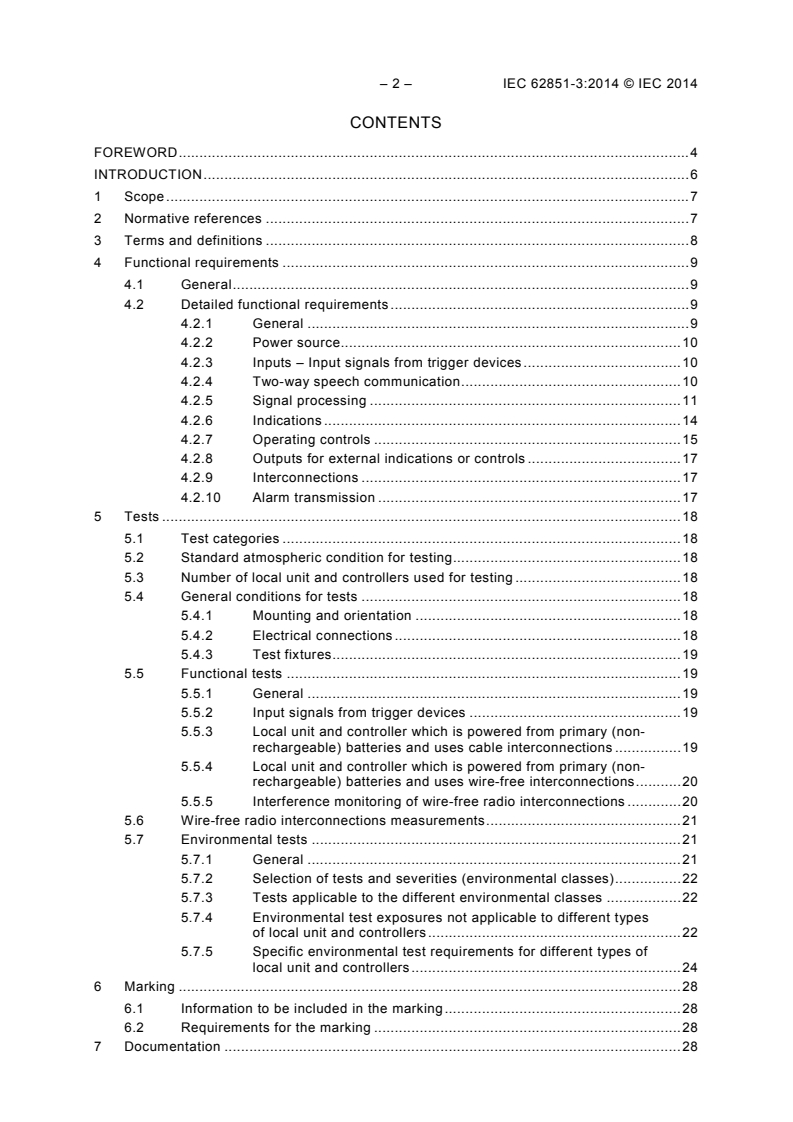
– 2 – IEC 62851-3:2014 © IEC 2014
CONTENTS
FOREWORD . 4
INTRODUCTION . 6
1 Scope . 7
2 Normative references . 7
3 Terms and definitions . 8
4 Functional requirements . 9
4.1 General . 9
4.2 Detailed functional requirements . 9
4.2.1 General . 9
4.2.2 Power source. 10
4.2.3 Inputs – Input signals from trigger devices . 10
4.2.4 Two-way speech communication . 10
4.2.5 Signal processing . 11
4.2.6 Indications . 14
4.2.7 Operating controls . 15
4.2.8 Outputs for external indications or controls . 17
4.2.9 Interconnections . 17
4.2.10 Alarm transmission . 17
5 Tests . 18
5.1 Test categories . 18
5.2 Standard atmospheric condition for testing. 18
5.3 Number of local unit and controllers used for testing . 18
5.4 General conditions for tests . 18
5.4.1 Mounting and orientation . 18
5.4.2 Electrical connections . 18
5.4.3 Test fixtures . 19
5.5 Functional tests . 19
5.5.1 General . 19
5.5.2 Input signals from trigger devices . 19
5.5.3 Local unit and controller which is powered from primary (non-
rechargeable) batteries and uses cable interconnections . 19
5.5.4 Local unit and controller which is powered from primary (non-
rechargeable) batteries and uses wire-free interconnections . 20
5.5.5 Interference monitoring of wire-free radio interconnections . 20
5.6 Wire-free radio interconnections measurements . 21
5.7 Environmental tests . 21
5.7.1 General . 21
5.7.2 Selection of tests and severities (environmental classes) . 22
5.7.3 Tests applicable to the different environmental classes . 22
5.7.4 Environmental test exposures not applicable to different types
of local unit and controllers . 22
5.7.5 Specific environmental test requirements for different types of
local unit and controllers . 24
6 Marking . 28
6.1 Information to be included in the marking . 28
6.2 Requirements for the marking . 28
7 Documentation . 28
Annex A (normative) Function, indication and timing of a local unit and controller in
relation to an alarm triggering signal . 30
Annex B (normative) Test set-up by using radio-frequency shielded test fixtures . 31
B.1 Radio-frequency shielded test fixture for the trigger device . 31
B.2 Radio-frequency shielded test fixture for the local unit and controller . 31
B.3 Connection between trigger device and local unit and controller . 31
B.4 Test set-up for testing of the interference monitoring of wire-free radio
interconnections. 32
Annex C (normative) Test method for electro-acoustical 2-way speech tests of
loudspeaker output and microphone input of the local unit . 34
C.1 Loudspeaker . 34
C.1.1 General . 34
C.1.2 Sound power . 34
C.1.3 Frequency range. 34
C.1.4 Distortion . 34
C.2 Microphone . 35
C.2.1 General . 35
C.2.2 Sensitivity . 35
C.2.3 Frequency characteristics . 35
C.2.4 Distortion . 35
Bibliography . 36
Figure A.1 – Function, indication and timing diagram of local unit and controller . 30
Figure B.1 – Radio-frequency shielded test fixtures and interconnections . 32
Figure B.2 – Test set-up for testing of the interference monitoring function . 33
Table 1 – Limits of frequency response . 11
Table 2 – Permissible time intervals by different types of fault . 13
Table 3 – Fault indications on the local unit and/or controller . 15
Table 4 – Environmental tests for fixed local unit and controller . 23
Table 5 – Environmental tests for movable local unit and controller . 24
– 4 – IEC 62851-3:2014 © IEC 2014
INTERNATIONAL ELECTROTECHNICAL COMMISSION
____________
ALARM AND ELECTRONIC SECURITY SYSTEMS –
SOCIAL ALARM SYSTEMS –
Part 3: Local unit and controller
FOREWORD
1) The International Electrotechnical Commission (IEC) is a worldwide organization for standardization comprising
all national electrotechnical committees (IEC National Committees). The object of IEC is to promote
international co-operation on all questions concerning standardization in the electrical and electronic fields. To
this end and in addition to other activities, IEC publishes International Standards, Technical Specifications,
Technical Reports, Publicly Available Specifications (PAS) and Guides (hereafter referred to as “IEC
Publication(s)”). Their preparation is entrusted to technical committees; any IEC National Committee interested
in the subject dealt with may participate in this preparatory work. International, governmental and non-
governmental organizations liaising with the IEC also participate in this preparation. IEC collaborates closely
with the International Organization for Standardization (ISO) in accordance with conditions determined by
agreement between the two organizations.
2) The formal decisions or agreements of IEC on technical matters express, as nearly as possible, an international
consensus of opinion on the relevant subjects since each technical committee has representation from all
interested IEC National Committees.
3) IEC Publications have the form of recommendations for international use and are accepted by IEC National
Committees in that sense. While all reasonable efforts are made to ensure that the technical content of IEC
Publications is accurate, IEC cannot be held responsible for the way in which they are used or for any
misinterpretation by any end user.
4) In order to promote international uniformity, IEC National Committees undertake to apply IEC Publications
transparently to the maximum extent possible in their national and regional publications. Any divergence
between any IEC Publication and the corresponding national or regional publication shall be clearly indicated in
the latter.
5) IEC itself does not provide any attestation of conformity. Independent certification bodies provide conformity
assessment services and, in some areas, access to IEC marks of conformity. IEC is not responsible for any
services carried out by independent certification bodies.
6) All users should ensure that they have the latest edition of this publication.
7) No liability shall attach to IEC or its directors, employees, servants or agents including individual experts and
members of its technical committees and IEC National Committees for any personal injury, property damage or
other damage of any nature whatsoever, whether direct or indirect, or for costs (including legal fees) and
expenses arising out of the publication, use of, or reliance upon, this IEC Publication or any other IEC
Publications.
8) Attention is drawn to the Normative references cited in this publication. Use of the referenced publications is
indispensable for the correct application of this publication.
9) Attention is drawn to the possibility that some of the elements of this IEC Publication may be the subject of
patent rights. IEC shall not be held responsible for identifying any or all such patent rights.
International Standard IEC 62851-3 has been prepared by IEC technical committee 79: Alarm
and electronic security systems.
This first edition is based on EN 50134-3:2012.
The text of this standard is based on the following documents:
FDIS Report on voting
79/458/FDIS 79/469/RVD
Full information on the voting for the approval of this standard can be found in the report on
voting indicated in the above table.
This publication has been drafted in accordance with the ISO/IEC Directives, Part 2.
A list of all parts in the IEC 62851 series, published under the general title Alarm and
electronic security systems – Social alarm systems, can be found on the IEC website.
The committee has decided that the contents of this publication will remain unchanged until
the stability date indicated on the IEC web site under "http://webstore.iec.ch" in the data
related to the specific publication. At this date, the publication will be
• reconfirmed,
• withdrawn,
• replaced by a revised edition, or
• amended.
– 6 – IEC 62851-3:2014 © IEC 2014
INTRODUCTION
This standard is part of the IEC 62851 series of International Standards and Technical
Specifications “Alarm and electronic security systems – Social alarms systems“, written to
include the following parts:
– Part 1: System requirements
– Part 2: Trigger devices
– Part 3: Local unit and controller
– Part 5: Interconnections and communications
– Part 7: Application guidelines (under consideration)
A social alarm system provides 24 hours facilities for alarm triggering, identification, signal
transmission, alarm reception, logging and 2-way speech communication, to provide
reassurance and assistance for people living at home or at places under surveillance and
considered to be at risk.
A social alarm system is comprised of a number of system parts which can be configured in
different ways to provide this functionality.
A user can request assistance by the use of a manually activated trigger device resulting in
an alarm triggering signal. In certain cases, alarm triggering signals can be generated by
automatic trigger devices. A local unit or controller receives the alarm triggering signal,
switching from the normal to the alarm condition and indicating this to the user (some systems
use an optional pre-alarm condition that allows the user to reset the alarm for a short period
of time).
The controller normally transmits the alarm condition to an Alarm Receiving Centre (ARC) via
the alarm transmission system. The ARC can either be local to the controller or remote from
the controller. The ARC has the facility to identify the local unit, alarm type and to then
establish two-way speech communication between the alarm recipient and the user. The
alarm recipient provides reassurance to the user and directs assistance where appropriate.
In some cases, the alarm may be diverted to an alarm recipient using a personal receiver. In
this case, the alarm is identified to the alarm recipient and a two-way speech communication
path established to the user and receipt of the alarm acknowledged to the controller. In all
cases, the system records the time, date, location and type of alarm.
The system is designed to detect and report fault conditions affecting the transmission of
alarms. In some cases, temporary disconnection of a local unit is possible to minimize faults
or prevent alarms triggered inadvertently affecting the correct operation of the system.
ALARM AND ELECTRONIC SECURITY SYSTEMS –
SOCIAL ALARM SYSTEMS –
Part 3: Local unit and controller
1 Scope
This part of IEC 62851 specifies the minimum requirements and tests for local units and
controllers forming part of a social alarm system.
This International Standard applies to local units and controllers that receive an alarm
triggering signal from manually or automatically activated trigger devices and convert this into
an alarm signal for transmission to the alarm receiving centre or an alarm recipient.
The local unit and controller may be either separate units or integrated into one unit.
The design should also take into consideration situations where the user may be unable to
send an alarm, or where an unwanted alarm may be sent, due to technical malfunctions or
poor ergonomic design.
2 Normative references
The following documents, in whole or in part, are normatively referenced in this document and
are indispensable for its application. For dated references, only the edition cited applies. For
undated references, the latest edition of the referenced document (including any
amendments) applies.
IEC 60068-1:1988, Environmental testing – Part 1: General and guidance
IEC 60529, Degrees of protection provided by enclosures (IP Code)
IEC 62599-1:2010, Alarm systems – Part 1: Environmental test methods
IEC 62599-2:2010, Alarm systems – Part 2: Electromagnetic compatibility – Immunity
requirements for components of fire and security alarm systems
IEC 62851-1, Alarm and electronic security systems – Social alarm systems – Part 1: System
requirements
IEC 62851-2, Alarm and electronic security systems – Social alarm systems – Part 2: Trigger
devices
ISO 3741, Acoustics – Determination of sound power levels and sound energy levels of noise
sources using sound pressure – Precision methods for reverberation test rooms
ETSI EN 300 220-1, Electromagnetic compatibility and Radio spectrum Matters (ERM); Short
Range Devices (SRD); Radio equipment to be used in the 25 MHz to 1 000 MHz frequency
range with power levels ranging up to 500 mW – Part 1: Technical characteristics and test
methods
– 8 – IEC 62851-3:2014 © IEC 2014
ETSI EN 300 440-1, Electromagnetic compatibility and Radio spectrum Matters (ERM);Short
range devices;Radio equipment to be used in the 1 GHz to 40 GHz frequency range – Part 1:
Technical characteristics and test methods
ETSI EN 301 406, Digital Enhanced Cordless Telecommunications (DECT);Harmonized EN for
Digital Enhanced Cordless Telecommunications (DECT) covering the essential requirements
under article 3.2 of the R&TTE Directive; Generic radio
3 Terms and definitions
For the purposes of this document, the terms and definitions given in IEC 62851-1, as well as
the following apply.
3.1
activity monitoring trigger device
alarm device that operates automatically when a routine activity of the user, being monitored
by a trigger device, is modified within a specified period
3.2
alarm transmission equipment
equipment which is primarily for the transmission of alarm and fault signals from the local unit
and controller to the alarm receiving centre or the alarm recipient and which may be integral
to the local unit and controller
3.3
disconnection condition
temporary and deliberate disconnection of a local unit to prevent alarm or fault transmission
to the controller or the alarm receiving centre
3.4
disconnection indication
indication of the disconnection condition
3.5
fixed trigger device
trigger device in a fixed position
3.6
interconnections
transmission system that provides the communication between trigger devices and local unit
and controller
3.7
portable trigger device
trigger device carried by the user and providing wire-free communication
3.8
pre-alarm warning indication
indication at the local unit that the local unit is in the pre-alarm condition
3.9
reassurance indication
indication provided locally in alarm condition in order to verify to the user that the local unit
has received the alarm triggering signal
3.10
reset
return to the normal condition where only one alarm triggering signal has been received
3.11
two-way speech
speech communication originating at either end of the connection and received by the other
4 Functional requirements
4.1 General
Unless otherwise noted the following requirements of this standard are the same for a local
unit and a controller:
a) if an optional function is implemented the related requirement shall be fulfilled;
b) the local unit and controller shall be protected against environmental influences by a box
or a cabinet of suitable mechanical strength, which shall be classified to at least IP30 and
IP32 for where it is intended for table top use as specified in IEC 60529;
NOTE 1 If the controller is installed in a separate protected and locked room, the requirement is not
applicable.
c) all visual indicators described in 4.2.6 and manual controls described in 4.2.7 for a local
unit or combined local unit and controller shall be contained in one mechanical unit and
their purpose shall be clearly indicated;
NOTE 2 If the controller is a separate unit all manual controls and visual indications related to the function or
facility of the controller is contained in the separate controller.
d) the local unit and controller shall be suitable for use in its intended environment and as a
minimum shall satisfy the tests specified in 5.7 to meet the requirements for environmental
class 1.
4.2 Detailed functional requirements
4.2.1 General
The functions of a local unit and controller are divided into the following groups:
• power source,
• inputs,
• two-way speech communication,
• signal processing,
• indications,
• operating controls,
• outputs for external indications or controls (optional),
• interconnections,
• alarm transmission.
Where an alarm system consists of a local unit and a controller with separate alarm
transmission equipment and / or separate radio transceiver equipment, the requirements for
the local unit and controller shall apply to the related separate equipment, to the extent that
those requirements are applicable to the intended functionality of the additional equipment.
– 10 – IEC 62851-3:2014 © IEC 2014
4.2.2 Power source
4.2.2.1 Primary power source
The conditions under which requirements concerning the primary power source have to be
tested are the following:
a) the local unit or controller shall have a visual indication that it is operating using the
primary power source and is in the normal condition;
b) if the primary source of power is a battery, it shall be capable of supplying power to the
local unit and controller for a minimum of 12 months of normal operation, including a
minimum of one alarm transmission and two-way-speech communication per day for a
minimum of 1 min. Additionally the local unit and controller shall be capable of indicating a
battery low fault warning signal at the local unit and controller, and transmitting a fault
signal to the alarm receiving centre or an alarm recipient automatically for a minimum of
seven days.
4.2.2.2 Secondary supply input
Where the primary power source is mains power or the alarm transmission system then:
a) if the primary power source is interrupted the local unit and controller shall automatically
be switched to the secondary power source without any interruption to the operation of the
device;
b) in the case of failure of the primary power source,
1) power to the local unit and controller shall be maintained by a secondary power
source;
2) the secondary power source shall be capable of supplying power to the local unit and
controller for a minimum of 24 h in normal condition, including a minimum of half an
hour of alarm condition during which alarm transmission and two-way speech
communication occurs;
3) the local unit and controller shall be capable of indicating a battery low fault warning
signal at the local unit and controller, and transmitting it to the alarm receiving centre
or an alarm recipient automatically;
4) the battery low fault warning signal shall be generated no less than two hours before
there shall be insufficient power to operate the unit as required in 4.2.2.2, items b) 2)
and b) 3);
c) if the secondary power source is a rechargeable battery a fully discharged battery shall be
recharged to a minimum of 80 % of its nominal capacity within 24 h and to its rated
capacity within another 48 h.
4.2.3 Inputs – Input signals from trigger devices
a) The input signals from trigger devices are transmitted to the local unit and controller via
cable and/or wire-free transmission. Such signals shall be stored in the local unit and
controller, indicated and transmitted to the alarm receiving centre or an alarm recipient in
accordance with the functional requirements of this standard.
b) For wire free trigger devices using a radio interconnection, without managed spectrum
access only radio frequencies dedicated to social alarm systems shall be used for the
transmission of alarm and fault conditions.
4.2.4 Two-way speech communication
4.2.4.1 General
The testing conditions under which requirements concerning the two–way speech
communication are the following:
a) there shall be a two-way speech communication facility between the local unit and
controller and the ARC or the alarm recipient;
b) the two-way speech communication shall require no manual operation at the local unit;
c) the part of the local unit and controller which is used to provide two-way speech
communication shall fulfil the requirements specified in 4.2.4.2 and 4.2.4.3.
The test methods to be used for the verification of conformance with these requirements
are given in the normative Annex C.
4.2.4.2 Loudspeaker output of the local unit
The requirements concerning the loudspeaker output of the local unit are the following:
a) the local unit shall be capable of delivering an A-weighted sound power level of not less
than 90 dB re 1 pW, with less than 10 % harmonic distortion;
b) the output shall be adjustable to less than 70 dB re 1 pW;
c) the frequency response shall be within the limits shown in Table 1.
Table 1 – Limits of frequency response
Frequency band Upper limit Lower limit
315 Hz to 630 Hz –10 dB at 315 Hz increasing
+5 dB
linearly with the logarithm of the
frequency to –5 dB at 630 Hz
630 Hz to 3 150 Hz –5 dB
+5 dB
4.2.4.3 Microphone input of the local unit
The requirements concerning the microphone input of the local unit are the following:
a) If the local unit and controller is connected to an analogue PSTN or equivalent leased line
transmission system then it shall be capable of delivering an analogue output signal to the
alarm transmission system of (–15 ± 3) dBV into a reference impedance ZR with less than
10 % harmonic distortion when the microphone is exposed to a sound pressure level of
60 dB re 20 µPa.
b) If the local unit and controller is designed for connection to other alarm transmission
systems, then it shall output to the alarm transmission a signal representing 100 % of the
local unit and controller’s maximum output when the microphone is exposed to a sound
pressure level of 90 dB re 20 µPa.
c) The frequency response shall be within ± 5 dB in the frequency range of 315 Hz to
3,15 kHz.
4.2.5 Signal processing
4.2.5.1 General
Requirements concerning the signal processing are the following:
a) the processing of an alarm triggering signal shall comply with the requirements to
function, indication and timing as shown in the Figure A.1 of Annex A and described in
4.2.5.2 and 4.2.5.3;
b) if a manually selectable condition can inhibit the sending of an alarm signal it shall not be
possible to select this condition without the use of a tool, key or code;
c) in the event of more than one signal, none of the signals that have not already been
processed shall be lost;
d) alarm signals shall have priority over all other signals;
e) where the controller is designed for use with more than one local unit, it shall have:
1) the facility to support more than one concurrent alarm transmission session;
– 12 – IEC 62851-3:2014 © IEC 2014
2) sufficient capacity to process, route and manage the number of concurrent alarm
transmission sessions for which it is rated without deterioration in respect of the
performance of the controller against the requirements in this standard or delays in the
transmission of speech between a local unit and the ARC.
4.2.5.2 Pre-alarm condition
This subclause is optional.
Requirements concerning the pre-alarm condition are the following:
a) the indication of the pre-alarm condition shall be given and cancellation of the pre-alarm
warning signal shall be possible in accordance with 4.2.6.2 and 4.2.6.3 respectively;
b) the pre-alarm condition shall be initiated after the reception of an alarm triggering signal;
c) if this condition is not cancelled within the pre-alarm condition period the local unit and
controller shall change its state to the alarm condition in accordance with 4.2.5.3, item b).
4.2.5.3 Alarm condition
Requirements concerning the alarm conditions are the following:
a) if the pre-alarm function is not implemented, the alarm condition shall be initiated not
more than 10 s after the trigger device has been activated;
b) if pre-alarm condition is implemented, the alarm condition shall be initiated not more than
10 s after the pre-alarm condition period has elapsed;
c) during the alarm condition the local unit and controller shall:
1) automatically initiate the alarm transmission system to transmit the alarm signal to the
alarm receiving centre or an alarm recipient,
2) transmit a signal to the alarm receiving centre or an alarm recipient containing
information identifying the cause of the alert and/or the trigger device that has
activated;
d) for inputs from specified trigger devices the local unit and controller shall provide the
option to disable the facility to:
1) give audible and visible indications locally as a reassurance signal in accordance with
4.2.6.3,
2) provide a two-way speech communication with the alarm receiving centre or the alarm
recipient;
e) the alarm condition shall be reset from the alarm receiving centre or by an alarm recipient.
4.2.5.4 Fault condition
Requirements concerning the fault conditions are the following:
a) Types of fault
The local unit and controller shall detect and distinguish the following faults:
– Type A: Fault in the primary power source where this is mains power or the alarm
transmission system;
– Type B: Discharge of any battery (primary or secondary source of power) below the
battery low voltage level as specified by the manufacturer;
– Type C: Battery low warning signal received from fixed or portable trigger devices;
– Type D: Disconnections or short circuits of the cable interconnections between the
local unit and controller and a fixed trigger device and/or a radio transceiver unit;
NOTE The fault in the interconnections can be indicated and transmitted to the alarm receiving centre or
an alarm recipient as an alarm signal if it is not possible to distinguish between a fault and an alarm
condition.
– Type E: Fault in the cable interconnections which prevents the local unit and
controller from meeting the requirements of this standard;
– Type F: The presence of a continuous radio signal for a minimum of 30 s that may
inhibit the reception of an alarm triggering signal from a trigger device;
– Type G: Disconnection of the local unit and/or controller from the alarm transmission
system for a minimum of 60 s or a fault in the alarm transmission equipment.
b) Time intervals
The time intervals from the time the fault occurs until it is indicated locally or transmission
to the alarm receiving centre or an alarm recipient has been initiated shall be in
accordance with the requirements of Table 2.
Table 2 – Permissible time intervals by different types of fault
Type of fault T T
F1 F2
A
≤ 120 s to 3 h ≤ 10 s for visual indication and
≤ 3 h for audible indication
B ≤ 120 s ≤ 10 s
C N/A
≤ (T + 120) s
PAC
D N/A
≤ (T + 120) s
PAC
E
≤ 120 s ≤ 10 s
F
≤ 120 s ≤ 10 s
G N/A
≤ 10 s
Key
T : Permissible time interval between the occurrence of fault condition and until initiation of the alarm
F1
transmission system for transmission of the fault to the alarm receiving centre or an alarm recipient
occurs.
T : Permissible time interval between the occurrence of fault condition and until local indication occurs.
F2
: Pre-alarm condition period in s.
T
PAC
N/A: Not applicable.
c) Detailed requirements
The local unit and controller shall provide:
1) transmission of a signal dedicated to a fault type A, B and C, to the alarm receiving
centre or an alarm recipient;
2) transmission of other faults by a minimum of a common fault signal to the alarm
receiving centre or an alarm recipient;
3) audible and visible indication locally of the types of fault in accordance with 4.2.6.4;
4) a fault indication until transmission has taken place to an alarm receiving centre or an
alarm recipient, and/or until the service personnel have identified the type of failure
even though the cause of the fault has ceased;
5) in the case of fault type A return to the normal condition from the fault condition if the
fault in the primary power source where this is mains power or the alarm transmission
system is rectified prior to transmission of a fault signal to the alarm receiving centre
or an alarm recipient.
4.2.5.5 Disconnection condition
This subclause is optional.
Requirements concerning the disconnection condition are the following:
a) Types of disconnection
– 14 – IEC 62851-3:2014 © IEC 2014
If disconnections are possible either by operation locally or by remote control from the
alarm receiving centre or an alarm recipient, the local unit and controller shall enter the
disconnection condition if any of the following are disconnected:
• one or more trigger devices,
• the interconnections,
• the alarm transmission system.
b) Detailed requirements
During the disconnection condition the local unit and controller shall include:
• transmission of a disconnection signal to the alarm receiving centre or an alarm
recipient where possible; where this is not possible it shall be indicated locally,
• maintenance of the disconnection condition until logging has taken place at the alarm
receiving centre or by an alarm recipient and until the user or the service personnel
have re-established the device or function that was disconnected,
• audible and visible indication in accordance with 4.2.6.5.
4.2.6 Indications
4.2.6.1 General
All indications shall be clearly distinguishable.
4.2.6.2 Pre-alarm warning indication
This subclause is optional.
Requirements concerning the pre-alarm warnig indication are the following:
a) Local warning indication
During the pre-alarm condition, if implemented, the local unit and controller shall give a
local warning indication that an alarm signal will be transmitted to the alarm receiving
centre or an alarm recipient if the condition is not cancelled within the pre-alarm condition
period.
b) Audible and visible indication
1) The pre-alarm warning indication shall be given by means of audible and visible
indicators on the local unit and controller or by output facilities for presentation of the
pre-alarm warning signal on external indication devices.
2) The audible indication shall be in accordance with 4.2.6.6.
3) The audible and visible indication shall continue as long as the pre-alarm condition
exists.
4.2.6.3 Reassurance indication
Requirements concerning the reassurance indication are the following:
a) Local reassurance indication
During the alarm condition period the local unit and controller shall give a reassurance
indication that the system has responded locally and that the alarm transmission from the
local unit and controller is initiated.
b) Detailed requirements
The reassurance indication shall comply with the following:
1) it shall be given by means of audible and visible indicators at the local unit, or by
output facilities for presentation of the reassurance signal on external indication
devices;
2) it shall automatically be initiated when the alarm condition period starts and it shall
remain until the two-way speech communication is initiated as a confirmation to the
user that the alarm signal has been received by the alarm receiving centre or an alarm
recipient;
3) the audible indication shall be in accordance with 4.2.6.6.
4.2.6.4 Fault indication
During a fault condition the fault indication signal shall comply with the following:
a) the type of faults indicated locally and the time interval between occurrence of the fault
condition and until local indication occurs shall comply with Table 2;
b) the different types of faults, as described in 4.2.5.4, item a) shall be indicated on the local
unit and/or controller according to Table 3;
Table 3 – Fault indications on the local unit and/or controller
Type of fault
Fault indications
A B E F G
Fault indications on the local unit if the local unit is not
a
+
an integral part of the controller.
Fault indications on the controller if the local unit is not
+ + + + +
an integral part of the controller.
Fault indications on the local unit and controller if the
+ + + +
local unit is an integral part of the controller.
a
Only the faults in the primary power source of the local unit shall be indicated.
c) it shall be given by means of audible and visible indicators at the local unit and controller,
or by output facilities for presentation of the fault signal on external indication devices;
d) it shall automatically be initiated when the fault condition period starts and it shall last until
transmission to the alarm receiving centre or an alarm recipient;
e)
...