

IEC 60826:2017
(Main)Design criteria of overhead transmission lines
General Information
- Abstract
IEC 60826:2017 specifies the loading and strength requirements of overhead lines derived from reliability-based design principles. These requirements apply to lines 45 kV and above, but can also be applied to lines with a lower nominal voltage.
This document also provides a framework for the preparation of national standards dealing with overhead transmission lines, using reliability concepts and employing probabilistic or semi-probabilistic methods. These national standards will need to establish the local climatic data for the use and application of this standard, in addition to other data that are country- specific.
Although the design criteria in this standard apply to new lines, many concepts can be used to address the design and reliability requirements for refurbishment, upgrading and uprating of existing lines.
This document does not cover the detailed design of line components such as supports, foundations, conductors or insulators strings.
This fourth edition cancels and replaces the third edition published in 2003. It constitutes a technical revision.
The main technical changes with regard to the previous edition are as follows:
This standard has been further simplified by removing many informative annexes and theoretical details that can now be found in CIGRE Technical Brochure 178 and referred to as needed in the text of the standard. Many revisions have also been made that reflect the users experience in the application of this standard, together with information about amplification of wind speed due to escarpments. The annexes dealing with icing data have also been updated using new work by CIGRE.
Key words: Overhead lines, Overhead transmission lines, reliability, energy
- Status
- Published
- Publication Date
- 12-Feb-2017
- Technical Committee
- TC 11 - Overhead lines
- Drafting Committee
- MT 1 - TC 11/MT 1
- Current Stage
- PPUB - Publication issued
- Start Date
- 13-Feb-2017
- Completion Date
- 24-Feb-2017
Buy Documents
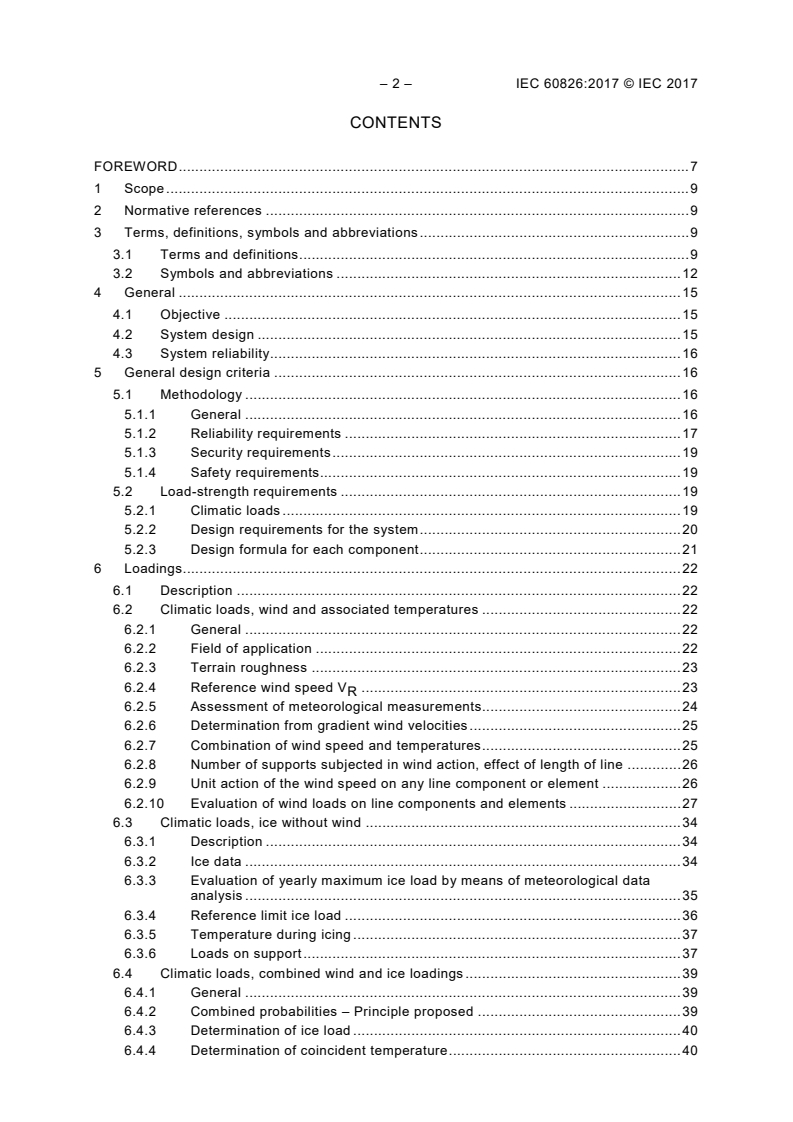
IEC 60826:2017 - Design criteria of overhead transmission lines Released:2/13/2017
IEC 60826:2017 RLV - Design criteria of overhead transmission lines Released:2/13/2017
Overview
IEC 60826:2017 - Design criteria of overhead transmission lines - sets out reliability-based loading and strength requirements for overhead transmission lines. Primarily intended for lines of 45 kV and above (but applicable to lower voltages where appropriate), the standard establishes a probabilistic/semi‑probabilistic framework for determining climatic loads (wind, ice, combined), structural strength coordination and limit states. It also provides a model for preparing national standards using local climatic and country‑specific data. IEC 60826:2017 is the 4th edition and incorporates updates on wind amplification (topography/escarpments) and updated ice data, while streamlining informative material by referencing CIGRE Technical Brochure 178.
Key Topics and Technical Requirements
- Reliability‑based design methodology: Principles for defining system reliability, security and safety requirements and translating them into design criteria.
- Climatic load definitions and limits: Procedures to define reference wind speeds, terrain roughness categories, ice accretion, and combined wind‑and‑ice loadings. Guidance covers meteorological data assessment and conversion (gradient vs. measured winds).
- Load combinations and probabilistic approaches: Use of probabilistic or semi‑probabilistic methods to combine loads and establish design return periods and limit climatic loads.
- Strength of components and limit states: Framework for component strength evaluation, strength coordination factors (Φ), and limit‑state considerations for supports, conductors and insulator strings (note: detailed component design is outside the scope).
- Construction, maintenance and security loads: Special considerations for erection, stringing, maintenance safety loads and failure containment/security requirements.
- Annexes and calculation tools: Informative annexes on statistical distributions, atmospheric icing, span variation effects, conductor tension limits and methods for wind‑speed amplification due to local topography.
Practical Applications
IEC 60826:2017 is used to:
- Establish design criteria for new overhead transmission lines and guide refurbishment, upgrading or uprating of existing lines.
- Form the technical basis for national transmission‑line standards by incorporating country‑specific climatic data.
- Guide utilities, consultants and planners in assessing line reliability, setting design return periods and performing load/strength calculations.
Who Should Use This Standard
- Transmission line designers and structural engineers
- Utility planners and asset managers
- National standards bodies and regulatory authorities
- Consultants performing reliability assessments or climate‑based load studies
Related Standards and References
- CIGRE Technical Brochure 178 (referenced for theoretical background and supplementary methods)
- National transmission‑line codes and other IEC standards for component design (used in conjunction with IEC 60826)
Keywords: IEC 60826:2017, overhead lines, overhead transmission lines, reliability, climatic loads, wind, ice, probabilistic design, energy.
Relations
- Effective Date
- 05-Sep-2023
Buy Documents
IEC 60826:2017 - Design criteria of overhead transmission lines Released:2/13/2017
IEC 60826:2017 RLV - Design criteria of overhead transmission lines Released:2/13/2017
Get Certified
Connect with accredited certification bodies for this standard

IMQ S.p.A. (Certification)
Italian electrical product certification.

SLG Prüf- und Zertifizierungs GmbH
German testing and certification body.

UL Solutions
Global safety science company with testing, inspection and certification.
Sponsored listings
Frequently Asked Questions
IEC 60826:2017 is a standard published by the International Electrotechnical Commission (IEC). Its full title is "Design criteria of overhead transmission lines". This standard covers: IEC 60826:2017 specifies the loading and strength requirements of overhead lines derived from reliability-based design principles. These requirements apply to lines 45 kV and above, but can also be applied to lines with a lower nominal voltage. This document also provides a framework for the preparation of national standards dealing with overhead transmission lines, using reliability concepts and employing probabilistic or semi-probabilistic methods. These national standards will need to establish the local climatic data for the use and application of this standard, in addition to other data that are country- specific. Although the design criteria in this standard apply to new lines, many concepts can be used to address the design and reliability requirements for refurbishment, upgrading and uprating of existing lines. This document does not cover the detailed design of line components such as supports, foundations, conductors or insulators strings. This fourth edition cancels and replaces the third edition published in 2003. It constitutes a technical revision. The main technical changes with regard to the previous edition are as follows: This standard has been further simplified by removing many informative annexes and theoretical details that can now be found in CIGRE Technical Brochure 178 and referred to as needed in the text of the standard. Many revisions have also been made that reflect the users experience in the application of this standard, together with information about amplification of wind speed due to escarpments. The annexes dealing with icing data have also been updated using new work by CIGRE. Key words: Overhead lines, Overhead transmission lines, reliability, energy
IEC 60826:2017 specifies the loading and strength requirements of overhead lines derived from reliability-based design principles. These requirements apply to lines 45 kV and above, but can also be applied to lines with a lower nominal voltage. This document also provides a framework for the preparation of national standards dealing with overhead transmission lines, using reliability concepts and employing probabilistic or semi-probabilistic methods. These national standards will need to establish the local climatic data for the use and application of this standard, in addition to other data that are country- specific. Although the design criteria in this standard apply to new lines, many concepts can be used to address the design and reliability requirements for refurbishment, upgrading and uprating of existing lines. This document does not cover the detailed design of line components such as supports, foundations, conductors or insulators strings. This fourth edition cancels and replaces the third edition published in 2003. It constitutes a technical revision. The main technical changes with regard to the previous edition are as follows: This standard has been further simplified by removing many informative annexes and theoretical details that can now be found in CIGRE Technical Brochure 178 and referred to as needed in the text of the standard. Many revisions have also been made that reflect the users experience in the application of this standard, together with information about amplification of wind speed due to escarpments. The annexes dealing with icing data have also been updated using new work by CIGRE. Key words: Overhead lines, Overhead transmission lines, reliability, energy
IEC 60826:2017 is classified under the following ICS (International Classification for Standards) categories: 01 - GENERALITIES. TERMINOLOGY. STANDARDIZATION. DOCUMENTATION; 29.240.20 - Power transmission and distribution lines. The ICS classification helps identify the subject area and facilitates finding related standards.
IEC 60826:2017 has the following relationships with other standards: It is inter standard links to IEC 60826:2003. Understanding these relationships helps ensure you are using the most current and applicable version of the standard.
IEC 60826:2017 is available in PDF format for immediate download after purchase. The document can be added to your cart and obtained through the secure checkout process. Digital delivery ensures instant access to the complete standard document.
Standards Content (Sample)
IEC 60826 ®
Edition 4.0 2017-02
INTERNATIONAL
STANDARD
colour
inside
Overhead transmission lines – Design criteria
All rights reserved. Unless otherwise specified, no part of this publication may be reproduced or utilized in any form
or by any means, electronic or mechanical, including photocopying and microfilm, without permission in writing from
either IEC or IEC's member National Committee in the country of the requester. If you have any questions about IEC
copyright or have an enquiry about obtaining additional rights to this publication, please contact the address below or
your local IEC member National Committee for further information.
IEC Central Office Tel.: +41 22 919 02 11
3, rue de Varembé Fax: +41 22 919 03 00
CH-1211 Geneva 20 info@iec.ch
Switzerland www.iec.ch
About the IEC
The International Electrotechnical Commission (IEC) is the leading global organization that prepares and publishes
International Standards for all electrical, electronic and related technologies.
About IEC publications
The technical content of IEC publications is kept under constant review by the IEC. Please make sure that you have the
latest edition, a corrigenda or an amendment might have been published.
IEC Catalogue - webstore.iec.ch/catalogue Electropedia - www.electropedia.org
The stand-alone application for consulting the entire The world's leading online dictionary of electronic and
bibliographical information on IEC International Standards, electrical terms containing 20 000 terms and definitions in
Technical Specifications, Technical Reports and other English and French, with equivalent terms in 16 additional
documents. Available for PC, Mac OS, Android Tablets and languages. Also known as the International Electrotechnical
iPad. Vocabulary (IEV) online.
IEC publications search - www.iec.ch/searchpub IEC Glossary - std.iec.ch/glossary
The advanced search enables to find IEC publications by a 65 000 electrotechnical terminology entries in English and
variety of criteria (reference number, text, technical French extracted from the Terms and Definitions clause of
committee,…). It also gives information on projects, replaced IEC publications issued since 2002. Some entries have been
and withdrawn publications. collected from earlier publications of IEC TC 37, 77, 86 and
CISPR.
IEC Just Published - webstore.iec.ch/justpublished
Stay up to date on all new IEC publications. Just Published IEC Customer Service Centre - webstore.iec.ch/csc
details all new publications released. Available online and If you wish to give us your feedback on this publication or
also once a month by email. need further assistance, please contact the Customer Service
Centre: csc@iec.ch.
IEC 60826 ®
Edition 4.0 2017-02
INTERNATIONAL
STANDARD
colour
inside
Overhead transmission lines – Design criteria
INTERNATIONAL
ELECTROTECHNICAL
COMMISSION
ICS 29.240.20 ISBN 978-2-8322-3884-4
– 2 – IEC 60826:2017 © IEC 2017
CONTENTS
FOREWORD . 7
1 Scope . 9
2 Normative references . 9
3 Terms, definitions, symbols and abbreviations . 9
3.1 Terms and definitions . 9
3.2 Symbols and abbreviations . 12
4 General . 15
4.1 Objective . 15
4.2 System design . 15
4.3 System reliability . 16
5 General design criteria . 16
5.1 Methodology . 16
5.1.1 General . 16
5.1.2 Reliability requirements . 17
5.1.3 Security requirements . 19
5.1.4 Safety requirements. 19
5.2 Load-strength requirements . 19
5.2.1 Climatic loads . 19
5.2.2 Design requirements for the system . 20
5.2.3 Design formula for each component . 21
6 Loadings. 22
6.1 Description . 22
6.2 Climatic loads, wind and associated temperatures . 22
6.2.1 General . 22
6.2.2 Field of application . 22
6.2.3 Terrain roughness . 23
6.2.4 Reference wind speed V . 23
R
6.2.5 Assessment of meteorological measurements. 24
6.2.6 Determination from gradient wind velocities . 25
6.2.7 Combination of wind speed and temperatures . 25
6.2.8 Number of supports subjected in wind action, effect of length of line . 26
6.2.9 Unit action of the wind speed on any line component or element . 26
6.2.10 Evaluation of wind loads on line components and elements . 27
6.3 Climatic loads, ice without wind . 34
6.3.1 Description . 34
6.3.2 Ice data . 34
6.3.3 Evaluation of yearly maximum ice load by means of meteorological data
analysis . 35
6.3.4 Reference limit ice load . 36
6.3.5 Temperature during icing . 37
6.3.6 Loads on support . 37
6.4 Climatic loads, combined wind and ice loadings . 39
6.4.1 General . 39
6.4.2 Combined probabilities – Principle proposed . 39
6.4.3 Determination of ice load . 40
6.4.4 Determination of coincident temperature . 40
6.4.5 Determination of wind speed associated with icing conditions . 40
6.4.6 Drag coefficients of ice-covered conductors . 41
6.4.7 Determination of loads on supports . 42
6.5 Loads for construction and maintenance (safety loads) . 43
6.5.1 General . 43
6.5.2 Erection of supports . 43
6.5.3 Construction stringing and sagging . 44
6.5.4 Maintenance loads . 44
6.6 Loads for failure containment (security requirements) . 45
6.6.1 General . 45
6.6.2 Security requirements . 45
6.6.3 Security related loads – Torsional, longitudinal and additional security
measures. 45
7 Strength of components and limit states . 47
7.1 General . 47
7.2 General formulas for the strength of components . 47
7.2.1 General . 47
7.2.2 Values of strength factor Φ . 48
N
7.2.3 General basis for strength coordination . 49
7.2.4 Strength factor Φ related to the coordination of strength . 50
S
7.2.5 Methods for calculating strength coordination factors Φ . 50
S
7.3 Data related to the calculation of components . 51
7.3.1 Limit states for line components . 51
7.3.2 Strength data of line components . 54
7.3.3 Support design strength . 55
7.3.4 Foundation design strength . 56
7.3.5 Conductor and ground wire design criteria . 56
7.3.6 Insulator string design criteria . 56
Annex A (informative) Technical information – Strength of line components . 58
A.1 Calculation of characteristic strength . 58
Annex B (informative) Formulas of curves and figures . 60
B.1 General . 60
B.2 Formula for G – Figure 4 . 60
c
B.3 Formula for G – Figure 5 . 60
L
B.4 Formula for G – Figure 6 . 60
t
B.5 Formula for C – Figure 8 (flat-sided members) . 60
xt
B.6 Formula for C – Figure 9 (round-sided members) . 61
xt
B.7 Formulas for C – Figure 10 . 61
xtc
Annex C (informative) Atmospheric icing . 62
C.1 General . 62
C.2 Precipitation icing . 62
C.2.1 Freezing rain . 62
C.2.2 Wet snow. 62
C.3 Dry ice . 63
C.4 In-cloud icing . 63
C.5 Physical properties of ice . 64
C.6 Meteorological parameters controlling ice accretion . 64
C.7 Terrain influences . 65
– 4 – IEC 60826:2017 © IEC 2017
C.7.1 In-cloud icing . 65
C.7.2 Precipitation icing . 65
C.8 Guidelines for the implementation of an ice observation program . 65
C.9 Ice data . 67
C.9.1 Influence of height and conductor diameter. 67
C.9.2 The effect of icing on structures . 67
C.10 Combined wind and ice loadings . 67
C.10.1 Combined probabilities . 67
C.10.2 Drag coefficients of ice-covered conductors . 68
Annex D (informative) Application of statistical distribution functions to load and
strength of overhead lines . 69
Annex E (informative) Effect of span variation on load-strength relationship –
Calculation of span use factor . 71
E.1 General . 71
E.2 Effect of use factor on load reduction and its calculation . 72
Annex F (normative) Conductor tension limits . 73
F.1 General . 73
F.2 Limits for lines with short spans . 74
F.3 Recommended conductor limit tensions . 74
F.3.1 Initial tension limit . 74
F.3.2 Maximum final tension limit . 75
F.4 Benefits from reducing conductor tensions . 75
Annex G (informative) Methods of calculation for wind speed up effects due to local
topography. 76
G.1 Application . 76
G.2 Notes on application . 77
Bibliography . 79
Figure 1 – Diagram of a transmission line . 16
Figure 2 – Transmission line design methodology . 17
Figure 3 – Relationship between meteorological wind velocities at a height of 10 m
depending on terrain category and on averaging period . 25
Figure 4 – Combined wind factor G for conductors for various terrain categories and
c
heights above ground . 28
Figure 5 – Span factor G . 28
L
Figure 6 – Combined wind factor G applicable to supports and insulator strings . 30
t
Figure 7 – Definition of the angle of incidence of wind . 31
Figure 8 – Drag coefficient C for lattice supports made of flat sided members . 32
xt
Figure 9 – Drag coefficient C for lattice supports made of rounded members. 32
xt
Figure 10 – Drag coefficient C of cylindrical elements having a large diameter . 33
xtc
Figure 11 – Factor K related to the conductor diameter . 36
d
Figure 12 – Factor K related to the conductor height . 37
h
a) Single circuit support . 38
b) Double circuit support . 38
Figure 13 – Typical support types . 38
Figure 14 – Equivalent cylindrical shape of ice deposit . 42
Figure 15 – Simulated longitudinal conductor load (case of a single circuit support) . 46
Figure 16 – Diagram of limit states of line components . 47
Figure C.1 – Type of accreted in-cloud icing as a function of wind speed and
temperature . 64
Figure C.2 – Strategy flow chart for utilizing meteorological data, icing models and
field measurements of ice loads . 66
Figure G.1 – Diagram of typical topographical cross-section . 77
Table 1 – Reliability levels for transmission lines . 18
Table 2 – Default γ factors for adjustment of climatic loads in relation to return period
T
T versus 50 years . 20
Table 3 – Design requirements for the system . 21
Table 4 – Classification of terrain categories . 23
Table 5 – Factors describing wind action depending on terrain category . 24
Table 6 – Correction factor τ of dynamic reference wind pressure q due to altitude
and temperatures . 27
Table 7 – Drag coefficient of polygonal pole sections . 34
Table 8 – Drag coefficient of structures having a triangular section . 34
Table 9 – Statistical parameters of ice loads . 36
Table 10 – Non-uniform ice loading conditions . 39
Table 11 – Return period of combined ice and wind load . 40
Table 12 – Drag coefficients of ice-covered conductors . 41
Table 13 – Additional security measures . 47
Table 14 – Number of supports subjected to maximum load intensity during any single
occurrence of a climatic event . 48
Table 15 – Strength factor Φ related to the number N of components or elements
N
subjected to the critical load intensity. 49
Table 16 – Values of Φ . 50
S2
Table 17 – Typical strength coordination of line components . 50
Table 18 – Damage and failure limits of supports . 52
Table 19 – Damage and failure limits of foundations . 53
Table 20 – Damage and failure limits of conductors and ground wires . 53
Table 21 – Damage and failure limit of interface components . 54
Table 22 – Default values for strength coefficients of variation (COV). 55
Table 23 – u factors for log-normal distribution function for e = 10 % . 55
Table 24 – Value of quality factor Φ for lattice towers . 56
Q
Table A.1 – Values of u associated to exclusion limits . 59
e
Table C.1 – Physical properties of ice . 64
Table C.2 – Meteorological parameters controlling ice accretion . 64
Table C.3 – Approximate values of ice weights on lattice structures . 67
Table C.4 – Combined wind and ice loading conditions . 68
Table C.5 – Drag coefficients and density of ice-covered conductors . 68
Table D.1 – Parameters C and C of Gumbel distribution . 69
1 2
Table D.2 – Ratios of x / x for a Gumbel distribution function, T return period in years
of loading event, n number of years with observations, v coefficient of variation . 70
x
Table E.1 – Use factor coefficient γ . 72
u
– 6 – IEC 60826:2017 © IEC 2017
Table F.1 – Variation of conductor sag with catenary parameter C . 74
Table F.2 – Conductor tensioning – recommended catenary parameter limits . 75
Table G. 1 – Values of µ and γ . 77
INTERNATIONAL ELECTROTECHNICAL COMMISSION
____________
OVERHEAD TRANSMISSION LINES – DESIGN CRITERIA
FOREWORD
1) The International Electrotechnical Commission (IEC) is a worldwide organization for standardization comprising
all national electrotechnical committees (IEC National Committees). The object of IEC is to promote
international co-operation on all questions concerning standardization in the electrical and electronic fields. To
this end and in addition to other activities, IEC publishes International Standards, Technical Specifications,
Technical Reports, Publicly Available Specifications (PAS) and Guides (hereafter referred to as “IEC
Publication(s)”). Their preparation is entrusted to technical committees; any IEC National Committee interested
in the subject dealt with may participate in this preparatory work. International, governmental and non-
governmental organizations liaising with the IEC also participate in this preparation. IEC collaborates closely
with the International Organization for Standardization (ISO) in accordance with conditions determined by
agreement between the two organizations.
2) The formal decisions or agreements of IEC on technical matters express, as nearly as possible, an international
consensus of opinion on the relevant subjects since each technical committee has representation from all
interested IEC National Committees.
3) IEC Publications have the form of recommendations for international use and are accepted by IEC National
Committees in that sense. While all reasonable efforts are made to ensure that the technical content of IEC
Publications is accurate, IEC cannot be held responsible for the way in which they are used or for any
misinterpretation by any end user.
4) In order to promote international uniformity, IEC National Committees undertake to apply IEC Publications
transparently to the maximum extent possible in their national and regional publications. Any divergence
between any IEC Publication and the corresponding national or regional publication shall be clearly indicated in
the latter.
5) IEC itself does not provide any attestation of conformity. Independent certification bodies provide conformity
assessment services and, in some areas, access to IEC marks of conformity. IEC is not responsible for any
services carried out by independent certification bodies.
6) All users should ensure that they have the latest edition of this publication.
7) No liability shall attach to IEC or its directors, employees, servants or agents including individual experts and
members of its technical committees and IEC National Committees for any personal injury, property damage or
other damage of any nature whatsoever, whether direct or indirect, or for costs (including legal fees) and
expenses arising out of the publication, use of, or reliance upon, this IEC Publication or any other IEC
Publications.
8) Attention is drawn to the Normative references cited in this publication. Use of the referenced publications is
indispensable for the correct application of this publication.
9) Attention is drawn to the possibility that some of the elements of this IEC Publication may be the subject of
patent rights. IEC shall not be held responsible for identifying any or all such patent rights.
International Standard IEC 60826 has been prepared by IEC technical committee 11:
Overhead lines.
This fourth edition cancels and replaces the third edition published in 2003. It constitutes a
technical revision.
The main technical changes with regard to the previous edition are as follows:
This standard has been further simplified by removing many informative annexes and
theoretical details that can now be found in CIGRE Technical Brochure 178 and referred to as
needed in the text of the standard. Many revisions have also been made that reflect the users
experience in the application of this standard, together with information about amplification of
wind speed due to escarpments. The annexes dealing with icing data have also been updated
using new work by CIGRE.
– 8 – IEC 60826:2017 © IEC 2017
The text of this standard is based on the following documents:
FDIS Report on voting
11/251/FDIS 11/252/RVD
Full information on the voting for the approval of this International Standard can be found in
the report on voting indicated in the above table.
This document has been drafted in accordance with the ISO/IEC Directives, Part 2.
The committee has decided that the contents of this document will remain unchanged until the
stability date indicated on the IEC website under "http://webstore.iec.ch" in the data related to
the specific document. At this date, the document will be
• reconfirmed,
• withdrawn,
• replaced by a revised edition, or
• amended.
IMPORTANT – The “colour inside” logo on the cover page of this publication indicates
that it contains colours which are considered to be useful for the correct understanding
of its contents. Users should therefore print this publication using a colour printer.
OVERHEAD TRANSMISSION LINES – DESIGN CRITERIA
1 Scope
This International Standard specifies the loading and strength requirements of overhead lines
derived from reliability-based design principles. These requirements apply to lines 45 kV and
above, but can also be applied to lines with a lower nominal voltage.
This document also provides a framework for the preparation of national standards dealing
with overhead transmission lines, using reliability concepts and employing probabilistic or
semi-probabilistic methods. These national standards will need to establish the local climatic
data for the use and application of this standard, in addition to other data that are country-
specific.
Although the design criteria in this standard apply to new lines, many concepts can be used to
address the design and reliability requirements for refurbishment, upgrading and uprating of
existing lines.
This document does not cover the detailed design of line components such as supports,
foundations, conductors or insulators strings.
2 Normative references
The following documents are referred to in the text in such a way that some or all of their
content constitutes requirements of this document. For dated references, only the edition
cited applies. For undated references, the latest edition of the referenced document (including
any amendments) applies.
IEC 60652, Loading tests on overhead line structures
IEC 61089, Round wire concentric lay overhead electrical stranded conductors
IEC 61773, Overhead lines – Testing of foundations for structures
IEC 61774, Overhead lines – Meteorological data for assessing climatic loads
IEC 61284, Overhead lines – Requirements and tests for fittings
3 Terms, definitions, symbols and abbreviations
For the purposes of this document, the following terms, definitions, symbols and abbreviations
apply.
3.1 Terms and definitions
3.1.1
characteristic strength
guaranteed strength, minimum strength, minimum failing load
R
c
strength value guaranteed in appropriate standards
Note 1 to entry: This value usually corresponds to an exclusion limit, from 2 % to 5 %, with 10 % being an upper
practical (and conservative) limit.
– 10 – IEC 60826:2017 © IEC 2017
3.1.2
coefficient of variation
COV
ratio of the standard deviation to the mean value
Note 1 to entry: The COV of load and strength are respectively denoted by v and v .
Q R
3.1.3
components
different parts of a transmission line system having a specified purpose
Note 1 to entry: Typical components are supports, foundations, conductors and insulator strings.
3.1.4
damage limit (of a component)
serviceability limit state
strength limit of a component corresponding to a defined limit of permanent (or inelastic)
deformation of this component which leads to damage to the system if it is exceeded
Note 1 to entry: This limit is also called the serviceability limit state in building codes based on limit states design.
3.1.5
damage state (of the system)
state where the system needs repairing because one of its components has exceeded its
damage limit
Note 1 to entry: The system needs repairing because it is not capable of fulfilling its task under design loads or
because design clearances may be reduced (e.g. conductor to ground).
3.1.6
elements
different parts of a component
Note 1 to entry: For example, the elements of a steel lattice tower are steel angles, plates and bolts.
3.1.7
exclusion limit
e %
value of a variable taken from its distribution function and corresponding to a probability of
e % of not being exceeded
3.1.8
failure limit (of a component)
ultimate limit state
strength limit of a component which leads to the failure of the system if this limit is exceeded
Note 1 to entry: If this strength limit is exceeded, the system will reach a state called “ultimate limit state” as
defined in building codes based on limit states design.
3.1.9
failure state (of the system)
state of a system in which a major component has failed because one of its components has
reached its failure limit (such as by rupture, buckling, overturning)
Note 1 to entry: This state leads to the termination of the ability of the line to transmit power and needs to be
repaired.
3.1.10
intact state
state in which a system can accomplish its required function and can sustain limit loads
3.1.11
limit load
Q
T
climatic load corresponding to a return period, T, used for design purposes without additional
load factors
Note 1 to entry: Refer to 5.2.1.
3.1.12
load factor
γ
factor to be multiplied by the limit load in order to design line components
3.1.13
operating period
general measure of useful (or economical) life
Note 1 to entry: Typical operating periods of transmission lines vary from 30 years to 80 years.
3.1.14
reference wind speed
V
R
wind speed at 10 m in height, corresponding to an averaging period of 10 min and having
a return period T
Note 1 to entry: When this wind speed is taken in a terrain type B, which is the most common case in the industry,
the reference wind speed is identified as V .
RB
3.1.15
reference ice load
g or t
R R
is a unit ice weight and t is a uniform radial ice thickness around
reference limit ice loads (g
R R
the conductor) having a return period T
3.1.16
reliability (structural)
probability that a system performs a given task, under a set of operating conditions, during a
specified time
Note 1 to entry: Reliability is thus a measure of the success of a system in accomplishing its task. The
complement to reliability is the probability of failure or unreliability.
3.1.17
return period (of a climatic event)
T
average occurrence in years of a climatic event having a defined intensity
Note 1 to entry: The inverse of the return period is the yearly frequency which corresponds to the probability of
exceeding this climatic event in a given year.
3.1.18
safety
ability of a system not to cause human injuries or loss of lives
Note 1 to entry: In this document, safety relates mainly to protection of workers during construction and
maintenance operations. The safety of the public and of the environment in general is covered by national
regulations.
– 12 – IEC 60826:2017 © IEC 2017
3.1.19
security (structural)
ability of a system to be protected from a major collapse (cascading effect) if a failure is
triggered in a given component
Note 1 to entry: Security is a deterministic concept as opposed to reliability which is a probabilistic concept.
3.1.20
strength factor
Φ
factor applied to the characteristic strength of a component
Note 1 to entry: This factor takes into account the coordination of strength, the number of components subjected
to maximum load, quality and statistical parameters of components.
3.1.21
system
set of components connected together to form the transmission line
3.1.22
task
function of the system (transmission line), i.e. to transmit power between its two ends
3.1.23
unavailability
inability of a system to accomplish its task
Note 1 to entry: Unavailability of transmission lines results from structural unreliability as well as from failure due
to other events such as landslides, impact of objects, sabotage, defects in material, etc.
3.1.24
use factor
U
ratio of the actual load (as built) to limit load of a component
Note 1 to entry: For tangent supports, it is virtually equal to the ratio of actual to maximum design spans (wind or
weight) and for angle supports; it also includes the ratio of the sines of the half angles of deviation (actual to
design angles).
3.2 Symbols and abbreviations
a Unit action of wind speed on line elements (Pa or N/m )
Wind force on conductors (N)
A
c
A Wind force on insulators (N)
i
A Wind force acting on a tower panel made of steel angles, A for cylindrical tower
t tc
members (N)
B Reduction factor of the reference wind speed for wind and ice combinations
i
C Drag coefficient (general form)
x
C Drag coefficient of ice covered conductors (C for low probability and C for a high
i iL iH
probability)
C Drag coefficient of conductors
xc
C Drag coefficient of insulators
xi
C Drag coefficient of supports C , C for each tower face (C on cylindrical tower
xt xt1 xt2 xtc
members)
COV Coefficient of variation, also identified as v (ratio of standard deviation to mean
x
value)
d Conductor diameter (m)
d Diameter of cylindrical tower members (m)
tc
D Equivalent diameter of ice covered conductors (D for high probability and D for low
H L
probability) (m)
e Exclusion limit (%)
e Exclusion limit of N components in series (%)
N
F Cumulative distribution function of variable x
(x)
G Wind factor (general form)
G Combined wind factor of conductors
c
G Combined wind factor of towers
t
G Span factor for wind calculations
L
g Unit weight of ice (N/m)
g Yearly maximum ice load (N/m)
m
g Mean yearly maximum ice loads (N/m)
m
g Maximum weight of ice per unit length observed during a certain number of years
max
(N/m)
g Reference design ice weight (N/m)
R
g Ice load having a high probability (N/m)
H
g Ice load having a low probability (N/m)
L
H Horizontal tensile load
K Terrain roughness factor
R
K Diameter factor related to the influence of conductor diameter
d
K Height factor to be multiplied by g to account for the influence of height above
h
ground
K Factor to be multiplied by to account for the influence of the number of years with
g
n
icing observations
l Length of a support member (m)
e
L Span length or wind span (m)
L Average span (m)
m
n Number of years of observation of a climatic event
N Number of components subjected to maximum loading intensity
Q General expression used to identify the effects of weather related loads on lines and
their components
Q The system limit load corresponding a return period T
T
q Dynamic reference wind pressure due to reference wind speed V (q q for low
0 R 0L, 0H
and high probability) (Pa or N/m )
Re Reynolds number
R Strength (usually in Pa or in kN depending on components)
R Mean strength (units same as for R)
R Characteristic strength (units same as for R)
c
(e)R Exclusion limit (e) of strength (units same as for R)
RSL Residual static load of a broken conductor (kN)
S Projected area of insulators (m )
i
– 14 – IEC 60826:2017 © IEC 2017
S Projected area of a tower panel (m )
t
t Ice load expressed in uniform radial ice thickness around the conductor (mm)
t Reference ice load expressed in uniform radial thickness around the conductor (mm)
R
T Return period of weather events (years)
u Number of standard deviations between mean strength and characteristic strength
U Use factor
v Coefficient of variation (COV) of variable x
x
V Wind speed (m/s)
V Yearly maximum wind speed (m/s)
m
V Mean yearly maximum wind speed (m/s)
m
V Yearly maximum gradient wind speed (m/s)
G
V Mean yearly maximum gradient wind speed (m/s)
G
V Reference wind speed (m/s)
R
V Low probability wind speed associated with icing (m/s)
iL
V High probability wind speed associated with icing (m/s)
iH
w Unit weight of conductor or ground wire (N/m)
x Mean value of variable x
Y Horizontal distance between foundations of a support (m)
z Height above ground of conductors, centre of gravity of towers panels, or insulator
strings (m)
γ Load factor (general form)
γ Use factor coefficient
U
γ Load factor to adjust the 50 year wind speed to a return period T
TW
γ
Load factor to adjust the 50 year ice thickness to a return period T
Tit
γ
Load factor to adjust the 50 year ice weight to a return period T
T i w
δ Ice density (kg/m )
Φ Strength factor (general form)
Φ Global strength factor
R
Φ Strength factor due to number of components subjected to maximum load intensity
N
Φ Strength factor due to coordination of strength
S
Φ Strength factor due to quality
Q
Φ Strength factor related to the characteristic strength R
c c
σ Standard deviation of variable x
x
σ Standard deviation of yearly maximum ice loads (N/m)
g
µ Mass of air per unit volume (kg/m )
τ Air density correction factor
ν Kinetic air viscosity (m /s)
Ω Angle between wind direction and the conductor (degrees)
θ Angle of incidence of wind direction with the tower panel (degrees)
θ ′ Angle of incidence of wind direction with cylindrical elements of tower (degrees)
χ Solidity ratio of a tower panel
4 General
4.1 Objective
This document serves either of the following purposes:
a) It provides design criteria for overhead lines based on reliability concepts. The reliability
based method is particularly useful in areas where significant amounts of meteorological
and strength data are readily available. This method may however be used for lines
designed to withstand specific climatic loads, either derived from experience or through
calibration with existing lines that had a long history of satisfactory performance. In these
cases, design consistency between strengths of line components will be achieved, but
actual reliability levels may not be known, particularly if there has been no evidence or
experience with previous line failures.
It is important to note that the design criteria in this standard do not constitute a complete
design manual for transmission lines. However, guidance is given on how to increase the
line reliability if required, and to adjust the strength of individual components to achieve a
desired coordination of strength between them.
b) It provides a framework for the preparation of national standards for transmission lines
using reliability concep
...
IEC 60826 ®
Edition 4.0 2017-02
REDLINE VERSION
INTERNATIONAL
STANDARD
colour
inside
Design criteria of Overhead transmission lines – Design criteria
All rights reserved. Unless otherwise specified, no part of this publication may be reproduced or utilized in any form
or by any means, electronic or mechanical, including photocopying and microfilm, without permission in writing from
either IEC or IEC's member National Committee in the country of the requester. If you have any questions about IEC
copyright or have an enquiry about obtaining additional rights to this publication, please contact the address below or
your local IEC member National Committee for further information.
IEC Central Office Tel.: +41 22 919 02 11
3, rue de Varembé Fax: +41 22 919 03 00
CH-1211 Geneva 20 info@iec.ch
Switzerland www.iec.ch
About the IEC
The International Electrotechnical Commission (IEC) is the leading global organization that prepares and publishes
International Standards for all electrical, electronic and related technologies.
About IEC publications
The technical content of IEC publications is kept under constant review by the IEC. Please make sure that you have the
latest edition, a corrigenda or an amendment might have been published.
IEC Catalogue - webstore.iec.ch/catalogue Electropedia - www.electropedia.org
The stand-alone application for consulting the entire The world's leading online dictionary of electronic and
bibliographical information on IEC International Standards, electrical terms containing 20 000 terms and definitions in
Technical Specifications, Technical Reports and other English and French, with equivalent terms in 16 additional
documents. Available for PC, Mac OS, Android Tablets and languages. Also known as the International Electrotechnical
iPad. Vocabulary (IEV) online.
IEC publications search - www.iec.ch/searchpub IEC Glossary - std.iec.ch/glossary
The advanced search enables to find IEC publications by a 65 000 electrotechnical terminology entries in English and
variety of criteria (reference number, text, technical French extracted from the Terms and Definitions clause of
committee,…). It also gives information on projects, replaced IEC publications issued since 2002. Some entries have been
and withdrawn publications. collected from earlier publications of IEC TC 37, 77, 86 and
CISPR.
IEC Just Published - webstore.iec.ch/justpublished
Stay up to date on all new IEC publications. Just Published IEC Customer Service Centre - webstore.iec.ch/csc
details all new publications released. Available online and If you wish to give us your feedback on this publication or
also once a month by email. need further assistance, please contact the Customer Service
Centre: csc@iec.ch.
IEC 60826 ®
Edition 4.0 2017-02
REDLINE VERSION
INTERNATIONAL
STANDARD
colour
inside
Design criteria of Overhead transmission lines – Design criteria
INTERNATIONAL
ELECTROTECHNICAL
COMMISSION
ICS 29.240.20 ISBN 978-2-8322-3960-5
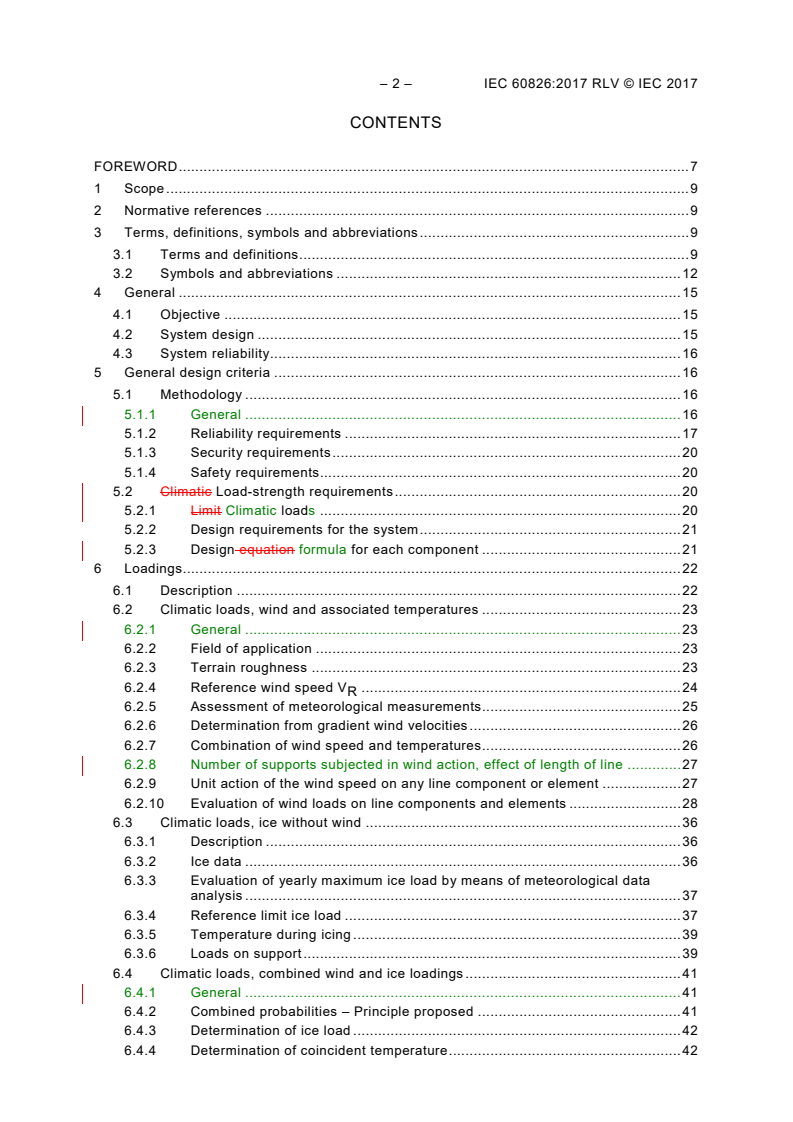
– 2 – IEC 60826:2017 RLV © IEC 2017
CONTENTS
FOREWORD . 7
1 Scope . 9
2 Normative references . 9
3 Terms, definitions, symbols and abbreviations . 9
3.1 Terms and definitions . 9
3.2 Symbols and abbreviations . 12
4 General . 15
4.1 Objective . 15
4.2 System design . 15
4.3 System reliability . 16
5 General design criteria . 16
5.1 Methodology . 16
5.1.1 General . 16
5.1.2 Reliability requirements . 17
5.1.3 Security requirements . 20
5.1.4 Safety requirements. 20
5.2 Climatic Load-strength requirements . 20
5.2.1 Limit Climatic loads . 20
5.2.2 Design requirements for the system . 21
5.2.3 Design equation formula for each component . 21
6 Loadings. 22
6.1 Description . 22
6.2 Climatic loads, wind and associated temperatures . 23
6.2.1 General . 23
6.2.2 Field of application . 23
6.2.3 Terrain roughness . 23
6.2.4 Reference wind speed V . 24
R
6.2.5 Assessment of meteorological measurements. 25
6.2.6 Determination from gradient wind velocities . 26
6.2.7 Combination of wind speed and temperatures . 26
6.2.8 Number of supports subjected in wind action, effect of length of line . 27
6.2.9 Unit action of the wind speed on any line component or element . 27
6.2.10 Evaluation of wind loads on line components and elements . 28
6.3 Climatic loads, ice without wind . 36
6.3.1 Description . 36
6.3.2 Ice data . 36
6.3.3 Evaluation of yearly maximum ice load by means of meteorological data
analysis . 37
6.3.4 Reference limit ice load . 37
6.3.5 Temperature during icing . 39
6.3.6 Loads on support . 39
6.4 Climatic loads, combined wind and ice loadings . 41
6.4.1 General . 41
6.4.2 Combined probabilities – Principle proposed . 41
6.4.3 Determination of ice load . 42
6.4.4 Determination of coincident temperature . 42
6.4.5 Determination of wind speed associated with icing conditions . 42
6.4.6 Drag coefficients of ice-covered conductors . 43
6.4.7 Determination of loads on supports . 44
6.5 Loads for construction and maintenance (safety loads) . 45
6.5.1 General . 45
6.5.2 Erection of supports . 45
6.5.3 Construction stringing and sagging . 46
6.5.4 Maintenance loads . 46
6.6 Loads for failure containment (security requirements) . 47
6.6.1 General . 47
6.6.2 Security requirements . 47
6.6.3 Security related loads – Torsional, longitudinal and additional security
measures. 47
7 Strength of components and limit states . 49
7.1 General . 49
7.2 General equations formulas for the strength of components . 49
7.2.1 General . 49
7.2.2 Values of strength factor Φ . 50
N
7.2.3 General basis for strength coordination . 51
7.2.4 Strength factor Φ related to the coordination of strength . 52
S
7.2.5 Methods for calculating strength coordination factors Φ . 52
S
7.3 Data related to the calculation of components . 53
7.3.1 Limit states for line components . 53
7.3.2 Strength data of line components . 56
7.3.3 Support design strength . 57
7.3.4 Foundation design strength . 58
7.3.5 Conductor and ground wire design criteria . 58
7.3.6 Insulator string design criteria . 58
Annex A (informative) Technical information– Strength of line components . 60
A.1 Calculation of characteristic strength . 78
Annex B (informative) Formulas of curves and figures . 87
B.1 General . 87
B.2 Formula for G – Figure 4 . 87
c
B.3 Formula for G – Figure 5 . 87
L
B.4 Formula for G – Figure 6 . 87
t
B.5 Formula for C – Figure 8 (flat-sided members) . 87
xt
B.6 Formula for C – Figure 9 (round-sided members) . 88
xt
B.7 Formulas for C – Figure 10 . 88
xtc
Annex C (informative) Statistical distribution and their application in probabilistic
design of transmission lines .
Annex C (informative) Atmospheric icing . 89
C.1 General . 89
C.2 Precipitation icing . 89
C.2.1 Freezing rain . 89
C.2.2 Wet snow. 89
C.3 Dry ice . 90
C.4 In-cloud icing . 90
C.5 Physical properties of ice . 91
C.6 Meteorological parameters controlling ice accretion . 91
– 4 – IEC 60826:2017 RLV © IEC 2017
C.7 Terrain influences . 92
C.7.1 In-cloud icing . 92
C.7.2 Precipitation icing . 92
C.8 Guidelines for the implementation of an ice observation program . 92
C.9 Ice data . 94
C.9.1 Influence of height and conductor diameter. 94
C.9.2 The effect of icing on structures . 95
C.10 Combined wind and ice loadings . 95
C.10.1 Combined probabilities . 95
C.10.2 Drag coefficients of ice-covered conductors . 96
Annex D (informative) Application of statistical distribution functions to load and
strength of overhead lines . 97
Annex E (informative) Effect of span variation on load-strength relationship –
Calculation of span use factor . 105
E.1 General . 105
E.2 Effect of use factor on load reduction and its calculation . 106
Annex F (normative) Conductor tension limits . 124
F.1 General . 124
F.2 Limits for lines with short spans . 125
F.3 Recommended conductor limit tensions . 125
F.3.1 Initial tension limit . 125
F.3.2 Maximum final tension limit . 126
F.4 Benefits from reducing conductor tensions . 126
Annex G (informative) Methods of calculation for wind speed up effects due to local
topography. 127
G.1 Application . 127
G.2 Notes on application . 128
Bibliography . 130
Figure 1 – Diagram of a transmission line . 16
Figure 2 – Transmission line design methodology . 17
Figure 3 – Relationship between meteorological wind velocities at a height of 10 m
depending on terrain category and on averaging period . 26
Figure 4 – Combined wind factor G for conductors for various terrain categories and
c
heights above ground . 29
Figure 5 – Span factor G . 30
L
Figure 6 – Combined wind factor G applicable to supports and insulator strings . 31
t
Figure 7 – Definition of the angle of incidence of wind . 33
Figure 8 – Drag coefficient C for lattice supports made of flat sided members . 33
xt
Figure 9 – Drag coefficient C for lattice supports made of rounded members. 34
xt
Figure 10 – Drag coefficient C of cylindrical elements having a large diameter . 35
xtc
Figure 11 – Factor K related to the conductor diameter . 38
d
Figure 12 – Factor K related to the conductor height . 39
h
Figure 13 – Typical support types . 40
Figure 14 – Equivalent cylindrical shape of ice deposit . 44
Figure 15 – Simulated longitudinal conductor load (case of a single circuit support) . 48
Figure 16 – Diagram of limit states of line components . 49
Figure A.1 – Relations between load and strength .
Figure A.2 – Relations between loads and strengths .
Figure A.3 – Failure probability P = (1 – P ) for various distributions of Q and R, for T
f s
= 50 years .
Figure A.4 – Failure probability P = (1 – P ) for various distributions of Q and R, for T
f s
= 150 years .
Figure A.5 – Failure probability P = (1 – P ) for various distributions of Q and R, for T
f s
= 500 years .
Figure A.6 – Coordination of strength by using different exclusion limits .
Figure A.8 – Wind action on conductors and resultant wind load on support .
Figure B.1 – Fitting of Gumbel distribution with wind data histogram .
Figure B.2 – Fitting of Gumbel distribution with yearly minimum temperature histogram .
Figure B.3 – Fitting of Gamma distribution with ice load histogram .
Figure B.4 – Fitting data from in-cloud icing with Gumbel distribution .
Figure B.5 – Fitting of Weibull distribution with strength data of lattice supports .
Figure C.1 – Probability density function of standardized normal distribution .
Figure C.2 – Probability density function of standardized log-normal distribution .
Figure C.3 – Probability density function of standardized Gumbel distribution .
Figure C.4 – Probability density function of standardized Weibull distribution for
parameter p = 0,5; 1,0 and 2,0 .
Figure C.5 – Probability density function of standardized Gamma distribution
for parameter p = 0,5; 1,0 and 2,0 .
Figure C.6 – Probability density function of standardized beta distribution for
parameters r = 5,0, t = 5,5; 6,0 and 7,0 .
Figure C.1 – Type of accreted in-cloud icing as a function of wind speed and
temperature . 91
Figure C.2 – Strategy flow chart for utilizing meteorological data, icing models and
field measurements of ice loads . 93
Figure G.1 – Diagram of typical topographical cross-section . 128
Table 1 – Reliability levels for transmission lines . 18
Table 2 – Default γ factors for adjustment of climatic loads in relation to return period
T
T versus 50 years . 21
Table 3 – Design requirements for the system . 21
Table 4 – Classification of terrain categories . 24
Table 5 – Factors describing wind action depending on terrain category . 25
Table 6 – Correction factor τ of dynamic reference wind pressure q due to altitude
and temperatures . 28
Table 7 – Drag coefficient of polygonal pole sections . 35
Table 8 – Drag coefficient of structures having a triangular section . 36
Table 9 – Statistical parameters of ice loads . 38
Table 10 – Non-uniform ice loading conditions . 41
Table 11 – Return period of combined ice and wind load . 42
Table 12 – Drag coefficients of ice-covered conductors . 43
Table 13 – Additional security measures . 49
– 6 – IEC 60826:2017 RLV © IEC 2017
Table 14 – Number of supports subjected to maximum load intensity during any single
occurrence of a climatic event . 50
Table 15 – Strength factor Φ related to the number N of components or elements
N
subjected to the critical load intensity. 51
Table 16 – Values of Φ . 52
S2
Table 17 – Typical strength coordination of line components . 52
Table 18 – Damage and failure limits of supports . 54
Table 19 – Damage and failure limits of foundations . 55
Table 20 – Damage and failure limits of conductors and ground wires . 55
Table 21 – Damage and failure limit of interface components . 56
Table 22 – Default values for strength coefficients of variation (COV). 57
Table 23 – u factors for log-normal distribution function for e = 10 % . 57
Table 24 – Value of quality factor Φ for lattice towers . 58
Q
Table A.1 – Yearly reliability corresponding to various assumptions of load and strength . 117
Table A.1 – Values of u associated to exclusion limits . 79
e
Table A.2 – Relationship between reliability levels and return periods of limit loads . 125
Table A.3 – Typical strength coordination . 129
Table A.4 – Values of central safety factor α and strength coordination factor Φ
S
required to insure that component R will fail after component R with a 90 %
2 1
probability . 137
Table A.5 – Strength factor Φ related to N components in series subjected to the
N
critical load . 143
Table A.7 – Definition of terrain category . 151
Table A.9 – Values of reference wind speed V . 157
R
Table B.2 – Parameters of Weibull distribution . 199
Table B.3 – Statistical parameters U and σ of wind span variation . 203
u
Table B.4 – Statistical parameters U and σ of weight span variation . 205
u
Table B.6 – Use factor coefficient γ for different strength coefficients of variation . 211
u
Table B.5 – Values of use factor coefficient γ as a function of U and N for v = 0,10 . 209
u R
Table C.1 – Physical properties of ice . 91
Table C.2 – Values of u for given values of function F = Ι(u ,p -1) . 235
(u )
1 1 3
Table C.2 – Meteorological parameters controlling ice accretion . 91
Table C.3 – Approximate values of ice weights on lattice structures . 95
Table C.4 – Combined wind and ice loading conditions . 95
Table C.5 – Drag coefficients and density of ice-covered conductors . 96
Table D.1 – Parameters C and C of Gumbel distribution . 98
1 2
Table D.2 – Ratios of x / x for a Gumbel distribution function, T return period in years
of loading event, n number of years with observations, v coefficient of variation . 101
x
Table E.1 – Use factor coefficient γ . 107
u
Table F.1 – Variation of conductor sag with catenary parameter C . 125
Table F.2 – Conductor tensioning – recommended catenary parameter limits . 126
Table G. 1 – Values of µ and γ . 128
INTERNATIONAL ELECTROTECHNICAL COMMISSION
____________
DESIGN CRITERIA OF OVERHEAD TRANSMISSION LINES –
DESIGN CRITERIA
FOREWORD
1) The International Electrotechnical Commission (IEC) is a worldwide organization for standardization comprising
all national electrotechnical committees (IEC National Committees). The object of IEC is to promote
international co-operation on all questions concerning standardization in the electrical and electronic fields. To
this end and in addition to other activities, IEC publishes International Standards, Technical Specifications,
Technical Reports, Publicly Available Specifications (PAS) and Guides (hereafter referred to as “IEC
Publication(s)”). Their preparation is entrusted to technical committees; any IEC National Committee interested
in the subject dealt with may participate in this preparatory work. International, governmental and non-
governmental organizations liaising with the IEC also participate in this preparation. IEC collaborates closely
with the International Organization for Standardization (ISO) in accordance with conditions determined by
agreement between the two organizations.
2) The formal decisions or agreements of IEC on technical matters express, as nearly as possible, an international
consensus of opinion on the relevant subjects since each technical committee has representation from all
interested IEC National Committees.
3) IEC Publications have the form of recommendations for international use and are accepted by IEC National
Committees in that sense. While all reasonable efforts are made to ensure that the technical content of IEC
Publications is accurate, IEC cannot be held responsible for the way in which they are used or for any
misinterpretation by any end user.
4) In order to promote international uniformity, IEC National Committees undertake to apply IEC Publications
transparently to the maximum extent possible in their national and regional publications. Any divergence
between any IEC Publication and the corresponding national or regional publication shall be clearly indicated in
the latter.
5) IEC itself does not provide any attestation of conformity. Independent certification bodies provide conformity
assessment services and, in some areas, access to IEC marks of conformity. IEC is not responsible for any
services carried out by independent certification bodies.
6) All users should ensure that they have the latest edition of this publication.
7) No liability shall attach to IEC or its directors, employees, servants or agents including individual experts and
members of its technical committees and IEC National Committees for any personal injury, property damage or
other damage of any nature whatsoever, whether direct or indirect, or for costs (including legal fees) and
expenses arising out of the publication, use of, or reliance upon, this IEC Publication or any other IEC
Publications.
8) Attention is drawn to the Normative references cited in this publication. Use of the referenced publications is
indispensable for the correct application of this publication.
9) Attention is drawn to the possibility that some of the elements of this IEC Publication may be the subject of
patent rights. IEC shall not be held responsible for identifying any or all such patent rights.
This redline version of the official IEC Standard allows the user to identify the changes
made to the previous edition. A vertical bar appears in the margin wherever a change
has been made. Additions are in green text, deletions are in strikethrough red text.
– 8 – IEC 60826:2017 RLV © IEC 2017
International Standard IEC 60826 has been prepared by IEC technical committee 11:
Overhead lines.
This fourth edition cancels and replaces the third edition published in 2003. It constitutes a
technical revision.
The main technical changes with regard to the previous edition are as follows:
This standard has been further simplified by removing many informative annexes and
theoretical details that can now be found in CIGRE Technical Brochure 178 and referred to as
needed in the text of the standard. Many revisions have also been made that reflect the users
experience in the application of this standard, together with information about amplification of
wind speed due to escarpments. The annexes dealing with icing data have also been updated
using new work by CIGRE.
The text of this standard is based on the following documents:
FDIS Report on voting
11/251/FDIS 11/252/RVD
Full information on the voting for the approval of this International Standard can be found in
the report on voting indicated in the above table.
This document has been drafted in accordance with the ISO/IEC Directives, Part 2.
The committee has decided that the contents of this document will remain unchanged until the
stability date indicated on the IEC website under "http://webstore.iec.ch" in the data related to
the specific document. At this date, the document will be
• reconfirmed,
• withdrawn,
• replaced by a revised edition, or
• amended.
IMPORTANT – The “colour inside” logo on the cover page of this publication indicates
that it contains colours which are considered to be useful for the correct understanding
of its contents. Users should therefore print this publication using a colour printer.
DESIGN CRITERIA OF OVERHEAD TRANSMISSION LINES –
DESIGN CRITERIA
1 Scope
This International Standard specifies the loading and strength requirements of overhead lines
derived from reliability-based design principles. These requirements apply to lines 45 kV and
above, but can also be applied to lines with a lower nominal voltage.
This document also provides a framework for the preparation of national standards dealing
with overhead transmission lines, using reliability concepts and employing probabilistic or
semi-probabilistic methods. These national standards will need to establish the local climatic
data for the use and application of this standard, in addition to other data that are country-
specific.
Although the design criteria in this standard apply to new lines, many concepts can be used to
address the design and reliability requirements for refurbishment, upgrading and uprating of
existing lines.
This document does not cover the detailed design of line components such as towers
supports, foundations, conductors or insulators strings.
2 Normative references
The following documents are referred to in the text in such a way that some or all of their
content constitutes requirements of this document. For dated references, only the edition
cited applies. For undated references, the latest edition of the referenced document (including
any amendments) applies.
IEC 60652:2002, Loading tests on overhead line structures
IEC 61089:1991, Round wire concentric lay overhead electrical stranded conductors
IEC 61773:1996, Overhead lines – Testing of foundations for structures
IEC 61774:1997, Overhead lines – Meteorological data for assessing climatic loads
IEC 61284:1997, Overhead lines – Requirements and tests for fittings
3 Terms, definitions, symbols and abbreviations
For the purposes of this document, the following terms, definitions, symbols and abbreviations
apply.
3.1 Terms and definitions
3.1.1
characteristic strength
guaranteed strength, minimum strength, minimum failing load
R
c
strength value guaranteed in appropriate standards
– 10 – IEC 60826:2017 RLV © IEC 2017
Note 1 to entry: This value usually corresponds to an exclusion limit, from 2 % to 5 %, with 10 % being an upper
practical (and conservative) limit.
3.1.2
coefficient of variation
COV
ratio of the standard deviation to the mean value
Note 1 to entry: The COV of load and strength are respectively denoted by v and v .
Q R
3.1.3
components
different parts of a transmission line system having a specified purpose
Note 1 to entry: Typical components are towers supports, foundations, conductors and insulator strings.
3.1.4
damage limit (of a component)
serviceability limit state
strength limit of a component corresponding to a defined limit of permanent (or inelastic)
deformation of this component which leads to damage to the system if it is exceeded
Note 1 to entry: This limit is also called the serviceability limit state in building codes based on limit states design.
3.1.5
damage state (of the system)
state where the system needs repairing because one of its components has exceeded its
damage limit
Note 1 to entry: The system needs repairing because it is not capable of fulfilling its task under design loads or
because design clearances may be reduced (e.g. conductor to ground).
3.1.6
elements
different parts of a component
Note 1 to entry: For example, the elements of a steel lattice tower are steel angles, plates and bolts.
3.1.7
exclusion limit
e %
value of a variable taken from its distribution function and corresponding to a probability of
e % of not being exceeded
3.1.8
failure limit (of a component)
ultimate limit state
strength limit of a component which leads to the failure of the system if this limit is exceeded
Note 1 to entry: If this strength limit is exceeded, the system will reach a state called “ultimate limit state” as
defined in building codes based on limit states design.
3.1.9
failure state (of the system)
state of a system in which a major component has failed because one of its components has
reached its failure limit (such as by rupture, buckling, overturning)
Note 1 to entry: This state leads to the termination of the ability of the line to transmit power and needs to be
repaired.
3.1.10
intact state
state in which a system can accomplish its required function and can sustain limit loads
3.1.11
limit load
Q
T
climatic load corresponding to a return period, T, used for design purposes without additional
load factors
Note 1 to entry: Refer to 5.2.1.
3.1.12
load factor
γ
factor to be multiplied by the limit load in order to design line components
3.1.13
operating period
general measure of useful (or economical) life
Note 1 to entry: Typical operating periods of transmission lines vary from 30 years to 80 years.
3.1.14
reference wind speed
V
R
wind speed at 10 m in height, corresponding to an averaging period of 10 min and having
a return period T
Note 1 to entry: When this wind speed is taken in a terrain type B, which is the most common case in the industry,
the reference wind speed is identified as V .
RB
3.1.15
reference ice load
g or t
R R
reference limit ice loads (g is a unit ice weight and t is a uniform radial ice thickness around
R R
the conductor) having a return period T
3.1.16
reliability (structural)
probability that a system performs a given task, under a set of operating conditions, during a
specified time
Note 1 to entry: Reliability is thus a measure of the success of a system in accomplishing its task. The
complement to reliability is the probability of failure or unreliability.
3.1.17
return period (of a climatic event)
T
average occurrence in years of a climatic event having a defined intensity
Note 1 to entry: The inverse of the return period is the yearly frequency which corresponds to the probability of
exceeding this climatic event in a given year.
3.1.18
safety
ability of a system not to cause human injuries or loss of lives
Note 1 to entry: In this document, safety relates mainly to protection of workers during construction and
maintenance operations. The safety of the public and of the environment in general is covered by national
regulations.
– 12 – IEC 60826:2017 RLV © IEC 2017
3.1.19
security (structural)
ability of a system to be protected from a major collapse (cascading effect) if a failure is
triggered in a given component
Note 1 to entry: Security is a deterministic concept as opposed to reliability which is a probabilistic concept.
3.1.20
strength factor
Φ
factor applied to the characteristic strength of a component
Note 1 to entry: This factor takes into account the coordination of strength, the number of components subjected
to maximum load, quality and statistical parameters of components.
3.1.21
system
set of components connected together to form the transmission line
3.1.22
task
function of the system (transmission line), i.e. to transmit power between its two ends
3.1.23
unavailability
inability of a system to accomplish its task
Note 1 to entry: Unavailability of transmission lines results from structural unreliability as well as from failure due
to other events such as landslides, impact of objects, sabotage, defects in material, etc.
3.1.24
use factor
U
ratio of the actual load (as built) to limit load of a component
Note 1 to entry: For tangent towers supports, it is virtually equal to the ratio of actual to maximum design spans
(wind or weight) and for angle towers supports; it also includes the ratio of the sines of the half angles of deviation
(actual to design angles).
3.2 Symbols and abbreviations
a Unit action of wind speed on line elements (Pa or N/m )
Wind force on conductors (N)
A
c
A Wind force on insulators (N)
i
A Wind force acting on a tower panel made of steel angles, A for cylindrical tower
t tc
members (N)
B Reduction factor of the reference wind speed for wind and ice combinations
i
C Drag coefficient (general form)
x
C Drag coefficient of ice covered conductors (C for low probability and C for a high
i iL iH
probability)
C Drag coefficient of conductors
xc
C Drag coefficient of insulators
xi
C Drag coefficient of supports C , C for each tower face (C on cylindrical tower
xt xt1 xt2 xtc
members)
COV Coefficient of variation, also identified as v (ratio of standard deviation to mean
x
value)
d Conductor diameter (m)
d Diameter of cylindrical tower members (m)
tc
D Equivalent diameter of ice covered conductors (D for high probability and D for low
H L
probability) (m)
e Exclusion limit (%)
e Exclusion limit of N components in series (%)
N
f Probability density function of variable x
(x)
F Cumulative distribution function of variable x
(x)
G Wind factor (general form)
G Combined wind factor of conductors
c
G Combined wind factor of towers
t
G Span factor for wind calculations
L
g Unit weight
...