

IEC 60352-2:2006
(Main)Solderless connections - Part 2: Crimped connections - General requirements, test methods and practical guidance
General Information
- Abstract
Determines the suitability of solderless crimped connections under specified mechanical, electrical and atmospheric conditions and provides a means of comparing test results when the tools used to make the connections are of different designs or manufacture.
- Status
- Published
- Publication Date
- 26-Jun-2013
- Technical Committee
- SC 48B - Electrical connectors
- Drafting Committee
- WG 6 - TC 48/SC 48B/WG 6
- Current Stage
- DELPUB - Deleted Publication
- Start Date
- 30-Oct-2024
- Completion Date
- 30-Apr-2021
Buy Documents
IEC 60352-2:2006+AMD1:2013 CSV - Solderless connections - Part 2: Crimped connections - Generalrequirements, test methods and practical guidance Released:6/27/2013
IEC 60352-2:2006 - Solderless connections - Part 2: Crimped connections - General requirements, test methods and practical guidance Released:2/23/2006
Overview
IEC 60352-2:2006 (Consolidated Edition 2.1:2013), Solderless connections - Part 2: Crimped connections - General requirements, test methods and practical guidance is an international standard published by the International Electrotechnical Commission (IEC). This standard specifies the requirements, test methods, and practical recommendations for solderless crimped connections. These connections are widely used in telecommunication equipment, electronic devices, and related fields to ensure robust electrical and mechanical performance without the use of solder.
The standard applies to connections made with stranded wires (0.05 mm² to 10 mm² cross-section) or solid wires (0.25 mm to 3.6 mm diameter) and appropriately designed uninsulated or pre-insulated crimp barrels. IEC 60352-2 provides a framework for evaluating the suitability of solderless crimped connections under mechanical, electrical, and environmental conditions, facilitating reliable comparisons between different tool designs and manufacturing variations.
Key Topics
- Scope: Covers solderless crimped connections for telecommunications and electronics, excluding coaxial cable crimping.
- Requirements: Details on workmanship, tooling, materials, surface finishes, and compatibility of barrel, tool, and wire.
- Use of appropriate crimping tools and inspection according to manufacturer instructions
- Crimp barrels predominantly of copper or copper alloys, with alternate materials permissible under full testing
- Surface finishes such as tin, tin-alloy, silver, gold, and palladium to ensure corrosion resistance
- Crimp Types: Explains different barrel types - open, closed, and pre-insulated - and their appropriate applications.
- Test Methods: Outlines mechanical, electrical, and environmental test procedures to determine connection reliability, including:
- Pull-out force
- Insulation grip effectiveness
- Contact resistance
- Visual and dimensional checks
- Test Schedules: Describes a basic schedule for connections meeting all requirements and a full schedule for cases with alternative materials or designs.
Applications
IEC 60352-2 plays a crucial role in quality assurance and product development for electrical connectors in various industries:
- Telecommunications: Ensures reliable performance of crimp connections in communication devices and infrastructure.
- Electronics Manufacturing: Guides assembly processes for consumer electronics, automotive electronics, appliances, and industrial control systems.
- Cable and Harness Assembly: Applicable to production lines manufacturing wire harnesses and assemblies using crimped terminations.
- Tooling and Component Evaluation: Supports testing and benchmarking of different hand and automated crimping tools and terminals for consistency and reliability.
- Compliance & Certification: Facilitates product testing and certification against international quality benchmarks, aiding market acceptance worldwide.
Related Standards
IEC 60352-2 is part of a broader family of IEC standards concerning solderless connections, which collectively address various connection methods:
- IEC 60352-1: Wrapped connections - General requirements, test methods, and practical guidance
- IEC 60352-3: Solderless accessible insulation displacement connections
- IEC 60352-4: Solderless non-accessible insulation displacement connections
- IEC 60352-5: Press-in connections
- IEC 60352-6: Insulation piercing connections
- IEC 60352-7: Spring clamp connections
Other referenced standards include:
- IEC 60512: Connectors for electronic equipment - Tests and measurements
- IEC 60068-1: Environmental testing - General and guidance
- ISO 6892: Metallic materials - Tensile testing at ambient temperature
Practical Value
By following IEC 60352-2, manufacturers and quality engineers can ensure the electrical and mechanical reliability of solderless crimped connections across equipment lifespans and variable environmental conditions. The standard’s structured test methods provide a recognized baseline for product comparison, tool evaluation, and continuous improvement of connection technology. Adherence to IEC 60352-2 supports product certification, international market access, and safer, more durable electronic assemblies.
Keywords: IEC 60352-2, solderless crimped connections, test methods, general requirements, telecommunication connectors, electronic device assembly, international standards, crimping tools, quality assurance, electrical reliability, wire termination.
Relations
- Effective Date
- 05-Sep-2023
- Effective Date
- 05-Sep-2023
- Effective Date
- 05-Sep-2023
- Effective Date
- 05-Sep-2023
Buy Documents
IEC 60352-2:2006+AMD1:2013 CSV - Solderless connections - Part 2: Crimped connections - Generalrequirements, test methods and practical guidance Released:6/27/2013
IEC 60352-2:2006 - Solderless connections - Part 2: Crimped connections - General requirements, test methods and practical guidance Released:2/23/2006
Frequently Asked Questions
IEC 60352-2:2006 is a standard published by the International Electrotechnical Commission (IEC). Its full title is "Solderless connections - Part 2: Crimped connections - General requirements, test methods and practical guidance". This standard covers: Determines the suitability of solderless crimped connections under specified mechanical, electrical and atmospheric conditions and provides a means of comparing test results when the tools used to make the connections are of different designs or manufacture.
Determines the suitability of solderless crimped connections under specified mechanical, electrical and atmospheric conditions and provides a means of comparing test results when the tools used to make the connections are of different designs or manufacture.
IEC 60352-2:2006 is classified under the following ICS (International Classification for Standards) categories: 31.220.10 - Plug-and-socket devices. Connectors. The ICS classification helps identify the subject area and facilitates finding related standards.
IEC 60352-2:2006 has the following relationships with other standards: It is inter standard links to IEC 60352-2:2006/AMD1:2013, IEC 60352-2:1990/AMD2:2002, IEC 60352-2:2024, IEC 60352-2:1990/AMD1:1996. Understanding these relationships helps ensure you are using the most current and applicable version of the standard.
IEC 60352-2:2006 is available in PDF format for immediate download after purchase. The document can be added to your cart and obtained through the secure checkout process. Digital delivery ensures instant access to the complete standard document.
Standards Content (Sample)
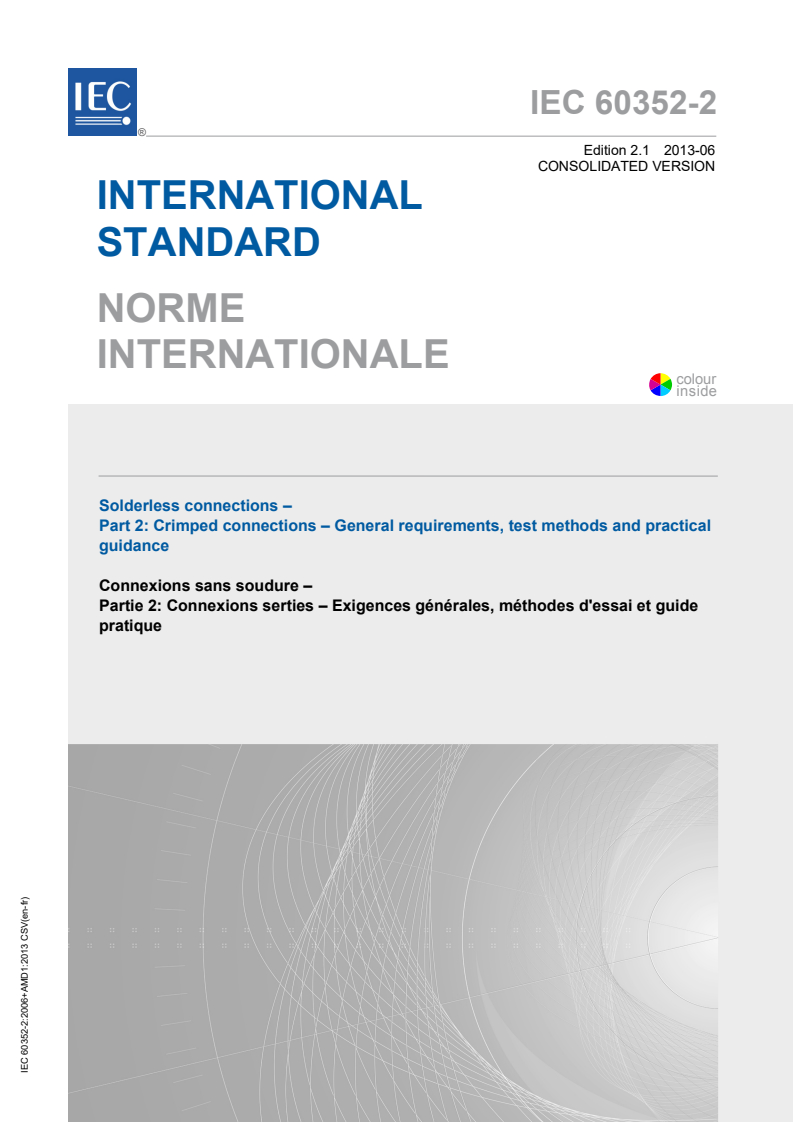
IEC 60352-2 ®
Edition 2.1 2013-06
CONSOLIDATED VERSION
INTERNATIONAL
STANDARD
NORME
INTERNATIONALE
colour
inside
Solderless connections –
Part 2: Crimped connections – General requirements, test methods and practical
guidance
Connexions sans soudure –
Partie 2: Connexions serties – Exigences générales, méthodes d'essai et guide
pratique
All rights reserved. Unless otherwise specified, no part of this publication may be reproduced or utilized in any form
or by any means, electronic or mechanical, including photocopying and microfilm, without permission in writing from
either IEC or IEC's member National Committee in the country of the requester.
If you have any questions about IEC copyright or have an enquiry about obtaining additional rights to this publication,
please contact the address below or your local IEC member National Committee for further information.
Droits de reproduction réservés. Sauf indication contraire, aucune partie de cette publication ne peut être reproduite ni
utilisée sous quelque forme que ce soit et par aucun procédé, électronique ou mécanique, y compris la photocopie et les
microfilms, sans l'accord écrit de la CEI ou du Comité national de la CEI du pays du demandeur.
Si vous avez des questions sur le copyright de la CEI ou si vous désirez obtenir des droits supplémentaires sur cette
publication, utilisez les coordonnées ci-après ou contactez le Comité national de la CEI de votre pays de résidence.
IEC Central Office Tel.: +41 22 919 02 11
3, rue de Varembé Fax: +41 22 919 03 00
CH-1211 Geneva 20 info@iec.ch
Switzerland www.iec.ch
About the IEC
The International Electrotechnical Commission (IEC) is the leading global organization that prepares and publishes
International Standards for all electrical, electronic and related technologies.
About IEC publications
The technical content of IEC publications is kept under constant review by the IEC. Please make sure that you have the
latest edition, a corrigenda or an amendment might have been published.
Useful links:
IEC publications search - www.iec.ch/searchpub Electropedia - www.electropedia.org
The advanced search enables you to find IEC publications The world's leading online dictionary of electronic and
by a variety of criteria (reference number, text, technical electrical terms containing more than 30 000 terms and
committee,…). definitions in English and French, with equivalent terms in
It also gives information on projects, replaced and additional languages. Also known as the International
withdrawn publications. Electrotechnical Vocabulary (IEV) on-line.
IEC Just Published - webstore.iec.ch/justpublished Customer Service Centre - webstore.iec.ch/csc
Stay up to date on all new IEC publications. Just Published If you wish to give us your feedback on this publication
details all new publications released. Available on-line and or need further assistance, please contact the
also once a month by email. Customer Service Centre: csc@iec.ch.
A propos de la CEI
La Commission Electrotechnique Internationale (CEI) est la première organisation mondiale qui élabore et publie des
Normes internationales pour tout ce qui a trait à l'électricité, à l'électronique et aux technologies apparentées.
A propos des publications CEI
Le contenu technique des publications de la CEI est constamment revu. Veuillez vous assurer que vous possédez
l’édition la plus récente, un corrigendum ou amendement peut avoir été publié.
Liens utiles:
Recherche de publications CEI - www.iec.ch/searchpub Electropedia - www.electropedia.org
La recherche avancée vous permet de trouver des Le premier dictionnaire en ligne au monde de termes
publications CEI en utilisant différents critères (numéro de électroniques et électriques. Il contient plus de 30 000
référence, texte, comité d’études,…). termes et définitions en anglais et en français, ainsi que
Elle donne aussi des informations sur les projets et les les termes équivalents dans les langues additionnelles.
publications remplacées ou retirées. Egalement appelé Vocabulaire Electrotechnique
International (VEI) en ligne.
Just Published CEI - webstore.iec.ch/justpublished
Service Clients - webstore.iec.ch/csc
Restez informé sur les nouvelles publications de la CEI.
Just Published détaille les nouvelles publications parues. Si vous désirez nous donner des commentaires sur
Disponible en ligne et aussi une fois par mois par email. cette publication ou si vous avez des questions
contactez-nous: csc@iec.ch.
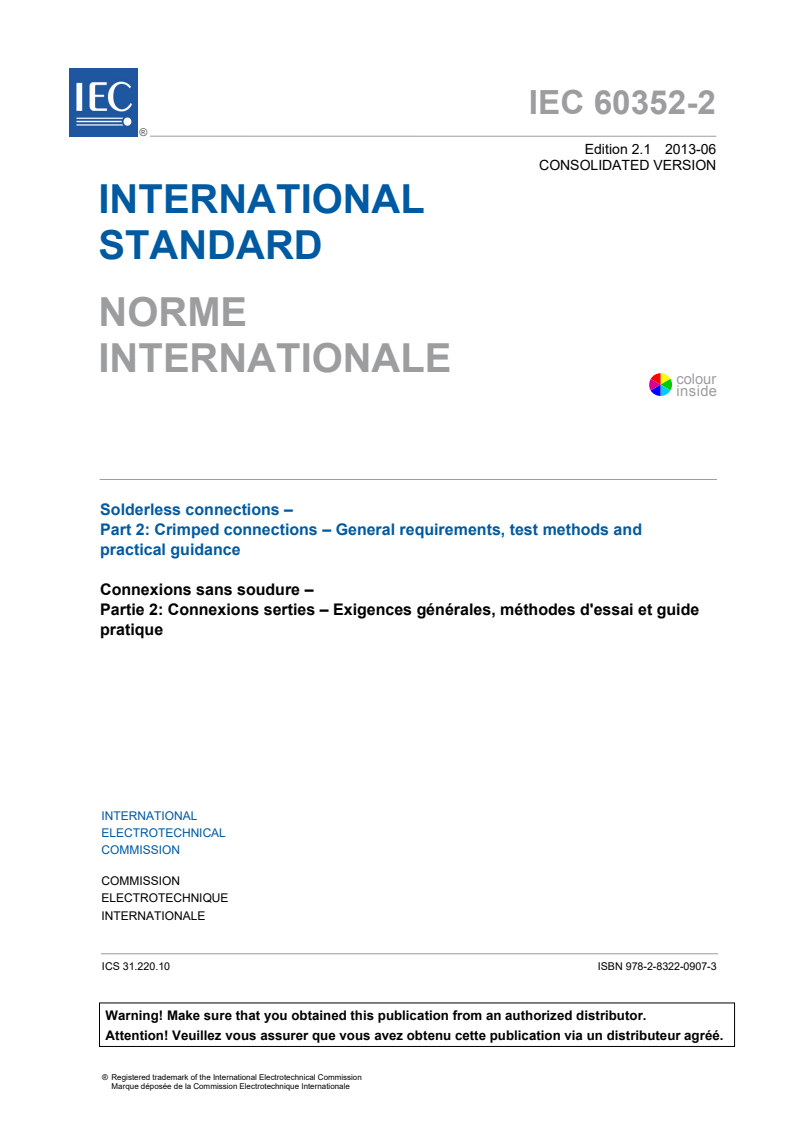
IEC 60352-2 ®
Edition 2.1 2013-06
CONSOLIDATED VERSION
INTERNATIONAL
STANDARD
NORME
INTERNATIONALE
colour
inside
Solderless connections –
Part 2: Crimped connections – General requirements, test methods and
practical guidance
Connexions sans soudure –
Partie 2: Connexions serties – Exigences générales, méthodes d'essai et guide
pratique
INTERNATIONAL
ELECTROTECHNICAL
COMMISSION
COMMISSION
ELECTROTECHNIQUE
INTERNATIONALE
ICS 31.220.10 ISBN 978-2-8322-0907-3
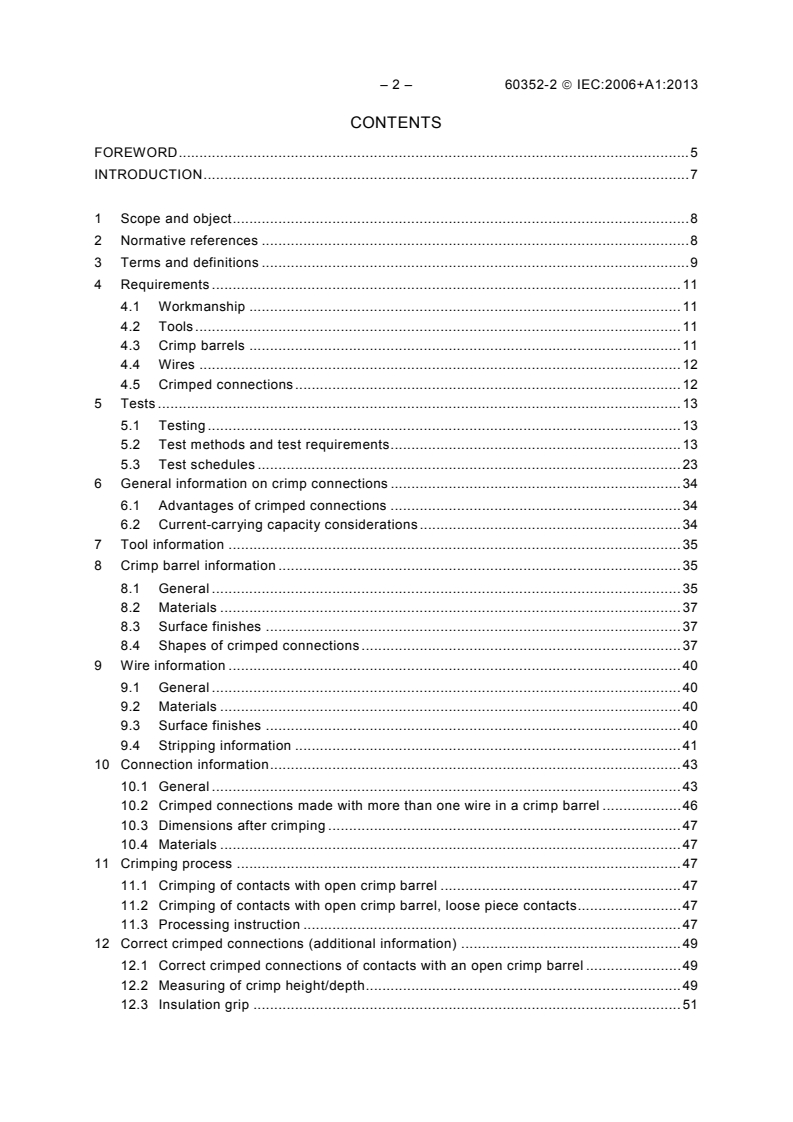
– 2 – 60352-2 IEC:2006+A1:2013
CONTENTS
FOREWORD . 5
INTRODUCTION . 7
1 Scope and object . 8
2 Normative references . 8
3 Terms and definitions . 9
4 Requirements . 11
4.1 Workmanship . 11
4.2 Tools . 11
4.3 Crimp barrels . 11
4.4 Wires . 12
4.5 Crimped connections . 12
5 Tests . 13
5.1 Testing . 13
5.2 Test methods and test requirements . 13
5.3 Test schedules . 23
6 General information on crimp connections . 34
6.1 Advantages of crimped connections . 34
6.2 Current-carrying capacity considerations . 34
7 Tool information . 35
8 Crimp barrel information . 35
8.1 General . 35
8.2 Materials . 37
8.3 Surface finishes . 37
8.4 Shapes of crimped connections . 37
9 Wire information . 40
9.1 General . 40
9.2 Materials . 40
9.3 Surface finishes . 40
9.4 Stripping information . 41
10 Connection information . 43
10.1 General . 43
10.2 Crimped connections made with more than one wire in a crimp barrel . 46
10.3 Dimensions after crimping . 47
10.4 Materials . 47
11 Crimping process . 47
11.1 Crimping of contacts with open crimp barrel . 47
11.2 Crimping of contacts with open crimp barrel, loose piece contacts. 47
11.3 Processing instruction . 47
12 Correct crimped connections (additional information) . 49
12.1 Correct crimped connections of contacts with an open crimp barrel . 49
12.2 Measuring of crimp height/depth . 49
12.3 Insulation grip . 51
60352-2 IEC:2006+A1:2013 – 3 –
13 Faults with crimped contacts having open barrels . 51
14 General information about crimp type contacts as part of a multipole connector . 54
14.1 Insertion of crimped contacts into the contact cavities of the connector
housing . 54
14.2 Removal of inserted contacts . 54
14.3 Mounting and bending of wire bundles/cables with crimped contacts . 54
14.4 Mating and unmating of multipole connectors with crimped contacts . 55
15 Final remarks . 56
Figure 1 – Open crimp barrel . 9
Figure 2 – Closed crimp barrels . 9
Figure 3 – Pre-insulated crimp barrel . 10
Figure 4 – Crimping zones . 10
Figure 5 – Test arrangement for measurement of contact resistance . 15
Figure 6 – Contact resistance R of crimped connections with copper barrels and
C
copper conductor (K = 1) . 17
Figure 7 – Examples of test arrangements . 20
Figure 8 – Test current for crimped connections . 22
Figure 9 – Examples of type A specimens . 23
Figure 10 – Examples of type B specimens . 24
Figure 11 – Example of type C specimen . 24
Figure 12 – Examples of type D specimens . 25
Figure 13 – Example of type E specimen . 25
Figure 14 – Basic test schedule (see 5.3.2) . 32
Figure 15 – Full test schedule (see 5.3.3) . 33
Figure 16 – Open crimp barrels . 36
Figure 17 – Closed crimp barrels . 37
Figure 18 – Crimping shape in the wire axis . 38
Figure 19 – Crimping shape 90° angled to the wire axis . 38
Figure 20 – Crimping shape without insulation grip . 39
Figure 21 – Crimping shape with pre-insulation crimp barrel . 39
Figure 22 – Crimping shape without pre-insulation crimp barrel . 40
Figure 23 – Stripping length . 41
Figure 24 – Correctly stripped wire . 41
Figure 25 – Examples of stripping faults . 42
Figure 26 – Examples of correctly crimped connections with open crimp barrels . 43
Figure 27 – Examples of correctly crimped connections with closed crimp barrels. 44
Figure 28 – Examples of crimping faults with open crimp barrels, with insulation grip . 45
Figure 29 – Examples of crimping faults with closed crimp barrels, without insulation grip . 46
Figure 30 – Crimping process of an open crimp barrel . 48
Figure 31 – Correct crimped connections of contacts with open crimp barrel . 49
Figure 32 – Measuring instructions . 50
Figure 33 – Measuring process . 50
Figure 34 – Examples of insulation grips . 51
– 4 – 60352-2 IEC:2006+A1:2013
Figure 35 – Examples of faults with crimped contacts . 53
Figure 36 – Insertion of crimped contacts into contact cavities . 54
Figure 37 – Mounting of wire bundles/cables with crimped contacts . 55
Figure 38 – Bending of wire bundles of connectors . 55
Figure 39 – Mating and unmating of multipole connectors . 56
Table 1 – Pull out force of crimped connections . 14
Table 2 – Example of other materials . 18
Table 3 – Number of specimens . 26
Table 4 – Test group P1 . 27
Table 5 – Test group P2 . 27
Table 6 – Test group P3 . 27
Table 7 – Test group P4 . 28
Table 8 – Test group A . 29
Table 9 – Test group B . 29
Table 10 – Test group C . 29
Table 11 – Test group D . 30
Table 12 – Test group E . 30
Table 13 – Test group F . 30
Table 14 – Test group G . 31
60352-2 IEC:2006+A1:2013 – 5 –
INTERNATIONAL ELECTROTECHNICAL COMMISSION
____________
SOLDERLESS CONNECTIONS –
Part 2: Crimped connections –
General requirements, test methods and practical guidance
FOREWORD
1) The International Electrotechnical Commission (IEC) is a worldwide organization for standardization comprising
all national electrotechnical committees (IEC National Committees). The object of IEC is to promote
international co-operation on all questions concerning standardization in the electrical and electronic fields. To
this end and in addition to other activities, IEC publishes International Standards, Technical Specifications,
Technical Reports, Publicly Available Specifications (PAS) and Guides (hereafter referred to as “IEC
Publication(s)”). Their preparation is entrusted to technical committees; any IEC National Committee interested
in the subject dealt with may participate in this preparatory work. International, governmental and non-
governmental organizations liaising with the IEC also participate in this preparation. IEC collaborates closely
with the International Organization for Standardization (ISO) in accordance with conditions determined by
agreement between the two organizations.
2) The formal decisions or agreements of IEC on technical matters express, as nearly as possible, an international
consensus of opinion on the relevant subjects since each technical committee has representation from all
interested IEC National Committees.
3) IEC Publications have the form of recommendations for international use and are accepted by IEC National
Committees in that sense. While all reasonable efforts are made to ensure that the technical content of IEC
Publications is accurate, IEC cannot be held responsible for the way in which they are used or for any
misinterpretation by any end user.
4) In order to promote international uniformity, IEC National Committees undertake to apply IEC Publications
transparently to the maximum extent possible in their national and regional publications. Any divergence
between any IEC Publication and the corresponding national or regional publication shall be clearly indicated in
the latter.
5) IEC provides no marking procedure to indicate its approval and cannot be rendered responsible for any
equipment declared to be in conformity with an IEC Publication.
6) All users should ensure that they have the latest edition of this publication.
7) No liability shall attach to IEC or its directors, employees, servants or agents including individual experts and
members of its technical committees and IEC National Committees for any personal injury, property damage or
other damage of any nature whatsoever, whether direct or indirect, or for costs (including legal fees) and
expenses arising out of the publication, use of, or reliance upon, this IEC Publication or any other IEC
Publications.
8) Attention is drawn to the Normative references cited in this publication. Use of the referenced publications is
indispensable for the correct application of this publication.
9) Attention is drawn to the possibility that some of the elements of this IEC Publication may be the subject of
patent rights. IEC shall not be held responsible for identifying any or all such patent rights.
This consolidated version of the official IEC Standard and its amendment has been prepared
for user convenience.
IEC 60352-2 edition 2.1 contains the second edition (2006) [documents 48B/1584/FDIS and
48B/1617/RVD] and its amendment 1 (2013) [documents 48B/2340/FDIS and 48B/2348/RVD].
A vertical line in the margin shows where the base publication has been modified by
amendment 1. Additions and deletions are displayed in red, with deletions being struck
through.
– 6 – 60352-2 IEC:2006+A1:2013
International Standard IEC 60352-2 has been prepared by subcommittee 48B: Connectors, of
IEC technical committee 48: Electromechanical components and mechanical structures for
electronic equipment.
This edition includes the following major technical changes with respect to the previous
edition:
a) The contents of clauses have been re-arranged, for example the old clauses 5, 6, 7, 8 and
9 are now included in the new clause 4, Requirements.
b) Subclause 4.3.1: the material requirements for crimp barrels have been changed from
Vickers hardness into more appropriate tensile strength requirements and the
requirements have been opened to other materials, if it is of suitable characteristics.
c) Subclause 4.3.3, Surface finishes: the tin-lead has been replaced by tin-alloy to comply
with RoHS legislation. Other plating materials, such as nickel, may be used provided their
suitability has been proven.
d) Subclause 5.1.4, Recovering, has been added.
e) Table 2, example of other materials, has been shortened.
f) Subclause 5.2.4.5 and Figure 7, Current loading, cyclic: the length of wire between two
specimens has been changed to a “minimum of 150 mm” to comply with regional
requirements.
g) Subclause 5.2.4.6, Crimping at low temperature, has been changed to “under
consideration”.
h) Subclause 15.4 of IEC 60352-2 amendment 1 (1996-11) has been deleted for the sake of
design freedom, because the dimensions are not widely used as stated; only a minority of
products, in most cases older ones have these dimensions.
This publication has been drafted in accordance with the ISO/IEC Directives, Part 2.
IEC 60352 consists of the following parts, under the general title Solderless connections:
Part 1: Wrapped connections − General requirements, test methods and practical guidance
Part 2: Crimped connections − General requirements, test methods and practical guidance
Part 3: Solderless accessible insulation displacement connections − General requirements,
test methods and practical guidance
Part 4: Solderless non-accessible insulation displacement connections − General
requirements, test methods and practical guidance
Part 5: Press-in connections − General requirements, test methods and practical guidance
Part 6: Insulation piercing connections − General requirements, test methods and practical
guidance
Part 7: Spring clamp connections − General requirements, test methods and practical
guidance
The committee has decided that the contents of the base publication and its amendment will
remain unchanged until the maintenance result date indicated on the IEC web site under
"http://webstore.iec.ch" in the data related to the specific publication. At this date, the
publication will be
• reconfirmed;
• withdrawn;
• replaced by a revised edition, or
• amended.
IMPORTANT – The “colour inside” logo on the cover page of this publication indicates
that it contains colours which are considered to be useful for the correct understanding
of its contents. Users should therefore print this publication using a colour printer.
60352-2 IEC:2006+A1:2013 – 7 –
INTRODUCTION
IEC 60352-2 includes requirements, tests and practical guidance information. Two test
schedules are provided: a basic test schedule which applies to solderless crimped
connections which conform to all of the requirements given in Clause 4 and a full test
schedule which applies to solderless crimped connections which do not fully conform to all of
the requirements, for example which are made with solid wires, different materials, etc.
IEC Guide 109 advocates the need to minimise the impact of a product on the natural environ-
ment throughout the product life cycle. It is understood that some of the materials permitted in
this standard may have a negative environmental impact. As technological advances lead to
acceptable alternatives for these materials, they will be eliminated from the standard.
– 8 – 60352-2 IEC:2006+A1:2013
SOLDERLESS CONNECTIONS –
Part 2: Crimped connections –
General requirements, test methods and practical guidance
1 Scope and object
This part of IEC 60352 is applicable to solderless crimped connections made with stranded
2 2
wires of 0,05 mm to 10 mm cross-section or solid wires of 0,25 mm to 3,6 mm diameter and
appropriately designed uninsulated or pre-insulated crimp barrels for use in telecom-
munication equipment and in electronic devices employing similar techniques.
Information on the materials and data from industrial experience is included in addition to the
test procedures to provide electrically stable connections under prescribed environmental
conditions.
NOTE This part of IEC 60352 is not intended to be applicable to crimping of coaxial cables.
The object of this part of IEC 60352 is to determine the suitability of solderless crimped
connections under specified mechanical, electrical and atmospheric conditions and to provide
a means of comparing test results when the tools used to make the connections are of
different designs or manufacture.
2 Normative references
The following referenced documents are indispensable for the application of this document.
For dated references, only the edition cited applies. For undated references, the latest edition
of the referenced document (including any amendments) applies.
IEC 60050(581):1978, International Electrotechnical Vocabulary (IEV) – Chapter 581: Electro-
mechanical components for electronic equipment
IEC 60068-1:1988, Environmental testing – Part 1: General and guidance
Amendment 1 (1992)
IEC 60189-3:1988, Low-frequency cables and wires with PVC insulation and PVC sheath –
Part 3: Equipment wires with solid or stranded conductor, PVC insulated, in singles, pairs and
triples
IEC 60512 (all parts), Connectors for electronic equipment – Tests and measurements
IEC 60512-1-100:2001, Connectors for electronic equipment – Tests and measurements –
Part 1-100: General – Applicable publications
IEC 60760:1989, Flat, quick-connect terminations
Amendment 1 (1993)
ISO 6892:1998, Metallic materials – Tensile testing at ambient temperature
60352-2 IEC:2006+A1:2013 – 9 –
3 Terms and definitions
For the purpose of this document, the terms and definitions of IEC 60050(581), IEC 60512-1
and the following apply:
3.1
crimp barrel
conductor barrel designed to accommodate one or more conductors and to be crimped by
means of a crimping tool
3.2
open crimp barrel
crimp barrel with an open shape before crimping, for example U- or V-shape (see Figure 1)
Insulation grip
IEC 2733/05
Figure 1 – Open crimp barrel
3.3
closed crimp barrel
crimp barrel with a closed shape before crimping (see Figure 2)
IEC 2734/05 IEC 2735/05 IEC 2736/05
Figure 2a – Machined crimp barrel Figure 2b – Brazed/welded crimp Figure 2c – Stamped/rolled
barrel crimp barrel
Figure 2 – Closed crimp barrels
3.4
pre-insulated crimp barrel
crimp barrel with a permanent layer of insulation through which the crimp is made (see Figure
3)
– 10 – 60352-2 IEC:2006+A1:2013
Barrel insulation
(cross section)
Insulation support sleeve
(cross section)
Crimp barrel
IEC 2737/05
Figure 3 – Pre-insulated crimp barrel
3.5
crimping zone
that portion of a crimp barrel where the crimped connection is achieved by pressure
deformation or reshaping of the barrel around the conductor (see Figure 4)
NOTE Where the crimp barrel is equipped with an insulation grip, this is also reshaped by compression by the
crimping tool to secure the insulation of the wire.
Crimp zone
Insulation grip
IEC 2738/05 IEC 2739/05
Figure 4a – Closed crimp barrel Figure 4b – Open crimp barrel
Compression zone of
the insulation grip
Wire strands
Insulation
Insulation grip
IEC 2740/05
Figure 4c – Insulation grip
Figure 4 – Crimping zones
3.6
crimping die
that part of a crimping tool which forms the crimp(s) and usually incorporates the crimp
anvil(s), the crimp indentor(s), and the positioner
NOTE Crimping dies may have separate or integral sections for compressing the insulation grip, if provided.
60352-2 IEC:2006+A1:2013 – 11 –
4 Requirements
4.1 Workmanship
The connection shall be processed in a careful and workmanlike manner, in accordance with
good current practice.
4.2 Tools
Crimping tools shall be used and inspected according to the instructions given by the tool
manufacturer.
The crimping tool shall be able to make uniformly reliable connections during its useful life.
The crimping tool shall be equipped with the appropriate dies. Where the dies are adjustable,
the correct setting for the barrel to be crimped shall be used.
Hand crimping tools shall be provided with a full cycle crimping mechanism.
Automatic crimping tools shall be provided with a full cycle crimping mechanism or equivalent
safeguard. They shall be correctly set and the setting shall be maintained.
Tools are evaluated by testing crimped connections made with the tools to be evaluated.
4.3 Crimp barrels
4.3.1 Materials
Crimp barrels shall be made of copper or copper alloy with a copper content of 60 %
minimum.
The minimum tensile strength of the material shall not exceed 600 MPa in accordance with
ISO 6892.
Other materials of suitable characteristics may be used, for example nickel, steel, stainless
steel. Materials with a high resistivity-coefficient (K values, see 5.2.3.1) or materials
exceeding the tensile strength specified above, may not be suitable for certain applications. In
these cases, the full test schedule of 5.3.3 shall be applied (see 5.1.1).
4.3.2 Dimensions
The dimensions shall be suitable for stranded wires as specified in 4.4.
4.3.3 Surface finishes
The crimp barrel shall be unplated or plated with tin, tin-alloy, silver, gold or palladium.
The surface shall be free of contamination and corrosion. Other plating materials, such as
nickel, (unless used as under-plate) may be used provided their suitability has been proven.
In these cases, the full test schedule of 5.3.3 shall be applied (see 5.1.1).
4.3.4 Design features
The crimp barrel shall be so designed that the crimped connection is achieved by pressure
deformation or reshaping of the crimp barrel around the stripped conductor.
NOTE Techniques where the connection is achieved by parts of barrel penetrating through the insulation of an
insulated conductor are not covered by this standard.
– 12 – 60352-2 IEC:2006+A1:2013
The following barrel types shall be used:
– open crimp barrels, uninsulated;
– closed crimp barrel, either pre-insulated or uninsulated.
The crimp barrels shall be free of sharp edges likely to damage the conductors.
4.4 Wires
4.4.1 General
Stranded conductors shall be used, solid round conductors of 0,25 mm to 3,6 mm diameter
may be used provided their suitability has been proven.
4.4.2 Materials
Annealed copper having an elongation at break of not less than 10 % shall be used.
4.4.3 Dimensions
2 2
The cross-section of the stranded conductor shall be within the range 0,05 mm to 10 mm .
4.4.4 Surface finishes
Conductors which are unplated or finished with tin, tin-alloy or silver shall be used.
The surface shall be free of contamination and corrosion.
4.4.5 Insulation
The insulation shall be capable of being readily stripped from the conductor without changing
the physical characteristics of the conductor or strands, respectively.
4.5 Crimped connections
The combination of the tool, barrel and wire shall be compatible.
Where the crimp barrel is equipped with an insulation support or insulation grip, the overall
diameter of the insulation wire shall be compatible with the dimensions of the support or grip.
The wire shall be stripped to the correct length. The strands of the stripped part of the
conductor shall not be damaged, for example partly or totally broken.
The stripped part of the conductor shall be clean and free from particles of insulation.
The lay of the strands shall be correct. If the lay has been disturbed, it may be restored by a
light twist.
The conductor shall be correctly located in the barrel, i.e. to the correct depth. This shall be
verified as follows:
– in the case of open crimp barrels or closed crimp barrels with inspection provision, this
shall be visually checked;
– in the case of closed crimp barrels without inspection provisions, for example an
inspection hole, this shall be measured (indirectly by measuring the possible insertion
depth of the barrel, the stripping length of the wire and the distance between the end of
the barrel and the beginning of the wire insulation).
All strands of the wire shall be within the barrel. There shall be no damaged strands.
60352-2 IEC:2006+A1:2013 – 13 –
Where the crimp barrel is equipped with an insulation support or insulation grip, the insulation
shall be correctly located in the support or grip.
NOTE For crimped connections made with more than one wire, see 10.2.
5 Tests
5.1 Testing
5.1.1 General
As explained in the introduction, there are two test schedules which shall be applied
according to the following conditions:
– crimped connections, which conform to all of the requirements of Clause 4 shall be tested
to and meet the requirements of the basic test schedule of 5.3.2;
– crimped connections, which do not fully conform to all of the requirements of Clause 4, for
example which are made with solid wires, different materials, etc., shall be tested to and
meet the requirements of the full test schedule of 5.3.3.
NOTE For crimped connections made with more than one wire, see 10.2.
5.1.2 Standard conditions for testing
Unless otherwise specified, all tests shall be carried out under the standard conditions for
testing as specified in IEC 60512-1.
The ambient temperature and the relative humidity at which the measurements are made shall
be stated in the test report.
In case of dispute about test results, the test shall be repeated at one of the referred
conditions of IEC 60068-1.
5.1.3 Preconditioning
Where specified, the connection shall be preconditioned under standard conditions for testing
for a period of 24 h, in accordance with IEC 60512-1.
5.1.4 Recovering
Where specified, the specimen shall be allowed to recover under standard conditions for
testing for a period of 1 h to 2 h, after conditioning.
5.1.5 Mounting of the specimen
When mounting is required in a test, the specimens shall be mounted using the normal
mounting method, unless otherwise specified.
5.2 Test methods and test requirements
5.2.1 General examination
The tests shall be carried out in accordance with test 1a of IEC 60512 and test 1b of
IEC 60512. The visual examination test may be carried out with magnification up to
approximately five times.
All crimp connections shall be examined to ensure that the applicable requirements of 4.3 to
4.5 have been met.
– 14 – 60352-2 IEC:2006+A1:2013
5.2.2 Mechanical tests
5.2.2.1 Pull out force
The test shall be carried out in accordance with test 16d of IEC 60512.
Unless otherwise specified by the manufacturer of the crimp barrel (terminal), the minimum
values of the pull out force given in Table 1 shall be applied.
Table 1 – Pull out force of crimped connections
Conductor cross-section Pull out force
2 a
mm AWG N
0,05 30 6
0,08 28 11
0,12 26 15
0,14 18
0,22 24 28
0,25 32
0,32 22 40
0,5 20 60
0,75 85
0,82 18 90
1,0 108
1,3 16 135
1,5 150
2,1 14 200
2,5 230
3,3 12 275
4,0 310
5,3 10 355
6,0 360
8,4 8 370
10,0 380
NOTE To test the crimped connection, the same values are included
in IEC 60760, Clause 17 and IEC 61210, Table 9.
a
For information only.
5.2.2.2 Insulation grip effectiveness
The test shall be carried out in accordance with test 16h of IEC 60512.
Number of winding cycles: 2
Tension to be applied: Lowest tension necessary to bring the wire into contact with the
mandrel.
5.2.3 Electrical tests
5.2.3.1 Contact resistance
The test shall be carried out in accordance with test 2a of IEC 60512 or with test 2b of
IEC 60512, as specified in the detail specification.
A suitable test arrangement is shown in Figure 5.
60352-2 IEC:2006+A1:2013 – 15 –
Measuring points
B
E
D
Closed crimp
barrel with
insulation grip
Closed crimp
barrel
Open crimp
Insulation removed
barrel with
insulation grip
Open crimp
barrel
R X mm 100 mm
C
R R
BD 100
IEC 2741/05
X
R = R − × R
C BD 100
where
R is the contact resistance of crimped connection;
C
R is the measured resistance between measuring points B and D;
BD
R is the measured distance over 100 mm wire length (D – E);
X is the distance between crimp barrel and measuring point D in mm.
NOTE For distance X, 25 mm to 100 mm is recommended.
Figure 5 – Test arrangement for measurement of contact resistance
Contact point B shall be as close as possible to the end of the wire in the crimp barrel but, in
the case of an open crimp barrel, not touching the end of the wire.
To achieve dependable and reproducible test results, good contact to all strands at the
measuring points is necessary. By locating the measuring point D at a safe distance away
from the crimped connection, any means to ensure the necessary good contact to all strands
may be used.
A suitable test device shall be used to ensure good contact at all measuring points. The test
device shall ensure that the measuring points are located at predetermined fixed distances.
Where test probes are used, they shall be sufficiently rounded to avoid damaging the
conductor strands.
When test 2b of IEC 60512 is applied, the test current shall be 1 A per mm conductor cross-
section. The duration of application of the test current shall be short enough to prevent
heating of the specimens.
– 16 – 60352-2 IEC:2006+A1:2013
6,5
3,3
A
1,0
B
0,5
0,1
0,06
0,03
0,05 0,08 0,13 0,20 0,28 0,50 0,75 1,0 1,5 2,5 4,0 6,0 10,0
Conductor cross-section mm
IEC 2742/05
Contact resistance mΩ
60352-2 IEC:2006+A1:2013 – 17 –
10,00
A
0,05
0,08
B
Note
0,13
0,2
0,28
1,00
0,5
0,75
1,5
2,5
0,10 6
0,01
0,01 0,1 1 10
Conductor cross-section (mm )
IEC 1410/13
Curve A: Values for initial contact resistance, maximum.
Curve B: Values for maximum change in resistance after electrical or climatic conditioning.
NOTE Numbers indicate specific conductor cross-sections in mm .
The lines for maximum initial contact resistance (A) and maximum change in resistance after electrical or climatic
conditioning (B) are based on the following equations. These formulas may be used in place of the graph in Figure
6 to determine the maximum allowed initial resistance and post-conditioning change in resistance values.
–0,8843
A = 0,4596xC
B = A / 2
Where:
A is the maximum allowed initial resistance, in milliohms (mΩ);
B is the maximum allowed change in resistance, in milliohms (mΩ);
C is the wire cross-section, in mm .
Figure 6 – Contact resistance R of crimped connections with copper barrels
C
and copper conductor (K = 1)
The cross-section to be used when applying Figure 6 is the cross-section calculated with the
number of strands and the nominal diameter of one strand.
The values for maximum initial contact resistance (curve A) and the values for maximum
change in resistance (curve B) as presented in Figure 6 apply only to crimped connections
made with crimp barrels according to 4.3 and conductors according to 4.4 and where K = 1.
Contact resistance (mΩ)
– 18 – 60352-2 IEC:2006+A1:2013
For barrel materials other than copper, the values of both curves A and B are to be multiplied
by “K”, where
resistivity of material used
K=
resistivity of copper
Table 2 includes values of resistivity and K for other materials.
Table 2 – Example of other materials
Material Resistivity
K
Ω mm /m
Annealed copper, 100,0 Cu 0,017 2 1
Copper-zinc alloys (brasses) 0,030 to 0,061 1,74 to 3,55
For example 70,0 Cu, 30,0 Zn 0,061 3,55
Copper-tin alloys (bronzes) 0,083 to 0,15 4,83 to 8,72
For example 94,0 Cu, 6,0 Sn 0,11 6,40
The maximum permitted change in resistance is to be added to the initially measured
resistance, not to the permitted initial limit, i.e. the maximum permitted contact resistance
after conditioning is equal to the measured initial value plus the maximum permitted change
as given in curve B of Figure 6 and corrected by “K”, if applicable.
NOTE For crimped connections made with more than one wire, see 10.2. For further information on wires, see
IEC 60189-3.
5.2.3.2 Voltage proof (crimped connection with pre-insulated crimp barrels)
The test shall be carried out in accordance with test 4c of IEC 60512.
Proof voltage: 1 500 V r.m.s. 45 Hz to 60 Hz unless otherwise agreed between user and
manufacturer.
5.2.4 Climatic tests
5.2.4.1 General
Unless otherwise specified, the following upper category temperature (UCT) and lower
category temperature (LCT) shall be used in the following tests:
UCT: +125 °C (for tin plated barrels +100 °C)
LCT: –55 °C
5.2.4.2 Rapid change of temperature
The test shall be carried out in accordance with test 11d of IEC 60512.
The following details shall apply:
Low temperature: T LCT
A
High temperature T UCT
B
Duration of exposure: t 30 min
Number of cycles: 5
This test is not intended to examine the characteristics of the wire insulation nor the insulation
of pre-insulated crimp barrels.
60352-2 IEC:2006+A1:2013 – 19 –
5.2.4.3 Dry heat
The test shall
...
NORME CEI
INTERNATIONALE
IEC
60352-2
INTERNATIONAL
Deuxième édition
STANDARD
Second edition
2006-02
Connexions sans soudure –
Partie 2:
Connexions serties –
Exigences générales, méthodes d'essai
et guide pratique
Solderless connections –
Part 2:
Crimped connections –
General requirements, test methods
and practical guidance
Numéro de référence
Reference number
CEI/IEC 60352-2:2006
Numérotation des publications Publication numbering
Depuis le 1er janvier 1997, les publications de la CEI As from 1 January 1997 all IEC publications are
sont numérotées à partir de 60000. Ainsi, la CEI 34-1 issued with a designation in the 60000 series. For
devient la CEI 60034-1. example, IEC 34-1 is now referred to as IEC 60034-1.
Editions consolidées Consolidated editions
Les versions consolidées de certaines publications de la The IEC is now publishing consolidated versions of its
CEI incorporant les amendements sont disponibles. Par publications. For example, edition numbers 1.0, 1.1
exemple, les numéros d’édition 1.0, 1.1 et 1.2 indiquent and 1.2 refer, respectively, to the base publication,
respectivement la publication de base, la publication de the base publication incorporating amendment 1 and
base incorporant l’amendement 1, et la publication de the base publication incorporating amendments 1
base incorporant les amendements 1 et 2. and 2.
Informations supplémentaires Further information on IEC publications
sur les publications de la CEI
Le contenu technique des publications de la CEI est The technical content of IEC publications is kept
constamment revu par la CEI afin qu'il reflète l'état under constant review by the IEC, thus ensuring that
actuel de la technique. Des renseignements relatifs à the content reflects current technology. Information
cette publication, y compris sa validité, sont dispo- relating to this publication, including its validity, is
nibles dans le Catalogue des publications de la CEI available in the IEC Catalogue of publications
(voir ci-dessous) en plus des nouvelles éditions, (see below) in addition to new editions, amendments
amendements et corrigenda. Des informations sur les and corrigenda. Information on the subjects under
sujets à l’étude et l’avancement des travaux entrepris consideration and work in progress undertaken by the
par le comité d’études qui a élaboré cette publication, technical committee which has prepared this
ainsi que la liste des publications parues, sont publication, as well as the list of publications issued,
également disponibles par l’intermédiaire de: is also available from the following:
• Site web de la CEI (www.iec.ch) • IEC Web Site (www.iec.ch)
• Catalogue des publications de la CEI • Catalogue of IEC publications
Le catalogue en ligne sur le site web de la CEI The on-line catalogue on the IEC web site
(www.iec.ch/searchpub) vous permet de faire des (www.iec.ch/searchpub) enables you to search by a
recherches en utilisant de nombreux critères, variety of criteria including text searches,
comprenant des recherches textuelles, par comité technical committees and date of publication. On-
d’études ou date de publication. Des informations en line information is also available on recently
ligne sont également disponibles sur les nouvelles issued publications, withdrawn and replaced
publications, les publications remplacées ou retirées, publications, as well as corrigenda.
ainsi que sur les corrigenda.
• IEC Just Published • IEC Just Published
Ce résumé des dernières publications parues This summary of recently issued publications
(www.iec.ch/online_news/justpub) est aussi dispo- (www.iec.ch/online_news/justpub) is also available
nible par courrier électronique. Veuillez prendre by email. Please contact the Customer Service
contact avec le Service client (voir ci-dessous) Centre (see below) for further information.
pour plus d’informations.
• Service clients • Customer Service Centre
Si vous avez des questions au sujet de cette If you have any questions regarding this
publication ou avez besoin de renseignements publication or need further assistance, please
supplémentaires, prenez contact avec le Service contact the Customer Service Centre:
clients:
Email: custserv@iec.ch Email: custserv@iec.ch
Tél: +41 22 919 02 11 Tel: +41 22 919 02 11
Fax: +41 22 919 03 00 Fax: +41 22 919 03 00
.
NORME CEI
INTERNATIONALE
IEC
60352-2
INTERNATIONAL
Deuxième édition
STANDARD
Second edition
2006-02
Connexions sans soudure –
Partie 2:
Connexions serties –
Exigences générales, méthodes d'essai
et guide pratique
Solderless connections –
Part 2:
Crimped connections –
General requirements, test methods
and practical guidance
IEC 2006 Droits de reproduction réservés Copyright - all rights reserved
Aucune partie de cette publication ne peut être reproduite ni No part of this publication may be reproduced or utilized in any
utilisée sous quelque forme que ce soit et par aucun procédé, form or by any means, electronic or mechanical, including
électronique ou mécanique, y compris la photocopie et les photocopying and microfilm, without permission in writing from
microfilms, sans l'accord écrit de l'éditeur. the publisher.
International Electrotechnical Commission, 3, rue de Varembé, PO Box 131, CH-1211 Geneva 20, Switzerland
Telephone: +41 22 919 02 11 Telefax: +41 22 919 03 00 E-mail: inmail@iec.ch Web: www.iec.ch
CODE PRIX
XA
PRICE CODE
Commission Electrotechnique Internationale
International Electrotechnical Commission
МеждународнаяЭлектротехническаяКомиссия
Pour prix, voir catalogue en vigueur
For price, see current catalogue
– 2 – 60352-2 CEI:2006
SOMMAIRE
AVANT-PROPOS.8
INTRODUCTION.12
1 Domaine d'application et objet.14
2 Références normatives.14
3 Termes et définitions .16
4 Exigences .20
4.1 Exécution .20
4.2 Outils .20
4.3 Fûts à sertir.20
4.4 Fils.22
4.5 Connexions serties.22
5 Essais .24
5.1 Essais .24
5.2 Méthodes et exigences d'essai .26
5.3 Programmes d’essais .40
6 Guide pratique pour les connexions serties .62
6.1 Avantages des connexions serties.62
6.2 Courant limite admissible .62
7 Informations sur les outils.64
8 Informations sur les fûts à sertir .64
8.1 Généralités.64
8.2 Matériaux .68
8.3 Finitions de surface .68
8.4 Formes des connexions serties .68
9 Informations sur les fils .74
9.1 Généralités.74
9.2 Matériaux .74
9.3 Finitions de surface .76
9.4 Information sur le dénudage .76
10 Informations sur les connexions .82
10.1 Généralités.82
10.2 Connexions serties réalisées avec plus d’un fil dans le fût.90
10.3 Dimensions après sertissage.90
10.4 Matériaux .90
11 Procédé de sertissage.90
11.1 Sertissage des contacts sur les fûts ouverts .90
11.2 Sertissage des contacts sur les fûts ouverts, en vrac .90
11.3 Instructions pour l'opération .92
12 Connexions serties correctes (informations complémentaires).94
12.1 Connexions serties correctes sur contacts à fût ouvert .94
12.2 Méthode de mesure de la hauteur ou profondeur de sertissage.94
12.3 Frettage d’isolant .98
60352-2 IEC:2006 – 3 –
CONTENTS
FOREWORD.9
INTRODUCTION.13
1 Scope and object.15
2 Normative references .15
3 Terms and definitions .17
4 Requirements .21
4.1 Workmanship .21
4.2 Tools .21
4.3 Crimp barrels .21
4.4 Wires .23
4.5 Crimped connections.23
5 Tests .25
5.1 Testing .25
5.2 Test methods and test requirements.27
5.3 Test schedules .41
6 General information on crimp connections .63
6.1 Advantages of crimped connections .63
6.2 Current-carrying capacity considerations.63
7 Tool information .65
8 Crimp barrel information .65
8.1 General .65
8.2 Materials .69
8.3 Surface finishes .69
8.4 Shapes of crimped connections .69
9 Wire information .75
9.1 General .75
9.2 Materials .75
9.3 Surface finishes .77
9.4 Stripping information .77
10 Connection information.83
10.1 General .83
10.2 Crimped connections made with more than one wire in a crimp barrel .91
10.3 Dimensions after crimping .91
10.4 Materials .91
11 Crimping process .91
11.1 Crimping of contacts with open crimp barrel .91
11.2 Crimping of contacts with open crimp barrel, loose piece contacts.91
11.3 Processing instruction .93
12 Correct crimped connections (additional information) .95
12.1 Correct crimped connections of contacts with an open crimp barrel .95
12.2 Measuring of crimp height/depth.95
12.3 Insulation grip .99
– 4 – 60352-2 CEI:2006
13 Défauts sur contact sertis à fût ouvert .100
14 Informations générales sur les contacts sertis des connecteurs multipolaires .106
14.1 Insertion des contacts sertis dans les alvéoles de contact du boîtier de
connecteur .106
14.2 Extraction des contacts insérés .106
14.3 Montage et cambrage des faisceaux de fils ou câbles de contacts sertis .106
14.4 Accouplement et désaccouplement des connecteurs multipolaires avec des
contacts sertis .108
15 Remarques finales.110
Figure 1 – Fût ouvert .16
Figure 2 – Fûts fermés.16
Figure 3 – Fût à sertir préisolé .18
Figure 4 – Zones de sertissage.18
Figure 5 – Montage d'essai pour la mesure de la résistance de contact .28
Figure 6 – Résistance de contact R des connexions serties avec fûts en cuivre et
C
conducteur en cuivre (K = 1).30
Figure 7 – Exemples de montages d’essais .36
Figure 8 – Courant d'essai pour les connexions serties.38
Figure 9 – Exemples de spécimens de type A .42
Figure 10 – Exemples de spécimens de type B .42
Figure 11 – Exemple de spécimen de type C .44
Figure 12 – Exemples de spécimens de type D.44
Figure 13 – Exemple de spécimen de type E .46
Figure 14 – Programme d'essais de base (voir 5.3.2).58
Figure 15 – Programme d'essais complet (voir 5.3.3).60
Figure 16 – Fûts ouverts .66
Figure 17 – Fûts fermés.68
Figure 18 – Forme de sertissage dans l'axe du fil .70
Figure 19 – Forme de sertissage perpendiculaire à l'axe du fil .70
Figure 20 – Forme de sertissage sans frettage d'isolant .72
Figure 21 – Forme de sertissage avec fût préisolé .72
Figure 22 – Forme de sertissage sans fût préisolé .74
Figure 23 – Longueur de dénudage .76
Figure 24 – Fil correctement dénudé.78
Figure 25 – Exemples de défauts de dénudage.80
Figure 26 – Exemples de connexions correctement serties à fût ouvert .82
Figure 27 – Exemples de connexions correctement serties à fût fermé .84
Figure 28 – Exemples de défauts de sertissage de fûts ouverts avec frettage d’isolant .86
Figure 29 – Exemples de défauts de sertissage de fûts fermés sans frettage d’isolant.88
Figure 30 – Procédé de sertissage d’un fût ouvert .92
Figure 31 – Connexions serties correctes sur contacts à fût ouvert.94
Figure 32 – Instructions de mesure .96
Figure 33 – Méthode de mesure .96
60352-2 IEC:2006 – 5 –
13 Faults with crimped contacts having open barrels.101
14 General information about crimp type contacts as part of a multipole connector .107
14.1 Insertion of crimped contacts into the contact cavities of the connector
housing .107
14.2 Removal of inserted contacts .107
14.3 Mounting and bending of wire bundles/cables with crimped contacts .107
14.4 Mating and unmating of multipole connectors with crimped contacts .109
15 Final remarks .111
Figure 1 – Open crimp barrel .17
Figure 2 – Closed crimp barrels .17
Figure 3 – Pre-insulated crimp barrel .19
Figure 4 – Crimping zones .19
Figure 5 – Test arrangement for measurement of contact resistance .29
Figure 6 – Contact resistance R of crimped connections with copper barrels and
C
copper conductor (K = 1) .31
Figure 7 – Examples of test arrangements .37
Figure 8 – Test current for crimped connections .39
Figure 9 – Examples of type A specimens.43
Figure 10 – Examples of type B specimens.43
Figure 11 – Example of type C specimen .45
Figure 12 – Examples of type D specimens.45
Figure 13 – Example of type E specimen .47
Figure 14 – Basic test schedule (see 5.3.2) .59
Figure 15 – Full test schedule (see 5.3.3) .61
Figure 16 – Open crimp barrels.67
Figure 17 – Closed crimp barrels .69
Figure 18 – Crimping shape in the wire axis.71
Figure 19 – Crimping shape 90° angled to the wire axis.71
Figure 20 – Crimping shape without insulation grip .73
Figure 21 – Crimping shape with pre-insulation crimp barrel .73
Figure 22 – Crimping shape without pre-insulation crimp barrel .75
Figure 23 – Stripping length.77
Figure 24 – Correctly stripped wire .79
Figure 25 – Examples of stripping faults .81
Figure 26 – Examples of correctly crimped connections with open crimp barrels .83
Figure 27 – Examples of correctly crimped connections with closed crimp barrels.85
Figure 28 – Examples of crimping faults with open crimp barrels, with insulation grip .87
Figure 29 – Examples of crimping faults with closed crimp barrels, without insulation grip .89
Figure 30 – Crimping process of an open crimp barrel .93
Figure 31 – Correct crimped connections of contacts with open crimp barrel.95
Figure 32 – Measuring instructions .97
Figure 33 – Measuring process .97
– 6 – 60352-2 CEI:2006
Figure 34 – Exemples de frettage d’isolant .98
Figure 35 – Exemples de défauts de contacts sertis.104
Figure 36 – Insertion des contacts sertis dans leurs alvéoles.106
Figure 37 – Montage des faisceaux de fils et câbles avec contacts sertis .108
Figure 38 – Pliage de faisceau de fils de connecteurs.108
Figure 39 – Accouplement et désaccouplement de connecteurs multipolaires.110
Tableau 1 – Résistance à la traction des connexions serties.26
Tableau 2 – Exemple d'autres matériaux .32
Tableau 3 – Nombre de spécimens .46
Tableau 4 – Groupe d’essais P1 .48
Tableau 5 – Groupe d’essais P2 .48
Tableau 6 – Groupe d’essais P3 .50
Tableau 7 – Groupe d’essais P4 .50
Tableau 8 – Groupe d'essais A .52
Tableau 9 – Groupe d’essais B .52
Tableau 10 – Groupe d'essais C .54
Tableau 11 – Groupe d’essais D .54
Tableau 12 – Groupe d’essais E .56
Tableau 13 – Groupe d’essais F .56
Tableau 14 – Groupe d'essais G .56
60352-2 IEC:2006 – 7 –
Figure 34 – Examples of insulation grips.99
Figure 35 – Examples of faults with crimped contacts .105
Figure 36 – Insertion of crimped contacts into contact cavities.107
Figure 37 – Mounting of wire bundles/cables with crimped contacts .109
Figure 38 – Bending of wire bundles of connectors .109
Figure 39 – Mating and unmating of multipole connectors.111
Table 1 – Pull out force of crimped connections .27
Table 2 – Example of other materials.33
Table 3 – Number of specimens.47
Table 4 – Test group P1 .49
Table 5 – Test group P2 .49
Table 6 – Test group P3 .51
Table 7 – Test group P4 .51
Table 8 – Test group A .53
Table 9 – Test group B .53
Table 10 – Test group C .55
Table 11 – Test group D .55
Table 12 – Test group E .57
Table 13 – Test group F.57
Table 14 – Test group G .57
– 8 – 60352-2 CEI:2006
COMMISSION ÉLECTROTECHNIQUE INTERNATIONALE
____________
CONNEXIONS SANS SOUDURE –
Partie 2: Connexions serties –
Exigences générales, méthodes d'essai et guide pratique
AVANT-PROPOS
1) La Commission Electrotechnique Internationale (CEI) est une organisation mondiale de normalisation
composée de l'ensemble des comités électrotechniques nationaux (Comités nationaux de la CEI). La CEI a
pour objet de favoriser la coopération internationale pour toutes les questions de normalisation dans les
domaines de l'électricité et de l'électronique. A cet effet, la CEI – entre autres activités – publie des Normes
internationales, des Spécifications techniques, des Rapports techniques, des Spécifications accessibles au
public (PAS) et des Guides (ci-après dénommés "Publication(s) de la CEI"). Leur élaboration est confiée à des
comités d'études, aux travaux desquels tout Comité national intéressé par le sujet traité peut participer. Les
organisations internationales, gouvernementales et non gouvernementales, en liaison avec la CEI, participent
également aux travaux. La CEI collabore étroitement avec l'Organisation Internationale de Normalisation (ISO),
selon des conditions fixées par accord entre les deux organisations.
2) Les décisions ou accords officiels de la CEI concernant les questions techniques représentent, dans la mesure
du possible, un accord international sur les sujets étudiés, étant donné que les Comités nationaux de la CEI
intéressés sont représentés dans chaque comité d’études.
3) Les Publications de la CEI se présentent sous la forme de recommandations internationales et sont agréées
comme telles par les Comités nationaux de la CEI. Tous les efforts raisonnables sont entrepris afin que la CEI
s'assure de l'exactitude du contenu technique de ses publications; la CEI ne peut pas être tenue responsable
de l'éventuelle mauvaise utilisation ou interprétation qui en est faite par un quelconque utilisateur final.
4) Dans le but d'encourager l'uniformité internationale, les Comités nationaux de la CEI s'engagent, dans toute la
mesure possible, à appliquer de façon transparente les Publications de la CEI dans leurs publications
nationales et régionales. Toutes divergences entre toutes Publications de la CEI et toutes publications
nationales ou régionales correspondantes doivent être indiquées en termes clairs dans ces dernières.
5) La CEI n’a prévu aucune procédure de marquage valant indication d’approbation et n'engage pas sa
responsabilité pour les équipements déclarés conformes à une de ses Publications.
6) Tous les utilisateurs doivent s'assurer qu'ils sont en possession de la dernière édition de cette publication.
7) Aucune responsabilité ne doit être imputée à la CEI, à ses administrateurs, employés, auxiliaires ou
mandataires, y compris ses experts particuliers et les membres de ses comités d'études et des Comités
nationaux de la CEI, pour tout préjudice causé en cas de dommages corporels et matériels, ou de tout autre
dommage de quelque nature que ce soit, directe ou indirecte, ou pour supporter les coûts (y compris les frais
de justice) et les dépenses découlant de la publication ou de l'utilisation de cette Publication de la CEI ou de
toute autre Publication de la CEI, ou au crédit qui lui est accordé.
8) L'attention est attirée sur les références normatives citées dans cette publication. L'utilisation de publications
référencées est obligatoire pour une application correcte de la présente publication.
9) L’attention est attirée sur le fait que certains des éléments de la présente Publication de la CEI peuvent faire
l’objet de droits de propriété intellectuelle ou de droits analogues. La CEI ne saurait être tenue pour
responsable de ne pas avoir identifié de tels droits de propriété et de ne pas avoir signalé leur existence.
La Norme internationale CEI 60352-2 a été établie par le sous-comité 48B: Connecteurs, du
comité d’études 48 de la CEI: Composants électromécaniques et structures mécaniques pour
équipements électroniques.
Cette seconde édition annule et remplace la première édition publiée en 1990, ses
amendements 1 (1996) et 2 (2002). Cette édition constitue une révision technique.
Cette édition comprend les modifications techniques majeures suivantes par rapport à
l’édition précédente:
a) Le contenu des articles a été remanié, par exemple les anciens articles 5, 6, 7, 8 et 9 sont
maintenant incorporés dans le nouvel article 4, Exigences.
60352-2 IEC:2006 – 9 –
INTERNATIONAL ELECTROTECHNICAL COMMISSION
____________
SOLDERLESS CONNECTIONS –
Part 2: Crimped connections –
General requirements, test methods and practical guidance
FOREWORD
1) The International Electrotechnical Commission (IEC) is a worldwide organization for standardization comprising
all national electrotechnical committees (IEC National Committees). The object of IEC is to promote
international co-operation on all questions concerning standardization in the electrical and electronic fields. To
this end and in addition to other activities, IEC publishes International Standards, Technical Specifications,
Technical Reports, Publicly Available Specifications (PAS) and Guides (hereafter referred to as “IEC
Publication(s)”). Their preparation is entrusted to technical committees; any IEC National Committee interested
in the subject dealt with may participate in this preparatory work. International, governmental and non-
governmental organizations liaising with the IEC also participate in this preparation. IEC collaborates closely
with the International Organization for Standardization (ISO) in accordance with conditions determined by
agreement between the two organizations.
2) The formal decisions or agreements of IEC on technical matters express, as nearly as possible, an international
consensus of opinion on the relevant subjects since each technical committee has representation from all
interested IEC National Committees.
3) IEC Publications have the form of recommendations for international use and are accepted by IEC National
Committees in that sense. While all reasonable efforts are made to ensure that the technical content of IEC
Publications is accurate, IEC cannot be held responsible for the way in which they are used or for any
misinterpretation by any end user.
4) In order to promote international uniformity, IEC National Committees undertake to apply IEC Publications
transparently to the maximum extent possible in their national and regional publications. Any divergence
between any IEC Publication and the corresponding national or regional publication shall be clearly indicated in
the latter.
5) IEC provides no marking procedure to indicate its approval and cannot be rendered responsible for any
equipment declared to be in conformity with an IEC Publication.
6) All users should ensure that they have the latest edition of this publication.
7) No liability shall attach to IEC or its directors, employees, servants or agents including individual experts and
members of its technical committees and IEC National Committees for any personal injury, property damage or
other damage of any nature whatsoever, whether direct or indirect, or for costs (including legal fees) and
expenses arising out of the publication, use of, or reliance upon, this IEC Publication or any other IEC
Publications.
8) Attention is drawn to the Normative references cited in this publication. Use of the referenced publications is
indispensable for the correct application of this publication.
9) Attention is drawn to the possibility that some of the elements of this IEC Publication may be the subject of
patent rights. IEC shall not be held responsible for identifying any or all such patent rights.
International Standard IEC 60352-2 has been prepared by subcommittee 48B: Connectors, of
IEC technical committee 48: Electromechanical components and mechanical structures for
electronic equipment.
This second edition cancels and replaces the first edition published in 1990 and its
amendments 1 (1996) and 2 (2002). This edition constitutes a technical revision.
This second edition includes the following major technical changes with respect to the
previous edition:
a) The contents of clauses have been re-arranged, for example the old clauses 5, 6, 7, 8 and
9 are now included in the new clause 4, Requirements.
– 10 – 60352-2 CEI:2006
b) Paragraphe 4.3.1, les exigences de dureté Vickers pour les matériaux pour les fûts à sertir
ont été modifiées en des exigences de résistance à la traction plus appropriées et les
exigences ont été étendues à d'autres matériaux s'ils ont des caractéristiques
convenables.
c) Paragraphe 4.3.3, pour les finitions de surface l'étain-plomb a été remplacé par de
l'alliage d'étain afin d'être en conformité avec la législation ROHS. D'autres matériaux tels
que le Nickel peuvent être utilisés pourvu que leur applicabilité ait été prouvée.
d) Paragraphe 5.1.4, un temps de reprise a été ajouté.
e) Tableau 2, l'exemple relatif aux autres matériaux a été abrégé.
f) Paragraphe 5.2.4.5 et Figure 7, pour l'essai de charge en courant, cyclique, la longueur la
longueur du fil entre deux spécimens a été modifiée en “minimum de 150 mm”.
g) Paragraphe 5.2.4.6 l'essai de "sertissage à basse température" a été indiqué "à l'étude".
h) Le paragraphe 15.4 de l'amendement 1 à la CEI 60352-2 (1996-11) a été supprimé afin de
donner plus de liberté aux ingénieurs de conception; en effet les dimensions indiquées ne
sont pas largement utilisées; seule une minorité de produits dans la plupart des cas
anciens correspondaient à ces dimensions.
Le texte de cette norme est issu des documents suivants:
FDIS Rapport de vote
48B/1584/FDIS 48B/1617/RVD
Le rapport de vote indiqué dans le tableau ci-dessus donne toute information sur le vote ayant
abouti à l'approbation de cette norme.
Cette publication a été rédigée selon les Directives ISO/CEI, Partie 2.
La CEI 60352 comporte les parties suivantes sous le titre général Connexions sans soudure:
Partie 1: Connexions enroulées – Règles générales, méthodes d'essai et guide pratique
Partie 2: Connexions serties – Règles générales, méthodes d'essai et guide pratique
Partie 3: Connexions autodénudantes accessibles sans soudure – Règles générales,
méthodes d'essai et guide pratique
Partie 4: Connexions autodénudantes, non accessibles sans soudure – Règles générales,
méthodes d'essai et guide pratique
Partie 5: Connexions insérées à force – Règles générales, méthodes d'essai et guide
pratique
Partie 6: Connexions à percement d'isolant – Règles générales, méthodes d'essai et guide
pratique
Partie 7: Connexions à ressort – Règles générales, méthodes d'essai et guide pratique
Le comité a décidé que le contenu de cette publication ne sera pas modifié avant la date de
maintenance indiquée sur le site web de la CEI sous «http://webstore.iec.ch» dans les
données relatives à la publication recherchée. A cette date, la publication sera
• reconduite;
• supprimée;
• remplacée par une édition révisée, ou
• amendée.
60352-2 IEC:2006 – 11 –
b) Subclause 4.3.1: the material requirements for crimp barrels have been changed from
Vickers hardness into more appropriate tensile strength requirements and the
requirements have been opened to other materials, if it is of suitable characteristics.
c) Subclause 4.3.3, Surface finishes: the tin-lead has been replaced by tin-alloy to comply
with RoHS legislation. Other plating materials, such as nickel, may be used provided their
suitability has been proven.
d) Subclause 5.1.4, Recovering, has been added.
e) Table 2, example of other materials, has been shortened.
f) Subclause 5.2.4.5 and Figure 7, Current loading, cyclic: the length of wire between two
specimens has been changed to a “minimum of 150 mm” to comply with regional
requirements.
g) Subclause 5.2.4.6, Crimping at low temperature, has been changed to “under
consideration”.
h) Subclause 15.4 of IEC 60352-2 amendment 1 (1996-11) has been deleted for the sake of
design freedom, because the dimensions are not widely used as stated; only a minority of
products, in most cases older ones have these dimensions.
The text of this standard is based on the following documents:
FDIS Report on voting
48B/1584/FDIS 48B/1617/RVD
Full information on the voting for the approval of this standard can be found in the report on
voting indicated in the above table.
This publication has been drafted in accordance with the ISO/IEC Directives, Part 2.
IEC 60352 consists of the following parts, under the general title Solderless connections:
Part 1: Wrapped connections − General requirements, test methods and practical guidance
Part 2: Crimped connections − General requirements, test methods and practical guidance
Part 3: Solderless accessible insulation displacement connections − General requirements,
test methods and practical guidance
Part 4: Solderless non-accessible insulation displacement connections − General
requirements, test methods and practical guidance
Part 5: Press-in connections − General requirements, test methods and practical guidance
Part 6: Insulation piercing connections − General requirements, test methods and practical
guidance
P
...