

IEC 61202-1:2009
(Main)Fibre optic interconnecting devices and passive components - Fibre optic isolators - Part 1: Generic specification
General Information
- Abstract
IEC 612021-1:2009 applies to isolators used in the field of fibre optics which are non-reciprocal optical devices, passive components and have two optical ports for directionally transmitting optical power. The specific technical changes with regard to the previous edition are:
- the definitions have been reconsidered;
- environmental category has been deleted from classification;
- the clause relating to quality assessment procedures has been deleted; and
- annexes A and B have been added.
- Status
- Published
- Publication Date
- 28-Jun-2009
- Technical Committee
- SC 86B - Fibre optic interconnecting devices and passive components
- Drafting Committee
- WG 7 - TC 86/SC 86B/WG 7
- Current Stage
- DELPUB - Deleted Publication
- Start Date
- 08-Dec-2016
- Completion Date
- 13-Dec-2016
Overview
IEC 61202-1:2009 is an international standard published by the International Electrotechnical Commission (IEC) that specifies generic requirements for fibre optic isolators. As part of the IEC 61202 series focused on fibre optic interconnecting devices and passive components, this standard addresses non-reciprocal optical devices used in fibre optics, which passively transmit optical power in one direction between two optical ports-either fibre ends or fibre optic connectors. The 2009 edition is the third iteration, fully revising earlier editions to reflect current technology, and introduces important updates such as revised definitions, removal of the environmental classification, and the addition of informative annexes illustrating isolator technologies.
Key Topics
- Scope and Application: Applies exclusively to passive fibre optic isolators with two optical ports to enable directional optical power transmission without active components.
- Non-Reciprocal Optical Devices: Devices described are non-reciprocal, meaning optical signals can only pass in one defined direction, preventing back-reflections that degrade system performance.
- Classification Structure: The standard defines a detailed classification based on type, style, variant, and assessment level to standardize isolator specifications.
- Documentation Requirements: Includes detailed guidelines for symbols, drawings, test and measurement procedures, data sheets, and user instructions to ensure consistent quality and interoperability.
- Design and Construction: Addresses materials, workmanship, identification, marking, packaging, storage, and safety to promote durable and reliable isolator components.
- Performance Parameters: Establishes performance standards to address key isolator characteristics such as insertion loss, isolation, polarization dependence, and operational stability.
- Quality and Standardization: Eliminates previous quality assessment procedures but maintains adherence to relevant IEC and ISO standards for reliability and quality assurance.
- Informative Annexes: Annex A and B provide technology examples focusing on bulk magneto-optic isolators and optical waveguide isolators, respectively, offering practical insights into common isolator implementations.
Applications
Fibre optic isolators conforming to IEC 61202-1 are critical components in optical communication and sensing systems. Their applications include:
- Optical Fibre Communication Networks: Protect laser sources and amplifiers from back reflections that can cause signal degradation or damage.
- Optical Amplifiers: Ensure stability by preventing unwanted reflections in erbium-doped fibre amplifiers (EDFAs).
- Laser Systems: Maintain laser output integrity by blocking reflected light from optical components in sensing or signal processing.
- Research and Development: Provide reliable performance for experimental testbeds and prototype fibre optic systems.
- Passive Optical Networks (PONs): Aid in maintaining signal integrity and downstream signal directionality.
These isolators contribute to enhanced system reliability, signal quality, and longevity of fibre optic components.
Related Standards
IEC 61202-1 references and aligns with a range of international standards to maintain system compatibility and safety:
- IEC 60027 – Letter symbols for electrical technology
- IEC 60050(731) – International Electrotechnical Vocabulary for optical fibre communication
- IEC 60695-11-5 – Fire hazard testing methods
- IEC 60825-1 – Safety of laser products and equipment classification
- IEC 60869-1 – Generic specification for fibre optic attenuators
- IEC 60874 – Connectors for optical fibres and cables
- IEC 61300 – Test and measurement procedures for fibre optic components
- IEC 61754 series – Fibre optic connector interfaces (e.g., BFOC, SC, FC-PC connectors)
- ISO 129 & ISO 8601 – Technical drawings and data interchange standards
Complementing these, IEC 61202-1 supports integration within a wider quality and reliability framework, essential for consistent global fibre optic device manufacturing and deployment.
Keywords: IEC 61202-1, fibre optic isolators, fibre optic passive components, optical isolators standard, non-reciprocal optical devices, fibre optics standard, fibre optic interconnecting devices, optical power transmission, fibre optic communication, IEC standards, optical device classification.
Relations
- Effective Date
- 05-Sep-2023
- Effective Date
- 05-Sep-2023
Get Certified
Connect with accredited certification bodies for this standard

ANCE
Mexican certification and testing association.

Intertek Slovenia
Intertek testing, inspection, and certification services in Slovenia.

LNE (Laboratoire National de Métrologie et d'Essais)
French national laboratory for metrology and testing.
Sponsored listings
Frequently Asked Questions
IEC 61202-1:2009 is a standard published by the International Electrotechnical Commission (IEC). Its full title is "Fibre optic interconnecting devices and passive components - Fibre optic isolators - Part 1: Generic specification". This standard covers: IEC 612021-1:2009 applies to isolators used in the field of fibre optics which are non-reciprocal optical devices, passive components and have two optical ports for directionally transmitting optical power. The specific technical changes with regard to the previous edition are: - the definitions have been reconsidered; - environmental category has been deleted from classification; - the clause relating to quality assessment procedures has been deleted; and - annexes A and B have been added.
IEC 612021-1:2009 applies to isolators used in the field of fibre optics which are non-reciprocal optical devices, passive components and have two optical ports for directionally transmitting optical power. The specific technical changes with regard to the previous edition are: - the definitions have been reconsidered; - environmental category has been deleted from classification; - the clause relating to quality assessment procedures has been deleted; and - annexes A and B have been added.
IEC 61202-1:2009 is classified under the following ICS (International Classification for Standards) categories: 33.180.20 - Fibre optic interconnecting devices. The ICS classification helps identify the subject area and facilitates finding related standards.
IEC 61202-1:2009 has the following relationships with other standards: It is inter standard links to IEC 61202-1:2016, IEC 61202-1:2000. Understanding these relationships helps ensure you are using the most current and applicable version of the standard.
IEC 61202-1:2009 is available in PDF format for immediate download after purchase. The document can be added to your cart and obtained through the secure checkout process. Digital delivery ensures instant access to the complete standard document.
Standards Content (Sample)
IEC 61202-1 ®
Edition 3.0 2009-06
INTERNATIONAL
STANDARD
NORME
INTERNATIONALE
Fibre optic interconnecting devices and passive components – Fibre optic
isolators –
Part 1: Generic specification
Dispositfs d’interconnexion et composants passifs à fibres optiques – Isolateurs
à fibres optiques –
Partie 1: Spécification générique
All rights reserved. Unless otherwise specified, no part of this publication may be reproduced or utilized in any form or by
any means, electronic or mechanical, including photocopying and microfilm, without permission in writing from either IEC or
IEC's member National Committee in the country of the requester.
If you have any questions about IEC copyright or have an enquiry about obtaining additional rights to this publication,
please contact the address below or your local IEC member National Committee for further information.
Droits de reproduction réservés. Sauf indication contraire, aucune partie de cette publication ne peut être reproduite
ni utilisée sous quelque forme que ce soit et par aucun procédé, électronique ou mécanique, y compris la photocopie
et les microfilms, sans l'accord écrit de la CEI ou du Comité national de la CEI du pays du demandeur.
Si vous avez des questions sur le copyright de la CEI ou si vous désirez obtenir des droits supplémentaires sur cette
publication, utilisez les coordonnées ci-après ou contactez le Comité national de la CEI de votre pays de résidence.
IEC Central Office
3, rue de Varembé
CH-1211 Geneva 20
Switzerland
Email: inmail@iec.ch
Web: www.iec.ch
About the IEC
The International Electrotechnical Commission (IEC) is the leading global organization that prepares and publishes
International Standards for all electrical, electronic and related technologies.
About IEC publications
The technical content of IEC publications is kept under constant review by the IEC. Please make sure that you have the
latest edition, a corrigenda or an amendment might have been published.
ƒ Catalogue of IEC publications: www.iec.ch/searchpub
The IEC on-line Catalogue enables you to search by a variety of criteria (reference number, text, technical committee,…).
It also gives information on projects, withdrawn and replaced publications.
ƒ IEC Just Published: www.iec.ch/online_news/justpub
Stay up to date on all new IEC publications. Just Published details twice a month all new publications released. Available
on-line and also by email.
ƒ Electropedia: www.electropedia.org
The world's leading online dictionary of electronic and electrical terms containing more than 20 000 terms and definitions
in English and French, with equivalent terms in additional languages. Also known as the International Electrotechnical
Vocabulary online.
ƒ Customer Service Centre: www.iec.ch/webstore/custserv
If you wish to give us your feedback on this publication or need further assistance, please visit the Customer Service
Centre FAQ or contact us:
Email: csc@iec.ch
Tel.: +41 22 919 02 11
Fax: +41 22 919 03 00
A propos de la CEI
La Commission Electrotechnique Internationale (CEI) est la première organisation mondiale qui élabore et publie des
normes internationales pour tout ce qui a trait à l'électricité, à l'électronique et aux technologies apparentées.
A propos des publications CEI
Le contenu technique des publications de la CEI est constamment revu. Veuillez vous assurer que vous possédez
l’édition la plus récente, un corrigendum ou amendement peut avoir été publié.
ƒ Catalogue des publications de la CEI: www.iec.ch/searchpub/cur_fut-f.htm
Le Catalogue en-ligne de la CEI vous permet d’effectuer des recherches en utilisant différents critères (numéro de référence,
texte, comité d’études,…). Il donne aussi des informations sur les projets et les publications retirées ou remplacées.
ƒ Just Published CEI: www.iec.ch/online_news/justpub
Restez informé sur les nouvelles publications de la CEI. Just Published détaille deux fois par mois les nouvelles
publications parues. Disponible en-ligne et aussi par email.
ƒ Electropedia: www.electropedia.org
Le premier dictionnaire en ligne au monde de termes électroniques et électriques. Il contient plus de 20 000 termes et
définitions en anglais et en français, ainsi que les termes équivalents dans les langues additionnelles. Egalement appelé
Vocabulaire Electrotechnique International en ligne.
ƒ Service Clients: www.iec.ch/webstore/custserv/custserv_entry-f.htm
Si vous désirez nous donner des commentaires sur cette publication ou si vous avez des questions, visitez le FAQ du
Service clients ou contactez-nous:
Email: csc@iec.ch
Tél.: +41 22 919 02 11
Fax: +41 22 919 03 00
IEC 61202-1 ®
Edition 3.0 2009-06
INTERNATIONAL
STANDARD
NORME
INTERNATIONALE
Fibre optic interconnecting devices and passive components – Fibre optic
isolators –
Part 1: Generic specification
Dispositfs d’interconnexion et composants passifs à fibres optiques – Isolateurs
à fibres optiques –
Partie 1: Spécification générique
INTERNATIONAL
ELECTROTECHNICAL
COMMISSION
COMMISSION
ELECTROTECHNIQUE
PRICE CODE
INTERNATIONALE
U
CODE PRIX
ICS 33.180.20 ISBN 978-2-88910-445-1
– 2 – 61202-1 © IEC:2009
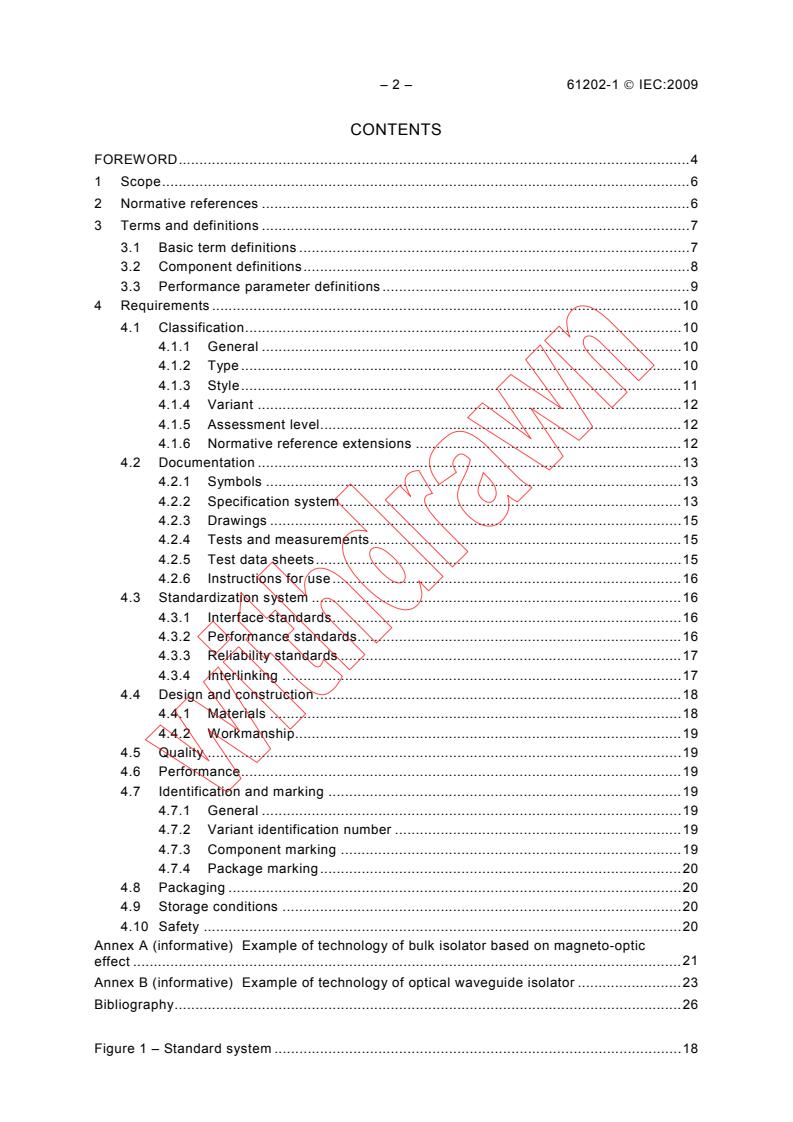
CONTENTS
FOREWORD.4
1 Scope.6
2 Normative references .6
3 Terms and definitions .7
3.1 Basic term definitions .7
3.2 Component definitions.8
3.3 Performance parameter definitions .9
4 Requirements .10
4.1 Classification.10
4.1.1 General .10
4.1.2 Type.10
4.1.3 Style.11
4.1.4 Variant .12
4.1.5 Assessment level.12
4.1.6 Normative reference extensions .12
4.2 Documentation .13
4.2.1 Symbols .13
4.2.2 Specification system.13
4.2.3 Drawings .15
4.2.4 Tests and measurements.15
4.2.5 Test data sheets.15
4.2.6 Instructions for use.16
4.3 Standardization system .16
4.3.1 Interface standards.16
4.3.2 Performance standards.16
4.3.3 Reliability standards .17
4.3.4 Interlinking .17
4.4 Design and construction .18
4.4.1 Materials .18
4.4.2 Workmanship.19
4.5 Quality .19
4.6 Performance.19
4.7 Identification and marking .19
4.7.1 General .19
4.7.2 Variant identification number .19
4.7.3 Component marking .19
4.7.4 Package marking.20
4.8 Packaging .20
4.9 Storage conditions .20
4.10 Safety .20
Annex A (informative) Example of technology of bulk isolator based on magneto-optic
effect .21
Annex B (informative) Example of technology of optical waveguide isolator .23
Bibliography.26
Figure 1 – Standard system .18
61202-1 © IEC:2009 – 3 –
Figure A.1 – Polarization-dependent optical.22
Figure A.2 – Polarization-independent optical isolator.23
Figure B.1 – Mode conversion type of the optical waveguide isolator .24
Figure B.2 – Phase shifter type of the optical waveguide isolator .25
Table 1 – Three-level IEC specification structure .13
Table 2 – Standards interlink matrix.18
– 4 – 61202-1 © IEC:2009
INTERNATIONAL ELECTROTECHNICAL COMMISSION
____________
FIBRE OPTIC INTERCONNECTING
DEVICES AND PASSIVE COMPONENTS –
FIBRE OPTIC ISOLATORS –
Part 1: Generic specification
FOREWORD
1) The International Electrotechnical Commission (IEC) is a worldwide organization for standardization comprising
all national electrotechnical committees (IEC National Committees). The object of IEC is to promote
international co-operation on all questions concerning standardization in the electrical and electronic fields. To
this end and in addition to other activities, IEC publishes International Standards, Technical Specifications,
Technical Reports, Publicly Available Specifications (PAS) and Guides (hereafter referred to as “IEC
Publication(s)”). Their preparation is entrusted to technical committees; any IEC National Committee interested
in the subject dealt with may participate in this preparatory work. International, governmental and non-
governmental organizations liaising with the IEC also participate in this preparation. IEC collaborates closely
with the International Organization for Standardization (ISO) in accordance with conditions determined by
agreement between the two organizations.
2) The formal decisions or agreements of IEC on technical matters express, as nearly as possible, an international
consensus of opinion on the relevant subjects since each technical committee has representation from all
interested IEC National Committees.
3) IEC Publications have the form of recommendations for international use and are accepted by IEC National
Committees in that sense. While all reasonable efforts are made to ensure that the technical content of IEC
Publications is accurate, IEC cannot be held responsible for the way in which they are used or for any
misinterpretation by any end user.
4) In order to promote international uniformity, IEC National Committees undertake to apply IEC Publications
transparently to the maximum extent possible in their national and regional publications. Any divergence
between any IEC Publication and the corresponding national or regional publication shall be clearly indicated in
the latter.
5) IEC provides no marking procedure to indicate its approval and cannot be rendered responsible for any
equipment declared to be in conformity with an IEC Publication.
6) All users should ensure that they have the latest edition of this publication.
7) No liability shall attach to IEC or its directors, employees, servants or agents including individual experts and
members of its technical committees and IEC National Committees for any personal injury, property damage or
other damage of any nature whatsoever, whether direct or indirect, or for costs (including legal fees) and
expenses arising out of the publication, use of, or reliance upon, this IEC Publication or any other IEC
Publications.
8) Attention is drawn to the Normative references cited in this publication. Use of the referenced publications is
indispensable for the correct application of this publication.
9) Attention is drawn to the possibility that some of the elements of this IEC Publication may be the subject of
patent rights. IEC shall not be held responsible for identifying any or all such patent rights.
International Standard IEC 61202-1 has been prepared by subcommittee 86B: Fibre optic
interconnecting devices and passive components, of IEC technical committee 86: Fibre optics.
This third edition cancels and replaces the first edition published in 2000. It constitutes a
technical revision. The specific technical changes with regard to the previous edition are as
follows.
1) The definitions have been reconsidered.
2) Environmental category has been deleted from classification.
3) The clause relating to quality assessment procedures has been deleted.
4) Annexes A and B have been added.
Future standards in this series will carry the new general title as cited above.
61202-1 © IEC:2009 – 5 –
The text of this standard is based on the following documents:
FDIS Report on voting
86B/2845/FDIS 86B/2883/RVD
Full information on the voting for the approval of this standard can be found in the report on
voting indicated in the above table.
A list of all parts of the IEC 61202 series, under the general title: Fibre optic interconnecting
devices and passive components – Fibre optic isolators, can be found on the IEC website.
This publication has been drafted in accordance with the ISO/IEC Directives, Part 2.
The committee has decided that the contents of this publication will remain unchanged until
the maintenance result date indicated on the IEC web site under "http://webstore.iec.ch" in
the data related to the specific publication. At this date, the publication will be
• reconfirmed,
• withdrawn,
• replaced by a revised edition, or
• amended.
– 6 – 61202-1 © IEC:2009
FIBRE OPTIC INTERCONNECTING
DEVICES AND PASSIVE COMPONENTS –
FIBRE OPTIC ISOLATORS –
Part 1: Generic specification
1 Scope
This part of IEC 61202 applies to isolators used in the field of fibre optics, all exhibiting the
following features:
– they are non-reciprocal optical devices, in which each port is either an optical fibre or fibre
optic connector;
– they are passive devices containing no opto-electronic or other transducing elements;
– they have two optical ports for directionally transmitting optical power.
2 Normative references
The following referenced documents are indispensable for the application of this document.
For dated references, only the edition cited applies. For undated references, the latest edition
of the referenced document (including any amendments) applies.
IEC 60027 (all parts), Letter symbols to be used in electrical technology
IEC 60050(731):1991, International Electrotechnical Vocabulary – Chapter 731: Optical fibre
communication
IEC 60617 (all parts), Graphical symbols for diagrams
IEC 60695-11-5:2004, Fire hazard testing – Part 11-5: Test flames – Needle-flame test
method – Apparatus, confirmatory test arrangement and guidance
IEC 60825-1:2007, Safety of laser products – Part 1: Equipment classification and
requirements
IEC 60869-1, Fibre optic attenuators – Part 1: Generic specification
IEC 60874 (all parts), Connectors for optical fibres and cables
IEC 61073-1, Fibre optic interconnecting devices and passive components – Mechanical
splices and fusion splice protectors for optical fibres and cables – Part 1: Generic
specification
IEC 61300 (all parts), Fibre optic interconnecting devices and passive components – Basic
test and measurement procedures
IEC 61754-2, Fibre optic connector interfaces – Part 2: Type BFOC/2,5 connector family
IEC 61754-4, Fibre optic connector interfaces – Part 4: Type SC connector family
IEC 61754-13, Fibre optic connector interfaces – Part 13: Type FC-PC connector
61202-1 © IEC:2009 – 7 –
IEC QC 01, IEC Quality Assessment System for Electronic Components (IECQ System) –
Basic Rules
IEC QC 001002-3, IEC Quality Assessment System for Electronic Components (IECQ) –
Rules of Procedure – Part 3: Approval procedures
IEC Guide 102, Electronic components – Specification structures for quality assessment
(Qualification approval and capability approval)
ISO 129-1:2004, Technical drawings – Indication of dimensions and tolerances – Part 1:
General principles
ISO 286-1:1988, ISO system of limits and fits – Part 1: Bases of tolerances, deviations and
fits
ISO 1101, Geometrical Product Specifications (GPS) – Geometrical tolerancing – Tolerances
of form, orientation, location and run-out
ISO 8601:2004, Data elements and interchange formats – Information interchange –
Representation of dates and times
3 Terms and definitions
For the purposes of this document, the terms and definitions given in IEC 60050(731) apply,
together with the following.
3.1 Basic term definitions
3.1.1
port
optical fibre or fibre optic connector attached to a passive component for the entry and/or exit
of the optical power
3.1.2
input port, output port
port designated for the ingress or regress respectively of an optical power
NOTE As a non-reciprocal device, the isolator is a directional one. The input and output port should be clearly
marked.
3.1.3
forward direction of an optical isolator
operational direction in which the power of the optical source launches into the input port of
an isolator
NOTE In this direction, the isolator has minimum insertion loss.
3.1.4
backward direction of an optical isolator
operational direction in which the power of the optical source launches into the output port of
an isolator
NOTE The backward direction is opposite to the forward direction.
– 8 – 61202-1 © IEC:2009
3.2 Component definitions
3.2.1
fibre optic isolator
non-reciprocal optical device intended to suppress backward reflections along an optical fibre
transmission line while having minimum insertion loss in the forward direction
NOTE Fibre optic isolators are commonly used to avoid reflections back into laser diodes and optical amplifiers,
which can make the laser and amplifiers oscillate unstably, and cause noise in the fibre optic transmission system.
3.2.2
bulk isolator based on magneto-optic effect
type of isolator with discrete components including a suitable magneto-optic crystal (ferro-
magnetic crystal or paramagnetic glass, diamagnetic glass, etc.), of which the fundamental
principle is based on magneto-optic effect
EXAMPLE It consists of the following discrete components: a polarizer, a 45° Faraday rotator and an analyser.
The azimuthal angle between the polarizer and the analyser is set at 45°. It also has its own magnetic circuit,
coupling devices, etc. The incident light, with linear polarization, will produce a 45° rotation with respect to its
polarization plane in the rotator element and pass through the isolator with lower insertion loss while the backward
light is blocked regardless of its polarization state.
3.2.3
in-line isolator
type of isolator with optical fibre for the entry input and output of the light
3.2.4
optical waveguide isolator
type of isolator with planer epitaxial magneto-optic crystal layers on a suitable substrate
NOTE The configuration of this type of isolator is compatible with the waveguide structures of the laser diode and
other optical waveguide devices and transmission lines.
3.2.5
polarization-dependent optical isolator
type of isolator not designed to have performance independent of the state of the polarization
of the incident light
3.2.6
polarization-independent optical isolator
type of isolator in which the optical performance characteristics are independent of the
polarization state of the incident light
3.2.7
polarization maintain optical isolator
type of isolator with the polarization-maintaining optical fibre for input and output, designed to
have maintain polarization of the light which is adjusted to the optical axis of the polarization-
maintaining optical fibre
3.2.8
single-stage/ dual(double)-stage isolator
• single-stage isolator: type of isolator composed of a basic isolator unit such as a set of
polarizer, faraday rotator and analyser
• dual(double)-stage isolator: type of isolator composed of two basic isolator units connected
in tandem for the purpose of obtaining more backward loss
3.2.9
PMD compensated optical isolator
type of isolator designed to compensate the polarization mode dispersion which is intrinsic to
the birefringent crystal
61202-1 © IEC:2009 – 9 –
3.3 Performance parameter definitions
3.3.1
insertion loss
measure of the decrease in optical power (decibels) resulting from the insertion of an optical
isolator in its forward direction
It is defined as follows:
a = –10×log (P /P ) (dB)
f
o i
where
P is the optical power received from the output port of the isolator;
o
P is the power of any polarized light launched at the input port.
i
NOTE 1 In the case of polarization-independent isolators, a is defined as the maximum value for any state of
f
polarization of P .
i
NOTE 2 In the case of polarization-dependent isolators, a is defined as the linearly polarized light which
f
coincides with the polarizing direction of the polarizer in the isolator of P .
i
3.3.2
isolation
measure of the decrease in optical power (decibels) resulting from the insertion of an isolator
in its backward direction
The launching port is the output port and the receiving port is the input port of the isolator.
The measure of the decrease is given by the following formula:
a = –10×log (P /P ) (dB)
b ob ib
where
P is the optical power measured at the input port of the isolator when P is launched into
ib
ob
the output port and a is defined as the minimum absolute value for any state of
b
polarization of P ;
ib
P is the power of any polarized light launched at the output port.
ib
3.3.3
polarization-dependent loss
PDL
for polarization-independent isolators, maximum fluctuation of a (insertion loss) for any state
f
of polarization of P
i
3.3.4
polarization mode dispersion
PMD
for polarization-independent isolators, maximum differential delay for all polarization states
when they pass through an optical isolator
3.3.5
return loss
fraction of input power that is returned from the input port of passive component and defined
as
a = –10×log (P /P ) (dB)
1 0
where
P is the optical power launched into the port;
is the optical power received back from the same port.
P
– 10 – 61202-1 © IEC:2009
3.3.6
operating wavelength
nominal wavelength λi, at which a passive component operates with the specified
performance
3.3.7
operating wavelength range
bandpass
specified range of wavelengths from λi min. to λi max. close to a nominal operating
wavelength λi, within which a passive component is designed to operate with the specified
performance
4 Requirements
4.1 Classification
4.1.1 General
Fibre optic isolators shall be classified as follows:
– type;
– style;
– variant;
– environmental category;
– assessment level;
– normative reference extensions.
An example of a typical isolator classification is as follows:
Type: – Name: Type OIFR
bulk isolators based on the
Faraday rotation
– Operating wavelength: 1 300 nm
– State of polarization: polarization-independent
Style: – Configuration: C
– Connector type: FC
– Fibre type: IEC type B 1,2
Variant: – Means of mounting
Assessment level: – ………………………
Normative reference – ………………………
extensions:
4.1.2 Type
Isolators are divided into types.
• By their fabrication technology:
– bulk isolators based on the magneto-optic effect;
– optical waveguide isolators;
– other types.
• By their polarization selectivity:
– polarization-dependent isolators;
– polarization-independent isolators;
– polarization maintain optical isolator.
61202-1 © IEC:2009 – 11 –
• By their operational principles:
– magneto-optic Faraday effect;
– magneto-optic Cotton-Mouton effect and Kerr effect.
• By their operating wavelength:
– short wavelength isolators (e.g. 630 nm);
– long wavelength isolators (e.g. 1 300 nm, 1 550 nm);
– other wavelength isolators.
4.1.3 Style
Optical isolators may be classified into styles based upon fibre type(s), connector type(s),
cable type(s), housing shape and dimensions, and configuration. The configuration of the
isolator ports is classified as follows.
Configuration A – Device containing integral fibre optic pigtails without connector
Isolator
Pigtail Pigtail
L1 L2
IEC 1941/99
Configuration B – Device containing integral fibre optic pigtails, with a connector on each
pigtail
Isolator
Connector Connector
L1 L2
IEC 1942/99
Configuration C – Device containing connectors as an integral part of the device housing
Isolator
Connector Connector
IEC 1943/99
Configuration D – Device containing some combination of the interfacing features of the
preceding configurations, for example:
Isolator
Pigtail
Connector
L
IEC 1944/99
– 12 – 61202-1 © IEC:2009
4.1.4 Variant
The isolator variant identifies those common features which encompass structurally similar
components. Examples of features which define a variant include, but are not limited to, the
following:
– position and orientation of ports on housing;
– means of mounting.
4.1.5 Assessment level
Assessment level defines the inspection levels and the acceptable quality level (AQL) of
groups A and B and the periodicity of inspection of groups C and D. Detail specifications shall
specify one or more assessment levels, each of which shall be designated by a capital letter.
The following are preferred levels:
– assessment level A:
• group A inspection: inspection level II, AQL = 4 %
• group B inspection: inspection level II, AQL = 4 %
• group C inspection: 24-month periods
• group D inspection: 48-month periods
– assessment level B:
• group A inspection: inspection level II, AQL = 1 %
• group B inspection: inspection level II, AQL = 1 %
• group C inspection: 18-month periods
• group D inspection: 36-month periods
– assessment level C:
• group A inspection: inspection level II, AQL = 0,4 %
• group B inspection: inspection level II, AQL = 0,4 %
• group C inspection: 12-month periods
• group D inspection: 24-month periods
One additional assessment level may be added in the detail specification. When this is done,
the capital letter X shall be used.
4.1.6 Normative reference extensions
Normative reference extensions are used to identify independent standards, specifications or
other reference documents integrated into blank detail specifications. Unless specified
exception is noted, additional requirements imposed by an extension are mandatory. Usage is
primarily intended to merge associated components to form hybrid devices, or integrated
functional application requirements that are dependent on technical expertise other than fibre
optics.
Published reference documents produced by ITU, consistent with the scope statements of the
relevant IEC specification series may be used as extensions. Published documents produced
by other regional standardization bodies may be referenced in a bibliography, attached to the
generic specification.
Some optical fibre isolator configurations require special qualification provisions which shall
not be imposed universally. This accommodates individual component design configurations,
specialized field tooling or specific application processes. In this case, requirements are
necessary to assure repeatable performance or adequate safety and to provide additional
61202-1 © IEC:2009 – 13 –
guidance for complete product specification. These extensions are mandatory whenever used
to prepare, assemble or install an optical fibre isolator either for field application usage or
preparation of qualification test specimens. The relevant specification shall clarify all
stipulations. However, design and style-dependent extensions shall not be imposed
universally.
In the event of conflicting requirements, precedence, in descending order, shall be as follows:
“generic” over “mandatory extension”, over “blank detail”, over “detail”, over “application
specific extension”.
Examples of optical connector extensions are given as follows:
• using IEC 61754-4 and IEC 61754-2 to partially define a future specification in the
IEC 60874 series for a duplex type “SC/BFOC/2,5” hybrid connector adapter;
• using IEC 61754-13 and IEC 60869-1 to partially define a future specification in the
IEC 60874 series for an integrated type “FC” preset attenuated optical connector;
• using IEC 61754-2 and IEC 61073-1 to partially define a future specification in the
IEC 60874 series for a duplex “BFOC/2,5” receptacle incorporating integral mechanical
splices.
Other examples of requirements for normative extensions include the following:
a) some commercial or residential building applications may require direct reference to
specific safety codes and regulations or incorporate other specific material flammability or
toxicity requirements for specialized locations;
b) specialized field tooling may require an extension to implement specific ocular safety,
electrical shock or burn hazard avoidance requirements, or require isolation procedures to
prevent potential ignition of combustible gases.
4.2 Documentation
4.2.1 Symbols
Graphical and letter symbols shall, whenever possible, be taken from IEC 60027 series and
IEC 60617.
4.2.2 Specification system
4.2.2.1 General
This specification is part of a three-level IEC specification system. Subsidiary specifications
shall consist of blank detail specifications and detail specifications. This system is shown in
Table 1. There are no sectional specifications for isolators.
Table 1 – Three-level IEC specification structure
Specification Examples of information Applicable to
level to be included
– Assessment system rules
– Inspection rules
– Optical measuring methods
– Environmental test methods
– Sampling plans
Basic – Identification rule Two or more component families or
sub-families
– Marking standards
– Dimensional standards
– Terminology
– 14 – 61202-1 © IEC:2009
Specification Examples of information Applicable to
level to be included
– Symbol standards
– Preferred number series
– SI units
– Specific terminology
– Specific symbols
– Specific units
– Preferred values
Generic – Marking Component family
– Quality assessment procedures
– Selection of tests
– Qualification approval procedures
– Capability approval procedures
– Quality conformation test schedule Groups of types having a common test
schedule
Blank detail – Inspection requirements
– Information common to a number of types
– Individual values
Detail – Specific information Individual type
– Completed quality conformance test schedules
4.2.2.2 Blank detail specification
Blank detail specifications are not, by themselves, a specification level. They are associated
with the generic specification.
Each blank detail specification shall contain
– the minimum mandatory test schedules and performance requirements;
– one or more assessment levels;
– the preferred format for stating the required information in the detail specification;
– in case of hybrid components, including connectors, addition of appropriate entry fields to
show the normative reference document, document title and issue date.
4.2.2.3 Detail specification
A specific isolator is described by a corresponding detail specification which is prepared by
filling in the blanks of the blank detail specification. Within the constraints imposed by this
generic specification, the blank detail specification may be filled in by any national committee
of the IEC, thereby defining a particular isolator design as an official IEC standard.
Detail specifications shall specify the following, as applicable:
– type (see 4.1.2);
– style (see 4.1.3);
– variant(s) (see 4.1.4);
– assessment level (see 4.1.5);
– part identification number for each variant (see 4.7.2);
– drawings, dimensions required (see 4.2.3);
– quality assessment test schedules (see 4.1.5);
– performance requirements (see 4.6).
61202-1 © IEC:2009 – 15 –
4.2.3 Drawings
4.2.3.1 General
The drawings and dimensions given in relevant specifications shall not restrict themselves to
details of construction, nor shall they be used as manufacturing drawings.
4.2.3.2 Projection system
Either first-angle or third-angle projection shall be used for the drawings in documents
covered by this specification. All drawings within a document shall use the same projection
system and the drawings shall state which system is used.
4.2.3.3 Dimensional system
All dimensions shall be given in accordance with ISO 129, ISO 286-1 and ISO 1101.
The metric system shall be used in all specifications.
Dimensions shall not contain more than five significant digits.
When units are converted, a note shall be added in each relevant specification and the
conversion between systems of units shall use a factor of 25,4 mm to 1 inch.
4.2.4 Tests and measurements
4.2.4.1 Test and measurement procedures
The test and measurement procedures for optical, mechanical, climatic, and environmental
characteristics of isolators to be used shall be defined and selected preferentially from the
IEC 61300 series.
The size measurement method to be used shall be specified in the relevant specification for
dimensions which are specified within a total tolerance zone of 0,01 mm or less.
4.2.4.2 Reference components
Reference components, if required, shall be specified in the relevant specification.
4.2.4.3 Gauges
Gauges, if required, shall be specified in the relevant specification.
4.2.5 Test data sheets
Test data sheets shall be prepared for each test conducted as required by a relevant
specification. The data sheets shall be included in the qualification report and in the periodic
inspection report.
Data sheets shall contain the following information:
– title of test and date;
– specimen description including the type of fibre, connector or other coupling device. The
description shall also include the variant identification number (see 4.7.2);
– test equipment used and date of latest calibration;
– all applicable test details;
– all measurement values and observations;
– 16 – 61202-1 © IEC:2009
– sufficiently detailed documentation to provide traceable information for failure analysis.
4.2.6 Instructions for use
Instructions for use, when required, shall be given by the manufacturer and shall include
– assembly and connection instructions;
– cleaning method;
– safety aspects;
– additional information as necessary.
4.3 Standardization system
4.3.1 Interface standards
Interface standards provide both manufacturer and user with all the information they require
to make or use products conforming to the physical features of that standard interface.
Interface standards fully define and dimension the features essential for the mating and
unmating of fibre optic connectors and other components. They also serve to position the
optical datum target, where defined, relative to other reference data.
Interface standards ensure that connectors and adapters that comply with the standard will fit
together. The standards may also contain tolerance grades for ferrules and alignment devices.
Tolerance grades are used to provide different levels of alignment precision.
The interface dimensions may also be used to design other components that will mate with
the connectors. For example, an active device mount can be designed using the adapter
interface dimensions. The use of these dimensions combined with those of a standard plug,
provides the designer with assurance that the standard plugs will fit into the optical device
mount. They also provide the location of the plug’s optical datum target.
Standard interface dimensions do not, by themselves, guarantee optical performance. They
guarantee connector mating at a specified fit. Optical performance is currently guaranteed via
the manufacturing specification. Products from the same or different manufacturing
specifications using the same standard interface will always fit together. Guaranteed
performance can be given by any single manufacturer only for products delivered to the same
manufacturing specification. However, it can be reasonably expected that some level of
performance will be obtained by mating products from different manufacturing specifications,
although the level of performance cannot be expected to be any better than that of the lowest
specified performance.
4.3.2 Performance standards
Performance standards contain a series of tests and measurements (which may or may not be
grouped into a specified schedule depending on the requirements of that standard) with
clearly defined conditions, severities, and pass/fail criteria. The tests are intended to be run
on a “once-off” basis to prove any product’s ability to satisfy the “performance standards”
requirement. Each performance standard has a different set of tests and/or severities (and/or
groupings) and represents the requirements of a market sector, user group or system location.
A product that has been shown to meet all the requirements of a performance standard can
be declared as complying with a performance standard but should then be controlled by a
quality assurance/ quality conformance programme.
It is possible to define a key point of the test and measurements standards for their
application (particularly with regard to attenuation and return loss) in conjunction with the
interface standards of inter-product compatibility. The conformance of each individual product
to this standard will be ensured.
61202-1 © IEC:2009 – 17 –
4.3.3 Reliability standards
Reliability standards are intended to ensure that a component can meet performance speci-
fications under stated conditions for a stated time period.
For each type of component, the following shall be identified (and appear in the standard):
• failure modes (observable general mechanical or optical effects of failure);
• failure mechanisms (general causes of failure, common to several components);
• failure effects (detailed causes of failure, specific to component).
These are all related to environmental and material aspects.
Initially, just after component manufacture, there is an “infant mortality phase” during which
many components would fail if deployed in the field. To avoid early field failure, all
components may be subjected to screen process in the factory involving environmental
stresses that may be mechanical, thermal or humidity-related. This is to induce known failure
mechanisms in a controlled environmental situation to occur earlier than would normally be
seen in the unscreened population. For those components that survive (and are then sold),
there is a reduced failure rate since these mechanisms have been eliminated.
Screening is an optional part of the manufacturing process rather than a test method. It will
not affect the “useful life” of a component defined as the period during which it performs
according to specifications. Eventually, other failure mechanisms appear, and the failure rate
increases beyond the defined threshold. At this point, the “useful life” ends and the “wear-out
region” begins, and the component must be replaced.
At the beginning of useful life, performance testing on a sampled population of components
may be applied by the supplier, by the manufacturer or by a third party. This is to ensure that
the component meets performance specifications over the range of intended environments at
this initial time. Reliability testing, on the other hand, is applied to ensure that the component
meets performance specifications for at least a specified minimum useful lifetime or specified
maximum failure rate. These tests are usually done by utilizing the performance testing, but
increasing duration and severity in order to accelerate the failure mechanisms.
A reliability theory relates component reliability testing to component parameters and to
lifetime or failure rate under testing. The theory then extrapolates these to lifetime or failure
rate under less stressful service conditions. The reliability specifications include values of the
component parameters needed to ensure the specified minimum lifetime or maximum failure
rate in service.
4.3.4 Interlinking
Standards currently under preparation are given in Figure 1. A large number of the test and
measurements standards already exist and the quality assurance qualification approval
standards, recognized by the term IECQ, exist already and have done so for many years. As
previously mentioned, alternative methods of quality assurance / quality conformance are
being developed under the headings capacity approval and technology approval, covered by
IEC QC 01, IEC QC 001002-3 and IEC Guide 102.
With regard to interface, performance and reliability standards, once all three of these
standards are in place, the matrix given in Table
...