

IEC TR 62343-6-9:2015
(Main)Dynamic modules - Part 6-9: Design guide - Study of mechanisms and measurements of crosstalk in wavelength-selective switches
General Information
- Abstract
IEC TR 62343-6-9:2015(E) which is a Technical Report, describes a study of the impact of WSS dynamic crosstalk on the optical network and includes dynamic crosstalk measurement examples for three types of WSS. The generating mechanism and the generation factor of dynamic crosstalk in WSS are clarified, and the evaluation of same-channel crosstalk and different-channel crosstalk is shown to be necessary. Keywords: WSS, wavelength selective switch
- Status
- Published
- Publication Date
- 24-Jun-2015
- Technical Committee
- SC 86C - Fibre optic systems, sensing and active devices
- Drafting Committee
- WG 5 - TC 86/SC 86C/WG 5
- Current Stage
- PPUB - Publication issued
- Start Date
- 25-Jun-2015
- Completion Date
- 30-Sep-2015
Overview
IEC TR 62343-6-9:2015 is a Technical Report published by the International Electrotechnical Commission (IEC) that provides a comprehensive study on the mechanisms and measurement of dynamic crosstalk in wavelength-selective switches (WSS), which are pivotal components in modern optical networks, especially those utilizing dense wavelength division multiplexing (DWDM). The document outlines the impact of dynamic crosstalk on optical network performance, describes the generation mechanisms of crosstalk within WSS modules, and demonstrates practical measurement methods across various WSS technologies.
Key Topics
- Dynamic Crosstalk in WSS: The report distinguishes between static and dynamic crosstalk. Dynamic crosstalk occurs during switching events or when channel attenuation changes, differing from static crosstalk, which arises in stationary states without active switching.
- Types of Crosstalk:
- Same-Channel Crosstalk (also known as coherent crosstalk): Involves interference between signals at the same wavelength, significantly impacting system performance.
- Different-Channel Crosstalk (power crosstalk): Refers to interference among different wavelength channels, typically with a lesser effect on signal quality.
- Generation Mechanisms: The report clarifies how dynamic crosstalk is generated within different WSS configurations, such as multiplexing and demultiplexing scenarios, and the importance of evaluating both same-channel and different-channel crosstalk.
- Measurement Methods:
- Use of tunable laser sources in combination with optical power meters or optical-to-electrical (OE) converters and oscilloscopes to capture crosstalk events.
- Details practical measurement setups for various WSS types (MEMS, LCOS, DLP) and highlights the necessity for high dynamic range and fast sampling rates to capture transient crosstalk phenomena.
Applications
Wavelength-selective switches (WSS) are critical in the design and operation of advanced optical networks, such as third-generation DWDM systems and optical cross-connect (OXC) systems. This standard is highly relevant in the following applications:
- Network Design and Optimization: Assisting network engineers and designers in evaluating and minimizing crosstalk in optical switching nodes, which is essential for maintaining high transmission quality, maximizing network capacity, and ensuring reliable operation.
- Component Development and Testing: Enabling manufacturers and quality assurance teams to benchmark and improve WSS performance by applying standardized crosstalk measurement procedures.
- System Integration: Assuring network operators and integrators that deployed WSS modules meet international requirements for dynamic and static crosstalk, essential in multi-vendor environments.
- Research and Development: Providing a reference framework for academic and industrial research focused on improving optical signal integrity and developing next-generation optical network technologies.
Related Standards
The IEC TR 62343-6-9:2015 Technical Report refers to several other international standards that address fundamental testing and measurement procedures for fibre optic components:
- IEC 61300-3-21: Basic test and measurement procedures for fibre optic interconnecting devices and passive components - specifically switching time.
- IEC 61300-3-29: Measurement of spectral transfer characteristics of DWDM devices.
- IEC 62343 Series: A family of standards covering dynamic modules in optical networks, including other WSS design and testing guides.
Practical Value
This document stands out for its design guidance and practical measurement solutions for dynamic crosstalk in WSS. By applying the recommendations and methodologies from IEC TR 62343-6-9:2015, organizations involved in the development, deployment, or maintenance of DWDM and optical cross-connect systems can achieve:
- Improved network performance and reliability
- Standardized crosstalk evaluation techniques
- Enhanced interoperability of WSS technology across different manufacturers
Keywords: wavelength-selective switch (WSS), dynamic crosstalk, static crosstalk, optical network, DWDM, optical cross-connect, IEC standards, fibre optics, optical switching, measurement techniques.
Get Certified
Connect with accredited certification bodies for this standard

ANCE
Mexican certification and testing association.

Intertek Slovenia
Intertek testing, inspection, and certification services in Slovenia.

LNE (Laboratoire National de Métrologie et d'Essais)
French national laboratory for metrology and testing.
Sponsored listings
Frequently Asked Questions
IEC TR 62343-6-9:2015 is a technical report published by the International Electrotechnical Commission (IEC). Its full title is "Dynamic modules - Part 6-9: Design guide - Study of mechanisms and measurements of crosstalk in wavelength-selective switches". This standard covers: IEC TR 62343-6-9:2015(E) which is a Technical Report, describes a study of the impact of WSS dynamic crosstalk on the optical network and includes dynamic crosstalk measurement examples for three types of WSS. The generating mechanism and the generation factor of dynamic crosstalk in WSS are clarified, and the evaluation of same-channel crosstalk and different-channel crosstalk is shown to be necessary. Keywords: WSS, wavelength selective switch
IEC TR 62343-6-9:2015(E) which is a Technical Report, describes a study of the impact of WSS dynamic crosstalk on the optical network and includes dynamic crosstalk measurement examples for three types of WSS. The generating mechanism and the generation factor of dynamic crosstalk in WSS are clarified, and the evaluation of same-channel crosstalk and different-channel crosstalk is shown to be necessary. Keywords: WSS, wavelength selective switch
IEC TR 62343-6-9:2015 is classified under the following ICS (International Classification for Standards) categories: 01 - GENERALITIES. TERMINOLOGY. STANDARDIZATION. DOCUMENTATION; 33.180.01 - Fibre optic systems in general; 33.180.99 - Other fibre optic equipment. The ICS classification helps identify the subject area and facilitates finding related standards.
IEC TR 62343-6-9:2015 is available in PDF format for immediate download after purchase. The document can be added to your cart and obtained through the secure checkout process. Digital delivery ensures instant access to the complete standard document.
Standards Content (Sample)
IEC TR 62343-6-9 ®
Edition 1.0 2015-06
TECHNICAL
REPORT
colour
inside
Dynamic modules –
Part 6-9: Design guide – Study of mechanisms and measurements of crosstalk
in wavelength-selective switches
All rights reserved. Unless otherwise specified, no part of this publication may be reproduced or utilized in any form
or by any means, electronic or mechanical, including photocopying and microfilm, without permission in writing from
either IEC or IEC's member National Committee in the country of the requester. If you have any questions about IEC
copyright or have an enquiry about obtaining additional rights to this publication, please contact the address below or
your local IEC member National Committee for further information.
IEC Central Office Tel.: +41 22 919 02 11
3, rue de Varembé Fax: +41 22 919 03 00
CH-1211 Geneva 20 info@iec.ch
Switzerland www.iec.ch
About the IEC
The International Electrotechnical Commission (IEC) is the leading global organization that prepares and publishes
International Standards for all electrical, electronic and related technologies.
About IEC publications
The technical content of IEC publications is kept under constant review by the IEC. Please make sure that you have the
latest edition, a corrigenda or an amendment might have been published.
IEC Catalogue - webstore.iec.ch/catalogue Electropedia - www.electropedia.org
The stand-alone application for consulting the entire The world's leading online dictionary of electronic and
bibliographical information on IEC International Standards, electrical terms containing more than 30 000 terms and
Technical Specifications, Technical Reports and other definitions in English and French, with equivalent terms in 15
documents. Available for PC, Mac OS, Android Tablets and additional languages. Also known as the International
iPad. Electrotechnical Vocabulary (IEV) online.
IEC publications search - www.iec.ch/searchpub IEC Glossary - std.iec.ch/glossary
The advanced search enables to find IEC publications by a More than 60 000 electrotechnical terminology entries in
variety of criteria (reference number, text, technical English and French extracted from the Terms and Definitions
committee,…). It also gives information on projects, replaced clause of IEC publications issued since 2002. Some entries
and withdrawn publications. have been collected from earlier publications of IEC TC 37,
77, 86 and CISPR.
IEC Just Published - webstore.iec.ch/justpublished
Stay up to date on all new IEC publications. Just Published IEC Customer Service Centre - webstore.iec.ch/csc
details all new publications released. Available online and If you wish to give us your feedback on this publication or
also once a month by email. need further assistance, please contact the Customer Service
Centre: csc@iec.ch.
IEC TR 62343-6-9 ®
Edition 1.0 2015-06
TECHNICAL
REPORT
colour
inside
Dynamic modules –
Part 6-9: Design guide – Study of mechanisms and measurements of crosstalk
in wavelength-selective switches
INTERNATIONAL
ELECTROTECHNICAL
COMMISSION
ICS 33.180.01; 33.180.99 ISBN 978-2-8322-2769-5
– 2 – IEC TR 62343-6-9:2015 © IEC 2015
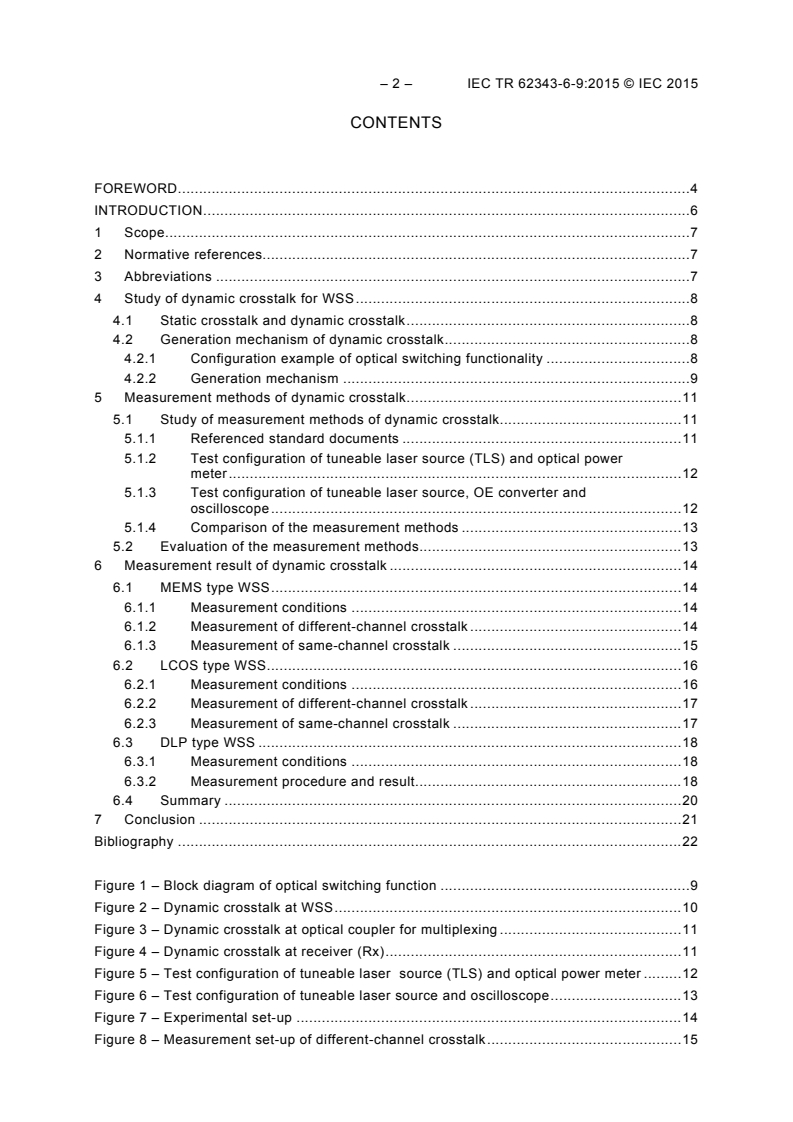
CONTENTS
FOREWORD . 4
INTRODUCTION . 6
1 Scope . 7
2 Normative references. 7
3 Abbreviations . 7
4 Study of dynamic crosstalk for WSS . 8
4.1 Static crosstalk and dynamic crosstalk . 8
4.2 Generation mechanism of dynamic crosstalk . 8
4.2.1 Configuration example of optical switching functionality . 8
4.2.2 Generation mechanism . 9
5 Measurement methods of dynamic crosstalk . 11
5.1 Study of measurement methods of dynamic crosstalk . 11
5.1.1 Referenced standard documents . 11
5.1.2 Test configuration of tuneable laser source (TLS) and optical power
meter . 12
5.1.3 Test configuration of tuneable laser source, OE converter and
oscilloscope . 12
5.1.4 Comparison of the measurement methods . 13
5.2 Evaluation of the measurement methods. 13
6 Measurement result of dynamic crosstalk . 14
6.1 MEMS type WSS . 14
6.1.1 Measurement conditions . 14
6.1.2 Measurement of different-channel crosstalk . 14
6.1.3 Measurement of same-channel crosstalk . 15
6.2 LCOS type WSS . 16
6.2.1 Measurement conditions . 16
6.2.2 Measurement of different-channel crosstalk . 17
6.2.3 Measurement of same-channel crosstalk . 17
6.3 DLP type WSS . 18
6.3.1 Measurement conditions . 18
6.3.2 Measurement procedure and result. 18
6.4 Summary . 20
7 Conclusion . 21
Bibliography . 22
Figure 1 – Block diagram of optical switching function . 9
Figure 2 – Dynamic crosstalk at WSS . 10
Figure 3 – Dynamic crosstalk at optical coupler for multiplexing . 11
Figure 4 – Dynamic crosstalk at receiver (Rx) . 11
Figure 5 – Test configuration of tuneable laser source (TLS) and optical power meter . 12
Figure 6 – Test configuration of tuneable laser source and oscilloscope . 13
Figure 7 – Experimental set-up . 14
Figure 8 – Measurement set-up of different-channel crosstalk . 15
Figure 9 – Measurement result of different-channel crosstalk for MEMS type WSS . 15
Figure 10 – Measurement result of same-channel crosstalk for MEMS type WSS . 16
Figure 11 – Measurement result of different-channel crosstalk for LCOS type WSS . 17
Figure 12 – Measurement result of same-channel crosstalk for LCOS type WSS . 18
Figure 13 – Switching characteristics for 1 × 2 DLP type WSS . 19
Figure 14 – Crosstalk measurement result of case a) for DLP type WSS . 19
Figure 15 – Crosstalk measurement result of case b) for DLP type WSS . 20
Figure 16 – Crosstalk measurement result of case c) for DLP type WSS . 20
Table 1 – Static crosstalk and dynamic crosstalk . 8
Table 2 – Same-channel crosstalk and different-channel crosstalk . 8
Table 3 – Generating mechanism of same-channel crosstalk and different-channel
crosstalk . 10
– 4 – IEC TR 62343-6-9:2015 © IEC 2015
INTERNATIONAL ELECTROTECHNICAL COMMISSION
____________
DYNAMIC MODULES –
Part 6-9: Design guide – Study of mechanisms and
measurements of crosstalk in wavelength-selective switches
FOREWORD
1) The International Electrotechnical Commission (IEC) is a worldwide organization for standardization comprising
all national electrotechnical committees (IEC National Committees). The object of IEC is to promote
international co-operation on all questions concerning standardization in the electrical and electronic fields. To
this end and in addition to other activities, IEC publishes International Standards, Technical Specifications,
Technical Reports, Publicly Available Specifications (PAS) and Guides (hereafter referred to as “IEC
Publication(s)”). Their preparation is entrusted to technical committees; any IEC National Committee interested
in the subject dealt with may participate in this preparatory work. International, governmental and non-
governmental organizations liaising with the IEC also participate in this preparation. IEC collaborates closely
with the International Organization for Standardization (ISO) in accordance with conditions determined by
agreement between the two organizations.
2) The formal decisions or agreements of IEC on technical matters express, as nearly as possible, an international
consensus of opinion on the relevant subjects since each technical committee has representation from all
interested IEC National Committees.
3) IEC Publications have the form of recommendations for international use and are accepted by IEC National
Committees in that sense. While all reasonable efforts are made to ensure that the technical content of IEC
Publications is accurate, IEC cannot be held responsible for the way in which they are used or for any
misinterpretation by any end user.
4) In order to promote international uniformity, IEC National Committees undertake to apply IEC Publications
transparently to the maximum extent possible in their national and regional publications. Any divergence
between any IEC Publication and the corresponding national or regional publication shall be clearly indicated in
the latter.
5) IEC itself does not provide any attestation of conformity. Independent certification bodies provide conformity
assessment services and, in some areas, access to IEC marks of conformity. IEC is not responsible for any
services carried out by independent certification bodies.
6) All users should ensure that they have the latest edition of this publication.
7) No liability shall attach to IEC or its directors, employees, servants or agents including individual experts and
members of its technical committees and IEC National Committees for any personal injury, property damage or
other damage of any nature whatsoever, whether direct or indirect, or for costs (including legal fees) and
expenses arising out of the publication, use of, or reliance upon, this IEC Publication or any other IEC
Publications.
8) Attention is drawn to the Normative references cited in this publication. Use of the referenced publications is
indispensable for the correct application of this publication.
9) Attention is drawn to the possibility that some of the elements of this IEC Publication may be the subject of
patent rights. IEC shall not be held responsible for identifying any or all such patent rights.
The main task of IEC technical committees is to prepare International Standards. However, a
technical committee may propose the publication of a Technical Report when it has collected
data of a different kind from that which is normally published as an International Standard, for
example "state of the art".
IEC TR 62343-6-9, which is a Technical Report, has been prepared by subcommittee SC86C:
Fibre optic systems and active devices, of IEC technical committee TC 86: Fibre optics.
The text of this Technical Report is based on the following documents:
Enquiry draft Report on voting
86C/1300/DTR 86C/1321/RVC
Full information on the voting for the approval of this Technical Report can be found in the
report on voting indicated in the above table.
This publication has been drafted in accordance with the ISO/IEC Directives, Part 2.
A list of all parts in the IEC 62343 series, published under the general title Dynamic modules,
can be found on the IEC website.
The committee has decided that the contents of this publication will remain unchanged until
the stability date indicated on the IEC website under "http://webstore.iec.ch" in the data
related to the specific publication. At this date, the publication will be
• reconfirmed,
• withdrawn,
• replaced by a revised edition, or
• amended.
A bilingual version of this publication may be issued at a later date.
IMPORTANT – The 'colour inside' logo on the cover page of this publication indicates
that it contains colours which are considered to be useful for the correct
understanding of its contents. Users should therefore print this document using a
colour printer.
– 6 – IEC TR 62343-6-9:2015 © IEC 2015
INTRODUCTION
A dense wavelength division multiplexing (DWDM) system for fibre optic communication was
developed in the late 1990’s. The first generation DWDM systems were point-to-point optical
networks. In the mid-2000’s, second generation DWDM systems, typically ring networks, were
developed. One of the key optical components for DWDM systems is a wavelength division
multiplexing device. An AWG (arrayed waveguide grating) module has been mainly deployed
for first and second generation DWDM systems.
Due to the increasing demand for communication capacity, more flexible optical
communication systems, such as mesh networks, have been required. In the past several
years, the third generation of DWDM systems, the optical cross-connect system, has been
developed and deployed by some communication network carriers and is expected to be
deployed worldwide. A wavelength-selective switch (WSS) module plays a key role in
realizing the optical switch function in the optical cross-connect system, so that the
performance of the WSS directly impacts on the performance of the optical cross-connect
systems, such as the capacity, transmission distance, etc.
For AWG modules, only static performance, such as insertion loss, bandwidth, pass-band
ripple, polarization dependent loss (PDL), polarization mode dispersion (PMD), coherent
crosstalk, etc., has been evaluated. In addition to static performance, dynamic performance
during switching or changing attenuation should be taken into consideration for the WSS as a
key module of optical cross-connect systems.
For dynamic performance parameters, the influence not only on the controlled channel but
also on other channels should be considered.
Considering this background, the influence of WSS dynamic crosstalk on cross-connect
system performance and the measurements of dynamic crosstalk has been demonstrated.
This Technical Report is based on Optoelectronic Industry and Technology Development
Association (OITDA) – Technical Paper (TP), TP15/TP-2013, "Dynamic crosstalk
measurement for wavelength selective switches”.
DYNAMIC MODULES –
Part 6-9: Design guide – Study of mechanisms and
measurements of crosstalk in wavelength-selective switches
1 Scope
This part of IEC 62343, which is a Technical Report, describes a study of the impact of WSS
dynamic crosstalk on the optical network and includes dynamic crosstalk measurement
examples for three types of WSS. The generating mechanism and the generation factor of
dynamic crosstalk in WSS are clarified, and the evaluation of same-channel crosstalk and
different-channel crosstalk is shown to be necessary.
2 Normative references
The following documents, in whole or in part, are normatively referenced in this document and
are indispensable for its application. For dated references, only the edition cited applies. For
undated references, the latest edition of the referenced document (including any
amendments) applies.
IEC 61300-3-21, Fibre optic interconnecting devices and passive components – Basic test
and measurement procedures – Part 3-21: Examinations and measurements – Switching time
IEC 61300-3-29, Fibre optic interconnecting devices and passive components – Basic test
and measurement procedures – Part 3-29: Examinations and measurements – Spectral
transfer characteristics of DWDM devices
3 Abbreviations
ADD add port
AWG arrayed waveguide grating
COM common port
CW continuous wave
DLP digital light processor
DRP drop port
DUT device under test
DWDM dense wavelength division multiplexing
EXP express port
LCOS liquid crystal on silicon
MEMS micro electro mechanical system
OE optical-to-electrical
PDL polarization dependent loss
PMD polarization mode dispersion
TLS tuneable laser source
Tx transmitter
Rx receiver
WSS wavelength selective switch
– 8 – IEC TR 62343-6-9:2015 © IEC 2015
4 Study of dynamic crosstalk for WSS
4.1 Static crosstalk and dynamic crosstalk
WSSs can be considered as the combination of optical spatial switches, variable optical
attenuators, and DWDM devices such as AWG modules. For the WSS, dynamic crosstalk,
which is the interference between ports and channels during switching and changing
attenuation, is generated in addition to static crosstalk.
Static crosstalk has been studied, and the definition and standard measurement methods for
WDM devices such as AWG modules have been established. In addition to static crosstalk,
dynamic crosstalk for WSSs has to be considered because WSSs vary attenuation and switch
ports during operation.
Two types of dynamic crosstalk are considered in this Technical Report: same-channel
crosstalk (coherent crosstalk), and different-channel crosstalk (power crosstalk). In this sense,
the word of channel refers to the signal at a particular wavelength.
The impact on signal quality of same-channel crosstalk to cross-connect systems is
considered to be larger than that of different-channel crosstalk, which may be negligible.
The classification of dynamic crosstalk and static crosstalk and that of same-channel
crosstalk and different-channel crosstalk are independent. Therefore, four combinations
(dynamic-same-channel crosstalk, dynamic-different-channel crosstalk, static-same-channel
crosstalk, and static-different-channel crosstalk) have to be considered.
Table 1 and Table 2 show the features of static and dynamic crosstalk and same-channel and
different-channel crosstalk, respectively.
Table 1 – Static crosstalk and dynamic crosstalk
Crosstalk Description
Static crosstalk Crosstalk generated during static state, that is without switching ports or
changing attenuations
Dynamic crosstalk Crosstalk generated during dynamic state, such as switching ports and changing
attenuations
Table 2 – Same-channel crosstalk and different-channel crosstalk
Crosstalk Description
Same-channel crosstalk Crosstalk between same channels. The impact to the cross-connect systems is
larger than that of different-channel crosstalk.
Different-channel crosstalk Crosstalk between different channels. The impact to the cross-connect systems
is smaller than that of same-channel crosstalk.
4.2 Generation mechanism of dynamic crosstalk
4.2.1 Configuration example of optical switching functionality
Figure 1 shows an example block diagram of optical switching functionality in optical mesh
networks. This node is known as a route and select topology, since incoming data are first
routed by the ingress WSS to its correct optical path, where an egress WSS selects the
correct data from all its input ports before multiplexing and passing into the transmission fibre.
This example configuration of a switching functionality is composed of four WSSs. Using
multichannel WSSs, the number of switching optical ports can be increased and can realize
cross-connect systems having many paths. Each WSS is connected to each transmission line
through WDM IN and WDM OUT ports, and the number of WSS pairs is equal to the number
of transmission paths.
Data in the form of DWDM signals are applied to the switching node from th
...