

IEC 61116:2025
(Main)Electromechanical equipment guidance for small hydroelectric installations
General Information
- Abstract
IEC 61116:2025 used as a guidance that applies to hydroelectric installations containing impulse or reaction turbines with unit power up to about 15 MW and reference diameter of about 3 m. These figures do not represent absolute limits.
This document deals only with the direct relations between the purchaser or the consulting engineer and the supplier. It does not deal with civil works, administrative conditions or commercial conditions. This document is intended to be used by all concerned in the installation of electromechanical equipment for small hydroelectric plants.
This document, based essentially on practical information, aims specifically at supplying the purchaser of the equipment with information which will assist him with the following:
preparation of the call for tenders;
- evaluation of the tenders;
- contact with the supplier during the design and manufacture of the equipment;
- quality control during the manufacture and shop-testing;
- follow-up of site erection;
- commissioning;
- acceptance tests;
- operation and maintenance.
The document comprises the following:
a) general requirements for the electromechanical equipment of small hydroelectric installations;
b) technical specifications for the electromechanical equipment, excluding its dimensioning and standardization;
c) requirements for acceptance, operation and maintenance
This second edition cancels and replaces the first edition published in 1992. This edition includes the following significant technical changes with respect to the previous edition:
a) harmonization of scope with IEC 62006;
b) introduction of new technical aspects;
c) overall editorial revision.
- Status
- Published
- Publication Date
- 24-Sep-2025
- Technical Committee
- TC 4 - Hydraulic turbines
- Drafting Committee
- WG 25 - TC 4/WG 25
- Current Stage
- PPUB - Publication issued
- Start Date
- 25-Sep-2025
- Completion Date
- 05-Sep-2025
Buy Documents

IEC 61116:2025 - Electromechanical equipment guidance for small hydroelectric installations Released:9/25/2025
IEC 61116:2025 - Recommandations pour l'équipement électromécanique des petits aménagements hydroélectriques Released:9/25/2025

IEC 61116:2025 - Electromechanical equipment guidance for small hydroelectric installations Released:9/25/2025
Overview
IEC 61116:2025 - Electromechanical equipment guidance for small hydroelectric installations - is a practical IEC guidance standard for hydroelectric plants using impulse or reaction turbines with unit power up to about 15 MW and a reference diameter near 3 m (figures not absolute limits). The second edition (2025) replaces the 1992 edition and includes harmonization with IEC 62006, new technical aspects and an editorial overhaul. IEC 61116 focuses on the direct technical relationship between purchaser/consulting engineer and supplier and does not cover civil works, administrative or commercial conditions.
Key topics and technical requirements
IEC 61116 is structured to guide procurement, design verification, manufacture, testing, delivery and lifecycle activities. Major topics include:
- General requirements for electromechanical equipment for small hydro plants.
- Technical specifications for components (excluding detailed dimensioning and standardization).
- Acceptance, operation and maintenance requirements, including guarantees.
- Site and operating condition descriptions: hydraulic, electrical and environmental conditions.
- Equipment elements covered: trashracks and cleaners, water-level control, discharge closure devices, penstocks, turbines, generators, governors and automatic control systems, main transformers, auxiliary systems, spare parts and special tools, corrosion protection, mechanical handling.
- Inspection and quality control provisions: design approval, factory inspection, shop testing and delivery checks.
- Commissioning procedures: pre-watering checks, watering-up, unit rotation, preliminary and electrical load tests.
- Operation & maintenance: trial operation, routine checks, training of personnel and scheduled maintenance.
- References to operational modes, frequency/power regulation and automation (links to IEC 61362 and IEC 60308 where relevant).
Practical applications
IEC 61116 is used to:
- Prepare and structure a call for tenders and technical specifications for electromechanical equipment.
- Evaluate and compare supplier tenders and technical offers.
- Manage supplier design review, manufacture oversight and shop-testing (quality control).
- Guide site erection follow-up, commissioning and acceptance testing.
- Establish operation, maintenance and training programs for small hydro plants. This makes the standard valuable for project lifecycle activities from procurement through sustained operation.
Who should use it
- Purchasers and consulting engineers specifying electromechanical equipment.
- Equipment suppliers, manufacturers and test engineers preparing bids or shop tests.
- Project managers, commissioning teams and operations & maintenance staff for small hydroelectric installations.
Related standards
- IEC 62006 (scope harmonization)
- IEC 60076-1 (transformer references)
- IEC 61362, IEC 60308 (regulation and modes of operation) Using IEC 61116 alongside these standards helps ensure compliant, reliable electromechanical solutions for small hydro projects.
Buy Documents
IEC 61116:2025 - Electromechanical equipment guidance for small hydroelectric installations Released:9/25/2025
IEC 61116:2025 - Recommandations pour l'équipement électromécanique des petits aménagements hydroélectriques Released:9/25/2025
IEC 61116:2025 - Electromechanical equipment guidance for small hydroelectric installations Released:9/25/2025
Get Certified
Connect with accredited certification bodies for this standard

DNV
DNV is an independent assurance and risk management provider.

Lloyd's Register
Lloyd's Register is a global professional services organisation specialising in engineering and technology.
DNV Energy Systems
Energy and renewable energy certification.
Sponsored listings
Frequently Asked Questions
IEC 61116:2025 is a standard published by the International Electrotechnical Commission (IEC). Its full title is "Electromechanical equipment guidance for small hydroelectric installations". This standard covers: IEC 61116:2025 used as a guidance that applies to hydroelectric installations containing impulse or reaction turbines with unit power up to about 15 MW and reference diameter of about 3 m. These figures do not represent absolute limits. This document deals only with the direct relations between the purchaser or the consulting engineer and the supplier. It does not deal with civil works, administrative conditions or commercial conditions. This document is intended to be used by all concerned in the installation of electromechanical equipment for small hydroelectric plants. This document, based essentially on practical information, aims specifically at supplying the purchaser of the equipment with information which will assist him with the following: preparation of the call for tenders; - evaluation of the tenders; - contact with the supplier during the design and manufacture of the equipment; - quality control during the manufacture and shop-testing; - follow-up of site erection; - commissioning; - acceptance tests; - operation and maintenance. The document comprises the following: a) general requirements for the electromechanical equipment of small hydroelectric installations; b) technical specifications for the electromechanical equipment, excluding its dimensioning and standardization; c) requirements for acceptance, operation and maintenance This second edition cancels and replaces the first edition published in 1992. This edition includes the following significant technical changes with respect to the previous edition: a) harmonization of scope with IEC 62006; b) introduction of new technical aspects; c) overall editorial revision.
IEC 61116:2025 used as a guidance that applies to hydroelectric installations containing impulse or reaction turbines with unit power up to about 15 MW and reference diameter of about 3 m. These figures do not represent absolute limits. This document deals only with the direct relations between the purchaser or the consulting engineer and the supplier. It does not deal with civil works, administrative conditions or commercial conditions. This document is intended to be used by all concerned in the installation of electromechanical equipment for small hydroelectric plants. This document, based essentially on practical information, aims specifically at supplying the purchaser of the equipment with information which will assist him with the following: preparation of the call for tenders; - evaluation of the tenders; - contact with the supplier during the design and manufacture of the equipment; - quality control during the manufacture and shop-testing; - follow-up of site erection; - commissioning; - acceptance tests; - operation and maintenance. The document comprises the following: a) general requirements for the electromechanical equipment of small hydroelectric installations; b) technical specifications for the electromechanical equipment, excluding its dimensioning and standardization; c) requirements for acceptance, operation and maintenance This second edition cancels and replaces the first edition published in 1992. This edition includes the following significant technical changes with respect to the previous edition: a) harmonization of scope with IEC 62006; b) introduction of new technical aspects; c) overall editorial revision.
IEC 61116:2025 is classified under the following ICS (International Classification for Standards) categories: 27.140 - Hydraulic energy engineering; 29.160.20 - Generators. The ICS classification helps identify the subject area and facilitates finding related standards.
IEC 61116:2025 is available in PDF format for immediate download after purchase. The document can be added to your cart and obtained through the secure checkout process. Digital delivery ensures instant access to the complete standard document.
Standards Content (Sample)
IEC 61116 ®
Edition 2.0 2025-09
INTERNATIONAL
STANDARD
Electromechanical equipment guidance for small hydroelectric installations
ICS 29.160.20; 27.140 ISBN 978-2-8327-0635-0
All rights reserved. Unless otherwise specified, no part of this publication may be reproduced or utilized in any form or
by any means, electronic or mechanical, including photocopying and microfilm, without permission in writing from either
IEC or IEC's member National Committee in the country of the requester. If you have any questions about IEC copyright
or have an enquiry about obtaining additional rights to this publication, please contact the address below or your local
IEC member National Committee for further information.
IEC Secretariat Tel.: +41 22 919 02 11
3, rue de Varembé info@iec.ch
CH-1211 Geneva 20 www.iec.ch
Switzerland
About the IEC
The International Electrotechnical Commission (IEC) is the leading global organization that prepares and publishes
International Standards for all electrical, electronic and related technologies.
About IEC publications
The technical content of IEC publications is kept under constant review by the IEC. Please make sure that you have the
latest edition, a corrigendum or an amendment might have been published.
IEC publications search - IEC Products & Services Portal - products.iec.ch
webstore.iec.ch/advsearchform Discover our powerful search engine and read freely all the
The advanced search enables to find IEC publications by a
publications previews, graphical symbols and the glossary.
variety of criteria (reference number, text, technical With a subscription you will always have access to up to date
committee, …). It also gives information on projects, content tailored to your needs.
replaced and withdrawn publications.
Electropedia - www.electropedia.org
IEC Just Published - webstore.iec.ch/justpublished The world's leading online dictionary on electrotechnology,
Stay up to date on all new IEC publications. Just Published containing more than 22 500 terminological entries in English
details all new publications released. Available online and and French, with equivalent terms in 25 additional languages.
once a month by email. Also known as the International Electrotechnical Vocabulary
(IEV) online.
IEC Customer Service Centre - webstore.iec.ch/csc
If you wish to give us your feedback on this publication or
need further assistance, please contact the Customer
Service Centre: sales@iec.ch.
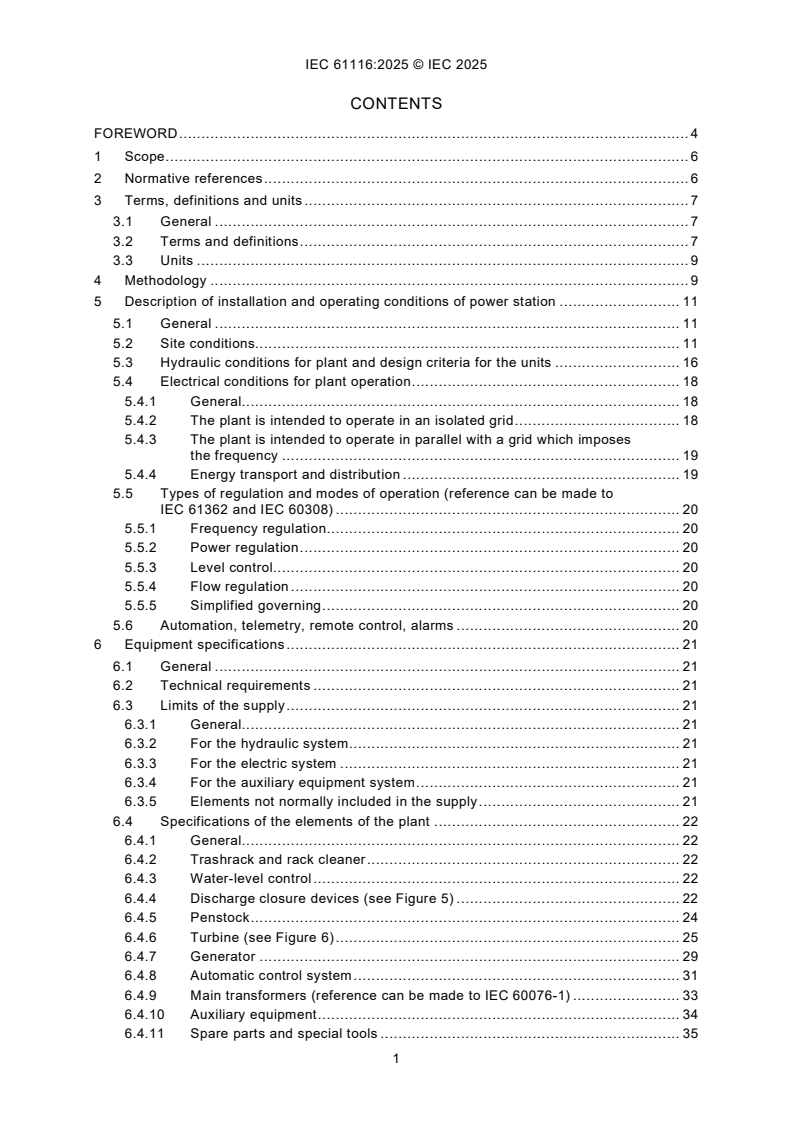
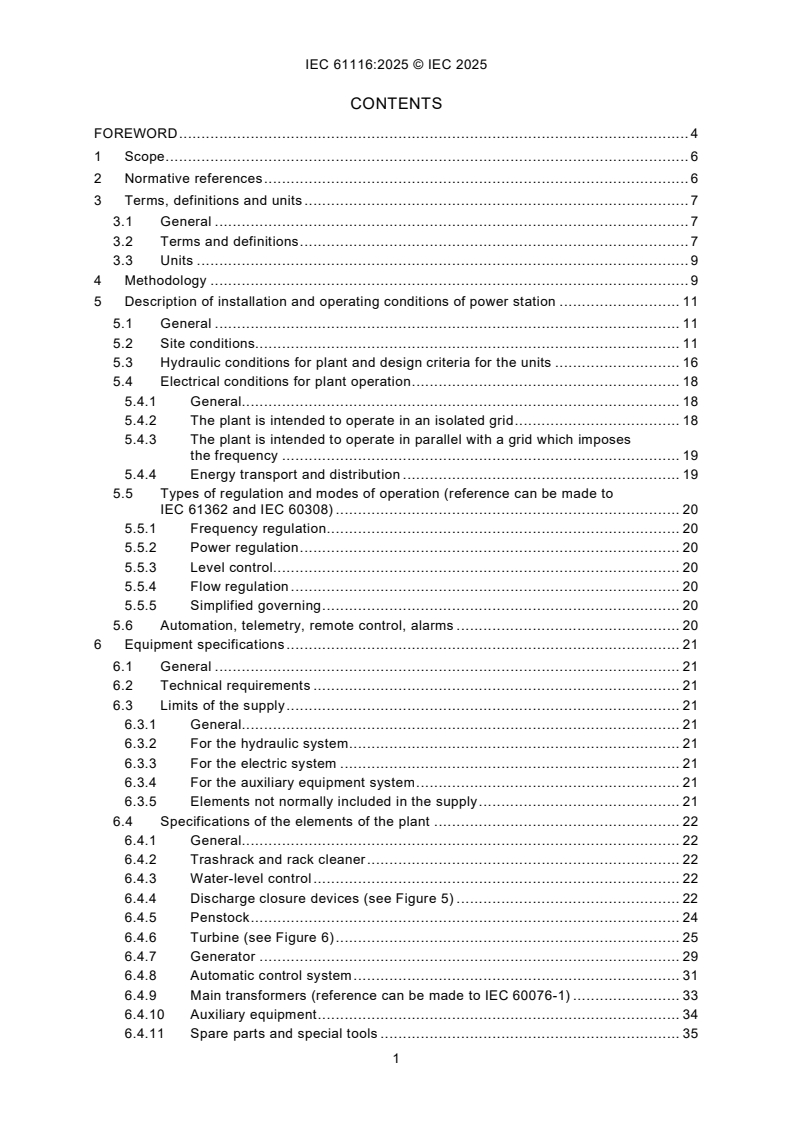
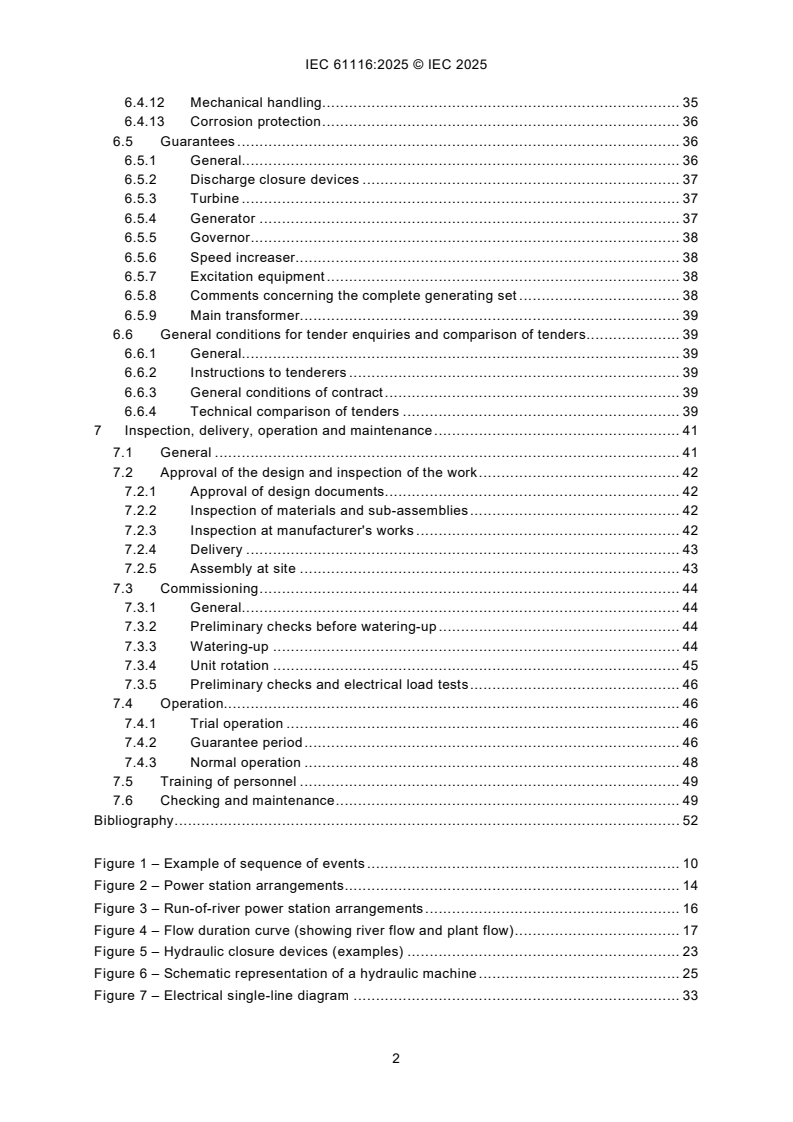
CONTENTS
FOREWORD . 4
1 Scope . 6
2 Normative references . 6
3 Terms, definitions and units . 7
3.1 General . 7
3.2 Terms and definitions . 7
3.3 Units . 9
4 Methodology . 9
5 Description of installation and operating conditions of power station . 11
5.1 General . 11
5.2 Site conditions. 11
5.3 Hydraulic conditions for plant and design criteria for the units . 16
5.4 Electrical conditions for plant operation . 18
5.4.1 General. 18
5.4.2 The plant is intended to operate in an isolated grid . 18
5.4.3 The plant is intended to operate in parallel with a grid which imposes
the frequency . 19
5.4.4 Energy transport and distribution . 19
5.5 Types of regulation and modes of operation (reference can be made to
IEC 61362 and IEC 60308) . 20
5.5.1 Frequency regulation . 20
5.5.2 Power regulation . 20
5.5.3 Level control. 20
5.5.4 Flow regulation . 20
5.5.5 Simplified governing . 20
5.6 Automation, telemetry, remote control, alarms . 20
6 Equipment specifications . 21
6.1 General . 21
6.2 Technical requirements . 21
6.3 Limits of the supply . 21
6.3.1 General. 21
6.3.2 For the hydraulic system . 21
6.3.3 For the electric system . 21
6.3.4 For the auxiliary equipment system . 21
6.3.5 Elements not normally included in the supply . 21
6.4 Specifications of the elements of the plant . 22
6.4.1 General. 22
6.4.2 Trashrack and rack cleaner . 22
6.4.3 Water-level control . 22
6.4.4 Discharge closure devices (see Figure 5) . 22
6.4.5 Penstock . 24
6.4.6 Turbine (see Figure 6) . 25
6.4.7 Generator . 29
6.4.8 Automatic control system . 31
6.4.9 Main transformers (reference can be made to IEC 60076-1) . 33
6.4.10 Auxiliary equipment . 34
6.4.11 Spare parts and special tools . 35
6.4.12 Mechanical handling . 35
6.4.13 Corrosion protection . 36
6.5 Guarantees . 36
6.5.1 General. 36
6.5.2 Discharge closure devices . 37
6.5.3 Turbine . 37
6.5.4 Generator . 37
6.5.5 Governor . 38
6.5.6 Speed increaser. 38
6.5.7 Excitation equipment . 38
6.5.8 Comments concerning the complete generating set . 38
6.5.9 Main transformer. 39
6.6 General conditions for tender enquiries and comparison of tenders . 39
6.6.1 General. 39
6.6.2 Instructions to tenderers . 39
6.6.3 General conditions of contract . 39
6.6.4 Technical comparison of tenders . 39
7 Inspection, delivery, operation and maintenance . 41
7.1 General . 41
7.2 Approval of the design and inspection of the work . 42
7.2.1 Approval of design documents . 42
7.2.2 Inspection of materials and sub-assemblies . 42
7.2.3 Inspection at manufacturer's works . 42
7.2.4 Delivery . 43
7.2.5 Assembly at site . 43
7.3 Commissioning . 44
7.3.1 General. 44
7.3.2 Preliminary checks before watering-up . 44
7.3.3 Watering-up . 44
7.3.4 Unit rotation . 45
7.3.5 Preliminary checks and electrical load tests . 46
7.4 Operation. 46
7.4.1 Trial operation . 46
7.4.2 Guarantee period . 46
7.4.3 Normal operation . 48
7.5 Training of personnel . 49
7.6 Checking and maintenance . 49
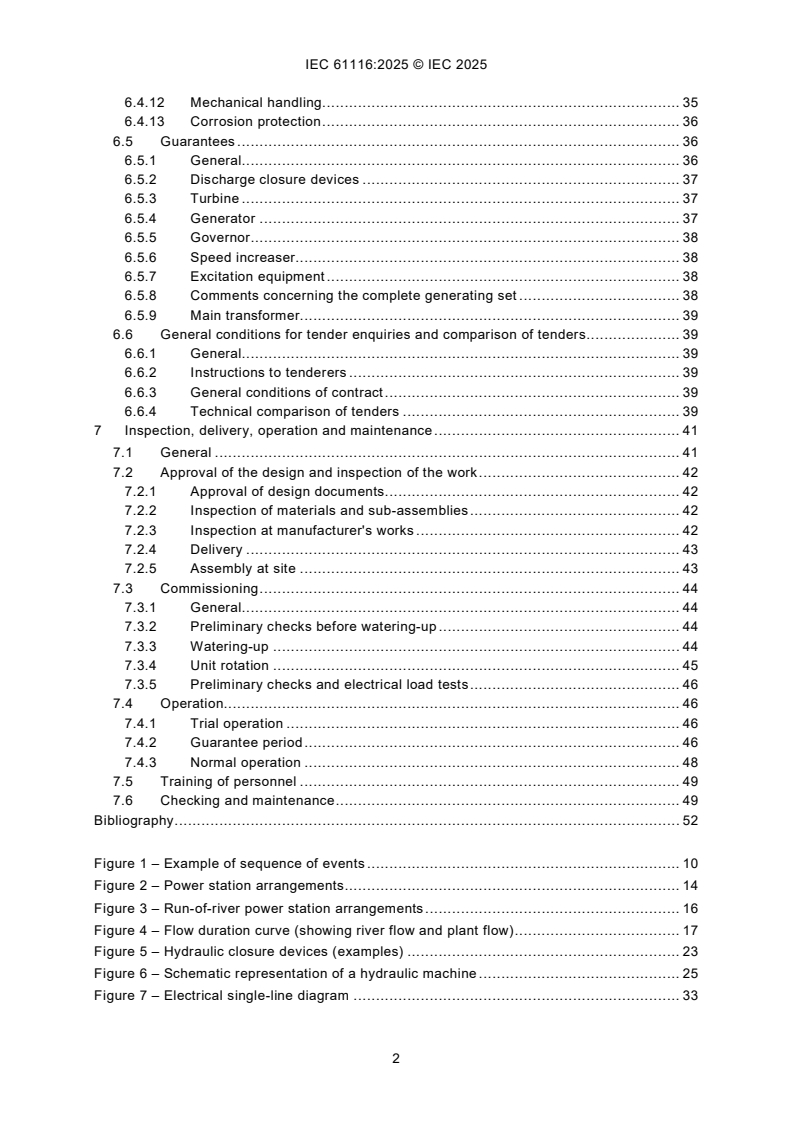
Bibliography . 52
Figure 1 – Example of sequence of events . 10
Figure 2 – Power station arrangements . 14
Figure 3 – Run-of-river power station arrangements . 16
Figure 4 – Flow duration curve (showing river flow and plant flow) . 17
Figure 5 – Hydraulic closure devices (examples) . 23
Figure 6 – Schematic representation of a hydraulic machine . 25
Figure 7 – Electrical single-line diagram . 33
Table 1 – Energy utilization for passive and active loads . 19
Table 2 – Elements of bid evaluation . 40
Table 3 – Examples of checks during normal operation . 51
INTERNATIONAL ELECTROTECHNICAL COMMISSION
____________
Electromechanical equipment guidance for
small hydroelectric installations
FOREWORD
1) The International Electrotechnical Commission (IEC) is a worldwide organization for standardization comprising
all national electrotechnical committees (IEC National Committees). The object of IEC is to promote international
co-operation on all questions concerning standardization in the electrical and electronic fields. To this end and
in addition to other activities, IEC publishes International Standards, Technical Specifications, Technical Reports,
Publicly Available Specifications (PAS) and Guides (hereafter referred to as "IEC Publication(s)"). Their
preparation is entrusted to technical committees; any IEC National Committee interested in the subject dealt with
may participate in this preparatory work. International, governmental and non-governmental organizations liaising
with the IEC also participate in this preparation. IEC collaborates closely with the International Organization for
Standardization (ISO) in accordance with conditions determined by agreement between the two organizations.
2) The formal decisions or agreements of IEC on technical matters express, as nearly as possible, an international
consensus of opinion on the relevant subjects since each technical committee has representation from all
interested IEC National Committees.
3) IEC Publications have the form of recommendations for international use and are accepted by IEC National
Committees in that sense. While all reasonable efforts are made to ensure that the technical content of IEC
Publications is accurate, IEC cannot be held responsible for the way in which they are used or for any
misinterpretation by any end user.
4) In order to promote international uniformity, IEC National Committees undertake to apply IEC Publications
transparently to the maximum extent possible in their national and regional publications. Any divergence between
any IEC Publication and the corresponding national or regional publication shall be clearly indicated in the latter.
5) IEC itself does not provide any attestation of conformity. Independent certification bodies provide conformity
assessment services and, in some areas, access to IEC marks of conformity. IEC is not responsible for any
services carried out by independent certification bodies.
6) All users should ensure that they have the latest edition of this publication.
7) No liability shall attach to IEC or its directors, employees, servants or agents including individual experts and
members of its technical committees and IEC National Committees for any personal injury, property damage or
other damage of any nature whatsoever, whether direct or indirect, or for costs (including legal fees) and
expenses arising out of the publication, use of, or reliance upon, this IEC Publication or any other IEC
Publications.
8) Attention is drawn to the Normative references cited in this publication. Use of the referenced publications is
indispensable for the correct application of this publication.
9) IEC draws attention to the possibility that the implementation of this document may involve the use of (a)
patent(s). IEC takes no position concerning the evidence, validity or applicability of any claimed patent rights in
respect thereof. As of the date of publication of this document, IEC had not received notice of (a) patent(s), which
may be required to implement this document. However, implementers are cautioned that this may not represent
the latest information, which may be obtained from the patent database available at https://patents.iec.ch. IEC
shall not be held responsible for identifying any or all such patent rights.
IEC 61116 has been prepared by IEC technical committee 4: Hydraulic turbines. It is an
International Standard.
This second edition cancels and replaces the first edition published in 1992. This edition
constitutes a technical revision.
This edition includes the following significant technical changes with respect to the previous
edition:
a) harmonization of scope with IEC 62006;
b) introduction of new technical aspects;
c) overall editorial revision.
The text of this International Standard is based on the following documents:
Draft Report on voting
4/510/CDV 4/521A/RVC
Full information on the voting for its approval can be found in the report on voting indicated in
the above table.
The language used for the development of this International Standard is English.
This document was drafted in accordance with ISO/IEC Directives, Part 2, and developed in
accordance with ISO/IEC Directives, Part 1 and ISO/IEC Directives, IEC Supplement, available
at www.iec.ch/members_experts/refdocs. The main document types developed by IEC are
described in greater detail at www.iec.ch/publications.
The committee has decided that the contents of this document will remain unchanged until the
stability date indicated on the IEC website under webstore.iec.ch in the data related to the
specific document. At this date, the document will be
– reconfirmed,
– withdrawn, or
– revised.
1 Scope
This document is used as a guidance that applies to hydroelectric installations containing
impulse or reaction turbines with unit power up to about 15 MW and reference diameter of about
3 m. These figures do not represent absolute limits.
This document deals only with the direct relations between the purchaser or the consulting
engineer and the supplier. It does not deal with civil works, administrative conditions or
commercial conditions.
This document is intended to be used by all concerned in the installation of electromechanical
equipment for small hydroelectric plants.
This document, based essentially on practical information, aims specifically at supplying the
purchaser of the equipment with information which will assist him with the following:
– preparation of the call for tenders;
– evaluation of the tenders;
– contact with the supplier during the design and manufacture of the equipment;
– quality control during the manufacture and shop-testing;
– follow-up of site erection;
– commissioning;
– acceptance tests;
– operation and maintenance.
The document comprises the following:
a) general requirements for the electromechanical equipment of small hydroelectric
installations;
b) technical specifications for the electromechanical equipment, excluding its dimensioning
and standardization;
c) requirements for acceptance, operation and maintenance.
Bearing in mind the type of installation considered, the relevant documents are intended to be
as simple as possible but to satisfactorily define the particular operation conditions. Over-
specification is harmful to the economy of the project.
This document does not cover the initial stage of investigations, that is to say the preliminary
study and feasibility study. Neither does it deal with the economic study concerning the supply
and demand of energy.
To conclude, the document does not replace the applicable engineering studies for the
selection, design, manufacture, installation and testing of the equipment. It is intended only to
make the purchaser aware of the important points and data to be furnished, specified and kept
in due consideration in the construction of small hydroelectric plants.
2 Normative references
There are no normative references in this document.
3 Terms, definitions and units
3.1 General
For the purposes of this document, the following terms and definitions apply.
ISO and IEC maintain terminology databases for use in standardization at the following
addresses:
– IEC Electropedia: available at https://www.electropedia.org/
– ISO Online browsing platform: available at https://www.iso.org/obp
3.2 Terms and definitions
3.2.1
power station
installation whose purpose is to generate electricity and which includes civil engineering works,
energy conversion equipment and all the necessary ancillary equipment
[SOURCE: IEC 60050-602:1983, 602-01-01]
3.2.2
hydroelectric installation
ordered arrangement of civil engineering structures, machinery and plant designed chiefly to
convert the gravitational potential energy of water into electricity
[SOURCE: IEC 60050-602:1983, 602-01-03]
3.2.3
powerhouse
central structure that houses the key electromechanical equipment required to convert the
kinetic energy of flowing water into electrical energy
3.2.4
hydroelectric power station
power station in which the gravitational energy of water is converted into electricity
[SOURCE: IEC 60050-602:1983, 602-01-04]
3.2.5
run-of-river power station
hydroelectric power station which uses the river flow as it occurs, the filling period of its own
reservoir by the cumulative water flows being practically negligible
[SOURCE: IEC 60050-602:1983, 602-01-05]
3.2.6
generating set
group of rotating machines transforming mechanical or thermal energy into electricity
[SOURCE: IEC 60050-602:1983, 602-02-01]
3.2.7
hydroelectric set
generating set consisting of a hydraulic turbine mechanically connected to an electrical
generator
[SOURCE: IEC 60050-602:1983, 602-02-03]
3.2.8
dam
structure to retain water inflows for specific uses
[SOURCE: IEC 60050-602:1983, 602-02-05]
3.2.9
penstock
pipeline bringing water under pressure to the turbine
[SOURCE: IEC 60050-602:1983, 602-02-09]
3.2.10
surge tank
surge shaft
open-surface reservoir of water decreasing the effects of shock pressure waves in the penstock
[SOURCE: IEC 60050-602:1983, 602-02-10]
3.2.11
impulse type turbine
turbine in which a fluid acts chiefly by its kinetic energy
[SOURCE: IEC 60050-602:1983, 602-02-11]
3.2.12
reaction type turbine
turbine in which a fluid acts both by its kinetic energy and by its pressure
[SOURCE: IEC 60050-602:1983, 602-02-12]
3.2.13
Pelton turbine
hydraulic impulse type turbine usually operated from a high head source with small flow rate
[SOURCE: IEC 60050-602:1983, 602-02-13]
3.2.14
Kaplan turbine
axial hydraulic reaction type turbine with adjustable runner blades operated with a high flow
rate
[SOURCE: IEC 60050-602:1983, 602-02-15]
3.2.15
crossflow turbine
action turbine with a very small degree of reaction
Note 1 to entry: The flow crosses the runner twice perpendicularly to its axis of rotation and the runner blades are
arranged cylindrically.
[SOURCE: IEC TR 61364:1999, 4.4.3]
3.3 Units
The International System of Units (SI, see ISO 80000-4) has been used throughout this
document.
All terms are given in SI Base Units or derived coherent units (for example N instead of
-2
kg m s ). The basic equations are valid using these Units. This shall be taken into account if
other than coherent SI-Units are used for certain data (for example kilowatt or megawatt instead
-1 -1
of watt for power, kilopascal or bar instead of pascal for pressure, min instead of s for
rotational speed, etc.). Temperatures should be given in degrees Celsius because
thermodynamic (absolute) temperatures (in Kelvins) are rarely required.
Any other system of units can be used, but only if agreed to in writing by the contracting parties.
4 Methodology
In the interests of clarity, the sequence of the necessary steps for the construction of a small
hydroelectric power station is represented diagrammatically in Figure 1.
It principally covers the preparation of technical specifications, the examination of tenders, the
manufacture, and finally the commercial operation and maintenance of equipment.
This sequence also shows the relationship between the different phases and areas of
responsibility of all the parties concerned (consulting engineer, chief resident engineer, and
users).
If the purchaser does not have in-house engineering capabilities or the services of a consulting
engineer he can call for, to facilitate relations with contractors, a "turn-key" supply, or at least
a leading contractor responsible for the supply of all or part of the electromechanical equipment
should be adopted (e.g. the turbine and generator package, or a "water-to-wire" package).
Figure 1 – Example of sequence of events
5 Description of installation and operating conditions of power station
5.1 General
The following data is generally required by the equipment supplier and should appear in the
enquiry. In some cases, all these data are not always readily available. Nevertheless, it shall
be emphasized that the more information that is given, the better will the project be understood
and therefore the better the technical solution which will result.
5.2 Site conditions
5.2.1 Supply a topographic survey (plan and profile) giving the altitude of the points indicated
and the position desired for the main works (see Figure 2), water intake, reservoir, channel,
surge tank or head pond, penstock, power plant, headwater, tailwater and their main
characteristics (sections, lengths, materials of the channels and penstocks, etc.). Indicate the
foundation conditions (sand, rock, soft ground, etc.).
a) High and medium head plant arrangements
b) Low head station (bulb unit and rim generator unit)
c) Low head station (vertical unit and unit with elbowed tail-race)
d) Low head station (siphon unit and unit with elbowed penstock)
Figure 2 – Power station arrangements
5.2.2 Attach numbered pictures with cross-references to the topographic survey described
in 5.2.1, showing the setting and location of the main works.
5.2.3 Supply the chemical analysis of the water with extremes of temperature and, if
necessary, the amount and size of sediments carried by the water in the area around the water
intake or downstream of the sand trap, if any.
Indicate the presence of any living organisms or floating debris, etc.
5.2.4 Specify the local conditions: extremes of air temperature, humidity, occurrence of
strong winds, earthquakes, etc.
5.2.5 Indicate any transport or access limitations.
5.2.6 Certain information mentioned in 7.2.5.1 and 7.2.5.3 (erection) should also be shown
in the tender enquiry if this reflects a particular feature of the purchaser's own country.
5.2.7 State if it is a run-of-river (see Figure 3) or a scheme with a reservoir.
Indicate if there exists any particular operational constraints: e.g. multi-purpose scheme,
environmental, fisheries, etc.
State and describe (with drawings) those elements of the plant which are part of an existing
installation which it is foreseen will eventually be put back into use.
a) Run-of-river power station
Key
1 Power house
2 Intake
3 Trashrack
4 Dam
5 Coarse trashrack
b) Run-of-river plant in a bypass channel
Figure 3 – Run-of-river power station arrangements
5.2.8 State if the plant will be manned or unmanned.
5.2.9 Indicate if there exists any particular operational constraints and provide any relevant
environmental regulations or permits required for the project. This could include water quality
constraints, fish passage requirements, minimum seasonal flow requirements, etc.
5.3 Hydraulic conditions for plant and design criteria for the units
5.3.1 Specify the maximum allowable up or down surges in the channels.
5.3.2 Provide a flow duration curve (see Figure 4) with an indication of the limiting flows
(guaranteed water supply, irrigation, drinking-water).
Key
1 + 2 = Q = Available run-of-river flow
river
1 = Q = Usable or exploitable flow
usable
2 = Q - Q = Flow losses (dotation, drainage, leakage, spilled flow)
river usable
Q = Total rated flow that can be used by the turbine
a
Figure 4 – Flow duration curve (showing river flow and plant flow)
5.3.3 Specify the chosen design flow, Q , in cubic metres per second, and the availability in
a
days per year.
5.3.4 Specify the extreme water-levels at the intake and at the tail-race in metres (m) above
sea-level, as follows.
a) headwater level max … m
min . m
b) tailwater level max . m
min . m
c) operational range allowed: . m
and give the curves for:
d) level versus discharge (headwater and tailwater)
e) level versus volume of the headwater reservoir or head pond (essential for a reservoir
scheme).
5.3.5 Specify the desired outputs and the duration of the corresponding operations. The
number of starts and stops, load rejections per year and expected runaway events in a lifetime
can also be useful. The net heads are defined as in IEC 62006. The crossflow turbines with
diffusers are considered as reaction turbines.
5.3.6 State the number of units suggested.
5.3.7 Define the evaluation criteria for efficiency over the full range of operation as well as
overload conditions (weighting the efficiency according to the amount of energy produced at
different heads and flows). The weight to be given to a particular efficiency or overload depends
on the time of utilization at the point of operation considered and the energy thus recovered
from the installation. For general instructions to tenderers, see 6.6.
NOTE 1 For low head plants with short intakes, the intake design can significantly affect hydraulic behavior, such
as the formation of vortices and air admission.
NOTE 2 The proper design of the waterways is essential in order to minimize the head losses (difference between
gross and net head).
5.3.8 For containerized minimum hydroelectric plants, the influence of container storage
space on the type and size of the hydroelectric units should also be considered.
5.4 Electrical conditions for plant operation
5.4.1 General
The plant electrical conditions and requirements are listed under either 5.4.2 or 5.4.3.
5.4.2 The plant is intended to operate in an isolated grid
a) Without any other energy supply on the grid
For isolated grids, black-start capability is essential.
1) Required grid voltage . V
Tolerance (under steady-state conditions) + . % - .%
2) Grid frequency . Hz
Tolerance (under steady-state conditions) + . % - . %
3) Minimum output required all year round by the grid . kW
4) Load acceptance rate of the grid
(to determine whether or not a flywheel is required) . kW/s
5) Hydraulic inertia time constant (T ) . s
w
6) Mechanical inertia time constant (T ) . s
a
7) Value of the maximum step-change in load which
the grid can accept + . kW - . kW
8) Power factor (cos φ) .
b) With permanent connection to another electrical energy supply defined as follows:
1) Hydroelectric unit: type .
min output . kW
2) Thermoelectric unit: type .
3) Generator characteristics (synchronous or asynchronous):
i) rated voltage . V
ii) rated frequency . Hz
iii) rated output . kVA
iv) inertia J of rotating parts . kg·m
v) Mechanical inertia time constant (T ) . s
a
vi) power factor (cos φ) .
4) Turbine governor characteristics
The grid conditions shall be defined as in 5.4.2 a), items 2) to 7).
5) Voltage regulator characteristics (distribution of reactive power).
The grid conditions shall be defined as in 5.4.2 a), items 1) and 8).
c) Energy utilization: daily and seasonal load variations, see Table 1 below.
Table 1 – Energy utilization for passive and active loads
Output (kW) Minimum Average Maximum
Passive loads
(lighting, heating, drying, …)
Active loads
(electric motors)
Total
In order to decide the method of regulation and the design of the governor, it is necessary
to give an indication of the load variations (load curve):
1) daily;
2) weekly;
3) seasonal.
Indicate the priority and non-priority loads (load shedding) as this is useful for designing the
governor.
5.4.3 The plant is intended to operate in parallel with a grid which imposes the
frequency
a) Characteristics of the grid
1) Voltage . V
Tolerance + . % - . %
2) Frequency . Hz
Tolerance + . % - . %
3) Short-circuit power
(at the point where the new scheme is linked to the grid) . kVA
4) Power factor (cos φ) .
b) Apparent output of the largest generator working on the grid . kVA
5.4.4 Energy transport and distribution
Provide the following drawings:
– a general layout drawing of the entire proposed grid, in the case of isolated load operation;
– a drawing showing the link to the grid, in the case of operation in parallel with a large grid.
The layout should also indicate the main load centres and power supply points.
Also provide information on any possible developments of the grid.
5.5 Types of regulation and modes of operation (reference can be made to IEC 61362
and IEC 60308)
5.5.1 Frequency regulation
If the unit or the plant operates in an isolated grid, or is an important part of the grid, a governor
is required to maintain the grid frequency during load changes.
For units with low output and where hydraulic energy is abundant, simplified governors could
also be used by producing a constant output at full load and dumping the unused power.
5.5.2 Power regulation
The operating position of the power station in the power system map and the accuracy
requirement of power regulation should be clarified.
The type of power regulation should be specified, and the load regulation curve according to
the plan should be provided when taking part in peak load or intermediate load of the system.
5.5.3 Level control
Specify if it is necessary to maintain the headwater or tailwater level constant, or within a
working range using the generating sets or some other discharge device. If this is so, the turbine
opening shall then be governed with level feedback. This is generally the case with run-of-river
plants (in the river itself or in a bypass channel) or when linked to an irrigation canal.
NOTE On isolated load, level or frequency can be controlled but not both.
5.5.4 Flow regulation
Specify the presence of any reservoirs and their respective capacity.
NOTE On isolated load, flow or frequency can be controlled but not both.
5.5.5 Simplified governing
If the plant is to operate on a large grid which imposes the frequency, its units can be fitted with
simplified governors (positioners) having level feedback or load feedback. Stability can be
affected in the case where part of a large grid becomes accidentally detached and simplified
governors are used.
5.6 Automation, telemetry, remote control, alarms
a) Indicate if staff are available for the starting and shut-down sequences or if it is required to
minimize the use of operators.
b) If the plant is unattended, unmanned or remote controlled, specify where the alarms shall
be located.
c) Specify whether the starting sequence, synchronization, loading and shut-down operations
shall be:
1) manual;
2) automatic;
3) remote controlled (in this case, indicate the location of the control centre, the carrier and
the type and method of transmission of the signals).
d) Where a scheme has a reservoir, and there are several units, specify if manual or automatic
control of the reservoir water is required (operation according to a programme).
e) Specify if the plant shall be the control centre for other energy supply sources in the grid.
6 Equipment specifications
6.1 General
The information given below is useful in establishing technical specifications and comparing the
technical offers for the most important items in a small hydroelectric development.
6.2 Technical requirements
In addition to supplying the equipment, the supplier should provide the following:
a) Suitability of the proposed technical solutions with regard to the hydraulic characteristics,
the operational requirements and the operating range.
b) The supplier should inform the purchaser of the necessary civil work data at an early stage
so that the civil work can be designed in accordance with the requirements of the equipment.
Verification of the compatibility between the civil work and the electro-mechanical
equipment (overall dimensions, floor loads, supply and verification of the preliminary civil
work layout drawings, etc.).
c) Information required for erecting, starting-up, operating and maintaining the equipment.
d) Results for the hydraulic transients and rotor-dynamic calculations, if included in the works.
6.3 Limits of the supply
6.3.1 General
These limits should be clearly and physically defined for each item. It should be checked that
no equipment has been excluded.
6.3.2 For the hydraulic system
On the upstream side, the limit could be trashrack and the rack cleaning machine, if installed,
or the first hydraulic closure device (stop-logs, gate or valve), or any other suitable section.
On the downstream side, the limit could be defined as the end of the draft tube or of the stop-
logs or gate, or any other suitable section.
6.3.3 For the electric system
This could include all the electrical equipment, up to the first point of connection with the grid
to be defined by the purchaser.
6.3.4 For the auxiliary equipment system
This could include all the auxiliary equipment, such as lifting equipment, oil supply system (e.g.
for governor control and bearing lubrication), water supply systems (e.g. cooling water and
lubricating water), compressed air systems, hydraulic monitoring system, etc.
6.3.5 Elements not normally included in the supply
Generally, the following are not included:
a) civil works,
b) telemetry and remote control,
c) ventilation and sanitation.
6.4 Specifications of the elements of the plant
6.4.1 General
Without overlooking the criterion of simplicity which this type of installation requires, the
selection of good quality materials, suitable technology and good machine characteristics has
the advantage of affording reliability and prolonged life of the plant.
6.4.2 Trashrack and rack cleaner
The opening between the bars of the trashrack should be as large as possible, but less than
the minimum dimension of the hydraulic circuit downstream. Some environmental local
regulations can limit and define maximum opening between the bars of the trashrack. Specify
that the racks should be able to support the loads which can be produced when they are
completely obstructed.
The rack cleaning machine, if it is required, could be manual or automatic, but in any event, the
clearing away, transporting and dumping of the debris should be taken into account.
6.4.3 Water-level control
According to the operation of the plant, the control of level could be for information, and also
for protection and auxiliary regulation.
The elements of level control are generally placed headwater of the unit (intake, dam, etc.)
although in some cases it can be applicable to control the tailwater level (flow requirements,
downstream plant, etc.).
If the level measuring equipment is very remote from the power station, it shall be protected,
together with the connecting line, against electrical surges. This is particularly important when
electronic devices are used.
Moreover, the level control equipment (and other associated equipment) should be protected
against damage from environmental causes or caused by a third party.
For low head stations, in most instances, the level control can be tapped at turbine inlet inside
the power station.
6.4.4 Discharge closure devices (see Figure 5)
6.4.4.1 General
The unit should be protected by at least one closure device, which in an emergency would close
due to lack of electrical signal (this could be the admission of air in a siphon-type turbine) or
activation by electrical signal. This device could be the guide vanes. If conditions permit, it is
advisable to install two closure devices.
The opening of the gates and valves is generally performed by means of an actuator and with
balanced upstream and downstream pressures. The actuator shall have sufficient power to
enable it to open the device under unbalanced pressures.
The closure should be guaranteed under any circumstances for reasons of safety:
a) for gates, closure should be affected by their own weight;
b) while for valves and guide vanes acting as safety closing devices, closure should be
affected by a counterweight or any other device having an equivalent effect.
For the correct and lasting operation of the stop-logs and gates, it is necessary to maintain the
parallelism of the fixed guides.
The valves and the gates should be designed to withstand a test pressure of 1,5 times the
maximum total pressure, including surge, and to be capable of stopping the maximum
discharge, including broken penstock flow conditions.
It is important to study the sealing systems and to specify the guaranteed limit of leakage to be
permitted (e.g. in litres/minute). It is recommended that the seals be replaceable.
Figure 5 – Hydraulic closure devices (examples)
6.4.4.2 Stop-logs or maintenance gates
In certain cases, these could act as a secondary closure device, independent of the turbine.
6.4.4.3 Intake and head gates and valves
If these devices are necessary, it is essential to study their closing rates and consequences on
closing to avoid unfavourable disturbances in the waterway and hydraulic units. Suitable venting
of the penstock by vacuum downstream of the closure device is necessary to prevent the
collapse of the penstock or serious damage to the water conveying struct
...
IEC 61116 ®
Edition 2.0 2025-09
NORME
INTERNATIONALE
Recommandations pour l'équipement électromécanique des petits
aménagements hydroélectriques
ICS 29.160.20; 27.140 ISBN 978-2-8327-0635-0
Droits de reproduction réservés. Sauf indication contraire, aucune partie de cette publication ne peut être reproduite ni
utilisée sous quelque forme que ce soit et par aucun procédé, électronique ou mécanique, y compris la photocopie et
les microfilms, sans l'accord écrit de l'IEC ou du Comité national de l'IEC du pays du demandeur. Si vous avez des
questions sur le copyright de l'IEC ou si vous désirez obtenir des droits supplémentaires sur cette publication, utilisez
les coordonnées ci-après ou contactez le Comité national de l'IEC de votre pays de résidence.
IEC Secretariat Tel.: +41 22 919 02 11
3, rue de Varembé info@iec.ch
CH-1211 Geneva 20 www.iec.ch
Switzerland
A propos de l'IEC
La Commission Electrotechnique Internationale (IEC) est la première organisation mondiale qui élabore et publie des
Normes internationales pour tout ce qui a trait à l'électricité, à l'électronique et aux technologies apparentées.
A propos des publications IEC
Le contenu technique des publications IEC est constamment revu. Veuillez vous assurer que vous possédez l’édition la
plus récente, un corrigendum ou amendement peut avoir été publié.
Recherche de publications IEC - IEC Products & Services Portal - products.iec.ch
webstore.iec.ch/advsearchform Découvrez notre puissant moteur de recherche et consultez
La recherche avancée permet de trouver des publications gratuitement tous les aperçus des publications, symboles
IEC en utilisant différents critères (numéro de référence, graphiques et le glossaire. Avec un abonnement, vous aurez
texte, comité d’études, …). Elle donne aussi des toujours accès à un contenu à jour adapté à vos besoins.
informations sur les projets et les publications remplacées
ou retirées. Electropedia - www.electropedia.org
Le premier dictionnaire d'électrotechnologie en ligne au
IEC Just Published - webstore.iec.ch/justpublished monde, avec plus de 22 500 articles terminologiques en
Restez informé sur les nouvelles publications IEC. Just anglais et en français, ainsi que les termes équivalents
Published détaille les nouvelles publications parues. dans 25 langues additionnelles. Egalement appelé
Disponible en ligne et une fois par mois par email. Vocabulaire Electrotechnique International (IEV) en ligne.
Service Clients - webstore.iec.ch/csc
Si vous désirez nous donner des commentaires sur cette
publication ou si vous avez des questions contactez-
nous: sales@iec.ch.
SOMMAIRE
AVANT-PROPOS . 4
1 Domaine d'application . 6
2 Références normatives . 6
3 Termes, définitions et unités . 7
3.1 Généralités . 7
3.2 Termes et définitions. 7
3.3 Unités. 9
4 Méthodologie . 9
5 Description de l'aménagement et des conditions d'exploitation de la centrale
hydroélectrique. 11
5.1 Généralités . 11
5.2 Conditions d'implantation. 11
5.3 Conditions hydrauliques de l'aménagement et critères de conception des
groupes . 16
5.4 Conditions d'exploitation électrique de la centrale . 18
5.4.1 Généralités . 18
5.4.2 La centrale est prévue pour fonctionner en réseau isolé . 18
5.4.3 La centrale est prévue pour fonctionner en parallèle avec un réseau qui
impose la fréquence . 19
5.4.4 Transport et distribution de l'énergie . 19
5.5 Types de régulations et modes d'exploitation (l'IEC 61362 et l'IEC 60308
peuvent être consultées) . 20
5.5.1 Régulation de fréquence . 20
5.5.2 Régulation de puissance . 20
5.5.3 Régulation de niveau . 20
5.5.4 Régulation de débit . 20
5.5.5 Régulation simplifiée . 20
5.6 Automatismes, télémesures, téléconduites, alarmes . 20
6 Spécifications des équipements . 21
6.1 Généralités . 21
6.2 Exigences techniques . 21
6.3 Limites de fourniture . 21
6.3.1 Généralités . 21
6.3.2 Pour le circuit hydraulique. 21
6.3.3 Pour le circuit électrique . 21
6.3.4 Pour le circuit des équipements auxiliaires . 21
6.3.5 Éléments qui ne font habituellement pas partie de la fourniture. 22
6.4 Spécifications des éléments de l'aménagement . 22
6.4.1 Généralités . 22
6.4.2 Grille et dégrilleur . 22
6.4.3 Régulation de niveau d'eau . 22
6.4.4 Organes de coupure du débit (voir la Figure 5) . 22
6.4.5 Conduite forcée . 25
6.4.6 Turbine (voir la Figure 6) . 26
6.4.7 Génératrice . 30
6.4.8 Système de commande automatique . 32
6.4.9 Transformateurs principaux (l'IEC 60076-1 peut être consultée) . 34
6.4.10 Équipements auxiliaires . 35
6.4.11 Pièces de rechange et outillages spéciaux. 36
6.4.12 Manutention . 36
6.4.13 Protection contre la corrosion . 37
6.5 Garanties . 37
6.5.1 Généralités . 37
6.5.2 Organes de coupure du débit . 38
6.5.3 Turbine . 38
6.5.4 Génératrice . 38
6.5.5 Régulateur . 39
6.5.6 Multiplicateur de vitesse . 39
6.5.7 Dispositif d'excitation. 39
6.5.8 Commentaires s'appliquant à l'ensemble du groupe générateur . 39
6.5.9 Transformateur principal . 40
6.6 Conditions générales pour l'appel d'offres et la comparaison des offres . 40
6.6.1 Généralités . 40
6.6.2 Instructions aux soumissionnaires . 40
6.6.3 Conditions générales du contrat . 40
6.6.4 Comparaison technique des offres . 40
7 Inspection, livraison, exploitation et entretien . 42
7.1 Généralités . 42
7.2 Approbation du projet et contrôle de l'ouvrage . 43
7.2.1 Approbation des documents de projet . 43
7.2.2 Contrôle des matières et des sous-ensembles . 43
7.2.3 Inspection en usine . 43
7.2.4 Livraison . 44
7.2.5 Assemblage sur site . 44
7.3 Mise en service . 45
7.3.1 Généralités . 45
7.3.2 Vérifications préalables avant la mise en eau. 45
7.3.3 Mise en eau . 45
7.3.4 Rotation du groupe. 46
7.3.5 Vérifications préalables et essais électriques en charge . 47
7.4 Exploitation . 47
7.4.1 Essai d'exploitation . 47
7.4.2 Période de garantie . 47
7.4.3 Exploitation normale . 50
7.5 Formation du personnel . 50
7.6 Surveillance et entretien . 50
Bibliographie . 53
Figure 1 – Exemple de séquence d'étapes . 10
Figure 2 – Schémas d'installation selon le type de centrale . 14
Figure 3 – Schémas d'installation d'une centrale au fil de l'eau . 16
Figure 4 – Courbe des débits classés (débit rivière et débit d'équipement) . 17
Figure 5 – Organes de coupure hydraulique (exemples) . 24
Figure 6 – Représentation schématique d'une machine hydraulique . 26
Figure 7 – Schéma électrique unifilaire . 34
Tableau 1 – Utilisation de l'énergie pour les charges passives et actives . 19
Tableau 2 – Éléments de comparaison des offres . 41
Tableau 3 – Exemples de contrôles pendant l'exploitation normale . 52
COMMISSION ÉLECTROTECHNIQUE INTERNATIONALE
____________
Recommandations pour l'équipement électromécanique
des petits aménagements hydroélectriques
AVANT-PROPOS
1) La Commission Electrotechnique Internationale (IEC) est une organisation mondiale de normalisation composée
de l'ensemble des comités électrotechniques nationaux (Comités nationaux de l'IEC). L'IEC a pour objet de
favoriser la coopération internationale pour toutes les questions de normalisation dans les domaines de
l'électricité et de l'électronique. À cet effet, l'IEC – entre autres activités – publie des Normes internationales,
des Spécifications techniques, des Rapports techniques, des Spécifications accessibles au public (PAS) et des
Guides (ci-après dénommés "Publication(s) de l'IEC"). Leur élaboration est confiée à des comités d'études, aux
travaux desquels tout Comité national intéressé par le sujet traité peut participer. Les organisations
internationales, gouvernementales et non gouvernementales, en liaison avec l'IEC, participent également aux
travaux. L'IEC collabore étroitement avec l'Organisation Internationale de Normalisation (ISO), selon des
conditions fixées par accord entre les deux organisations.
2) Les décisions ou accords officiels de l'IEC concernant les questions techniques représentent, dans la mesure du
possible, un accord international sur les sujets étudiés, étant donné que les Comités nationaux de l'IEC intéressés
sont représentés dans chaque comité d'études.
3) Les Publications de l'IEC se présentent sous la forme de recommandations internationales et sont agréées
comme telles par les Comités nationaux de l'IEC. Tous les efforts raisonnables sont entrepris afin que l'IEC
s'assure de l'exactitude du contenu technique de ses publications; l'IEC ne peut pas être tenue responsable de
l'éventuelle mauvaise utilisation ou interprétation qui en est faite par un quelconque utilisateur final.
4) Dans le but d'encourager l'uniformité internationale, les Comités nationaux de l'IEC s'engagent, dans toute la
mesure possible, à appliquer de façon transparente les Publications de l'IEC dans leurs publications nationales
et régionales. Toutes divergences entre toutes Publications de l'IEC et toutes publications nationales ou
régionales correspondantes doivent être indiquées en termes clairs dans ces dernières.
5) L'IEC elle-même ne fournit aucune attestation de conformité. Des organismes de certification indépendants
fournissent des services d'évaluation de conformité et, dans certains secteurs, accèdent aux marques de
conformité de l'IEC. L'IEC n'est responsable d'aucun des services effectués par les organismes de certification
indépendants.
6) Tous les utilisateurs doivent s'assurer qu'ils sont en possession de la dernière édition de cette publication.
7) Aucune responsabilité ne doit être imputée à l'IEC, à ses administrateurs, employés, auxiliaires ou mandataires,
y compris ses experts particuliers et les membres de ses comités d'études et des Comités nationaux de l'IEC,
pour tout préjudice causé en cas de dommages corporels et matériels, ou de tout autre dommage de quelque
nature que ce soit, directe ou indirecte, ou pour supporter les coûts (y compris les frais de justice) et les dépenses
découlant de la publication ou de l'utilisation de cette Publication de l'IEC ou de toute autre Publication de l'IEC,
ou au crédit qui lui est accordé.
8) L'attention est attirée sur les références normatives citées dans cette publication. L'utilisation de publications
référencées est obligatoire pour une application correcte de la présente publication.
9) L'IEC attire l'attention sur le fait que la mise en application du présent document peut entraîner l'utilisation d'un
ou de plusieurs brevets. L'IEC ne prend pas position quant à la preuve, à la validité et à l'applicabilité de tout
droit de brevet revendiqué à cet égard. À la date de publication du présent document, l'IEC n'avait pas reçu
notification qu'un ou plusieurs brevets pouvaient être nécessaires à sa mise en application. Toutefois, il y a lieu
d'avertir les responsables de la mise en application du présent document que des informations plus récentes
sont susceptibles de figurer dans la base de données de brevets, disponible à l'adresse https://patents.iec.ch.
L'IEC ne saurait être tenue pour responsable de ne pas avoir identifié de tels droits de brevets.
L'IEC 61116 a été établie par le comité d'études 4 de l'IEC: Turbines hydrauliques. Il s'agit
d'une Norme internationale.
Cette deuxième édition annule et remplace la première édition parue en 1992. Cette édition
constitue une révision technique.
Cette édition inclut les modifications techniques majeures suivantes par rapport à l'édition
précédente:
a) harmonisation du domaine d'application avec l'IEC 62006;
b) introduction de nouveaux aspects techniques;
c) révision rédactionnelle complète.
Le texte de cette Norme internationale est issu des documents suivants:
Projet Rapport de vote
4/510/CDV 4/521A/RVC
Le rapport de vote indiqué dans le tableau ci-dessus donne toute information sur le vote ayant
abouti à son approbation.
La langue employée pour l'élaboration de cette Norme internationale est l'anglais.
Ce document a été rédigé selon les Directives ISO/IEC, Partie 2, il a été développé selon les
Directives ISO/IEC, Partie 1 et les Directives ISO/IEC, Supplément IEC, disponibles sous
www.iec.ch/members_experts/refdocs. Les principaux types de documents développés par
l'IEC sont décrits plus en détail sous www.iec.ch/publications/.
Le comité a décidé que le contenu de ce document ne sera pas modifié avant la date de stabilité
indiquée sur le site web de l'IEC sous webstore.iec.ch dans les données relatives au document
recherché. À cette date, le document sera
– reconduit,
– supprimé, ou
– révisé.
1 Domaine d'application
Le présent document est utilisé à titre de recommandations applicables aux aménagements
hydroélectriques équipés de turbines à action ou à réaction caractérisées par une puissance
jusqu'à 15 MW environ par groupe et par un diamètre de référence de 3 m environ. Ces valeurs
ne constituent pas des limites absolues.
Le présent document traite uniquement des relations directes entre l'acquéreur ou
l'ingénieur-conseil et le fournisseur. II ne traite ni du génie civil ni des conditions administratives
ou commerciales.
Le présent document est destiné à être utilisé par l'ensemble des parties intéressées par
l'installation d'équipements électromécaniques pour les petits aménagements hydroélectriques.
Le présent document, fondé essentiellement sur des informations pratiques, a pour objet
particulier de fournir à l'acquéreur de l'équipement des renseignements qui lui faciliteront:
– la préparation des appels d'offres;
– l'évaluation des offres;
– les contacts avec le fournisseur pendant la conception et la fabrication des équipements;
– le contrôle de qualité pendant la fabrication et les essais en usine;
– le suivi du montage sur site;
– la mise en service;
– les essais de réception;
– l'exploitation et l'entretien.
Le document comporte:
a) des exigences générales pour l'équipement électromécanique des petits aménagements
hydroélectriques;
b) des spécifications techniques pour l'équipement électromécanique, à l'exclusion de son
dimensionnement et de toute normalisation dans ce domaine;
c) des exigences pour la réception, l'exploitation et l'entretien.
Étant donné le type d'installation considéré, les documents applicables visent à être aussi
simples que possible, tout en définissant convenablement les conditions particulières de
fonctionnement. L'excès de spécifications est préjudiciable à la bonne économie du projet.
Le présent document ne couvre pas la phase initiale des études, c'est-à-dire l'étude préliminaire
et l'étude de faisabilité. Il ne traite pas non plus de l'étude économique concernant l'offre et la
demande en énergie.
Pour conclure, le document ne remplace pas les études techniques applicables au choix, à la
conception, à la fabrication, à l'installation et aux essais de l'équipement. Il vise seulement à
attirer l'attention de l'acquéreur sur les principales données et indications à fournir, à spécifier
et à considérer lors de la réalisation de petits aménagements hydroélectriques.
2 Références normatives
Le présent document ne contient aucune référence normative.
3 Termes, définitions et unités
3.1 Généralités
Pour les besoins du présent document, les termes et définitions suivants s'appliquent.
L'ISO et l'IEC tiennent à jour des bases de données terminologiques destinées à être utilisées
en normalisation, consultables aux adresses suivantes:
– IEC Electropedia: disponible à l'adresse https://www.electropedia.org/
– ISO Online browsing platform: disponible à l'adresse https://www.iso.org/obp
3.2 Termes et définitions
3.2.1
centrale électrique
installation destinée à la production d'énergie électrique et qui comprend les ouvrages de génie
civil, de conversion énergétique ainsi que l'appareillage associé
[SOURCE: IEC 60050-602:1983, 602-01-01, modifiée – En français, "équipement destiné" a été
remplacé par "installation destinée" dans la définition.]
3.2.2
aménagement hydroélectrique
complexe ordonné d'ouvrages de génie civil, de machines et d'appareillages divers destiné
principalement à transformer l'énergie potentielle gravitationnelle de l'eau en énergie électrique
[SOURCE: IEC 60050-602:1983, 602-01-03, modifiée – En français, "de gravité" a été remplacé
par "gravitationnelle" dans la définition.]
3.2.3
centrale
structure centrale qui abrite les équipements électromécaniques importants exigés pour
convertir l'énergie cinétique de l'eau courante en énergie électrique
3.2.4
centrale hydroélectrique
usine hydroélectrique (CH)
centrale hydraulique (déconseillé)
centrale dans laquelle l'énergie de gravité de l'eau est transformée en énergie électrique
[SOURCE: IEC 60050-602:1983, 602-01-04]
3.2.5
centrale au fil de l'eau
centrale hydroélectrique qui utilise le débit de la rivière tel qu'il se présente, la durée de
remplissage de son propre réservoir par les apports hydrauliques étant pratiquement
négligeable
[SOURCE: IEC 60050-602:1983, 602-01-05]
3.2.6
groupe générateur
association de machines tournantes permettant de transformer l'énergie mécanique ou
thermique en énergie électrique
[SOURCE: IEC 60050-602:1983, 602-02-01]
3.2.7
groupe hydroélectrique
groupe générateur constitué par une turbine hydraulique accouplée mécaniquement à un
générateur d'énergie électrique
[SOURCE: IEC 60050-602:1983, 602-02-03]
3.2.8
barrage
ouvrage de retenue des apports hydrauliques pour leur utilisation à des fins spécifiques
[SOURCE: IEC 60050-602:1983, 602-02-05]
3.2.9
conduite forcée
conduite destinée à amener l'eau sous pression aux turbines
[SOURCE: IEC 60050-602:1983, 602-02-09]
3.2.10
cheminée d'équilibre
réservoir à surface libre d'eau réduisant l'importance du coup de bélier dans les conduites
forcées
[SOURCE: IEC 60050-602:1983, 602-02-10]
3.2.11
turbine à action
turbine dans laquelle un fluide agit principalement par son énergie cinétique
[SOURCE: IEC 60050-602:1983, 602-02-11]
3.2.12
turbine à réaction
turbine dans laquelle un fluide agit à la fois par son énergie cinétique et par sa pression
[SOURCE: IEC 60050-602:1983, 602-02-12]
3.2.13
turbine Pelton
turbine hydraulique à action convenant aux très hautes chutes à faibles débits
[SOURCE: IEC 60050-602:1983, 602-02-13]
3.2.14
turbine Kaplan
turbine hydraulique axiale à réaction dont le rotor est une hélice à pales orientables en
fonctionnement, adaptée aux débits élevés
[SOURCE: IEC 60050-602:1983, 602-02-15, modifiée – En français, "aubes" a été remplacé
par "pales" dans la définition.]
3.2.15
turbine à écoulement traversant
turbine à action avec un très faible degré de réaction
Note 1 à l'article: L'écoulement passe deux fois à travers la roue perpendiculairement à l'axe de rotation. Les aubes
de la roue sont disposées d'une manière cylindrique.
[SOURCE: IEC TR 61364:1999, 4.4.3, modifiée – En français, "transversal" a été remplacé par
"traversant" dans la définition.]
3.3 Unités
Le Système International d'unités (SI, voir l'ISO 80000-4) a été utilisé dans l'ensemble du
présent document.
Tous les termes sont exprimés en unités de base SI ou en unités dérivées cohérentes (par
-2
exemple, N au lieu de kg m s ). Les équations de base qui utilisent ces unités sont valides.
Cela doit être pris en compte si certaines données sont exprimées dans d'autres unités que les
unités SI cohérentes (par exemple, le kilowatt ou le mégawatt au lieu du watt pour la puissance,
-1 -1
le kilopascal ou le bar au lieu du pascal pour la pression, min au lieu de s pour la vitesse de
rotation, etc.). Il convient d'exprimer les températures en degrés Celsius, car les températures
thermodynamiques (ou absolues) en kelvins sont rarement exigées.
Il est permis d'utiliser un autre système d'unités sous réserve d'un accord écrit entre les parties
contractantes.
4 Méthodologie
Dans un souci de clarté, la séquence des étapes nécessaires à la réalisation d'une centrale
hydroélectrique de petite puissance est représentée sous la forme d'un organigramme sur la
Figure 1.
Ces étapes comprennent notamment la préparation des spécifications techniques, l'examen
des offres, la fabrication, et enfin l'exploitation commerciale et l'entretien des équipements.
Cette séquence montre également l'interaction entre les différentes phases et les compétences
de l'ensemble des parties concernées (ingénieur-conseil, maître d'œuvre et exploitants).
Si l'acquéreur ne dispose pas d'un bureau d'études ni de l'appui d'un ingénieur-conseil, il peut
adopter, pour faciliter ses échanges avec les constructeurs, une fourniture "clés en main" de
tout ou partie de l'équipement électromécanique, ou du moins il convient de prévoir un
contractant principal responsable de la fourniture de tout ou partie de l'équipement
électromécanique (par exemple, l’ensemble turbogénérateur ou l’ensemble depuis la turbine
jusqu'au poste de couplage).
Figure 1 – Exemple de séquence d'étapes
5 Description de l'aménagement et des conditions d'exploitation de la centrale
hydroélectrique
5.1 Généralités
Les données suivantes sont généralement exigées par le fournisseur de l'équipement; il
convient de les faire figurer dans l'appel d'offres. Dans certains cas, toutes ces données ne
sont pas toujours disponibles immédiatement. Néanmoins, il doit être souligné que plus ces
renseignements seront complets, meilleure sera la compréhension du projet et meilleure sera
la solution technique.
5.2 Conditions d'implantation
5.2.1 Fournir un levé topographique (vue en plan et profil en long) indiquant l'altitude des
points relevés et l'implantation souhaitée des principaux ouvrages (voir la Figure 2), prises
d'eau, réservoir, canal ou galerie, cheminée d'équilibre ou bassin de mise en charge, conduite
forcée, centrale, hauteur d'eau en amont, hauteur d'eau en aval, ainsi que leurs principales
caractéristiques (sections, longueurs, matériaux des canaux et conduites forcées, etc.).
Indiquer la nature des fondations (sable, rocher, terrain meuble, etc.).
a) Centrale haute chute et moyenne chute
b) Centrale basse chute (groupe bulbe et groupe à génératrice circonférentielle)
c) Centrale basse chute (groupe vertical et groupe tubulaire avec coude aval)
d) Centrale basse chute (groupe en siphon et groupe avec coude amont)
Figure 2 – Schémas d'installation selon le type de centrale
5.2.2 Joindre des photographies, numérotées et repérées sur le levé topographique décrit
au 5.2.1, représentant les points d'implantation des principaux ouvrages.
5.2.3 Fournir l'analyse chimique de l'eau, assortie des valeurs de températures extrêmes et,
si nécessaire, une analyse granulométrique des sédiments effectuée à l'endroit de la prise
d'eau ou en aval du dessableur, s'il y en a un.
Indiquer la présence éventuelle d'organismes vivants, de déchets flottants, etc.
5.2.4 Spécifier les conditions locales: températures extrêmes de l'air, taux d'humidité,
existence de vents violents, tremblements de terre, etc.
5.2.5 Indiquer les contraintes de transport ou d'accès.
5.2.6 Il convient que certains renseignements mentionnés aux 7.2.5.1 et 7.2.5.3 (montage)
soient également indiqués dans l'appel d'offres, s'ils revêtent un caractère particulier, propre
au pays de l'acquéreur.
5.2.7 Préciser s'il s'agit d'une centrale au fil de l'eau (voir la Figure 3) ou d'un aménagement
avec réservoir.
Indiquer s'il existe des contraintes d'exploitation particulières, par exemple aménagement à
buts multiples, environnement, pêche, etc.
Citer et décrire (par des plans) les éléments de l'aménagement qui font partie d'une installation
existante et qu'il est éventuellement prévu de réutiliser.
a) Centrale au fil de l'eau en rivière
Légende
1 centrale
2 prise d'eau
3 grille
4 barrage
5 grille grossière
b) Centrale au fil de l'eau en dérivation
Figure 3 – Schémas d'installation d'une centrale au fil de l'eau
5.2.8 Indiquer si la centrale sera gardiennée ou pas.
5.2.9 Indiquer s'il existe des contraintes d'exploitation particulières, puis préciser les
réglementations environnementales ou les permis applicables éventuellement exigés pour la
réalisation du projet. Cela peut inclure: contraintes liées à la qualité de l'eau, exigences liées
au passage des poissons, exigences liées aux débits saisonniers minimaux, etc.
5.3 Conditions hydrauliques de l'aménagement et critères de conception des groupes
5.3.1 Préciser les niveaux extrêmes d'intumescence dans les canaux.
5.3.2 Joindre une courbe des débits classés (voir la Figure 4) avec indication des débits
réservés (débit garanti, irrigation, eau potable).
Légende
1 + 2 = Q = débit de la rivière disponible à la prise
river
1 = Q = débit captable ou utilisable
usable
2 = Q - Q = pertes de débit (restitution, vidange, fuites, trop-plein)
river usable
Q = débit nominal total pouvant être utilisé par la turbine
a
Figure 4 – Courbe des débits classés (débit rivière et débit d'équipement)
5.3.3 Spécifier le débit d'équipement choisi Q , en mètres cubes par seconde, et la
a
disponibilité en jours par an.
5.3.4 Spécifier les niveaux extrêmes à la prise d'eau (amont) et à la restitution (aval) en
mètres (m) au-dessus du niveau de la mer, comme suit:
a) niveau d'eau amont maxi … m
mini . m
b) niveau d'eau aval maxi . m
mini . m
c) marnage autorisé: . m
et fournir les courbes suivantes:
d) niveaux en fonction du débit (amont et aval)
e) niveau en fonction du volume du réservoir amont ou du bassin de mise en charge (essentiel
pour un aménagement à réservoir)
5.3.5 Spécifier les puissances souhaitées et les durées de fonctionnement correspondantes.
Il peut également être utile d'indiquer le nombre de démarrages et d'arrêts, les déclenchements,
ainsi que les emballements attendus au cours de la vie de la centrale. Les chutes nettes sont
définies dans l'IEC 62006. Les turbines à écoulement traversant (dites "crossflow") avec
diffuseurs sont considérées comme des turbines à réaction.
5.3.6 Indiquer le nombre de groupes souhaité.
5.3.7 Définir les critères d'évaluation des rendements pour l'ensemble des conditions de
fonctionnement, y compris la surpuissance (pondération des rendements par les énergies
produites aux différents débits et chutes). Le poids à donner à un rendement ou à une
surpuissance en particulier dépend de la durée d'utilisation du point de fonctionnement
considéré et de l'énergie ainsi produite par l'aménagement. Pour les instructions aux
soumissionnaires, voir le 6.6.
NOTE 1 Pour les aménagements basse chute avec de courts ouvrages de prises, la forme de la prise d'eau peut
avoir un effet sur le comportement hydraulique, comme la formation de vortex et l'admission d'air.
NOTE 2 Un tracé adéquat des conduits hydrauliques est essentiel pour réduire les pertes de charge (différence
entre chute brute et chute nette).
5.3.8 Pour les minicentrales hydroélectriques conteneurisées, il convient également de
prendre en compte l'influence de l'espace de stockage des conteneurs sur le type et la taille
des groupes hydroélectriques.
5.4 Conditions d'exploitation électrique de la centrale
5.4.1 Généralités
Les conditions d'exploitation électrique et les exigences associées sont répertoriées au 5.4.2
ou au 5.4.3.
5.4.2 La centrale est prévue pour fonctionner en réseau isolé
a) Sans autre source d'énergie sur le réseau
Pour une centrale en réseau isolé, il est essentiel de pouvoir démarrer manuellement sans
apport d'énergie.
1) Tension réseau exigée . V
Tolérance (en régime établi) + . % - .%
2) Fréquence du réseau . Hz
Tolérance (en régime établi) + . % - . %
3) Puissance minimale exigée par le réseau toute l'année . kW
4) Vitesse de variation de la charge admissible sur le réseau
(pour déterminer si un volant d'inertie est exigé ou non) . kW/s
5) Constante de temps d'inertie hydraulique (T ) . s
w
6) Constante de temps d'inertie mécanique (T ) . s
a
7) Valeur des échelons de variation de charge maximaux
que le réseau peut tolérer + . kW - . kW
8) Facteur de puissance (cos φ) .
b) Avec connexion permanente, à une autre source d'électricité définie comme suit:
1) Groupe hydroélectrique: type .
puissance mini . kW
2) Groupe thermoélectrique: type .
3) Caractéristiques des génératrices (synchrones ou asynchrones):
i) tension nominale . V
ii) fréquence nominale . Hz
iii) puissance nominale . kVA
iv) inertie J des pièces en rotation . kg·m
v) constante de temps d'inertie mécanique (T ) . s
a
vi) facteur de puissance (cos φ) .
4) Caractéristiques du régulateur de turbine
Les conditions du réseau doivent être définies conformément au 5.4.2 a), points 2) à 7).
5) Caractéristiques du régulateur de tension (répartition de la puissance réactive).
Les conditions du réseau doivent être définies conformément au 5.4.2 a), points 1) et 8).
c) Utilisation de l'énergie: évolution de la charge quotidienne et saisonnière, voir le Tableau 1
ci-dessous.
Tableau 1 – Utilisation de l'énergie pour les charges passives et actives
Puissance (kW) Minimale Moyenne Maximale
Charges passives
(éclairage, chauffage, séchage, …)
Charges actives
(moteurs électriques)
Total
Pour déterminer le mode de régulation et le dimensionnement du régulateur, il est
nécessaire de fournir une indication de l'évolution de la charge (courbe de charge):
1) quotidienne;
2) hebdomadaire;
3) saisonnière.
Indiquer les charges prioritaires et non prioritaires (délestage). Ces renseignements sont
utiles au dimensionnement du régulateur.
5.4.3 La centrale est prévue pour fonctionner en parallèle avec un réseau qui impose
la fréquence
a) Caractéristiques du réseau
1) Tension . V
Tolérance + . % - . %
2) Fréquence . Hz
Tolérance + . % - . %
3) Puissance de court-circuit (au point de raccordement du projet) . kVA
4) Facteur de puissance (cos φ) .
b) Puissance apparente due la plus grosse génératrice
en fonctionnement sur le réseau . kVA
5.4.4 Transport et distribution de l'énergie
Joindre les plans suivants:
– pour le cas du fonctionnement en réseau isolé, un plan général du tracé de l'ensemble du
réseau envisagé;
– pour le cas du fonctionnement en parallèle avec un grand réseau, un plan comportant la
liaison à celui-ci.
Il convient que le tracé fasse apparaître les principaux centres de charge et points de
raccordement.
Fournir également des renseignements sur toutes les évolutions possibles du réseau.
5.5 Types de régulations et modes d'exploitation (l'IEC 61362 et l'IEC 60308 peuvent
être consultées)
5.5.1 Régulation de fréquence
Si le groupe ou l'aménagement fonctionne en réseau isolé ou représente une part importante
du réseau considéré, un régulateur est exigé pour maintenir la fréquence du réseau lors des
transferts de charge.
Pour les groupes de faible puissance et lorsque la puissance hydraulique disponible est
abondante, des régulateurs simplifiés pourraient également être utilisés en dissipant l'énergie
inutilisée, la turbine fonctionnant en permanence à pleine charge.
5.5.2 Régulation de puissance
Il convient d'indiquer clairement le positionnement du fonctionnement de la centrale dans le
schéma du réseau et de préciser l'exigence d'exactitude associée à la régulation de puissance.
Il convient de spécifier le type de régulation de puissance employé, et il convient de fournir la
courbe de régulation de la charge correspondant au plan lors de l'étude de la puissance de
pointe ou de la puissance intermédiaire du système.
5.5.3 Régulation de niveau
Spécifier s'il est nécessaire de maintenir le niveau d'eau amont ou aval constant, ou qu'ils
soient compris dans une plage de fonctionnement, à l'aide des groupes générateurs ou de tout
autre organe d'évacuation. Si tel est le cas, un asservissement de l'ouverture de la turbine au
niveau d'eau doit être mis en œuvre. C'est généralement le cas des centrales au fil de l'eau (en
rivière ou en dérivation) ou raccordées à un canal d'irrigation.
NOTE En réseau isolé, l'asservissement peut s'effectuer au niveau ou à la fréquence, mais pas aux deux.
5.5.4 Régulation de débit
Spécifier la présence de réservoirs éventuels, ainsi que leur contenance.
NOTE En réseau isolé, l'asservissement peut s'effectuer au débit ou à la fréquence, mais pas aux deux.
5.5.5 Régulation simplifiée
Si l'aménagement considéré doit fonctionner sur un grand réseau qui impose la fréquence, ses
groupes peuvent être équipés de régulateurs simplifiés avec asservissement niveau-ouverture
ou asservissement charge-ouverture. La stabilité peut être compromise lorsqu'un secteur du
grand réseau se déconnecte accidentellement et que des régulateurs simplifiés sont utilisés.
5.6 Automatismes, télémesures, téléconduites, alarmes
a) Indiquer si du personnel est à disposition pour assurer les séquences de démarrage et
d'arrêt des groupes, ou si les interventions des opérateurs doivent être réduites.
b) Si la centrale n'est pas supervisée, gardiennée ou qu'elle est téléconduite, spécifier où
doivent être transmises les alarmes.
c) Spécifier si les séquences de démarrage, de synchronisation, de prise de charge et d'arrêt
des groupes doivent être:
1) manuelles;
2) automatiques;
3) téléconduites (dans ce cas, indiquer l'emplacement du centre de commande, le support,
ainsi que le type et le mode de transmission des signaux).
d) Dans le cas d'un aménagement comportant un réservoir et plusieurs groupes, spécifier si
la gestion de l'eau du réservoir doit être optimisée manuellement ou automatiquement
(introduction de programmes de marche).
e) Spécifier si la centrale doit également jouer un rôle de centre de commande pour d'autres
sources d'énergie alimentant le réseau.
6 Spécifications des équipements
6.1 Généralités
Les informations fournies ci-après donnent quelques indications utiles pour établir les
spécifications techniques et comparer les offres techniques correspondant aux équipements
les plus importants d'un petit aménagement hydroélectrique.
6.2 Exigences techniques
Outre la fourniture de l'équipement, il convient que le fournisseur assure les prestations
suivantes:
a) Adaptation des solutions techniques envisagées aux caractéristiques hydrauliques, aux
exigences d'exploitation et à la plage de fonctionnement.
b) Il convient que le fournisseur transmette à l'acquéreur les données nécessaires à la
définition des ouvrages de génie civil suffisamment tôt pour pouvoir réaliser ces ouvrages
conformément aux exigences de l'équipement. Vérification de la compatibilité entre les
ouvrages de génie civil et l'équipement électromécanique (dimensions globales, charges
au sol, fourniture et vérification des plans guides du génie civil, etc.).
c) Fourniture de la documentation exigée pour le montage, la mise en service, l'exploitation et
l'entretien de l'équipement.
d) Résultats des calculs de transitoires hydrauliques et des calculs dynamiques du rotor, s'ils
sont inclus dans les travaux.
6.3 Limites de fourniture
6.3.1 Généralités
Il convient de définir et localiser clairement ces limites pour chaque élément. Il convient de
contrôler qu'aucun équipement n'a été exclu.
6.3.2 Pour le circuit hydraulique
En amont, la limite peut se situer au niveau de la grille et du dégrilleur, s'ils existent, ou du
premier organe de coupure hydraulique (batardeau, robinet ou vanne), ou de toute autre section
appropriée.
En aval, la fin de l'aspirateur, du batardeau ou de la vanne, ou de toute autre section appropriée
peut être définie comme la limite de fourniture.
6.3.3 Pour le circuit électrique
Tout l'équipement électrique peut être inclus, jusqu'au premier point de jonction avec le réseau
à définir par l'acquéreur.
6.3.4 Pour le circuit des équipements auxiliaires
Tous les équipements auxiliaires peuvent être inclus, tels que les équipements de levage, le
circuit d'huile (pour l'asservissement du régulateur et la lubrification des paliers, par exemple),
les systèmes d'alimentation en eau (eau de refroidissement et eau de lubrification, par
exemple)
...
IEC 61116 ®
Edition 2.0 2025-09
INTERNATIONAL
STANDARD
NORME
INTERNATIONALE
Electromechanical equipment guidance for small hydroelectric installations
Recommandations pour l'équipement électromécanique des petits
aménagements hydroélectriques
ICS 29.160.20, 27.140 ISBN 978-2-8327-0635-0
All rights reserved. Unless otherwise specified, no part of this publication may be reproduced or utilized in any form or
by any means, electronic or mechanical, including photocopying and microfilm, without permission in writing from either
IEC or IEC's member National Committee in the country of the requester. If you have any questions about IEC copyright
or have an enquiry about obtaining additional rights to this publication, please contact the address below or your local
IEC member National Committee for further information.
Droits de reproduction réservés. Sauf indication contraire, aucune partie de cette publication ne peut être reproduite ni
utilisée sous quelque forme que ce soit et par aucun procédé, électronique ou mécanique, y compris la photocopie et
les microfilms, sans l'accord écrit de l'IEC ou du Comité national de l'IEC du pays du demandeur. Si vous avez des
questions sur le copyright de l'IEC ou si vous désirez obtenir des droits supplémentaires sur cette publication, utilisez
les coordonnées ci-après ou contactez le Comité national de l'IEC de votre pays de résidence.
IEC Secretariat Tel.: +41 22 919 02 11
3, rue de Varembé info@iec.ch
CH-1211 Geneva 20 www.iec.ch
Switzerland
About the IEC
The International Electrotechnical Commission (IEC) is the leading global organization that prepares and publishes
International Standards for all electrical, electronic and related technologies.
About IEC publications
The technical content of IEC publications is kept under constant review by the IEC. Please make sure that you have the
latest edition, a corrigendum or an amendment might have been published.
IEC publications search - IEC Products & Services Portal - products.iec.ch
webstore.iec.ch/advsearchform Discover our powerful search engine and read freely all the
The advanced search enables to find IEC publications by a publications previews, graphical symbols and the glossary.
variety of criteria (reference number, text, technical With a subscription you will always have access to up to date
committee, …). It also gives information on projects, content tailored to your needs.
replaced and withdrawn publications.
Electropedia - www.electropedia.org
IEC Just Published - webstore.iec.ch/justpublished The world's leading online dictionary on electrotechnology,
Stay up to date on all new IEC publications. Just Published containing more than 22 500 terminological entries in English
details all new publications released. Available online and and French, with equivalent terms in 25 additional languages.
once a month by email. Also known as the International Electrotechnical Vocabulary
(IEV) online.
IEC Customer Service Centre - webstore.iec.ch/csc
If you wish to give us your feedback on this publication or
need further assistance, please contact the Customer
Service Centre: sales@iec.ch.
A propos de l'IEC
La Commission Electrotechnique Internationale (IEC) est la première organisation mondiale qui élabore et publie des
Normes internationales pour tout ce qui a trait à l'électricité, à l'électronique et aux technologies apparentées.
A propos des publications IEC
Le contenu technique des publications IEC est constamment revu. Veuillez vous assurer que vous possédez l’édition la
plus récente, un corrigendum ou amendement peut avoir été publié.
Recherche de publications IEC - IEC Products & Services Portal - products.iec.ch
webstore.iec.ch/advsearchform Découvrez notre puissant moteur de recherche et consultez
La recherche avancée permet de trouver des publications gratuitement tous les aperçus des publications, symboles
IEC en utilisant différents critères (numéro de référence, graphiques et le glossaire. Avec un abonnement, vous aurez
texte, comité d’études, …). Elle donne aussi des toujours accès à un contenu à jour adapté à vos besoins.
informations sur les projets et les publications remplacées
ou retirées. Electropedia - www.electropedia.org
Le premier dictionnaire d'électrotechnologie en ligne au
IEC Just Published - webstore.iec.ch/justpublished monde, avec plus de 22 500 articles terminologiques en
Restez informé sur les nouvelles publications IEC. Just anglais et en français, ainsi que les termes équivalents
Published détaille les nouvelles publications parues. dans 25 langues additionnelles. Egalement appelé
Disponible en ligne et une fois par mois par email. Vocabulaire Electrotechnique International (IEV) en ligne.
Service Clients - webstore.iec.ch/csc
Si vous désirez nous donner des commentaires sur cette
publication ou si vous avez des questions contactez-
nous: sales@iec.ch.
CONTENTS
FOREWORD . 4
1 Scope . 6
2 Normative references . 6
3 Terms, definitions and units . 7
3.1 General . 7
3.2 Terms and definitions . 7
3.3 Units . 9
4 Methodology . 9
5 Description of installation and operating conditions of power station . 11
5.1 General . 11
5.2 Site conditions. 11
5.3 Hydraulic conditions for plant and design criteria for the units . 16
5.4 Electrical conditions for plant operation . 18
5.4.1 General. 18
5.4.2 The plant is intended to operate in an isolated grid . 18
5.4.3 The plant is intended to operate in parallel with a grid which imposes
the frequency . 19
5.4.4 Energy transport and distribution . 19
5.5 Types of regulation and modes of operation (reference can be made to
IEC 61362 and IEC 60308) . 20
5.5.1 Frequency regulation . 20
5.5.2 Power regulation . 20
5.5.3 Level control. 20
5.5.4 Flow regulation . 20
5.5.5 Simplified governing . 20
5.6 Automation, telemetry, remote control, alarms . 20
6 Equipment specifications . 21
6.1 General . 21
6.2 Technical requirements . 21
6.3 Limits of the supply . 21
6.3.1 General. 21
6.3.2 For the hydraulic system . 21
6.3.3 For the electric system . 21
6.3.4 For the auxiliary equipment system . 21
6.3.5 Elements not normally included in the supply . 21
6.4 Specifications of the elements of the plant . 22
6.4.1 General. 22
6.4.2 Trashrack and rack cleaner . 22
6.4.3 Water-level control . 22
6.4.4 Discharge closure devices (see Figure 5) . 22
6.4.5 Penstock . 24
6.4.6 Turbine (see Figure 6) . 25
6.4.7 Generator . 29
6.4.8 Automatic control system . 31
6.4.9 Main transformers (reference can be made to IEC 60076-1) . 33
6.4.10 Auxiliary equipment . 34
6.4.11 Spare parts and special tools . 35
6.4.12 Mechanical handling . 35
6.4.13 Corrosion protection . 36
6.5 Guarantees . 36
6.5.1 General. 36
6.5.2 Discharge closure devices . 37
6.5.3 Turbine . 37
6.5.4 Generator . 37
6.5.5 Governor . 38
6.5.6 Speed increaser. 38
6.5.7 Excitation equipment . 38
6.5.8 Comments concerning the complete generating set . 38
6.5.9 Main transformer. 39
6.6 General conditions for tender enquiries and comparison of tenders . 39
6.6.1 General. 39
6.6.2 Instructions to tenderers . 39
6.6.3 General conditions of contract . 39
6.6.4 Technical comparison of tenders . 39
7 Inspection, delivery, operation and maintenance . 41
7.1 General . 41
7.2 Approval of the design and inspection of the work . 42
7.2.1 Approval of design documents . 42
7.2.2 Inspection of materials and sub-assemblies . 42
7.2.3 Inspection at manufacturer's works . 42
7.2.4 Delivery . 43
7.2.5 Assembly at site . 43
7.3 Commissioning . 44
7.3.1 General. 44
7.3.2 Preliminary checks before watering-up . 44
7.3.3 Watering-up . 44
7.3.4 Unit rotation . 45
7.3.5 Preliminary checks and electrical load tests . 46
7.4 Operation. 46
7.4.1 Trial operation . 46
7.4.2 Guarantee period . 46
7.4.3 Normal operation . 48
7.5 Training of personnel . 49
7.6 Checking and maintenance . 49
Bibliography . 52
Figure 1 – Example of sequence of events . 10
Figure 2 – Power station arrangements . 14
Figure 3 – Run-of-river power station arrangements . 16
Figure 4 – Flow duration curve (showing river flow and plant flow) . 17
Figure 5 – Hydraulic closure devices (examples) . 23
Figure 6 – Schematic representation of a hydraulic machine . 25
Figure 7 – Electrical single-line diagram . 33
Table 1 – Energy utilization for passive and active loads . 19
Table 2 – Elements of bid evaluation . 40
Table 3 – Examples of checks during normal operation . 51
INTERNATIONAL ELECTROTECHNICAL COMMISSION
____________
Electromechanical equipment guidance for
small hydroelectric installations
FOREWORD
1) The International Electrotechnical Commission (IEC) is a worldwide organization for standardization comprising
all national electrotechnical committees (IEC National Committees). The object of IEC is to promote international
co-operation on all questions concerning standardization in the electrical and electronic fields. To this end and
in addition to other activities, IEC publishes International Standards, Technical Specifications, Technical Reports,
Publicly Available Specifications (PAS) and Guides (hereafter referred to as "IEC Publication(s)"). Their
preparation is entrusted to technical committees; any IEC National Committee interested in the subject dealt with
may participate in this preparatory work. International, governmental and non-governmental organizations liaising
with the IEC also participate in this preparation. IEC collaborates closely with the International Organization for
Standardization (ISO) in accordance with conditions determined by agreement between the two organizations.
2) The formal decisions or agreements of IEC on technical matters express, as nearly as possible, an international
consensus of opinion on the relevant subjects since each technical committee has representation from all
interested IEC National Committees.
3) IEC Publications have the form of recommendations for international use and are accepted by IEC National
Committees in that sense. While all reasonable efforts are made to ensure that the technical content of IEC
Publications is accurate, IEC cannot be held responsible for the way in which they are used or for any
misinterpretation by any end user.
4) In order to promote international uniformity, IEC National Committees undertake to apply IEC Publications
transparently to the maximum extent possible in their national and regional publications. Any divergence between
any IEC Publication and the corresponding national or regional publication shall be clearly indicated in the latter.
5) IEC itself does not provide any attestation of conformity. Independent certification bodies provide conformity
assessment services and, in some areas, access to IEC marks of conformity. IEC is not responsible for any
services carried out by independent certification bodies.
6) All users should ensure that they have the latest edition of this publication.
7) No liability shall attach to IEC or its directors, employees, servants or agents including individual experts and
members of its technical committees and IEC National Committees for any personal injury, property damage or
other damage of any nature whatsoever, whether direct or indirect, or for costs (including legal fees) and
expenses arising out of the publication, use of, or reliance upon, this IEC Publication or any other IEC
Publications.
8) Attention is drawn to the Normative references cited in this publication. Use of the referenced publications is
indispensable for the correct application of this publication.
9) IEC draws attention to the possibility that the implementation of this document may involve the use of (a)
patent(s). IEC takes no position concerning the evidence, validity or applicability of any claimed patent rights in
respect thereof. As of the date of publication of this document, IEC had not received notice of (a) patent(s), which
may be required to implement this document. However, implementers are cautioned that this may not represent
the latest information, which may be obtained from the patent database available at https://patents.iec.ch. IEC
shall not be held responsible for identifying any or all such patent rights.
IEC 61116 has been prepared by IEC technical committee 4: Hydraulic turbines. It is an
International Standard.
This second edition cancels and replaces the first edition published in 1992. This edition
constitutes a technical revision.
This edition includes the following significant technical changes with respect to the previous
edition:
a) harmonization of scope with IEC 62006;
b) introduction of new technical aspects;
c) overall editorial revision.
The text of this International Standard is based on the following documents:
Draft Report on voting
4/510/CDV 4/521A/RVC
Full information on the voting for its approval can be found in the report on voting indicated in
the above table.
The language used for the development of this International Standard is English.
This document was drafted in accordance with ISO/IEC Directives, Part 2, and developed in
accordance with ISO/IEC Directives, Part 1 and ISO/IEC Directives, IEC Supplement, available
at www.iec.ch/members_experts/refdocs. The main document types developed by IEC are
described in greater detail at www.iec.ch/publications.
The committee has decided that the contents of this document will remain unchanged until the
stability date indicated on the IEC website under webstore.iec.ch in the data related to the
specific document. At this date, the document will be
– reconfirmed,
– withdrawn, or
– revised.
1 Scope
This document is used as a guidance that applies to hydroelectric installations containing
impulse or reaction turbines with unit power up to about 15 MW and reference diameter of about
3 m. These figures do not represent absolute limits.
This document deals only with the direct relations between the purchaser or the consulting
engineer and the supplier. It does not deal with civil works, administrative conditions or
commercial conditions.
This document is intended to be used by all concerned in the installation of electromechanical
equipment for small hydroelectric plants.
This document, based essentially on practical information, aims specifically at supplying the
purchaser of the equipment with information which will assist him with the following:
– preparation of the call for tenders;
– evaluation of the tenders;
– contact with the supplier during the design and manufacture of the equipment;
– quality control during the manufacture and shop-testing;
– follow-up of site erection;
– commissioning;
– acceptance tests;
– operation and maintenance.
The document comprises the following:
a) general requirements for the electromechanical equipment of small hydroelectric
installations;
b) technical specifications for the electromechanical equipment, excluding its dimensioning
and standardization;
c) requirements for acceptance, operation and maintenance.
Bearing in mind the type of installation considered, the relevant documents are intended to be
as simple as possible but to satisfactorily define the particular operation conditions. Over-
specification is harmful to the economy of the project.
This document does not cover the initial stage of investigations, that is to say the preliminary
study and feasibility study. Neither does it deal with the economic study concerning the supply
and demand of energy.
To conclude, the document does not replace the applicable engineering studies for the
selection, design, manufacture, installation and testing of the equipment. It is intended only to
make the purchaser aware of the important points and data to be furnished, specified and kept
in due consideration in the construction of small hydroelectric plants.
2 Normative references
There are no normative references in this document.
3 Terms, definitions and units
3.1 General
For the purposes of this document, the following terms and definitions apply.
ISO and IEC maintain terminology databases for use in standardization at the following
addresses:
– IEC Electropedia: available at https://www.electropedia.org/
– ISO Online browsing platform: available at https://www.iso.org/obp
3.2 Terms and definitions
3.2.1
power station
installation whose purpose is to generate electricity and which includes civil engineering works,
energy conversion equipment and all the necessary ancillary equipment
[SOURCE: IEC 60050-602:1983, 602-01-01]
3.2.2
hydroelectric installation
ordered arrangement of civil engineering structures, machinery and plant designed chiefly to
convert the gravitational potential energy of water into electricity
[SOURCE: IEC 60050-602:1983, 602-01-03]
3.2.3
powerhouse
central structure that houses the key electromechanical equipment required to convert the
kinetic energy of flowing water into electrical energy
3.2.4
hydroelectric power station
power station in which the gravitational energy of water is converted into electricity
[SOURCE: IEC 60050-602:1983, 602-01-04]
3.2.5
run-of-river power station
hydroelectric power station which uses the river flow as it occurs, the filling period of its own
reservoir by the cumulative water flows being practically negligible
[SOURCE: IEC 60050-602:1983, 602-01-05]
3.2.6
generating set
group of rotating machines transforming mechanical or thermal energy into electricity
[SOURCE: IEC 60050-602:1983, 602-02-01]
3.2.7
hydroelectric set
generating set consisting of a hydraulic turbine mechanically connected to an electrical
generator
[SOURCE: IEC 60050-602:1983, 602-02-03]
3.2.8
dam
structure to retain water inflows for specific uses
[SOURCE: IEC 60050-602:1983, 602-02-05]
3.2.9
penstock
pipeline bringing water under pressure to the turbine
[SOURCE: IEC 60050-602:1983, 602-02-09]
3.2.10
surge tank
surge shaft
open-surface reservoir of water decreasing the effects of shock pressure waves in the penstock
[SOURCE: IEC 60050-602:1983, 602-02-10]
3.2.11
impulse type turbine
turbine in which a fluid acts chiefly by its kinetic energy
[SOURCE: IEC 60050-602:1983, 602-02-11]
3.2.12
reaction type turbine
turbine in which a fluid acts both by its kinetic energy and by its pressure
[SOURCE: IEC 60050-602:1983, 602-02-12]
3.2.13
Pelton turbine
hydraulic impulse type turbine usually operated from a high head source with small flow rate
[SOURCE: IEC 60050-602:1983, 602-02-13]
3.2.14
Kaplan turbine
axial hydraulic reaction type turbine with adjustable runner blades operated with a high flow
rate
[SOURCE: IEC 60050-602:1983, 602-02-15]
3.2.15
crossflow turbine
action turbine with a very small degree of reaction
Note 1 to entry: The flow crosses the runner twice perpendicularly to its axis of rotation and the runner blades are
arranged cylindrically.
[SOURCE: IEC TR 61364:1999, 4.4.3]
3.3 Units
The International System of Units (SI, see ISO 80000-4) has been used throughout this
document.
All terms are given in SI Base Units or derived coherent units (for example N instead of
-2
kg m s ). The basic equations are valid using these Units. This shall be taken into account if
other than coherent SI-Units are used for certain data (for example kilowatt or megawatt instead
-1 -1
of watt for power, kilopascal or bar instead of pascal for pressure, min instead of s for
rotational speed, etc.). Temperatures should be given in degrees Celsius because
thermodynamic (absolute) temperatures (in Kelvins) are rarely required.
Any other system of units can be used, but only if agreed to in writing by the contracting parties.
4 Methodology
In the interests of clarity, the sequence of the necessary steps for the construction of a small
hydroelectric power station is represented diagrammatically in Figure 1.
It principally covers the preparation of technical specifications, the examination of tenders, the
manufacture, and finally the commercial operation and maintenance of equipment.
This sequence also shows the relationship between the different phases and areas of
responsibility of all the parties concerned (consulting engineer, chief resident engineer, and
users).
If the purchaser does not have in-house engineering capabilities or the services of a consulting
engineer he can call for, to facilitate relations with contractors, a "turn-key" supply, or at least
a leading contractor responsible for the supply of all or part of the electromechanical equipment
should be adopted (e.g. the turbine and generator package, or a "water-to-wire" package).
Figure 1 – Example of sequence of events
5 Description of installation and operating conditions of power station
5.1 General
The following data is generally required by the equipment supplier and should appear in the
enquiry. In some cases, all these data are not always readily available. Nevertheless, it shall
be emphasized that the more information that is given, the better will the project be understood
and therefore the better the technical solution which will result.
5.2 Site conditions
5.2.1 Supply a topographic survey (plan and profile) giving the altitude of the points indicated
and the position desired for the main works (see Figure 2), water intake, reservoir, channel,
surge tank or head pond, penstock, power plant, headwater, tailwater and their main
characteristics (sections, lengths, materials of the channels and penstocks, etc.). Indicate the
foundation conditions (sand, rock, soft ground, etc.).
a) High and medium head plant arrangements
b) Low head station (bulb unit and rim generator unit)
c) Low head station (vertical unit and unit with elbowed tail-race)
d) Low head station (siphon unit and unit with elbowed penstock)
Figure 2 – Power station arrangements
5.2.2 Attach numbered pictures with cross-references to the topographic survey described
in 5.2.1, showing the setting and location of the main works.
5.2.3 Supply the chemical analysis of the water with extremes of temperature and, if
necessary, the amount and size of sediments carried by the water in the area around the water
intake or downstream of the sand trap, if any.
Indicate the presence of any living organisms or floating debris, etc.
5.2.4 Specify the local conditions: extremes of air temperature, humidity, occurrence of
strong winds, earthquakes, etc.
5.2.5 Indicate any transport or access limitations.
5.2.6 Certain information mentioned in 7.2.5.1 and 7.2.5.3 (erection) should also be shown
in the tender enquiry if this reflects a particular feature of the purchaser's own country.
5.2.7 State if it is a run-of-river (see Figure 3) or a scheme with a reservoir.
Indicate if there exists any particular operational constraints: e.g. multi-purpose scheme,
environmental, fisheries, etc.
State and describe (with drawings) those elements of the plant which are part of an existing
installation which it is foreseen will eventually be put back into use.
a) Run-of-river power station
Key
1 Power house
2 Intake
3 Trashrack
4 Dam
5 Coarse trashrack
b) Run-of-river plant in a bypass channel
Figure 3 – Run-of-river power station arrangements
5.2.8 State if the plant will be manned or unmanned.
5.2.9 Indicate if there exists any particular operational constraints and provide any relevant
environmental regulations or permits required for the project. This could include water quality
constraints, fish passage requirements, minimum seasonal flow requirements, etc.
5.3 Hydraulic conditions for plant and design criteria for the units
5.3.1 Specify the maximum allowable up or down surges in the channels.
5.3.2 Provide a flow duration curve (see Figure 4) with an indication of the limiting flows
(guaranteed water supply, irrigation, drinking-water).
Key
1 + 2 = Q = Available run-of-river flow
river
1 = Q = Usable or exploitable flow
usable
2 = Q - Q = Flow losses (dotation, drainage, leakage, spilled flow)
river usable
Q = Total rated flow that can be used by the turbine
a
Figure 4 – Flow duration curve (showing river flow and plant flow)
5.3.3 Specify the chosen design flow, Q , in cubic metres per second, and the availability in
a
days per year.
5.3.4 Specify the extreme water-levels at the intake and at the tail-race in metres (m) above
sea-level, as follows.
a) headwater level max … m
min . m
b) tailwater level max . m
min . m
c) operational range allowed: . m
and give the curves for:
d) level versus discharge (headwater and tailwater)
e) level versus volume of the headwater reservoir or head pond (essential for a reservoir
scheme).
5.3.5 Specify the desired outputs and the duration of the corresponding operations. The
number of starts and stops, load rejections per year and expected runaway events in a lifetime
can also be useful. The net heads are defined as in IEC 62006. The crossflow turbines with
diffusers are considered as reaction turbines.
5.3.6 State the number of units suggested.
5.3.7 Define the evaluation criteria for efficiency over the full range of operation as well as
overload conditions (weighting the efficiency according to the amount of energy produced at
different heads and flows). The weight to be given to a particular efficiency or overload depends
on the time of utilization at the point of operation considered and the energy thus recovered
from the installation. For general instructions to tenderers, see 6.6.
NOTE 1 For low head plants with short intakes, the intake design can significantly affect hydraulic behavior, such
as the formation of vortices and air admission.
NOTE 2 The proper design of the waterways is essential in order to minimize the head losses (difference between
gross and net head).
5.3.8 For containerized minimum hydroelectric plants, the influence of container storage
space on the type and size of the hydroelectric units should also be considered.
5.4 Electrical conditions for plant operation
5.4.1 General
The plant electrical conditions and requirements are listed under either 5.4.2 or 5.4.3.
5.4.2 The plant is intended to operate in an isolated grid
a) Without any other energy supply on the grid
For isolated grids, black-start capability is essential.
1) Required grid voltage . V
Tolerance (under steady-state conditions) + . % - .%
2) Grid frequency . Hz
Tolerance (under steady-state conditions) + . % - . %
3) Minimum output required all year round by the grid . kW
4) Load acceptance rate of the grid
(to determine whether or not a flywheel is required) . kW/s
5) Hydraulic inertia time constant (T ) . s
w
6) Mechanical inertia time constant (T ) . s
a
7) Value of the maximum step-change in load which
the grid can accept + . kW - . kW
8) Power factor (cos φ) .
b) With permanent connection to another electrical energy supply defined as follows:
1) Hydroelectric unit: type .
min output . kW
2) Thermoelectric unit: type .
3) Generator characteristics (synchronous or asynchronous):
i) rated voltage . V
ii) rated frequency . Hz
iii) rated output . kVA
iv) inertia J of rotating parts . kg·m
v) Mechanical inertia time constant (T ) . s
a
vi) power factor (cos φ) .
4) Turbine governor characteristics
The grid conditions shall be defined as in 5.4.2 a), items 2) to 7).
5) Voltage regulator characteristics (distribution of reactive power).
The grid conditions shall be defined as in 5.4.2 a), items 1) and 8).
c) Energy utilization: daily and seasonal load variations, see Table 1 below.
Table 1 – Energy utilization for passive and active loads
Output (kW) Minimum Average Maximum
Passive loads
(lighting, heating, drying, …)
Active loads
(electric motors)
Total
In order to decide the method of regulation and the design of the governor, it is necessary
to give an indication of the load variations (load curve):
1) daily;
2) weekly;
3) seasonal.
Indicate the priority and non-priority loads (load shedding) as this is useful for designing the
governor.
5.4.3 The plant is intended to operate in parallel with a grid which imposes the
frequency
a) Characteristics of the grid
1) Voltage . V
Tolerance + . % - . %
2) Frequency . Hz
Tolerance + . % - . %
3) Short-circuit power
(at the point where the new scheme is linked to the grid) . kVA
4) Power factor (cos φ) .
b) Apparent output of the largest generator working on the grid . kVA
5.4.4 Energy transport and distribution
Provide the following drawings:
– a general layout drawing of the entire proposed grid, in the case of isolated load operation;
– a drawing showing the link to the grid, in the case of operation in parallel with a large grid.
The layout should also indicate the main load centres and power supply points.
Also provide information on any possible developments of the grid.
5.5 Types of regulation and modes of operation (reference can be made to IEC 61362
and IEC 60308)
5.5.1 Frequency regulation
If the unit or the plant operates in an isolated grid, or is an important part of the grid, a governor
is required to maintain the grid frequency during load changes.
For units with low output and where hydraulic energy is abundant, simplified governors could
also be used by producing a constant output at full load and dumping the unused power.
5.5.2 Power regulation
The operating position of the power station in the power system map and the accuracy
requirement of power regulation should be clarified.
The type of power regulation should be specified, and the load regulation curve according to
the plan should be provided when taking part in peak load or intermediate load of the system.
5.5.3 Level control
Specify if it is necessary to maintain the headwater or tailwater level constant, or within a
working range using the generating sets or some other discharge device. If this is so, the turbine
opening shall then be governed with level feedback. This is generally the case with run-of-river
plants (in the river itself or in a bypass channel) or when linked to an irrigation canal.
NOTE On isolated load, level or frequency can be controlled but not both.
5.5.4 Flow regulation
Specify the presence of any reservoirs and their respective capacity.
NOTE On isolated load, flow or frequency can be controlled but not both.
5.5.5 Simplified governing
If the plant is to operate on a large grid which imposes the frequency, its units can be fitted with
simplified governors (positioners) having level feedback or load feedback. Stability can be
affected in the case where part of a large grid becomes accidentally detached and simplified
governors are used.
5.6 Automation, telemetry, remote control, alarms
a) Indicate if staff are available for the starting and shut-down sequences or if it is required to
minimize the use of operators.
b) If the plant is unattended, unmanned or remote controlled, specify where the alarms shall
be located.
c) Specify whether the starting sequence, synchronization, loading and shut-down operations
shall be:
1) manual;
2) automatic;
3) remote controlled (in this case, indicate the location of the control centre, the carrier and
the type and method of transmission of the signals).
d) Where a scheme has a reservoir, and there are several units, specify if manual or automatic
control of the reservoir water is required (operation according to a programme).
e) Specify if the plant shall be the control centre for other energy supply sources in the grid.
6 Equipment specifications
6.1 General
The information given below is useful in establishing technical specifications and comparing the
technical offers for the most important items in a small hydroelectric development.
6.2 Technical requirements
In addition to supplying the equipment, the supplier should provide the following:
a) Suitability of the proposed technical solutions with regard to the hydraulic characteristics,
the operational requirements and the operating range.
b) The supplier should inform the purchaser of the necessary civil work data at an early stage
so that the civil work can be designed in accordance with the requirements of the equipment.
Verification of the compatibility between the civil work and the electro-mechanical
equipment (overall dimensions, floor loads, supply and verification of the preliminary civil
work layout drawings, etc.).
c) Information required for erecting, starting-up, operating and maintaining the equipment.
d) Results for the hydraulic transients and rotor-dynamic calculations, if included in the works.
6.3 Limits of the supply
6.3.1 General
These limits should be clearly and physically defined for each item. It should be checked that
no equipment has been excluded.
6.3.2 For the hydraulic system
On the upstream side, the limit could be trashrack and the rack cleaning machine, if installed,
or the first hydraulic closure device (stop-logs, gate or valve), or any other suitable section.
On the downstream side, the limit could be defined as the end of the draft tube or of the stop-
logs or gate, or any other suitable section.
6.3.3 For the electric system
This could include all the electrical equipment, up to the first point of connection with the grid
to be defined by the purchaser.
6.3.4 For the auxiliary equipment system
This could include all the auxiliary equipment, such as lifting equipment, oil supply system (e.g.
for governor control and bearing lubrication), water supply systems (e.g. cooling water and
lubricating water), compressed air systems, hydraulic monitoring system, etc.
6.3.5 Elements not normally included in the supply
Generally, the following are not included:
a) civil works,
b) telemetry and remote control,
c) ventilation and sanitation.
6.4 Specifications of the elements of the plant
6.4.1 General
Without overlooking the criterion of simplicity which this type of installation requires, the
selection of good quality materials, suitable technology and good machine characteristics has
the advantage of affording reliability and prolonged life of the plant.
6.4.2 Trashrack and rack cleaner
The opening between the bars of the trashrack should be as large as possible, but less than
the minimum dimension of the hydraulic circuit downstream. Some environmental local
regulations can limit and define maximum opening between the bars of the trashrack. Specify
that the racks should be able to support the loads which can be produced when they are
completely obstructed.
The rack cleaning machine, if it is required, could be manual or automatic, but in any event, the
clearing away, transporting and dumping of the debris should be taken into account.
6.4.3 Water-level control
According to the operation of the plant, the control of level could be for information, and also
for protection and auxiliary regulation.
The elements of level control are generally placed headwater of the unit (intake, dam, etc.)
although in some cases it can be applicable to control the tailwater level (flow requirements,
downstream plant, etc.).
If the level measuring equipment is very remote from the power station, it shall be protected,
together with the connecting line, against electrical surges. This is particularly important when
electronic
...