

IEC TS 61400-11-2:2024
(Main)Wind energy generation systems - Part 11-2: Acoustic noise measurement techniques - Measurement of wind turbine sound characteristics in receptor position
General Information
- Abstract
IEC TS 61400-11-2:2024 presents measurement procedures, that enable the sound characteristics of a wind turbine to be determined at receptor (immission) locations. This involves using measurement methods appropriate to sound immission assessment at far-field locations of a wind turbine or wind farm. The procedures described are different in some respects from those that would be used for noise assessment from other industrial sound sources in environmental noise impact assessments. The procedures present methodologies that will enable the sound immission and sound characteristics of wind turbines to be described in a consistent and accurate manner.
- Status
- Published
- Publication Date
- 26-Mar-2024
- Technical Committee
- TC 88 - Wind energy generation systems
- Drafting Committee
- PT 61400-11-2 - TC 88/PT 61400-11-2
- Current Stage
- PPUB - Publication issued
- Start Date
- 27-Mar-2024
- Completion Date
- 05-Apr-2024
Buy Documents
IEC TS 61400-11-2:2024 - Wind energy generation systems - Part 11-2: Acoustic noise measurement techniques - Measurement of wind turbine sound characteristics in receptor position Released:3/27/2024
Overview
IEC TS 61400-11-2:2024 is a Technical Specification from the IEC that defines measurement procedures to determine wind turbine sound characteristics at receptor (immission) positions. It focuses on sound immission assessment at far‑field locations (receptors) for single turbines and wind farms, and provides methodologies tailored to wind energy rather than typical industrial noise sources. The document promotes consistent, accurate description of turbine noise for environmental assessment, compliance and research.
Key topics and technical requirements
The standard covers measurement planning, instrumentation, data handling and reporting for receptor‑position noise assessment. Major technical topics include:
- Outline of method and test planning (representative conditions, site effects)
- Instrumentation: acoustic instruments (A‑weighted levels, 1/3‑octave and narrowband spectra), calibrators, audio recording, and non‑acoustic sensors (anemometry, meteorological, GNSS)
- Measurement setup: receptor and proxy locations, mounting and time synchronization
- Non‑acoustic measurements: wind speed binning, wind direction, precipitation and environmental parameters
- Data reduction and uncertainty: bin analysis, averaging methods, uncertainty estimation
- Sound metrics: equivalent continuous A‑weighted levels (LAeq), statistical levels (LAx), and sound power level based regulatory schemes
- Specific phenomena: tonal audibility (ISO/TS 20065 referenced), amplitude modulation, impulsivity, low‑frequency sound and infrasound guidance
- Prediction and propagation: references to ISO 9613‑2, Nord2000 for sound propagation and regulatory approaches
- Reporting: comprehensive reporting requirements including instrumentation, environment, turbine characterization and uncertainty
Applications and who uses it
IEC TS 61400-11-2:2024 is intended for professionals involved in wind turbine noise measurement and assessment:
- Acoustical consultants and test laboratories performing receptor noise surveys and post‑construction verification
- Wind farm developers and operators assessing operational noise and community impact
- Regulators and permitting authorities using standardized measurement methods for compliance checks
- Environmental impact assessors integrating receptor noise data into EIA studies
- Researchers studying tonal audibility, amplitude modulation and low‑frequency effects
Practical uses include compliance testing, community noise assessments, design validation, mitigation planning and scientific studies of turbine sound characteristics.
Related standards
- IEC 61400 series (wind energy generation systems)
- ISO/TS 20065 (tonal audibility method) - referenced
- ISO 9613‑2 and Nord2000 (sound propagation/prediction) - referenced
Keywords: IEC TS 61400-11-2:2024, wind turbine sound characteristics, receptor position, acoustic noise measurement techniques, wind farm noise, tonal audibility, amplitude modulation, noise assessment, sound immission.
Buy Documents
IEC TS 61400-11-2:2024 - Wind energy generation systems - Part 11-2: Acoustic noise measurement techniques - Measurement of wind turbine sound characteristics in receptor position Released:3/27/2024
Get Certified
Connect with accredited certification bodies for this standard

DNV
DNV is an independent assurance and risk management provider.

Lloyd's Register
Lloyd's Register is a global professional services organisation specialising in engineering and technology.
DNV Energy Systems
Energy and renewable energy certification.
Sponsored listings
Frequently Asked Questions
IEC TS 61400-11-2:2024 is a technical specification published by the International Electrotechnical Commission (IEC). Its full title is "Wind energy generation systems - Part 11-2: Acoustic noise measurement techniques - Measurement of wind turbine sound characteristics in receptor position". This standard covers: IEC TS 61400-11-2:2024 presents measurement procedures, that enable the sound characteristics of a wind turbine to be determined at receptor (immission) locations. This involves using measurement methods appropriate to sound immission assessment at far-field locations of a wind turbine or wind farm. The procedures described are different in some respects from those that would be used for noise assessment from other industrial sound sources in environmental noise impact assessments. The procedures present methodologies that will enable the sound immission and sound characteristics of wind turbines to be described in a consistent and accurate manner.
IEC TS 61400-11-2:2024 presents measurement procedures, that enable the sound characteristics of a wind turbine to be determined at receptor (immission) locations. This involves using measurement methods appropriate to sound immission assessment at far-field locations of a wind turbine or wind farm. The procedures described are different in some respects from those that would be used for noise assessment from other industrial sound sources in environmental noise impact assessments. The procedures present methodologies that will enable the sound immission and sound characteristics of wind turbines to be described in a consistent and accurate manner.
IEC TS 61400-11-2:2024 is classified under the following ICS (International Classification for Standards) categories: 27.180 - Wind turbine energy systems. The ICS classification helps identify the subject area and facilitates finding related standards.
IEC TS 61400-11-2:2024 is available in PDF format for immediate download after purchase. The document can be added to your cart and obtained through the secure checkout process. Digital delivery ensures instant access to the complete standard document.
Standards Content (Sample)
IEC TS 61400-11-2 ®
Edition 1.0 2024-03
TECHNICAL
SPECIFICATION
colour
inside
Wind energy generation systems –
Part 11-2: Acoustic noise measurement techniques – Measurement of wind
turbine sound characteristics in receptor position
All rights reserved. Unless otherwise specified, no part of this publication may be reproduced or utilized in any form
or by any means, electronic or mechanical, including photocopying and microfilm, without permission in writing from
either IEC or IEC's member National Committee in the country of the requester. If you have any questions about IEC
copyright or have an enquiry about obtaining additional rights to this publication, please contact the address below or
your local IEC member National Committee for further information.
IEC Secretariat Tel.: +41 22 919 02 11
3, rue de Varembé info@iec.ch
CH-1211 Geneva 20 www.iec.ch
Switzerland
About the IEC
The International Electrotechnical Commission (IEC) is the leading global organization that prepares and publishes
International Standards for all electrical, electronic and related technologies.
About IEC publications
The technical content of IEC publications is kept under constant review by the IEC. Please make sure that you have the
latest edition, a corrigendum or an amendment might have been published.
IEC publications search - webstore.iec.ch/advsearchform IEC Products & Services Portal - products.iec.ch
The advanced search enables to find IEC publications by a Discover our powerful search engine and read freely all the
variety of criteria (reference number, text, technical publications previews, graphical symbols and the glossary.
committee, …). It also gives information on projects, replaced With a subscription you will always have access to up to date
and withdrawn publications. content tailored to your needs.
IEC Just Published - webstore.iec.ch/justpublished
Electropedia - www.electropedia.org
Stay up to date on all new IEC publications. Just Published
The world's leading online dictionary on electrotechnology,
details all new publications released. Available online and once
containing more than 22 500 terminological entries in English
a month by email.
and French, with equivalent terms in 25 additional languages.
Also known as the International Electrotechnical Vocabulary
IEC Customer Service Centre - webstore.iec.ch/csc
(IEV) online.
If you wish to give us your feedback on this publication or need
further assistance, please contact the Customer Service
Centre: sales@iec.ch.
IEC TS 61400-11-2 ®
Edition 1.0 2024-03
TECHNICAL
SPECIFICATION
colour
inside
Wind energy generation systems –
Part 11-2: Acoustic noise measurement techniques – Measurement of wind
turbine sound characteristics in receptor position
INTERNATIONAL
ELECTROTECHNICAL
COMMISSION
ICS 27.180 ISBN 978-2-8322-8405-6
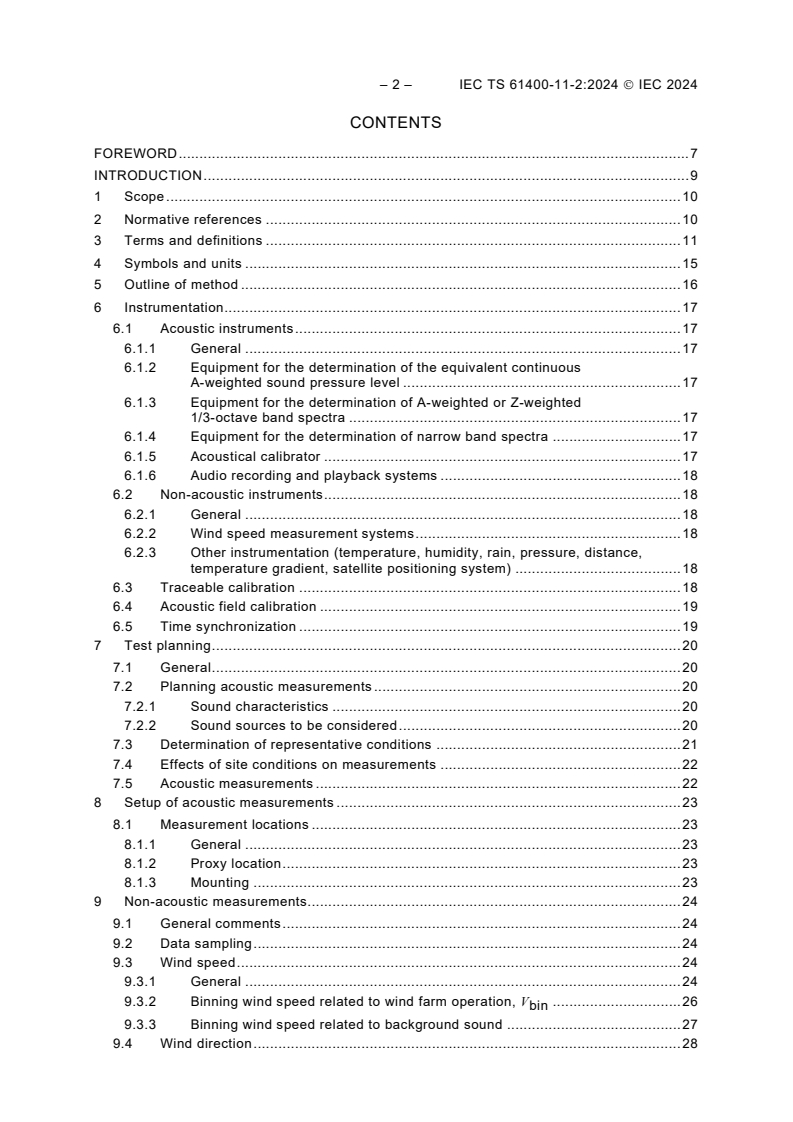
– 2 – IEC TS 61400-11-2:2024 IEC 2024
CONTENTS
FOREWORD . 7
INTRODUCTION . 9
1 Scope . 10
2 Normative references . 10
3 Terms and definitions . 11
4 Symbols and units . 15
5 Outline of method . 16
6 Instrumentation . 17
6.1 Acoustic instruments . 17
6.1.1 General . 17
6.1.2 Equipment for the determination of the equivalent continuous
A-weighted sound pressure level . 17
6.1.3 Equipment for the determination of A-weighted or Z-weighted
1/3-octave band spectra . 17
6.1.4 Equipment for the determination of narrow band spectra . 17
6.1.5 Acoustical calibrator . 17
6.1.6 Audio recording and playback systems . 18
6.2 Non-acoustic instruments . 18
6.2.1 General . 18
6.2.2 Wind speed measurement systems . 18
6.2.3 Other instrumentation (temperature, humidity, rain, pressure, distance,
temperature gradient, satellite positioning system) . 18
6.3 Traceable calibration . 18
6.4 Acoustic field calibration . 19
6.5 Time synchronization . 19
7 Test planning . 20
7.1 General . 20
7.2 Planning acoustic measurements . 20
7.2.1 Sound characteristics . 20
7.2.2 Sound sources to be considered . 20
7.3 Determination of representative conditions . 21
7.4 Effects of site conditions on measurements . 22
7.5 Acoustic measurements . 22
8 Setup of acoustic measurements . 23
8.1 Measurement locations . 23
8.1.1 General . 23
8.1.2 Proxy location . 23
8.1.3 Mounting . 23
9 Non-acoustic measurements . 24
9.1 General comments . 24
9.2 Data sampling . 24
9.3 Wind speed . 24
9.3.1 General . 24
9.3.2 Binning wind speed related to wind farm operation, V . 26
bin
9.3.3 Binning wind speed related to background sound . 27
9.4 Wind direction . 28
9.5 Precipitation . 28
9.6 Temperature, humidity, etc . 29
9.7 Wind turbine parameters (optional if necessary for assessment) . 29
10 Data reduction . 29
10.1 Bin analysis . 29
10.2 Data recommendations . 29
10.3 Uncertainty . 30
10.3.1 General . 30
10.3.2 Calculation of average sound pressure level and uncertainty per bin
based on measurements . 30
10.3.3 Calculation of average values and uncertainty per bin based on
measurements – Arithmetic averaging . 32
10.3.4 Calculation of average sound pressure level and uncertainty per bin
when using the sound power level based regulatory scheme . 32
11 Sound pressure level . 33
11.1 Outline . 33
11.2 Instrumentation . 33
11.3 Acoustic measurements . 34
11.3.1 General . 34
11.3.2 Equivalent continuous A-weighted sound pressure evel, L . 34
Aeq
11.3.3 Statistical level, L . 34
Axx
11.4 Non-acoustic measurements (SCADA, wind speed, temperature, humidity). 34
11.5 Data processing and analysis . 35
11.5.1 Data requirements . 35
11.5.2 Data binning . 35
11.5.3 Handling extraneous sound data . 35
11.5.4 Determination of representative conditions . 36
11.6 Measurement methods . 36
11.6.1 Long term measurements of wind turbine operation without shut down . 36
11.6.2 Short term measurements including periods of wind turbine operation
and shut down . 36
11.6.3 Long term measurements including periods of wind turbine operation
and shut down . 37
11.6.4 High background sound situation . 38
11.7 Guidance on background sound correction . 38
11.8 Sound power level based regulatory scheme . 39
11.8.1 General . 39
11.8.2 ISO 9613-2 . 39
11.8.3 Nord2000. 40
11.9 Reporting of results . 42
12 Tonal audibility . 42
12.1 Outline . 42
12.2 Overview of the ISO/TS 20065 method . 43
12.3 Instrumentation . 43
12.4 Acoustic measurements . 44
12.5 Non-acoustic measurements . 44
12.5.1 General . 44
12.5.2 Implementation specifics . 44
12.5.3 Data binning . 47
– 4 – IEC TS 61400-11-2:2024 IEC 2024
12.5.4 Uncertainty . 47
12.6 Reporting . 47
13 Amplitude modulation . 48
13.1 General . 48
13.2 Outline . 48
13.3 Instrumentation . 49
13.4 Acoustic measurements . 49
13.5 Non-acoustic measurements . 49
13.6 Data reduction procedures . 49
13.6.1 General methodology . 49
13.6.2 10 s methodology . 50
13.6.3 Signal analysis – 10 min results . 54
13.6.4 Signal analysis – Binned results . 55
13.6.5 Uncertainty . 55
13.7 Reporting . 55
14 Impulsivity . 56
14.1 Outline . 56
14.2 Instrumentation . 56
14.3 Acoustic measurements . 57
14.4 Non-acoustic measurements . 57
14.5 Data reduction . 57
14.6 Uncertainty . 57
14.7 Reporting . 57
15 Reporting. 57
15.1 Information to be reported . 57
15.1.1 General . 57
15.1.2 Description of the test scope and measurement concept . 57
15.1.3 Characterization of the wind turbine(s) . 58
15.1.4 Physical environment . 58
15.1.5 Instrumentation . 59
15.1.6 Data . 59
15.1.7 Uncertainty . 59
Annex A (informative) Rating level . 60
A.1 Rating of sound characteristics . 60
A.2 Examples of adjustments to the determined sound pressure levels for tonal
audibility . 60
A.3 Examples of adjustments to the determined sound pressure levels for
amplitude modulation . 61
A.4 Examples of adjustments to the determined sound pressure levels for
impulsivity . 61
Annex B (informative) Infrasound and wind turbines. 62
Annex C (informative) Low frequency sound evaluation . 63
C.1 Outline . 63
C.2 Standardised prediction approach . 63
C.3 Data reduction . 65
C.4 Uncertainty . 65
C.5 Reporting . 65
C.6 Examples of sound criteria in Scandinavian countries . 66
C.6.1 Denmark . 66
C.6.2 Sweden . 66
Annex D (informative) Examples for test plan and other considerations . 67
D.1 General . 67
D.2 Understanding the test scope and setting up a test plan – Example 1 . 67
D.3 Understanding the test scope and setting up a test plan – Example 2 . 67
D.4 Advantages and disadvantages of different measurement methodologies for
L . 68
p
D.4.1 Long term measurements of wind turbine operation without shut down . 68
D.4.2 Short term measurements including periods of wind turbine operation
and shut down . 68
D.4.3 Long term measurements including periods of wind turbine operation
and shut down . 69
Annex E (informative) Objective method for assessing the audibility of tones in sound
– Survey method . 70
Annex F (informative) Data exclusion tools . 71
F.1 General . 71
F.2 General data exclusion tools and methods . 71
Annex G (informative) Amplitude modulation adaptions . 73
G.1 General . 73
G.2 Faster rotor speeds . 73
G.3 Higher frequency bands . 73
Annex H (informative) Additional analysis tools . 75
H.1 General . 75
H.2 L tools . 75
p
H.2.1 Using statistical descriptors to remove transient events . 75
H.2.2 Band limited analysis . 75
H.2.3 Identify periods of turbine-only noise . 76
Annex I (informative) Secondary wind screens, façade mounted microphone and proxy
location . 77
I.1 General . 77
I.2 Oversize or secondary wind screens . 77
I.3 Façade mounted microphone . 77
I.4 Proxy location . 78
Annex J (informative) Sound emergence . 79
J.1 General . 79
J.2 Ambient sound . 79
J.3 Particular sound . 79
J.4 Background sound . 79
J.5 Calculation of the “émergence” criterion E(j) . 79
Annex K (informative) Meteorological effects . 80
K.1 Motivation . 80
K.2 Reminder on ground-based sound sources . 80
K.3 Sound sources at high heights . 81
K.4 Meteorological conditions for acoustic measurements . 82
K.4.1 General . 82
K.4.2 Temperature gradient . 82
K.4.3 Wind shear . 82
K.4.4 Potential temperature difference . 84
– 6 – IEC TS 61400-11-2:2024 IEC 2024
K.4.5 Cloud cover . 84
K.4.6 3D sonic anemometers . 84
K.4.7 SoDAR and LiDAR systems . 85
K.4.8 Reanalysis weather data . 85
K.4.9 Roughness length . 85
K.5 Outlook . 86
Annex L (informative) ISO/TS 20065 implementation – Areas for further consideration . 87
L.1 General . 87
L.2 Combining 3 s tonal audibilities . 87
L.3 Audibility threshold . 87
L.4 Critical bands not centred on tones . 88
Bibliography . 89
Figure 1 – Power spectrum for a 10 s block . 54
Figure A.1 – Examples of adjustments to the determined sound pressure levels for
amplitude modulation . 61
Table 1 – Example 1: Wind speed data categorization – Maximum sound power level
emissions . 25
Table 2 – Example 2: Wind speed data categorization – Maximum sound power level
emissions . 25
Table 3 – Examples of possible values of type B uncertainty components relevant for
apparent sound power spectra . 32
Table 4 – Quantities as required for analysis . 35
Table 5 – ISO 9613-2 modelling parameters . 40
Table 6 – Nord2000 modelling parameters . 41
Table 7 – Upper tone search frequencies based on a range of distance and
meteorological conditions . 45
Table A.1 – Example of tonal adjustment K from the mean audibility ΔL . 60
T
Table C.1 – Impedance class descriptions . 64
Table C.2 – Equation coefficients for a rural setting at 70 % humidity and 10 °C . 64
Table C.3 – Examples of façade insulation values ΔL . 65
σ
Table C.4 – Low frequency measurements reporting table . 66
Table C.5 – Z-weighted sound levels in individual 1/3-octave bands from 31,5 Hz to
200 Hz . 66
Table K.1 – Example of wind speed at 10 m and 120 m considering different vertical
profiles (alpha) . 83
Table K.2 – Example of shear factor (𝜶𝜶) calculations considering wind speed
measurements at 10 m and 120 m . 84
Table K.3 – Roughness length . 85
INTERNATIONAL ELECTROTECHNICAL COMMISSION
____________
WIND ENERGY GENERATION SYSTEMS –
Part 11-2: Acoustic noise measurement techniques –
Measurement of wind turbine sound characteristics in receptor position
FOREWORD
1) The International Electrotechnical Commission (IEC) is a worldwide organization for standardization comprising
all national electrotechnical committees (IEC National Committees). The object of IEC is to promote international
co-operation on all questions concerning standardization in the electrical and electronic fields. To this end and
in addition to other activities, IEC publishes International Standards, Technical Specifications, Technical Reports,
Publicly Available Specifications (PAS) and Guides (hereafter referred to as “IEC Publication(s)”). Their
preparation is entrusted to technical committees; any IEC National Committee interested in the subject dealt with
may participate in this preparatory work. International, governmental and non-governmental organizations liaising
with the IEC also participate in this preparation. IEC collaborates closely with the International Organization for
Standardization (ISO) in accordance with conditions determined by agreement between the two organizations.
2) The formal decisions or agreements of IEC on technical matters express, as nearly as possible, an international
consensus of opinion on the relevant subjects since each technical committee has representation from all
interested IEC National Committees.
3) IEC Publications have the form of recommendations for international use and are accepted by IEC National
Committees in that sense. While all reasonable efforts are made to ensure that the technical content of IEC
Publications is accurate, IEC cannot be held responsible for the way in which they are used or for any
misinterpretation by any end user.
4) In order to promote international uniformity, IEC National Committees undertake to apply IEC Publications
transparently to the maximum extent possible in their national and regional publications. Any divergence between
any IEC Publication and the corresponding national or regional publication shall be clearly indicated in the latter.
5) IEC itself does not provide any attestation of conformity. Independent certification bodies provide conformity
assessment services and, in some areas, access to IEC marks of conformity. IEC is not responsible for any
services carried out by independent certification bodies.
6) All users should ensure that they have the latest edition of this publication.
7) No liability shall attach to IEC or its directors, employees, servants or agents including individual experts and
members of its technical committees and IEC National Committees for any personal injury, property damage or
other damage of any nature whatsoever, whether direct or indirect, or for costs (including legal fees) and
expenses arising out of the publication, use of, or reliance upon, this IEC Publication or any other IEC
Publications.
8) Attention is drawn to the Normative references cited in this publication. Use of the referenced publications is
indispensable for the correct application of this publication.
9) IEC draws attention to the possibility that the implementation of this document may involve the use of (a)
patent(s). IEC takes no position concerning the evidence, validity or applicability of any claimed patent rights in
respect thereof. As of the date of publication of this document, IEC had not received notice of (a) patent(s), which
may be required to implement this document. However, implementers are cautioned that this may not represent
the latest information, which may be obtained from the patent database available at https://patents.iec.ch. IEC
shall not be held responsible for identifying any or all such patent rights.
IEC TS 61400-11-2 has been prepared by IEC technical committee 88: Wind energy generation
systems. It is a Technical Specification.
The text of this Technical Specification is based on the following documents:
Draft Report on voting
88/995/DTS 88/1009/RVDTS
Full information on the voting for its approval can be found in the report on voting indicated in
the above table.
The language used for the development of this Technical Specification is English.
– 8 – IEC TS 61400-11-2:2024 IEC 2024
This document was drafted in accordance with ISO/IEC Directives, Part 2, and developed in
accordance with ISO/IEC Directives, Part 1 and ISO/IEC Directives, IEC Supplement, available
at www.iec.ch/members_experts/refdocs. The main document types developed by IEC are
described in greater detail at www.iec.ch/publications.
A list of all parts in the IEC 61400 series, published under the general title Wind energy
generation systems, can be found on the IEC website.
The committee has decided that the contents of this document will remain unchanged until the
stability date indicated on the IEC website under webstore.iec.ch in the data related to the
specific document. At this date, the document will be
• reconfirmed,
• withdrawn, or
• revised.
IMPORTANT – The "colour inside" logo on the cover page of this document indicates
that it contains colours which are considered to be useful for the correct understanding
of its contents. Users should therefore print this document using a colour printer.
INTRODUCTION
The primary objective of this document is to establish uniform measurement and data analysis
techniques to facilitate the evaluation of the A-weighted sound pressure level, or other
acoustical properties, attributable to wind turbines at representative far-field locations. While
this is a seemingly simple objective, wind turbines require wind to operate and the presence of
wind complicates reliable acoustical measurements, either directly through wind induced
microphone noise or indirectly through wind induced vegetative rustling sound. The presence
of other common environmental sounds (planes, trains, road traffic, industrial, agricultural
activities, etc.) can complicate or adversely influence the measured sound level. Owing to the
distance of sound propagation, the meteorological conditions have a significant impact on the
measurement results and the influence should be considered.
Given that the regulatory requirements and history vary from country to country (and even within
the same country), this document does not dictate regulatory metrics, but provides guidance on
how best to isolate the sound attributable to wind turbines alone in the presence of other
environmental sounds. It also provides guidance for those whose regulatory history for wind or
other sources require the evaluation of specific acoustical aspects that have historically been
subject to highly varying methodologies. Some countries have substantial experience with wind
turbines while other countries are new to the special requirements of wind turbine sound
measurements. Both can find guidance on how to standardise their approaches.
In general, the document can be used by regulators and authorities, measurement laboratories,
developers, operators and manufacturers for
• comparison with local regulation;
• comparison with guarantee values;
• where no tradition for regulations of wind turbine sound immissions is available it can be
used to aid the decision process;
• assessment of the sound characteristics in wind turbine sound as well as the sound level.
– 10 – IEC TS 61400-11-2:2024 IEC 2024
WIND ENERGY GENERATION SYSTEMS –
Part 11-2: Acoustic noise measurement techniques –
Measurement of wind turbine sound characteristics in receptor position
1 Scope
This part of IEC 61400-11 presents measurement procedures, that enable the sound
characteristics of a wind turbine to be determined at receptor (immission) locations. This
involves using measurement methods appropriate to sound immission assessment at far-field
locations of a wind turbine or wind farm. The procedures described are different in some
respects from those that would be used for noise assessment from other industrial sound
sources in environmental noise impact assessments. They are intended to facilitate
characterization of wind turbine sound with respect to a range of wind speeds and directions.
The procedures present methodologies that will enable the sound immission and sound
characteristics of wind turbines to be described in a consistent and accurate manner. These
procedures include the following aspects:
• location of acoustic measurement positions (receptor position);
• requirements for the acquisition of acoustic, meteorological, and associated wind turbine
operational data;
• analysis of the data obtained and the content for the data report; and
• definition of specific acoustic parameters, and associated descriptors which are used for
making environmental assessments.
This document is not restricted to wind turbines of a particular size or type. The procedures
described in this document allow for the thorough description of the sound characteristics and
sound immissions from wind turbines.
2 Normative references
The following documents are referred to in the text in such a way that some or all of their content
constitutes requirements of this document. For dated references, only the edition cited applies.
For undated references, the latest edition of the referenced document (including any
amendments) applies.
IEC 60942, Electroacoustics – Sound calibrators
IEC 61400-11:2012, Wind turbines – Part 11: Acoustic noise measurement techniques
IEC 61400-11:2012/AMD1:2018
IEC 61400-12-1, Wind energy generation systems – Part 12-1: Power performance
measurements of electricity producing wind turbines
IEC 61672-1, Electroacoustics – Sound level meters – Part 1: Specifications
ISO 1996-2:2017, Acoustics – Description, measurement and assessment of environmental
noise – Part 2: Determination of sound pressure levels
3 Terms and definitions
For the purposes of this document, the following terms and definitions apply.
ISO and IEC maintain terminology databases for use in standardization at the following
addresses:
• IEC Electropedia: available at https://www.electropedia.org/
• ISO Online browsing platform: available at https://www.iso.org/obp
3.1
apparent sound power level
L
WA
A-weighted sound power level re. 1 pW of a point source at the rotor centre with the same
emission in the downwind direction as the wind turbine being measured, L is determined at
WA
bin centre wind speeds at hub height as described
Note 1 to entry: Apparent sound power level is expressed in dB re. 1 pW.
[SOURCE: IEC 61400-11:2012, 3.1]
3.2
apparent sound power level with reference to wind speed at 10 m height
L
WA,10m
A-weighted sound power level re. 1 pW of a point source at the rotor centre with the same
emission in the downwind direction as the wind turbine being measured, L is determined
WA,10m
at integer wind speeds at 10 m height within the wind speed range achieved during
measurements
Note 1 to entry: Apparent sound power level with reference to wind speed at 10 m height is expressed in dB re. 1
pW.
[SOURCE: IEC 61400-11:2012, 3.2, modified – “achieved during measurements has been
added to the definition.]
3.3
A-weighted sound pressure level
L
A
sound pressure level measured with the A frequency weighting networks as specified in
IEC 61672-1
Note 1 to entry: A-weighted sound pressure level is expressed in dB re. 20 µPa.
3.4
bin centre
centre value of a wind speed bin or wind direction bin
3.5
time-weighted and frequency-weighted sound pressure level
ten times the logarithm to the base 10 of the ratio of the time-mean-square of the sound
pressure to the square of a reference value, being obtained with a standard frequency weighting
and standard time weighting
Note 1 to entry: Sound pressure is expressed in pascal (Pa).
Note 2 to entry: The reference value is 20 μPa.
Note 3 to entry: Time-weighted and frequency-weighted sound pressure level is expressed in decibels (dB).
– 12 – IEC TS 61400-11-2:2024 IEC 2024
Note 4 to entry: The standard frequency weightings are A-weighting and C-weighting as specified in IEC 61672-1,
and the standard time weightings are F-weighting and S-weighting as specified in IEC 61672-1
3.6
background sound
contribution from all sources of acoustic sound other than the source of interest (i.e. wind
turbine)
3.7
total sound
totally encompassing sound composed of sound from many sources near and far (including
background sound and sound source of interest)
3.8
low frequency sound
sound containing frequency components of interest within the range generally covering the
1/3-octave bands 10 Hz to 200 Hz
Note 1 to entry: This definition is specific for this document. Other definitions can apply in different national
regulations.
3.9
tonality
∆L
k
difference between the tone level and the level of the masking noise in the critical band around
the tone in each wind speed bin where k is the centre value of the wind speed bin
3.10
tone frequency
f
T
frequency of the spectral line (or mid band frequency of the narrow band filter), to the level of
which the tone contributes most strongly
3.11
tone level
L
T
energy summation of the narrow-band level with the tone frequency, f , and the lateral lines
T
about f , assignable to this tone
T
Note 1 to entry: If the critical band for the frequency, f , under consideration contains a number of tones, then the
T
tone level, L , is the energy sum of these tones. This level, L , is then assigned to the frequency of the participating
T T
tone that has the maximal value of audibility, ΔL.
3.12
audibility
∆L
difference between the tonality and the audibility criterion, a in each wind speed bin
v
Note 1 to entry: Tonal au
...