

IEC 62237:2003
(Main)Live working - Insulating hoses with fittings for use with hydraulic tools and equipment
General Information
- Abstract
Is applicable to mobile insulating hoses with fittings used with hydraulic tools and equipment for live working at nominal voltages exceeding 1 kV r.m.s. at power frequency. Insulating hoses with fittings are used to provide a connection between the hydraulic tool and the pump which are at different potentials. They are not considered as a fixed component of a live working device (e.g. aerial device). They can be connected and disconnected under negligible pressure. They can be directly handled by the user.
- Status
- Published
- Publication Date
- 26-Oct-2003
- Technical Committee
- TC 78 - Live working
- Drafting Committee
- WG 12 - TC 78/WG 12
- Current Stage
- PPUB - Publication issued
- Start Date
- 27-Oct-2003
- Completion Date
- 15-Feb-2004
Overview
IEC 62237:2003 is an international standard published by the International Electrotechnical Commission (IEC) focusing on live working applications. It specifically addresses the requirements for insulating hoses with fittings used with hydraulic tools and equipment operating at nominal voltages exceeding 1 kV r.m.s. at power frequency. These insulating hoses provide essential electrical isolation between hydraulic tools and pumps that may be at different electrical potentials, ensuring safety during live electrical work.
This standard applies to mobile insulating hoses which can be connected and disconnected under negligible pressure and may be directly handled by users. Unlike fixed components on live working devices such as aerial devices, these hoses are designed for flexible, safe use during live electrical operations involving hydraulic equipment.
Key Topics
Scope and Application:
- Applies to mobile insulating hoses with fittings used for live working over 1 kV r.m.s.
- Ensures compatibility with hydraulic tools and pump systems operating at different potentials.
- Covers hoses that are not fixed components and can be handled directly by operators.
Technical Requirements:
- Protection against corrosion for durability in various environments.
- Mechanical protection and finishing standards to ensure robustness and safety.
- Specifications for insulating parts and conductive components to maintain electrical isolation.
- Clear marking requirements for safe identification and traceability.
- Comprehensive instructions for use to guide proper handling and application.
Testing and Quality Assurance:
- Visual and dimensional inspections to verify physical conformity.
- Electrical tests including dielectric performance under wet and dry conditions.
- Mechanical tests such as hydrostatic pressure, fatigue resistance, pulsation, leakage, burst, and cold bend tests.
- Durability evaluation of markings to ensure long-term legibility.
- Quality assurance plan detailing manufacturing controls, acceptance tests, and ongoing conformity verification.
Safety and Operational Precautions:
- Annexes provide guidelines for in-service care to maintain hose performance during use.
- Procedures on proper handling, connection, and disconnection under live working conditions.
Applications
IEC 62237:2003 is essential for organizations and professionals involved in live working where hydraulic tools are used near high-voltage equipment. Typical applications include:
- Electrical utility maintenance workers operating hydraulic tools on live power lines.
- Industrial settings involving live electrical equipment maintenance with hydraulic devices.
- Electrical contractors and engineers ensuring safety and reliability in live working procedures.
- Manufacturers and suppliers of insulating hoses and fittings intended for live working environments.
- Safety officers implementing international best practices for electrical live working safety products.
By adhering to IEC 62237:2003, stakeholders can ensure insulating hoses meet rigid global standards that minimize electrical hazards and provide durable, reliable performance in demanding live electrical working scenarios.
Related Standards
IEC 62237:2003 is part of a broader framework of IEC standards covering live working and electrical safety. Related standards include:
- IEC 60417-5216 – Graphical symbols, including the double triangle symbol signifying suitability for live working.
- IEC 60034 series – General electrical machinery standards which may intersect with hydraulic and electrical equipment safety.
- Other IEC live working standards detailing insulated tools, protective equipment, and apparatus designed for electrical safety under live conditions.
Together, these standards form the foundation for ensuring globally harmonized safety, quality, and interoperability of electrical live working tools and equipment.
Keywords: IEC 62237, insulating hoses, hydraulic tools, live working, electrical safety, high voltage, insulating hoses with fittings, hydraulic equipment, electrical maintenance, electrical live work safety, IEC standards, quality assurance, electrical insulation, safety testing.
Get Certified
Connect with accredited certification bodies for this standard

IMQ S.p.A. (Certification)
Italian electrical product certification.

SLG Prüf- und Zertifizierungs GmbH
German testing and certification body.

UL Solutions
Global safety science company with testing, inspection and certification.
Sponsored listings
Frequently Asked Questions
IEC 62237:2003 is a standard published by the International Electrotechnical Commission (IEC). Its full title is "Live working - Insulating hoses with fittings for use with hydraulic tools and equipment". This standard covers: Is applicable to mobile insulating hoses with fittings used with hydraulic tools and equipment for live working at nominal voltages exceeding 1 kV r.m.s. at power frequency. Insulating hoses with fittings are used to provide a connection between the hydraulic tool and the pump which are at different potentials. They are not considered as a fixed component of a live working device (e.g. aerial device). They can be connected and disconnected under negligible pressure. They can be directly handled by the user.
Is applicable to mobile insulating hoses with fittings used with hydraulic tools and equipment for live working at nominal voltages exceeding 1 kV r.m.s. at power frequency. Insulating hoses with fittings are used to provide a connection between the hydraulic tool and the pump which are at different potentials. They are not considered as a fixed component of a live working device (e.g. aerial device). They can be connected and disconnected under negligible pressure. They can be directly handled by the user.
IEC 62237:2003 is classified under the following ICS (International Classification for Standards) categories: 13.260 - Protection against electric shock. Live working; 29.240.99 - Other equipment related to power transmission and distribution networks; 29.260.99 - Other electrical equipment for working in special conditions. The ICS classification helps identify the subject area and facilitates finding related standards.
IEC 62237:2003 is available in PDF format for immediate download after purchase. The document can be added to your cart and obtained through the secure checkout process. Digital delivery ensures instant access to the complete standard document.
Standards Content (Sample)
NORME CEI
INTERNATIONALE IEC
INTERNATIONAL
Première édition
STANDARD
First edition
2003-10
Travaux sous tension –
Conduits flexibles isolants
avec raccords utilisés avec les outils
et matériels hydrauliques
Live working –
Insulating hoses with fittings
for use with hydraulic tools
and equipment
Numéro de référence
Reference number
CEI/IEC 62237:2003
Numérotation des publications Publication numbering
Depuis le 1er janvier 1997, les publications de la CEI As from 1 January 1997 all IEC publications are
sont numérotées à partir de 60000. Ainsi, la CEI 34-1 issued with a designation in the 60000 series. For
devient la CEI 60034-1. example, IEC 34-1 is now referred to as IEC 60034-1.
Editions consolidées Consolidated editions
Les versions consolidées de certaines publications de la The IEC is now publishing consolidated versions of its
CEI incorporant les amendements sont disponibles. Par publications. For example, edition numbers 1.0, 1.1
exemple, les numéros d’édition 1.0, 1.1 et 1.2 indiquent and 1.2 refer, respectively, to the base publication,
respectivement la publication de base, la publication de the base publication incorporating amendment 1 and
base incorporant l’amendement 1, et la publication de the base publication incorporating amendments 1
base incorporant les amendements 1 et 2. and 2.
Informations supplémentaires Further information on IEC publications
sur les publications de la CEI
Le contenu technique des publications de la CEI est The technical content of IEC publications is kept
constamment revu par la CEI afin qu'il reflète l'état under constant review by the IEC, thus ensuring that
actuel de la technique. Des renseignements relatifs à the content reflects current technology. Information
cette publication, y compris sa validité, sont dispo- relating to this publication, including its validity, is
nibles dans le Catalogue des publications de la CEI available in the IEC Catalogue of publications
(voir ci-dessous) en plus des nouvelles éditions, (see below) in addition to new editions, amendments
amendements et corrigenda. Des informations sur les and corrigenda. Information on the subjects under
sujets à l’étude et l’avancement des travaux entrepris consideration and work in progress undertaken by the
par le comité d’études qui a élaboré cette publication, technical committee which has prepared this
ainsi que la liste des publications parues, sont publication, as well as the list of publications issued,
également disponibles par l’intermédiaire de: is also available from the following:
• Site web de la CEI (www.iec.ch) • IEC Web Site (www.iec.ch)
• Catalogue des publications de la CEI • Catalogue of IEC publications
Le catalogue en ligne sur le site web de la CEI The on-line catalogue on the IEC web site
(www.iec.ch/searchpub) vous permet de faire des (www.iec.ch/searchpub) enables you to search by a
recherches en utilisant de nombreux critères, variety of criteria including text searches,
comprenant des recherches textuelles, par comité technical committees and date of publication. On-
d’études ou date de publication. Des informations en line information is also available on recently
ligne sont également disponibles sur les nouvelles issued publications, withdrawn and replaced
publications, les publications remplacées ou retirées, publications, as well as corrigenda.
ainsi que sur les corrigenda.
• IEC Just Published • IEC Just Published
Ce résumé des dernières publications parues This summary of recently issued publications
(www.iec.ch/online_news/justpub) est aussi dispo- (www.iec.ch/online_news/justpub) is also available
nible par courrier électronique. Veuillez prendre by email. Please contact the Customer Service
contact avec le Service client (voir ci-dessous) Centre (see below) for further information.
pour plus d’informations.
• Service clients • Customer Service Centre
Si vous avez des questions au sujet de cette If you have any questions regarding this
publication ou avez besoin de renseignements publication or need further assistance, please
supplémentaires, prenez contact avec le Service contact the Customer Service Centre:
clients:
Email: custserv@iec.ch Email: custserv@iec.ch
Tél: +41 22 919 02 11 Tel: +41 22 919 02 11
Fax: +41 22 919 03 00 Fax: +41 22 919 03 00
.
NORME CEI
INTERNATIONALE IEC
INTERNATIONAL
Première édition
STANDARD
First edition
2003-10
Travaux sous tension –
Conduits flexibles isolants
avec raccords utilisés avec les outils
et matériels hydrauliques
Live working –
Insulating hoses with fittings
for use with hydraulic tools
and equipment
IEC 2003 Droits de reproduction réservés Copyright - all rights reserved
Aucune partie de cette publication ne peut être reproduite ni No part of this publication may be reproduced or utilized in any
utilisée sous quelque forme que ce soit et par aucun procédé, form or by any means, electronic or mechanical, including
électronique ou mécanique, y compris la photocopie et les photocopying and microfilm, without permission in writing from
microfilms, sans l'accord écrit de l'éditeur. the publisher.
International Electrotechnical Commission, 3, rue de Varembé, PO Box 131, CH-1211 Geneva 20, Switzerland
Telephone: +41 22 919 02 11 Telefax: +41 22 919 03 00 E-mail: inmail@iec.ch Web: www.iec.ch
CODE PRIX
V
Commission Electrotechnique Internationale PRICE CODE
International Electrotechnical Commission
Международная Электротехническая Комиссия
Pour prix, voir catalogue en vigueur
For price, see current catalogue
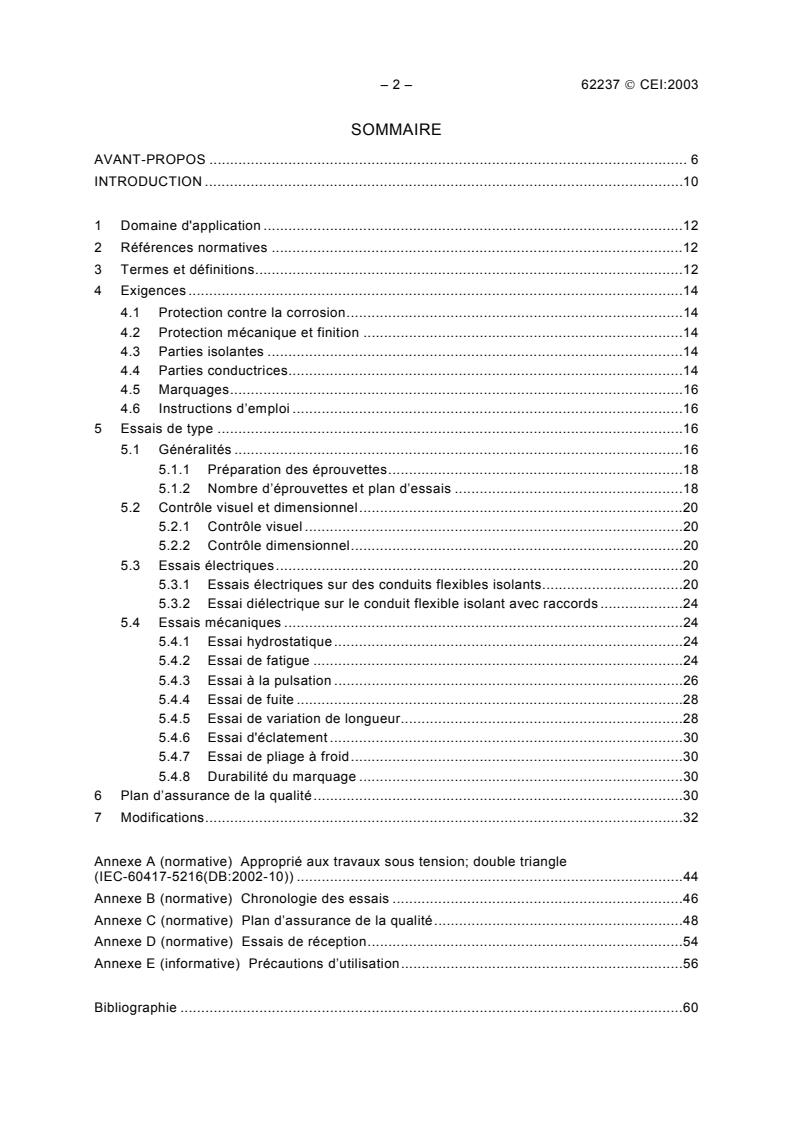
– 2 – 62237 CEI:2003
SOMMAIRE
AVANT-PROPOS . 6
INTRODUCTION .10
1 Domaine d'application .12
2 Références normatives .12
3 Termes et définitions.12
4 Exigences .14
4.1 Protection contre la corrosion.14
4.2 Protection mécanique et finition .14
4.3 Parties isolantes .14
4.4 Parties conductrices.14
4.5 Marquages.16
4.6 Instructions d’emploi .16
5 Essais de type .16
5.1 Généralités .16
5.1.1 Préparation des éprouvettes.18
5.1.2 Nombre d’éprouvettes et plan d’essais .18
5.2 Contrôle visuel et dimensionnel.20
5.2.1 Contrôle visuel .20
5.2.2 Contrôle dimensionnel.20
5.3 Essais électriques.20
5.3.1 Essais électriques sur des conduits flexibles isolants.20
5.3.2 Essai diélectrique sur le conduit flexible isolant avec raccords .24
5.4 Essais mécaniques .24
5.4.1 Essai hydrostatique.24
5.4.2 Essai de fatigue .24
5.4.3 Essai à la pulsation .26
5.4.4 Essai de fuite .28
5.4.5 Essai de variation de longueur.28
5.4.6 Essai d'éclatement .30
5.4.7 Essai de pliage à froid.30
5.4.8 Durabilité du marquage .30
6 Plan d’assurance de la qualité.30
7 Modifications.32
Annexe A (normative) Approprié aux travaux sous tension; double triangle
(IEC-60417-5216(DB:2002-10)) .44
Annexe B (normative) Chronologie des essais .46
Annexe C (normative) Plan d’assurance de la qualité.48
Annexe D (normative) Essais de réception.54
Annexe E (informative) Précautions d’utilisation.56
Bibliographie .60
62237 IEC:2003 – 3 –
CONTENTS
FOREWORD . 7
INTRODUCTION .11
1 Scope .13
2 Normative references.13
3 Terms and definitions .13
4 Requirements .15
4.1 Protection against corrosion .15
4.2 Finishing and mechanical protection .15
4.3 Insulating parts.15
4.4 Conductive parts.15
4.5 Markings.17
4.6 Instructions for use .17
5 Type tests.17
5.1 General .17
5.1.1 Preparation of test pieces .19
5.1.2 Number of test pieces and test plan .19
5.2 Visual inspection and dimensional check .21
5.2.1 Visual inspection.21
5.2.2 Dimensional check.21
5.3 Electric tests.21
5.3.1 Electric tests on insulating hoses .21
5.3.2 Dielectric test on insulating hose with fittings .25
5.4 Mechanical tests.25
5.4.1 Hydrostatic test.25
5.4.2 Fatigue test.25
5.4.3 Mechanical impulse test.27
5.4.4 Leakage test .29
5.4.5 Change in length test.29
5.4.6 Burst test .31
5.4.7 Cold bend test .31
5.4.8 Durability of marking .31
6 Quality assurance plan .31
7 Modifications .33
Annex A (normative) Suitable for live working; double triangle (IEC-60417-5216(DB:2002-10)) . 45
Annex B (normative) Chronology of the tests.47
Annex C (normative) Quality assurance plan.49
Annex D (normative) Acceptance tests.55
Annex E (informative) In-service care.57
Bibliography.61
– 4 – 62237 CEI:2003
Figure 1 – Bouchon pour éprouvette (voir 5.1.1).34
Figure 2 – Montage pour essais électriques (voir 5.3.1.1).34
Figure 3 – Préparation de l'éprouvette pour essai après entaille superficielle (voir 5.3.1.4) .36
Figure 4 – Essais diélectrique sous pluie – Exemple de montage d’essai (voir 5.3.1.5) .36
Figure 5 – Essais diélectrique sous pluie – Détails de la disposition de l’électrode
(voir 5.3.1.5).38
Figure 6 – Dispositif d’essai pour l’essai de fatigue (voir 5.4.2) .40
Figure 7 – Diagramme de l'essai à la pulsation (voir 5.4.3).42
Tableau B.1 – Ordre chronologique des essais .46
Tableau C.1 – Informations relatives aux défauts.48
62237 IEC:2003 – 5 –
Figure 1 – Stopper for test piece (see 5.1.1) .35
Figure 2 – Test set-up for electric tests (see 5.3.1.1).35
Figure 3 – Preparation of specimen for test after the infliction of a cut (see 5.3.1.4).37
Figure 4 – Dielectric wet test – Typical test arrangement (see 5.3.1.5).37
Figure 5 – Dielectric wet test – Details of electrode arrangement (see 5.3.1.5).39
Figure 6 – Testing device for the fatigue test (see 5.4.2) .41
Figure 7 – Diagram of mechanical impulse test (see 5.4.3).43
Table B.1 – Chronological order of the tests.47
Table C.1 – Information relative to defects .49
– 6 – 62237 CEI:2003
COMMISSION ÉLECTROTECHNIQUE INTERNATIONALE
____________
TRAVAUX SOUS TENSION –
CONDUITS FLEXIBLES ISOLANTS AVEC RACCORDS
UTILISÉS AVEC LES OUTILS ET MATÉRIELS HYDRAULIQUES
AVANT-PROPOS
1) La Commission Electrotechnique Internationale (CEI) est une organisation mondiale de normalisation composée
de l'ensemble des comités électrotechniques nationaux (Comités nationaux de la CEI). La CEI a pour objet de
favoriser la coopération internationale pour toutes les questions de normalisation dans les domaines de
l'électricité et de l'électronique. A cet effet, la CEI – entre autres activités – publie des Normes internationales,
des Spécifications techniques, des Rapports techniques, des Spécifications accessibles au public (PAS) et des
Guides (ci-après dénommés "Publication(s) de la CEI"). Leur élaboration est confiée à des comités d'études,
aux travaux desquels tout Comité national intéressé par le sujet traité peut participer. Les organisations
internationales, gouvernementales et non gouvernementales, en liaison avec la CEI, participent également aux
travaux. La CEI collabore étroitement avec l'Organisation Internationale de Normalisation (ISO), selon des
conditions fixées par accord entre les deux organisations.
2) Les décisions ou accords officiels de la CEI concernant les questions techniques représentent, dans la mesure
du possible, un accord international sur les sujets étudiés, étant donné que les Comités nationaux de la CEI
intéressés sont représentés dans chaque comité d’études.
3) Les Publications de la CEI se présentent sous la forme de recommandations internationales et sont agréées
comme telles par les Comités nationaux de la CEI. Tous les efforts raisonnables sont entrepris afin que la CEI
s'assure de l'exactitude du contenu technique de ses publications; la CEI ne peut pas être tenue responsable de
l'éventuelle mauvaise utilisation ou interprétation qui en est faite par un quelconque utilisateur final.
4) Dans le but d'encourager l'uniformité internationale, les Comités nationaux de la CEI s'engagent, dans toute la
mesure possible, à appliquer de façon transparente les Publications de la CEI dans leurs publications
nationales et régionales. Toutes divergences entre toutes Publications de la CEI et toutes publications
nationales ou régionales correspondantes doivent être indiquées en termes clairs dans ces dernières.
5) La CEI n’a prévu aucune procédure de marquage valant indication d’approbation et n'engage pas sa
responsabilité pour les équipements déclarés conformes à une de ses Publications.
6) Tous les utilisateurs doivent s'assurer qu'ils sont en possession de la dernière édition de cette publication.
7) Aucune responsabilité ne doit être imputée à la CEI, à ses administrateurs, employés, auxiliaires ou
mandataires, y compris ses experts particuliers et les membres de ses comités d'études et des Comités
nationaux de la CEI, pour tout préjudice causé en cas de dommages corporels et matériels, ou de tout autre
dommage de quelque nature que ce soit, directe ou indirecte, ou pour supporter les coûts (y compris les frais
de justice) et les dépenses découlant de la publication ou de l'utilisation de cette Publication de la CEI ou de
toute autre Publication de la CEI, ou au crédit qui lui est accordé.
8) L'attention est attirée sur les références normatives citées dans cette publication. L'utilisation de publications
référencées est obligatoire pour une application correcte de la présente publication.
9) L’attention est attirée sur le fait que certains des éléments de la présente Publication de la CEI peuvent faire
l’objet de droits de propriété intellectuelle ou de droits analogues. La CEI ne saurait être tenue pour
responsable de ne pas avoir identifié de tels droits de propriété et de ne pas avoir signalé leur existence.
La Norme internationale CEI 62237 a été établie par le comité d'études 78 de la CEI: Travaux
sous tension.
Le texte de cette norme est issu des documents suivants:
FDIS Rapport de vote
78/530/FDIS 78/540/RVD
Le rapport de vote indiqué dans le tableau ci-dessus donne toute information sur le vote ayant
abouti à l'approbation de cette norme.
Cette publication a été rédigée selon les Directives ISO/CEI, Partie 2.
62237 IEC:2003 – 7 –
INTERNATIONAL ELECTROTECHNICAL COMMISSION
____________
LIVE WORKING –
INSULATING HOSES WITH FITTINGS
FOR USE WITH HYDRAULIC TOOLS AND EQUIPMENT
FOREWORD
1) The International Electrotechnical Commission (IEC) is a worldwide organization for standardization comprising
all national electrotechnical committees (IEC National Committees). The object of IEC is to promote
international co-operation on all questions concerning standardization in the electrical and electronic fields. To
this end and in addition to other activities, IEC publishes International Standards, Technical Specifications,
Technical Reports, Publicly Available Specifications (PAS) and Guides (hereafter referred to as “IEC
Publication(s)”). Their preparation is entrusted to technical committees; any IEC National Committee interested
in the subject dealt with may participate in this preparatory work. International, governmental and non-
governmental organizations liaising with the IEC also participate in this preparation. IEC collaborates closely
with the International Organization for Standardization (ISO) in accordance with conditions determined by
agreement between the two organizations.
2) The formal decisions or agreements of IEC on technical matters express, as nearly as possible, an international
consensus of opinion on the relevant subjects since each technical committee has representation from all
interested IEC National Committees.
3) IEC Publications have the form of recommendations for international use and are accepted by IEC National
Committees in that sense. While all reasonable efforts are made to ensure that the technical content of IEC
Publications is accurate, IEC cannot be held responsible for the way in which they are used or for any
misinterpretation by any end user.
4) In order to promote international uniformity, IEC National Committees undertake to apply IEC Publications
transparently to the maximum extent possible in their national and regional publications. Any divergence
between any IEC Publication and the corresponding national or regional publication shall be clearly indicated in
the latter.
5) IEC provides no marking procedure to indicate its approval and cannot be rendered responsible for any
equipment declared to be in conformity with an IEC Publication.
6) All users should ensure that they have the latest edition of this publication.
7) No liability shall attach to IEC or its directors, employees, servants or agents including individual experts and
members of its technical committees and IEC National Committees for any personal injury, property damage or
other damage of any nature whatsoever, whether direct or indirect, or for costs (including legal fees) and
expenses arising out of the publication, use of, or reliance upon, this IEC Publication or any other IEC
Publications.
8) Attention is drawn to the Normative references cited in this publication. Use of the referenced publications is
indispensable for the correct application of this publication.
9) Attention is drawn to the possibility that some of the elements of this IEC Publication may be the subject of
patent rights. IEC shall not be held responsible for identifying any or all such patent rights.
International Standard IEC 62237 has been prepared by IEC technical committee 78: Live
working.
The text of this standard is based on the following documents:
FDIS Report on voting
78/530/FDIS 78/540/RVD
Full information on the voting for the approval of this standard can be found in the report on
voting indicated in the above table.
This publication has been drafted in accordance with the ISO/IEC Directives, Part 2.
– 8 – 62237 CEI:2003
Le comité a décidé que le contenu de cette publication ne sera pas modifié avant 2010. A cette
date, la publication sera
• reconduite;
• supprimée;
• remplacée par une édition révisée, ou
• amendée.
62237 IEC:2003 – 9 –
The committee has decided that the contents of this publication will remain unchanged until
2010. At this date, the publication will be
• reconfirmed;
• withdrawn;
• replaced by a revised edition, or
• amended.
– 10 – 62237 CEI:2003
INTRODUCTION
Cette Norme internationale a été rédigée en conformité avec les exigences de la CEI 61477.
Les éléments du plan qualité ont été préparés en accord avec les exigences de la CEI 61318.
62237 IEC:2003 – 11 –
INTRODUCTION
This International Standard has been prepared in accordance with the requirements of
IEC 61477.
The quality plan elements were prepared in accordance with the requirements of IEC 61318.
– 12 – 62237 CEI:2003
TRAVAUX SOUS TENSION –
CONDUITS FLEXIBLES ISOLANTS AVEC RACCORDS
UTILISÉS AVEC LES OUTILS ET MATÉRIELS HYDRAULIQUES
1 Domaine d'application
Cette Norme internationale est applicable aux conduits flexibles isolants avec raccords
portables utilisés avec des outils et matériels hydrauliques pour travaux sous tension sur
réseaux électriques à fréquence industrielle, de tension nominale supérieure à 1 kV efficace.
L’utilisation en courant continu n’est pas couverte par la présente norme.
Ces conduits flexibles isolants avec raccords sont utilisés pour effectuer la connexion entre
l'outil hydraulique et la pompe qui sont à des potentiels différents. Ils ne sont pas considérés
comme une partie fixe d’un dispositif pour travaux sous tension (par exemple l'élévateur). Ils
peuvent être connectés et déconnectés sous une pression négligeable. Ils peuvent être
manipulés directement par le travailleur.
2 Références normatives
Les documents de référence suivants sont indispensables pour l'application du présent
document. Pour les références datées, seule l'édition citée s'applique. Pour les références non
datées, la dernière édition du document de référence s'applique (y compris les éventuels
amendements).
CEI 60060-1:1989, Techniques des essais à haute tension – Partie 1: Définitions et prescrip-
tions générales relatives aux essais
CEI 60060-2, Techniques des essais à haute tension – Partie 2: Systèmes de mesure
CEI 60212:1971, Conditions normales à observer avant et pendant les essais de matériaux
isolants électriques solides
)
CEI 60417-DB:2002 , Symboles graphiques utilisables sur le matériel
CEI 61318 :2003, Travaux sous tension – Plans d’assurance de la qualité applicables à
l’outillage, au matériel et aux dispositifs
CEI 61477:2001, Travaux sous tension – Exigences minimales pour l’utilisation des outils,
dispositifs et équipements
2)
Amendement 1:2002
3 Termes et définitions
Pour les besoins de ce document, les termes et définitions suivantes ainsi que ceux de la
CEI 61318 s’appliquent.
———————
1)
« DB » se réfère à la base de données en ligne de la CEI.
2)
Il existe une édition consolidée 1.1 (2002) qui comprend l’édition 1 (2001) et l’Amendement 1 (2002).
62237 IEC:2003 – 13 –
LIVE WORKING –
INSULATING HOSES WITH FITTINGS
FOR USE WITH HYDRAULIC TOOLS AND EQUIPMENT
1 Scope
This International Standard is applicable to mobile insulating hoses with fittings used with
hydraulic tools and equipment for live working at nominal voltages exceeding 1 kV r.m.s. at
power frequency.
The use under D.C. conditions is not covered by this standard.
Insulating hoses with fittings are used to provide a connection between the hydraulic tool and
the pump which are at different potentials. They are not considered as a fixed component of a
live working device (e.g. aerial device). They can be connected and disconnected under
negligible pressure. They can be directly handled by the user.
2 Normative references
The following referenced documents are indispensable for the application of this document.
For dated references, only the edition cited applies. For undated references, the latest edition
of the referenced document (including any amendments) applies.
IEC 60060-1:1989, High-voltage test techniques – Part 1: General definitions and test
requirements
IEC 60060-2, High-voltage test techniques – Part 2: Measuring systems
IEC 60212:1971, Standard conditions for use prior to and during the testing of solid electrical
insulating materials
1)
IEC 60417-DB:2002 , Graphical symbols for use on equipment
IEC 61318:2003, Live working – Quality assurance plans applicable to tools, devices and
equipment
IEC 61477:2001, Live working – Minimum requirements for the utilization of tools, devices and
equipment
2)
Amendment 1:2002
3 Terms and definitions
For the purpose of this document, the following terms and definitions and the ones included in
IEC 61318 apply.
———————
1)
“DB” refers to the IEC on-line database.
2)
There exists a consolidated edition 1.1 (2002) that includes edition 1 (2001) and its Amendment 1 (2002).
– 14 – 62237 CEI:2003
3.1
conduit flexible isolant avec raccords
conduit flexible muni de raccords, isolant et résistant à la pression, utilisé pour procurer une
liaison entre des parties des matériels hydrauliques à des potentiels électriques différents
[Définition 12.1.4 de la CEI 60743]
3.2
conduit flexible isolant
conduit flexible isolant et résistant à la pression sans les raccords
3.3
pression de service maximale
pression spécifiée par le fabricant qui ne doit pas être dépassée lors de l’utilisation du conduit
flexible isolant
3.4
fluide isolant (pour matériel hydraulique)
liquide isolant qui est utilisé pour la transmission de l’énergie hydraulique entre des parties
portées à des potentiels électriques différents
[VEI 651-11-02]
4 Exigences
4.1 Protection contre la corrosion
Les parties métalliques doivent être résistantes à la corrosion soit du fait de leur propre
composition, soit du fait d’un traitement adapté.
NOTE Si deux matériaux métalliques sont utilisés, il convient de les choisir de manière à éviter la formation de
couples électrolytiques.
4.2 Protection mécanique et finition
Les différents composants doivent être conçus de manière à ne pas créer des conditions
susceptibles d’engendrer un risque de blessure.
4.3 Parties isolantes
L’isolation requise est obtenue en utilisant une longueur appropriée de conduit flexible isolant.
Les raccords ne doivent pas diminuer les propriétés diélectriques de l’outil.
Les parties isolantes doivent être d’une couleur mettant en évidence leur caractère isolant.
NOTE La couleur orange est privilégiée pour indiquer les parties isolantes.
4.4 Parties conductrices
Toutes les parties conductrices fixées à des parties isolantes doivent être facilement
identifiables.
La surface extérieure d’une partie isolante contenant une partie conductrice doit être marquée
clairement à l’aide d’un trait indiquant la position extrême de la partie conductrice interne.
Toutes les parties conductrices doivent être conçues et fabriquées de façon à réduire les
risques de court-circuit.
62237 IEC:2003 – 15 –
3.1
insulating hose with fittings
insulating and pressure resistant hose and fittings which are used to provide a connection
between parts of hydraulic equipment at different electric potentials
[Definition 12.1.4 of IEC 60743]
3.2
insulating hose
insulating and pressure resistant hose without fittings
3.3
maximum operating pressure
pressure specified by the manufacturer which shall not be exceeded during the use of the
insulating hose
3.4
insulating liquid (for hydraulic equipment)
insulating liquid which is used for the transmission of hydraulic energy between parts at
different electric potentials
[IEV 651-11-02]
4 Requirements
4.1 Protection against corrosion
Metal parts shall be resistant to corrosion either by their own composition or by being suitably
treated.
NOTE When two metallic materials are used, they should be selected in such a way as to avoid electrolytic action.
4.2 Finishing and mechanical protection
The various components shall be designed so that they do not create the potential for injury.
4.3 Insulating parts
Insulation is achieved by using a proper length of insulating hose. End fittings shall not impair
the dielectric properties of the tool.
The insulating parts shall be characterized by a special colour that shows their insulating
property.
NOTE Orange is a preferred colour to indicate insulating parts.
4.4 Conductive parts
All conductive parts fixed to insulating parts shall be easily identifiable.
The exterior surface of the insulating part that contains a conductive element shall be clearly
marked by a line indicating the extreme position of the internal conductive part.
All conductive parts shall be designed and manufactured so as to limit the risk of short-
circuits.
– 16 – 62237 CEI:2003
4.5 Marquages
Chaque conduit flexible isolant avec raccords doit comporter les marquages permanents qui
suivent:
– le nom du fabricant ou la marque;
– la date de fabrication (mois et année) et éventuellement le numéro d’identification;
– la pression de service maximale (bar ou MPa);
– la longueur isolante du conduit flexible isolant avec raccords;
– le symbole IEC-60417-5216(DB:2002-10) – Approprié aux travaux sous tension; double
triangle (voir Annexe A);
NOTE La proportion exacte de la hauteur de la figure à la base du triangle est de 1,43. Dans un souci pratique,
la proportion peut se situer entre les valeurs de 1,4 et 1,5.
– le numéro de la norme CEI applicable, immédiatement adjacent au symbole avec l'année
de publication (4 chiffres), (IEC 62237:2003).
La tolérance de la longueur isolante est ±50 mm.
Les marquages doivent être lisibles à l’œil nu par une personne dont la vue est normale ou
corrigée, sans moyen de grossissement additionnel.
Les marquages doivent être résistants et ne doivent pas nuire aux performances du conduit
flexible isolant avec raccords.
4.6 Instructions d’emploi
Chaque conduit flexible isolant avec raccords doit être fourni avec les instructions écrites du
fabricant concernant les précautions d’emploi. Ces instructions doivent être préparées
conformément aux dispositions générales données dans la CEI 61477.
Ces instructions doivent inclure au minimum:
– les caractéristiques du ou des fluides isolants exigés;
NOTE Lorsque les conduits isolants avec raccords sont prévus pour usage à basse température, il convient que
fabricant et client s’assurent que des informations sur le ou les fluides isolants adéquats sont incluses.
– la pression minimale d’éclatement;
– les dimensions des raccords, avec ±1 mm de tolérance;
– les diamètres (intérieur et extérieur) du conduit flexible isolant, avec ±2 mm de tolérance;
– le rayon minimal de courbure, avec ±25 mm de tolérance;
– le poids;
– les instructions de nettoyage, de stockage et de transport;
– les instructions relatives au contrôle périodique, aux réparations possibles et à la mise au
rebut du conduit flexible.
5 Essais de type
5.1 Généralités
Pour mettre en évidence la conformité à cette norme, le fabricant doit fournir la preuve que les
essais suivants ont été effectués avec succès.
62237 IEC:2003 – 17 –
4.5 Markings
Each insulating hose with fittings shall be marked with the following permanent markings:
– manufacturer’s name or trademark:
– date of manufacture (month and year) and possibly identification number;
– maximum operating pressure (bar or MPa);
– insulating length of the insulating hose with fittings;
– symbol IEC-60417-5216(DB:2002-10) – Suitable for live working; double triangle (see
Annex A);
NOTE The exact ratio of the height of the figure to the base of the triangle is 1,43. For the purpose of
convenience, this ratio can be between the values of 1,4 and 1,5.
– number of the relevant IEC standard immediately adjacent to the symbol with year of
publication (4 digits), (IEC 62237:2003).
The tolerance of the insulating length is ±50 mm.
Markings shall be clearly legible to a person with normal or corrected vision, without
additional magnification.
The markings shall be resistant and shall not reduce the performance of the insulating hose
with fittings.
4.6 Instructions for use
Each insulating hose with fittings shall be supplied with the manufacturer’s written instructions
for use and care. These instructions shall be prepared in accordance with the general
provisions given in IEC 61477.
These instructions shall include as a minimum:
– characteristics of required insulating liquid(s),
NOTE When the insulating hoses with fittings are to be used at low temperatures, user and manufacturer should
make sure that information on adequate insulating liquid(s) are included.
– minimum burst pressure;
– dimensions of the fittings, with tolerance ±1 mm;
– diameters (internal and external) of the insulating hose, with tolerance ±2 mm;
– minimum bending radius, with tolerance ±25 mm;
–weight;
– instructions for cleaning, storage and transportation;
– instructions for periodic testing, possible repair and disposal of the hose.
5 Type tests
5.1 General
In order to show compliance with this standard, the manufacturer shall provide evidence that
the following tests have been carried out successfully.
– 18 – 62237 CEI:2003
Les conduits flexibles isolants avec raccords peuvent être utilisés à l'intérieur et à l'extérieur.
Sauf contre-indication pour une mesure ou un essai particulier, les essais sont réalisés dans
une atmosphère ambiante normale (voir la CEI 60212):
– plage de températures ambiantes entre 15 °C et 35 °C;
– humidité relative entre 45 % et 80 %.
Le fluide isolant utilisé lors des essais doit répondre aux caractéristiques spécifiées par le
fabricant dans les instructions d’emploi (voir 4.6). Les références du fluide isolant utilisé lors
des essais doivent être enregistrées avec les résultats d’essai.
5.1.1 Préparation des éprouvettes
Avant chaque essai, les éprouvettes doivent être nettoyées avec de l’isopropanol
(CH -CH(OH)-CH ) et laissées au moins 15 min à l'air libre, avant d’être remplies si
3 3
nécessaire. Avant chaque essai électrique, les parties des éprouvettes qui seront en contact
avec les électrodes doivent être recouvertes de ruban adhésif conducteur, ceci étant réalisé
après conditionnement humide le cas échéant.
Les essais sont conduits sur trois groupes d’éprouvettes:
Groupe I: chaque éprouvette est constituée du conduit flexible isolant entier avec raccords.
Groupe II: chaque éprouvette est constituée d’un conduit flexible isolant de 600 mm de
longueur au minimum, rempli de fluide isolant à la pression atmosphérique, et
obturé de manière étanche avec des bouchons qui laissent libre la paroi de la
section du conduit flexible (voir Figure 1). Plusieurs éprouvettes peuvent provenir
du même conduit flexible isolant avec raccords. Le conduit flexible isolant avec
raccords dont proviennent les éprouvettes doit avoir subi et réussi l’essai
hydrostatique décrit en 5.4.1 avant d’être coupé.
Groupe III: chaque éprouvette est constituée d’un conduit flexible isolant de 1 200 mm de
longueur au minimum, rempli de fluide isolant à la pression atmosphérique, et
obturé de manière étanche avec des bouchons qui laissent libre la paroi de la
section du conduit flexible (voir Figure 1). Plusieurs éprouvettes peuvent provenir
du même conduit flexible isolant avec raccords. Le conduit flexible isolant avec
raccords dont proviennent les éprouvettes doit avoir subi et réussi l’essai
hydrostatique décrit en 5.4.1 avant d’être coupé.
5.1.2 Nombre d’éprouvettes et plan d’essais
Chaque essai de type doit être réalisé sur trois éprouvettes. Si une ou plusieurs de ces
éprouvettes ne passe pas les essais avec succès, l’essai doit être considéré comme négatif.
Les essais de type nécessitent 27 éprouvettes au total.
Les essais doivent être réalisés suivant le Tableau B.1, dans l’ordre indiqué par les chiffres
donnés dans ce même tableau. Le groupe des éprouvettes à utiliser pour les essais est
également indiqué dans le Tableau B.1.
Lorsque les différences entre les conduits flexibles avec raccords de différentes conceptions
sont limitées à quelques caractéristiques, les essais qui ne sont pas liés à ces caractéristiques
peuvent être effectués sur des conduits flexibles avec raccords d’une seule conception, et les
résultats appliqués aux conduits flexibles avec raccords des autres conceptions.
62237 IEC:2003 – 19 –
Insulating hoses with fittings can be used indoors and outdoors. Unless otherwise specified
for a particular test or measurement, the tests are carried out in a normal ambient
atmosphere, (see IEC 60212):
– temperature range 15 °C to 35 °C;
– relative humidity 45 % to 80 %.
The insulating liquid used for the tests shall meet the characteristics specified by the
manufacturer in the instructions for use (see 4.6). The references of liquid used for the type
tests shall be recorded with the test results.
5.1.1 Preparation of test pieces
Before each test, the test pieces shall be prepared by cleaning using isopropanol
(CH -CH(OH)-CH ) and dried in air at room temperature for a period of not less than 15 min,
3 3
before being filled up if the need arises. Before each electrical test, the parts of the test
pieces to be in contact with electrodes shall be covered with conductive adhesive tape, this to
be done after the humidity conditioning when the case arises.
Tests are carried out on three groups of test pieces:
Group I : the test piece is the whole insulating hose with fittings.
Group II : each test piece consists of an insulating hose, at least 600 mm long, filled with
insulating liquid at atmospheric pressure, and made watertight with suitable
stoppers, which let free the wall section of the hose (see Figure 1). Several test
pieces may be formed from the same insulating hose with fittings. The hose from
which the test pieces are cut shall be subject to, and pass the hydrostatic test
defined in 5.4.1 before the cut is made.
Group III: each test piece consists of an insulating hose, at least 1 200 mm long, filled with
insulating liquid at atmospheric pressure, and made watertight with suitable
stoppers, which let free the wall section of the hose (see Figure 1). Several test
pieces may be formed from the same insulating hose with fittings. The hose from
which the test pieces are cut shall be subject to, and pass the hydrostatic test
defined in 5.4.1 before the cut is made.
5.1.2 Number of test pieces and test plan
Each type test shall be carried out on three test pieces. If one or more test pieces fail during
the type test, the test shall be considered as failed. Type testing requires 27 test pieces.
The tests shall be carried out following Table B.1, in the order indicated in the table. The
group of test pieces
...