

IEC 60358-1:2012
(Main)Coupling capacitors and capacitor dividers - Part 1: General rules
General Information
- Abstract
IEC 60358-1:2012 applies to capacitors, with rated voltage >1 000 V, connected line to ground with the low voltage terminal either permanently earthed or connected to devices, for applications listed hereunder and other similar uses. This standard serves as basic standard for the coupling capacitor, the different parts of this standard will present the supplementary specifications and tests, for example IEC 60358-2, IEC 60358-3 or IEC 60358-4. This standard cancels and replaces the second edition of IEC 60358 (1990), and constitutes a technical revision. This edition of IEC 60358-1 includes the following significant technical changes with respect to the former edition of IEC 60358:
- the standard has been split into different parts; Part 1 is the general rules and Parts 2, 3, 4 will be specific to the PLC, filters and dividers applications.
- the routine and type test have been reviewed and are presented in Figure 2.
Keywords: coupling capacitor, capacitor dividers The contents of the corrigendum of July 2013 have been included in this copy.
- Status
- Published
- Publication Date
- 11-Jun-2012
- Technical Committee
- TC 33 - Power capacitors and their applications
- Drafting Committee
- MT 20 - TC 33/MT 20
Overview
IEC 60358-1:2012 is an international standard published by the International Electrotechnical Commission (IEC) that sets general rules for coupling capacitors and capacitor dividers with a rated voltage exceeding 1,000 volts. It applies to capacitors connected line-to-ground where the low voltage terminal is either permanently earthed or connected to devices. This standard serves as the foundational document for coupling capacitors and capacitor dividers, with subsequent parts (IEC 60358-2, 60358-3, 60358-4) providing specific technical requirements for applications such as power line carrier (PLC), filters, and dividers.
Significant changes in the 2012 edition include the subdivision of the standard into parts and revisions of routine and type testing procedures. It replaces the earlier 1990 edition, reflecting updated technical requirements to ensure safety, reliability, and performance in electrical systems using high voltage capacitors.
Key Topics
- Scope and Application: Covers capacitors with voltage ratings above 1,000 V used in coupling and dividers, including outdoor and indoor conditions.
- Service Conditions: Defines environmental and operational parameters such as ambient temperature, altitude, vibrations, and exposure to weather for both indoor and outdoor equipment.
- Design Requirements: Focuses on insulation, external insulation, partial discharge limits, mechanical strength, tightness of equipment, and voltage grading for DC capacitors.
- Testing Protocols:
- Routine Tests: Capacitance measurement, power frequency withstand, partial discharge measurement, tightness checks.
- Type Tests: Impulse tests including lightning impulse, chopped impulse, wet withstand tests, radio interference voltage tests, and polarity reversal tests for DC equipment.
- Special Tests: Mechanical strength testing to ensure durability under operational stresses.
- Marking and Documentation: Requirements for clear identification including rating plates and manufacturer markings for traceability and compliance.
- Reference Diagrams and Circuit Examples: Annexes provide typical coupling capacitor diagrams, partial discharge test circuits, and radio interference voltage measurement setup.
Applications
IEC 60358-1:2012 is critical for designers, manufacturers, and users of high-voltage coupling capacitors and capacitor dividers employed in:
- Power Transmission Lines: Ensures reliable coupling for power line carrier communications and system monitoring.
- Electrical Filters and Dividers: Supports accurate voltage and current measurement components in substations.
- High-Voltage Equipment: Applied in outdoor and indoor equipment exposed to varying environmental conditions ensuring insulation integrity and operational safety.
- Testing Labs and Quality Assurance: Provides standardized test procedures for product verification and certification.
- Electrical System Safety: Helps maintain system earthing compliance and reduces electromagnetic interference through standardized capacitor design and testing.
Related Standards
- IEC 60358-2: Supplementary specifications for Coupling Capacitors used in Power Line Carrier Equipment.
- IEC 60358-3: Coupling Capacitors used in filters applications.
- IEC 60358-4: Capacitor Dividers requirements and testing.
- IEC 60071: Insulation coordination for high voltage equipment.
- IEC 61083: Test procedures for high-voltage capacitor banks.
- IEC 60270: Partial discharge measurement techniques.
By adhering to IEC 60358-1:2012, electrical industry stakeholders can ensure high-voltage capacitors meet international safety, reliability, and electromagnetic compatibility standards. This promotes interoperability, enhances equipment lifespan, and supports safe operation in diverse electrical environments.
Relations
- Effective Date
- 05-Sep-2023
- Effective Date
- 05-Sep-2023
Get Certified
Connect with accredited certification bodies for this standard

IMQ S.p.A. (Certification)
Italian electrical product certification.

SLG Prüf- und Zertifizierungs GmbH
German testing and certification body.

UL Solutions
Global safety science company with testing, inspection and certification.
Sponsored listings
Frequently Asked Questions
IEC 60358-1:2012 is a standard published by the International Electrotechnical Commission (IEC). Its full title is "Coupling capacitors and capacitor dividers - Part 1: General rules". This standard covers: IEC 60358-1:2012 applies to capacitors, with rated voltage >1 000 V, connected line to ground with the low voltage terminal either permanently earthed or connected to devices, for applications listed hereunder and other similar uses. This standard serves as basic standard for the coupling capacitor, the different parts of this standard will present the supplementary specifications and tests, for example IEC 60358-2, IEC 60358-3 or IEC 60358-4. This standard cancels and replaces the second edition of IEC 60358 (1990), and constitutes a technical revision. This edition of IEC 60358-1 includes the following significant technical changes with respect to the former edition of IEC 60358: - the standard has been split into different parts; Part 1 is the general rules and Parts 2, 3, 4 will be specific to the PLC, filters and dividers applications. - the routine and type test have been reviewed and are presented in Figure 2. Keywords: coupling capacitor, capacitor dividers The contents of the corrigendum of July 2013 have been included in this copy.
IEC 60358-1:2012 applies to capacitors, with rated voltage >1 000 V, connected line to ground with the low voltage terminal either permanently earthed or connected to devices, for applications listed hereunder and other similar uses. This standard serves as basic standard for the coupling capacitor, the different parts of this standard will present the supplementary specifications and tests, for example IEC 60358-2, IEC 60358-3 or IEC 60358-4. This standard cancels and replaces the second edition of IEC 60358 (1990), and constitutes a technical revision. This edition of IEC 60358-1 includes the following significant technical changes with respect to the former edition of IEC 60358: - the standard has been split into different parts; Part 1 is the general rules and Parts 2, 3, 4 will be specific to the PLC, filters and dividers applications. - the routine and type test have been reviewed and are presented in Figure 2. Keywords: coupling capacitor, capacitor dividers The contents of the corrigendum of July 2013 have been included in this copy.
IEC 60358-1:2012 is classified under the following ICS (International Classification for Standards) categories: 29.120.99 - Other electrical accessories; 29.240.99 - Other equipment related to power transmission and distribution networks; 31.060.70 - Power capacitors. The ICS classification helps identify the subject area and facilitates finding related standards.
IEC 60358-1:2012 has the following relationships with other standards: It is inter standard links to IEC 60358-1:2012/COR1:2013, IEC 60358-1:2025. Understanding these relationships helps ensure you are using the most current and applicable version of the standard.
IEC 60358-1:2012 is available in PDF format for immediate download after purchase. The document can be added to your cart and obtained through the secure checkout process. Digital delivery ensures instant access to the complete standard document.
Standards Content (Sample)
IEC 60358-1 ®
Edition 1.0 2012-06
INTERNATIONAL
STANDARD
NORME
INTERNATIONALE
colour
inside
Coupling capacitors and capacitor dividers –
Part 1: General rules
Condensateurs de couplage et diviseurs capacitifs –
Partie 1: Règles générales
All rights reserved. Unless otherwise specified, no part of this publication may be reproduced or utilized in any form
or by any means, electronic or mechanical, including photocopying and microfilm, without permission in writing from
either IEC or IEC's member National Committee in the country of the requester.
If you have any questions about IEC copyright or have an enquiry about obtaining additional rights to this publication,
please contact the address below or your local IEC member National Committee for further information.
Droits de reproduction réservés. Sauf indication contraire, aucune partie de cette publication ne peut être reproduite ni
utilisée sous quelque forme que ce soit et par aucun procédé, électronique ou mécanique, y compris la photocopie et les
microfilms, sans l'accord écrit de la CEI ou du Comité national de la CEI du pays du demandeur.
Si vous avez des questions sur le copyright de la CEI ou si vous désirez obtenir des droits supplémentaires sur cette
publication, utilisez les coordonnées ci-après ou contactez le Comité national de la CEI de votre pays de résidence.
IEC Central Office Tel.: +41 22 919 02 11
3, rue de Varembé Fax: +41 22 919 03 00
CH-1211 Geneva 20 info@iec.ch
Switzerland www.iec.ch
About the IEC
The International Electrotechnical Commission (IEC) is the leading global organization that prepares and publishes
International Standards for all electrical, electronic and related technologies.
About IEC publications
The technical content of IEC publications is kept under constant review by the IEC. Please make sure that you have the
latest edition, a corrigenda or an amendment might have been published.
Useful links:
IEC publications search - www.iec.ch/searchpub Electropedia - www.electropedia.org
The advanced search enables you to find IEC publications The world's leading online dictionary of electronic and
by a variety of criteria (reference number, text, technical electrical terms containing more than 30 000 terms and
committee,…). definitions in English and French, with equivalent terms in
It also gives information on projects, replaced and additional languages. Also known as the International
withdrawn publications. Electrotechnical Vocabulary (IEV) on-line.
IEC Just Published - webstore.iec.ch/justpublished Customer Service Centre - webstore.iec.ch/csc
Stay up to date on all new IEC publications. Just Published If you wish to give us your feedback on this publication
details all new publications released. Available on-line and or need further assistance, please contact the
also once a month by email. Customer Service Centre: csc@iec.ch.
A propos de la CEI
La Commission Electrotechnique Internationale (CEI) est la première organisation mondiale qui élabore et publie des
Normes internationales pour tout ce qui a trait à l'électricité, à l'électronique et aux technologies apparentées.
A propos des publications CEI
Le contenu technique des publications de la CEI est constamment revu. Veuillez vous assurer que vous possédez
l’édition la plus récente, un corrigendum ou amendement peut avoir été publié.
Liens utiles:
Recherche de publications CEI - www.iec.ch/searchpub Electropedia - www.electropedia.org
La recherche avancée vous permet de trouver des Le premier dictionnaire en ligne au monde de termes
publications CEI en utilisant différents critères (numéro de électroniques et électriques. Il contient plus de 30 000
référence, texte, comité d’études,…). termes et définitions en anglais et en français, ainsi que
Elle donne aussi des informations sur les projets et les les termes équivalents dans les langues additionnelles.
publications remplacées ou retirées. Egalement appelé Vocabulaire Electrotechnique
International (VEI) en ligne.
Just Published CEI - webstore.iec.ch/justpublished
Service Clients - webstore.iec.ch/csc
Restez informé sur les nouvelles publications de la CEI.
Just Published détaille les nouvelles publications parues. Si vous désirez nous donner des commentaires sur
Disponible en ligne et aussi une fois par mois par email. cette publication ou si vous avez des questions
contactez-nous: csc@iec.ch.
IEC 60358-1 ®
Edition 1.0 2012-06
INTERNATIONAL
STANDARD
NORME
INTERNATIONALE
colour
inside
Coupling capacitors and capacitor dividers –
Part 1: General rules
Condensateurs de couplage et diviseurs capacitifs –
Partie 1: Règles générales
INTERNATIONAL
ELECTROTECHNICAL
COMMISSION
COMMISSION
ELECTROTECHNIQUE
PRICE CODE
INTERNATIONALE
CODE PRIX X
ICS 29.120.99; 29.240.99; 31.060.70 ISBN 978-2-83220-120-6
– 2 – 60358-1 © IEC:2012
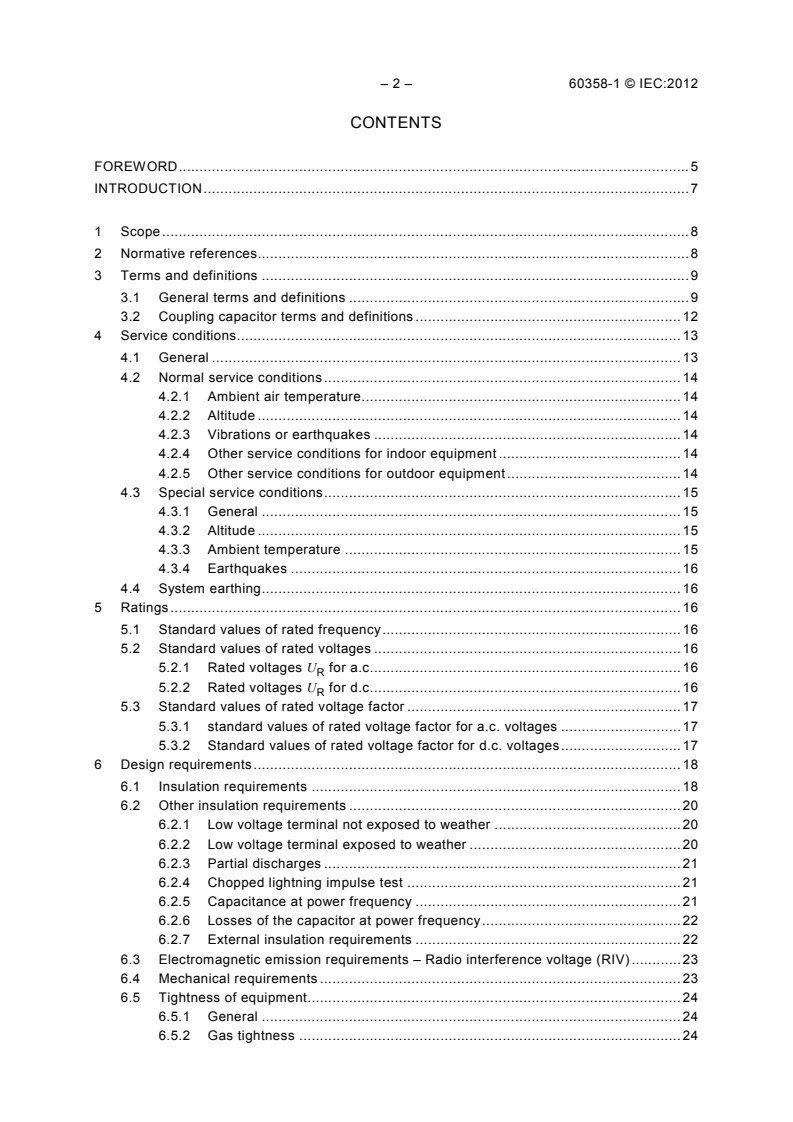
CONTENTS
FOREWORD . 5
INTRODUCTION . 7
1 Scope . 8
2 Normative references. 8
3 Terms and definitions . 9
3.1 General terms and definitions . 9
3.2 Coupling capacitor terms and definitions . 12
4 Service conditions. 13
4.1 General . 13
4.2 Normal service conditions . 14
4.2.1 Ambient air temperature . 14
4.2.2 Altitude . 14
4.2.3 Vibrations or earthquakes . 14
4.2.4 Other service conditions for indoor equipment . 14
4.2.5 Other service conditions for outdoor equipment . 14
4.3 Special service conditions . 15
4.3.1 General . 15
4.3.2 Altitude . 15
4.3.3 Ambient temperature . 15
4.3.4 Earthquakes . 16
4.4 System earthing . 16
5 Ratings . 16
5.1 Standard values of rated frequency . 16
5.2 Standard values of rated voltages . 16
5.2.1 Rated voltages U for a.c. . 16
R
5.2.2 Rated voltages U for d.c. . 16
R
5.3 Standard values of rated voltage factor . 17
5.3.1 standard values of rated voltage factor for a.c. voltages . 17
5.3.2 Standard values of rated voltage factor for d.c. voltages . 17
6 Design requirements . 18
6.1 Insulation requirements . 18
6.2 Other insulation requirements . 20
6.2.1 Low voltage terminal not exposed to weather . 20
6.2.2 Low voltage terminal exposed to weather . 20
6.2.3 Partial discharges . 21
6.2.4 Chopped lightning impulse test . 21
6.2.5 Capacitance at power frequency . 21
6.2.6 Losses of the capacitor at power frequency . 22
6.2.7 External insulation requirements . 22
6.3 Electromagnetic emission requirements – Radio interference voltage (RIV) . 23
6.4 Mechanical requirements . 23
6.5 Tightness of equipment. 24
6.5.1 General . 24
6.5.2 Gas tightness . 24
60358-1 © IEC:2012 – 3 –
6.6 Voltage grading for d.c. capacitors . 25
7 Test conditions . 25
8 Classification of tests . 26
8.1 General . 26
8.2 Routine tests . 26
8.3 Type tests . 26
8.4 Special tests . 27
9 Routine tests . 28
9.1 Tightness of the liquid-filled equipment . 28
9.1.1 General . 28
9.1.2 Closed pressure systems for gas . 29
9.2 Electrical routine tests . 29
9.2.1 General . 29
9.2.2 Capacitance and tanδ measurement at power-frequency . 29
9.2.3 Power-frequency or d.c. withstand test . 30
9.2.4 Partial discharge measurement . 31
9.2.5 AC-withstand test on low-voltage terminal of the equipment (6.2.1 and
6.2.2) . 31
9.2.6 Resistance measurement for d.c. equipment . 32
10 Type tests . 32
10.1 Impulse tests . 32
10.1.1 General . 32
10.1.2 Discharge test and chopped impulse test . 32
10.1.3 Lightning-impulse test . 33
10.2 Wet test for outdoor equipment . 33
10.2.1 a.c./d.c. withstand wet test on equipment . 34
10.2.2 Switching impulse withstand wet test on equipment “range II” (a.c.:
U ≥ 300 kV and d.c.: U ≥ 750kV (peak)) . 34
m SIL
10.3 Radio interference voltage test. 34
10.4 Voltage polarity reversal test for d.c. equipment . 35
11 Special tests – Mechanical strength test . 35
12 Marking of the equipment . 36
12.1 General . 36
12.2 Markings of the rating plate . 37
Annex A (informative) Typical diagram of an equipment . 38
Annex B (informative) Partial discharge test circuit and instrumentation . 39
Annex C (normative) Radio interference voltage – Measurement circuit . 41
Bibliography . 43
Figure 1 – Altitude correction factor for insulation . 15
Figure 2 – Flow charts test sequence to be applied when performing the type test
(Figure 2a) and routine test (Figure 2b) .28
Figure A.1 – Example of a diagram for a coupling capacitor (with and without low
voltage terminal) . 38
Figure B.1 – Test circuit . 39
Figure B.2 – Alternative circuit . 39
– 4 – 60358-1 © IEC:2012
Figure B.3 – Example of balanced test circuit . 40
Figure B.4 – Example of calibration circuit . 40
Figure C.1 – Measuring circuit . 42
Table 1 – Rated ambient temperature categories . 14
Table 2 – Standard values of rated voltage factors . 17
Table 3 – Standard insulation levels for a.c. voltages . 18
Table 4 – Partial discharge test voltages and permissible levels . 21
Table 5 – Creepage distance . 22
Table 6 – Static withstand test loads for insulators . 24
Table 7 – Permissible temporary leakage rates for gas systems . 25
Table 8 – Test voltages for units, stacks and complete equipment . 31
Table 9 – Modalities of application of the test loads to the line primary terminals . 36
Table 10 – Marking of the rating plate . 37
60358-1 © IEC:2012 – 5 –
INTERNATIONAL ELECTROTECHNICAL COMMISSION
___________
COUPLING CAPACITORS AND CAPACITOR DIVIDERS –
Part 1: General rules
FOREWORD
1) The International Electrotechnical Commission (IEC) is a worldwide organization for standardization comprising
all national electrotechnical committees (IEC National Committees). The object of IEC is to promote
international co-operation on all questions concerning standardization in the electrical and electronic fields. To
this end and in addition to other activities, IEC publishes International Standards, Technical Specifications,
Technical Reports, Publicly Available Specifications (PAS) and Guides (hereafter referred to as “IEC
Publication(s)”). Their preparation is entrusted to technical committees; any IEC National Committee interested
in the subject dealt with may participate in this preparatory work. International, governmental and non-
governmental organizations liaising with the IEC also participate in this preparation. IEC collaborates closely
with the International Organization for Standardization (ISO) in accordance with conditions determined by
agreement between the two organizations.
2) The formal decisions or agreements of IEC on technical matters express, as nearly as possible, an international
consensus of opinion on the relevant subjects since each technical committee has representation from all
interested IEC National Committees.
3) IEC Publications have the form of recommendations for international use and are accepted by IEC National
Committees in that sense. While all reasonable efforts are made to ensure that the technical content of IEC
Publications is accurate, IEC cannot be held responsible for the way in which they are used or for any
misinterpretation by any end user.
4) In order to promote international uniformity, IEC National Committees undertake to apply IEC Publications
transparently to the maximum extent possible in their national and regional publications. Any divergence
between any IEC Publication and the corresponding national or regional publication shall be clearly indicated in
the latter.
5) IEC itself does not provide any attestation of conformity. Independent certification bodies provide conformity
assessment services and, in some areas, access to IEC marks of conformity. IEC is not responsible for any
services carried out by independent certification bodies.
6) All users should ensure that they have the latest edition of this publication.
7) No liability shall attach to IEC or its directors, employees, servants or agents including individual experts and
members of its technical committees and IEC National Committees for any personal injury, property damage or
other damage of any nature whatsoever, whether direct or indirect, or for costs (including legal fees) and
expenses arising out of the publication, use of, or reliance upon, this IEC Publication or any other IEC
Publications.
8) Attention is drawn to the Normative references cited in this publication. Use of the referenced publications is
indispensable for the correct application of this publication.
9) Attention is drawn to the possibility that some of the elements of this IEC Publication may be the subject of
patent rights. IEC shall not be held responsible for identifying any or all such patent rights.
International Standard IEC 60358-1 has been prepared by IEC Technical Committee 33: Power
capacitors and their applications.
This standard cancels and replaces the second edition of IEC 60358 (1990), and constitutes a
technical revision.
This edition of IEC 60358-1 includes the following significant technical changes with respect to
the former edition of IEC 60358:
– The standard has been split into different parts; Part 1 is the general rules and Parts 2, 3, 4
will be specific to the PLC, filters and dividers applications.
– The routine and type test have been reviewed and are presented in Figure 2.
– 6 – 60358-1 © IEC:2012
The text of this standard is based on the following documents:
FDIS Report on voting
33/499/FDIS 33/508/RVD
Full information on the voting for the approval of this standard can be found in the report on
voting indicated in the above table.
This publication has been drafted in accordance with the ISO/IEC Directives, Part 2.
The committee has decided that the contents of this publication will remain unchanged until the
stability date indicated on the IEC web site under "http://webstore.iec.ch" in the data related to
the specific publication. At this date, the publication will be
• reconfirmed,
• withdrawn,
• replaced by a revised edition, or
• amended.
The contents of the corrigendum of July 2013 have been included in this copy.
IMPORTANT – The 'colour inside' logo on the cover page of this publication indicates
that it contains colours which are considered to be useful for the correct understanding
of its contents. Users should therefore print this document using a colour printer.
60358-1 © IEC:2012 – 7 –
INTRODUCTION
For the new re-structured IEC 60358 series, the following parts are envisaged:
IEC 60358-1 , Coupling capacitors and capacitor dividers – Part 1: General rules
IEC 60358-2 , Coupling capacitor and capacitor dividers – Part 2: AC or DC single-phase
coupling capacitor connected between line and ground for power line carrier-
frequency (PLC) application
IEC 60358-3 , Coupling capacitors and capacitor dividers – Part 3: AC or DC single-phase
coupling capacitor for harmonic-filters applications
IEC 60358-4 , Coupling capacitor and capacitor dividers – Part 4: AC or DC single-phase
capacitor-divider and RC-divider connected between line and ground (except
for CVT’s which belong to IEC 61869-5)
___________
To be published.
To be published.
Under consideration.
Under consideration.
– 8 – 60358-1 © IEC:2012
COUPLING CAPACITORS AND CAPACITOR DIVIDERS –
Part 1: General rules
1 Scope
This part of IEC 60358 applies to:
• Capacitors, with rated voltage > 1 000 V, connected line to ground with the low voltage
terminal either permanently earthed or connected to devices, for applications listed
hereunder and other similar uses.
This standard serves as basic standard for the coupling capacitor, the different parts of this
standard will present the supplementary specifications and tests, for example IEC 60358-2,
IEC 60358-3 or IEC 60358-4.
NOTE Diagrams of coupling capacitor to which this standard applies are given in Figures A.1.
2 Normative references
The following documents, in whole or in part, are normatively referenced in this document and
are indispensable for its application. For dated references, only the edition cited applies. For
undated references, the latest edition of the referenced document (including any amendments)
applies.
IEC 60038, IEC standard voltages
IEC 60050-321:1986, International Electrotechnical Vocabulary – Chapter 321: Instrument
transformers
IEC 60050-436:1990, International Electrotechnical Vocabulary – Chapter 436: Power
capacitors
IEC 60050-601:1985, International Electrotechnical Vocabulary – Chapter 601: Generation,
transmission and distribution of electricity – General
IEC 60050-604:1987, International Electrotechnical Vocabulary – Chapter 604: Generation,
transmission and distribution of electricity – Operation
IEC 60060-1, High-voltage test techniques – Part 1: General definitions and test requirements
IEC 60068-2-17, Basic environmental testing procedures – Part 2-17: Tests – Test Q: Sealing
IEC 60071-1, Insulation co-ordination – Part 1: Definitions, principles and rules
IEC 60270, High-voltage test techniques – Partial discharge measurements
IEC 60721 (all parts), Classification of environmental conditions
IEC 61462, Composite hollow insulators – Pressurized and unpressurized insulators for use in
electrical equipment with rated voltage greater than 1 000 V – Definitions, test methods,
acceptance criteria and design recommendations
60358-1 © IEC:2012 – 9 –
CISPR/TR 18-2, Radio interference characteristics of overhead power lines and high-voltage
equipment – Part 2: Methods of measurement and procedure for determining limits
3 Terms and definitions
For the purposes of this document, the following terms and definitions apply.
NOTE Some of these terms and definitions are identical with or are similar to those of IEC 60050-321:1986,
IEC 60050-436:1990, IEC 60050-601:1985 and IEC 60050-604:1987. These are indicated by the relevant reference
in brackets.
3.1 General terms and definitions
3.1.1
equipment
general term used for this standard, either for complete capacitor, capacitor divider, RC-divider
3.1.2
coupling capacitor
capacitor used for the transmission of signals in a power system
[SOURCE: IEC 60050-436:1990, 436-02-11]
3.1.3
rated frequency of equipment
frequency for which the coupling capacitor has been designed
3.1.4
standard reference range of frequency
range of frequency which is applicable for the equipment.
3.1.5
rated voltage
U
R
value of the voltage which appears in the designation of the equipment and on which its
performance is based
[SOURCE: IEC 60050-321:1986, 321-01-12]
3.1.6
highest voltage for equipment
U
m
a.c.: the highest r.m.s. value of phase-to-phase voltage for which the equipment is designed
and may be used in respect of its insulation
d.c.: the highest value of line to ground voltage for which the equipment is designed and may
be used in respect of its insulation
3.1.7
d.c.-system voltage
U
DC
highest mean or average operating voltage to earth, excluding harmonics and commutation
overshoots
[SOURCE: IEC 60071-5]
– 10 – 60358-1 © IEC:2012
3.1.8
Maximum d.c.-system voltage
U
DCmax
maximum D.C.-system voltage is almost a pure d.c. voltage with a magnitude dependent on
voltage control and measuring tolerance excluding harmonics and commutation overshoots.
3.1.9
rated insulation level
combination of voltage values which characterises the insulation of the equipment with regard
to its capability to withstand dielectric stresses
3.1.10
isolated neutral system
system where the neutral point is not intentionally connected to earth, except for high
impedance connections for protection or measurement purposes
[SOURCE: IEC 60050-601:1985, 601-02-24]
3.1.11
solidly earthed (neutral) system
system whose neutral point(s) is (are) earthed directly
[SOURCE: IEC 60050-601:1985, 601-02-25]
3.1.12
impedance earthed (neutral) system
system whose neutral point(s) is (are) earthed through impedances to limit earth fault currents
[SOURCE: IEC 60050-601:1985, 601-02-26]
3.1.13
resonant earthed (neutral) system
system in which one or more neutral points are connected to earth through reactances which
approximately compensate the capacitive component of a single-phase-to-earth fault current
[SOURCE: IEC 60050-601:1985, 601-02-27]
Note 1 to entry: With resonant earthing of a system, the residual current in the fault is limited to such an extent
that an arcing fault in air is self-extinguishing.
3.1.14
earth fault factor
at a given location of a three-phase system, and for a given system configuration, the ratio of
the highest r.m.s. phase-to-earth power frequency voltage on a healthy phase during a fault to
earth affecting one or more phases at any point on the system to the r.m.s. value of phase-to-
earth power frequency voltage which would be obtained at the given location in the absence of
any such fault
[SOURCE: IEC 60050-604:1987, 604-03-06]
3.1.15
earthed neutral system
system in which the neutral is connected to earth either solidly or through a resistance or
reactance of sufficiently low value to reduce transient oscillations and to give a current
sufficient for selective earth fault protection
a) A three-phase system with effectively earthed neutral at a given location is a system
characterized by an earth fault factor at this point which does not exceed 1,4
60358-1 © IEC:2012 – 11 –
Note 1 to entry: This condition is obtained approximately when, for all system configurations, the ratio of zero-
sequence reactance to the positive-sequence reactance is less than 3 and the ratio of zero-sequence
resistance to positive-sequence reactance is less than one.
b) A three-phase system with non-effectively earthed neutral at a given location is a system
characterized by an earth fault factor at this point that may exceed 1,4
3.1.16
unified specific creepage distance USCD
creepage distance of an insulator divider by the r.m.s value of the highest operating voltage
across the insulator
Note 1 to entry: This definition differs from that of specific creepage distance where the line-line value of the
highest voltage for the equipment is used (for a.c. systems usually U /√3). For line-to-earth insulation, this
m
definition will result in a value that √3 times that given by the definition of specific creepage distance in IEC/TR
60815 (1986).
Note 2 to entry: For Um see IEC 60050-604:1987, 604-03-01.
Note 3 to entry: It is generally expressed in mm/KV and usually expressed as a minimum.
3.1.17
exposed installation
installation in which the apparatus is subject to overvoltages of atmospheric origin
NOTE Such installations are usually connected to overhead transmission lines either directly or through a short
length of cable.
3.1.18
non-exposed installation
installation in which the apparatus is not subject to overvoltages of atmospheric origin
Note 1 to entry: Such installations are usually connected to underground cable networks.
3.1.19
rated voltage factor
F
V
multiplying factor to be applied to the rated voltage U to determine the maximum voltage at
R
which equipment must comply with relevant thermal requirements for a specified time
3.1.20
rated temperature category of the equipment
range of temperature of the ambient air or of the cooling medium for which the equipment has
been designed
3.1.21
line terminal
terminal intended for connection to a line conductor of a network
[SOURCE: IEC 60050-436:1990, 436-03-01]
3.1.22
mechanical stress
stresses on different parts of the equipment as a function of four main forces:
– forces on the terminals due to the line connections,
– forces due to the wind on the cross-section of the equipment with and without line trap
mounted on the top of a coupling/filter capacitor,
– seismic forces and
– electrodynamic forces due to short circuit current
– 12 – 60358-1 © IEC:2012
3.1.23
voltage-connected equipment
equipment which has only one connection to the high voltage line
Note 1 to entry: Under normal conditions the top connection carries only the current of the equipment.
3.1.24
current-connected equipment
equipment which has two connections to the high voltage line
Note 1 to entry: The terminals and the top connection are designed to carry the line current under normal
conditions.
3.1.25
line trap-connected coupling/filter capacitor
coupling/filter capacitor which supports a line trap on its top
Note 1 to entry: In this case, the two connections to the line trap carry the HV line current and one connection
from the line trap to the capacitor carries the current of the capacitor
Note 2 to entry: The pedestal-mounting line traps in two phases generate additional forces during a short circuit in
more than one phase.
3.2 Coupling capacitor terms and definitions
3.2.1
coupling capacitor
capacitor used for the transmission of signals in a power system
[SOURCE: IEC 60050-436:1990, 436-02-11]
3.2.2
(capacitor) element
device consisting essentially of two electrodes separated by a dielectric
3.2.3
(capacitor) unit
assembly of one or more capacitor elements in the same container with terminals brought out
[SOURCE: IEC 60050-436:1990, 436-01-04]
3.2.4
(capacitor) stack
assembly of capacitor units connected in series
[SOURCE: IEC 60050-436:1990, 436-01-05]
3.2.5
capacitor
general term used when it is not necessary to state whether reference is made to a capacitor
unit or to a capacitor stack
3.2.6
rated capacitance of a capacitor C
R
capacitance value for which the capacitor has been designed
Note 1 to entry: This definition applies:
• for a capacitor unit, to the capacitance between the terminals of the unit;
• for a capacitor stack, to the capacitance between line and low voltage terminals or between line and earth
terminals of the stack
60358-1 © IEC:2012 – 13 –
3.2.7
low voltage terminal of a coupling capacitor
terminal (N ) intended for connection to earth either directly or via a drain coil of negligible
HF
value of impedance, at rated frequency, for power line carrier (PLC) application
[SOURCE: IEC 60050-436:1990, 436-03-04, modified]
3.2.8
capacitance tolerance
permissible difference between the actual capacitance and the rated capacitance under
specified conditions
[SOURCE: IEC 60050-436:1990, 436-04-01]
3.2.9
equivalent series resistance of a capacitor
virtual resistance which, if connected in series with an ideal capacitor of capacitance value
equal to that of the capacitor in question, would have a power loss equal to the active power
dissipated in that capacitor under specified operating conditions at a given high frequency
3.2.10
capacitor losses
active power dissipated in the capacitor
[SOURCE: IEC 60050-436:1990, 436-04-10]
3.2.11
tangent of the loss angle (tanδ) of a capacitor
ratio between the active power P and the reactive power P : tanδ = P /P
a r a r
3.2.12
temperature coefficient of capacitance T
C
fractional change of the capacitance for a given change in temperature:
∆C 1 1
T = or
K
Co∆T K °C
∆C represents the observed change in capacitance over the temperature interval ∆T
C represents the capacitance measured at 20 °C
20 °C
Note 1 to entry: The term ∆C/∆T according to this definition is usable only if the capacitance is an approximate
linear function of the temperature in the range under consideration. If not, the temperature dependency of the
capacitance should be shown in a graph or a table.
3.2.13
dielectric of a capacitor
insulating material between the electrodes
Note 1 to entry: The major insulation generally consists of paper, plastic film, or a mixed of paper and plastic film
subsequently treated and impregnated with oil or gas at atmospheric pressure or higher.
4 Service conditions
4.1 General
Detailed information concerning classification of environmental conditions is given in the
IEC 60721 series.
– 14 – 60358-1 © IEC:2012
4.2 Normal service conditions
4.2.1 Ambient air temperature
The equipment is classified in three categories as given in Table 1.
Table 1 – Rated ambient temperature categories
Category Minimum temperature Maximum temperature
°C °C
–5/40 –5 40
–25/40 –25 40
–40/40 –40 40
NOTE In the choice of the temperature category, storage and transportation
conditions should also be considered.
4.2.2 Altitude
The altitude does not exceed 1 000 m.
4.2.3 Vibrations or earthquakes
Vibrations due to causes external to the equipment or earthquakes are negligible.
4.2.4 Other service conditions for indoor equipment
Other considered service conditions are the following:
a) the influence of solar radiation may be neglected;
b) the ambient air is not significantly polluted by dust, smoke, corrosive gases, vapours or
salt;
c) the conditions of humidity are as follows:
1) the average value of the relative humidity, measured during a period of 24 h, does not
exceed 95 %;
2) the average value of the water vapour pressure for a period of 24 h, does not exceed
2,2 kPa;
3) the average value of the relative humidity, for a period of one month, does not exceed
90 %;
4) the average value of the water vapour pressure, for a period of one month, does not
exceed 1,8 kPa.
For these conditions, condensation may occasionally occur.
NOTE 1 Condensation be expected where sudden temperature changes occur in periods of high humidity.
NOTE 2 To withstand the effects of high humidity and condensation, such as breakdown of insulation or corrosion
of metallic parts, equipment designed for such conditions should be used.
NOTE 3 Condensation may be prevented by special design of the housing, by suitable ventilation and heating or
by the use of dehumidifying equipment.
4.2.5 Other service conditions for outdoor equipment
Other considered service conditions are the following:
a) average value of the ambient air temperature, measured over a period of 24 h, does not
exceed 35 °C;
60358-1 © IEC:2012 – 15 –
b) solar radiation up to a level of 1 000 W/m (on a clear day at noon) should be considered;
c) the ambient air may be polluted by dust, smoke, corrosive gases, vapours or salt. The
pollution does not exceed the pollution levels given in Table 5;
d) the wind pressure does not exceed 700 Pa (corresponding to 34 m/s wind speed);
e) account should be taken of the presence of condensation or precipitation.
4.3 Special service conditions
4.3.1 General
When equipment may be used under conditions different from the normal service conditions
given in 4.2, the user’s requirements should refer to standardized steps as follows.
4.3.2 Altitude
For installation at an altitude higher than 1 000 m, the arcing distance under the standardized
reference atmospheric conditions shall be determined by multiplying the withstand voltages
required at the service location by factor k in accordance with Figure 1.
1,5
k [1]
m = 1
1,4
m = 0,75
1,3
1,2
1,1
1,0
1 000 1 500 2 000 2 500 3 000 3 500 4 000
h [m]
IEC 305/04
These factors can be calculated with the following equation:
m (h – 1 000)/8 150
k = e
where
h is the altitude in metres;
m = 1 for power-frequency and lightning impulse voltage;
m = 0,75 for switching impulse voltage.
NOTE As for the internal insulation, the dielectric strength is not affected by altitude. The method for checking the
external insulation shall be agreed between manufacturer and purchaser.
Figure 1 – Altitude correction factor for insulation
4.3.3 Ambient temperature
For installation in a place where the ambient temperature can be significantly outside the
normal service condition range stated in 4.2.1, the preferred ranges of minimum and maximum
temperature to be specified should be:
a) −50 °C and 40 °C for very cold climates;
b) −5 °C and 50 °C for very hot climates.
NOTE 1 In extreme cases the purchasers shall inform the manufacturer of another temperature range.
– 16 – 60358-1 © IEC:2012
In certain regions with frequent occurrence of warm humid winds, sudden changes of
temperature may occur resulting in condensation even indoors.
NOTE 2 Under certain conditions of solar radiation, appropriate measures e.g. roofing, forced ventilation, etc. may
be necessary, in order not to exceed the specified temperature rises.
4.3.4 Earthquakes
For installations where earthquakes are likely to occur, the relevant severity level in
accordance with IEC 62271 shall be specified by the user.
The compliance with such special requirements, if applicable, has to be demonstrated, either
by calculation or by testing as defined by relevant standards.
4.4 System earthing
The considered system earthings are:
a) isolated neutral system (see 3.1.10);
b) resonant earthed system (see 3.1.13);
c) earthed neutral system (see 3.1.15):
1) solidly earthed neutral system (see 3.1.11)
2) impedance earthed (neutral) system (see 3.1.12).
5 Ratings
5.1 Standard values of rated frequency
Standard values are 50 Hz and 60 Hz for a.c. voltages.
5.2 Standard values of rated voltages
5.2.1 Rated voltages U for a.c.
R
The standard values of rated voltage of an equipment connected between one line of a
three-phase system and earth or between a system neutral point and earth shall be 1/ 3 times
the values of rated system voltage.
Preferred values are given in IEC 60038.
NOTE The performance of an equipment is based on the rated voltage U whereas the rated insulation level is
R
based on one of the highest voltages for equipment U (IEC 60071-1)
m
5.2.2 Rated voltages U for d.c.
R
The values of rated voltage of an equipment connected between one line and earth is the
values of rated d.c. line voltage.
For filter capacitors the harmonics voltages have to be included in the rated voltage according
to following formula:
U = U + 2 × U
R DCMAX ∑ h
U
∑ h
: RMS voltage of AC voltage components
60358-1 © IEC:2012 – 17 –
5.3 Standard values of rated voltage factor
5.3.1 standard values of rated voltage factor for a.c. voltages
The voltage factor is determined by the maximum operating voltage which, in turn, is
dependent on the system earthing conditions.
The standard voltage factors appropriate to the different earthing conditions are given in
Table 2 below, together with the permissible duration of maximum operating voltage (i.e. rated
time).
Table 2 – Standard values of rated voltage factors
Rated voltage Rated time Method of connecting the primary terminal
factor and system earthing conditions
F
V
1,2 Continuous
Between phase and earth in an effectively
earthed neutral system (3.1.15 a)
1,5 30 s
1,2 Continuous
Between phase and earth in a non-effectively earthed
neutral system (3.1.15 b)) with automatic earth-fault tripping.
1,9 30 s
1,2 Continuous Between phase and earth in an isolated neutral system (3.1.10)
without automatic earth-fault tripping or in a resonant earthed
1,9 8 h
system (3.1.13) without automatic earth-fault tripping.
NOTE 1 Reduced rated times are permissible by agreement between manufacturer and user.
NOTE 2 The thermal requirements of an equipment is based on the rated voltage whereas the rated insulation level is
based on the highest voltage for equipment U (IEC 60071-1).
m
NOTE 3 The maximum operating voltage of an equipment must be lower or equal to the highest voltage of equipment
U
m
or the rated voltage U multiplied with the rated voltage factor 1,2 for continuous service, whichever is the lowest.
R
5.3.2 Standard values of rated voltage factor for d.c. voltages
No rated voltage factor is applicable for d.c. voltages, the voltage is controlled through the
converter and the rated
...