

IEC 62236-1:2018
(Main)Railway applications - Electromagnetic compatibility - Part 1: General
General Information
- Abstract
IEC 62236-1:2018 outlines the structure and the content of the whole series. It specifies the performance criteria applicable to the whole standards series. This new edition includes the following significant technical change with respect to the previous edition: management of EMC now based on IEC 61000 series.
- Status
- Published
- Publication Date
- 08-Feb-2018
- Technical Committee
- TC 9 - Electrical equipment and systems for railways
- Drafting Committee
- MT 62236 - TC 9/MT 62236
- Current Stage
- PPUB - Publication issued
- Start Date
- 09-Feb-2018
- Completion Date
- 23-Feb-2018
Buy Documents
IEC 62236-1:2018 RLV - Railway applications - Electromagnetic compatibility - Part 1: General Released:2/9/2018
IEC 62236-1:2018 - Railway applications - Electromagnetic compatibility - Part 1: General Released:2/9/2018
Overview
IEC 62236-1:2018 - "Railway applications - Electromagnetic compatibility - Part 1: General" is the foundational document for the IEC 62236 series. It defines the structure and scope of the whole series and specifies the performance criteria applicable across railway EMC standards. This third edition (2018) updates EMC management to align with the IEC 61000 series and contains guiding material (Annex A) describing the electromagnetic behaviour of railway systems.
Key facts:
- Edition: 3.0 (2018)
- Frequency range addressed across the series: DC to 400 GHz
- Main purpose: set framework for EMC management, emission limits and immunity performance for railway systems and equipment
Key topics and requirements
- Structure and content of the IEC 62236 series: Part 1 defines how subsequent parts (Parts 2, 3-1, 3-2, 4, 5) relate and interact.
- Performance criteria: Establishes general emission and immunity objectives that the whole series uses to ensure electromagnetic compatibility within railway systems and with the outside world.
- Management of EMC: Introduces an EMC management approach based on the IEC 61000 family of standards - emphasizing planning, verification and interface control between infrastructure and rolling stock.
- Annex A (informative): Describes railway-specific electromagnetic characteristics, coupling mechanisms, principal emission and immunity phenomena, sources of disturbance (fixed and mobile), and traction system components.
- Scope exclusions: Explicitly excludes nuclear electromagnetic pulse (EMP), abnormal operating/fault conditions, and direct lightning-strike induction effects from the series’ remit.
- Practical testing guidance: Guides limit-setting policies and use of test levels-intended to achieve compatibility in typical operating environments while noting that special locations may require additional measures.
Practical applications / Who uses this standard
- Railway OEMs and rolling stock manufacturers - to design equipment compliant with series-level EMC objectives.
- Infrastructure owners and operators - for EMC planning at the infrastructure/rolling stock interface.
- Signalling and telecommunications engineers - to align equipment immunity and emission characteristics with network needs.
- EMC engineers and test labs - to develop test plans consistent with railway EMC performance criteria.
- Project managers, procurement and regulatory authorities - to specify, verify and accept EMC-related requirements in procurement and certification.
Related standards
- IEC 62236 series: Parts 2, 3-1, 3-2, 4 and 5 (covering system emissions, rolling stock, apparatus, signalling, and fixed power installations)
- IEC 61000 series: referenced for EMC management principles and test methodologies
IEC 62236-1:2018 is essential for anyone implementing an EMC management plan, defining interface limits, or assuring electromagnetic compatibility across modern railway systems. Keywords: IEC 62236-1, railway electromagnetic compatibility, EMC management, IEC 61000, rolling stock EMC, signalling EMC.
Relations
- Effective Date
- 05-Sep-2023
Buy Documents
IEC 62236-1:2018 RLV - Railway applications - Electromagnetic compatibility - Part 1: General Released:2/9/2018
IEC 62236-1:2018 - Railway applications - Electromagnetic compatibility - Part 1: General Released:2/9/2018
Get Certified
Connect with accredited certification bodies for this standard

IRIS Certification (UNIFE)
International Railway Industry Standard certification.

TÜV SÜD Rail GmbH
TÜV SÜD railway certification services.

ANCE
Mexican certification and testing association.
Sponsored listings
Frequently Asked Questions
IEC 62236-1:2018 is a standard published by the International Electrotechnical Commission (IEC). Its full title is "Railway applications - Electromagnetic compatibility - Part 1: General". This standard covers: IEC 62236-1:2018 outlines the structure and the content of the whole series. It specifies the performance criteria applicable to the whole standards series. This new edition includes the following significant technical change with respect to the previous edition: management of EMC now based on IEC 61000 series.
IEC 62236-1:2018 outlines the structure and the content of the whole series. It specifies the performance criteria applicable to the whole standards series. This new edition includes the following significant technical change with respect to the previous edition: management of EMC now based on IEC 61000 series.
IEC 62236-1:2018 is classified under the following ICS (International Classification for Standards) categories: 33.100 - Electromagnetic compatibility (EMC); 45.060.01 - Railway rolling stock in general. The ICS classification helps identify the subject area and facilitates finding related standards.
IEC 62236-1:2018 has the following relationships with other standards: It is inter standard links to IEC 62236-1:2008. Understanding these relationships helps ensure you are using the most current and applicable version of the standard.
IEC 62236-1:2018 is available in PDF format for immediate download after purchase. The document can be added to your cart and obtained through the secure checkout process. Digital delivery ensures instant access to the complete standard document.
Standards Content (Sample)
IEC 62236-1 ®
Edition 3.0 2018-02
REDLINE VERSION
INTERNATIONAL
STANDARD
colour
inside
Railway applications – Electromagnetic compatibility –
Part 1: General
All rights reserved. Unless otherwise specified, no part of this publication may be reproduced or utilized in any form
or by any means, electronic or mechanical, including photocopying and microfilm, without permission in writing from
either IEC or IEC's member National Committee in the country of the requester. If you have any questions about IEC
copyright or have an enquiry about obtaining additional rights to this publication, please contact the address below or
your local IEC member National Committee for further information.
IEC Central Office Tel.: +41 22 919 02 11
3, rue de Varembé info@iec.ch
CH-1211 Geneva 20 www.iec.ch
Switzerland
About the IEC
The International Electrotechnical Commission (IEC) is the leading global organization that prepares and publishes
International Standards for all electrical, electronic and related technologies.
About IEC publications
The technical content of IEC publications is kept under constant review by the IEC. Please make sure that you have the
latest edition, a corrigenda or an amendment might have been published.
IEC Catalogue - webstore.iec.ch/catalogue Electropedia - www.electropedia.org
The stand-alone application for consulting the entire The world's leading online dictionary of electronic and
bibliographical information on IEC International Standards, electrical terms containing 21 000 terms and definitions in
Technical Specifications, Technical Reports and other English and French, with equivalent terms in 16 additional
documents. Available for PC, Mac OS, Android Tablets and languages. Also known as the International Electrotechnical
iPad. Vocabulary (IEV) online.
IEC publications search - webstore.iec.ch/advsearchform IEC Glossary - std.iec.ch/glossary
The advanced search enables to find IEC publications by a 67 000 electrotechnical terminology entries in English and
variety of criteria (reference number, text, technical French extracted from the Terms and Definitions clause of
committee,…). It also gives information on projects, replaced IEC publications issued since 2002. Some entries have been
and withdrawn publications. collected from earlier publications of IEC TC 37, 77, 86 and
CISPR.
IEC Just Published - webstore.iec.ch/justpublished
Stay up to date on all new IEC publications. Just Published IEC Customer Service Centre - webstore.iec.ch/csc
details all new publications released. Available online and If you wish to give us your feedback on this publication or
also once a month by email. need further assistance, please contact the Customer Service
Centre: sales@iec.ch.
IEC 62236-1 ®
Edition 3.0 2018-02
REDLINE VERSION
INTERNATIONAL
STANDARD
colour
inside
Railway applications – Electromagnetic compatibility –
Part 1: General
INTERNATIONAL
ELECTROTECHNICAL
COMMISSION
ICS 33.100; 45.060.01 ISBN 978-2-8322-5391-5
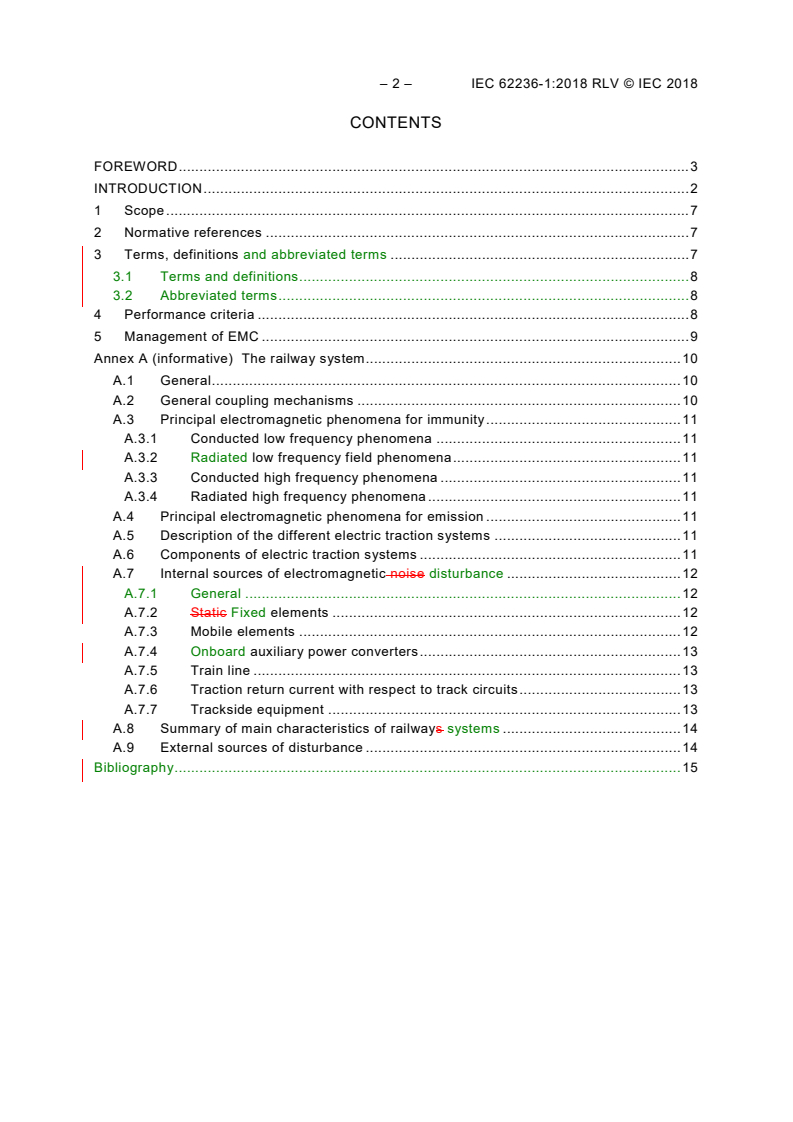
– 2 – IEC 62236-1:2018 RLV © IEC 2018
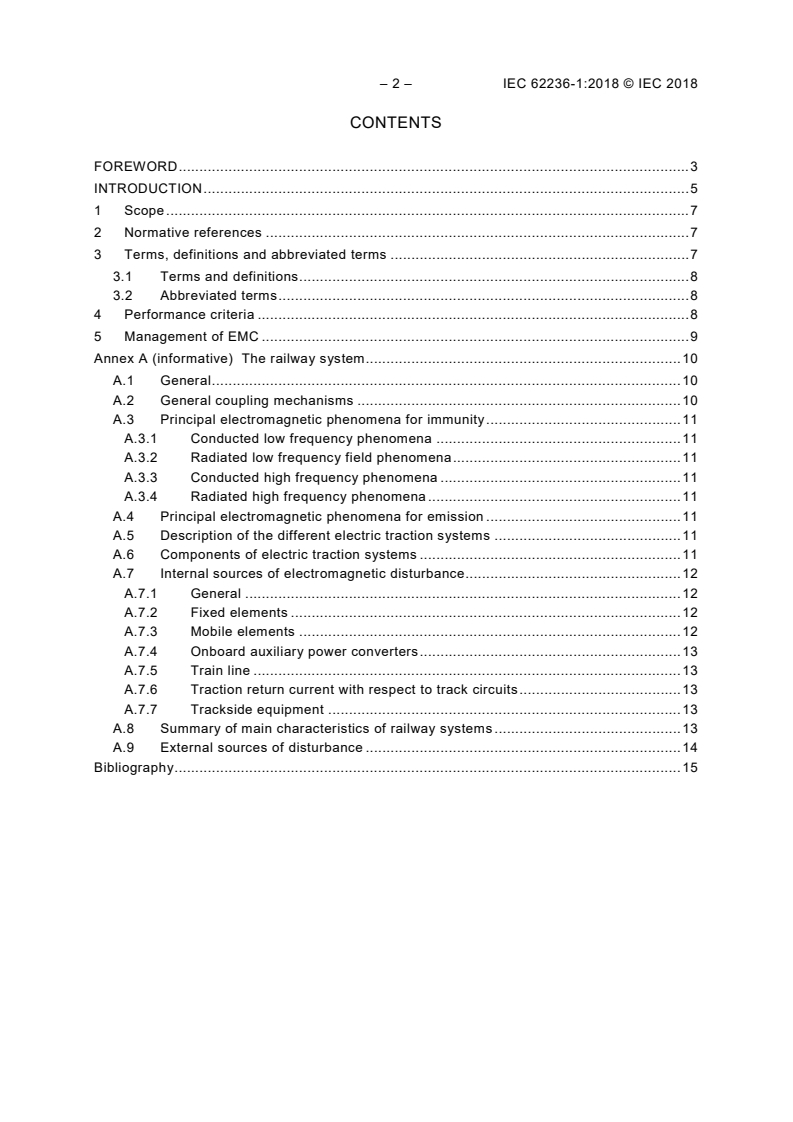
CONTENTS
FOREWORD . 3
INTRODUCTION . 2
1 Scope . 7
2 Normative references . 7
3 Terms, definitions and abbreviated terms . 7
3.1 Terms and definitions . 8
3.2 Abbreviated terms . 8
4 Performance criteria . 8
5 Management of EMC . 9
Annex A (informative) The railway system . 10
A.1 General . 10
A.2 General coupling mechanisms . 10
A.3 Principal electromagnetic phenomena for immunity . 11
A.3.1 Conducted low frequency phenomena . 11
A.3.2 Radiated low frequency field phenomena . 11
A.3.3 Conducted high frequency phenomena . 11
A.3.4 Radiated high frequency phenomena . 11
A.4 Principal electromagnetic phenomena for emission . 11
A.5 Description of the different electric traction systems . 11
A.6 Components of electric traction systems . 11
A.7 Internal sources of electromagnetic noise disturbance . 12
A.7.1 General . 12
A.7.2 Static Fixed elements . 12
A.7.3 Mobile elements . 12
A.7.4 Onboard auxiliary power converters . 13
A.7.5 Train line . 13
A.7.6 Traction return current with respect to track circuits . 13
A.7.7 Trackside equipment . 13
A.8 Summary of main characteristics of railways systems . 14
A.9 External sources of disturbance . 14
Bibliography . 15
INTERNATIONAL ELECTROTECHNICAL COMMISSION
____________
RAILWAY APPLICATIONS –
ELECTROMAGNETIC COMPATIBILITY –
Part 1: General
FOREWORD
1) The International Electrotechnical Commission (IEC) is a worldwide organization for standardization comprising
all national electrotechnical committees (IEC National Committees). The object of IEC is to promote
international co-operation on all questions concerning standardization in the electrical and electronic fields. To
this end and in addition to other activities, IEC publishes International Standards, Technical Specifications,
Technical Reports, Publicly Available Specifications (PAS) and Guides (hereafter referred to as “IEC
Publication(s)”). Their preparation is entrusted to technical committees; any IEC National Committee interested
in the subject dealt with may participate in this preparatory work. International, governmental and non-
governmental organizations liaising with the IEC also participate in this preparation. IEC collaborates closely
with the International Organization for Standardization (ISO) in accordance with conditions determined by
agreement between the two organizations.
2) The formal decisions or agreements of IEC on technical matters express, as nearly as possible, an international
consensus of opinion on the relevant subjects since each technical committee has representation from all
interested IEC National Committees.
3) IEC Publications have the form of recommendations for international use and are accepted by IEC National
Committees in that sense. While all reasonable efforts are made to ensure that the technical content of IEC
Publications is accurate, IEC cannot be held responsible for the way in which they are used or for any
misinterpretation by any end user.
4) In order to promote international uniformity, IEC National Committees undertake to apply IEC Publications
transparently to the maximum extent possible in their national and regional publications. Any divergence
between any IEC Publication and the corresponding national or regional publication shall be clearly indicated in
the latter.
5) IEC itself does not provide any attestation of conformity. Independent certification bodies provide conformity
assessment services and, in some areas, access to IEC marks of conformity. IEC is not responsible for any
services carried out by independent certification bodies.
6) All users should ensure that they have the latest edition of this publication.
7) No liability shall attach to IEC or its directors, employees, servants or agents including individual experts and
members of its technical committees and IEC National Committees for any personal injury, property damage or
other damage of any nature whatsoever, whether direct or indirect, or for costs (including legal fees) and
expenses arising out of the publication, use of, or reliance upon, this IEC Publication or any other IEC
Publications.
8) Attention is drawn to the Normative references cited in this publication. Use of the referenced publications is
indispensable for the correct application of this publication.
9) Attention is drawn to the possibility that some of the elements of this IEC Publication may be the subject of
patent rights. IEC shall not be held responsible for identifying any or all such patent rights.
This redline version of the official IEC Standard allows the user to identify the changes
made to the previous edition. A vertical bar appears in the margin wherever a change
has been made. Additions are in green text, deletions are in strikethrough red text.
– 4 – IEC 62236-1:2018 RLV © IEC 2018
International Standard IEC 62236-1 has been prepared by IEC technical committee 9:
Electrical equipment and systems for railways.
This third edition cancels and replaces the second edition published in 2008. It constitutes a
technical revision and has been developed on the basis of EN 50121-1:2015.
This edition includes the following significant technical changes with respect to the previous
edition:
a) Clarification in scope.
b) Introduction of subclause Abbreviated terms.
c) Management of EMC now based on IEC 61000 series as former reference is not adequate.
The text of this International Standard is based on the following documents:
FDIS Report on voting
9/2335/FDIS 9/2365/RVD
Full information on the voting for the approval of this International Standard can be found in
the report on voting indicated in the above table.
This document has been drafted in accordance with the ISO/IEC Directives, Part 2.
A list of all parts in the IEC 62236, published under the general title Railway applications –
Electromagnetic compatibility, can be found on the IEC website.
The committee has decided that the contents of this document will remain unchanged until the
stability date indicated on the IEC website under "http://webstore.iec.ch" in the data related to
the specific document. At this date, the document will be
• reconfirmed,
• withdrawn,
• replaced by a revised edition, or
• amended.
IMPORTANT – The “colour inside” logo on the cover page of this publication indicates
that it contains colours which are considered to be useful for the correct understanding
of its contents. Users should therefore print this publication using a colour printer.
INTRODUCTION
The railway system EMC set series of product-specific International Standards consists of five
parts described at the end of this introduction.
The set series of standards provides both a framework for managing the EMC for railways
systems and also specifies the limits for the electromagnetic (EM) emission of the railway
system as a whole to the outside world and for the EM emission and immunity for equipment
operating within the railway system. The latter must is intended to be compatible with the
emission limits set for the railway system as a whole and also provides for establishing
confidence in equipment being fit for purpose in the railway environment. There are different
stationary emission limits set for trams/trolleybuses and for metro/mainline railways systems.
The frequency covered by the standards is in the range from DC to 400 GHz. No
measurements need to be performed at frequencies where no requirement is specified. The
limits for EMC phenomena are set so that the railway system as a whole achieves
electromagnetic compatibility with the outside world, and between the various parts of the
railway system. Throughout the set series of standards, the immunity levels are chosen to
ensure a reasonable level of EMC with other apparatus within the local railway environment
and with emissions which enter the railway system from the outside world. Limits are also
placed on EM emission by railways systems into the outside world.
The compatibility between railway system emissions and their external environment is based
upon emission limits from the railways systems being set by considering the results from
measurements. Given that the general compatibility between railways systems and their
environment was satisfactory at the time these measurements were made and subsequent
experience of applying the limits has confirmed their acceptability, compliance with this
document has been judged to give satisfactory compatibility. The immunity and emission
levels do not of themselves guarantee that the railway system will have satisfactory
compliance EMC with its neighbours. In exceptional circumstances, for instance near a
“special location” which has unusually high levels of EM interference, the railway system may
require additional measures to be taken to ensure proper compatibility. Particular care should
be taken when in proximity to equipment such as radio transmission equipment, military or
medical installations. Attention is particularly drawn to any magnetic imaging equipment in
hospitals that may be near to urban transport. In all these cases, compatibility must should be
achieved with consultation and co-operation between the interested parties.
The immunity and emission levels do not of themselves guarantee that integration of the
apparatus within the railway system will necessarily be satisfactory. The document cannot
cover all the possible configurations of apparatus, but the test levels are sufficient to achieve
satisfactory EMC in the majority of cases. In exceptional circumstances, for instance near a
“special location” which has unusually high levels of EM interference, the system may require
additional measures to be taken to ensure proper operation. The resolution of this is a matter
for discussion between the equipment supplier and the project manager, infrastructure
controller manager or equivalent.
The railway apparatus is assembled into large systems and installations, such as trains and
signalling control centres. Details are given in annex A. It is not, therefore, possible to
establish immunity tests and limits for these large assemblies. The immunity levels for the
apparatus will normally ensure reliable operation, but it is necessary to prepare an EMC
management plan to deal with complex situations or to deal with specific circumstances. For
example, the passage of the railway line close to a high power radio transmitter which
produces abnormally high field strengths. Special conditions may have to be applied for
railway equipment which has to works near such a transmitter and these will be accepted as
national conditions for the specification.
The series of standards IEC 62236, Railway applications – Electromagnetic compatibility,
contains the following parts:
– Part 1: General. This part gives a description of the electromagnetic behaviour of a railway
system; it specifies the performance criteria for the whole set series. A management
– 6 – IEC 62236-1:2018 RLV © IEC 2018
process to achieve EMC at the interface between the railway infrastructure and trains is
referenced.
– Part 2: Emission of the whole railway system to the outside world. This part sets the
emission limits from the railway system to the outside world at radio frequencies. It defines
the applied test methods and gives information on typical field strength values at traction
and radio frequency (cartography).
– Part 3-1: Rolling stock – Train and complete vehicle. This part specifies the emission and
immunity requirements for all types of rolling stock. It covers traction rolling stock and
trainsets, as well as independent hauled rolling stock. The scope of this part of the series
ends at the interface of the rolling stock with its respective energy inputs and outputs.
– Part 3-2: Rolling stock – Apparatus. This part applies to emission and immunity aspects of
EMC for electrical and electronic apparatus intended for use on railway rolling stock. It is
also used as a means of dealing with the impracticality of immunity testing a complete
vehicle.
– Part 4: Emission and immunity of the signalling and telecommunications apparatus. This
part specifies limits for electromagnetic emission and immunity for signalling and
telecommunications apparatus installed within a railway system. The EMC plan states if
this part is also applicable for railway operational equipment mounted trackside or at
platforms.
– Part 5: Emission and immunity of fixed power supply installations and apparatus. This part
applies to emission and immunity aspects of EMC for electrical and electronic apparatus
and components intended for use in railway fixed installations associated with power
supply.
RAILWAY APPLICATIONS –
ELECTROMAGNETIC COMPATIBILITY –
Part 1: General
1 Scope
1.1 This Part 1 of IEC 62236 outlines the structure and the content of the whole series.
It specifies the performance criteria applicable to the whole standards series.
Clause 5 provides information about the management of EMC.
Annex A describes the characteristics of the railway system which affect electromagnetic
compatibility (EMC) behaviour.
Phenomena excluded from the series are nuclear EM pulse, abnormal operating conditions
(e.g. fault conditions) and the induction effects of direct lightning strike.
Emission limits at the railway system boundary do not apply to intentional transmitters within
the railway system boundaries.
Safety considerations are not covered by this series of standards.
The biological effects of non-ionising radiation as well as apparatus for medical assistance,
such as pacemakers, are not considered in this series.
1.2 This part of IEC 62236 is supplemented by the following specific standards:
IEC 62236-2 Railway applications – Electromagnetic compatibility – Part 2: Emission of
the whole railway system to the outside world
IEC 62236-3-1 Railway applications – Electromagnetic compatibility – Part 3-1: Rolling
stock – Train and complete vehicle
IEC 62236-3-2 Railway applications – Electromagnetic compatibility – Part 3-2: Rolling
stock – Apparatus
IEC 62236-4 Railway applications – Electromagnetic compatibility – Part 4: Emission and
immunity of the signalling and telecommunications apparatus
IEC 62236-5 Railway applications – Electromagnetic compatibility – Part 5: Emission and
immunity of fixed power supply installations and apparatus
2 Normative references
The following documents are referred to in the text in such a way that some or all of their
content constitutes requirements of this document. For dated references, only the edition
cited applies. For undated references, the latest edition of the referenced document (including
any amendments) applies.
IEC 60050-161, International Electrotechnical Vocabulary – Chapter 161: Electromagnetic
compatibility (EMC)
IEC 61000 (all parts), Electromagnetic compatibility (EMC)
– 8 – IEC 62236-1:2018 RLV © IEC 2018
IEC 61000-6-2, Electromagnetic compatibility (EMC) – Part 6-2: Generic standards –
Immunity for industrial environments
IEC 62427, Railway applications – Compatibility between rolling stock and train detection
systems
3 Terms, definitions and abbreviated terms
For the purposes of this document, the terms and definitions related to EMC and to relevant
phenomena given in IEC 60050-161 and the following apply.
ISO and IEC maintain terminological databases for use in standardization at the following
addresses:
• IEC Electropedia: available at http://www.electropedia.org/
• ISO Online browsing platform: available at http://www.iso.org/obp
3.1 Terms and definitions
3.1.1
intentional transmitter
transmitting equipment dedicated to radiate electromagnetic energy, such as radio, television,
communication
3.2 Abbreviated terms
AC Alternating current
DC Direct current
E Electric (field)
EM Electromagnetic
EMC Electromagnetic compatibility
GTO Gate turnoff (thyristor)
H Magnetic (field)
IGBT Insulated gate bipolar transistor
MVA Megavoltampere
RF Radio frequency
4 Performance criteria
NOTE This clause is based on IEC 61000-6-2:2016.
The variety and the diversity of the apparatus within the scope of this series set of standards
makes it difficult to define precise criteria for the evaluation of the immunity test results.
If, as a result of the application of the tests defined in this series of standards, the apparatus
becomes dangerous or unsafe, the apparatus shall be deemed to have failed the test.
A functional description and a definition of performance criteria, during or as a consequence
of the EMC testing, shall be provided by the manufacturer and noted in the test report, based
on the following criteria:
a) Performance criterion A
The apparatus shall continue to operate as intended during and after the test. No degradation
of performance or loss of function is allowed below a performance level specified by the
manufacturer, when the apparatus is used as intended. The performance level may be
replaced by a permissible loss of performance. If the minimum performance level or the
permissible performance loss is not specified by the manufacturer, either of these may be
derived from the product description and documentation, and from what the user may
reasonably expect from the apparatus if used as intended.
b) Performance criterion B
The apparatus shall continue to operate as intended after the test. No degradation of
performance or loss of function is allowed below a performance level specified by the
manufacturer, when the apparatus is used as intended. The performance level may be
replaced by a permissible loss of performance. During the test, degradation of performance is
however allowed. No change of actual operating state or stored data is allowed. If the
minimum performance level or the permissible performance loss is not specified by the
manufacturer, either of these may be derived from the product description and documentation,
and from what the user may reasonably expect from the apparatus if used as intended.
c) Performance criterion C
Temporary loss of function is allowed, provided the function is self-recoverable or can be
restored by the operation of the controls.
5 Management of EMC
The railway system is a complex installation with moving sources of electromagnetic energy
and the application of the EMC standards in the IEC 62236 series is not a guarantee of
satisfactory performance. There may be cases where apparatus has to be positioned in
restricted spaces or added to an existing assembly, with the possible creation of
environments of unusual severity. All cases shall be considered with respect to a formal an
EMC plan for the management of EMC. This plan should be established at as early a stage of
the project as is possible.
Refer to IEC 62427 for the management process to achieve EMC between rolling stock and
train detection systems.
For any new subsystem introduced within the railway systems boundary, potential sources
and victims as well the coupling mechanisms between these sources and victims shall be
considered.
The EMC plan shall make reference to the basic EMC phenomena described in the IEC 61000
series as applicable.
– 10 – IEC 62236-1:2018 RLV © IEC 2018
Annex A
(informative)
The railway system
A.1 General
For operating purposes, railways systems use electrical systems that require very high
outputs (up to several MVA) and power electronic systems that are characterised by their non-
linearity (producing harmonics).
In an electric railway system, the trains must be are supplied via by means of sliding contacts
from a power supply line, called the catenary or overhead contact line, or a trackside
conductor rail, which is installed along the track. The current generally returns to the
substation via the rails, a separate return conductor or via the earth. The railway system is an
integrated system in which electricity has many other uses in addition to train propulsion
including:
– heating, air conditioning, catering and lighting of passenger coaches with converters on
the vehicles. This power is fed along the train by separate conductors;
– signalling and telecommunication systems along the track and between control centres,
concerned with the movement of trains;
– computer installations in control centres, linked via trackside routes;
– passenger information systems on vehicles, stations and depots;
– traction within diesel-electric locomotives and multiple units;
– battery traction vehicles.
Hence, problems of EMC arise not only within the locomotive traction unit and the power
supply but also in these associated systems and their subsystems. Non-electrified traction
such as diesel electric traction may also be a source of EM noise disturbances.
The normal and disturbed working of these systems may be a source of electromagnetic noise
disturbance which can affect influence all other systems.
A.2 General coupling mechanisms
The coupling between systems is by the well known physical phenomena and limits are
expressed in terms of these phenomena.
Five modes of coupling are distinguished:
– electrostatic coupling, in which a charged body is discharged to a victim circuit;
– capacitive coupling, in which the varying voltage in one circuit produces voltage changes
in a victim circuit via mutual capacitance;
– inductive coupling, in which a varying magnetic field produced by a current in one circuit,
links with a victim circuit, inducing a voltage via mutual inductance;
– conductive coupling, in which the source and victim circuits share a common conduction
path;
– electric (E) and magnetic (H) radiation, in which the circuit structures act as antennas
transmitting and receiving energy.
A.3 Principal electromagnetic phenomena for immunity
A.3.1 Conducted low frequency phenomena
Slow variations of the supply voltage including dips, surges, fluctuations, unbalance,
harmonics, intermodulation products, data transfer carried on the power supply, power
frequency variations, induced low frequency voltages and DC in AC networks.
A.3.2 Radiated low frequency field phenomena
Magnetic fields, both steady and transient. Electric fields.
A.3.3 Conducted high frequency phenomena
Unidirectional and oscillatory transients, as single events or repetitive bursts. Induced
currents. Electrostatic discharge.
A.3.4 Radiated high frequency phenomena
Magnetic fields. Electric fields. Radio frequency radiated waves.
A.4 Principal electromagnetic phenomena for emission
In principle, the same phenomena exist as are listed for immunity, but limits have only been
applied to the following:
– magnetic fields produced by power frequency and harmonic frequency currents, up to
9 kHz;
– voltage fluctuations produced by power frequency and harmonic currents;
– radio frequency fields produced by trains.
A.5 Description of the different electric traction systems
Direct current and alternating current sources are used.
DC systems include:
High voltage: 3 000 V
Medium voltage: 1 500 V
Low voltage: from 600 V to 1 400 V, including more particularly urban transit
systems.
AC systems include:
Industrial frequency: 50/60 Hz at 20/25 kV or Autotransformer System 50/25 kV or Booster
Transformer System 20/25 kV or Autotransformer System 30/15 kV
Low frequency: 16,7 Hz at 15 kV.
Isolated three phase lines exist with two overhead conductors.
A.6 Components of electric traction systems
Traction power is generally supplied from the high voltage national or railway grid systems at
voltages up to 400 kV. Connection points, known as substations, perform the following
functions:
– 12 – IEC 62236-1:2018 RLV © IEC 2018
– protection (circuit breakers) for both public and railway system interests;
– adaptation of voltage level by transformer;
– possible rectification to provide DC supply or frequency conversion to give low frequency
supply.
The power obtained by this means is transmitted to the traction vehicle via a system of
flexible-suspension contact lines (known as the overhead catenary contact line) with which a
locomotive traction unit-mounted articulated device (known as the pantograph) is brought into
contact. On low voltage lines, a trackside conductor rail may be provided from which power is
collected by a sliding contact (known as the collector shoe).
On the traction vehicle, the traction power is regulated and supplied to electric traction motors
to control the movement of the train. Auxiliary power is also regulated and, although of lower
power than that supplied to the electric traction motors, can still be a significant source of
electromagnetic noise disturbance.
On AC lines, circuit components may be added to the traction power supply lines (e.g. auto-
transformers or booster transformers) to reduce the magnetic field and hence the induced
voltage in telecommunication circuits.
A.7 Internal sources of electromagnetic noise disturbance
A.7.1 General
There are several rail-specific components which produce electromagnetic noise disturbance.
These include:
A.7.2 Static Fixed elements
The overhead line of the railway system and the high voltage line feeding the substation can
be the source of high or low frequency noise disturbance.
Among the phenomena which are involved in RF emission are:
– the corona effect, where ionisation of neutral molecules in the electric field close to the
conductors produces RF noise disturbance. This can exist along the whole alignment;
– brush discharges in zones of high voltage gradient on the surface of insulators;
– discharge type micro-arcs at bad contacts between energised metallic parts. These effects
are local and attenuate rapidly with distance;
– partial flashovers across dry bands of polluted insulator surfaces.
Railway overhead systems differ from most high voltage overhead lines by being closer to the
ground, having more insulators and having less natural cleaning of the insulators.
Low frequency noise disturbance can be significant within a wide zone, up to 3 km (or more if
the ground resistivity is high). It is produced transiently at substations when high voltage
switching takes place, is distributed along the overhead line when it is energised, is enhanced
when non-linear traction loads such as rectifiers are supplied, and is stimulated locally when
flashover takes place. If a DC traction system is used, low frequency harmonics are produced
by the rectifier substation.
A.7.3 Mobile elements
Motive power units (electric locomotives traction units or multiple unit coaches) are a source
of electromagnetic noise disturbance during routine working, primarily controlled by the
following equipment:
– power control systems using controlled semiconductors such as thyristors, GTOs and
IGBTs. These produce energy, which gives either direct radiation from the vehicle
components or indirect radiation via the power supply lines. An overhead line can act as
an antenna;
– auxiliary apparatus on traction vehicles may have relatively high power rating and must be
considered as are a source of noise disturbance;
– the sliding contact between the line and the pantograph (or shoe and rail). This collection
is via a series of short arcs which act as radio sources;
– special case arcing and transients which are produced when the pantograph is raised or
lowered, or the vehicle circuit breaker is closed or opened.
Diesel-electric locomotives traction units should be included since they can contain
semiconductor power control which can generate noise disturbance. Such locomotives
traction units also contain auxiliary systems which may be sources.
A.7.4 Onboard auxiliary power converters
Coaching rolling stock air conditioning, catering and similar systems may be supplied via a
semiconductor static converter and these may be sources of noise disturbance. These
converters may be on several coaches in a train and the summation of their noise must be
considered disturbance is relevant.
A.7.5 Train line
The locomotive traction unit supplies power, generally at voltages less than or equal to
1 500 V, sometimes at 3 000 V, at powers up to 800 kW, to the electric systems of the train
for lighting, heating, air-conditioning, battery charging, and converters through a conductor
(termed “train line”). This current, which can be 800 A, is a source of noise disturbance to
adjacent equipment.
This auxiliary current may return to the locomotive traction unit via the rails and hence have
an influence on apparatus on the track. Train lengths of several hundred metres are not
unusual.
A.7.6 Traction return current with respect to track circuits
An electrical supply (continuous, alternating or pulse) is connected across the running rails, in
what is known as a track circuit. A track circuit is a system using the rails as transmission
path between emitter and receiver with the aim to detect the presence of railway vehicles.
When a train travels on the track, its axles short-circuit a detector of from this electrical supply
and the presence of the train is will be detected. Electrical noise disturbance may energise
the detector although the train is present, giving a false indication of clear track. Track circuits
take many forms with some having frequency and time coding to reduce the risk of false
energisation.
Since the power supply may contain voltage components at track circuit frequencies, the input
impedance of the train may have to be greater than a specified value. This prevents the
passage of currents at track circuit frequencies in the running rails. The traction and auxiliary
equipment on the vehicle and the substations should not be allowed to generate currents at
track circuit frequencies which exceed specified values. Limits are applied for particular
cases. These effects are entirely internal to the railway system and many different cases can
exist.
A.7.7 Trackside equipment
Electricity is used in trackside cabinets equipment to drive supply switch motors, heating and
train pre-heating as well as other apparatus. Although of relatively low power, these elements
are close to the line and may affect other railway apparatus.
– 14 – IEC 62236-1:2018 RLV © IEC 2018
A.8 Summary of main characteristics of railways systems
The essential differences between electric railways systems and other large electric networks
are:
– a very wide variety of power supply configurations;
– a very wide variety of power use and control systems and sub-systems;
– the use of sliding contacts to convey high powers to the moving trains;
– the high speed of some trains;
– the presence of several moving sources within the same zone of influence;
– a fluctuating and imprecise system of current flow to and from the train, including the
passage of current via the ground;
– high single phase loads which may cause imbalance in the three phase system;
– the possibility of simultaneous generation of disturbance from several sources;
– generation of EM noise disturbance over a wide frequency spectrum;
– the interaction of supply and vehicles to enhance or diminish the effect at any given
frequency.
A.9 External sources of disturbance
The railway system is distributed through the public domain and is exposed to various sources
of EM noise disturbance at various places.
These include:
– neighbouring railway systems;
– trackside radio stations (e.g. GSM-R system), sometimes operating at high powers;
– portable radio transmitters including portable telephones;
– adjacent overhead power lines from which power frequency induction may be experienced;
– radar sets at airports, on aircraft, in military use;
– industrial plants which disturb the electricity supply network.
Bibliography
IEC 61000-6-2:2016, Electromagnetic compatibility (EMC) – Part 6-2: Generic standards –
Immunity standard for industrial environments
___________
IEC 62236-1 ®
Edition 3.0 2018-02
INTERNATIONAL
STANDARD
NORME
INTERNATIONALE
Railway applications – Electromagnetic compatibility –
Part 1: General
Applications ferroviaires – Compatibilité électromagnétique –
Partie 1: Généralités
– 2 – IEC 62236-1:2018 © IEC 2018
CONTENTS
FOREWORD . 3
INTRODUCTION . 5
1 Scope . 7
2 Normative references . 7
3 Terms, definitions and abbreviated terms . 7
3.1 Terms and definitions . 8
3.2 Abbreviated terms . 8
4 Performance criteria . 8
5 Management of EMC . 9
Annex A (informative) The railway system . 10
A.1 General . 10
A.2 General coupling mechanisms . 10
A.3 Principal electromagnetic phenomena for immunity . 11
A.3.1 Conducted low frequency phenomena . 11
A.3.2 Radiated low frequency field phenomena . 11
A.3.3 Conducted high frequency phenomena . 11
A.3.4 Radiated high frequency phenomena . 11
A.4 Principal electromagnetic phenomena for emission . 11
A.5 Description of the different electric traction systems . 11
A.6 Components of electric traction systems . 11
A.7 Internal sources of electromagnetic disturbance. 12
A.7.1 General . 12
A.7.2 Fixed elements . 12
A.7.3 Mobile elements . 12
A.7.4 Onboard auxiliary power converters . 13
A.7.5 Train line . 13
A.7.6 Traction return current with respect to track circuits . 13
A.7.7 Trackside equipment . 13
A.8 Summary of main characteristics of railway systems . 13
A.9 External sources of disturbance . 14
Bibliography . 15
INTERNATIONAL ELECTROTECHNICAL COMMISSION
____________
RAILWAY APPLICATIONS –
ELECTROMAGNETIC COMPATIBILITY –
Part 1: General
FOREWORD
1) The International Electrotechnical Commission (IEC) is a worldwide organization for standardization comprising
all national electrotechnical committees (IEC National Committees). The object of IEC is to promote
international co-operation on all questions concerning standardization in the electrical and electronic fields. To
this end and in addition to other activities, IEC publishes International Standards, Technical Specifications,
Technical Reports, Publicly Available Specifications (PAS) and Guides (hereafter referred to as “IEC
Publication(s)”). Their preparation is entrusted to technical committees; any IEC National Committee interested
in the subject dealt with may participate in this preparatory work. International, governmental and non-
governmental organizations liaising with the IEC also participate in this preparation. IEC collaborates closely
with the International Organization for Standardization (ISO) in accordance with conditions determined by
agreement between the two organizations.
2) The formal decisions or agreements of IEC on technical matters express, as nearly as possible, an international
consensus of opinion on the relevant subjects since each technical committee has representation from all
interested IEC National Committees.
3) IEC Publications have the form of re
...
IEC 62236-1 ®
Edition 3.0 2018-02
INTERNATIONAL
STANDARD
NORME
INTERNATIONALE
Railway applications – Electromagnetic compatibility –
Part 1: General
Applications ferroviaires – Compatibilité électromagnétique –
Partie 1: Généralités
All rights reserved. Unless otherwise specified, no part of this publication may be reproduced or utilized in any form
or by any means, electronic or mechanical, including photocopying and microfilm, without permission in writing from
either IEC or IEC's member National Committee in the country of the requester. If you have any questions about IEC
copyright or have an enquiry about obtaining additional rights to this publication, please contact the address below or
your local IEC member National Committee for further information.
Droits de reproduction réservés. Sauf indication contraire, aucune partie de cette publication ne peut être reproduite
ni utilisée sous quelque forme que ce soit et par aucun procédé, électronique ou mécanique, y compris la photocopie
et les microfilms, sans l'accord écrit de l'IEC ou du Comité national de l'IEC du pays du demandeur. Si vous avez des
questions sur le copyright de l'IEC ou si vous désirez obtenir des droits supplémentaires sur cette publication, utilisez
les coordonnées ci-après ou contactez le Comité national de l'IEC de votre pays de résidence.
IEC Central Office Tel.: +41 22 919 02 11
3, rue de Varembé info@iec.ch
CH-1211 Geneva 20 www.iec.ch
Switzerland
About the IEC
The International Electrotechnical Commission (IEC) is the leading global organization that prepares and publishes
International Standards for all electrical, electronic and related technologies.
About IEC publications
The technical content of IEC publications is kept under constant review by the IEC. Please make sure that you have the
latest edition, a corrigenda or an amendment might have been published.
IEC Catalogue - webstore.iec.ch/catalogue Electropedia - www.electropedia.org
The stand-alone application for consulting the entire The world's leading online dictionary of electronic and
bibliographical information on IEC International Standards, electrical terms containing 21 000 terms and definitions in
Technical Specifications, Technical Reports and other English and French, with equivalent terms in 16 additional
documents. Available for PC, Mac OS, Android Tablets and languages. Also known as the International Electrotechnical
iPad. Vocabulary (IEV) online.
IEC publications search - webstore.iec.ch/advsearchform IEC Glossary - std.iec.ch/glossary
The advanced search enables to find IEC publications by a 67 000 electrotechnical terminology entries in English and
variety of criteria (reference number, text, technical French extracted from the Terms and Definitions clause of
committee,…). It also gives information on projects, replaced IEC publications issued since 2002. Some entries have been
and withdrawn publications. collected from earlier publications of IEC TC 37, 77, 86 and
CISPR.
IEC Just Published - webstore.iec.ch/justpublished
Stay up to date on all new IEC publications. Just Published IEC Customer Service Centre - webstore.iec.ch/csc
details all new publications released. Available online and If you wish to give us your feedback on this publication or
also once a month by email. need further assistance, please contact the Customer Service
Centre: sales@iec.ch.
A propos de l'IEC
La Commission Electrotechnique Internationale (IEC) est la première organisation mondiale qui élabore et publie des
Normes internationales pour tout ce qui a trait à l'électricité, à l'électronique et aux technologies apparentées.
A propos des publications IEC
Le contenu technique des publications IEC est constamment revu. Veuillez vous assurer que vous possédez l’édition la
plus récente, un corrigendum ou amendement peut avoir été publié.
Catalogue IEC - webstore.iec.ch/catalogue Electropedia - www.electropedia.org
Application autonome pour consulter tous les renseignements
Le premier dictionnaire en ligne de termes électroniques et
bibliographiques sur les Normes internationales,
électriques. Il contient 21 000 termes et définitions en anglais
Spécifications techniques, Rapports techniques et autres
et en français, ainsi que les termes équivalents dans 16
documents de l'IEC. Disponible pour PC, Mac OS, tablettes
langues additionnelles. Egalement appelé Vocabulaire
Android et iPad.
Electrotechnique International (IEV) en ligne.
Recherche de publications IEC -
Glossaire IEC - std.iec.ch/glossary
webstore.iec.ch/advsearchform
67 000 entrées terminologiques électrotechniques, en anglais
La recherche avancée permet de trouver des publications IEC et en français, extraites des articles Termes et Définitions des
en utilisant différents critères (numéro de référence, texte, publications IEC parues depuis 2002. Plus certaines entrées
comité d’études,…). Elle donne aussi des informations sur les antérieures extraites des publications des CE 37, 77, 86 et
projets et les publications remplacées ou retirées. CISPR de l'IEC.
IEC Just Published - webstore.iec.ch/justpublished Service Clients - webstore.iec.ch/csc
Restez informé sur les nouvelles publications IEC. Just Si vous désirez nous donner des commentaires sur cette
Published détaille les nouvelles publications parues. publication ou si vous avez des questions contactez-nous:
Disponible en ligne et aussi une fois par mois par email. sales@iec.ch.
IEC 62236-1 ®
Edition 3.0 2018-02
INTERNATIONAL
STANDARD
NORME
INTERNATIONALE
Railway applications – Electromagnetic compatibility –
Part 1: General
Applications ferroviaires – Compatibilité électromagnétique –
Partie 1: Généralités
INTERNATIONAL
ELECTROTECHNICAL
COMMISSION
COMMISSION
ELECTROTECHNIQUE
INTERNATIONALE
ICS 33.100; 45.060.01 ISBN 978-2-8322-5306-9
– 2 – IEC 62236-1:2018 © IEC 2018
CONTENTS
FOREWORD . 3
INTRODUCTION . 5
1 Scope . 7
2 Normative references . 7
3 Terms, definitions and abbreviated terms . 7
3.1 Terms and definitions . 8
3.2 Abbreviated terms . 8
4 Performance criteria . 8
5 Management of EMC . 9
Annex A (informative) The railway system . 10
A.1 General . 10
A.2 General coupling mechanisms . 10
A.3 Principal electromagnetic phenomena for immunity . 11
A.3.1 Conducted low frequency phenomena . 11
A.3.2 Radiated low frequency field phenomena . 11
A.3.3 Conducted high frequency phenomena . 11
A.3.4 Radiated high frequency phenomena . 11
A.4 Principal electromagnetic phenomena for emission . 11
A.5 Description of the different electric traction systems . 11
A.6 Components of electric traction systems . 11
A.7 Internal sources of electromagnetic disturbance. 12
A.7.1 General . 12
A.7.2 Fixed elements . 12
A.7.3 Mobile elements . 12
A.7.4 Onboard auxiliary power converters . 13
A.7.5 Train line . 13
A.7.6 Traction return current with respect to track circuits . 13
A.7.7 Trackside equipment . 13
A.8 Summary of main characteristics of railway systems . 13
A.9 External sources of disturbance . 14
Bibliography . 15
INTERNATIONAL ELECTROTECHNICAL COMMISSION
____________
RAILWAY APPLICATIONS –
ELECTROMAGNETIC COMPATIBILITY –
Part 1: General
FOREWORD
1) The International Electrotechnical Commission (IEC) is a worldwide organization for standardization comprising
all national electrotechnical committees (IEC National Committees). The object of IEC is to promote
international co-operation on all questions concerning standardization in the electrical and electronic fields. To
this end and in addition to other activities, IEC publishes International Standards, Technical Specifications,
Technical Reports, Publicly Available Specifications (PAS) and Guides (hereafter referred to as “IEC
Publication(s)”). Their preparation is entrusted to technical committees; any IEC National Committee interested
in the subject dealt with may participate in this preparatory work. International, governmental and non-
governmental organizations liaising with the IEC also participate in this preparation. IEC collaborates closely
with the International Organization for Standardization (ISO) in accordance with conditions determined by
agreement between the two organizations.
2) The formal decisions or agreements of IEC on technical matters express, as nearly as possible, an international
consensus of opinion on the relevant subjects since each technical committee has representation from all
interested IEC National Committees.
3) IEC Publications have the form of recommendations for international use and are accepted by IEC National
Committees in that sense. While all reasonable efforts are made to ensure that the technical content of IEC
Publications is accurate, IEC cannot be held responsible for the way in which they are used or for any
misinterpretation by any end user.
4) In order to promote international uniformity, IEC National Committees undertake to apply IEC Publications
transparently to the maximum extent possible in their national and regional publications. Any divergence
between any IEC Publication and the corresponding national or regional publication shall be clearly indicated in
the latter.
5) IEC itself does not provide any attestation of conformity. Independent certification bodies provide conformity
assessment services and, in some areas, access to IEC marks of conformity. IEC is not responsible for any
services carried out by independent certification bodies.
6) All users should ensure that they have the latest edition of this publication.
7) No liability shall attach to IEC or its directors, employees, servants or agents including individual experts and
members of its technical committees and IEC National Committees for any personal injury, property damage or
other damage of any nature whatsoever, whether direct or indirect, or for costs (including legal fees) and
expenses arising out of the publication, use of, or reliance upon, this IEC Publication or any other IEC
Publications.
8) Attention is drawn to the Normative references cited in this publication. Use of the referenced publications is
indispensable for the correct application of this publication.
9) Attention is drawn to the possibility that some of the elements of this IEC Publication may be the subject of
patent rights. IEC shall not be held responsible for identifying any or all such patent rights.
International Standard IEC 62236-1 has been prepared by IEC technical committee 9:
Electrical equipment and systems for railways.
This third edition cancels and replaces the second edition published in 2008. It constitutes a
technical revision and has been developed on the basis of EN 50121-1:2015.
This edition includes the following significant technical changes with respect to the previous
edition:
a) Clarification in scope.
b) Introduction of subclause Abbreviated terms.
c) Management of EMC now based on IEC 61000 series as former reference is not adequate.
– 4 – IEC 62236-1:2018 © IEC 2018
The text of this International Standard is based on the following documents:
FDIS Report on voting
9/2335/FDIS 9/2365/RVD
Full information on the voting for the approval of this International Standard can be found in
the report on voting indicated in the above table.
This document has been drafted in accordance with the ISO/IEC Directives, Part 2.
A list of all parts in the IEC 62236, published under the general title Railway applications –
Electromagnetic compatibility, can be found on the IEC website.
The committee has decided that the contents of this document will remain unchanged until the
stability date indicated on the IEC website under "http://webstore.iec.ch" in the data related to
the specific document. At this date, the document will be
• reconfirmed,
• withdrawn,
• replaced by a revised edition, or
• amended.
INTRODUCTION
The railway system EMC series of product-specific International Standards consists of five
parts described at the end of this introduction.
The series of standards provides both a framework for managing the EMC for railway systems
and also specifies the limits for the electromagnetic (EM) emission of the railway system as a
whole to the outside world and for the EM emission and immunity for equipment operating
within the railway system. The latter is intended to be compatible with the emission limits set
for the railway system as a whole and also provides for establishing confidence in equipment
being fit for purpose in the railway environment. There are different stationary emission limits
set for trams/trolleybuses and for metro/mainline railway systems. The frequency covered by
the standards is in the range from DC to 400 GHz. No measurements need to be performed at
frequencies where no requirement is specified. The limits for EMC phenomena are set so that
the railway system as a whole achieves electromagnetic compatibility with the outside world,
and between the various parts of the railway system. Throughout the series of standards, the
immunity levels are chosen to ensure a reasonable level of EMC with other apparatus within
the local railway environment and with emissions which enter the railway system from the
outside world. Limits are also placed on EM emission by railway systems into the outside
world.
The compatibility between railway system emissions and their external environment is based
upon emission limits from the railway systems being set by considering the results from
measurements. Given that the general compatibility between railway systems and their
environment was satisfactory at the time these measurements were made and subsequent
experience of applying the limits has confirmed their acceptability, compliance with this
document has been judged to give satisfactory compatibility. The immunity and emission
levels do not of themselves guarantee that the railway system will have satisfactory EMC with
its neighbours. In exceptional circumstances, for instance near a “special location” which has
unusually high levels of EM interference, the railway system may require additional measures
to be taken to ensure proper compatibility. Particular care should be taken when in proximity
to equipment such as radio transmission equipment, military or medical installations. Attention
is particularly drawn to any magnetic imaging equipment in hospitals that may be near to
urban transport. In all these cases, compatibility should be achieved with consultation and co-
operation between the interested parties.
The immunity and emission levels do not of themselves guarantee that integration of the
apparatus within the railway system will necessarily be satisfactory. The document cannot
cover all the possible configurations of apparatus, but the test levels are sufficient to achieve
satisfactory EMC in the majority of cases. In exceptional circumstances, for instance near a
“special location” which has unusually high levels of EM interference, the system may require
additional measures to be taken to ensure proper operation. The resolution of this is a matter
for discussion between the equipment supplier and the project manager, infrastructure
manager or equivalent.
The railway apparatus is assembled into large systems and installations, such as trains and
signalling control centres. Details are given in annex A. It is not, therefore, possible to
establish immunity tests and limits for these large assemblies. The immunity levels for the
apparatus will normally ensure reliable operation, but it is necessary to prepare an EMC plan
to deal with complex situations or to deal with specific circumstances. For example, the
passage of the railway line close to a high power radio transmitter which produces abnormally
high field strengths. Special conditions may be applied for railway equipment which works
near such a transmitter and these will be accepted as national conditions for the specification.
The series of standards IEC 62236, Railway applications – Electromagnetic compatibility,
contains the following parts:
– Part 1: General. This part gives a description of the electromagnetic behaviour of a railway
system; it specifies the performance criteria for the whole series. A management process
– 6 – IEC 62236-1:2018 © IEC 2018
to achieve EMC at the interface between the railway infrastructure and trains is
referenced.
– Part 2: Emission of the whole railway system to the outside world. This part sets the
emission limits from the railway system to the outside world at radio frequencies. It defines
the applied test methods and gives information on typical field strength values at traction
and radio frequency (cartography).
– Part 3-1: Rolling stock – Train and complete vehicle. This part specifies the emission and
immunity requirements for all types of rolling stock. It covers traction rolling stock and
trainsets, as well as independent hauled rolling stock. The scope of this part of the series
ends at the interface of the rolling stock with its respective energy inputs and outputs.
– Part 3-2: Rolling stock – Apparatus. This part applies to emission and immunity aspects of
EMC for electrical and electronic apparatus intended for use on railway rolling stock. It is
also used as a means of dealing with the impracticality of immunity testing a complete
vehicle.
– Part 4: Emission and immunity of the signalling and telecommunications apparatus. This
part specifies limits for electromagnetic emission and immunity for signalling and
telecommunications apparatus installed within a railway system. The EMC plan states if
this part is also applicable for railway operational equipment mounted trackside or at
platforms.
– Part 5: Emission and immunity of fixed power supply installations and apparatus. This part
applies to emission and immunity aspects of EMC for electrical and electronic apparatus
and components intended for use in railway fixed installations associated with power
supply.
RAILWAY APPLICATIONS –
ELECTROMAGNETIC COMPATIBILITY –
Part 1: General
1 Scope
This Part 1 of IEC 62236 outlines the structure and the content of the whole series.
It specifies the performance criteria applicable to the whole standards series.
Clause 5 provides information about the management of EMC.
Annex A describes the characteristics of the railway system which affect electromagnetic
compatibility (EMC) behaviour.
Phenomena excluded from the series are nuclear EM pulse, abnormal operating conditions
(e.g. fault conditions) and the induction effects of direct lightning strike.
Emission limits at the railway system boundary do not apply to intentional transmitters within
the railway system boundaries.
Safety considerations are not covered by this series of standards.
The biological effects of non-ionising radiation as well as apparatus for medical assistance,
such as pacemakers, are not considered in this series.
2 Normative references
The following documents are referred to in the text in such a way that some or all of their
content constitutes requirements of this document. For dated references, only the edition
cited applies. For undated references, the latest edition of the referenced document (including
any amendments) applies.
IEC 60050-161, International Electrotechnical Vocabulary. Chapter 161: Electromagnetic
compatibility
IEC 61000 (all parts), Electromagnetic compatibility (EMC)
3 Terms, definitions and abbreviated terms
For the purposes of this document, the terms and definitions given in IEC 60050-161 and the
following apply.
ISO and IEC maintain terminological databases for use in standardization at the following
addresses:
• IEC Electropedia: available at http://www.electropedia.org/
• ISO Online browsing platform: available at http://www.iso.org/obp
– 8 – IEC 62236-1:2018 © IEC 2018
3.1 Terms and definitions
3.1.1
intentional transmitter
transmitting equipment dedicated to radiate electromagnetic energy, such as radio, television,
communication
3.2 Abbreviated terms
AC Alternating current
DC Direct current
E Electric (field)
EM Electromagnetic
EMC Electromagnetic compatibility
GTO Gate turnoff (thyristor)
H Magnetic (field)
IGBT Insulated gate bipolar transistor
MVA Megavoltampere
RF Radio frequency
4 Performance criteria
NOTE This clause is based on IEC 61000-6-2:2016.
The variety and the diversity of the apparatus within the scope of this set of standards makes
it difficult to define precise criteria for the evaluation of the immunity test results.
A functional description and a definition of performance criteria, during or as a consequence
of the EMC testing, shall be provided by the manufacturer and noted in the test report, based
on the following criteria:
a) Performance criterion A
The apparatus shall continue to operate as intended during and after the test. No degradation
of performance or loss of function is allowed below a performance level specified by the
manufacturer, when the apparatus is used as intended. The performance level may be
replaced by a permissible loss of performance. If the minimum performance level or the
permissible performance loss is not specified by the manufacturer, either of these may be
derived from the product description and documentation, and from what the user may
reasonably expect from the apparatus if used as intended.
b) Performance criterion B
The apparatus shall continue to operate as intended after the test. No degradation of
performance or loss of function is allowed below a performance level specified by the
manufacturer, when the apparatus is used as intended. The performance level may be
replaced by a permissible loss of performance. During the test, degradation of performance is
however allowed. No change of actual operating state or stored data is allowed. If the
minimum performance level or the permissible performance loss is not specified by the
manufacturer, either of these may be derived from the product description and documentation,
and from what the user may reasonably expect from the apparatus if used as intended.
c) Performance criterion C
Temporary loss of function is allowed, provided the function is self-recoverable or can be
restored by the operation of the controls.
5 Management of EMC
The railway system is a complex installation with moving sources of electromagnetic energy
and the application of the EMC standards in the IEC 62236 series is not a guarantee of
satisfactory performance. There may be cases where apparatus has to be positioned in
restricted spaces or added to an existing assembly, with the possible creation of
environments of unusual severity. All cases shall be considered with respect to an EMC plan.
This plan should be established at as early a stage of the project as is possible.
For any new subsystem introduced within the railway systems boundary, potential sources
and victims as well the coupling mechanisms between these sources and victims shall be
considered.
The EMC plan shall make reference to the basic EMC phenomena described in the IEC 61000
series as applicable.
– 10 – IEC 62236-1:2018 © IEC 2018
Annex A
(informative)
The railway system
A.1 General
For operating purposes, railway systems use electrical systems that require very high outputs
(up to several MVA) and power electronic systems that are characterised by their non-linearity
(producing harmonics).
In an electric railway system, the trains are supplied by means of sliding contacts from a
power supply line, called the overhead contact line, or a trackside conductor rail, which is
installed along the track. The current generally returns to the substation via the rails, a
separate return conductor or via the earth. The railway system is an integrated system in
which electricity has many uses in addition to train propulsion including:
– heating, air conditioning, catering and lighting of passenger coaches with converters on
the vehicles. This power is fed along the train by separate conductors;
– signalling and telecommunication systems along the track and between control centres,
concerned with the movement of trains;
– computer installations in control centres, linked via trackside routes;
– passenger information systems on vehicles, stations and depots;
– traction within diesel-electric locomotives and multiple units;
– battery traction vehicles.
Hence, problems of EMC arise not only within the traction unit and the power supply but also
in these associated systems and their subsystems. Non-electrified traction such as diesel
electric traction may also be a source of EM disturbances.
The normal and disturbed working of these systems may be a source of electromagnetic
disturbance which can influence all other systems.
A.2 General coupling mechanisms
The coupling between systems is by the well known physical phenomena and limits are
expressed in terms of these phenomena.
Five modes of coupling are distinguished:
– electrostatic coupling, in which a charged body is discharged to a victim circuit;
– capacitive coupling, in which the varying voltage in one circuit produces voltage changes
in a victim circuit via mutual capacitance;
– inductive coupling, in which a varying magnetic field produced by a current in one circuit,
links with a victim circuit, inducing a voltage via mutual inductance;
– conductive coupling, in which the source and victim circuits share a common conduction
path;
– electric (E) and magnetic (H) radiation, in which the circuit structures act as antennas
transmitting and receiving energy.
A.3 Principal electromagnetic phenomena for immunity
A.3.1 Conducted low frequency phenomena
Slow variations of the supply voltage including dips, surges, fluctuations, unbalance,
harmonics, intermodulation products, data transfer carried on the power supply, power
frequency variations, induced low frequency voltages and DC in AC networks.
A.3.2 Radiated low frequency field phenomena
Magnetic fields, both steady and transient. Electric fields.
A.3.3 Conducted high frequency phenomena
Unidirectional and oscillatory transients, as single events or repetitive bursts. Induced
currents. Electrostatic discharge.
A.3.4 Radiated high frequency phenomena
Magnetic fields. Electric fields. Radio frequency radiated waves.
A.4 Principal electromagnetic phenomena for emission
In principle, the same phenomena exist as are listed for immunity, but limits have only been
applied to the following:
– magnetic fields produced by power frequency and harmonic frequency currents;
– voltage fluctuations produced by power frequency and harmonic currents;
– radio frequency fields produced by trains.
A.5 Description of the different electric traction systems
Direct current and alternating current sources are used.
DC systems include:
High voltage: 3 000 V
Medium voltage: 1 500 V
Low voltage: from 600 V to 1 400 V, including particularly urban transit systems.
AC systems include:
Industrial frequency: 50/60 Hz at 20/25 kV or Autotransformer System 50/25 kV or Booster
Transformer System 20/25 kV or Autotransformer System 30/15 kV
Low frequency: 16,7 Hz at 15 kV.
Isolated three phase lines exist with two overhead conductors.
A.6 Components of electric traction systems
Traction power is generally supplied from the high voltage national or railway grid systems at
voltages up to 400 kV. Connection points, known as substations, perform the following
functions:
– protection (circuit breakers) for both public and railway system interests;
– 12 – IEC 62236-1:2018 © IEC 2018
– adaptation of voltage level by transformer;
– possible rectification to provide DC supply or frequency conversion to give low frequency
supply.
The power obtained by this means is transmitted to the traction vehicle via a system of
flexible-suspension contact lines (known as the overhead contact line) with which a traction
unit-mounted articulated device (known as the pantograph) is brought into contact. On low
voltage lines, a trackside conductor rail may be provided from which power is collected by a
sliding contact (known as the collector shoe).
On the traction vehicle, the traction power is regulated and supplied to traction motors to
control the movement of the train. Auxiliary power is also regulated and, although of lower
power than that supplied to the traction motors, can still be a significant source of
electromagnetic disturbance.
On AC lines, circuit components may be added to the traction power supply lines (e.g. auto-
transformers or booster transformers) to reduce the magnetic field and hence the induced
voltage in telecommunication circuits.
A.7 Internal sources of electromagnetic disturbance
A.7.1 General
There are several rail-specific components which produce electromagnetic disturbance. These
include:
A.7.2 Fixed elements
The overhead line of the railway system and the high voltage line feeding the substation can
be the source of high or low frequency disturbance.
Among the phenomena which are involved in RF emission are:
– the corona effect, where ionisation of neutral molecules in the electric field close to the
conductors produces RF disturbance. This can exist along the whole alignment;
– brush discharges in zones of high voltage gradient on the surface of insulators;
– discharge type micro-arcs at bad contacts between energised metallic parts. These effects
are local and attenuate rapidly with distance;
– partial flashovers across dry bands of polluted insulator surfaces.
Railway overhead systems differ from most high voltage overhead lines by being closer to the
ground, having more insulators and having less natural cleaning of the insulators.
Low frequency disturbance can be significant within a wide zone, up to 3 km (or more if the
ground resistivity is high). It is produced transiently at substations when high voltage
switching takes place, is distributed along the overhead line when it is energised, is enhanced
when non-linear traction loads such as rectifiers are supplied, and is stimulated locally when
flashover takes place. If a DC traction system is used, low frequency harmonics are produced
by the rectifier substation.
A.7.3 Mobile elements
Motive power units (electric traction units or multiple unit coaches) are a source of
electromagnetic disturbance during routine working, primarily controlled by the following
equipment:
– power control systems using controlled semiconductors such as thyristors, GTOs and
IGBTs. These produce energy, which gives either direct radiation from the vehicle
components or indirect radiation via the power supply lines. An overhead line can act as
an antenna;
– auxiliary apparatus on traction vehicles may have relatively high power rating and are a
source of disturbance;
– the sliding contact between the line and the pantograph (or shoe and rail). This collection
is via a series of short arcs which act as radio sources;
– special case arcing and transients which are produced when the pantograph is raised or
lowered, or the vehicle circuit breaker is closed or opened.
Diesel-electric traction units should be included since they can contain semiconductor power
control which can generate disturbance. Such traction units also contain auxiliary systems
which may be sources.
A.7.4 Onboard auxiliary power converters
Coaching rolling stock air conditioning, catering and similar systems may be supplied via a
semiconductor static converter and these may be sources of disturbance. These converters
may be on several coaches in a train and the summation of their disturbance is relevant.
A.7.5 Train line
The traction unit supplies power, generally at voltages less than or equal to 1 500 V,
sometimes at 3 000 V, at powers up to 800 kW, to the electric systems of the train for lighting,
heating, air-conditioning, battery charging, and converters through a conductor (termed “train
line”). This current, which can be 800 A, is a source of disturbance to adjacent equipment.
This auxiliary current may return to the traction unit via the rails and hence have an influence
on apparatus on the track. Train lengths of several hundred metres are not unusual.
A.7.6 Traction return current with respect to track circuits
An electrical supply (continuous, alternating or pulse) is connected across the running rails, in
what is known as a track circuit. A track circuit is a system using the rails as transmission
path between emitter and receiver with the aim to detect the presence of railway vehicles.
When a train travels on the track, its axles short-circuit a detector from this electrical supply
and the presence of the train will be detected. Electrical disturbance may energise the
detector although the train is present, giving a false indication of clear track. Track circuits
take many forms with some having frequency and time coding to reduce the risk of false
energisation.
Since the power supply may contain voltage components at track circuit frequencies, the input
impedance of the train may have to be greater than a specified value. This prevents the
passage of currents at track circuit frequencies in the running rails. The traction and auxiliary
equipment on the vehicle and the substations should not be allowed to generate currents at
track circuit frequencies which exceed specified values. Limits are applied for particular
cases. These effects are entirely internal to the railway system and many different cases can
exist.
A.7.7 Trackside equipment
Electricity is used in trackside equipment to supply switch motors, heating and train pre-
heating as well as other apparatus. Although of relatively low power, these elements are close
to the line and may affect other railway apparatus.
A.8 Summary of main characteristics of railway systems
The essential differences between electric railway systems and other large electric networks
are:
– 14 – IEC 62236-1:2018 © IEC 2018
– a very wide variety of power supply configurations;
– a very wide variety of power use and control systems and sub-systems;
– the use of sliding contacts to convey high powers to the moving trains;
– the high speed of some trains;
– the presence of several moving sources within the same zone of influence;
– a fluctuating and imprecise system of current flow to and from the train, including the
passage of current via the ground;
– high single phase loads which may cause imbalance in the three phase system;
– the possibility of simultaneous generation of disturbance from several sources;
– generation of EM disturbance over a wide frequency spectrum;
– the interaction of supply and vehicles to enhance or diminish the effect at any given
frequency.
A.9 External sources of disturbance
The railway system is distributed through the public domain and is exposed to various sources
of EM disturbance at various places.
These include:
– neighbouring railway systems;
– radio transmitters including portable telephones;
– adjacent overhead power lines from which power frequency induction may be experienced;
– radar sets at airports, on aircraft, in military use;
– industrial plants which disturb the electricity supply network.
Bibliography
IEC 61000-6-2:2016, Electromagnetic compatibility (EMC) – Part 6-2: Generic standards –
Immunity standard for industrial environments
___________
– 16 – IEC 62236-1:2018 © IEC 2018
SOMMAIRE
AVANT-PROPOS . 17
INTRODUCTION . 19
1 Domaine d'application . 21
2 Références normatives . 21
3 Termes, définitions et termes abrégés . 21
3.1 Termes et définitions . 22
3.2 Termes abrégés . 22
4 Critères d’aptitude à la fonction . 22
5 Gestion de la CEM . 23
Annexe A (informative) Le système ferroviaire . 24
A.1 Généralités . 24
A.2 Mécanismes de couplage général . 24
A.3 Principaux phénomènes électromagnétiques pour l'immunité . 25
A.3.1 Phénomènes conduits à basse fréquence . 25
A.3.2 Phénomènes rayonnés de champ à basse fréquence. 25
A.3.3 Phénomènes conduits à haute fréquence . 25
A.3.4 Phénomènes rayonnés à haute fréquence . 25
A.4 Principaux phénomènes électromagnétiques en émission . 25
A.5 Description des différents réseaux de traction électrique. 25
A.6 Composants des réseaux de traction électrique . 26
A.7 Sources internes de perturbation électromagnétique . 26
A.7.1 Généralités . 26
A.7.2 Éléments fixes . 26
A.7.3 Éléments mobiles . 27
A.7.4 Convertisseurs de puissance auxiliaires à bord . 27
A.7.5 Ligne de train . 27
A.7.6 Retour de courant de traction vis-à-vis des circuits de voie . 27
A.7.7 Équipements le long des voies . 28
A.8 Résumé des caractéristiques principales des systèmes ferroviaires . 28
A.9 Sources externes de perturbation . 28
Bibliographie . 29
COMMISSION ÉLECTROTECHNIQUE INTERNATIONALE
____________
APPLICATIONS FERROVIAIRES –
COMPATIBILITÉ ÉLECTROMAGNÉTIQUE –
Partie 1: Généralités
AVANT-PROPOS
1) La Commission Electrotechnique Internationale (IEC) est une organisation mondiale de normalisation
composée de l'ensemble des comités électrotechniques nationaux (Comités nationaux de l’IEC). L’IEC a pour
objet de favoriser la coopération internationale pour toutes les questions de normalisation dans les domaines
de l'électricité et de l'électronique. A cet effet, l’IEC – entre autres activités – publie des Normes
internationales, des Spécifications techniques, des Rapports techniques, des Spécifications accessibles au
public (PAS) et des Guides (ci-après dénommés "Publication(s) de l’IEC"). Leur élaboration est confiée à des
comités d'études, aux travaux desquels tout Comité national intéressé par le sujet traité peut participer. Les
organisations internationales, gouvernementales et non gouvernementales, en liaison avec l’IEC, participent
également aux travaux. L’IEC collabore étroitement avec l'Organisation Internationale de Normalisation (ISO),
selon des conditions fixées par accord entre les deux organisations.
2) Les décisions ou accords officiels de l’IEC concernant les questions techniques représentent, dans la mesure
du possible, un accord internatio
...