

IEC 60947-7-2:2009
(Main)Low-voltage switchgear and controlgear - Part 7-2: Ancillary equipment - Protective conductor terminal blocks for copper conductors
General Information
- Abstract
IEC 60947-7-2:2009 specifies requirements for protective conductor terminal blocks with PE function up to 120 mm2 (250 kcmil) and for protective conductor terminal blocks with PEN function equal to and above 10 mm2 (AWG 8) with screw-type or screwless-type clamping units, primarily intended for industrial applications. Protective conductor terminal blocks are used to form the electrical and mechanical connection between copper conductors and the fixing support. lt is applicable to protective conductor terminal blocks for the connection of round copper conductors with or without special preparation having a cross-section between 0,2 mm2 and 120 mm2 (AWG 24 and 250 kcmil), intended to be used in circuits of a rated voltage not exceeding 1 000 V a.c. up to 1 000 Hz or 1 500 V d.c., most commonly in conjunction with terminal blocks according to IEC 60947-7-1. This standard may be used as guide for
- protective conductor terminal blocks requiring the fixing of special devices to the conductors, for example quick connect terminations or wrapped connections, etc.;
- protective conductor terminal blocks providing direct contact to the conductors by means of edges or points penetrating the insulation, for example insulation displacement connections, etc.
Where applicable in this standard, the term "clamping unit" has been used instead of the term "terminal". This is taken into account in case of reference to IEC 60947-1. The main technical modifications of this standard since this previous publication are listed below:
- requirements for tightening torques for the tests improved and referenced to Table 4 of IEC 60947-1, Annex B deleted;
- the wording of the short-time withstand current test improved in 8.4.6.
This publication shall be read in conjunction with IEC 60947-1:2007 and IEC 60947-7-1:2009.
- Status
- Published
- Publication Date
- 19-Apr-2009
- Technical Committee
- SC 121A - Low-voltage switchgear and controlgear
- Drafting Committee
- MT 8 - TC 121/SC 121A/MT 8
- Current Stage
- PPUB - Publication issued
- Start Date
- 20-Apr-2009
- Completion Date
- 15-May-2009
Overview
IEC 60947-7-2:2009 is an international standard published by the International Electrotechnical Commission (IEC) that specifies requirements for protective conductor terminal blocks used with copper conductors in low-voltage switchgear and controlgear. Part 7-2 of IEC 60947 focuses on ancillary equipment, namely protective conductor terminal blocks with PE (protective earth) and PEN (combined protective earth and neutral) functions.
These terminal blocks are designed for industrial applications and allow secure electrical and mechanical connections between copper conductors and fixing supports. The standard covers terminal blocks suitable for round copper conductors with cross-sections from 0.2 mm² to 120 mm² (AWG 24 to 250 kcmil), intended for circuits rated up to 1000 V AC (up to 1000 Hz) or 1500 V DC.
This edition includes updated requirements for tightening torques and improved test procedures, particularly for short-time withstand current testing, ensuring enhanced safety and reliability in electrical installations.
Key Topics
Scope and Application
Covers protective conductor terminal blocks for copper conductors, including PE function blocks (up to 120 mm²) and PEN function blocks (from 10 mm² with screw or screwless clamping units) primarily for industrial use.Product Types and Features
Includes screw-type and screwless-type clamping units designed for reliable mechanical and electrical connections. Supports round conductors with or without special preparation.Technical Requirements
Specifies rated cross-sections, rated connecting capacities, rated voltages, short-time withstand current, temperature rise limitations, dielectric properties, and voltage drop criteria to ensure optimal performance.Testing and Verification
Defines comprehensive mechanical, electrical, thermal, and electromagnetic compatibility (EMC) tests, including temperature-rise tests, voltage drop verification, dielectric tests, and ageing tests for screwless terminal blocks.Marking and Identification
Requires clear marking of terminal blocks for safe identification and compliance tracking, facilitating inspection and maintenance.Compatibility
Designed for use alongside terminal blocks covered in IEC 60947-7-1 for comprehensive low-voltage switchgear assemblies.
Applications
IEC 60947-7-2 compliant protective conductor terminal blocks are essential components in electrical distribution and control systems, especially in industrial installations requiring:
- Safe and reliable protective earth connections to prevent electrical shock hazards.
- Secure mechanical fixation for copper conductors in switchgear and controlgear assemblies.
- Support for quick-connect terminations and insulation displacement connections, enabling efficient wiring practices.
- Use in circuits with rated voltages up to 1000 V AC or 1500 V DC, featuring high short-time withstand current capacity.
- Industrial environments where robust electrical connections and compliance with international safety standards are mandatory.
These terminal blocks are widely used in manufacturing plants, machinery control panels, electrical distribution boards, and other industrial electrical systems requiring high standards of protective conductor connection integrity.
Related Standards
- IEC 60947-1:2007 – General rules for low-voltage switchgear and controlgear, providing foundational requirements applicable to IEC 60947-7-2.
- IEC 60947-7-1:2009 – Requirements for terminal blocks for copper conductors without PE function, complementing IEC 60947-7-2.
- IEC 60947 series – Comprehensive standards for low-voltage switchgear and controlgear covering various components and ancillary equipment.
- ISO/IEC Directives Part 2 – Guidelines for the drafting and format of international standards ensuring consistency and quality.
By adhering to IEC 60947-7-2, manufacturers and engineers ensure protective conductor terminal blocks meet rigorous international benchmarks for safety, performance, and interoperability in low-voltage electrical installations.
Relations
- Effective Date
- 05-Sep-2023
Get Certified
Connect with accredited certification bodies for this standard

IMQ S.p.A. (Certification)
Italian electrical product certification.

SLG Prüf- und Zertifizierungs GmbH
German testing and certification body.

UL Solutions
Global safety science company with testing, inspection and certification.
Sponsored listings
Frequently Asked Questions
IEC 60947-7-2:2009 is a standard published by the International Electrotechnical Commission (IEC). Its full title is "Low-voltage switchgear and controlgear - Part 7-2: Ancillary equipment - Protective conductor terminal blocks for copper conductors". This standard covers: IEC 60947-7-2:2009 specifies requirements for protective conductor terminal blocks with PE function up to 120 mm2 (250 kcmil) and for protective conductor terminal blocks with PEN function equal to and above 10 mm2 (AWG 8) with screw-type or screwless-type clamping units, primarily intended for industrial applications. Protective conductor terminal blocks are used to form the electrical and mechanical connection between copper conductors and the fixing support. lt is applicable to protective conductor terminal blocks for the connection of round copper conductors with or without special preparation having a cross-section between 0,2 mm2 and 120 mm2 (AWG 24 and 250 kcmil), intended to be used in circuits of a rated voltage not exceeding 1 000 V a.c. up to 1 000 Hz or 1 500 V d.c., most commonly in conjunction with terminal blocks according to IEC 60947-7-1. This standard may be used as guide for - protective conductor terminal blocks requiring the fixing of special devices to the conductors, for example quick connect terminations or wrapped connections, etc.; - protective conductor terminal blocks providing direct contact to the conductors by means of edges or points penetrating the insulation, for example insulation displacement connections, etc. Where applicable in this standard, the term "clamping unit" has been used instead of the term "terminal". This is taken into account in case of reference to IEC 60947-1. The main technical modifications of this standard since this previous publication are listed below: - requirements for tightening torques for the tests improved and referenced to Table 4 of IEC 60947-1, Annex B deleted; - the wording of the short-time withstand current test improved in 8.4.6. This publication shall be read in conjunction with IEC 60947-1:2007 and IEC 60947-7-1:2009.
IEC 60947-7-2:2009 specifies requirements for protective conductor terminal blocks with PE function up to 120 mm2 (250 kcmil) and for protective conductor terminal blocks with PEN function equal to and above 10 mm2 (AWG 8) with screw-type or screwless-type clamping units, primarily intended for industrial applications. Protective conductor terminal blocks are used to form the electrical and mechanical connection between copper conductors and the fixing support. lt is applicable to protective conductor terminal blocks for the connection of round copper conductors with or without special preparation having a cross-section between 0,2 mm2 and 120 mm2 (AWG 24 and 250 kcmil), intended to be used in circuits of a rated voltage not exceeding 1 000 V a.c. up to 1 000 Hz or 1 500 V d.c., most commonly in conjunction with terminal blocks according to IEC 60947-7-1. This standard may be used as guide for - protective conductor terminal blocks requiring the fixing of special devices to the conductors, for example quick connect terminations or wrapped connections, etc.; - protective conductor terminal blocks providing direct contact to the conductors by means of edges or points penetrating the insulation, for example insulation displacement connections, etc. Where applicable in this standard, the term "clamping unit" has been used instead of the term "terminal". This is taken into account in case of reference to IEC 60947-1. The main technical modifications of this standard since this previous publication are listed below: - requirements for tightening torques for the tests improved and referenced to Table 4 of IEC 60947-1, Annex B deleted; - the wording of the short-time withstand current test improved in 8.4.6. This publication shall be read in conjunction with IEC 60947-1:2007 and IEC 60947-7-1:2009.
IEC 60947-7-2:2009 is classified under the following ICS (International Classification for Standards) categories: 29.120.99 - Other electrical accessories; 29.130.20 - Low voltage switchgear and controlgear. The ICS classification helps identify the subject area and facilitates finding related standards.
IEC 60947-7-2:2009 has the following relationships with other standards: It is inter standard links to IEC 60947-7-2:2002. Understanding these relationships helps ensure you are using the most current and applicable version of the standard.
IEC 60947-7-2:2009 is available in PDF format for immediate download after purchase. The document can be added to your cart and obtained through the secure checkout process. Digital delivery ensures instant access to the complete standard document.
Standards Content (Sample)
IEC 60947-7-2 ®
Edition 3.0 2009-04
INTERNATIONAL
STANDARD
NORME
INTERNATIONALE
Low-voltage switchgear and controlgear –
Part 7-2: Ancillary equipment – Protective conductor terminal blocks for copper
conductors
Appareillage à basse tension –
Partie 7-2: Matériels accessoires – Blocs de jonction de conducteur de
protection pour conducteurs en cuivre
All rights reserved. Unless otherwise specified, no part of this publication may be reproduced or utilized in any form or by
any means, electronic or mechanical, including photocopying and microfilm, without permission in writing from either IEC or
IEC's member National Committee in the country of the requester.
If you have any questions about IEC copyright or have an enquiry about obtaining additional rights to this publication,
please contact the address below or your local IEC member National Committee for further information.
Droits de reproduction réservés. Sauf indication contraire, aucune partie de cette publication ne peut être reproduite
ni utilisée sous quelque forme que ce soit et par aucun procédé, électronique ou mécanique, y compris la photocopie
et les microfilms, sans l'accord écrit de la CEI ou du Comité national de la CEI du pays du demandeur.
Si vous avez des questions sur le copyright de la CEI ou si vous désirez obtenir des droits supplémentaires sur cette
publication, utilisez les coordonnées ci-après ou contactez le Comité national de la CEI de votre pays de résidence.
IEC Central Office
3, rue de Varembé
CH-1211 Geneva 20
Switzerland
Email: inmail@iec.ch
Web: www.iec.ch
About the IEC
The International Electrotechnical Commission (IEC) is the leading global organization that prepares and publishes
International Standards for all electrical, electronic and related technologies.
About IEC publications
The technical content of IEC publications is kept under constant review by the IEC. Please make sure that you have the
latest edition, a corrigenda or an amendment might have been published.
ƒ Catalogue of IEC publications: www.iec.ch/searchpub
The IEC on-line Catalogue enables you to search by a variety of criteria (reference number, text, technical committee,…).
It also gives information on projects, withdrawn and replaced publications.
ƒ IEC Just Published: www.iec.ch/online_news/justpub
Stay up to date on all new IEC publications. Just Published details twice a month all new publications released. Available
on-line and also by email.
ƒ Electropedia: www.electropedia.org
The world's leading online dictionary of electronic and electrical terms containing more than 20 000 terms and definitions
in English and French, with equivalent terms in additional languages. Also known as the International Electrotechnical
Vocabulary online.
ƒ Customer Service Centre: www.iec.ch/webstore/custserv
If you wish to give us your feedback on this publication or need further assistance, please visit the Customer Service
Centre FAQ or contact us:
Email: csc@iec.ch
Tel.: +41 22 919 02 11
Fax: +41 22 919 03 00
A propos de la CEI
La Commission Electrotechnique Internationale (CEI) est la première organisation mondiale qui élabore et publie des
normes internationales pour tout ce qui a trait à l'électricité, à l'électronique et aux technologies apparentées.
A propos des publications CEI
Le contenu technique des publications de la CEI est constamment revu. Veuillez vous assurer que vous possédez
l’édition la plus récente, un corrigendum ou amendement peut avoir été publié.
ƒ Catalogue des publications de la CEI: www.iec.ch/searchpub/cur_fut-f.htm
Le Catalogue en-ligne de la CEI vous permet d’effectuer des recherches en utilisant différents critères (numéro de référence,
texte, comité d’études,…). Il donne aussi des informations sur les projets et les publications retirées ou remplacées.
ƒ Just Published CEI: www.iec.ch/online_news/justpub
Restez informé sur les nouvelles publications de la CEI. Just Published détaille deux fois par mois les nouvelles
publications parues. Disponible en-ligne et aussi par email.
ƒ Electropedia: www.electropedia.org
Le premier dictionnaire en ligne au monde de termes électroniques et électriques. Il contient plus de 20 000 termes et
définitions en anglais et en français, ainsi que les termes équivalents dans les langues additionnelles. Egalement appelé
Vocabulaire Electrotechnique International en ligne.
ƒ Service Clients: www.iec.ch/webstore/custserv/custserv_entry-f.htm
Si vous désirez nous donner des commentaires sur cette publication ou si vous avez des questions, visitez le FAQ du
Service clients ou contactez-nous:
Email: csc@iec.ch
Tél.: +41 22 919 02 11
Fax: +41 22 919 03 00
IEC 60947-7-2 ®
Edition 3.0 2009-04
INTERNATIONAL
STANDARD
NORME
INTERNATIONALE
Low-voltage switchgear and controlgear –
Part 7-2: Ancillary equipment – Protective conductor terminal blocks for copper
conductors
Appareillage à basse tension –
Partie 7-2: Matériels accessoires – Blocs de jonction de conducteur de
protection pour conducteurs en cuivre
INTERNATIONAL
ELECTROTECHNICAL
COMMISSION
COMMISSION
ELECTROTECHNIQUE
PRICE CODE
INTERNATIONALE
R
CODE PRIX
ICS 29.120.99; 29.130.20 ISBN 978-2-88910-342-3
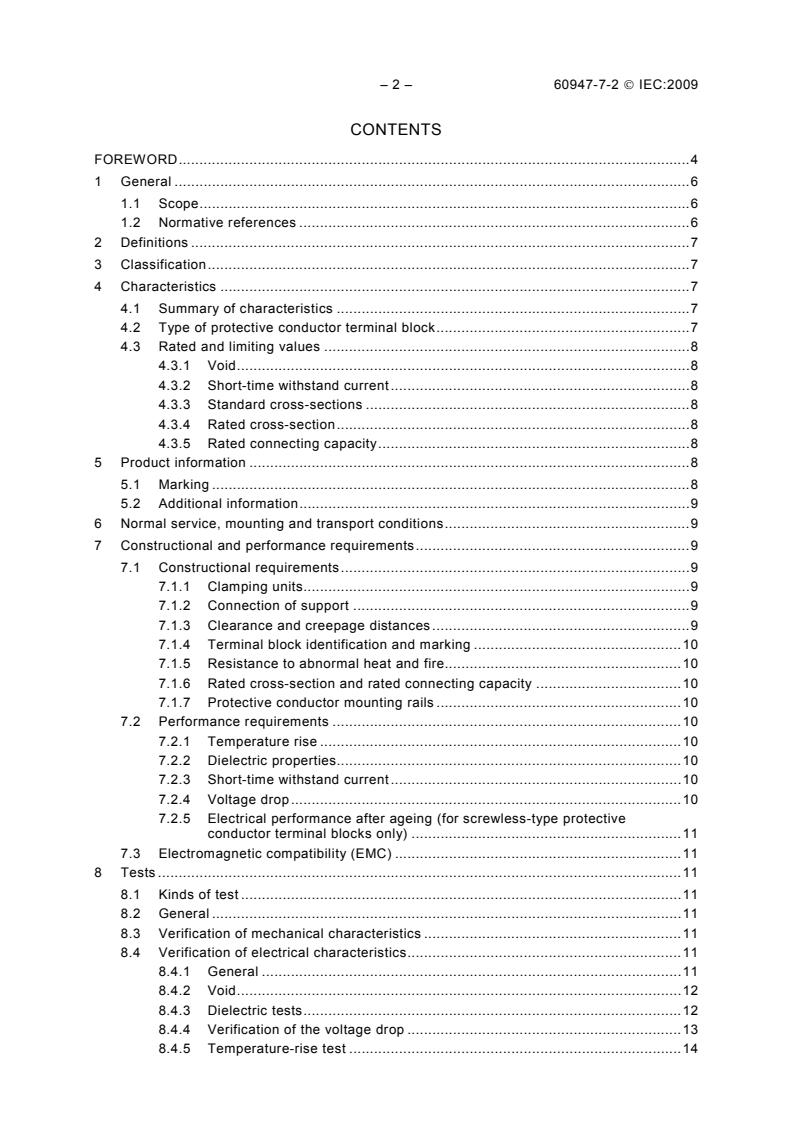
– 2 – 60947-7-2 © IEC:2009
CONTENTS
FOREWORD.4
1 General .6
1.1 Scope.6
1.2 Normative references .6
2 Definitions .7
3 Classification.7
4 Characteristics .7
4.1 Summary of characteristics .7
4.2 Type of protective conductor terminal block.7
4.3 Rated and limiting values .8
4.3.1 Void.8
4.3.2 Short-time withstand current.8
4.3.3 Standard cross-sections .8
4.3.4 Rated cross-section.8
4.3.5 Rated connecting capacity.8
5 Product information .8
5.1 Marking .8
5.2 Additional information.9
6 Normal service, mounting and transport conditions.9
7 Constructional and performance requirements.9
7.1 Constructional requirements.9
7.1.1 Clamping units.9
7.1.2 Connection of support .9
7.1.3 Clearance and creepage distances.9
7.1.4 Terminal block identification and marking .10
7.1.5 Resistance to abnormal heat and fire.10
7.1.6 Rated cross-section and rated connecting capacity .10
7.1.7 Protective conductor mounting rails .10
7.2 Performance requirements .10
7.2.1 Temperature rise .10
7.2.2 Dielectric properties.10
7.2.3 Short-time withstand current.10
7.2.4 Voltage drop.10
7.2.5 Electrical performance after ageing (for screwless-type protective
conductor terminal blocks only) .11
7.3 Electromagnetic compatibility (EMC) .11
8 Tests .11
8.1 Kinds of test .11
8.2 General .11
8.3 Verification of mechanical characteristics .11
8.4 Verification of electrical characteristics.11
8.4.1 General .11
8.4.2 Void.12
8.4.3 Dielectric tests.12
8.4.4 Verification of the voltage drop .13
8.4.5 Temperature-rise test .14
60947-7-2 © IEC:2009 – 3 –
8.4.6 Short-time withstand current test .15
8.4.7 Ageing test (for screwless-type terminal blocks only).16
8.5 Verification of thermal characteristics .17
8.6 Verification of EMC characteristics .17
Annex A (normative) Maximum short-time withstand currents allocated to the rail
profile and thermal rated current of a PEN busbar .18
Figure 1 – Arrangement for the dielectric test .12
Figure 2 – Arrangement for the voltage drop test .13
Figure 3 − Arrangement for the temperature-rise test for test group a) .15
Figure 4 − Arrangement for the temperature-rise test for test group b) .15
Figure 5 – Arrangement for the thermal short-time withstand current test.16
Table 1 − Relationship between rated cross-section and rated connecting capacity of
protective conductor terminal blocks .8
Table A.1 − Maximum short-time withstand currents allocated to the rail profile and
thermal rated current of a PEN busbar .18
– 4 – 60947-7-2 © IEC:2009
INTERNATIONAL ELECTROTECHNICAL COMMISSION
____________
LOW-VOLTAGE SWITCHGEAR AND CONTROLGEAR –
Part 7-2: Ancillary equipment –
Protective conductor terminal blocks for copper conductors
FOREWORD
1) The International Electrotechnical Commission (IEC) is a worldwide organization for standardization comprising
all national electrotechnical committees (IEC National Committees). The object of IEC is to promote
international co-operation on all questions concerning standardization in the electrical and electronic fields. To
this end and in addition to other activities, IEC publishes International Standards, Technical Specifications,
Technical Reports, Publicly Available Specifications (PAS) and Guides (hereafter referred to as “IEC
Publication(s)”). Their preparation is entrusted to technical committees; any IEC National Committee interested
in the subject dealt with may participate in this preparatory work. International, governmental and non-
governmental organizations liaising with the IEC also participate in this preparation. IEC collaborates closely
with the International Organization for Standardization (ISO) in accordance with conditions determined by
agreement between the two organizations.
2) The formal decisions or agreements of IEC on technical matters express, as nearly as possible, an international
consensus of opinion on the relevant subjects since each technical committee has representation from all
interested IEC National Committees.
3) IEC Publications have the form of recommendations for international use and are accepted by IEC National
Committees in that sense. While all reasonable efforts are made to ensure that the technical content of IEC
Publications is accurate, IEC cannot be held responsible for the way in which they are used or for any
misinterpretation by any end user.
4) In order to promote international uniformity, IEC National Committees undertake to apply IEC Publications
transparently to the maximum extent possible in their national and regional publications. Any divergence
between any IEC Publication and the corresponding national or regional publication shall be clearly indicated in
the latter.
5) IEC provides no marking procedure to indicate its approval and cannot be rendered responsible for any
equipment declared to be in conformity with an IEC Publication.
6) All users should ensure that they have the latest edition of this publication.
7) No liability shall attach to IEC or its directors, employees, servants or agents including individual experts and
members of its technical committees and IEC National Committees for any personal injury, property damage or
other damage of any nature whatsoever, whether direct or indirect, or for costs (including legal fees) and
expenses arising out of the publication, use of, or reliance upon, this IEC Publication or any other IEC
Publications.
8) Attention is drawn to the Normative references cited in this publication. Use of the referenced publications is
indispensable for the correct application of this publication.
9) Attention is drawn to the possibility that some of the elements of this IEC Publication may be the subject of
patent rights. IEC shall not be held responsible for identifying any or all such patent rights.
International Standard IEC 60947-7-2 has been prepared by subcommittee 17B: Low-voltage
switchgear and controlgear, of IEC technical committee 17: Switchgear and controlgear.
This third edition of IEC 60947-7-2 cancels and replaces the second edition, published in
2002, and constitutes a technical revision.
The main technical modifications of this standard since this previous publication are listed
below:
– requirements for tightening torques for the tests improved and referenced to Table 4 of
IEC 60947-1, Annex B deleted;
– the wording of the short-time withstand current test improved in 8.4.6.
60947-7-2 © IEC:2009 – 5 –
This standard shall be read in conjunction with IEC 60947-1 and IEC 60947-7-1. The
provisions of the general rules dealt with in IEC 60947-1 and the requirements for terminal
blocks of IEC 60947-7-1 are applicable to this standard, where specifically called for. Clauses
and subclauses, tables, figures and annexes thus applicable are identified by reference to
IEC 60947-1 or IEC 60947-7-1, e.g. 1.2 of IEC 60947-1, Table 4 of IEC 60947-7-1 or Annex A
of IEC 60947-1.
The text of this standard is based on the following documents:
FDIS Report on voting
17B/1655/FDIS 17B/1669/RVD
Full information on the voting for the approval of this standard can be found in the report on
voting indicated in the above table.
This publication has been drafted in accordance with the ISO/IEC Directives, Part 2.
A list of all the parts in the IEC 60947 series, under the general title Low-voltage switchgear
and controlgear, can be found on the IEC website.
The committee has decided that the contents of this publication will remain unchanged until
the maintenance result date indicated on the IEC web site under "http://webstore.iec.ch" in
the data related to the specific publication. At this date, the publication will be
• reconfirmed,
• withdrawn,
• replaced by a revised edition, or
• amended.
– 6 – 60947-7-2 © IEC:2009
LOW-VOLTAGE SWITCHGEAR AND CONTROLGEAR –
Part 7-2: Ancillary equipment –
Protective conductor terminal blocks for copper conductors
1 General
1.1 Scope
This part of IEC 60947 specifies requirements for protective conductor terminal blocks with
PE function up to 120 mm (250 kcmil) and for protective conductor terminal blocks with PEN
(AWG 8) with screw-type or screwless-type clamping
function equal to and above 10 mm
units, primarily intended for industrial applications.
NOTE AWG is the abbreviation of “American Wire Gage” [Gage (US) = Gauge (UK)]
kcmil = 1 000 cmil
1 cmil = 1 circular mil = surface of a circle having a diameter of 1 mil
1 mil = 1/1 000 inch
Protective conductor terminal blocks are used to form the electrical and mechanical
connection between copper conductors and the fixing support.
lt is applicable to protective conductor terminal blocks for the connection of round copper
conductors with or without special preparation having a cross-section between 0,2 mm and
120 mm (AWG 24 and 250 kcmil), intended to be used in circuits of a rated voltage not
exceeding 1 000 V a.c. up to 1 000 Hz or 1 500 V d.c., most commonly in conjunction with
terminal blocks according to IEC 60947-7-1.
This standard may be used as guide for
− protective conductor terminal blocks requiring the fixing of special devices to the
conductors, for example quick connect terminations or wrapped connections, etc.;
– protective conductor terminal blocks providing direct contact to the conductors by means
of edges or points penetrating the insulation, for example insulation displacement
connections, etc.
Where applicable in this standard, the term “clamping unit” has been used instead of the term
“terminal”. This is taken into account in case of reference to IEC 60947-1.
1.2 Normative references
The following referenced documents are indispensable for the application of this document.
For dated references, only the edition cited applies. For undated references, the latest edition
of the referenced document (including any amendments) applies.
IEC 60439-1:1999, Low-voltage switchgear and controlgear assemblies – Part 1: Type-tested
and partially type-tested assemblies
Amendment 1 (2004)
IEC 60715:1981, Dimensions of Iow-voltage switchgear and controlgear – Standardized
mounting on rails for mechanical support of electrical devices in switchgear and controlgear
installations
Amendment 1 (1995)
IEC 60947-1:2007, Low-voltage switchgear and controlgear – Part 1: General rules
60947-7-2 © IEC:2009 – 7 –
IEC 60947-7-1, Low-voltage switchgear and controlgear – Part 7-1: Ancillary equipment –
Terminal blocks for copper conductors
2 Definitions
For the purposes of this document, definitions given in IEC 60947-7-1, together with the
following definitions, apply.
2.1
protective conductor terminal block
device with one or more clamping units for connecting and/or joining protective conductors
(PE and PEN conductors) with conducting connection to their supports, which may be
designed with screw-type or screwless-type fixing means
NOTE 1 Supports are, for example, mounting rails, sheet metal cut-outs, mounting plates, etc.
NOTE 2 A protective conductor terminal block can be either partially insulated or not at all. lt does not require any
functional insulation.
2.2
partially insulated protective conductor terminal block
device which is only insulated against live parts of other devices but not against the support
itself
2.3
PEN conductor
earthed conductor combining the functions of both protective conductor and neutral conductor
NOTE The acronym PEN results from the combination of both symbols PE for the protective conductor and N for
the neutral conductor (see 2.1.15 of IEC 60947-1).
3 Classification
Distinction is made between various types of protective conductor terminal blocks as follows:
− method of fixing the protective conductor terminal block to the support;
− type of clamping units: screw-type clamping units or screwless-type clamping units;
− ability to receive conductors with or without special preparation (e.g. cable lugs);
− terminal assemblies with identical or dissimilar clamping units;
− number of clamping units on each terminal assembly;
− service conditions;
− PE or PEN functions.
4 Characteristics
4.1 Summary of characteristics
Subclause 4.1 of IEC 60947-7-1 applies.
4.2 Type of protective conductor terminal block
Subclause 4.2 of IEC 60947-7-1 applies.
– 8 – 60947-7-2 © IEC:2009
4.3 Rated and limiting values
4.3.1 Void
4.3.2 Short-time withstand current
Subclause 4.3.2 of IEC 60947-7-1 applies.
4.3.3 Standard cross-sections
Subclause 4.3.3 of IEC 60947-7-1 applies with the following addition.
In accordance with the scope of this standard, Table 1 of IEC 60947-7-1 applies only up to
120 mm (250 kcmil).
4.3.4 Rated cross-section
Subclause 4.3.4 of IEC 60947-7-1 applies.
4.3.5 Rated connecting capacity
Subclause 4.3.5 of IEC 60947-7-1 applies with the modification for one conductor per
clamping unit only, as for 7.4.3.1.6 of IEC 60439-1, and with the following Table 1.
Table 1 − Relationship between rated cross-section and rated connecting capacity
of protective conductor terminal blocks
Rated cross-section Rated connecting capacity
2 2
mm AWG/kcmil mm AWG/kcmil
0,2 24 0,2 24
0,34 22 0,2 – 0,34 24 – 22
0,5 20 0,2 – 0,34 – 0,5 24 – 22 – 20
0,75 18 0,34 – 0,5 – 0,75 22 – 20 – 18
1 – 0,5 – 0,75 – 1 –
1,5 16 0,75 – 1 – 1,5 20 – 18 – 16
2,5 14 1 – 1,5 – 2,5 18 – 16 – 14
4 12 1,5 – 2,5 – 4 16 – 14 – 12
6 10 2,5 – 4 – 6 14 – 12 – 10
10 8 4 – 6 – 10 12 – 10 – 8
16 6 6 – 10 – 16 10 – 8 – 6
25 4 10 – 16 – 25 8 – 6 – 4
35 2 16 – 25 – 35 6 – 4 – 2
50 0 25 – 35 – 50 4 – 2 – 0
70 00 35 – 50 – 70 2 – 0 – 00
95 000 50 – 70 – 95 0 – 00 – 000
120 250 70 – 95 – 120 00 – 000 – 250
5 Product information
5.1 Marking
A protective conductor terminal block shall be marked in a durable and legible manner with
the following:
a) the name of the manufacturer or a trade mark by which the manufacturer can be readily
identified;
60947-7-2 © IEC:2009 – 9 –
b) a type reference permitting its identification in order to obtain relevant information from the
manufacturer or his catalogue.
5.2 Additional information
The following information shall be stated by the manufacturer, if applicable, e.g. in the
manufacturer's data sheet or his catalogue or on the packing unit:
a) IEC 60947-7-2, if the manufacturer claims compliance with this standard;
b) the rated cross-section;
c) the rated connecting capacity if different from Table 1;
d) service conditions, if different from those of Clause 6.
The manufacturer shall declare if the protective conductor terminal block rated equal to or
above 10 mm (AWG 8) is intended for PE function only.
NOTE No marking indicates suitability for use in both PE + PEN functions.
6 Normal service, mounting and transport conditions
Clause 6 of IEC 60947-1 applies.
7 Constructional and performance requirements
7.1 Constructional requirements
7.1.1 Clamping units
Subclause 7.1.1 of IEC 60947-7-1 applies with the following additions.
The protective conductor terminal block shall permit a reliable connection between the
conductor clamping units and the clamping unit to the support.
The clamping units shall be able to withstand the forces that can be applied through
the connected conductors and the connected support.
Compliance is checked by inspection, by the test of 8.3.3.1 and by the tests of 8.3.3.2 and
8.3.3.3 of IEC 60947-7-1.
7.1.2 Connection of support
Protective conductor terminal blocks shall be provided with means for secure attachment to
the corresponding support without risk of galvanic corrosion.
The design of the protective conductor terminal block shall clearly show how the fixation has
to be made to ensure the correct conducting connection to the appropriate support.
The clamping connection to the support shall only be released by means of tools.
The test shall be carried out in accordance with 8.3.2 of IEC 60947-7-1.
NOTE Information on mounting rails can be found in IEC 60715.
7.1.3 Clearance and creepage distances
Clearance and creepage distances do not apply to protective conductor terminal blocks.
– 10 – 60947-7-2 © IEC:2009
NOTE The value of the clearance and creepage distances between protective conductor terminal blocks and
terminal blocks according to IEC 60947-7-1 should be as stated in 7.1.3 of IEC 60947-7-1.
7.1.4 Terminal block identification and marking
Subclause 7.1.4 of IEC 60947-7-1 applies with the following addition.
Any partially insulated protective conductor terminal block shall be coloured green and yellow.
7.1.5 Resistance to abnormal heat and fire
Subclause 7.1.5 of IEC 60947-7-1 applies.
7.1.6 Rated cross-section and rated connecting capacity
Subclause 7.1.6 of IEC 60947-7-1 applies.
7.1.7 Protective conductor mounting rails
Mounting rails may be used as protective conductor busbars, provided the values specified in
Table A.1 for thermal short-time withstand current and the thermal rated current are not
exceeded.
Other types of mounting rails may be used for this purpose if the values of Table A.1 are
comparable.
Table A.1 gives examples of standardized mounting rails meeting these requirements.
Steel protective conductor busbars are not allowed to be used as a PEN conductor.
NOTE Special tests may be necessary for protective conductor terminal blocks involving connection of aluminium
to copper or aluminium to copper alloy.
7.2 Performance requirements
7.2.1 Temperature rise
When protective conductor terminal blocks for PEN functions are tested in accordance with
8.4.5, the temperature rise of the terminals shall not exceed 45 K.
7.2.2 Dielectric properties
Protective conductor terminal blocks which shall be arranged directly beside terminal blocks
in accordance with IEC 60947-7-1 shall pass the dielectric tests according to 8.4.3.
7.2.3 Short-time withstand current
Protective conductor terminal blocks shall be capable of withstanding three applications of 1 s
duration each of the short-time withstand current which corresponds to 120 A/mm of its rated
cross-section. The test shall be made in accordance with 8.4.6.
7.2.4 Voltage drop
The voltage drop caused by the conductor connection and by the connection to the support of
a protective conductor terminal block, measured according to 8.4.4, shall not exceed the
values specified in 8.4.4 and, where applicable, in 8.4.7.
60947-7-2 © IEC:2009 – 11 –
7.2.5 Electrical performance after ageing (for screwless-type protective conductor
terminal blocks only)
Protective conductor terminal blocks shall be capable of withstanding the ageing test
comprising 192 temperature cycles in accordance with 8.4.7.
7.3 Electromagnetic compatibility (EMC)
Subclause 7.3 of IEC 60947-7-1 applies.
8 Tests
8.1 Kinds of test
Subclause 8.1 of IEC 60947-7-1 applies.
8.2 General
Subclause 8.2 of IEC 60947-7-1 applies.
8.3 Verification of mechanical characteristics
Subclause 8.3 of IEC 60947-7-1 applies with the modification of 8.3.3.1 which is replaced by
the following.
8.3.3.1 Test of mechanical strength of clamping units
Subclauses 8.2.4.1 and 8.2.4.2 of IEC 60947-1 apply with the following addition.
The test shall be made first on two conductor clamping units at the centre terminal block out
of five protective conductor terminal blocks mounted as in normal use on the appropriate
support according to the manufacturer’s instructions.
After verification of the voltage drop U according to 8.4.4 with a connected rigid conductor
cc
of the rated cross-section stated by the manufacturer and subsequently, if applicable, with
a connected flexible conductor of the minimum cross-section stated by the manufacturer, rigid
conductors of the rated cross-section shall be connected and disconnected five times each.
At the end of this test, the protective conductor terminal blocks shall pass the voltage drop
test (U ) according to 8.4.4 with a connected rigid conductor of the rated cross-section and
cc
subsequently, if applicable, with a connected flexible conductor of the minimum cross-section.
Subsequently the voltage drop U is verified on the protective conductor terminal block with
cs
a connected rigid conductor of the rated cross-section.
The protective conductor terminal blocks are then mounted and dismounted from their support
five times.
At the end of this test, the protective conductor terminal blocks shall pass the voltage drop
test (U ) according to 8.4.4.
cs
8.4 Verification of electrical characteristics
8.4.1 General
The verification of electrical characteristics includes the following:
− dielectric tests (see 8.4.3);
– 12 – 60947-7-2 © IEC:2009
− verification of the voltage drop (see 8.4.4);
− temperature-rise test (see 8.4.5);
− short-time withstand current test (see 8.4.6);
− ageing test (for screwless protective conductor terminal blocks only) (see 8.4.7).
8.4.2 Void
8.4.3 Dielectric tests
This test applies only if partially insulated protective conductor terminal blocks are intended to
be arranged directly beside terminal blocks according to IEC 60947-7-1.
The test is made on protective conductor terminal blocks installed with terminal blocks of the
same series and size according to the manufacturer's instructions.
a) If the manufacturer has declared a value for the rated impulse withstand voltage (U ),
imp
the impulse withstand voltage test shall be made in accordance with 8.3.3.4.1, item 2), of
IEC 60947-1, except item 2) c) which does not apply.
b) The power-frequency withstand verification of solid insulation shall be made in accordance
with 8.3.3.4.1, item 3), of IEC 60947-1. The value of the test voltage shall be as stated in
Table 12A of IEC 60947-1 (see 8.3.3.4.1, item 3) b) i), of IEC 60947-1).
The protective conductor terminal blocks and terminal blocks shall be wired and installed on a
metal support as shown in Figure 1 and under the conditions a), b) and c) of 8.4.2.1 of
IEC 60947-7-1.
The test voltage shall be applied between the protective conductor terminal blocks and the
terminal blocks.
IEC 540/09
Key
1 Protective conductor terminal block
2 Terminal block
3 Metal support
4 Conductor end
5 Test voltage
Figure 1 – Arrangement for the dielectric test
60947-7-2 © IEC:2009 – 13 –
8.4.4 Verification of the voltage drop
The voltage drop shall be verified
a) before and after the test of mechanical strength of clamping units (see 8.3.3.1);
b) before and after the temperature-rise test (see 8.4.5);
c) before and after the short-time withstand current test (see 8.4.6);
d) before, during and after the ageing test (see 8.4.7).
The verification is made as specified in 8.3.3.1, 8.4.5, 8.4.6 and 8.4.7.
If the protective conductor connection is made to steel supports with a chromated surface, the
chromate coat shall be removed at the contact points prior to the connection, except for
the short-time withstand current test in accordance with 8.4.6, for which the voltage drop shall
be measured only after the test.
The voltage drop is measured on each protective conductor terminal block as indicated
in Figure 2. The measurement is made with a direct current of 0,1 times the value given in
Table 4 or Table 5 of IEC 60947-7-1.
U
cc
1 1
I I
U
cs
I
IEC 541/09
Key
1 Measurement point
Figure 2 – Arrangement for the voltage drop test
Before the tests according to a), b), c) and d), the voltage drop U shall not exceed 3,2 mV;
cc
and the voltage drop U shall not exceed 6,4 mV with the exception of test c) for which the
cs
voltage drop test is performed after the test only, if steel supports with a chromated surface
are used.
If the measured value of U or U exceeds 3,2 mV or 6,4 mV respectively, the voltage drop
cc cs
is determined on each individual clamping unit separately, which shall not exceed 1,6 mV or
4,8 mV respectively.
After the tests according to a), b) and c), voltage drops U and U shall not exceed 4,8 mV
cc cs
or 9,6 mV respectively, or 150 % of the values measured before the tests, whichever
is the lower.
During and after the test according to d), voltage drops U and U shall not exceed the
cc cs
values specified in 8.4.7.
– 14 – 60947-7-2 © IEC:2009
8.4.5 Temperature-rise test
This test is only applicable for protective conductor terminal blocks with PEN function equal to
and above 10 mm (AWG 8) rated cross-section. To this effect, the thermal rated current
values allotted to the rail profiles in Table A.1 are to be seen as limit values.
Steel supports are not permissible. The test circuit shall be located horizontally as shown in
figures 3 and 4 on a wooden surface (e.g. tabletop or floor). The conductors shall Iie freely
on the surface.
The test shall be made with PVC-insulated conductors having the rated cross-section.
If applicable, the conductor connection and the connection to the support shall be made with
the tightening torque according to Table 4 of IEC 60947-1 or alternatively in accordance with
the higher torque value stated by the manufacturer.
The minimum conductor length L shall be 1 m for the cross-section of 10 mm (AWG 8) and
2 m for larger cross-sections.
The conductors shall be rigid stranded.
During the test, screws of clamping units shall not be re-tightened.
Two different test groups shall be provided:
a) five insulated protective conductor terminal blocks shall be arranged adjacently without
support (see Figure 3). The temperature shall be measured on the middle protective
conductor terminal block;
b) five protective conductor terminal blocks shall be arranged adjacently on their support
(see figure 4), the two outer protective conductor terminal blocks being linked through
their support. The temperature shall be measured on the two outer protective conductor
terminal blocks.
60947-7-2 © IEC:2009 – 15 –
L
L
L
IEC 543/09
L
IEC 542/09
Key Key
1 Measurement point 1 Measurement points
2 Support
Figure 3 − Arrangement for the Figure 4 − Arrangement for the
temperature-rise test for test group a) temperature-rise test for test group b)
After verification of the voltage drop according to 8.4.4, the test is made with an a.c. single-
phase current as specified in Table 4 or Table 5 of IEC 60947-7-1, according to the rated
cross-section, and is continued until steady temperature is reached. A variation of less than
1 K between any two out of three consecutive measurements made at an interval of 5 min is
considered as a steady temperature.
The temperature rise shall not exceed the limit given in 7.2.1.
At the end of the test, after cooling to ambient air temperature, the protective conductor
terminal blocks shall pass the voltage drop test according to 8.4.4 with measurement points in
accordance with Figure 2.
8.4.6 Short-time withstand current test
The purpose of this test is to verify the ability to withstand a thermal shock.
The test is performed on one protective conductor terminal block installed according to the
manufacturer's instructions. It is wired with a conductor of the rated cross-section, tightened
with the torque according to Table 4 of IEC 60947-1 or alternatively in accordance with the
higher torque value stated by the manufacturer.
If the rated cross-section is below 10 mm (AWG 8), the conductors shall be solid. For rated
cross-sections equal to or higher than 10 mm² (AWG 8), the conductors shall be rigid
stranded.
– 16 – 60947-7-2 © IEC:2009
After verification of the voltage drop according to 8.4.4, the value and the duration of the test
current shall be in accordance with 7.2.3.
The maximum short-time withstand currents allocated to the rail profiles in Table A.1 shall be
considered as limit values.
The test current is applied once through the current path 1-1 and then through the current
path 2-2, in accordance with Figure 5.
A pause of 6 min minimum shall be allowed between the current surges.
1 1
IEC 544/09
Figure 5 – Arrangement for the thermal short-time withstand current test
At the end of the test, continuity shall exist on the test sample assembly and the terminal
blocks shall not show any cracking, breakage or other critical damage. After cooling down to
ambient temperature, and without any change in the arrangement, the protective conductor
terminal block shall pass the voltage drop test according to 8.4.4.
8.4.7 Ageing test (for screwless-type terminal blocks only)
Five protective conductor terminal blocks shall be arranged adjacently without support (see
Figure 3).
If the rated cross-section is below 10 mm (AWG 8), the conductors shall be solid. For rated
cross-sections equal to or higher than 10 mm² (AWG 8), the conductors shall be rigid
stranded.
The minimum length of the conductor bridges shall be 300 mm.
If the connection to the support is also made screwless, five further protective conductor
terminal blocks are arranged adjacently on their support (see Figure 4).
The test is made with heat-resistant insulated or non-insulated conductors having the rated
cross-section.
The protective conductor terminal blocks are placed in a heating cabinet, which is initially kept
at a temperature of (20 ± 2) °C and then submitted to the verification of the voltage drop test
according to 8.4.4.
The whole test arrangement, including the conductors, shall not be moved until all the voltage
drop tests have been completed.
60947-7-2 © IEC:2009 – 17 –
The protective conductor terminal blocks are submitted to 192 temperature cycles as follows.
For protective conductor terminal blocks intended for use under “normal service conditions”
(maximum 40 °C), the temperature in the heating cabinet is increased to 85 °C.
For protective conductor terminal blocks for which the manufacturer has specified “maximum
service conditions above 40 °C”, the temperature in the heating cabinet is increased to the
temperature specified by the manufacturer plus 45 K.
The temperature is maintained within ± 5 °C of this value for approximately 10 min.
The protective conductor terminal blocks are then cooled down to a temperature of
approximately 30 °C, forced cooling being allowed; they are kept at this temperature for
approximately 10 min and, if necessary for measuring the voltage drop, it is allowed to cool
down further to a temperature of (20 ± 5) °C.
NOTE As a guide, a value for the heating and cooling rate of the heating cabinet of approximately 1,5 °C/min may
be taken as a basis.
The voltage drop on each protective conductor terminal block is also determined according to
8.4.4 after each of the 24 temperature cycles and after the 192 temperature cycles have been
completed, each time at a temperature of (20 ± 5) °C.
In no case the voltage drop U at the clamping units for the copper conductors shall exceed
cc
th
4,8 mV or 1,5 times the value measured after the 24 cycle, whichever is the lower.
At the clamping units to the support, the voltage drop U shall not exceed 9,6 mV or
cs
th
1,5 times the value measured after the 24 cycle, whichever is the lower.
After this test, a visual inspection shall show no changes impairing further use as cracks,
deformations or the like.
Furthermore, the pull-out test according to 8.3.3.3 of IEC 60947-7-1 shall be carried out.
8.5 Verification of thermal characteristics
Subclause 8.5 of IEC 60947-7-1 applies.
8.6 Verification of EMC characteristics
Subclause 8.6 of IEC 60947-7-1 applies.
– 18 – 60947-7-2 © IEC:2009
Annex A
(normative)
Maximum short-time withstand currents allocated to the rail profile
and thermal rated current of a PEN busbar
Table A.1 − Maximum short-time withstand currents allocated to the rail profile
and thermal rated current of a PEN busbar
Equivalent Short-time Thermal rated
E-Cu withstand current current of a PEN
Rail profile Material
cross-section 1 s busbar
mm kA A
“Top hat” rail Steel 10 1,2 –
a
IEC 60715/TH 15-5,5 Copper 25 3 101
a
Aluminium 16 1,92 76
G-type rail Steel 35 4,2 –
a
IEC 60715/G32 Copper 120 14,4 269
a
Aluminium 70 8,4 192
“Top hat” rail Steel 16 1,92 –
a
IEC 60715/TH 35-7,5 Copper 50 6 150
a
Aluminium 35 4,2 125
“Top hat” rail Steel 50 6 –
a
lEC 60715/TH 35-15 Copper 150 18 309
a
Aluminium 95 11,4 232
a
Copper or aluminium alloys selected by the manufacturer of the terminal block assembly to achieve
the values in the table.
___________
– 20 – 60947-7-2 © CEI:2009
SOMMAIRE
AVANT-PROPOS.22
1 Généralités.24
1.1 Domaine d'application .24
1.2 Références normatives.24
2 Définitions .25
3 Classification.25
4 Caractéristiques .26
4.1 Enumération des caractéristiques.
...