

IEC 60601-2-2:1998
(Main)Medical electrical equipment - Part 2-2: Particular requirements for the safety of high frequency surgical equipment
General Information
- Abstract
Specifies requirements for the safety of high frequency surgical equipment used in medical practice. This third edition of IEC 60601-2-2 cancels and replaces the second edition published in 1991, and constitutes a technical revision.
- Status
- Published
- Publication Date
- 22-Sep-1998
- Technical Committee
- SC 62D - Particular medical equipment, software, and systems
- Current Stage
- DELPUB - Deleted Publication
- Start Date
- 19-Jul-2006
- Completion Date
- 28-Aug-2026
Overview
IEC 60601-2-2:1998 is the third-edition Particular Standard from IEC that specifies safety requirements for high frequency (HF) surgical equipment used in medical practice. It amends and supplements IEC 60601-1 (General Standard) and collateral standards to address electrosurgery‑specific hazards. This edition (1998) cancels and replaces the 1991 edition and introduces technical revisions including provisions for split neutral electrodes, single‑fault limitations, and updated applied‑part requirements.
Key topics and technical requirements
- Scope & exemptions: Applies to HF surgical equipment; devices with a rated output power ≤ 50 W (e.g., micro‑coagulation, dentistry, ophthalmology) have specified exemptions.
- Definitions: Clear terms for active electrode, bipolar electrode, neutral (dispersive) electrode, rated output power, cutting and coagulation modes.
- Safety under single‑fault conditions: Additional single‑fault requirements cover failures such as neutral‑electrode monitoring circuit faults, unwanted patient‑circuit energization, excessive low‑frequency patient leakage current, and unexpected output power increases.
- Marking and documentation: Mandatory marking of rated output power (watts), rated load (ohms), and operating frequency (kHz/MHz); controls must indicate relative HF output and not be labeled in watts unless within ±20% accuracy over specified loads.
- Patient circuit protections: Requirements for neutral electrode monitoring, patient leakage currents, applied‑part classification (AP), and defibrillation‑proof indications.
- Thermal, mechanical and EMC considerations: Clauses cover excessive temperatures, sterilization/cleaning compatibility, ingress of liquids, and electromagnetic compatibility to prevent unwanted radiation or interference.
- Fire/ignition: Specific protections when flammable anaesthetic mixtures may be present (CATEGORY AP / APG equipment).
- Construction & testing: Dielectric strength, leakage current tests, simultaneous activation of multiple patient circuits, creep/air‑clearance distances, and constructional layout are specified or referenced.
Applications and practical value
- Use IEC 60601-2-2 to guide the design, risk assessment, testing, and labeling of electrosurgical generators, handpieces, neutral electrodes, and accessories.
- Supports compliance efforts for regulatory approval, type testing, and factory QA by manufacturers of HF surgical equipment.
- Helps biomedical engineers, test labs, and hospital clinical engineers evaluate device safety, patient circuit integrity, and maintenance procedures.
Who uses this standard
- Medical device manufacturers (design and compliance teams)
- Regulatory bodies and conformity assessment labs
- Biomedical/clinical engineers and hospital procurement
- Test laboratories performing safety and EMC testing
Related standards
- IEC 60601-1 (General requirements)
- IEC 60601-1-1, IEC 60601-1-2 (EMC), IEC 60601-1-4 (PEMS)
- IEC 60601-2-18 (endoscopic accessories) - for consistent definitions
Keywords: IEC 60601-2-2, high frequency surgical equipment, electrosurgery safety, neutral electrode, patient leakage current, rated output power, applied parts, medical device testing.
Relations
- Effective Date
- 05-Sep-2023
Get Certified
Connect with accredited certification bodies for this standard

BSI Group
BSI (British Standards Institution) is the business standards company that helps organizations make excellence a habit.

TÜV Rheinland
TÜV Rheinland is a leading international provider of technical services.

TÜV SÜD
TÜV SÜD is a trusted partner of choice for safety, security and sustainability solutions.
Sponsored listings
Frequently Asked Questions
IEC 60601-2-2:1998 is a standard published by the International Electrotechnical Commission (IEC). Its full title is "Medical electrical equipment - Part 2-2: Particular requirements for the safety of high frequency surgical equipment". This standard covers: Specifies requirements for the safety of high frequency surgical equipment used in medical practice. This third edition of IEC 60601-2-2 cancels and replaces the second edition published in 1991, and constitutes a technical revision.
Specifies requirements for the safety of high frequency surgical equipment used in medical practice. This third edition of IEC 60601-2-2 cancels and replaces the second edition published in 1991, and constitutes a technical revision.
IEC 60601-2-2:1998 is classified under the following ICS (International Classification for Standards) categories: 11.040.30 - Surgical instruments and materials. The ICS classification helps identify the subject area and facilitates finding related standards.
IEC 60601-2-2:1998 has the following relationships with other standards: It is inter standard links to IEC 60601-2-2:2006. Understanding these relationships helps ensure you are using the most current and applicable version of the standard.
IEC 60601-2-2:1998 is available in PDF format for immediate download after purchase. The document can be added to your cart and obtained through the secure checkout process. Digital delivery ensures instant access to the complete standard document.
Standards Content (Sample)
INTERNATIONAL
IEC
STANDARD
60601-2-2
Third edition
1998-09
Medical electrical equipment –
Part 2-2:
Particular requirements for the safety
of high frequency surgical equipment
Appareils électromédicaux –
Partie 2-2:
Règles particulières de sécurité pour appareils
d'électrochirurgie à courant haute fréquence
Reference number
IEC 60 601-2-2:1998(E)
Numbering
As from 1 January 1997 all IEC publications are issued with a designation in
the 60 000 series.
Consolidated publications
Consolidated versions of some IEC publications including amendments are
available. For example, edition numbers 1.0, 1.1 and 1.2 refer, respectively, to the
base publication, the base publication incorporating amendment 1 and the base
publication incorporating amendments 1 and 2.
Validity of this publication
The technical content of IEC publications is kept under constant review by the IEC,
thus ensuring that the content reflects current technology.
Information relating to the date of the reconfirmation of the publication is available
in the IEC catalogue.
Information on the subjects under consideration and work in progress undertaken by
the technical committee which has prepared this publication, as well as the list of
publications issued, is to be found at the following IEC sources:
• IEC web site*
• Catalogue of IEC publications
Published yearly with regular updates
(On-line catalogue)*
• IEC Bulletin
Available both at the IEC web site* and as a printed periodical
Terminology, graphical and letter symbols
For general terminology, readers are referred to IEC 60050: International Electro-
technical Vocabulary (IEV).
For graphical symbols, and letter symbols and signs approved by the IEC for
general use, readers are referred to publications IEC 60027: Letter symbols to be
used in electrical technology, IEC 60417: Graphical symbols for use on equipment.
Index, survey and compilation of the single sheets and IEC 60 617: Graphical symbols
for diagrams.
* IEC web site http: //www.iec.ch.
INTERNATIONAL
IEC
STANDARD
60601-2-2
Third edition
1998-09
Medical electrical equipment –
Part 2-2:
Particular requirements for the safety
of high frequency surgical equipment
Appareils électromédicaux –
Partie 2-2:
Règles particulières de sécurité pour appareils
d'électrochirurgie à courant haute fréquence
IEC 1998 Copyright - all rights reserved
No part of this publication may be reproduced or utilized in any form or by any means, electronic or
mechanical, including photocopying and microfilm, without permission in writing from the publisher.
International Electrotechnical Commission 3, rue de Varembé Geneva, Switzerland
Telefax: +41 22 919 0300 e-mail: inmail@iec.ch IEC web site http: //www.iec.ch
Commission Electrotechnique Internationale
PRICE CODE
X
International Electrotechnical Commission
For price, see current catalogue
– 2 – 60601-2-2 © IEC:1998(E)
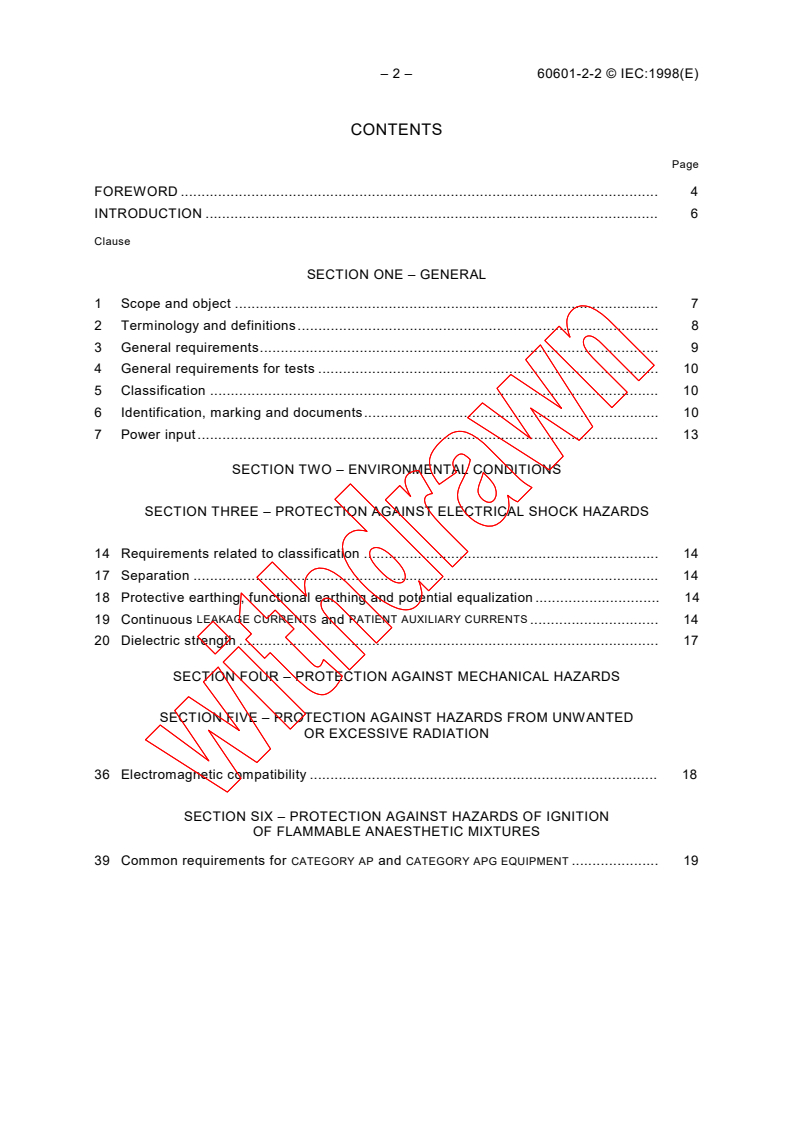
CONTENTS
Page
FOREWORD . 4
INTRODUCTION . 6
Clause
SECTION ONE – GENERAL
1 Scope and object . 7
2 Terminology and definitions. 8
3 General requirements. 9
4 General requirements for tests . 10
5 Classification . 10
6 Identification, marking and documents. 10
7 Power input. 13
SECTION TWO – ENVIRONMENTAL CONDITIONS
SECTION THREE – PROTECTION AGAINST ELECTRICAL SHOCK HAZARDS
14 Requirements related to classification . 14
17 Separation . 14
18 Protective earthing, functional earthing and potential equalization . 14
19 Continuous LEAKAGE CURRENTS and PATIENT AUXILIARY CURRENTS . 14
20 Dielectric strength . 17
SECTION FOUR – PROTECTION AGAINST MECHANICAL HAZARDS
SECTION FIVE – PROTECTION AGAINST HAZARDS FROM UNWANTED
OR EXCESSIVE RADIATION
36 Electromagnetic compatibility . 18
SECTION SIX – PROTECTION AGAINST HAZARDS OF IGNITION
OF FLAMMABLE ANAESTHETIC MIXTURES
39 Common requirements for CATEGORY AP and CATEGORY APG EQUIPMENT . 19
60601-2-2 © IEC:1998(E) – 3 –
SECTION SEVEN – PROTECTION AGAINST EXCESSIVE TEMPERATURES
AND OTHER SAFETY HAZARDS
42 Excessive temperatures . 19
44 Overflow, spillage, leakage, humidity, ingress of liquids, cleaning, sterilization,
disinfection and compatibility. 19
46 Human errors . 20
SECTION EIGHT – ACCURACY OF OPERATING DATA AND PROTECTION
AGAINST HAZARDOUS OUTPUT
50 Accuracy of operating data . 21
51 Protection against hazardous output . 22
SECTION NINE – ABNORMAL OPERATION AND FAULT CONDITIONS;
ENVIRONMENTAL TESTS
52 Abnormal operation and fault conditions . 24
SECTION TEN – CONSTRUCTIONAL REQUIREMENTS
56 Components and general assembly . 24
59 Construction and layout. 26
Figures 101 to 109. 29–33
Appendix L References – Publications mentioned in this standard. 34
Annex AA (informative) Guidance and rationale for particular clauses and subclauses. 35
– 4 – 60601-2-2 © IEC:1998(E)
INTERNATIONAL ELECTROTECHNICAL COMMISSION
––––––––––
MEDICAL ELECTRICAL EQUIPMENT –
Part 2-2: Particular requirements for the safety
of high frequency surgical equipment
FOREWORD
1) The IEC (International Electrotechnical Commission) is a worldwide organization for standardization comprising
all national electrotechnical committees (IEC National Committees). The object of the IEC is to promote
international co-operation on all questions concerning standardization in the electrical and electronic fields. To
this end and in addition to other activities, the IEC publishes International Standards. Their preparation is
entrusted to technical committees; any IEC National Committee interested in the subject dealt with may
participate in this preparatory work. International, governmental and non-governmental organizations liaising
with the IEC also participate in this preparation. The IEC collaborates closely with the International Organization
for Standardization (ISO) in accordance with conditions determined by agreement between the two
organizations.
2) The formal decisions or agreements of the IEC on technical matters express, as nearly as possible, an
international consensus of opinion on the relevant subjects since each technical committee has representation
from all interested National Committees.
3) The documents produced have the form of recommendations for international use and are published in the form
of standards, technical reports or guides and they are accepted by the National Committees in that sense.
4) In order to promote international unification, IEC National Committees undertake to apply IEC International
Standards transparently to the maximum extent possible in their national and regional standards. Any
divergence between the IEC Standard and the corresponding national or regional standard shall be clearly
indicated in the latter.
5) The IEC provides no marking procedure to indicate its approval and cannot be rendered responsible for any
equipment declared to be in conformity with one of its standards.
6) Attention is drawn to the possibility that some of the elements of this International Standard may be the subject
of patent rights. The IEC shall not be held responsible for identifying any or all such patent rights.
International Standard IEC 60601-2-2 has been prepared by subcommittee 62D:
Electromedical equipment, of IEC technical committee 62: Electrical equipment in medical
practice.
This third edition of IEC 60601-2-2 cancels and replaces the second edition published in 1991,
and constitutes a technical revision.
The text of this Particular Standard is based on the following documents:
FDIS Report on voting
62D/291/FDIS 62D/297/RVD
Full information on the voting for the approval of this Particular Standard can be found in the
report on voting indicated in the above table.
Annex AA is for information only.
60601-2-2 © IEC:1998(E) – 5 –
In this Particular Standard the following print types are used:
– requirements, compliance with which can be tested, and definitions: in roman type;
– notes, explanations, advice, introductions, general statements, exceptions and references: in smaller type;
– test specifications: in italic type;
–
TERMS DEFINED IN CLAUSE 2 OF THE GENERAL STANDARD OR THIS PARTICULAR STANDARD:
SMALL CAPITALS.
– 6 – 60601-2-2 © IEC:1998(E)
INTRODUCTION
The revisions for this third edition of the Particular Standard refer mainly to the following:
– Split NEUTRAL ELECTRODES are dealt with in more detail.
– Limitation of incorrect output power in SINGLE FAULT CONDITION.
– The requirements for AP EQUIPMENT are revised.
– White indicator lamps on coloured backgrounds for CUTTING and COAGULATION mode are no
longer allowed.
– Limitation of monitoring current to 100 μA for HF SURGICAL EQUIPMENT with BF or CF APPLIED
PARTS.
– Revised requirements for CREEPAGE DISTANCE and AIR CLEARANCE of APPLIED PARTS.
– Simultaneous activation of more than one PATIENT CIRCUIT is dealt with in more detail and a
compliance test method is now defined.
60601-2-2 © IEC:1998(E) – 7 –
MEDICAL ELECTRICAL EQUIPMENT –
Part 2-2: Particular requirements for the safety
of high frequency surgical equipment
SECTION ONE – GENERAL
The clauses and subclauses of this section of the General Standard apply except as follows:
1 Scope and object
This clause of the General Standard applies except as follows:
*1.1 Scope
Addition:
HIGH FREQUENCY SURGICAL
This Particular Standard specifies requirements for the safety of
EQUIPMENT used in medical practice, as defined in 2.1.101 and hereinafter referred to as HF
SURGICAL EQUIPMENT.
HF SURGICAL EQUIPMENT having a RATED OUTPUT POWER not exceeding 50 W (for example for
micro-coagulation, or for use in dentistry or ophthalmology) is exempt from certain of the
requirements of this Particular Standard. These exemptions are indicated in the relevant
requirements.
1.2 Object
Replacement:
The object of this Particular Standard is to establish particular requirements for the safety of HF
SURGICAL EQUIPMENT.
1.3 Particular Standards
Addition:
This Particular Standard amends and supplements a set of IEC publications consisting of
IEC 60601-1:1988, Medical electrical equipment – Part 1: General requirements for safety
Amendment 1 (1991)
Amendment 2 (1995)
IEC 60601-1-1:1992, Medical electrical equipment – Part 1: General requirements for safety –
1: Collateral Standard: Safety requirements for medical electrical systems
IEC 60601-1-2:1993, Medical electrical equipment – Part 1: General requirements for safety –
2: Collateral Standard: Electromagnetic compatibility – Requirements and tests
IEC 60601-1-4:1996, Medical electrical equipment – Part 1: General requirements for safety –
4: Collateral Standard: Programmable electrical medical systems
– 8 – 60601-2-2 © IEC:1998(E)
For brevity, IEC 60601-1 is referred to, in this Particular Standard, either as the “General Standard”
or as the “General Requirement(s)”, IEC 60601-1-1, IEC 60601-1-2, and IEC 60601-1-4 as the
Collateral Standard(s).
The term "this Standard" covers the Particular Standard used together with the General
Standard and any Collateral Standards.
The numbering of sections, clauses and subclauses of this Particular Standard corresponds to
that of the General Standard. The changes to the text of the General Standard are specified by
the use of the following words:
“Replacement” means that the clause or subclause of the General Standard is replaced
completely by the text of this Particular Standard.
“Addition” means that the text of this Particular Standard is additional to the requirements of
the General Standard.
“Amendment” means that the clause or subclause of the General Standard is amended as
indicated by the text of this Particular Standard.
Subclauses or figures which are additional to those of the General Standard are numbered
starting from 101, additional annexes are lettered AA, BB, etc., and additional items aa), bb),
etc.
Clauses and subclauses for which there is a rationale are marked with an asterisk*. These
rationales can be found in an informative annex AA. Annex AA should be used in determining
the relevance of the requirements addressed but should never be used to establish additional
test requirements.
Where there is no corresponding section, clause or subclause in this Particular Standard, the
section, clause or subclause of the General Standard or of Collateral Standards applies without
modification. Where it is intended that any part of the General Standard or Collateral
Standards, although possibly relevant, is not to be applied, a statement to that effect is given in
this Particular Standard.
A requirement of this Particular Standard, replacing or modifying requirements of the General
Standard or Collateral Standards, takes precedence over the corresponding General
Requirement(s).
2 Terminology and definitions
This clause of the General Standard applies except as follows:
Additional definitions:
*2.1.101
HF SURGICAL EQUIPMENT
MEDICAL ELECTRICAL EQUIPMENT including its associated ACCESSORIES intended for the
performance of surgical operations, such as the CUTTING or COAGULATION of biological tissue by
means of high frequency (h.f.) currents.
60601-2-2 © IEC:1998(E) – 9 –
2.1.102
ACTIVE ELECTRODE
Electrode intended to produce certain physical effects required in electrosurgery, for example
CUTTING and COAGULATION.
2.1.103
BIPOLAR ELECTRODE
Assembly of two ACTIVE ELECTRODES on the same support, so constructed that, when
energized, the h.f. current flows mainly between these two electrodes.
2.1.104
NEUTRAL ELECTRODE
Electrode of a relatively large area for connection to the body of the PATIENT, intended to
provide a return path for the high frequency current with such a low current density in the body
tissue that physical effects such as unwanted burns are avoided.
NOTE – The NEUTRAL ELECTRODE is also known as plate, plate electrode, passive, return or dispersive electrode.
2.1.105
ENDOSCOPICALLY USED ACCESSORY
See definition in IEC 60601-2-18:1996.
NOTE – The reader is referred to IEC 60601-2-18 to ensure that a consistent definition is used.
2.12.101
RATED OUTPUT POWER
The power in watts produced when the h.f. output is fed into the RATED LOAD.
2.12.102
CUTTING
Resection or dissection of body tissue caused by the passage of high frequency current of high
current density at the ACTIVE ELECTRODE(S).
2.12.103
COAGULATION
Sealing of small blood vessels or of body tissue caused by the passage of high frequency
ACTIVE ELECTRODE S
current at the ( ).
2.12.104
RATED LOAD
The value of non-reactive load resistance that results in the maximum h.f. output power from
each operating mode of the HF SURGICAL EQUIPMENT.
3 General requirements
This clause of the General Standard applies except as follows:
3.6
Additional SINGLE FAULT CONDITIONS:
aa) failure in the NEUTRAL ELECTRODE monitoring circuit which would result in a SAFETY HAZARD
(see 59.101);
bb) a defect in the output switching circuit resulting in an excessive low frequency PATIENT
LEAKAGE CURRENT (see 56.11);
– 10 – 60601-2-2 © IEC:1998(E)
cc) any defect which results in the unwanted energization of the PATIENT CIRCUIT (see 59.102);
dd) any defect which results in a significant increase in output power relative to the output
setting (see 51.5).
4 General requirements for tests
This clause of the General Standard applies except as follows:
4.6 Other conditions
Additional item:
aa) Where reference is made in test specifications to electrode cables and/or electrodes,
those supplied or recommended by the manufacturer shall be used.
5 Classification
This clause of the General Standard applies except as follows:
*5.2 According to the degree of protection against electric shock:
Amendment:
Delete TYPE B APPLIED PART.
6 Identification, marking and documents
This clause of the General Standard applies except as follows:
6.1 Marking on the outside of EQUIPMENT or EQUIPMENT parts
l) Classification
Additions:
The relevant symbols required for marking DEFIBRILLATION-PROOF APPLIED PARTS shall be
attached to the front panel, but are not required on the APPLIED PARTS.
Connections on the HF SURGICAL EQUIPMENT for the NEUTRAL ELECTRODE leads shall be marked
with the following symbols.
for PATIENT CIRCUITS according to 19.3.101 a) 1)
PATIENT CIRCUITS
for according to 19.3.101 a) 2)
60601-2-2 © IEC:1998(E) – 11 –
*p) Output
Replacement:
– RATED OUTPUT POWER, in watts, and RATED LOAD, in ohms, for each operating mode.
– Operating frequency or frequencies (RATED VALUE of the fundamental frequency or
frequencies), in megahertz or kilohertz.
*6.3 Marking of controls and instruments
Additional item:
aa) The output control shall have a scale and/or associated indicator showing the relative units
of high frequency output. The indication shall not be marked in watts unless the indicated
power is delivered with an accuracy of ±20 % over the total load resistance range specified
in 6.8.3.
The numeral "0" shall not be used unless no h.f. power in excess of 10 mW is delivered
from an ACTIVE or BIPOLAR ELECTRODE in this position.
NOTE – The compliance test is the application of clause 50.
*6.7 Indicator lights and push-buttons
a) Colours of indicator lights
Addition:
Where certain functions are indicated by lights, these indicator lights shall have the following
colours:
green power supply switched on;
red FAULT CONDITION, for example in the PATIENT CIRCUIT;
yellow CUTTING mode activated;
blue COAGULATION mode activated.
Blue and yellow lights shall not be used simultaneously for 'blend' modes. The colour shall be
similar to the colour coding of the pushbutton of the fingerswitch or of the footswitch-pedal
which is activated at the same time.
NOTE – Blended outputs are regarded as a CUTTING mode.
6.8 ACCOMPANYING DOCUMENTS
6.8.2 Instructions for use
Additional items:
*aa) Information concerning the use of suitable cables, ACCESSORIES, ACTIVE and NEUTRAL
ELECTRODES, including values for the highest allowed h.f. peak voltage, in order to avoid
incompatibility and unsafe operation.
Advice for the OPERATOR to ensure that connected ACCESSORIES are rated for at least the
HF SURGICAL EQUIPMENT
maximum peak output voltage of the set at the intended output
control setting in the intended operating mode, with reference to the diagrams required
by 6.8.2 ee).
– 12 – 60601-2-2 © IEC:1998(E)
*bb) Notes on the application of HF SURGICAL EQUIPMENT. These notes shall draw the attention
of the OPERATOR to certain precautions which are necessary in order to reduce the risk of
accidental burns. In particular, advice, when appropriate, shall be given on the following:
*1) The entire area of the NEUTRAL ELECTRODE should be reliably attached to the
PATIENT'S body and as close to the operating field as possible (see notes 1 and 2).
*2) The PATIENT should not come into contact with metal parts which are earthed or
which have an appreciable capacitance to earth (for example operating table
supports, etc.). The use of antistatic sheeting is recommended for this purpose.
*3) Skin-to-skin contact (for example between the arms and body of the PATIENT) should
be avoided, for example by insertion of dry gauze (see notes 1 and 2).
*4) When HF SURGICAL EQUIPMENT and physiological monitoring EQUIPMENT are used
simultaneously on the same PATIENT, any monitoring electrodes should be placed as
far as possible from the surgical electrodes. Needle monitoring electrodes are not
recommended.
In all cases, monitoring systems incorporating high frequency current-limiting
devices are recommended.
*5) The cables to the surgical electrodes should be positioned in such a way that contact
with the PATIENT or other leads is avoided.
Temporarily unused ACTIVE ELECTRODES should be stored so that they are isolated
from the PATIENT.
*6) For surgical procedures where the h.f. current could flow through parts of the body
having a relatively small cross-sectional area, the use of bipolar techniques may be
desirable in order to avoid unwanted coagulation.
7) The output power selected should be as low as possible for the intended purpose.
*8) Apparent low output or failure of the HF SURGICAL EQUIPMENT to function correctly at
the normal operating settings may indicate faulty application of the NEUTRAL
ELECTRODE or poor contact in its connections. In this case, the application of the
NEUTRAL ELECTRODE and its connections should be checked before selecting a higher
output power (see notes 1 and 2).
9) The use of flammable anaesthetics or oxidizing gases such as nitrous oxide (N O)
and oxygen should be avoided if a surgical procedure is carried out in the region of
the thorax or the head, unless these agents are sucked away.
Non-flammable agents should be used for cleaning and disinfection wherever
possible.
Flammable agents used for cleaning or disinfecting, or as solvents of adhesives,
should be allowed to evaporate before the application of h.f. surgery. There is a risk
of pooling of flammable solutions under the PATIENT or in body depressions such as
the umbilicus, and in body cavities such as the vagina. Any fluid pooled in these
areas should be mopped up before HF SURGICAL EQUIPMENT is used. Attention should
be called to the danger of ignition of endogenous gases. Some materials, for
example cotton, wool and gauze, when saturated with oxygen may be ignited by
sparks produced in NORMAL USE of the HF SURGICAL EQUIPMENT.
10) For PATIENTS with cardiac pacemakers or other active implants, a possible hazard
exists because interference with the action of the pacemaker may occur, or the
pacemaker may be damaged. In case of doubt, approved qualified advice should be
obtained.
11) For HF SURGICAL EQUIPMENT with an operating mode as described in 46.103 b), a
warning is required to the effect that the output from either ACTIVE ELECTRODE may
change during use.
NOTE 1 – This requirement does not apply to HF SURGICAL EQUIPMENT only incorporating bipolar output.
NOTE 2 – This requirement does not apply to HF SURGICAL EQUIPMENT intended for use without a
NEUTRAL ELECTRODE.
60601-2-2 © IEC:1998(E) – 13 –
cc) A warning that interference produced by the operation of HF SURGICAL EQUIPMENT may
adversely influence the operation of other electronic EQUIPMENT.
dd) Advice for the USER regularly to inspect the ACCESSORIES. In particular, electrode cables
and ENDOSCOPICALLY USED ACCESSORIES should be checked for possible damage to the
insulation.
*ee) Information shall include diagrams showing the maximum possible peak output voltage of
the HF SURGICAL EQUIPMENT versus the output control setting for all operating modes
available.
ff) A warning that failure of the HF SURGICAL EQUIPMENT could result in an unintended
increase of output power.
*6.8.3 Technical description
Additional items:
*aa) Power output data – monopolar output (for all operating modes available, any variable
“blend” control being set to the maximum position)
1) Diagrams showing the power output at full and half output control settings minimally
over the range of load resistance 100 Ω to 2 000 Ω, but extended as necessary to
include the RATED LOAD.
2) Diagrams showing the power output versus the output control setting at a specified
load resistance in the range as defined above.
*bb) Power output data – bipolar output (for all operating modes as defined in item aa))
1) Diagrams showing the power output at full and half output control settings minimally
over the range of load resistance 10 Ω to 1 000 Ω, but extended as necessary to
RATED LOAD
include the .
2) Diagrams showing the power output versus the output control setting at a specified
load resistance in the range as defined above.
cc) Voltage output data – monopolar and bipolar output (for all operating modes available)
Diagrams showing the maximum possible peak output voltage versus the output control
setting.
*dd) Designation of the APPLIED PART(S) according to 19.3.101 of this Particular Standard.
Where HF SURGICAL EQUIPMENT is specified for use without a NEUTRAL ELECTRODE, this
shall be stated.
7 Power input
This clause of the General Standard applies except as follows:
7.1
Amendment:
The operational settings shall be such that HF SURGICAL EQUIPMENT delivers the RATED OUTPUT
POWER on all outputs which may be activated simultaneously.
HF SURGICAL EQUIPMENT shall be operated as specified in the test of 50.1.
– 14 – 60601-2-2 © IEC:1998(E)
SECTION TWO – ENVIRONMENTAL CONDITIONS
The clauses and subclauses of this section of the General Standard apply.
SECTION THREE – PROTECTION AGAINST ELECTRICAL SHOCK HAZARDS
The clauses and subclauses of this section of the General Standard apply except as follows:
14 Requirements related to classification
This clause of the General Standard applies except as follows:
14.6 TYPES B, BF and CF APPLIED PARTS
Replacement:
The APPLIED PARTS of HF SURGICAL EQUIPMENT shall be TYPE BF or CF APPLIED PARTS.
17 Separation
This clause of the General Standard applies except as follows:
*17h) Defibrillator protection
Amendment:
PATIENT CIRCUITS of HF SURGICAL EQUIPMENT shall be considered as APPLIED PARTS in the context
of this subclause.
Compliance is checked by the common-mode test only, as described in item h) of clause 17
and in figure 50 of the General Standard using a test voltage of 2 kV instead of 5 kV.
After this test, HF SURGICAL EQUIPMENT shall be capable of meeting all the requirements and
tests of this Particular Standard and of performing its intended function as described in the
ACCOMPANYING DOCUMENTS.
18 Protective earthing, functional earthing and potential equalization
This clause of the General Standard applies except as follows:
Additional item:
*aa) Generally, a PROTECTIVE EARTH CONDUCTOR shall not carry functional current. However, in
HF SURGICAL EQUIPMENT having a RATED OUTPUT POWER not exceeding 50 W and intended
for use without a NEUTRAL ELECTRODE, the PROTECTIVE EARTH CONDUCTOR of the mains
cord may be used as a return path for the functional high frequency current.
*19 Continuous LEAKAGE CURRENTS and PATIENT AUXILIARY CURRENTS
This clause of the General Standard applies except as follows:
60601-2-2 © IEC:1998(E) – 15 –
19.1 General requirements
Item b)
Addition:
– With the h.f. output inoperative, but in such a way that the low frequency LEAKAGE
CURRENTS are not affected.
*Item g)
Amendment:
These investigations shall be carried out with the HF SURGICAL EQUIPMENT switched on but with
PATIENT CIRCUITS not activated.
19.2 SINGLE FAULT CONDITIONS
Item a)
Addition:
– the simulation of a defect in the output switching circuit resulting in an increase of PATIENT
LEAKAGE CURRENT (see 56.11).
19.3 Allowable values
*Item a) and table lV
Amendment:
Currents intended to monitor the integrity of contact between a split NEUTRAL ELECTRODE and
the PATIENT shall meet the requirements for TYPE BF APPLIED PART AUXILIARY CURRENT.
Item b)
Amendment:
The 10 mA r.m.s. limit for LEAKAGE CURRENT does not apply to h.f. LEAKAGE CURRENTS tested
from ACTIVE and NEUTRAL ELECTRODES with PATIENT CIRCUITS activated (see 19.3.101).
Additional subclause:
19.3.101 Thermal effects of h.f. LEAKAGE CURRENTS
In order to prevent unintended thermal burns, h.f. LEAKAGE CURRENTS tested from ACTIVE and
NEUTRAL ELECTRODES with PATIENT CIRCUITS activated shall, depending on their design, comply
with the following requirements.
*a) High frequency LEAKAGE CURRENTS
1) NEUTRAL ELECTRODE referenced to earth
The PATIENT CIRCUIT is isolated from earth but the NEUTRAL ELECTRODE is referenced to
earth at high frequencies (see figure 107) by components (for example a capacitor)
satisfying the requirements of a TYPE BF APPLIED PART. When tested as described below,
the h.f. LEAKAGE CURRENT flowing from the NEUTRAL ELECTRODE through a non-inductive
200 Ω resistor to earth shall not exceed 150 mA.
– 16 – 60601-2-2 © IEC:1998(E)
Compliance is checked by the following tests.
Test 1 – The test is performed on each single output of the HF SURGICAL EQUIPMENT in
turn with the electrode cables and electrodes as shown in figure 101. The cables are
spaced 0,5 m apart on an insulating surface 1 m above an earthed conductive plane.
The output is loaded with 200 Ω and the HF SURGICAL EQUIPMENT is operated at
maximum output setting in each operating mode. The h.f. LEAKAGE CURRENT flowing from
NEUTRAL ELECTRODE
the through a non-inductive resistor of 200 Ω to earth is measured.
Test 2 – The HF SURGICAL EQUIPMENT is set up as for test 1, but the 200 Ω load resistor
is connected between the ACTIVE ELECTRODE and the PROTECTIVE EARTH TERMINAL of the
HF SURGICAL EQUIPMENT as shown in figure 102. The h.f. LEAKAGE CURRENT flowing from
the NEUTRAL ELECTRODE is measured.
2) NEUTRAL ELECTRODE isolated from earth at high frequency
The PATIENT CIRCUIT is isolated from earth at both high and low frequencies, and the
isolation shall be such that the h.f. LEAKAGE CURRENT flowing from each electrode
through a 200 Ω non-inductive resistor to earth does not exceed 150 mA when tested as
described below.
Compliance is checked by the following test.
The HF SURGICAL EQUIPMENT is set up as described for test 1 of 19.3.101a) 1), the output
being unloaded and loaded at the RATED LOAD.
Any metal ENCLOSURES of CLASS II HF SURGICAL EQUIPMENT and INTERNALLY POWERED HF
SURGICAL EQUIPMENT shall be connected to earth. HF SURGICAL EQUIPMENT having an
ENCLOSURE
insulating shall be positioned on earthed metal having an area at least equal
to that of the base of the HF SURGICAL EQUIPMENT, during this test (see figure 103). The
LEAKAGE CURRENT HF SURGICAL
h.f. is measured from each electrode in turn while the
EQUIPMENT is operated at maximum output setting in each operating mode.
NOTE – The above requirements do not apply for HF SURGICAL EQUIPMENT having a RATED OUTPUT POWER
not exceeding 50 W and intended for use without a NEUTRAL ELECTRODE.
*3) Bipolar application
Any PATIENT CIRCUIT specifically designed for bipolar application shall be isolated from
earth and from other APPLIED PARTS at both high and low frequencies.
The h.f. LEAKAGE CURRENT flowing from either pole of the bipolar output to earth and to
the NEUTRAL ELECTRODE via a 200 Ω non-inductive resistor in each line (these two
values are added if a NEUTRAL ELECTRODE is present on the HF SURGICAL EQUIPMENT)
shall not exceed the value which produces a power in a 200 Ω non-inductive resistor
equal to 1 % of the maximum bipolar RATED OUTPUT POWER, with all output controls set
to maximum.
Compliance is checked by the following test.
The HF SURGICAL EQUIPMENT is set up as shown in figure 104. The test is conducted
NEUTRAL
using one side of the bipolar output and using bipolar and (if applicable)
ELECTRODE leads supplied or recommended by the manufacturer. The test is conducted
with the output first being unloaded and then repeated with the output loaded at the
RATED LOAD. The squared current value multiplied by 200 Ω shall not exceed the
requirement above. The test is then repeated for the other side of the bipolar output.
Any metal ENCLOSURES of CLASS II HF SURGICAL EQUIPMENT and INTERNALLY POWERED HF
SURGICAL EQUIPMENT shall be connected to earth. HF SURGICAL EQUIPMENT having an
insulating ENCLOSURE shall be positioned on earthed metal having an area at least equal
to that of the base of the HF SURGICAL EQUIPMENT.
During all measurements of h.f. LEAKAGE CURRENTS, the POWER SUPPLY CORD of the HF
SURGICAL EQUIPMENT
shall be folded up to form a bundle having a length not exceeding
40 cm.
NOTE – The above requirements 1), 2) and 3) apply to HF SURGICAL EQUIPMENT with both TYPE BF and TYPE
CF APPLIED PARTS.
Requirements for h.f. ENCLOSURE LEAKAGE CURRENTS are under consideration.
60601-2-2 © IEC:1998(E) – 17 –
*b) High frequency LEAKAGE CURRENTS measured directly at the HF SURGICAL EQUIPMENT
terminals
The preceding item a) shall alternatively be fulfilled with a limit of 100 mA for 1) and 2) and
with unchanged limits corresponding to 1 % of the bipolar RATED OUTPUT POWER into 200 Ω
and not exceeding 100 mA for 3) when the HF LEAKAGE CURRENT is measured directly at the
HF SURGICAL EQUIPMENT terminals.
Compliance is checked by measurement similar to the tests described in 19.3.101 a), but
without the electrode cables, and using leads as short as practicable for connecting the
load resistor, the measuring resistor and the current-measuring instrument to the HF
SURGICAL EQUIPMENT terminals.
c) Cross-coupling between different h.f. PATIENT CIRCUITS
1) A non-activated monopolar PATIENT CIRCUIT shall produce no more than 150 mA high
frequency current into a 200 Ω load to earth and, in turn, to the NEUTRAL ELECTRODE.
2) A non-activated bipolar PATIENT CIRCUIT shall produce no more than 50 mA into a 200 Ω
load connected across the two terminals or – with short-circuited terminals – into a
200 Ω load to earth and into a 200 Ω load to the NEUTRAL ELECTRODE (both currents
added, see figure 104).
This is when any other PATIENT CIRCUIT is activated at its highest output settings and at all
available operation modes.
Compliance is checked by measurements using the test arrangements specified in
subclause 19.3.101 b) and the HF SURGICAL EQUIPMENT is set up as shown in figure 102 (for
PATIENT CIRCUITS
monopolar) or figure 104 (for bipolar ).
20 Dielectric strength
This clause of the General Standard applies except as follows:
Amendment:
The requirements and tests for h.f. electrodes, electrode cables, connectors and handles are
given in 59.103.4.
The requirements and tests for ENDOSCOPICALLY USED ACCESSORIES are given in IEC 60601-2-18.
*20.2 Requirements for EQUIPMENT with an APPLIED PART
For HF SURGICAL EQUIPMENT, separation B-e need not be tested (see also 57.10). When
investigating insulation other than separation B-e, tests may be conducted at a standard
atmospheric pressure greater than 960 hPa or 720 mm Hg to fix the insulating properties of the
atmosphere.
20.3 Values of test voltages
Table V, note 2: Replacement:
For the test voltage on APPLIED PARTS, the reference voltage (U) shall be determined by
measuring the peak h.f. voltage, calculating the r.m.s. value of a mains frequency sinusoidal
waveform having the same peak voltage and using this calculated value as the reference
voltage (U) in table V. However, the reference voltage (U) shall be minimally 250 V.
– 18 – 60601-2-2 © IEC:1998(E)
*20.4 Tests
Additional item:
aa) If, during the testing of separation B-a, a breakdown or flashover occurs through the
atmosphere at the AIR CLEARANCE specified in 57.10, an insulating barrier may be placed to
prevent this breakdown so that the protective insulation can be tested.
If, during the testing of separation B-a, a breakdown or flashover occurs at the CREEPAGE
DISTANCE specified in subclause 57.10, the test shall be carried out on such components
which insulate separation B-a, such as transformers, relays, optocouplers or CREEPAGE
DISTANCES on printed circuit boards.
SECTION FOUR – PROTECTION AGAINST MECHANICAL HAZARDS
The clauses and subclauses of this section of the General Standard apply.
SECTION FIVE – PROTECTION AGAINST HAZARDS FROM UNWANTED
OR EXCESSIVE RADIATION
The clauses and subclauses of this section of the General Standard apply except as follows:
36 Electromagnetic compatibility
In accordance with amendment 2 of the General Standard, the Collateral Standard IEC 60601-1-2
applies, except as follows:
36.201 EMISSIONS
*36.201.1.6 HF SURGICAL EQUIPMENT
Replacement:
HF SURGICAL EQUIPMENT shall comply with the requirements of 36.201, when it is switched on
but the output switch (see 56.11) is not activated and with all the electrode cables attached to
the HF SURGICAL EQUIPMENT.
NOTE – Frequencies which are reserved for international emergency communications (for example 500 kHz ± 5 kHz)
should not be used for the fundamental frequency in HF SURGICAL EQUIPMENT.
36.202 IMMUNITY
Compliance test:
Addition:
In the context of the compliance test, failures which do not create a SAFETY HAZARD and which
shall be accepted during the tests are
– interruption of the h.f. power output,
– switching-off of the HF SURGICAL EQUIPMENT,
– reset into stand-by mode,
provided that after the interference has ceased, NORMAL CONDITION is restored, either
spontaneously or after power to the HF SURGICAL EQUIPMENT is switched off and on again.
60601-2-2 © IEC:1998(E) – 19 –
Unacceptable failures creating a SAFETY HAZARD, which shall not occur during the tests, are
– unintended energization of any PATIENT CIRCUIT,
– unintended increase of output power by more than the defined power in 51.5,
– unintended changes of operating mode or power setting during stand-by or activation,
– permanent failure of any visible or audible indicator.
SECTION SIX – PROTECTION AGAINST HAZARDS OF IGNITION
OF FLAMMABLE ANAESTHETIC MIXTURES
The clauses and subclauses of this section of the General Standard apply except as follows:
39 Common requirements for CATEGORY AP and CATEGORY APG EQUIPMENT
This clause of the General Standard applies except as follows:
39.3 Prevention of electrostatic charges
Additional subclause:
39.3.101 Footswitches
The electrically conductive path from footswitches to a conductive floor shall have a resistance
of no more than 10 MΩ.
SECTION SEVEN – PROTECTION AGAINST EXCESSIVE TEMPERATURES
AND OTHER SAFETY HAZARDS
The clauses and subclauses of this section of the General Standard apply except as follows:
*42 Excessive temperatures
This clause of the General Standard applies except as follows:
42.3
3) DUTY CYCLE
Replacement:
HF SURGICAL EQUIPMENT, set up to deliver its RATED OUTPUT POWER into a resistive load using
the electrode cable, is operated for 1 h with a DUTY CYCLE as specified by the manufacturer but
with operating times of at least 10 s alternating with a resting time of not more than 30 s
(see 6.1 m) of the General Standard).
44 Overflow, spillage, leakage, humidity, ingress of liquids,
cleaning, sterilization, disinfection and compatibility
This clause of the General Standard applies except as follows:
– 20 – 60601-2-2 © IEC:1998(E)
*44.3 Spillage
Replacement:
The ENCLOSURE of the HF SURGICAL EQUIPMENT shall be constructed so that liquid spillage in
NORMAL USE does not wet electrical insulation or other components which, when wetted, are
likely to affect adversely the safety of the HF SURGICAL EQUIPMENT.
Compliance is checked by the following test.
A quantity of 1 l of water is poured steadily onto the middle of the top surface of the HF
SURGICAL EQUIPMENT HF SURGICAL EQUIPMENT
over a period of 15 s. intended to be built into a
wall or cabinet is tested mounted as recommended, the water being poured onto the wall above
HF SURGICAL EQUIPMENT
the control panel. After this treatment, the shall withstand the dielectric
strength test specified in clause 20, and inspection shall show that water which may have
ENCLOSURE HF SURGICAL EQUIPMENT
entered the cannot adversely affect the safety of the . In
particular, there shall be no trace of water on the insulation for which CREEPAGE DISTANCES are
specified in 57.10 of the General Standard.
*44.6 Ingress of liquids
Addition:
HF SURGICAL EQUIPMENT
aa) The electrical switching parts of footswitches for intended for use
in operating rooms shall comply with the following test.
The footswitch shall be completely immersed in water to a depth of 150 mm for a period of
30 min. While immersed, it shall be connected in a circuit corresponding to its NORMAL USE
and actuated 50 times. After completion of this test the switch shall be inspected. There
shall be no evidence of entry of water and the switch shall pass the dielectric strength test
specified in clause 20.
bb) The electrical parts of fingerswitches shall be protected against the effects of ingress of
liquids that might cause inadvertent energization of the APPLIED PART (see also 59.103.2).
Compliance is checked by the following test.
The ACTIVE ELECTRODE handle is supported horizontally at least 50 mm above any surface
with the switch actuating parts uppermost, connected to the HF SURGICAL EQUIPMENT which
is switched on and ready for operation. One litre of 0,9 % saline solution is poured steadily
from above over the ACTIVE ELECTRODE handle over a period of 15 s so as to wet the entire
length of the ACTIVE ELECTRODE handle. The liquid is allowed to drain away freely. No
output of the HF SURGICAL EQUIPMENT shall become energized.
Immediately after, the switch is operated 10 times. The output shall become energized and
de-energized at each operation of the switch.
46 Human errors
This clause of the General Standard applies except as follows:
Additional subclauses:
*46.101 Where a double footswitch assembly is used to select CUTTING and COAGULATION
output modes, the arrangement shall be such that, when viewed by the OPERATOR, the "CUT"
pedal is at the left and the "COAGULATE" pedal at the right-hand side.
Compliance is checked by inspection.
60601-2-2 © IEC:1998(E
...