

IEC 61347-2-10:2000
(Main)Lamp controlgear - Part 2-10: Particular requirements for electronic invertors and convertors for high-frequency operation of cold start tubular discharge lamps (neon tubes)
General Information
- Abstract
This part of IEC 61347 specifies general and safety requirements for lamp controlgear for use on d.c. supplies up to 250 V and/or a.c. supplies up to 1 000 V at 50 Hz or 60 Hz. This standard also covers lamp controlgear for lamps which are not yet standardized. Tests dealt with in this standard are type tests. Requirements for testing individual lamp controlgear during production are not included. This part 1 is to be used in conjunction with the appropriate part 2, which contains clauses to supplement or modify the corresponding clauses in part 1, to provide the relevant requirements for each type of product. This first edition of IEC 61347-1, together with parts 1 to 9 of IEC 61347-2, cancels and replaces IEC 60920, IEC 60922, IEC 60924, IEC 60926, IEC 60928 and IEC 61046, and constitute a minor revision. The relationship between the parts that make up IEC 61347-2 and the IEC standards they replace is detailed as follows: IEC 61347-2-1 replaces IEC 60926 IEC 61347-2-2 replaces IEC 61046 IEC 61347-2-3 replaces IEC 60928 IEC 61347-2-4 replaces IEC 60924, Section 3 IEC 61347-2-5 replaces IEC 60924, Section 4 IEC 61347-2-6 replaces IEC 60924, Section 5 IEC 61347-2-7 replaces IEC 60924, Section 6 IEC 61347-2-8 replaces IEC 60920 IEC 61347-2-9 replaces IEC 60922
- Status
- Published
- Publication Date
- 27-Jan-2009
- Technical Committee
- SC 34C - Auxiliaries for lamps
- Drafting Committee
- WG 1 - TC 34/SC 34C/WG 1
- Current Stage
- DELPUB - Deleted Publication
- Start Date
- 14-May-2024
- Completion Date
- 29-Mar-2019
Buy Documents
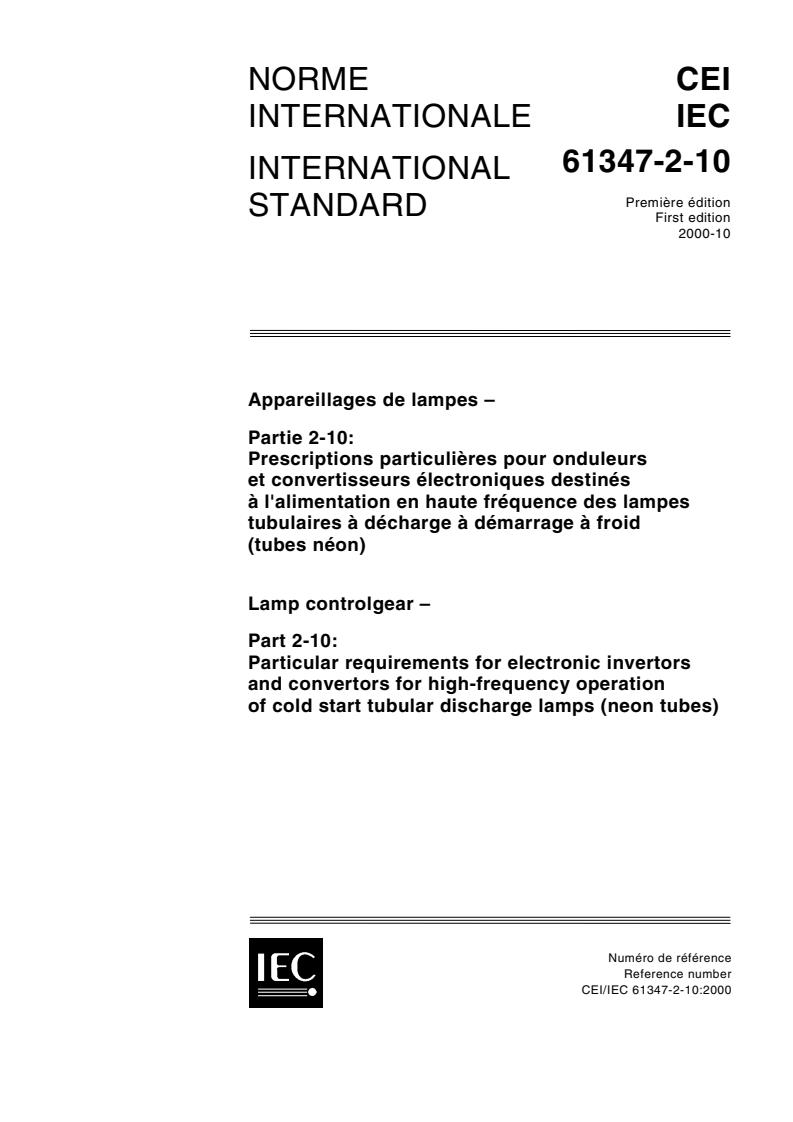
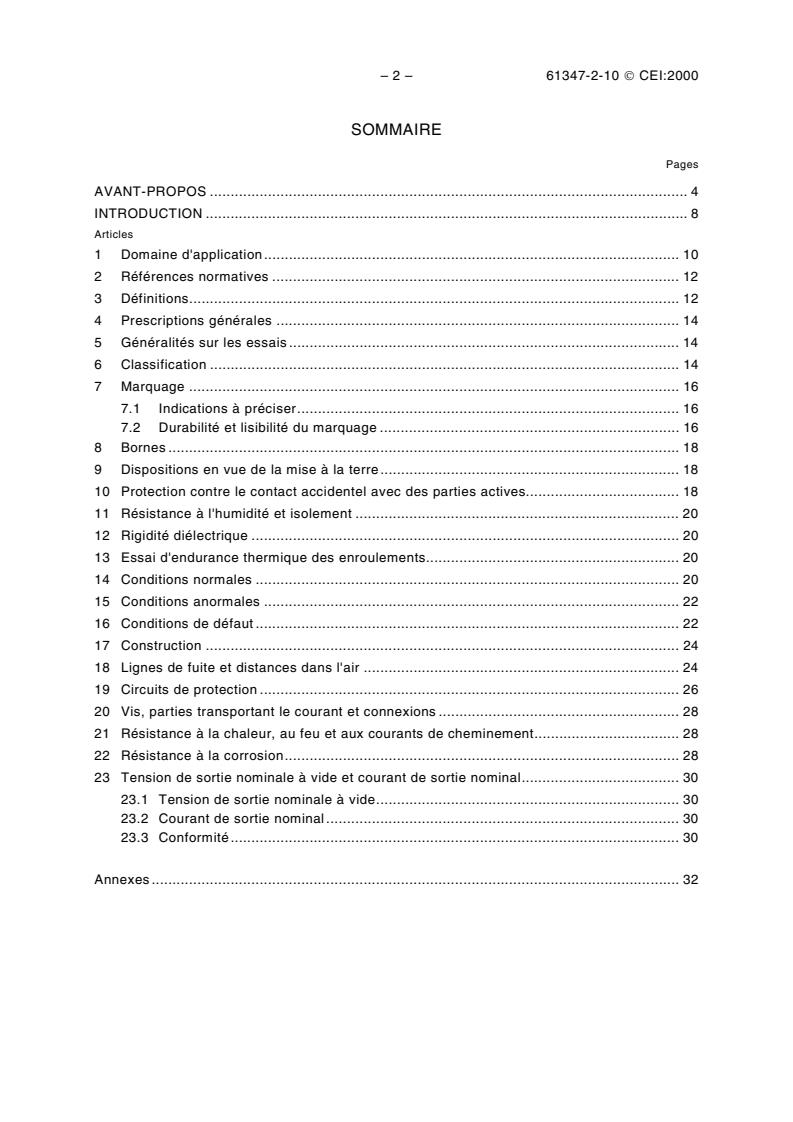
IEC 61347-2-10:2000 - Lamp controlgear - Part 2-10: Particular requirements for electronic invertors and convertors for high-frequency operation of cold start tubular discharge lamps (neon tubes) Released:10/13/2000
IEC 61347-2-10:2000+AMD1:2008 CSV - Lamp controlgear - Part 2-10: Particular requirements for electronic invertors and convertors for high-frequency operation of cold start tubular discharge lamps (neon tubes) Released:1/28/2009
Overview
IEC 61347-2-10:2000 from the International Electrotechnical Commission (IEC) establishes the particular safety and general requirements for electronic invertors and convertors intended for the high-frequency operation of cold start tubular discharge lamps, commonly known as neon tubes. This standard applies to devices powered by DC supplies up to 250 V and/or AC supplies up to 1000 V at 50 Hz or 60 Hz. It is designed to supplement IEC 61347-1, which contains the general and safety requirements for lamp controlgear.
IEC 61347-2-10 is pivotal for manufacturers, installers, and end-users concerned with high-voltage, high-frequency neon lighting systems, ensuring safe, reliable, and compliant operation. The standard specifies type tests for products but does not cover routine production testing.
Key Topics
- Scope of Application: Applies to electronic invertors and convertors operating neon tubes at high frequency, with output voltages typically exceeding 1,000 V and up to 10,000 V.
- Device Types:
- Type A - intended for output voltages up to 5,000 V (peak), current limits of 35 mA RMS/50 mA peak, within 20–50 kHz frequency range, and supply voltages not exceeding 250 V.
- Type B - for output voltages up to 10,000 V (between terminals), current limits of 200 mA RMS/400 mA peak, operating between 10–100 kHz, and with supply voltages up to 1,000 V.
- Safety Provisions:
- Requirements for marking, insulation, earthing, and protection against accidental contact with live parts.
- Detailed provisions for earth-leakage and open-circuit protective devices, especially for high-risk Type B devices.
- Specifications for thermal endurance, insulation strength, creepage distances, and clearances.
- Testing Requirements:
- Type tests to verify safety and compliance with electrical, thermal, and mechanical performance.
- Requirements reference specific test loads to standardize results, given the absence of standardized neon tubes.
- Marking and labeling instructions for critical product information such as voltage, current, frequency, and protection warnings.
Applications
Implementing IEC 61347-2-10 ensures that electronic invertors and convertors for neon tube lighting meet essential safety and performance criteria, addressing risks such as electric shock, overheating, and fire. Typical areas where this standard is applied include:
- Signage and Advertising: Neon tubes powered by high-frequency electronic invertors in outdoor and indoor illuminated signs.
- Architectural Lighting: Luminous tube installations for decorative lighting in commercial buildings, theaters, and resorts.
- Specialty Displays: Installations where visual effect and longevity are crucial, benefitting from the reliable operation of standardized controlgear.
Compliance with IEC 61347-2-10 helps manufacturers meet regulatory and market acceptance requirements, facilitates international trade, and promotes safe installation and use of neon tube systems. Installers and system designers benefit from clear guidelines for equipment selection and configuration to ensure operational safety.
Related Standards
For comprehensive compliance, IEC 61347-2-10 should be applied in conjunction with related IEC lamp controlgear standards, including:
- IEC 61347-1: General and safety requirements for lamp controlgear (foundation standard).
- Other part 2 standards:
- IEC 61347-2-1: Starting devices
- IEC 61347-2-2: Step-down convertors for filament lamps
- IEC 61347-2-3: AC supplied electronic ballasts for fluorescent lamps
- IEC 61347-2-8, -2-9: Ballasts for various discharge lamps
- IEC 60598-1: General requirements for luminaires (pertinent for output terminals and cabling).
- ISO 3864: Safety signs and symbols (for marking requirements)
Staying up-to-date with the latest editions and amendments of these standards is vital for ongoing compliance and safety in the design, manufacture, and maintenance of neon tube lighting systems.
Relations
- Effective Date
- 05-Sep-2023
- Effective Date
- 05-Sep-2023
Buy Documents
IEC 61347-2-10:2000 - Lamp controlgear - Part 2-10: Particular requirements for electronic invertors and convertors for high-frequency operation of cold start tubular discharge lamps (neon tubes) Released:10/13/2000
IEC 61347-2-10:2000+AMD1:2008 CSV - Lamp controlgear - Part 2-10: Particular requirements for electronic invertors and convertors for high-frequency operation of cold start tubular discharge lamps (neon tubes) Released:1/28/2009
Get Certified
Connect with accredited certification bodies for this standard

IMQ S.p.A. (Certification)
Italian electrical product certification.

SLG Prüf- und Zertifizierungs GmbH
German testing and certification body.

UL Solutions
Global safety science company with testing, inspection and certification.
Sponsored listings
Frequently Asked Questions
IEC 61347-2-10:2000 is a standard published by the International Electrotechnical Commission (IEC). Its full title is "Lamp controlgear - Part 2-10: Particular requirements for electronic invertors and convertors for high-frequency operation of cold start tubular discharge lamps (neon tubes)". This standard covers: This part of IEC 61347 specifies general and safety requirements for lamp controlgear for use on d.c. supplies up to 250 V and/or a.c. supplies up to 1 000 V at 50 Hz or 60 Hz. This standard also covers lamp controlgear for lamps which are not yet standardized. Tests dealt with in this standard are type tests. Requirements for testing individual lamp controlgear during production are not included. This part 1 is to be used in conjunction with the appropriate part 2, which contains clauses to supplement or modify the corresponding clauses in part 1, to provide the relevant requirements for each type of product. This first edition of IEC 61347-1, together with parts 1 to 9 of IEC 61347-2, cancels and replaces IEC 60920, IEC 60922, IEC 60924, IEC 60926, IEC 60928 and IEC 61046, and constitute a minor revision. The relationship between the parts that make up IEC 61347-2 and the IEC standards they replace is detailed as follows: IEC 61347-2-1 replaces IEC 60926 IEC 61347-2-2 replaces IEC 61046 IEC 61347-2-3 replaces IEC 60928 IEC 61347-2-4 replaces IEC 60924, Section 3 IEC 61347-2-5 replaces IEC 60924, Section 4 IEC 61347-2-6 replaces IEC 60924, Section 5 IEC 61347-2-7 replaces IEC 60924, Section 6 IEC 61347-2-8 replaces IEC 60920 IEC 61347-2-9 replaces IEC 60922
This part of IEC 61347 specifies general and safety requirements for lamp controlgear for use on d.c. supplies up to 250 V and/or a.c. supplies up to 1 000 V at 50 Hz or 60 Hz. This standard also covers lamp controlgear for lamps which are not yet standardized. Tests dealt with in this standard are type tests. Requirements for testing individual lamp controlgear during production are not included. This part 1 is to be used in conjunction with the appropriate part 2, which contains clauses to supplement or modify the corresponding clauses in part 1, to provide the relevant requirements for each type of product. This first edition of IEC 61347-1, together with parts 1 to 9 of IEC 61347-2, cancels and replaces IEC 60920, IEC 60922, IEC 60924, IEC 60926, IEC 60928 and IEC 61046, and constitute a minor revision. The relationship between the parts that make up IEC 61347-2 and the IEC standards they replace is detailed as follows: IEC 61347-2-1 replaces IEC 60926 IEC 61347-2-2 replaces IEC 61046 IEC 61347-2-3 replaces IEC 60928 IEC 61347-2-4 replaces IEC 60924, Section 3 IEC 61347-2-5 replaces IEC 60924, Section 4 IEC 61347-2-6 replaces IEC 60924, Section 5 IEC 61347-2-7 replaces IEC 60924, Section 6 IEC 61347-2-8 replaces IEC 60920 IEC 61347-2-9 replaces IEC 60922
IEC 61347-2-10:2000 is classified under the following ICS (International Classification for Standards) categories: 29.140.99 - Other standards related to lamps. The ICS classification helps identify the subject area and facilitates finding related standards.
IEC 61347-2-10:2000 has the following relationships with other standards: It is inter standard links to IEC 61347-2-10:2000/AMD1:2008, IEC 61347-2-10:2024. Understanding these relationships helps ensure you are using the most current and applicable version of the standard.
IEC 61347-2-10:2000 is available in PDF format for immediate download after purchase. The document can be added to your cart and obtained through the secure checkout process. Digital delivery ensures instant access to the complete standard document.
Standards Content (Sample)
NORME CEI
INTERNATIONALE IEC
61347-2-10
INTERNATIONAL
Première édition
STANDARD
First edition
2000-10
Appareillages de lampes –
Partie 2-10:
Prescriptions particulières pour onduleurs
et convertisseurs électroniques destinés
à l'alimentation en haute fréquence des lampes
tubulaires à décharge à démarrage à froid
(tubes néon)
Lamp controlgear –
Part 2-10:
Particular requirements for electronic invertors
and convertors for high-frequency operation
of cold start tubular discharge lamps (neon tubes)
Numéro de référence
Reference number
CEI/IEC 61347-2-10:2000
Numérotation des publications Publication numbering
Depuis le 1er janvier 1997, les publications de la CEI As from 1 January 1997 all IEC publications are
sont numérotées à partir de 60000. Ainsi, la CEI 34-1 issued with a designation in the 60000 series. For
devient la CEI 60034-1. example, IEC 34-1 is now referred to as IEC 60034-1.
Editions consolidées Consolidated editions
Les versions consolidées de certaines publications de la The IEC is now publishing consolidated versions of its
CEI incorporant les amendements sont disponibles. Par publications. For example, edition numbers 1.0, 1.1
exemple, les numéros d’édition 1.0, 1.1 et 1.2 indiquent and 1.2 refer, respectively, to the base publication,
respectivement la publication de base, la publication de the base publication incorporating amendment 1 and
base incorporant l’amendement 1, et la publication de the base publication incorporating amendments 1
base incorporant les amendements 1 et 2. and 2.
Informations supplémentaires Further information on IEC publications
sur les publications de la CEI
Le contenu technique des publications de la CEI est The technical content of IEC publications is kept
constamment revu par la CEI afin qu'il reflète l'état under constant review by the IEC, thus ensuring that
actuel de la technique. Des renseignements relatifs à the content reflects current technology. Information
cette publication, y compris sa validité, sont dispo- relating to this publication, including its validity, is
nibles dans le Catalogue des publications de la CEI available in the IEC Catalogue of publications
(voir ci-dessous) en plus des nouvelles éditions, (see below) in addition to new editions, amendments
amendements et corrigenda. Des informations sur les and corrigenda. Information on the subjects under
sujets à l’étude et l’avancement des travaux entrepris consideration and work in progress undertaken by the
par le comité d’études qui a élaboré cette publication, technical committee which has prepared this
ainsi que la liste des publications parues, sont publication, as well as the list of publications issued,
également disponibles par l’intermédiaire de: is also available from the following:
• Site web de la CEI (www.iec.ch) • IEC Web Site (www.iec.ch)
• Catalogue des publications de la CEI • Catalogue of IEC publications
Le catalogue en ligne sur le site web de la CEI The on-line catalogue on the IEC web site
(www.iec.ch/catlg-f.htm) vous permet de faire des (www.iec.ch/catlg-e.htm) enables you to search
recherches en utilisant de nombreux critères, by a variety of criteria including text searches,
comprenant des recherches textuelles, par comité technical committees and date of publication. On-
d’études ou date de publication. Des informations line information is also available on recently
en ligne sont également disponibles sur les issued publications, withdrawn and replaced
nouvelles publications, les publications rempla- publications, as well as corrigenda.
cées ou retirées, ainsi que sur les corrigenda.
• IEC Just Published
• IEC Just Published
Ce résumé des dernières publications parues
This summary of recently issued publications
(www.iec.ch/JP.htm) est aussi disponible par
(www.iec.ch/JP.htm) is also available by email.
courrier électronique. Veuillez prendre contact
Please contact the Customer Service Centre (see
avec le Service client (voir ci-dessous) pour plus
below) for further information.
d’informations.
• Service clients
• Customer Service Centre
Si vous avez des questions au sujet de cette
If you have any questions regarding this
publication ou avez besoin de renseignements
publication or need further assistance, please
supplémentaires, prenez contact avec le Service
contact the Customer Service Centre:
clients:
Email: custserv@iec.ch
Email: custserv@iec.ch
Tél: +41 22 919 02 11
Tel: +41 22 919 02 11
Fax: +41 22 919 03 00
Fax: +41 22 919 03 00
.
NORME CEI
INTERNATIONALE IEC
61347-2-10
INTERNATIONAL
Première édition
STANDARD
First edition
2000-10
Appareillages de lampes –
Partie 2-10:
Prescriptions particulières pour onduleurs
et convertisseurs électroniques destinés
à l'alimentation en haute fréquence des lampes
tubulaires à décharge à démarrage à froid
(tubes néon)
Lamp controlgear –
Part 2-10:
Particular requirements for electronic invertors
and convertors for high-frequency operation
of cold start tubular discharge lamps (neon tubes)
IEC 2000 Droits de reproduction réservés Copyright - all rights reserved
Aucune partie de cette publication ne peut être reproduite ni No part of this publication may be reproduced or utilized in
utilisée sous quelque forme que ce soit et par aucun procédé, any form or by any means, electronic or mechanical,
électronique ou mécanique, y compris la photocopie et les including photocopying and microfilm, without permission in
microfilms, sans l'accord écrit de l'éditeur. writing from the publisher.
International Electrotechnical Commission 3, rue de Varembé Geneva, Switzerland
Telefax: +41 22 919 0300 e-mail: inmail@iec.ch IEC web site http://www.iec.ch
CODE PRIX
Commission Electrotechnique Internationale
S
PRICE CODE
International Electrotechnical Commission
Pour prix, voir catalogue en vigueur
For price, see current catalogue
– 2 – 61347-2-10 CEI:2000
SOMMAIRE
Pages
AVANT-PROPOS . 4
INTRODUCTION .8
Articles
1 Domaine d'application. 10
2 Références normatives . 12
3 Définitions. 12
4 Prescriptions générales . 14
5 Généralités sur les essais . 14
6 Classification .14
7 Marquage . 16
7.1 Indications à préciser. 16
7.2 Durabilité et lisibilité du marquage . 16
8 Bornes . 18
9 Dispositions en vue de la mise à la terre. 18
10 Protection contre le contact accidentel avec des parties actives. 18
11 Résistance à l'humidité et isolement . 20
12 Rigidité diélectrique . 20
13 Essai d'endurance thermique des enroulements. 20
14 Conditions normales . 20
15 Conditions anormales . 22
16 Conditions de défaut . 22
17 Construction .24
18 Lignes de fuite et distances dans l'air . 24
19 Circuits de protection . 26
20 Vis, parties transportant le courant et connexions . 28
21 Résistance à la chaleur, au feu et aux courants de cheminement. 28
22 Résistance à la corrosion. 28
23 Tension de sortie nominale à vide et courant de sortie nominal. 30
23.1 Tension de sortie nominale à vide. 30
23.2 Courant de sortie nominal . 30
23.3 Conformité. 30
Annexes . 32
61347-2-10 IEC:2000 – 3 –
CONTENTS
Page
FOREWORD . 5
INTRODUCTION .9
Clause
1 Scope . 11
2 Normative references. 13
3 Definitions. 13
4 General requirements . 15
5 General notes on tests. 15
6 Classification .15
7 Marking. 17
7.1 Item to be marked. 17
7.2 Durability and legibility of marking . 17
8 Terminals. 19
9 Provisions for earthing . 19
10 Protection against accidental contact with live parts. 19
11 Moisture resistance and insulation . 21
12 Electric strength.21
13 Thermal endurance test for windings. 21
14 Normal conditions . 21
15 Abnormal conditions . 23
16 Fault conditions . 23
17 Construction .25
18 Creepage distances and clearances. 25
19 Protective circuits . 27
20 Screws, current-carrying parts and connections . 29
21 Resistance to heat, fire and tracking . 29
22 Resistance to corrosion. 29
23 No-load rated output voltage and rated output current. 31
23.1 No-load rated output voltage. 31
23.2 Rated output current . 31
23.3 Compliance. 31
Annexes . 33
– 4 – 61347-2-10 CEI:2000
COMMISSION ÉLECTROTECHNIQUE INTERNATIONALE
–––––––––––
APPAREILLAGES DE LAMPES –
Partie 2-10: Prescriptions particulières pour onduleurs
et convertisseurs électroniques destinés à l’alimentation
en haute fréquence des lampes tubulaires à décharge
à démarrage à froid (tubes néon)
AVANT-PROPOS
1) La CEI (Commission Électrotechnique Internationale) est une organisation mondiale de normalisation
composée de l'ensemble des comités électrotechniques nationaux (Comités nationaux de la CEI). La CEI a
pour objet de favoriser la coopération internationale pour toutes les questions de normalisation dans les
domaines de l'électricité et de l'électronique. A cet effet, la CEI, entre autres activités, publie des Normes
internationales. Leur élaboration est confiée à des comités d'études, aux travaux desquels tout Comité national
intéressé par le sujet traité peut participer. Les organisations internationales, gouvernementales et non
gouvernementales, en liaison avec la CEI, participent également aux travaux. La CEI collabore étroitement
avec l'Organisation Internationale de Normalisation (ISO), selon des conditions fixées par accord entre les
deux organisations.
2) Les décisions ou accords officiels de la CEI concernant les questions techniques représentent, dans la mesure
du possible, un accord international sur les sujets étudiés, étant donné que les Comités nationaux intéressés
sont représentés dans chaque comité d’études.
3) Les documents produits se présentent sous la forme de recommandations internationales. Ils sont publiés
comme normes, spécifications techniques, rapports techniques ou guides et agréés comme tels par les
Comités nationaux.
4) Dans le but d'encourager l'unification internationale, les Comités nationaux de la CEI s'engagent à appliquer de
façon transparente, dans toute la mesure possible, les Normes internationales de la CEI dans leurs normes
nationales et régionales. Toute divergence entre la norme de la CEI et la norme nationale ou régionale
correspondante doit être indiquée en termes clairs dans cette dernière.
5) La CEI n’a fixé aucune procédure concernant le marquage comme indication d’approbation et sa responsabilité
n’est pas engagée quand un matériel est déclaré conforme à l’une de ses normes.
6) L’attention est attirée sur le fait que certains des éléments de la présente Norme internationale peuvent faire
l’objet de droits de propriété intellectuelle ou de droits analogues. La CEI ne saurait être tenue pour
responsable de ne pas avoir identifié de tels droits de propriété et de ne pas avoir signalé leur existence.
La Norme internationale CEI 61347-2-10 a été établie par le sous-comité 34C: Appareils
auxiliaires pour lampes, du comité d’études 34 de la CEI: Lampes et équipements associés.
Cette norme doit être utilisée conjointement avec la CEI 61347-1. Elle a été établie sur la
base de la première édition (2000) de cette norme.
La présente partie 2 complète ou modifie les articles correspondants de la CEI 61347-1 de
façon à la transformer en norme CEI: Prescriptions particulières pour ondulateurs et
convertisseurs électroniques destinés à l'alimentation en haute fréquence des lampes
tubulaires à décharge à démarrage à froid (tubes néon)
NOTE Dans la présente norme, les caractères suivants sont employés:
– Prescriptions proprement dites: caractères romains.
– Modalités d'essais: caractères italiques.
– NOTES: petits caractères romains.
61347-2-10 IEC:2000 – 5 –
INTERNATIONAL ELECTROTECHNICAL COMMISSION
–––––––––––
LAMP CONTROLGEAR –
Part 2-10: Particular requirements for electronic invertors
and convertors for high-frequency operation of cold start
tubular discharge lamps (neon tubes)
FOREWORD
1) The IEC (International Electrotechnical Commission) is a worldwide organization for standardization comprising
all national electrotechnical committees (IEC National Committees). The object of the IEC is to promote
international co-operation on all questions concerning standardization in the electrical and electronic fields. To
this end and in addition to other activities, the IEC publishes International Standards. Their preparation is
entrusted to technical committees; any IEC National Committee interested in the subject dealt with may
participate in this preparatory work. International, governmental and non-governmental organizations liaising
with the IEC also participate in this preparation. The IEC collaborates closely with the International
Organization for Standardization (ISO) in accordance with conditions determined by agreement between the
two organizations.
2) The formal decisions or agreements of the IEC on technical matters express, as nearly as possible, an
international consensus of opinion on the relevant subjects since each technical committee has representation
from all interested National Committees.
3) The documents produced have the form of recommendations for international use and are published in the form
of standards, technical specifications, technical reports or guides and they are accepted by the National
Committees in that sense.
4) In order to promote international unification, IEC National Committees undertake to apply IEC International
Standards transparently to the maximum extent possible in their national and regional standards. Any
divergence between the IEC Standard and the corresponding national or regional standard shall be clearly
indicated in the latter.
5) The IEC provides no marking procedure to indicate its approval and cannot be rendered responsible for any
equipment declared to be in conformity with one of its standards.
6) Attention is drawn to the possibility that some of the elements of this International Standard may be the subject
of patent rights. The IEC shall not be held responsible for identifying any or all such patent rights.
International Standard IEC 61347-2-10 has been prepared by subcommittee 34C: Auxiliaries
for lamps, of IEC technical committee 34: Lamps and related equipment.
This standard shall be used in conjunction with IEC 61347-1. It was established on the basis
of the first edition (2000) of that standard.
This part 2 supplements or modifies the corresponding clauses in IEC 61347-1, so as to
convert that publication into the IEC Standard: Particular requirements for electronic invertors
and convertors for high-frequency operation of cold start tubular discharge lamps (neon
tubes)
NOTE In this standard, the following print types are used:
– Requirements proper: in roman type.
– Test specifications: in italic type.
– NOTES: Explanatory matter: in smaller roman type.
– 6 – 61347-2-10 CEI:2000
Le texte de cette norme est issu des documents suivants:
FDIS Rapport de vote
34C/507/FDIS 34C/521/RVD
Le rapport de vote indiqué dans le tableau ci-dessus donne toute information sur le vote ayant
abouti à l'approbation de cette norme.
Cette publication a été rédigée selon les Directives ISO/CEI, Partie 3.
Les annexes A, B, C, D, E, F, H et I font partie intégrante de cette norme.
La CEI 61347 comprend les parties suivantes, présentées sous le titre général Appareillages
de lampes:
– Partie 1: Prescriptions générales et de sécurité
– Partie 2-1: Prescriptions particulières pour les dispositifs d'amorçage (autres que starters
à lueur)
– Partie 2-2: Prescriptions particulières pour les convertisseurs abaisseurs électroniques
alimentés en courant continu ou alternatif pour lampes à incandescence
– Partie 2-3: Prescriptions particulières pour les ballasts électroniques alimentés en courant
alternatif pour lampes fluorescentes
– Partie 2-4: Prescriptions particulières pour les ballasts électroniques alimentés en courant
continu pour l'éclairage général
– Partie 2-5: Prescriptions particulières pour les ballasts électroniques alimentés en courant
continu pour l'éclairage des transports en commun
– Partie 2-6: Prescriptions particulières pour les ballasts électroniques alimentés en courant
continu pour l'éclairage des aéronefs
– Partie 2-7: Prescriptions particulières pour les ballasts électroniques alimentés en courant
continu pour l'éclairage de secours
– Partie 2-8: Prescriptions particulières pour les ballasts pour lampes fluorescentes
– Partie 2-9: Prescriptions particulières pour les ballasts pour lampes à décharge (à
l'exclusion des lampes fluorescentes)
– Partie 2-10: Prescriptions particulières pour les onduleurs et les convertisseurs
électroniques destinés à l’alimentation en haute fréquence des lampes tubulaires à
décharge à démarrage à froid (tubes néon)
1)
– Partie 2-11: Prescriptions particulières pour les circuits électroniques divers
Le comité a décidé que le contenu de cette publication ne sera pas modifié avant 2003. A
cette date, la publication sera:
y reconduite;
y supprimée;
y remplacée par une édition révisée, ou
y amendée.
———————
1)
A publier.
61347-2-10 IEC:2000 – 7 –
The text of this standard is based on the following documents:
FDIS Report on voting
34C/507/FDIS 34C/521/RVD
Full information on the voting for the approval of this standard can be found in the report on
voting indicated in the above table.
This publication has been drafted in accordance with the ISO/IEC Directives, Part 3.
Annexes A, B, C, D, E, F, H and I form an integral part of this standard.
IEC 61347 consists of the following parts, under the general title: Lamp controlgear:
– Part 1: General and safety requirements
– Part 2-1: Particular requirements for starting devices (other than glow starters)
– Part 2-2: Particular requirements for d.c. or a.c. supplied electronic step-down convertors
for filament lamps
– Part 2-3: Particular requirements for a.c. supplied electronic ballasts for fluorescent lamps
– Part 2-4: Particular requirements for d.c electronic ballasts for general lighting
– Part 2-5: Particular requirements for d.c. supplied electronic ballasts for public transport
lighting
– Part 2-6: Particular requirements for d.c supplied electronic ballasts for aircraft lighting
– Part 2-7: Particular requirements for d.c supplied electronic ballasts for emergency lighting
– Part 2-8: Particular requirements for ballasts for fluorescent lamps
– Part 2-9: Particular requirements for ballasts for discharge lamps (excluding fluorescent
lamps)
– Part 2-10: Particular requirements for electronic invertors and convertors for high
frequency operation of cold start tubular discharge lamps (neon tubes)
1)
– Part 2-11: Particular requirements for miscellaneous electronic circuits used with luminaires
The committee has decided that the contents of this publication will remain unchanged until
2003. At this date, the publication will be
reconfirmed;
withdrawn;
replaced by a revised edition, or
amended.
———————
1)
To be published
– 8 – 61347-2-10 CEI:2000
INTRODUCTION
La présente partie de la CEI 61347, et les autres parties qui composent la CEI 61347-2, en
faisant référence à un quelconque des articles de la CEI 61347-1, spécifient le domaine dans
lequel cet article est applicable et l'ordre dans lequel il convient d’effectuer les essais; elles
incluent aussi des prescriptions supplémentaires, si nécessaire. Toutes les parties composant
la CEI 61347-2 sont autonomes et, par conséquent, ne contiennent pas de références les
unes aux autres.
Quand les prescriptions de l'un quelconque des articles de la CEI 61347-1 sont citées en
référence dans la présente partie par la phrase «Les prescriptions de l'article n de la
CEI 61347-1 s'appliquent», cette phrase s'interpréte comme signifiant que toutes les
prescriptions de cet article de la partie 1 s'appliquent, excepté celles qui d'évidence ne
s'appliquent pas au type particulier d'appareillage de lampe considéré dans cette partie
spécifique de la CEI 61347-2.
61347-2-10 IEC:2000 – 9 –
INTRODUCTION
This part of IEC 61347, and the parts which make up IEC 61347-2, in referring to any of the
clauses of IEC 61347-1, specify the extent to which such a clause is applicable and the order
in which the tests are to be performed; they also include additional requirements, as
necessary. All parts which make up IEC 61347-2 are self-contained and, therefore, do not
include references to each other.
Where the requirements of any of the clauses of IEC 61347-1 are referred to in this standard
by the phrase ”The requirements of clause n of IEC 61347-1 apply”, this phrase is interpreted
as meaning that all requirements of the clause in question of part 1 apply, except any which
are clearly inapplicable to the specific type of lamp controlgear covered by this particular part
of IEC 61347-2.
– 10 – 61347-2-10 CEI:2000
APPAREILLAGES DE LAMPES –
Partie 2-10: Prescriptions particulières pour onduleurs
et convertisseurs électroniques destinés à l’alimentation
en haute fréquence des lampes tubulaires à décharge
à démarrage à froid (tubes néon)
1 Domaine d'application
La présente partie de la CEI 61347 spécifie les prescriptions particulières aux onduleurs et
aux convertisseurs électroniques pour le fonctionnement en haute fréquence des lampes
tubulaires à décharge, à cathodes froides. Ces lampes sont utilisées dans les enseignes et
les installations à tubes à décharge lumineux, et fonctionnent sous une tension de sortie
supérieure à 1 000 V mais n'excédant pas 10 000 V, pour le branchement direct sur des
tensions d'alimentation ne dépassant pas 1 000 V à 50 Hz ou 60 Hz ou 1 000 V en courant
continu.
NOTE 1 Au Japon, une tension de sortie de 15 000 V est acceptable.
Les prescriptions pour deux types d'onduleurs et de convertisseurs, A et B, sont spécifiées ci-
dessous:
– Unité de type A: un onduleur ou un convertisseur fonctionnant dans la gamme de
fréquence de 20 kHz à 50 kHz et ayant une tension de sortie (entre bornes) ne dépassant
pas 5 000 V crête et un courant maximal de sortie limité à 35 mA (efficace) et 50 mA
(valeur de crête), la tension d’alimentation ne dépassant pas 250 V à 50 Hz ou 60 Hz ou
250 V en courant continu.
NOTE 2 Le courant de sortie d'une unité de type A peut être considéré comme ne présentant pas de risque de
chocs électriques en raison des limites du courant et de la plage de fréquence.
NOTE 3 Au Japon, une tension de sortie de 15 000 V est acceptable.
– Unité de type B: un onduleur ou un convertisseur ayant une tension de sortie à vide ne
dépassant pas 5 000 V par rapport à la terre ou 10 000 V entre les bornes, fonctionnant
dans une gamme de fréquence entre 10 kHz et 100 kHz avec un courant maximal de
sortie limité à 200 mA (efficace) et 400 mA (valeur de crête).
NOTE 4 Les unités de type B nécessitent une protection additionnelle dans le circuit de sortie.
NOTE 5 Au Japon, une unité de type B dépassant 50 mA et/ou le circuit secondaire mis à la terre ne sont pas
acceptables.
Dans le but de vérifier la sécurité des onduleurs ou des convertisseurs, il est nécessaire de
vérifier leurs performances. Cependant, comme aucune normalisation des caractéristiques
des tubes au néon n'existe, des charges de référence sont spécifiées dans cette norme afin
d'obtenir des résultats d'essais reproductibles.
La température nominale maximale de l'enroulement, t , ne s'applique pas à cette norme.
w
61347-2-10 IEC:2000 – 11 –
LAMP CONTROLGEAR –
Part 2-10: Particular requirements for electronic invertors
and convertors for high-frequency operation of cold start
tubular discharge lamps (neon tubes)
1 Scope
This part of IEC 61347 specifies particular requirements for electronic invertors and
convertors for high-frequency operation of tubular cold-cathode discharge lamps used in
signs and luminous discharge tube installations and operating with an output voltage
exceeding 1 000 V but not exceeding 10 000 V for direct connection to supply voltages not
exceeding 1 000 V at 50 Hz or 60 Hz or 1 000 V d.c.
NOTE 1 In Japan, the output voltage of 15 000 V is acceptable.
The requirements for two types of invertors and convertors, types A and B, are specified as
follows:
– Type A unit: an invertor or convertor operating within the frequency range 20 kHz to
50 kHz, and having an output voltage (between terminals) not exceeding 5 000 V peak, a
maximum output current limited to 35 mA (r.m.s.) and 50 mA (peak value). The supply
voltage does not exceed 250 V at 50 Hz or 60 Hz or 250 V d.c.
NOTE 2 The output current of a type A unit may be considered as not presenting an electric shock hazard due to
the limits on the current and frequency range.
NOTE 3 In Japan, the output voltage of 15 000 V is acceptable.
– Type B unit: an invertor or convertor having a no-load output voltage not exceeding
5 000 V to earth or 10 000 V between terminals, operating within the frequency range
10 kHz to 100 kHz with a maximum output current limited to 200 mA (r.m.s.) and 400 mA
(peak value).
NOTE 4 Type B units require additional protection in the output circuit.
NOTE 5 In Japan, a type B unit exceeding 50 mA and/or the secondary grounded is not acceptable.
In order to check the safety of invertors or convertors, it is necessary to check their
performance. However, since no standardization of the characteristics of neon tubes exists,
reference loads are specified in this standard to ensure reproducible test results.
The rated maximum operating temperature of the winding, t , is not applicable to this
w
standard.
– 12 – 61347-2-10 CEI:2000
2 Références normatives
Pour les besoins de la présente partie de la CEI 61347, les références normatives données à
l’article 2 de la CEI 61347-1 et qui sont mentionnées dans la présente norme s’appliquent,
conjointement avec les références normatives suivantes:
CEI 61347-1, Appareillages de lampes – Partie 1: Prescriptions générales et prescriptions de
sécurité
ISO 3864:1984, Couleurs et signaux de sécurité
3 Définitions
Pour les besoins de la présente partie de la CEI 61347, les définitions de l'article 3 de la
CEI 61347-1, à l'exception des définitions 3.14, 3.16 et 3.17 s'appliquent, conjointement avec
les suivantes:
3.1
lampes à décharge tubulaire à cathode froide (tube néon)
tubes à décharge ayant des cathodes qui peuvent être revêtues avec un matériau émettant
des électrons et qui, pendant la phase de démarrage, sans échauffement extérieur, émettent
des électrons par effet de champ. Ces lampes ont un remplissage à basse pression d'un gaz
rare (ou d'un mélange de gaz rares) et éventuellement de vapeur de mercure. Elles peuvent
avoir intérieurement un revêtement de matières fluorescentes
3.2
tension de sortie nominale à vide
U
o
tension nominale maximale entre les bornes de sortie ou les extrémités des fils de sortie
intégrés de l'onduleur ou du convertisseur connecté à la tension d'alimentation nominale et à
la fréquence nominale, avec aucune charge sur le circuit de sortie. C'est la plus grande des
deux valeurs: valeur efficace ou valeur de crête, divisée par 2
3.3
onduleur
convertisseur d'énergie qui convertit le courant continu en courant alternatif
3.4
convertisseur
élément destiné à la conversion électronique du courant alternatif à une fréquence donnée en
une alimentation en courant alternatif à une autre fréquence
3.5
dispositif de protection contre les fuites à la terre
dispositif qui supprime la puissance de sortie d'un onduleur ou d'un convertisseur dans
l'éventualité d'un courant de défaut circulant entre une partie quelconque du circuit de sortie à
haute tension et la terre
61347-2-10 IEC:2000 – 13 –
2 Normative references
For the purpose of this part of IEC 61347, the normative references given in clause 2 of
IEC 61347-1 which are mentioned in this standard apply, together with the following
normative references:
IEC 61347-1, Lamp controlgear – Part 1: General and safety requirements
ISO 3864:1984, Safety colours and safety signs
3 Definitions
For the purpose of this part of IEC 61347, the definitions given in clause 3 of IEC 61347-1,
with the exception of definitions 3.14, 3.16 and 3.17 apply, together with the following:
3.1
tubular cold cathode discharge lamp (neon tube)
discharge tube having cathodes which may be coated with an electron emitting material and
which, during the starting process without external heating, emits electrons by field emission.
These lamps have a low-pressure filling of a rare gas (or a mixture of rare gases) and
possibly mercury vapour. They can have an inside coating of fluorescent materials
3.2
no-load rated output voltage
U
o
maximum rated voltage between the output terminals or the ends of the integral connecting
leads of the invertor or convertor connected to the rated supply voltage at rated frequency,
with no load on the output circuit. It is the r.m.s value or the peak value divided by 2
(whichever is the greater)
3.3
invertor
electric energy transducer that converts direct current to alternating current
3.4
convertor
unit for the electronic conversion of a.c. supply at one frequency to an a.c. supply at another
frequency
3.5
earth-leakage protective device
device which removes the output power from an invertor or convertor in the event of an earth
fault current flowing between any part of the output high-voltage circuit and earth
– 14 – 61347-2-10 CEI:2000
3.6
dispositif de protection contre les circuits ouverts
dispositif qui supprime la puissance de sortie d'un onduleur ou d'un convertisseur dans
l'éventualité d'un non-fonctionnement du tube ou d'une interruption dans le circuit de sortie
haute tension
NOTE Un dispositif de protection contre les circuits ouverts peut fonctionner par la détection d'un accroissement
de la tension de sortie ou par tout autre moyen approprié.
3.7
limite supérieure de déclenchement
tension de sortie d'un onduleur ou d'un convertisseur pour laquelle un dispositif de protection
contre les circuits ouverts fonctionne
3.8
circuit de sortie
partie du circuit constituée des éléments suivants :
a) câbles entre les bornes de sortie d’un onduleur ou d’un convertisseur et tubes à décharge;
b) tubes à décharge;
c) éventuelles connexions en série entre les tubes.
Elle n’inclut pas d’éventuels composants internes ou le câblage de l’onduleur ou du convertisseur.
4 Prescriptions générales
Les prescriptions de l'article 4 de la CEI 61347-1 s'appliquent.
5 Généralités sur les essais
Les prescriptions de l'article 5 de la CEI 61347-1 s'appliquent.
6 Classification
Les prescriptions de l'article 6 de la CEI 61347-1 s'appliquent, conjointement avec ce qui suit:
Les onduleurs et les convertisseurs doivent être classés en fonction de leur tension de sortie
à vide, de leur fréquence de fonctionnement et de leur gamme de courants de sortie, comme
suit:
a) onduleur ou convertisseur de type A;
b) onduleur ou convertisseur de type B.
Les onduleurs ou convertisseurs de type B peuvent avoir plus d'une sortie. Dans ce cas,
chaque sortie doit être conforme à ce qui précède.
61347-2-10 IEC:2000 – 15 –
3.6
open-circuit protective device
device which removes the output power from an invertor or convertor in the event of non-
operation of the tube load or an interruption in the output high-voltage circuit
NOTE An open-circuit protective device may operate by detecting an increase in the output voltage or by other
suitable means.
3.7
upper shut-down limit
output voltage of an invertor or convertor at which an open-circuit protective device operates
3.8
output circuit
that part of the circuit consisting of
a) cables between the output terminals of the convertor or invertor and the discharge tubes;
b) discharge tubes;
c) any series connections between the discharge tubes.
It does not include any internal components or wiring of the invertor or convertor.
4 General requirements
The general requirements of clause 4 of IEC 61347-1 apply.
5 General notes on tests
The general requirements of clause 5 of IEC 61347-1 apply.
6 Classification
The requirements of clause 6 of IEC 61347-1 apply, together with the following:
Invertors and convertors shall be classified according to their no-load output voltage, the
rating of the operating frequency and output current range, as follows:
a) type A invertor or convertor;
b) type B invertor or convertor.
Type B invertors or convertors may have more than one output. In this case, each output shall
comply with the above.
– 16 – 61347-2-10 CEI:2000
7 Marquage
7.1 Indications à préciser
Les marquages des onduleurs et des convertisseurs électroniques destinés à l'alimentation
en haute fréquence des lampes tubulaires à décharge à démarrage à froid doivent être
indélébiles et lisibles, et conformes aux prescriptions de 7.2 de la CEI 61347-1. Ils doivent
comporter les indications suivantes:
– les points a), b), c), d), e) et f) de 7.1 de la CEI 61347-1, conjointement avec
– pour les onduleurs et convertisseurs électroniques indépendants: une notice d'avertissement
pour la haute tension, par exemple: «HAUTE TENSION», et un symbole en forme de
flèche en conformité avec la CEI 60417 et la figure 1 de l’ISO 3864.
Ce marquage doit être placé à l'extérieur de l'enveloppe de l'onduleur ou du convertisseur
électronique pour qu'il soit clairement visible.
NOTE Il n'est pas nécessaire de marquer séparément les onduleurs ou convertisseurs à intégrer car leur
marquage est traité dans les normes concernant les enseignes ou les luminaires.
– type A ou type B, selon le cas.
7.2 Durabilité et lisibilité du marquage
En plus des marquages ci-dessus, les renseignements suivants doivent, si nécessaire, être
indiqués sur les inducteurs et les convertisseurs électroniques ou figurer dans le catalogue du
fabricant ou document similaire:
– points h), k), m), n) et o) de 7.1 de la CEI 61347-1, conjointement avec
– si l'onduleur ou le convertisseur électronique est constitué de plus d'une unité
indépendante, les unités assurant les sorties, qui doivent être marquées avec les informations
nécessaires qui concernent les autres unités associées comme les alimentations à courant
continu ou les condensateurs;
– la gamme et le nombre de types de tubes, ainsi que les diamètres et longueurs
recommandés pour l'onduleur ou le convertisseur;
– dans le cas ou l'onduleur ou le convertisseur n'est pas fourni avec des fils intégrés
(câbles), les détails sur les types de câbles recommandés et les longueurs maximales des
câbles;
– les détails concernant les types de surfaces de montage convenables et les dispositions
de montage conseillées;
– les détails des dispositions de mise à la terre, incluant le branchement de l'enroulement
de sortie de l'onduleur ou du convertisseur, selon le cas;
– les détails sur les éventuels circuits de protection incorporés dans l'onduleur ou le
convertisseur;
– les caractéristiques électriques nominales suivantes:
1) tension de sortie à vide. Ce marquage doit être fait sous la forme suivante:
y si la borne de sortie n’est pas connectée à une borne de terre:
«.kV» (par exemple 4 kV),
y si l'une des bornes de sortie est connectée à une borne de terre:
«E - .kV» (par exemple E-4 kV),
y si le point milieu de l'enroulement de sortie se réfère à une borne de terre:
«. - E -.kV» (par exemple 3-E-3 kV);
NOTE Au Japon, E- .kV et - E - kV ne sont pas utilisés.
Pour les unités de type A, ceci sera la valeur de crête. Pour les unités de type B, ce sera
la plus grande des deux valeurs suivantes: valeur efficace ou 0,5 fois la valeur de crête.
61347-2-10 IEC:2000 – 17 –
7 Marking
7.1 Item to be marked
Electronic invertors and convertors for high-frequency operation of cold start tubular
discharge lamps shall be clearly and durably marked, in accordance with the requirements of
7.2 of IEC 61347-1, with the following markings:
– items a), b), c), d), e) and f) of 7.1 of IEC 61347-1, together with
– on independent electronic invertors and convertors, a warning notice for high voltage, e.g.
"HIGH VOLTAGE" and a symbol in the form of an arrow in accordance with IEC 60417
and figure 1 of ISO 3864.
This marking shall bea placed on the outside of the enclosure of the electronic invertor or
convertor so that it is clearly visible.
NOTE It is not necessary to mark integral invertors or convertors separately as their marking is the subject of
relevant sign or luminaire standards.
– type A or type B as applicable.
7.2 Durability and legibility of marking
In addition to the above mandatory marking, the following information, if applicable, shall be
given on the electronic invertor or convertor, or be made available in the manufacturer’s
catalogue or similar:
– items h), k), m), n) and o) of 7.1 of IEC 61347-1, together with
– if the electronic invertor or convertor consists of more than one separate unit, the units
providing the output shall be marked with necessary information about other associated
units such as d.c power supplies or capacitors;
– the range and number of tube types, diameters and lengths recommended for the invertor
or convertor;
– where the invertor or convertor is not supplied with integral leads, (tails) details of the
recommended cable types and maximum cable lengths;
– details of suitable types of mounting surfaces and recommended mounting arrangements;
– details of earthing arrangements, including connections to the invertor or convertor output
winding, where appropriate;
– details of any protective circuits incorporated in the invertor or convertor;
– the following nominal electrical characteristics:
1) output no-load voltage. This marking shall be in the following terms:
y if the output terminal is not connected to an earthing terminal:
“.kV” (e.g. 4 kV),
y if one output terminal is connected to an earthing terminal:
“E -.kV” (e.g. E – 4 kV),
y if the centre point of the output winding is referred to an earthing terminal:
“. - E -.kV” (e.g. 3 – E – 3 kV);
NOTE In Japan, E -.kV and - E - kV are not used.
For type A units, this will be the peak value. For type B units, it will be
...
IEC 61347-2-10 ®
Edition 1.1 2009-01
CONSOLIDATED VERSION
INTERNATIONAL
STANDARD
NORME
INTERNATIONALE
Lamp controlgear –
Part 2-10: Particular requirements for electronic invertors and convertors for
high-frequency operation of cold start tubular discharge lamps (neon tubes)
Appareillages de lampes –
Partie 2-10: Prescriptions particulières pour onduleurs et convertisseurs
électroniques destinés à l'alimentation en haute fréquence des lampes
tubulaires à décharge à démarrage à froid (tubes néon)
All rights reserved. Unless otherwise specified, no part of this publication may be reproduced or utilized in any form
or by any means, electronic or mechanical, including photocopying and microfilm, without permission in writing from
either IEC or IEC's member National Committee in the country of the requester. If you have any questions about IEC
copyright or have an enquiry about obtaining additional rights to this publication, please contact the address below or
your local IEC member National Committee for further information.
Droits de reproduction réservés. Sauf indication contraire, aucune partie de cette publication ne peut être reproduite
ni utilisée sous quelque forme que ce soit et par aucun procédé, électronique ou mécanique, y compris la photocopie
et les microfilms, sans l'accord écrit de l'IEC ou du Comité national de l'IEC du pays du demandeur. Si vous avez des
questions sur le copyright de l'IEC ou si vous désirez obtenir des droits supplémentaires sur cette publication, utilisez
les coordonnées ci-après ou contactez le Comité national de l'IEC de votre pays de résidence.
IEC Central Office Tel.: +41 22 919 02 11
3, rue de Varembé Fax: +41 22 919 03 00
CH-1211 Geneva 20 info@iec.ch
Switzerland www.iec.ch
About the IEC
The International Electrotechnical Commission (IEC) is the leading global organization that prepares and publishes
International Standards for all electrical, electronic and related technologies.
About IEC publications
The technical content of IEC publications is kept under constant review by the IEC. Please make sure that you have the
latest edition, a corrigenda or an amendment might have been published.
IEC Catalogue - webstore.iec.ch/catalogue Electropedia - www.electropedia.org
The stand-alone application for consulting the entire The world's leading online dictionary of electronic and
bibliographical information on IEC International Standards, electrical terms containing 20 000 terms and definitions in
Technical Specifications, Technical Reports and other English and French, with equivalent terms in 15 additional
documents. Available for PC, Mac OS, Android Tablets and languages. Also known as the International Electrotechnical
iPad. Vocabulary (IEV) online.
IEC publications search - www.iec.ch/searchpub IEC Glossary - std.iec.ch/glossary
The advanced search enables to find IEC publications by a 65 000 electrotechnical terminology entries in English and
variety of criteria (reference number, text, technical French extracted from the Terms and Definitions clause of
committee,…). It also gives information on projects, replaced IEC publications issued since 2002. Some entries have been
and withdrawn publications. collected from earlier publications of IEC TC 37, 77, 86 and
CISPR.
IEC Just Published - webstore.iec.ch/justpublished
Stay up to date on all new IEC publications. Just Published IEC Customer Service Centre - webstore.iec.ch/csc
details all new publications released. Available online and If you wish to give us your feedback on this publication or
also once a month by email. need further assistance, please contact the Customer Service
Centre: csc@iec.ch.
A propos de l'IEC
La Commission Electrotechnique Internationale (IEC) est la première organisation mondiale qui élabore et publie des
Normes internationales pour tout ce qui a trait à l'électricité, à l'électronique et aux technologies apparentées.
A propos des publications IEC
Le contenu technique des publications IEC est constamment revu. Veuillez vous assurer que vous possédez l’édition la
plus récente, un corrigendum ou amendement peut avoir été publié.
Catalogue IEC - webstore.iec.ch/catalogue Electropedia - www.electropedia.org
Application autonome pour consulter tous les renseignements
Le premier dictionnaire en ligne de termes électroniques et
bibliographiques sur les Normes internationales,
électriques. Il contient 20 000 termes et définitions en anglais
Spécifications techniques, Rapports techniques et autres
et en français, ainsi que les termes équivalents dans 15
documents de l'IEC. Disponible pour PC, Mac OS, tablettes
langues additionnelles. Egalement appelé Vocabulaire
Android et iPad.
Electrotechnique International (IEV) en ligne.
Recherche de publications IEC - www.iec.ch/searchpub
Glossaire IEC - std.iec.ch/glossary
La recherche avancée permet de trouver des publications IEC
65 000 entrées terminologiques électrotechniques, en anglais
en utilisant différents critères (numéro de référence, texte,
et en français, extraites des articles Termes et Définitions des
comité d’études,…). Elle donne aussi des informations sur les
publications IEC parues depuis 2002. Plus certaines entrées
projets et les publications remplacées ou retirées.
antérieures extraites des publications des CE 37, 77, 86 et
CISPR de l'IEC.
IEC Just Published - webstore.iec.ch/justpublished
Restez informé sur les nouvelles publications IEC. Just Service Clients - webstore.iec.ch/csc
Published détaille les nouvelles publications parues. Si vous désirez nous donner des commentaires sur cette
Disponible en ligne et aussi une fois par mois par email. publication ou si vous avez des questions contactez-nous:
csc@iec.ch.
IEC 61347-2-10 ®
Edition 1.1 2009-01
CONSOLIDATED VERSION
INTERNATIONAL
STANDARD
NORME
INTERNATIONALE
Lamp controlgear –
Part 2-10: Particular requirements for electronic invertors and convertors for
high-frequency operation of cold start tubular discharge lamps (neon tubes)
Appareillages de lampes –
Partie 2-10: Prescriptions particulières pour onduleurs et convertisseurs
électroniques destinés à l'alimentation en haute fréquence des lampes tubulaires
à décharge à démarrage à froid (tubes néon)
INTERNATIONAL
ELECTROTECHNICAL
COMMISSION
COMMISSION
ELECTROTECHNIQUE
INTERNATIONALE
ICS 29.140.99 ISBN 978-2-8891-0511-3
– 2 – 61347-2-10 © IEC:2000+A1:2008
CONTENTS
FOREWORD.3
INTRODUCTION.5
1 Scope.6
2 Normative references .6
3 Definitions .7
4 General requirements .8
5 General notes on tests .8
6 Classification.8
7 Marking .8
7.1 Items to be marked.8
7.2 Durability and legibility of marking .8
8 Terminals .9
9 Provisions for earthing.9
10 Protection against accidental contact with live parts .9
11 Moisture resistance and insulation.10
12 Electric strength .10
13 Thermal endurance test for windings .10
14 Normal conditions.10
15 Abnormal conditions .11
16 Fault conditions .11
17 Construction .12
18 Creepage distances and clearances .12
19 Protective circuits .12
20 Screws, current-carrying parts and connections.14
21 Resistance to heat, fire and tracking.14
22 Resistance to corrosion .14
23 No-load rated output voltage and rated output current .14
23.1 No-load rated output voltage .14
23.2 Rated output current.14
23.3 Compliance .14
Annexes .15
61347-2-10 © IEC:2000+A1:2008 – 3 –
INTERNATIONAL ELECTROTECHNICAL COMMISSION
–––––––––––
LAMP CONTROLGEAR –
Part 2-10: Particular requirements for electronic invertors
and convertors for high-frequency operation of cold start
tubular discharge lamps (neon tubes)
FOREWORD
1) The International Electrotechnical Commission (IEC) is a worldwide organization for standardization comprising
all national electrotechnical committees (IEC National Committees). The object of IEC is to promote
international co-operation on all questions concerning standardization in the electrical and electronic fields. To
this end and in addition to other activities, IEC publishes International Standards, Technical Specifications,
Technical Reports, Publicly Available Specifications (PAS) and Guides (hereafter referred to as “IEC
Publication(s)”). Their preparation is entrusted to technical committees; any IEC National Committee interested
in the subject dealt with may participate in this preparatory work. International, governmental and non-
governmental organizations liaising with the IEC also participate in this preparation. IEC collaborates closely
with the International Organization for Standardization (ISO) in accordance with conditions determined by
agreement between the two organizations.
2) The formal decisions or agreements of IEC on technical matters express, as nearly as possible, an international
consensus of opinion on the relevant subjects since each technical committee has representation from all
interested IEC National Committees.
3) IEC Publications have the form of recommendations for international use and are accepted by IEC National
Committees in that sense. While all reasonable efforts are made to ensure that the technical content of IEC
Publications is accurate, IEC cannot be held responsible for the way in which they are used or for any
misinterpretation by any end user.
4) In order to promote international uniformity, IEC National Committees undertake to apply IEC Publications
transparently to the maximum extent possible in their national and regional publications. Any divergence
between any IEC Publication and the corresponding national or regional publication shall be clearly indicated in
the latter.
5) IEC provides no marking procedure to indicate its approval and cannot be rendered responsible for any
equipment declared to be in conformity with an IEC Publication.
6) All users should ensure that they have the latest edition of this publication.
7) No liability shall attach to IEC or its directors, employees, servants or agents including individual experts and
members of its technical committees and IEC National Committees for any personal injury, property damage or
other damage of any nature whatsoever, whether direct or indirect, or for costs (including legal fees) and
expenses arising out of the publication, use of, or reliance upon, this IEC Publication or any other IEC
Publications.
8) Attention is drawn to the Normative references cited in this publication. Use of the referenced publications is
indispensable for the correct application of this publication.
9) Attention is drawn to the possibility that some of the elements of this IEC Publication may be the subject of
patent rights. IEC shall not be held responsible for identifying any or all such patent rights.
This consolidated version of the official IEC Standard and its amendment has been
prepared for user convenience.
IEC 61347-2-10 edition 1.1 contains the first edition (2000) [documents 34C/507/FDIS and
34C/521/RVD] and its amendment 1 (2008) [documents 34C/849/FDIS and 34C/859/RVD].
A vertical line in the margin shows where the base publication has been modified by
amendment 1.
International Standard IEC 61347-2-10 has been prepared by subcommittee 34C: Auxiliaries
for lamps, of IEC technical committee 34: Lamps and related equipment.
– 4 – 61347-2-10 © IEC:2000+A1:2008
This standard shall be used in conjunction with IEC 61347-1. It was established on the basis
of the first edition (2000) of that standard.
This part 2 supplements or modifies the corresponding clauses in IEC 61347-1, so as to
convert that publication into the IEC Standard: Particular requirements for electronic invertors
and convertors for high-frequency operation of cold start tubular discharge lamps (neon
tubes)
NOTE In this standard, the following print types are used:
– Requirements proper: in roman type.
– Test specifications: in italic type.
– NOTES: Explanatory matter: in smaller roman type.
Annexes A, B, C, D, E, F, H and I form an integral part of this standard.
IEC 61347 consists of the following parts, under the general title: Lamp controlgear:
– Part 1: General and safety requirements
– Part 2-1: Particular requirements for starting devices (other than glow starters)
– Part 2-2: Particular requirements for d.c. or a.c. supplied electronic step-down convertors
for filament lamps
– Part 2-3: Particular requirements for a.c. supplied electronic ballasts for fluorescent lamps
– Part 2-4: Particular requirements for d.c electronic ballasts for general lighting
– Part 2-5: Particular requirements for d.c. supplied electronic ballasts for public transport
lighting
– Part 2-6: Particular requirements for d.c supplied electronic ballasts for aircraft lighting
– Part 2-7: Particular requirements for d.c supplied electronic ballasts for emergency lighting
– Part 2-8: Particular requirements for ballasts for fluorescent lamps
– Part 2-9: Particular requirements for ballasts for discharge lamps (excluding fluorescent
lamps)
– Part 2-10: Particular requirements for electronic invertors and convertors for high
frequency operation of cold start tubular discharge lamps (neon tubes)
– Part 2-11: Particular requirements for miscellaneous electronic circuits used with luminaires
The committee has decided that the contents of the base publication and its amendments will
remain unchanged until the maintenance result date indicated on the IEC web site under
"http://webstore.iec.ch" in the data related to the specific publication. At this date,
the publication will be
• reconfirmed,
• withdrawn,
• replaced by a revised edition, or
• amended.
61347-2-10 © IEC:2000+A1:2008 – 5 –
INTRODUCTION
This part of IEC 61347, and the parts which make up IEC 61347-2, in referring to any of the
clauses of IEC 61347-1, specify the extent to which such a clause is applicable and the order
in which the tests are to be performed; they also include additional requirements, as
necessary. All parts which make up IEC 61347-2 are self-contained and, therefore, do not
include references to each other.
Where the requirements of any of the clauses of IEC 61347-1 are referred to in this standard
by the phrase ”The requirements of clause n of IEC 61347-1 apply”, this phrase is interpreted
as meaning that all requirements of the clause in question of part 1 apply, except any which
are clearly inapplicable to the specific type of lamp controlgear covered by this particular part
of IEC 61347-2.
– 6 – 61347-2-10 © IEC:2000+A1:2008
LAMP CONTROLGEAR –
Part 2-10: Particular requirements for electronic invertors
and convertors for high-frequency operation of cold start
tubular discharge lamps (neon tubes)
1 Scope
This part of IEC 61347 specifies particular requirements for electronic invertors and
convertors for high-frequency operation of tubular cold-cathode discharge lamps used in
signs and luminous discharge tube installations and operating with an output voltage
exceeding 1 000 V but not exceeding 10 000 V for direct connection to supply voltages not
exceeding 1 000 V at 50 Hz or 60 Hz or 1 000 V d.c.
NOTE 1 In Japan, the output voltage of 15 000 V is acceptable.
The requirements for two types of invertors and convertors, types A and B, are specified as
follows:
– Type A unit: an invertor or convertor operating within the frequency range 20 kHz to
50 kHz, and having an output voltage (between terminals) not exceeding 5 000 V peak, a
maximum output current limited to 35 mA (r.m.s.) and 50 mA (peak value). The supply
voltage does not exceed 250 V at 50 Hz or 60 Hz or 250 V d.c.
NOTE 2 The output current of a type A unit may be considered as not presenting an electric shock hazard due to
the limits on the current and frequency range.
NOTE 3 In Japan, the output voltage of 15 000 V is acceptable.
– Type B unit: an invertor or convertor having a no-load output voltage not exceeding
5 000 V to earth or 10 000 V between terminals, operating within the frequency range
10 kHz to 100 kHz with a maximum output current limited to 200 mA (r.m.s.) and 400 mA
(peak value).
NOTE 4 Type B units require additional protection in the output circuit.
NOTE 5 In Japan, a type B unit exceeding 50 mA and/or the secondary grounded is not acceptable.
In order to check the safety of invertors or convertors, it is necessary to check their
performance. However, since no standardization of the characteristics of neon tubes exists,
reference loads are specified in this standard to ensure reproducible test results.
The rated maximum operating temperature of the winding, t , is not applicable to this
w
standard.
2 Normative references
For the purpose of this part of IEC 61347, the normative references given in clause 2 of
IEC 61347-1 which are mentioned in this standard apply, together with the following
normative references:
IEC 61347-1, Lamp controlgear – Part 1: General and safety requirements
ISO 3864:1984, Safety colours and safety signs
61347-2-10 © IEC:2000+A1:2008 – 7 –
3 Definitions
For the purpose of this part of IEC 61347, the definitions given in clause 3 of IEC 61347-1,
with the exception of definitions 3.14, 3.16 and 3.17 apply, together with the following:
3.1
tubular cold cathode discharge lamp (neon tube)
discharge tube having cathodes which may be coated with an electron emitting material and
which, during the starting process without external heating, emits electrons by field emission.
These lamps have a low-pressure filling of a rare gas (or a mixture of rare gases) and
possibly mercury vapour. They can have an inside coating of fluorescent materials
3.2
no-load rated output voltage
U
o
maximum rated voltage between the output terminals or the ends of the integral connecting
leads of the invertor or convertor connected to the rated supply voltage at rated frequency
with no load on the output circuit
NOTE For sinusoidal wave forms, it is the r.m.s. value or the peak value divided by square root of 2. For other
waveforms, it is the r.m.s. value or the equivalent value deduced from the peak value, obtained by mathematical
calculation.
3.3
invertor
electric energy transducer that converts direct current to alternating current
3.4
convertor
unit for the electronic conversion of a.c. supply at one frequency to an a.c. supply at another
frequency
3.5
earth-leakage protective device
device which removes the output power from an invertor or convertor in the event of an earth
fault current flowing between any part of the output high-voltage circuit and earth
3.6
open-circuit protective device
device which removes the output power from an invertor or convertor in the event of non-
operation of the tube load or an interruption in the output high-voltage circuit
NOTE An open-circuit protective device may operate by detecting an increase in the output voltage or by other
suitable means.
3.7
upper shut-down limit
output voltage of an invertor or convertor at which an open-circuit protective device operates
3.8
output high-voltage circuit
that part of the circuit consisting of
a) cables between the output terminals of the convertor or invertor and the discharge tubes;
b) discharge tubes;
c) any series connections between the discharge tubes.
It does not include any internal components or wiring of the invertor or convertor.
– 8 – 61347-2-10 © IEC:2000+A1:2008
4 General requirements
The general requirements of clause 4 of IEC 61347-1 apply.
5 General notes on tests
The general requirements of clause 5 of IEC 61347-1 apply.
6 Classification
The requirements of clause 6 of IEC 61347-1 apply, together with the following:
Invertors and convertors shall be classified according to their no-load output voltage, the
rating of the operating frequency and output current range, as follows:
a) type A invertor or convertor;
b) type B invertor or convertor.
Type B invertors or convertors may have more than one output. In this case, each output shall
comply with the above.
7 Marking
7.1 Items to be marked
Electronic invertors and convertors for high-frequency operation of cold start tubular
discharge lamps shall be clearly and durably marked, in accordance with the requirements of
7.2 of IEC 61347-1, with the following markings:
– items a), b), c), d), e) and f) of 7.1 of IEC 61347-1, together with
– on independent electronic invertors and convertors, a warning notice for high voltage, e.g.
"HIGH VOLTAGE" and a symbol in the form of an arrow in accordance with IEC 60417
and figure 1 of ISO 3864.
This marking shall be placed on the outside of the enclosure of the electronic invertor or
convertor so that it is clearly visible.
NOTE It is not necessary to mark integral invertors or convertors separately as their marking is the subject of
relevant sign or luminaire standards.
– type A or type B as applicable.
7.2 Durability and legibility of marking
In addition to the above mandatory marking, the following information, if applicable, shall be
given on the electronic invertor or convertor, or be made available in the manufacturer’s
catalogue or similar:
– items h), k), m), n) and o) of 7.1 of IEC 61347-1, together with
– if the electronic invertor or convertor consists of more than one separate unit, the units
providing the output shall be marked with necessary information about other associated
units such as d.c power supplies or capacitors;
– the range and number of tube types, diameters and lengths recommended for the invertor
or convertor;
– where the invertor or convertor is not supplied with integral leads, (tails) details of the
recommended cable types and maximum cable lengths;
– details of suitable types of mounting surfaces and recommended mounting arrangements;
61347-2-10 © IEC:2000+A1:2008 – 9 –
– details of earthing arrangements, including connections to the invertor or convertor output
winding, where appropriate;
– details of any protective circuits incorporated in the invertor or convertor;
– the following nominal electrical characteristics:
1) output no-load voltage. This marking shall be in the following terms:
y if the output terminal is not connected to an earthing terminal:
“.kV” (e.g. 4 kV),
y if one output terminal is connected to an earthing terminal:
“E -.kV” (e.g. E – 4 kV),
y if the centre point of the output winding is referred to an earthing terminal:
“. - E -.kV” (e.g. 3 – E – 3 kV);
NOTE In Japan, E -.kV and - E - kV are not used.
For type A units, this will be the peak value. For type B units, it will be the r.m.s. value
or 0,5 times the peak value, whichever is the greater.
2) output current with rated load;
3) output frequency.
Where appropriate, the details in items 1) and 2) above shall be marked for each independent
output circuit of an invertor or convertor.
8 Terminals
The requirements of clause 8 of IEC 61347-1 apply, together with the following:
Invertors or convertors provided with tails shall comply with the relevant requirements of
IEC 60598-1.
9 Provisions for earthing
The requirements of clause 9 of IEC 61347-1 apply, together with the following:
For type B invertors or convertors, the earthing terminal shall be connected to a part of the
output circuit except where
– the earthing terminal is connected to a part of the output circuit through means to detect
earth-fault currents, or
– there is no direct connection between any part of the output circuit and the earth terminal,
and for example, part(s) of that output circuit are referenced to earth potential by means of
the internal circuits.
Compliance is checked by inspection.
NOTE In Japan, this clause is not applicable.
10 Protection against accidental contact with live parts
The requirements of clause 10 of IEC 61347-1 apply, together with the following:
10.1 The remaining charge between terminals in the output circuit of an invertor or convertor
following a worst case of disconnection shall not exceed 45 μC.
Compliance is checked by measurement.
– 10 – 61347-2-10 © IEC:2000+A1:2008
10.2 Where part(s) of the output circuit of an invertor or convertor is(are) not connected to
earth, or is(are) not referenced to earth by means of internal circuits, the insulation barrier
between the input and output circuits shall consist of double or reinforced insulation
(see clause 12, test voltages).
Compliance is checked by the test of clause 12, test voltages.
11 Moisture resistance and insulation
The requirements of clause 11 of IEC 61347-1 apply, together with the following:
For type A units the capacitance between the output terminals and the metal foil of not less
than 100 cm area placed anywhere on the surface of the enclosure of the invertor or
convertor shall not exceed 50 pF. During the test the convertor shall not operate.
12 Electric strength
The requirements of clause 12 of IEC 61347-1 apply, together with the following:
Test voltages
The test voltages for all invertors and convertors are:
– twice the rated input voltage plus 1 000 V on the input side, with the output circuits
connected to external metal parts;
– twice the no-load rated output voltage on the output side, the input circuits being
connected to external metal parts.
NOTE In Japan, 1,5 times the test voltage is approved.
Table 10.2 of IEC 60598-1 applies for independent invertors or convertors.
13 Thermal endurance test for windings
An invertor or convertor or its support shall not, under normal or abnormal conditions, have
too high a temperature or impair safety.
Compliance is checked by the tests specified in clauses 14, 15 and 16.
14 Normal conditions
14.1 The invertor or convertor shall be installed in its normal operating position arranged in
accordance with the manufacturer’s instructions and mounted as shown in figure H.1 of
IEC 61347-1. The test shall be carried out in a draught-free enclosure as specified in annex F
of IEC 61347-1.
14.2 The invertor or convertor shall be operated with the tube load replaced by the specified
load resistor R (see annex I) and with nominal supply voltage.
– In the case of invertors or convertors which provide near constant current output, the supply
voltage shall be maintained at the nominal value until steady-state temperatures are obtained.
– In the case of invertors or convertors which do not provide near constant current output,
adjustments shall be made to the supply voltage until the output current is the same as the
nominal value specified on the label of the invertor or convertor. The output current is then
maintained at this value until steady-state temperatures are obtained.
61347-2-10 © IEC:2000+A1:2008 – 11 –
14.3 If the invertor or convertor has more than one output, the appropriate load resistors (R )
shall be connected to each pair of output terminals.
14.4 During the test, the temperature on the relevant parts shall not exceed the values
specified in tables 12.1 and 12.2 of IEC 60598-1.
15 Abnormal conditions
15.1 The invertor or convertor shall be operated under the test conditions specified in 15.2,
and according to the manufacturer’s instructions (including heatsinks and spacers, if
specified) at the most onerous voltage between 90 % and 110 % of the rated supply voltage
for a period of 1 h. The test shall be carried out in a draught-free enclosure as specified in
annex F of IEC 61347-1.
15.2 The test shall be carried out with one of the following combination of conditions,
whichever is the most onerous. The time interval between tests shall not exceed 15 min.
a) Conditions 1) to 3) applied sequentially.
b) Conditions 2) and 3) applied simultaneously.
1) The output circuit(s) shall be short-circuited.
If there is more than one output circuit, all circuits shall be short-circuited at the same
time.
NOTE 1 If the invertor or convertor includes means to remove the output power in the event of a short-circuit of
the output load, this test may be omitted.
2) The abnormal load resistor R (see annex I) shall be connected across the output
terminals. If the invertor or convertor has more than one output, the appropriate
abnormal resistors R shall be connected to each pair of output terminals at the same
time.
3) The invertor or convertor shall be mounted on a 1 mm thick metal sheet, whose
material shall be specified by the manufacturer.
If not specified, then either steel or aluminium (whichever provides the worst condition)
shall be used.
NOTE 2 In addition, other materials may be taken into consideration.
15.3 During and at the end of the tests specified in 15.2, the invertor or convertor shall show
no defect impairing safety, nor shall any smoke be produced.
The temperature of any part of the outer surface of an independent invertor or convertor shall
not exceed 90 °C. In addition, the output current and voltage shall not exceed the values
specified in clause 23.
16 Fault conditions
The requirements of clause 14 of IEC 61347-1 apply, together with the following:
16.1 The output current shall not exceed 1,5 times the nominal value specified by the
manufacturer under the following conditions:
a) with the output short-circuited, or in the case of an invertor or convertor having short-
circuit protection, with the output connected to resistor R as described in annex I;
b) with an earth fault of negligible impedance applied on one or both of the output terminals.
NOTE The test of 16.1 b) need not be applied if there is no earth connection to any part of the output circuit; or if
the invertor or convertor includes means to remove the output power in the event of a short-circuit between one of
the output terminals and earth, in accordance with clause 19.
– 12 – 61347-2-10 © IEC:2000+A1:2008
17 Construction
The requirements of clause 15 of IEC 61347-1 apply, together with following:
17.1 Independent invertors or convertors of class II construction shall be provided with an
enclosure of insulating material only.
Compliance is checked by inspection.
17.2 The cable between the output terminals of an invertor or convertor and the discharge
tube shall be of a type specified by the manufacturer of the invertor or convertor and shall
satisfy the following requirements:
a) be suitable for operation at high frequency;
b) be suitable for operation at the output voltage of the invertor or convertor.
18 Creepage distances and clearances
The requirements of clause 16 of IEC 61347-1 apply, together with the following:
18.1 Creepage distances and clearances in the output circuit, whether the invertor or
convertor is installed in dry or damp situations, shall be not less than the following, expressed
in millimetres:
– minimum creepage distance d = 12 + 6 U
o
– minimum clearance c = 9 + 4,5 U
o
where:
U is the no-load rated output voltage of the invertor or convertor supplying the circuit in
o
kilovolts.
18.2 Distance through insulation shall be dimensioned according to the application of the
insulation and the working voltage (exceeding 50 V r.m.s. or 71 V peak or d.c.) and in
accordance with the following:
– supplementary insulation shall have a minimum thickness of 0,4 mm;
– reinforced insulation shall have a minimum thickness of 0,4 mm when not subject to any
mechanical stress which, at nominal operating temperature, would be likely to lead to
deformation or deterioration of the insulating material.
NOTE Under mechanical stress conditions, it may be necessary to increase the thickness.
Compliance is checked by measurement and, where specified, by electric strength tests.
19 Protective circuits
Protective circuits in type B invertors and convertors shall comply with the requirements of
19.1, 19.2 and 19.3.
19.1 Type B invertors or convertors shall include earth-leakage protection to remove the
output power in the event of an earth fault occurring in the output circuits. Protection shall
comply with 19.5.
19.2 If provided, the open-circuit protection of the type B invertors or convertors shall
remove the output power in the event of a disconnection or tube failure occurring in the output
circuits. Protection shall comply with 19.6.
61347-2-10 © IEC:2000+A1:2008 – 13 –
19.3 After an earth fault or open circuit has caused the protective device in an invertor or
convertor to operate, it shall remain as it is until the mains supply is also switched off. When
the mains supply is switched on again, the protective device to remove the output power shall
automatically reset. If the earth-leakage or open-circuit fault is still present at the time of the
reset, the protective device shall operate in accordance with 19.5.3 or 19.6.3.
NOTE Special arrangements may be required in circuits with animation to ensure that any protective device does
not continue to reset.
19.4 Compliance is checked by carrying out the relevant tests in accordance with 19.5 and 19.6.
19.5 Earth leakage protection
If provided, an earth-leakage protective device shall comply with the requirements of 19.5.1
to 19.5.3.
19.5.1 Earth leakage current
The earth leakage current shall be measured in accordance with annex I.
19.5.2 Accidental contact
In the event of accidental contact between the high-voltage circuit and earth, the earth-
leakage protective device shall remove the output power of the invertor or convertor.
19.5.3 Earth-leakage protective device
The earth-leakage protective device shall comply with the following requirements:
a) If any part of the sensor and/or the protective switch or device to remove the output power
is mounted within the case of the invertor or convertor, that part shall operate correctly
over the temperature range as specified by the manufacturer.
b) If the sensor and/or the protective device to remove the output power is mounted in a
position not within the case of the invertor or convertor, it shall operate correctly over a
temperature range of –25 °C to +65 °C.
c) The rated operating current of the protective device shall be less than the rated output
current of the invertor or convertor to be protected and shall not exceed 25 mA.
NOTE The actual current which flows through the sensor circuit during earth fault is determined by the impedance
of that fault path and the output characteristics of the invertor or convertor feeding the fault. It does not depend on
the operating current of the protection device.
d) The time to operate, at rated fault current, shall not exceed 200 ms.
19.6 Open-circuit protection
If an open-circuit protective device is provided, its performance shall comply with the
requirements of 19.6.1 to 19.6.3.
19.6.1 Open-circuit voltage
The open-circuit voltage shall be measured in accordance with annex I.
19.6.2 Upper shut-down limit
In the event of the upper shut-down limit being exceeded, the open-circuit protective device
shall remove the output power of the invertor or convertor. Detection of a fault condition shall
be by means of sensor(s) connected in the output circuit(s), or other suitable means.
– 14 – 61347-2-10 © IEC:2000+A1:2008
19.6.3 Open-circuit protective device
The open-circuit protective device shall comply with the following requirements:
a) If any part of the sensor and/or the protective switch or device to remove the output power
is mounted within the case of the invertor or convertor, that part shall operate correctly
over the temperature range as specified by the manufacturer.
b) If the sensor, and/or the protective device, to remove the output power is mounted in a
position not within the case of the invertor or convertor, it shall operate correctly over a
temperature range of –25 °C to +65 °C.
c) If the invertor or convertor is switched on with an open-circuit condition as described in
I.3.1, the protective device shall operate in not more than 5 s.
d) If an open circuit occurs, as described in I.3.1, whilst the installation is switched on, the
protective device shall operate in a time not exceeding 200 ms. If the mains supply is then
switched off and switched on again, with the open-circuit condition still persisting, the
device shall operate in not more than 5 s.
NOTE Special arrangements may be required in circuits with animation to ensure that any protective device does
not continue to reset.
20 Screws, current-carrying parts and connections
The requirements of clause 17 of IEC 61347-1 apply.
21 Resistance to heat, fire and tracking
The requirements of clause 18 of IEC 61347-1 apply.
22 Resistance to corrosion
The requirements of clause 19 of IEC 61347-1 apply.
23 No-load rated output voltage and rated output current
23.1 No-load rated output voltage
The no-load rated output voltage of type A invertors or convertors shall not exceed 5 000 V
peak either between terminals or to earth.
The no-load rated output voltage of type B invertors or convertors shall not exceed 5 000 V to
earth or 10 000 V between terminals.
23.2 Rated output current
The rated output current of type A invertors or convertors, measured in accordance with
annex I, shall not exceed either 35 mA (r.m.s.) or 50 mA peak, whichever is the greater.
The rated output current of type B invertors or convertors, measured in accordance with
annex I, shall not exceed 200 mA (r.m.s.) or 400 mA peak value, whichever is the greater.
23.3 Compliance
Compliance is checked by measurement.
61347-2-10 © IEC:2000+A1:2008 – 15 –
Annex A
(normative)
Test to establish whether a conductive part is a live part
which may cause an electric shock
The requirements of annex A of IEC 61347-1 apply.
Annex B
(normative)
Particular requirements for thermally protected lamp controlgear
The requirements of Annex B of IEC 61347-1 are not applicable.
Annex C
(normative)
Particular requirements for electronic lamp controlgear
with means of protection against overheating
The requirements of annex C of IEC 61347-1 apply.
Annex D
(normative)
Requirements for carrying out the heating tests of thermally
protected lamp controlgear
The requirements of annex D of IEC 61347-1 apply.
– 16 – 61347-2-10 © IEC:2000+A1:2008
Annex E
(normative)
Use of constant S other than 4 500 in t tests
w
The requirements of annex E of IEC 61347-1 are not applicable.
Annex F
(normative)
Draught-proof enclosure
The requirements of annex F of IEC 61347-1 apply.
Annex G
(normative)
Explanation of the derivation of the values of pulse voltages
The requirements of annex G of IEC 61347-1 are not applicable.
Annex H
(normative)
Tests
The requirements of annex H of IEC 61347-1 apply.
61347-2-10 © IEC:2000+A1:2008 – 17 –
Annex I
(normative)
Measurement of currents and voltages in the output circuits
of electronic invertors or convertors for neon tubes
I.1 General
I.1.1 For test purposes, the manufacturer shall provide details of the following equivalent
load resistors having low self-inductance and capacitance:
– load resistor R : resistor designed to provide rated output current of the invertor or
convertor;
– load resistor R : resistor designed to provide the maximum output power of the invertor or
convertor within its upper and lower shut-down limits;
– load resistor R : resistor designed to provide the output current of the invertor or convertor
at the minimum declared tube load;
– load resistor R : resistor designed to provide the output current of the invertor or convertor
at the maximum declared tube load.
The manufacturer of the invertor or convertor shall declare the value of these resistors for an
average sample of each invertor or convertor operating at nominal supply voltage frequ
...