

IEC 63129:2020
(Main)Determination of inrush current characteristics of lighting products
General Information
- Abstract
IEC 63129:2020 describes a method, based on measurements combined with calculations, to determine specific characteristics of the inrush current of single and/or multiple lighting products of the same type. Lighting products include the following:
- light sources with integrated controlgear,
- controlgear,
- luminaires.
- Status
- Published
- Publication Date
- 13-Oct-2025
- Technical Committee
- TC 34 - Lighting
- Drafting Committee
- WG 5 - TC 34/WG 5
- Current Stage
- PPUB - Publication issued
- Start Date
- 21-Apr-2020
- Completion Date
- 19-May-2020
Buy Documents
IEC 63129:2020+AMD1:2025 CSV - Determination of inrush current characteristics of lighting products Released:10/14/2025
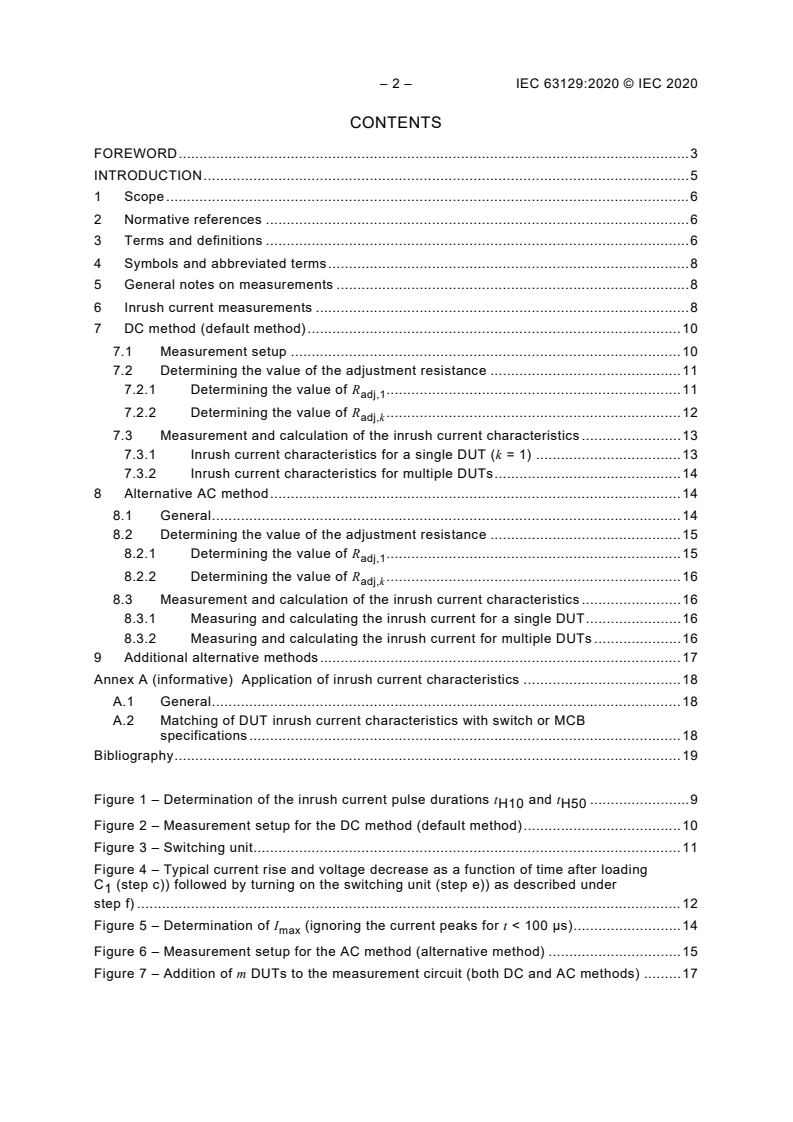
IEC 63129:2020 - Determination of inrush current characteristics of lighting products Released:4/21/2020
Overview
IEC 63129:2020 (consolidated with Amendment 1, 2025) defines a standardized method to determine inrush current characteristics of lighting products. The standard covers measurement and calculation procedures to obtain the peak inrush current and inrush current pulse duration for single or multiple devices under test (DUT) connected to low-voltage 230 V AC networks. Lighting products included are light sources with integrated controlgear, controlgear, and luminaires. The goal is to provide reliable inrush current data to ensure compatibility with switches, circuit breakers and other switchgear in building electrical installations.
Key topics and technical requirements
- Measured characteristics
- Peak inrush current (Ipeak) - maximum absolute transient current on power-up.
- Inrush current pulse duration (tHx) - full width at x% of peak (commonly H10 and H50).
- Measurement approach
- Method combines measurements and calculations; supports single and multiple DUTs.
- DC method is the default measurement setup; an AC method is provided as an alternative.
- Procedures for determining and applying adjustment resistances (Radj) to replicate installation conditions.
- Guidance on ignoring very short RF noise spikes and defining measurement windows (e.g., discounting current peaks for t < 100 µs).
- Reference conditions
- Uses reference values for line inductance and short-circuit peak current representative of typical 230 V AC installations.
- Extensions
- Additional alternative methods and annexed guidance (Annex A) for applying inrush data to real installation scenarios and switchgear selection.
Practical applications and users
IEC 63129 is practical for:
- Manufacturers of luminaires, light sources and controlgear - to publish validated inrush data.
- Test laboratories and certification bodies - to perform reproducible inrush current tests.
- Lighting designers, electrical installers and installation planners - to select compatible switches and overcurrent protection devices and to avoid nuisance tripping or welded contacts.
- Switchgear and circuit breaker manufacturers - to verify device immunity to lighting inrush currents and update product specifications.
- Typical uses:
- Determining the maximum number of identical lighting products that can be switched by a given MCB or electronic switch.
- Matching DUT inrush profiles to breaker/time-current and peak let-through characteristics to prevent false trips.
Related standards and references
- Vocabulary and definitions referenced from IEC Electropedia (IEC 60050).
- Prepared by IEC Technical Committee 34 (Lamps and related equipment); consult other IEC lighting standards and national wiring regulations for complementary requirements.
Keywords: IEC 63129, inrush current, lighting products, peak inrush current, inrush pulse duration, 230 V AC, luminaires, controlgear, measurement method, DC method, AC method, switchgear compatibility.
Relations
- Effective Date
- 01-Mar-2024
Buy Documents
IEC 63129:2020+AMD1:2025 CSV - Determination of inrush current characteristics of lighting products Released:10/14/2025
IEC 63129:2020 - Determination of inrush current characteristics of lighting products Released:4/21/2020
Get Certified
Connect with accredited certification bodies for this standard

IMQ S.p.A. (Certification)
Italian electrical product certification.

SLG Prüf- und Zertifizierungs GmbH
German testing and certification body.

UL Solutions
Global safety science company with testing, inspection and certification.
Sponsored listings
Frequently Asked Questions
IEC 63129:2020 is a standard published by the International Electrotechnical Commission (IEC). Its full title is "Determination of inrush current characteristics of lighting products". This standard covers: IEC 63129:2020 describes a method, based on measurements combined with calculations, to determine specific characteristics of the inrush current of single and/or multiple lighting products of the same type. Lighting products include the following: - light sources with integrated controlgear, - controlgear, - luminaires.
IEC 63129:2020 describes a method, based on measurements combined with calculations, to determine specific characteristics of the inrush current of single and/or multiple lighting products of the same type. Lighting products include the following: - light sources with integrated controlgear, - controlgear, - luminaires.
IEC 63129:2020 is classified under the following ICS (International Classification for Standards) categories: 29.140.01 - Lamps in general; 29.140.99 - Other standards related to lamps. The ICS classification helps identify the subject area and facilitates finding related standards.
IEC 63129:2020 has the following relationships with other standards: It is inter standard links to IEC 63129:2020/AMD1:2025. Understanding these relationships helps ensure you are using the most current and applicable version of the standard.
IEC 63129:2020 is available in PDF format for immediate download after purchase. The document can be added to your cart and obtained through the secure checkout process. Digital delivery ensures instant access to the complete standard document.
Standards Content (Sample)
IEC 63129 ®
Edition 1.1 2025-10
INTERNATIONAL
STANDARD
CONSOLIDATED VERSION
Determination of inrush current characteristics of lighting products
ICS 29.140.01; 29.140.99 ISBN 978-2-8327-0788-3
All rights reserved. Unless otherwise specified, no part of this publication may be reproduced or utilized in any form or
by any means, electronic or mechanical, including photocopying and microfilm, without permission in writing from either
IEC or IEC's member National Committee in the country of the requester. If you have any questions about IEC copyright
or have an enquiry about obtaining additional rights to this publication, please contact the address below or your local
IEC member National Committee for further information.
IEC Secretariat Tel.: +41 22 919 02 11
3, rue de Varembé info@iec.ch
CH-1211 Geneva 20 www.iec.ch
Switzerland
About the IEC
The International Electrotechnical Commission (IEC) is the leading global organization that prepares and publishes
International Standards for all electrical, electronic and related technologies.
About IEC publications
The technical content of IEC publications is kept under constant review by the IEC. Please make sure that you have the
latest edition, a corrigendum or an amendment might have been published.
IEC publications search - IEC Products & Services Portal - products.iec.ch
webstore.iec.ch/advsearchform Discover our powerful search engine and read freely all the
The advanced search enables to find IEC publications by a publications previews, graphical symbols and the glossary.
variety of criteria (reference number, text, technical With a subscription you will always have access to up to date
committee, …). It also gives information on projects, content tailored to your needs.
replaced and withdrawn publications.
Electropedia - www.electropedia.org
The world's leading online dictionary on electrotechnology,
IEC Just Published - webstore.iec.ch/justpublished
Stay up to date on all new IEC publications. Just Published containing more than 22 500 terminological entries in English
details all new publications released. Available online and and French, with equivalent terms in 25 additional languages.
once a month by email. Also known as the International Electrotechnical Vocabulary
(IEV) online.
IEC Customer Service Centre - webstore.iec.ch/csc
If you wish to give us your feedback on this publication or
need further assistance, please contact the Customer
Service Centre: sales@iec.ch.
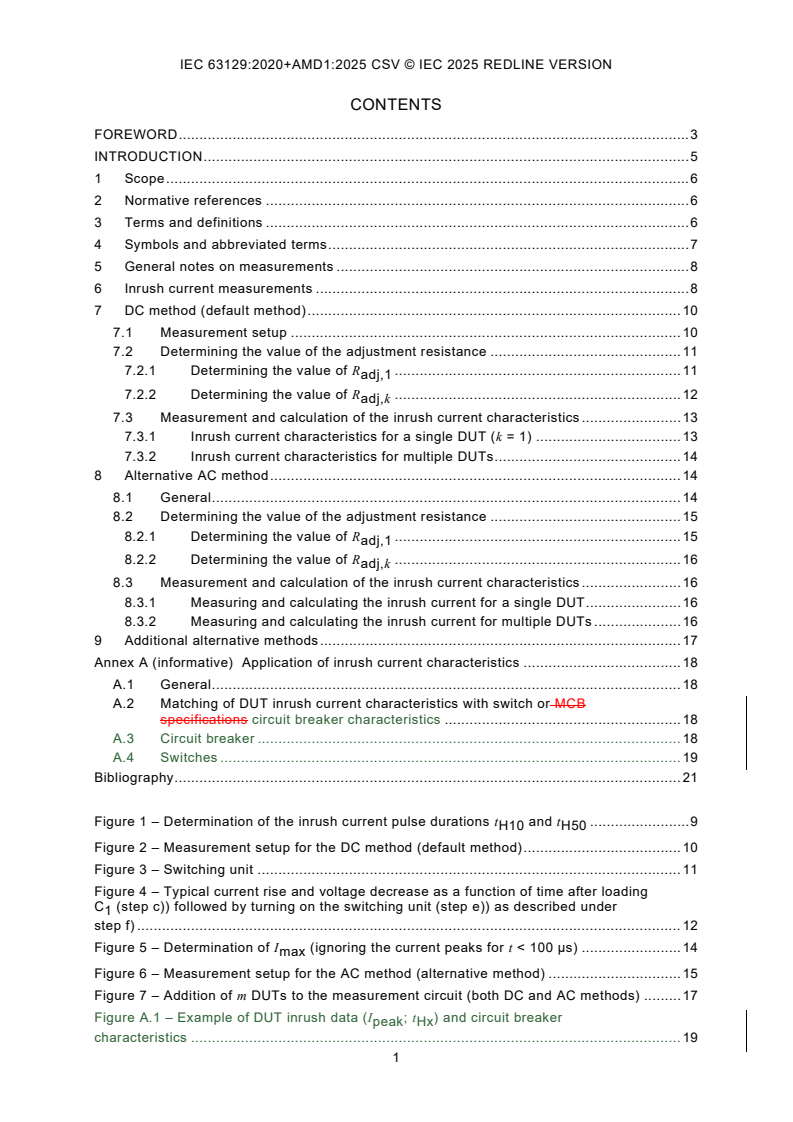
CONTENTS
FOREWORD . 3
INTRODUCTION . 5
1 Scope . 6
2 Normative references . 6
3 Terms and definitions . 6
4 Symbols and abbreviated terms . 7
5 General notes on measurements . 8
6 Inrush current measurements . 8
7 DC method (default method) . 10
7.1 Measurement setup . 10
7.2 Determining the value of the adjustment resistance . 11
7.2.1 Determining the value of R . 11
adj,1
7.2.2 Determining the value of R . 12
adj,k
7.3 Measurement and calculation of the inrush current characteristics . 13
7.3.1 Inrush current characteristics for a single DUT (k = 1) . 13
7.3.2 Inrush current characteristics for multiple DUTs . 14
8 Alternative AC method . 14
8.1 General . 14
8.2 Determining the value of the adjustment resistance . 15
8.2.1 Determining the value of R . 15
adj,1
8.2.2 Determining the value of R . 16
adj,k
8.3 Measurement and calculation of the inrush current characteristics . 16
8.3.1 Measuring and calculating the inrush current for a single DUT . 16
8.3.2 Measuring and calculating the inrush current for multiple DUTs . 16
9 Additional alternative methods . 17
Annex A (informative) Application of inrush current characteristics . 18
A.1 General . 18
A.2 Matching of DUT inrush current characteristics with switch or MCB
specifications circuit breaker characteristics . 18
A.3 Circuit breaker . 18
A.4 Switches . 19
Bibliography . 21
Figure 1 – Determination of the inrush current pulse durations t and t . 9
H10 H50
Figure 2 – Measurement setup for the DC method (default method) . 10
Figure 3 – Switching unit . 11
Figure 4 – Typical current rise and voltage decrease as a function of time after loading
C (step c)) followed by turning on the switching unit (step e)) as described under
step f) . 12
Figure 5 – Determination of I (ignoring the current peaks for t < 100 µs) . 14
max
Figure 6 – Measurement setup for the AC method (alternative method) . 15
Figure 7 – Addition of m DUTs to the measurement circuit (both DC and AC methods) . 17
Figure A.1 – Example of DUT inrush data (I ; t ) and circuit breaker
peak Hx
characteristics . 19
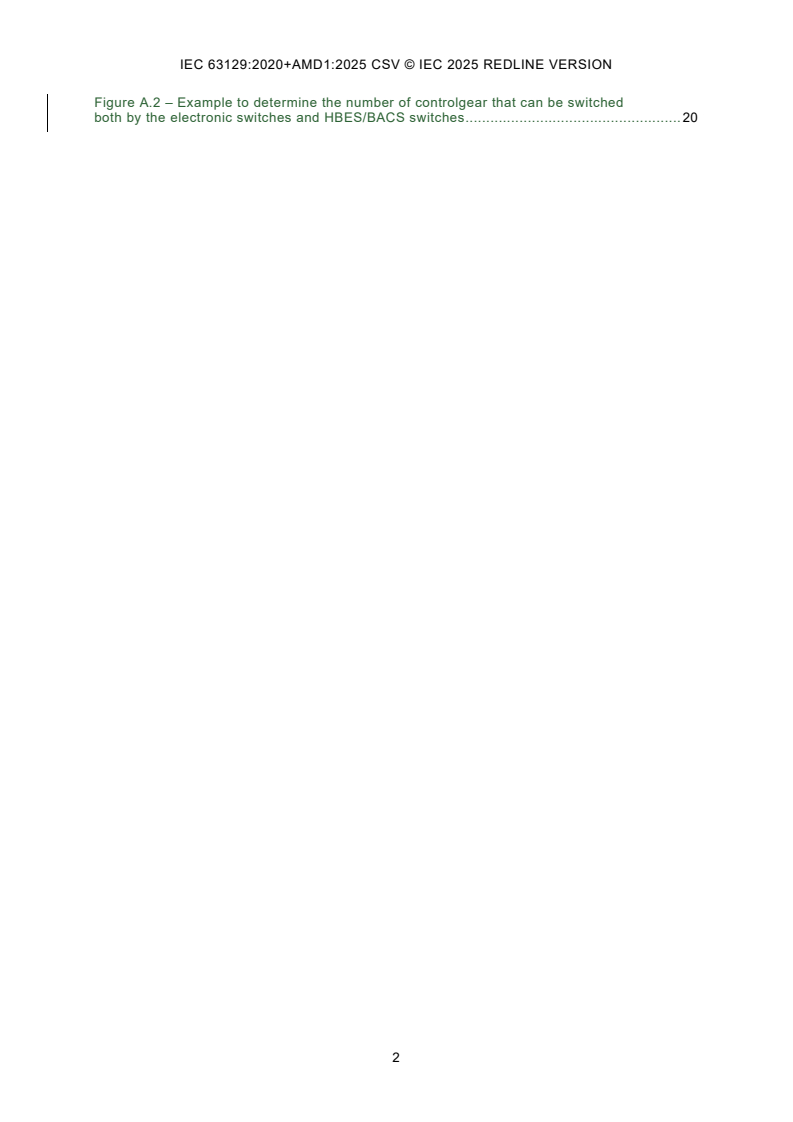
Figure A.2 – Example to determine the number of controlgear that can be switched
both by the electronic switches and HBES/BACS switches . 20
INTERNATIONAL ELECTROTECHNICAL COMMISSION
____________
Determination of inrush current characteristics of lighting products
FOREWORD
1) The International Electrotechnical Commission (IEC) is a worldwide organization for standardization comprising
all national electrotechnical committees (IEC National Committees). The object of IEC is to promote international
co-operation on all questions concerning standardization in the electrical and electronic fields. To this end and
in addition to other activities, IEC publishes International Standards, Technical Specifications, Technical Reports,
Publicly Available Specifications (PAS) and Guides (hereafter referred to as "IEC Publication(s)"). Their
preparation is entrusted to technical committees; any IEC National Committee interested in the subject dealt with
may participate in this preparatory work. International, governmental and non-governmental organizations liaising
with the IEC also participate in this preparation. IEC collaborates closely with the International Organization for
Standardization (ISO) in accordance with conditions determined by agreement between the two organizations.
2) The formal decisions or agreements of IEC on technical matters express, as nearly as possible, an international
consensus of opinion on the relevant subjects since each technical committee has representation from all
interested IEC National Committees.
3) IEC Publications have the form of recommendations for international use and are accepted by IEC National
Committees in that sense. While all reasonable efforts are made to ensure that the technical content of IEC
Publications is accurate, IEC cannot be held responsible for the way in which they are used or for any
misinterpretation by any end user.
4) In order to promote international uniformity, IEC National Committees undertake to apply IEC Publications
transparently to the maximum extent possible in their national and regional publications. Any divergence between
any IEC Publication and the corresponding national or regional publication shall be clearly indicated in the latter.
5) IEC itself does not provide any attestation of conformity. Independent certification bodies provide conformity
assessment services and, in some areas, access to IEC marks of conformity. IEC is not responsible for any
services carried out by independent certification bodies.
6) All users should ensure that they have the latest edition of this publication.
7) No liability shall attach to IEC or its directors, employees, servants or agents including individual experts and
members of its technical committees and IEC National Committees for any personal injury, property damage or
other damage of any nature whatsoever, whether direct or indirect, or for costs (including legal fees) and
expenses arising out of the publication, use of, or reliance upon, this IEC Publication or any other IEC
Publications.
8) Attention is drawn to the Normative references cited in this publication. Use of the referenced publications is
indispensable for the correct application of this publication.
9) IEC draws attention to the possibility that the implementation of this document may involve the use of (a)
patent(s). IEC takes no position concerning the evidence, validity or applicability of any claimed patent rights in
respect thereof. As of the date of publication of this document, IEC had not received notice of (a) patent(s), which
may be required to implement this document. However, implementers are cautioned that this may not represent
the latest information, which may be obtained from the patent database available at https://patents.iec.ch. IEC
shall not be held responsible for identifying any or all such patent rights.
This consolidated version of the official IEC Standard and its amendment has been prepared
for user convenience.
IEC 63129 edition 1.1 contains the first edition (2020-04) [documents 34/636/CDV and
34/679/RVC] and its amendment 1 (2025-10) [documents 34/1337/FDIS and 34/1392/RVD].
In this Redline version, a vertical line in the margin shows where the technical content is
modified by amendment 1. Additions are in green text, deletions are in strikethrough red text.
A separate Final version with all changes accepted is available in this publication.
International Standard IEC 63129 has been prepared by IEC technical committee 34: Lamps
and related equipment.
The text of this International Standard is based on the following documents:
CDV Report on voting
34/636/CDV 34/679/RVC
Full information on the voting for the approval of this International Standard can be found in the
report on voting indicated in the above table.
This document has been drafted in accordance with the ISO/IEC Directives, Part 2.
The committee has decided that the contents of this document and its amendment will remain
unchanged until the stability date indicated on the IEC website under webstore.iec.ch in the
data related to the specific document. At this date, the document will be
– reconfirmed,
– withdrawn, or
– revised.
INTRODUCTION
Inrush current is the transient current drawn by an electrical device after it is switched on via
an independent mains switch, the maximum amplitude of which is often much higher than in
steady state during normal operation. Inrush current occurs because of charging capacitances
during power up of a device.
Quantities such as peak inrush current and inrush current pulse duration are key parameters to
characterize the inrush current, which are important to consider when selecting the switchgear
of a lighting installation. This information is indispensable for electric installation planners,
lighting designers and installers to be able to guarantee compatibility of a lighting system with
other installation components like switches and overcurrent protection devices.
Careful selection of overcurrent protection devices, like circuit breakers, is important when
dealing with high inrush currents. The overcurrent protection should react quickly to overload
or short circuit but should not interrupt the circuit when an inrush current flows (i.e. false
tripping). Another unwanted adverse effect that could occur when inrush current is not
considered is welding of contacts of mechanical or electromechanical switches (manual or
automatic).
The aim of this document is to determine the peak inrush current and the inrush current pulse
duration of one or multiple lighting products of the same type.
This can serve as valuable information for installers in making the correct selection of
components like switches and overcurrent protection devices in an installation or conversely for
determination of the maximum number of lighting products of the same type that can be applied
in an installation with switches and overcurrent protection devices (see Annex A).
The resulting functional compatibility between switchgear and lighting products in an installation
is the main rationale for this document.
The rated voltage of lighting products which can be tested with this document is limited to 230
V AC only. Future inclusion of other voltages (for example 100 V AC, 120 V AC, 200 V AC, 277
V AC, 347 V AC) is not excluded.
1 Scope
This document describes a method, based on measurements combined with calculations, to
determine specific characteristics of the inrush current of single and/or multiple lighting products
of the same type. Lighting products include the following:
• light sources with integrated controlgear,
• controlgear,
• luminaires.
The inrush current characteristics that are determined are
• the peak inrush current,
• the inrush current pulse duration.
This document applies to lighting products connected to low-voltage 230 V AC 50/60 Hz
electrical supply networks.
NOTE In Clause 6 it is stated that the methodology applies reference values for the reference (line) inductance and
the reference (short circuit) peak current which reflect the typical situation in a 230 V AC installation.
2 Normative references
There are no normative references in this document.
3 Terms and definitions
For the purposes of this document, the following terms and definitions apply.
ISO and IEC maintain terminological databases for use in standardization at the following
addresses:
• IEC Electropedia: available at http://www.electropedia.org/
• ISO Online browsing platform: available at http://www.iso.org/obp
3.1
bidirectional diode thyristor
DIAC
two-terminal thyristor having substantially the same switching behaviour in the first and third
quadrants of the current-voltage characteristic
[SOURCE: IEC 60050-521:2002, 521-04-66]
3.2
bidirectional triode thyristor
TRIAC
three-terminal thyristor having substantially the same switching behaviour in the first and third
quadrants of the current-voltage characteristic
[SOURCE: IEC 60050-521:2002, 521-04-67]
3.3
circuit-breaker
mechanical switching device, capable of making, carrying and breaking currents under normal
circuit conditions and also making, carrying for a specified duration and breaking currents under
specified abnormal circuit conditions such as those of short circuit
[SOURCE: IEC 60050-441:2000, 441-14-20]
3.4
control gear
controlgear
unit inserted between the power supply (IEV 151-13-75) and at
least one light source, which serves to supply the light source(s) with its (their) rated voltage or
rated current, and which can consist of one or more separate components
Note 1 to entry: The control gear can include means for igniting, dimming, correcting the power factor and
suppressing radio interference, and further control functions.
Note 2 to entry: The control gear consists of a power supply (IEV 151-13-76) and a control unit.
Note 3 to entry: The control gear can be partly or totally integrated in the light source.
Note 4 to entry: The terms "control gear" and "controlgear" are interchangeable. In IEC standards, the term
"controlgear" is commonly used.
[SOURCE: IEC 60050-845:—, 845-28-048]
3.5
I
inrush
inrush current
transient current associated with energizing of electrical apparatus or components
EXAMPLE Lighting products, transformers, cables, reactors.
[SOURCE: IEC 60050-448:1995, 448-11-30, modified – In the definition, "electrical apparatus
or components" replaces "transformer, cables, reactors, etc." now given as examples.]
3.6
t
Hx
inrush current pulse duration
time period over which the value of the inrush current is larger than x % of the peak inrush
current
Note 1 to entry: See also Figure 1.
Note 2 to entry: Any RF noise should be disregarded.
Note 3 to entry: By this definition, the inrush current pulse duration t is the full width at half maximum (FWHM)
H50
of the current pulse.
Note 4 to entry: In this document values of x = 10 and x = 50 are used.
3.7
I
peak
peak inrush current
maximum of the absolute value of the inrush current
Note 1 to entry: The peak inrush current is typically reached when switch-on happens at the point in time that the
mains voltage is at its peak.
Note 2 to entry: See also Figure 1.
Note 3 to entry: Any RF noise should be disregarded.
4 Symbols and abbreviated terms
DIAC bidirectional diode thyristor
DUT device under test
MCB miniature circuit breaker
NTC negative temperature coefficient thermistor
TRIAC bidirectional triode thyristor
k number of DUTs (as represented by the corresponding measurement setup)
n maximum number of DUTs (intended to be characterized)
I reference (short circuit) peak current
ref
L reference (line) inductance
ref
I short circuit peak current (for k DUT)
adj,k
L inductance (for k DUT)
k
R adjustment resistance (for k DUT)
adj,k
I maximum current (as measured)
max
t time at which maximum current I is reached
max max
U maximum voltage (as measured at t )
max max
I peak inrush current (for k DUT)
peak,k
t inrush current pulse duration (for a threshold of x % of the peak inrush current and k
Hx,k
DUT)
5 General notes on measurements
In this document the term DUT (device under test) is used for the lighting product for which the
inrush current characteristics are determined according to the requirements of this document.
Controlgear shall be operated at maximum power (100 % light output) and with actual loads or
dummy loads as specified by the manufacturer.
6 Inrush current measurements
For the measurements, a reference (line) inductance of L = 100 µH and a reference (short
ref
circuit) peak current I = 400 A are used that reflect the average situation in 230 V
ref
installations. The values are based on tests conducted by switch manufacturers that suggest
that they represent an appropriate average value. When a different mains voltage is used, the
reference line inductance value and the reference peak current value may need to be adjusted.
NOTE 3 For office applications the current level of 400 A is sufficient. In the future, it can be necessary to consider
higher levels for high power applications such as flood lighting.
Inrush current measurements could be done with one DUT and the result multiplied by the
number of devices in the installation considered.
However, this does not reflect the situation in installations as they can be typically found. When
different devices are connected in different parts of the circuit, the characteristics of the inrush
current as well as the resulting voltage drop in the line are different. Therefore, the reference
values defined above are used to simulate the average situation.
Measuring a number of k individual DUTs in one measurement setup is equivalent to using one
DUT while adjusting the impedance by a factor of k. Therefore, in particular the latter approach –
which is the default approach followed in this document – results in a characterization of the
inrush current of k DUTs connected to the same network.
The peak inrush current I and the inrush current pulse duration t as a function of the
peak Hx
number k of DUTs (represented by the corresponding measurement setup) are the key
characteristics of interest. Therefore, typically a series of measurements is performed from
k = 1 to the maximum number n of DUTs intended to be characterized. As a result, n pairs of
peak inrush current values and inrush current pulse duration values (I ; t ) are obtained.
peak,k Hx,k
It is suggested to present these in table form as a function of k.
If only one peak inrush current value without further explanation is given, this is interpreted as
I (k = 1).
peak
For illustration purposes, Figure 1 shows an exemplary inrush current pulse with the
corresponding peak inrush current I and inrush current pulse duration t and t with
peak H10 H50
threshold values of x = 10 % and x = 50 % of the peak inrush current, respectively.
NOTE 1 It is suggested to use a default value of n that is the ratio of the rated current of the MCB or switch,
respectively, divided by the rated current of the DUT.
It is not mandatory to perform all individual n measurements from k = 1 to k = n nor do the
individual measurements have to follow k in numerical order.
NOTE 2 It might be advised to start with k = 1, then k = n and select intermediate values for k in order to reduce
measurement time to establish the curves as described in Annex A.
Key
I peak inrush current
peak
t ; t inrush current pulse durations
H10 H50
Figure 1 – Determination of the inrush current pulse durations t and t
H10 H50
The DC method – as described in Clause 7 – shall be used as the default method.
In case the DC method is not suitable (e.g. zero crossing detection DUT or DUT with mains
transformer), the AC method, as described in Clause 8 may be used alternatively. The AC
method, however, is not preferred, as the mains voltage that is used in the AC method instead
of a defined sine wave from a voltage generator is subject to fluctuations that are not reflected
in the measurement setup. Thus, the results from the AC method are less accurate.
For k > 4 the AC method values typically do not deviate by more than 20 % with respect to the
DC method.
Additional alternative methods allowing for a reduction of measurement time – as the
adjustment procedure does not need to be repeated for all values of n – may be generally used
as described in Clause 9 for both methods (DC and AC).
7 DC method (default method)
7.1 Measurement setup
The measurement setup to determine the inrush current of the DUT is given in Figure 2.
Current measurement shall be done by using a digital oscilloscope in combination with either a
current probe or a shunt resistor.
If a current probe with an iron core is used, care should be taken that the current probe does
not saturate in case of large currents. This can be verified by checking the specification of the
maximum I(t) of the probe. For high inrush currents of longer duration, a Rogowski current
probe can be applied instead.
The switching unit shall contain an electronic switch that ensures bounce-free switching. It may
be realized as depicted in Figure 3.
Key
U supply voltage
supply
DUT device under test
k number of DUTs (as represented by the corresponding measurement setup)
L inductance (for k DUTs)
k
I short circuit peak current
adj,k
R adjustment resistance (for k DUTs)
adj,k
R resistance of DUT connection wires (≤ 0,1 Ω)
DUT
47 Ω)
R load resistance (R
=
load,C1 load,C1
C load capacitance (C 750 µF)
1 1 =
A, B short circuit terminals
C, D DUT terminals
Figure 2 – Measurement setup for the DC method (default method)
Key
S: Switch
Q TRIAC (Q8025R5 or equivalent)
D DIAC (DB3 or equivalent)
C = 47 nF
R = 1 kΩ
Figure 3 – Switching unit
7.2 Determining the value of the adjustment resistance
7.2.1 Determining the value of R
adj,1
In subclause 7.2.1 the procedure is explained to determine the value of the adjustment
resistance R with one DUT connected to the circuit. R shall be adjusted in such a way
adj,1 adj,1
that the short circuit peak current I , measured by the digital oscilloscope (see Figure 2)
adj,1
reaches the reference value of I 400 A using the following procedure:
ref =
a) Set up a measurement for k = 1 according to Figure 2 using a supply voltage with
U = 230 V with L = L and R . Start with an arbitrary value of R , for instance
RMS 1 ref adj,1 adj,1
0,5 Ω.
b) Connect terminals A and B establishing a short circut.
c) Turn on switch 2, then turn on switch 1.
d) Measure the voltage across the capacitor, C , with an oscilloscope (oscilloscope not shown
in Figure 2). Wait until this voltage has stabilized at 325 V, the supply voltage peak value.
e) Turn on the switching unit and record the voltage across C and the current (according to
Figure 2) as a function of time.
f) Now with capacitor C starting to discharge, the current will rise, while the voltage across
C will decrease, see Figure 4.
Figure 4 – Typical current rise and voltage decrease as a function of time after loading
C (step c)) followed by turning on the switching unit (step e)) as described under
step f)
g) Turn off the switching unit, then turn off switch 2 and then turn off switch 1.
h) In an ideal case, the capacitance of C would be infinite, so that the voltage would remain
should be adjusted such that a short circuit peak current of
at 325 V. In this case, R
adj,1
I = 400 A is reached.
adj,1
i) However, as the switching unit is turned on, the voltage will drop below 325 V before the
actual short circuit peak current is reached. Therefore, the maximum current as measured
needs to be corrected as described in step j).
j) Determine the voltage U across C at the time, t , when the maximum current, I ,
max 1 max max
is reached. Calculate the short circuit peak current value I = 325 V · I / U and
adj,1 max max
compare it to the reference value I = 400 A. If 400 A ≤ I ≤ 460 A, then the adjustment
ref adj,1
of R is finished. If not, set the adjustment resistance, R , to a different value and
adj,1 adj,1
repeat steps c) to j) until the calculated short circuit peak current is in the range
400 A ≤ I ≤ 460 A.
adj,1
k) Remove the short circuit between terminals A and B.
To avoid too high currents when determining the value of the adjustment resistance using
setups with low values of k instead of charging the capacitor C to 325 V a lower voltage value
may be chosen (e.g. 180 V).
NOTE This has no effect on the formulas listed under 7.2.1 j) and 7.2.2 c), respectively.
The procedure to measure the inrush current for one DUT is explained in 7.3.1.
7.2.2 Determining the value of R
adj,k
In subclause 7.2.2 the procedure is explained to determine the value of the adjustment
resistance R with multiple k DUTs represented by the measurement setup. The procedure
adj, k
to measure the corresponding inrush current is explained in 7.3.2.
For (the representation of) multiple k DUTs, R shall be adjusted in such a way that the short
adj, k
circuit peak current, I reaches a value of I = I / k = 400 A / k using the following
adj,k adj, k ref
procedure:
a) Set up the measurement representing k DUTs according to Figure 2 with L = k · L using
k ref
a supply voltage of U = 230 V. A starting value for the adjustment resistance of
RMS
R = k · R is recommended using R as determined in 7.2.1. If this value is not
adj,k adj,1 adj,1
available, any arbitrary value may be chosen, for instance R = k · 0,5 Ω.
adj,k
b) Connect terminals A and B establishing a short circuit.
c) Perform steps c) to i) as in 7.2.1.
– Determine the voltage, U , across C at the time, t , when the peak, I , is
max 1 max max
reached. Calculate the short circuit peak current, I = 325 V · I / U and
adj,k max max
compare it to I / k, = 400 A / k. If 400 A / k ≤ I ≤ 460 A / k, then the adjustment of
ref adj,k
R is finished. If not, set the adjustment resistance, R to a different value and
adj,k adj,k
repeat steps c) and d) until the calculated short circuit peak current is in the range 400 A
/ k ≤ I ≤ 460 A / k.
adj,k
d) Remove the short circuit between terminals A and B.
7.3 Measurement and calculation of the inrush current characteristics
7.3.1 Inrush current characteristics for a single DUT (k = 1)
The following measurement and calculation procedure shall be used to determine the inrush
current characteristics for a single DUT (k = 1):
a) Set up the measurement for k = 1 according to Figure 2 by using L , and R as
1 adj,1
determined under 7.2.1.
b) Connect the DUT terminals C and D to the circuit terminals A and B.
c) All energy storage components of the DUT shall be discharged. The DUT shall be operated
with the highest load specified by the manufacturer. If components have different
characteristics at different temperatures (e.g. NTC in series to limit the inrush current), the
test shall be made with all components of the DUT at ambient temperature.
d) Turn on switch 2, then turn on switch 1.
e) Measure the voltage across the capacitor, C , with an oscilloscope (oscilloscope not shown
in Figure 2). Wait until this voltage has stabilized at 325 V, the supply voltage peak value.
f) Turn on the switching unit and record the voltage across C and the current through the
DUT (according to Figure 2) as a function of time.
g) Turn off the switching unit, then turn off switch 2, then turn off switch 1 and remove the DUT.
h) Determine the voltage U across C at the time, t , when the peak, I , is reached.
max 1 max max
The current through the line capacitors shall be ignored in the time frame of 100 µs, if their
average energy is less than 10 % of the energy of the inrush current (see Figure 5).
Calculate the inrush current, I = 325 V · I / U
peak,1 max max.
NOTE Current peaks before 100 µs are caused by filter capacitances in resonance with the line inductance.
i) Determine the inrush current pulse duration t (see Figure 1).
Hx,1
Figure 5 – Determination of I (ignoring the current peaks for t < 100 µs)
max
7.3.2 Inrush current characteristics for multiple DUTs
The following procedure shall be used to measure and calculate the inrush current for multiple,
k DUTs. The measurement shall be performed using one DUT representative of production.
Following the standard DC method described here for all steps k only one DUT is used.
NOTE Not all of the individual measurements of k will need to be performed (see Annex A).
a) Set up the measurement as determined under 7.2.2 for one DUT according to Figure 2 but
now using L , and R .
k adj,k
b) Follow steps b) to g) as described in 7.3.1.
c) Determine the voltage, U across C at the time, t , when the peak, I , is reached.
max 1 max max
The current through the line capacitors shall be ignored in the time frame of 100 µs, if their
average energy is less than 10 % of the energy of the inrush current,(see Figure 5).
Calculate the inrush current, I = 325 V · k · I / U
peak,k max max.
d) Determine the pulse duration t (see Figure 1).
Hx,k
8 Alternative AC method
8.1 General
When using the AC method, the inrush current of the DUT shall be measured according to
Figure 6.
The current measurement shall be done by using a digital oscilloscope in combination with
either a current probe or a shunt resistor.
The mains supply inductance becomes less relevant and results of the AC method and the DC
method become more similar, as the number of k increases.
A better comparison with the DC method may be achieved if the short circuit current (RMS
value) of the mains supply is between 3 kA and 4 kA at cos ϕ = 0,9 ± 0,05 (lagging).
Key
U supply voltage
supply
DUT device under test
k number of DUTs (as represented by the corresponding measurement setup)
L inductance (for k DUTs); L = (k - 1) · 100 (± 5) µH
k k
I short circuit peak current
adj,k
R adjustment resistance (for k DUTs)
adj,k
R resistance of DUT connection wires (≤ 0,1 Ω)
DUT
A,B short circuit terminals
C, D DUT terminals
Fuse MCB (miniature circuit breaker), for instance C16 or K16
Switching unit: See Figure 3
Trigger unit: including zero-crossing detection and delay of 5 ms trigger (at the top of the supply voltage for 50 Hz)
NOTE For k = 1 there is no choke in the measurement circuit (L = 0).
Figure 6 – Measurement setup for the AC method (alternative method)
8.2 Determining the value of the adjustment resistance
8.2.1 Determining the value of R
adj,1
The adjustment resistance, R , shall be adjusted using the following procedure:
adj,1
a) Set up the measurement for k = 1 according to Figure 6. Start with an arbitrary value of
R , for instance 0,5 Ω.
adj,1
b) Connect terminals A and B establishing a short circuit.
c) Turn on the switching unit and record the mains voltage and the current as depicted in
Figure 4.
d) Turn the switching unit off.
e) Determine the short circuit peak current, I , and compare it to I = 400 A with a
adj,1 ref
maximum tolerance of +15 % (i.e. 460 A). If 400 A ≤ I ≤ 460 A, then the adjustment of
adj,1
R is finished. If not, set the adjustment resistance, R to a different value and repeat
adj,1 adj,1,
steps c) through e) until the short circuit peak current is in the range 400 A ≤ I ≤ 460 A.
adj,1
f) Remove the short circuit between terminals A and B.
8.2.2 Determining the value of R
adj,k
For multiple, k DUTs, the adjustment resistance, R , shall be adjusted in such a way that the
adj,k
short circuit peak current, I reaches a value of I I / k = 400 A / k.
adj,k adj,k = ref
a) Set up the measurement for one DUT according to Figure 6, but now with L = (k - 1) · L .
k ref
Start with an arbitrary value of R , for instance (k - 1) · R or R = k · 0,5 Ω, if a
adj,k adj,1 adj,k
value for R is not available.
adj,1
b) Connect terminals A and B establishing a short circuit.
c) Turn on the switching unit and record the current as depicted in Figure 4.
d) Turn the switching unit off.
e) Determine the short circuit peak current, I , and compare it to I / k = 400 A / k with a
adj,k ref
maximum tolerance of +15 % (i.e. 460 A / k ). If 400 A / k ≤ I ≤ 460 A / k , then the
adj,k
adjustment of R is finished. If not, set the adjustment resistance to a different value and
adj,k
repeat steps c) through e) until the short circuit peak current is in the range
400 A / k ≤ I ≤ 460 A / k .
adj,k
f) Remove the short circuit between terminals A and B.
8.3 Measurement and calculation of the inrush current characteristics
8.3.1 Measuring and calculating the inrush current for a single DUT
The following procedure shall be used to measure and calculate the inrush current:
a) Set up the measurement for k = 1 according to Figure 6 by using the adjustment resistance,
as determined under 8.2.1.
R
adj,1
b) Connect the DUT terminals C and D to the circuit terminals A and B.
c) All energy storage components of the DUT shall be discharged. The DUT shall be operated
with the highest load specified by the manufacturer. If components have different
characteristics at different temperatures (e.g. NTC in series to limit the inrush current), the
test shall be made with all components of the DUT at ambient temperature.
d) Turn on the switching unit and record the current as depicted in Figure 4.
e) Turn the switching unit off and remove the DUT.
f) Determine the inrush current I = I . The current through the line capacitors shall be
peak,1 max
ignored in the time frame of 100 µs, if their average energy is less than 10 % of the energy
of the inrush current, see Figure 5.
g) Determine the inrush current pulse duration t (see Figure 1).
Hx,1
8.3.2 Measuring and calculating the inrush current for multiple DUTs
a) Set up the measurement as determined under 8.2.2 for one DUT according to Figure 6, but
now using L , and R .
k adj,k
b) Connect the DUT terminals C and D to the circuit terminals A and B.
c) All energy storage components of the DUT shall be discharged. The DUT shall be operated
with the highest load specified by the manufacturer.
d) Turn on the switching unit and record the current as depicted in Figure 4.
e) Turn the switching unit off and remove the DUT.
f) Determine the inrush current I = k · I . The current through the line capacitors shall
peak,k max
be ignored in the time frame of 100 µs, if their average energy is less than 10 % of the
energy of the inrush current, see Figure 5.
g) Determine the inrush current pulse duration t (see Figure 1).
Hx,k
9 Additional alternative methods
Both the DC method and the AC method may be optionally extended by increasing to a number
of m DUTs actually connected in parallel to the measurement circuit terminals C, D. In this case,
in any of the equations in 7.3.2 and 8.3.2, k shall be replaced by (k · m), see Figure 7. (k · m)
gives the number of devices that are characterized by the corresponding measurement.
Additionally, when using the DC method with multiple DUTs physically connected in parallel as
in Figure 7, a higher value of capacitance, C (see Figure 2), may be chosen to reduce the
amount of correction when calculating the short circuit peak current I .
adj
Figure 7 – Addition of m DUTs to the measurement circuit (both DC and AC methods)
Annex A
(informative)
Application of inrush current characteristics
A.1 General
The values of the peak inrush current and the inrush current pulse duration of a lighting product
can be used by installers in making the correct selection of components like switches and
overcurrent protection devices in an installation or conversely for determination of the maximum
number of lighting products of the same type that can be applied in an installation with switches
and overcurrent protection devices.
A.2 Matching of DUT inrush current characteristics with switch or MCB
specifications circuit breaker characteristics
The lighting equipment inrush current data obtained through the method in this document can
be compared with the inrush current withstandspecifications characteristics of a switch or MCB
(miniature circuit breaker).
The inrush current withstand specifications characteristics of a switch or an MCB a circuit
breaker are typically specified by the switch/MCB or circuit breaker manufacturer. The inrush
current characteristics of lighting equipment obtained via the method in this document are
typically determined and provided by the lighting equipment manufacturer.
A method of matching this data in order to determine the maximum number of the same lighting
equipment that may be present in an installation for each of the types of switch/MCB is currently
under consideration.
To achieve compatibility, lighting product manufacturers and switch or circuit breaker
manufacturers should provide information in their literature based on the content of this
Annex A.
A.3 Circuit breaker
The maximum number of lighting devices connected to a circuit should be aligned with the
capability of the circuit breaker to prevent unintentional tripping. This Clause A.3 explains how
to determine this maximum number for a certain type of circuit breaker where the characteristics
are supplied by the manufacturer.
The maximum number of devices can be determined by diagramming the DUT inrush data and
circuit breaker characteristics as shown in Figure A.1.
NOTE 1 The maximum number of devices is also determined by factors other than the inrush current (e.g. maximum
current).
The pairs of peak inrush current, I , and inrush current pulse duration, t , associated with
peak Hx
each number of DUTs are sketched in a diagram together with the corresponding circuit breaker
characteristics, CB_x. The maximum allowable number of DUTs is equivalent to the (I ; t )
peak Hx
pair associated with the highest DUT number which is still below the curve of the circuit breaker
type, as shown in Figure A.1, used in the installation.
An example illustrating the use of the diagram is shown in Figure A.1. For CB_2 type circuit
breakers the maximum allowable number of devices of type DUT_B would be 10 in order to
prevent unintended acting of the circuit breaker. Ten is the highest number on the DUT_B curve
that lies below the CB_2 curve.
NOTE 2 Non-acting of a circuit breaker is determined by its energy capability which is proportional to I .
peak
NOTE 3 To get accurate results and to achieve a good comparability in the field applications, t is commonly
H50
used for specifying the t .
Hx
Figure A.1 – Example of DUT inrush data (I ; t ) and circuit breaker characteristics
peak Hx
A.4 Switches
The number of connec
...
IEC 63129 ®
Edition 1.0 2020-04
INTERNATIONAL
STANDARD
NORME
INTERNATIONALE
colour
inside
Determination of inrush current characteristics of lighting products
Détermination des caractéristiques du courant d'appel des produits d'éclairage
IEC 63129 :2020-04(en-fr)
All rights reserved. Unless otherwise specified, no part of this publication may be reproduced or utilized in any form
or by any means, electronic or mechanical, including photocopying and microfilm, without permission in writing from
either IEC or IEC's member National Committee in the country of the requester. If you have any questions about IEC
copyright or have an enquiry about obtaining additional rights to this publication, please contact the address below or
your local IEC member National Committee for further information.
Droits de reproduction réservés. Sauf indication contraire, aucune partie de cette publication ne peut être reproduite ni
utilisée sous quelque forme que ce soit et par aucun procédé, électronique ou mécanique, y compris la photocopie et
les microfilms, sans l'accord écrit de l'IEC ou du Comité national de l'IEC du pays du demandeur. Si vous avez des
questions sur le copyright de l'IEC ou si vous désirez obtenir des droits supplémentaires sur cette publication, utilisez
les coordonnées ci-après ou contactez le Comité national de l'IEC de votre pays de résidence.
IEC Central Office Tel.: +41 22 919 02 11
3, rue de Varembé info@iec.ch
CH-1211 Geneva 20 www.iec.ch
Switzerland
About the IEC
The International Electrotechnical Commission (IEC) is the leading global organization that prepares and publishes
International Standards for all electrical, electronic and related technologies.
About IEC publications
The technical content of IEC publications is kept under constant review by the IEC. Please make sure that you have the
latest edition, a corrigendum or an amendment might have been published.
IEC publications search - webstore.iec.ch/advsearchform Electropedia - www.electropedia.org
The advanced search enables to find IEC publications by a The world's leading online dictionary on electrotechnology,
variety of criteria (reference number, text, technical containing more than 22 000 terminological entries in English
committee,…). It also gives information on projects, replaced and French, with equivalent terms in 16 additional languages.
and withdrawn publications. Also known as the International Electrotechnical Vocabulary
(IEV) online.
IEC Just Published - webstore.iec.ch/justpublished
Stay up to date on all new IEC publications. Just Published IEC Glossary - std.iec.ch/glossary
details all new publications released. Available online and once 67 000 electrotechnical terminology entries in English and
a month by email. French extracted from the Terms and Definitions clause of IEC
publications issued since 2002. Some entries have been
IEC Customer Service Centre - webstore.iec.ch/csc collected from earlier publications of IEC TC 37, 77, 86 and
If you wish to give us your feedback on this publication or need CISPR.
further assistance, please contact the Customer Service
Centre: sales@iec.ch.
A propos de l'IEC
La Commission Electrotechnique Internationale (IEC) est la première organisation mondiale qui élabore et publie des
Normes internationales pour tout ce qui a trait à l'électricité, à l'électronique et aux technologies apparentées.
A propos des publications IEC
Le contenu technique des publications IEC est constamment revu. Veuillez vous assurer que vous possédez l’édition la
plus récente, un corrigendum ou amendement peut avoir été publié.
Recherche de publications IEC - Le premier dictionnaire d'électrotechnologie en ligne au monde,
webstore.iec.ch/advsearchform avec plus de 22 000 articles terminologiques en anglais et en
La recherche avancée permet de trouver des publications IEC français, ainsi que les termes équivalents dans 16 langues
en utilisant différents critères (numéro de référence, texte, additionnelles. Egalement appelé Vocabulaire
comité d’études,…). Elle donne aussi des informations sur les Electrotechnique International (IEV) en ligne.
projets et les publications remplacées ou retirées.
Glossaire IEC - std.iec.ch/glossary
IEC Just Published - webstore.iec.ch/justpublished 67 000 entrées terminologiques électrotechniques, en anglais
Restez informé sur les nouvelles publications IEC. Just et en français, extraites des articles Termes et Définitions des
Published détaille les nouvelles publications parues. publications IEC parues depuis 2002. Plus certaines entrées
Disponible en ligne et une fois par mois par email. antérieures extraites des publications des CE 37, 77, 86 et
CISPR de l'IEC.
Service Clients - webstore.iec.ch/csc
Si vous désirez nous donner des commentaires sur cette
publication ou si vous avez des questions contactez-nous:
sales@iec.ch.
Electropedia - www.electropedia.org
IEC 63129 ®
Edition 1.0 2020-04
INTERNATIONAL
STANDARD
NORME
INTERNATIONALE
colour
inside
Determination of inrush current characteristics of lighting products
Détermination des caractéristiques du courant d'appel des produits d'éclairage
INTERNATIONAL
ELECTROTECHNICAL
COMMISSION
COMMISSION
ELECTROTECHNIQUE
INTERNATIONALE
ICS 29.140.01; 29.140.99 ISBN 978-2-8322-8205-2
– 2 – IEC 63129:2020 © IEC 2020
CONTENTS
FOREWORD . 3
INTRODUCTION . 5
1 Scope . 6
2 Normative references . 6
3 Terms and definitions . 6
4 Symbols and abbreviated terms . 8
5 General notes on measurements . 8
6 Inrush current measurements . 8
7 DC method (default method) . 10
7.1 Measurement setup . 10
7.2 Determining the value of the adjustment resistance . 11
7.2.1 Determining the value of R . 11
adj,1
7.2.2 Determining the value of R . 12
adj,k
7.3 Measurement and calculation of the inrush current characteristics . 13
7.3.1 Inrush current characteristics for a single DUT (k = 1) . 13
7.3.2 Inrush current characteristics for multiple DUTs . 14
8 Alternative AC method . 14
8.1 General . 14
8.2 Determining the value of the adjustment resistance . 15
8.2.1 Determining the value of R . 15
adj,1
8.2.2 Determining the value of R . 16
adj,k
8.3 Measurement and calculation of the inrush current characteristics . 16
8.3.1 Measuring and calculating the inrush current for a single DUT . 16
8.3.2 Measuring and calculating the inrush current for multiple DUTs . 16
9 Additional alternative methods . 17
Annex A (informative) Application of inrush current characteristics . 18
A.1 General . 18
A.2 Matching of DUT inrush current characteristics with switch or MCB
specifications . 18
Bibliography . 19
Figure 1 – Determination of the inrush current pulse durations t and t . 9
H10 H50
Figure 2 – Measurement setup for the DC method (default method) . 10
Figure 3 – Switching unit. 11
Figure 4 – Typical current rise and voltage decrease as a function of time after loading
C (step c)) followed by turning on the switching unit (step e)) as described under
step f) . 12
Figure 5 – Determination of I (ignoring the current peaks for t < 100 µs) . 14
max
Figure 6 – Measurement setup for the AC method (alternative method) . 15
Figure 7 – Addition of m DUTs to the measurement circuit (both DC and AC methods) . 17
INTERNATIONAL ELECTROTECHNICAL COMMISSION
____________
DETERMINATION OF INRUSH CURRENT CHARACTERISTICS
OF LIGHTING PRODUCTS
FOREWORD
1) The International Electrotechnical Commission (IEC) is a worldwide organization for standardization comprising
all national electrotechnical committees (IEC National Committees). The object of IEC is to promote international
co-operation on all questions concerning standardization in the electrical and electronic fields. To this end and
in addition to other activities, IEC publishes International Standards, Technical Specifications, Technical Reports,
Publicly Available Specifications (PAS) and Guides (hereafter referred to as “IEC Publication(s)”). Their
preparation is entrusted to technical committees; any IEC National Committee interested in the subject dealt with
may participate in this preparatory work. International, governmental and non-governmental organizations liaising
with the IEC also participate in this preparation. IEC collaborates closely with the International Organization for
Standardization (ISO) in accordance with conditions determined by agreement between the two organizations.
2) The formal decisions or agreements of IEC on technical matters express, as nearly as possible, an international
consensus of opinion on the relevant subjects since each technical committee has representation from all
interested IEC National Committees.
3) IEC Publications have the form of recommendations for international use and are accepted by IEC National
Committees in that sense. While all reasonable efforts are made to ensure that the technical content of IEC
Publications is accurate, IEC cannot be held responsible for the way in which they are used or for any
misinterpretation by any end user.
4) In order to promote international uniformity, IEC National Committees undertake to apply IEC Publications
transparently to the maximum extent possible in their national and regional publications. Any divergence between
any IEC Publication and the corresponding national or regional publication shall be clearly indicated in the latter.
5) IEC itself does not provide any attestation of conformity. Independent certification bodies provide conformity
assessment services and, in some areas, access to IEC marks of conformity. IEC is not responsible for any
services carried out by independent certification bodies.
6) All users should ensure that they have the latest edition of this publication.
7) No liability shall attach to IEC or its directors, employees, servants or agents including individual experts and
members of its technical committees and IEC National Committees for any personal injury, property damage or
other damage of any nature whatsoever, whether direct or indirect, or for costs (including legal fees) and
expenses arising out of the publication, use of, or reliance upon, this IEC Publication or any other IEC
Publications.
8) Attention is drawn to the Normative references cited in this publication. Use of the referenced publications is
indispensable for the correct application of this publication.
9) Attention is drawn to the possibility that some of the elements of this IEC Publication may be the subject of patent
rights. IEC shall not be held responsible for identifying any or all such patent rights.
International Standard IEC 63129 has been prepared by IEC technical committee 34: Lamps
and related equipment.
The text of this International Standard is based on the following documents:
CDV Report on voting
34/636/CDV 34/679/RVC
Full information on the voting for the approval of this International Standard can be found in the
report on voting indicated in the above table.
This document has been drafted in accordance with the ISO/IEC Directives, Part 2.
– 4 – IEC 63129:2020 © IEC 2020
The committee has decided that the contents of this document will remain unchanged until the
stability date indicated on the IEC website under "http://webstore.iec.ch" in the data related to
the specific document. At this date, the document will be
• reconfirmed,
• withdrawn,
• replaced by a revised edition, or
• amended.
IMPORTANT – The 'colour inside' logo on the cover page of this publication indicates
that it contains colours which are considered to be useful for the correct understanding
of its contents. Users should therefore print this document using a colour printer.
INTRODUCTION
Inrush current is the transient current drawn by an electrical device after it is switched on via
an independent mains switch, the maximum amplitude of which is often much higher than in
steady state during normal operation. Inrush current occurs because of charging capacitances
during power up of a device.
Quantities such as peak inrush current and inrush current pulse duration are key parameters to
characterize the inrush current, which are important to consider when selecting the switchgear
of a lighting installation. This information is indispensable for electric installation planners,
lighting designers and installers to be able to guarantee compatibility of a lighting system with
other installation components like switches and overcurrent protection devices.
Careful selection of overcurrent protection devices, like circuit breakers, is important when
dealing with high inrush currents. The overcurrent protection should react quickly to overload
or short circuit but should not interrupt the circuit when an inrush current flows (i.e. false
tripping). Another unwanted adverse effect that could occur when inrush current is not
considered is welding of contacts of mechanical or electromechanical switches (manual or
automatic).
The aim of this document is to determine the peak inrush current and the inrush current pulse
duration of one or multiple lighting products of the same type.
This can serve as valuable information for installers in making the correct selection of
components like switches and overcurrent protection devices in an installation or conversely for
determination of the maximum number of lighting products of the same type that can be applied
in an installation with switches and overcurrent protection devices (see Annex A).
The resulting functional compatibility between switchgear and lighting products in an installation
is the main rationale for this document.
The rated voltage of lighting products which can be tested with this document is limited to 230
V AC only. Future inclusion of other voltages (for example 100 V AC, 120 V AC, 200 V AC, 277
V AC, 347 V AC) is not excluded.
– 6 – IEC 63129:2020 © IEC 2020
DETERMINATION OF INRUSH CURRENT CHARACTERISTICS
OF LIGHTING PRODUCTS
1 Scope
This document describes a method, based on measurements combined with calculations, to
determine specific characteristics of the inrush current of single and/or multiple lighting products
of the same type. Lighting products include the following:
• light sources with integrated controlgear,
• controlgear,
• luminaires.
The inrush current characteristics that are determined are
• the peak inrush current,
• the inrush current pulse duration.
This document applies to lighting products connected to low-voltage 230 V AC 50/60 Hz
electrical supply networks.
NOTE In Clause 6 it is stated that the methodology applies reference values for the reference (line) inductance and
the reference (short circuit) peak current which reflect the typical situation in a 230 V AC installation.
2 Normative references
There are no normative references in this document.
3 Terms and definitions
For the purposes of this document, the following terms and definitions apply.
ISO and IEC maintain terminological databases for use in standardization at the following
addresses:
• IEC Electropedia: available at http://www.electropedia.org/
• ISO Online browsing platform: available at http://www.iso.org/obp
3.1
bidirectional diode thyristor
DIAC
two-terminal thyristor having substantially the same switching behaviour in the first and third
quadrants of the current-voltage characteristic
[SOURCE: IEC 60050-521:2002, 521-04-66]
3.2
bidirectional triode thyristor
TRIAC
three-terminal thyristor having substantially the same switching behaviour in the first and third
quadrants of the current-voltage characteristic
[SOURCE: IEC 60050-521:2002, 521-04-67]
3.3
circuit-breaker
mechanical switching device, capable of making, carrying and breaking currents under normal
circuit conditions and also making, carrying for a specified duration and breaking currents under
specified abnormal circuit conditions such as those of short circuit
[SOURCE: IEC 60050-441:2000, 441-14-20]
3.4
control gear
controlgear
unit inserted between the power supply (IEV 151-13-75) and at
least one light source, which serves to supply the light source(s) with its (their) rated voltage or
rated current, and which can consist of one or more separate components
Note 1 to entry: The control gear can include means for igniting, dimming, correcting the power factor and
suppressing radio interference, and further control functions.
Note 2 to entry: The control gear consists of a power supply (IEV 151-13-76) and a control unit.
Note 3 to entry: The control gear can be partly or totally integrated in the light source.
Note 4 to entry: The terms "control gear" and "controlgear" are interchangeable. In IEC standards, the term
"controlgear" is commonly used.
[SOURCE: IEC 60050-845:—, 845-28-048]
3.5
I
inrush
inrush current
transient current associated with energizing of electrical apparatus or components
EXAMPLE Lighting products, transformers, cables, reactors.
[SOURCE: IEC 60050-448:1995, 448-11-30, modified – In the definition, "electrical apparatus
or components" replaces "transformer, cables, reactors, etc." now given as examples.]
3.6
t
Hx
inrush current pulse duration
time period over which the value of the inrush current is larger than x % of the peak inrush
current
Note 1 to entry: See also Figure 1.
Note 2 to entry: Any RF noise should be disregarded.
Note 3 to entry: By this definition, the inrush current pulse duration t is the full width at half maximum (FWHM)
H50
of the current pulse.
Note 4 to entry: In this document values of x = 10 and x = 50 are used.
3.7
I
peak
peak inrush current
maximum of the absolute value of the inrush current
Note 1 to entry: The peak inrush current is typically reached when switch-on happens at the point in time that the
mains voltage is at its peak.
Note 2 to entry: See also Figure 1.
Note 3 to entry: Any RF noise should be disregarded.
– 8 – IEC 63129:2020 © IEC 2020
4 Symbols and abbreviated terms
DIAC bidirectional diode thyristor
DUT device under test
MCB miniature circuit breaker
NTC negative temperature coefficient thermistor
TRIAC bidirectional triode thyristor
k number of DUTs (as represented by the corresponding measurement setup)
n maximum number of DUTs (intended to be characterized)
I reference (short circuit) peak current
ref
L reference (line) inductance
ref
I short circuit peak current (for k DUT)
adj,k
L inductance (for k DUT)
k
R adjustment resistance (for k DUT)
adj,k
I maximum current (as measured)
max
t time at which maximum current I is reached
max max
U maximum voltage (as measured at t )
max max
I peak inrush current (for k DUT)
peak,k
t inrush current pulse duration (for a threshold of x % of the peak inrush current and k
Hx,k
DUT)
5 General notes on measurements
In this document the term DUT (device under test) is used for the lighting product for which the
inrush current characteristics are determined according to the requirements of this document.
Controlgear shall be operated at maximum power (100 % light output) and with actual loads or
dummy loads as specified by the manufacturer.
6 Inrush current measurements
For the measurements, a reference (line) inductance of L = 100 µH and a reference (short
ref
circuit) peak current I = 400 A are used that reflect the average situation in 230 V
ref
installations. The values are based on tests conducted by switch manufacturers that suggest
that they represent an appropriate average value. When a different mains voltage is used, the
reference line inductance value and the reference peak current value may need to be adjusted.
Inrush current measurements could be done with one DUT and the result multiplied by the
number of devices in the installation considered.
However, this does not reflect the situation in installations as they can be typically found. When
different devices are connected in different parts of the circuit, the characteristics of the inrush
current as well as the resulting voltage drop in the line are different. Therefore, the reference
values defined above are used to simulate the average situation.
Measuring a number of k individual DUTs in one measurement setup is equivalent to using one
DUT while adjusting the impedance by a factor of k. Therefore, in particular the latter approach –
which is the default approach followed in this document – results in a characterization of the
inrush current of k DUTs connected to the same network.
The peak inrush current I and the inrush current pulse duration t as a function of the
peak Hx
number k of DUTs (represented by the corresponding measurement setup) are the key
characteristics of interest. Therefore, typically a series of measurements is performed from k = 1
to the maximum number n of DUTs intended to be characterized. As a result, n pairs of peak
inrush current values and inrush current pulse duration values (I ; t ) are obtained. It is
peak,k Hx,k
suggested to present these in table form as a function of k.
If only one peak inrush current value without further explanation is given, this is interpreted as
I (k = 1).
peak
For illustration purposes, Figure 1 shows an exemplary inrush current pulse with the
corresponding peak inrush current I and inrush current pulse duration t and t with
peak H10 H50
threshold values of x = 10 % and x = 50 % of the peak inrush current, respectively.
NOTE 1 It is suggested to use a default value of n that is the ratio of the rated current of the MCB or switch,
respectively, divided by the rated current of the DUT.
It is not mandatory to perform all individual n measurements from k = 1 to k = n nor do the
individual measurements have to follow k in numerical order.
NOTE 2 It might be advised to start with k = 1, then k = n and select intermediate values for k in order to reduce
measurement time to establish the curves as described in Annex A.
Key
I peak inrush current
peak
t ; t inrush current pulse durations
H10 H50
Figure 1 – Determination of the inrush current pulse durations t and t
H10 H50
The DC method – as described in Clause 7 – shall be used as the default method.
In case the DC method is not suitable (e.g. zero crossing detection DUT or DUT with mains
transformer), the AC method, as described in Clause 8 may be used alternatively. The AC
method, however, is not preferred, as the mains voltage that is used in the AC method instead
of a defined sine wave from a voltage generator is subject to fluctuations that are not reflected
in the measurement setup. Thus, the results from the AC method are less accurate.
For k > 4 the AC method values typically do not deviate by more than 20 % with respect to the
DC method.
– 10 – IEC 63129:2020 © IEC 2020
Additional alternative methods allowing for a reduction of measurement time – as the
adjustment procedure does not need to be repeated for all values of n – may be generally used
as described in Clause 9 for both methods (DC and AC).
7 DC method (default method)
7.1 Measurement setup
The measurement setup to determine the inrush current of the DUT is given in Figure 2.
Current measurement shall be done by using a digital oscilloscope in combination with either a
current probe or a shunt resistor.
If a current probe with an iron core is used, care should be taken that the current probe does
not saturate in case of large currents. This can be verified by checking the specification of the
maximum I(t) of the probe. For high inrush currents of longer duration, a Rogowski current
probe can be applied instead.
The switching unit shall contain an electronic switch that ensures bounce-free switching. It may
be realized as depicted in Figure 3.
Key
U supply voltage
supply
DUT device under test
k number of DUTs (as represented by the corresponding measurement setup)
L inductance (for k DUTs)
k
I short circuit peak current
adj,k
R adjustment resistance (for k DUTs)
adj,k
R resistance of DUT connection wires (≤ 0,1 Ω)
DUT
R load resistance (R 47 Ω)
load,C1 load,C1 =
C load capacitance (C 750 µF)
1 1 =
A, B short circuit terminals
C, D DUT terminals
Figure 2 – Measurement setup for the DC method (default method)
Key
S: Switch
Q TRIAC (Q8025R5 or equivalent)
D DIAC (DB3 or equivalent)
C = 47 nF
R = 1 kΩ
Figure 3 – Switching unit
7.2 Determining the value of the adjustment resistance
7.2.1 Determining the value of R
adj,1
In subclause 7.2.1 the procedure is explained to determine the value of the adjustment
resistance R with one DUT connected to the circuit. R shall be adjusted in such a way
adj,1 adj,1
that the short circuit peak current I , measured by the digital oscilloscope (see Figure 2)
adj,1
reaches the reference value of I 400 A using the following procedure:
ref =
a) Set up a measurement for k = 1 according to Figure 2 using a supply voltage with
U = 230 V with L = L and R . Start with an arbitrary value of R , for instance
RMS 1 ref adj,1 adj,1
0,5 Ω.
b) Connect terminals A and B establishing a short circut.
c) Turn on switch 2, then turn on switch 1.
d) Measure the voltage across the capacitor, C , with an oscilloscope (oscilloscope not shown
in Figure 2). Wait until this voltage has stabilized at 325 V, the supply voltage peak value.
e) Turn on the switching unit and record the voltage across C and the current (according to
Figure 2) as a function of time.
f) Now with capacitor C starting to discharge, the current will rise, while the voltage across
C will decrease, see Figure 4.
– 12 – IEC 63129:2020 © IEC 2020
Figure 4 – Typical current rise and voltage decrease as a function of time after loading
C (step c)) followed by turning on the switching unit (step e)) as described under
step f)
g) Turn off the switching unit, then turn off switch 2 and then turn off switch 1.
h) In an ideal case, the capacitance of C would be infinite, so that the voltage would remain
at 325 V. In this case, R should be adjusted such that a short circuit peak current of
adj,1
I = 400 A is reached.
adj,1
i) However, as the switching unit is turned on, the voltage will drop below 325 V before the
actual short circuit peak current is reached. Therefore, the maximum current as measured
needs to be corrected as described in step j).
j) Determine the voltage U across C at the time, t , when the maximum current, I ,
max 1 max max
is reached. Calculate the short circuit peak current value I = 325 V · I / U and
adj,1 max max
compare it to the reference value I = 400 A. If 400 A ≤ I ≤ 460 A, then the adjustment
ref adj,1
is finished. If not, set the adjustment resistance, R , to a different value and
of R
adj,1 adj,1
repeat steps c) to j) until the calculated short circuit peak current is in the range
400 A ≤ I ≤ 460 A.
adj,1
k) Remove the short circuit between terminals A and B.
To avoid too high currents when determining the value of the adjustment resistance using
setups with low values of k instead of charging the capacitor C to 325 V a lower voltage value
may be chosen (e.g. 180 V).
NOTE This has no effect on the formulas listed under 7.2.1 j) and 7.2.2 c), respectively.
The procedure to measure the inrush current for one DUT is explained in 7.3.1.
7.2.2 Determining the value of R
adj,k
In subclause 7.2.2 the procedure is explained to determine the value of the adjustment
resistance R with multiple k DUTs represented by the measurement setup. The procedure
adj, k
to measure the corresponding inrush current is explained in 7.3.2.
For (the representation of) multiple k DUTs, R shall be adjusted in such a way that the short
adj, k
circuit peak current, I reaches a value of I = I / k = 400 A / k using the following
adj,k adj, k ref
procedure:
a) Set up the measurement representing k DUTs according to Figure 2 with L = k · L using
k ref
a supply voltage of U = 230 V. A starting value for the adjustment resistance of
RMS
R = k · R is recommended using R as determined in 7.2.1. If this value is not
adj,k adj,1 adj,1
available, any arbitrary value may be chosen, for instance R = k · 0,5 Ω.
adj,k
b) Connect terminals A and B establishing a short circuit.
c) Perform steps c) to i) as in 7.2.1.
– Determine the voltage, U , across C at the time, t , when the peak, I , is
max 1 max max
reached. Calculate the short circuit peak current, I = 325 V · I / U and
adj,k max max
compare it to I / k, = 400 A / k. If 400 A / k ≤ I ≤ 460 A / k, then the adjustment of
ref adj,k
is finished. If not, set the adjustment resistance, R to a different value and
R
adj,k adj,k
repeat steps c) and d) until the calculated short circuit peak current is in the range 400 A
/ k ≤ I ≤ 460 A / k.
adj,k
d) Remove the short circuit between terminals A and B.
7.3 Measurement and calculation of the inrush current characteristics
7.3.1 Inrush current characteristics for a single DUT (k = 1)
The following measurement and calculation procedure shall be used to determine the inrush
current characteristics for a single DUT (k = 1):
a) Set up the measurement for k = 1 according to Figure 2 by using L , and R as
1 adj,1
determined under 7.2.1.
b) Connect the DUT terminals C and D to the circuit terminals A and B.
c) All energy storage components of the DUT shall be discharged. The DUT shall be operated
with the highest load specified by the manufacturer. If components have different
characteristics at different temperatures (e.g. NTC in series to limit the inrush current), the
test shall be made with all components of the DUT at ambient temperature.
d) Turn on switch 2, then turn on switch 1.
e) Measure the voltage across the capacitor, C , with an oscilloscope (oscilloscope not shown
in Figure 2). Wait until this voltage has stabilized at 325 V, the supply voltage peak value.
f) Turn on the switching unit and record the voltage across C and the current through the
DUT (according to Figure 2) as a function of time.
g) Turn off the switching unit, then turn off switch 2, then turn off switch 1 and remove the DUT.
h) Determine the voltage U across C at the time, t , when the peak, I , is reached.
max 1 max max
The current through the line capacitors shall be ignored in the time frame of 100 µs, if their
average energy is less than 10 % of the energy of the inrush current (see Figure 5).
Calculate the inrush current, I = 325 V · I / U
peak,1 max max.
NOTE Current peaks before 100 µs are caused by filter capacitances in resonance with the line inductance.
i) Determine the inrush current pulse duration t (see Figure 1).
Hx,1
– 14 – IEC 63129:2020 © IEC 2020
Figure 5 – Determination of I (ignoring the current peaks for t < 100 µs)
max
7.3.2 Inrush current characteristics for multiple DUTs
The following procedure shall be used to measure and calculate the inrush current for multiple,
k DUTs. The measurement shall be performed using one DUT representative of production.
Following the standard DC method described here for all steps k only one DUT is used.
NOTE Not all of the individual measurements of k will need to be performed (see Annex A).
a) Set up the measurement as determined under 7.2.2 for one DUT according to Figure 2 but
now using L , and R .
k adj,k
b) Follow steps b) to g) as described in 7.3.1.
c) Determine the voltage, U across C at the time, t , when the peak, I , is reached.
max 1 max max
The current through the line capacitors shall be ignored in the time frame of 100 µs, if their
average energy is less than 10 % of the energy of the inrush current,(see Figure 5).
Calculate the inrush current, I = 325 V · k · I / U
peak,k max max.
d) Determine the pulse duration t (see Figure 1).
Hx,k
8 Alternative AC method
8.1 General
When using the AC method, the inrush current of the DUT shall be measured according to
Figure 6.
The current measurement shall be done by using a digital oscilloscope in combination with
either a current probe or a shunt resistor.
The mains supply inductance becomes less relevant and results of the AC method and the DC
method become more similar, as the number of k increases.
A better comparison with the DC method may be achieved if the short circuit current (RMS
value) of the mains supply is between 3 kA and 4 kA at cos ϕ = 0,9 ± 0,05 (lagging).
Key
U supply voltage
supply
DUT device under test
k number of DUTs (as represented by the corresponding measurement setup)
L inductance (for k DUTs); L = (k - 1) · 100 (± 5) µH
k k
I short circuit peak current
adj,k
R adjustment resistance (for k DUTs)
adj,k
R resistance of DUT connection wires (≤ 0,1 Ω)
DUT
A,B short circuit terminals
C, D DUT terminals
Fuse MCB (miniature circuit breaker), for instance C16 or K16
Switching unit: See Figure 3
Trigger unit: including zero-crossing detection and delay of 5 ms trigger (at the top of the supply voltage for 50 Hz)
NOTE For k = 1 there is no choke in the measurement circuit (L = 0).
Figure 6 – Measurement setup for the AC method (alternative method)
8.2 Determining the value of the adjustment resistance
8.2.1 Determining the value of R
adj,1
The adjustment resistance, R , shall be adjusted using the following procedure:
adj,1
a) Set up the measurement for k = 1 according to Figure 6. Start with an arbitrary value of
R , for instance 0,5 Ω.
adj,1
b) Connect terminals A and B establishing a short circuit.
c) Turn on the switching unit and record the mains voltage and the current as depicted in
Figure 4.
d) Turn the switching unit off.
e) Determine the short circuit peak current, I , and compare it to I = 400 A with a
adj,1 ref
maximum tolerance of +15 % (i.e. 460 A). If 400 A ≤ I ≤ 460 A, then the adjustment of
adj,1
R is finished. If not, set the adjustment resistance, R to a different value and repeat
adj,1 adj,1,
steps c) through e) until the short circuit peak current is in the range 400 A ≤ I ≤ 460 A.
adj,1
f) Remove the short circuit between terminals A and B.
– 16 – IEC 63129:2020 © IEC 2020
8.2.2 Determining the value of R
adj,k
For multiple, k DUTs, the adjustment resistance, R , shall be adjusted in such a way that the
adj,k
short circuit peak current, I reaches a value of I I / k = 400 A / k.
adj,k adj,k = ref
a) Set up the measurement for one DUT according to Figure 6, but now with L = (k - 1) · L .
k ref
Start with an arbitrary value of R , for instance (k - 1) · R or R = k · 0,5 Ω, if a
adj,k adj,1 adj,k
is not available.
value for R
adj,1
b) Connect terminals A and B establishing a short circuit.
c) Turn on the switching unit and record the current as depicted in Figure 4.
d) Turn the switching unit off.
e) Determine the short circuit peak current, I , and compare it to I / k = 400 A / k with a
adj,k ref
maximum tolerance of +15 % (i.e. 460 A / k ). If 400 A / k ≤ I ≤ 460 A / k , then the
adj,k
adjustment of R is finished. If not, set the adjustment resistance to a different value and
adj,k
repeat steps c) through e) until the short circuit peak current is in the range
400 A / k ≤ I ≤ 460 A / k .
adj,k
f) Remove the short circuit between terminals A and B.
8.3 Measurement and calculation of the inrush current characteristics
8.3.1 Measuring and calculating the inrush current for a single DUT
The following procedure shall be used to measure and calculate the inrush current:
a) Set up the measurement for k = 1 according to Figure 6 by using the adjustment resistance,
R as determined under 8.2.1.
adj,1
b) Connect the DUT terminals C and D to the circuit terminals A and B.
c) All energy storage components of the DUT shall be discharged. The DUT shall be operated
with the highest load specified by the manufacturer. If components have different
characteristics at different temperatures (e.g. NTC in series to limit the inrush current), the
test shall be made with all components of the DUT at ambient temperature.
d) Turn on the switching unit and record the current as depicted in Figure 4.
e) Turn the switching unit off and remove the DUT.
f) Determine the inrush current I = I . The current through the line capacitors shall be
peak,1 max
ignored in the time frame of 100 µs, if their average energy is less than 10 % of the energy
of the inrush current, see Figure 5.
g) Determine the inrush current pulse duration t (see Figure 1).
Hx,1
8.3.2 Measuring and calculating the inrush current for multiple DUTs
a) Set up the measurement as determined under 8.2.2 for one DUT according to Figure 6, but
now using L , and R .
k adj,k
b) Connect the DUT terminals C and D to the circuit terminals A and B.
c) All energy storage components of the DUT shall be discharged. The DUT shall be operated
with the highest load specified by the manufacturer.
d) Turn on the switching unit and record the current as depicted in Figure 4.
e) Turn the switching unit off and remove the DUT.
f) Determine the inrush current I = k · I . The current through the line capacitors shall
peak,k max
be ignored in the time frame of 100 µs, if their average energy is less than 10 % of the
energy of the inrush current, see Figure 5.
g) Determine the inrush current pulse duration t (see Figure 1).
Hx,k
9 Additional alternative methods
Both the DC method and the AC method may be optionally extended by increasing to a number
of m DUTs actually connected in parallel to the measurement circuit terminals C, D. In this case,
in any of the equations in 7.3.2 and 8.3.2, k shall be replaced by (k · m), see Figure 7. (k · m)
gives the number of devices that are characterized by the corresponding measurement.
Additionally, when using the DC method with multiple DUTs physically connected in parallel as
in Figure 7, a higher value of capacitance, C (see Figure 2), may be chosen to reduce the
amount of correction when calculating the short circuit peak current I .
adj
Figure 7 – Addition of m DUTs to the measurement circuit (both DC and AC methods)
– 18 – IEC 63129:2020 © IEC 2020
Annex A
(informative)
Application of inrush current characteristics
A.1 General
The values of the peak inrush current and the inrush current pulse duration of a lighting product
can be used by installers in making the correct selection of components like switches and
overcurrent protection devices in an installation or conversely for determination of the maximum
number of lighting products of the same type that can be applied in an installation with switches
and overcurrent protection devices.
A.2 Matching of DUT inrush current characteristics with switch or MCB
specifications
The lighting equipment inrush current data obtained through the method in this document can
be compared with the inrush current withstand specifications of a switch or MCB (miniature
circuit breaker).
The inrush current withstand specifications of a switch or an MCB are typically specified by the
switch/MCB manufacturer. The inrush current characteristics of lighting equipment obtained via
the method in this document are typically determined and provided by the lighting equipment
manufacturer.
A method of matching this data in order to determine the maximum number of the same lighting
equipment that may be present in an installation for each of the types of switch/MCB is currently
under consideration.
Bibliography
IEC 60050-441, International Electrotechnical Vocabulary (IEV) – Part 441: Switchgear,
controlgear and fuses (available at http://www.electropedia.org)
IEC 60050-448, International Electrotechnical Vocabulary (IEV) – Part 448: Power system
protection (available at http://www.electropedia.org)
IEC 60050-521, International Electrotechnical Vocabulary (IEV) – Part 521: Semiconductor
devices and integrated circuits (available at http://www.electropedia.org)
IEC 60050-845:— , International Electrotechnical Vocabulary (IEV) – Part 845: Lighting
IEC 60669-1, Switches for household and similar fixed electrical installations – Part 1: General
requirements
IEC 60898, Electrical accessories – Circuit-breakers for overcurrent protection for household
and similar installations (all parts)
___________
___________
Second edition under preparation. Stage at the time of pub
...