

IEC 62485-1:2015
(Main)Safety requirements for secondary batteries and battery installations - Part 1: General safety information
General Information
- Abstract
IEC 62485-1:2015 specifies the basic requirements for secondary batteries and battery installations. The requirements regarding safety, reliability, life expectancy, mechanical strength, cycle stability, internal resistance, and battery temperature, are determined by various applications, and this, in turn, determines the selection of the battery design and technology. In general, the requirements and definitions are specified for lead-acid and nickel-cadmium batteries. For other battery systems with aqueous electrolyte, the requirements may be applied accordingly. The standard covers safety aspects taking into account hazards associated with:
- electricity (installation, charging, discharging, etc.);
- electrolyte;
- inflammable gas mixtures;
- storage and transportation.
- Status
- Published
- Publication Date
- 14-Apr-2015
- Technical Committee
- TC 21 - Secondary cells and batteries
- Current Stage
- PPUB - Publication issued
- Start Date
- 15-Apr-2015
- Completion Date
- 15-May-2015
Overview
IEC 62485-1:2015 is an international standard published by the International Electrotechnical Commission (IEC) that specifies the general safety requirements for secondary batteries and battery installations. It focuses on essential safety information that addresses electrical, chemical, and mechanical hazards involved in the lifecycle of secondary batteries. Primarily applicable to lead-acid and nickel-cadmium batteries, the standard also extends guidelines to other battery systems using aqueous electrolytes.
This standard is fundamental for ensuring safety, reliability, and performance in a variety of applications ranging from stationary power systems to portable devices. It encompasses critical factors such as life expectancy, mechanical strength, cycle stability, internal resistance, and battery temperature management.
Key Topics
Safety Requirements
Covers hazards associated with electricity during installation, charging, discharging, and operation phases. Includes provisions for protection against electric shock aligned with IEC 60364-4-41.Electrolyte and Gas Hazards
Addresses risks related to electrolyte handling and the formation of inflammable gas mixtures, ensuring precautions during battery operation, storage, and transportation.Battery Design and Technology Selection
Guidance for selecting appropriate battery types and technologies based on specific performance criteria including cycle stability and mechanical strength.Charging and Discharging Protocols
Defines safe charging techniques, charger characteristics, and discharge considerations to maintain battery efficiency and longevity.Environmental and Transport Safety
Includes best practices for safe storage, transport, and disposal, minimizing environmental and health hazards.Marking and Labeling
Specifies requirements for clear labeling and instructions to promote safe handling and compliance with recycling regulations.
Applications
IEC 62485-1:2015 is widely used by manufacturers, installers, and safety inspectors involved with secondary battery systems. Its practical applications include:
Industrial Stationary Battery Systems
Used as backup power supplies for telecommunications, data centers, and energy storage, ensuring safe operation under load conditions.Traction and Portable Batteries
Provides guidelines for batteries in electric vehicles, portable tools, and equipment where safety during use and charging is paramount.Renewable Energy Storage
Supports safe installation and operation of batteries in solar and wind energy storage solutions.Transport and Logistics
Defines protocols for safely transporting secondary batteries to minimize risks related to electrolyte spills and gas explosion hazards.Battery Maintenance and Commissioning
Offers instructions for safe commissioning, electrolyte topping, and temperature management to optimize battery service life.
Related Standards
IEC 62485-1 is part of a series addressing secondary battery safety comprehensively. Related standards include:
IEC 62485-2: Safety requirements for stationary batteries, detailing installation and operational safety.
IEC 62485-3: Safety requirements for traction batteries, focusing on batteries used in electric vehicles.
IEC 62485-4: Safety for valve-regulated lead-acid batteries in portable appliances.
IEC 60364-4-41: Electrical protection measures against electric shock, referenced for installation safety.
IEC 60050-482: Electrotechnical vocabulary to ensure consistent terminology across related documents.
These standards collectively provide a robust framework for secondary battery safety, applicable in diverse industrial and consumer contexts.
Keywords: secondary batteries safety, IEC 62485-1, battery installations, lead-acid batteries, nickel-cadmium batteries, battery charging safety, electrical hazards, electrolyte hazards, inflammable gases, battery transport safety, battery marking and labeling, battery life expectancy, battery temperature management, battery cycle stability, IEC standards.
Get Certified
Connect with accredited certification bodies for this standard

IMQ S.p.A. (Certification)
Italian electrical product certification.

SLG Prüf- und Zertifizierungs GmbH
German testing and certification body.

UL Solutions
Global safety science company with testing, inspection and certification.
Sponsored listings
Frequently Asked Questions
IEC 62485-1:2015 is a standard published by the International Electrotechnical Commission (IEC). Its full title is "Safety requirements for secondary batteries and battery installations - Part 1: General safety information". This standard covers: IEC 62485-1:2015 specifies the basic requirements for secondary batteries and battery installations. The requirements regarding safety, reliability, life expectancy, mechanical strength, cycle stability, internal resistance, and battery temperature, are determined by various applications, and this, in turn, determines the selection of the battery design and technology. In general, the requirements and definitions are specified for lead-acid and nickel-cadmium batteries. For other battery systems with aqueous electrolyte, the requirements may be applied accordingly. The standard covers safety aspects taking into account hazards associated with: - electricity (installation, charging, discharging, etc.); - electrolyte; - inflammable gas mixtures; - storage and transportation.
IEC 62485-1:2015 specifies the basic requirements for secondary batteries and battery installations. The requirements regarding safety, reliability, life expectancy, mechanical strength, cycle stability, internal resistance, and battery temperature, are determined by various applications, and this, in turn, determines the selection of the battery design and technology. In general, the requirements and definitions are specified for lead-acid and nickel-cadmium batteries. For other battery systems with aqueous electrolyte, the requirements may be applied accordingly. The standard covers safety aspects taking into account hazards associated with: - electricity (installation, charging, discharging, etc.); - electrolyte; - inflammable gas mixtures; - storage and transportation.
IEC 62485-1:2015 is classified under the following ICS (International Classification for Standards) categories: 01 - GENERALITIES. TERMINOLOGY. STANDARDIZATION. DOCUMENTATION; 29.220.20 - Acid secondary cells and batteries; 29.220.30 - Alkaline secondary cells and batteries. The ICS classification helps identify the subject area and facilitates finding related standards.
IEC 62485-1:2015 is available in PDF format for immediate download after purchase. The document can be added to your cart and obtained through the secure checkout process. Digital delivery ensures instant access to the complete standard document.
Standards Content (Sample)
IEC 62485-1 ®
Edition 1.0 2015-04
INTERNATIONAL
STANDARD
NORME
INTERNATIONALE
colour
inside
Safety requirements for secondary batteries and battery installations –
Part 1: General safety information
Exigences de sécurité pour les batteries d’accumulateurs et les installations de
batteries –
Partie 1: Informations générales de sécurité
All rights reserved. Unless otherwise specified, no part of this publication may be reproduced or utilized in any form
or by any means, electronic or mechanical, including photocopying and microfilm, without permission in writing from
either IEC or IEC's member National Committee in the country of the requester. If you have any questions about IEC
copyright or have an enquiry about obtaining additional rights to this publication, please contact the address below or
your local IEC member National Committee for further information.
Droits de reproduction réservés. Sauf indication contraire, aucune partie de cette publication ne peut être reproduite
ni utilisée sous quelque forme que ce soit et par aucun procédé, électronique ou mécanique, y compris la photocopie
et les microfilms, sans l'accord écrit de l'IEC ou du Comité national de l'IEC du pays du demandeur. Si vous avez des
questions sur le copyright de l'IEC ou si vous désirez obtenir des droits supplémentaires sur cette publication, utilisez
les coordonnées ci-après ou contactez le Comité national de l'IEC de votre pays de résidence.
IEC Central Office Tel.: +41 22 919 02 11
3, rue de Varembé Fax: +41 22 919 03 00
CH-1211 Geneva 20 info@iec.ch
Switzerland www.iec.ch
About the IEC
The International Electrotechnical Commission (IEC) is the leading global organization that prepares and publishes
International Standards for all electrical, electronic and related technologies.
About IEC publications
The technical content of IEC publications is kept under constant review by the IEC. Please make sure that you have the
latest edition, a corrigenda or an amendment might have been published.
IEC Catalogue - webstore.iec.ch/catalogue Electropedia - www.electropedia.org
The stand-alone application for consulting the entire The world's leading online dictionary of electronic and
bibliographical information on IEC International Standards, electrical terms containing more than 30 000 terms and
Technical Specifications, Technical Reports and other definitions in English and French, with equivalent terms in 15
documents. Available for PC, Mac OS, Android Tablets and additional languages. Also known as the International
iPad. Electrotechnical Vocabulary (IEV) online.
IEC publications search - www.iec.ch/searchpub IEC Glossary - std.iec.ch/glossary
The advanced search enables to find IEC publications by a More than 60 000 electrotechnical terminology entries in
variety of criteria (reference number, text, technical English and French extracted from the Terms and Definitions
committee,…). It also gives information on projects, replaced clause of IEC publications issued since 2002. Some entries
and withdrawn publications. have been collected from earlier publications of IEC TC 37,
77, 86 and CISPR.
IEC Just Published - webstore.iec.ch/justpublished
Stay up to date on all new IEC publications. Just Published IEC Customer Service Centre - webstore.iec.ch/csc
details all new publications released. Available online and If you wish to give us your feedback on this publication or
also once a month by email. need further assistance, please contact the Customer Service
Centre: csc@iec.ch.
A propos de l'IEC
La Commission Electrotechnique Internationale (IEC) est la première organisation mondiale qui élabore et publie des
Normes internationales pour tout ce qui a trait à l'électricité, à l'électronique et aux technologies apparentées.
A propos des publications IEC
Le contenu technique des publications IEC est constamment revu. Veuillez vous assurer que vous possédez l’édition la
plus récente, un corrigendum ou amendement peut avoir été publié.
Catalogue IEC - webstore.iec.ch/catalogue Electropedia - www.electropedia.org
Application autonome pour consulter tous les renseignements
Le premier dictionnaire en ligne de termes électroniques et
bibliographiques sur les Normes internationales,
électriques. Il contient plus de 30 000 termes et définitions en
Spécifications techniques, Rapports techniques et autres
anglais et en français, ainsi que les termes équivalents dans
documents de l'IEC. Disponible pour PC, Mac OS, tablettes
15 langues additionnelles. Egalement appelé Vocabulaire
Android et iPad.
Electrotechnique International (IEV) en ligne.
Recherche de publications IEC - www.iec.ch/searchpub
Glossaire IEC - std.iec.ch/glossary
Plus de 60 000 entrées terminologiques électrotechniques, en
La recherche avancée permet de trouver des publications IEC
en utilisant différents critères (numéro de référence, texte, anglais et en français, extraites des articles Termes et
comité d’études,…). Elle donne aussi des informations sur les Définitions des publications IEC parues depuis 2002. Plus
projets et les publications remplacées ou retirées. certaines entrées antérieures extraites des publications des
CE 37, 77, 86 et CISPR de l'IEC.
IEC Just Published - webstore.iec.ch/justpublished
Service Clients - webstore.iec.ch/csc
Restez informé sur les nouvelles publications IEC. Just
Published détaille les nouvelles publications parues. Si vous désirez nous donner des commentaires sur cette
Disponible en ligne et aussi une fois par mois par email. publication ou si vous avez des questions contactez-nous:
csc@iec.ch.
IEC 62485-1 ®
Edition 1.0 2015-04
INTERNATIONAL
STANDARD
NORME
INTERNATIONALE
colour
inside
Safety requirements for secondary batteries and battery installations –
Part 1: General safety information
Exigences de sécurité pour les batteries d’accumulateurs et les installations de
batteries –
Partie 1: Informations générales de sécurité
INTERNATIONAL
ELECTROTECHNICAL
COMMISSION
COMMISSION
ELECTROTECHNIQUE
INTERNATIONALE
ICS 29.220.20; 29.220.30 ISBN 978-2-8322-2614-8
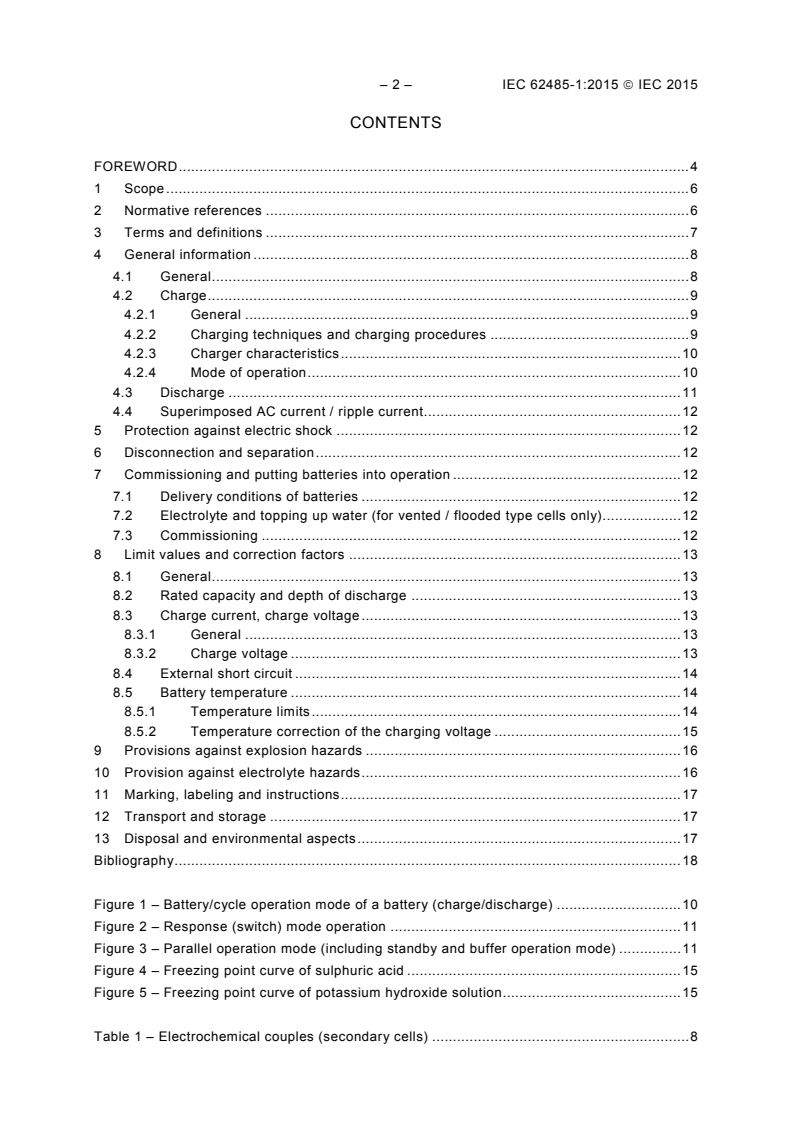
– 2 – IEC 62485-1:2015 IEC 2015
CONTENTS
FOREWORD . 4
1 Scope . 6
2 Normative references . 6
3 Terms and definitions . 7
4 General information . 8
4.1 General . 8
4.2 Charge . 9
4.2.1 General . 9
4.2.2 Charging techniques and charging procedures . 9
4.2.3 Charger characteristics . 10
4.2.4 Mode of operation . 10
4.3 Discharge . 11
4.4 Superimposed AC current / ripple current. 12
5 Protection against electric shock . 12
6 Disconnection and separation . 12
7 Commissioning and putting batteries into operation . 12
7.1 Delivery conditions of batteries . 12
7.2 Electrolyte and topping up water (for vented / flooded type cells only). 12
7.3 Commissioning . 12
8 Limit values and correction factors . 13
8.1 General . 13
8.2 Rated capacity and depth of discharge . 13
8.3 Charge current, charge voltage . 13
8.3.1 General . 13
8.3.2 Charge voltage . 13
8.4 External short circuit . 14
8.5 Battery temperature . 14
8.5.1 Temperature limits . 14
8.5.2 Temperature correction of the charging voltage . 15
9 Provisions against explosion hazards . 16
10 Provision against electrolyte hazards . 16
11 Marking, labeling and instructions . 17
12 Transport and storage . 17
13 Disposal and environmental aspects . 17
Bibliography . 18
Figure 1 – Battery/cycle operation mode of a battery (charge/discharge) . 10
Figure 2 – Response (switch) mode operation . 11
Figure 3 – Parallel operation mode (including standby and buffer operation mode) . 11
Figure 4 – Freezing point curve of sulphuric acid . 15
Figure 5 – Freezing point curve of potassium hydroxide solution . 15
Table 1 – Electrochemical couples (secondary cells) . 8
Table 2 – Preferred fields of application of secondary battery design . 9
Table 3 – Permitted variation of single cell voltage during charging with constant
voltage at battery temperature 20 °C. 14
Table 4 – Operating temperatures . 14
Table 5 – Typical temperature correction factor λ of the single cell charging voltage . 16
U
– 4 – IEC 62485-1:2015 IEC 2015
INTERNATIONAL ELECTROTECHNICAL COMMISSION
____________
SAFETY REQUIREMENTS FOR SECONDARY
BATTERIES AND BATTERY INSTALLATIONS –
Part 1: General safety information
FOREWORD
1) The International Electrotechnical Commission (IEC) is a worldwide organization for standardization comprising
all national electrotechnical committees (IEC National Committees). The object of IEC is to promote
international co-operation on all questions concerning standardization in the electrical and electronic fields. To
this end and in addition to other activities, IEC publishes International Standards, Technical Specifications,
Technical Reports, Publicly Available Specifications (PAS) and Guides (hereafter referred to as “IEC
Publication(s)”). Their preparation is entrusted to technical committees; any IEC National Committee interested
in the subject dealt with may participate in this preparatory work. International, governmental and non-
governmental organizations liaising with the IEC also participate in this preparation. IEC collaborates closely
with the International Organization for Standardization (ISO) in accordance with conditions determined by
agreement between the two organizations.
2) The formal decisions or agreements of IEC on technical matters express, as nearly as possible, an international
consensus of opinion on the relevant subjects since each technical committee has representation from all
interested IEC National Committees.
3) IEC Publications have the form of recommendations for international use and are accepted by IEC National
Committees in that sense. While all reasonable efforts are made to ensure that the technical content of IEC
Publications is accurate, IEC cannot be held responsible for the way in which they are used or for any
misinterpretation by any end user.
4) In order to promote international uniformity, IEC National Committees undertake to apply IEC Publications
transparently to the maximum extent possible in their national and regional publications. Any divergence
between any IEC Publication and the corresponding national or regional publication shall be clearly indicated in
the latter.
5) IEC itself does not provide any attestation of conformity. Independent certification bodies provide conformity
assessment services and, in some areas, access to IEC marks of conformity. IEC is not responsible for any
services carried out by independent certification bodies.
6) All users should ensure that they have the latest edition of this publication.
7) No liability shall attach to IEC or its directors, employees, servants or agents including individual experts and
members of its technical committees and IEC National Committees for any personal injury, property damage or
other damage of any nature whatsoever, whether direct or indirect, or for costs (including legal fees) and
expenses arising out of the publication, use of, or reliance upon, this IEC Publication or any other IEC
Publications.
8) Attention is drawn to the Normative references cited in this publication. Use of the referenced publications is
indispensable for the correct application of this publication.
9) Attention is drawn to the possibility that some of the elements of this IEC Publication may be the subject of
patent rights. IEC shall not be held responsible for identifying any or all such patent rights.
International Standard IEC 62485-1 has been prepared by IEC technical committee 21:
Secondary cells and batteries.
The text of this standard is based on the following documents:
FDIS Report on voting
21/851/FDIS 21/856/RVD
Full information on the voting for the approval of this standard can be found in the report on
voting indicated in the above table.
This publication has been drafted in accordance with the ISO/IEC Directives, Part 2.
A list of all parts of the IEC 62485 series can be found, under the general title Safety
requirements for secondary batteries and battery installations, on the IEC website.
The committee has decided that the contents of this publication will remain unchanged until
the stability date indicated on the IEC website under "http://webstore.iec.ch" in the data
related to the specific publication. At this date, the publication will be
• reconfirmed,
• withdrawn,
• replaced by a revised edition, or
• amended.
IMPORTANT – The 'colour inside' logo on the cover page of this publication indicates
that it contains colours which are considered to be useful for the correct
understanding of its contents. Users should therefore print this document using a
colour printer.
– 6 – IEC 62485-1:2015 IEC 2015
SAFETY REQUIREMENTS FOR SECONDARY
BATTERIES AND BATTERY INSTALLATIONS –
Part 1: General safety information
1 Scope
This Part of IEC 62485 specifies the basic requirements for secondary batteries and battery
installations.
The requirements regarding safety, reliability, life expectancy, mechanical strength, cycle
stability, internal resistance, and battery temperature, are determined by various applications,
and this, in turn, determines the selection of the battery design and technology.
In general, the requirements and definitions are specified for lead-acid and nickel-cadmium
batteries. For other battery systems with aqueous electrolyte, the requirements may be
applied accordingly.
The standard covers safety aspects taking into account hazards associated with:
– electricity (installation, charging, discharging, etc.);
– electrolyte;
– inflammable gas mixtures;
– storage and transportation.
With respect to electrical safety, reference is made to IEC 60364-4-41.
2 Normative references
The following documents, in whole or in part, are normatively referenced in this document and
are indispensable for its application. For dated references, only the edition cited applies. For
undated references, the latest edition of the referenced document (including any
amendments) applies.
IEC 60050-482:2004, International Electrotechnical Vocabulary – Part 482: Primary and
secondary cells and batteries
IEC 60364-4-41, Low-voltage electrical installations – Part 4-41: Protection for safety –
Protection against electric shock
IEC 60993, Electrolyte for vented nickel-cadmium cells
IEC 61429:1995, Marking of secondary cells and batteries with the international recycling
symbol ISO 7000-1135
IEC 62485-2, Safety requirements for secondary batteries and battery installations – Part 2:
Stationary batteries
IEC 62485-3, Safety requirements for secondary batteries and battery installations – Part 3:
Traction batteries
IEC 62485-4, Safety requirements for secondary batteries and battery installations – Part 4:
Valve-regulated lead-acid batteries for use in portable appliances
ISO 7000, Graphical symbols for use on equipment – Registered symbols
3 Terms and definitions
For the purposes of this document, the terms and definitions given in IEC 60050-482, as well
the following apply.
3.1
stationary battery
stationary battery installation
battery installed in a fixed location and not generally intended to be moved from place to
place
Note 1 to entry: The batteries are permanently connected to a charger and in many cases in addition to the load
and the power supply and are incorporated into stationary equipment or installed in battery rooms for use in
telecom, uninterruptible power supply (UPS), utility switching, emergency power or similar applications.
3.2
traction battery
secondary battery designed to provide the propulsion energy for electrical vehicles
3.3
cranking battery
battery used for starting of internal combustion engines in stationary, railway or other onboard
applications
3.4
starter battery
battery primarily used as a power source for the starting of internal combustion engines,
lighting and also for auxiliary equipment of internal combustion engine vehicles
3.5
onboard battery
battery used for power supply of a DC network onboard ships, rail vehicles or off-road
vehicles without authorization for public traffic
3.6
aircraft battery
battery used in aircrafts and helicopters for starting the auxiliary engine and powering the DC
network
3.7
portable battery
battery mainly used for power supply of portable appliances
Note 1 to entry: Batteries for portable equipment are usually maintenance-free.
3.8
battery room
room in a building dedicated for the accommodation of stationary batteries
3.9
battery enclosure
enclosure designed for the accommodation of batteries to protect against environmental
impacts, unauthorised access of persons and hazards caused by the batteries
– 8 – IEC 62485-1:2015 IEC 2015
3.10
mode of operation
condition where the batteries require different type of charging and discharging depending on
the type of application
Note 1 to entry: The modes are listed in 4.2.4.
3.11
charge of a battery
operation during which a secondary cell or battery is supplied with electric energy from an
external circuit which results in chemical changes within the cell and thus the storage of this
energy as chemical energy
[SOURCE: IEC 60050-482:2004, 482-05-27, modified – replacement of "charging" by "charge"
in the entry]
3.12
discharge (of a battery)
operation by which a secondary cell or battery delivers to an external electric circuit and
under specified conditions electric energy produced in the cells
[SOURCE: IEC 60050-482:2004, 482-03-23, modified – replacement of "battery" by
"secondary cell or battery" in the definition]
4 General information
4.1 General
The technical characteristics of secondary cells are listed in Table 1. The different electro-
chemical systems have acidic or alkaline aqueous electrolyte. These electro-chemical
systems generate different voltages depending on the type of positive and negative electrodes
and the type of electrolyte. For each of the systems a nominal voltage is defined.
During operation some systems may generate and release gasses, which may be hazardous
under certain conditions and require specific protective measures.
Table 1 – Electrochemical couples (secondary cells)
Battery Designation of system components Nominal Gassing
Simplified equation of
a
system voltage voltage cell reaction
Electrodes Electrolyte Active mass of electrodes
charged condition <
charged discharged
discharged condition
positive negative positive negative [V] [V]
Lead-acid Pb / PbO H SO PbO Pb PbSO PbSO 2,00
≈ 2,40 PbO + Pb + 2H SO <
2 2 4 2 4 4
2 2 4
2PbSO + 2H O
4 2
Nickel-
Ni / Cd KOH / NiOOH Cd Ni(OH) Cd(OH) 1,20 ≈ 1,55 2NiOOH + Cd + 2H O <
2 2 2
cadmium NaOH
2Ni(OH) + Cd(OH)
2 2
Ni-metal- Ni/MH KOH NiOOH H Ni(OH) H O 1,20 ≈ 1,55 2(NiOOH•H O) + H <
2 2 2 2 2
hydride
2Ni(OH) + 2H O
2 2
Nickel- Ni / Fe KOH NiOOH Fe Ni(OH) Fe(OH) 1,20 ≈ 1,70 2NiOOH + Fe + 2H O <
2 2 2
iron
2Ni(OH) + Fe(OH)
2 2
Silver- Ag / Zn KOH AgO Zn Ag Zn(OH) 1,55 O <
≈ 2,05 AgO + Zn + H
2 2
zinc
Ag + Zn(OH)
a
Typical nominal voltage.
In Table 2 preferred applications according to the battery design are listed.
Table 2 – Preferred fields of application of secondary battery design
Field of application Stationary Traction Portable
battery battery battery
IEC 62485-2 IEC 62485-3 IEC 62485-4
Telecommunication
Power plants / Substations
DC power supply systems
alarm system, signal systems, railway crossings, etc.
Emergency power supply
UPS systems
Starting of internal combustion engines (cranking battery)
PV solar systems
Forklift trucks / Materials Handling Equipment (MHE)
Automatic guided vehicles
Mobile robots
Cleaning machines
Wheel chairs
Explosion proof batteries
mining batteries
Leisure type batteries, e.g.
Caravans, boats, yachts
Batteries onboard ships (boats), railway and other vehicles
Portable appliances
General purpose batteries
4.2 Charge
4.2.1 General
After a discharge, secondary batteries can be recharged by use of a suitable DC power
source. Normally batteries supply the energy for a specified time period to appliances,
systems or vehicles independent from the mains power supply.
Batteries can also be kept fully charged by applying permanent float charge and can be
operated as a reserve power source, e.g. in ‘fail safe’ power supply systems.
The characteristic of the charge equipment is determined by the electro-chemical system, the
battery design and the application. The charger shall provide the required charging
characteristics and charging regime to suit to the operating conditions.
In the case of parallel operation of the battery with the charger and load, the system’s settings
for current and voltage shall reflect the values specified by the battery manufacturer.
4.2.2 Charging techniques and charging procedures
For proper charging of secondary batteries, manufacturer’s specified charging procedures and
charging regimes shall be applied. For achieving long service life of secondary batteries the
limit values and operating conditions shall be observed. The control of charge voltage (over
charge protection) and current are recommended to detect irregularities during a charge.
Some conditions can extend a recharge time, e.g. low voltage of the mains supply, or low
electrolyte temperature requiring a longer recharge time, or suffer undercharge.
– 10 – IEC 62485-1:2015 IEC 2015
Normally the charge current for vented batteries is not limited until the gassing voltage is
reached. With valve-regulated and gastight sealed batteries the manufacturer’s instruction
regarding charge current, voltage and temperature shall be followed.
When exceeding the gassing voltage the charge current shall be adjusted according to
information from the battery manufacturer or from the relevant safety standards.
4.2.3 Charger characteristics
Chargers with uncontrolled taper characteristics are affected by variations in the mains
supply, i.e. variations of mains voltage and frequency. In order to compensate for these
variations, manual adjustment of the transformer tappings may be required, to achieve the
chargers specified recharge values.
The mains voltage variation for long periods on uncontrolled taper charge rectifiers gives
deviations of the output current. The manual adjustment of the transformer tappings may be
necessary to bring the charger back to recommended output limits
Influences from the mains supply are compensated when chargers with controlled charge
characteristic are used, e.g. constant current / constant voltage (IU) characteristic.
Parallel connected batteries shall have identical electrochemical system and identical number
of cells. They shall be charged with controlled IU-chargers only. The individual strings in the
installation shall have an equal potential.
4.2.4 Mode of operation
4.2.4.1 General
The mode of operation specifies the joint operation of the DC power source, the battery and
the consumer load.
The following modes of operation are typical:
• battery / cycle operation (charge / discharge operation);
• response mode operation (switch mode operation);
• parallel operation mode. Battery, load and charger are permanently connected and
operate in parallel.
4.2.4.2 Battery / cycle operation mode (charge / discharge)
The load is powered by the battery only. A conductive connection between load and DC power
source does not exist. The DC power source recharges the battery only. Figure 1 illustrates
this operation mode.
≈ ≈
Load
Load
Battery charge Battery discharge
IEC
Figure 1 – Battery/cycle operation mode of a battery (charge/discharge)
4.2.4.3 Response (switch) mode operation
The power source DC1 feeds the load. The battery is kept charged by a second power source
DC2. A conductive connection between both circuits does not exist in the first instance. When
the power source DC1 of the load fails, the switching contact responds and connects the
battery to the load. Figure 2 illustrates this operation mode.
≈
DC1
Utilisation
Load
≈
DC2
IEC
Figure 2 – Response (switch) mode operation
4.2.4.4 Parallel operation mode
4.2.4.4.1 General
The DC power source, the batteries and the consumer load are permanently connected in
parallel. Figure 3 illustrates this operation mode.
≈
Load
IEC
Figure 3 – Parallel operation mode (including standby and buffer operation mode)
4.2.4.4.2 Parallel standby operation mode
The DC power source is designed to supply the sum of the maximum load current and the
battery charge current (also recharge current after a discharge) at any time. The battery is
kept fully charged. The battery supplies only the load, when the DC power source fails.
4.2.4.4.3 Buffer operation
At times, the load current can exceed the nominal current of the DC power source. During
these periods the current will be supplied by the battery. The battery provides the peak loads
and is not always in a fully state of charge. In case of DC power source failure the battery
supplies the load.
4.3 Discharge
The battery capacity depends on the discharge current. The corresponding voltage shall not
drop below the specified end of discharge voltage. Discharges exceeding these limits are
deep discharges.
The voltage curve during discharge is determined by the battery design and is influenced by
the current, discharge time, initial state of charge, temperature and the battery's state of
health.
Test of capacity shall be performed in accordance with the appropriate standards of the
products (see bibliography).
– 12 – IEC 62485-1:2015 IEC 2015
4.4 Superimposed AC current / ripple current
Depending on the charger and load design and its characteristic, AC current, superimposed
on the DC charge current, does flow through the battery during the charging process. This
superimposed AC current can be generated by the charger or fed back from the load. This AC
current will generate additional heat in the battery with consequential damage or accelerated
ageing.
Values for the maximum permitted superimposed AC current are specified in IEC 62485-2.
5 Protection against electric shock
The required measures for the protection against electric shock are based on the
requirements specified in IEC 60364-4-41. Reference is made to this standard wherever
applicable in DC power supply systems, and additional information is given where explanation
for DC systems including batteries is required.
More detailed information is available in the relevant parts of IEC 62485 series.
NOTE In addition, relevant national regulations regarding installation and working conditions are applied.
6 Disconnection and separation
Devices shall be provided to separate the battery from all incoming and outgoing current
circuits and also from protective earth, especially in case of maintenance and repair.
The connection terminals of batteries can be considered as separation contacts.
Disconnection of connectors or contacts (plugs) is only permitted when no current is flowing.
NOTE Before disconnecting batteries switch off charger and load, to avoid of risk of sparks.
7 Commissioning and putting batteries into operation
7.1 Delivery conditions of batteries
Batteries can be supplied in different initial conditions and shall be put into operation
according to the manufacturer’s instructions. Initial conditions and relating procedures for
putting into operation might be:
a) unfilled (dry) and uncharged (NiCd): electrolyte filling and commissioning charge required;
b) unfilled and charged (dry charged) (Pb): electrolyte filling; eventually charge required;
c) filled and charged (Pb; NiCd,Ni-MH);
d) filled and discharged (NiCd,Ni-MH): charge required.
7.2 Electrolyte and topping up water (for vented / flooded type cells only)
Properties of electrolyte for filling and water for topping-up shall comply with IEC 60993 for
Ni/Cd. For other battery systems such as lead acid the electrolyte density (specific gravity in
Kg/l), amount and level of electrolyte refer to the manufacturer’s specification.
NOTE The electrolyte and the water for lead acid batteries will be defined in IEC 62877-1 and IEC 62877-2.
7.3 Commissioning
Voltages, currents, rest and charging periods as well as temperature limits specified by the
manufacturer shall be considered.
The manufacturer shall specify the maximum storage time and the conditioning requirements.
8 Limit values and correction factors
8.1 General
The following limit values specify the conditions under which safe use and operation of
batteries is ensured. Permanent operation outside or close to the limit values leads to
reduction of reliability and may cause malfunction with risks for health and the environment,
premature ageing and battery failure.
8.2 Rated capacity and depth of discharge
Rated capacity stated by the manufacturer refers to a depth of discharge of 100 % at rated
current.
Where batteries are regularly cyclic charged and discharged, especially lead-acid batteries,
not more than 80 % rated capacity shall be discharged. Discharge below the specified end of
discharge voltage is defined as deep discharge.
Frequent discharge of more than 80 % of rated capacity or deep discharge leads to
irreversible damage and reduced lifetime of lead-acid batteries. Lead-acid batteries remaining
in low state of charge for long periods will receive irreversible damage and loss of capacity.
The sensitivity of vented NiCd batteries to deep discharge depends on the electrode design.
NiCd batteries are however virtually insensitive to storage in the discharged state.
NOTE For sealed NiCd and NiMH batteries refer to battery manufacturer’s recommendations.
Taking into account a capacity loss over the battery life due to ageing the required initial
capacity shall be corrected by an ageing factor. In case of stationary / traction battery
applications the ageing factor of 1,25 is typical with reference to a capacity reduction to 80 %
at the end of life. Also certain margin shall be included for later expansion of the DC power
supply system.
8.3 Charge current, charge voltage
8.3.1 General
For recharge currents see manufacturer’s instruction. When applying higher charging voltage,
exceeding the gassing voltage, the charging current will increase leading to increased oxygen
and hydrogen gas emission, increased water loss, increased temperature and reduced
lifetime.
The accuracy of battery charger output voltage shall be better than ± 1 %.
8.3.2 Charge voltage
The single cells may have slightly different voltages, when charging a fully charged battery
with constant voltage, e.g. float or boost charge voltage. The following variations of the
voltage values listed in Table 3 can be expected. Depending of the product design other
values can be specified by the manufacturer.
– 14 – IEC 62485-1:2015 IEC 2015
Table 3 – Permitted variation of single cell voltage during charging
with constant voltage at battery temperature 20 °C
Pb Pb NiCd NiCd Ni MH
Vented Valve-regulated vented sealed portable sealed portable
Vpc Vpc Vpc Float charge at constant voltage is
prohibited.
a a a
2,20 – 2,40 2,25 – 2,40 1,40 – 1,45
Preferred charging method:
b b b
+0,1 +0,15 +0,1
Constant current charge with adequate cut
c c c
–0,05 –0,075 –0,05
off method.
Refer to manufacturer’s instructions
NOTE The same tolerances can be applied for boost charge voltages values.
a
Range of operation, manufacturer has to define a operating voltage for one cell.
b
Upper level of average voltage deviation of one cell in a string. Out of level is an indicator for malfunction.
c
Lower level of average voltage deviation of one cell in a string. Out of level is an indicator for malfunction.
8.4 External short circuit
Batteries are able to withstand an external short circuit under specified conditions. The
batteries resist certain over-current or a short circuit current for a specified duration. These
values determine the design of the electrical power supply systems consisting of fuses, circuit
breakers and cables. The manufacturer shall provide appropriate values. External shorts can
lead to irreversible damage and a reduced service life.
8.5 Battery temperature
8.5.1 Temperature limits
The limit values specified in Table 4 are possible and depend on battery design and
application.
Table 4 – Operating temperatures
Temperature Pb Pb NiCd NiCd NiMH
vented VRLA vented sealed portable sealed portable
Lower limit –40 °C –40 °C –50 °C –50 °C –40 °C
(fully charged)
a
Upper limit +60 °C +55 °C +70 °C +60 °C +60 °C
NOTE For other battery systems refer to the manufacturer’s information.
a
Stress temperature which should be applied only for a limited time. If used permanently reduction in lifetime is
inevitable.
The lower temperature limit is determined by the freezing of the electrolyte. Lead-acid
batteries reduce the specific gravity of the electrolyte during discharge. At very low
temperature ice crystals may affect the plate structure or frozen electrolyte may destroy the
battery container. Figures 4 and 5 illustrate the dependency of the freezing point from the
specific gravity of the electrolyte for sulfuric acid and potassium hydroxide solutions.
Low temperature will significantly decrease the battery capacity / power, charge acceptance
and efficiency.
Specific gravity, kg/ltr
1,00 1,05 1,10 1,15 1,20 1,25 1,30 1,35 1,40 1,45 1,50
−10
−20
−30
−40
−50
−60
−70
−80
IEC
Figure 4 – Freezing point curve of sulphuric acid
Specific gravity, kg/ltr
1,00 1,05 1,10 1,15 1,20 1,25 1,30
−10
−20
−30
−40
−50
−60
−70
−80
IEC
Figure 5 – Freezing point curve of potassium hydroxide solution
8.5.2 Temperature correction of the charging voltage
Charging voltage range is limited by the open circuit voltage and the gassing voltage.
High charging voltage High gassing rate High water loss
Low charging voltage Low charge acceptance Low state of charge
The charging voltage of a battery depends on the temperature and therefore shall be
temperature corrected, e.g. when charging with constant voltage.
High temperature Low voltage
Low temperature High voltage
Therefore the output voltage of the charger shall be temperature compensated to avoid
damage to the battery. Where no other information is provided by the manufacturer the
following formula for the correction of the single cell charging voltage may be applied:
U = U + λ (ϑ – ϑ )
CC C U rt
where
U is the temperature compensated charge voltage [V];
CC
Temperature, °C Temperature, °C
– 16 – IEC 62485-1:2015 IEC 2015
U is the charge voltage at reference temperature [V];
C
λ is the temperature correction factor [V/K];
U
ϑ is the measured temperature [°C];
ϑ is the reference temperature [°C].
rt
Typical temperature correction factors and temperature ranges are given in Table 5.
Table 5 – Typical temperature correction
factor λ of the single cell charging voltage
U
Temperature correction factor Temperature range
λ (per cell) ϑ
U
Vented lead-acid battery –0,004 V/K 0 °C to +60 °C
Valve-regulated lead-acid battery –0,003 V/K
0 °C to +55 °C
Ni Cd battery –0,003 V/K
–20 °C to +70 °C
NOTE For other battery systems refer to the manufacturer’s information.
For vented as well as valve-regulated lead-acid batteries the calculated charging voltage for
0 °C can be applied down to –40 °C.
For high temperature float service application with VRLA batteries the appearance of thermal
run-away effects shall be taken into consideration. Specific information regarding temperature
limits shall be given by the battery manufacturer.
9 Provisions against explosion hazards
Gasses can be released during operation (mainly during charging) depending on the type of
battery. The gasses can be flammable and can explode at certain gas concentration,
temperature and external source of ignition. Risks can be minimised by adjusted charging
procedure, by design, by ventilation of accommodation area and/or prevention of ignition
sources. Details can be found in the appropriate application standards.
10 Provision against electrolyte hazards
Most of the electrolytes used in batteries are hazardous and can create irritation or burns on
eyes and skin. Inhalation and swallowing of electrolyte is dangerous. In case of contact with
electrolyte, medical attention is always required. The battery manufacturers are recommended
to provide safety instructions. Protective measures are specified in the appropriate application
standard.
Contact with electrolyte is possible, for example due to:
• handling of electrolyte;
• touching of battery surface or vent plugs, i.e. vented type batteries;
• accidental burst of battery container;
• tilting of vented batteries during handling and transport;
• spilling of electrolyte and ejection of a fine acidic mist or spray being emitted from the
battery vents due to gassing.
11 Marking, labeling and instructions
Cells, batteries, and battery packs, shall be equipped with markings, e.g. polarity and plastic
marking, labels or prints indicating technical information, warnings and supplier information in
accordance to relevant battery standards listed in the bibliography. Appropriate instructions
for safety requirements and operation shall be provided.
12 Transport and storage
Packing and transportation of secondary batteries is covered in national and international
regulations. The following international regulations for transport, safe packing and carriage of
dangerous goods apply:
• Road: Agreement for the International Carriage of Dangerous Goods by Road;
• Rail (international): International Convention concerning the carriage of Goods by Rail
(CIM) Annex A: International regulations concerning the carriage of dangerous goods by
rail (RID);
• Sea: International Maritime Organisation, Dangerous Goods Code;
• IMDG Code 8 Class 8 corrosive;
• Air: International Air Transport Association (IATA);
• Dangerous Goods Regulations (latest edition).
For storage of cells or batteries under various climatic conditions, the characteristics
regarding charge retention and corrosion effects shall be observed. The manufacturer’s
recommendations shall be followed.
13 Disposal and environmental aspects
All cells and batteries containing the electro-chemically active substances mercury, cadmium
or lead shall be marked with the recycling symbol ISO 7000-1135 according to
IEC 61429:1995, respectively with the crossed-out waste bin and the ISO symbol in
accordance with IEC 61429:1995.
– 18 – IEC 62485-1:2015 IEC 2015
Bibliography
IEC 60095-1, Lead-acid starter batteries – Part 1: General requirements and methods of test
IEC 60254-1, Lead-acid traction batteries – Part 1: General requirements and methods of test
IEC 60254-2, Lead-acid traction batteries – Part 2: Dimensions of cells and terminals and
marking of polarity on cells
IEC 60622, Secondary cells and batteries containing alkaline or other non-acid electrolytes –
Sealed nickel-cadmium prismatic rechargeable singl
...