

IEC 62660-1:2018
(Main)Secondary lithium-ion cells for the propulsion of electric road vehicles - Part 1: Performance testing
General Information
- Abstract
IEC 62660-1:2018 specifies performance and life testing of secondary lithium-ion cells used for propulsion of electric vehicles including battery electric vehicles (BEV) and hybrid electric vehicles (HEV). This document specifies the test procedures to obtain the essential characteristics of lithium-ion cells for vehicle propulsion applications regarding capacity, power density, energy density, storage life and cycle life. This document provides the standard test procedures and conditions for testing basic performance characteristics of lithium-ion cells for vehicle propulsion applications, which are indispensable for securing a basic level of performance and obtaining essential data on cells for various designs of battery systems and battery packs. IEC 62660-1:2018 cancels and replaces the first edition published in 2010. This edition constitutes a technical revision. This edition includes the following significant technical changes with respect to the previous edition:
a) The purpose of each test has been added.
b) The power test has been revised for clarification, and an informative part of the current-voltage characteristic test has been moved to the new Annex C.
- Status
- Published
- Publication Date
- 11-Dec-2018
- Technical Committee
- TC 21 - Secondary cells and batteries
- Drafting Committee
- JWG 69 Li - TC 21/JWG 69 Li
- Current Stage
- PPUB - Publication issued
- Start Date
- 12-Dec-2018
- Completion Date
- 14-Dec-2018
Buy Documents
IEC 62660-1:2018 RLV - Secondary lithium-ion cells for the propulsion of electric road vehicles - Part 1: Performance testing Released:12/12/2018
IEC 62660-1:2018 - Secondary lithium-ion cells for the propulsion of electric road vehicles - Part 1: Performance testing Released:12/12/2018
Overview
IEC 62660-1:2018 - "Secondary lithium‑ion cells for the propulsion of electric road vehicles - Part 1: Performance testing" is an international standard from IEC that defines standardized performance and life testing methods for lithium‑ion cells used in electric road vehicles (BEV and HEV). This second edition (2018) cancels and replaces the 2010 edition and constitutes a technical revision. The standard establishes test procedures and conditions to obtain essential cell characteristics including capacity, power density, energy density, storage life and cycle life, providing baseline data for traction battery design and evaluation.
Key Topics
The standard covers practical, repeatable test methods and conditions, including:
- Test conditions and measuring equipment: recommended ranges and tolerances for voltage, current, temperature and other instruments to ensure consistent results.
- Physical measurements: cell dimension and mass measurement procedures relevant to pack integration.
- Electrical measurements: charge/discharge procedures, state‑of‑charge (SOC) adjustment, and standardized capacity testing for traction applications.
- Power and energy tests: procedures to determine power density, regenerative power and energy density under defined SOC and temperature conditions.
- Storage tests: charge‑retention and storage‑life tests that characterize calendar ageing.
- Cycle life tests: BEV and HEV specific dynamic cycling profiles to measure long‑term durability and degradation under application‑relevant use patterns.
- Energy efficiency: test methods to quantify round‑trip energy efficiency for BEV and HEV use cases.
- Informative annexes: selective test conditions, cycle test sequences and a current–voltage characteristic test moved to Annex C (clarified in this edition). The purpose of each test is explicitly stated in this revision.
Applications
IEC 62660-1:2018 is intended for:
- Cell manufacturers for R&D and quality control to benchmark product performance.
- Automotive OEMs and battery pack designers to collect comparable cell data for pack design, thermal management and system integration.
- Independent test laboratories and certification bodies for standardized evaluation and supplier comparison.
- Procurement and regulatory teams requiring objective test outcomes for supplier selection or compliance evidence.
Practical uses include baseline performance comparison of chemistries, informing battery pack sizing, validating cycle and storage life expectations, and supporting product specifications and claims.
Related Standards
- Part of the IEC 62660 series (secondary lithium‑ion cells for vehicle propulsion).
- Associated reference standards include ISO test series such as ISO 12405‑1 and ISO 12405‑2 (related electric vehicle battery testing methodologies).
Keywords: IEC 62660-1:2018, lithium‑ion cells, performance testing, BEV, HEV, power density, energy density, cycle life, storage life, traction battery, battery pack design.
Relations
- Effective Date
- 05-Sep-2023
Buy Documents
IEC 62660-1:2018 RLV - Secondary lithium-ion cells for the propulsion of electric road vehicles - Part 1: Performance testing Released:12/12/2018
IEC 62660-1:2018 - Secondary lithium-ion cells for the propulsion of electric road vehicles - Part 1: Performance testing Released:12/12/2018
Get Certified
Connect with accredited certification bodies for this standard

TÜV Rheinland
TÜV Rheinland is a leading international provider of technical services.

TÜV SÜD
TÜV SÜD is a trusted partner of choice for safety, security and sustainability solutions.

DEKRA Certification Inc.
DEKRA US certification services.
Sponsored listings
Frequently Asked Questions
IEC 62660-1:2018 is a standard published by the International Electrotechnical Commission (IEC). Its full title is "Secondary lithium-ion cells for the propulsion of electric road vehicles - Part 1: Performance testing". This standard covers: IEC 62660-1:2018 specifies performance and life testing of secondary lithium-ion cells used for propulsion of electric vehicles including battery electric vehicles (BEV) and hybrid electric vehicles (HEV). This document specifies the test procedures to obtain the essential characteristics of lithium-ion cells for vehicle propulsion applications regarding capacity, power density, energy density, storage life and cycle life. This document provides the standard test procedures and conditions for testing basic performance characteristics of lithium-ion cells for vehicle propulsion applications, which are indispensable for securing a basic level of performance and obtaining essential data on cells for various designs of battery systems and battery packs. IEC 62660-1:2018 cancels and replaces the first edition published in 2010. This edition constitutes a technical revision. This edition includes the following significant technical changes with respect to the previous edition: a) The purpose of each test has been added. b) The power test has been revised for clarification, and an informative part of the current-voltage characteristic test has been moved to the new Annex C.
IEC 62660-1:2018 specifies performance and life testing of secondary lithium-ion cells used for propulsion of electric vehicles including battery electric vehicles (BEV) and hybrid electric vehicles (HEV). This document specifies the test procedures to obtain the essential characteristics of lithium-ion cells for vehicle propulsion applications regarding capacity, power density, energy density, storage life and cycle life. This document provides the standard test procedures and conditions for testing basic performance characteristics of lithium-ion cells for vehicle propulsion applications, which are indispensable for securing a basic level of performance and obtaining essential data on cells for various designs of battery systems and battery packs. IEC 62660-1:2018 cancels and replaces the first edition published in 2010. This edition constitutes a technical revision. This edition includes the following significant technical changes with respect to the previous edition: a) The purpose of each test has been added. b) The power test has been revised for clarification, and an informative part of the current-voltage characteristic test has been moved to the new Annex C.
IEC 62660-1:2018 is classified under the following ICS (International Classification for Standards) categories: 01 - GENERALITIES. TERMINOLOGY. STANDARDIZATION. DOCUMENTATION; 29.220.20 - Acid secondary cells and batteries; 43.120 - Electric road vehicles. The ICS classification helps identify the subject area and facilitates finding related standards.
IEC 62660-1:2018 has the following relationships with other standards: It is inter standard links to IEC 62660-1:2010. Understanding these relationships helps ensure you are using the most current and applicable version of the standard.
IEC 62660-1:2018 is available in PDF format for immediate download after purchase. The document can be added to your cart and obtained through the secure checkout process. Digital delivery ensures instant access to the complete standard document.
Standards Content (Sample)
IEC 62660-1 ®
Edition 2.0 2018-12
REDLINE VERSION
INTERNATIONAL
STANDARD
colour
inside
Secondary lithium-ion cells for the propulsion of electric road vehicles –
Part 1: Performance testing
All rights reserved. Unless otherwise specified, no part of this publication may be reproduced or utilized in any form
or by any means, electronic or mechanical, including photocopying and microfilm, without permission in writing from
either IEC or IEC's member National Committee in the country of the requester. If you have any questions about IEC
copyright or have an enquiry about obtaining additional rights to this publication, please contact the address below or
your local IEC member National Committee for further information.
IEC Central Office Tel.: +41 22 919 02 11
3, rue de Varembé info@iec.ch
CH-1211 Geneva 20 www.iec.ch
Switzerland
About the IEC
The International Electrotechnical Commission (IEC) is the leading global organization that prepares and publishes
International Standards for all electrical, electronic and related technologies.
About IEC publications
The technical content of IEC publications is kept under constant review by the IEC. Please make sure that you have the
latest edition, a corrigenda or an amendment might have been published.
IEC Catalogue - webstore.iec.ch/catalogue Electropedia - www.electropedia.org
The stand-alone application for consulting the entire The world's leading online dictionary of electronic and
bibliographical information on IEC International Standards, electrical terms containing 21 000 terms and definitions in
Technical Specifications, Technical Reports and other English and French, with equivalent terms in 16 additional
documents. Available for PC, Mac OS, Android Tablets and languages. Also known as the International Electrotechnical
iPad. Vocabulary (IEV) online.
IEC publications search - webstore.iec.ch/advsearchform IEC Glossary - std.iec.ch/glossary
The advanced search enables to find IEC publications by a 67 000 electrotechnical terminology entries in English and
variety of criteria (reference number, text, technical French extracted from the Terms and Definitions clause of
committee,…). It also gives information on projects, replaced IEC publications issued since 2002. Some entries have been
and withdrawn publications. collected from earlier publications of IEC TC 37, 77, 86 and
CISPR.
IEC Just Published - webstore.iec.ch/justpublished
Stay up to date on all new IEC publications. Just Published IEC Customer Service Centre - webstore.iec.ch/csc
details all new publications released. Available online and If you wish to give us your feedback on this publication or
also once a month by email. need further assistance, please contact the Customer Service
Centre: sales@iec.ch.
IEC 62660-1 ®
Edition 2.0 2018-12
REDLINE VERSION
INTERNATIONAL
STANDARD
colour
inside
Secondary lithium-ion cells for the propulsion of electric road vehicles –
Part 1: Performance testing
INTERNATIONAL
ELECTROTECHNICAL
COMMISSION
ICS 29.220.20; 43.120 ISBN 978-2-8322-6349-5
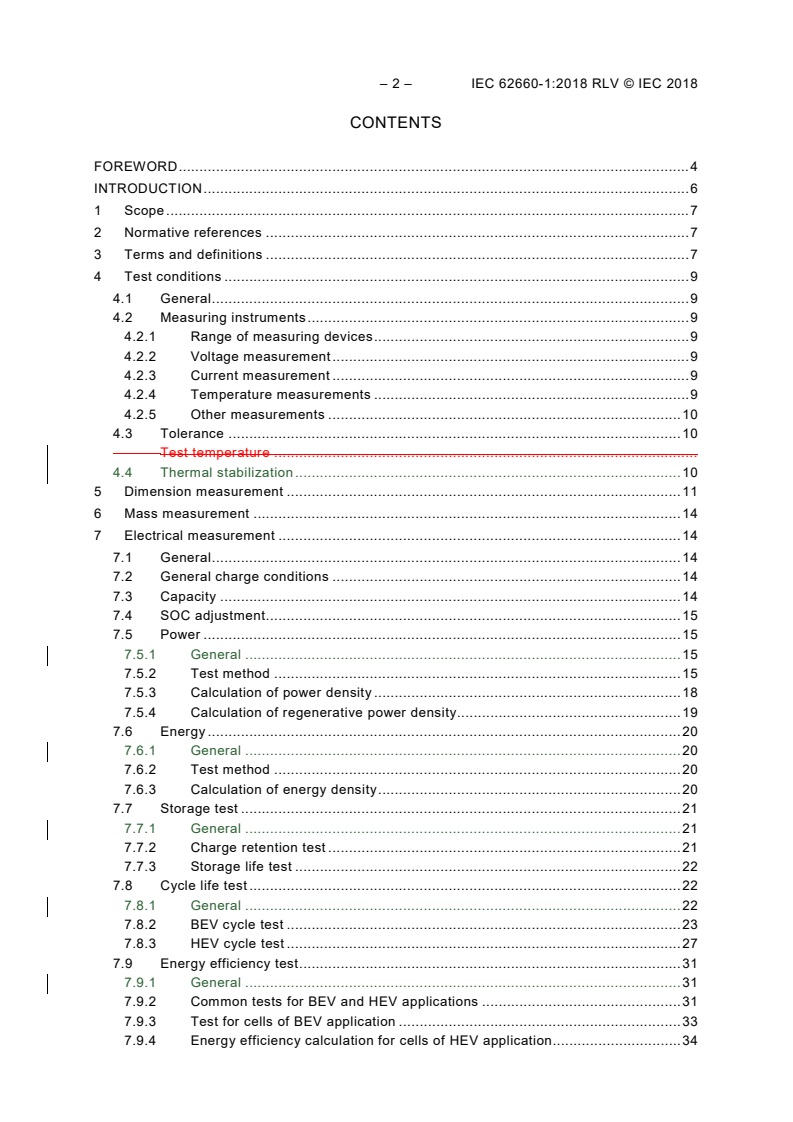
– 2 – IEC 62660-1:2018 RLV © IEC 2018
CONTENTS
FOREWORD . 4
INTRODUCTION . 6
1 Scope . 7
2 Normative references . 7
3 Terms and definitions . 7
4 Test conditions . 9
4.1 General . 9
4.2 Measuring instruments . 9
4.2.1 Range of measuring devices . 9
4.2.2 Voltage measurement . 9
4.2.3 Current measurement . 9
4.2.4 Temperature measurements . 9
4.2.5 Other measurements . 10
4.3 Tolerance . 10
Test temperature .
4.4 Thermal stabilization . 10
5 Dimension measurement . 11
6 Mass measurement . 14
7 Electrical measurement . 14
7.1 General . 14
7.2 General charge conditions . 14
7.3 Capacity . 14
7.4 SOC adjustment . 15
7.5 Power . 15
7.5.1 General . 15
7.5.2 Test method . 15
7.5.3 Calculation of power density . 18
7.5.4 Calculation of regenerative power density . 19
7.6 Energy . 20
7.6.1 General . 20
7.6.2 Test method . 20
7.6.3 Calculation of energy density . 20
7.7 Storage test . 21
7.7.1 General . 21
7.7.2 Charge retention test . 21
7.7.3 Storage life test . 22
7.8 Cycle life test . 22
7.8.1 General . 22
7.8.2 BEV cycle test . 23
7.8.3 HEV cycle test . 27
7.9 Energy efficiency test . 31
7.9.1 General . 31
7.9.2 Common tests for BEV and HEV applications . 31
7.9.3 Test for cells of BEV application . 33
7.9.4 Energy efficiency calculation for cells of HEV application . 34
Annex A (informative) Selective test conditions . 36
Annex B (informative) Cycle life test sequence . 38
Annex C (informative) Current-voltage characteristic test . 41
C.1 General . 41
C.2 Test method . 41
Bibliography . 44
Figure 1 – Example of temperature measurement of cell . 9
Figure 2 – Examples of maximum dimensions of cell . 11
Figure 3 – Dynamic discharge profile A for BEV cycle test . 20
Figure 4 – Dynamic discharge profile B for BEV cycle test . 22
Figure 5 – Discharge-rich profile for HEV cycle test . 25
Figure 6 – Charge-rich profile for HEV cycle test. 26
Figure 7 – Typical SOC swing by combination of two profiles for HEV cycle test . 26
Figure B.1 – Test sequence of BEV cycle test . 34
Figure B.2 – Concept of BEV cycle test . 35
Figure C.1 – Test order of the current-voltage characteristic test . 37
Table 1 – Discharge conditions . 12
Table 2 – SOC and temperature condition for power test . 13
Table 3 – Dynamic discharge profile A for BEV cycle test . 20
Table 4 – Dynamic discharge profile B for BEV cycle test . 22
Table 5 – Discharge-rich profile for HEV cycle test . 24
Table 6 – Charge-rich profile for HEV cycle test . 25
Table A.1 – Capacity test conditions . 31
Table A.2 – Power test conditions . 31
Table A.3 – Cycle life test conditions . 31
Table A.4 – Conditions for energy efficiency test for BEV application . 32
Table B.1 – Test sequence of HEV cycle test . 35
Table C.1 – Charge and discharge current for the current-voltage characteristic test . 36
– 4 – IEC 62660-1:2018 RLV © IEC 2018
INTERNATIONAL ELECTROTECHNICAL COMMISSION
____________
SECONDARY LITHIUM-ION CELLS FOR
THE PROPULSION OF ELECTRIC ROAD VEHICLES –
Part 1: Performance testing
FOREWORD
1) The International Electrotechnical Commission (IEC) is a worldwide organization for standardization comprising
all national electrotechnical committees (IEC National Committees). The object of IEC is to promote
international co-operation on all questions concerning standardization in the electrical and electronic fields. To
this end and in addition to other activities, IEC publishes International Standards, Technical Specifications,
Technical Reports, Publicly Available Specifications (PAS) and Guides (hereafter referred to as “IEC
Publication(s)”). Their preparation is entrusted to technical committees; any IEC National Committee interested
in the subject dealt with may participate in this preparatory work. International, governmental and non-
governmental organizations liaising with the IEC also participate in this preparation. IEC collaborates closely
with the International Organization for Standardization (ISO) in accordance with conditions determined by
agreement between the two organizations.
2) The formal decisions or agreements of IEC on technical matters express, as nearly as possible, an international
consensus of opinion on the relevant subjects since each technical committee has representation from all
interested IEC National Committees.
3) IEC Publications have the form of recommendations for international use and are accepted by IEC National
Committees in that sense. While all reasonable efforts are made to ensure that the technical content of IEC
Publications is accurate, IEC cannot be held responsible for the way in which they are used or for any
misinterpretation by any end user.
4) In order to promote international uniformity, IEC National Committees undertake to apply IEC Publications
transparently to the maximum extent possible in their national and regional publications. Any divergence
between any IEC Publication and the corresponding national or regional publication shall be clearly indicated in
the latter.
5) IEC itself does not provide any attestation of conformity. Independent certification bodies provide conformity
assessment services and, in some areas, access to IEC marks of conformity. IEC is not responsible for any
services carried out by independent certification bodies.
6) All users should ensure that they have the latest edition of this publication.
7) No liability shall attach to IEC or its directors, employees, servants or agents including individual experts and
members of its technical committees and IEC National Committees for any personal injury, property damage or
other damage of any nature whatsoever, whether direct or indirect, or for costs (including legal fees) and
expenses arising out of the publication, use of, or reliance upon, this IEC Publication or any other IEC
Publications.
8) Attention is drawn to the Normative references cited in this publication. Use of the referenced publications is
indispensable for the correct application of this publication.
9) Attention is drawn to the possibility that some of the elements of this IEC Publication may be the subject of
patent rights. IEC shall not be held responsible for identifying any or all such patent rights.
This redline version of the official IEC Standard allows the user to identify the changes
made to the previous edition. A vertical bar appears in the margin wherever a change
has been made. Additions are in green text, deletions are in strikethrough red text.
International Standard IEC 62660-1 has been prepared by IEC technical committee 21:
Secondary cells and batteries.
This second edition cancels and replaces the first edition published in 2010. This edition
constitutes a technical revision.
This edition includes the following significant technical changes with respect to the previous
edition:
a) The purpose of each test has been added.
b) The power test has been revised for clarification, and an informative part of the current-
voltage characteristic test has been moved to the new Annex C.
The text of this International Standard is based on the following documents:
FDIS Report on voting
21/975/FDIS 21/985/RVD
Full information on the voting for the approval of this International Standard can be found in
the report on voting indicated in the above table.
This document has been drafted in accordance with the ISO/IEC Directives, Part 2.
A list of all the parts in the IEC 62660 series, published under the general title Secondary
lithium-ion cells for the propulsion of electric road vehicles, can be found on the IEC website.
The committee has decided that the contents of this document will remain unchanged until the
stability date indicated on the IEC website under "http://webstore.iec.ch" in the data related to
the specific document. At this date, the document will be
• reconfirmed,
• withdrawn,
• replaced by a revised edition, or
• amended.
IMPORTANT – The “colour inside” logo on the cover page of this publication indicates
that it contains colours which are considered to be useful for the correct understanding
of its contents. Users should therefore print this publication using a colour printer.
– 6 – IEC 62660-1:2018 RLV © IEC 2018
INTRODUCTION
The commercialization of electric road vehicles including battery, hybrid and plug-in hybrid
electric vehicles has been accelerated in the global market, responding to the global concerns
on CO reduction and energy security. This, in turn, has led to rapidly increasing demand for
high-power and high-energy-density traction batteries. Lithium-ion batteries are estimated to
be one of the most promising secondary batteries for the propulsion of electric vehicles. In the
light of rapidly diffusing the rapid spread of hybrid electric vehicles and the emergence of
battery and plug-in hybrid electric vehicles, a standard method for testing performance
requirements of lithium-ion batteries is indispensable for securing a basic level of
performance and obtaining essential data for the design of vehicle systems and battery packs.
This document specifies performance testing for automobile traction lithium-ion cells that
basically differ from the other cells including those for portable and stationary applications
specified by other IEC standards. For automobile application, it is important to note the usage
specificity; i.e. the design diversity of automobile battery packs and systems, and specific
requirements for cells and batteries corresponding to each of such designs. Based on these
facts, the purpose of this document is to provide a basic test methodology with general
versatility, which serves a function in common primary testing of lithium-ion cells to be used in
a variety of battery systems.
1 2
This document is associated with ISO 12405-1-and ISO 12405-2 ISO 12405-4 [1] .
IEC 62660-2 [2] specifies the reliability and abuse testing for lithium-ion cells for electric
vehicle application.
IEC 62660-3 [3] specifies the safety requirements of lithium-ion cells for electric vehicle
application.
___________
Under consideration.
Numbers in square brackets refer to the Bibliography.
SECONDARY LITHIUM-ION CELLS FOR
THE PROPULSION OF ELECTRIC ROAD VEHICLES –
Part 1: Performance testing
1 Scope
This part of IEC 62660 specifies performance and life testing of secondary lithium-ion cells
used for propulsion of electric vehicles including battery electric vehicles (BEV) and hybrid
electric vehicles (HEV).
NOTE 1 Secondary lithium-ion cell used for propulsion of plug-in hybrid electric vehicle (PHEV) can be tested by
the procedure either for BEV application or HEV application, according to the battery system design, based on the
agreement between the cell manufacturer and the customer.
This document specifies the test procedures to obtain the essential characteristics of lithium-
ion cells for vehicle propulsion applications regarding capacity, power density, energy density,
storage life and cycle life.
This document provides the standard test procedures and conditions for testing basic
performance characteristics of lithium-ion cells for vehicle propulsion applications, which are
indispensable for securing a basic level of performance and obtaining essential data on cells
for various designs of battery systems and battery packs.
NOTE 2 Based on the agreement between the cell manufacturer and the customer, specific test conditions may
can be selected in addition to the conditions specified in this document. Selective test conditions are described in
Annex A.
NOTE 3 The performance tests for the electrically connected lithium-ion cells may can be performed with
reference to this document.
NOTE 4 The test specification for lithium-ion battery packs and systems is defined in ISO 12405-1 and
ISO 12405-2 (under consideration) ISO 12405-4 [1].
2 Normative references
The following documents are referred to in the text in such a way that some or all of their
content constitutes requirements of this document. For dated references, only the edition
cited applies. For undated references, the latest edition of the referenced document (including
any amendments) applies.
IEC 60050-482, International Electrotechnical Vocabulary – Part 482: Primary and secondary
cells and batteries
IEC 61434, Secondary cells and batteries containing alkaline or other non-acid electrolytes –
Guide to the designation of current in alkaline secondary cell and battery standards
ISO/TR 8713, Electrically propelled road vehicles – Vocabulary
3 Terms and definitions
For the purposes of this document, the terms and definitions given in IEC 60050-482
ISO/TR 8713 and the following apply.
– 8 – IEC 62660-1:2018 RLV © IEC 2018
ISO and IEC maintain terminological databases for use in standardization at the following
addresses:
• IEC Electropedia: available at http://www.electropedia.org/
• ISO Online browsing platform: available at http://www.iso.org/obp
3.1
battery electric vehicle
BEV
electric vehicle with only a traction battery as power source for vehicle propulsion
3.2
hybrid electric vehicle
HEV
vehicle with both a rechargeable energy storage system and a fuelled power source for
propulsion
3.3
rated capacity
C
n
Ah (ampere-hours) for BEV and C Ah for HEV declared by the
quantity of electricity C
3 1
manufacturer
capacity value of a cell in ampere hours (Ah) determined under specified conditions and
declared by the cell manufacturer
Note 1 to entry: n in C is the time base in hours (h). In this document, n = 3 for BEV application and n = 1 for
n
HEV application unless otherwise specified.
3.4
reference test current
I
t
current in ampereswhich is expressed as
I (A) = C (Ah)/ 1 (h)
t n
where
C is the rated capacity of the cell ;
n
reference test current in amperes (A) which is expressed as
I = C / 1
t n
Note 1 to entry: 1 has a dimension of time in hours (h).
Note 2 to entry: See IEC 61434:1996 [4], Clause 2.
3.5
room temperature
temperature of 25 °C ± 2 K
3.6
secondary lithium-ion cell
cell
secondary single cell whose electrical energy is derived from the insertion and extraction
reactions of lithium ions between the anode and the cathode
Note 1 to entry: The secondary lithium-ion cell is a basic manufactured unit providing a source of electrical
energy by direct conversion of chemical energy. It consists of electrodes, separators, electrolyte, container and
terminals, and is designed to be charged electrically.
NOTE 2 In this standard, cell or secondary cell means the secondary lithium ion cell to be used for the propulsion
of electric road vehicles.
3.7
state of charge
SOC
available capacity in a battery cell expressed as a percentage of rated capacity
3.8
charge retention
ability of a cell to retain capacity on open circuit under specified conditions of storage
4 Test conditions
4.1 General
The details of the instrumentation used shall be provided in any report of results.
Test and measurement shall be conducted with caution to prevent a short circuit.
NOTE Test and measurement can be conducted under fixing condition recommended by the cell manufacturer.
4.2 Measuring instruments
4.2.1 Range of measuring devices
The instruments used shall enable the values of voltage, current and temperature to be
measured. The range of these instruments and measuring methods shall be chosen so as to
ensure the accuracy specified for each test.
For analogue instruments, this implies that the readings shall be taken in the last third of the
graduated scale.
Any other measuring instruments may be used provided they give an equivalent accuracy.
4.2.2 Voltage measurement
The resistance of the voltmeters used shall be at least 1 MΩ/V.
4.2.3 Current measurement
The entire assembly of ammeter, shunt and leads shall be of an accuracy class of 0,5 or
better.
4.2.4 Temperature measurements
The cell temperature shall be measured by use of a surface temperature measuring device
capable of an equivalent scale definition and accuracy of calibration as specified in 4.2.1. The
temperature should shall be measured at a location which most closely reflects the cell
temperature. The temperature may be measured at additional appropriate locations, if
necessary.
The examples for temperature measurement are shown in Figure 1. The instructions for
temperature measurement specified by the cell manufacturer shall be followed.
– 10 – IEC 62660-1:2018 RLV © IEC 2018
Prismatic or flat cell Cylindrical cell
Temperature measuring device
Cell
Cell Cell
Insulating material
EC
Figure 1 – Example of temperature measurement of cell
4.2.5 Other measurements
Other values including capacity and power may be measured by use of a measuring device,
provided that it complies with 4.3.
4.3 Tolerance
The overall accuracy of controlled or measured values, relative to the specified or actual
values, shall be within the following tolerances:
a) ± 0,1 % for voltage;
b) ± 1 % for current;
c) ± 2 K for temperature;
d) ± 0,1 % for time;
e) ± 0,1 % for mass;
f) ± 0,1 % for dimensions.
These tolerances comprise the combined accuracy of the measuring instruments, the
measurement technique used, and all other sources of error in the test procedure.
4.4 Test temperature
If not otherwise defined, before each test the cell shall be stabilized at the test temperature
for a minimum of 12 h. This period can be reduced if thermal stabilization is reached. Thermal
stabilization is considered to be reached if after one interval of 1 h, the change of cell
temperature is lower than 1 K.
Unless otherwise stated in this standard, cells shall be tested at room temperature using the
method declared by the manufacturer.
4.4 Thermal stabilization
For the stablization of cell temperature, the cell shall be soaked to a specified ambient
temperature for a minimum of 12 h. This period may be reduced if thermal stabilization is
reached. Thermal stabilization is considered to be reached if after one interval of 1 h, the
change of cell temperature is lower than 1 K.
5 Dimension measurement
The maximum dimension of the total width, thickness or diameter, and length height of a cell
shall be measured at room temperature up to three significant figures in accordance with the
tolerances in 4.3.
Examples of maximum dimensions are shown in Figures 2a to 2f.
– 12 – IEC 62660-1:2018 RLV © IEC 2018
C
C
E D E D
IEC 2862/10 IEC 2863/10
Figure 2a – Cylindrical cell (1) Figure 2b – Cylindrical cell (2)
B
A B
A
D
E
D, E
IEC 2864/10 IEC 2865/10
Figure 2c – Prismatic cell (1) Figure 2d – Prismatic cell (2)
A
A
D
D
E
E
B
B
IEC 2866/10 IEC 2867/10
Figure 2e – Flat cell (1) Figure 2f – Flat cell (2)
Key
A total width
B total thickness
C diameter
D total length (including terminals)
E total length (excluding terminals)
IEC
IEC
Figure 2a – Cylindrical cell (1) Figure 2b – Cylindrical cell (2)
B
A
A
B
IEC
IEC
Figure 2c – Prismatic cell (1) Figure 2d – Prismatic cell (2)
A A
B
B
IEC
IEC
Figure 2e – Prismatic cell with laminate film case (1) Figure 2f – Prismatic cell with laminate film case (2)
Key
A total width D total height (including terminals)
B total thickness E total height (excluding terminals)
C diameter
Figure 2 – Examples of maximum dimensions of cell
NOTE Prismatic cells are provided with either a rigid metal case or flexible laminate film case. A prismatic cell
with laminate film case is usually called a pouch cell.
The volume of a prismatic cell is given by the product of its total height excluding terminals,
total width, and total thickness, and that of a cylindrical cell is given by the product of the
cross section of the cylinder and its total height excluding terminals.
E
C
E
D
D
E
D
E
D E C
D
D, E
– 14 – IEC 62660-1:2018 RLV © IEC 2018
6 Mass measurement
The mass of a cell is measured at room temperature up to three significant figures in
accordance with the tolerances in 4.3.
7 Electrical measurement
7.1 General
During each test, voltage, current and temperature shall be recorded.
Before each test, the cell temperature shall be stabilized at room temperature according to
4.4, unless otherwise specified.
The ambient temperature shall be the room temperature unless otherwise specified.
7.2 General charge conditions
Unless otherwise stated in this document, prior to electrical measurement test, the cell shall
be charged as follows.
Prior to charging, the cell shall be discharged at room temperature at a constant current
described in Table 1 down to an end-of-discharge voltage specified by the cell manufacturer.
Then, the cell shall be charged at room temperature according to the charging method
declared by the cell manufacturer.
7.3 Capacity
The capacity of a cell shall be measured in accordance with the following phases.
Phase 1 – The cell shall be charged in accordance with 7.2.
After recharge, the cell temperature shall be stabilized in accordance with 4.4.
Phase 2 – The cell shall be discharged at specified temperature at a constant current I (A) to
t
the end-of-discharge voltage that is provided by the cell manufacturer. The discharge current
and cell temperatures indicated in Table 1 shall be used.
NOTE Selective test conditions are shown in Table A.1 in Annex A.
The method of designation of test current I is defined in IEC 61434.
t
In addition to Table 1, specific test conditions may be selected based on the agreement
between the cell manufacturer and the customer. Selective test conditions are shown in
Table A.1.
Table 1 – Discharge conditions
Discharge current
Cell temperature
A
°C
BEV application HEV application
25 1/3 I 1 I
t t
Phase 3 – Measure the discharge duration until the specified end-of-discharge voltage is
reached. Calculate the capacity of cell expressed in Ah up to three significant figures, by
multiplying the discharge current (A) with the discharge duration (h).
7.4 SOC adjustment
The test cells shall be charged as specified below, unless otherwise specified. The SOC
adjustment is the procedure to be followed for preparing cells to the various SOCs for the
tests in this document.
Phase 1 – The cell shall be charged in accordance with 7.2.
Phase 2 – The cell shall be left at rest at room temperature in accordance with 4.4.
Phase 3 – The cell shall be discharged at a constant current according to Table 1 for
(100 − n)/100 × 3 h for BEV application and (100 − n)/100 × 1 h for HEV application, where n
is SOC (%) to be adjusted for each test.
7.5 Power
7.5.1 General
This test is intended to determine the power characteristics of a cell under the representative
usage conditions of BEV and HEV applications.
Based on the current-voltage characteristic test in 7.5.2, the power density and regenerative
power density of a cell shall be calculated according to 7.5.3 and 7.5.4, respectively.
The power density and regenerative power density shall be calculated and reported for each
combination of SOC and temperature in 7.5.2.
7.5.2 Test method
The test shall be carried out in accordance with the following procedure.
a) Mass measurement
Mass of the cell shall be measured as specified in Clause 6.
b) Dimension measurement
Dimensions of the cell shall be measured as specified in Clause 5.
c) SOC and temperature adjustment
The test in 7.5.2 d) shall be conducted under each combination of SOC and cell
temperature at the test commencement as specified in Table 2, according to the procedure
specified by the cell manufacturer.
SOC shall be adjusted according to 7.4.
Table 2 – SOC and temperature condition for power test
Cell temperature
SOC
% °C
20 25
50 −20 0 25 40
80 25
NOTE Selective test conditions are shown in Table A.2.
– 16 – IEC 62660-1:2018 RLV © IEC 2018
d) Current-voltage characteristics test
Current-voltage characteristics shall be determined by measuring the voltage at the end of
the 10 second pulse, when a constant current is discharged and charged under the
conditions specified below.
1) SOC shall be adjusted to 20 %, 50 %, and 80 % according to the procedure specified
in 7.3.
2) The cell temperature at test commencement shall be set to 40 °C, 25 °C, 0 °C, and
–20 °C.
3) The cell is charged or discharged at each value of the current corresponding to the
respective rated capacity level, and the voltage is measured at the end of the
10 s pulse. The range of the charge and discharge current shall be specified by the
manufacturer, and the standard measurement interval shall be 1 s. If the voltage after
10 s exceeds the discharge lower limit voltage or charge upper limit voltage, the
measurement data shall be omitted.
NOTE The charge/discharge limits at low temperature specified by the manufacturer should be taken into account.
Table 2 shows examples of charge and discharge current according to the applications.
If it is required, the maximum current for charge and discharge is specified by the cell
manufacturer (I ). This value can be reduced according to the agreement with the
max
customer. The maximum charge and discharge current can be applied after the
measurement at 5 I for BEV application and 10 I for HEV application. I value
t t max
changes depending on SOC, test temperature and charge or discharge state.
Table 2 – Examples of charge and discharge current
Charge and discharge current
Application
A
I
BEV 1/3 I 1 I 2 I 5 I max
t t t t
I
HEV 1/3 I 1 I 5 I 10 I max
t t t t
4) 10-min rest time shall be provided between charge and discharge pulses as well as
between discharge and charge pulses. However, if the cell temperature after 10 min is
not within 2 K of test temperature, it shall be cooled further; alternatively, the rest time
duration shall be extended and it shall be inspected whether the cell temperature then
settles within 2 K. The next discharging or charging procedure is then proceeded with.
5) The test is performed according to the scheme shown in Figure 3a and Figure 3b.
NOTE 1 Selective test conditions are shown in Table A.2 in Annex A.
NOTE 2 The current-voltage characteristic line can be obtained by straight-line approximation using the measured
values of current and voltage, from which I and power can be calculated. The slope of this line shows the
max
internal resistance of cell.
10 s
I
max
Discharge
(+)
10 s
10 I
t
Rest time
see 7.4.1 c) 4)
10 s
5 I
t
10 s
10 s
1 I
t
1/3 I
Time
t
Current
(A)
10 s
10 s
1/3 I
t
1 I
t
10 s
5 I
t
10 s
10 I
t
Charge
(–)
10 s
I
max
IEC 2868/10
Figure 3a – Test order of the current-voltage characteristic test for HEV application
10 s
I
max
Discharge
(+)
10 s
5 I
t
Rest time
see 7.4.1 c) 4)
10 s
2 I
t
10 s
10 s
1 I
t
1/3 I
Time
t
Current
(A)
10 s
10 s
1/3 I
t
1 I
t
10 s
2 I
t
10 s
5 I
t
Rest time
Charge
(–)
10 s
I
max
IEC 2869/10
Figure 3b – Test order of the current-voltage characteristic test for BEV application
Figure 3 – Test order of the current-voltage characteristic test
– 18 – IEC 62660-1:2018 RLV © IEC 2018
Discharge the cell for 10 s at the maximum current for discharge specified by the cell
manufacturer (I ), and measure the voltage at the end of the 10 s pulse (U ).
dmax d
Charge the cell for 10 s at the maximum current for charge specified by the cell
), and measure the voltage at the end of the 10 s pulse (U ).
manufacturer (I
cmax c
The values of I and I change depending on SOC, test temperature and charge or
dmax cmax
discharge state.
The charge and discharge limits of current and voltage at low temperature specified by the
cell manufacturer should be taken into account.
In case that I and I are not available, the value may be obtained according to the
dmax cmax
test in Annex C.
7.5.3 Calculation of power density
7.5.3.1 Power calculation
The power shall be calculated according to Equation (1) and is rounded to three significant
figures.
PU× I (1)
d d dmax
where
P is the power (W);
d
U is the measured voltage at the end of the 10 s pulse of I discharge (V);
d dmax
I is the maximum discharge current which is specified by the cell manufacturer (A).
dmax
If P is an estimated value, this shall be stated.
d
7.5.3.2 Power density per unit mass
Mass power density is shall be calculated from Equation (2), and is rounded to three
significant figures.
P
d
ρ =
(2)
pd
m
where
ρ is the power density (W/kg);
pd
P is the power (W);
d
m is the mass of the cell (kg).
7.5.3.3 Power density per unit volume
Volumetric power density shall be calculated from Equation (3), and is rounded to three
significant figures.
P
d
ρ = (3)
pvlm
V
where
ρ is the volumetric power density (W/l);
pvlm
is the power (W);
P
d
=
V is the volume of the cell (l).
The volume of a prismatic or a flat cell is given by the product of its total height excluding
terminals, width, and length, and that of a cylindrical cell is given by the product of the cross
section of the cylinder and its total length excluding terminals.
7.5.4 Calculation of regenerative power density
7.5.4.1 Regenerative power
Regenerative power shall be calculated according to Equation (4) and is rounded to three
significant figures.
PU× I (4)
c c cmax
where
P is the regenerative power (W);
c
U is the measured voltage at the end of the 10 s pulse of I charge (V);
c cmax
I is the maximum charge current specified by the cell manufacturer (A).
cmax
If P is an estimated value, this shall be stated.
c
7.5.4.2 Regenerative power density per unit mass
Regenerative power density per unit mass shall be calculated from Equation (5) and is
rounded to three significant figures.
P
c
(5)
ρ =
pc
m
where
ρ is the regenerative power density (W/kg);
pc
is the regenerative power (W);
P
c
m is the mass of the cell (kg).
7.5.4.3 Regenerative power density per unit volume
Volumetric regenerative power density is shall be calculated from Equation (6) and is rounded
to three significant figures.
P
c
(6)
ρ =
pvlmc
V
where
ρ is the volumetric regenerative power density (W/l);
pvlmc
P is the regenerative power (W);
c
V is the volume of the cell (l).
The volume of a prismatic or a flat cell is given by the product of its total height excluding
terminals, width, and length, and that of a cylindrical battery is given by the product of the
cross section of the cylinder and its total length excluding terminals.
=
– 20 – IEC 62660-1:2018 RLV © IEC 2018
7.6 Energy
7.6.1 General
This test is intended to determine the energy density that can be derived from a cell under the
representative usage conditions of BEV and HEV applications.
Based on the test in 7.6.2, the energy density of a cell shall be calculated according to 7.6.3.
7.6.2 Test method
Mass energy density (Wh/kg) and volumetric energy density (Wh/l) of cells in a certain current
discharge of 1/3 I (A) for BEV application and 1 I (A) for HEV application shall be determined
t t
according to the following procedure.
a) Mass measurement
Mass of the cell shall be measured as specified in Clause 6.
b) Dimension measurement
Dimensions of the cell shall be measured as specified in Clause 5.
c) Capacity measurement
Capacity of the cell shall be determined in accordance with 7.3 at room temperature.
d) Average voltage calculation
The value of the average voltage during discharging in the above capacity test shall be
obtained by integrating the discharge voltage over time and dividing the result by the
discharge duration. The average voltage is calculated in a simple manner using the
following method: Discharge voltages U , U , …, U are noted every 5 s from the time the
1 2 n
discharging starts and voltages that cut off the end-of-discharge voltage in less than 5 s
are discarded. The average voltage U is then calculated in a simplified manner using
avr
Equation (7) up to three significant figures by rounding off the result.
UU+ ++ U
12 n
U = (7)
avr
n
NOTE Values provided by measurement devices may be used, if sufficient accuracy can be achieved.
7.6.3 Calculation of energy density
7.6.3.1 Energy density per unit mass
The mass energy density shall be calculated using Equation (8) and Equation (9) up to three
significant figures by rounding off the result.
W = CU (8)
ed d avr
where
W is the electric energy of the cell at room temperature (Wh) when discharged under
ed
specified conditions;
C is the discharge capacity (Ah) at 1/3 I (A) for BEV or 1 I (A) for HEV;
d t t
U is the average voltage during discharging (V).
avr
W
ed
ρ = (9)
ed
m
where
ρ is the mass energy density (Wh/kg);
ed
W is the electric energy of the cell at room temperature (Wh) when discharged under
ed
specified conditions;
m is the mass of the cell (kg).
7.6.3.2 Energy density per unit volume
The volumetric energy density shall be calculated using Equation (10) up to three significant
figures by rounding off the result.
W
ed
ρ =
(10)
evlmd
V
where
ρ is the volumetric energy density (Wh/l);
evlmd
W is the electric energy of the cell at room temperature (Wh) when discharged under
ed
specified conditions;
V is the volume of the cell (l).
The volume of prismatic cell shall be given by the product of the total height excluding
terminals, width, and length of the cell, and that of cylindrical cells shall be given by the
product of the c
...
IEC 62660-1 ®
Edition 2.0 2018-12
INTERNATIONAL
STANDARD
NORME
INTERNATIONALE
Secondary lithium-ion cells for the propulsion of electric road vehicles –
Part 1: Performance testing
Éléments d’accumulateurs lithium-ion pour la propulsion des véhicules routiers
électriques –
Partie 1: Essais de performance
All rights reserved. Unless otherwise specified, no part of this publication may be reproduced or utilized in any form
or by any means, electronic or mechanical, including photocopying and microfilm, without permission in writing from
either IEC or IEC's member National Committee in the country of the requester. If you have any questions about IEC
copyright or have an enquiry about obtaining additional rights to this publication, please contact the address below or
your local IEC member National Committee for further information.
Droits de reproduction réservés. Sauf indication contraire, aucune partie de cette publication ne peut être reproduite
ni utilisée sous quelque forme que ce soit et par aucun procédé, électronique ou mécanique, y compris la photocopie
et les microfilms, sans l'accord écrit de l'IEC ou du Comité national de l'IEC du pays du demandeur. Si vous avez des
questions sur le copyright de l'IEC ou si vous désirez obtenir des droits supplémentaires sur cette publication, utilisez
les coordonnées ci-après ou contactez le Comité national de l'IEC de votre pays de résidence.
IEC Central Office Tel.: +41 22 919 02 11
3, rue de Varembé info@iec.ch
CH-1211 Geneva 20 www.iec.ch
Switzerland
About the IEC
The International Electrotechnical Commission (IEC) is the leading global organization that prepares and publishes
International Standards for all electrical, electronic and related technologies.
About IEC publications
The technical content of IEC publications is kept under constant review by the IEC. Please make sure that you have the
latest edition, a corrigenda or an amendment might have been published.
IEC Catalogue - webstore.iec.ch/catalogue Electropedia - www.electropedia.org
The stand-alone application for consulting the entire The world's leading online dictionary of electronic and
bibliographical information on IEC International Standards, electrical terms containing 21 000 terms and definitions in
Technical Specifications, Technical Reports and other English and French, with equivalent terms in 16 additional
documents. Available for PC, Mac OS, Android Tablets and languages. Also known as the International Electrotechnical
iPad. Vocabulary (IEV) online.
IEC publications search - webstore.iec.ch/advsearchform IEC Glossary - std.iec.ch/glossary
The advanced search enables to find IEC publications by a 67 000 electrotechnical terminology entries in English and
variety of criteria (reference number, text, technical French extracted from the Terms and Definitions clause of
committee,…). It also gives information on projects, replaced IEC publications issued since 2002. Some entries have been
and withdrawn publications. collected from earlier publications of IEC TC 37, 77, 86 and
CISPR.
IEC Just Published - webstore.iec.ch/justpublished
Stay up to date on all new IEC publications. Just Published IEC Customer Service Centre - webstore.iec.ch/csc
details all new publications released. Available online and If you wish to give us your feedback on this publication or
also once a month by email. need further assistance, please contact the Customer Service
Centre: sales@iec.ch.
A propos de l'IEC
La Commission Electrotechnique Internationale (IEC) est la première organisation mondiale qui élabore et publie des
Normes internationales pour tout ce qui a trait à l'électricité, à l'électronique et aux technologies apparentées.
A propos des publications IEC
Le contenu technique des publications IEC est constamment revu. Veuillez vous assurer que vous possédez l’édition la
plus récente, un corrigendum ou amendement peut avoir été publié.
Catalogue IEC - webstore.iec.ch/catalogue Electropedia - www.electropedia.org
Application autonome pour consulter tous les renseignements
Le premier dictionnaire en ligne de termes électroniques et
bibliographiques sur les Normes internationales,
électriques. Il contient 21 000 termes et définitions en anglais
Spécifications techniques, Rapports techniques et autres
et en français, ainsi que les termes équivalents dans 16
documents de l'IEC. Disponible pour PC, Mac OS, tablettes
langues additionnelles. Egalement appelé Vocabulaire
Android et iPad.
Electrotechnique International (IEV) en ligne.
Recherche de publications IEC -
.iec.ch/glossary
Glossaire IEC - std
webstore.iec.ch/advsearchform
67 000 entrées terminologiques électrotechniques, en anglais
La recherche avancée permet de trouver des publications IEC et en français, extraites des articles Termes et Définitions des
en utilisant différents critères (numéro de référence, texte, publications IEC parues depuis 2002. Plus certaines entrées
comité d’études,…). Elle donne aussi des informations sur les antérieures extraites des publications des CE 37, 77, 86 et
projets et les publications remplacées ou retirées. CISPR de l'IEC.
IEC Just Published - webstore.iec.ch/justpublished Service Clients - webstore.iec.ch/csc
Restez informé sur les nouvelles publications IEC. Just Si vous désirez nous donner des commentaires sur cette
Published détaille les nouvelles publications parues. publication ou si vous avez des questions contactez-nous:
Disponible en ligne et aussi une fois par mois par email. sales@iec.ch.
IEC 62660-1 ®
Edition 2.0 2018-12
INTERNATIONAL
STANDARD
NORME
INTERNATIONALE
Secondary lithium-ion cells for the propulsion of electric road vehicles –
Part 1: Performance testing
Éléments d’accumulateurs lithium-ion pour la propulsion des véhicules routiers
électriques –
Partie 1: Essais de performance
INTERNATIONAL
ELECTROTECHNICAL
COMMISSION
COMMISSION
ELECTROTECHNIQUE
INTERNATIONALE
ICS 29.220.20; 43.120 ISBN 978-2-8322-6288-7
– 2 – IEC 62660-1:2018 © IEC 2018
CONTENTS
FOREWORD . 4
INTRODUCTION . 6
1 Scope . 7
2 Normative references . 7
3 Terms and definitions . 7
4 Test conditions . 8
4.1 General . 8
4.2 Measuring instruments . 9
4.2.1 Range of measuring devices . 9
4.2.2 Voltage measurement . 9
4.2.3 Current measurement . 9
4.2.4 Temperature measurements . 9
4.2.5 Other measurements . 10
4.3 Tolerance . 10
4.4 Thermal stabilization . 10
5 Dimension measurement . 10
6 Mass measurement . 12
7 Electrical measurement . 12
7.1 General . 12
7.2 General charge conditions . 12
7.3 Capacity . 12
7.4 SOC adjustment . 13
7.5 Power . 13
7.5.1 General . 13
7.5.2 Test method . 13
7.5.3 Calculation of power density . 14
7.5.4 Calculation of regenerative power density . 15
7.6 Energy . 15
7.6.1 General . 15
7.6.2 Test method . 16
7.6.3 Calculation of energy density . 16
7.7 Storage test . 17
7.7.1 General . 17
7.7.2 Charge retention test . 17
7.7.3 Storage life test . 18
7.8 Cycle life test . 18
7.8.1 General . 18
7.8.2 BEV cycle test . 18
7.8.3 HEV cycle test . 22
7.9 Energy efficiency test . 26
7.9.1 General . 26
7.9.2 Common tests for BEV and HEV applications . 26
7.9.3 Test for cells of BEV application . 28
7.9.4 Energy efficiency calculation for cells of HEV application . 29
Annex A (informative) Selective test conditions . 31
Annex B (informative) Cycle life test sequence . 33
Annex C (informative) Current-voltage characteristic test . 36
C.1 General . 36
C.2 Test method . 36
Bibliography . 39
Figure 1 – Example of temperature measurement of cell . 9
Figure 2 – Examples of maximum dimensions of cell . 11
Figure 3 – Dynamic discharge profile A for BEV cycle test . 20
Figure 4 – Dynamic discharge profile B for BEV cycle test . 22
Figure 5 – Discharge-rich profile for HEV cycle test . 24
Figure 6 – Charge-rich profile for HEV cycle test. 25
Figure 7 – Typical SOC swing by combination of two profiles for HEV cycle test . 26
Figure B.1 – Test sequence of BEV cycle test . 34
Figure B.2 – Concept of BEV cycle test . 35
Figure C.1 – Test order of the current-voltage characteristic test . 37
Table 1 – Discharge conditions . 12
Table 2 – SOC and temperature condition for power test . 13
Table 3 – Dynamic discharge profile A for BEV cycle test . 20
Table 4 – Dynamic discharge profile B for BEV cycle test . 21
Table 5 – Discharge-rich profile for HEV cycle test . 24
Table 6 – Charge-rich profile for HEV cycle test . 25
Table A.1 – Capacity test conditions . 31
Table A.2 – Power test conditions . 31
Table A.3 – Cycle life test conditions . 31
Table A.4 – Conditions for energy efficiency test for BEV application . 32
Table B.1 – Test sequence of HEV cycle test . 35
Table C.1 – Charge and discharge current for the current-voltage characteristic test . 36
– 4 – IEC 62660-1:2018 © IEC 2018
INTERNATIONAL ELECTROTECHNICAL COMMISSION
____________
SECONDARY LITHIUM-ION CELLS FOR
THE PROPULSION OF ELECTRIC ROAD VEHICLES –
Part 1: Performance testing
FOREWORD
1) The International Electrotechnical Commission (IEC) is a worldwide organization for standardization comprising
all national electrotechnical committees (IEC National Committees). The object of IEC is to promote
international co-operation on all questions concerning standardization in the electrical and electronic fields. To
this end and in addition to other activities, IEC publishes International Standards, Technical Specifications,
Technical Reports, Publicly Available Specifications (PAS) and Guides (hereafter referred to as “IEC
Publication(s)”). Their preparation is entrusted to technical committees; any IEC National Committee interested
in the subject dealt with may participate in this preparatory work. International, governmental and non-
governmental organizations liaising with the IEC also participate in this preparation. IEC collaborates closely
with the International Organization for Standardization (ISO) in accordance with conditions determined by
agreement between the two organizations.
2) The formal decisions or agreements of IEC on technical matters express, as nearly as possible, an international
consensus of opinion on the relevant subjects since each technical committee has representation from all
interested IEC National Committees.
3) IEC Publications have the form of recommendations for international use and are accepted by IEC National
Committees in that sense. While all reasonable efforts are made to ensure that the technical content of IEC
Publications is accurate, IEC cannot be held responsible for the way in which they are used or for any
misinterpretation by any end user.
4) In order to promote international uniformity, IEC National Committees undertake to apply IEC Publications
transparently to the maximum extent possible in their national and regional publications. Any divergence
between any IEC Publication and the corresponding national or regional publication shall be clearly indicated in
the latter.
5) IEC itself does not provide any attestation of conformity. Independent certification bodies provide conformity
assessment services and, in some areas, access to IEC marks of conformity. IEC is not responsible for any
services carried out by independent certification bodies.
6) All users should ensure that they have the latest edition of this publication.
7) No liability shall attach to IEC or its directors, employees, servants or agents including individual experts and
members of its technical committees and IEC National Committees for any personal injury, property damage or
other damage of any nature whatsoever, whether direct or indirect, or for costs (including legal fees) and
expenses arising out of the publication, use of, or reliance upon, this IEC Publication or any other IEC
Publications.
8) Attention is drawn to the Normative references cited in this publication. Use of the referenced publications is
indispensable for the correct application of this publication.
9) Attention is drawn to the possibility that some of the elements of this IEC Publication may be the subject of
patent rights. IEC shall not be held responsible for identifying any or all such patent rights.
International Standard IEC 62660-1 has been prepared by IEC technical committee 21:
Secondary cells and batteries.
This second edition cancels and replaces the first edition published in 2010. This edition
constitutes a technical revision.
This edition includes the following significant technical changes with respect to the previous
edition:
a) The purpose of each test has been added.
b) The power test has been revised for clarification, and an informative part of the current-
voltage characteristic test has been moved to the new Annex C.
The text of this International Standard is based on the following documents:
FDIS Report on voting
21/975/FDIS 21/985/RVD
Full information on the voting for the approval of this International Standard can be found in
the report on voting indicated in the above table.
This document has been drafted in accordance with the ISO/IEC Directives, Part 2.
A list of all the parts in the IEC 62660 series, published under the general title Secondary
lithium-ion cells for the propulsion of electric road vehicles, can be found on the IEC website.
The committee has decided that the contents of this document will remain unchanged until the
stability date indicated on the IEC website under "http://webstore.iec.ch" in the data related to
the specific document. At this date, the document will be
• reconfirmed,
• withdrawn,
• replaced by a revised edition, or
• amended.
– 6 – IEC 62660-1:2018 © IEC 2018
INTRODUCTION
The commercialization of electric road vehicles including battery, hybrid and plug-in hybrid
electric vehicles has been accelerated in the global market, responding to the global concerns
on CO reduction and energy security. This, in turn, has led to rapidly increasing demand for
high-power and high-energy-density traction batteries. Lithium-ion batteries are estimated to
be one of the most promising secondary batteries for the propulsion of electric vehicles. In the
light of the rapid spread of hybrid electric vehicles and the emergence of battery and plug-in
hybrid electric vehicles, a standard method for testing performance requirements of lithium-
ion batteries is indispensable for securing a basic level of performance and obtaining
essential data for the design of vehicle systems and battery packs.
This document specifies performance testing for automobile traction lithium-ion cells that
basically differ from the other cells including those for portable and stationary applications
specified by other IEC standards. For automobile application, it is important to note the usage
specificity; i.e. the design diversity of automobile battery packs and systems, and specific
requirements for cells and batteries corresponding to each of such designs. Based on these
facts, the purpose of this document is to provide a basic test methodology with general
versatility, which serves a function in common primary testing of lithium-ion cells to be used in
a variety of battery systems.
This document is associated with ISO 12405-4 [1] .
IEC 62660-2 [2] specifies the reliability and abuse testing for lithium-ion cells for electric
vehicle application.
IEC 62660-3 [3] specifies the safety requirements of lithium-ion cells for electric vehicle
application.
___________
Numbers in square brackets refer to the Bibliography.
SECONDARY LITHIUM-ION CELLS FOR
THE PROPULSION OF ELECTRIC ROAD VEHICLES –
Part 1: Performance testing
1 Scope
This part of IEC 62660 specifies performance and life testing of secondary lithium-ion cells
used for propulsion of electric vehicles including battery electric vehicles (BEV) and hybrid
electric vehicles (HEV).
NOTE 1 Secondary lithium-ion cell used for propulsion of plug-in hybrid electric vehicle (PHEV) can be tested by
the procedure either for BEV application or HEV application, according to the battery system design, based on the
agreement between the cell manufacturer and the customer.
This document specifies the test procedures to obtain the essential characteristics of lithium-
ion cells for vehicle propulsion applications regarding capacity, power density, energy density,
storage life and cycle life.
This document provides the standard test procedures and conditions for testing basic
performance characteristics of lithium-ion cells for vehicle propulsion applications, which are
indispensable for securing a basic level of performance and obtaining essential data on cells
for various designs of battery systems and battery packs.
NOTE 2 Based on the agreement between the cell manufacturer and the customer, specific test conditions can be
selected in addition to the conditions specified in this document. Selective test conditions are described in Annex A.
NOTE 3 The performance tests for the electrically connected lithium-ion cells can be performed with reference to
this document.
NOTE 4 The test specification for lithium-ion battery packs and systems is defined in ISO 12405-4 [1].
2 Normative references
The following documents are referred to in the text in such a way that some or all of their
content constitutes requirements of this document. For dated references, only the edition
cited applies. For undated references, the latest edition of the referenced document (including
any amendments) applies.
ISO/TR 8713, Electrically propelled road vehicles – Vocabulary
3 Terms and definitions
For the purposes of this document, the terms and definitions given in ISO/TR 8713 and the
following apply.
ISO and IEC maintain terminological databases for use in standardization at the following
addresses:
• IEC Electropedia: available at http://www.electropedia.org/
• ISO Online browsing platform: available at http://www.iso.org/obp
– 8 – IEC 62660-1:2018 © IEC 2018
3.1
battery electric vehicle
BEV
electric vehicle with only a traction battery as power source for vehicle propulsion
3.2
hybrid electric vehicle
HEV
vehicle with both a rechargeable energy storage system and a fuelled power source for
propulsion
3.3
rated capacity
C
n
capacity value of a cell in ampere hours (Ah) determined under specified conditions and
declared by the cell manufacturer
Note 1 to entry: n in C is the time base in hours (h). In this document, n = 3 for BEV application and n = 1 for
n
HEV application unless otherwise specified.
3.4
I
t
reference test current in amperes (A) which is expressed as
I = C / 1
t n
Note 1 to entry: 1 has a dimension of time in hours (h).
Note 2 to entry: See IEC 61434:1996 [4], Clause 2.
3.5
room temperature
temperature of 25 °C ± 2 K
3.6
secondary lithium-ion cell
cell
secondary single cell whose electric energy is derived from the insertion and extraction
reactions of lithium ions between the anode and the cathode
Note 1 to entry: The secondary lithium-ion cell is a basic manufactured unit providing a source of electric energy
by direct conversion of chemical energy. It consists of electrodes, separators, electrolyte, container and terminals,
and is designed to be charged electrically.
3.7
state of charge
SOC
capacity in a cell expressed as a percentage of rated capacity
3.8
charge retention
ability of a cell to retain capacity on open circuit under specified conditions of storage
4 Test conditions
4.1 General
The details of the instrumentation used shall be provided in any report of results.
Test and measurement shall be conducted with caution to prevent a short circuit.
NOTE Test and measurement can be conducted under fixing condition recommended by the cell manufacturer.
4.2 Measuring instruments
4.2.1 Range of measuring devices
The instruments used shall enable the values of voltage, current and temperature to be
measured. The range of these instruments and measuring methods shall be chosen so as to
ensure the accuracy specified for each test.
For analogue instruments, this implies that the readings shall be taken in the last third of the
graduated scale.
Any other measuring instruments may be used provided they give an equivalent accuracy.
4.2.2 Voltage measurement
The resistance of the voltmeters used shall be at least 1 MΩ/V.
4.2.3 Current measurement
The entire assembly of ammeter, shunt and leads shall be of an accuracy class of 0,5 or
better.
4.2.4 Temperature measurements
The cell temperature shall be measured by use of a surface temperature measuring device
capable of an equivalent scale definition and accuracy of calibration as specified in 4.2.1. The
temperature shall be measured at a location which most closely reflects the cell temperature.
The temperature may be measured at additional appropriate locations, if necessary.
The examples for temperature measurement are shown in Figure 1. The instructions for
temperature measurement specified by the cell manufacturer shall be followed.
Prismatic or flat cell Cylindrical cell
Temperature measuring device
Cell
Cell Cell
Insulating material
IEC
Figure 1 – Example of temperature measurement of cell
– 10 – IEC 62660-1:2018 © IEC 2018
4.2.5 Other measurements
Other values may be measured by use of a measuring device, provided that it complies
with 4.3.
4.3 Tolerance
The overall accuracy of controlled or measured values, relative to the specified or actual
values, shall be within the following tolerances:
a) ± 0,1 % for voltage;
b) ± 1 % for current;
c) ± 2 K for temperature;
d) ± 0,1 % for time;
e) ± 0,1 % for mass;
f) ± 0,1 % for dimensions.
These tolerances comprise the combined accuracy of the measuring instruments, the
measurement technique used, and all other sources of error in the test procedure.
4.4 Thermal stabilization
For the stablization of cell temperature, the cell shall be soaked to a specified ambient
temperature for a minimum of 12 h. This period may be reduced if thermal stabilization is
reached. Thermal stabilization is considered to be reached if after one interval of 1 h, the
change of cell temperature is lower than 1 K.
5 Dimension measurement
The maximum dimension of the total width, thickness or diameter, and height of a cell shall be
measured at room temperature up to three significant figures in accordance with the
tolerances in 4.3.
Examples of maximum dimensions are shown in Figures 2a to 2f.
IEC
IEC
Figure 2a – Cylindrical cell (1) Figure 2b – Cylindrical cell (2)
B
A
A
B
IEC
IEC
Figure 2c – Prismatic cell (1) Figure 2d – Prismatic cell (2)
A A
B
B
IEC
IEC
Figure 2e – Prismatic cell with laminate film case (1) Figure 2f – Prismatic cell with laminate film case (2)
Key
A total width D total height (including terminals)
B total thickness E total height (excluding terminals)
C diameter
Figure 2 – Examples of maximum dimensions of cell
NOTE Prismatic cells are provided with either a rigid metal case or flexible laminate film case. A prismatic cell
with laminate film case is usually called a pouch cell.
The volume of a prismatic cell is given by the product of its total height excluding terminals,
total width, and total thickness, and that of a cylindrical cell is given by the product of the
cross section of the cylinder and its total height excluding terminals.
E
C
E
D
D
E
D
E
D E C
D
D, E
– 12 – IEC 62660-1:2018 © IEC 2018
6 Mass measurement
The mass of a cell is measured at room temperature up to three significant figures in
accordance with the tolerances in 4.3.
7 Electrical measurement
7.1 General
During each test, voltage, current and temperature shall be recorded.
Before each test, the cell temperature shall be stabilized at room temperature according to
4.4, unless otherwise specified.
The ambient temperature shall be the room temperature unless otherwise specified.
7.2 General charge conditions
Unless otherwise stated in this document, prior to electrical measurement test, the cell shall
be charged as follows.
Prior to charging, the cell shall be discharged at room temperature at a constant current
described in Table 1 down to an end-of-discharge voltage specified by the cell manufacturer.
Then, the cell shall be charged at room temperature according to the charging method
declared by the cell manufacturer.
7.3 Capacity
The capacity of a cell shall be measured in accordance with the following phases.
Phase 1 – The cell shall be charged in accordance with 7.2.
After recharge, the cell temperature shall be stabilized in accordance with 4.4.
Phase 2 – The cell shall be discharged at specified temperature at a constant current I (A) to
t
the end-of-discharge voltage that is provided by the cell manufacturer. The discharge current
and cell temperatures indicated in Table 1 shall be used.
In addition to Table 1, specific test conditions may be selected based on the agreement
between the cell manufacturer and the customer. Selective test conditions are shown in
Table A.1.
Table 1 – Discharge conditions
Discharge current
Cell temperature
A
°C
BEV application HEV application
25 1/3 I 1 I
t t
Phase 3 – Measure the discharge duration until the specified end-of-discharge voltage is
reached. Calculate the capacity of cell expressed in Ah up to three significant figures, by
multiplying the discharge current (A) with the discharge duration (h).
7.4 SOC adjustment
The test cells shall be charged as specified below, unless otherwise specified. The SOC
adjustment is the procedure to be followed for preparing cells to the various SOCs for the
tests in this document.
Phase 1 – The cell shall be charged in accordance with 7.2.
Phase 2 – The cell shall be left at rest at room temperature in accordance with 4.4.
Phase 3 – The cell shall be discharged at a constant current according to Table 1 for
(100 − n)/100 × 3 h for BEV application and (100 − n)/100 × 1 h for HEV application, where n
is SOC (%) to be adjusted for each test.
7.5 Power
7.5.1 General
This test is intended to determine the power characteristics of a cell under the representative
usage conditions of BEV and HEV applications.
Based on the current-voltage characteristic test in 7.5.2, the power density and regenerative
power density of a cell shall be calculated according to 7.5.3 and 7.5.4, respectively.
The power density and regenerative power density shall be calculated and reported for each
combination of SOC and temperature in 7.5.2.
7.5.2 Test method
The test shall be carried out in accordance with the following procedure.
a) Mass measurement
Mass of the cell shall be measured as specified in Clause 6.
b) Dimension measurement
Dimensions of the cell shall be measured as specified in Clause 5.
c) SOC and temperature adjustment
The test in 7.5.2 d) shall be conducted under each combination of SOC and cell
temperature at the test commencement as specified in Table 2, according to the procedure
specified by the cell manufacturer.
SOC shall be adjusted according to 7.4.
Table 2 – SOC and temperature condition for power test
Cell temperature
SOC
°C
%
20 25
50 −20 0 25 40
80 25
NOTE Selective test conditions are shown in Table A.2.
d) Current-voltage characteristics test
Discharge the cell for 10 s at the maximum current for discharge specified by the cell
manufacturer (I ), and measure the voltage at the end of the 10 s pulse (U ).
dmax d
– 14 – IEC 62660-1:2018 © IEC 2018
Charge the cell for 10 s at the maximum current for charge specified by the cell
manufacturer (I ), and measure the voltage at the end of the 10 s pulse (U ).
cmax c
The values of I and I change depending on SOC, test temperature and charge or
dmax cmax
discharge state.
The charge and discharge limits of current and voltage at low temperature specified by the
cell manufacturer should be taken into account.
In case that I and I are not available, the value may be obtained according to the
dmax cmax
test in Annex C.
7.5.3 Calculation of power density
7.5.3.1 Power calculation
The power shall be calculated according to Equation (1) and is rounded to three significant
figures.
PU× I (1)
d d dmax
where
P is the power (W);
d
U is the measured voltage at the end of the 10 s pulse of I discharge (V);
d dmax
I is the maximum discharge current which is specified by the cell manufacturer (A).
dmax
If P is an estimated value, this shall be stated.
d
7.5.3.2 Power density per unit mass
Mass power density shall be calculated from Equation (2), and is rounded to three significant
figures.
P
d
ρ = (2)
pd
m
where
ρ is the power density (W/kg);
pd
P is the power (W);
d
m is the mass of the cell (kg).
7.5.3.3 Power density per unit volume
Volumetric power density shall be calculated from Equation (3), and is rounded to three
significant figures.
P
d
ρ = (3)
pvlm
V
where
ρ is the volumetric power density (W/l);
pvlm
P is the power (W);
d
V is the volume of the cell (l).
=
7.5.4 Calculation of regenerative power density
7.5.4.1 Regenerative power
Regenerative power shall be calculated according to Equation (4) and is rounded to three
significant figures.
PU× I (4)
c c cmax
where
P is the regenerative power (W);
c
U is the measured voltage at the end of the 10 s pulse of I charge (V);
c cmax
I is the maximum charge current specified by the cell manufacturer (A).
cmax
If P is an estimated value, this shall be stated.
c
7.5.4.2 Regenerative power density per unit mass
Regenerative power density per unit mass shall be calculated from Equation (5) and is
rounded to three significant figures.
P
c
ρ = (5)
pc
m
where
ρ is the regenerative power density (W/kg);
pc
P is the regenerative power (W);
c
m is the mass of the cell (kg).
7.5.4.3 Regenerative power density per unit volume
Volumetric regenerative power density shall be calculated from Equation (6) and is rounded to
three significant figures.
P
c
ρ = (6)
pvlmc
V
where
ρ is the volumetric regenerative power density (W/l);
pvlmc
P is the regenerative power (W);
c
V is the volume of the cell (l).
7.6 Energy
7.6.1 General
This test is intended to determine the energy density that can be derived from a cell under the
representative usage conditions of BEV and HEV applications.
Based on the test in 7.6.2, the energy density of a cell shall be calculated according to 7.6.3.
=
– 16 – IEC 62660-1:2018 © IEC 2018
7.6.2 Test method
Mass energy density (Wh/kg) and volumetric energy density (Wh/l) of cells in a certain current
discharge of 1/3 I (A) for BEV application and 1 I (A) for HEV application shall be determined
t t
according to the following procedure.
a) Mass measurement
Mass of the cell shall be measured as specified in Clause 6.
b) Dimension measurement
Dimensions of the cell shall be measured as specified in Clause 5.
c) Capacity measurement
Capacity of the cell shall be determined in accordance with 7.3 at room temperature.
d) Average voltage calculation
The value of the average voltage during discharging in the above capacity test shall be
obtained by integrating the discharge voltage over time and dividing the result by the
discharge duration. The average voltage is calculated in a simple manner using the
following method: Discharge voltages U , U , …, U are noted every 5 s from the time the
1 2 n
discharging starts and voltages that cut off the end-of-discharge voltage in less than 5 s
are discarded. The average voltage U is then calculated in a simplified manner using
avr
Equation (7) up to three significant figures by rounding off the result.
UU+ ++ U
12 n
U = (7)
avr
n
7.6.3 Calculation of energy density
7.6.3.1 Energy density per unit mass
The mass energy density shall be calculated using Equation (8) and Equation (9) up to three
significant figures by rounding off the result.
W = CU (8)
ed d avr
where
W is the electric energy of the cell at room temperature (Wh) when discharged under
ed
specified conditions;
C is the discharge capacity (Ah) at 1/3 I (A) for BEV or 1 I (A) for HEV;
d t t
U is the average voltage during discharging (V).
avr
W
ed
(9)
ρ =
ed
m
where
ρ is the mass energy density (Wh/kg);
ed
W is the electric energy of the cell at room temperature (Wh) when discharged under
ed
specified conditions;
m is the mass of the cell (kg).
7.6.3.2 Energy density per unit volume
The volumetric energy density shall be calculated using Equation (10) up to three significant
figures by rounding off the result.
W
ed
ρ = (10)
evlmd
V
where
ρ is the volumetric energy density (Wh/l);
evlmd
W is the electric energy of the cell at room temperature (Wh) when discharged under
ed
specified conditions;
V is the volume of the cell (l).
7.7 Storage test
7.7.1 General
This test is intended to determine the capacity retaining characteristics of a cell under storage
or non-use, and is composed of the charge retention test in 7.7.2 and the storage life test
in 7.7.3.
7.7.2 Charge retention test
This test is intended to determine the charge retention characteristics of a cell under storage
including transportation.
The charge retention characteristics of the cell at a 50 % SOC shall be determined according
to the following procedure.
Phase 1 – The cell shall be charged in accordance with 7.2.
Phase 2 – The cell shall be discharged to 50 % SOC in accordance with the method specified
in 7.4. Then, the cell shall be stabilized at room temperature for 1 h.
NOTE The SOC value can be changed according to the agreement between the customer and the cell
manufacturer.
Phase 3 – Discharge the cell to the end-of-discharge voltage at a discharge current of 1/3 I (A)
t
for BEV application and 1 I (A) for HEV application and at room temperature. This discharge
t
capacity is C .
b
Phase 4 – Repeat phases 1 and 2 one time.
Phase 5 – The cell shall be stored for 28 days at an ambient temperature of 45 °C.
Phase 6 – After phase 5, the cell shall be stabilized at room temperature according to 4.4.
Then, discharge the cell at a constant current of 1/3 I (A) for BEV application and 1 I (A) for
t t
HEV application until the end-of-discharge voltage, and then measure the capacity of cell.
This discharge capacity is C .
r
Charge retention ratio shall be calculated according to Equation (11).
C
r
R ×100 (11)
C
b
=
– 18 – IEC 62660-1:2018 © IEC 2018
where
R is the charge retention ratio (%);
C is the capacity of the cell after storage (Ah);
r
C is the capacity of the cell before storage (Ah).
b
7.7.3 Storage life test
This test is intended to determine the degradation characteristics of a cell under the storage
or non-use of BEV and HEV applications.
The storage life of a cell shall be determined according to the following procedure.
Phase 1 – Determine the capacity, power density and regenerative power density of the cell in
accordance with 7.2, 7.3 and 7.5.
Phase 2 – Adjust the SOC of the cell to 100 % for BEV application, and to 50 % for HEV
application in accordance with 7.4. The cell shall then be stored for 42 days at an ambient
temperature of 45 °C.
Phase 3 – Following the storage of phase 2, the cell shall be stablized at room temperature
according to 4.4 and discharged at a constant current of 1/3 I (A) for BEV application and
t
1 I (A) for HEV application, down to the end-of-discharge voltage specified by the cell
t
manufacturer. Then, measure the capacity of the cell. This discharge capacity is the retained
capacity (Ah). The power density and regenerative power density shall also be measured.
Phase 4 – Repeat phase 2 and phase 3 for three times.
The capacity, power density, regenerative power density and retained capacity measured in
phase 1 and phase 3 shall be reported.
If the cell is stored at room temperature during the test for rest such as for test timing
adjustment, the total time of such rest shall be reported.
7.8 Cycle life test
7.8.1 General
This test is intended to determine the degradation characteristics of the cell by charge and
discharge cycles representing the normal usage conditions of BEV and HEV applications.
The cycle life performance of a cell for BEV application and HEV application shall be
determined according to the tests in 7.8.2 and 7.8.3.
The test sequence is shown in Annex B.
NOTE Selective test conditions are shown in Table A.3.
7.8.2 BEV cycle test
7.8.2.1 Measurement of initial performance
Before the charge and discharge cycle test, measure the capacity, dynamic discharge
capacity, and power as the initial performance of the cell.
• Capacity
The capacity shall be measured as specified in 7.3 at 25 °C.
• Dynamic discharge capacity C
D
The dynamic discharge capacity C shall be measured at 25 °C and 45 °C.
D
The dynamic discharge capacity is defined by the time integ
...