

IEC 60092-503:2021
(Main)Electrical installations in ships - Part 503: Special features - AC supply systems with voltages in the range of above 1 kV up to and including 36 kV
General Information
- Abstract
IEC 60092-503:2021(E) is applicable to AC supply systems with voltages from 1 kV up to and including 36 kV. The requirements contained in other parts of the IEC 60092 series apply where appropriate, subject to the exceptions stated in the clauses of this document.
- Status
- Published
- Publication Date
- 26-Oct-2021
- Drafting Committee
- MT 6 - TC 18/MT 6
- Current Stage
- PPUB - Publication issued
- Start Date
- 27-Oct-2021
- Completion Date
- 19-Nov-2021
Overview
IEC 60092-503:2021 - "Electrical installations in ships - Part 503: Special features - AC supply systems with voltages in the range of above 1 kV up to and including 36 kV" is the IEC international standard that sets safety, design and installation guidance for shipboard high-voltage AC systems. Applicable to AC systems with nominal voltages greater than 1 kV and up to 36 kV, this third edition updates the previous edition (2007) and integrates references to relevant high-voltage standards while aligning with other parts of the IEC 60092 series.
Key topics and technical requirements
The standard focuses on practical, safety-driven requirements for maritime high-voltage systems, including:
- Scope and integration: Applies where other IEC 60092 parts are relevant, subject to stated exceptions.
- Environmental and operational conditions: Guidance for marine environmental exposures and system design considerations.
- Personnel and operational safety: Requirements for protecting crew and maintaining safe operation of HV systems.
- Insulation and clearances: Selection of appropriate insulation levels, verification of clearance and creepage distances (for marine HV equipment).
- Electrical protection: Overvoltage protection, voltage-transformer protection and earth-fault monitoring to ensure system integrity.
- High-voltage equipment requirements: Design and installation rules for switchgear, controlgear, generators, motors, transformers, reactors and converters; includes considerations like ingress protection, encapsulation, temperature monitoring and safe earthing measures.
- Switchgear and busbar specifics: Requirements for switchgear construction, internal arc classification, busbar arrangements, and earthing switches.
- Cables and terminations: Installation, conductor/termination considerations and testing for HV shipboard cables.
- System testing, identification and marking: Acceptance testing, labelling, information/warning plates and documentation for commissioning and safe maintenance.
Notable technical updates in the 2021 edition include an increased voltage range (up to 36 kV), references to IEC 61936‑1 and inclusion of relevant parts of the IEC 62271 series, removal of low‑impedance earthed neutral systems, and enhanced switchgear requirements.
Practical applications and who uses this standard
IEC 60092-503:2021 is essential for:
- Shipbuilders and naval architects designing high-voltage shipboard power systems
- Marine electrical engineers and system integrators specifying switchgear, transformers, converters and cables
- Classification societies, flag administrations and regulatory bodies assessing compliance
- Ship operators, maintenance teams and commissioning engineers implementing safe installation, testing and documentation practices
- Offshore and mobile unit electrical designers applying maritime HV practices
Use cases include design/specification of shipboard HV distribution, equipment selection, earthing arrangement design, acceptance testing and safe maintenance procedures for maritime AC systems.
Related standards
- IEC 60092 series (Electrical installations in ships)
- IEC 61936‑1 (Power installations exceeding 1 kV AC)
- IEC 62271 series (High-voltage switchgear and controlgear)
Keywords: IEC 60092-503:2021, electrical installations in ships, AC supply systems, 1 kV to 36 kV, marine electrical systems, shipboard high voltage, switchgear, earthing, insulation, IEC 60092.
Relations
- Effective Date
- 05-Sep-2023
Get Certified
Connect with accredited certification bodies for this standard

DNV
DNV is an independent assurance and risk management provider.

Lloyd's Register
Lloyd's Register is a global professional services organisation specialising in engineering and technology.

FSC International
Forest Stewardship Council certification.
Sponsored listings
Frequently Asked Questions
IEC 60092-503:2021 is a standard published by the International Electrotechnical Commission (IEC). Its full title is "Electrical installations in ships - Part 503: Special features - AC supply systems with voltages in the range of above 1 kV up to and including 36 kV". This standard covers: IEC 60092-503:2021(E) is applicable to AC supply systems with voltages from 1 kV up to and including 36 kV. The requirements contained in other parts of the IEC 60092 series apply where appropriate, subject to the exceptions stated in the clauses of this document.
IEC 60092-503:2021(E) is applicable to AC supply systems with voltages from 1 kV up to and including 36 kV. The requirements contained in other parts of the IEC 60092 series apply where appropriate, subject to the exceptions stated in the clauses of this document.
IEC 60092-503:2021 is classified under the following ICS (International Classification for Standards) categories: 47.020.60 - Electrical equipment of ships and of marine structures. The ICS classification helps identify the subject area and facilitates finding related standards.
IEC 60092-503:2021 has the following relationships with other standards: It is inter standard links to IEC 60092-503:2007. Understanding these relationships helps ensure you are using the most current and applicable version of the standard.
IEC 60092-503:2021 is available in PDF format for immediate download after purchase. The document can be added to your cart and obtained through the secure checkout process. Digital delivery ensures instant access to the complete standard document.
Standards Content (Sample)
IEC 60092-503 ®
Edition 3.0 2021-10
INTERNATIONAL
STANDARD
Electrical installations in ships –
Part 503: Special features – AC supply systems with voltages in the range of
above 1 kV up to and including 36 kV
All rights reserved. Unless otherwise specified, no part of this publication may be reproduced or utilized in any form
or by any means, electronic or mechanical, including photocopying and microfilm, without permission in writing from
either IEC or IEC's member National Committee in the country of the requester. If you have any questions about IEC
copyright or have an enquiry about obtaining additional rights to this publication, please contact the address below or
your local IEC member National Committee for further information.
IEC Central Office Tel.: +41 22 919 02 11
3, rue de Varembé info@iec.ch
CH-1211 Geneva 20 www.iec.ch
Switzerland
About the IEC
The International Electrotechnical Commission (IEC) is the leading global organization that prepares and publishes
International Standards for all electrical, electronic and related technologies.
About IEC publications
The technical content of IEC publications is kept under constant review by the IEC. Please make sure that you have the
latest edition, a corrigendum or an amendment might have been published.
IEC publications search - webstore.iec.ch/advsearchform IEC online collection - oc.iec.ch
The advanced search enables to find IEC publications by a Discover our powerful search engine and read freely all the
variety of criteria (reference number, text, technical publications previews. With a subscription you will always
committee, …). It also gives information on projects, replaced have access to up to date content tailored to your needs.
and withdrawn publications.
Electropedia - www.electropedia.org
IEC Just Published - webstore.iec.ch/justpublished
The world's leading online dictionary on electrotechnology,
Stay up to date on all new IEC publications. Just Published
containing more than 22 000 terminological entries in English
details all new publications released. Available online and
and French, with equivalent terms in 18 additional languages.
once a month by email.
Also known as the International Electrotechnical Vocabulary
(IEV) online.
IEC Customer Service Centre - webstore.iec.ch/csc
If you wish to give us your feedback on this publication or
need further assistance, please contact the Customer Service
Centre: sales@iec.ch.
IEC 60092-503 ®
Edition 3.0 2021-10
INTERNATIONAL
STANDARD
Electrical installations in ships –
Part 503: Special features – AC supply systems with voltages in the range of
above 1 kV up to and including 36 kV
INTERNATIONAL
ELECTROTECHNICAL
COMMISSION
ICS 47.020.60 ISBN 978-2-8322-1039-2
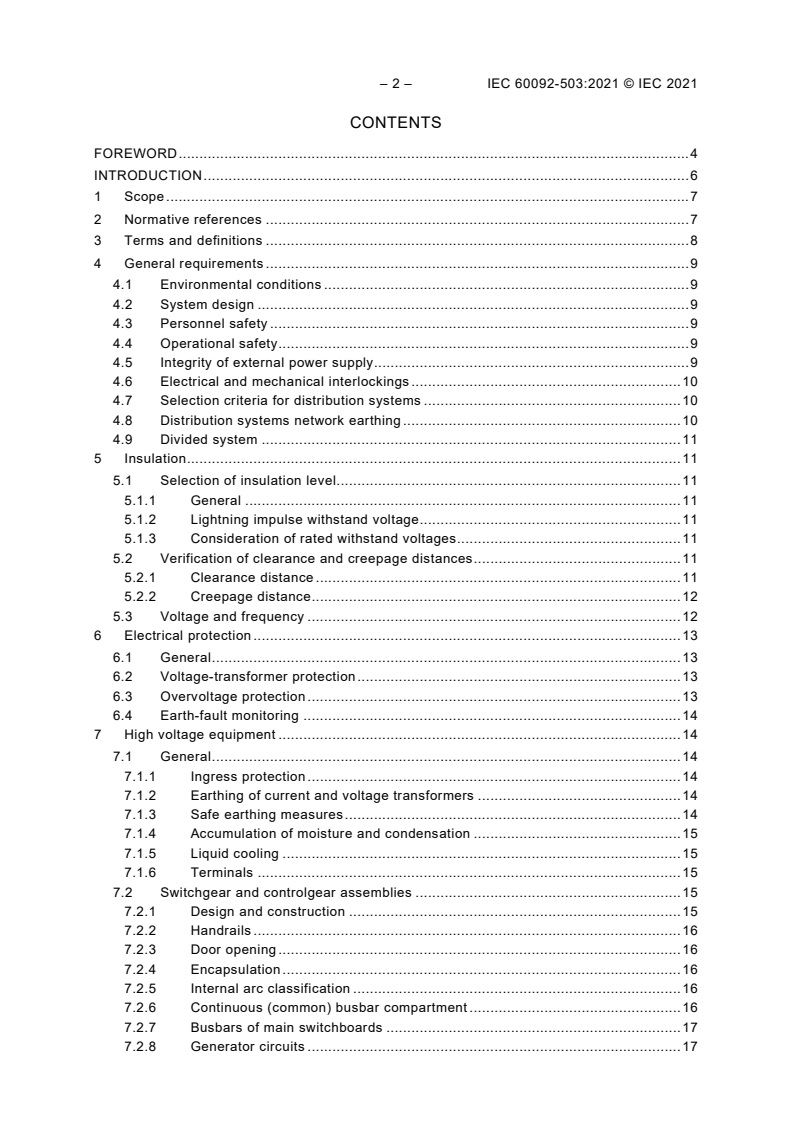
– 2 – IEC 60092-503:2021 © IEC 2021
CONTENTS
FOREWORD . 4
INTRODUCTION . 6
1 Scope . 7
2 Normative references . 7
3 Terms and definitions . 8
4 General requirements . 9
4.1 Environmental conditions . 9
4.2 System design . 9
4.3 Personnel safety . 9
4.4 Operational safety . 9
4.5 Integrity of external power supply. 9
4.6 Electrical and mechanical interlockings . 10
4.7 Selection criteria for distribution systems . 10
4.8 Distribution systems network earthing . 10
4.9 Divided system . 11
5 Insulation . 11
5.1 Selection of insulation level. 11
5.1.1 General . 11
5.1.2 Lightning impulse withstand voltage . 11
5.1.3 Consideration of rated withstand voltages . 11
5.2 Verification of clearance and creepage distances . 11
5.2.1 Clearance distance . 11
5.2.2 Creepage distance . 12
5.3 Voltage and frequency . 12
6 Electrical protection . 13
6.1 General . 13
6.2 Voltage-transformer protection . 13
6.3 Overvoltage protection . 13
6.4 Earth-fault monitoring . 14
7 High voltage equipment . 14
7.1 General . 14
7.1.1 Ingress protection . 14
7.1.2 Earthing of current and voltage transformers . 14
7.1.3 Safe earthing measures . 14
7.1.4 Accumulation of moisture and condensation . 15
7.1.5 Liquid cooling . 15
7.1.6 Terminals . 15
7.2 Switchgear and controlgear assemblies . 15
7.2.1 Design and construction . 15
7.2.2 Handrails . 16
7.2.3 Door opening . 16
7.2.4 Encapsulation . 16
7.2.5 Internal arc classification . 16
7.2.6 Continuous (common) busbar compartment . 16
7.2.7 Busbars of main switchboards . 17
7.2.8 Generator circuits . 17
7.2.9 Outgoing circuits . 17
7.2.10 Power-transformer circuits . 17
7.2.11 Shore-connection circuits . 17
7.2.12 Earthing switches . 17
7.2.13 Earthing of equipment . 18
7.2.14 Auxiliary circuits . 18
7.3 Generators and motors . 18
7.3.1 General . 18
7.3.2 Installation . 18
7.3.3 Encapsulation . 18
7.3.4 Temperature monitoring . 18
7.3.5 Stator winding circuit arrangement . 18
7.3.6 De-excitation . 18
7.4 Transformers and reactors . 19
7.4.1 General . 19
7.4.2 Enclosures and installation . 19
7.4.3 Encapsulation . 19
7.4.4 Temperature monitoring . 19
7.5 Converters . 19
7.5.1 General . 19
7.5.2 Encapsulation . 19
7.6 Cables . 20
7.6.1 General . 20
7.6.2 Installation . 20
7.6.3 Conductors and terminations . 20
7.6.4 Testing . 20
7.7 System test . 21
8 Installation requirements for high voltage equipment . 21
8.1 Access . 21
8.2 Identification and marking . 21
8.2.1 General . 21
8.2.2 Labelling . 21
8.2.3 Information plates and warning plates . 22
8.2.4 Installations with incorporated capacitors. 22
Bibliography . 23
Table 1 – Minimum clearance . 12
Table 2 – AC three-phase systems having a nominal voltage above 1 kV and up to
and including 36 kV . 13
Table 3 – Minimum IP ratings . 14
– 4 – IEC 60092-503:2021 © IEC 2021
INTERNATIONAL ELECTROTECHNICAL COMMISSION
____________
ELECTRICAL INSTALLATIONS IN SHIPS –
Part 503: Special features –
AC supply systems with voltages in the range
of above 1 kV up to and including 36 kV
FOREWORD
1) The International Electrotechnical Commission (IEC) is a worldwide organization for standardization comprising
all national electrotechnical committees (IEC National Committees). The object of IEC is to promote international
co-operation on all questions concerning standardization in the electrical and electronic fields. To this end and
in addition to other activities, IEC publishes International Standards, Technical Specifications, Technical Reports,
Publicly Available Specifications (PAS) and Guides (hereafter referred to as "IEC Publication(s)"). Their
preparation is entrusted to technical committees; any IEC National Committee interested in the subject dealt with
may participate in this preparatory work. International, governmental and non-governmental organizations liaising
with the IEC also participate in this preparation. IEC collaborates closely with the International Organization for
Standardization (ISO) in accordance with conditions determined by agreement between the two organizations.
2) The formal decisions or agreements of IEC on technical matters express, as nearly as possible, an international
consensus of opinion on the relevant subjects since each technical committee has representation from all
interested IEC National Committees.
3) IEC Publications have the form of recommendations for international use and are accepted by IEC National
Committees in that sense. While all reasonable efforts are made to ensure that the technical content of IEC
Publications is accurate, IEC cannot be held responsible for the way in which they are used or for any
misinterpretation by any end user.
4) In order to promote international uniformity, IEC National Committees undertake to apply IEC Publications
transparently to the maximum extent possible in their national and regional publications. Any divergence between
any IEC Publication and the corresponding national or regional publication shall be clearly indicated in the latter.
5) IEC itself does not provide any attestation of conformity. Independent certification bodies provide conformity
assessment services and, in some areas, access to IEC marks of conformity. IEC is not responsible for any
services carried out by independent certification bodies.
6) All users should ensure that they have the latest edition of this publication.
7) No liability shall attach to IEC or its directors, employees, servants or agents including individual experts and
members of its technical committees and IEC National Committees for any personal injury, property damage or
other damage of any nature whatsoever, whether direct or indirect, or for costs (including legal fees) and
expenses arising out of the publication, use of, or reliance upon, this IEC Publication or any other IEC
Publications.
8) Attention is drawn to the Normative references cited in this publication. Use of the referenced publications is
indispensable for the correct application of this publication.
9) Attention is drawn to the possibility that some of the elements of this IEC Publication may be the subject of patent
rights. IEC shall not be held responsible for identifying any or all such patent rights.
IEC 60092-503 has been prepared by IEC technical committee 18: Electrical installations of
ships and of mobile and fixed offshore units. It is an International Standard.
This third edition cancels and replaces the second edition published in 2007. This edition
constitutes a technical revision.
This edition includes the following significant technical changes with respect to the previous
edition:
a) modified the scope, increasing the voltage from 15 kV to 36 kV;
b) reference to IEC 61936-1 added:
c) included relevant parts of the IEC 62271 series;
d) removed low-impedance earthed neutral systems;
e) updated 7.7 on system test;
f) added requirements for switchgear and switchboards.
The text of this International Standard is based on the following documents:
Draft Report on voting
18/1734/FDIS 18/1742/RVD
Full information on the voting for its approval can be found in the report on voting indicated in
the above table.
The language used for the development of this International Standard is English.
This document was drafted in accordance with ISO/IEC Directives, Part 2, and developed in
accordance with ISO/IEC Directives, Part 1 and ISO/IEC Directives, IEC Supplement, available
at www.iec.ch/members_experts/refdocs. The main document types developed by IEC are
described in greater detail at www.iec.ch/standardsdev/publications.
A list of all parts in the IEC 60092 series, published under the general title Electrical installations
in ships, can be found on the IEC website.
The committee has decided that the contents of this document will remain unchanged until the
stability date indicated on the IEC website under webstore.iec.ch in the data related to the
specific document. At this date, the document will be
• reconfirmed,
• withdrawn,
• replaced by a revised edition, or
• amended.
– 6 – IEC 60092-503:2021 © IEC 2021
INTRODUCTION
IEC 60092 (all parts) forms a series of International Standards for electrical installations in sea-
going ships, incorporating good practice and coordinating, as far as possible, existing rules.
These standards form a code of practical interpretation and amplification of the requirements
of the International Convention on Safety of Life at Sea, a guide for future regulations which
may be prepared and a statement of practice for use by shipowners, shipbuilders and
appropriate organizations.
ELECTRICAL INSTALLATIONS IN SHIPS –
Part 503: Special features –
AC supply systems with voltages in the range
of above 1 kV up to and including 36 kV
1 Scope
This part of IEC 60092 is applicable to AC supply systems with voltages from 1 kV up to and
including 36 kV. The requirements contained in other parts of the IEC 60092 series apply where
appropriate, subject to the exceptions stated in the clauses of this document.
2 Normative references
The following documents are referred to in the text in such a way that some or all of their content
constitutes requirements of this document. For dated references, only the edition cited applies.
For undated references, the latest edition of the referenced document (including any
amendments) applies.
IEC 60034 (all parts), Rotating electrical machines
IEC 60038, IEC standard voltages
IEC 60060-1, High-voltage test techniques – Part 1: General definitions and test requirements
IEC 60071-1, Insulation co-ordination – Part 1: Definitions, principles and rules
IEC 60076 (all parts), Power transformers
IEC 60092-101, Electrical installations in ships – Part 101: Definitions and general requirements
IEC 60092-201, Electrical installations in ships – Part 201: System design – General
IEC 60092-202, Electrical installations in ships – Part 202: System design – Protection
IEC 60092-303, Electrical installations in ships – Part 303: Equipment – Transformers for power
and lighting
IEC 60092-304, Electrical installations in ships – Part 304: Equipment – Semiconductor
convertors
IEC 60092-350, Electrical installations in ships – Part 350: General construction and test
methods of power, control and instrumentation cables for shipboard and offshore applications
IEC 60092-353, Electrical installations in ships – Part 353: Power cables for rated voltages 1 kV
and 3 kV
IEC 60092-354, Electrical installations in ships – Part 354: Single- and three-core power cables
with extruded solid insulation for rated voltages 6 kV (U = 7,2 kV) up to 30 kV (U = 36 kV)
m m
IEC 60282-1, High-voltage fuses – Part 1: Current-limiting fuses
– 8 – IEC 60092-503:2021 © IEC 2021
IEC 60282-2, High-voltage fuses – Part 2: Expulsion fuses
IEC 60502 (all parts), Power cables with extruded insulation and their accessories for rated
voltages from 1 kV (U = 1,2 kV) up to 30 kV (U = 36 kV)
m m
IEC 60502-1, Power cables with extruded insulation and their accessories for rated voltages
from 1 kV (U = 1,2 kV) up to 30 kV (U = 36 kV) – Part 1: Cables for rated voltages of 1 kV
m m
(U = 1,2 kV) up to 3 kV (U = 3,6 kV)
m m
IEC 60502-2, Power cables with extruded insulation and their accessories for rated voltages
from 1 kV (U = 1,2 kV) up to 30 kV (U = 36 kV) – Part 2: Cables for rated voltages from
m m
6 kV (U = 7,2 kV) up to 30 kV (U = 36 kV)
m m
IEC TS 60815-1, Selection and dimensioning of high-voltage insulators intended for use in
polluted conditions – Part 1: Definitions, information and general principles
IEC TS 60815-2, Selection and dimensioning of high-voltage insulators intended for use in
polluted conditions – Part 2: Ceramic and glass insulators for a.c. systems
IEC TS 60815-3, Selection and dimensioning of high-voltage insulators intended for use in
polluted conditions – Part 3: Polymer insulators for a.c. systems
IEC 62271-100, High-voltage switchgear and controlgear – Part 100: Alternating-current circuit-
breakers
IEC 62271-102, High-voltage switchgear and controlgear – Part 102: Alternating current
disconnectors and earthing switches
IEC 62271-106, High-voltage switchgear and controlgear – Part 106: Alternating current
contactors, contactor-based controllers and motor-starters
IEC 62271-200:2021, High-voltage switchgear and controlgear – Part 200: AC metal-enclosed
switchgear and controlgear for rated voltages above 1 kV and up to and including 52 kV
IEC 62271-201, High-voltage switchgear and controlgear – Part 201: AC solid-insulation
enclosed switchgear and controlgear for rated voltages above 1 kV and up to and including
52 kV
IEC/IEEE 80005-1, Utility connections in port – Part 1: High voltage shore connection (HVSC)
systems – General requirements
3 Terms and definitions
For the purposes of this document, the following terms and definitions apply.
ISO and IEC maintain terminological databases for use in standardization at the following
addresses:
• IEC Electropedia: available at http://www.electropedia.org/
• ISO Online browsing platform: available at http://www.iso.org/obp
3.1
high-impedance earthed neutral
IT system where the neutral is earthed through an impedance with numerical value equal to, or
higher than, the capacitive reactance between phase and earth
3.2
category A machinery space
spaces and trunks which contain:
1) internal combustion machinery used for main propulsion; or
2) internal combustion machinery used for purposes other than main propulsion where such
machinery with an accumulated total power output of not less than 375 kW; or
3) any oil-fired boiler or oil fuel unit.
[SOURCE: SOLAS, Chapter II-1, Part A, regulation 3.17]
3.3
main circuit
all the conductive parts of an assembly included in a circuit which is intended to transmit
electrical energy
[SOURCE: IEC 60050-441:1984, 441-13-02]
4 General requirements
4.1 Environmental conditions
Environmental conditions shall be in accordance with relevant requirements of IEC 60092-101.
4.2 System design
System design shall be in accordance with relevant requirements of IEC 60092-201.
4.3 Personnel safety
Particular attention shall be given to the safety of personnel during the installation, operation
and maintenance of equipment. This shall include
– manuals and instructions for transport, storage, installation, operation and maintenance,
– special tools required for operation, maintenance and testing,
– safe working procedures developed for specific locations, and
– safe earthing measures.
High voltage equipment shall be designed to limit the risk of arcing faults and contain possible
arcing faults in such a way that the risk for operators is reduced to a level acceptable to the
appropriate authority during internal fault conditions.
4.4 Operational safety
Control and protection systems shall take into account that continuous power supply is essential
to ship’s safety. The design shall be such that unnecessary tripping or de-energisation is
avoided.
4.5 Integrity of external power supply
If the power supply is divided into more than one switchboard, in order to provide power supply
availability in case of a single point failure (typically under fire condition), it shall be designed
and protected such that any single point failure does not jeopardize overall functionality of the
other switchboards.
– 10 – IEC 60092-503:2021 © IEC 2021
4.6 Electrical and mechanical interlockings
Interlocks between different components of the equipment are provided for reasons of safety
and for convenience of operations. The following provisions are mandatory for main circuits.
Apparatus installed in main circuits, the incorrect operation of which can cause damage, or
which are used for assuring isolating distances during maintenance work, shall be provided with
locking facilities (for example provision for padlocks).
Access to operation of a circuit-breaker, switch or contactor in the switchboard shall be limited
by a "safety system" which co-ordinates other apparatus involved such as motors, transformers,
generators, switchboards, etc. Back-feeding through transformers and shut off of starting air
and oil to engines shall be taken into consideration.
Earthing switches having a short-circuit making capacity less than the rated peak withstand
current of the circuit shall be interlocked with the associated disconnectors.
NOTE According to 7.2.1, the requirements of IEC 62271-200 are applicable. See IEC 62271-200:2021, 6.12 a), for
removable parts of assemblies, and IEC 62271-200:2021, 6.12 b), for other parts of assemblies.
4.7 Selection criteria for distribution systems
The neutral earthing method shall be carefully selected, considering the following:
– selection of insulation level;
– characteristics of overvoltage – limiting devices – such as spark gaps or surge arresters;
– selection of protective relays;
– design of earthing system.
NOTE 1 The method of neutral earthing strongly influences the fault current level and the fault current duration.
NOTE 2 The choice of the type of neutral earthing is normally based on the following criteria:
– continuity of supply required for the network;
– limitation of damage to equipment caused by earth faults;
– selective elimination of faulty sections of the network;
– detection of fault location;
– touch and step voltages;
– operation and maintenance aspects.
A
...