

IEC 62840-2:2016
(Main)Electric vehicle battery swap system - Part 2: Safety requirements
General Information
- Abstract
IEC 62840-2:2016 provides the safety requirements for a battery swap system, for the purposes of swapping swappable battery system (SBS) of electric vehicles. The battery swap system is intended to be connected to the supply network. The power supply is up to 1 000 V AC or up to 1 500 V d.c, in accordance with IEC 60038. This standard also applies to battery swap systems supplied from on-site storage systems (e.g. buffer batteries).
This publication is to be read in conjunction with IEC 62840-1:2016.
- Status
- Published
- Publication Date
- 03-Oct-2016
- Technical Committee
- TC 69 - Electrical power/energy transfer systems for electrically propelled road vehicles and industrial trucks
- Drafting Committee
- WG 13 - TC 69/WG 13
Overview
IEC 62840-2:2016 is an international standard developed by the International Electrotechnical Commission (IEC) that specifies the safety requirements for electric vehicle battery swap systems. This standard applies to battery swap systems intended to handle swappable battery systems (SBS) for electric vehicles (EVs) connected to power supplies up to 1,000 V AC or 1,500 V DC, including those powered by on-site energy storage like buffer batteries. IEC 62840-2:2016 complements Part 1 (IEC 62840-1:2016), providing a comprehensive framework for designing and implementing safe, reliable battery swapping infrastructure to support widespread electric mobility.
Key Topics
System Safety Requirements: Detailed provisions cover the safety measures for lane systems allowing vehicle positioning, battery handling mechanisms with interlocks and emergency responses, storage systems for batteries, charging systems including SBS chargers and communication protocols, and supervisory/control systems.
Protection Against Electric Shock: Requirements address protection for users and maintenance personnel, including enclosure ratings (IP degrees), discharge of stored energy in capacitors, fault protection mechanisms, protective conductors, and supplementary protective measures.
Construction and Materials: Specifications on constructional requirements ensure durability and environmental resilience, strength of materials, mechanical switching devices, clearances and creepage distances, and properties of insulating materials to ensure overall system integrity.
Electromagnetic Compatibility (EMC): Guidelines to maintain functional safety and proper operation by minimizing electromagnetic interference affecting the battery swap system.
Marking and Instructions: Standards for clear labeling, legibility, signals, and warning devices to ensure safe usage, handling, and maintenance of battery swap equipment.
Communication and Data Security: Emphasis on secure data transmission and reliability of safety-critical messages exchanged between system components to prevent operational hazards.
Applications
IEC 62840-2:2016 is essential for manufacturers, system integrators, and safety engineers involved in designing, installing, and maintaining electric vehicle battery swap systems. Practical applications include:
Battery Swap Stations: Ensuring safe installation and operation of automated or manual swapping stations for electric vehicles, which is a critical enabler for faster EV recharging alternatives.
Energy Infrastructure: Integration with on-site energy storage and supply networks, facilitating efficient power management with high-voltage systems while ensuring user safety.
Vehicle Fleets and Commercial EV Operations: Applying the standard to fleets using battery swapping to maximize vehicle uptime and operational efficiency, such as taxis, buses, and delivery vehicles.
Compliance and Certification: Supporting regulatory bodies and certification organizations in evaluating EV battery swap systems against recognized safety benchmarks.
By adhering to IEC 62840-2, stakeholders help mitigate risks associated with electric shock, mechanical failures, and system interoperability, contributing to safer, cleaner electric transportation solutions.
Related Standards
Key complementary standards to consider alongside IEC 62840-2:2016 include:
IEC 62840-1:2016 – Electric Vehicle Battery Swap System – Part 1: System Requirements, providing the general requirements and performance criteria for swapping systems.
IEC 60038 – Standard Voltages, referenced for the power supply voltage limits applicable to battery swap systems.
IEC 60364 – Electrical Installations of Buildings, recommended for installation safety practices.
IEC 61000 Series – Electromagnetic Compatibility standards, supporting the EMC requirements outlined in the battery swap system specifications.
ISO 26262 – Functional safety of electrical/electronic systems in road vehicles, relevant for safety management in supervisory and control systems.
Implementing these interconnected standards ensures a holistic approach to the safety, performance, and reliability of electric vehicle battery swap infrastructure, enabling sustainable growth of electric mobility worldwide.
Relations
- Effective Date
- 05-Sep-2023
Get Certified
Connect with accredited certification bodies for this standard

TÜV Rheinland
TÜV Rheinland is a leading international provider of technical services.

TÜV SÜD
TÜV SÜD is a trusted partner of choice for safety, security and sustainability solutions.

DEKRA Certification Inc.
DEKRA US certification services.
Sponsored listings
Frequently Asked Questions
IEC 62840-2:2016 is a standard published by the International Electrotechnical Commission (IEC). Its full title is "Electric vehicle battery swap system - Part 2: Safety requirements". This standard covers: IEC 62840-2:2016 provides the safety requirements for a battery swap system, for the purposes of swapping swappable battery system (SBS) of electric vehicles. The battery swap system is intended to be connected to the supply network. The power supply is up to 1 000 V AC or up to 1 500 V d.c, in accordance with IEC 60038. This standard also applies to battery swap systems supplied from on-site storage systems (e.g. buffer batteries). This publication is to be read in conjunction with IEC 62840-1:2016.
IEC 62840-2:2016 provides the safety requirements for a battery swap system, for the purposes of swapping swappable battery system (SBS) of electric vehicles. The battery swap system is intended to be connected to the supply network. The power supply is up to 1 000 V AC or up to 1 500 V d.c, in accordance with IEC 60038. This standard also applies to battery swap systems supplied from on-site storage systems (e.g. buffer batteries). This publication is to be read in conjunction with IEC 62840-1:2016.
IEC 62840-2:2016 is classified under the following ICS (International Classification for Standards) categories: 43.120 - Electric road vehicles. The ICS classification helps identify the subject area and facilitates finding related standards.
IEC 62840-2:2016 has the following relationships with other standards: It is inter standard links to IEC 62840-2:2025. Understanding these relationships helps ensure you are using the most current and applicable version of the standard.
IEC 62840-2:2016 is available in PDF format for immediate download after purchase. The document can be added to your cart and obtained through the secure checkout process. Digital delivery ensures instant access to the complete standard document.
Standards Content (Sample)
IEC 62840-2 ®
Edition 1.0 2016-10
INTERNATIONAL
STANDARD
NORME
INTERNATIONALE
Electric vehicle battery swap system –
Part 2: Safety requirements
Système d'échange de batterie de véhicule électrique –
Partie 2: Exigences de sécurité
All rights reserved. Unless otherwise specified, no part of this publication may be reproduced or utilized in any form
or by any means, electronic or mechanical, including photocopying and microfilm, without permission in writing from
either IEC or IEC's member National Committee in the country of the requester. If you have any questions about IEC
copyright or have an enquiry about obtaining additional rights to this publication, please contact the address below or
your local IEC member National Committee for further information.
Droits de reproduction réservés. Sauf indication contraire, aucune partie de cette publication ne peut être reproduite
ni utilisée sous quelque forme que ce soit et par aucun procédé, électronique ou mécanique, y compris la photocopie
et les microfilms, sans l'accord écrit de l'IEC ou du Comité national de l'IEC du pays du demandeur. Si vous avez des
questions sur le copyright de l'IEC ou si vous désirez obtenir des droits supplémentaires sur cette publication, utilisez
les coordonnées ci-après ou contactez le Comité national de l'IEC de votre pays de résidence.
IEC Central Office Tel.: +41 22 919 02 11
3, rue de Varembé Fax: +41 22 919 03 00
CH-1211 Geneva 20 info@iec.ch
Switzerland www.iec.ch
About the IEC
The International Electrotechnical Commission (IEC) is the leading global organization that prepares and publishes
International Standards for all electrical, electronic and related technologies.
About IEC publications
The technical content of IEC publications is kept under constant review by the IEC. Please make sure that you have the
latest edition, a corrigenda or an amendment might have been published.
IEC Catalogue - webstore.iec.ch/catalogue Electropedia - www.electropedia.org
The stand-alone application for consulting the entire The world's leading online dictionary of electronic and
bibliographical information on IEC International Standards, electrical terms containing 20 000 terms and definitions in
Technical Specifications, Technical Reports and other English and French, with equivalent terms in 15 additional
documents. Available for PC, Mac OS, Android Tablets and languages. Also known as the International Electrotechnical
iPad. Vocabulary (IEV) online.
IEC publications search - www.iec.ch/searchpub IEC Glossary - std.iec.ch/glossary
The advanced search enables to find IEC publications by a 65 000 electrotechnical terminology entries in English and
variety of criteria (reference number, text, technical French extracted from the Terms and Definitions clause of
committee,…). It also gives information on projects, replaced IEC publications issued since 2002. Some entries have been
and withdrawn publications. collected from earlier publications of IEC TC 37, 77, 86 and
CISPR.
IEC Just Published - webstore.iec.ch/justpublished
Stay up to date on all new IEC publications. Just Published IEC Customer Service Centre - webstore.iec.ch/csc
details all new publications released. Available online and If you wish to give us your feedback on this publication or
also once a month by email. need further assistance, please contact the Customer Service
Centre: csc@iec.ch.
A propos de l'IEC
La Commission Electrotechnique Internationale (IEC) est la première organisation mondiale qui élabore et publie des
Normes internationales pour tout ce qui a trait à l'électricité, à l'électronique et aux technologies apparentées.
A propos des publications IEC
Le contenu technique des publications IEC est constamment revu. Veuillez vous assurer que vous possédez l’édition la
plus récente, un corrigendum ou amendement peut avoir été publié.
Catalogue IEC - webstore.iec.ch/catalogue Electropedia - www.electropedia.org
Application autonome pour consulter tous les renseignements
Le premier dictionnaire en ligne de termes électroniques et
bibliographiques sur les Normes internationales,
électriques. Il contient 20 000 termes et définitions en anglais
Spécifications techniques, Rapports techniques et autres
et en français, ainsi que les termes équivalents dans 15
documents de l'IEC. Disponible pour PC, Mac OS, tablettes
langues additionnelles. Egalement appelé Vocabulaire
Android et iPad.
Electrotechnique International (IEV) en ligne.
Recherche de publications IEC - www.iec.ch/searchpub
Glossaire IEC - std.iec.ch/glossary
La recherche avancée permet de trouver des publications IEC 65 000 entrées terminologiques électrotechniques, en anglais
en utilisant différents critères (numéro de référence, texte, et en français, extraites des articles Termes et Définitions des
comité d’études,…). Elle donne aussi des informations sur les publications IEC parues depuis 2002. Plus certaines entrées
projets et les publications remplacées ou retirées. antérieures extraites des publications des CE 37, 77, 86 et
CISPR de l'IEC.
IEC Just Published - webstore.iec.ch/justpublished
Service Clients - webstore.iec.ch/csc
Restez informé sur les nouvelles publications IEC. Just
Published détaille les nouvelles publications parues. Si vous désirez nous donner des commentaires sur cette
Disponible en ligne et aussi une fois par mois par email. publication ou si vous avez des questions contactez-nous:
csc@iec.ch.
IEC 62840-2 ®
Edition 1.0 2016-10
INTERNATIONAL
STANDARD
NORME
INTERNATIONALE
Electric vehicle battery swap system –
Part 2: Safety requirements
Système d'échange de batterie de véhicule électrique –
Partie 2: Exigences de sécurité
INTERNATIONAL
ELECTROTECHNICAL
COMMISSION
COMMISSION
ELECTROTECHNIQUE
INTERNATIONALE
ICS 43.120 ISBN 978-2-8322-3632-1
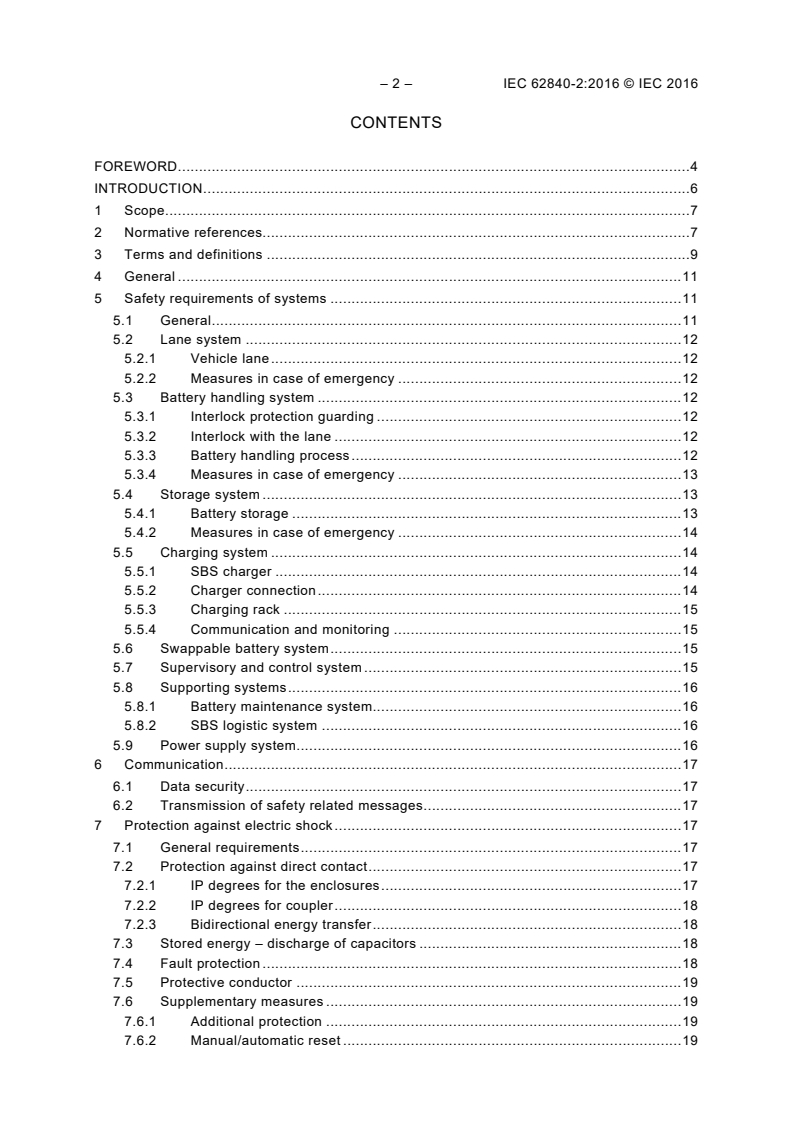
– 2 – IEC 62840-2:2016 © IEC 2016
CONTENTS
FOREWORD . 4
INTRODUCTION . 6
1 Scope . 7
2 Normative references. 7
3 Terms and definitions . 9
4 General . 11
5 Safety requirements of systems . 11
5.1 General . 11
5.2 Lane system . 12
5.2.1 Vehicle lane . 12
5.2.2 Measures in case of emergency . 12
5.3 Battery handling system . 12
5.3.1 Interlock protection guarding . 12
5.3.2 Interlock with the lane . 12
5.3.3 Battery handling process . 12
5.3.4 Measures in case of emergency . 13
5.4 Storage system . 13
5.4.1 Battery storage . 13
5.4.2 Measures in case of emergency . 14
5.5 Charging system . 14
5.5.1 SBS charger . 14
5.5.2 Charger connection . 14
5.5.3 Charging rack . 15
5.5.4 Communication and monitoring . 15
5.6 Swappable battery system . 15
5.7 Supervisory and control system . 15
5.8 Supporting systems . 16
5.8.1 Battery maintenance system . 16
5.8.2 SBS logistic system . 16
5.9 Power supply system . 16
6 Communication . 17
6.1 Data security . 17
6.2 Transmission of safety related messages . 17
7 Protection against electric shock . 17
7.1 General requirements . 17
7.2 Protection against direct contact . 17
7.2.1 IP degrees for the enclosures . 17
7.2.2 IP degrees for coupler . 18
7.2.3 Bidirectional energy transfer . 18
7.3 Stored energy – discharge of capacitors . 18
7.4 Fault protection . 18
7.5 Protective conductor . 19
7.6 Supplementary measures . 19
7.6.1 Additional protection . 19
7.6.2 Manual/automatic reset . 19
7.6.3 Protection of persons against electric shock . 20
7.7 Telecommunication network . 20
8 Equipment constructional requirements . 20
8.1 General . 20
8.2 Characteristics of mechanical switching devices . 20
8.2.1 Switch and switch-disconnector . 20
8.2.2 Contactor . 20
8.2.3 Circuit-breaker . 21
8.2.4 Relays . 21
8.2.5 Metering . 21
8.3 Clearances and creepage distances . 21
8.4 Strength of materials and parts . 21
8.4.1 General . 21
8.4.2 Mechanical impact . 21
8.4.3 Environmental conditions . 21
8.4.4 Properties of insulating materials . 22
9 Electromagnetic compatibility (EMC) . 23
9.1 General . 23
9.2 EMC of the BSS . 23
9.3 Functional safety related to EMC . 23
10 Marking and instructions . 23
10.1 General . 23
10.2 Marking of equipment . 23
10.3 Legibility . 24
10.4 Signals and warning devices . 24
Bibliography . 26
– 4 – IEC 62840-2:2016 © IEC 2016
INTERNATIONAL ELECTROTECHNICAL COMMISSION
____________
ELECTRIC VEHICLE BATTERY SWAP SYSTEM –
Part 2: Safety requirements
FOREWORD
1) The International Electrotechnical Commission (IEC) is a worldwide organization for standardization comprising
all national electrotechnical committees (IEC National Committees). The object of IEC is to promote
international co-operation on all questions concerning standardization in the electrical and electronic fields. To
this end and in addition to other activities, IEC publishes International Standards, Technical Specifications,
Technical Reports, Publicly Available Specifications (PAS) and Guides (hereafter referred to as “IEC
Publication(s)”). Their preparation is entrusted to technical committees; any IEC National Committee interested
in the subject dealt with may participate in this preparatory work. International, governmental and non-
governmental organizations liaising with the IEC also participate in this preparation. IEC collaborates closely
with the International Organization for Standardization (ISO) in accordance with conditions determined by
agreement between the two organizations.
2) The formal decisions or agreements of IEC on technical matters express, as nearly as possible, an international
consensus of opinion on the relevant subjects since each technical committee has representation from all
interested IEC National Committees.
3) IEC Publications have the form of recommendations for international use and are accepted by IEC National
Committees in that sense. While all reasonable efforts are made to ensure that the technical content of IEC
Publications is accurate, IEC cannot be held responsible for the way in which they are used or for any
misinterpretation by any end user.
4) In order to promote international uniformity, IEC National Committees undertake to apply IEC Publications
transparently to the maximum extent possible in their national and regional publications. Any divergence
between any IEC Publication and the corresponding national or regional publication shall be clearly indicated in
the latter.
5) IEC itself does not provide any attestation of conformity. Independent certification bodies provide conformity
assessment services and, in some areas, access to IEC marks of conformity. IEC is not responsible for any
services carried out by independent certification bodies.
6) All users should ensure that they have the latest edition of this publication.
7) No liability shall attach to IEC or its directors, employees, servants or agents including individual experts and
members of its technical committees and IEC National Committees for any personal injury, property damage or
other damage of any nature whatsoever, whether direct or indirect, or for costs (including legal fees) and
expenses arising out of the publication, use of, or reliance upon, this IEC Publication or any other IEC
Publications.
8) Attention is drawn to the Normative references cited in this publication. Use of the referenced publications is
indispensable for the correct application of this publication.
9) Attention is drawn to the possibility that some of the elements of this IEC Publication may be the subject of
patent rights. IEC shall not be held responsible for identifying any or all such patent rights.
International Standard IEC 62840-2 has been prepared by IEC technical committee 69:
Electric road vehicles and electric industrial trucks.
The text of this standard is based on the following documents:
FDIS Report on voting
69/420/FDIS 69/433/RVD
Full information on the voting for the approval of this standard can be found in the report on
voting indicated in the above table.
This publication has been drafted in accordance with the ISO/IEC Directives, Part 2.
This standard is to be read in conjunction with IEC 62840-1:2016.
in this document, the following print types are used:
– requirements: in roman type;
– test specifications: in italic type;
– notes: in small roman type.
A list of all parts in the IEC 62840 series, published under the general title Electric vehicle
battery swap system, can be found on the IEC website.
The following differing practices of a less permanent nature exist in the countries indicated
below
– 7.6.1: RCDs of type AC may be used (Japan).
– 7.6.1: a device which measures leakage current over a range of frequencies and trips at
pre-defined levels of leakage current, based upon the frequency, is required (United
States).
– 10.4: three-part cautionary statements are required (United States).
The committee has decided that the contents of this publication will remain unchanged until
the stability date indicated on the IEC website under "http://webstore.iec.ch" in the data
related to the specific publication. At this date, the publication will be
• reconfirmed,
• withdrawn,
• replaced by a revised edition, or
• amended.
– 6 – IEC 62840-2:2016 © IEC 2016
INTRODUCTION
The purpose of the battery swap system is to provide energy partly or in total to electric
vehicles (EV) through fast replacement of their swappable battery systems (SBS). While
charging, the EV typically takes a relatively long time, whereas the battery swap process
takes only a few minutes to complete. Thus it will reduce the range anxiety and will facilitate
travel for longer distances.
As there is a possibility to charge the batteries after their removal from the vehicle in various
ways, the impact of this process on the critical infrastructure of the electrical grid can be
minimized.
Battery swap stations mainly include one or more of the following functions:
• swap of EV swappable battery system (SBS);
• storage of EV SBS;
• charging and cooling of EV SBS;
• testing, maintenance and safety management of EV SBS.
This part of IEC 62840 serves as a generic approach for safety during the lifecycle of battery
swap systems and stations for electric vehicles.
ELECTRIC VEHICLE BATTERY SWAP SYSTEM –
Part 2: Safety requirements
1 Scope
This part of IEC 62840 provides the safety requirements for a battery swap system, for the
purposes of swapping swappable battery system (SBS) of electric vehicles. The battery swap
system is intended to be connected to the supply network. The power supply is up to 1 000 V
AC or up to 1 500 V d.c, in accordance with IEC 60038.
This standard also applies to battery swap systems supplied from on-site storage systems
(e.g. buffer batteries).
Aspects covered in this standard:
• safety requirements of the battery swap system and/or its systems;
• security requirements for communication;
• electromagnetic compatibility (EMC);
• signs and instructions;
• protection against electric shock and other hazards.
This standard is applicable to battery swap systems for EV equipped with one or more SBS.
NOTE Battery swap systems for light EVs according to the IEC 61851-3 series are under consideration.
This standard is not applicable to:
• aspects related to maintenance and service of the battery swap station (BSS);
• trolley buses, rail vehicles and vehicles designed primarily for use off-road;
• maintenance and service of EVs.
2 Normative references
The following documents, in whole or in part, are normatively referenced in this document and
are indispensable for its application. For dated references, only the edition cited applies. For
undated references, the latest edition of the referenced document (including any
amendments) applies.
IEC 60038, IEC standard voltages
IEC 60112, Method for the determination of the proof and the comparative tracking indices of
solid insulating materials
IEC 60204-1, Safety of machinery – Electrical equipment of machines – General requirements
IEC 60364 (all parts), Low-voltage electrical installations
_____________
Under consideration.
– 8 – IEC 62840-2:2016 © IEC 2016
IEC 60364-4-41:2005, Low-voltage electrical installations – Part 4-41: Protection for safety –
Protection against electric shock
IEC 60364-5-54, Low-voltage electrical installations – Part 5-54: Selection and erection of
electrical equipment – Earthing arrangements and protective conductors
IEC 60364-7-722, Low-voltage electrical installations – Part 7-722: Requirements for special
installations or locations – Supply of electric vehicle
IEC 60479 (all parts), Effects of current on human beings and livestock
IEC 60529, Degrees of protection provided by enclosures (IP Code)
IEC 60664-1:2007, Insulation coordination for equipment within low-voltage systems – Part 1:
Principles, requirements and tests
IEC 60695-2-11, Fire hazard testing – Part 2-11: Glowing/hot-wire based test methods –
Glow-wire flammability test method for end-products (GWEPT)
IEC 60695-10-2, Fire hazard testing – Part 10-2: Abnormal heat – Ball pressure test method
IEC TR 60755, General requirements for residual current operated protective devices
IEC 60898-1, Electrical accessories – Circuit-breakers for overcurrent protection for
household and similar installations – Part 1: Circuit-breakers for a.c. operation
IEC 60947-2, Low-voltage switchgear and control gear – Part 2: Circuit-breakers
IEC 60947-3, Low-voltage switchgear and controlgear – Part 3: Switches, disconnectors,
switch-disconnectors and fuse-combination units
IEC 60947-4-1, Low-voltage switchgear and controlgear – Part 4-1: Contactors and motor-
starters – Electromechanical contactors and motor-starters
IEC 60950-1:2005, Information technology equipment – Safety – Part 1: General requirements
IEC 60950-1:2005/AMD1:2009
IEC 60950-1:2005/AMD2:2013
IEC 61000-6-7, Electromagnetic compatibility (EMC) – Part 6-7: Generic standards –
Immunity requirements equipment intended to perform functions in a safety-related system
(functional safety) in industrial environments
IEC 61008 (all parts), Residual current operated circuit-breakers without integral overcurrent
protection for household and similar uses (RCCBs)
IEC 61008-1, Residual current operated circuit-breakers without integral overcurrent
protection for household and similar uses (RCCBs) – Part 1: General rules
IEC 61009 (all parts), Residual current operated circuit-breakers with integral overcurrent
protection for household and similar uses (RCBOs)
IEC 61009-1, Residual current operated circuit-breakers with integral overcurrent protection
for household and similar uses (RCBOs) – Part 1: General rules
IEC 61140, Protection against electric shock – Common aspects for installation and
equipment
IEC 61439-1:2011, Low-voltage switchgear and controlgear assemblies – Part 1: General
rules
IEC 61508-1, Functional safety of electrical/electronic/programmable electronic safety-related
systems – Part 1: General requirements
IEC 61511-1, Functional safety – Safety instrumented systems for the process industry sector
– Part 1: Framework, definitions, system, hardware and application programming
requirements
IEC 61784-3, Industrial communication networks – Profiles – Part 3: Functional safety
fieldbuses – General rules and profile definitions
IEC 61810-1, Electromechanical elementary relays – Part 1: General and safety requirements
IEC 61851-23:2014, Electric vehicle conductive charging system – Part 23: DC electric
vehicle charging station
IEC 62052-11, Electricity metering equipment (AC) – General requirements, tests and test
conditions – Part 11: Metering equipment
IEC 62262, Degrees of protection provided by enclosures for electrical equipment against
external mechanical impacts (IK code)
IEC 62423, Type F and type B residual current operated circuit-breakers with and without
integral overcurrent protection for household and similar uses
IEC 62840-1:2016, Electric vehicle battery swap system – Part 1: General and guidance
ISO 2972, Numerical control of machines – Symbols
ISO 7000, Graphical symbols for use on equipment – Registered symbols
ISO 10218-1, Robots and robotic devices – Safety requirements for industrial robots – Part 1:
Robots
ISO 10218-2, Robots and robotic devices – Safety requirements for industrial robots – Part 2:
Robot systems and integration
ISO 12405-1, Electrically propelled road vehicles – Test specification for lithium-ion traction
battery packs and systems – Part 1: High-power applications
ISO 13849-1, Safety of machinery –Safety-related parts of control systems – Part 1: General
principles for design
ISO 14119, Safety of machinery – Interlocking devices associated with guards – Principles for
design and selection
3 Terms and definitions
For the purposes of this document, the terms and definitions given in IEC 62840-1 and the
following apply.
– 10 – IEC 62840-2:2016 © IEC 2016
3.1
hazard
potential source of injury or death
3.2
operator
trained personnel who installs, operates, adjusts, maintains, cleans, repairs or works in the
battery swap station premises
3.3
direct contact
electric contact of persons or animals with live parts
[SOURCE: IEC 60050-195:1998, 195-06-03]
3.4
indirect contact
electric contact of persons or animals with exposed-conductive-parts which have become live
under fault conditions
[SOURCE: IEC 60050-195:1998, 195-06-04]
3.5
live part
conductor or conductive part intended to be energized in normal operation, including a neutral
conductor, but by convention not a PEN conductor or PEM conductor or PEL conductor
[SOURCE: IEC 60050-195:1998, 195-02-19, modified — The note to entry has been deleted.]
3.6
risk
combination of the probability of occurrence of harm and the severity of that harm
Note 1 to entry: In French, the term “risque” also denotes the potential source of harm, in English “hazard” (see
903-01-02). [ISO/IEC Guide 51:1999, definition 3.2]
[SOURCE: IEC 60050-903:1998, 903-01-07]
3.7
real time
pertaining to the processing of data by a computer in connection with another process outside
the computer according to time requirements imposed by the outside process
[SOURCE: IEC 60050-714:1992, 714-21-03]
3.8
alternating current
AC
electric current that is a periodic function of time with a zero direct component or, by
extension, a negligible direct component
Note 1 to entry: This note only applies to the French language.
[SOURCE: IEC 60050-131:2002, 131-11-24, modified — The note to entry has been replaced
by another one.]
3.9
direct current
DC
electric current that is time-independent or, by extension, periodic current the direct
component of which is of primary importance
Note 1 to entry: This note only applies to th French language.
[SOURCE: IEC 60050-131:2002, 131-11-22, modified — The note to entry has been replaced
by another one.]
3.10
residual current device
RCD
a mechanical switching device designed to make, carry and break currents under normal
service conditions and to cause the opening of the contacts when the residual current attains
a given value under specified conditions
[SOURCE: IEC 60050-442:1998, 442-05-02, modified — The note to entry has been deleted.]
4 General
The battery swap system shall be rated for one, or a range of, standard nominal voltages
according to IEC 60038. The safe operation of a battery swap system will be achieved by
fulfilling the relevant requirements specified in this standard, and compliance is checked by
carrying out all relevant tests.
The battery swap system shall be so designed and constructed that in normal use its
performance is reliable and minimizes the risk of danger to the human individuals, equipment
and surroundings.
In general, this principle is achieved by fulfilling the relevant requirements specified by this
standard and IEC 62840-1, together with IEC 61851-21-2 . Compliance is checked by
carrying out the relevant tests.
Unless otherwise stated, tests may be conducted on separate samples at the discretion of the
manufacturer.
Unless otherwise specified, all other tests shall be carried out in the order of the clauses and
subclauses in this standard.
The electrical interface and communication interface characteristics of the battery swap
system will be specified in another part of the IEC 62840 series.
5 Safety requirements of systems
5.1 General
The battery swap system for electrical vehicles shall be in accordance with IEC 60204-1,
IEC 61511-1 and ISO 13849-1. Specific requirements are the subject of this standard.
_____________
Under consideration.
– 12 – IEC 62840-2:2016 © IEC 2016
5.2 Lane system
5.2.1 Vehicle lane
At the entrance to the lane, the EV information shall be identified and fed into the supervisor
and control system in order to use the right parameters and components for this vehicle.
The lane may include a cleaning station for the purposes of cleaning EV/battery parts before
the swap process starts. All lane system components shall be able to resist the effect of
automotive solvents and fluids.
Drivers and passengers may be allowed to stay on-board during the battery swap process.
The lane system shall be built in such a manner that humans and EVs are not at risk as a
result of movement of mechanical parts or as a result of open underground cavities.
5.2.2 Measures in case of emergency
During each phase of the battery swap process, the driver (if on board) and system operators
should have immediate access to emergency stop buttons to stop all automation motions in
case of emergency.
The lane shall be equipped with suitable escape routes and emergency exits allowing people
(if on board), including disabled persons, children and infants to evacuate from the lane area
in case of fire or other emergency.
All marking, routing and geometry of escape routes and exits should be done according to
local regulations.
5.3 Battery handling system
5.3.1 Interlock protection guarding
In automatic mode, a door or a sensor system shall be installed to prevent an unauthorized
person gaining access to the battery swap zone:
• if a door or access is opened, the system has to stop;
• the system can only operate if all accesses are closed;
• a door can be opened from outside only if the system stops;
• a door, if one exists, shall be able to open from inside in any case;
• a restart can only be performed if all accesses are closed and no person is inside the zone;
• ISO 14119 applies.
5.3.2 Interlock with the lane
The battery handling system shall only be enabled to operate when the vehicle is immobilized
and/or the vehicle powertrain is turned off.
During the battery handling process, the vehicle on the lane shall be immobilized by specific
measures (e.g. chocking and blocking the wheels, hand braking, turning off the powertrain).
5.3.3 Battery handling process
Battery handling systems shall have an emergency procedure when the SBS to be removed
from vehicle is suffering from a contact welding malfunction.
In automatic mode and semi-automatic mode, the battery handling system shall communicate
with the supervisory and control system. The operator should control the battery handling
system remotely through the human machine interface (HMI) or a remote control device which
allows the operator to be located a safe distance away from any moving parts.
The battery handling system shall be able to detect if the SBS has been unlocked successfully
before it moves the SBS out of the vehicle, and detect if the SBS is locked after it moves the
SBS into the vehicle.
An automatic battery handling system shall have the function of detecting presence of SBS in
the storage compartment to prevent an SBS being loaded into a compartment which is already
occupied by another SBS.
The battery handling system shall be designed in such a manner that deflections of structural
parts generated by SBS’s weight and/or acceleration of the system moving parts will not
cause SBS to fall down from their supports.
If the battery handling system is using a crane or lift type devices, all relevant safety
measures appearing in the regional machinery directive shall be respected.
Mechanical safety requirements for handling system shall be in accordance with ISO 10218-1
and ISO 10218-2 as far as applicable.
5.3.4 Measures in case of emergency
In the event of a grid power outage (loss of electrical power), the battery handling system
shall have a function that prevents the battery handling system from releasing unsafely.
The battery handling system of either automatic mode or semi-automatic mode shall have
emergency operation mode and manual operation mode.
An emergency stop device shall be provided, so that the operator can stop the battery
handling system immediately in case of emergency.
Detecting and warning devices or relevant protection measures are recommended in case of a
human or an animal having unexpected proximity to the system.
5.4 Storage system
5.4.1 Battery storage
The storage condition provided by the battery storage system shall comply with the specific
requirements of SBS. Structural elements carrying SBS in battery storage system shall be
rigid and precise enough to prevent a risk of a SBS falling down from a storage compartment.
Structural elements supporting SBS in the storage system shall be secured to the ground or to
the wall in such a manner that the structure shall not collapse under SBS weight or as the
result of impact or vibration, such as failure in undesired motion of automatic devices against
battery storage.
If SBS is not fully sealed, each SBS shall be separated by coverage from other SBS stored in
the same rack by at least IP4x.
If SBS is not fully sealed, each SBS shall be protected by coverage to avoid liquid drops from
other SBS stored in the same rack by at least IPx2.
The storage system shall be designed and constructed in accordance with local construction
regulations. The storage rack shall be equipped with locking device to prevent unintended
motion of SBS, and provide locking state information to the supervisor and control system.
– 14 – IEC 62840-2:2016 © IEC 2016
Safety critical parameters shall be monitored as long as the SBS is stored in the storage rack.
If there are no other local regulations or system requirements, the following parameters shall
be monitored:
• temperature of critical components;
• electrical malfunctions;
• locking state.
If any of these parameters are out of specific level, necessary actions shall be activated by
the supervisory and control system.
5.4.2 Measures in case of emergency
Rapid isolation or transfer of the battery in case of emergency shall be ensured, including the
following equipment:
• fire detection and extinguishing equipment in the battery storage/bin area. The fire
detection system should be connected to the supervisory and control system of the BSS;
• isolated observation facility, such as fire bunker, in order to isolate abnormal batteries.
5.5 Charging system
5.5.1 SBS charger
Charging parameters of the charger shall meet the inherent parameters of the battery which
are specified by the battery manufacturer.
The SBS charger shall supply a DC current or voltage to the battery in accordance with a
charging control function request. Functions provided in DC charging shall comply with 6.4.1
and 6.4.2 of IEC 61851-23:2014.
The SBS charger shall connect to SBS on the charging rack through both power connections
and communication connections, for the purpose of battery charging.
An emergency means shall be installed to isolate the AC supply network (mains) from the
SBS charger in case of risk of electric shock, fire or explosion.
The SBS charger shall be equipped with a protective device against the uncontrolled reverse
power flow from the SBS.
Specific requirements for isolated systems shall comply with 101.2 of IEC 61851-23:2014.
The charger shall have an unambiguous signal and indicator during the charging procedure,
so as to avoid an incorrect operation.
Chargers shall be installed according to manufacturers’ instructions. This applies to
requirements regarding installation, cooling, ventilation and further requirements.
5.5.2 Charger connection
The battery charge process should be enabled only if the SBS coupler between the charging
rack and the SBS is reliably connected as well as the locking device is reliably locked. The
charger shall cease its output, if any abnormal connection or condition between the charger
and SBS is detected.
5.5.3 Charging rack
As long as the SBS is stored in the charging rack, the requirement of storage system shall be
applied.
5.5.4 Communication and monitoring
The battery charge process shall be based on a real time handshake between the charger
controller and battery control unit (BCU). Parameters, such as:
• temperature of critical components,
• voltage,
• state of health (SOH),
• state of charge (SOC), and
• maximum allowed charging current,
shall be provided by BCU to the charger controller.
The charger controller shall have a communication interface with the supervisory and control
system to transmit charging data to the supervisory and control system.
5.6 Swappable battery system
The batteries to be used in the BSS shall be constructed according to relevant standards (e.g.
ISO 12405-1).
The swappable battery system shall have a standard interface, guarantee safe and reliable
connection and allow the SBS to be conveniently swapped.
The SBS shall provide intrinsic safety by design in order to withstand high temperatures
exceeding the specific limits and avoid dangerous situations.
Monitoring of the SBS while charging is required in order to avoid abnormal situations
developing in the SBS.
SBS abnormal information should be uploaded to the supervisory and control system in real
time. If something abnormal is occurring, then action could be taken to avoid a hazardous
condition.
Inspection and maintenance of the SBS should be performed according to battery
manufacturer’s instructions.
5.7 Supervisory and control system
The supervisory and control system shall communicate with the charging system. The
exchanged information includes:
• charging states;
• battery states;
• fault alert;
• other information.
The supervisory and control system shall communicate with the handling system, and
supervise the whole swap process.
– 16 – IEC 62840-2:2016 © IEC 2016
The remote control module shall allow operators and technicians to operate the system
without being positioned in areas which are restricted during operations in an automatic mode.
The supervisory and control system may be slaved under a remote control center system for
purposes of:
• diagnosis;
• monitoring;
• remote troubleshooting.
Since the supervisory and control system is in charge of controlling the overall functionality of
the battery swap system, any unsafe condition shall be avoided by following the requirement
of Clause 6.
Any mis-operation from accidents due to violation of the electrical or mechanical operation
procedure shall be prevented.
The status message and the identifier about an abnormal situation shall be received and the
respective SBS shall be located. Further action shall be taken by the storage system.
5.8 Supporting systems
5.8.1 Battery maintenance system
The battery maintenance system shall have the functions of periodic inspection and
maintenance of SBS to ensure the safety and to extend the life cycle of SBS.
The battery maintenance system shall have a function that checks and tests the SBS’s:
• appearance;
• insulation;
• mechanical condition of the wearing parts;
• reliability of connections between cables and key parts, such as connectors and fuse.
The battery maintenance system shall have functions that:
• forecast and maintain the cells’ electrical quantity and life cycle;
• check and test the consistency of assembled battery cells;
• store and analyse the data during the process of SBS maintenance;
• communicate with the supervisory and control system.
5.8.2 SBS logistic system
The proper functioning of the SBS logistic system shall be ensured which includes
communication with the SBS by monitoring the voltage, temperature and other safety relevant
parameters.
The SBS logistic system should have an anti-vibration device and thermal management unit,
and guarantee the safety of SBS during transferring according the manufacturer’s
requirements.
5.9 Power supply system
The power supply system should be designed, constructed and tested according to local
regulations.
The power supply system shall be constructed in such
...