

IEC 61937-1:2003
(Main)Digital audio - Interface for non-linear PCM encoded audio bitstreams applying IEC 60958 - Part 1: General
General Information
- Abstract
applies to the digital audio interface using the IEC 60958 series for the conveying of non-linear PCM encoded audio bitstreams
- Status
- Published
- Publication Date
- 18-May-2003
- Technical Committee
- TC 100 - Audio, video and multimedia systems and equipment
- Drafting Committee
- MT 61937-1 - TC 100/TA 20/MT 61937-1
- Current Stage
- DELPUB - Deleted Publication
- Start Date
- 24-Jan-2007
- Completion Date
- 28-Aug-2026
Overview
IEC 61937-1:2003 specifies the general requirements for the digital audio interface used for transmitting non-linear PCM encoded audio bitstreams over consumer digital audio connections compliant with the IEC 60958 series. This standard is developed by the International Electrotechnical Commission (IEC) and serves as the foundational document for conveying compressed (non-linear PCM) audio formats-such as Dolby Digital or MPEG Audio-over digital audio interfaces typically used in home entertainment systems.
The primary scope of IEC 61937-1 is to describe how non-linear PCM data can be encapsulated and reliably transmitted while using the physical and signaling conventions of the IEC 60958 interface, widely recognized as the basis for consumer S/PDIF (Sony/Philips Digital Interface) connections.
Key Topics
- Non-linear PCM Encoded Audio: The standard addresses the transmission of audio data that has been encoded in formats beyond the traditional linear PCM, such as AC-3, MPEG Audio, and other compressed formats.
- IEC 60958 Interface: IEC 61937-1 utilizes the established digital audio interface defined in IEC 60958, ensuring compatibility across a broad range of consumer audio equipment.
- Data-bursts Structure: Audio streams are conveyed in discrete packets called data-bursts, each with a defined burst-preamble and burst-payload.
- Burst-preamble: Contains synchronization words and information for accurate interpretation and decoding of the data.
- Burst-payload: The actual encoded audio content.
- Stuffing and Burst Spacing: Describes methods for managing unused bandwidth and ensuring reliable detection of audio and non-audio data transmission.
- Pause and Null Data-bursts: Defines how stream gaps are bridged and how the interface's operational state is managed to minimize audio gaps and manage transitions between PCM and non-PCM modes.
- Multiplexing and Bitstream Numbers: Provides a means to transmit multiple independent bitstreams simultaneously, supporting main and associated audio services.
Applications
IEC 61937-1 has direct practical value for manufacturers and developers of consumer digital audio equipment. Typical applications include:
- Home Theater Systems: Ensures interoperability for devices transmitting multi-channel compressed audio, such as AV receivers and Blu-ray/DVD players.
- Soundbars and Audio Processors: Supports the transmission of various non-PCM audio formats to external sound equipment via S/PDIF or other digital interfaces.
- Digital TVs and Set-top Boxes: Facilitates reliable delivery of encoded audio streams from broadcast or streaming services to home audio systems.
- Game Consoles and Multimedia PCs: Allows game consoles and PCs to output high-quality multichannel audio to AV receivers or digital speakers.
- Testing and Compliance: Essential for testing laboratories ensuring that equipment meets international requirements for digital audio transmission.
By being compliant with IEC 61937-1, brands can confidently claim compatibility with a wide range of consumer audio electronics, ensuring seamless experience across a multi-vendor ecosystem.
Related Standards
IEC 61937-1 is part of a comprehensive family of standards addressing digital audio transmission using the IEC 60958 interface. Related standards include:
- IEC 60958 Series – Defines the digital audio interface (often known as S/PDIF or AES/EBU in the professional domain).
- IEC 61937-2 – Details the burst-info structure for identifying the audio format within a data-burst.
- IEC 61937-3 and Above – Specify data-burst formats for particular encoded audio types, such as AC-3 (Dolby Digital), MPEG Audio, DTS, and others.
Implementing IEC 61937-1:2003 is critical for any consumer digital audio product seeking interoperability and reliable transport of compressed audio formats in accordance with global digital audio interface standards. This ensures robust performance and a high-quality user experience for digital audio delivery in modern consumer applications.
Relations
- Effective Date
- 05-Sep-2023
- Effective Date
- 05-Sep-2023
- Effective Date
- 05-Sep-2023
Get Certified
Connect with accredited certification bodies for this standard

ANCE
Mexican certification and testing association.

Intertek Slovenia
Intertek testing, inspection, and certification services in Slovenia.

LNE (Laboratoire National de Métrologie et d'Essais)
French national laboratory for metrology and testing.
Sponsored listings
Frequently Asked Questions
IEC 61937-1:2003 is a standard published by the International Electrotechnical Commission (IEC). Its full title is "Digital audio - Interface for non-linear PCM encoded audio bitstreams applying IEC 60958 - Part 1: General". This standard covers: applies to the digital audio interface using the IEC 60958 series for the conveying of non-linear PCM encoded audio bitstreams
applies to the digital audio interface using the IEC 60958 series for the conveying of non-linear PCM encoded audio bitstreams
IEC 61937-1:2003 is classified under the following ICS (International Classification for Standards) categories: 33.160.30 - Audio systems. The ICS classification helps identify the subject area and facilitates finding related standards.
IEC 61937-1:2003 has the following relationships with other standards: It is inter standard links to IEC 61937:2000, IEC 61937-1:2003/COR1:2004, IEC 61937-1:2007. Understanding these relationships helps ensure you are using the most current and applicable version of the standard.
IEC 61937-1:2003 is available in PDF format for immediate download after purchase. The document can be added to your cart and obtained through the secure checkout process. Digital delivery ensures instant access to the complete standard document.
Standards Content (Sample)
INTERNATIONAL IEC
STANDARD
61937-1
First edition
2003-05
Digital audio –
Interface for non-linear PCM encoded
audio bitstreams applying IEC 60958 –
Part 1:
General
Reference number
Publication numbering
As from 1 January 1997 all IEC publications are issued with a designation in the
60000 series. For example, IEC 34-1 is now referred to as IEC 60034-1.
Consolidated editions
The IEC is now publishing consolidated versions of its publications. For example,
edition numbers 1.0, 1.1 and 1.2 refer, respectively, to the base publication, the
base publication incorporating amendment 1 and the base publication incorporating
amendments 1 and 2.
Further information on IEC publications
The technical content of IEC publications is kept under constant review by the IEC,
thus ensuring that the content reflects current technology. Information relating to
this publication, including its validity, is available in the IEC Catalogue of
publications (see below) in addition to new editions, amendments and corrigenda.
Information on the subjects under consideration and work in progress undertaken
by the technical committee which has prepared this publication, as well as the list
of publications issued, is also available from the following:
• IEC Web Site (www.iec.ch)
• Catalogue of IEC publications
The on-line catalogue on the IEC web site (http://www.iec.ch/searchpub/cur_fut.htm)
enables you to search by a variety of criteria including text searches, technical
committees and date of publication. On-line information is also available on
recently issued publications, withdrawn and replaced publications, as well as
corrigenda.
• IEC Just Published
This summary of recently issued publications (http://www.iec.ch/online_news/
justpub/jp_entry.htm) is also available by email. Please contact the Customer
Service Centre (see below) for further information.
• Customer Service Centre
If you have any questions regarding this publication or need further assistance,
please contact the Customer Service Centre:
Email: custserv@iec.ch
Tel: +41 22 919 02 11
Fax: +41 22 919 03 00
INTERNATIONAL IEC
STANDARD
61937-1
First edition
2003-05
Digital audio –
Interface for non-linear PCM encoded
audio bitstreams applying IEC 60958 –
Part 1:
General
IEC 2003 Copyright - all rights reserved
No part of this publication may be reproduced or utilized in any form or by any means, electronic or
mechanical, including photocopying and microfilm, without permission in writing from the publisher.
International Electrotechnical Commission, 3, rue de Varembé, PO Box 131, CH-1211 Geneva 20, Switzerland
Telephone: +41 22 919 02 11 Telefax: +41 22 919 03 00 E-mail: inmail@iec.ch Web: www.iec.ch
PRICE CODE
Commission Electrotechnique Internationale
S
International Electrotechnical Commission
Международная Электротехническая Комиссия
For price, see current catalogue
– 2 – 61937-1 IEC:2003(E)
CONTENTS
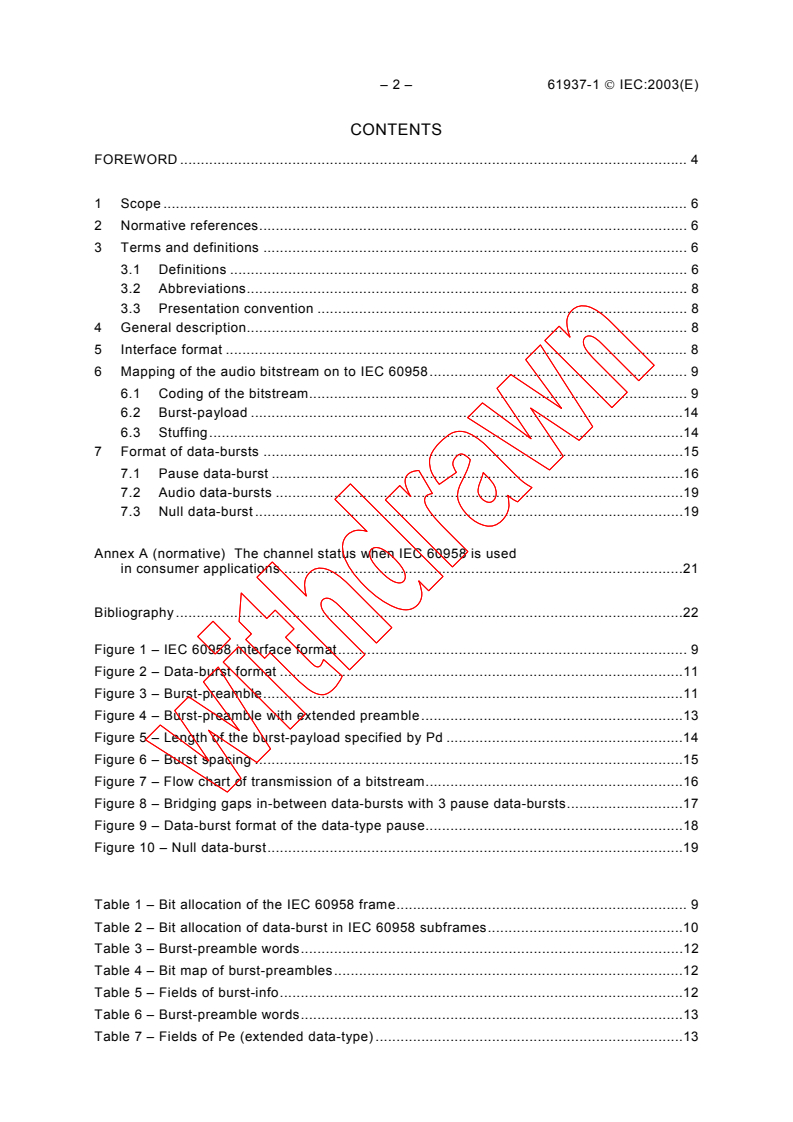
FOREWORD . 4
1 Scope . 6
2 Normative references. 6
3 Terms and definitions . 6
3.1 Definitions . 6
3.2 Abbreviations. 8
3.3 Presentation convention . 8
4 General description. 8
5 Interface format .8
6 Mapping of the audio bitstream on to IEC 60958. 9
6.1 Coding of the bitstream. 9
6.2 Burst-payload .14
6.3 Stuffing.14
7 Format of data-bursts .15
7.1 Pause data-burst .16
7.2 Audio data-bursts .19
7.3 Null data-burst.19
Annex A (normative) The channel status when IEC 60958 is used
in consumer applications .21
Bibliography.22
Figure 1 – IEC 60958 interface format. 9
Figure 2 – Data-burst format .11
Figure 3 – Burst-preamble.11
Figure 4 – Burst-preamble with extended preamble.13
Figure 5 – Length of the burst-payload specified by Pd .14
Figure 6 – Burst spacing .15
Figure 7 – Flow chart of transmission of a bitstream.16
Figure 8 – Bridging gaps in-between data-bursts with 3 pause data-bursts.17
Figure 9 – Data-burst format of the data-type pause.18
Figure 10 – Null data-burst.19
Table 1 – Bit allocation of the IEC 60958 frame. 9
Table 2 – Bit allocation of data-burst in IEC 60958 subframes.10
Table 3 – Burst-preamble words.12
Table 4 – Bit map of burst-preambles.12
Table 5 – Fields of burst-info.12
Table 6 – Burst-preamble words.13
Table 7 – Fields of Pe (extended data-type) .13
61937-1 IEC:2003(E) – 3 –
Table 8 – Fields of Pf .13
Table 9 – Repetition period of pause data-bursts .18
Table 10 – Values of data-type-dependent info of the pause data-burst .19
Table 11 – Burst-payload of pause data-burst .19
Table 12 – Fields of a null data-burst .20
Table A.1 – The allocation of the channel status bits.21
– 4 – 61937-1 IEC:2003(E)
INTERNATIONAL ELECTROTECHNICAL COMMISSION
____________
DIGITAL AUDIO –
INTERFACE FOR NON-LINEAR PCM ENCODED
AUDIO BITSTREAMS APPLYING IEC 60958 –
Part 1: General
FOREWORD
1) The IEC (International Electrotechnical Commission) is a worldwide organization for standardization comprising
all national electrotechnical committees (IEC National Committees). The object of the IEC is to promote
international co-operation on all questions concerning standardization in the electrical and electronic fields. To
this end and in addition to other activities, the IEC publishes International Standards. Their preparation is
entrusted to technical committees; any IEC National Committee interested in the subject dealt with may
participate in this preparatory work. International, governmental and non-governmental organizations liaising
with the IEC also participate in this preparation. The IEC collaborates closely with the International
Organization for Standardization (ISO) in accordance with conditions determined by agreement between the
two organizations.
2) The formal decisions or agreements of the IEC on technical matters express, as nearly as possible, an
international consensus of opinion on the relevant subjects since each technical committee has representation
from all interested National Committees.
3) The documents produced have the form of recommendations for international use and are published in the form
of standards, technical specifications, technical reports or guides and they are accepted by the National
Committees in that sense.
4) In order to promote international unification, IEC National Committees undertake to apply IEC International
Standards transparently to the maximum extent possible in their national and regional standards. Any
divergence between the IEC Standard and the corresponding national or regional standard shall be clearly
indicated in the latter.
5) The IEC provides no marking procedure to indicate its approval and cannot be rendered responsible for any
equipment declared to be in conformity with one of its standards.
6) Attention is drawn to the possibility that some of the elements of this International Standard may be the subject
of patent rights. The IEC shall not be held responsible for identifying any or all such patent rights.
International Standard IEC 61937-1 has been prepared by technical area 4: Digital system
interfaces, of IEC technical committee 100: Audio, video and multimedia systems and
equipment.
This standard cancels and replaces IEC 61937, published in 2000, which has been divided
into four parts (see below). This first edition constitutes a technical revision.
The text of this standard is based on the following documents:
FDIS Report on voting
100/644/FDIS 100/670/RVD
Full information on the voting for the approval of this standard can be found in the report on
voting indicated in the above table.
This publication has been drafted in accordance with the ISO/IEC Directives, Part 2.
61937-1 IEC:2003(E) – 5 –
IEC 61937 consists of the following parts under the general title Digital audio – Interface for
non-linear PCM encoded audio bitstreams applying IEC 60958:
Part 1: General
Part 2: Burst-info
Part 3: Non-linear PCM bitstreams according to the AC-3 format
Part 4: Non-linear PCM bitstreams according to the MPEG audio formats
Part 5: Non-linear PCM bitstreams according to the DTS (Digital Theatre Systems) format(s)
Part 6: Non-linear PCM bitstreams according to the MPEG-2 AAC format
Part 7: Non-linear PCM bitstreams according to the ATRAC and ATRAC2/3 formats
The committee has decided that the contents of this publication will remain unchanged until
October 2005. At this date, the publication will be
• reconfirmed;
• withdrawn;
• replaced by a revised edition, or
• amended.
The contents of the corrigendum of March 2004 have been included in this copy.
– 6 – 61937-1 IEC:2003(E)
DIGITAL AUDIO –
INTERFACE FOR NON-LINEAR PCM ENCODED
AUDIO BITSTREAMS APPLYING IEC 60958 –
Part 1: General
1 Scope
This International Standard applies to the digital audio interface using the IEC 60958 series
for the conveying of non-linear PCM encoded audio bitstreams.
It describes a way in which this digital interface can be used in consumer applications.
The professional mode (AES/EBU) is not considered within the scope of this standard.
2 Normative references
The following referenced documents are indispensable for the application of this document.
For dated references, only the edition cited applies. For undated references, the latest edition
of the referenced document (including any amendments) applies.
IEC 60958 (all parts), Digital audio interface
IEC 61937-2, Digital audio – Interface for non-linear PCM encoded audio bitstreams applying
IEC 60958 – Part 2: Burst-info
IEC 61937-3, Digital audio – Interface for non-linear PCM encoded audio bitstreams applying
IEC 60958 – Part 3: Non-linear PCM bitstreams according to the AC-3 format
3 Terms and definitions
3.1 Definitions
3.1.1
audio data-burst
data-burst with an encoded audio frame as burst-payload
3.1.2
audio data-word
16-bit data word
3.1.3
audio frame
fixed number of audio samples
NOTE The number of samples in an audio frame is dependent on the particular encoding system which is used to
encode the audio frame into the encoded audio frame.
3.1.4
audio gap
period in the sequence of baseband audio samples where valid samples of audio are not
available
61937-1 IEC:2003(E) – 7 –
3.1.5
bitstream
non-linear PCM encoded audio source, represented in a sequence of bits
NOTE In this interface the bitstream consists of a sequence of data-bursts.
3.1.6
data-burst
packet of data, including the burst-preamble, to be transmitted across the interface
3.1.7
burst-payload
information content of the data-burst
3.1.8
burst-preamble
header for the data-burst, containing synchronization, and information about the data
contained in the burst-payload
3.1.9
data-type
reference to the type of payload of the data-bursts
3.1.10
encoded audio frame
minimum decodable unit of an encoded data sequence
NOTE Each encoded audio frame is the encoded representation of a fixed number of audio samples (for each
original audio channel). The number of samples which are encoded into an encoded audio frame depends on the
particular encoding system which is used to encode the audio frame into the encoded audio frame.
3.1.11
idle
state in which the interface is not used to convey any sequence of data-bursts, or PCM data
NOTE The channel status data is still active (bit b1 is set to ‘1’ when further non-linear PCM encoded audio is
anticipated – see Figure 7).
3.1.12
length-code
code indicating the length of the data-burst-payload in bits
3.1.13
repetition period
period between the reference point of the current data-burst and the reference point of the
immediately following data-burst of the same data-type
3.1.14
sampling frequency
sampling frequency of the encoded PCM audio samples (i.e. before encoding and after
decoding)
3.1.15
sampling period
time period related to the sampling frequency of the PCM audio samples, represented in the
encoded bitstream
3.1.16
stuffing
occupying the unused data capacity of the interface
– 8 – 61937-1 IEC:2003(E)
3.1.17
stuffing sub-frame
occupying the unused data capacity in 16-bit audio data words
3.1.18
stream gap
period within the encoded audio bitstream without any audio frame; a discontinuity in the
bitstream
NOTE Typically, a stream gap will occur between encoded audio frames.
3.2 Abbreviations
3.2.1
MPEG
Moving Pictures Expert Group, a joint committee of ISO and IEC
3.2.1
ITU-R
International Telecommunication Union, Radio Communication Bureau
3.3 Presentation convention
F872h
Value ‘F872’ in hexadecimal format
4 General description
The format of the IEC 60958 interface consists of a sequence of IEC 60958 subframes. Each
IEC 60958 subframe is normally used to carry 1 linear PCM sample but may also be used to
convey data. The non-linear PCM encoded audio bitstreams to be transported over this
interface are formed into a sequence of data-bursts.
Each data-burst consists of a 64-bit burst-preamble, followed by the burst-payload. The burst-
preamble consists of a sync-word, information about the burst-payload and a bitstream
number.
The interface may convey one or more bitstreams. Each type of bitstream may impose a
particular requirement for the repetition period for the data-bursts that make up the bitstream
(see Clause 7).
The 16 bits of a data-burst are placed in time-slots 12-27 of an IEC 60958 subframe. Both odd
and even IEC 60958 subframes (ch1, ch2) are simultaneously used to carry 32 bits of data.
This allows IEC 60958, in the consumer mode, to convey either two-channel linear PCM
audio, or a set of non-linear PCM encoded bitstreams (alternating data words), but not both
simultaneously.
5 Interface format
The interface format as defined in IEC 60958-1 and IEC 60958-3 is used.
61937-1 IEC:2003(E) – 9 –
6 Mapping of the audio bitstream on to IEC 60958
6.1 Coding of the bitstream
The non-linear PCM encoded audio bitstream is transferred using the basic 16-bit data area
of the IEC 60958 subframes, i.e. in time-slots 12 to 27. Because the non-linear PCM encoded
audio bitstream to be transported is at a lower data rate than that supported by the IEC 60958
interface, the audio bitstream is broken into a sequence of discrete data-bursts, and stuffing
between the data-bursts is necessary (see 6.3).
Each data-burst contains data of an encoded audio frame that is the encoded representation
of a fixed number of audio samples per PCM audio channel. The number of samples to be
encoded into an encoded audio frame depends on the particular encoding system.
It is possible for this interface to simultaneously convey multiple non-linear PCM encoded
audio bitstreams. One of the applications of this capability would be to convey both a main
audio service and an associated audio service.
1 block = 192 frames
Frame 191 Frame 0 Frame 1 Frame 191 Frame 0
W B W M
Preamble Auxiliary LSB MSB V U C P
0 3 4 7 8 11 12 27 28 31
16-bit of bitstream
IEC 1288/03
Figure 1 – IEC 60958 interface format
Table 1 – Bit allocation of the IEC 60958 frame
Field IEC 60958 time-slot Value
0 – 3 Preamble IEC 60958 preamble
4 – 7 Auxiliary field Not used, all “0”
8 – 11 Unused data bits Not used, all “0”
12 – 27 16-bit data Sections of the bitstream
28 Validity flag According to IEC 60958
29 User data According to IEC 60958
30 Channel status According to IEC 60958
31 Parity bit According to IEC 60958
– 10 – 61937-1 IEC:2003(E)
6.1.1 Bit map of bitstream
The method of placing the data into the IEC 60958 bitstream is to format the data to be
transmitted into data-bursts and to send each data-burst in a continuous sequence of
IEC 60958 frames.
Table 2 – Bit allocation of data-burst in IEC 60958 subframes
Bit of subframes
Subframe MSB LSB
b27 b26 b25 ………… b14 b13 b12
Frame 0; subframe B or M 0 1 14 15
Frame 0; subframe W 16 17 30 31
Frame 1; subframe B or M 32 33 46 47
Frame 1; subframe W 48 49 62 63
Frame 2; subframe B or M 64 65 78 79
-------------------- ------------
Last subframe B or M of data-burst n-32 n-31 n-18 n-17
Last subframe W of data-burst n-16 n-15 n-2 n-1
Considering the data within an IEC 60958 subframe as a 16-bit word out of a serial stream of
bits, the first bit of the burst-payload in a data-burst would occupy the MSB of subframe 1
(time-slot 27), and the 32nd bit would occupy the LSB (or what would be the LSB for 16-bit
PCM audio) of subframe 2 (time-slot 12). The next 32-bit of the burst-payload would occupy
the next IEC 60958 frame. The last data bits of the audio data-burst might occupy only a
fraction of the last frame. Any unused bits in the last frame will be ignored by the receiver. In
the case where the audio data-burst contains a multiple of 16-bit, all used IEC 60958 sub-
frames are completely filled. When it is not a multiple of 16-bit, the bits of the burst-payload to
be conveyed in the last IEC 60958 subframe will be MSB aligned; the remaining bits shall be
stuffed with ‘0’s.
6.1.2 IEC 60958 validity flag
It is recommended to set the validity bit to a logical ‘1’. This is intended to prevent accidental
decoding of non-audio data to analogue before a complete channel status block is received.
6.1.3 IEC 60958 channel status bit 1
The purpose of channel status bit 1 is to indicate if IEC 60958 is used to convey linear PCM
or to indicate that the interface is used for other purposes (see Annex A). This bit shall be set
to ‘1’ when IEC 60958 is used to convey non-linear PCM encoded audio bitstreams.
6.1.4 Symbol frequency
When the IEC 60958 bitstream conveys linear PCM audio, the symbol frequency is 64 times
the PCM sampling frequency (32 time-slots per PCM sample, times 2 channels). When a non-
linear PCM encoded audio bitstream is conveyed by the interface, the symbol frequency is
64 times the sampling rate of the encoded audio within that bitstream, but, in the case where
a non-linear PCM encoded audio bitstream is conveyed by the interface containing audio with
low sampling frequency, the symbol frequency shall be 128 times the sampling rate of the
encoded audio within that bitstream.
61937-1 IEC:2003(E) – 11 –
6.1.5 The format of the data-bursts
Each data-burst contains a burst-preamble consisting of 4 16-bit words (Pa, Pb, Pc and Pd)
followed by the burst-payload which contains data of an encoded audio frame.
Data-burst Stuffing Data-burst Stuffing Data-burst Stuffing Data-burst
...
Pa Pb Pc Pd Burst-payload Pa Pb Pc Pd
R
R
Repetition period between 2 data-bursts
IEC 1289/03
Figure 2 – Data-burst format
The repetition period of these bursts is defined as the length between the reference points R
(measured in IEC 60958 frames) of one data-burst and the next data-burst (with the same
bit-stream-number). The data representing each individual encoded audio frame is typically
specified to be packaged into a single individual data-burst, with a repetition period
(measured in IEC 60958 frames) for that data-burst equal to the number of encoded audio
samples of each channel contained within that encoded audio frame.
It is possible for a number of data-bursts representing multiple bitstreams to be interleaved on
the interface. When more than one non-linear PCM encoded audio bitstream are transmitted
through the same interface, the audio sampling rates of these bitstreams are identical to each
other.
6.1.6 Burst-preamble
The burst-preamble consists of 4 mandatory fields. Pa and Pb represent a synchronization
word. Pc gives information about the type of data, and some information/control for the
receiver. Pd gives the length of the burst-payload, limited to 65 535 bits.
The 4 preamble words are contained in 2 sequential IEC 60958 frames. The frame beginning
the data-burst contains preamble word Pa in subframe 1, and Pb in subframe 2. The next
frame contains Pc in subframe 1 and Pd in subframe 2. When placed into an IEC 60958
subframe, the MSB of a 16-bit burst-preamble word is placed into time-slot 27 and the LSB is
placed into time-slot 12.
Pa Pb Pc Pd Burst_payload Pa Pb Pc Pd Burst_payload
Length of burst-payload
Length of burst-payload
Data-burst
Data burst
IEC 1290/03
Figure 3 – Burst-preamble
– 12 – 61937-1 IEC:2003(E)
Table 3 – Burst-preamble words
Preamble word Length of field Contents Value
MSB.LSB
Pa 16-bit Sync word 1 F872h
Pb 16-bit Sync word 2 4E1Fh
Pc 16-bit Burst-info Table 5
Pd 16-bit Length-code Number of bits
Table 4 – Bit map of burst-preambles
IEC 60958 time-slot
27 12
bit-number
Preamble
15 14 13 12 11 10 9 8 7 6 5 4 3 2 1 0
bit-number
Pa 11 11 10 00 01 11 00 10
Pb 01 00 11 10 00 01 11 11
Pc According to Table 5, burst-info values Pc, bit 15 = MSB
Pd Length-code, bit 15 = MSB
6.1.7 Burst-info
The 16-bit burst-info contains information about the data which will be found in the data-burst.
Table 5 – Fields of burst-info
Bits of Pc Value Contents
...