

IEC TS 63189-2:2023
(Main)Virtual Power Plants - Part 2: Use Cases
General Information
- Abstract
IEC TS 63189-2:2023 is applicable to virtual power plants (VPPs) that consist of distributed generation, controllable loads, and electrical energy storages.
This part of IEC 63189 is to provide VPPs use cases that capture the basic information, business roles, actors, scenarios, and processes.
- Status
- Published
- Publication Date
- 26-Oct-2023
- Technical Committee
- SC 8B - Decentralized electrical energy systems
- Drafting Committee
- WG 4 - TC 8/SC 8B/WG 4
- Current Stage
- PPUB - Publication issued
- Start Date
- 27-Oct-2023
- Completion Date
- 03-Nov-2023
Overview
IEC TS 63189-2:2023 - Virtual Power Plants (VPP) Part 2: Use Cases provides a structured collection of use cases for virtual power plants that aggregate distributed generation, controllable loads, and electrical energy storages. The technical specification captures business roles, actors, scenarios, processes and functional steps to help stakeholders define VPP requirements from a system perspective. It also supports interoperability, requirements harmonization and future standardization activities for VPP and DER aggregation projects.
Key topics and technical requirements
- Scope and applicability: Use cases apply to VPPs, DER aggregation (physical or virtual), and microgrids.
- System requirements: Covers general considerations and basic requirements including privacy, cybersecurity, adaptability/flexibility, interoperability, communication and information, and reliability.
- Operational risk classification: Framework for identifying major, moderate and minor operational risks for VPPs.
- Business roles and actors: Defines roles such as VPP participant, DER owner, system operator, electricity market operator and other stakeholders.
- Use case methodology: Template-driven approach with a use case matrix, narrative, scope/objectives, KPIs, scenario conditions, diagrams (actors, processes), technical details, step-by-step scenarios and information exchanged.
- Standardization intent: Designed to build a common nomenclature for functions and roles, and to feed the IEC Use Case management repository.
Practical applications
- Project design and requirements: Use the documented use cases to derive system and functional requirements for VPP pilots, DER aggregation projects, and microgrids.
- Interoperability planning: Adopt the VPP use-case templates to specify interfaces, data flows and communication needs across devices, aggregators and market platforms.
- Risk and operations planning: Apply the operational risk categories and scenario steps to develop operational procedures and contingency plans.
- Regulatory and market participation: Support market-operator integration, demand response schemes, ancillary services and energy-storage dispatch by clarifying roles and exchanged information.
- Vendor and integrator alignment: Manufacturers, platform providers and integrators can use the use cases to align product features with common VPP functional expectations.
Who will use this standard
- VPP operators and developers
- Distributed generation and energy storage operators
- Demand response service providers and aggregators
- System and electricity market operators
- Distribution/transmission companies, energy service companies, regulators and technology vendors
Related standards
- IEC SRD 62913-1:2019 (Use Case methodology for smart grid requirements) - normative reference used by this document.
- Other parts of the IEC 63189 series (refer to IEC webstore for full list).
IEC TS 63189-2:2023 is a practical resource for anyone specifying, implementing or regulating VPP solutions and seeking harmonized, interoperable approaches to DER aggregation and smart-grid integration.
Get Certified
Connect with accredited certification bodies for this standard

IMQ S.p.A. (Certification)
Italian electrical product certification.

SLG Prüf- und Zertifizierungs GmbH
German testing and certification body.

UL Solutions
Global safety science company with testing, inspection and certification.
Sponsored listings
Frequently Asked Questions
IEC TS 63189-2:2023 is a technical specification published by the International Electrotechnical Commission (IEC). Its full title is "Virtual Power Plants - Part 2: Use Cases". This standard covers: IEC TS 63189-2:2023 is applicable to virtual power plants (VPPs) that consist of distributed generation, controllable loads, and electrical energy storages. This part of IEC 63189 is to provide VPPs use cases that capture the basic information, business roles, actors, scenarios, and processes.
IEC TS 63189-2:2023 is applicable to virtual power plants (VPPs) that consist of distributed generation, controllable loads, and electrical energy storages. This part of IEC 63189 is to provide VPPs use cases that capture the basic information, business roles, actors, scenarios, and processes.
IEC TS 63189-2:2023 is classified under the following ICS (International Classification for Standards) categories: 29.240.01 - Power transmission and distribution networks in general. The ICS classification helps identify the subject area and facilitates finding related standards.
IEC TS 63189-2:2023 is available in PDF format for immediate download after purchase. The document can be added to your cart and obtained through the secure checkout process. Digital delivery ensures instant access to the complete standard document.
Standards Content (Sample)
IEC TS 63189-2 ®
Edition 1.0 2023-10
TECHNICAL
SPECIFICATION
colour
inside
Virtual Power Plants-
Part 2: Use Cases
All rights reserved. Unless otherwise specified, no part of this publication may be reproduced or utilized in any form
or by any means, electronic or mechanical, including photocopying and microfilm, without permission in writing from
either IEC or IEC's member National Committee in the country of the requester. If you have any questions about IEC
copyright or have an enquiry about obtaining additional rights to this publication, please contact the address below or
your local IEC member National Committee for further information.
IEC Secretariat Tel.: +41 22 919 02 11
3, rue de Varembé info@iec.ch
CH-1211 Geneva 20 www.iec.ch
Switzerland
About the IEC
The International Electrotechnical Commission (IEC) is the leading global organization that prepares and publishes
International Standards for all electrical, electronic and related technologies.
About IEC publications
The technical content of IEC publications is kept under constant review by the IEC. Please make sure that you have the
latest edition, a corrigendum or an amendment might have been published.
IEC publications search - webstore.iec.ch/advsearchform IEC Products & Services Portal - products.iec.ch
The advanced search enables to find IEC publications by a Discover our powerful search engine and read freely all the
variety of criteria (reference number, text, technical publications previews. With a subscription you will always have
committee, …). It also gives information on projects, replaced access to up to date content tailored to your needs.
and withdrawn publications.
Electropedia - www.electropedia.org
IEC Just Published - webstore.iec.ch/justpublished
The world's leading online dictionary on electrotechnology,
Stay up to date on all new IEC publications. Just Published
containing more than 22 300 terminological entries in English
details all new publications released. Available online and once
and French, with equivalent terms in 19 additional languages.
a month by email.
Also known as the International Electrotechnical Vocabulary
(IEV) online.
IEC Customer Service Centre - webstore.iec.ch/csc
If you wish to give us your feedback on this publication or need
further assistance, please contact the Customer Service
Centre: sales@iec.ch.
IEC TS 63189-2 ®
Edition 1.0 2023-10
TECHNICAL
SPECIFICATION
colour
inside
Virtual Power Plants-
Part 2: Use Cases
INTERNATIONAL
ELECTROTECHNICAL
COMMISSION
ICS 29.240.01 ISBN 978-2-8322-7623-5
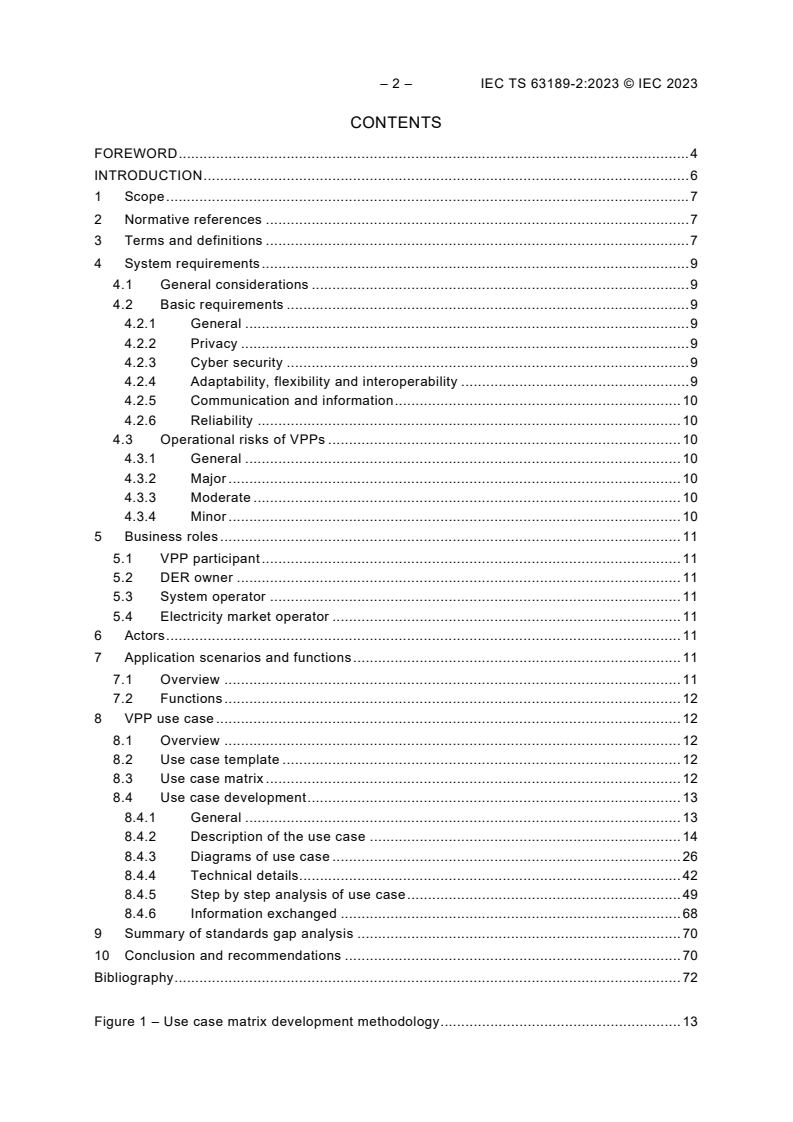
– 2 – IEC TS 63189-2:2023 © IEC 2023
CONTENTS
FOREWORD . 4
INTRODUCTION . 6
1 Scope . 7
2 Normative references . 7
3 Terms and definitions . 7
4 System requirements . 9
4.1 General considerations . 9
4.2 Basic requirements . 9
4.2.1 General . 9
4.2.2 Privacy . 9
4.2.3 Cyber security . 9
4.2.4 Adaptability, flexibility and interoperability . 9
4.2.5 Communication and information . 10
4.2.6 Reliability . 10
4.3 Operational risks of VPPs . 10
4.3.1 General . 10
4.3.2 Major . 10
4.3.3 Moderate . 10
4.3.4 Minor . 10
5 Business roles . 11
5.1 VPP participant . 11
5.2 DER owner . 11
5.3 System operator . 11
5.4 Electricity market operator . 11
6 Actors . 11
7 Application scenarios and functions . 11
7.1 Overview . 11
7.2 Functions . 12
8 VPP use case . 12
8.1 Overview . 12
8.2 Use case template . 12
8.3 Use case matrix . 12
8.4 Use case development . 13
8.4.1 General . 13
8.4.2 Description of the use case . 14
8.4.3 Diagrams of use case . 26
8.4.4 Technical details . 42
8.4.5 Step by step analysis of use case . 49
8.4.6 Information exchanged . 68
9 Summary of standards gap analysis . 70
10 Conclusion and recommendations . 70
Bibliography . 72
Figure 1 – Use case matrix development methodology . 13
Table 1 – Use case list . 14
Table 2 – Scope and objectives of use case . 16
Table 3 – Narrative of use case . 19
Table 4 – Key performance indicators . 22
Table 5 – Use case conditions . 24
Table 6 – Diagrams of use case . 26
Table 7 – Diagram(s) of actors . 43
Table 8 – Grouping of China . 44
Table 9 – Grouping of Japan . 45
Table 10 – Grouping of Australia . 46
Table 11 – Grouping of Germany . 47
Table 12 – References . 47
Table 13 – Scenario conditions . 49
Table 14 – Steps of scenarios . 54
Table 15 – Information exchanged . 68
Table 16 – Conclusion of use cases . 71
– 4 – IEC TS 63189-2:2023 © IEC 2023
INTERNATIONAL ELECTROTECHNICAL COMMISSION
____________
VIRTUAL POWER PLANTS –
Part 2: Use cases
FOREWORD
1) The International Electrotechnical Commission (IEC) is a worldwide organization for standardization comprising
all national electrotechnical committees (IEC National Committees). The object of IEC is to promote international
co-operation on all questions concerning standardization in the electrical and electronic fields. To this end and
in addition to other activities, IEC publishes International Standards, Technical Specifications, Technical Reports,
Publicly Available Specifications (PAS) and Guides (hereafter referred to as "IEC Publication(s)"). Their
preparation is entrusted to technical committees; any IEC National Committee interested in the subject dealt with
may participate in this preparatory work. International, governmental and non-governmental organizations liaising
with the IEC also participate in this preparation. IEC collaborates closely with the International Organization for
Standardization (ISO) in accordance with conditions determined by agreement between the two organizations.
2) The formal decisions or agreements of IEC on technical matters express, as nearly as possible, an international
consensus of opinion on the relevant subjects since each technical committee has representation from all
interested IEC National Committees.
3) IEC Publications have the form of recommendations for international use and are accepted by IEC National
Committees in that sense. While all reasonable efforts are made to ensure that the technical content of IEC
Publications is accurate, IEC cannot be held responsible for the way in which they are used or for any
misinterpretation by any end user.
4) In order to promote international uniformity, IEC National Committees undertake to apply IEC Publications
transparently to the maximum extent possible in their national and regional publications. Any divergence between
any IEC Publication and the corresponding national or regional publication shall be clearly indicated in the latter.
5) IEC itself does not provide any attestation of conformity. Independent certification bodies provide conformity
assessment services and, in some areas, access to IEC marks of conformity. IEC is not responsible for any
services carried out by independent certification bodies.
6) All users should ensure that they have the latest edition of this publication.
7) No liability shall attach to IEC or its directors, employees, servants or agents including individual experts and
members of its technical committees and IEC National Committees for any personal injury, property damage or
other damage of any nature whatsoever, whether direct or indirect, or for costs (including legal fees) and
expenses arising out of the publication, use of, or reliance upon, this IEC Publication or any other IEC
Publications.
8) Attention is drawn to the Normative references cited in this publication. Use of the referenced publications is
indispensable for the correct application of this publication.
9) IEC draws attention to the possibility that the implementation of this document may involve the use of (a)
patent(s). IEC takes no position concerning the evidence, validity or applicability of any claimed patent rights in
respect thereof. As of the date of publication of this document, IEC had not received notice of (a) patent(s), which
may be required to implement this document. However, implementers are cautioned that this may not represent
the latest information, which may be obtained from the patent database available at https://patents.iec.ch. IEC
shall not be held responsible for identifying any or all such patent rights.
IEC TS 63189-2 has been prepared by subcommittee 8B: Decentralized electrical energy
systems, of IEC technical committee 8: System aspects of electrical energy supply. It is a
Technical Specification.
The text of this Technical Specification is based on the following documents:
Draft Report on voting
8B/136/DTS 8B/198/RVDTS
Full information on the voting for its approval can be found in the report on voting indicated in
the above table.
The language used for the development of this Technical Specification is English.
This document was drafted in accordance with ISO/IEC Directives, Part 2, and developed in
accordance with ISO/IEC Directives, Part 1 and ISO/IEC Directives, IEC Supplement, available
at www.iec.ch/members_experts/refdocs. The main document types developed by IEC are
described in greater detail at www.iec.ch/publications.
A list of all parts in the IEC 63189 series, published under the general title Virtual power plants,
can be found on the IEC website.
The committee has decided that the contents of this document will remain unchanged until the
stability date indicated on the IEC website under webstore.iec.ch in the data related to the
specific document. At this date, the document will be
• reconfirmed,
• withdrawn, or
• revised.
IMPORTANT – The "colour inside" logo on the cover page of this document indicates that it
contains colours which are considered to be useful for the correct understanding of its
contents. Users should therefore print this document using a colour printer.
– 6 – IEC TS 63189-2:2023 © IEC 2023
INTRODUCTION
The virtual power plants use cases are developed to facilitate the standardization in this area
from a system perspective. The use cases capture the basic information, business roles, actors,
scenarios, and processes from practical business applications, pilot projects, and academic
researches of virtual power plants in different countries. This document is developed to capture
the requirements in the form of use cases that contain the scenarios and steps in a logical
sequence so that it cannot only be understood by interested parties to obtain their related
requirements, develop a virtual power plant, or operate a virtual power plant, but also establish
a nomenclature for the functions, roles, etc. Meanwhile, the use cases in the document apply
to any types of DER aggregation (physical, virtual, small and large), and also to microgrids.
Interested parties for this document include, but are not limited to:
• virtual power plant operator
• distributed generation operator
• demand response service operator
• electrical energy storage operator
• electric vehicle operator
• electric vehicle charging station with storage
• power system operator
• electricity market operator
• transmission and/or distribution company
• energy service company
• energy information provider
• regulator
The major objectives of this document include:
• to build common understanding of the business, system and functional requirements and
thus to facilitate further development of VPPs;
• to investigate future standardization needs, in order to ensure the easy implementation,
performance and interoperability of VPPs;
• to serve as an input to the IEC Use Case management repository, the purpose of which is
to collect, administer, maintain, and analyze generic use cases.
VIRTUAL POWER PLANTS –
Part 2: Use cases
1 Scope
This document is applicable to virtual power plants (VPPs) that consist of distributed generation,
controllable loads, and electrical energy storages.
This part of IEC 63189 is to provide VPPs use cases that capture the basic information,
business roles, actors, scenarios, and processes.
2 Normative references
The following documents are referred to in the text in such a way that some or all of their content
constitutes requirements of this document. For dated references, only the edition cited applies.
For undated references, the latest edition of the referenced document (including any
amendments) applies.
IEC SRD 62913-1:2019 , Generic smart grid requirements – Part 1: Specific application of
the Use Case methodology for defining generic smart grid requirements according to the IEC
systems approach
3 Terms and definitions
For the purposes of this document, the following terms and definitions apply.
ISO and IEC maintain terminological databases for use in standardization at the following
addresses:
• IEC Electropedia: available at http://www.electropedia.org/
• ISO Online browsing platform: available at http://www.iso.org/obp
3.1
aggregator
party who contracts with a number of other network users (e.g. energy consumers) in order to
combine the effect of smaller loads or distributed energy resources for actions such as demand
response or ancillary services
[SOURCE: IEC 60050-617:2017, 617-02-18]
3.2
controllable load
CL
load of particular consumers which under contract shall be reduced, for a limited period of time,
at the request of the distribution supply undertaking
Note 1 to entry: Controllable load can be increased as well as reduced, according to the request of the distribution
supply undertaking.
___________
This publication was withdrawn.
– 8 – IEC TS 63189-2:2023 © IEC 2023
[SOURCE: IEC 60050-603:1986, 603-04-42, modified ─ Addition of a Note 1 to entry.]
3.3
demand response
DR
action resulting from management of the electricity demand in response to supply conditions
[SOURCE: IEC 60050-617:2011, 617-04-16]
3.4
distributed energy resources
DER
generators (with their auxiliaries, protection and connection equipment), including load having
a generating mode (such as electrical energy storage systems), connected to a low-voltage or
a medium-voltage network
[ SOURCE: IEC 60050-617:2017, 617-04-20]
3.5
distributed generation
DG
generation of electric energy by multiple resources which are connected to the power
distribution system
Note 1 to entry: Distributed generation in VPPs are usually in the form of renewable energy generation, such as
wind power, photovoltaic generation.
[SOURCE: IEC 60050-617:2009, 617-04-09, modified ─ Addition of a Note 1 to entry.]
3.6
electrical energy storage
EES
installation able to absorb electrical energy, to store it for a certain amount of time and to
release electrical energy during which energy conversion processes may be included
Note 1 to entry: The term "electrical energy storage" may also be used to indicate the activity that an apparatus,
described in the definition, carries out when performing its own functionality.
Note 2 to entry: The term "electrical energy storage" should not be used to designate a grid-connected installation,
"electrical energy storage system" is the appropriate term.
[SOURCE: IEC 62933-1:2018, 3.1, modified ─ The example was deleted.]
3.7
prosumer
network user that consumes and produces electrical energy
[SOURCE: IEC 60050-617:2017, 617-02-16]
3.8
use case
specification of a set of actions performed by a system, which yields an observable result that
is, typically, of value for one or more actors or other stakeholders of the system
[SOURCE: ISO/IEC 19505-2:2012, 16.3.6]
3.9
virtual power plant
VPP
party or system that realizes aggregation, optimization and control of distributed generation,
energy storage devices and controllable loads
Note 1 to entry: The aggregated distributed generation, energy storage devices and controllable loads are not
necessarily within the same geographical area.
Note 2 to entry: The party or system is to facilitate the activities in power system operations and electricity market.
4 System requirements
4.1 General considerations
VPPs aim to effectively aggregate DG, EESs and CLs as one dispatchable and tradable unit by
utilizing technologies in areas such as information, communication and control technologies.
VPPs provide capacity and ancillary services to the power system operation and sell energy to
electricity markets. VPPs enhance the overall system economics and reliability, promote
efficient optimization in resources, and facilitate renewable energy consumption.
The general objective of this document is to collect actual business applications, pilot projects,
and academic researches, and develop use cases that capture VPPs basic information,
business requirements, actors and roles, scenarios, and processes. VPPs use cases help
participants to understand an existing function or process, engineers to develop system and
functional requirements, and stakeholders to reach common consensus on best practice
processes.
Use cases in this document can also provide guidance to development teams on user's needs
related to cyber security and data privacy.
4.2 Basic requirements
4.2.1 General
The system should be capable of aggregating, forecasting, optimizing, coordinating, and
controlling distributed generation, energy storage systems, and controllable loads, as one
dispatchable unit in power system operations and one tradable unit in electricity markets.
Meanwhile, it should be capable of providing ancillary services, such as reserve to guarantee
promised delivery, and communicating with the power system operator directly to provide the
support in operators' tasks.
4.2.2 Privacy
The system should comply with applicable laws and regulations to ensure the integrity, security
and privacy of related data acquired during the VPPs operation process.
4.2.3 Cyber security
VPPs' operation depends on cyber security to a large extent. The system should consider
preventive measures to ensure cyber security and minimize risks that could cause network
communication breakdowns in system failures.
4.2.4 Adaptability, flexibility and interoperability
The system should be adaptable to various software and hardware conditions, as well as flexible
to incorporate customer needs, and interoperable among related equipment to realize
coordinated operation.
– 10 – IEC TS 63189-2:2023 © IEC 2023
4.2.5 Communication and information
The system should utilize the information and communication technologies to ensure the secure,
reliable and effective communication to satisfy the technical and commercial needs.
4.2.6 Reliability
The reliability and security of the system should be ensured.
4.3 Operational risks of VPPs
4.3.1 General
Potential operational risks caused by the failure of a VPP equipment or system are classified
into three levels, depending on the severity of potential damages to grid operations and
electricity market.
4.3.2 Major
A failure in a VPP equipment or system is considered as major, if it could result in serious
impacts or damages to grid operations and/or the market, including but not limited to:
– blackout;
– complete or large-scale loss of data acquisition and transmission;
– complete or large-scale failure of communication network;
– database crashes;
– application program outage;
– unable to cover the reserves.
4.3.3 Moderate
Abnormal operation of DER dispatch and control could result in moderate impacts or damages
to grid operations and/or the market, including but not limited to:
– brownout or frequency drift;
– partial loss of stored data;
– failure of system upgrade;
– abnormal of software and/or hardware operation environment.
4.3.4 Minor
Abnormal operation of DER dispatch and control could result in minor impacts or damages to
operations or the market, including but not limited to:
– redistribution of load or short-term unavailability of backup systems;
– terminal data collection deviation;
– failure of database backup;
– failure of data processing and calculation;
– interruption of access to network.
5 Business roles
5.1 VPP participant
A VPP participant can be an aggregator or VPP operator to group distinct agents in a power
system (i.e. consumers, producers, prosumers, etc.) to act as a single entity when interacting
with various market operator or providing services to system operator.
5.2 DER owner
A DER owner is a party who owns physical assets of the distributed resources to participate in
VPP, including DG, EES, CL and electric vehicle (EV) charging station.
5.3 System operator
The system operator is responsible for the safe and reliable operation of a part of the power
system in certain area and for connection to other parts of the power system.
5.4 Electricity market operator
The electricity market operator is responsible for operation of the electricity market through
managing the selling and buying prices with the objective of maximizing profit while ensuring
satisfaction of customers' needs.
6 Actors
An actor can be a person, an equipment, or an organization that plays a role in use cases
developed in this document.
Common actors derived from stakeholders are listed as follows.
– VPP service provider
– DG operator
– demand response service operator
– EES operator
– electric vehicle operator
– EV charging station with storage
– system operator
– electricity market operator
– transmission and/or distribution company
– energy service company
– energy information provider
– regulator
7 Application scenarios and functions
7.1 Overview
Primary application scenarios and functions of VPP are categorized into five types:
1) aggregation and optimization;
2) analysis and forecast;
3) energy system management;
– 12 – IEC TS 63189-2:2023 © IEC 2023
4) trading and settlements;
5) communication.
7.2 Functions
– Aggregation and optimization
Aggregation refers to the function that multiple distributed resources, such as DG, electrical
energy storage and CLs are grouped together to act as one operating unit that is
dispatchable and tradable.
Optimization refers to the function that improves the VPP system's operational and
economic performance through maximizing or minimizing certain parameters.
– Analysis and forecast
Analysis refers to the functions conducted via quantitative calculations. The results can be
provided to VPP stakeholders for investigation, inspection and survey purposes.
Forecast refers to the function that predicts DG's output, CL's consumption, etc.
– Energy system management
Energy system management refers to the function that VPP decomposes power system's
dispatchments and send controls to individual DER based on interaction with power system
operator.
– Trading and settlements
Trading refers to the function that realizes VPP buys or sells in electricity market.
Settlements refer to the function that performs financial settlements between VPP and the
market, as well as financial settlements between a VPP service provider and an individual
VPP component.
– Communication
Communication refers to the function that realizes information transfers and data exchanges
(such as dispatch order, schedules, bids and offers, etc.) between VPP and system
operator, VPP and electricity market, a VPP service provider and an individual VPP
component.
8 VPP use case
8.1 Overview
This clause is to present the use case template and use case matrix applied in the development
process of VPP use cases.
8.2 Use case template
The use case template provided in IEC SRD 62913-1 shall be adopted to facilitate the collection
of relevant information and ensure the consistency of all use cases.
8.3 Use case matrix
A use case matrix is developed to fully cover the application scenarios, functions, business
roles, as illustrated in Figure 1.
Figure 1 – Use case matrix development methodology
8.4 Use case development
8.4.1 General
VPPs use cases are developed to cover each application scenarios and functions listed in use
case matrix defined in 8.3, using the provided use case template required in 8.2.
– 14 – IEC TS 63189-2:2023 IEC 2023
8.4.2 Description of the use case
8.4.2.1 Use case list
Table 1 lists all use cases described in this document.
Table 1 – Use case list
Use case identification
ID Area/Domain(s)/Zone(s) Name of use case
BUC-1 Area: Energy systems
Virtual power plant operation in peak shaving
and regulation energy market in China
Domains: VPP, DER
Zone: Energy market, operation
BUC-2 Area: Energy systems Virtual power plant operation in providing
frequency control ancillary services in China
Domains: VPP, DER, customers
Zone: Frequency control market, operation
BUC-3 Area: Energy systems Virtual power plant operation in providing
comprehensive energy services in China
Domains: VPP, DER, Customers
Zones: Energy services, business operation
BUC-4 Area: Energy systems Virtual power plant operation platform and its
practice in Japan
Domains: VPP, DER
Zone: Energy market, operation
BUC-5 Area: Energy systems Virtual power plant demonstrations in the
Australian National Electricity Market (NEM)
Domains: DER, VPP
Zones: Energy market, frequency control market, operation
BUC-6 VPP, DER Generic commercial use case of virtual power
plants in Australia
BUC-7 Area: Energy systems, Virtual power plant for Power Supply Co., Ltd.
in Germany
Domains: DER, VPP
Zones: Energy market, frequency control market, operation
Use case identification
ID Area/Domain(s)/Zone(s) Name of use case
SUC-1-a VPP, DER Normal mode of participating in power system
operation
SUC-1-b VPP, DER Emergency mode of alleviating power system
contingencies
SUC-1-c VPP, DER Participating in peak shaving and regulation
energy market
SUC-1-d VPP, DER Local energy management and coordinated
control of distributed energy resources
SUC-2-a VPP, DER Virtual power plant participating in primary
frequency control
SUC-2-b VPP, DER Virtual power plant participating in secondary
frequency control
SUC-7-a VPP, DER Virtual power plant participating in system
frequency control
SUC-7-b VPP, DER Virtual power plant participating in voltage
optimization
8.4.2.2 Scope and objectives of use case
Table 2 lists scope and objectives of all use cases in this document.
– 16 – IEC TS 63189-2:2023 IEC 2023
Table 2 – Scope and objectives of use case
Scope and objectives of use case
Scope BUC-1, SUC-1-a, SUC-1-b, SUC-1-c & SUC-1-d: These use cases are applicable to the VPPs that integrate industrial and
commercial facilities, electric vehicles and charging stations, smart homes and buildings, electric heating devices, air conditioning
and cooling systems, distributed photovoltaic systems, etc. These VPPs participate in the normal/emergent modes of power system
operation and valley filling energy market via local energy management.
BUC-2, SUC-2-a & SUC-2-b: These use cases describe the VPPs providing primary frequency control services and participating in
secondary frequency control ancillary service market.
BUC-3: This use case describes VPPs providing comprehensive energy services for DER, including energy utilization optimizations,
economic analysis to increase incomes, and comprehensive analysis to maximum social benefits.
BUC-4: This use case describes VPPs that consist of DG, CL and EES, which are integrated to the VPP operation platform.
BUC-5: To explore the capabilities of aggregated DER/VPPs to deliver frequency control following contingencies (in the NEM
frequency control ancillary service market), and better understand how VPPs respond to market price signals.
BUC-6: This use case describes business/commercial, low voltage, "behind the meter" VPPs in Australia as of 2020, consisting of
distributed solar PV generation and EES.
BUC-7, SUC-7-a & SUC-7-b: To explore the capabilities of aggregated DER/VPPs to increase the grid stability.
BUC-1: This VPP pilot project has a total capacity of 357,6 MW including both 256,7 MW CL, 106 kW DG and 800 kW EES, where
Objective
CL includes 73,2 MW industrial and commercial loads, 259,7 MW electric heating devices, and 23,8 MW other types of CL. The
project covers multiple regions in Jibei power system including Zhangjiakou, Langfang and Qinhuangdao cities. The objectives of
the use case mainly include:
– to investigate and develop key technologies of VPPs
This use case is supposed to take on new roles as market intermediaries between power system operators and local DER. This use
case aims to investigate and develop the key technologies of VPPs including operation framework, communication architecture,
market mechanism, etc.
– to provide regulation services for power system operation
This use case aims to provide regulation services for power system during peak/valley periods of load profiles. With the
dispatchable resources provided by VPPs, thermal power plants can reduce the needs for peak shaving and thus save operational
costs. Local DER can be utilized to balance renewable generation and load. In addition, this VPP project in China is able to provide
154-MW capacity for regulation.
– to test and verify the emerging technologies applied in energy industries
This use case provides an opportunity to apply emerging technologies, such as 5G, Artificial Intelligence, Internet of Things, etc.
These technologies can be verified and used to accelerate the innovations in energy industries and support the development of
business models and economies of VPPs.
– to provide policy suggestions for the development of VPPs
This use case aims to provide operation and regulatory approaches/policy suggestions for the development of VPPs. It can also
promote the transition of China's regulated electric power industry toward the deregulated electricity market.
– to support 100 % Green Winter Olympics in 2022
This use case will help to fulfil the promise on "100 % Green Olympic" made for 2022 Beijing Winter Olympics. By integrating and
controlling DGs, EESs and controllable loads in Olympic zones, the VPP pilot project can dynamically balance renewable
generation and load in Olympic stadium through day-ahead and real-time energy markets.
– to accelerate energy transition toward a clean and sustainable system
This use case is developed to verify the operation architecture, technology, and mechanism of VPPs. The VPP pilot project can
reduce renewable energy curtailment and operation costs for generators, explore the regulation capability and the cost savings on
electricity bills for customers, and defer the investment in utility infrastructures. This use case provides an effective solution to
accelerate a clean and sustainable energy transition.
BUC-2: This use case includes two types of VPPs. The first type is VPPs that are mainly composed of DG, EES, etc. This type of
VPPs has the capability and task to provide primary frequency control service. Therefore, they should meet the requirements of grid
code and provide primary frequency control capability. Besides, this type of VPPs can participate in the secondary frequency
control ancillary service market. The second type is VPPs that only participate in the second frequency control. The objectives of
the VPP project mainly include the following aspects:
– VPPs mainly composed of DGs provide primary frequency control service.
– VPPs participate in secondary frequency control ancillary service market.
BUC-3: The objectives of the VPPs providing comprehensive energy services mainly include:
– the operational process of VPPs that provide comprehensive energy services for DER
VPPs collect, and analyse real-time and historical energy utilization data of DER. VPPs provide diversified and targeted
comprehensive energy services for DER.
– the business mechanisms for three types of energy services including energy utilization optimization, increasing revenue of
DER, and maximizing social benefits of DER
BUC-4: The objectives and importance of VPP use cases in Japan are as follows:
– enhance economic efficiency of power system
By using VPPs to decrease the peak demand, it can reduce maintenance costs and capital investment for power generation
equipment, also to suppress the increase in output of thermal power plants with high fuel costs. These measures can reduce power
generation costs, leading to more economical use of energy.
– higher penetration of renewable energy
With the penetration of renewable generation such as solar and wind generation increasing, the amount of generated power may
exceed demand during the day. In such cases, it is necessary to maintain the balance between supply and demand by suppressing
renewable energy. But if VPPs can control energy resources such as EES to increase the demand, it is possible to effectively use
the generated power. These measures will contribute to the introduction of more renewable energy.
– reduction of power system stabilization cost
Conventionally, power generation for peak demand such as thermal power and pumped-storage hydro power have been utilized in
order to supply electricity stably. Since VPPs use the DER on the demand side for purposes different from the original one, it is
expected to reduce the capital cost and stabilize the power system at lower cost.
– 18 – IEC TS 63189-2:2023 IEC 2023
BUC-5: The objectives of the demonstration are intended to allow the system operator to explore:
– the operational capability for market participation
This relates to the VPPs' reliability to deliver contingency frequency control ancillary services (FCAS). In the Australian National
Electricity Market Contingency FCAS is facilitated through a market that is co-optimised with the energy market. The purpose of the
contingency FCAS market is to assist in correcting supply unbalances following a major contingency event, such as a loss of a
generating unit/major load or large transmission element. The contingency FCAS market consists of several markets, relating to
response timeframes to the frequency event (e.g. 6 seconds, 60 seconds, 5 minutes).
The VPP demonstrations explore the capability of VPPs to deliver contingency FCAS, such as whether they can deliver the
frequency response they are enabled for and what may be a typical extra fleet capacity VPP operators dispatch over and above
their enabled contribution to reliably meet that target.
– gain operational visibility of aggregated DER
To understand VPPs' impact on power system security, local power quality, and how they interact with the market. A series of
application programming interfaces (APIs) are established for participants to submit operational forecasts and actual performance
data, this is necessary because the VPP demonstration participants operate un-scheduled in the energy market.
– operational and policy ongoing arrangements
In addition, the demonstrations will assist determining appropriate operational and regulatory arrangements for DER to participate
in FCAS and energy markets on an ongoing basis (following the demonstrations). This will be done by assessing the suitability of a
new approach for FCAS DER specifications and will inform required changes to regulatory frameworks and operational process to
ensure VPPs are better integrated in the NEM electricity markets.
– market dynamics and planning
This aspect explores the extent that VPPs' response to energy market price signals. If this can be extrapolated to very large VPPs,
what impacts could this have on energy markets and how much reliance should be placed on VPPs responding to energy market
signals for planning studies.
BUC-6: The first objective of Australian VPPs is to demonstrate the role of virtual power plants in enabling higher penetrations of
distributed renewable generation in the grid, and help further understanding of the role of distributed "smart" storage in supporting
grid resilience and reliability.
The second objective is to address growing "prosumer" interest and demand for greater control over their electricity bills as well as
to achieve greater energy independence against a backdrop of high retail energy costs.
Thirdly, the VPP would also enable VPP retailers/aggregators to derive additional value streams during specific network and
wholesale market events, through coordinated/orchestrated VPP dispatch.
Collectively, the 2nd and 3rd objectives can ultimately reduce the cost of the system to the end customer, while reducing the energy
costs going forward.
Lastly, this document is a contribution to the IEC use case management repository, the purpose of which is to collect, administer,
maintain, and analyse use cases.
BUC-7: The objectives of the VPP are intended to allow DER to response to
– demand-response signals based on the current availability/flexibility of each asset
– cold load pickup support based on the current availability/flexibility of each asset
– system frequency control signals based on the predefined reserve band
– voltage optimization signals to improve the reliability and power quality of distribution network operation
Related business case(s) – energy management system use case
– microgrid use case
– TBC
8.4.2.3 Narrative of use case
Table 3 lists narrative of all use cases in this document.
Table 3 – Narrative of use case
Narrative of use case
Short description
BUC-1, S
...