

IEC 62933-2-1:2017
(Main)Electrical energy storage (EES) systems - Part 2-1: Unit parameters and testing methods - General specification
General Information
- Abstract
IEC 62933-2-1:2017 focuses on unit parameters and testing methods of EES systems. The energy storage devices and technologies are outside the scope of this document. This document deals with EES system performance defining:
unit parameters,
testing methods. The contents of the corrigendum of January 2019 have been included in this copy.
- Status
- Published
- Publication Date
- 12-Dec-2017
- Technical Committee
- TC 120 - Electrical Energy Storage (EES) systems
- Drafting Committee
- WG 2 - TC 120/WG 2
- Current Stage
- PPUB - Publication issued
- Start Date
- 13-Dec-2017
- Completion Date
- 12-Jan-2018
Overview
IEC 62933-2-1:2017 is an international standard developed by the International Electrotechnical Commission (IEC) that specifies unit parameters and testing methods for Electrical Energy Storage (EES) systems. This general specification focuses on the performance assessment of EES units without addressing the specific energy storage technologies or devices themselves. It serves as a fundamental framework to define key parameters relevant to EES system functionality and outlines standardized testing procedures to measure system capabilities and reliability under controlled conditions.
The standard incorporates comprehensive guidance on:
- Defining unit parameters such as energy capacity, power rating, efficiency, and service life.
- Testing methodologies for accurate evaluation of these parameters.
- Classification of EES applications covering frequency regulation, peak shaving, and backup power.
Updates from the corrigendum of January 2019 are included in this 2017 edition, affirming the document’s current relevance for industry professionals requiring rigorous testing and specification guidance for electrical energy storage systems.
Key Topics
Classification of EES Systems
IEC 62933-2-1 introduces a structured classification approach categorizing EES applications into three main classes:
- Class A: Frequency regulation, fluctuation reduction, and voltage regulation.
- Class B: Peak shaving/peak shifting.
- Class C: Backup power.
This classification supports targeted performance testing and parameter evaluation tailored to specific use cases in power grids and industrial applications.
Unit Parameters
The standard identifies essential parameters necessary to characterize the performance of an EES system unit, including but not limited to:
- Nominal energy capacity: Defines the usable stored energy at standard test conditions.
- Input/output power rating: Maximum power capabilities for charge and discharge cycles.
- Roundtrip efficiency: Measures the energy lost in the storage cycle process.
- Expected service life: Anticipated operational lifespan under normative usage conditions.
- System response: Includes step response time and ramp rate, critical for applications requiring rapid reaction to grid demands.
- Auxiliary power consumption: Power used by the system itself in operational standby or management modes.
- Self-discharge rate: The natural loss of stored energy over time when idle.
- Rated voltage and frequency ranges: Operational limits ensuring compatibility with power systems.
Testing Methods
IEC 62933-2-1 standardizes test procedures covering:
- Actual energy capacity tests to verify nominal values.
- Power rating tests evaluating maximum discharge and charging capabilities.
- Efficiency tests to calculate roundtrip losses accurately.
- Service life assessments through accelerated cycling and degradation evaluation.
- System response time testing for dynamic performance profiling.
- Environmental and grid compatibility tests, such as insulation, earthing, and electromagnetic compatibility (EMC) immunity testing.
- Performance tests tailored to each application class, ensuring compliance with operational requirements.
Applications
This IEC standard is vital for manufacturers, testing laboratories, and system integrators involved in the design, verification, and deployment of electrical energy storage units in diverse scenarios including:
- Grid services like frequency and voltage regulation.
- Renewable energy smoothing and fluctuation mitigation to enhance stability.
- Peak load management through peak shaving and shifting.
- Uninterruptable power supply (UPS) and backup power applications ensuring energy reliability.
- Smart grid and microgrid integrations where energy storage performance and interoperability are critical.
By following IEC 62933-2-1, stakeholders can ensure EES units meet stringent performance criteria, reliability expectations, and regulatory compliance, leading to more efficient and sustainable energy storage solutions.
Related Standards
Professionals working with IEC 62933-2-1:2017 may also consider related IEC publications and international standards to complement the general specifications:
- IEC 62933-1: General guidance on electrical energy storage systems overview and terminology.
- IEC 62933-2-2: Specific parameters and testing methods for individual storage technologies.
- IEC 61000 series: Standards on electromagnetic compatibility relevant to EES system installations.
- ISO/IEC standards on environmental testing to assess durability under varied climatic conditions.
Referencing these related standards helps create a holistic compliance framework addressing both system-level and component-specific requirements in electrical energy storage.
The IEC 62933-2-1:2017 standard provides a critical foundation for industry-wide harmonization of testing and specification methods for electrical energy storage units, facilitating improved system design, verification, and regulatory approval while promoting the reliability and effectiveness of energy storage in modern power systems.
Relations
- Effective Date
- 05-Sep-2023
Get Certified
Connect with accredited certification bodies for this standard

BSI Group
BSI (British Standards Institution) is the business standards company that helps organizations make excellence a habit.

Bureau Veritas
Bureau Veritas is a world leader in laboratory testing, inspection and certification services.

DNV
DNV is an independent assurance and risk management provider.
Sponsored listings
Frequently Asked Questions
IEC 62933-2-1:2017 is a standard published by the International Electrotechnical Commission (IEC). Its full title is "Electrical energy storage (EES) systems - Part 2-1: Unit parameters and testing methods - General specification". This standard covers: IEC 62933-2-1:2017 focuses on unit parameters and testing methods of EES systems. The energy storage devices and technologies are outside the scope of this document. This document deals with EES system performance defining: unit parameters, testing methods. The contents of the corrigendum of January 2019 have been included in this copy.
IEC 62933-2-1:2017 focuses on unit parameters and testing methods of EES systems. The energy storage devices and technologies are outside the scope of this document. This document deals with EES system performance defining: unit parameters, testing methods. The contents of the corrigendum of January 2019 have been included in this copy.
IEC 62933-2-1:2017 is classified under the following ICS (International Classification for Standards) categories: 13.020.30 - Environmental impact assessment. The ICS classification helps identify the subject area and facilitates finding related standards.
IEC 62933-2-1:2017 has the following relationships with other standards: It is inter standard links to IEC 62933-2-1:2017/COR1:2019. Understanding these relationships helps ensure you are using the most current and applicable version of the standard.
IEC 62933-2-1:2017 is available in PDF format for immediate download after purchase. The document can be added to your cart and obtained through the secure checkout process. Digital delivery ensures instant access to the complete standard document.
Standards Content (Sample)
IEC 62933-2-1 ®
Edition 1.0 2017-12
INTERNATIONAL
STANDARD
NORME
INTERNATIONALE
colour
inside
Electrical energy storage (EES) systems –
Part 2-1: Unit parameters and testing methods – General specification
Systèmes de stockage de l'énergie électrique (EES) –
Partie 2-1: Paramètres unitaires et méthodes d'essai – Spécifications générales
All rights reserved. Unless otherwise specified, no part of this publication may be reproduced or utilized in any form
or by any means, electronic or mechanical, including photocopying and microfilm, without permission in writing from
either IEC or IEC's member National Committee in the country of the requester. If you have any questions about IEC
copyright or have an enquiry about obtaining additional rights to this publication, please contact the address below or
your local IEC member National Committee for further information.
Droits de reproduction réservés. Sauf indication contraire, aucune partie de cette publication ne peut être reproduite
ni utilisée sous quelque forme que ce soit et par aucun procédé, électronique ou mécanique, y compris la photocopie
et les microfilms, sans l'accord écrit de l'IEC ou du Comité national de l'IEC du pays du demandeur. Si vous avez des
questions sur le copyright de l'IEC ou si vous désirez obtenir des droits supplémentaires sur cette publication, utilisez
les coordonnées ci-après ou contactez le Comité national de l'IEC de votre pays de résidence.
IEC Central Office Tel.: +41 22 919 02 11
3, rue de Varembé Fax: +41 22 919 03 00
CH-1211 Geneva 20 info@iec.ch
Switzerland www.iec.ch
About the IEC
The International Electrotechnical Commission (IEC) is the leading global organization that prepares and publishes
International Standards for all electrical, electronic and related technologies.
About IEC publications
The technical content of IEC publications is kept under constant review by the IEC. Please make sure that you have the
latest edition, a corrigenda or an amendment might have been published.
IEC Catalogue - webstore.iec.ch/catalogue Electropedia - www.electropedia.org
The stand-alone application for consulting the entire The world's leading online dictionary of electronic and
bibliographical information on IEC International Standards, electrical terms containing 20 000 terms and definitions in
Technical Specifications, Technical Reports and other English and French, with equivalent terms in 16 additional
documents. Available for PC, Mac OS, Android Tablets and languages. Also known as the International Electrotechnical
iPad. Vocabulary (IEV) online.
IEC publications search - www.iec.ch/searchpub IEC Glossary - std.iec.ch/glossary
The advanced search enables to find IEC publications by a 65 000 electrotechnical terminology entries in English and
variety of criteria (reference number, text, technical French extracted from the Terms and Definitions clause of
committee,…). It also gives information on projects, replaced IEC publications issued since 2002. Some entries have been
and withdrawn publications. collected from earlier publications of IEC TC 37, 77, 86 and
CISPR.
IEC Just Published - webstore.iec.ch/justpublished
Stay up to date on all new IEC publications. Just Published IEC Customer Service Centre - webstore.iec.ch/csc
details all new publications released. Available online and If you wish to give us your feedback on this publication or
also once a month by email. need further assistance, please contact the Customer Service
Centre: csc@iec.ch.
A propos de l'IEC
La Commission Electrotechnique Internationale (IEC) est la première organisation mondiale qui élabore et publie des
Normes internationales pour tout ce qui a trait à l'électricité, à l'électronique et aux technologies apparentées.
A propos des publications IEC
Le contenu technique des publications IEC est constamment revu. Veuillez vous assurer que vous possédez l’édition la
plus récente, un corrigendum ou amendement peut avoir été publié.
Catalogue IEC - webstore.iec.ch/catalogue Electropedia - www.electropedia.org
Application autonome pour consulter tous les renseignements
Le premier dictionnaire en ligne de termes électroniques et
bibliographiques sur les Normes internationales,
électriques. Il contient 20 000 termes et définitions en anglais
Spécifications techniques, Rapports techniques et autres
et en français, ainsi que les termes équivalents dans 16
documents de l'IEC. Disponible pour PC, Mac OS, tablettes
langues additionnelles. Egalement appelé Vocabulaire
Android et iPad.
Electrotechnique International (IEV) en ligne.
Recherche de publications IEC - www.iec.ch/searchpub
Glossaire IEC - std.iec.ch/glossary
65 000 entrées terminologiques électrotechniques, en anglais
La recherche avancée permet de trouver des publications IEC
en utilisant différents critères (numéro de référence, texte, et en français, extraites des articles Termes et Définitions des
comité d’études,…). Elle donne aussi des informations sur les publications IEC parues depuis 2002. Plus certaines entrées
projets et les publications remplacées ou retirées. antérieures extraites des publications des CE 37, 77, 86 et
CISPR de l'IEC.
IEC Just Published - webstore.iec.ch/justpublished
Service Clients - webstore.iec.ch/csc
Restez informé sur les nouvelles publications IEC. Just
Published détaille les nouvelles publications parues. Si vous désirez nous donner des commentaires sur cette
Disponible en ligne et aussi une fois par mois par email. publication ou si vous avez des questions contactez-nous:
csc@iec.ch.
IEC 62933-2-1 ®
Edition 1.0 2017-12
INTERNATIONAL
STANDARD
NORME
INTERNATIONALE
colour
inside
Electrical energy storage (EES) systems –
Part 2-1: Unit parameters and testing methods – General specification
Systèmes de stockage de l'énergie électrique (EES) –
Partie 2-1: Paramètres unitaires et méthodes d'essai – Spécifications générales
INTERNATIONAL
ELECTROTECHNICAL
COMMISSION
COMMISSION
ELECTROTECHNIQUE
INTERNATIONALE
ICS 13.020.30 ISBN 978-2-8322-5146-1
– 2 – IEC 62933-2-1:2017 © IEC 2017
CONTENTS
FOREWORD . 5
1 Scope . 7
2 Normative references . 7
3 Terms, definitions, abbreviated terms and symbols . 7
3.1 Terms and definitions . 7
3.2 Abbreviated terms . 8
3.3 Symbols . 8
4 Classification of EES system . 8
4.1 General . 8
4.2 Categorizing the application of EES system . 9
4.3 Class A applications . 9
4.3.1 Frequency regulation . 9
4.3.2 Fluctuation reduction . 9
4.3.3 Voltage regulation . 9
4.4 Class B – Peak shaving/peak shifting . 10
4.5 Class C – Back-up power . 10
5 Unit parameters . 10
5.1 General . 10
5.1.1 Overview . 10
5.1.2 Reference environmental conditions . 10
5.1.3 Standard testing conditions . 11
5.1.4 Typical architecture . 11
5.2 List of unit parameters . 12
5.2.1 Nominal energy capacity . 12
5.2.2 Input and output power rating . 12
5.2.3 Roundtrip efficiency . 14
5.2.4 Expected service life . 15
5.2.5 System response . 15
5.2.6 Auxiliary power consumption . 16
5.2.7 Self- discharge of EES system . 17
5.2.8 Rated voltage range . 17
5.2.9 Rated frequency range . 17
6 Testing methods and procedures . 17
6.1 General . 17
6.2 Parameter test . 18
6.2.1 Actual energy capacity test . 18
6.2.2 Input and output power rating test. 19
6.2.3 Roundtrip efficiency test . 20
6.2.4 Expected service life test . 21
6.2.5 System response test, step response time and ramp rate . 21
6.2.6 Auxiliary power consumption test . 24
6.2.7 Self-discharge of EES system test . 24
6.2.8 Rated voltage and frequency range test . 25
6.3 Performance test . 25
6.3.1 General . 25
6.3.2 Performance test for class A applications . 26
6.3.3 Performance test for class B applications . 26
6.3.4 Performance test for Class C applications . 27
6.4 System implementation test . 27
6.4.1 Visual inspection . 27
6.4.2 Continuity and validity of conductors . 27
6.4.3 Earthing test . 28
6.4.4 Insulation test . 28
6.4.5 Protective and switching device test . 28
6.4.6 Equipment and basic function test . 28
6.4.7 Grid connection compatibility test . 29
6.4.8 Available energy test . 30
6.4.9 EMC immunity test . 30
Annex A (informative) Duty cycle for efficiency test . 31
A.1 General . 31
A.2 Class A application duty cycle . 31
A.2.1 General . 31
A.2.2 Duty cycle . 31
A.3 Class B application duty cycles . 32
A.3.1 General . 32
A.3.2 Duty cycle . 32
Annex B (informative) Fluctuation reduction test . 33
B.1 General . 33
B.2 Fluctuation reduction test . 33
Annex C (informative) Back-to-back test method for EES system . 35
C.1 Back-to-back test without grid interconnection . 35
C.2 Back-to-back test with grid interconnection . 36
Bibliography . 37
Figure 1 – Example of classification of EES systems . 9
Figure 2 – Typical architecture of EES system . 12
Figure 3 – Optional architecture of EES system . 12
Figure 4 – Sign convention of active power and reactive power . 14
Figure 5 – Step response time and ramp rate of EES system . 16
Figure 6 – Typical testing points for apparent power . 20
Figure 7 – System response test . 23
Figure A.1 – Class A application duty cycle . 31
Figure A.2 – Class B application duty cycles . 32
Figure B.1 – Power stabilization test . 33
Figure B.2 – Report of stabilization test . 34
Figure C.1 – Back-to-back test configuration (EESS module type) . 35
Figure C.2 – Back-to-back test configuration (AC/DC/AC converter type) . 36
Figure C.3 – Back-to-back test configuration (EESS module type) . 36
– 4 – IEC 62933-2-1:2017 © IEC 2017
Table 1 – Example of typical and not exclusive applications classification . 9
Table 2 – Normal environmental conditions . 11
Table 3 – Standard testing conditions . 11
Table 4 – Document format of roundtrip efficiency . 20
Table 5 – Performance test items. 26
INTERNATIONAL ELECTROTECHNICAL COMMISSION
____________
ELECTRICAL ENERGY STORAGE (EES) SYSTEMS –
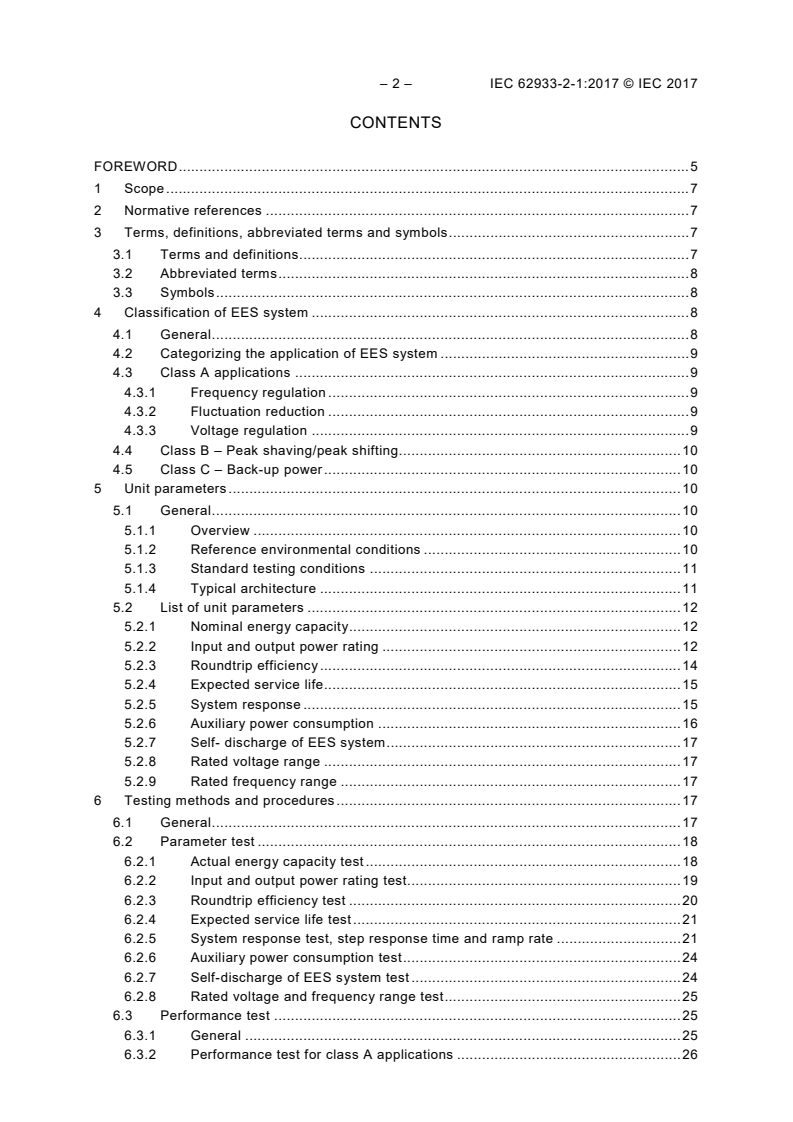
Part 2-1: Unit parameters and testing methods – General specification
FOREWORD
1) The International Electrotechnical Commission (IEC) is a worldwide organization for standardization comprising
all national electrotechnical committees (IEC National Committees). The object of IEC is to promote
international co-operation on all questions concerning standardization in the electrical and electronic fields. To
this end and in addition to other activities, IEC publishes International Standards, Technical Specifications,
Technical Reports, Publicly Available Specifications (PAS) and Guides (hereafter referred to as “IEC
Publication(s)”). Their preparation is entrusted to technical committees; any IEC National Committee interested
in the subject dealt with may participate in this preparatory work. International, governmental and non-
governmental organizations liaising with the IEC also participate in this preparation. IEC collaborates closely
with the International Organization for Standardization (ISO) in accordance with conditions determined by
agreement between the two organizations.
2) The formal decisions or agreements of IEC on technical matters express, as nearly as possible, an international
consensus of opinion on the relevant subjects since each technical committee has representation from all
interested IEC National Committees.
3) IEC Publications have the form of recommendations for international use and are accepted by IEC National
Committees in that sense. While all reasonable efforts are made to ensure that the technical content of IEC
Publications is accurate, IEC cannot be held responsible for the way in which they are used or for any
misinterpretation by any end user.
4) In order to promote international uniformity, IEC National Committees undertake to apply IEC Publications
transparently to the maximum extent possible in their national and regional publications. Any divergence
between any IEC Publication and the corresponding national or regional publication shall be clearly indicated in
the latter.
5) IEC itself does not provide any attestation of conformity. Independent certification bodies provide conformity
assessment services and, in some areas, access to IEC marks of conformity. IEC is not responsible for any
services carried out by independent certification bodies.
6) All users should ensure that they have the latest edition of this publication.
7) No liability shall attach to IEC or its directors, employees, servants or agents including individual experts and
members of its technical committees and IEC National Committees for any personal injury, property damage or
other damage of any nature whatsoever, whether direct or indirect, or for costs (including legal fees) and
expenses arising out of the publication, use of, or reliance upon, this IEC Publication or any other IEC
Publications.
8) Attention is drawn to the Normative references cited in this publication. Use of the referenced publications is
indispensable for the correct application of this publication.
9) Attention is drawn to the possibility that some of the elements of this IEC Publication may be the subject of
patent rights. IEC shall not be held responsible for identifying any or all such patent rights.
International Standard IEC 62933-2-1 has been prepared by IEC technical committee TC 120:
Electrical energy storage (EES) systems.
The text of this International Standard is based on the following documents:
FDIS Report on voting
120/109/FDIS 120/115/RVD
Full information on the voting for the approval of this International Standard can be found in
the report on voting indicated in the above table.
This document has been drafted in accordance with the ISO/IEC Directives, Part 2.
A list of all parts in the IEC 62933 series, published under the general title Electrical energy
storage (EES) systems, can be found on the IEC website.
– 6 – IEC 62933-2-1:2017 © IEC 2017
The committee has decided that the contents of this document will remain unchanged until the
stability date indicated on the IEC website under "http://webstore.iec.ch" in the data related to
the specific document. At this date, the document will be
• reconfirmed,
• withdrawn,
• replaced by a revised edition, or
• amended.
The contents of the corrigendum of January 2019 have been included in this copy.
IMPORTANT – The 'colour inside' logo on the cover page of this publication indicates
that it contains colours which are considered to be useful for the correct
understanding of its contents. Users should therefore print this document using a
colour printer.
ELECTRICAL ENERGY STORAGE (EES) SYSTEMS –
Part 2-1: Unit parameters and testing methods – General specification
1 Scope
This part of IEC 62933 focuses on unit parameters and testing methods of EES systems. The
energy storage devices and technologies are outside the scope of this document. This
document deals with EES system performance defining:
– unit parameters,
– testing methods.
2 Normative references
The following documents are referred to in the text in such a way that some or all of their
content constitutes requirements of this document. For dated references, only the edition
cited applies. For undated references, the latest edition of the referenced document (including
any amendments) applies.
IEC 60364-6, Low voltage electrical installations – Part 6: Verification
IEC 61000-4-7, Electromagnetic compatibility (EMC) – Part 4-7: Testing and measurement
techniques – General guide on harmonics and interharmonics measurements and
instrumentation, for power supply systems and equipment connected thereto
IEC 61400-21, Wind turbines – Part 21: Measurement and assessment of power quality
characteristics of grid connected wind turbines
IEC TR 61850-90-7, Communication networks and systems for power utility automation –
Part 90-7: Object models for power converters in distributed energy resources (DER) systems
IEC 61936-1, Power installations exceeding 1 kV a.c. - Part 1: Common rules
IEC 62933-1 , Electrical energy storage (EES) systems – Part 1: Vocabulary
3 Terms, definitions, abbreviated terms and symbols
3.1 Terms and definitions
For the purposes of this document, the terms and definitions given in IEC 62933-1 apply.
ISO and IEC maintain terminological databases for use in standardization at the following
addresses:
• IEC Electropedia: available at http://www.electropedia.org/
• ISO Online browsing platform: available at http://www.iso.org/obp
_____________
Under preparation. Stage at the time of publication: IEC FDIS 62933-1:2017
– 8 – IEC 62933-2-1:2017 © IEC 2017
3.2 Abbreviated terms
CAES compressed air energy storage
CB circuit breaker
DLC double layer capacitor
EES electrical energy storage
FES flywheel energy storage
NaS sodium sulphur
NiCd nickel cadmium
NiMH nickel metal hydride
PHS pumped hydro storage
POC point of connection
SMES superconducting magnetic energy storage
SNG synthetic natural gas
SOC state of charge
3.3 Symbols
ƞ roundtrip efficiency
rt
E total output energy measured at POC
o
E total input energy measured at POC
I
E
aux_o
energy consumption of auxiliary subsystem measured at auxiliary POC during
output operation
E
aux_I
energy consumption of auxiliary subsystem measured at auxiliary POC during
input operation
RR ramp rate
SRT step response time
P active power
Q reactive power
S apparent power
U voltage
I current
P auxiliary power consumption
aux
4 Classification of EES system
4.1 General
A widely-used approach for classifying EES systems is the determination according to the
form of energy used. A classification example of EES systems according to energy form is
shown in Figure 1. EES systems are classified into mechanical, electrochemical, chemical,
electrical and thermal energy storage systems.
EES systems
Mechanical Electrochemical Electrical
Secondary batteries Double-layer
Pumped hydro –
Lead acid/NiCd/NiMH/Li/NaS
Capacitor – DLC
PHS
Flow batteries Superconducting
Compressed air – CAES
Redox flow/Hybrid flow
magnetic coil – SMES
Flywheel – FES
Chemical Thermal
Hydrogen Sensible heat storage
Electrolyser/Fuel cell/SNG Molten salt/A-CAES
IEC
Figure 1 – Example of classification of EES systems
4.2 Categorizing the application of EES system
The application and use of an EES system differs according to its purpose and location. The
application of an EES system can be classified into three classes, and five representative
applications are described in Table 1. The summary of the three classes of Table 1 is as
follows:
a) Class A: short-duration application that requires the EES system to input/output the
required power over a duty cycle for a short period of time (for example, the EES system
is charged and discharged in less than 1 h).
b) Class B: long-duration application that requires the EES system to input/output the
required power over a duty cycle for a long period of time (for example, the EES system is
charged and discharged in more than 1 h).
c) Class C: the EES system is used to supply AC power to electric power grids in emergency
case, without relying on an external power source.
One EES system can be used in combination with applications of different classes.
Table 1 – Example of typical and not exclusive applications classification
Classifications Class A Class B Class C
(short duration) (long duration) (back-up)
Typical applications Frequency regulation Peak shaving/peak shifting Back-up power
Fluctuation reduction
Voltage regulation
4.3 Class A applications
4.3.1 Frequency regulation
The EES system supports grid frequency stabilization using active power.
4.3.2 Fluctuation reduction
The EES system stabilizes a fluctuating power supply or a fluctuating load.
4.3.3 Voltage regulation
The EES system stabilizes the voltage of a power grid using reactive and active power.
– 10 – IEC 62933-2-1:2017 © IEC 2017
4.4 Class B – Peak shaving/peak shifting
The EES system has a function to use the stored energy for peak demand or a function to
store excess energy of generation. EES system can achieve better operation efficiency of the
transmission and distribution lines.
4.5 Class C – Back-up power
The EES system has a function to supply AC power in electric power grids or microgrids
installed to operate critically important systems over a fixed duration in accordance with the
system specifications. ESS system can therefore reduce the risk of major blackouts.
5 Unit parameters
5.1 General
5.1.1 Overview
The following parameters shall be specified as the common basic parameters to ensure EES
system capability and performance:
• nominal energy capacity (Wh);
• input and output power rating (W, var, VA);
• roundtrip efficiency (%);
• expected service life (years, duty-cycles);
• system response (step response time (s) and ramp rate (W/s));
• auxiliary power consumption (W);
• self-discharge of EESS (Wh/h);
• voltage range (V);
• frequency range (Hz).
Each parameter defined in this document shall be measured and evaluated at the POC.
5.1.2 Reference environmental conditions
The EES system shall be used under the conditions listed in Table 2.
Table 2 – Normal environmental conditions
Indoor installation Outdoor installation
Upper limit ≤ 40 °C ≤ 40 °C
and 24 h average ≤ 35 °C ≤ 35 °C
Ambient air
and one category: -5 indoor: ≥ −5 °C -10 outdoor: ≥ −10 °C
temperature
or -15 indoor: ≥ −15 °C -25 outdoor: ≥ −25 °C
or -25 indoor: ≥ −25 °C -40 outdoor: ≥ −40 °C
a b
Solar radiation (clear day, noon) Negligible ≤ 1 000 W/m
Altitude ≤ 1 000 m ≤ 1 000 m
b
Relative humidity: 24 h average ≤ 95 %
c
Condensation, precipitation
a
Details of global solar radiation are given in IEC 60721-2-4. Ultraviolet (UV) radiation can damage some
synthetic materials, for more details see IEC 60068.
b
For these conditions, condensation may occasionally occur. Condensation can be expected where sudden
temperature changes occur in periods of high humidity. To avoid breakdown of insulation or corrosion of
metallic parts due to high humidity and condensation, equipment designed for such conditions and tested
accordingly should be used. Condensation may be prevented by special design of the building or housing, by
suitable ventilation and heating of the station or by the use of dehumidifying equipment.
c
Precipitation in the form of dew, condensation, fog, rain, snow, ice or hoar frost should be taken into account.
Precipitation characteristics for insulation are described in IEC 60060-1 and IEC 60071-1. For other
properties, precipitation characteristics are described in IEC 60721-2-2.
When the EES system is intended to be used under conditions different from the normal
environmental conditions given in Table 2, an agreement between user and system supplier is
necessary. For each test described in this document, the system supplier shall report the
following environmental conditions:
a) ambient air temperature
b) altitude
c) relative humidity/condensation and precipitation (precipitation is only needed for outdoor
equipment)
d) Atmospheric pressure
5.1.3 Standard testing conditions
The EES system shall be tested under the conditions listed in Table 3. However, if it cannot
be tested under standard test conditions, conversion to standard test conditions is allowed.
Table 3 – Standard testing conditions
Item Conditions
Ambient air temperature 25 ºC
Altitude ≤ 1 000 m
Humidity ≤ 95 % with no condensation
5.1.4 Typical architecture
The typical architecture of an EES system is shown in Figure 2. The boundary between the
EES system and the electrical power system is defined as POC. Each parameter that is
defined in this document shall be measured at POC.
– 12 – IEC 62933-2-1:2017 © IEC 2017
Figure 2 and Figure 3 are examples.
Control subsystem
Communication subsystem
Communication
Management subsystem
interface
Protection subsystem
Auxiliary subsystem
Primary subsystem
Power
Accumulation Connection
conversion
POC
subsystem subsystem
subsystem
IEC
Figure 2 – Typical architecture of EES system
If the auxiliary subsystem is fed from another feeder, the optional architecture of the ESS
system is shown in Figure 3.
Control subsystem
Communication subsystem
Communication
Management subsystem
interface
Protection subsystem
Auxiliary
Auxiliary subsystem connection Auxiliary POC
subsystem
Primary subsystem
Power Primary
Accumulation
conversion connection
Primary POC
subsystem
subsystem subsystem
IEC
Figure 3 – Optional architecture of EES system
5.2 List of unit parameters
5.2.1 Nominal energy capacity
The nominal energy capacity is the energy that can be output by the system at POC under the
standard testing conditions specified in 5.1.3. The energy capacity shall be evaluated
considering energy losses including conversion loss and energy used for the auxiliary
subsystem. The energy capacity shall be defined as the product of the rated output power and
the output duration time at this rated power. The unit of energy capacity shall be defined as
Wh for an EES system.
5.2.2 Input and output power rating
5.2.2.1 General
The input and output power is the value of power that an EES system can absorb or provide
for a specified time at the POC under the reference environmental conditions specified in
5.1.3. The rated input and output power shall be specified together with input or output
duration.
The input and output power are classified as active power (P), reactive power (Q) and
apparent power (S) and the required parameters from these three parameters depending on
applications shall be specified. The units of active power, reactive power and apparent power
are defined as W, var and VA respectively.
5.2.2.2 Active power
The rated input active power of the EES system is the maximum value of power that can be
input at constant for a specified duration at the POC from the lower state of charge limit. Input
active power shall be expressed with a negative sign as shown in Figure 4 according to
IEC 62933-1 and IEC TR 61850-90-7.
The rated output active power of the EES system is the maximum value of power that can be
output for a specified duration at POC from the full available energy level. Output active
power shall be expressed with a positive sign as shown in Figure 4 according to IEC 62933-1
and IEC TR 61850-90-7.
The EES system can be applied for various types of applications as listed in Table 1. Different
types of input and output characteristics are required for various applications. Therefore, the
input power rating, output power rating and input and output period during which the EES
system can absorb or deliver constant power should be defined based on the application.
Specific input and output related performance parameters for specific applications may be
added as required. Short-duration input and output power is an example. Short-duration input
power is the maximum power that the EES system can input at the POC during a specified
duration, which is typically less than 5 min. Short-duration output power is the maximum
power that the EES system can output at the POC for a specified duration, which is typically
less than 5 min. The specific conditions, such as duration for short duration input and output
power, shall be specified as agreed upon by the system supplier and user for these specific
parameters.
5.2.2.3 Reactive power
The rated reactive power of the EES system is the maximum value of constant reactive power
that can be output or input continuously at the POC.
Sign convention of reactive power is shown in Figure 4 according to IEC 62933-1 and IEC TR
61850-90-7.
5.2.2.4 Apparent power
The apparent power is the absolute value of combining active power and reactive power at
the POC as shown in Figure 4.
– 14 – IEC 62933-2-1:2017 © IEC 2017
EES system I: + Power grid
P, Q: +
POC
+Q (var)
Rated Q
Rated Q
S (VA)
S (VA)
(Capacitive)
(Capacitive) (Capacitive) (Capacitive)
–P (W) +P (W) –P (W) +P (W)
(Input) (Output) (Input) (Output)
Rated P Rated P
(Inductive)
(Inductive) (Inductive) (Inductive)
Operating zone Operating zone
–Q (var) –Q (var)
IEC
Figure 4 – Sign convention of active power and reactive power
NOTE The purpose of Figure 4 is to define the sign convention of active power and reactive power. The P and Q
characteristic of EES system described in Figure 4 is an example with the same ratings for charging and
discharging.
5.2.3 Roundtrip efficiency
The roundtrip efficiency is the ratio of total output energy divided by total input energy over
one charging/discharging cycle using rated input and output power, and it should be evaluated
by energy efficiency in cycle, which is charging from minimum available energy level to the full
available energy level, then discharging to the minimum available energy level. The roundtrip
efficiency depends on actual energy capacity, rated input active power, rated output active
power, power consumption of the auxiliary subsystem, as well as the standard testing
conditions specified in 5.1.3.
The roundtrip efficiency (ƞ ) shall be defined as shown in the formula below.
rt
For Figure 2:
E
o
η = (1)
rt
E
I
For Figure 3:
E − E
o aux_o
η = (2)
rt
E + E
I aux_I
where
E is the total output energy measured at the (primary) POC considering energy
o
losses including conversion loss and energy used for the auxiliary subsystem in
as shown in Figure 2,
E is the total input energy measured at the (primary) POC,
I
E is the energy consumption of the auxiliary subsystem measured at the auxiliary
aux_o
POC during output operation as shown in Figure 3,
E is the energy consumption of the auxiliary subsystem measured at the auxiliary
aux_I
POC during the input operation as shown in Figure 3.
5.2.4 Expected service life
The time point when any of the following degradation phenomena have occurred and EES
system no longer complies with the specifications is defined as expected service life of EES
system. The end of service life values that are specified in the specification should be used as
performance criteria as follows so that EES system can comply with the specifications.
• The actual energy capacity of the EES system at rated power becomes lower than the end
of service life values.
• The input and output power during system charging and discharging for a specified
duration is lower than the end of service life values.
• The system response is deteriorated for end of service life values.
In view of these points, the degradation characteristic due to ageing or the charge and
discharge cycles shall be considered as one of the important performance data to evaluate
the expected service life of the EES system. In particular, the actual initial energy capacity of
the EES system should be calculated in the planning stage taking into account the energy
capacity degradation characteristics depending on the applications addressed by the EES
system to meet the required service life of the EES system.
NOTE In some cases, the end of service life values can be considered as rated values.
5.2.5 System response
5.2.5.1 Step response time
The step response time of the EES system is the duration of the time interval between the
instant T when the set point is received at the EES system, which is in stand-by mode, or
when the grid parameter changes in a way to trigger the system response, and the instant T
when the active power at the POC reaches within 2 % of the set point as shown in Figure 5. A
detailed definition of T shall be agreed between the system supplier and user. The reference
set point for the definition of the step response time is the rated input/output power.
If the system has a rated value of reactive power, then the step response time shall be also
tested at:
– rated input/output reactive power,
– rated input/output apparent power (with different ratio of active/reactive powers),
– other set points with reduced power respect to the rated one.
NOTE In general, the response time of reactive power is covered by the response time of active power, because
the response time of reactive power is faster than the response time of active power.
5.2.5.2 Ramp rate
The ramp rate of the EES system is the average rate of active power variation per unit of time
between T and T as shown in Figure 5. T is the time when the active power at the POC
2 1 1
becomes higher than 10 % of the set point value. T is the time when the active power at the
POC becomes higher than 90 % of the set point value. The reference set point for the
– 16 – IEC 62933-2-1:2017 © IEC 2017
definition of the ramp rate is the rated input and output power to decide the charge and
discharge ramp rate. In case the consideration of non-linear characteristics or transition
behaviour during mode change for the ramp rate is required, for example charge – discharge
– charge, the definition of ramp rate shall be defined by agreement between the user and
system supplier.
P(T )− P(T )
2 1
RR= (W/s) (3)
T − T
2 1
If the system has a rated value of reactive power, then the ramp rate shall be also tested at:
– rated input/output reactive power,
– rated input/output apparent power (with different ratios of active/reactive powers),
– other set points with reduced power respect to the rated one.
Ramp
rate
T T T T
Time
0 1 2 3
Step response time
IEC
Figure 5 – Step response time and ramp rate of EES system
5.2.6 Auxiliary power consumption
The auxiliary power consumption corresponds to the power needed to operate the auxiliary
subsystem. The unit shall be defined as W.
Auxiliary power consumption shall be measured or estimated by keeping the parameters of
power conversion subsystem as in the following five cases:
a) active power 0 W and reactive power 0 var,
b) rated output active power,
c) rated input active power,
d) rated output reactive power (if the system has a rated value of reactive power),
e) rated input reactive power (if the system has a rated value of reactive power).
In case the auxiliary subsystem is fed from the auxiliary POC (Figure 3), auxiliary power
consumption shall be measured as input power at the auxiliary POC.
Auxiliary power consumption shall be evaluated under the standard testing conditions
specified in 5.1.3.
% set point
5.2.7 Self- discharge of EES system
The self-discharge of the EES system is the energy loss of the EES system in the stopped
state during the standard measurement time. The standard measurement time of self-
discharge for EES system is one of one hour, one day or one week. Energy consumption of
the auxiliary subsystem shall be excluded. The unit shall be Wh/h.
5.2.8 Rated voltage range
The rated voltage range is the range of voltage values at the POC throughout where the EES
system can remain connected to the grid.
The nominal operating voltage at the POC falls within the lower limit U and upper limit
min
U .
max
5.2.9 Rated frequency range
The rated frequency range is the range of frequency values at the POC throughout which the
EES system can remain connected to the grid.
The nominal operating frequency at POC is limited by the lower limit f and upper limit f .
min max
6 Testing methods and procedures
6.1 General
In Clause 6, the test items and procedures are required to evaluate the performance of EES
system to comply with requirements that relate to safety, reliability, performance, function and
system interconnection.
In
...