


IEC 60728-6:2003
(Main)Cable networks for television signals, sound signals and interactive services - Part 6: Optical equipment
General Information
- Abstract
Lays down the measuring methods, performance requirements and data publication requirements of optical equipment of cable networks for for television signals, sound signals and interactive services.
- Status
- Published
- Publication Date
- 30-Jul-2003
- Technical Committee
- TC 100 - Audio, video and multimedia systems and equipment
- Current Stage
- DELPUB - Deleted Publication
- Start Date
- 11-Apr-2011
- Completion Date
- 28-Aug-2026

Overview
IEC 60728-6:2003 - "Cable networks for television signals, sound signals and interactive services - Part 6: Optical equipment" specifies the measuring methods, performance requirements and data publication requirements for optical equipment used in cable networks. It applies to optical transmitters, receivers, amplifiers, passive optical components (directional couplers, isolators, multiplexers), connectors and splices used in headend and distribution systems for CATV, MATV, SMATV and interactive services. The standard covers the operational frequency range (example given: 5 MHz to 3000 MHz) and defines how vendors and test labs must measure and publish guaranteed performance.
Key topics and technical requirements
- Methods of measurement for essential optical parameters (optical power, loss, isolation, directivity, return loss).
- Active device tests including saturation output power of optical amplifiers, optical modulation index, centroidal wavelength, spectral width, linewidth and laser chirp.
- Distortion and linearity metrics such as Composite Second Order (CSO), Composite Triple Beats (CTB), composite crossmodulation and receiver intermodulation.
- Noise and sensitivity: carrier-to-noise ratio, relative intensity noise (RIN), equivalent input noise, and noise figure for optical amplifiers.
- Other parameters: polarization dependent loss (PDL), slope and flatness, connector/splice data publication, stimulated Brillouin scattering (SBS) threshold.
- Universal requirements addressing safety, electromagnetic compatibility (EMC), environmental conditions and marking.
- Data publication requirements: mandatory lists of guaranteed performance parameters that manufacturers must provide for product selection and compliance.
Practical applications
- Ensures consistent, comparable specifications for optical transmitters, receivers and amplifiers used in cable TV networks and interactive multimedia services.
- Provides test methods for product compliance, procurement, and acceptance testing by network operators and independent test laboratories.
- Guides equipment manufacturers in defining and publishing guaranteed performance data for datasheets (power budgets, return loss, CSO/CTB values, noise figures).
- Supports system designers and installers in specifying optical components for headends, fiber-distributed nodes and RF-over-fiber links, improving interoperability and network reliability.
Who should use this standard
- Optical equipment manufacturers and product engineers
- Cable network operators and system integrators (CATV, SMATV, MATV)
- Test laboratories and certification bodies performing compliance and performance tests
- Procurement teams specifying technical requirements for optical components
Related standards
- Other parts of the IEC 60728 series (covering equipment, systems and installations for cable networks).
- National/regional telecom and EMC standards referenced for safety, environmental and measurement practices.
IEC 60728-6 is essential for anyone involved in the design, testing, procurement or operation of optical elements within cable television and interactive service networks who needs standardized measurement methods and published performance data.
Relations
- Effective Date
- 05-Sep-2023
- Effective Date
- 05-Sep-2023
Get Certified
Connect with accredited certification bodies for this standard

ANCE
Mexican certification and testing association.

Intertek Slovenia
Intertek testing, inspection, and certification services in Slovenia.

LNE (Laboratoire National de Métrologie et d'Essais)
French national laboratory for metrology and testing.
Sponsored listings
Frequently Asked Questions
IEC 60728-6:2003 is a standard published by the International Electrotechnical Commission (IEC). Its full title is "Cable networks for television signals, sound signals and interactive services - Part 6: Optical equipment". This standard covers: Lays down the measuring methods, performance requirements and data publication requirements of optical equipment of cable networks for for television signals, sound signals and interactive services.
Lays down the measuring methods, performance requirements and data publication requirements of optical equipment of cable networks for for television signals, sound signals and interactive services.
IEC 60728-6:2003 is classified under the following ICS (International Classification for Standards) categories: 33.060.40 - Cabled distribution systems; 33.160.99 - Other audio, video and audiovisual equipment. The ICS classification helps identify the subject area and facilitates finding related standards.
IEC 60728-6:2003 has the following relationships with other standards: It is inter standard links to IEC 60728-6:2011, IEC 60728-6:2001. Understanding these relationships helps ensure you are using the most current and applicable version of the standard.
IEC 60728-6:2003 is available in PDF format for immediate download after purchase. The document can be added to your cart and obtained through the secure checkout process. Digital delivery ensures instant access to the complete standard document.
Standards Content (Sample)
INTERNATIONAL IEC
STANDARD
60728-6
Second edition
2003-07
Cable networks for television signals,
sound signals and interactive services –
Part 6:
Optical equipment
Reference number
Publication numbering
As from 1 January 1997 all IEC publications are issued with a designation in the
60000 series. For example, IEC 34-1 is now referred to as IEC 60034-1.
Consolidated editions
The IEC is now publishing consolidated versions of its publications. For example,
edition numbers 1.0, 1.1 and 1.2 refer, respectively, to the base publication, the
base publication incorporating amendment 1 and the base publication incorporating
amendments 1 and 2.
Further information on IEC publications
The technical content of IEC publications is kept under constant review by the IEC,
thus ensuring that the content reflects current technology. Information relating to
this publication, including its validity, is available in the IEC Catalogue of
publications (see below) in addition to new editions, amendments and corrigenda.
Information on the subjects under consideration and work in progress undertaken
by the technical committee which has prepared this publication, as well as the list
of publications issued, is also available from the following:
• IEC Web Site (www.iec.ch)
• Catalogue of IEC publications
The on-line catalogue on the IEC web site (http://www.iec.ch/searchpub/cur_fut.htm)
enables you to search by a variety of criteria including text searches, technical
committees and date of publication. On-line information is also available on
recently issued publications, withdrawn and replaced publications, as well as
corrigenda.
• IEC Just Published
This summary of recently issued publications (http://www.iec.ch/online_news/
justpub/jp_entry.htm) is also available by email. Please contact the Customer
Service Centre (see below) for further information.
• Customer Service Centre
If you have any questions regarding this publication or need further assistance,
please contact the Customer Service Centre:
Email: custserv@iec.ch
Tel: +41 22 919 02 11
Fax: +41 22 919 03 00
INTERNATIONAL IEC
STANDARD
60728-6
Second edition
2003-07
Cable networks for television signals,
sound signals and interactive services –
Part 6:
Optical equipment
IEC 2003 Copyright - all rights reserved
No part of this publication may be reproduced or utilized in any form or by any means, electronic or
mechanical, including photocopying and microfilm, without permission in writing from the publisher.
International Electrotechnical Commission, 3, rue de Varembé, PO Box 131, CH-1211 Geneva 20, Switzerland
Telephone: +41 22 919 02 11 Telefax: +41 22 919 03 00 E-mail: inmail@iec.ch Web: www.iec.ch
PRICE CODE
Commission Electrotechnique Internationale
XA
International Electrotechnical Commission
Международная Электротехническая Комиссия
For price, see current catalogue
– 2 – 60728-6 IEC:2003(E)
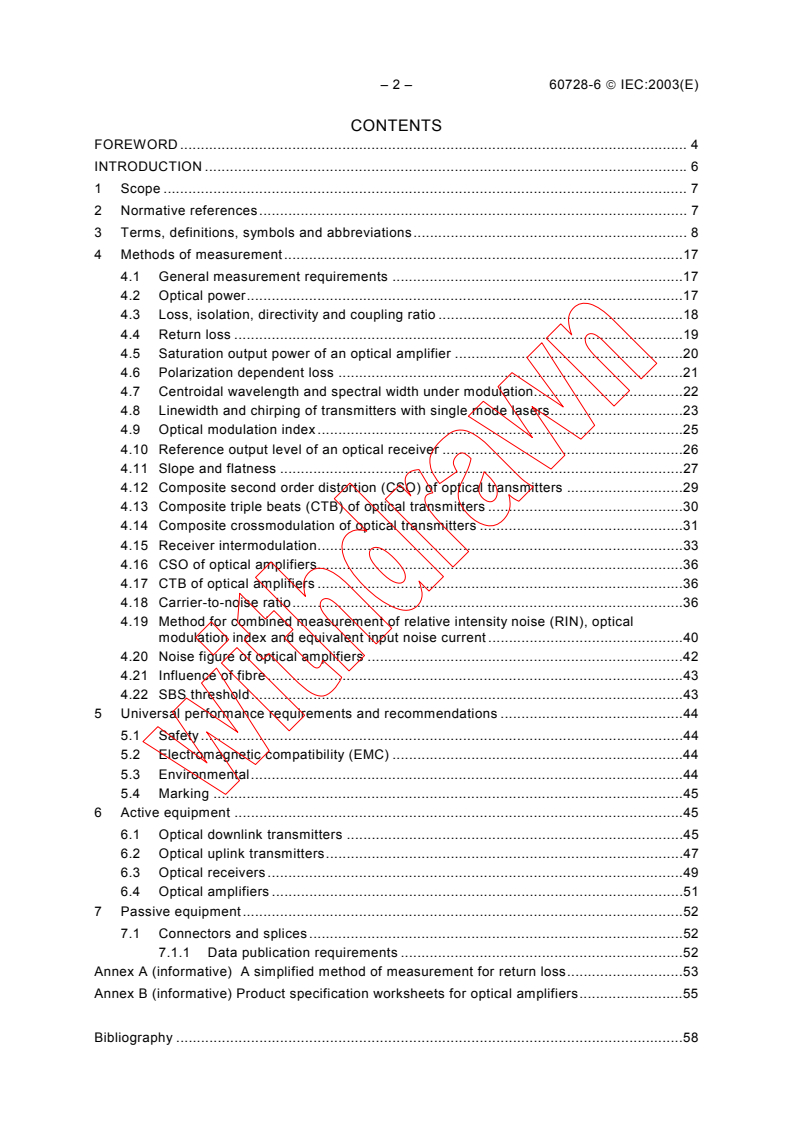
CONTENTS
FOREWORD . 4
INTRODUCTION .6
1 Scope . 7
2 Normative references. 7
3 Terms, definitions, symbols and abbreviations. 8
4 Methods of measurement.17
4.1 General measurement requirements .17
4.2 Optical power.17
4.3 Loss, isolation, directivity and coupling ratio .18
4.4 Return loss .19
4.5 Saturation output power of an optical amplifier .20
4.6 Polarization dependent loss .21
4.7 Centroidal wavelength and spectral width under modulation.22
4.8 Linewidth and chirping of transmitters with single mode lasers.23
4.9 Optical modulation index .25
4.10 Reference output level of an optical receiver .26
4.11 Slope and flatness .27
4.12 Composite second order distortion (CSO) of optical transmitters .29
4.13 Composite triple beats (CTB) of optical transmitters .30
4.14 Composite crossmodulation of optical transmitters .31
4.15 Receiver intermodulation.33
4.16 CSO of optical amplifiers.36
4.17 CTB of optical amplifiers .36
4.18 Carrier-to-noise ratio.36
4.19 Method for combined measurement of relative intensity noise (RIN), optical
modulation index and equivalent input noise current .40
4.20 Noise figure of optical amplifiers .42
4.21 Influence of fibre.43
4.22 SBS threshold.43
5 Universal performance requirements and recommendations .44
5.1 Safety.44
5.2 Electromagnetic compatibility (EMC) .44
5.3 Environmental.44
5.4 Marking .45
6 Active equipment .45
6.1 Optical downlink transmitters .45
6.2 Optical uplink transmitters.47
6.3 Optical receivers .49
6.4 Optical amplifiers .51
7 Passive equipment.52
7.1 Connectors and splices .52
7.1.1 Data publication requirements .52
Annex A (informative) A simplified method of measurement for return loss.53
Annex B (informative) Product specification worksheets for optical amplifiers.55
Bibliography .58
60728-6 IEC:2003(E) – 3 –
Figure 1 – Measurement of optical power.18
Figure 2 – Measurement of optical loss, directivity and isolation.19
Figure 3 – Measurement of the optical return loss.20
Figure 4 – Optical saturation output power .21
Figure 5 – Measurement of the polarization dependent loss .21
Figure 6 – Measurement of central wavelength and spectral width under modulation .22
Figure 7 – Measurement of the chirping and the linewidth of transmitters .24
Figure 8 – Measurement of the optical modulation index .26
Figure 9 – Measurement of the reference output level of an optical receiver .27
Figure 10 – Measurement of the frequency range and flatness.28
Figure 11 – Evaluation of the slope.28
Figure 12 – Evaluating the flatness .29
Figure 13 – Device under test for measuring CSO of optical transmitters .30
Figure 14 – Device under test for measuring CTB of optical transmitters .31
Figure 15 – Arrangement for measuring composite crossmodulation of optical transmitters .32
Figure 16 – Arrangement of test equipment for measuring receiver intermodulation.35
Figure 17 – System with internal noise sources.36
Figure 18 – PIN diode receiver .37
Figure 19 – Optical transmission system under test .38
Figure 20 – Arrangement of test equipment for carrier-to-noise measurement .38
Figure 21 – Measurement set-up for determination of the noise parameters and the
optical modulation index .42
Figure 22 – Arrangement for measuring the SBS threshold .44
Figure 23 – Classification of uplink transmitters .48
Figure A.1 – Test set-up for calibration .53
Figure A.2 – Measurement of the optical power of the light source .54
Figure A.3 – Test set-up for device under test.54
Figure A.4 – Measurement of the optical power at port A.54
Table 1 – Noise correction factors C for different noise level differences D.40
n
Table 2 – Data publication requirements for optical downlink transmitters .46
Table 3 – Recommendations for optical downlink transmitters.46
Table 4 – Requirements for optical downlink transmitters.47
Table 5 – Data publication requirements for optical uplink transmitters.48
Table 6 – Recommendations for optical uplink transmitters .49
Table 7 – Requirements for optical uplink transmitters .49
Table 8 – Classification of optical receivers .50
Table 9 – Data publication requirements for optical receivers .50
Table 10 – Recommendations for optical receivers .50
Table 11 – Performance requirements for optical receivers .51
Table B.1 – Minimum list of relevant parameters of power amplifiers to be specified for
analogue applications .55
Table B.2 – Minimum list of relevant parameters of line amplifiers to be specified for
analogue applications .56
Table B.3 – Minimum list of relevant parameters of optically amplified transmitters
(OAT) to be specified for analogue applications .57
– 4 – 60728-6 IEC:2003(E)
INTERNATIONAL ELECTROTECHNICAL COMMISSION
___________
CABLE NETWORKS FOR TELEVISION SIGNALS,
SOUND SIGNALS AND INTERACTIVE SERVICES –
Part 6: Optical equipment
FOREWORD
1) The International Electrotechnical Commission (IEC) is a worldwide organization for standardization comprising
all national electrotechnical committees (IEC National Committees). The object of IEC is to promote
international co-operation on all questions concerning standardization in the electrical and electronic fields. To
this end and in addition to other activities, IEC publishes International Standards, Technical Specifications,
Technical Reports, and Guides (hereafter referred to as “IEC Publication(s)”). Their preparation is entrusted to
technical committees; any IEC National Committee interested in the subject dealt with may participate in this
preparatory work. International, governmental and non-governmental organizations liaising with the IEC also
participate in this preparation. IEC collaborates closely with the International Organization for Standardization
(ISO) in accordance with conditions determined by agreement between the two organizations.
2) The formal decisions or agreements of IEC on technical matters express, as nearly as possible, an international
consensus of opinion on the relevant subjects since each technical committee has representation from all
interested IEC National Committees.
3) IEC Publications have the form of recommendations for international use and are accepted by IEC National
Committees in that sense. While all reasonable efforts are made to ensure that the technical content of IEC
Publications is accurate, IEC cannot be held responsible for the way in which they are used or for any
misinterpretation by any end user.
4) In order to promote international uniformity, IEC National Committees undertake to apply IEC Publications
transparently to the maximum extent possible in their national and regional publications. Any divergence
between any IEC Publication and the corresponding national or regional publication shall be clearly indicated in
the latter.
5) IEC provides no marking procedure to indicate its approval and cannot be rendered responsible for any
equipment declared to be in conformity with an IEC Publication.
6) All users should ensure that they have the latest edition of this publication.
7) No liability shall attach to IEC or its directors, employees, servants or agents including individual experts and
members of its technical committees and IEC National Committees for any personal injury, property damage or
other damage of any nature whatsoever, whether direct or indirect, or for costs (including legal fees) and
expenses arising out of the publication, use of, or reliance upon, this IEC Publication or any other IEC
Publications.
8) Attention is drawn to the Normative references cited in this publication. Use of the referenced publications is
indispensable for the correct application of this publication.
9) Attention is drawn to the possibility that some of the elements of this IEC Publication may be the subject of
patent rights. IEC shall not be held responsible for identifying any or all such patent rights.
International Standard IEC 60728-6 has been prepared by technical area 5: Cable networks for
television signals, sound signals and interactive services, of IEC technical committee 100:
Audio, video and multimedia systems and equipment.
This second edition cancels and replaces the first edition published in 2001 of which it
constitutes a technical revision.
The text of this standard is based on
FDIS Report on voting
100/680/FDIS 100/697/RVD
Full information on the voting for the approval of this standard can be found in the report on
voting indicated in the above table.
This publication has been drafted in accordance with the ISO/IEC Directives, Part 2.
60728-6 IEC:2003(E) – 5 –
The committee has decided that this publication remains valid until 2006. At this date, in
accordance with the committee’s decision, the publication will be:
• reconfirmed;
• withdrawn;
• replaced by a revised edition, or
• amended.
– 6 – 60728-6 IEC:2003(E)
INTRODUCTION
Standards of the IEC 60728 series deal with cable networks for television signals, sound
signals and interactive services including equipment, systems and installations:
• for headend-reception, processing and distribution of sound and television signals and their
associated data signals, and
• for processing, interfacing and transmitting all kinds of interactive multimedia signals using
all applicable transmission media.
They cover all kinds of networks that convey modulated RF carriers such as
• CATV-networks;
• MATV-networks and SMATV-networks;
• individual receiving networks;
and all kinds of equipment, systems and installations installed in such networks.
The scope of these standards extends from antennas and special signal source inputs to
headend or other interface points, to networks as a whole up through system outlets, or
terminal inputs where no system outlet exists.
The standardization of any user terminals (i.e. tuners, receivers, decoders, multimedia
terminals, etc.) is excluded.
60728-6 IEC:2003(E) – 7 –
CABLE NETWORKS FOR TELEVISION SIGNALS,
SOUND SIGNALS AND INTERACTIVE SERVICES –
Part 6: Optical equipment
1 Scope
This part of IEC 60728 lays down the measuring methods, performance requirements and data
publication requirements of optical equipment of cable networks for television signals, sound
signals and interactive services.
This standard
• applies to all optical transmitters, receivers, amplifiers, directional couplers, isolators,
multiplexing devices, connectors and splices used in cable networks;
• covers the frequency range 5 MHz to 3 000 MHz;
NOTE The upper limit of 3 000 MHz is an example, but not a strict value. The frequency range or ranges, over
which the equipment is specified, shall be published.
• identifies guaranteed performance requirements for certain parameters;
• lays down data publication requirements with guaranteed performance;
• describes methods of measurement for compliance testing.
All requirements and published data relate to minimum performance levels within the specified
frequency range and in well-matched conditions as might be applicable to cable networks for
television signals, sound signals and interactive services.
2 Normative references
The following referenced documents are indispensable for the application of this document. For
dated references, only the edition cited applies. For undated references, the latest edition of
the referenced document (including any amendments) applies.
IEC 60068-1, Environmental testing. Part 1: General and guidance
IEC 60068-2, (all parts), Environmental testing – Part 2: Tests
IEC 60169-2, Radio-frequency connectors – Part 2: Coaxial unmatched connector
IEC 60169-24, Radio-frequency connectors – Part 24: Radio-frequency coaxial connectors with
screw coupling, typically for use in 75 ohm cable distribution systems (Type F)
*
IEC 60417-DB:2002 , Graphical symbols for use on equipment
IEC 60529, Degrees of protection provided by enclosures (IP Code)
IEC 60617 (all parts) [DB]*, Graphical symbols for diagrams
___________
*
“DB” refers to the IEC on-line database.
– 8 – 60728-6 IEC:2003(E)
IEC 60728-1, Cabled distribution systems for television and sound signals – Part 1: Methods of
measurement and system performance
IEC 60728-2, Cabled distribution systems for television and sound signals – Part 2:
Electromagnetic compatibility of equipment
IEC 60728-3, Cabled distribution systems for television and sound signals – Part 3: Active
coaxial wideband distribution equipment
IEC 61280-2-2, Fibre optic communication subsystem basic test procedures – Part 2-2: Test
procedures for digital systems – Optical eye pattern, waveform, and extinction ratio
IEC 61280-4-2, Fibre optic communication subsystem basic test procedures – Part 4-2: Fibre
optic cable plant – Single-mode fibre optic cable plant attenuation
IEC 61282-4, Fibre optic communication system design guides – Part 4: Guideline to
accommodate and utilize nonlinear effects in single-mode fibre optic systems
IEC 61290-1-3, Optical fibre amplifiers – Basic specification – Part 1-3: Test methods for gain
parameters – Optical power meter
IEC 61290-3, Optical fibre amplifiers – Basic specification – Part 3-1: Test methods for noise
figure parameters
IEC 61290-3-2, Optical fibre amplifiers – Part 3-2: Test methods for noise figure parameters –
Electrical spectrum analyzer
IEC 61290-5, Optical fibre amplifiers – Basic specification – Part 5: Test methods for
reflectance parameters
IEC 61291-1, Optical fibre amplifiers – Part 1: Generic specification
IEC 61931, Fibre optics – Terminology
IEC 80416, Basic principles for graphical symbols for use on equipment
ITU G.692, Optical interfaces for multichannel systems with optical amplifiers
EN 300019-1-3, Environmental Engineering (EE); Environmental conditions and environmental
tests for telecommunications equipment; Part 1-3: Classification of environmental conditions;
Stationary use at weatherprotected locations
3 Terms, definitions, symbols and abbreviations
3.1 Terms and definitions
For the purposes of this document, the definitions given in IEC 60728-1, IEC 61931 and the
following terms and definitions apply.
3.1.1
optical transmitting unit; optical transmitter; Tx (abbreviation)
transmit fibre optic terminal device accepting at its input port an electrical signal and providing
at its output port an optical carrier modulated by that input signal
NOTE For the purposes of this standard, optical transmitters may have more than one input port accepting
electrical RF signals.
[IEC 61931, definition 2.9.6]
60728-6 IEC:2003(E) – 9 –
3.1.2
optical receiving unit; optical receiver; Rx (abbreviation)
receive fibre optic terminal device accepting at its input port a modulated optical carrier, and
providing at its output port the corresponding demodulated electrical signal (with the associated
clock, if digital)
NOTE For the purposes of this standard, optical receivers may have more than one output port providing electrical
RF signals.
[IEC 61931, definition 2.9.7]
3.1.3
optical amplifier
optical waveguide device containing a suitably pumped, active medium which is able to amplify
an optical signal
[IEC 61931, definition 2.7.75]
3.1.4
(optical) isolator
two port non-reciprocal optical device intended to suppress backward reflection, while having
minimum insertion loss in the forward direction, based on Faraday effect
NOTE 1 An isolator is commonly used to prevent return reflections along a transmission path.
NOTE 2 An isolator is generally polarization dependent; however fibre optic polarization independent isolators exist.
[IEC 61931, definition 2.6.30]
3.1.5
(optical (fibre)) splice
permanent, or semi permanent, joint whose purpose is to couple optical power between two
optical fibres
[IEV 731-05-05 modified]
[IEC 61931, definition 2.6.8]
3.1.6
fibre optic branching device; (optical) (fibre) branching device;
(optical) (fibre) coupler (deprecated)]
optical fibre device, possessing three or more optical ports, which shares optical power among
its ports in a predetermined fashion, at the same wavelength or wavelengths, without
wavelength conversion
NOTE The ports may be connected to fibres, sources, detectors, etc.
[IEC 61931, definition 2.6.21]
3.1.7
directional branching device; directional coupler (deprecated)
device which distributes an optical signal among the output ports in a predetermined fashion
only when light is launched into one preselected input port
[IEC 61931, definition 2.6.22]
NOTE For the purposes of this standard, directional coupler is the preferred term because this is also the term for
its electrical equivalent.
3.1.8
multiplexing device; WDM device
wavelength selective branching device (used in WDM transmission systems) in which optical
signals can be transferred between two predetermined ports, depending on the wavelength of
the signal
– 10 – 60728-6 IEC:2003(E)
[IEC 61931, definition 2.6.51]
3.1.9
reference output level of an optical receiver
offset x by which the electrical output level of an optical receiver can be calculated from the
optical input level at a modulation index of m = 0,05 using following equation:
(1)
U = 2 P + x dB(μV)
opt,RX
where
U
is the electrical output level in dB(μV)
is the optical input level in dB(mW)
P
opt,RX
x
is the reference output level in dB(μV)
3.1.10
optical modulation index
optical modulation index is defined as
-
φ φ
h l
m =
(2)
φ + φ
h l
where φ is the highest and φ is the lowest instantaneous optical power of the intensity
h l
modulated optical signal. This term is mainly used for analogue systems.
NOTE This definition does not apply to systems where the input signals are converted and transported as digital
baseband signals. In this case, the terms modulation depth or extinction ratio defined in 2.6.79 and 2.7.46 of
IEC 61931 must be used. A test procedure for extinction ratio is described in IEC 61280-2-2.
3.1.11
noise figure
decrease of the signal-to-noise ratio (SNR), at the output of an optical detector with unitary
quantum efficiency, due to the propagation of a shot noise-limited signal through the optical
amplifier (OFA), expressed in dB
[IEC 61291-1]
NOTE The noise figure of optical amplifiers depends on the optical input power and on the wavelength used.
60728-6 IEC:2003(E) – 11 –
3.1.12
relative intensity noise
RIN
ratio of the mean square of the intensity fluctuations in the optical power of a light source to the
−1
square of the mean of the optical output power. The RIN is usually expressed in dB(Hz )
resulting in negative values then
NOTE The value for the RIN can be calculated from the results of a carrier-to-noise measurement for the system
(see 4.18).
3.1.13
noise equivalent power
NEP
value of the radiant power at the input of an optical detector which produces at the output a
signal-to-noise ratio equal to one, for a given wavelength, modulation frequency and equivalent
noise bandwidth
[IEV 731-06-40]
[IEC 61931, definition 2.7.61]
NOTE The NEP can be calculated from the carrier-to-noise ratio C/N (see 4.18) of a receiver using:
− C / N
mP
(3)
NEP = 10
2B
where
m is the optical modulation index;
P is the received optical power;
B is the bandwidth.
The NEP shall be expressed in units of W/√Hz.
3.1.14
equivalent input noise current density
notional input noise current density which, when applied to the input of an ideal noiseless
device, would produce an output noise current density equal in value to that observed at the
output of the actual device under consideration
NOTE It can be calculated from the carrier-to-noise ratio C/N (see 4.18) of a device or system using:
C
=
I
r
(4)
C/N
Z
where
C is the power of the carrier at the input of the device or system;
Z is its input impedance.
The equivalent input noise current density shall be expressed in units of A/√Hz.
3.1.15
responsivity
ratio of an optical detector’s electrical output to its optical input at a given wavelength
[IEV 731-06-36 modified]
NOTE 1 The responsivity is generally expressed in amperes per watt or volts per watt of incident radiant power.
NOTE 2 Sensitivity is sometimes used as an imprecise synonym for responsivity.
NOTE 3 The wavelength interval around the given wavelength may be specified.
[IEC 61931, definition 2.7.56]
– 12 – 60728-6 IEC:2003(E)
3.1.16
chromatic dispersion; total dispersion (deprecated)
spreading of a light pulse per unit source spectrum width in an optical fibre caused by different
group velocities of the different wavelengths composing the source spectrum.
NOTE The chromatic dispersion may be due to the following contributions: material dispersion, waveguide
dispersion, profile dispersion.
[IEC 61931, definition 2.4.54]
3.1.17
wavelength
distance covered in a period by the wavefront of a harmonic plane wave.
[IEC 61931, definition 2.2.9]
NOTE The wavelength λ of light in vacuum is given by
c
λ =
(5)
f
where
c
is the speed of light in vacuum (c ≈ 2,99792 × 10 m/s);
f is the optical frequency.
Although the wavelength in dielectric material such as fibres is shorter than in vacuum, only the
wavelength of light in vacuum is used.
3.1.18
chirping
rapid change of the emission wavelengths of a directly intensity-modulated optical source as
a function of the intensity of the modulating signal
NOTE 1 Chirping should not be confused with long-term wavelength drift.
NOTE 2 Due to the fibre chromatic dispersion, using a single-mode laser, chirping can cause either degradation or
improvement of the total bandwidth.
[IEC 61931, definition 2.7.44]
3.1.19
polarization
orientation of the electric field vector of the electromagnetic radiation
[IEC 61931, definition 2.1.44]
3.1.20
linewidth
spectral bandwidth of an individual mode of a laser, defined as the difference between those
optical frequencies at which the amplitude reaches or first falls to half of the maximum
amplitude
3.1.21
coherence length
propagation distance over which propagating light may be considered to be coherent radiation
[IEV 731-01-17 modified]
NOTE The coherence length in a medium of refractive index n is approximately
λ /(n⋅Δλ)
60728-6 IEC:2003(E) – 13 –
where
λ is the central wavelength;
Δλ is the spectral linewidth of the source.
[IEC 61931, definition 2.1.67]
3.1.22
coherence time
time over which a propagating light may be considered to be coherent radiation
[IEV 731-01-18]
NOTE 1 The coherence time is equal to coherence length divided by the phase velocity of light in a medium.
NOTE 2 The coherence time is given approximately λ /(c⋅Δλ) where λ is the central wavelength, Δλ is the
0 0
spectral linewidth and c is the velocity of light in vacuum.
[IEC 61931, definition 2.1.68]
3.1.23
well-cleaved
well-cleaved end of fibre has a clean plane front perpendicular to the axis of the fibre
3.1.24
amplified spontaneous emission
ASE
optical power associated to spontaneously emitted photons amplified by an active medium in
an optical amplifier
[IEC 61931, definition 2.7.87]
3.1.25
directivity
in a generic optical branching device, measure of the undesired transfer of a portion of optical
power from one input port, when all other ports are optically matched for zero reflection
[IEC 61931, definition 2.6.50]
3.1.26
central wavelength
the average of those wavelengths at which the amplitude of a light source reaches or last falls
to half of the maximum amplitude
3.1.27
spectral width
measure of the wavelength range of a spectrum or spectral characteristic
[IEV 731-06-24 modified]
[IEC 61931, definition 2.7.42]
3.1.28
(stimulated) Brillouin scattering
SBS
non-linear scattering of optical radiation characterized by a frequency shift as for the Raman
scattering, but accompanied by a lower frequency (acoustical) vibration of the medium lattice.
The light is scattered backward with respect to the incident radiation
NOTE In silica fibres the frequency shift is typically around 10 GHz.
[IEC 61931, definition 2.1.88]
– 14 – 60728-6 IEC:2003(E)
3.1.29
saturation output power (gain compression power)
optical power level associated with the output signal above which the gain is reduced by N dB
(typically N=3) with respect to the small-signal gain at the signal wavelength.
NOTE The wavelength at which the parameter is specified shall be stated.
[IEC 61291-1, definition 3.1.11]
3.1.30
optical return loss; return loss; ORL (abbreviation)
ratio, expressed in dB, of the total reflected power to the incident power from an optical fibre,
optical device, or optical system, and defined as:
P
r
−10lg
P
i
where
P is the reflected power;
r
is the incident power.
P
i
NOTE 1 When referring to a reflected power from an individual component, reflectance is the preferred term.
[IEC 61931, definition 2.6.49]
NOTE 2 For the purposes of this standard, the term reflectance is used for optical amplifiers only. The term optical
return loss is used for ports of all other types of equipment.
NOTE 3 The term return loss is also used for electrical ports. The definition relates to electrical powers in this
case.
3.1.31
cladding mode
mode in which the electromagnetic field is confined in the cladding and the core by virtue of
there being a lower refractive index medium surrounding the outermost cladding
[IEV 731-03-60]
[IEC 61931, definition 2.4.10]
3.1.32
slope
gain or attenuation difference at two defined frequencies between any two ports of a device or
system
3.1.33
flatness
difference between the maximum and the minimum gain or attenuation reduced by the slope
within the specified modulation frequency range of a device or system
3.1.34
small-signal gain
gain of an optical amplifier operated in its linear region where this gain is independent from the
optical input power
NOTE This parameter can be given for a single wavelength or as a function of the wavelength.
3.1.35
polarization dependent loss
maximum change in insertion loss for all states of input polarization
60728-6 IEC:2003(E) – 15 –
3.1.36
centroidal wavelength
mean or average wavelength of an optical spectrum
3.2 Symbols
The following graphical symbols are used in the figures of this standard. These symbols are
either listed in IEC 60617 or based on symbols defined in IEC 60617.
O
E
Optical transmitter Optical receiver
[S00213] [S00213]
E
O
Optical amplifier Optical fibre
[S00127, S01239] [S01318]
Isolator Coupler
[S01175] [S00059, S01188]
Directional coupler Delay line
[S00059, S01193] [S00608]
τ
Polarisation control device Low-pass filter
[S001430, proposed] [S01248]
Bandpass filter Variable attenuator
A
[S01249] [S01245]
G G
Pulse generator Sine-wave generator
[S01228] [S00899, S01403]
G Voltmeter
Bit pattern generator V
[S00059, S00913]
Ammeter Power meter
A
P
[S00059, S00910] [S00059, S00910]
Selective voltmeter
Oscilloscope
[S00059, S00081,
[S00059, S00922] V
S00913, S01249]
Electrical spectrum analyzer Optical spectrum analyzer
P(f)
P( )
λ
[S00059, S00910] [S00059, S00910]
– 16 – 60728-6 IEC:2003(E)
RF choke Resistor
[S00583] [S00555]
Capacitor DC power supply
[S00567] [S00206]
Amplifier Photodiode with fibre pigtail
[S01239] [S01327]
Ground
[S01410]
3.3 Abbreviations
The following abbreviations are used in this standard:
AC alternating current
AGC automatic gain control
ALC automatic level control
ASE amplified spontaneous emission
CATV community antenna television (network)
C/N carrier-to-noise ratio
CSO composite second order
CTB composite triple beat
CW continuous wave
DC direct current
EMC electromagnetic compatibility
IF intermediate frequency
MATV master antenna television (network)
MTBF mean time between failure
NEP noise equivalent power
NF noise figure
PDL polarization dependent loss
PRBS pseudo random bit sequence
RF radio frequency
RIN relative intensity noise
SMATV satellite master antenna television (network)
WDM wavelength division multiplexing
XM composite crossmodulation
60728-6 IEC:2003(E) – 17 –
4 Methods of measurement
4.1 General measurement requirements
For all methods of measurements described in this clause the following requirements shall be
considered.
4.1.1 Input specification
The following conditions shall be obtained from the device specification:
• supply voltage(s);
• control signal(s), if any, with correct impedance, level and frequency.
4.1.2 Measurement conditions
Unless otherwise specified, all measurement shall be carried out under following conditions:
• the ambient or reference point temperature shall be 25 °C ± 5 °C;
• the ambient humidity shall be in the range 40 % to 70 %;
• sufficient care shall be taken to ensure that optical reflection does not impair the accuracy
of the measurement;
• during measurement any control input signal(s) shall be held constant.
• test fibres shall have clean and unscratched ends in order to prevent losses of power and
reflections.
4.2 Optical power
4.2.1 Purpose
The purpose of this test method is to measure the total average optical power emanating from
the end of a test fibre. The test fibre and the coupling means shall be as specified by the
manufacturer. The optical power shall be expressed in dB(mW).
4.2.2 Equipment required
a) An optical power meter with a range suitable for the expected power. The detector system
of the power meter shall have a sufficiently large area to collect all the radiation from the
test fibre and a spectral sensitivity compatible with the light source. A minimum accuracy of
±10 % is recommended.
b) A length of fibre for connecting the light source to the power meter.
c) A cladding mode stripper if the fibre has no cladding mode stripping coating.
d) Test signal generator(s).
4.2.3 General measurement requirements
a) The transmitter shall be modulated with at least one modulation carrier at the specified
optical modulation index.
b) Cladding modes shall be stripped from the fibre by means of suitable cladding mode
stripping techniques.
– 18 – 60728-6 IEC:2003(E)
4.2.4 Procedure
a) Set the supply voltage(s) and any control input signal(s) to the specified value(s).
b) Connect the equipment as shown in Figure 1.
Test fibre
G E
P
O
Cladding
mode
stripper
IEC 2004/03
Figure 1 – Measurement of optical power
c) Connect the optical output of the device under test to the detector (a power meter) through
the test fibre and the specified coupling means.
d) Measure and record the output power using the power meter.
4.2.5 Potential sources of error
Such sources of error are the following:
• the inaccuracy of the power meter, for example if its dark current is not sufficiently low;
• the attenuation of the test fibre and the specified coupling means.
4.3 Loss, isolation, directivity and coupling ratio
The measurement of the following parameters is based on the measurement of optical power,
and therefore no special methods of measurement are given for these items:
• loss of fibres, connectors, and optical isolators;
• isolation of optical isolators.
NOTE Methods of measurement for the attenuation of fibre optic plants are described in IEC 61280-4-2. A method
for measurement of the gain of optical amplifiers is described in IEC 61290-1.
4.3.1 General measurement requirements
The equipment under test shall be tested with a light source suitable for the specified
wavelength range.
All optical inputs or outputs not involved during the measurement shall be terminated to make
sure that no reflected light can impair the accuracy of the measurement.
4.3.2 Principle of measurement
a) Connect the light source to the power meter and measure the optical output power P of
the light source (see 4.2).
b) Connect the device under test to the light source and the optical power meter as shown in
Figure 2 and measure the power P .
60728-6 IEC:2003(E) – 19 –
Terminator
Device
E
under Terminator
test
O
P
IEC 2005/03
Figure 2 – Measurement of optical loss, directivity and isolation
c) The loss, directivity or isolation is calculated by
P
a = 10 ⋅ lg (6)
P
4.4 Return loss
4.4.1 Purpose
In general, the return loss is the ratio of the incident optical power P to the reflected optical
in
power P , expressed in dB. The purpose of this test is to measure the return loss of an
back
optical equipment. For optical fibre amplifiers, the term reflectance is used which is the
reciprocal of the return loss (see IEC 61291-1). Methods of measurement for the reflectance of
optical fibre amplifiers are specified in IEC 61290-5.
NOTE A simpler method with reduced accuracy is given in Annex A.
4.4.2 Equipment required
a) A fused fibre coupler with a directivity higher than the return loss to be measured.
b) A continuous light source.
c) An optical power meter with a dynamic range higher than the return loss to be measured.
d) Lengths of fibre for connecting the optical equipment.
e) Two optical terminators with reflection ideally 20 dB better than the return loss to be
measured.
f) A reference reflector, which provides a well-known return loss a .
ref
4.4.3 General measurement requirements
The length of the fibre for connecting the light source to the coupler shall be longer than the
coherence length of the light source.
4.4.4 Procedure
a) Set the supply voltage(s) and any control input signal(s) to the specified value(s).
b) Connect the equipment as shown in Figure 3.
– 20 – 60728-6 IEC:2003(E)
E
O
Terminator
Reference
reflector
A
Terminator
P
Device
under
test
IEC 2006/03
Figure 3 – Measurement of the optical return loss
c) Connect the reference reflector with the known return loss to port A of the coupler and note
the reading P of the power meter.
d) Connect the second terminator to port A of the coupler and note the reading P of the
power meter.
e) Connect the device under test to port A of the coupler and note the reading P of the power
meter. If the device under test has more than one optical port, the other ports shall be
terminated with low reflection.
f) The return loss of the device shall be calculated from:
−
P P
1 2
= a +10lg (dB)
a (7)
r ref
−
P3 P2
4.4.5 Potential sources of error
Such sources of error are the following:
• the return loss of the connection at port A shall be at least as high as the return loss of the
device under test. Otherwise, the dynamic range of the measurement will suffer;
• if the impedance matching of the terminators produces a reflection which is not much less
than the reflection of the device under test, the accuracy will suffer;
• the instability of the light source;
• the inaccuracy of the power meter;
• any polarization dependent loss (PDL) of the equipment used. The method of 4.6 can be
used in order to measure the influence of polarization on the result.
4.5 Saturation output power of an optical amplifier
4.5.1 Purpose
The purpose of this test method is to measure the mean optical output power of a test fibre
whose far end is connected to the optical output port of a saturated optical amplifier. The
saturation output power shall be expressed in dB(mW).
4.5.2 Procedure
The gain G of the optical amplifier shall be measured as a function of the optical input power
according to IEC 61290-1-3. Plot the gain versus optical input power resulting in a curve shown
in Figure 4. At low input levels the small-signal gain is constant. At higher input levels the gain
decreases. The saturation output power is reached when the gain lags N dB (if no other value
is stated, N shoul
...