

IEC 60068-3-4:2023
(Main)Environmental testing - Part 3-4: Supporting documentation and guidance - Damp heat tests
General Information
- Abstract
IEC 60068-3-4:2023 provides the necessary information and the basic principles of the effect of humidity in the context of environmental testing to assist in preparing relevant specifications, such as standards for components or equipment. Furthermore, information is provided on operating climatic test chambers. This second edition cancels and replaces the first edition published in 2001. This edition constitutes a technical revision. This edition includes the following significant technical changes with respect to the previous edition:
a) the requirements for distilled and deionized water have been revised;
b) recommendations for the cleaning procedure of test chambers have been included;
c) humidification systems (ultrasonic humidifiers and atomizers) have been added;
d) the description of water penetration mechanisms has been refined.
- Status
- Published
- Publication Date
- 28-Jun-2023
- Technical Committee
- TC 104 - Environmental conditions, classification and methods of test
- Drafting Committee
- MT 16 - TC 104/MT 16
- Current Stage
- PPUB - Publication issued
- Start Date
- 29-Jun-2023
- Completion Date
- 14-Jul-2023
Buy Documents
IEC 60068-3-4:2023 RLV - Environmental testing - Part 3-4: Supporting documentation and guidance - Damp heat tests Released:6/29/2023
IEC 60068-3-4:2023 - Environmental testing - Part 3-4: Supporting documentation and guidance - Damp heat tests Released:6/29/2023
Overview - IEC 60068-3-4:2023 (Damp heat tests)
IEC 60068-3-4:2023 is the second edition of the IEC guidance document on damp heat tests within the IEC 60068 environmental testing series. It provides supporting documentation and basic principles on the effects of humidity for use when preparing specifications, selecting appropriate damp heat tests and operating climatic test chambers. This 2023 revision replaces the 2001 edition and includes updated guidance on water quality, test-chamber cleaning, humidification systems and refined descriptions of water penetration mechanisms.
Key topics and technical requirements
- Scope and purpose: Guidance to help select test types and severities for product qualification against high relative humidity and condensation.
- Humidity production and control: Overview of different methods (spraying/injection, steam, saturation, surface evaporation) and control strategies used in climatic test chambers.
- Water quality: Requirement to use distilled or deionized water with pH between 6.0 and 7.2 and minimum resistivity of 0.05 MΩ·cm for humidification systems.
- Humidification systems: Added advice on modern systems including ultrasonic humidifiers and atomizers.
- Chamber hygiene: New recommendations for cleaning procedures and maintenance of internal chamber parts to avoid contamination and test artefacts.
- Physical effects of humidity: Definitions and behaviour of condensation, adsorption, absorption, diffusion and “breathing” (air exchange in hollow spaces).
- Water penetration mechanisms: Refined descriptions explaining how moisture penetrates materials and assemblies.
- Test types & acceleration: Comparison of steady‑state (Test C) and cyclic (Test Db) damp heat tests, acceleration factors and guidance on composite sequences.
- Effects on specimens: How humidity can alter electrical and mechanical characteristics, and contribute to corrosion.
Practical applications - who uses this standard
IEC 60068-3-4:2023 is intended for:
- Test laboratories operating environmental and climatic test chambers
- Product and reliability engineers specifying damp heat tests for qualification
- Standards writers and procurement teams developing component or equipment specifications
- Design and QA teams assessing risks from condensation and moisture ingress
- Manufacturers of climatic chambers and humidification systems
Practical uses include selecting appropriate test severities, defining chamber operating procedures, establishing water quality and cleaning regimes, and interpreting humidity-related failure modes during qualification testing.
Related standards
- IEC 60068 series - broader environmental testing methods and procedures
- Other parts of IEC 60068 (e.g., damp heat test procedures in the -2 series) for specific test methods and normative requirements
Keywords: IEC 60068-3-4, damp heat tests, environmental testing, humidity control, climatic test chambers, condensation, deionized water, humidification systems, water penetration, accelerated testing.
Relations
- Effective Date
- 09-Feb-2026
- Effective Date
- 05-Sep-2023
Buy Documents
IEC 60068-3-4:2023 RLV - Environmental testing - Part 3-4: Supporting documentation and guidance - Damp heat tests Released:6/29/2023
IEC 60068-3-4:2023 - Environmental testing - Part 3-4: Supporting documentation and guidance - Damp heat tests Released:6/29/2023
Get Certified
Connect with accredited certification bodies for this standard

IMQ S.p.A. (Certification)
Italian electrical product certification.

SLG Prüf- und Zertifizierungs GmbH
German testing and certification body.

UL Solutions
Global safety science company with testing, inspection and certification.
Sponsored listings
Frequently Asked Questions
IEC 60068-3-4:2023 is a standard published by the International Electrotechnical Commission (IEC). Its full title is "Environmental testing - Part 3-4: Supporting documentation and guidance - Damp heat tests". This standard covers: IEC 60068-3-4:2023 provides the necessary information and the basic principles of the effect of humidity in the context of environmental testing to assist in preparing relevant specifications, such as standards for components or equipment. Furthermore, information is provided on operating climatic test chambers. This second edition cancels and replaces the first edition published in 2001. This edition constitutes a technical revision. This edition includes the following significant technical changes with respect to the previous edition: a) the requirements for distilled and deionized water have been revised; b) recommendations for the cleaning procedure of test chambers have been included; c) humidification systems (ultrasonic humidifiers and atomizers) have been added; d) the description of water penetration mechanisms has been refined.
IEC 60068-3-4:2023 provides the necessary information and the basic principles of the effect of humidity in the context of environmental testing to assist in preparing relevant specifications, such as standards for components or equipment. Furthermore, information is provided on operating climatic test chambers. This second edition cancels and replaces the first edition published in 2001. This edition constitutes a technical revision. This edition includes the following significant technical changes with respect to the previous edition: a) the requirements for distilled and deionized water have been revised; b) recommendations for the cleaning procedure of test chambers have been included; c) humidification systems (ultrasonic humidifiers and atomizers) have been added; d) the description of water penetration mechanisms has been refined.
IEC 60068-3-4:2023 is classified under the following ICS (International Classification for Standards) categories: 19.040 - Environmental testing; 29.020 - Electrical engineering in general. The ICS classification helps identify the subject area and facilitates finding related standards.
IEC 60068-3-4:2023 has the following relationships with other standards: It is inter standard links to EN ISO 4064-2:2025, IEC 60068-3-4:2001. Understanding these relationships helps ensure you are using the most current and applicable version of the standard.
IEC 60068-3-4:2023 is available in PDF format for immediate download after purchase. The document can be added to your cart and obtained through the secure checkout process. Digital delivery ensures instant access to the complete standard document.
Standards Content (Sample)
IEC 60068-3-4 ®
Edition 2.0 2023-06
REDLINE VERSION
INTERNATIONAL
STANDARD
colour
inside
Environmental testing –
Part 3-4: Supporting documentation and guidance – Damp heat tests
All rights reserved. Unless otherwise specified, no part of this publication may be reproduced or utilized in any form
or by any means, electronic or mechanical, including photocopying and microfilm, without permission in writing from
either IEC or IEC's member National Committee in the country of the requester. If you have any questions about IEC
copyright or have an enquiry about obtaining additional rights to this publication, please contact the address below or
your local IEC member National Committee for further information.
IEC Secretariat Tel.: +41 22 919 02 11
3, rue de Varembé info@iec.ch
CH-1211 Geneva 20 www.iec.ch
Switzerland
About the IEC
The International Electrotechnical Commission (IEC) is the leading global organization that prepares and publishes
International Standards for all electrical, electronic and related technologies.
About IEC publications
The technical content of IEC publications is kept under constant review by the IEC. Please make sure that you have the
latest edition, a corrigendum or an amendment might have been published.
IEC publications search - webstore.iec.ch/advsearchform IEC Products & Services Portal - products.iec.ch
The advanced search enables to find IEC publications by a Discover our powerful search engine and read freely all the
variety of criteria (reference number, text, technical publications previews. With a subscription you will always have
committee, …). It also gives information on projects, replaced access to up to date content tailored to your needs.
and withdrawn publications.
Electropedia - www.electropedia.org
IEC Just Published - webstore.iec.ch/justpublished
The world's leading online dictionary on electrotechnology,
Stay up to date on all new IEC publications. Just Published
containing more than 22 300 terminological entries in English
details all new publications released. Available online and once
and French, with equivalent terms in 19 additional languages.
a month by email.
Also known as the International Electrotechnical Vocabulary
(IEV) online.
IEC Customer Service Centre - webstore.iec.ch/csc
If you wish to give us your feedback on this publication or need
further assistance, please contact the Customer Service
Centre: sales@iec.ch.
IEC 60068-3-4 ®
Edition 2.0 2023-06
REDLINE VERSION
INTERNATIONAL
STANDARD
colour
inside
Environmental testing –
Part 3-4: Supporting documentation and guidance – Damp heat tests
INTERNATIONAL
ELECTROTECHNICAL
COMMISSION
ICS 00.000 ISBN 978-2-8322-7183-4
– 2 – IEC 60068-3-4:2023 RLV © IEC 2023
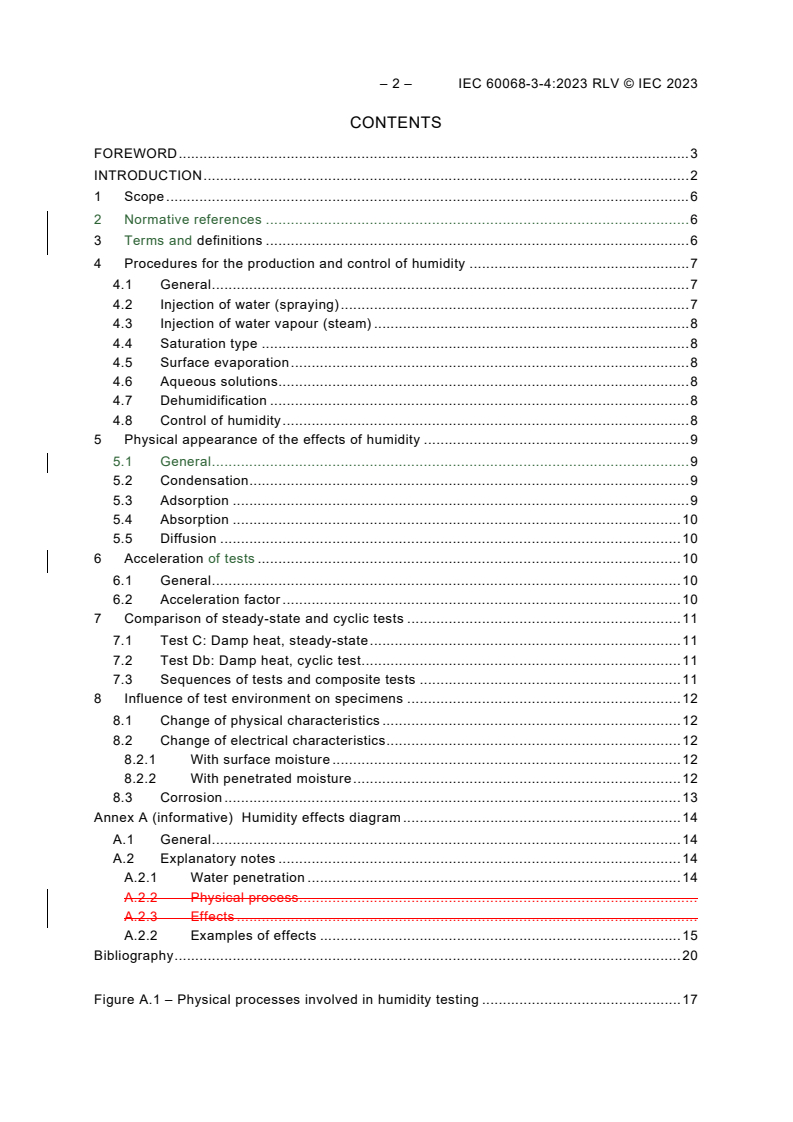
CONTENTS
FOREWORD . 3
INTRODUCTION . 2
1 Scope . 6
2 Normative references . 6
3 Terms and definitions . 6
4 Procedures for the production and control of humidity . 7
4.1 General . 7
4.2 Injection of water (spraying) . 7
4.3 Injection of water vapour (steam) . 8
4.4 Saturation type . 8
4.5 Surface evaporation . 8
4.6 Aqueous solutions. 8
4.7 Dehumidification . 8
4.8 Control of humidity . 8
5 Physical appearance of the effects of humidity . 9
5.1 General . 9
5.2 Condensation . 9
5.3 Adsorption . 9
5.4 Absorption . 10
5.5 Diffusion . 10
6 Acceleration of tests . 10
6.1 General . 10
6.2 Acceleration factor . 10
7 Comparison of steady-state and cyclic tests . 11
7.1 Test C: Damp heat, steady-state . 11
7.2 Test Db: Damp heat, cyclic test . 11
7.3 Sequences of tests and composite tests . 11
8 Influence of test environment on specimens . 12
8.1 Change of physical characteristics . 12
8.2 Change of electrical characteristics . 12
8.2.1 With surface moisture . 12
8.2.2 With penetrated moisture . 12
8.3 Corrosion . 13
Annex A (informative) Humidity effects diagram . 14
A.1 General . 14
A.2 Explanatory notes . 14
A.2.1 Water penetration . 14
A.2.2 Physical process.
A.2.3 Effects .
A.2.2 Examples of effects . 15
Bibliography . 20
Figure A.1 – Physical processes involved in humidity testing . 17
INTERNATIONAL ELECTROTECHNICAL COMMISSION
____________
ENVIRONMENTAL TESTING –
Part 3-4: Supporting documentation and guidance – Damp heat tests
FOREWORD
1) The International Electrotechnical Commission (IEC) is a worldwide organization for standardization comprising
all national electrotechnical committees (IEC National Committees). The object of IEC is to promote international
co-operation on all questions concerning standardization in the electrical and electronic fields. To this end and
in addition to other activities, IEC publishes International Standards, Technical Specifications, Technical Reports,
Publicly Available Specifications (PAS) and Guides (hereafter referred to as "IEC Publication(s)"). Their
preparation is entrusted to technical committees; any IEC National Committee interested in the subject dealt with
can participate in this preparatory work. International, governmental and non-governmental organizations liaising
with the IEC also participate in this preparation. IEC collaborates closely with the International Organization for
Standardization (ISO) in accordance with conditions determined by agreement between the two organizations.
2) The formal decisions or agreements of IEC on technical matters express, as nearly as possible, an international
consensus of opinion on the relevant subjects since each technical committee has representation from all
interested IEC National Committees.
3) IEC Publications have the form of recommendations for international use and are accepted by IEC National
Committees in that sense. While all reasonable efforts are made to ensure that the technical content of IEC
Publications is accurate, IEC cannot be held responsible for the way in which they are used or for any
misinterpretation by any end user.
4) In order to promote international uniformity, IEC National Committees undertake to apply IEC Publications
transparently to the maximum extent possible in their national and regional publications. Any divergence between
any IEC Publication and the corresponding national or regional publication shall be clearly indicated in the latter.
5) IEC itself does not provide any attestation of conformity. Independent certification bodies provide conformity
assessment services and, in some areas, access to IEC marks of conformity. IEC is not responsible for any
services carried out by independent certification bodies.
6) All users should ensure that they have the latest edition of this publication.
7) No liability shall attach to IEC or its directors, employees, servants or agents including individual experts and
members of its technical committees and IEC National Committees for any personal injury, property damage or
other damage of any nature whatsoever, whether direct or indirect, or for costs (including legal fees) and
expenses arising out of the publication, use of, or reliance upon, this IEC Publication or any other IEC
Publications.
8) Attention is drawn to the Normative references cited in this publication. Use of the referenced publications is
indispensable for the correct application of this publication.
9) Attention is drawn to the possibility that some of the elements of this IEC Publication can be the subject of patent
rights. IEC shall not be held responsible for identifying any or all such patent rights.
This redline version of the official IEC Standard allows the user to identify the changes
made to the previous edition IEC 60068-3-4:2001. A vertical bar appears in the margin
wherever a change has been made. Additions are in green text, deletions are in
strikethrough red text.
– 4 – IEC 60068-3-4:2023 RLV © IEC 2023
IEC 60068-3-4 has been prepared by IEC technical committee 104: Environmental conditions,
classification and methods of test. It is an International Standard.
This second edition cancels and replaces the first edition published in 2001. This edition
constitutes a technical revision.
This edition includes the following significant technical changes with respect to the previous
edition:
a) the requirements for distilled and deionized water have been revised;
b) recommendations for the cleaning procedure of test chambers have been included;
c) humidification systems (ultrasonic humidifiers and atomizers) have been added;
d) the description of water penetration mechanisms has been refined.
The text of this International Standard is based on the following documents:
Draft Report on voting
104/985/FDIS 104/1001/RVD
Full information on the voting for its approval can be found in the report on voting indicated in
the above table.
The language used for the development of this International Standard is English.
This document was drafted in accordance with ISO/IEC Directives, Part 2, and developed in
accordance with ISO/IEC Directives, Part 1 and ISO/IEC Directives, IEC Supplement, available
at www.iec.ch/members_experts/refdocs. The main document types developed by IEC are
described in greater detail at www.iec.ch/publications.
A list of all parts in the IEC 60068 series, published under the general title Environmental
testing, can be found on the IEC website.
The committee has decided that the contents of this document will remain unchanged until the
stability date indicated on the IEC website under webstore.iec.ch in the data related to the
specific document. At this date, the document will be
• reconfirmed,
• withdrawn,
• replaced by a revised edition, or
• amended.
IMPORTANT – The "colour inside" logo on the cover page of this document indicates that it
contains colours which are considered to be useful for the correct understanding of its
contents. Users should therefore print this document using a colour printer.
INTRODUCTION
Temperature and relative humidity (RH) of the air, in varying combinations, are climatic factors
which act upon a product during storage, transportation and operation.
Meteorological measurements made over many years have shown that a relative
humidity > 95 % combined with a temperature > 30 °C does not occur in free-air conditions over
long periods, except in regions with extreme climates. In dwelling rooms and workshops
temperatures of > 30 °C may can occur but in most cases are combined with a lower relative
humidity than in the open air.
Special conditions exist in certain wet rooms, for example in the chemical industry, metallurgical
plants, mines, electroplating plants and laundries, where the temperature can reach 45 °C
combined with a relative humidity up to saturation over long periods.
Certain equipment placed under particular conditions may can be subjected to a relative
humidity of more than 95 % at higher temperatures. This may can happen when the equipment
is placed in enclosures, such as vehicles, tents or aircraft cockpits, since this can result in
intense heating through solar radiation while, because of inadequate ventilation, any humidity
that may can be developed will be retained permanently within the interior.
In rooms having several heat sources, temperatures and relative humidity may can vary in
different parts of the room.
To take these climatic factors over the lifetime of the product into account, environmental testing
includes the practice of accelerated testing (see Clause 6).
Atmospheric pollution can intensify the effects of a damp climate on products. Attention is drawn
to this fact because of its general importance, although pollutants are not contained in the
atmospheres used for damp heat testing. If the effects of pollutants, for example corrosion and
mould growth, are to be investigated, a suitable test from the IEC 60068-2 series should be
used.
– 6 – IEC 60068-3-4:2023 RLV © IEC 2023
ENVIRONMENTAL TESTING –
Part 3-4: Supporting documentation and guidance – Damp heat tests
1 Scope
This part of IEC 60068 provides the necessary information and the basic principles of the effect
of humidity in the context of environmental testing to assist in preparing relevant specifications,
such as standards for components or equipment, in order to select appropriate tests and test
severities for specific products and, in some cases, specific types of application. Furthermore,
information is provided on operating climatic test chambers.
The object of this document is to present supporting documentation and guidance for a range
of damp heat tests which, when specified by the relevant specification, can be applied to
demonstrate the performance of equipment for which damp heat testing is required with the
main aim of achieving qualification. This information and basic principles are intended to help
selecting appropriate tests and test severities for specific products and, in some cases, specific
types of application.
The object of damp heat tests is to determine the ability of products to withstand the stresses
occurring in a high relative humidity environment, with or without condensation, and with special
regard to variations of electrical and mechanical characteristics. Damp heat tests may can also
be utilized to check the resistance of a specimen to some forms of corrosion attack.
2 Normative references
There are no normative references in this document.
3 Terms and definitions
For the purposes of this document, the following terms and definitions apply.
ISO and IEC maintain terminology databases for use in standardization at the following
addresses:
• IEC Electropedia: available at https://www.electropedia.org/
• ISO Online browsing platform: available at https://www.iso.org/obp
NOTE A more detailed explanation of some phenomena is available in A.2.1.
3.1
condensation
precipitation of water vapour on a surface when the surface temperature is lower than the dew
point temperature of the ambient air whereby water is transformed from vapour to the liquid
state of aggregation
3.2
adsorption
adherence of water vapour molecules to a surface when the surface temperature is higher than
the dew point temperature
3.3
absorption
accumulation of water molecules within a material
3.4
diffusion
transportation of water molecules through a material, produced induced by a partial pressure
difference
Note 1 to entry: Diffusion results in a balance of partial pressures, whilst flow (such as through leaks, when the
dimensions of such leaks are great enough to provide viscous or laminar flow) always finally results in the balance
of the total pressures.
3.5
breathing
exchange of air between a hollow space and its surroundings, produced induced by changes of
temperature or pressure
4 Procedures for the production and control of humidity
4.1 General
There are a great number of humidity test chambers available, equipped with different methods
of humidity generation and of humidity control.
Distilled or deionized water should be used. The water should have a pH value between 6,0
and 7,2 and a minimum resistivity of 0,05 MΩ.cm.
All internal parts of the chamber should be maintained in a clean condition.
In the following subclauses, only the principal methods of generation of humidity are mentioned.
The water resistivity should be between 2 000 Ωm to 500 Ωm corresponding to a conductivity
between 5 µS/cm to 20 µS/cm at +23 °C. Before the water is placed in the humidifier or storage
tank of the chamber, all internal parts of the chamber should be cleaned.
NOTE 1 A conductivity lower than 5 µS/cm can harm the humidifier system. A conductivity higher than 20 µS/cm
can cause limescale or other mineral deposits to form on parts of the humidifier system or specimen.
The chamber and its internal parts can be cleaned using diluted laboratory cleaning agent and
a soft brush and rinsed with distilled or deionized water. It is recommended that the chamber is
cleaned prior to each test. The test facility should be operated in a clean area.
NOTE 2 Chamber sensors can be affected by the cleaning procedure, as some sensors (e.g. capacitive humidity
sensors) can be damaged by some cleaning agents.
NOTE 3 During cleaning, wearing gloves and a protective mask can be helpful as a precaution against the
contamination of the test chamber and of the internal fixtures.
4.2 Injection of water (spraying)
Water is atomized to very fine particles or droplets.
The spray produced in this way moistens the air stream before it enters the working space, the
greater part of the droplets evaporating on the way. Small droplets of water may can remain in
the airflow.
Direct water injection into the working space must should be avoided, otherwise liquid water
can accumulate on the test specimen.
– 8 – IEC 60068-3-4:2023 RLV © IEC 2023
These simple systems provide rapid humidification and require little maintenance. Examples of
such humidification systems are ultrasonic humidifiers and atomization by means of a nozzle
(one- and two-substance nozzles).
4.3 Injection of water vapour (steam)
Evaporated water (steam) is blown into the working space of the chamber.
This system gives rapid humidification and is easier maintained to maintain (steam valve).
However, the resultant heat input may can necessitate additional cooling with possible
dehumidification effects.
4.4 Saturation type
Air is blown through a vessel containing water, thus becoming saturated with vapour.
At a fixed airflow, the humidity is controlled by changing the water temperature. If an increase
of humidification is produced by increasing the water temperature, this may can cause a
temperature rise in the working space and, owing to the thermal capacity of the water, the
response time may can be longer. This may can necessitate additional cooling with possible
de-humidification effects.
If bubbles occur, they may can produce a small amount of spray when bursting.
4.5 Surface evaporation
The air is humidified by passing it over a large surface area of water. Different methods are
used, for example repeated airflow over standing water or water-jet scrubbing over a vertical
surface with the air stream in counter current. In this system, the spray is minimized. The
humidity is controlled by changing the water temperature. Owing to the thermal capacity of the
water, the response time may can be longer.
4.6 Aqueous solutions
Relative humidity is generated over standardized aqueous solutions of salts in small, sealed
chambers at constant temperature. This system is not appropriate for heat-dissipating
specimens or for specimens absorbing large quantities of moisture.
NOTE Salt particles may can be deposited on the surface of the test specimens and can cause stress corrosion in
some materials.
WARNING – In some cases, for example with ammonium salts, salt particles may can be
hazardous to health and may cause stress corrosion in some materials.
4.7 Dehumidification
In order to control humidity, various dehumidification methods are used, including cold surfaces,
injection of dry air, desiccants, etc.
NOTE Even with temperature tests, condensation can occur on the test specimen, when humidity in the test space
condenses on the cold test specimen during heating.
4.8 Control of humidity
The size of the chamber, the humidifier and the response time of temperature/humidity sensors
have important influences on the possible uncertainties of the humidity control system. The
chamber performance can degrade, and therefore uncertainty is affected by the quality of
maintenance. A regular reference measurement is recommended.
NOTE The humidity can be measured using e.g. psychrometers or capacitive sensors. With capacitive sensors, the
dielectric can drift (e.g. due to acetic acid), and outgassing test specimens can damage the measuring system.
5 Physical appearance of the effects of humidity
5.1 General
The test specimen should be tested in the as-delivered condition without any special treatment,
if not specified otherwise. It is possible that test items that are specially cleaned before the test
will not give an indication of effects which occur in service.
Additional information on the effects of humidity on specimens is given in Annex A.
5.2 Condensation
The dew point temperature depends on the content of water vapour in the air. A direct
relationship exists between dew point, absolute humidity and vapour pressure.
When introducing a specimen into a test chamber, condensation may can occur if its surface
temperature is lower than the dew point temperature of the chamber air. It may can be
necessary to pre-heat the specimen or dehumidify the chamber air according to the test
parameters if condensation has to should be prevented.
When condensation is required on the specimen during the conditioning period, the temperature
and the water content of the air shall should be raised so that the dew point temperature of the
air becomes higher than the surface temperature of the specimen.
If the specimen has a low thermal time constant, condensation occurs only if the dewpoint
temperature of the air increases very rapidly, or if the relative humidity is very close to 100 %.
With the rate of temperature rise prescribed for tests Db, condensation may not occur on very
small specimens.
Condensation may occur on the inner surface of casings subsequent to a fall in ambient
temperature.
In general, condensation can usually be detected by visual inspection, however, this is not
always possible, especially with small objects having a rough surface.
An example of a test where such condensation can be induced is Test Z/AD of IEC 60068-2-38.
Normally for specimen that are small, lightweight (or more generally have a low thermal time
constant) condensation occurs only if the dew point temperature of the air increases very
rapidly, or if the relative humidity is very close to 100 %. With the rate of temperature rise
specified in IEC 60068-2-30 for Test Db, it is possible that condensation will not occur on very
small specimens.
When testing includes condensation, two phenomena should be taken into consideration:
1) Microclimate: When two test specimens are positioned next to each other, one can shield
the other. Even though the absolute humidity is the same, the relative humidity can be
different.
2) Inner climate in the encapsulation: The water content is constant, but the temperatures are
different. Condensation can occur on the inner surface of casings subsequent to a fall in
ambient temperature.
Condensation can usually be detected by visual inspection, however, this is not always
possible, especially with small objects having a rough surface.
NOTE Condensation can be determined by comparing the dew point and the temperature obtained by IR
measurements or temperature measurements on the relevant spots on the specimen.
– 10 – IEC 60068-3-4:2023 RLV © IEC 2023
5.3 Adsorption
The amount of humidity that may can adhere to the surface depends on the type of material, its
surface structure, the vapour pressure and the temperature. Separate evaluation of the effects
of adsorption is difficult because of the usual effects of absorption being more evident.
5.4 Absorption
The quantity of moisture which will be absorbed depends on the material, the vapour pressure,
the temperature and the water content of the ambient air. The absorbing process proceeds
steadily until equilibrium is established. The speed of penetration of the water molecules
increases with the temperature.
5.5 Diffusion
An example of diffusion, which is frequently found in electronic components, is the penetration
of water vapour through encapsulations of organic material, for example into a capacitor or
semiconductor device, or through the sealing compound into the casing.
6 Acceleration of tests
6.1 General
The aim of an accelerated test is to obtain as far as possible the same changes of
characteristics as would occur in the normal service environment but in a much shorter time.
Different failure mechanisms may can occur under severe conditions than would occur under
normal conditions of use.
The severity of the test should be chosen, taking into account the limiting conditions of service
and storage for which a product is constructed.
While the time required for condensation and adsorption processes is in general rather short,
much longer periods of time (up to several thousand hours) may can be needed required for
absorption and diffusion processes until the equilibrium state is reached. Therefore, the test
times can reach several thousand hours for some test routines (e.g. IEC 60068-2-67: up to
2 000 h test time).
When the relationship between penetration speed and temperature is known, acceleration of a
damp heat test may can be achieved by using a higher temperature.
Some additional acceleration may can be achieved by the use of bias voltage (see
IEC 60068‑2‑66: Test Cx and IEC 60068-2-67: Test Cy).
The cycling of temperature as applied in the Db tests (see IEC 60068-2-30) has, in general, no
accelerating effect on the absorption and diffusion processes. In view of the fact that the speed
of penetration of water vapour increases with a rising temperature, the absorption will proceed
more slowly with Test Db if the effective average value of the two temperature levels is lower
than the test temperature of Test C (see IEC 60068-2-78, IEC 60068-2-66: Test Cx and
IEC 60068-2-67: Test Cy).
6.2 Acceleration factor
It is not possible to give a generally valid acceleration factor for damp heat tests. If it is desired
to know the acceleration factor, it can only be determined empirically for each particular product.
For comparative tests, a high degree of acceleration may can be useful and admissible if the
failure mechanism does not change for the different specimens.
7 Comparison of steady-state and cyclic tests
7.1 Test C: Damp heat, steady-state
The steady-state test should be used where adsorption, absorption or diffusion plays the main
part. When diffusion but not breathing is involved, either the steady-state or the cyclic test
should be applied depending on the type of specimen and its application.
In many cases, Test Cab (see IEC 60068-2-78) is applied to determine whether the required
electrical characteristics of the dielectric are maintained in the humid atmosphere or whether
an insulating encapsulation can guarantee sufficient protection.
An alternate test method for investigating the effects of diffusion can be achieved by the use of
Test Cx (see IEC 60068-2-66) or Test Cy (see IEC 60068-2-67).
For some specimens, the stresses produced by a steady-state test may can be similar to those
produced by a cyclic test. In such cases, time constraints may can determine the selection of
the appropriate test.
7.2 Test Db: Damp heat, cyclic test
When a cyclic damp heat test is appropriate, Test Db described in IEC 60068-2-30 may can be
used for all types of specimens. Cyclic tests should be applied in all cases where the effects of
condensation, or of the ingress and accumulation of water vapour by breathing, are important.
Variant 1 is preferred in cases where the effects of absorption, or of the ingress and
accumulation of water vapour by breathing are important.
Variant 2 requires less sophisticated test equipment and can be used in cases where these
effects are of minor importance.
Test Q: sealing, described in IEC 60068-2-17 can quickly detect leaks which may can permit
breathing. However, it cannot reproduce the effects of a cyclic humidity test.
7.3 Sequences of tests and composite tests
An example of the need for a sequence or composite test would be the determination of joint
tightness or crack detection by the application of one or more temperature cycles. It is not
generally necessary to combine temperature cycles with humidity.
The desired effect can be made more stringent when Test N: Change of temperature
(IEC 60068‑2‑14) is applied, followed by Test C or Test Db (IEC 60068-2-30) as appropriate.
The effect will also be enhanced if the humidity test is immediately followed by Test A: Cold
(IEC 60068‑2‑1). The large temperature difference with Test N produces a much greater thermal
stress than Test Db where the rate of change of temperature is rather slow.
A composite test consisting of several damp heat cycles and a cold cycle is recommended when
specimens composed of different materials and including joints, especially specimens including
cemented glass joints, are to be tested. Such a test is specified in Test Z/AD and differs from
other cyclic damp heat tests in that it derives its added effectiveness from a greater number of
temperature variations in a given time, a higher upper temperature and the addition of a number
of excursions to sub-zero temperatures. The accelerated breathing and the effect of the freezing
of trapped water in cracks or fissures are the essential effects of the composite test.
The introduction of cold cycles between the humidity cycles is intended to freeze water which
may can have been retained in any defects and by expansion due to freezing, to convert such
defects into faults more rapidly than would occur during normal life.
– 12 – IEC 60068-3-4:2023 RLV © IEC 2023
It is emphasized, however, that the freezing effect will occur only if the fissure dimensions are
large enough to allow the penetration of a coherent mass of water, as is normally the case in
fissures between seals and metal assemblies or between seals and wire terminations.
For small hairline cracks or porous materials, for example in plastic encapsulation, the
absorption effect will prevail and a steady-state, damp heat test should be preferred for
investigating these effects.
8 Influence of test environment on specimens
8.1 Change of physical characteristics
Mechanical and optical characteristics of materials may can change in humid atmospheres, e.g.
material expansion, variation of surface characteristics such as the coefficient of friction,
change of strength, etc.
To determine such changes of characteristics, it depends on the application, whether a steady-
state or a cyclic test is appropriate, and whether or not condensation is required.
8.2 Change of electrical characteristics
8.2.1 With surface moisture
If the surface of an insulating material is affected by condensation or by a certain amount of
adsorbed moisture, certain electrical characteristics can change, such as decrease of surface
resistance, increase of loss angle (for capacities/ and inductance with alternating current).
Leakage currents can also occur.
In general, Test Db (IEC 60068-2-30) is applied in such cases. If condensation is excluded,
Test Cab (IEC 60068-2-78) can be used instead.
In certain cases, specimens are required to be switched on, loaded or measured during
conditioning.
In general, changes of electrical characteristics due to surface moisture will become evident
after a few minutes.
8.2.2 With penetrated moisture
Moisture absorbed by an insulating material may can cause a variation of electrical
characteristics, such as decrease of electric strength, decrease of insulation resistance,
increase of loss angle, increase of capacitance.
Since the absorption and diffusion processes occur over long periods of time and the equilibrium
state is reached only after some hundreds or even thousands of hours, long conditioning times
should be chosen accordingly. The extrapolation of test results is only possible if the time
dependency is known. As an example, plastic encapsulation which appears satisfactory after
56 days of exposure to Test Cab (IEC 60068-2-78) may can deteriorate over a longer period
due to absorption/ or diffusion of high moisture quantity.
The evaluation of the influence of absorbed moisture may can become problematic when the
functional parts in the encapsulation are additionally protected against humidity, for example
by the passivation of semiconductors, by enclosing drying agents, etc.
8.3 Corrosion
Corrosion can occur when a sufficient amount of moisture is available. With increasing humidity
or temperature the corrosive effect is accelerated; severe deterioration by corrosion will occur
when there is frequent condensation with re-evaporation.
Damp heat tests should not be used for the determination of corrosion effects. When foreign
substances are deposited on metallic surfaces, for example flux residues, or other residues of
manufacturing processes, dirt, fingerprints, etc., these may can produce or promote corrosion
in the presence of humidity.
Joints between different metals or between metal and a non-metallic material can be a source
of corrosion when condensation or a high relative humidity is present.
This can be enhanced by the use of bias voltage (see Tests Cx and Cy).
– 14 – IEC 60068-3-4:2023 RLV © IEC 2023
Annex A
(informative)
Humidity effects diagram
A.1 General
The diagram in Figure A.1 shows the physical processes involved in humidity testing and the
links between these processes, the constructional features of the materials or the specimen
and the effects of the test.
Symbols corresponding to the various test parameters listed below have been inserted in the
various "boxes" of the diagram as appropriate.
Time (total duration of conditioning) t [s]
Temperature θ T [K]
Difference of temperature ∆θ ΔT [K]
Rate of change of temperature dθ dT/dt
Relative humidity RH [%]
Difference of relative humidity Δ(RH)
Absolute humidity AH [g/m ]
Degree of impurities present in the test atmosphere Pu
A.2 Explanatory notes
A.2.1 Water penetration
The difference between the mechanisms of penetration in materials and those occurring through
leaks in enclosures is described as follows:
a) In materials, penetration is due to "bulk diffusion" i.e. a movement of single water molecules
through molecular voids existing in solids. This mechanism gives rise to the phenomenon
of "absorption". Bulk diffusion can allow water molecules to reach sensitive parts of a device
surrounded by protective materials (e.g. to the resistive film of a film resistor embedded in
a plastic envelope). By the same process, water molecules can reach internal cavities in
enclosures.
b) Penetration through leaks is due to water ingression or water vapour movement in or along
the air filling leakage channels, enclosures or through seals. The three main mechanisms
are:
diffusion: the movement of water molecules is due to a concentration gradient in the leak,
independently from any macroscopic flow of the air;
flow: water molecules are drawn through the leak with the airflow;
breathing: for the purposes of this document, breathing is considered to be when water
vapour flows along the leak due to fluctuation of the difference in total or partial
pressure along the leak, for example, due to temperature fluctuations.
This process can be initiated by the forming of condensation on the specimen's
surface. As the temperature on parts or the whole of the specimen's surface
can be lower than the corresponding dew point at the humidity value, water can
accumulate in small cracks or gaps on the specimen's surface.
Once the air temperature is reduced, the air in the internal voids of the
specimen is contracted which results in a drop of pressure and drawing-in
either wet air or condensed water through cracks or other leaks inside the
specimen. The wet air will condense on inner walls of a void and can gradually
fill it. During a temperature rising phase, the air in the void is expanded, this
time with a lower dew point than during drawing-in, and partially escape out.
When this is repeated, water can be accumulated inside the specimen and can
gradually fill its voids.
This so-called "breathing" effect is caused by changing the temperature inside
the specimen in an atmosphere with high humidity. During the excursion to the
sub-zero temperature phase of a test, the water trapped in cracks and other
voids freezes and owing to the expansion of ice volume the cracks extend, and
new cracks can form.
NOTE The discrimination between the mechanisms of penetration through leaks is somewhat arbitrary; in fact, there
is a continuous transition between diffusion and flow, and flow can be a consequence of breathing.
A.2.2 Physical process
See clause 5.
A.2.3 Effects
See clause 8.
A.2.2 Examples of effects
The last line in the diagram in Figure A.1 lists typical examples of these effects. It is not implied
that the examples quoted are necessarily the only ones which can result from these physical
processes.
The "boxes" in this last line should not be considered as being completely separate since
interaction between the various effects is both possible and probable.
This is indicated in the fourth box from the left, where chemical reactions between materials
and moisture are indicated as possibly leading to changes in volume resistivity, loss angle, etc.
and whilst this is one of the more obvious interactions, there are many others.
– 16 – IEC 60068-3-4:2023 RLV © IEC 2023
Humidity
Environment
Water disposition
Adsorption Condensation
on exposed
surfaces, by
∆θ, dθ/dt, RH
θ, RH, t
Bulk diffusion Diffusion through
Flow through
Breathing
through materials small leaks
major leaks
Water disposition, by
θ, ∆(RH), t θ, ∆(RH), t Air flow
Air flow, ∆θ
Humid micro-environment in
enclosed cavities with possible
water accumulation
Absorption in
materials
Consequences of
the water penetration
θ, AH, t
Deposition on and/or penetration
into enclosed material
Figure A.1 – Physical processes involved in humidity testing (1 of 2)
– 18 – IEC 60068-3-4:2023 RLV © IEC 2023
Change in Change in non-
Change in non-
mechanical
mechanical mechanical
properties
properties
properties
of specimen
of specimen
of specimen
Effects
Dimensional Material effects, Non-electrical
Electrical Non-electrical
Electrical
effects non-dimensional effects
effects effects
effects
θ, AH, t θ, AH, t θ, AH, t θ, AH, t dθ/dt, RH, t, Pu θ, dθ/dt, RH, t, Pu
Multiple
Volumetric Interface
Single
materials
material
θ, dθ/dt, RH, t, Pu
θ, AH, t
θ, AH, t
θ, dθ/dt, RH, t, Pu
Chemical
Change of Volume resistivity Chemical reactions Corrosion Surface Electrolytic
Friction
corrosion
Loss angle between materials corrosion
Examples of hardness Loss of resistivity
Loss of hermetic
(contacts magnetic
Dielectric and moisture may (dissimilar metallic
effects seals adhesion flashover
cores, solder tags)
constant lead to material)
Cracking
Surface finish
Voltage Migration
printing (labels)
breakdown
Light
Transmissibility
Figure A.1 – Physical processes involved in humidity testing (2 of 2)
– 20 – IEC 60068-3-4:2023 © IEC 2023
Bibliography
IEC 60068-1, Environmental testing – Part 1: General and guidance
IEC 60068-2-1, Environmental testing – Part 2-1: Tests – Test A: Cold
IEC 60068-2-10, Basic Environmental testing procedures – Part 2-10: Tests – Test J and
guidance: Mould growth
IEC 60068-2-1
...
IEC 60068-3-4 ®
Edition 2.0 2023-06
INTERNATIONAL
STANDARD
NORME
INTERNATIONALE
Environmental testing –
Part 3-4: Supporting documentation and guidance – Damp heat tests
Essais d'environnement –
Partie 3-4: Documentation d'accompagnement et recommandations – Essais de
chaleur humide
All rights reserved. Unless otherwise specified, no part of this publication may be reproduced or utilized in any form
or by any means, electronic or mechanical, including photocopying and microfilm, without permission in writing from
either IEC or IEC's member National Committee in the country of the requester. If you have any questions about IEC
copyright or have an enquiry about obtaining additional rights to this publication, please contact the address below or
your local IEC member National Committee for further information.
Droits de reproduction réservés. Sauf indication contraire, aucune partie de cette publication ne peut être reproduite ni
utilisée sous quelque forme que ce soit et par aucun procédé, électronique ou mécanique, y compris la photocopie et
les microfilms, sans l'accord écrit de l'IEC ou du Comité national de l'IEC du pays du demandeur. Si vous avez des
questions sur le copyright de l'IEC ou si vous désirez obtenir des droits supplémentaires sur cette publication, utilisez
les coordonnées ci-après ou contactez le Comité national de l'IEC de votre pays de résidence.
IEC Secretariat Tel.: +41 22 919 02 11
3, rue de Varembé info@iec.ch
CH-1211 Geneva 20 www.iec.ch
Switzerland
About the IEC
The International Electrotechnical Commission (IEC) is the leading global organization that prepares and publishes
International Standards for all electrical, electronic and related technologies.
About IEC publications
The technical content of IEC publications is kept under constant review by the IEC. Please make sure that you have the
latest edition, a corrigendum or an amendment might have been published.
IEC publications search - webstore.iec.ch/advsearchform IEC Products & Services Portal - products.iec.ch
The advanced search enables to find IEC publications by a Discover our powerful search engine and read freely all the
variety of criteria (reference number, text, technical publications previews. With a subscription you will always have
committee, …). It also gives information on projects, replaced access to up to date content tailored to your needs.
and withdrawn publications.
Electropedia - www.electropedia.org
IEC Just Published - webstore.iec.ch/justpublished
The world's leading online dictionary on electrotechnology,
Stay up to date on all new IEC publications. Just Published
containing more than 22 300 terminological entries in English
details all new publications released. Available online and once
and French, with equivalent terms in 19 additional languages.
a month by email.
Also known as the International Electrotechnical Vocabulary
(IEV) online.
IEC Customer Service Centre - webstore.iec.ch/csc
If you wish to give us your feedback on this publication or need
further assistance, please contact the Customer Service
Centre: sales@iec.ch.
A propos de l'IEC
La Commission Electrotechnique Internationale (IEC) est la première organisation mondiale qui élabore et publie des
Normes internationales pour tout ce qui a trait à l'électricité, à l'électronique et aux technologies apparentées.
A propos des publications IEC
Le contenu technique des publications IEC est constamment revu. Veuillez vous assurer que vous possédez l’édition la
plus récente, un corrigendum ou amendement peut avoir été publié.
Recherche de publications IEC - IEC Products & Services Portal - products.iec.ch
webstore.iec.ch/advsearchform Découvrez notre puissant moteur de recherche et consultez
La recherche avancée permet de trouver des publications IEC gratuitement tous les aperçus des publications. Avec un
en utilisant différents critères (numéro de référence, texte, abonnement, vous aurez toujours accès à un contenu à jour
comité d’études, …). Elle donne aussi des informations sur les adapté à vos besoins.
projets et les publications remplacées ou retirées.
Electropedia - www.electropedia.org
IEC Just Published - webstore.iec.ch/justpublished
Le premier dictionnaire d'électrotechnologie en ligne au monde,
Restez informé sur les nouvelles publications IEC. Just
avec plus de 22 300 articles terminologiques en anglais et en
Published détaille les nouvelles publications parues.
français, ainsi que les termes équivalents dans 19 langues
Disponible en ligne et une fois par mois par email.
additionnelles. Egalement appelé Vocabulaire
Electrotechnique International (IEV) en ligne.
Service Clients - webstore.iec.ch/csc
Si vous désirez nous donner des commentaires sur cette
publication ou si vous avez des questions contactez-nous:
sales@iec.ch.
IEC 60068-3-4 ®
Edition 2.0 2023-06
INTERNATIONAL
STANDARD
NORME
INTERNATIONALE
Environmental testing –
Part 3-4: Supporting documentation and guidance – Damp heat tests
Essais d'environnement –
Partie 3-4: Documentation d'accompagnement et recommandations – Essais de
chaleur humide
INTERNATIONAL
ELECTROTECHNICAL
COMMISSION
COMMISSION
ELECTROTECHNIQUE
INTERNATIONALE
ICS 19.040, 29.020 ISBN 978-2-8322-7135-3
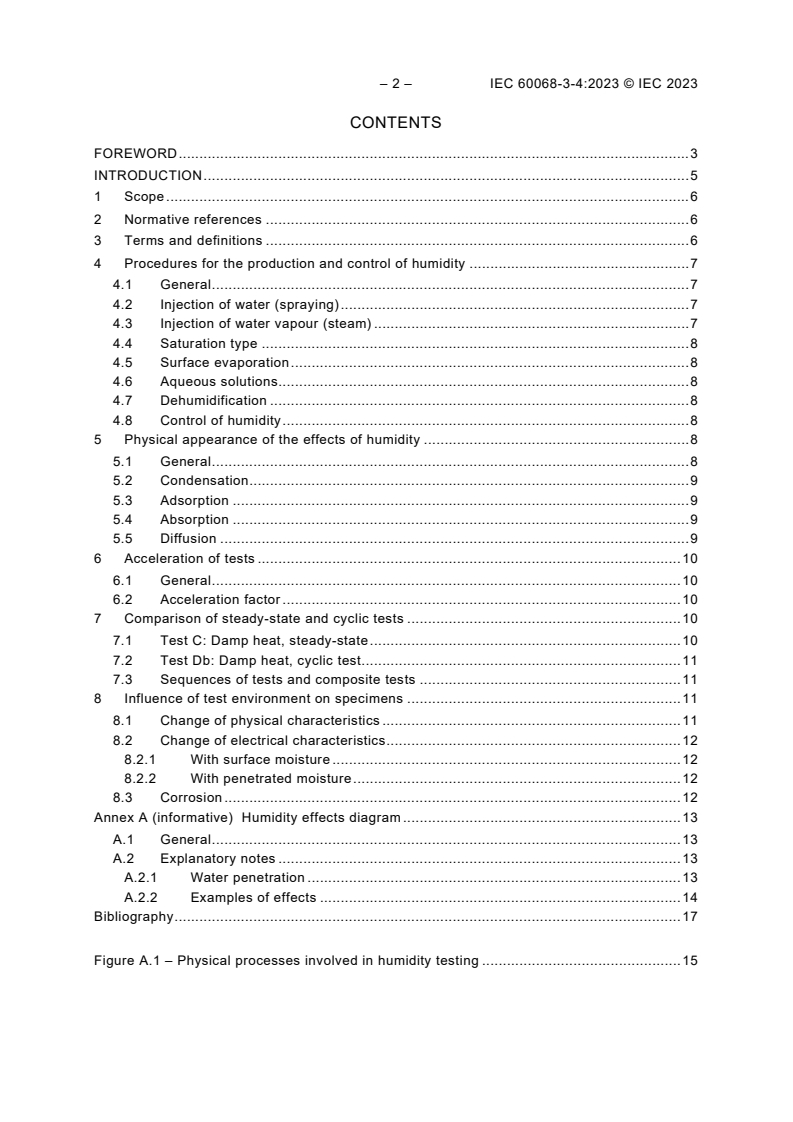
– 2 – IEC 60068-3-4:2023 © IEC 2023
CONTENTS
FOREWORD . 3
INTRODUCTION . 5
1 Scope . 6
2 Normative references . 6
3 Terms and definitions . 6
4 Procedures for the production and control of humidity . 7
4.1 General . 7
4.2 Injection of water (spraying) . 7
4.3 Injection of water vapour (steam) . 7
4.4 Saturation type . 8
4.5 Surface evaporation . 8
4.6 Aqueous solutions. 8
4.7 Dehumidification . 8
4.8 Control of humidity . 8
5 Physical appearance of the effects of humidity . 8
5.1 General . 8
5.2 Condensation . 9
5.3 Adsorption . 9
5.4 Absorption . 9
5.5 Diffusion . 9
6 Acceleration of tests . 10
6.1 General . 10
6.2 Acceleration factor . 10
7 Comparison of steady-state and cyclic tests . 10
7.1 Test C: Damp heat, steady-state . 10
7.2 Test Db: Damp heat, cyclic test . 11
7.3 Sequences of tests and composite tests . 11
8 Influence of test environment on specimens . 11
8.1 Change of physical characteristics . 11
8.2 Change of electrical characteristics . 12
8.2.1 With surface moisture . 12
8.2.2 With penetrated moisture . 12
8.3 Corrosion . 12
Annex A (informative) Humidity effects diagram . 13
A.1 General . 13
A.2 Explanatory notes . 13
A.2.1 Water penetration . 13
A.2.2 Examples of effects . 14
Bibliography . 17
Figure A.1 – Physical processes involved in humidity testing . 15
INTERNATIONAL ELECTROTECHNICAL COMMISSION
____________
ENVIRONMENTAL TESTING –
Part 3-4: Supporting documentation and guidance – Damp heat tests
FOREWORD
1) The International Electrotechnical Commission (IEC) is a worldwide organization for standardization comprising
all national electrotechnical committees (IEC National Committees). The object of IEC is to promote international
co-operation on all questions concerning standardization in the electrical and electronic fields. To this end and
in addition to other activities, IEC publishes International Standards, Technical Specifications, Technical Reports,
Publicly Available Specifications (PAS) and Guides (hereafter referred to as "IEC Publication(s)"). Their
preparation is entrusted to technical committees; any IEC National Committee interested in the subject dealt with
can participate in this preparatory work. International, governmental and non-governmental organizations liaising
with the IEC also participate in this preparation. IEC collaborates closely with the International Organization for
Standardization (ISO) in accordance with conditions determined by agreement between the two organizations.
2) The formal decisions or agreements of IEC on technical matters express, as nearly as possible, an international
consensus of opinion on the relevant subjects since each technical committee has representation from all
interested IEC National Committees.
3) IEC Publications have the form of recommendations for international use and are accepted by IEC National
Committees in that sense. While all reasonable efforts are made to ensure that the technical content of IEC
Publications is accurate, IEC cannot be held responsible for the way in which they are used or for any
misinterpretation by any end user.
4) In order to promote international uniformity, IEC National Committees undertake to apply IEC Publications
transparently to the maximum extent possible in their national and regional publications. Any divergence between
any IEC Publication and the corresponding national or regional publication shall be clearly indicated in the latter.
5) IEC itself does not provide any attestation of conformity. Independent certification bodies provide conformity
assessment services and, in some areas, access to IEC marks of conformity. IEC is not responsible for any
services carried out by independent certification bodies.
6) All users should ensure that they have the latest edition of this publication.
7) No liability shall attach to IEC or its directors, employees, servants or agents including individual experts and
members of its technical committees and IEC National Committees for any personal injury, property damage or
other damage of any nature whatsoever, whether direct or indirect, or for costs (including legal fees) and
expenses arising out of the publication, use of, or reliance upon, this IEC Publication or any other IEC
Publications.
8) Attention is drawn to the Normative references cited in this publication. Use of the referenced publications is
indispensable for the correct application of this publication.
9) Attention is drawn to the possibility that some of the elements of this IEC Publication can be the subject of patent
rights. IEC shall not be held responsible for identifying any or all such patent rights.
IEC 60068-3-4 has been prepared by IEC technical committee 104: Environmental conditions,
classification and methods of test. It is an International Standard.
This second edition cancels and replaces the first edition published in 2001. This edition
constitutes a technical revision.
This edition includes the following significant technical changes with respect to the previous
edition:
a) the requirements for distilled and deionized water have been revised;
b) recommendations for the cleaning procedure of test chambers have been included;
c) humidification systems (ultrasonic humidifiers and atomizers) have been added;
d) the description of water penetration mechanisms has been refined.
– 4 – IEC 60068-3-4:2023 © IEC 2023
The text of this International Standard is based on the following documents:
Draft Report on voting
104/985/FDIS 104/1001/RVD
Full information on the voting for its approval can be found in the report on voting indicated in
the above table.
The language used for the development of this International Standard is English.
This document was drafted in accordance with ISO/IEC Directives, Part 2, and developed in
accordance with ISO/IEC Directives, Part 1 and ISO/IEC Directives, IEC Supplement, available
at www.iec.ch/members_experts/refdocs. The main document types developed by IEC are
described in greater detail at www.iec.ch/publications.
A list of all parts in the IEC 60068 series, published under the general title Environmental
testing, can be found on the IEC website.
The committee has decided that the contents of this document will remain unchanged until the
stability date indicated on the IEC website under webstore.iec.ch in the data related to the
specific document. At this date, the document will be
• reconfirmed,
• withdrawn,
• replaced by a revised edition, or
• amended.
INTRODUCTION
Temperature and relative humidity (RH) of the air, in varying combinations, are climatic factors
which act upon a product during storage, transportation and operation.
Meteorological measurements made over many years have shown that a relative
humidity > 95 % combined with a temperature > 30 °C does not occur in free-air conditions over
long periods, except in regions with extreme climates. In dwelling rooms and workshops
temperatures of > 30 °C can occur but in most cases are combined with a lower relative humidity
than in the open air.
Special conditions exist in certain wet rooms, for example in the chemical industry, metallurgical
plants, mines, electroplating plants and laundries, where the temperature can reach 45 °C
combined with a relative humidity up to saturation over long periods.
Certain equipment placed under particular conditions can be subjected to a relative humidity of
more than 95 % at higher temperatures. This can happen when the equipment is placed in
enclosures, such as vehicles, tents or aircraft cockpits, since this can result in intense heating
through solar radiation while, because of inadequate ventilation, any humidity that can be
developed will be retained permanently within the interior.
In rooms having several heat sources, temperatures and relative humidity can vary in different
parts of the room.
To take these climatic factors over the lifetime of the product into account, environmental testing
includes the practice of accelerated testing (see Clause 6).
Atmospheric pollution can intensify the effects of a damp climate on products. Attention is drawn
to this fact because of its general importance, although pollutants are not contained in the
atmospheres used for damp heat testing. If the effects of pollutants, for example corrosion and
mould growth, are to be investigated, a suitable test from the IEC 60068-2 series should be
used.
– 6 – IEC 60068-3-4:2023 © IEC 2023
ENVIRONMENTAL TESTING –
Part 3-4: Supporting documentation and guidance – Damp heat tests
1 Scope
This part of IEC 60068 provides the necessary information and the basic principles of the effect
of humidity in the context of environmental testing to assist in preparing relevant specifications,
such as standards for components or equipment. Furthermore, information is provided on
operating climatic test chambers.
The object of this document is to present supporting documentation and guidance for a range
of damp heat tests which, when specified by the relevant specification, can be applied to
demonstrate the performance of equipment for which damp heat testing is required with the
main aim of achieving qualification. This information and basic principles are intended to help
selecting appropriate tests and test severities for specific products and, in some cases, specific
types of application.
The object of damp heat tests is to determine the ability of products to withstand the stresses
occurring in a high relative humidity environment, with or without condensation, and with special
regard to variations of electrical and mechanical characteristics. Damp heat tests can also be
utilized to check the resistance of a specimen to some forms of corrosion attack.
2 Normative references
There are no normative references in this document.
3 Terms and definitions
For the purposes of this document, the following terms and definitions apply.
ISO and IEC maintain terminology databases for use in standardization at the following
addresses:
• IEC Electropedia: available at https://www.electropedia.org/
• ISO Online browsing platform: available at https://www.iso.org/obp
NOTE A more detailed explanation of some phenomena is available in A.2.1.
3.1
condensation
precipitation of water vapour on a surface when the surface temperature is lower than the dew
point temperature of the ambient air whereby water is transformed from vapour to the liquid
state of aggregation
3.2
adsorption
adherence of water vapour molecules to a surface when the surface temperature is higher than
the dew point temperature
3.3
absorption
accumulation of water molecules within a material
3.4
diffusion
transportation of water molecules through a material, induced by a partial pressure difference
Note 1 to entry: Diffusion results in a balance of partial pressures, whilst flow (such as through leaks, when the
dimensions of such leaks are great enough to provide viscous or laminar flow) always finally results in the balance
of the total pressures.
3.5
breathing
exchange of air between a hollow space and its surroundings, induced by changes of
temperature or pressure
4 Procedures for the production and control of humidity
4.1 General
There are a great number of humidity test chambers available, equipped with different methods
of humidity generation and of humidity control.
The water resistivity should be between 2 000 Ωm to 500 Ωm corresponding to a conductivity
between 5 µS/cm to 20 µS/cm at +23 °C. Before the water is placed in the humidifier or storage
tank of the chamber, all internal parts of the chamber should be cleaned.
NOTE 1 A conductivity lower than 5 µS/cm can harm the humidifier system. A conductivity higher than 20 µS/cm
can cause limescale or other mineral deposits to form on parts of the humidifier system or specimen.
The chamber and its internal parts can be cleaned using diluted laboratory cleaning agent and
a soft brush and rinsed with distilled or deionized water. It is recommended that the chamber is
cleaned prior to each test. The test facility should be operated in a clean area.
NOTE 2 Chamber sensors can be affected by the cleaning procedure, as some sensors (e.g. capacitive humidity
sensors) can be damaged by some cleaning agents.
NOTE 3 During cleaning, wearing gloves and a protective mask can be helpful as a precaution against the
contamination of the test chamber and of the internal fixtures.
4.2 Injection of water (spraying)
Water is atomized to very fine particles or droplets.
The spray produced in this way moistens the air stream before it enters the working space, the
greater part of the droplets evaporating on the way. Small droplets of water can remain in the
airflow.
Direct water injection into the working space should be avoided, otherwise liquid water can
accumulate on the test specimen.
These simple systems provide rapid humidification and require little maintenance. Examples of
such humidification systems are ultrasonic humidifiers and atomization by means of a nozzle
(one- and two-substance nozzles).
4.3 Injection of water vapour (steam)
Evaporated water (steam) is blown into the working space of the chamber.
This system gives rapid humidification and is easier to maintain (steam valve). However, the
resultant heat input can necessitate additional cooling with possible dehumidification effects.
– 8 – IEC 60068-3-4:2023 © IEC 2023
4.4 Saturation type
Air is blown through a vessel containing water, thus becoming saturated with vapour.
At a fixed airflow, the humidity is controlled by changing the water temperature. If an increase
of humidification is produced by increasing the water temperature, this can cause a temperature
rise in the working space and, owing to the thermal capacity of the water, the response time
can be longer. This can necessitate additional cooling with possible de-humidification effects.
If bubbles occur, they can produce a small amount of spray when bursting.
4.5 Surface evaporation
The air is humidified by passing it over a large surface area of water. Different methods are
used, for example repeated airflow over standing water or water-jet scrubbing over a vertical
surface with the air stream in counter current. In this system, the spray is minimized. The
humidity is controlled by changing the water temperature. Owing to the thermal capacity of the
water, the response time can be longer.
4.6 Aqueous solutions
Relative humidity is generated over standardized aqueous solutions of salts in small, sealed
chambers at constant temperature. This system is not appropriate for heat-dissipating
specimens or for specimens absorbing large quantities of moisture.
NOTE Salt particles can be deposited on the surface of the test specimens and can cause stress corrosion in some
materials.
WARNING – In some cases, for example with ammonium salts, salt particles can be hazardous
to health.
4.7 Dehumidification
In order to control humidity, various dehumidification methods are used, including cold surfaces,
injection of dry air, desiccants, etc.
NOTE Even with temperature tests, condensation can occur on the test specimen, when humidity in the test space
condenses on the cold test specimen during heating.
4.8 Control of humidity
The size of the chamber, the humidifier and the response time of temperature/humidity sensors
have important influences on the possible uncertainties of the humidity control system. The
chamber performance can degrade, and therefore uncertainty is affected by the quality of
maintenance. A regular reference measurement is recommended.
NOTE The humidity can be measured using e.g. psychrometers or capacitive sensors. With capacitive sensors, the
dielectric can drift (e.g. due to acetic acid), and outgassing test specimens can damage the measuring system.
5 Physical appearance of the effects of humidity
5.1 General
The test specimen should be tested in the as-delivered condition without any special treatment,
if not specified otherwise. It is possible that test items that are specially cleaned before the test
will not give an indication of effects which occur in service.
Additional information on the effects of humidity on specimens is given in Annex A.
5.2 Condensation
The dew point temperature depends on the content of water vapour in the air. A direct
relationship exists between dew point, absolute humidity and vapour pressure.
When introducing a specimen into a test chamber, condensation can occur if its surface
temperature is lower than the dew point temperature of the chamber air. It can be necessary to
pre-heat the specimen or dehumidify the chamber air according to the test parameters if
condensation should be prevented.
When condensation is required on the specimen during the conditioning period, the temperature
and the water content of the air should be raised so that the dew point temperature of the air
becomes higher than the surface temperature of the specimen.
An example of a test where such condensation can be induced is Test Z/AD of IEC 60068-2-38.
Normally for specimen that are small, lightweight (or more generally have a low thermal time
constant) condensation occurs only if the dew point temperature of the air increases very
rapidly, or if the relative humidity is very close to 100 %. With the rate of temperature rise
specified in IEC 60068-2-30 for Test Db, it is possible that condensation will not occur on very
small specimens.
When testing includes condensation, two phenomena should be taken into consideration:
1) Microclimate: When two test specimens are positioned next to each other, one can shield
the other. Even though the absolute humidity is the same, the relative humidity can be
different.
2) Inner climate in the encapsulation: The water content is constant, but the temperatures are
different. Condensation can occur on the inner surface of casings subsequent to a fall in
ambient temperature.
Condensation can usually be detected by visual inspection, however, this is not always
possible, especially with small objects having a rough surface.
NOTE Condensation can be determined by comparing the dew point and the temperature obtained by IR
measurements or temperature measurements on the relevant spots on the specimen.
5.3 Adsorption
The amount of humidity that can adhere to the surface depends on the type of material, its
surface structure, the vapour pressure and the temperature. Separate evaluation of the effects
of adsorption is difficult because of the usual effects of absorption being more evident.
5.4 Absorption
The quantity of moisture which will be absorbed depends on the material, the vapour pressure,
the temperature and the water content of the ambient air. The absorbing process proceeds
steadily until equilibrium is established. The speed of penetration of the water molecules
increases with the temperature.
5.5 Diffusion
An example of diffusion, which is frequently found in electronic components, is the penetration
of water vapour through encapsulations of organic material, for example into a capacitor or
semiconductor device, or through the sealing compound into the casing.
– 10 – IEC 60068-3-4:2023 © IEC 2023
6 Acceleration of tests
6.1 General
The aim of an accelerated test is to obtain as far as possible the same changes of
characteristics as would occur in the normal service environment but in a much shorter time.
Different failure mechanisms can occur under severe conditions than would occur under normal
conditions of use.
The severity of the test should be chosen, taking into account the limiting conditions of service
and storage for which a product is constructed.
While the time required for condensation and adsorption processes is in general rather short,
much longer periods of time (up to several thousand hours) can be required for absorption and
diffusion processes until the equilibrium state is reached. Therefore, the test times can reach
several thousand hours for some test routines (e.g. IEC 60068-2-67: up to 2 000 h test time).
When the relationship between penetration speed and temperature is known, acceleration of a
damp heat test can be achieved by using a higher temperature.
Some additional acceleration can be achieved by the use of bias voltage (see IEC 60068‑2‑66:
Test Cx and IEC 60068-2-67: Test Cy).
The cycling of temperature as applied in the Db tests (see IEC 60068-2-30) has, in general, no
accelerating effect on the absorption and diffusion processes. In view of the fact that the speed
of penetration of water vapour increases with a rising temperature, the absorption will proceed
more slowly with Test Db if the effective average value of the two temperature levels is lower
than the test temperature of Test C (see IEC 60068-2-78, IEC 60068-2-66: Test Cx and
IEC 60068-2-67: Test Cy).
6.2 Acceleration factor
It is not possible to give a generally valid acceleration factor for damp heat tests. If it is desired
to know the acceleration factor, it can only be determined empirically for each particular product.
For comparative tests, a high degree of acceleration can be useful and admissible if the failure
mechanism does not change for the different specimens.
7 Comparison of steady-state and cyclic tests
7.1 Test C: Damp heat, steady-state
The steady-state test should be used where adsorption, absorption or diffusion plays the main
part. When diffusion but not breathing is involved, either the steady-state or the cyclic test
should be applied depending on the type of specimen and its application.
In many cases, Test Cab (see IEC 60068-2-78) is applied to determine whether the required
electrical characteristics of the dielectric are maintained in the humid atmosphere or whether
an insulating encapsulation can guarantee sufficient protection.
An alternate test method for investigating the effects of diffusion can be achieved by the use of
Test Cx (see IEC 60068-2-66) or Test Cy (see IEC 60068-2-67).
For some specimens, the stresses produced by a steady-state test can be similar to those
produced by a cyclic test. In such cases, time constraints can determine the selection of the
appropriate test.
7.2 Test Db: Damp heat, cyclic test
When a cyclic damp heat test is appropriate, Test Db described in IEC 60068-2-30 can be used
for all types of specimens. Cyclic tests should be applied in all cases where the effects of
condensation, or of the ingress and accumulation of water vapour by breathing, are important.
Variant 1 is preferred in cases where the effects of absorption, or of the ingress and
accumulation of water vapour by breathing are important.
Variant 2 requires less sophisticated test equipment and can be used in cases where these
effects are of minor importance.
Test Q: sealing, described in IEC 60068-2-17 can quickly detect leaks which can permit
breathing. However, it cannot reproduce the effects of a cyclic humidity test.
7.3 Sequences of tests and composite tests
An example of the need for a sequence or composite test would be the determination of joint
tightness or crack detection by the application of one or more temperature cycles. It is not
generally necessary to combine temperature cycles with humidity.
The desired effect can be made more stringent when Test N: Change of temperature
(IEC 60068‑2‑14) is applied, followed by Test C or Test Db (IEC 60068-2-30) as appropriate.
The effect will also be enhanced if the humidity test is immediately followed by Test A: Cold
(IEC 60068‑2‑1). The large temperature difference with Test N produces a much greater thermal
stress than Test Db where the rate of change of temperature is rather slow.
A composite test consisting of several damp heat cycles and a cold cycle is recommended when
specimens composed of different materials and including joints, especially specimens including
cemented glass joints, are to be tested. Such a test is specified in Test Z/AD and differs from
other cyclic damp heat tests in that it derives its added effectiveness from a greater number of
temperature variations in a given time, a higher upper temperature and the addition of a number
of excursions to sub-zero temperatures. The accelerated breathing and the effect of the freezing
of trapped water in cracks or fissures are the essential effects of the composite test.
The introduction of cold cycles between the humidity cycles is intended to freeze water which
can have been retained in any defects and by expansion due to freezing, to convert such defects
into faults more rapidly than would occur during normal life.
It is emphasized, however, that the freezing effect will occur only if the fissure dimensions are
large enough to allow the penetration of a coherent mass of water, as is normally the case in
fissures between seals and metal assemblies or between seals and wire terminations.
For small hairline cracks or porous materials, for example in plastic encapsulation, the
absorption effect will prevail and a steady-state, damp heat test should be preferred for
investigating these effects.
8 Influence of test environment on specimens
8.1 Change of physical characteristics
Mechanical and optical characteristics of materials can change in humid atmospheres, e.g.
material expansion, variation of surface characteristics such as the coefficient of friction,
change of strength.
To determine such changes of characteristics, it depends on the application, whether a steady-
state or a cyclic test is appropriate, and whether or not condensation is required.
– 12 – IEC 60068-3-4:2023 © IEC 2023
8.2 Change of electrical characteristics
8.2.1 With surface moisture
If the surface of an insulating material is affected by condensation or by a certain amount of
adsorbed moisture, certain electrical characteristics can change, such as decrease of surface
resistance, increase of loss angle (for capacities and inductance with alternating current).
Leakage currents can also occur.
In general, Test Db (IEC 60068-2-30) is applied in such cases. If condensation is excluded,
Test Cab (IEC 60068-2-78) can be used instead.
In certain cases, specimens are required to be switched on, loaded or measured during
conditioning.
In general, changes of electrical characteristics due to surface moisture will become evident
after a few minutes.
8.2.2 With penetrated moisture
Moisture absorbed by an insulating material can cause a variation of electrical characteristics,
such as decrease of electric strength, decrease of insulation resistance, increase of loss angle,
increase of capacitance.
Since the absorption and diffusion processes occur over long periods of time and the equilibrium
state is reached only after some hundreds or even thousands of hours, long conditioning times
should be chosen accordingly. The extrapolation of test results is only possible if the time
dependency is known. As an example, plastic encapsulation which appears satisfactory after
56 days of exposure to Test Cab (IEC 60068-2-78) can deteriorate over a longer period due to
absorption or diffusion of high moisture quantity.
The evaluation of the influence of absorbed moisture can become problematic when the
functional parts in the encapsulation are additionally protected against humidity, for example
by the passivation of semiconductors, by enclosing drying agents.
8.3 Corrosion
Corrosion can occur when a sufficient amount of moisture is available. With increasing humidity
or temperature the corrosive effect is accelerated; severe deterioration by corrosion will occur
when there is frequent condensation with re-evaporation.
Damp heat tests should not be used for the determination of corrosion effects. When foreign
substances are deposited on metallic surfaces, for example flux residues, or other residues of
manufacturing processes, dirt, fingerprints, etc., these can produce or promote corrosion in the
presence of humidity.
Joints between different metals or between metal and a non-metallic material can be a source
of corrosion when condensation or a high relative humidity is present.
This can be enhanced by the use of bias voltage (see Tests Cx and Cy).
Annex A
(informative)
Humidity effects diagram
A.1 General
The diagram in Figure A.1 shows the physical processes involved in humidity testing and the
links between these processes, the constructional features of the materials or the specimen
and the effects of the test.
Symbols corresponding to the various test parameters listed below have been inserted in the
various "boxes" of the diagram as appropriate.
Time (total duration of conditioning) t [s]
Temperature T [K]
Difference of temperature ΔT [K]
Rate of change of temperature dT/dt
Relative humidity RH [%]
Difference of relative humidity Δ(RH)
Absolute humidity AH [g/m ]
Degree of impurities present in the test atmosphere Pu
A.2 Explanatory notes
A.2.1 Water penetration
The difference between the mechanisms of penetration in materials and those occurring through
leaks in enclosures is described as follows:
a) In materials, penetration is due to "bulk diffusion" i.e. a movement of single water molecules
through molecular voids existing in solids. This mechanism gives rise to the phenomenon
of "absorption". Bulk diffusion can allow water molecules to reach sensitive parts of a device
surrounded by protective materials (e.g. to the resistive film of a film resistor embedded in
a plastic envelope). By the same process, water molecules can reach internal cavities in
enclosures.
b) Penetration through leaks is due to water ingression or water vapour movement in or along
the air filling leakage channels, enclosures or through seals. The three main mechanisms
are:
diffusion: the movement of water molecules is due to a concentration gradient in the leak,
independently from any macroscopic flow of the air;
flow: water molecules are drawn through the leak with the airflow;
– 14 – IEC 60068-3-4:2023 © IEC 2023
breathing: for the purposes of this document, breathing is considered to be when water
vapour flows along the leak due to fluctuation of the difference in total or partial
pressure along the leak, for example, due to temperature fluctuations.
This process can be initiated by the forming of condensation on the specimen's
surface. As the temperature on parts or the whole of the specimen's surface
can be lower than the corresponding dew point at the humidity value, water can
accumulate in small cracks or gaps on the specimen's surface.
Once the air temperature is reduced, the air in the internal voids of the
specimen is contracted which results in a drop of pressure and drawing-in
either wet air or condensed water through cracks or other leaks inside the
specimen. The wet air will condense on inner walls of a void and can gradually
fill it. During a temperature rising phase, the air in the void is expanded, this
time with a lower dew point than during drawing-in, and partially escape out.
When this is repeated, water can be accumulated inside the specimen and can
gradually fill its voids.
This so-called "breathing" effect is caused by changing the temperature inside
the specimen in an atmosphere with high humidity. During the excursion to the
sub-zero temperature phase of a test, the water trapped in cracks and other
voids freezes and owing to the expansion of ice volume the cracks extend, and
new cracks can form.
NOTE The discrimination between the mechanisms of penetration through leaks is somewhat arbitrary; in fact, there
is a continuous transition between diffusion and flow, and flow can be a consequence of breathing.
A.2.2 Examples of effects
The last line in the diagram in Figure A.1 lists typical examples of these effects. It is not implied
that the examples quoted are necessarily the only ones which can result from these physical
processes.
The "boxes" in this last line should not be considered as being completely separate since
interaction between the various effects is both possible and probable.
This is indicated in the fourth box from the left, where chemical reactions between materials
and moisture are indicated as possibly leading to changes in volume resistivity, loss angle, etc.
and whilst this is one of the more obvious interactions, there are many others.
Figure A.1 – Physical processes involved in humidity testing (1 of 2)
– 16 – IEC 60068-3-4:2023 © IEC 2023
Figure A.1 – Physical processes involved in humidity testing (2 of 2)
Bibliography
IEC 60068-1, Environmental testing – Part 1: General and guidance
IEC 60068-2-1, Environmental testing – Part 2-1: Tests – Test A: Cold
IEC 60068-2-10, Environmental testing – Part 2-10: Tests – Test J and guidance: Mould growth
IEC 60068-2-14, Environmental testing – Part 2-14: Tests – Test N: Change of temperature
IEC 60068-2-17, Environmental testing – Part 2-17: Tests – Test Q: Sealing
IEC 60068-2-30, Environmental testing – Part 2-30: Tests – Test Db: Damp heat, cyclic
(12 h + 12 h cycle)
IEC 60068-2-38, Environmental testing – Part 2-38: Tests – Test Z/AD: Composite temperature/
humidity cyclic test
IEC 60068-2-39, Environmental testing – Part 2-39: Tests – Tests and guidance: Combined
temperature or temperature and humidity with low air pressure tests
IEC 60068-2-66, Environmental testing – Part 2-66: Test methods – Test Cx: Damp heat,
steady state (unsaturated pressurized vapour)
IEC 60068-2-67, Environmental testing – Part 2-67: Tests – Test Cy: Damp heat, steady state,
accelerated test primarily intended for components
IEC 60068-2-78, Environmental testing – Part 2-78: Tests – Test Cab: Damp heat, steady state
IEC 60721-2-1, Classification of environmental conditions – Part 2-1: Environmental conditions
appearing in nature – Temperatu
...