

IEC/IEEE 63253-5713-8:2024
(Main)Station Service Voltage Transformers (SSVT)
General Information
- Abstract
IEC/IEEE 63253-5713-8:2024 describes electrical and mechanical requirements of single-phase station service voltage transformers with system voltages of 46 kV or higher and with the maximum rated voltage of the power winding of 1 000 V.
This document is a basis for the establishment of performance and limited electrical and mechanical interchangeability requirements of the equipment are described. It is also a basis for assistance in the proper selection of such equipment.
A station service voltage transformer (SSVT) is a single-phase transformer to be connected line-to-earth on an effectively earthed system. It can be used either as an individual unit for supplying single-phase loads, or in a three-phase bank to support three-phase loads. A typical application is to supply substation power such as lighting, pump and motor loads. The SSVT can be provided with a measuring winding when requested by the user.
- Status
- Published
- Publication Date
- 25-Nov-2024
- Technical Committee
- TC 38 - Instrument Transformers
- Drafting Committee
- JWG 56 - TC 38/JWG 56
- Current Stage
- PPUB - Publication issued
- Start Date
- 26-Nov-2024
- Completion Date
- 17-May-2024
Overview
IEC/IEEE 63253-5713-8:2024 defines electrical and mechanical requirements for Station Service Voltage Transformers (SSVT). It applies to single‑phase SSVTs intended for connection line‑to‑earth on effectively earthed systems with system voltages of 46 kV or higher and a maximum rated primary (power winding) voltage of 1 000 V. The standard provides the technical basis for specifying performance, limited electrical and mechanical interchangeability, testing, and guidance for proper selection of SSVTs used to supply substation power (lighting, pumps, motors) either as individual units or as three‑phase banks. A measuring winding may be provided on request.
Key Topics
- Scope and definitions: Terms related to voltage, windings, ratings, losses, gas insulation and abbreviations.
- Environmental conditions: Normal and special environmental profiles (temperature, altitude, loading).
- Ratings and markings: Secondary voltages, rated power, taps, turns ratio, accuracy classes for measuring windings, short‑circuit impedance and losses.
- Insulation requirements: Creepage distances, basic lightning impulse level (BIL), switching impulse levels, insulation resistance, earth‑shielding and partial discharge limits.
- Construction and materials: Liquid‑filled and gas‑insulated designs, tank pressure, sealing, gas monitoring, preservation of insulating liquids and protective finishes.
- Mechanical and safety: Mechanical strength, degrees of protection, earthing of tank and core, internal arc classification.
- Short‑circuit and thermal limits: Short‑circuit withstand, test durations, calculation of symmetrical/asymmetrical currents and winding temperature limits.
- Tests and verification: Routine, type and special tests including dielectric, induced and applied voltage tests, partial discharge, RIV, temperature‑rise, leak tests, dissolved gas and water content (for oil‑filled units), and internal arc testing.
Applications
- Selection and specification of SSVTs for substations supplying single‑phase and three‑phase auxiliary loads (lighting, motors, pumps).
- Procurement documents for utilities and EPC contractors requiring standard compliance and interchangeability.
- Design and quality control for transformer manufacturers and testing laboratories to validate insulation levels, performance and safety.
- Installation and maintenance teams for operational checks, testing and end‑user acceptance.
Related Standards
- Framework complements other IEC/IEEE publications for instrument transformers and substation equipment. Users should consult applicable IEC/IEEE and national standards for broader requirements on instrument transformers, safety and testing procedures.
Keywords: Station Service Voltage Transformer, SSVT, IEC/IEEE 63253-5713-8:2024, station service voltage transformers, substation power, voltage transformer standards, insulation levels, short‑circuit withstand, SSVT testing.
Get Certified
Connect with accredited certification bodies for this standard

BSMI (Bureau of Standards, Metrology and Inspection)
Taiwan's standards and inspection authority.
Sponsored listings
Frequently Asked Questions
IEC/IEEE 63253-5713-8:2024 is a standard published by the International Electrotechnical Commission (IEC). Its full title is "Station Service Voltage Transformers (SSVT)". This standard covers: IEC/IEEE 63253-5713-8:2024 describes electrical and mechanical requirements of single-phase station service voltage transformers with system voltages of 46 kV or higher and with the maximum rated voltage of the power winding of 1 000 V. This document is a basis for the establishment of performance and limited electrical and mechanical interchangeability requirements of the equipment are described. It is also a basis for assistance in the proper selection of such equipment. A station service voltage transformer (SSVT) is a single-phase transformer to be connected line-to-earth on an effectively earthed system. It can be used either as an individual unit for supplying single-phase loads, or in a three-phase bank to support three-phase loads. A typical application is to supply substation power such as lighting, pump and motor loads. The SSVT can be provided with a measuring winding when requested by the user.
IEC/IEEE 63253-5713-8:2024 describes electrical and mechanical requirements of single-phase station service voltage transformers with system voltages of 46 kV or higher and with the maximum rated voltage of the power winding of 1 000 V. This document is a basis for the establishment of performance and limited electrical and mechanical interchangeability requirements of the equipment are described. It is also a basis for assistance in the proper selection of such equipment. A station service voltage transformer (SSVT) is a single-phase transformer to be connected line-to-earth on an effectively earthed system. It can be used either as an individual unit for supplying single-phase loads, or in a three-phase bank to support three-phase loads. A typical application is to supply substation power such as lighting, pump and motor loads. The SSVT can be provided with a measuring winding when requested by the user.
IEC/IEEE 63253-5713-8:2024 is classified under the following ICS (International Classification for Standards) categories: 17.220.20 - Measurement of electrical and magnetic quantities. The ICS classification helps identify the subject area and facilitates finding related standards.
IEC/IEEE 63253-5713-8:2024 is available in PDF format for immediate download after purchase. The document can be added to your cart and obtained through the secure checkout process. Digital delivery ensures instant access to the complete standard document.
Standards Content (Sample)
IEC/IEEE 63253-5713-8 ®
Edition 1.0 2024-11
INTERNATIONAL
STANDARD
Station Service Voltage Transformers (SSVT)
All rights reserved. Unless otherwise specified, no part of this publication may be reproduced or utilized in any form or
by any means, electronic or mechanical, including photocopying and microfilm, without permission in writing being
secured. Requests for permission to reproduce should be addressed to either IEC at the address below or IEC’s
member National Committee in the country of the requester or from IEEE.
IEC Secretariat Institute of Electrical and Electronics Engineers, Inc.
3, rue de Varembé 3 Park Avenue
CH-1211 Geneva 20 New York, NY 10016-5997
Switzerland United States of America
Tel.: +41 22 919 02 11 stds.ipr@ieee.org
info@iec.ch www.ieee.org
www.iec.ch
About the IEC
The International Electrotechnical Commission (IEC) is the leading global organization that prepares and publishes
International Standards for all electrical, electronic and related technologies.
About IEC publications
The technical content of IEC publications is kept under constant review by the IEC. Please make sure that you have the
latest edition, a corrigendum or an amendment might have been published.
IEC publications search - webstore.iec.ch/advsearchform IEC Products & Services Portal - products.iec.ch
The advanced search enables to find IEC publications by a Discover our powerful search engine and read freely all the
variety of criteria (reference number, text, technical publications previews, graphical symbols and the glossary.
committee, …). It also gives information on projects, replaced With a subscription you will always have access to up to date
and withdrawn publications. content tailored to your needs.
IEC Just Published - webstore.iec.ch/justpublished
Electropedia - www.electropedia.org
Stay up to date on all new IEC publications. Just Published
The world's leading online dictionary on electrotechnology,
details all new publications released. Available online and once
containing more than 22 500 terminological entries in English
a month by email.
and French, with equivalent terms in 25 additional languages.
Also known as the International Electrotechnical Vocabulary
IEC Customer Service Centre - webstore.iec.ch/csc
(IEV) online.
If you wish to give us your feedback on this publication or need
further assistance, please contact the Customer Service
Centre: sales@iec.ch.
IEC/IEEE 63253-5713-8 ®
Edition 1.0 2024-11
INTERNATIONAL
STANDARD
Station Service Voltage Transformers (SSVT)
INTERNATIONAL
ELECTROTECHNICAL
COMMISSION
ICS 17.220.20 ISBN 978-2-8322-8810-8
– 2 – IEC/IEEE 63253-5713-8:2024
© IEC/IEEE 2024
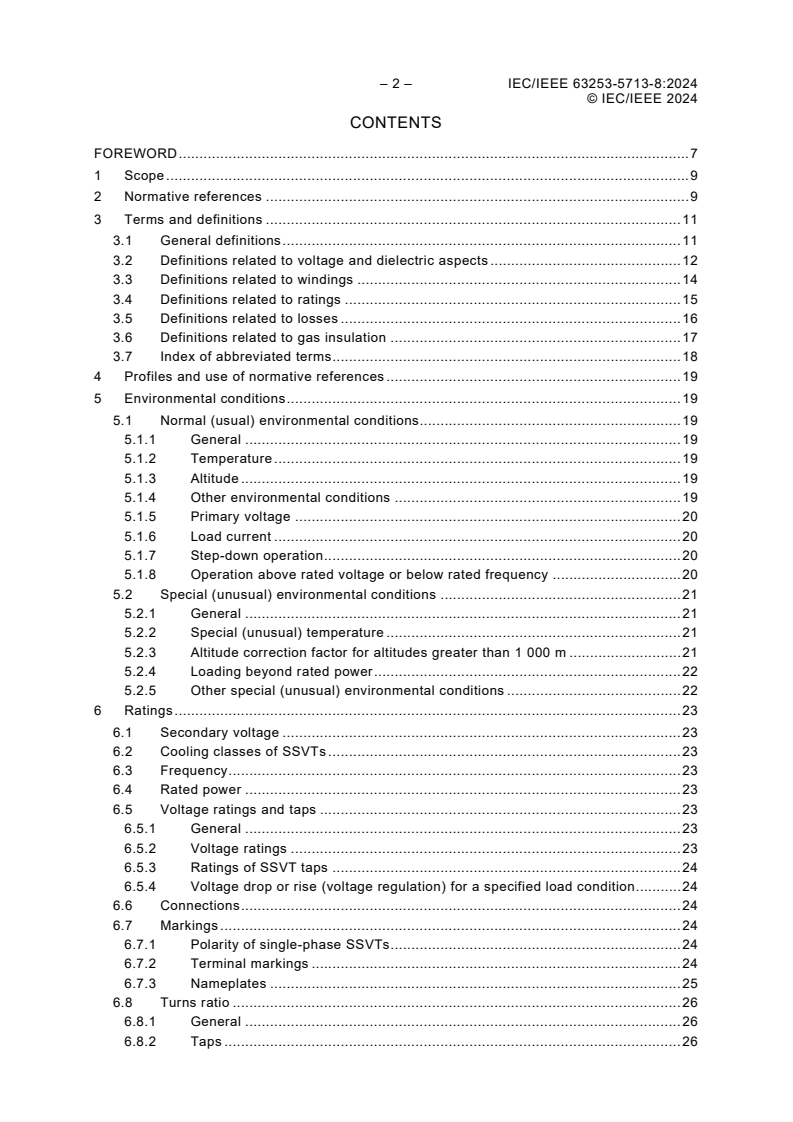
CONTENTS
FOREWORD . 7
1 Scope . 9
2 Normative references . 9
3 Terms and definitions . 11
3.1 General definitions . 11
3.2 Definitions related to voltage and dielectric aspects . 12
3.3 Definitions related to windings . 14
3.4 Definitions related to ratings . 15
3.5 Definitions related to losses . 16
3.6 Definitions related to gas insulation . 17
3.7 Index of abbreviated terms . 18
4 Profiles and use of normative references . 19
5 Environmental conditions . 19
5.1 Normal (usual) environmental conditions . 19
5.1.1 General . 19
5.1.2 Temperature . 19
5.1.3 Altitude . 19
5.1.4 Other environmental conditions . 19
5.1.5 Primary voltage . 20
5.1.6 Load current . 20
5.1.7 Step-down operation . 20
5.1.8 Operation above rated voltage or below rated frequency . 20
5.2 Special (unusual) environmental conditions . 21
5.2.1 General . 21
5.2.2 Special (unusual) temperature . 21
5.2.3 Altitude correction factor for altitudes greater than 1 000 m . 21
5.2.4 Loading beyond rated power . 22
5.2.5 Other special (unusual) environmental conditions . 22
6 Ratings . 23
6.1 Secondary voltage . 23
6.2 Cooling classes of SSVTs . 23
6.3 Frequency . 23
6.4 Rated power . 23
6.5 Voltage ratings and taps . 23
6.5.1 General . 23
6.5.2 Voltage ratings . 23
6.5.3 Ratings of SSVT taps . 24
6.5.4 Voltage drop or rise (voltage regulation) for a specified load condition . 24
6.6 Connections . 24
6.7 Markings . 24
6.7.1 Polarity of single-phase SSVTs . 24
6.7.2 Terminal markings . 24
6.7.3 Nameplates . 25
6.8 Turns ratio . 26
6.8.1 General . 26
6.8.2 Taps . 26
© IEC/IEEE 2024
6.9 Accuracy ratings of measurement windings . 26
6.9.1 General . 26
6.9.2 Assignment of accuracy class . 27
6.9.3 Accuracy classification for SSVT with two secondary measuring
windings or tapped secondary windings . 27
6.10 Short-circuit impedance . 27
6.11 Total losses . 27
6.12 Rated insulation levels of primary terminals . 27
6.12.1 Line terminal . 27
6.12.2 Creepage distance requirements . 29
6.12.3 Basic lightning impulse insulation level (BIL) . 29
6.12.4 Switching impulse insulation level (BSL) . 29
6.12.5 Neutral terminals . 29
6.13 Rated insulation levels of secondary terminals . 29
6.13.1 Secondary power windings terminals . 29
6.13.2 Secondary measuring windings terminals . 29
6.14 Insulation resistance requirements . 29
6.15 Earth shield requirements . 30
6.16 Dissolved gas and water content requirements for new mineral oil-immersed
SSVTs . 30
6.17 Internal arc requirements . 30
6.17.1 General . 30
6.17.2 Internal arc protection class I . 31
6.17.3 Internal arc protection class II . 31
6.18 Temperature rise and loading conditions for SSVT . 31
6.19 Partial discharge requirements . 32
6.20 RIV requirements . 32
7 Construction . 32
7.1 Tank pressure requirements for liquid-filled SSVTs . 32
7.2 Mechanical performance requirements . 32
7.2.1 Overview . 32
7.2.2 Sealing requirements tests . 33
7.2.3 Mechanical strength of the SSVT . 34
7.3 Liquid insulation system . 35
7.3.1 Insulating liquids . 35
7.3.2 Insulating liquid preservation . 35
7.4 Gas insulation system . 35
7.4.1 Requirements for gases in SSVTs . 35
7.4.2 Pressure monitoring devices . 36
7.4.3 Tank construction and maximum gas leakage rates . 36
7.5 Earthing . 36
7.5.1 SSVT tank earthing. 36
7.5.2 Earthing of core . 37
7.6 Degrees of protection by enclosures . 37
7.6.1 General . 37
7.6.2 Protection of persons against access to hazardous parts and protection
of the equipment against ingress of solid foreign objects . 37
7.6.3 Protection against ingress of water . 37
7.6.4 Protection of equipment against mechanical impact under normal
environmental conditions . 37
– 4 – IEC/IEEE 63253-5713-8:2024
© IEC/IEEE 2024
7.6.5 Tank or enclosure finish. 38
8 Short-circuit characteristics . 38
8.1 Short-circuit withstand requirements . 38
8.1.1 General . 38
8.1.2 Duration of short-circuit tests . 38
8.1.3 Number of short-circuit shots . 38
8.2 Short-circuit current calculations . 38
8.2.1 Symmetrical current . 38
8.2.2 Asymmetrical current . 39
8.3 Temperature limits of SSVTs for short-circuit conditions . 39
8.4 Calculation of winding temperature during a short-circuit . 39
9 Tests . 40
9.1 General . 40
9.2 Dielectric tests . 40
9.2.1 General . 40
9.2.2 Dielectric tests at factory . 40
9.2.3 Dielectric tests by end user . 40
9.3 Overview of tests for SSVTs . 41
9.3.1 General . 41
9.3.2 Routine tests . 42
9.3.3 Type tests . 42
9.3.4 Special tests . 42
9.4 Routine test procedures . 42
9.4.1 Resistance measurement of windings . 42
9.4.2 Verification of terminal markings and polarity . 42
9.4.3 Winding insulation resistance . 43
9.4.4 Losses measurement . 43
9.4.5 Capacitance and dissipation factor measurements. 45
9.4.6 Applied voltage tests . 46
9.4.7 Induced voltage test . 46
9.4.8 Partial discharge test . 47
9.4.9 Routine leak test . 49
9.4.10 Routine ratio and accuracy tests . 49
9.4.11 Lightning impulse tests . 50
9.4.12 Earth shield check . 52
9.5 Type test procedures . 52
9.5.1 Dissolved gas and water content analysis . 52
9.5.2 Mechanical test . 53
9.5.3 Lightning impulse voltage test on the primary winding . 54
9.5.4 Switching impulse voltage test in wet conditions . 56
9.5.5 External radio interference voltage (RIV) test . 57
9.5.6 Induced voltage test in wet conditions . 60
9.5.7 Temperature rise test . 60
9.6 Special test procedures . 65
9.6.1 Endurance chopped wave test for liquid filled SSVT . 65
9.6.2 Internal arc test . 67
9.6.3 Low temperature sealing system test for gas-filled SSVTs . 69
9.6.4 Seismic qualification . 70
9.6.5 Verification of the degree of protection by enclosures . 71
© IEC/IEEE 2024
9.6.6 Short-circuit withstand test . 71
9.7 Frequency conversion of SSVT performance parameters (50/60 Hz) . 72
9.8 Test report . 72
Annex A (informative) Temperature rise testing considerations . 73
A.1 Heating and cooling curves . 73
A.2 Temperature stabilization . 74
A.3 Effect of shutting off power to take resistance measurements . 74
A.4 Use of cooling curve to extrapolate to time of shutdown . 75
A.5 Use of heating or cooling to determine thermal time constant. 75
Annex B (informative) Internal arc protection for SSVT . 76
Annex C (informative) Technical information exchange during contracting stage . 77
C.1 General . 77
C.2 System information . 77
C.3 Environmental conditions . 77
C.4 Ratings . 78
Annex D (normative) Temperature correction of load loss and impedance voltage . 79
Bibliography . 81
Figure 1 – Factor m for the switching impulse withstand test . 22
Figure 2 – Recommended earth pad dimensions . 36
Figure 3 – Circuit for measuring impedance: wattmeter, voltmeter, ammeter method . 44
Figure 4 – Application of the test loads to the primary terminals . 53
Figure 5 – Application of the test load to the secondary terminals . 54
Figure 6 – Example of the application of the test load to the secondary extending
conductor . 54
Figure 7 – RIV measuring circuit according to CISPR 18-2. 58
Figure 8 – RIV measuring circuit according to NEMA 107 (alternative 3-3 c) . 59
Figure 9 – Example of loading back method . 64
Figure 10 – Internal arc fault test setup . 68
Figure A.1 – Heating curve . 73
Figure A.2 – Cooling curve. 74
Table 1 – Index of abbreviated terms . 18
Table 2 – Standard values of rated voltage factor . 21
Table 3 – Nameplate information . 25
Table 4 – Basic impulse insulation levels and power frequency withstand voltages . 28
Table 5 – Creepage distances as a function of U / 3 . 29
m
Table 6 – Dissolved gas and water content for new mineral oil-immersed SSVTs . 30
Table 7 – Limits of temperature rise . 31
Table 8 – Maximum allowable 24 h average temperature of cooling air to permit SSVT
to operate at rated power . 32
Table 9 – Maximum operating temperature of power terminals intended for bolted
connection in air . 32
Table 10 – Sealing test options for liquid filled SSVTs . 33
Table 11 – Static terminal loads for high voltage terminals . 34
– 6 – IEC/IEEE 63253-5713-8:2024
© IEC/IEEE 2024
Table 12 – Static terminal loads for low voltage terminals . 34
Table 13 – Routine, type, and other tests for SSVTs . 41
Table 14 – Test system accuracy requirements . 45
Table 15 – Partial discharge test voltages . 48
Table 16 – External radio interference voltage (RIV) . 60
Table 17 – Comparable seismic levels . 70
Table A.1 – Data from Figure A.1 . 73
Table A.2 – Data from Figure A.2 . 74
Table C.1 – System data . 77
Table C.2 – Environmental conditions data . 77
Table C.3 – Rating data . 78
Table D.1 – List of symbols . 79
© IEC/IEEE 2024
STATION SERVICE VOLTAGE TRANSFORMERS (SSVT)
FOREWORD
1) The International Electrotechnical Commission (IEC) is a worldwide organization for standardization comprising
all national electrotechnical committees (IEC National Committees). The object of IEC is to promote international
co-operation on all questions concerning standardization in the electrical and electronic fields. To this end and
in addition to other activities, IEC publishes International Standards, Technical Specifications, Technical Reports,
Publicly Available Specifications (PAS) and Guides (hereafter referred to as “IEC document(s)”). Their
preparation is entrusted to technical committees; any IEC National Committee interested in the subject dealt with
may participate in this preparatory work. International, governmental and non-governmental organizations liaising
with the IEC also participate in this preparation.
EEE Standards documents are developed within IEEE Societies and subcommittees of IEEE Standards
Association (IEEE SA) Board of Governors. IEEE develops its standards through an accredited consensus
development process, which brings together volunteers representing varied viewpoints and interests to achieve
the final product. IEEE standards are documents developed by volunteers with scientific, academic, and industry-
based expertise in technical working groups. Volunteers involved in technical working groups are not necessarily
members of IEEE or IEEE SA and participate without compensation from IEEE. While IEEE administers the
process and establishes rules to promote fairness in the consensus development process, IEEE does not
independently evaluate, test, or verify the accuracy of any of the information or the soundness of any judgments
contained in its standards.
IEC collaborates closely with IEEE in accordance with conditions determined by agreement between the two
organizations. This Dual Logo International Standard was jointly developed by the IEC and IEEE under the terms
of that agreement.
2) The formal decisions of IEC on technical matters express, as nearly as possible, an international consensus of
opinion on the relevant subjects since each technical committee has representation from all interested IEC
National Committees. The formal decisions of IEEE on technical matters, once consensus within IEEE Societies
and Standards Coordinating Committees has been reached, is determined by a balanced ballot of materially
interested parties who indicate interest in reviewing the proposed standard. Final approval of the IEEE standards
document is given by the IEEE Standards Association (IEEE SA) Standards Board.
3) IEC/IEEE Publications have the form of recommendations for international use and are accepted by IEC National
Committees/IEEE Societies in that sense. While all reasonable efforts are made to ensure that the technical
content of IEC/IEEE Publications is accurate, IEC or IEEE cannot be held responsible for the way in which they
are used or for any misinterpretation by any end user.
4) In order to promote international uniformity, IEC National Committees undertake to apply IEC Publications
(including IEC/IEEE Publications) transparently to the maximum extent possible in their national and regional
publications. Any divergence between any IEC/IEEE Publication and the corresponding national or regional
publication shall be clearly indicated in the latter.
5) IEC and IEEE do not provide any attestation of conformity. Independent certification bodies provide conformity
assessment services and, in some areas, access to IEC marks of conformity. IEC and IEEE are not responsible
for any services carried out by independent certification bodies.
6) All users should ensure that they have the latest edition of this publication.
7) No liability shall attach to IEC or IEEE or their directors, employees, servants or agents including individual
experts and members of technical committees and IEC National Committees, or volunteers of IEEE Societies and
the Standards Coordinating Committees of the IEEE Standards Association (IEEE SA) Standards Board, for any
personal injury, property damage or other damage of any nature whatsoever, whether direct or indirect, or for
costs (including legal fees) and expenses arising out of the publication, use of, or reliance upon, this IEC/IEEE
Publication or any other IEC or IEEE Publications.
8) Attention is drawn to the normative references cited in this publication. Use of the referenced publications is
indispensable for the correct application of this publication.
9) Attention is drawn to the possibility that implementation of this IEC/IEEE Publication may require use of material
covered by patent rights. By publication of this standard, no position is taken with respect to the existence or
validity of any patent rights in connection therewith. IEC or IEEE shall not be held responsible for identifying
Essential Patent Claims for which a license may be required, for conducting inquiries into the legal validity or
scope of Patent Claims or determining whether any licensing terms or conditions provided in connection with
submission of a Letter of Assurance, if any, or in any licensing agreements are reasonable or non-discriminatory.
Users of this standard are expressly advised that determination of the validity of any patent rights, and the risk
of infringement of such rights, is entirely their own responsibility.
IEC/IEEE 63253-5713-8 has been prepared by IEC technical committee 38: Instrument
Transformers, in cooperation with Transformers Committee of the IEEE Power and Energy
Society, under the IEC/IEEE Dual Logo Agreement.
It is published as an IEC/IEEE dual logo standard.
– 8 – IEC/IEEE 63253-5713-8:2024
© IEC/IEEE 2024
The text of this International Standard is based on the following IEC documents:
Draft Report on voting
38/788/FDIS 38/789/RVD
Full information on the voting for its approval can be found in the report on voting indicated in
the above table.
The language used for the development of this International Standard is English.
This document was drafted in accordance with the rules given in the ISO/IEC Directives, Part 2,
available at www.iec.ch/members_experts/refdocs. The main document types developed by IEC
are described in greater detail at www.iec.ch/publications/.
The IEC Technical Committee and IEEE Technical Committee have decided that the contents
of this document will remain unchanged until the stability date indicated on the IEC website
under webstore.iec.ch in the data related to the specific document. At this date, the document
will be
reconfirmed,
withdrawn, or
revised.
© IEC/IEEE 2024
STATION SERVICE VOLTAGE TRANSFORMERS (SSVT)
1 Scope
This document describes electrical and mechanical requirements of single-phase station
service voltage transformers with system voltages of 46 kV or higher and with the maximum
rated voltage of the power winding of 1 000 V.
This document is a basis for the establishment of performance and limited electrical and
mechanical interchangeability requirements of the equipment are described. It is also a basis
for assistance in the proper selection of such equipment.
A station service voltage transformer (SSVT) is a single-phase transformer to be connected
line-to-earth on an effectively earthed system. It can be used either as an individual unit for
supplying single-phase loads, or in a three-phase bank to support three-phase loads. A typical
application is to supply substation power such as lighting, pump and motor loads. The SSVT
can be provided with a measuring winding when requested by the user.
2 Normative references
The following documents are referred to in the text in such a way that some or all of their content
constitutes requirements of this document. For dated references, only the edition cited applies.
For undated references, the latest edition of the referenced document (including any
amendments) applies.
IEC 60060-1:2010, High-voltage testing techniques – Part 1: General definitions and test
requirements
IEC 60060-2, High-voltage testing techniques – Part 2: Measuring systems
IEC 60071-2:2023, Insulation co-ordination – Part 2: Application guidelines
IEC 60076-1:2011, Power transformers – Part 1: General
IEC 60076-5, Power transformers – Part 5: Ability to withstand short circuit
IEC 60270, High-voltage test techniques – Partial discharge measurements
IEC 60376, Specification of technical grade sulphur hexafluoride (SF ) and complementary
gases to be used in its mixtures for use in electrical equipment
IEC 60475, Method of sampling insulating liquids
IEC 60480, Specifications for the re-use of sulphur hexafluoride (SF ) and its mixtures in
electrical equipment
IEC 60567, Oil-filled electrical equipment – Sampling of free gases and analysis of free and
dissolved gases in mineral oils and other insulating liquids – Guidance
IEC 60529, Degrees of protection provided by enclosures (IP Code)
– 10 – IEC/IEEE 63253-5713-8:2024
© IEC/IEEE 2024
IEC 60867, Insulating liquids – Specifications for unused liquids based on synthetic aromatic
hydrocarbons
IEC 60836, Specifications for used silicon insulating liquids for electrotechnical purposes
IEC 60944, Guide for the maintenance of silicon transformer liquids
IEC 61099, Insulating liquids – Specifications for unused synthetic organic esters for electrical
purposes
IEC 61869-1:2023, Instrument transformers – Part 1: General requirements
IEC 61869-3:2011, Instrument transformers – Part 3: Additional requirements for inductive
voltage transformers
IEC 61869-99:2022, Instrument transformers – Part 99: Glossary
IEC 62262, Degrees of protection provided by enclosures for electrical equipment against
external mechanical impacts (IK Code)
IEC 62770, Fluids for electrotechnical applications – Unused natural esters for transformers
and similar electrical equipment
ASTM D2225, Standard Test Methods for Silicone Liquids Used for Electrical Insulation
ASTM D3487, Standard Specification for Mineral Insulating Oil Used in Electrical Apparatus
ASTM D5222, Standard Specification for High Fire-Point Mineral Electrical Insulating Oils
ASTM D6871, Standard Specification for Natural (Vegetable Oil) Ester Fluids Used in Electrical
Apparatus
CISPR TR 18-2:2017, Radio interference characteristics of overhead power lines and
high-voltage equipment – Part 2: Methods of measurement and procedure for determining limits
IEEE Std 4™-2013, High-Voltage Testing Techniques
IEEE Std C57.12.70™, IEEE Standard Terminal Markings and Connections for Distribution and
Power Transformers
IEEE Std C57.12.80™-2010, IEEE Standard Terminology for Power and Distribution
Transformers
IEEE Std C57.12.90™-2015, IEEE Standard Test Code for Liquid-Immersed Distribution,
Power, and Regulating Transformers
IEEE Std C57.13™-2016, IEEE Standard for Requirements for Instrument Transformers
IEEE Std C57.13.5™, IEEE Standard of Performance and Test Requirements for Instrument
Transformers of a Nominal System Voltage of 115 kV and Above
IEEE Std C57.19.100™, IEEE Guide for Application of Power Apparatus Bushings
IEEE Std 693™, IEEE Recommended Practice for Seismic Design of Substations
© IEC/IEEE 2024
NEMA 107-2016, Methods of measurement of radio influence voltage (RIV) of high-voltage
apparatus
NEMA 250, Enclosures for Electrical Equipment (1000 Volts Maximum)
3 Terms and definitions
For the purposes of this document, the terms and definitions given in IEC 61869-99,
TM
IEEE Std C57.12.80 , and the following apply.
ISO, IEC and IEEE maintain terminological databases for use in standardization at the following
addresses:
• IEC Electropedia: available at http://www.electropedia.org/
• ISO Online browsing platform: available at http://www.iso.org/obp
• IEEE Standards Dictionary Online: available at http://dictionary.ieee.org
3.1 General definitions
3.1.1
station service voltage transformer
SSVT
line-to-earth connected single-phase transformer that can be used either as an individual unit
for supplying single-phase loads, or in a three-phase bank to supply three-phase loads and can
be provided with a measuring winding
EXAMPLE A typical application is to supply power to the control house and yard loads inside a substation.
3.1.2
enclosure
housing affording the type and degree of protection suitable for the intended application
Note 1 to entry: This definition needs the following explanations under the scope of this document:
1) enclosure provides protection for persons or animals against access to hazardous parts;
2) enclosure provides protection for equipment against the harmful effects of mechanical impact;
3) barriers, shapes of openings or other means – whether attached to the enclosure or formed by the enclosed
equipment – suitable to prevent or limit penetration, are considered as part of the enclosure, except when they
can be removed without the use of a key or tool.
[SOURCE: IEC 60050-151:2001, 151-13-08, modified – the Note to entry has been added.]
3.1.3
primary terminal
terminal to which the voltage to be transformed is applied
3.1.4
secondary terminal
terminal which transfers the power to the secondary circuit or transmits the secondary signal to
measuring instruments, meters and protective or control devices or similar apparatus
3.1.5
neutral terminal
terminal intended for connection to a neutral point of a network
– 12 – IEC/IEEE 63253-5713-8:2024
© IEC/IEEE 2024
3.1.6
secondary circuit
external circuit connected to the secondary terminals
[SOURCE: IEC 61869-99:2022, 3.1.4]
3.1.7
pressure relief device
device suitable to limit dangerous over-pressures inside the SSVT
[SOURCE: IEC 61869-99:2022, 3.2.61, modified – Reference to "instrument transformer"
replaced with "SSVT".]
3.1.8
zero period acceleration
ZPA
acceleration level of the high-frequency, non-amplified portion of the response spectrum,
corresponding to the maximum (peak) acceleration of the time history used to derive the
spectrum
Note 1 to entry: The ZPA is assumed to be the acceleration at 33 Hz or greater.
[SOURCE: IEEE Std 693™-2018- 3.1, modified – second part of the definition moved to a Note.]
3.1.9
IEC profile
iteration of this document where the user of this document follows the IEC references
3.1.10
IEEE profile
iteration of this document where the user of this document follows the IEEE references
3.2 Definitions related to voltage and dielectric aspects
3.2.1
nominal system voltage
suitable approximate value of voltage used to designate or identify a system
[SOURCE: IEC 60050-601:1985, 601-01-21, modified – the term "nominal voltage of a system"
has been replaced with "nominal system voltage", which is the common term in North America.]
3.2.2
highest voltage of a system
maximum system voltage
U
sys
highest value of operating voltage which occurs under normal operating conditions at any time
and any point in the system
Note 1 to entry: Transient overvoltages due e.g. to switching operations and unusual temporary variations of
voltage, are not taken into account.
[SOURCE: IEC 60050-601:1985, 601-01-23, modified – the term "maximum system voltage"
and symbol have been added; the word "abnormal" replaced with "unusual" in the definition.]
© IEC/IEEE 2024
3.2.3
highest voltage for equipment
maximum equipment voltage
U
m
highest value of line-to-line voltage (RMS value) for which the equipment is designed in respect
of its insulation as well as other characteristics which relate to this voltage in the relevant
equipment standards under normal operating conditions
[SOURCE: IEC 60050-614:2016, 614-03-01, modified – the term "maximum equipment voltage"
and symbol have been added; in the definition "greatest" has been replaced with "highest" and
"service conditions" replaced with "operating conditions".]
3.2.4
rated primary voltage
U
pr
value of the primary line-to-earth voltage of the SSVT on which its performance is based
3.2.5
rated secondary voltage
U
sr
value of the secondary voltage of the SSVT to be developed at no-load between the secondary
terminals with rated primary voltage
3.2.6
harmonic factor
ratio of the RMS vaIue of harmonic content to the RMS value of an alternating quantity
[SOURCE: IEC 60050-161:1990, 161-02-23, modified – "total" has been omitted from the term.]
3.2.7
rated voltage factor
F
v
multiplying factor to be applied to the rated primary voltage to determine the maximum voltage
at which an SSVT must comply with the relevant thermal and optional accuracy requirements
for a specific time
3.2.8
rated insulation level
test voltages, under specified conditions, that the insulation is designed to withstand
Note 1 to entry: These test voltages can be for instance:
a) rated lightning impulse and short duration power frequency withstand voltages;
b) rated lightning and switching impulse withstand voltages (phase-to-earth).
[SOURCE: IEC 60050-421:1990, 421-09-02]
3.2.9
earth fault factor
at a given location of a three-phase system, and for a given system configuration, ratio of the
highest RMS value of line-to-earth power frequency voltage on a healthy line condu
...