

IEC 62731:2018
(Main)Text-to-speech for television - General requirements
General Information
- Abstract
IEC 62731:2018 specifies the text-to-speech functionality for a (broadcast) receiver with a text-to-speech system. Such a system may be one device, i.e. a receiver with an integrated text-to-speech generator, or may be two devices, i.e. a receiver interfacing with an external text-to-speech device. This document applies only to completely functional stationary (or semi-stationary) digital TV receivers such as set top boxes, integrated digital TVs, recorders and other products whose primary function is to receive TV content. Where this document refers to TV, this will be shorthand for all such receivers.
This document does not apply to products that are capable of receiving TV as a secondary function (e.g. PCs or game consoles with digital television receivers). It also does not apply to sub-assemblies (e.g. PC tuner cards).
This edition includes the following significant technical changes with respect to the previous edition:
a) in 6.2, the levels of announcement quality were revised as well as considerations for ways in which device users can provide service providers with feedback on incorrectly announced terms.
b) in 6.3, the following TV functionality was added: the TV can receive updated words, associated conversions and updated conversion rules for the TTS engine via a network connection.
- Status
- Published
- Publication Date
- 09-Jan-2018
- Technical Committee
- TA 16 - Active Assisted Living (AAL), wearable electronic devices and technologies, accessibility and user interfaces
- Drafting Committee
- PT 62731 - TC 100/PT 62731
- Current Stage
- PPUB - Publication issued
- Start Date
- 10-Jan-2018
- Completion Date
- 05-Jan-2018
Buy Documents

IEC 62731:2018 - Text-to-speech for television - General requirements Released:1/10/2018

IEC 62731:2018 - Text-to-speech for television - General requirements Released:1/10/2018
Overview
IEC 62731:2018 - Text-to-speech for television: General requirements - defines the functional requirements for implementing text-to-speech (TTS) on digital television receivers. The standard covers both integrated TTS in a receiver and architectures where a TV or set-top box (STB) interfaces with an external TTS device. IEC 62731 applies to fully functional stationary or semi‑stationary digital TV receivers (set‑top boxes, integrated digital TVs, recorders) whose primary function is receiving TV content. It excludes devices with TV as a secondary function (e.g., PCs, game consoles) and sub‑assemblies (e.g., tuner cards).
This second edition (2018) updates announcement quality levels and adds support for receiving updated words and conversion rules for TTS via network connections.
Key topics and technical requirements
- Scope and intended products: Applies to TVs, STBs and similar receivers; excludes secondary‑function devices and sub‑assemblies.
- User‑centred accessibility: Focus on the needs of visually impaired users - navigation of channels and inputs, access to EPGs and text services, and TV operation/setup via speech.
- Profiles: Defines multiple TTS capability profiles (Basic, Main, Enhanced) to accommodate varying levels of functionality and implementation complexity.
- Functional requirements:
- Behavioural requirements for TV–TTS combinations and for standalone TTS engines/devices.
- Handling of TV events and associated TTS data (e.g., channel change, context switch, pop‑ups).
- Mechanisms for user feedback on incorrect announcements and configurable announcement quality.
- Support for receiving updated words, conversions and conversion rules over a network to improve pronunciation and vocab management.
- Conformity: Mandatory requirements are specified; conformity claims require meeting all mandatory clauses. Optional features may be implemented but are not required.
Applications and who uses this standard
- TV and STB manufacturers implementing built‑in accessibility features and speech UIs.
- External TTS device makers designing interfaces to receivers.
- Broadcast equipment vendors and middleware developers ensuring that EPGs and interactive text services are accessible by TTS.
- Accessibility engineers and UX designers creating functionally equivalent speech interfaces for visually impaired users.
- Test labs, regulators and procurement teams specifying or verifying accessibility compliance for consumer receivers.
Practical benefits include improved accessibility for visually impaired viewers, standardized behaviour across devices, and mechanisms to update TTS vocabularies and rules remotely.
Related standards
- IEC 62731 was prepared by IEC TC 100 (audio, video and multimedia systems). The document notes interoperability with broadcast metadata and references related broadcast specifications (for example, DVB‑SI for supplementary audio services). For product conformance, consult IEC guidance and regional accessibility regulations.
Relations
- Effective Date
- 05-Sep-2023
Buy Documents
IEC 62731:2018 - Text-to-speech for television - General requirements Released:1/10/2018
IEC 62731:2018 - Text-to-speech for television - General requirements Released:1/10/2018
Get Certified
Connect with accredited certification bodies for this standard

ANCE
Mexican certification and testing association.

Intertek Slovenia
Intertek testing, inspection, and certification services in Slovenia.

LNE (Laboratoire National de Métrologie et d'Essais)
French national laboratory for metrology and testing.
Sponsored listings
Frequently Asked Questions
IEC 62731:2018 is a standard published by the International Electrotechnical Commission (IEC). Its full title is "Text-to-speech for television - General requirements". This standard covers: IEC 62731:2018 specifies the text-to-speech functionality for a (broadcast) receiver with a text-to-speech system. Such a system may be one device, i.e. a receiver with an integrated text-to-speech generator, or may be two devices, i.e. a receiver interfacing with an external text-to-speech device. This document applies only to completely functional stationary (or semi-stationary) digital TV receivers such as set top boxes, integrated digital TVs, recorders and other products whose primary function is to receive TV content. Where this document refers to TV, this will be shorthand for all such receivers. This document does not apply to products that are capable of receiving TV as a secondary function (e.g. PCs or game consoles with digital television receivers). It also does not apply to sub-assemblies (e.g. PC tuner cards). This edition includes the following significant technical changes with respect to the previous edition: a) in 6.2, the levels of announcement quality were revised as well as considerations for ways in which device users can provide service providers with feedback on incorrectly announced terms. b) in 6.3, the following TV functionality was added: the TV can receive updated words, associated conversions and updated conversion rules for the TTS engine via a network connection.
IEC 62731:2018 specifies the text-to-speech functionality for a (broadcast) receiver with a text-to-speech system. Such a system may be one device, i.e. a receiver with an integrated text-to-speech generator, or may be two devices, i.e. a receiver interfacing with an external text-to-speech device. This document applies only to completely functional stationary (or semi-stationary) digital TV receivers such as set top boxes, integrated digital TVs, recorders and other products whose primary function is to receive TV content. Where this document refers to TV, this will be shorthand for all such receivers. This document does not apply to products that are capable of receiving TV as a secondary function (e.g. PCs or game consoles with digital television receivers). It also does not apply to sub-assemblies (e.g. PC tuner cards). This edition includes the following significant technical changes with respect to the previous edition: a) in 6.2, the levels of announcement quality were revised as well as considerations for ways in which device users can provide service providers with feedback on incorrectly announced terms. b) in 6.3, the following TV functionality was added: the TV can receive updated words, associated conversions and updated conversion rules for the TTS engine via a network connection.
IEC 62731:2018 is classified under the following ICS (International Classification for Standards) categories: 33.160.25 - Television receivers; 33.160.99 - Other audio, video and audiovisual equipment. The ICS classification helps identify the subject area and facilitates finding related standards.
IEC 62731:2018 has the following relationships with other standards: It is inter standard links to IEC 62731:2013. Understanding these relationships helps ensure you are using the most current and applicable version of the standard.
IEC 62731:2018 is available in PDF format for immediate download after purchase. The document can be added to your cart and obtained through the secure checkout process. Digital delivery ensures instant access to the complete standard document.
Standards Content (Sample)
IEC 62731 ®
Edition 2.0 2018-01
INTERNATIONAL
STANDARD
Text-to-speech for television – General requirements
All rights reserved. Unless otherwise specified, no part of this publication may be reproduced or utilized in any form
or by any means, electronic or mechanical, including photocopying and microfilm, without permission in writing from
either IEC or IEC's member National Committee in the country of the requester. If you have any questions about IEC
copyright or have an enquiry about obtaining additional rights to this publication, please contact the address below or
your local IEC member National Committee for further information.
IEC Central Office Tel.: +41 22 919 02 11
3, rue de Varembé info@iec.ch
CH-1211 Geneva 20 www.iec.ch
Switzerland
About the IEC
The International Electrotechnical Commission (IEC) is the leading global organization that prepares and publishes
International Standards for all electrical, electronic and related technologies.
About IEC publications
The technical content of IEC publications is kept under constant review by the IEC. Please make sure that you have the
latest edition, a corrigenda or an amendment might have been published.
IEC Catalogue - webstore.iec.ch/catalogue Electropedia - www.electropedia.org
The stand-alone application for consulting the entire The world's leading online dictionary of electronic and
bibliographical information on IEC International Standards, electrical terms containing 21 000 terms and definitions in
Technical Specifications, Technical Reports and other English and French, with equivalent terms in 16 additional
documents. Available for PC, Mac OS, Android Tablets and languages. Also known as the International Electrotechnical
iPad. Vocabulary (IEV) online.
IEC publications search - webstore.iec.ch/advsearchform IEC Glossary - std.iec.ch/glossary
The advanced search enables to find IEC publications by a 67 000 electrotechnical terminology entries in English and
variety of criteria (reference number, text, technical French extracted from the Terms and Definitions clause of
committee,…). It also gives information on projects, replaced IEC publications issued since 2002. Some entries have been
and withdrawn publications. collected from earlier publications of IEC TC 37, 77, 86 and
CISPR.
IEC Just Published - webstore.iec.ch/justpublished
Stay up to date on all new IEC publications. Just Published IEC Customer Service Centre - webstore.iec.ch/csc
details all new publications released. Available online and If you wish to give us your feedback on this publication or
also once a month by email. need further assistance, please contact the Customer Service
Centre: sales@iec.ch.
IEC 62731 ®
Edition 2.0 2018-01
INTERNATIONAL
STANDARD
Text-to-speech for television – General requirements
INTERNATIONAL
ELECTROTECHNICAL
COMMISSION
ICS 33.160.25; 33.160.99 ISBN 978-2-8322-5125-6
– 2 – IEC 62731:2018 © IEC 2018
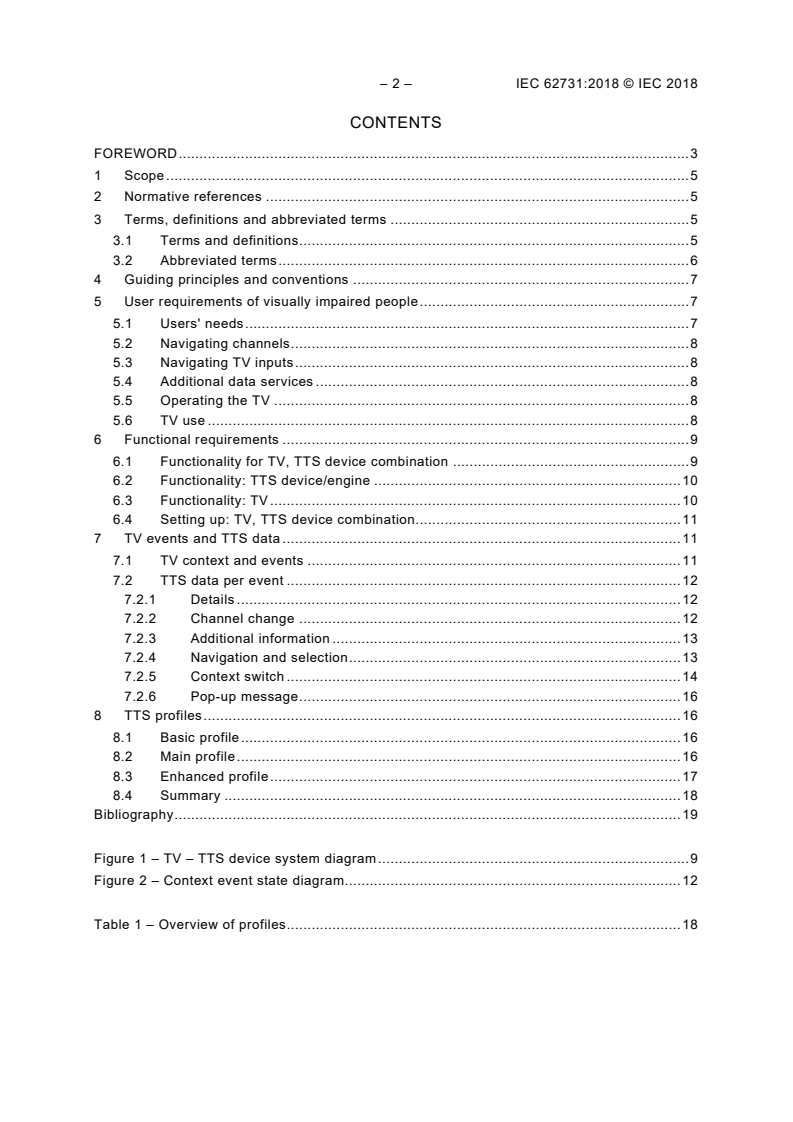
CONTENTS
FOREWORD . 3
1 Scope . 5
2 Normative references . 5
3 Terms, definitions and abbreviated terms . 5
3.1 Terms and definitions . 5
3.2 Abbreviated terms . 6
4 Guiding principles and conventions . 7
5 User requirements of visually impaired people . 7
5.1 Users' needs . 7
5.2 Navigating channels . 8
5.3 Navigating TV inputs . 8
5.4 Additional data services . 8
5.5 Operating the TV . 8
5.6 TV use . 8
6 Functional requirements . 9
6.1 Functionality for TV, TTS device combination . 9
6.2 Functionality: TTS device/engine . 10
6.3 Functionality: TV . 10
6.4 Setting up: TV, TTS device combination . 11
7 TV events and TTS data . 11
7.1 TV context and events . 11
7.2 TTS data per event . 12
7.2.1 Details . 12
7.2.2 Channel change . 12
7.2.3 Additional information . 13
7.2.4 Navigation and selection . 13
7.2.5 Context switch . 14
7.2.6 Pop-up message . 16
8 TTS profiles . 16
8.1 Basic profile . 16
8.2 Main profile . 16
8.3 Enhanced profile . 17
8.4 Summary . 18
Bibliography . 19
Figure 1 – TV – TTS device system diagram . 9
Figure 2 – Context event state diagram . 12
Table 1 – Overview of profiles . 18
INTERNATIONAL ELECTROTECHNICAL COMMISSION
____________
TEXT-TO-SPEECH FOR TELEVISION –
GENERAL REQUIREMENTS
FOREWORD
1) The International Electrotechnical Commission (IEC) is a worldwide organization for standardization comprising
all national electrotechnical committees (IEC National Committees). The object of IEC is to promote
international co-operation on all questions concerning standardization in the electrical and electronic fields. To
this end and in addition to other activities, IEC publishes International Standards, Technical Specifications,
Technical Reports, Publicly Available Specifications (PAS) and Guides (hereafter referred to as "IEC
Publication(s)"). Their preparation is entrusted to technical committees; any IEC National Committee interested
in the subject dealt with may participate in this preparatory work. International, governmental and non-
governmental organizations liaising with the IEC also participate in this preparation. IEC collaborates closely
with the International Organization for Standardization (ISO) in accordance with conditions determined by
agreement between the two organizations.
2) The formal decisions or agreements of IEC on technical matters express, as nearly as possible, an international
consensus of opinion on the relevant subjects since each technical committee has representation from all
interested IEC National Committees.
3) IEC Publications have the form of recommendations for international use and are accepted by IEC National
Committees in that sense. While all reasonable efforts are made to ensure that the technical content of IEC
Publications is accurate, IEC cannot be held responsible for the way in which they are used or for any
misinterpretation by any end user.
4) In order to promote international uniformity, IEC National Committees undertake to apply IEC Publications
transparently to the maximum extent possible in their national and regional publications. Any divergence
between any IEC Publication and the corresponding national or regional publication shall be clearly indicated in
the latter.
5) IEC itself does not provide any attestation of conformity. Independent certification bodies provide conformity
assessment services and, in some areas, access to IEC marks of conformity. IEC is not responsible for any
services carried out by independent certification bodies.
6) All users should ensure that they have the latest edition of this publication.
7) No liability shall attach to IEC or its directors, employees, servants or agents including individual experts and
members of its technical committees and IEC National Committees for any personal injury, property damage or
other damage of any nature whatsoever, whether direct or indirect, or for costs (including legal fees) and
expenses arising out of the publication, use of, or reliance upon, this IEC Publication or any other IEC
Publications.
8) Attention is drawn to the Normative references cited in this publication. Use of the referenced publications is
indispensable for the correct application of this publication.
9) Attention is drawn to the possibility that some of the elements of this IEC Publication may be the subject of
patent rights. IEC shall not be held responsible for identifying any or all such patent rights.
International Standard IEC 62731 has been prepared by IEC technical committee 100: Audio,
video and multimedia systems and equipment.
This second edition cancels and replaces the first edition published in 2013. This edition
constitutes a technical revision.
This edition includes the following significant technical changes with respect to the previous
edition:
a) in 6.2, the levels of announcement quality were revised as well as considerations for ways
in which device users can provide service providers with feedback on incorrectly
announced terms.
b) in 6.3, the following TV functionality was added: the TV can receive updated words,
associated conversions and updated conversion rules for the TTS engine via a network
connection.
– 4 – IEC 62731:2018 © IEC 2018
The text of this standard is based on the following documents:
FDIS Report on voting
100/2989/FDIS 100/3013/RVD
Full information on the voting for the approval of this International Standard can be found in
the report on voting indicated in the above table.
This document has been drafted in accordance with the ISO/IEC Directives, Part 2.
The committee has decided that the contents of this document will remain unchanged until the
stability date indicated on the IEC website under "http://webstore.iec.ch" in the data related to
the specific document. At this date, the document will be
• reconfirmed,
• withdrawn,
• replaced by a revised edition, or
• amended.
A bilingual version of this publication may be issued at a later date.
TEXT-TO-SPEECH FOR TELEVISION –
GENERAL REQUIREMENTS
1 Scope
This International Standard specifies the text-to-speech functionality for a (broadcast) receiver
with a text-to-speech system. Such a system may be one device, i.e. a receiver with an
integrated text-to-speech generator, or may be two devices, i.e. a receiver interfacing with an
external text-to-speech device. This document applies only to completely functional stationary
(or semi-stationary) digital TV receivers such as set top boxes, integrated digital TVs,
recorders and other products whose primary function is to receive TV content. Where this
document refers to TV, this will be shorthand for all such receivers.
This document does not apply to products that are capable of receiving TV as a secondary
function (e.g. PCs or game consoles with digital television receivers). It also does not apply to
sub-assemblies (e.g. PC tuner cards).
2 Normative references
There are no normative references in this document.
3 Terms, definitions and abbreviated terms
3.1 Terms and definitions
For the purposes of this document, the following terms and definitions apply.
ISO and IEC maintain terminological databases for use in standardization at the following
addresses:
• IEC Electropedia: available at http://www.electropedia.org/
• ISO Online browsing platform: available at http://www.iso.org/obp
3.1.1
context
one specific function of a TV
EXAMPLE: Watching TV, EPG.
3.1.2
DTV broadcast event classification
general category of programme/event content, or its classification
EXAMPLES: Movie (drama), news/current affairs, talk show, sports (football).
3.1.3
EPG filter
filter that organises or reduces the list of displayed EPG items according to certain criteria
EXAMPLES Of criteria are to show only:
• programmes with a certain content type;
• favourites;
• programmes that are audio described;
• programmes for a given time period (for instance "today", "tomorrow", "next 7 days").
– 6 – IEC 62731:2018 © IEC 2018
3.1.4
event
trigger to start an action
3.1.5
list
collection of items
3.1.6
menu
subsequent order of items
3.1.7
receiver
device capable of receiving or handling digital television signals
3.1.8
service
sequence of programmes under the control of a broadcaster which can be broadcast as part
of a schedule
3.1.9
subtitle
textual representation of the dialogue (and frequently additional auditory information),
typically shown at the bottom of the screen
Note 1 to entry: Subtitles can be a textual rendering in the same language as the spoken dialogue, or can provide
a written translation in a different language.
Note 2 to entry: In some parts of the world, subtitles are called "(closed) captions", and subtitling is referred to as
"(closed) captioning".
Note 3 to entry: This document uses the term subtitles throughout.
3.1.10
TTS audio
audio generated by the TTS engine based on the TTS data
Note 1 to entry: If the TV uses an external TTS converter, TTS audio is interpreted as TTS data.
3.1.11
priority audio information
audio information for immediate output typically related to emergency information
3.1.12
TTS data
(text) data converted into TTS audio information by the text-to-speech engine
3.2 Abbreviated terms
DTV digital television
EPG electronic programme guide
STB set top box
TTS text-to-speech
TV television
UI user interface
4 Guiding principles and conventions
This document describes the required basic behaviour for a TV text-to-speech combination in
a basic profile, but also provides for enhanced profiles. It also gives a short introduction into
the basic problems of visually impaired people: i.e. what are the problems visually impaired
people experience when using and watching TV?
Providing text-to-speech functionality for a broadcast receiver, for example a TV or an STB,
can be of great help to (visually) disabled people. Such speech functionality may be
integrated in the receiver or may be external to the receiver in a separate device.
In general as the guiding principle, when building a TTS interface in the context of this
document, implementers should aspire to achieve functional equivalence of the user
experience. This means that a person operating the device using the speech interface should
have access to similar information and be able to accomplish tasks similar to those they
would with a graphical UI.
The main features of this document are:
• basic functional description for a TV-TTS device combination or TV with integrated TTS;
• profiles for different levels of TV-TTS functionality;
• targeted towards the digital TV application.
In this document, mandatory requirements are specified; optional and informative features are
also included.
A claim of conformity with this document requires conformity with all mandatory requirements.
A TV-TTS device combination or a TV with a TTS that is integrated may provide options for a
user to enable or disable each feature of a product. While options for user configurations may
be provided, the product shall meet the mandatory requirements.
5 User requirements of visually impaired people
5.1 Users' needs
This subclause explains the needs of visually impaired people as the primary target users for
a TV with TTS. Unless these needs are met, the system is not accessible to this user group.
Visually impaired people experience access barriers in the course of the following activities
when watching TV:
a) following TV programming, e.g. the TV series;
b) using a remote control;
c) not being able to see subtitles;
d) navigating channels;
e) navigating TV inputs;
f) using additional data (text) services provided by the broadcaster, e.g. an EPG;
g) daily operation of the TV and initial setup of the TV for use.
Items a), b) and c) are outside the scope of this document. Item c) further relates to the fact
that, in some countries, foreign language programmes are translated via subtitles. For users
who cannot see the subtitles, supplementary audio services are sometimes used to deliver an
audio version of the subtitles. This document elaborates on the remaining four items, i.e. d),
e), f) and g), in 5.2 to 5.6.
– 8 – IEC 62731:2018 © IEC 2018
NOTE 1 For DVB systems, item a) is already solved by audio description. Also, the use case of providing
supplementary audio services to deliver an audio version of the subtitles is covered in the DVB-SI specification
ETSI EN 300 468.
NOTE 2 For ATSC systems, the audio system includes a visually impaired (VI) associate service, which allows a
complete programme mix containing music, effects, dialogue, and additionally a narrative description of the picture
content, see ATSC A/53 part 5 and part 6.
5.2 Navigating channels
The problem is that a user does not know which channel the TV displays, i.e. the user gets
"lost during navigation". The TV is displaying navigation data on the screen but the user is
unable to see it. Such data are, for example:
• channel number,
• service name,
• (DTV broadcast) event name.
5.3 Navigating TV inputs
The problem is that a user is unable to select the required input to the TV, e.g. the user
wishes to select DTV or a specific external input linked to a recording or other device. The
choice is shown on the screen but the user is unable to see it.
5.4 Additional data services
With digital TV, a broadcaster may transmit additional data (text) services to augment TV
programming, provide additional information on programming, or provide news. Such
additional data are:
• information about whether audio description, subtitling is available,
• (next) (DTV broadcast) event name,
• (DVB-) event information (enhanced description of the (DTV broadcast) event),
• EPG data.
The items above are listed in order of importance with the most important item appearing first.
It is noted that this data provides additional convenience in using the TV, but that is non-
essential for the primary function of watching TV, and selecting channels.
5.5 Operating the TV
User settings are another needed function besides navigation. This can be done through
buttons on the remote control (out of scope of this specification), but also via on-screen
menus. For visually impaired people, on-screen menus are typically of little use.
A distinction exists between initial setup and daily operation of the TV. Initial setup is typically
a one-time operation during the lifetime of a TV. Daily operation is more frequent and more
important. Consequently, a distinction among menu items for daily operation exists, those
addressing specific accessibil
...
IEC 62731 ®
Edition 2.0 2018-01
INTERNATIONAL
STANDARD
NORME
INTERNATIONALE
Text-to-speech for television – General requirements
Synthèse vocale pour télévision – Exigences générales
All rights reserved. Unless otherwise specified, no part of this publication may be reproduced or utilized in any form
or by any means, electronic or mechanical, including photocopying and microfilm, without permission in writing from
either IEC or IEC's member National Committee in the country of the requester. If you have any questions about IEC
copyright or have an enquiry about obtaining additional rights to this publication, please contact the address below or
your local IEC member National Committee for further information.
Droits de reproduction réservés. Sauf indication contraire, aucune partie de cette publication ne peut être reproduite ni
utilisée sous quelque forme que ce soit et par aucun procédé, électronique ou mécanique, y compris la photocopie et
les microfilms, sans l'accord écrit de l'IEC ou du Comité national de l'IEC du pays du demandeur. Si vous avez des
questions sur le copyright de l'IEC ou si vous désirez obtenir des droits supplémentaires sur cette publication, utilisez
les coordonnées ci-après ou contactez le Comité national de l'IEC de votre pays de résidence.
IEC Secretariat Tel.: +41 22 919 02 11
3, rue de Varembé info@iec.ch
CH-1211 Geneva 20 www.iec.ch
Switzerland
About the IEC
The International Electrotechnical Commission (IEC) is the leading global organization that prepares and publishes
International Standards for all electrical, electronic and related technologies.
About IEC publications
The technical content of IEC publications is kept under constant review by the IEC. Please make sure that you have the
latest edition, a corrigendum or an amendment might have been published.
IEC publications search - webstore.iec.ch/advsearchform IEC Products & Services Portal - products.iec.ch
The advanced search enables to find IEC publications by a Discover our powerful search engine and read freely all the
variety of criteria (reference number, text, technical publications previews. With a subscription you will always have
committee, …). It also gives information on projects, replaced access to up to date content tailored to your needs.
and withdrawn publications.
Electropedia - www.electropedia.org
IEC Just Published - webstore.iec.ch/justpublished
The world's leading online dictionary on electrotechnology,
Stay up to date on all new IEC publications. Just Published
containing more than 22 300 terminological entries in English
details all new publications released. Available online and once
and French, with equivalent terms in 19 additional languages.
a month by email.
Also known as the International Electrotechnical Vocabulary
(IEV) online.
IEC Customer Service Centre - webstore.iec.ch/csc
If you wish to give us your feedback on this publication or need
further assistance, please contact the Customer Service
Centre: sales@iec.ch.
A propos de l'IEC
La Commission Electrotechnique Internationale (IEC) est la première organisation mondiale qui élabore et publie des
Normes internationales pour tout ce qui a trait à l'électricité, à l'électronique et aux technologies apparentées.
A propos des publications IEC
Le contenu technique des publications IEC est constamment revu. Veuillez vous assurer que vous possédez l’édition la
plus récente, un corrigendum ou amendement peut avoir été publié.
Recherche de publications IEC - Découvrez notre puissant moteur de recherche et consultez
webstore.iec.ch/advsearchform gratuitement tous les aperçus des publications. Avec un
La recherche avancée permet de trouver des publications IEC abonnement, vous aurez toujours accès à un contenu à jour
en utilisant différents critères (numéro de référence, texte, adapté à vos besoins.
comité d’études, …). Elle donne aussi des informations sur les
projets et les publications remplacées ou retirées. Electropedia - www.electropedia.org
Le premier dictionnaire d'électrotechnologie en ligne au monde,
IEC Just Published - webstore.iec.ch/justpublished
avec plus de 22 300 articles terminologiques en anglais et en
Restez informé sur les nouvelles publications IEC. Just
français, ainsi que les termes équivalents dans 19 langues
Published détaille les nouvelles publications parues.
additionnelles. Egalement appelé Vocabulaire
Disponible en ligne et une fois par mois par email.
Electrotechnique International (IEV) en ligne.
Service Clients - webstore.iec.ch/csc
Si vous désirez nous donner des commentaires sur cette
publication ou si vous avez des questions contactez-nous:
sales@iec.ch.
IEC Products & Services Portal - products.iec.ch
IEC 62731 ®
Edition 2.0 2018-01
INTERNATIONAL
STANDARD
NORME
INTERNATIONALE
Text-to-speech for television – General requirements
Synthèse vocale pour télévision – Exigences générales
INTERNATIONAL
ELECTROTECHNICAL
COMMISSION
COMMISSION
ELECTROTECHNIQUE
INTERNATIONALE
ICS 33.160.25; 33.160.99 ISBN 978-2-8322-1087-9
– 2 – IEC 62731:2018 © IEC 2018
CONTENTS
FOREWORD . 3
1 Scope . 5
2 Normative references . 5
3 Terms, definitions and abbreviated terms . 5
3.1 Terms and definitions . 5
3.2 Abbreviated terms . 6
4 Guiding principles and conventions . 7
5 User requirements of visually impaired people . 7
5.1 Users' needs . 7
5.2 Navigating channels . 8
5.3 Navigating TV inputs . 8
5.4 Additional data services . 8
5.5 Operating the TV . 8
5.6 TV use . 8
6 Functional requirements . 9
6.1 Functionality for TV, TTS device combination . 9
6.2 Functionality: TTS device/engine . 10
6.3 Functionality: TV . 10
6.4 Setting up: TV, TTS device combination . 11
7 TV events and TTS data . 11
7.1 TV context and events . 11
7.2 TTS data per event . 12
7.2.1 Details . 12
7.2.2 Channel change . 12
7.2.3 Additional information . 13
7.2.4 Navigation and selection . 13
7.2.5 Context switch . 14
7.2.6 Pop-up message . 16
8 TTS profiles . 16
8.1 Basic profile . 16
8.2 Main profile . 16
8.3 Enhanced profile . 17
8.4 Summary . 18
Bibliography . 19
Figure 1 – TV – TTS device system diagram . 9
Figure 2 – Context event state diagram . 12
Table 1 – Overview of profiles . 18
INTERNATIONAL ELECTROTECHNICAL COMMISSION
____________
TEXT-TO-SPEECH FOR TELEVISION –
GENERAL REQUIREMENTS
FOREWORD
1) The International Electrotechnical Commission (IEC) is a worldwide organization for standardization comprising
all national electrotechnical committees (IEC National Committees). The object of IEC is to promote
international co-operation on all questions concerning standardization in the electrical and electronic fields. To
this end and in addition to other activities, IEC publishes International Standards, Technical Specifications,
Technical Reports, Publicly Available Specifications (PAS) and Guides (hereafter referred to as "IEC
Publication(s)"). Their preparation is entrusted to technical committees; any IEC National Committee interested
in the subject dealt with may participate in this preparatory work. International, governmental and non-
governmental organizations liaising with the IEC also participate in this preparation. IEC collaborates closely
with the International Organization for Standardization (ISO) in accordance with conditions determined by
agreement between the two organizations.
2) The formal decisions or agreements of IEC on technical matters express, as nearly as possible, an international
consensus of opinion on the relevant subjects since each technical committee has representation from all
interested IEC National Committees.
3) IEC Publications have the form of recommendations for international use and are accepted by IEC National
Committees in that sense. While all reasonable efforts are made to ensure that the technical content of IEC
Publications is accurate, IEC cannot be held responsible for the way in which they are used or for any
misinterpretation by any end user.
4) In order to promote international uniformity, IEC National Committees undertake to apply IEC Publications
transparently to the maximum extent possible in their national and regional publications. Any divergence
between any IEC Publication and the corresponding national or regional publication shall be clearly indicated in
the latter.
5) IEC itself does not provide any attestation of conformity. Independent certification bodies provide conformity
assessment services and, in some areas, access to IEC marks of conformity. IEC is not responsible for any
services carried out by independent certification bodies.
6) All users should ensure that they have the latest edition of this publication.
7) No liability shall attach to IEC or its directors, employees, servants or agents including individual experts and
members of its technical committees and IEC National Committees for any personal injury, property damage or
other damage of any nature whatsoever, whether direct or indirect, or for costs (including legal fees) and
expenses arising out of the publication, use of, or reliance upon, this IEC Publication or any other IEC
Publications.
8) Attention is drawn to the Normative references cited in this publication. Use of the referenced publications is
indispensable for the correct application of this publication.
9) Attention is drawn to the possibility that some of the elements of this IEC Publication may be the subject of
patent rights. IEC shall not be held responsible for identifying any or all such patent rights.
International Standard IEC 62731 has been prepared by IEC technical committee 100: Audio,
video and multimedia systems and equipment.
This second edition cancels and replaces the first edition published in 2013. This edition
constitutes a technical revision.
This edition includes the following significant technical changes with respect to the previous
edition:
a) in 6.2, the levels of announcement quality were revised as well as considerations for ways
in which device users can provide service providers with feedback on incorrectly
announced terms.
b) in 6.3, the following TV functionality was added: the TV can receive updated words,
associated conversions and updated conversion rules for the TTS engine via a network
connection.
– 4 – IEC 62731:2018 © IEC 2018
The text of this standard is based on the following documents:
FDIS Report on voting
100/2989/FDIS 100/3013/RVD
Full information on the voting for the approval of this International Standard can be found in
the report on voting indicated in the above table.
This document has been drafted in accordance with the ISO/IEC Directives, Part 2.
The committee has decided that the contents of this document will remain unchanged until the
stability date indicated on the IEC website under "http://webstore.iec.ch" in the data related to
the specific document. At this date, the document will be
• reconfirmed,
• withdrawn,
• replaced by a revised edition, or
• amended.
TEXT-TO-SPEECH FOR TELEVISION –
GENERAL REQUIREMENTS
1 Scope
This International Standard specifies the text-to-speech functionality for a (broadcast) receiver
with a text-to-speech system. Such a system may be one device, i.e. a receiver with an
integrated text-to-speech generator, or may be two devices, i.e. a receiver interfacing with an
external text-to-speech device. This document applies only to completely functional stationary
(or semi-stationary) digital TV receivers such as set top boxes, integrated digital TVs,
recorders and other products whose primary function is to receive TV content. Where this
document refers to TV, this will be shorthand for all such receivers.
This document does not apply to products that are capable of receiving TV as a secondary
function (e.g. PCs or game consoles with digital television receivers). It also does not apply to
sub-assemblies (e.g. PC tuner cards).
2 Normative references
There are no normative references in this document.
3 Terms, definitions and abbreviated terms
3.1 Terms and definitions
For the purposes of this document, the following terms and definitions apply.
ISO and IEC maintain terminological databases for use in standardization at the following
addresses:
• IEC Electropedia: available at http://www.electropedia.org/
• ISO Online browsing platform: available at http://www.iso.org/obp
3.1.1
context
one specific function of a TV
EXAMPLE: Watching TV, EPG.
3.1.2
DTV broadcast event classification
general category of programme/event content, or its classification
EXAMPLES: Movie (drama), news/current affairs, talk show, sports (football).
3.1.3
EPG filter
filter that organises or reduces the list of displayed EPG items according to certain criteria
EXAMPLES Of criteria are to show only:
• programmes with a certain content type;
• favourites;
• programmes that are audio described;
• programmes for a given time period (for instance "today", "tomorrow", "next 7 days").
– 6 – IEC 62731:2018 © IEC 2018
3.1.4
event
trigger to start an action
3.1.5
list
collection of items
3.1.6
menu
subsequent order of items
3.1.7
receiver
device capable of receiving or handling digital television signals
3.1.8
service
sequence of programmes under the control of a broadcaster which can be broadcast as part
of a schedule
3.1.9
subtitle
textual representation of the dialogue (and frequently additional auditory information),
typically shown at the bottom of the screen
Note 1 to entry: Subtitles can be a textual rendering in the same language as the spoken dialogue, or can provide
a written translation in a different language.
Note 2 to entry: In some parts of the world, subtitles are called "(closed) captions", and subtitling is referred to as
"(closed) captioning".
Note 3 to entry: This document uses the term subtitles throughout.
3.1.10
TTS audio
audio generated by the TTS engine based on the TTS data
Note 1 to entry: If the TV uses an external TTS converter, TTS audio is interpreted as TTS data.
3.1.11
priority audio information
audio information for immediate output typically related to emergency information
3.1.12
TTS data
(text) data converted into TTS audio information by the text-to-speech engine
3.2 Abbreviated terms
DTV digital television
EPG electronic programme guide
STB set top box
TTS text-to-speech
TV television
UI user interface
4 Guiding principles and conventions
This document describes the required basic behaviour for a TV text-to-speech combination in
a basic profile, but also provides for enhanced profiles. It also gives a short introduction into
the basic problems of visually impaired people: i.e. what are the problems visually impaired
people experience when using and watching TV?
Providing text-to-speech functionality for a broadcast receiver, for example a TV or an STB,
can be of great help to (visually) disabled people. Such speech functionality may be
integrated in the receiver or may be external to the receiver in a separate device.
In general as the guiding principle, when building a TTS interface in the context of this
document, implementers should aspire to achieve functional equivalence of the user
experience. This means that a person operating the device using the speech interface should
have access to similar information and be able to accomplish tasks similar to those they
would with a graphical UI.
The main features of this document are:
• basic functional description for a TV-TTS device combination or TV with integrated TTS;
• profiles for different levels of TV-TTS functionality;
• targeted towards the digital TV application.
In this document, mandatory requirements are specified; optional and informative features are
also included.
A claim of conformity with this document requires conformity with all mandatory requirements.
A TV-TTS device combination or a TV with a TTS that is integrated may provide options for a
user to enable or disable each feature of a product. While options for user configurations may
be provided, the product shall meet the mandatory requirements.
5 User requirements of visually impaired people
5.1 Users' needs
This subclause explains the needs of visually impaired people as the primary target users for
a TV with TTS. Unless these needs are met, the system is not accessible to this user group.
Visually impaired people experience access barriers in the course of the following activities
when watching TV:
a) following TV programming, e.g. the TV series;
b) using a remote control;
c) not being able to see subtitles;
d) navigating channels;
e) navigating TV inputs;
f) using additional data (text) services provided by the broadcaster, e.g. an EPG;
g) daily operation of the TV and initial setup of the TV for use.
Items a), b) and c) are outside the scope of this document. Item c) further relates to the fact
that, in some countries, foreign language programmes are translated via subtitles. For users
who cannot see the subtitles, supplementary audio services are sometimes used to deliver an
audio version of the subtitles. This document elaborates on the remaining four items, i.e. d),
e), f) and g), in 5.2 to 5.6.
– 8 – IEC 62731:2018 © IEC 2018
NOTE 1 For DVB systems, item a) is already solved by audio description. Also, the use case of providing
supplementary audio services to deliver an audio version of the subtitles is covered in the DVB-SI specification
ETSI EN 300 468.
NOTE 2 For ATSC systems, the audio system includes a visually impaired (VI) associate service, which allows a
complete programme mix containing music, effects, dialogue, and additionally a narrative description of the picture
content, see ATSC A/53 part 5 and part 6.
5.2 Navigating channels
The problem is that a user does not know which channel the TV displays, i.e. the user gets
"lost during navigation". The TV is displaying navigation data on the screen but the user is
unable to see it. Such data are, for example:
• channel number,
• service name,
• (DTV broadcast) event name.
5.3 Navigating TV inputs
The problem is that a user is unable to select the required input to the TV, e.g. the user
wishes to select DTV or a specific external input linked to a recording or other device. The
choice is shown on the screen but the user is unable to see it.
5.4 Additional data services
With digital TV, a broadcaster may transmit additional data (text) services to augment TV
programming, provide additional information on programming, or provide news. Such
additional data are:
• information about whether audio description, subtitling is available,
• (next) (DTV broadcast) event name,
• (DVB-) event information (enhanced description of the (DTV broadcast) event),
• EPG data.
The items above are listed in order of importance with the most important item appearing first.
It is noted that this data provides additional convenience in using the TV, but that is non-
essential for the primary function of watching TV, and selecting channels.
5.5 Operating the TV
User settings are another needed function besides navigation. This can be done through
buttons on the remote control (out of scope of this specification), but also via on-screen
menus. For visually impaired people, on-screen menus are typically of little use.
A distinction exists between initial setup and daily operation of the TV. Initial setup is typically
a one-time operation during the lifetime of a TV. Daily operation is more frequent and more
important. Consequently, a distinction among menu items for daily operation exists, those
addressing specific accessibility functions, and TV setup menu items. However, the most
frequently used keys are "volume", "channel up/down", and number keys.
5.6 TV use
Use characterization of a TV helps in determining implementation profiles. Navigating
channels, for example, is done most often when watching TV, as well as commands such as
volume up and down. This may be supported by additional data services, but does not affect
the primary functions of the TV. Changing the TV's system settings is not done very often,
except perhaps for changing sound or video settings or switching audio description on and off.
Such settings may have an easy access mode through a special menu. TV installation is
typically performed only once during the lifetime of the TV. Often, visually impaired people
can benefit from specialized support for installing the TV, i.e. it is part of the service when
buying a new TV. Understanding this life- and usage cycle of a TV helps with defining the
most effective and efficient solutions and is reflected in the profiles. In the following
paragraphs, we refer to "basic", "main" and "enhanced" profiles, which are further defined and
detailed in Clause 8.
Key operations for a minimum TTS implementation on a receiver for TV use are as set out in
the basic profile defined in this document. This basic profile shall include:
a) channel number, name and event information – key for a user to identify which service
has been selected;
b) availability of audio description – key for a user to know about the availability of this
service feature;
c) availability of subtitles – key for a user to know about the availability of this service
feature;
d) basic EPG – allow the user to navigate through the EPG, if such data is present in the
broadcast, to identify which future events are available to them;
e) context changes – key for a user to understand if the TV went to another state or when a
pop-up message appears.
Additional operations that shall be included in the main profile, in addition to all those in the
basic profile are:
f) receiver menu functions allow the user to navigate receiver operations and functions.
Additional operations that shall be included in the enhanced profile, in addition to all those
from the basic and main profiles, are:
g) event information – provide the event synopsis;
h) additional EPG data – allows the user to get more info on the service or event;
i) operations of a recording device – allows the user to record future events, possibly
selected via the EPG; play/pause a recorded event.
6 Functional requirements
6.1 Functionality for TV, TTS device combination
The TV-TTS device system diagram is illustrated in Figure 1. As shown in the figure, the TTS
device is a separate function from the TV, which can be implemented on a device connected
with a TV-TTS device interface, or may also be integrated in the TV.
Text to
speech
TV
device
IEC
Figure 1 – TV – TTS device system diagram
The functionality requirements for a TV with TTS combination are:
• the TV, in principle, only outputs text strings towards the TTS device;
• the delay between an event and the resulting TTS audio related to that event shall be such
that they are perceived as belonging tied together;
– 10 – IEC 62731:2018 © IEC 2018
• the user should be able to move to the next operation even in the middle of currently
playing TTS audio;
• the user should be able to stop currently playing TTS audio;
• the user shall be able to repeat the current or previous TTS audio;
• the user shall be able to mute the TTS audio;
• the user shall be able to switch on/off the TTS function;
• the language of the TTS audio shall be the same as set for the TV’s UI, except when
signalled differently; the TTS device/engine may choose to pronounce the text or to
indicate failure in case it does not support the signalled language;
• TTS audio may not need to literally represent the related visual information on the screen
as long as the meaning of the visual information stays intact;
• priority audio information shall overrule currently playing TTS audio information.
NOTE For example, EAS (Emergency Alert System) [USA] or EWS (Emergency Warning System) [JPN] are higher
priority than TTS audio information.
6.2 Functionality: TTS device/engine
The functionality requirements for the TTS device/engine are:
• an external TTS device should be designed to be fully accessible to visually impaired
users without being dependent on the TV;
• the volume level of the TTS device/engine shall be changeable by the user: the TTS
device shall announce the new volume level; it should be possible to do this independently
of the TV volume;
• the user should be able to adjust speech characteristics like speed, pitch, voice type,
when applicable;
• the TTS engine should announce abbreviations in a manner suited to the context, for
example: "IEC" should be announced "I E C"; and "IEEE" should be announced "I triple E".
The TTS engine may also pronounce common acronyms in full, e.g. "sub" could be spoken
as "subtitles" where appropriate;
• the TTS engine should announce numbers in a manner suited to the context, e.g. as a
natural number, digit-by-digit, etc.;
• the TTS engine should announce proper nouns (e.g. names, place names) correctly;
• levels of announcement quality are at the discretion of the implementers; the following are
examples of the implementation in order to achieve good levels of quality:
– consider ways to update the vocabulary database and conversion rules of the TTS
engine;
– consider provision of additional information (= metadata) to help the TTS engine for
pronunciations or readings;
– consider ways in which device users can provide service providers with feedback on
incorrectly announced terms.
6.3 Functionality: TV
The TV determines the user interface, i.e. what is displayed on the screen, and how the TV
interacts with the user. The TV therefore also determines which text is sent to the TTS engine.
The TV can receive updated words, associated conversions and updated conversion rules for
the TTS engine via a network connection.
The user should be able to control, via the TV TTS, settings such as volume, speed, pitch,
voice type.
NOTE In Europe, to fulfil basic accessibility needs, the TV is expected to comply with SELFC.
6.4 Setting up: TV, TTS device combination
TTS audio guidance may be given during the installation of a receiver. TTS audio guidance for
receiver installation should adhere to the following requirements when implemented:
• the requirements of 6.1 should apply;
• the user should be able to easily switch on the TTS audio at the beginning of the
installation;
• all essential information to complete the installation procedure should be available as TTS
audio; special attention should be given to inform the user about the progress of slow
processes such as channel searches.
Additional suggestions for TTS audio guidance during receiver installation may be found in
DTG-UG024.
7 TV events and TTS data
7.1 TV context and events
The TV can output data in response to events and events can take place in different contexts.
The following TV contexts can exist (this list is not necessarily exhaustive):
• watching TV: the user watches TV;
• list: the user browses a (channel) list;
• (acc-)menu: the user browses through the (accessibility) menu structure of the TV. If the
menu contains accessibility services, it is called an accessibility menu, or acc-menu. An
example of an accessibility service is audio description;
• EPG: the user browses the EPG;
• standby: the TV is on stand-by;
• timeshift: the user may start a timeshift recording or play a timeshift recording.
The following contexts are currently outside the scope of this specification and are to be
considered for future versions of this specification:
• interactive TV;
• pay-TV.
Within said contexts, the following events may occur:
– channel change: the TV changes channels after the user initiated a change channel event,
e.g. by pressing a button on the remote control;
– additional information: the TV presents additional information on the item shown. This item
may be the event shown on the display, but may also be a highlighted menu item, etc.
Additional information may be presented, for example after the user has pressed the "info"
button on the remote control;
– navigation and selection: the TV highlights another item in, for example, a list or menu.
The user selects an item;
– context switch: the TV switches to another context, for example from watching TV to
showing a menu;
– pop-up message: the TV puts a message on the screen for some purpose, for example
PIN required, or gives status information.
The TV is expected to output data after an event to the TTS device using the TV-TTS
interface. These data contain an indication of the event and the TTS data to be announced.
– 12 – IEC 62731:2018 © IEC 2018
The different TV contexts and the events that may occur in a certain context are graphically
shown in Figure 2. Figure 2 lists the events in a certain context and shows the possible
transitions between the different contexts. It also shows that in the menu context it is possible
to switch to (sub) menus.
Menu/list: EPG:
(Sub) menu/list:
- navigate - navigate
- navigate
- select - additional info
- select
(and watch TV) - select
(and watch TV)
(and watch TV)
Watch TV:
- change channel
- additional info
- select:
. menu,
. EPG,
….
Timeshift:
- navigate
- additional info
- select
Standby:
IEC
Figure 2 – Context event state diagram
7.2 TTS data per event
7.2.1 Details
Subclauses 7.2.2 to 7.2.6 specify which TTS data the TV shall output to the TTS
device/engine given a specified event.
7.2.2 Channel change
7.2.2.1 General
A channel change event outputs data on the newly selected channel. Channel change
typically only occurs in the watch TV context.
7.2.2.2 Watch TV context
A channel change event in the watch TV context shall at least output the following TTS data
for the newly selected channel if present:
a) ;
b) ;
c) ;
d)