

IEC 62961:2018
(Main)Insulating liquids - Test methods for the determination of interfacial tension of insulating liquids - Determination with the ring method
General Information
- Abstract
IEC 62961:2018 establishes the measurement of the interfacial tension between insulating liquid and water by means of the Du Noüy ring method close to equilibrium conditions. In order to obtain a value that provides a realistic expression of the real interfacial tension, a measurement after a surface age of approximately 180 s is recorded.
- Status
- Published
- Publication Date
- 19-Sep-2018
- Technical Committee
- TC 10 - Fluids for electrotechnical applications
- Drafting Committee
- PT 62961 - TC 10/PT 62961
- Current Stage
- PPUB - Publication issued
- Start Date
- 20-Sep-2018
- Completion Date
- 14-Sep-2018
Overview
IEC 62961:2018 is an international standard issued by the International Electrotechnical Commission (IEC) that specifies test methods for determining the interfacial tension (IFT) of insulating liquids. This standard focuses particularly on measuring the IFT between insulating liquids and water using the Du Noüy ring method under near-equilibrium conditions. By standardizing the procedure, IEC 62961:2018 ensures consistent, accurate assessments critical for evaluating the quality and aging condition of insulating liquids used in electrical equipment.
Key Topics
- Interfacial Tension Measurement: The standard establishes how to precisely measure the tension at the interface between insulating liquids and water-a key parameter for assessing liquid insulation performance and degradation.
- Du Noüy Ring Method: The method relies on a platinum-iridium ring to measure the force required to detach the ring from the liquid interface, which is directly related to interfacial tension.
- Surface Age Control: Emphasizes recording measurements after a surface age of approximately 180 seconds to obtain dynamic but near-equilibrium values, providing realistic and repeatable results.
- Apparatus and Preparation: Details apparatus requirements such as tensiometers, measuring vessels, and cleaning procedures to prevent contamination and ensure repeatability.
- Calibration and Procedure: Covers calibration against known standards, tare adjustments, and step-by-step measurement instructions for both interfacial tension and pure water surface tension determination.
- Repeatability and Reproducibility: Specifies precision evaluation protocols to ensure test reliability within and across different laboratories.
- Supplementary Methods: Annexes discuss alternative techniques like the drop volume method for IFT determination and investigative tests for differentiating aged insulating liquids.
Applications
- Electrical Equipment Maintenance: Monitoring the aging and degradation of insulating oils in transformers, capacitors, and other high-voltage apparatus to predict end-of-life and schedule maintenance.
- Quality Control in Manufacturing: Verifying that new insulating liquids meet stringent performance standards before use in electrical systems.
- Research and Development: Supporting the development of new insulating liquids and additives by providing standardized IFT measurement techniques.
- Environmental and Safety Assessments: Understanding the behavior of insulating liquids in interaction with water, which is vital for leakage scenarios and contamination control.
Related Standards
- IEC 60422: Provides guidance on the monitoring and maintenance of insulating oils in electrical equipment, including orientation values for IFT used in IEC 62961:2018 interpretations.
- ISO and IEC Directives, Part 2: Governs the preparation and presentation of International Standards and ensures harmonization in method development.
- Other IEC Technical Committees: Collaborates with standards relevant to fluids in electrotechnical applications, reflecting consistent terminology and measurement principles.
By following IEC 62961:2018, industries can adopt a uniform and reliable methodology to determine the interfacial tension of insulating liquids, facilitating improved performance monitoring, safety, and longevity of electrical insulation systems.
Get Certified
Connect with accredited certification bodies for this standard

IMQ S.p.A. (Certification)
Italian electrical product certification.

SLG Prüf- und Zertifizierungs GmbH
German testing and certification body.

UL Solutions
Global safety science company with testing, inspection and certification.
Sponsored listings
Frequently Asked Questions
IEC 62961:2018 is a standard published by the International Electrotechnical Commission (IEC). Its full title is "Insulating liquids - Test methods for the determination of interfacial tension of insulating liquids - Determination with the ring method". This standard covers: IEC 62961:2018 establishes the measurement of the interfacial tension between insulating liquid and water by means of the Du Noüy ring method close to equilibrium conditions. In order to obtain a value that provides a realistic expression of the real interfacial tension, a measurement after a surface age of approximately 180 s is recorded.
IEC 62961:2018 establishes the measurement of the interfacial tension between insulating liquid and water by means of the Du Noüy ring method close to equilibrium conditions. In order to obtain a value that provides a realistic expression of the real interfacial tension, a measurement after a surface age of approximately 180 s is recorded.
IEC 62961:2018 is classified under the following ICS (International Classification for Standards) categories: 17.220.20 - Measurement of electrical and magnetic quantities; 29.040.10 - Insulating oils. The ICS classification helps identify the subject area and facilitates finding related standards.
IEC 62961:2018 is available in PDF format for immediate download after purchase. The document can be added to your cart and obtained through the secure checkout process. Digital delivery ensures instant access to the complete standard document.
Standards Content (Sample)
IEC 62961 ®
Edition 1.0 2018-09
INTERNATIONAL
STANDARD
NORME
INTERNATIONALE
colour
inside
Insulating liquids – Test methods for the determination of interfacial tension of
insulating liquids – Determination with the ring method
Isolants liquides – Méthodes d'essai pour la détermination de la tension
interfaciale des isolants liquides – Détermination par la méthode à l'anneau
All rights reserved. Unless otherwise specified, no part of this publication may be reproduced or utilized in any form
or by any means, electronic or mechanical, including photocopying and microfilm, without permission in writing from
either IEC or IEC's member National Committee in the country of the requester. If you have any questions about IEC
copyright or have an enquiry about obtaining additional rights to this publication, please contact the address below or
your local IEC member National Committee for further information.
Droits de reproduction réservés. Sauf indication contraire, aucune partie de cette publication ne peut être reproduite
ni utilisée sous quelque forme que ce soit et par aucun procédé, électronique ou mécanique, y compris la photocopie
et les microfilms, sans l'accord écrit de l'IEC ou du Comité national de l'IEC du pays du demandeur. Si vous avez des
questions sur le copyright de l'IEC ou si vous désirez obtenir des droits supplémentaires sur cette publication, utilisez
les coordonnées ci-après ou contactez le Comité national de l'IEC de votre pays de résidence.
IEC Central Office Tel.: +41 22 919 02 11
3, rue de Varembé info@iec.ch
CH-1211 Geneva 20 www.iec.ch
Switzerland
About the IEC
The International Electrotechnical Commission (IEC) is the leading global organization that prepares and publishes
International Standards for all electrical, electronic and related technologies.
About IEC publications
The technical content of IEC publications is kept under constant review by the IEC. Please make sure that you have the
latest edition, a corrigenda or an amendment might have been published.
IEC Catalogue - webstore.iec.ch/catalogue Electropedia - www.electropedia.org
The stand-alone application for consulting the entire The world's leading online dictionary of electronic and
bibliographical information on IEC International Standards, electrical terms containing 21 000 terms and definitions in
Technical Specifications, Technical Reports and other English and French, with equivalent terms in 16 additional
documents. Available for PC, Mac OS, Android Tablets and languages. Also known as the International Electrotechnical
iPad. Vocabulary (IEV) online.
IEC publications search - webstore.iec.ch/advsearchform IEC Glossary - std.iec.ch/glossary
The advanced search enables to find IEC publications by a 67 000 electrotechnical terminology entries in English and
variety of criteria (reference number, text, technical French extracted from the Terms and Definitions clause of
committee,…). It also gives information on projects, replaced IEC publications issued since 2002. Some entries have been
and withdrawn publications. collected from earlier publications of IEC TC 37, 77, 86 and
CISPR.
IEC Just Published - webstore.iec.ch/justpublished
Stay up to date on all new IEC publications. Just Published IEC Customer Service Centre - webstore.iec.ch/csc
details all new publications released. Available online and If you wish to give us your feedback on this publication or
also once a month by email. need further assistance, please contact the Customer Service
Centre: sales@iec.ch.
A propos de l'IEC
La Commission Electrotechnique Internationale (IEC) est la première organisation mondiale qui élabore et publie des
Normes internationales pour tout ce qui a trait à l'électricité, à l'électronique et aux technologies apparentées.
A propos des publications IEC
Le contenu technique des publications IEC est constamment revu. Veuillez vous assurer que vous possédez l’édition la
plus récente, un corrigendum ou amendement peut avoir été publié.
Catalogue IEC - webstore.iec.ch/catalogue Electropedia - www.electropedia.org
Application autonome pour consulter tous les renseignements
Le premier dictionnaire en ligne de termes électroniques et
bibliographiques sur les Normes internationales,
électriques. Il contient 21 000 termes et définitions en anglais
Spécifications techniques, Rapports techniques et autres
et en français, ainsi que les termes équivalents dans 16
documents de l'IEC. Disponible pour PC, Mac OS, tablettes
langues additionnelles. Egalement appelé Vocabulaire
Android et iPad.
Electrotechnique International (IEV) en ligne.
Recherche de publications IEC -
Glossaire IEC - std.iec.ch/glossary
webstore.iec.ch/advsearchform
67 000 entrées terminologiques électrotechniques, en anglais
La recherche avancée permet de trouver des publications IEC et en français, extraites des articles Termes et Définitions des
en utilisant différents critères (numéro de référence, texte, publications IEC parues depuis 2002. Plus certaines entrées
comité d’études,…). Elle donne aussi des informations sur les antérieures extraites des publications des CE 37, 77, 86 et
projets et les publications remplacées ou retirées. CISPR de l'IEC.
IEC Just Published - webstore.iec.ch/justpublished Service Clients - webstore.iec.ch/csc
Restez informé sur les nouvelles publications IEC. Just Si vous désirez nous donner des commentaires sur cette
Published détaille les nouvelles publications parues. publication ou si vous avez des questions contactez-nous:
Disponible en ligne et aussi une fois par mois par email. sales@iec.ch.
IEC 62961 ®
Edition 1.0 2018-09
INTERNATIONAL
STANDARD
NORME
INTERNATIONALE
colour
inside
Insulating liquids – Test methods for the determination of interfacial tension of
insulating liquids – Determination with the ring method
Isolants liquides – Méthodes d'essai pour la détermination de la tension
interfaciale des isolants liquides – Détermination par la méthode à l'anneau
INTERNATIONAL
ELECTROTECHNICAL
COMMISSION
COMMISSION
ELECTROTECHNIQUE
INTERNATIONALE
ICS 29.040.10 ISBN 978-2-8322-6037-1
– 2 – IEC 62961:2018 IEC 2018
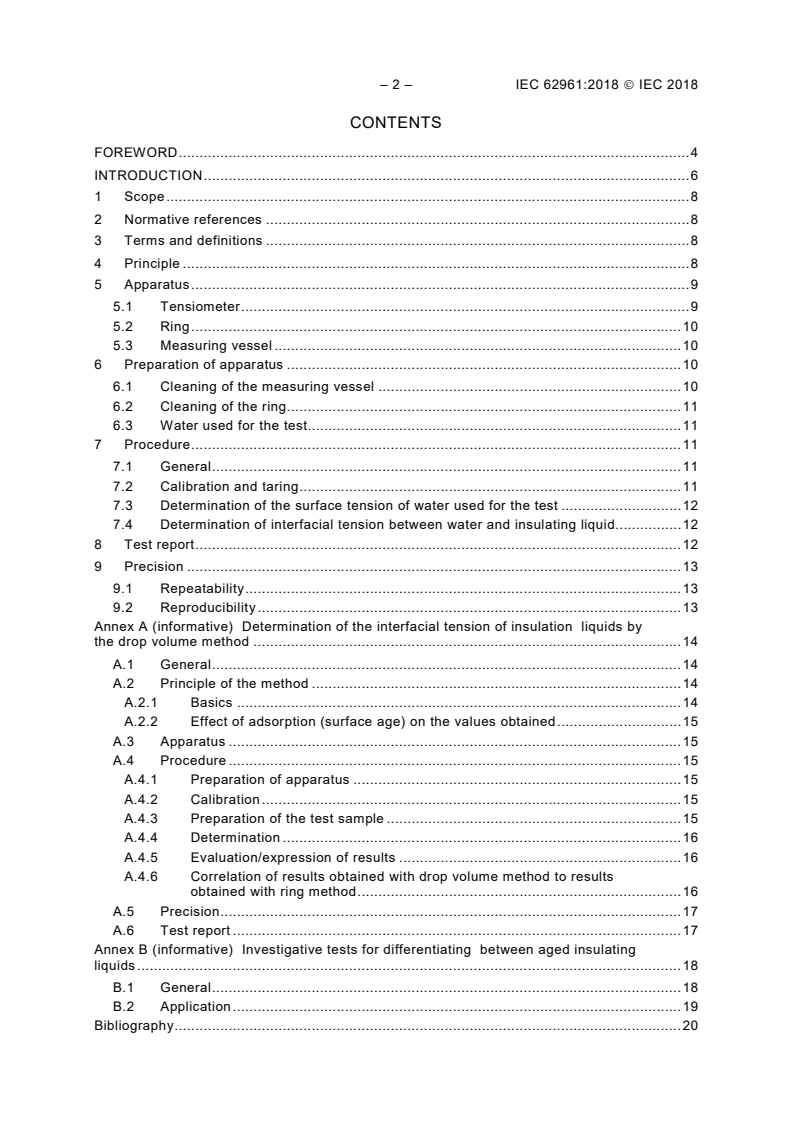
CONTENTS
FOREWORD . 4
INTRODUCTION . 6
1 Scope . 8
2 Normative references . 8
3 Terms and definitions . 8
4 Principle . 8
5 Apparatus . 9
5.1 Tensiometer . 9
5.2 Ring . 10
5.3 Measuring vessel . 10
6 Preparation of apparatus . 10
6.1 Cleaning of the measuring vessel . 10
6.2 Cleaning of the ring . 11
6.3 Water used for the test. 11
7 Procedure . 11
7.1 General . 11
7.2 Calibration and taring . 11
7.3 Determination of the surface tension of water used for the test . 12
7.4 Determination of interfacial tension between water and insulating liquid. 12
8 Test report . 12
9 Precision . 13
9.1 Repeatability . 13
9.2 Reproducibility . 13
Annex A (informative) Determination of the interfacial tension of insulation liquids by
the drop volume method . 14
A.1 General . 14
A.2 Principle of the method . 14
A.2.1 Basics . 14
A.2.2 Effect of adsorption (surface age) on the values obtained . 15
A.3 Apparatus . 15
A.4 Procedure . 15
A.4.1 Preparation of apparatus . 15
A.4.2 Calibration . 15
A.4.3 Preparation of the test sample . 15
A.4.4 Determination . 16
A.4.5 Evaluation/expression of results . 16
A.4.6 Correlation of results obtained with drop volume method to results
obtained with ring method . 16
A.5 Precision . 17
A.6 Test report . 17
Annex B (informative) Investigative tests for differentiating between aged insulating
liquids . 18
B.1 General . 18
B.2 Application . 19
Bibliography . 20
Figure 1 – Typical development of interfacial tension values of new and service aged
mineral insulating liquids . 6
Figure 2 – Typical development of interfacial tension values of a new and a service
aged ester insulating liquid . 7
Figure 3 – Dimensions of platinum-iridium alloy ring in mm . 10
Figure B.1 – Plot of the data from Table B.1 according to Kezdy-Swinbourne method . 19
Table 1 – Repeatability (r) as a % for the measurement of interfacial tension at
approximately 180 s with both manual and motor driven instruments . 13
Table 2 – Reproducibility (R) as a % for the measurement of interfacial tension at
approximately 180 s with both manual and motor driven instruments . 13
Table A.1 – Comparison of interfacial values by measurement at 180 s and at 300 s to
400 s between the drop volume and ring methods . 17
Table B.1 – Interfacial tension measured in constant equal time intervals . 18
Table B.2 – Comparison of interfacial tension values by measurement at 180 s with
equilibrium values according to Kezdy-Swinbourne method . 19
– 4 – IEC 62961:2018 IEC 2018
INTERNATIONAL ELECTROTECHNICAL COMMISSION
____________
INSULATING LIQUIDS – TEST METHODS FOR
THE DETERMINATION OF INTERFACIAL TENSION OF INSULATING
LIQUIDS – DETERMINATION WITH THE RING METHOD
FOREWORD
1) The International Electrotechnical Commission (IEC) is a worldwide organization for standardization comprising
all national electrotechnical committees (IEC National Committees). The object of IEC is to promote
international co-operation on all questions concerning standardization in the electrical and electronic fields. To
this end and in addition to other activities, IEC publishes International Standards, Technical Specifications,
Technical Reports, Publicly Available Specifications (PAS) and Guides (hereafter referred to as "IEC
Publication(s)"). Their preparation is entrusted to technical committees; any IEC National Committee interested
in the subject dealt with may participate in this preparatory work. International, governmental and non-
governmental organizations liaising with the IEC also participate in this preparation. IEC collaborates closely
with the International Organization for Standardization (ISO) in accordance with conditions determined by
agreement between the two organizations.
2) The formal decisions or agreements of IEC on technical matters express, as nearly as possible, an international
consensus of opinion on the relevant subjects since each technical committee has representation from all
interested IEC National Committees.
3) IEC Publications have the form of recommendations for international use and are accepted by IEC National
Committees in that sense. While all reasonable efforts are made to ensure that the technical content of IEC
Publications is accurate, IEC cannot be held responsible for the way in which they are used or for any
misinterpretation by any end user.
4) In order to promote international uniformity, IEC National Committees undertake to apply IEC Publications
transparently to the maximum extent possible in their national and regional publications. Any divergence
between any IEC Publication and the corresponding national or regional publication shall be clearly indicated in
the latter.
5) IEC itself does not provide any attestation of conformity. Independent certification bodies provide conformity
assessment services and, in some areas, access to IEC marks of conformity. IEC is not responsible for any
services carried out by independent certification bodies.
6) All users should ensure that they have the latest edition of this publication.
7) No liability shall attach to IEC or its directors, employees, servants or agents including individual experts and
members of its technical committees and IEC National Committees for any personal injury, property damage or
other damage of any nature whatsoever, whether direct or indirect, or for costs (including legal fees) and
expenses arising out of the publication, use of, or reliance upon, this IEC Publication or any other IEC
Publications.
8) Attention is drawn to the Normative references cited in this publication. Use of the referenced publications is
indispensable for the correct application of this publication.
9) Attention is drawn to the possibility that some of the elements of this IEC Publication may be the subject of
patent rights. IEC shall not be held responsible for identifying any or all such patent rights.
International Standard IEC 62961 has been prepared by IEC technical committee 10: Fluids
for electrotechnical applications.
The text of this standard is based on the following documents:
FDIS Report on voting
10/1062/FDIS 10/1066/RVD
Full information on the voting for the approval of this International Standard can be found in
the report on voting indicated in the above table.
This document has been drafted in accordance with the ISO/IEC Directives, Part 2.
The committee has decided that the contents of this document will remain unchanged until the
stability date indicated on the IEC website under "http://webstore.iec.ch" in the data related to
the specific document. At this date, the document will be
• reconfirmed,
• withdrawn,
• replaced by a revised edition, or
• amended.
IMPORTANT – The 'colour inside' logo on the cover page of this publication indicates
that it contains colours which are considered to be useful for the correct
understanding of its contents. Users should therefore print this document using a
colour printer.
– 6 – IEC 62961:2018 IEC 2018
INTRODUCTION
Interfacial tension (IFT) of insulating liquid against water has been used for a long time as a
criterion for ageing evaluation. Statistical values that are used as orientation values and for
their interpretation have been published in IEC 60422 [1] .
The interfacial tension of insulating liquids changes with time depending on the type and
nature of the ageing products. This process is more pronounced with aged than with new
insulating liquids. It is well known that the interfacial tension of insulating liquids depends on
the interfacial concentration of the surface active amphiphilic aged products at the time of
measuring (dynamic interfacial tension), see Figure 1. The adsorption procedures, and thus
the attaining of a state of equilibrium, can take several minutes or even hours. With the
so-called static measuring methods – e.g. the Du Noüy ring [2]– measurements are repeated
on the same sample surface until no further change occurs.
49 19
Aged mineral
New mineral
insulating liquid insulating liquid
48,5 18,5
48 18
47,5 17,5
47 17
46,5 16,5
46 16
0 100 200 300 400 500 600 700 0 100 200 300 400 500 600 700
Time (s) Time (s)
IEC IEC
a) Typical development of interfacial tension b) Typical development of interfacial tension
values of a new inhibited mineral insulating liquid values of a service aged mineral insulating liquid
Figure 1 – Typical development of interfacial tension values
of new and service aged mineral insulating liquids
____________
Numbers in square brackets refer to the Bibliography.
IFT new mineral insulating liquid (mN/m)
IFT aged mineral insulating liquid (mN/m)
New ester
Aged ester
0 200 400 600 800 1 000
Time (s)
IEC
Figure 2 – Typical development of interfacial tension values
of a new and a service aged ester insulating liquid
The interfacial tension of insulating liquids measured by the existing method ASTM D971 [3],
working in non-equilibrium modus, provides only a single value within quite a short time (60 s)
and hence might be quite different from the static interfacial value, particularly in the case of
aged insulating liquids. In addition, the error of the time measurement might become a more
important aspect than the performance of the measurement itself. These weaknesses of
ASTM D971 could be generally compensated by replacing it with EN 14210 [4]. However, for
the practical work in the laboratory, the requirement of repeating tests until "static" conditions
are obtained can increase the test time dramatically.
The scope of this document is to find a compromise between the less accurate but fast
ASTM D971 method and the precise, but time consuming EN 14210 procedure. Experience of
the round robin tests shows clearly that the slope of the time-dependent interfacial tension
curve decreases significantly over a period of 180 s in the case of both mineral insulating
liquids (Figure 1 a), Figure 1 b)) and insulating synthetic and natural esters (Figure 2). A
measurement is carried out after a surface age of approximately 180 s in order to obtain a
value that provides a more realistic expression of the real interfacial tension, and that is less
sensitive to the timing of the measurement taken, and does not overly increase the test time.
The proposed surface age of 180 s allows the distinction between differently aged ester
liquids, which is not possible with ASTM D971.
The drop volume method for the determination of interfacial tension can deliver similar results
as the ring method if adapted concerning the surface age. This method is described in
Annex A.
Experience and results of round robin tests have shown that the deviation of tests repeated
after 10 min is less than 1 mN/m per min. Such tests can be necessary in case of further
comparative investigations of aged mineral and ester insulating liquids, and are described in
Annex B.
IFT ester liquids (mN/m)
– 8 – IEC 62961:2018 IEC 2018
INSULATING LIQUIDS – TEST METHODS FOR
THE DETERMINATION OF INTERFACIAL TENSION OF INSULATING
LIQUIDS – DETERMINATION WITH THE RING METHOD
1 Scope
This document establishes the measurement of the interfacial tension between insulating
liquid and water by means of the Du Noüy ring method close to equilibrium conditions. In
order to obtain a value that provides a realistic expression of the real interfacial tension, a
measurement after a surface age of approximately 180 s is recorded.
2 Normative references
The following documents are referred to in the text in such a way that some or all of their
content constitutes requirements of this document. For dated references, only the edition
cited applies. For undated references, the latest edition of the referenced document (including
any amendments) applies.
ISO 862, Surface active agents – Vocabulary
ISO 3675, Crude petroleum and liquid petroleum products – Laboratory determination of
density – Hydrometer method
ISO 12185, Crude petroleum and petroleum products – Determination of density – Oscillating
U-tube method
EN 14370, Surface active agents – Determination of surface tension
3 Terms and definitions
For the purposes of this document, the terms and definitions given in ISO 862 and the
following apply.
ISO and IEC maintain terminological databases for use in standardization at the following
addresses:
• IEC Electropedia: available at http://www.electropedia.org/
• ISO Online browsing platform: available at http://www.iso.org/obp
3.1
interfacial tension
tension at the interface between two phases
Note 1 to entry: The SI unit of interfacial tension is the Newton per metre (N/m). In practice, the submultiple
millinewton per metre (mN/m) is used.
4 Principle
The maximum force, F, necessary to pull or to force a ring of perimeter πD out of the interface
between insulating liquid and water in the direction of the insulating liquid is measured. The
interfacial tension, σ, is obtained by calculation, where the following approximate equation (1)
serves as the base:
F
max
(1)
σ= f
2πD
where
σ is the interfacial tension expressed as mN/m;
F is the maximum force exerted on the ring when pulled out of the liquid, in mN;
max
D is the mean diameter of the ring, in m;
f is a correction factor, taking into account that the measured maximum force includes
the additional volume of liquid extracted together with the ring because of the finite
diameter of the wire and of the lamella overlap inside the ring immediately prior to
detachment. Extrapolation formulae have been reported by Zuidema and Waters [5]
and others.
For the ring dimensions valid for this document and described in EN 14370, the following
simplified correction factor (2) is commonly used for interfacial tension tests in the range from
4 mN/m to 50 mN/m:
γ
-4
f= 0,725 + 4,014 ×10 × + 0,012 87 (2)
∆ρ
where
f is the correction factor according to Zuidema and Waters [5];
γ is the interfacial tension without correction in mN/m;
is the difference in the densities between water and insulating liquid at the measuring
∆ρ
temperature in g/cm . Density shall be measured in accordance with ISO 12185
(reference method), but ISO 3675 is accepted as well.
In automatic tensiometers with a built-in evaluation unit, software may perform the necessary
corrections without a direct report of the measured force.
To obtain exact values for surface or interfacial tension, it is necessary to measure the
maximum force on pulling the ring out of the liquid. Because of the great risk of detachment in
the case of the manual apparatus, extremely smooth manipulation is necessary since the
value obtained immediately prior to detachment of the film is not identical to the maximum
value. Automatic tensiometers can determine the maximum value electronically and reverse
the platform movement promptly prior to detachment of the film. This makes it possible to
obtain reliable, accurate time-consistent serial measurements without tearing the film.
5 Apparatus
5.1 Tensiometer
The tensiometer shall be designed for a ring and shall consist mainly of two parts:
• support for the sample vessel in the form of a small horizontal platform which can be
moved up and down;
• apparatus for measuring the force exerted on the ring; the uncertainty of measurement
-6
shall not exceed ± 10 N, which corresponds to a maximum error of ± 0,1 mg weight
measurement.
Instead of a torsion balance as stated in ASTM D971, a lever balance or an electronic
balance (laboratory, analytical or microbalance) can be used. To obtain higher efficiency and
reproducibility, it is recommended to use an automatic tensiometer incorporating a balance,
motor driven platform and evaluation unit.
– 10 – IEC 62961:2018 IEC 2018
5.2 Ring
The ring shall consist of a platinum/iridium wire with a thickness not greater than 0,4 mm and
a mean circumference of 60 mm (for example: inner diameter 18,7 mm, outer diameter
19,5 mm). It shall be suspended horizontally and connected to the tensiometer.
The dimensions of the ring made of platinum-iridium alloy are specified in EN 14370
(Figure 3).
Pt/lr 10
≤0,4
ø19,5
IEC
Figure 3 – Dimensions of platinum-iridium alloy ring in mm
5.3 Measuring vessel
Cylindrical glass vessel with a minimum diameter of 60 mm.
NOTE If a vessel with a diameter of less than 60 mm is used, wall effects can cause an error in the interfacial
tension measurement result.
6 Preparation of apparatus
6.1 Cleaning of the measuring vessel
The vessels shall be dedicated to IFT measurement only. Rinsing with solvents with
increasing polarity (such as heptane, acetone and/or 2-propanol, in this order) followed by a
final rinse with hot tap water and afterwards with deionized water or bi-distilled water has
been found suitable.
EXAMPLE An example of a step-by-step cleaning procedure is as follows:
• rinse three times with n-heptane (only if the vessel is being used after previous tests with insulating liquid),
then afterwards with 2-propanol (also in the case of unused beakers and after water testing). Rinse with hot
tap water and afterwards thoroughly with deionized water/bi-distilled water – see requirements for water in 6.3.
• a laboratory dishwasher with integrated deionized water with the required quality may be used if this provides
the required cleanliness. Ensure that all washing agents are removed completely before drying.
6.2 Cleaning of the ring
The ring shall be cleaned with a suitable solvent and then by flame cleaning.
A typical cleaning procedure is as follows:
– rinse three times with n-heptane, and afterwards with deionized water;
– heat in the oxidizing flame for approximately 5 s in an ethanol or natural gas burner to red
heat.
To prevent mechanical stress on the ring, twist it during this procedure.
6.3 Water used for the test
Bi-distilled or deionized water from a glass bottle with a surface tension of > 70 mN/m at
maximum 25 °C (permissible range 18 °C to 25 °C) and with a known low conductivity
(typically < 0,1 µS/cm). It is crucial that the water used not be from the tap and that it be free
from any ions, since they may lead to a significant decrease of the measured interfacial
tension. HPLC-grade water may be used, if suitable.
NOTE For pure water, the following relationship (Equation 3) between surface tension of water and temperature
exists:
∆σ
=− 0,15 (3)
∆T
where
∆σ is the difference between the surface tension values in mN/m measured at two different temperatures;
∆T is the difference between the two temperatures in °C.
7 Procedure
7.1 General
The measurement shall be done in the temperature range between 18 °C and 25 °C. The
water and insulating liquid shall be at the same temperature. The density of the insulating
liquid shall be determined at the temperature of measurement or can be calculated from a
linear extrapolation of density from measurement at a standard temperature (e.g. 20 °C) to
the temperature used for the IFT measurement. Round robin test results have shown that
variations within this temperature range do not practically influence the test results.
The correction according to Zuidema and Waters [5] shall be used.
The correction of Zuidema and Waters [5] is the preferred correction, since it is the most
widely used in existing standards (ASTM D971, EN 14210, EN 14370). Further corrections
known are those of Harkins and Jordan [6], Fox and Chrisman [7], and Huh and Mason [8]. If
another correction formula is used, this shall be noted in the test report.
7.2 Calibration and taring
Calibration shall be performed according to manufacturer instructions.
Tare the force sensor to zero with the attached cleaned and dry ring. Ensure that there is no
contact with any sample or vessel wall.
– 12 – IEC 62961:2018 IEC 2018
7.3 Determination of the surface tension of water used for the test
Start the measurement according to the manufacturer instructions.
Introduce water into a clean vessel to a level of 20 mm to 30 mm. Slowly raise the platform
and the measurement vessel until the ring is immersed in the water phase. The ring shall be
at least 3 mm below the water surface and centred in the vessel. Ensure that the ring is
properly wetted and not repelled from the water surface.
Depending on the test temperature, a value of 70 mN/m to 73 mN/m shall be obtained. If
lower values are found, repeat cleaning of the sample vessel and the ring. Check the source
of the sample water in respect to surface active contaminants. In exceptional cases, search
for a fresh sample of water from another source (see also 6.3).
If the water quality (according to 6.3) and the cleanliness of vessels (according to 6.1) and the
ring (according to 6.2) are validated in the testing laboratory by an established and
reproducible procedure, it is not necessary to carry out the determination of the surface
tension of water (according to 7.3) prior to each sample, but once in a daily successive series
of tests.
7.4 Determination of interfacial tension between water and insulating liquid
Introduce water into a clean vessel to a level of 20 mm to 30 mm. Slowly raise the platform
and the measurement vessel until the ring is immersed in the aqueous phase. The ring shall
be at least 3 mm below the water surface and centred in the vessel.
• Then overlay the water with a 15 mm to 20 mm layer of insulating liquid using a pipette or
a clean narrow beaker with spout (if plastic single use syringes are used it shall be verified
that the material does not interact with the liquid). No bubbles shall be present. Complete
this process within 30 s.
• Begin the time counting.
• Measurement shall be completed within 180 s ± 30 s.
• The measurement value shall be taken at the time closest to 180 s (this time shall not
differ from 180 s by more than 30 s).
• Ascertain whether the obtained value is to be corrected or if the correction factor has
already been implemented in the software.
NOTE 1 Some instruments can automatize the procedures above.
NOTE 2 A series of several consecutive measurements on the same sample interface (different surface age)
within the given time frame can be made.
8 Test report
The test report shall include at least the following information:
• a reference to this document and to the method used;
• identification of test specimen;
• the date and place where the determination has been carried out;
• the type of correction formula, if other than that of Zuidema and Waters [5], as well as
further significant deviations from the described procedure;
• the value of the measured interfacial tension at approximately 180 s according to 7.4;
• ring speed in mm/s (optional).
9 Precision
9.1 Repeatability
The following results for repeatability (r) as a percentage (Table 1) were established in a
round robin test within 29 laboratories at a 95 % confidence interval:
Table 1 – Repeatability (r) as a % for the measurement of interfacial tension at
approximately 180 s with both manual and motor driven instruments
New mineral insulating
liquid
Aged mineral insulating
liquid
New ester liquid 5
Aged ester liquid 10
NOTE The repeatability for aged mineral insulating liquid is valid for absolute values higher than 20 mN/m.
Duplicate determinations carried out by one operator shall be considered suspect at the 95 %
confidence level if they differ by more than the percentage reported in Table 1.
9.2 Reproducibility
The following results for reproducibility (R) as a percentage (Table 2) were established in a
round robin test within 29 laboratories at a 95 % confidence interval:
Table 2 – Reproducibility (R) as a % for the measurement of interfacial tension at
approximately 180 s with both manual and motor driven instruments
New mineral insulating
liquid
Aged mineral insulating
liquid
New ester liquid 20
Aged ester liquid 20
Duplicate determinations carried out by different laboratories on identical test material shall
be considered suspect at the 95 % confidence level if they differ by more than the percentage
reported in Table 2.
– 14 – IEC 62961:2018 IEC 2018
Annex A
(informative)
Determination of the interfacial tension of insulation
liquids by the drop volume method
A.1 General
In practice the use of the recommended ring method suffers from some weaknesses:
• the sensitive measuring cell (balance) needs a vibration-free location;
• the method needs a very delicate Pt/Ir ring, which can be easily deformed and
contaminated;
• an open flame is needed to clean the ring by "burning": not allowed in some laboratories
for safety reasons;
• repetition of the tests with the same sample is not possible. An additional test requires a
complete replacement of the insulating liquid and water and rigorous cleaning of the
vessel and ring;
• in the case of aged insulating liquids, the dynamic effect, i.e. the (fast) decrease of IFT
with interface age, is difficult to reproduce and depends on the method and duration of the
"overlaying" process;
• the sample preparation and handling of the sample vessel requires complex steps to be
taken, that are difficult to automate.
Some laboratories have evaluated other methods of testing the IFT of insulating liquids. The
drop volume method is a particularly reasonable alternative to the force (ring) method as it
overcomes some of those weaknesses. In the tests carried out within the round robin tests,
fast and reproducible results at a well-defined interface age could be obtained. It allows
multiple tests to be carried out with many fewer samples and without the need for refilling.
The parts in contact with insulating liquid do not need flame cleaning. Syringes and needles
are stable and robust.
It shall, however, be considered that the result of the drop volume method is more sensitive to
the exact determination of the density of the liquid than that of the ring method.
A.2 Principle of the method
A.2.1 Basics
The interfacial tension between insulating liquid and water can be determined with a drop
volume tensiometer. The method uses drops (water or insulating liquid, depending on the
instrument configuration) produced by means of a vertically positioned capillary using a
suitable, high-precision dosing device.
The size of each droplet increases with specific volume flow until they break off from the
dosing capillary. The detached droplets are detected by a suitable sensor. When the volume
flow and the number of droplets are known, the break-off volume for each droplet can be
calculated. This measurement of break-off volume enables calculation of the surface tension
from the balance of forces at the moment of break-off. In the case of interfacial tension, the
needle is dipped into the test liquid – either insulating liquid or water – depending on the
instrument configuration. The droplet will detach at the moment when the buoyancy balances
the wetting force at the capillary tip.
A.2.2 Effect of adsorption (surface age) on the values obtained
As already mentioned in the introduction, the interfacial tension between insulating liquids
that contain surface active products due to aging and water depends on the interfacial
concentration of the surface active component at the moment of measuring (dynamic
interfacial tension). Because drop volume tensiometers create fresh surfaces at a defined
time (= drop age), there is no need to wait for surface saturation (adsorption equilibrium);
instead, the so-called "dynamic" surface tension can be measured reproducibly with
considerably shorter surface ages. Therefore, in comparison with other methods, it is
essential that the surface age associated with the measured interfacial tension (= drop break
time) be taken into account. Values for interfacial tension comparable with those of the ring
method can be obtained by carefully choosing an appropriate drop surface age from the data
(e.g. Table B.1) or by extrapolating a measurement curve to corresponding time frames.
For such purposes, it is advisable to determine this time-dependent interfacial tension for
each type of sample by creating droplets with different surface ages; this could be done in a
sequence, preferably program-controlled.
In the case of slowly adsorbing surfactants and low drop surface age, the dynamic values
can, therefore, be well above the equilibrium values. This is for example the case with the
stalagmometer method, which has found application in some countries.
A.3 Apparatus
A drop volume tensiometer for the purpose described above requires a temperature-controlled
cell, a sensor to detect drops, and a dosing device to create droplets providing a constant
flow rate with sufficient precision.
Laboratory thermostat, with cooling unit or other means to maintain the temperature of the
drop cell at 23 °C ± 1 °C.
A.4 Procedure
A.4.1 Preparation of apparatus
Capillaries taken from the original packaging shall be used for measurements. Avoid
unprotected contact with the capillaries. Ensure that all components coming into contact with
water or insulating liquid are cleaned in a similar way as described in 6.1.
A.4.2 Calibration
The drop volume method is an absolute method which is based on constant, predetermined or
measured geometrical values and, therefore, does not require calibration.
Regular checks of the device (e.g. the detector sensor) shall be performed according to the
manufacturer’s recommendations.
A.4.3 Preparation of the test sample
Using the thermostatic bath, adjust the temperature of the test sample to 23 °C ± 1 °C.
Determine the density of the insulating liquid under test at that temperature. Density shall be
measured in accordance with ISO 12185 (reference method) but ISO 3675 is accepted as
well.
For an accurate measurement, the density of the insulating liquid shall be known better than
± 0,01 g/cm at the temperature of measurement.
– 16 – IEC 62961:2018 IEC 2018
Pour the water and the insulating liquid into the instrument (depending on the instrument
design and experimental set-up).
A.4.4 Determination
The apparatus shall be set up in such a way that the tip of the needle is positioned into the
water/insulating liquid but far enough away from the drop sensor to avoid premature triggering
of the signal as a result of the drop growing into the field of the sensor.
It is important to ensure that the drop formation time chosen is such that the volume of the
drop that is formed is not affected. For better comparison, it is recommended to compare
identical surface ages or ranges of surface ages.
A.4.5 Evaluation/expression of results
The result of the measured interfacial tension is derived from the average of a freely
selectable number of individual measurements consisting of at least three drops.
Calculate the interfacial tension, σ, in mN/m according to the formula (A.1)
∆ρVg
σ= (A.1)
2π rf×
HB
where
σ is the interfacial tension expressed as mN/m;
∆ρ is the density difference between water and insulating liquid in g/cm ;
V is the drop break-off volume in cm ;
g is the gravitational acceleration = 981 cm/s (the exact value is given by the local
authorities);
r is the effective radius at break-off in cm;
-2
f is the correction factor (Harkins and Brown [9] in cm ) (required depending on the
HB
instrument design).
Depending on the design of the capillary, the Harkins and Brown [9] correction may be
required. Please contact the manufacturer for the choice of the correction with respect to the
capillary.
Because there is some necking of the drop when it breaks away from the needle, the effective
radius at break-off is normally slightly smaller than the external radius of the needle. The
necking depends only on the ratio of the capillary radius to a characteristic length. The
correction can be determined empirically by Harkins and Brown [9] and translated into an
analytical correlation by Wilkinson and Kidwell [10].
A.4.6 Correlation of results obtained with drop volume method to results obtained
with ring method
Limited evidence during a round robin test (Table A.1) showed
...