

IEC 61290-10-2:2007
(Main)Optical amplifiers - Test methods - Part 10-2: Multichannel parameters - Pulse method using a gated optical spectrum analyzer
General Information
- Abstract
Applies to optical fibre amplifiers (OFA) using active fibres, containing rare-earth dopants, currently commercially available. The object is to establish uniform requirements for accurate and reliable measurements of the signal-spontaneous noise figure as defined in IEC 61291-1.The test method described is, in general, for multichannel applications. Single-channel applications are a special case of multichannel applications. This second edition cancels and replaces the first edition. It is a technical revision with updated references and cautions on proper use of the procedure.
- Status
- Published
- Publication Date
- 17-Sep-2007
- Technical Committee
- SC 86C - Fibre optic systems, sensing and active devices
- Drafting Committee
- WG 3 - TC 86/SC 86C/WG 3
- Current Stage
- PPUB - Publication issued
- Start Date
- 18-Sep-2007
- Completion Date
- 30-Nov-2007
Overview
IEC 61290-10-2:2007 is an international standard developed by the International Electrotechnical Commission (IEC) focusing on optical amplifiers (OFA), specifically the testing methods for multichannel parameters using the pulse method and a gated optical spectrum analyzer (OSA). This standard applies to optical fiber amplifiers employing active fibers doped with rare-earth elements such as erbium, currently commercially available. It aims to establish uniform, accurate, and reliable measurements of the signal-spontaneous noise figure (NF), a critical parameter defined in IEC 61291-1 for evaluating amplifier performance.
The pulse method described here selectively measures amplified spontaneous emission (ASE) noise independently from the amplified signal power by applying pulsed optical inputs and synchronizing measurements with the OSA gating. This technique is designed primarily for multichannel applications and is also applicable to single-channel cases as a subset.
Key Topics
Scope and Application
This standard is dedicated to rare-earth doped optical fiber amplifiers, detailing how to measure the signal-spontaneous noise figure accurately, a key factor in fiber optic communication systems for understanding noise performance across multiple wavelengths.Test Methodology
Pulse method with gated optical spectrum analyzer: The approach involves launching optical pulses into the amplifier under test and measuring ASE levels during the ‘off’ period of the pulse via a gated OSA, while the ‘on’ period measurement captures the combined amplified signal and ASE. The difference between these measurements allows precise noise figure calculation.Test Setup and Apparatus
- Source module, which can be either:
- CW sources with optical switching and attenuation, or
- Directly modulated sources with attenuation.
- Optical attenuators for power control, optical spectrum analyzer with gating capability, and synchronization systems.
- Additional equipment includes optical power meters and polarization controllers if applicable.
- Source module, which can be either:
Measurement Parameters
- Optical pulse characteristics, such as repetition frequency and width, carefully considered to minimize gain recovery errors.
- Synchronization of pulse timing with OSA gating to isolate ASE from signal noise accurately.
- Calibration procedures ensure precise power measurement and reliability.
Noise Figure Calculation
Based on the difference between spectral power measurements during pulse 'on' and 'off' times, taking into account amplifier gain and calibration coefficients.Dynamic Gain Considerations
Gain recovery dynamics of rare-earth doped OFAs, especially erbium-doped fiber amplifiers, affect measurement accuracy. The standard advises validation of modulation frequencies to limit errors within 1 dB, with procedures detailed in Annex A for evaluating gain recovery errors.
Applications
Optical Communication Systems
Ensures precise noise figure characterization in wavelength-division multiplexing (WDM) enabled optical fiber networks, improving system design and performance evaluation.Amplifier Manufacture and Quality Control
Standardized testing allows manufacturers to verify OFA noise performance reliably, leading to improved product consistency and compliance with international norms.Research and Development
Supports R&D in advanced multi-wavelength optical amplifiers, helping engineers understand amplifier behavior in dynamic pulsed environments.System Integration and Maintenance
Network operators use standardized test methods to evaluate amplifier conditions in installed systems, contributing to optimized maintenance and troubleshooting.
Related Standards
IEC 61291-1: Optical amplifiers – Part 1: Generic specification – Defines key parameters including the signal-spontaneous noise figure that IEC 61290-10-2 helps measure.
IEC 61290-10-1: Optical amplifiers – Test methods – Part 10-1: Multichannel parameters – Optical switching technique – An alternative method for noise figure measurement to the pulse gated OSA technique.
IEC 61290 series: Other parts covering basic specifications and different test methods for optical amplifiers.
Keywords: IEC 61290-10-2, optical fiber amplifier testing, signal-spontaneous noise figure, multichannel parameters, pulse method, gated optical spectrum analyzer, erbium-doped fiber amplifier, ASE noise measurement, optical amplifier standards, WDM optical networks, optical amplifier gain dynamics, optical test methods, IEC standards.
Relations
- Effective Date
- 05-Sep-2023
Get Certified
Connect with accredited certification bodies for this standard

ANCE
Mexican certification and testing association.

Intertek Slovenia
Intertek testing, inspection, and certification services in Slovenia.

LNE (Laboratoire National de Métrologie et d'Essais)
French national laboratory for metrology and testing.
Sponsored listings
Frequently Asked Questions
IEC 61290-10-2:2007 is a standard published by the International Electrotechnical Commission (IEC). Its full title is "Optical amplifiers - Test methods - Part 10-2: Multichannel parameters - Pulse method using a gated optical spectrum analyzer". This standard covers: Applies to optical fibre amplifiers (OFA) using active fibres, containing rare-earth dopants, currently commercially available. The object is to establish uniform requirements for accurate and reliable measurements of the signal-spontaneous noise figure as defined in IEC 61291-1.The test method described is, in general, for multichannel applications. Single-channel applications are a special case of multichannel applications. This second edition cancels and replaces the first edition. It is a technical revision with updated references and cautions on proper use of the procedure.
Applies to optical fibre amplifiers (OFA) using active fibres, containing rare-earth dopants, currently commercially available. The object is to establish uniform requirements for accurate and reliable measurements of the signal-spontaneous noise figure as defined in IEC 61291-1.The test method described is, in general, for multichannel applications. Single-channel applications are a special case of multichannel applications. This second edition cancels and replaces the first edition. It is a technical revision with updated references and cautions on proper use of the procedure.
IEC 61290-10-2:2007 is classified under the following ICS (International Classification for Standards) categories: 33.180.30 - Optic amplifiers. The ICS classification helps identify the subject area and facilitates finding related standards.
IEC 61290-10-2:2007 has the following relationships with other standards: It is inter standard links to IEC 61290-10-2:2003. Understanding these relationships helps ensure you are using the most current and applicable version of the standard.
IEC 61290-10-2:2007 is available in PDF format for immediate download after purchase. The document can be added to your cart and obtained through the secure checkout process. Digital delivery ensures instant access to the complete standard document.
Standards Content (Sample)
IEC 61290-10-2
Edition 2.0 2007-09
INTERNATIONAL
STANDARD
NORME
INTERNATIONALE
Optical amplifiers – Test methods –
Part 10-2: Multichannel parameters – Pulse method using a gated optical
spectrum analyzer
Amplificateurs optiques – Méthodes d'essai –
Partie 10-2: Paramètres à canaux multiples – Méthode d'impulsion utilisant un
analyseur de spectre optique stroboscopique
All rights reserved. Unless otherwise specified, no part of this publication may be reproduced or utilized in any form or by
any means, electronic or mechanical, including photocopying and microfilm, without permission in writing from either IEC or
IEC's member National Committee in the country of the requester.
If you have any questions about IEC copyright or have an enquiry about obtaining additional rights to this publication,
please contact the address below or your local IEC member National Committee for further information.
Droits de reproduction réservés. Sauf indication contraire, aucune partie de cette publication ne peut être reproduite
ni utilisée sous quelque forme que ce soit et par aucun procédé, électronique ou mécanique, y compris la photocopie
et les microfilms, sans l'accord écrit de la CEI ou du Comité national de la CEI du pays du demandeur.
Si vous avez des questions sur le copyright de la CEI ou si vous désirez obtenir des droits supplémentaires sur cette
publication, utilisez les coordonnées ci-après ou contactez le Comité national de la CEI de votre pays de résidence.
IEC Central Office
3, rue de Varembé
CH-1211 Geneva 20
Switzerland
Email: inmail@iec.ch
Web: www.iec.ch
About the IEC
The International Electrotechnical Commission (IEC) is the leading global organization that prepares and publishes
International Standards for all electrical, electronic and related technologies.
About IEC publications
The technical content of IEC publications is kept under constant review by the IEC. Please make sure that you have the
latest edition, a corrigenda or an amendment might have been published.
ƒ Catalogue of IEC publications: www.iec.ch/searchpub
The IEC on-line Catalogue enables you to search by a variety of criteria (reference number, text, technical committee,…).
It also gives information on projects, withdrawn and replaced publications.
ƒ IEC Just Published: www.iec.ch/online_news/justpub
Stay up to date on all new IEC publications. Just Published details twice a month all new publications released. Available
on-line and also by email.
ƒ Electropedia: www.electropedia.org
The world's leading online dictionary of electronic and electrical terms containing more than 20 000 terms and definitions
in English and French, with equivalent terms in additional languages. Also known as the International Electrotechnical
Vocabulary online.
ƒ Customer Service Centre: www.iec.ch/webstore/custserv
If you wish to give us your feedback on this publication or need further assistance, please visit the Customer Service
Centre FAQ or contact us:
Email: csc@iec.ch
Tel.: +41 22 919 02 11
Fax: +41 22 919 03 00
A propos de la CEI
La Commission Electrotechnique Internationale (CEI) est la première organisation mondiale qui élabore et publie des
normes internationales pour tout ce qui a trait à l'électricité, à l'électronique et aux technologies apparentées.
A propos des publications CEI
Le contenu technique des publications de la CEI est constamment revu. Veuillez vous assurer que vous possédez
l’édition la plus récente, un corrigendum ou amendement peut avoir été publié.
ƒ Catalogue des publications de la CEI: www.iec.ch/searchpub/cur_fut-f.htm
Le Catalogue en-ligne de la CEI vous permet d’effectuer des recherches en utilisant différents critères (numéro de référence,
texte, comité d’études,…). Il donne aussi des informations sur les projets et les publications retirées ou remplacées.
ƒ Just Published CEI: www.iec.ch/online_news/justpub
Restez informé sur les nouvelles publications de la CEI. Just Published détaille deux fois par mois les nouvelles
publications parues. Disponible en-ligne et aussi par email.
ƒ Electropedia: www.electropedia.org
Le premier dictionnaire en ligne au monde de termes électroniques et électriques. Il contient plus de 20 000 termes et
définitions en anglais et en français, ainsi que les termes équivalents dans les langues additionnelles. Egalement appelé
Vocabulaire Electrotechnique International en ligne.
ƒ Service Clients: www.iec.ch/webstore/custserv/custserv_entry-f.htm
Si vous désirez nous donner des commentaires sur cette publication ou si vous avez des questions, visitez le FAQ du
Service clients ou contactez-nous:
Email: csc@iec.ch
Tél.: +41 22 919 02 11
Fax: +41 22 919 03 00
IEC 61290-10-2
Edition 2.0 2007-09
INTERNATIONAL
STANDARD
NORME
INTERNATIONALE
Optical amplifiers – Test methods –
Part 10-2: Multichannel parameters – Pulse method using a gated optical
spectrum analyzer
Amplificateurs optiques – Méthodes d'essai –
Partie 10-2: Paramètres à canaux multiples – Méthode d'impulsion utilisant un
analyseur de spectre optique stroboscopique
INTERNATIONAL
ELECTROTECHNICAL
COMMISSION
COMMISSION
ELECTROTECHNIQUE
PRICE CODE
INTERNATIONALE
N
CODE PRIX
ICS 33.180.30 ISBN 2-8318-9311-9
– 2 – 61290-10-2 © IEC:2007
CONTENTS
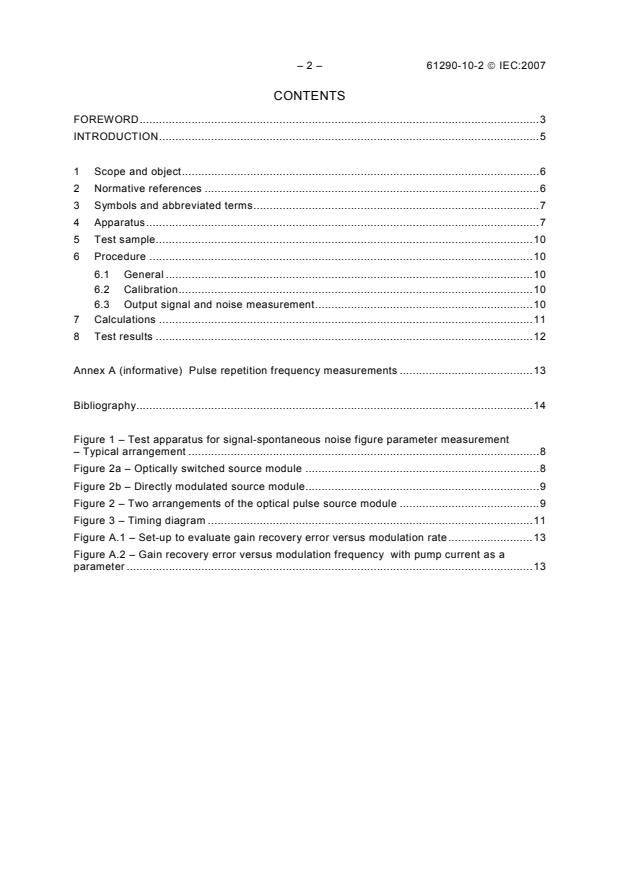
FOREWORD.3
INTRODUCTION.5
1 Scope and object.6
2 Normative references .6
3 Symbols and abbreviated terms.7
4 Apparatus.7
5 Test sample.10
6 Procedure .10
6.1 General .10
6.2 Calibration.10
6.3 Output signal and noise measurement.10
7 Calculations .11
8 Test results .12
Annex A (informative) Pulse repetition frequency measurements .13
Bibliography.14
Figure 1 – Test apparatus for signal-spontaneous noise figure parameter measurement
– Typical arrangement .8
Figure 2a – Optically switched source module .8
Figure 2b – Directly modulated source module.9
Figure 2 – Two arrangements of the optical pulse source module .9
Figure 3 – Timing diagram .11
Figure A.1 – Set-up to evaluate gain recovery error versus modulation rate.13
Figure A.2 – Gain recovery error versus modulation frequency with pump current as a
parameter .13
61290-10-2 © IEC:2007 – 3 –
INTERNATIONAL ELECTROTECHNICAL COMMISSION
____________
OPTICAL AMPLIFIERS – TEST METHODS –
Part 10-2: Multichannel parameters –
Pulse method using a gated optical spectrum analyzer
FOREWORD
1) The International Electrotechnical Commission (IEC) is a worldwide organization for standardization comprising
all national electrotechnical committees (IEC National Committees). The object of IEC is to promote
international co-operation on all questions concerning standardization in the electrical and electronic fields. To
this end and in addition to other activities, IEC publishes International Standards, Technical Specifications,
Technical Reports, Publicly Available Specifications (PAS) and Guides (hereafter referred to as “IEC
Publication(s)”). Their preparation is entrusted to technical committees; any IEC National Committee interested
in the subject dealt with may participate in this preparatory work. International, governmental and non-
governmental organizations liaising with the IEC also participate in this preparation. IEC collaborates closely
with the International Organization for Standardization (ISO) in accordance with conditions determined by
agreement between the two organizations.
2) The formal decisions or agreements of IEC on technical matters express, as nearly as possible, an international
consensus of opinion on the relevant subjects since each technical committee has representation from all
interested IEC National Committees.
3) IEC Publications have the form of recommendations for international use and are accepted by IEC National
Committees in that sense. While all reasonable efforts are made to ensure that the technical content of IEC
Publications is accurate, IEC cannot be held responsible for the way in which they are used or for any
misinterpretation by any end user.
4) In order to promote international uniformity, IEC National Committees undertake to apply IEC Publications
transparently to the maximum extent possible in their national and regional publications. Any divergence
between any IEC Publication and the corresponding national or regional publication shall be clearly indicated in
the latter.
5) IEC provides no marking procedure to indicate its approval and cannot be rendered responsible for any
equipment declared to be in conformity with an IEC Publication.
6) All users should ensure that they have the latest edition of this publication.
7) No liability shall attach to IEC or its directors, employees, servants or agents including individual experts and
members of its technical committees and IEC National Committees for any personal injury, property damage or
other damage of any nature whatsoever, whether direct or indirect, or for costs (including legal fees) and
expenses arising out of the publication, use of, or reliance upon, this IEC Publication or any other IEC
Publications.
8) Attention is drawn to the Normative references cited in this publication. Use of the referenced publications is
indispensable for the correct application of this publication.
The International Electrotechnical Commission (IEC) draws attention to the fact that it is claimed that compliance
with this document may involve the use of two patents.
One patent concerns a technique for determining the amplified spontaneous emission noise of an optical amplifier
in the presence of an optical signal given in Clause 4 and Clause 6.
IEC takes no position concerning the evidence, validity and scope of this patent right.
The holder of this patent right has assured the IEC that he/she is willing to negotiate licenses under reasonable
and non-discriminatory terms and conditions with applicants throughout the world. In this respect, the statement of
the holder of this patent right is registered with the IEC. Information may be obtained from:
Agilent Technologies
Palo Alto (CA)
USA
Another patent concerns a measurement system and noise measurement apparatus for an optical amplifier given in
Clause 4 and Clause 6.
IEC takes no position concerning the evidence, validity and scope of this patent right.
The holder of this patent right has assured the IEC that he/she is willing to negotiate licenses under reasonable
and non-discriminatory terms and conditions with applicants throughout the world. In this respect, the statement of
the holder of this patent right is registered with the IEC. Information may be obtained from:
Fujitsu Limited
Tokyo
Japan
– 4 – 61290-10-2 © IEC:2007
Attention is drawn to the possibility that some of the elements of this International Standard may be the subject of
patent rights other than those identified above. IEC shall not be held responsible for identifying any or all such
patent rights.
International Standard IEC 61290-10-2 has been prepared by subcommittee 86C: Fibre optic
systems and active devices, of IEC technical committee 86: Fibre optics.
This second edition cancels and replaces the first edition published in 2003. It is a technical
revision with updated references and cautions on proper use of the procedure.
This standard is to be read in conjunction with IEC 61291-1.
The text of this standard is based on the following documents:
FDIS Report on voting
86C/772/FDIS 86C/787/RVD
Full information on the voting for the approval of this standard can be found in the report on
voting indicated in the above table.
This publication has been drafted in accordance with the ISO/IEC Directives, Part 2.
A list of all parts of the IEC 61290 series, published under the general title Optical amplifiers –
1)
Test methods: can be found on the IEC website.
The committee has decided that the contents of this publication will remain unchanged until
the maintenance result date indicated on the IEC web site under "http://webstore.iec.ch" in
the data related to the specific publication. At this date, the publication will be
• reconfirmed,
• withdrawn,
• replaced by a revised edition, or
• amended.
—————————
1)
The first editions of some of these parts were published under the general title Optical fibre amplifiers – Basic
specification or Optical amplifier test methods.
61290-10-2 © IEC:2007 – 5 –
INTRODUCTION
As far as can be determined, this part of IEC 61290 is the first International Standard on this
subject. The technology of optical amplifiers is still evolving, hence amendments and new
editions to this document should be expected.
Each abbreviation introduced in this standard is explained in the text at least the first time it
appears. However, for an easier understanding of the whole text, a list of all abbreviations
used is given in Clause 3.
– 6 – 61290-10-2 © IEC:2007
OPTICAL AMPLIFIERS –
TEST METHODS –
Part 10-2: Multichannel parameters –
Pulse method using a gated optical spectrum analyzer
1 Scope and object
This part of IEC 61290 applies to optical fibre amplifiers (OFA) using active fibres, containing
rare-earth dopants, currently commercially available.
The object of this International Standard is to establish uniform requirements for accurate and
reliable measurements of the signal-spontaneous noise figure as defined in IEC 61291-1.
The test method independently detects amplified signal power and amplified spontaneous
emission (ASE) power by launching optical pulses into the OFA under test. The ASE level is
measured by synchronously measuring the power on an optical spectrum analyzer (OSA)
during the optical pulse off period. The average optical signal level is measured by random
sampling in the OSA.
Such measurement is possible because the gain response of the rare-earth doped OFA is
relatively slow, particularly in Er-doped OFA. However, since the OFA gain dynamics vary
with amplifier types, operating conditions, and control schemes, the gain dynamics should be
carefully considered when applying the present test method to various OFA. The
manufacturer of the OFA should present data validating the required modulation frequency to
limit the error to <1 dB. The measurements for obtaining this information are described in
Annex A.
Two alternatives for determining the signal-spontaneous noise figure are specified; namely,
the optical switching technique and the gated-OSA technique. The procedure described in this
standard is the gated-OSA technique. The optical switching technique is described in
IEC 61290-10-1.
The test method described is, in general, for multichannel applications. Single-channel
applications are a special case of multichannel applications.
NOTE All numerical values followed by (‡) are suggested values for which the measurement is assured. Other
values may be acceptable but should be verified.
2 Normative references
The following referenced documents are indispensable for the application of this document.
For dated references, only the edition cited applies. For undated references, the latest edition
of the referenced document (including any amendments) applies.
IEC 61291-1, Optical amplifiers – Part 1: Generic specification
61290-10-2 © IEC:2007 – 7 –
3 Symbols and abbreviated terms
AGC automatic gain control
ALC automatic level control
ASE amplified spontaneous emission
CW continuous wave
DBR distributed Bragg reflector (laser diode)
DFB distributed feed-back (laser diode)
ECL external cavity laser (diode)
FWHM full-width half maximum
LED light emitting diode
OFA optical fibre amplifier
OSA optical spectrum analyzer
WDM wavelength-division multiplexing (or multiplexer)
PM
P source input power on the power meter
i
OSA
P input signal power
i
λ signal wavelength
signal
B resolution bandwidth
RBW
meas
P output signal power plus ASE
total
meas
N measured ASE power
ASE
C calibration coefficient
cal
linear
P linear output signal power
o
P output signal power
o
G gain
NF signal-spontaneous noise figure
sig-sp
h Planck's constant
υ signal frequency
4 Apparatus
The basic measurement set-up is shown in Figure 1. A source module provides pulsed light to
the OFA under test and a synchronization signal to trigger the OSA gating function. The
optical attenuator adjusts the power level to the input of the OSA to a value within the OSA
measurement range.
– 8 – 61290-10-2 © IEC:2007
Optical power
meter
Calibration path
Source module
OFA under test
Polarization Optical spectrum
λ1 ~ λN
controller analyzer with
dB
(optional) a gating function
Trigger
IEC 2650/02
Figure 1 – Test apparatus for signal-spontaneous
noise figure parameter measurement –
Typical arrangement
The characteristics of the test apparatus are:
a) Source module: Two arrangements of the source module are possible, as shown in
Figure 2. The first source module (Figure 2a) consists of continuous wave (CW) optical
sources with an external optical switch and attenuator(s). The second source module
(Figure 2b) consists of directly modulated optical sources and attenuator(s). While only
one attenuator is shown, for the multi-wavelength source it will usually be necessary to
independently set channel power so that an attenuator is necessary for each channel.
Unless otherwise specified, the full-width half maximum (FWHM) of the output spectrum of
)
both source modules shall be narrower than 0,1 nm (‡) for each wavelength channel so
as not to cause any interference to adjacent channels. In the case of a single-channel
source, it shall be narrower than 1 nm (‡). Distributed feed-back lasers (DFB), distributed
Bragg reflector lasers (DBR) and external cavity laser diodes (ECL), for example, are
applicable. The suppression ratio of the side modes of the DFB laser, the DBR laser or the
ECL shall be higher than 30 dB (‡). The output power fluctuation shall be less than
0,05 dB(‡), which is more easily attainable with an optical isolator placed at the output
port of each source. (Power fluctuation in the measurements can also be caused by
interference effects if the setup or amplifier has multiple paths, such as cavities between
two reflections. These fluctuations should be controlled by using connectors or splices
with reflections weaker than -40 dB (‡) and if needed by increasing the source linewidth to
achieve coherence lengths much shorter than any unavoidable cavities in the setup.)
CW optical
Optical
Optical output
source dB
switch
λ1 ~ λN
Pulse
generator
Trigger output
IEC 2651/02
Figure 2a – Optically switched source module
—————————
2)
See Note in Clause 1.
61290-10-2 © IEC:2007 – 9 –
Direct modulated
optical source
Optical output
dB
λ1 ~ λN
Pulse
Trigger output
generator
IEC 2652/02
Figure 2b – Directly modulated source module
Figure 2 – Two arrangements of the optical pulse source module
For either arrangement of the source module, the extinction ratio shall be greater than
65 dB (‡). For the directly modulated wavelength-division multiplexing (WDM) source, care
should be taken to ensure timing synchronization of the individual lasers. The optical
switch in the arrangement of Figure 2a is typically an acousto-optic device in order to
obtain the necessary extinction ratio.
The pulse generator in combination with the modulator driver shall provide optical pulses
with the repetition frequency variable from 25 kHz to 300 kHz and a 50 % duty cycle.
The 10 % to 90 % rise and fall times shall be less than 10 % of the pulse width (‡).
The trigger output shall be coincident with the optical pulse turn-on edge with a precision
of ±1 μs (‡).
If an optical attenuator is not built into the source module, it shall have an attenuation
range greater than 40 dB (‡) and stability better than ±0,1 dB. The reflectance from this
device shall be smaller than –40 dB (‡) at each port.
b) Variable optical attenuator: The variable optical attenuator in front of the OSA shall have
an attenuation range and stability better than 20 dB (‡) and ±0,1 dB respectively.
c) Optical spectrum analyzer: This device shall have polarization sensitivity less than
±0,05 dB(‡), stability better than ±0,1 dB (‡), wavelength accuracy better than ±0,5 nm
(‡), and wavelength reproducibility better than ±0,01 nm (‡). Resolution bandwidth should
be calibrated with an accuracy better than ±3 % The device shall have a measurement
range at least from –75 dBm to +10 dBm (‡) with a resolution bandwidth better than
0,1 nm (‡). The reflectance from this device shall be smaller than –35 dB (‡) at its input
port. The OSA shall have a data sampling (gating) capability based on external triggering
with adjustable delay. The trigger delay resolution shall be ≤1 μs (‡). The OSA shall also
have the ability to do continuous (ungated) sampling in order to measure the average
power over the pulse period.
d) Optical power meter: This device shall have a measurement accuracy better than ±0,2 dB
(‡), irrespective of the state of the input light polarization, within the operational
wavelength band of the OFA and within a power range from –40 dBm to +20 dBm (‡).
e) Optical connectors: The connection loss repeatability shall be better than ±0,1 dB (‡). The
reflectance from this device shall be smaller than –40 dB (‡).
f) Optical fibre jumpers: The mode field diameter of the optical fibre jumpers shall differ from
that of the fibres used at input and output ports of the OFA by no more than ±0,5 μm.
The reflectance from optical fibre jumpers shall be less than –40 dB (‡) and their length
shall be less than 10 m.
g) Polarization controller: This device shall be able to provide as input signal light all possible
states of polarization (linear, elliptical and circular). For example, the polarization
controller may consist of an all-fibre-type polarization controller or a quarter-wave plate
rotatable by a minimum of 90° and a half-wave plate rotatable by a minimum of 180°. The
loss variation of the polarization controller shall be less than 0,1 dB (‡). The reflectance
from this device shall be smaller than –40 dB (‡) at each port. The polarization controller
needs to operate in a randomizing mode in which the polarization is scrambled at a rate
faster than the averaging time of the OSA.
– 10 – 61290-10-2 © IEC:2007
5 Test sample
The OFA shall operate under nominal operating conditions. If the OFA is likely to cause laser
oscillations due to unwanted reflections, optical isolators should be used to bracket the OFA
under test. This will minimize the signal instability and the measurement inaccuracy.
Care shall be taken in maintaining the state of polarization of the input light during the
measurement. Changes in the polarization state of the input light may result in input optical
power changes because of the slight polarization dependency expected from each of the
optical components resulting in measurement errors. This problem is largely eliminated if the
optional polarization controller is used.
6 Procedure
6.1 General
The test procedure consists of two parts:
a) calibration;
b) OFA measurement.
6.2 Calibration
To calibrate the system:
a) Select the modulation frequency and output power (or attenuator setting) of the source
module.
b) Set the output attenuator to a value such that the maximum expected power from the OFA
does not exceed the specified input level on the OSA.
If a polarization controller is used, set it to its randomizing mode in which it scrambles the
state of polarization.
c) Connect the source to the optical power meter as indicated in Figure 1 and set and
PM
measure the source input power on the power meter, P (dBm). If the source is a multi-
i
PM
wavelength source, turn on only one source at a time and set and measure P at each
i
wavelength.
d) Set the OSA to continuous sampling (no triggering). In this mode, the average power over
the pulse period is measured.
e) Connect the source to the OSA through the attenuator as shown in Figure 1 and measure
OSA
the input signal power, P . For the multi-wavelength source, repeat at each
i
wavelength.
NOTE The optical power meter detects total signal power including the source spontaneous emission. For signal
to spontaneous emission ratios of <40 dB/nm, it is necessary to consider the effect on OSA calibration and correct
accordingly.
6.3 Output signal and noise measurement
To measure the output signal and noise:
a) Connect the OFA between the source and output attenuator as shown in Figure 1.
b) Set the OSA to continuous sampling in order to measure the average power over the pulse
period. At the signal wavelength, λ , take an OSA reading in resolution bandwidth,
signal
B . A typical value of B is 0,2 nm. The measured quantity, expressed in decibels
RBW RBW
referred to 1 mW (dBm), is
61290-10-2 © IEC:2007 – 11 –
meas
output signal power plus ASE = P
total
c) Enable OSA triggering (gating).
d) Set the trigger delay value to 25 % of the modulation period in order to sample the ASE
power at the midpoint of the OFF cycle. Refer to the timing diagram in Figure 3.
e) Take OSA readings at λ +Δλ, and λ – Δλ. The measured quantities are the ASE
signal signal
power, expressed in decibels referred to 1 mW (dBm), at an offset, Δλ, from the signal
wavelength:
meas meas
N (λ + Δλ) and N (λ – Δλ)
signal signal
ASE ASE
f) For a multi-wavelength source, this procedure shall be repeated at each channel
NOTE 1 The error due to imperfect source extinction and OSA transient response is eliminated by interpolating
the ASE power at small Δλ from the signal wavelength. In IEC 61290-3-1, interpolation is integral to the
polarization nulling method in order to overcome non-ideal polarizer extinction. The value of Δλ may range from
zero (no interpolation) to about 1 nm. For a multi-wavelength source, Δλ should be set to less than one-half of the
channel separation. If the OFA contains a steep filter, the simple straight-line interpolation described here will
result in appreciable error. In that case, a suitable polynomial interpolation fit to the ASE data adjacent to the
signal wavelengths should be used. While interpolation will improve accuracy in most cases, it is not mandatory in
the implementation of this procedure.
40 μs
Input signal
(pulse modulation)
Optical power
(OFA output)
ASE power
(magnified)
OSA sampling
point
10 μs
IEC 2653/02
NOTE 2 Times indicated are for a 25 kHz pulse repetition rate. For higher repetition rates, the timing is adjusted
accordingly. OSA sampling need not occur at every pulse off period as shown.
Figure 3 – Timing diagram
7 Calculations
a) Calculate the calibration coefficient, C , expressed in decibels (dB). This term accounts
cal
for the attenuation of the output attenuator and the OSA amplitude response.
PM OSA
C = P − P (1)
cal
i i
b) Calculate the ASE at the signal wavelength, expressed in decibels referred to 1 mW (dBm):
meas meas
N (λ + Δλ) + N (λ − Δλ)
ASE signal ASE signal
N = + C (2)
ASE cal
linear
c) Calculate the linear output signal power, P , expressed in milliwatts (mW):
o
meas
P +C
cal N
total ASE
linear
10 10
P = 10 − 10 (3)
o
– 12 – 61290-10-2 © IEC:2007
d) Calculate the output signal power, P in decibels referred to 1 mW (dBm):
o,
linear
P = 10 log P (4)
o o
e) Calculate the gain, G, expressed in decibels (dB):
PM
G = P − P (5)
o
i
f) Calculate the signal-spontaneous noise figure, NF , expressed in decibels (dB)
sig-sp
NF = N − G − 10 log (hυB ) (6)
sig−sp ASE RBW
where
h is Planck's constant (Ws );
υ is the signal frequency (Hz);
B is the OSA resolution bandwidth (Hz).
RBW
8 Test results
The following details shall be presented for each channel:
a) spectral full width half maximum linewidth (FWHM) of the optical source
b) input signal wavelengths: λ
k
OSA optical bandwidth: B
c) RBW
d) indication of the optical pump power (if applicable)
e) ambient temperature
f) pulse repetition rate
g) input power levels
offset wavelength for interpolation, Δλ
h)
i) gain, G
j) ASE power: N
ASE
k) signal-spontaneous noise figure, NF
sig-sp
61290-10-2 © IEC:2007 – 13 –
Annex A
(informative)
Pulse repetition frequency measurements
The measurements described in this annex are possible because the gain response of the
rare-earth doped fibre amplifier is relatively slow, that is >100 μs for Er-doped fibre amplifiers.
Currently, the gain recovery times allow pulse repetition rates in the 25 kHz to 100 kHz range.
A simple set-up to evaluate OFA gain response versus modulation frequency is shown in
Figure A.1. An optical source with variable modulation frequency is applied to the OFA. The
average output power of the OFA is measured on an optical power meter. As the modulation
frequency is increased, the power meter reading asymptotically approaches a final value. At
low modulation frequencies there is an increasing error due to non-linear gain recovery of
the OFA.
OFA
Optical power
Pulse modulated
meter
optical source
IEC 2654/02
Figure A.1 – Set-up to evaluate gain recovery error versus modulation rate
Figure A.2 shows a measurement on a 980 nm pumped Er-doped fibre amplifier with three
values of pump current. As pump power increases, the gain recovery time constant becomes
shorter, resulting in a larger deviation from the high-frequency value. For this particular
amplifier, a modulation frequency above 20 kHz is required to give <0,1 dB error in measured
gain at 500 mA pump current.
–0,2
100 mA
–0,4
200 mA
–0,6
–0,8
500 mA
–1,0
–1,2
–1,4
110 1000
Modulation frequency kHz
IEC 2655/02
Figure A.2 – Gain recovery error versus modulation frequency
with pump current as a parameter
However, there are two situations that require careful consideration of modulation frequency.
First, as indicated in Figure A.2, higher pump current shortens the recovery time. Secondly, in
some situations it is necessary to test OFAs when automatic gain control (AGC) or automatic
level control (ALC) circuitry is operational. The bandwidths of these AGC and ALC control
loops will impose limitations on the modulation rate. It is recommended that this test be
performed to qualify the appropriate modulation rate for a particular amplifier design.
NOTE In performing the above test, modulation rates below about 10 kHz should not be used. A large output
power transient could destroy OFA or test system components.
Gain recovery error dB
...