

IEC 62421:2007
(Main)Electronics assembly technology - Electronic modules
General Information
- Abstract
IEC 62421:2007 provides a generic standard of electronic modules on which their sectional standards are based. It provides a definition, business model, interface between the trading partners, and related areas of standardization of electronic modules. In addition a generic set of test method is provided.
- Status
- Published
- Publication Date
- 23-Aug-2007
- Technical Committee
- TC 91 - Electronics assembly technology
- Drafting Committee
- WG 1 - TC 91/WG 1
- Current Stage
- PPUB - Publication issued
- Start Date
- 29-Aug-2007
- Completion Date
- 30-Sep-2007
Buy Documents
IEC 62421:2007 - Electronics assembly technology - Electronic modules Released:8/29/2007
IEC 62421:2007 - Electronics assembly technology - Electronic modules Released:8/24/2007
Overview
IEC 62421:2007 - Electronics assembly technology - Electronic modules - is a generic international standard that defines electronic modules, their business models, supplier‑user interfaces, and the standardization areas on which sectional (module‑specific) standards are based. The standard establishes a common vocabulary and a generic set of test methods to support module specification, design handover and verification across the electronics supply chain.
Key topics and requirements
- Definition and scope: Clear definition of an electronic module as a functional block containing electronic elements/packages intended for next‑level assemblies (wired, wireless, opto‑electronic, sensor, actuator modules).
- Business models: Classification of module supply chains into E‑type, M‑type and F‑type business models (in‑house, module supplier, and fabless/ODM models) and explanation of how requirements vary by model.
- S‑U interfaces: Three supplier–user interfaces (S‑U interface‑1, ‑2, ‑3) that define responsibilities and information flow between material suppliers, module designers/manufacturers and end users.
- Preferred ratings and characteristics: Guidance on preferred operating and storage temperature ranges, rated voltage, coplanarity, and other preferred ratings to harmonize module specifications.
- Tests and measuring methods: A generic test framework covering
- Electrical performance tests (measurement accuracy, equipment protection)
- Mechanical tests: robustness of terminations and mounting, resistance to soldering heat, solderability, shock, sinusoidal vibration, resistance to solvents
- Climatic tests: dry heat, cold, damp heat (steady state), change of temperature
- Standard atmospheric, referee and reference conditions for repeatable testing
- Standardization areas: Identification of topics to be standardized in sectional documents depending on business model and S‑U interfaces.
Applications and users
IEC 62421 is practical for:
- Module designers (including fabless companies) and OEMs defining handover requirements
- Contract manufacturers and foundries (ODMs) implementing manufacturing and test processes
- Suppliers of parts, substrates and assembly services needing to align specifications
- Test laboratories and quality/verification teams that perform module qualification Use cases include defining module interfaces for system integration, selecting environmental and mechanical tests for qualification, and establishing supplier contracts that reference consistent test conditions.
Related standards
- Normative references include the IEC 60068 series (environmental testing) and ISO 3 (preferred numbers). Sectional module standards should reference IEC 62421 for business model and S‑U interface context.
Keywords: IEC 62421, electronic modules, electronics assembly technology, module testing, supplier‑user interface, environmental testing, solderability, vibration, shock, operating temperature range.
Buy Documents
IEC 62421:2007 - Electronics assembly technology - Electronic modules Released:8/29/2007
IEC 62421:2007 - Electronics assembly technology - Electronic modules Released:8/24/2007
Frequently Asked Questions
IEC 62421:2007 is a standard published by the International Electrotechnical Commission (IEC). Its full title is "Electronics assembly technology - Electronic modules". This standard covers: IEC 62421:2007 provides a generic standard of electronic modules on which their sectional standards are based. It provides a definition, business model, interface between the trading partners, and related areas of standardization of electronic modules. In addition a generic set of test method is provided.
IEC 62421:2007 provides a generic standard of electronic modules on which their sectional standards are based. It provides a definition, business model, interface between the trading partners, and related areas of standardization of electronic modules. In addition a generic set of test method is provided.
IEC 62421:2007 is classified under the following ICS (International Classification for Standards) categories: 31.190 - Electronic component assemblies. The ICS classification helps identify the subject area and facilitates finding related standards.
IEC 62421:2007 is available in PDF format for immediate download after purchase. The document can be added to your cart and obtained through the secure checkout process. Digital delivery ensures instant access to the complete standard document.
Standards Content (Sample)
IEC 62421
Edition 1.0 2007-08
INTERNATIONAL
STANDARD
Electronics assembly technology – Electronic modules
All rights reserved. Unless otherwise specified, no part of this publication may be reproduced or utilized in any form
or by any means, electronic or mechanical, including photocopying and microfilm, without permission in writing from
either IEC or IEC's member National Committee in the country of the requester.
If you have any questions about IEC copyright or have an enquiry about obtaining additional rights to this publication,
please contact the address below or your local IEC member National Committee for further information.
IEC Central Office
3, rue de Varembé
CH-1211 Geneva 20
Switzerland
Email: inmail@iec.ch
Web: www.iec.ch
About the IEC
The International Electrotechnical Commission (IEC) is the leading global organization that prepares and publishes
International Standards for all electrical, electronic and related technologies.
About IEC publications
The technical content of IEC publications is kept under constant review by the IEC. Please make sure that you have the
latest edition, a corrigenda or an amendment might have been published.
ƒ Catalogue of IEC publications: www.iec.ch/searchpub
The IEC on-line Catalogue enables you to search by a variety of criteria (reference number, text, technical committee,…).
It also gives information on projects, withdrawn and replaced publications.
ƒ IEC Just Published: www.iec.ch/online_news/justpub
Stay up to date on all new IEC publications. Just Published details twice a month all new publications released. Available
on-line and also by email.
ƒ Electropedia: www.electropedia.org
The world's leading online dictionary of electronic and electrical terms containing more than 20 000 terms and definitions
in English and French, with equivalent terms in additional languages. Also known as the International Electrotechnical
Vocabulary online.
ƒ Customer Service Centre: www.iec.ch/webstore/custserv
If you wish to give us your feedback on this publication or need further assistance, please visit the Customer Service
Centre FAQ or contact us:
Email: csc@iec.ch
Tel.: +41 22 919 02 11
Fax: +41 22 919 03 00
IEC 62421
Edition 1.0 2007-08
INTERNATIONAL
STANDARD
Electronics assembly technology – Electronic modules
INTERNATIONAL
ELECTROTECHNICAL
COMMISSION
PRICE CODE
P
ICS 31.190 ISBN 2-8318-9300-3
– 2 – 62421 © IEC:2007(E)
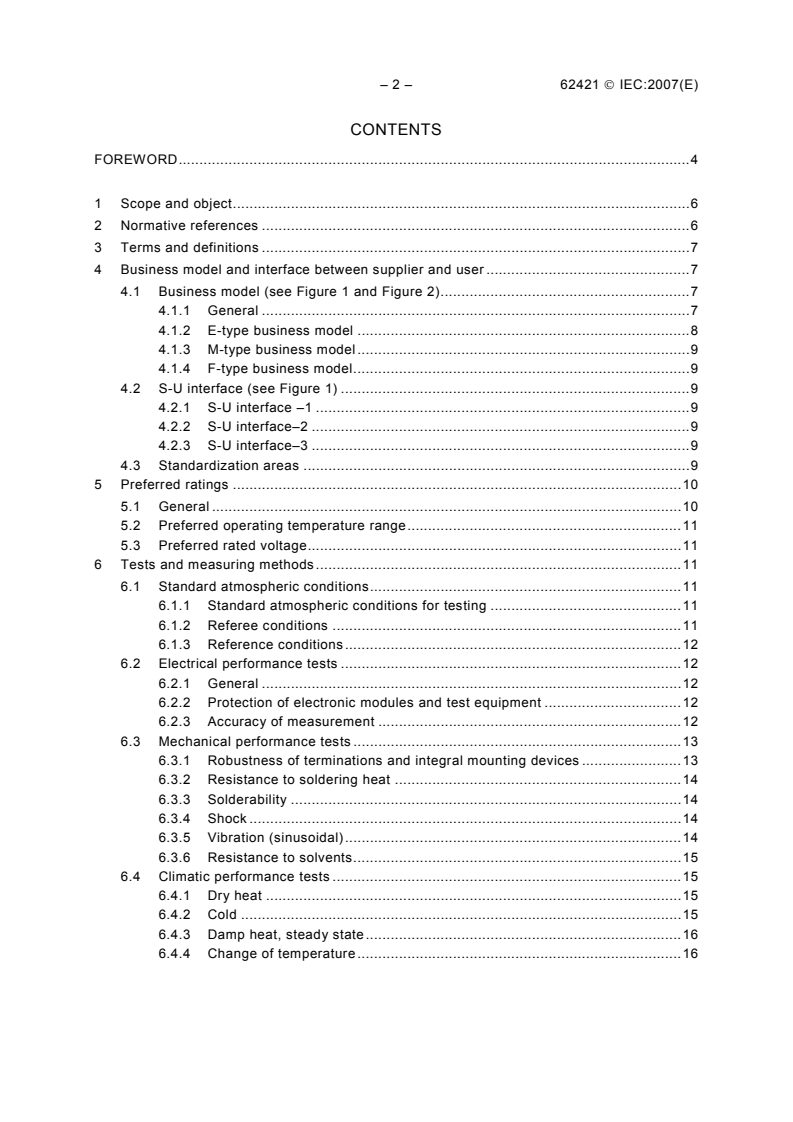
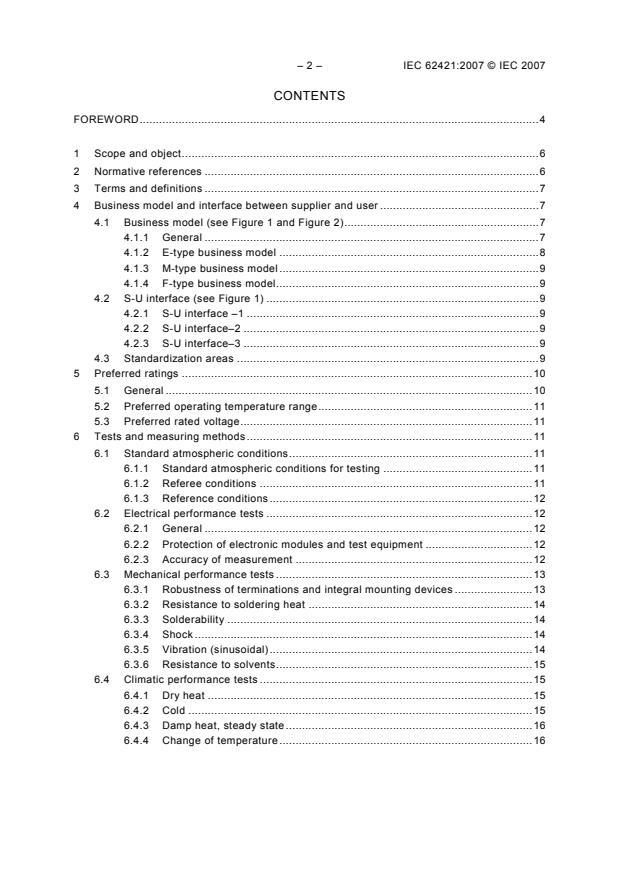
CONTENTS
FOREWORD.4
1 Scope and object.6
2 Normative references .6
3 Terms and definitions .7
4 Business model and interface between supplier and user .7
4.1 Business model (see Figure 1 and Figure 2).7
4.1.1 General .7
4.1.2 E-type business model .8
4.1.3 M-type business model.9
4.1.4 F-type business model.9
4.2 S-U interface (see Figure 1) .9
4.2.1 S-U interface –1 .9
4.2.2 S-U interface–2 .9
4.2.3 S-U interface–3 .9
4.3 Standardization areas .9
5 Preferred ratings .10
5.1 General .10
5.2 Preferred operating temperature range.11
5.3 Preferred rated voltage.11
6 Tests and measuring methods .11
6.1 Standard atmospheric conditions.11
6.1.1 Standard atmospheric conditions for testing .11
6.1.2 Referee conditions .11
6.1.3 Reference conditions.12
6.2 Electrical performance tests .12
6.2.1 General .12
6.2.2 Protection of electronic modules and test equipment .12
6.2.3 Accuracy of measurement .12
6.3 Mechanical performance tests .13
6.3.1 Robustness of terminations and integral mounting devices .13
6.3.2 Resistance to soldering heat .14
6.3.3 Solderability .14
6.3.4 Shock .14
6.3.5 Vibration (sinusoidal).14
6.3.6 Resistance to solvents.15
6.4 Climatic performance tests .15
6.4.1 Dry heat .15
6.4.2 Cold .15
6.4.3 Damp heat, steady state.16
6.4.4 Change of temperature.16
62421 © IEC:2007(E) – 3 –
Figure 1 – S-U interfaces in each business model.8
Figure 2 – Standardization areas in M-type and F-type business models .10
Table 1 – Preferred temperatures to be selected for temperature ranges (°C).11
Table 2 – Referee conditions .12
Table 3 – Application .14
– 4 – 62421 © IEC:2007(E)
INTERNATIONAL ELECTROTECHNICAL COMMISSION
______________
ELECTRONICS ASSEMBLY TECHNOLOGY –
ELECTRONIC MODULES
FOREWORD
1) The International Electrotechnical Commission (IEC) is a worldwide organization for standardization comprising
all national electrotechnical committees (IEC National Committees). The object of IEC is to promote
international co-operation on all questions concerning standardization in the electrical and electronic fields. To
this end and in addition to other activities, IEC publishes International Standards, Technical Specifications,
Technical Reports, Publicly Available Specifications (PAS) and Guides (hereafter referred to as “IEC
Publication(s)”). Their preparation is entrusted to technical committees; any IEC National Committee interested
in the subject dealt with may participate in this preparatory work. International, governmental and non-
governmental organizations liaising with the IEC also participate in this preparation. IEC collaborates closely
with the International Organization for Standardization (ISO) in accordance with conditions determined by
agreement between the two organizations.
2) The formal decisions or agreements of IEC on technical matters express, as nearly as possible, an international
consensus of opinion on the relevant subjects since each technical committee has representation from all
interested IEC National Committees.
3) IEC Publications have the form of recommendations for international use and are accepted by IEC National
Committees in that sense. While all reasonable efforts are made to ensure that the technical content of IEC
Publications is accurate, IEC cannot be held responsible for the way in which they are used or for any
misinterpretation by any end user.
4) In order to promote international uniformity, IEC National Committees undertake to apply IEC Publications
transparently to the maximum extent possible in their national and regional publications. Any divergence
between any IEC Publication and the corresponding national or regional publication shall be clearly indicated in
the latter.
5) IEC provides no marking procedure to indicate its approval and cannot be rendered responsible for any
equipment declared to be in conformity with an IEC Publication.
6) All users should ensure that they have the latest edition of this publication.
7) No liability shall attach to IEC or its directors, employees, servants or agents including individual experts and
members of its technical committees and IEC National Committees for any personal injury, property damage or
other damage of any nature whatsoever, whether direct or indirect, or for costs (including legal fees) and
expenses arising out of the publication, use of, or reliance upon, this IEC Publication or any other IEC
Publications.
8) Attention is drawn to the Normative references cited in this publication. Use of the referenced publications is
indispensable for the correct application of this publication.
9) Attention is drawn to the possibility that some of the elements of this IEC Publication may be the subject of
patent rights. IEC shall not be held responsible for identifying any or all such patent rights.
International Standard IEC 62421 has been prepared by IEC technical committee 91:
Electronics assembly technology.
The text of this standard is based on the following documents:
FDIS Report on voting
91/689/FDIS 91/722/RVD
Full information on the voting for the approval of this standard can be found in the report on
voting indicated in the above table.
This publication has been drafted in accordance with the ISO/IEC Directives, Part 2.
62421 © IEC:2007(E) – 5 –
The committee has decided that the contents of this publication will remain unchanged until
the maintenance result date indicated on the IEC web site under "http://webstore.iec.ch" in
the data related to the specific publication. At this date, the publication will be
• reconfirmed;
• withdrawn;
• replaced by a revised edition, or
• amended.
A bilingual version of this publication may be issued at a later date.
– 6 – 62421 © IEC:2007(E)
ELECTRONICS ASSEMBLY TECHNOLOGY –
ELECTRONIC MODULES
1 Scope and object
This International Standard provides a generic standard of electronic modules on which their
sectional standards are based.
This standard provides a definition, business model, interface between the trading partners,
and related areas of standardization of electronic modules. In addition a generic set of test
method is provided.
2 Normative references
The following referenced documents are indispensable for the application of this document.
For dated references, only the edition cited applies. For undated references, the latest edition
of the referenced document (including any amendments) applies.
IEC 60068 (all parts), Environmental testing
IEC 60068-1:1988, Environmental testing – Part 1: General and guidance
IEC 60068-2-1: Environmental Testing – Part 2-1: Tests – Test A: Cold
IEC 60068-2-2: Environmental testing – Part 2-2: Tests – Tests B: Dry heat
IEC 60068-2-6: Environmental testing – Part 2-6: Tests – Test Fc: Vibration (sinusoidal)
IEC 60068-2-14: Environmental testing – Part 2-14: Tests – Test N: Change of temperature
IEC 60068-2-20: Environmental testing – Part 2-20: Tests – Test T: Soldering
IEC 60068-2-21: Environmental testing – Part 2-21: Tests – Test U: Robustness of
terminations and integral mounting devices
IEC 60068-2-27: Environmental testing – Part 2-27: Tests – Test Ea and guidance: Shock
IEC 60068-2-45: Environmental testing – Part 2-45: Tests – Test XA and guidance: Immersion
in cleaning solvents
IEC 60068-2-58: Environmental testing – Part 2-58: Tests – Test Td: Test methods for
solderability, resistance to dissolution of metallization and to soldering heat of surface
mounting devices (SMD)
IEC 60068-2-78: Environmental testing – Part 2-78: Tests – Test Cab: Damp heat, steady
state
ISO 3: Preferred numbers – Series of preferred numbers
62421 © IEC:2007(E) – 7 –
3 Terms and definitions
For the purposes of this document, the terms and definitions given in the IEC 60068 series, as
well as the following, apply.
3.1
electronic module
functional block which contains individual electronic elements and /or electronic packages, to
be used in a next level assembly
NOTE An individual module having an application-specific function, including electronic, optoelectronic,
mechanical or other elements. The module typically provides protection of its elements and packages to assure the
required level of reliability.
Electronic modules may be categorized by signal interface, for example:
– wired module: a module which has only electrical interfaces (majority of present day modules)
– wireless module: a module which has a wireless interface
– opto-electronic module: a module which has an optoelectronic interface
– sensor module: a module which can input physical information
– actuator module: a module which could output physical information
3.2
coplanarity
distance in height between the lowest and highest leads or terminals when the module is in its
seating plane
3.3
operating temperature range
range of the ambient temperature at which an electronic module may be used continuously
3.4
storage temperature range
range of the ambient temperature at which an electronic module may be stored continuously
3.5
rated voltage
maximum d.c. voltage or the root-mean square value of an a.c. voltage which may be applied
continuously to an electronic module at any temperature within the operating temperature
range
4 Business model and interface between supplier and user
4.1 Business model (see Figure 1 and Figure 2)
4.1.1 General
Business models for electronic module manufacturing are classified into three types (See
Figure 1):
− E-type;
− M-type;
− F-type business models.
A supplier of material/parts is at one end of a business chain, from the viewpoint of an
electronic module supplier. A user of electronic modules is at the other end of the chain.
Items to be specified in standards of electronic modules depend on the business model to
which the relevant module is classified.
– 8 – 62421 © IEC:2007(E)
Items to be standardized basically depend on the relationship between suppliers and users
(S-U Interface). Moreover, the S-U Interface depends on the business model.
The S-U interface showing the relationship between suppliers and users shall be clarified in
the scope of a standard for an electronic module.
Business chain and models
M-Type F-Type
E-Type
(Fabless)
(module
(OEM)
manufacturer)
User
Design Design Design
Material
S-U interface 2
Substrate Substrate
and manufacturing manufacturing
Substrate
manufacturing
parts
Assembly Assembly
supply
Assembly
Test
Test Test
Packaging
Packaging Packaging
S-U Interface 2
Supply to user
Equipment Supply to user
production
S-U interface 3
Equipment Equipment
User
production production
IEC 1688/07
NOTE S-
...
IEC 62421 ®
Edition 1.0 2007-08
INTERNATIONAL
STANDARD
NORME
INTERNATIONALE
Electronics assembly technology – Electronic modules
Techniques d'assemblage des composants électroniques – Modules
électroniques
All rights reserved. Unless otherwise specified, no part of this publication may be reproduced or utilized in any form
or by any means, electronic or mechanical, including photocopying and microfilm, without permission in writing from
either IEC or IEC's member National Committee in the country of the requester. If you have any questions about IEC
copyright or have an enquiry about obtaining additional rights to this publication, please contact the address below or
your local IEC member National Committee for further information.
Droits de reproduction réservés. Sauf indication contraire, aucune partie de cette publication ne peut être reproduite
ni utilisée sous quelque forme que ce soit et par aucun procédé, électronique ou mécanique, y compris la photocopie
et les microfilms, sans l'accord écrit de l'IEC ou du Comité national de l'IEC du pays du demandeur. Si vous avez des
questions sur le copyright de l'IEC ou si vous désirez obtenir des droits supplémentaires sur cette publication, utilisez
les coordonnées ci-après ou contactez le Comité national de l'IEC de votre pays de résidence.
IEC Central Office Tel.: +41 22 919 02 11
3, rue de Varembé Fax: +41 22 919 03 00
CH-1211 Geneva 20 info@iec.ch
Switzerland www.iec.ch
About the IEC
The International Electrotechnical Commission (IEC) is the leading global organization that prepares and publishes
International Standards for all electrical, electronic and related technologies.
About IEC publications
The technical content of IEC publications is kept under constant review by the IEC. Please make sure that you have the
latest edition, a corrigenda or an amendment might have been published.
IEC Catalogue - webstore.iec.ch/catalogue Electropedia - www.electropedia.org
The stand-alone application for consulting the entire The world's leading online dictionary of electronic and
bibliographical information on IEC International Standards, electrical terms containing more than 30 000 terms and
Technical Specifications, Technical Reports and other definitions in English and French, with equivalent terms in 14
documents. Available for PC, Mac OS, Android Tablets and additional languages. Also known as the International
iPad. Electrotechnical Vocabulary (IEV) online.
IEC publications search - www.iec.ch/searchpub IEC Glossary - std.iec.ch/glossary
The advanced search enables to find IEC publications by a More than 55 000 electrotechnical terminology entries in
variety of criteria (reference number, text, technical English and French extracted from the Terms and Definitions
committee,…). It also gives information on projects, replaced clause of IEC publications issued since 2002. Some entries
and withdrawn publications. have been collected from earlier publications of IEC TC 37,
77, 86 and CISPR.
IEC Just Published - webstore.iec.ch/justpublished
Stay up to date on all new IEC publications. Just Published IEC Customer Service Centre - webstore.iec.ch/csc
details all new publications released. Available online and If you wish to give us your feedback on this publication or
also once a month by email. need further assistance, please contact the Customer Service
Centre: csc@iec.ch.
A propos de l'IEC
La Commission Electrotechnique Internationale (IEC) est la première organisation mondiale qui élabore et publie des
Normes internationales pour tout ce qui a trait à l'électricité, à l'électronique et aux technologies apparentées.
A propos des publications IEC
Le contenu technique des publications IEC est constamment revu. Veuillez vous assurer que vous possédez l’édition la
plus récente, un corrigendum ou amendement peut avoir été publié.
Catalogue IEC - webstore.iec.ch/catalogue Electropedia - www.electropedia.org
Application autonome pour consulter tous les renseignements
Le premier dictionnaire en ligne de termes électroniques et
bibliographiques sur les Normes internationales,
électriques. Il contient plus de 30 000 termes et définitions en
Spécifications techniques, Rapports techniques et autres
anglais et en français, ainsi que les termes équivalents dans
documents de l'IEC. Disponible pour PC, Mac OS, tablettes
14 langues additionnelles. Egalement appelé Vocabulaire
Android et iPad.
Electrotechnique International (IEV) en ligne.
Recherche de publications IEC - www.iec.ch/searchpub
Glossaire IEC - std.iec.ch/glossary
La recherche avancée permet de trouver des publications IEC Plus de 55 000 entrées terminologiques électrotechniques, en
en utilisant différents critères (numéro de référence, texte, anglais et en français, extraites des articles Termes et
comité d’études,…). Elle donne aussi des informations sur les Définitions des publications IEC parues depuis 2002. Plus
projets et les publications remplacées ou retirées. certaines entrées antérieures extraites des publications des
CE 37, 77, 86 et CISPR de l'IEC.
IEC Just Published - webstore.iec.ch/justpublished
Service Clients - webstore.iec.ch/csc
Restez informé sur les nouvelles publications IEC. Just
Published détaille les nouvelles publications parues. Si vous désirez nous donner des commentaires sur cette
Disponible en ligne et aussi une fois par mois par email. publication ou si vous avez des questions contactez-nous:
csc@iec.ch.
IEC 62421 ®
Edition 1.0 2007-08
INTERNATIONAL
STANDARD
NORME
INTERNATIONALE
Electronics assembly technology – Electronic modules
Techniques d'assemblage des composants électroniques – Modules
électroniques
INTERNATIONAL
ELECTROTECHNICAL
COMMISSION
COMMISSION
ELECTROTECHNIQUE
PRICE CODE
INTERNATIONALE
CODE PRIX P
ICS 31.190 ISBN 978-2-8322-1466-4
– 2 – IEC 62421:2007 © IEC 2007
CONTENTS
FOREWORD . 4
1 Scope and object . 6
2 Normative references . 6
3 Terms and definitions . 7
4 Business model and interface between supplier and user . 7
4.1 Business model (see Figure 1 and Figure 2) . 7
4.1.1 General . 7
4.1.2 E-type business model . 8
4.1.3 M-type business model . 9
4.1.4 F-type business model . 9
4.2 S-U interface (see Figure 1) . 9
4.2.1 S-U interface –1 . 9
4.2.2 S-U interface–2 . 9
4.2.3 S-U interface–3 . 9
4.3 Standardization areas . 9
5 Preferred ratings . 10
5.1 General . 10
5.2 Preferred operating temperature range . 11
5.3 Preferred rated voltage . 11
6 Tests and measuring methods . 11
6.1 Standard atmospheric conditions . 11
6.1.1 Standard atmospheric conditions for testing . 11
6.1.2 Referee conditions . 11
6.1.3 Reference conditions . 12
6.2 Electrical performance tests . 12
6.2.1 General . 12
6.2.2 Protection of electronic modules and test equipment . 12
6.2.3 Accuracy of measurement . 12
6.3 Mechanical performance tests . 13
6.3.1 Robustness of terminations and integral mounting devices . 13
6.3.2 Resistance to soldering heat . 14
6.3.3 Solderability . 14
6.3.4 Shock . 14
6.3.5 Vibration (sinusoidal) . 14
6.3.6 Resistance to solvents . 15
6.4 Climatic performance tests . 15
6.4.1 Dry heat . 15
6.4.2 Cold . 15
6.4.3 Damp heat, steady state . 16
6.4.4 Change of temperature . 16
Figure 1 – S-U interfaces in each business model . 8
Figure 2 – Standardization areas in M-type and F-type business models . 10
Table 1 – Preferred temperatures to be selected for temperature ranges (°C) . 11
Table 2 – Referee conditions . 12
Table 3 – Application . 14
– 4 – IEC 62421:2007 © IEC 2007
INTERNATIONAL ELECTROTECHNICAL COMMISSION
______________
ELECTRONICS ASSEMBLY TECHNOLOGY –
ELECTRONIC MODULES
FOREWORD
1) The International Electrotechnical Commission (IEC) is a worldwide organization for standardization comprising
all national electrotechnical committees (IEC National Committees). The object of IEC is to promote
international co-operation on all questions concerning standardization in the electrical and electronic fields. To
this end and in addition to other activities, IEC publishes International Standards, Technical Specifications,
Technical Reports, Publicly Available Specifications (PAS) and Guides (hereafter referred to as “IEC
Publication(s)”). Their preparation is entrusted to technical committees; any IEC National Committee interested
in the subject dealt with may participate in this preparatory work. International, governmental and non-
governmental organizations liaising with the IEC also participate in this preparation. IEC collaborates closely
with the International Organization for Standardization (ISO) in accordance with conditions determined by
agreement between the two organizations.
2) The formal decisions or agreements of IEC on technical matters express, as nearly as possible, an international
consensus of opinion on the relevant subjects since each technical committee has representation from all
interested IEC National Committees.
3) IEC Publications have the form of recommendations for international use and are accepted by IEC National
Committees in that sense. While all reasonable efforts are made to ensure that the technical content of IEC
Publications is accurate, IEC cannot be held responsible for the way in which they are used or for any
misinterpretation by any end user.
4) In order to promote international uniformity, IEC National Committees undertake to apply IEC Publications
transparently to the maximum extent possible in their national and regional publications. Any divergence
between any IEC Publication and the corresponding national or regional publication shall be clearly indicated in
the latter.
5) IEC provides no marking procedure to indicate its approval and cannot be rendered responsible for any
equipment declared to be in conformity with an IEC Publication.
6) All users should ensure that they have the latest edition of this publication.
7) No liability shall attach to IEC or its directors, employees, servants or agents including individual experts and
members of its technical committees and IEC National Committees for any personal injury, property damage or
other damage of any nature whatsoever, whether direct or indirect, or for costs (including legal fees) and
expenses arising out of the publication, use of, or reliance upon, this IEC Publication or any other IEC
Publications.
8) Attention is drawn to the Normative references cited in this publication. Use of the referenced publications is
indispensable for the correct application of this publication.
9) Attention is drawn to the possibility that some of the elements of this IEC Publication may be the subject of
patent rights. IEC shall not be held responsible for identifying any or all such patent rights.
International Standard IEC 62421 has been prepared by IEC technical committee 91:
Electronics assembly technology.
This bilingual version (2014-03) corresponds to the monolingual English version, published in
2007-08.
The text of this standard is based on the following documents:
FDIS Report on voting
91/689/FDIS 91/722/RVD
Full information on the voting for the approval of this standard can be found in the report on
voting indicated in the above table.
The French version of this standard has not been voted upon.
This publication has been drafted in accordance with the ISO/IEC Directives, Part 2.
The committee has decided that the contents of this publication will remain unchanged until
the maintenance result date indicated on the IEC web site under "http://webstore.iec.ch" in
the data related to the specific publication. At this date, the publication will be
• reconfirmed;
• withdrawn;
• replaced by a revised edition, or
• amended.
– 6 – IEC 62421:2007 © IEC 2007
ELECTRONICS ASSEMBLY TECHNOLOGY –
ELECTRONIC MODULES
1 Scope and object
This International Standard provides a generic standard of electronic modules on which their
sectional standards are based.
This standard provides a definition, business model, interface between the trading partners,
and related areas of standardization of electronic modules. In addition a generic set of test
method is provided.
2 Normative references
The following referenced documents are indispensable for the application of this document.
For dated references, only the edition cited applies. For undated references, the latest edition
of the referenced document (including any amendments) applies.
IEC 60068 (all parts), Environmental testing
IEC 60068-1:1988, Environmental testing – Part 1: General and guidance
IEC 60068-2-1: Environmental Testing – Part 2-1: Tests – Test A: Cold
IEC 60068-2-2: Environmental testing – Part 2-2: Tests – Tests B: Dry heat
IEC 60068-2-6: Environmental testing – Part 2-6: Tests – Test Fc: Vibration (sinusoidal)
IEC 60068-2-14: Environmental testing – Part 2-14: Tests – Test N: Change of temperature
IEC 60068-2-20: Environmental testing – Part 2-20: Tests – Test T: Soldering
IEC 60068-2-21: Environmental testing – Part 2-21: Tests – Test U: Robustness of
terminations and integral mounting devices
IEC 60068-2-27: Environmental testing – Part 2-27: Tests – Test Ea and guidance: Shock
IEC 60068-2-45: Environmental testing – Part 2-45: Tests – Test XA and guidance: Immersion
in cleaning solvents
IEC 60068-2-58: Environmental testing – Part 2-58: Tests – Test Td: Test methods for
solderability, resistance to dissolution of metallization and to soldering heat of surface
mounting devices (SMD)
IEC 60068-2-78: Environmental testing – Part 2-78: Tests – Test Cab: Damp heat, steady
state
ISO 3: Preferred numbers – Series of preferred numbers
3 Terms and definitions
For the purposes of this document, the terms and definitions given in the IEC 60068 series, as
well as the following, apply.
3.1
electronic module
functional block which contains individual electronic elements and /or electronic packages, to
be used in a next level assembly
NOTE An individual module having an application-specific function, including electronic, optoelectronic,
mechanical or other elements. The module typically provides protection of its elements and packages to assure the
required level of reliability.
Electronic modules may be categorized by signal interface, for example:
– wired module: a module which has only electrical interfaces (majority of present day modules)
– wireless module: a module which has a wireless interface
– opto-electronic module: a module which has an optoelectronic interface
– sensor module: a module which can input physical information
– actuator module: a module which could output physical information
3.2
coplanarity
distance in height between the lowest and highest leads or terminals when the module is in its
seating plane
3.3
operating temperature range
range of the ambient temperature at which an electronic module may be used continuously
3.4
storage temperature range
range of the ambient temperature at which an electronic module may be stored continuously
3.5
rated voltage
maximum d.c. voltage or the root-mean square value of an a.c. voltage which may be applied
continuously to an electronic module at any temperature within the operating temperature
range
4 Business model and interface between supplier and user
4.1 Business model (see Figure 1 and Figure 2)
4.1.1 General
Business models for electronic module manufacturing are classified into three types (See
Figure 1):
− E-type;
− M-type;
− F-type business models.
A supplier of material/parts is at one end of a business chain, from the viewpoint of an
electronic module supplier. A user of electronic modules is at the other end of the chain.
Items to be specified in standards of electronic modules depend on the business model to
which the relevant module is classified.
– 8 – IEC 62421:2007 © IEC 2007
Items to be standardized basically depend on the relationship between suppliers and users
(S-U Interface). Moreover, the S-U Interface depends on the business model.
The S-U interface showing the relationship between suppliers and users shall be clarified in
the scope of a standard for an electronic module.
Business chain and models
M-Type F-Type
E-Type
(module (Fabless)
(OEM)
manufacturer)
User
Design Design
Design
Material
S-U interface 2
Substrate Substrate
and manufacturing manufacturing
Substrate
manufacturing
parts
Assembly
Assembly
supply
Assembly
Test
Test Test
Packaging
Packaging Packaging
S-U Interface 2
Supply to user
Equipment Supply to user
production
S-U interface 3
Equipment Equipment
User
production production
IEC 1688/07
NOTE S-U interface: Supplier and user interface.
Figure 1 – S-U interfaces in each business model
4.1.2 E-type business model
The user of the electronic modules is also the supplier of the electronic modules. (The
modules are designed, manufactured and used within the same company.)
S-U Interface 1
An S-U interface exists only between the supplier of materials/parts and the supplier of the
electronic modules.
NOTE Certain design or manufacturing processes may be subcontracted under the responsibility of the
manufacturer.
4.1.3 M-type business model
The supplier of the electronic modules designs, manufactures and supplies the electronic
modules to the user.
An S-U interface exists between the supplier and the user of the electronic modules. An
additional S-U interface may also exist between suppliers of materials/parts and the supplier
of the electronic modules.
NOTE Certain designs or manufacturing processes may be subcontracted under the responsibility of the module
manufacturer.
4.1.4 F-type business model
The (fabless) supplier of the electronic modules designs and supplies the electronic modules
to the user. Final design and manufacturing takes place at one or more specialized
subcontractors (original design manufacturer (ODM) - foundries).
In this case, S-U interfaces are found between the designer (fabless) and the manufacturers
(ODM - foundries) of electronic modules, between the supplier and the user of electronic
modules, and also between the suppliers of materials/parts and the supplier of electronic
modules.
NOTE More complex allotment of business may exist in the F-type business model. When sectional standards for
F-type business model are developed, details of the interface should be defined in them.
4.2 S-U interface (see Figure 1)
4.2.1 S-U interface –1
The S-U interface–1 is defined as the interface between the supplier of electronic modules
and supplier of material/parts.
This interface exists on all the E-type, M-type and F-type business models.
4.2.2 S-U interface–2
The S-U interface–2 is defined as the interface between designer (fabless) and the
manufacturers (ODM - foundries) of electronic modules.
This interface is found only in the F-type business model.
4.2.3 S-U interface–3
The S-U interface–3 is defined as the interface between supplier and user of electronic
modules.
This interface exists in both of the M-type and F-type business models.
4.3 Standardization areas
Figure 2 shows typical standardization areas in M-type and F-type business models. The
standardization area of S-U interface–3 is described in Clause 5 and Clause 6 of this standard.
– 10 – IEC 62421:2007 © IEC 2007
The standardization area of S-U interface–2 shall be described by standards under the scope
of the F-type business model.
Standardization area
User F-type
M-type
business model
business mod e l
Output/input
Test methods
Standardization Test methods
Test m ethods
Outline and
area of S-U Outline and
Outline and
dimensions
dimensions
interface–3
dimensions
Circuit requirements
Circuit requirements
Circuit requirements
Development of
Business
Activity 1
circuit diagram
domain
of
supplier
Circuit design
Output/
input
Business
Domain of
Realization of
structure
Module
Selection and
Activity 2
development of Manufacturer
assembly and
interconnection
technology and
materials
Standardization
Inner
Output/
area of S-U
STRUCTURE
input
design interface–2
Manufacturing
Activit y 3
Business
domain of
ODM -
Electronic
Output
modules Foundries
IEC 1689/07
Figure 2 – Standardization areas in M-type and F-type business models
5 Preferred ratings
5.1 General
This standard provides the minimum number of items for which ratings need to be specified in
sectional standards of electronic modules. Each sectional standard shall describe the
preferred values appropriate to the subfamily of the electronic modules involved.
A rating is a value which establishes preferred ranges of either capability or condition beyond
which damage to the electronic modules may occur. When typical values are required in these
standards, it shall be understood that they are intended as an engineering guidance and are
not guaranteed values for operation.
5.2 Preferred operating temperature range
Table 1 provides a list of preferred values of upper and lower operating temperatures.
Table 1 – Preferred temperatures to be selected for temperature ranges (°C)
–55 +40 +70 +125
–40 +45 +85 +150
–25 +55 +100
–10 +60 +105
5.3 Preferred rated voltage
The R10 series as specified in ISO 3 is preferred for the selection of rated voltage values.
The preferred values of rated voltages below 200 V are as follows:
1,0; 1,25; [1,5]; 1,6; 2,0; 2,5; 3,15; [3,3]; 4,0; 5,0; 6,3; 8,0; 10,0; [12]
n
The values can be multiplied by 10 , where n is a positive or a negative integer.
The preferred values of rated voltages equal to or higher than 200 V are as follows:
200, 250, 300, (315), 400, 500, 600, (630), 800, 1000
6 Tests and measuring methods
6.1 Standard atmospheric conditions
6.1.1 Standard atmospheric conditions for testing
Unless otherwise specified, all tests and measurements shall be made under the standard
atmospheric conditions for testing given in 5.3 of IEC 60068-1:
– temperature: 15 °C to 35 °C;
– relative humidity: 25 % to 75 %;
– air pressure: 86 kPa to 106 kPa.
Before measurement, the module shall be stored at the measuring temperature for a time
sufficient to allow the entire electronic module to reach the given temperature. The same
duration of time as is prescribed for recovery at the end of a test is normally sufficient for this
purpose.
When it is difficult to measure under standard atmospheric conditions, and when other
conditions are allowed in the relevant specification, the conditions used during the
measurement process shall be the ones stated in the test report.
In the event of dispute or where required, the referee conditions (as given in 6.1.2) shall be
applied. If conversion is necessary, the conditions of 6.1.3 shall be employed.
During measurement, the electronic module shall not be exposed to draughts, direct sunlight
or other influences likely to cause an error.
6.1.2 Referee conditions
For referee purposes, one of the standard atmospheric conditions for referee tests as given in
Table 2, and specified in 5.2 of IEC 60068-1, shall be selected:
– 12 – IEC 62421:2007 © IEC 2007
Table 2 – Referee conditions
Temperature Relative humidity Air pressure
°C % kPa
20 ± 1 63 to 67 86 to 106
23 ± 1 48 to 52 86 to 106
25 ± 1 48 to 52 86 to 106
27 ± 1 63 to 67 86 to 106
6.1.3 Reference conditions
For reference purposes, the standard atmospheric conditions given in 5.1 of IEC 60068-1
apply:
– temperature: 20 °C;
– air pressure: 101,3 kPa.
The temperature alone may be specified as the reference condition.
6.2 Electrical performance tests
6.2.1 General
This clause describes general precautions needed to carry out the electrical performance
tests of electronic modules.
Details of the test methods of electrical performances and special precautions for a particular
electronic module category are given in the relevant specification.
6.2.2 Protection of electronic modules and test equipment
The test conditions for all measurements shall be such that the extreme values applied to the
electronic module do not exceed the specified limiting values. It is recommended that the
electronic modules should not be inserted into or removed from a circuit while it is under test,
unless specifically allowed (e.g. hot plugging).
The output level of all the power supplies connected to the test circuit of modules shall be
clamped to a specified value to protect the electronic module from possible damage caused
by transient phenomena and surges during switching, adjustment and measurement.
6.2.3 Accuracy of measurement
6.2.3.1 Thermal equilibrium conditions
All electrical tests shall be conducted under thermal equilibrium conditions unless the
measurement is performed under pulse conditions, or unless otherwise specified. When test
conditions cause a significant change in duration of the characteristic being measured, means
of compensation for such effects shall be specified; for example, the length of time that the
electronic module shall be maintained at test conditions before making a measurement.
Thermal equilibrium may be considered to have been achieved if doubling the time between
the application of power and the measurement causes no change in the indicated result within
the expected error.
6.2.3.2 Power supplies
The ripples of a power supply shall not affect the designated accuracy of the measurement.
6.2.3.3 Circuit conditions
If low currents are measured, suitable precautions shall be taken to ensure that parasitic
circuit currents or external leakage currents are small compared with the current being
measured.
Care shall be taken to ensure that stray capacitance and inductance values have no effect on
the measurement result within the desired accuracy, or alternatively that the effect of stray
capacitance and inductance are taken into account in the result.
Care shall be taken to minimize spurious oscillations or distortions likely to affect the
accuracy of the measurement.
6.2.3.4 Lighting conditions
When a characteristic is known to be light sensitive, the effect of lighting conditions shall be
taken into account.
6.2.3.5 Measuring instruments
For any electronic module carrying large currents, separate current-carrying and voltage-
measuring contacts are recommended. When this is not possible, corrections may have to be
made to the measured values of inter-terminal voltage.
In addition, for high-current electronic modules, low residual inductance is essential.
The input and output waveforms of rectifying and converting circuits may be distorted from
sinusoidal. Conventional sinusoidal conversion factors are not applicable to distorted
waveforms, e.g. from average to r.m.s. or crest values. Such effects shall be considered in
the measuring process. Allowance shall be made for the voltage drop across current
measuring circuits and for the current taken by voltage measuring circuits, if these are
significant.
6.3 Mechanical performance tests
6.3.1 Robustness of terminations and integral mounting devices
This test evaluates the resistance of terminations or of the electrodes of electronic modules to
the stress applied during normal assembly or handling operations.
The relevant test given in Table 3 shall be applied to electronic modules in accordance with
IEC 60068-2-21, unless otherwise specified in the detail specification. The details of
applicable test methods and conditions shall be specified in the detail specification.
– 14 – IEC 62421:2007 © IEC 2007
Table 3 – Application
Test Type Component Mounted/not mounted
Ua Tensile Leaded devices Not mounted
Ub Bending Leaded devices Not mounted
Uc Torsion Leaded devices Not mounted
Ud Torque Threaded stud or screw termination Not mounted
Ue Bending Surface mounted devices Mounted
Ue Pull/push Surface mounted devices Mounted
Ue Shear Surface mounted devices Mounted
6.3.2 Resistance to soldering heat
There are two types of resistance to soldering heat test for SMD, the solder bath method and
the reflow method, as specified in IEC 60068-2-58. Where applicable, details of the applicable
test methods and conditions shall be specified in the detail specification in accordance with
IEC 60068-2-58.
NOTE Drying and/or moisture soak should be carried out prior to the test of resistance to soldering heat for
electronic modules which contain plastic encapsulation, in accordance with IEC 60749-20 .
Solder bath and soldering iron methods are applicable to leaded modules for the test of
resistance to soldering heat. Details of the test methods and conditions shall be specified in
the detail specification in accordance with IEC 60068-2-20.
6.3.3 Solderability
There are two types of solderability test for SMD, the solder bath method and the reflow
method, as specified in IEC 60068-2-58. Details of the test methods and conditions shall be
specified in the detail specification in accordance with IEC 60068-2-58, unless otherwise
specified in the detail specification.
Solder bath, soldering iron and solder globule methods are applicable to leaded modules for
the test of solderability. Details of the test methods and conditions shall be specified in the
detail specification in accordance with IEC 60068-2-20.
6.3.4 Shock
This test is to evaluate the resistance of electronic modules to shock during transport or use;
the type of shock described is that which is relatively infrequent and non-repetitive.
Details of the test methods and conditions shall be specified in the detail specification in
accordance with IEC 60068-2-27.
6.3.5 Vibration (sinusoidal)
This test is to evaluate the resistance of electronic modules to harmonic vibration during
transport or use. The vibration of a harmonic pattern is generated primary by rotating,
pulsating or oscillating forces, such as occur in ships, aircraft, land vehicles, rotorcraft and
space applications, or are caused by machinery and seismic phenomena.
___________
IEC 60749-20: Semiconductor devices – Mechanical and climatic test methods – Part 20: Resistance of plastic-
encapsulated SMDs to the combined effect of moisture and soldering heat
Details of the test methods and conditions shall be specified in the detail specification in
accordance with IEC 60068-2-6.
6.3.6 Resistance to solvents
Many electronic modules mounted on printed boards are subjected to cleaning processes
using solvent. This test is applicable to the evaluation of the resistance of electronic modules
to solvents during cleaning.
Details of the test methods and conditions shall be specified in the detail specification in
accordance with IEC 60068-2-45.
6.4 Climatic performance tests
6.4.1 Dry heat
This test is to evaluate the ability of electronic modules for use or storage at high
temperatures. The high temperature load test shall be applied to evaluate the use at high
temperatures, and the high temperature storage test for high temperature storage.
NOTE These dry heat tests are not designed to assess a specimen’s ability to withstand or operate during
temperature variations. In this case, it would be necessary to use 6.4.4.
The dry heat tests are subdivided as follows:
a) Dry heat tests for non heat-dissipating specimens
– with sudden change of temperature, Ba,
– with gradual change of temperature, Bb;
b) Dry heat tests for heat-dissipating specimens
– with sudden change of temperature, Bc,
– with gradual change of temperature, Bd.
Details of the test methods and conditions shall be specified in the detail specification in
accordance with IEC 60068-2-2.
6.4.2 Cold
This test is to evaluate the ability of electronic modules for use or storage at low temperatures.
The low temperature load test shall be applied to evaluate the use, and the low temperature
storage test for storage.
NOTE These cold tests are not designed to assess a specimen’s ability to withstand or operate during
temperature variations. In this case, it would be necessary to use 6.4.4.
The cold tests are subdivided into follows:
a) Cold tests for non heat-dissipating specimens
– with sudden change of temperature, Aa,
– with gradual change of temperature, Ab;
b) Cold tests for heat-dissipating specimens
– with gradual change of temperature, Ad.
Details of the test methods and conditions shall be specified in the detail specification in
accordance with IEC 60068-2-1.
– 16 – IEC 62421:2007 © IEC 2007
6.4.3 Damp heat, steady state
This test is to evaluate the ability of electronic modules for use or storage under high relative
humidity.
Details of the test methods and conditions shall be specified in the detail specification in
accordance with IEC 60068-2-78.
6.4.4 Change of temperature
This test is to evaluate the effect on electronic modules of a change of temperature or a
succession of changes of temperatures.
Test Na in IEC 60068-2-14 shall be applied to electronic modules. Details of the test methods
and conditions shall be specified in the detail specification in accordance with IEC 60068-2-14.
___________
– 18 – IEC 62421:2007 © IEC 2007
SOMMAIRE
AVANT-PROPOS . 20
1 Domaine d'application et objet . 22
2 Références normatives . 22
3 Termes et définitions . 23
4 Modèle commercial et interface entre fournisseur et utilisateur . 23
4.1 Modèle commercial (voir Figure 1 et Figure 2) . 23
4.1.1 Généralités . 23
4.1.2 Modèle commercial de type E . 25
4.1.3 Modèle commercial de type M . 25
4.1.4 Modèle commercial de type F . 25
4.2 Interface F-U (voir la Figure 1) . 25
4.2.1 Interface –1 F-U . 25
4.2.2 Interface–2 F-U . 25
4.2.3 Interface–3 F-U . 25
4.3 Secteurs de normalisation . 26
5 Caractéristiques assignées préférentielles . 26
5.1 Généralités . 26
5.2 Gamme préférentielle de température de fonctionnement . 27
5.3 Tension assignée préférentielle . 27
6 Essais et méthodes de mesures . 27
6.1 Conditions atmosphériques normales . 27
6.1.1 Conditions atmosphériques normales pour les essais . 27
6.1.2 Conditions d’arbitrage . 28
6.1.3 Conditions de référence . 28
6.2 Essais de performance électriques . 28
6.2.1 Généralités . 28
6.2.2 Protection des modules électroniques et de l’équipement
d’essai . 28
6.2.3 Précision des mesures . 29
6.3 Essais de performances mécaniques . 30
6.3.1 Robustesse des sorties et des dispositifs de montage
incorporés . 30
6.3.2 Résistance à la chaleur de brasage . 30
6.3.3 Brasabilité . 30
6.3.4 Chocs . 31
6.3.5 Vibrations (sinusoïdales) . 31
6.3.6 Résistance aux solvants . 31
6.4 Essais de performances climatiques . 31
6.4.1 Chaleur sèche . 31
6.4.2 Froid . 32
6.4.3 Chaleur humide, essai continu . 32
6.4.4 Variations de température . 32
Figure 1 – Interfaces F-U dans chaque modèle commercial . 24
Figure 2 – Secteurs de normalisation pour les modèles commerciaux de types F et M . 26
Tableau 1 – Températures préférentielles devant être sélectionnées pour les plages de
températures (°C) . 27
Tableau 2 – Conditions d’arbitrage . 28
Tableau 3 – Application . 30
– 20 – IEC 62421:2007 © IEC 2007
COMMISSION ÉLECTROTECHNIQUE INTERNATIONALE
______________
TECHNIQUES D'ASSEMBLAGE DES COMPOSANTS ÉLECTRONIQUES –
MODULES ÉLECTRONIQUES
AVANT-PROPOS
1) La Commission Électrotechnique Internationale (CEI) est une organisation mondiale de normalisation
composée de l'ensemble des comités électrotechniques nationaux (Comités nationaux de la CEI). La CEI a
pour objet de favoriser la coopération internationale pour toutes les questions de normalisation dans les
domaines de l'électricité et de l'électronique. A cet effet, la CE I – entre autres activités – publie des Normes
internationales, des Spécifi
...