


IEC TS 61724-2:2016
(Main)Photovoltaic system performance - Part 2: Capacity evaluation method
General Information
- Abstract
IEC TS 61724-2:2016(E) defines a procedure for measuring and analyzing the power production of a specific photovoltaic system with the goal of evaluating the quality of the PV system performance. The test is intended to be applied during a relatively short time period (a few relatively sunny days). The intent of this document is to specify a framework procedure for comparing the measured power produced against the expected power from a PV system on relatively sunny days.
- Status
- Published
- Publication Date
- 03-Oct-2016
- Technical Committee
- TC 82 - Solar photovoltaic energy systems
- Drafting Committee
- WG 3 - TC 82/WG 3
Overview
IEC TS 61724-2:2016 establishes a recommended capacity evaluation method for photovoltaic (PV) system performance. Published by the International Electrotechnical Commission (IEC), this technical specification provides a standardized procedure for measuring and analyzing the real-time power production of PV systems. The principal objective is to evaluate how closely a PV installation's actual performance aligns with expected outcomes, specifically over a relatively short duration (e.g., a few sunny days). This short-term evaluation is particularly useful for quickly assessing system quality, commissioning new installations, or verifying contractual performance requirements under typical sunny weather conditions.
Key Topics
- Capacity Evaluation: The specification details how to compare the measured power output of a PV system to the predicted or target power under agreed-upon reference conditions.
- Test Procedure: Provides a framework procedure for data collection, test boundary definition, documentation of performance targets, measurement protocols, data analysis, and uncertainty assessment.
- Operation Modes: Addresses both unconstrained operation (where output is not limited by the inverter) and constrained operation (inverter or grid limits performance).
- Data Quality and Filtering: Emphasizes criteria for data validation, stability (e.g., full sunlight periods), and robust filtering to ensure that only representative data are analyzed.
- Measurement Equipment: Recommends measurement classes (A, B, or C-as defined by IEC 61724-1), and specifies proper sensor placement, accuracy, calibration, and alignment.
- Test Boundaries: Defines test boundaries (what is considered part of the system) and the importance of transparent agreement between parties on measurement points and system attributes.
- Documentation and Reporting: Mandates detailed documentation of procedures, system boundaries, and results-including comprehensive test reports.
Applications
- Commissioning and Acceptance Testing: Offers a standardized, transparent approach for installers and owners to verify that new PV systems meet specified power performance targets before final acceptance.
- Short-term Performance Assessment: Enables rapid capacity checks in response to maintenance, upgrades, or suspected performance changes, without extensive long-term monitoring.
- Contract Verification: Supports objective confirmation of PV system quality for warranty claims, contractual disputes, or performance guarantees.
- Model Verification: Allows system designers and operators to validate or fine-tune performance models by comparing actual measured output with model predictions under real weather conditions.
- Performance Degradation Tracking: Can be adapted and repeated over time to observe trends, identify degradation, or track changes in system quality across years.
Related Standards
- IEC 61724-1: Photovoltaic system performance - Part 1: Monitoring
- Defines performance data collection and monitoring classifications, essential for proper measurement under IEC TS 61724-2.
- IEC TS 61724-3: Photovoltaic system performance - Part 3: Energy evaluation method
- Complements Part 2 by specifying long-term (annual) energy evaluation procedures.
- IEC TS 61836: Solar photovoltaic energy systems - Terms, definitions, and symbols
- Provides standardized PV-related terminology.
- ISO/IEC Guide 98-1: Uncertainty of measurement
- Offers guidance for evaluating and expressing measurement uncertainties in PV system assessments.
- ASTM E2848-13: Standard test method for reporting photovoltaic non-concentrator system performance
- Specifies an alternative regression-based method for PV system performance assessment.
- ASME PTC 19.1: Performance Test Code
- Cited for general test measurement and data quality requirements.
Practical Value
Adopting IEC TS 61724-2:2016 streamlines capacity testing and performance validation for grid-connected PV systems, ensuring results are reliable, comparable, and defensible in contractual and regulatory settings. By clarifying test boundaries, environmental conditions, and measurement protocols, this standard helps stakeholders-engineers, installers, operators, and owners-achieve consistent, high-quality PV system evaluations across diverse installations and geographies.
Keywords: IEC TS 61724-2, photovoltaic system performance, PV capacity evaluation, PV system testing, solar power performance standards, PV system commissioning, PV performance verification, grid-connected photovoltaics, renewable energy standards.
Relations
- Effective Date
- 05-Sep-2023
- Effective Date
- 05-Sep-2023
Get Certified
Connect with accredited certification bodies for this standard

DNV
DNV is an independent assurance and risk management provider.

Lloyd's Register
Lloyd's Register is a global professional services organisation specialising in engineering and technology.
DNV Energy Systems
Energy and renewable energy certification.
Sponsored listings
Frequently Asked Questions
IEC TS 61724-2:2016 is a technical specification published by the International Electrotechnical Commission (IEC). Its full title is "Photovoltaic system performance - Part 2: Capacity evaluation method". This standard covers: IEC TS 61724-2:2016(E) defines a procedure for measuring and analyzing the power production of a specific photovoltaic system with the goal of evaluating the quality of the PV system performance. The test is intended to be applied during a relatively short time period (a few relatively sunny days). The intent of this document is to specify a framework procedure for comparing the measured power produced against the expected power from a PV system on relatively sunny days.
IEC TS 61724-2:2016(E) defines a procedure for measuring and analyzing the power production of a specific photovoltaic system with the goal of evaluating the quality of the PV system performance. The test is intended to be applied during a relatively short time period (a few relatively sunny days). The intent of this document is to specify a framework procedure for comparing the measured power produced against the expected power from a PV system on relatively sunny days.
IEC TS 61724-2:2016 is classified under the following ICS (International Classification for Standards) categories: 27.160 - Solar energy engineering. The ICS classification helps identify the subject area and facilitates finding related standards.
IEC TS 61724-2:2016 has the following relationships with other standards: It is inter standard links to IEC 61724:1998, IEC TS 61724-2:2025. Understanding these relationships helps ensure you are using the most current and applicable version of the standard.
IEC TS 61724-2:2016 is available in PDF format for immediate download after purchase. The document can be added to your cart and obtained through the secure checkout process. Digital delivery ensures instant access to the complete standard document.
Standards Content (Sample)
IEC TS 61724-2 ®
Edition 1.0 2016-10
TECHNICAL
SPECIFICATION
Photovoltaic system performance –
Part 2: Capacity evaluation method
All rights reserved. Unless otherwise specified, no part of this publication may be reproduced or utilized in any form
or by any means, electronic or mechanical, including photocopying and microfilm, without permission in writing from
either IEC or IEC's member National Committee in the country of the requester. If you have any questions about IEC
copyright or have an enquiry about obtaining additional rights to this publication, please contact the address below or
your local IEC member National Committee for further information.
IEC Central Office Tel.: +41 22 919 02 11
3, rue de Varembé Fax: +41 22 919 03 00
CH-1211 Geneva 20 info@iec.ch
Switzerland www.iec.ch
About the IEC
The International Electrotechnical Commission (IEC) is the leading global organization that prepares and publishes
International Standards for all electrical, electronic and related technologies.
About IEC publications
The technical content of IEC publications is kept under constant review by the IEC. Please make sure that you have the
latest edition, a corrigenda or an amendment might have been published.
IEC Catalogue - webstore.iec.ch/catalogue Electropedia - www.electropedia.org
The stand-alone application for consulting the entire The world's leading online dictionary of electronic and
bibliographical information on IEC International Standards, electrical terms containing 20 000 terms and definitions in
Technical Specifications, Technical Reports and other English and French, with equivalent terms in 15 additional
documents. Available for PC, Mac OS, Android Tablets and languages. Also known as the International Electrotechnical
iPad. Vocabulary (IEV) online.
IEC publications search - www.iec.ch/searchpub IEC Glossary - std.iec.ch/glossary
The advanced search enables to find IEC publications by a 65 000 electrotechnical terminology entries in English and
variety of criteria (reference number, text, technical French extracted from the Terms and Definitions clause of
committee,…). It also gives information on projects, replaced IEC publications issued since 2002. Some entries have been
and withdrawn publications. collected from earlier publications of IEC TC 37, 77, 86 and
CISPR.
IEC Just Published - webstore.iec.ch/justpublished
Stay up to date on all new IEC publications. Just Published IEC Customer Service Centre - webstore.iec.ch/csc
details all new publications released. Available online and If you wish to give us your feedback on this publication or
also once a month by email. need further assistance, please contact the Customer Service
Centre: csc@iec.ch.
IEC TS 61724-2 ®
Edition 1.0 2016-10
TECHNICAL
SPECIFICATION
Photovoltaic system performance –
Part 2: Capacity evaluation method
INTERNATIONAL
ELECTROTECHNICAL
COMMISSION
ICS 27.160 ISBN 978-2-83223-664-2
– 2 – IEC TS 61724-2:2016 © IEC 2016
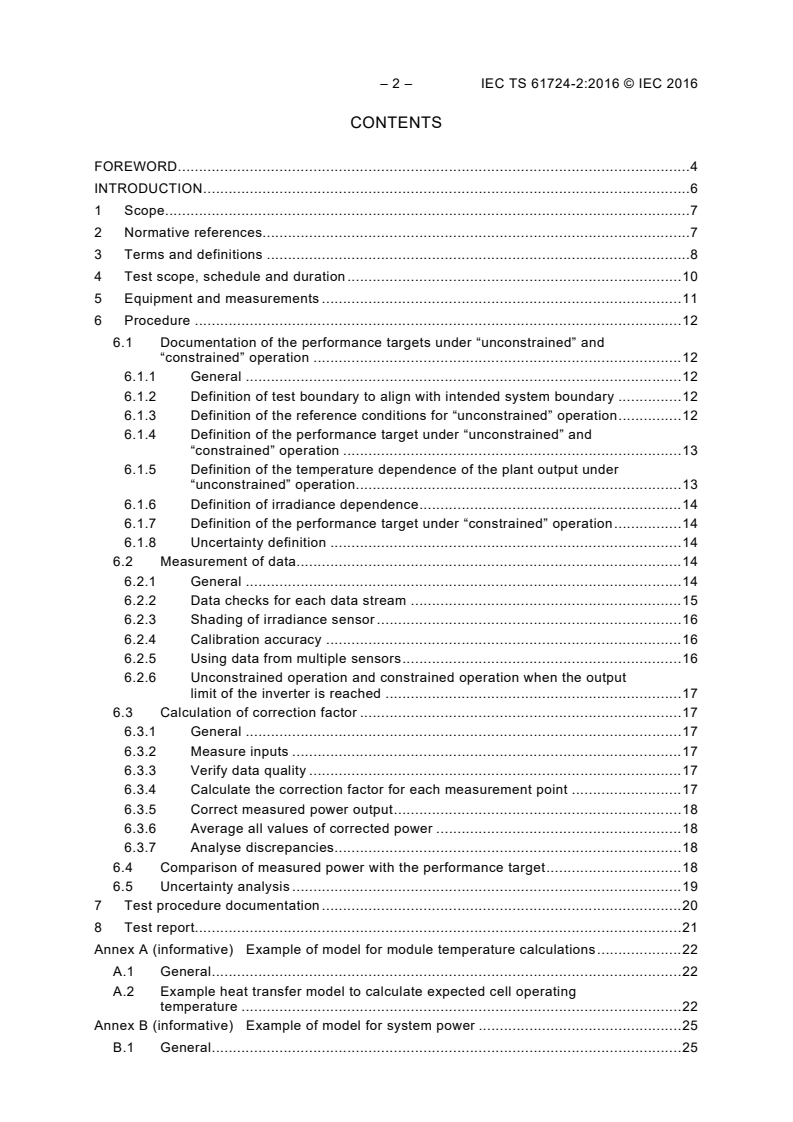
CONTENTS
FOREWORD . 4
INTRODUCTION . 6
1 Scope . 7
2 Normative references. 7
3 Terms and definitions . 8
4 Test scope, schedule and duration . 10
5 Equipment and measurements . 11
6 Procedure . 12
6.1 Documentation of the performance targets under “unconstrained” and
“constrained” operation . 12
6.1.1 General . 12
6.1.2 Definition of test boundary to align with intended system boundary . 12
6.1.3 Definition of the reference conditions for “unconstrained” operation . 12
6.1.4 Definition of the performance target under “unconstrained” and
“constrained” operation . 13
6.1.5 Definition of the temperature dependence of the plant output under
“unconstrained” operation . 13
6.1.6 Definition of irradiance dependence . 14
6.1.7 Definition of the performance target under “constrained” operation . 14
6.1.8 Uncertainty definition . 14
6.2 Measurement of data. 14
6.2.1 General . 14
6.2.2 Data checks for each data stream . 15
6.2.3 Shading of irradiance sensor . 16
6.2.4 Calibration accuracy . 16
6.2.5 Using data from multiple sensors . 16
6.2.6 Unconstrained operation and constrained operation when the output
limit of the inverter is reached . 17
6.3 Calculation of correction factor . 17
6.3.1 General . 17
6.3.2 Measure inputs . 17
6.3.3 Verify data quality . 17
6.3.4 Calculate the correction factor for each measurement point . 17
6.3.5 Correct measured power output . 18
6.3.6 Average all values of corrected power . 18
6.3.7 Analyse discrepancies . 18
6.4 Comparison of measured power with the performance target . 18
6.5 Uncertainty analysis . 19
7 Test procedure documentation . 20
8 Test report. 21
Annex A (informative) Example of model for module temperature calculations . 22
A.1 General . 22
A.2 Example heat transfer model to calculate expected cell operating
temperature . 22
Annex B (informative) Example of model for system power . 25
B.1 General . 25
B.2 Example model . 25
Annex C (informative) Inconsistent array orientation . 26
Bibliography . 27
Table 1 – Data validation and filtering criteria . 15
Table 2 – Example guide for seasonal minimum stable irradiance requirements for flat-
plate applications . 16
Table A.1 – Empirically determined coefficients used to predict module temperature . 23
Table A.2 – Hellmann coefficient, α, for correction of wind speed according to
measured height, if values in Table A.1 are used . 23
– 4 – IEC TS 61724-2:2016 © IEC 2016
INTERNATIONAL ELECTROTECHNICAL COMMISSION
____________
PHOTOVOLTAIC SYSTEM PERFORMANCE –
Part 2: Capacity evaluation method
FOREWORD
1) The International Electrotechnical Commission (IEC) is a worldwide organization for standardization comprising
all national electrotechnical committees (IEC National Committees). The object of IEC is to promote
international co-operation on all questions concerning standardization in the electrical and electronic fields. To
this end and in addition to other activities, IEC publishes International Standards, Technical Specifications,
Technical Reports, Publicly Available Specifications (PAS) and Guides (hereafter referred to as “IEC
Publication(s)”). Their preparation is entrusted to technical committees; any IEC National Committee interested
in the subject dealt with may participate in this preparatory work. International, governmental and non-
governmental organizations liaising with the IEC also participate in this preparation. IEC collaborates closely
with the International Organization for Standardization (ISO) in accordance with conditions determined by
agreement between the two organizations.
2) The formal decisions or agreements of IEC on technical matters express, as nearly as possible, an international
consensus of opinion on the relevant subjects since each technical committee has representation from all
interested IEC National Committees.
3) IEC Publications have the form of recommendations for international use and are accepted by IEC National
Committees in that sense. While all reasonable efforts are made to ensure that the technical content of IEC
Publications is accurate, IEC cannot be held responsible for the way in which they are used or for any
misinterpretation by any end user.
4) In order to promote international uniformity, IEC National Committees undertake to apply IEC Publications
transparently to the maximum extent possible in their national and regional publications. Any divergence
between any IEC Publication and the corresponding national or regional publication shall be clearly indicated in
the latter.
5) IEC itself does not provide any attestation of conformity. Independent certification bodies provide conformity
assessment services and, in some areas, access to IEC marks of conformity. IEC is not responsible for any
services carried out by independent certification bodies.
6) All users should ensure that they have the latest edition of this publication.
7) No liability shall attach to IEC or its directors, employees, servants or agents including individual experts and
members of its technical committees and IEC National Committees for any personal injury, property damage or
other damage of any nature whatsoever, whether direct or indirect, or for costs (including legal fees) and
expenses arising out of the publication, use of, or reliance upon, this IEC Publication or any other IEC
Publications.
8) Attention is drawn to the Normative references cited in this publication. Use of the referenced publications is
indispensable for the correct application of this publication.
9) Attention is drawn to the possibility that some of the elements of this IEC Publication may be the subject of
patent rights. IEC shall not be held responsible for identifying any or all such patent rights.
The main task of IEC technical committees is to prepare International Standards. In
exceptional circumstances, a technical committee may propose the publication of a technical
specification when
• the required support cannot be obtained for the publication of an International Standard,
despite repeated efforts, or
• the subject is still under technical development or where, for any other reason, there is the
future but no immediate possibility of an agreement on an International Standard.
Technical specifications are subject to review within three years of publication to decide
whether they can be transformed into International Standards.
IEC TS 61724-2, which is a technical specification, has been prepared by IEC technical
committee 82: Solar photovoltaic energy systems.
The text of this technical specification is based on the following documents:
Enquiry draft Report on voting
82/1101/DTS 82/1159/RVC
Full information on the voting for the approval of this technical specification can be found in
the report on voting indicated in the above table.
This document has been drafted in accordance with the ISO/IEC Directives, Part 2.
A list of all parts in the IEC 61724 series, published under the general title Photovoltaic
system performance, can be found on the IEC website.
The committee has decided that the contents of this publication will remain unchanged until
the stability date indicated on the IEC website under "http://webstore.iec.ch" in the data
related to the specific publication. At this date, the publication will be
• transformed into an International standard,
• reconfirmed,
• withdrawn,
• replaced by a revised edition, or
• amended.
A bilingual version of this publication may be issued at a later date.
– 6 – IEC TS 61724-2:2016 © IEC 2016
INTRODUCTION
The performance of a PV system is dependent on the weather, seasonal effects, and other
intermittent issues, so measurement of the performance of a PV system is expected to give
variable results. IEC 62446-1, Photovoltaic (PV) systems – Requirements for testing,
documentation and maintenance – Part 1 Grid connected – Documentation, commissioning
tests and inspection, describes a procedure for ensuring that the plant is constructed
correctly, but does not attempt to verify that the output of the plant meets the design
specifications. IEC 61724-1 , Photovoltaic system performance – Part 1: Monitoring, defines
the performance data that may be collected, but does not define how to analyze that data in
comparison to predicted performance. ASTM E2848-13 Standard test method for reporting
photovoltaic non-concentrator system performance describes a method for determining the
power output of a photovoltaic system based on a regression. IEC TS 61724-3 Photovoltaic
system performance – Part 3: Energy evaluation method describes a one-year test that
evaluates performance over the full range of operating conditions and is the preferred method
for evaluating system performance. However, it is essential that plant performance can also
be quantified with a shorter test, even if there can be higher uncertainty associated with that
test. This document is designed to complete an evaluation in a short time as a complement to
IEC TS 61724-3. As a capacity test, it measures power (not energy) at a specified set of
reference conditions (which can differ from standard test conditions that have been designed
to facilitate indoor measurements). The method in IEC TS 61724-2 is a non-regression-based
method for determining power output.
This method uses the design parameters of the plant to quantify a correction factor for
comparing the plant’s measured performance to the performance targeted under reference
conditions. In other words, the measured performance, adjusted by the correction factor, is
then compared with the target plant performance to identify whether the plant operates above
or below expectations at the target reference conditions.
Multiple aspects of PV system quality are dependent on both the weather and the system's
quality, so it is essential to have a clear understanding of the system being tested. For
example, the module temperature is primarily a function of irradiance, ambient temperature,
and wind speed, all of which are weather effects that can be difficult to simulate precisely.
However, the module-mounting configuration also affects the module temperature, and the
mounting is an aspect of the system that is being tested. This document presents a process
for test development and clarifies how measurement choices can affect the outcome of the
test so that users can benefit from streamlined test design with consistent definitions, while
still allowing flexibility in the application of the test so as to accommodate as many unique
installations as possible.
It is to be noted that when the output of a PV system exceeds the capability of the inverter,
the output of the system is defined more by the inverter operation than by the PV modules. In
this case, the measurement of the capacity of the plant to generate electricity is complicated
by the need to differentiate situations in which the inverter is saturated and when the output of
the PV system reflects the module performance. For PV plants with high DC-to-AC power
ratios, the operation of the plant can reflect the capability of the inverters for the majority of
the day, with the capability of the DC array only being measurable for a short time in the
morning and in the evening. In this case, it can be necessary to disconnect parts of the DC
array to reduce the DC-to-AC power ratio during the measurement period.
IEC TS 61724-2 is applicable to times when the system is fully available.
Methods presented in this document can be used in place of ASTM E2848-13 to determine
photovoltaic system performance.
___________
Under preparation. Stage at time of publication: IEC/FDIS 61724-1:2016
PHOTOVOLTAIC SYSTEM PERFORMANCE –
Part 2: Capacity evaluation method
1 Scope
This part of IEC 61724 defines a procedure for measuring and analyzing the power production
of a specific photovoltaic system with the goal of evaluating the quality of the PV system
performance. The test is intended to be applied during a relatively short time period (a few
relatively sunny days).
In this procedure, actual photovoltaic system power produced is measured and compared to
the power expected for the observed weather based on the design parameters of the system.
The expected power under reference and measured conditions are typically derived from the
design parameters that were used to derive the performance target for the plant as agreed to
prior to the commencement of the test. For cases when a power model was not developed
during the plant design, a simple model that increases transparency is presented in the
annexes as a possible approach.
The intent of this document is to specify a framework procedure for comparing the measured
power produced against the expected power from a PV system on relatively sunny days. This
test procedure is intended for application to grid-connected photovoltaic systems that include
at least one inverter and the associated hardware.
The performance of the system is quantified both during times when the inverters are
maximum-power-point tracking and during times when the system power is limited by the
output capability of the inverter or interconnection limit, reducing the system output relative to
what it would have been with an inverter with generation freely following irradiance, if this
condition is relevant.
This procedure can be applied to any PV system, including concentrator photovoltaic
systems, using the irradiance (direct or global) that is relevant to the performance of the
system.
This test procedure was designed and drafted with a primary goal of facilitating the
documentation of a performance target, but it can also be used to verify a model, track
performance (e.g., degradation) of a system over the course of multiple years, or to document
system quality for any other purpose. The terminology has not been generalized to apply to all
of these situations, but the intent is to create a methodology that can be used whenever the
goal is to verify system performance at a specific reference condition chosen to be a
frequently observed condition. A more complete evaluation of plant performance can be
accomplished by using the complementary Technical Specification IEC TS 61724-3,
Photovoltaic system performance – Part 3: Energy evaluation method.
2 Normative references
The following documents are referred to in the text in such a way that some or all of their
content constitutes requirements of this document. For dated references, only the edition
cited applies. For undated references, the latest edition of the referenced document (including
any amendments) applies.
– 8 – IEC TS 61724-2:2016 © IEC 2016
IEC 61724-1 , Photovoltaic system performance – Part 1: Monitoring
IEC TS 61836, Solar photovoltaic energy systems – Terms, definitions and symbols
ISO/IEC Guide 98-1, Uncertainty of measurement – Part 1: Introduction to the expression of
uncertainty in measurement
ASME, Performance Test Code 19.1
3 Terms and definitions
For the purposes of this document, the terms and definitions given in IEC 61724-1, IEC TS
61836, the ASME Performance Test Code 19.1 and the following and definitions apply.
ISO and IEC maintain terminological databases for use in standardization at the following
addresses:
• IEC Electropedia: available at http://www.electropedia.org/
• ISO Online browsing platform: available at http://www.iso.org/obp
3.1
constrained operation
operation of a plant in a condition when all inverters are limited by the capability of the
inverters (otherwise referred to as inverter saturation) rather than by the output from the PV
array, as is observed for a system with high DC rating relative to the AC rating and when the
irradiance is high
3.2
correction factor
ratio of the power expected for the reference conditions to the power expected for the
measured conditions
3.3
curtailed operation
output of the inverter(s) is limited due to external reasons such as inability of the local grid to
receive the power or contractual agreement
3.4
expected power
power generation of a PV system that is expected for actual weather data collected at the site
during operation of the system based on the design parameters of the system
3.5
measured power
electric power that is generated by the PV system
Note 1 to entry: See also 3.14 to define the location of measurement.
3.6
model
simulation model used to calculate the predicted or expected PV power generation based on
the design parameters of the system
___________
Under preparation. Stage at time of publication: IEC/FDIS 61724-1:2016.
3.7
parties to the test
individuals or companies that are applying the test
Note 1 to entry: Commonly, these parties may be the PV customer and the PV installer, with the test method
applied to define completion of a contract, but the test method may be applied in a variety of situations and the
parties to the test may in some cases be a single individual or company.
3.8
performance target
power generation expected from a PV system under reference conditions based on the design
parameters of the system
3.9
POA
plane of array
physical plane in which the modules are deployed according to the orientation of the system
under test
3.10
system operation
attributes of the system performance that can be traced to the quality of operations and
maintenance service provided
Note 1 to entry: For example, low availability of the system may be a result of slow response to a disruption.
Note 2 to entry: If different entities are responsible for the installation and the operations, then it is useful to
distinguish between aspects of the performance that are traced to the initial installation and those that are traced
to the operation.
3.11
system quality
attributes of the system performance that can be traced to the quality of the system design,
the quality of the system components and the quality of installation
Note 1 to entry: Generally, the installer is held responsible for the system quality.
3.12
target power
power generation expected from a PV system at target reference conditions (TRC) based on
the design parameters of the system
3.13
target reference conditions
TRC
reference conditions at which the expected power is the target power, which include
irradiance, ambient temperature, wind, and any other parameter used to define the target
performance
Note 1 to entry: See 6.1.3.
3.14
test boundary
physical differentiation between what is considered to be part of the system under test and
what is outside of the system
Note 1 to entry: In addition to defining the physical boundaries and which electricity meter is quantifying the
electricity production, the test boundary definition includes the location, type, and accuracy class of all
measurement devices.
Note 2 to entry: To facilitate the description of the test method, this document defines a default test boundary.
Ambient temperature and wind speed lie outside of this default test boundary. When this standard is applied using
class A (high precision) measurements as defined in IEC 61724-1, soiling will lie inside of the default test
– 10 – IEC TS 61724-2:2016 © IEC 2016
boundary, consistent with the IEC 61724-1 class A requirement that the sensors be cleaned, quantifying the
irradiance without interference from soiling. When this standard is applied using class B (medium precision)
measurements as defined in IEC 61724-1, soiling will lie outside of the default test boundary and it is expected that
sensors will not be cleaned, allowing soiling to be considered as part of the weather. The alignment of the array is
brought inside of the test boundary by confirming the alignment of the plane of array sensor. The parties to the test
may define the test boundary however they wish; the default test boundary is defined only as a tool to clarify the
application of the test method described here and as an example for how to define the test boundary. However, if
the purpose of application of the test is to measure degradation rates on small systems, it may be preferable to
measure module temperature in consistent locations on the modules.
3.15
unconstrained operation
outputs of all inverters freely following the DC array’s capability to respond to the solar
insolation rather than being limited by the capability of the inverters or curtailing influences
3.16
maximum-power-point tracking
inverter accurately maximizing the DC array’s output
4 Test scope, schedule and duration
This test may be applied at one of several levels of granularity of a PV plant. The users of the
test shall agree upon the level(s) at which the test will be applied. The smallest level at which
the test may be performed is the smallest level of AC power generating assembly capable of
independent on-grid operation.
When PV plant construction is divided into phases, it is recommended that the test be applied
at the highest level, that which encompasses the entire PV project. However, the test may be
applied to smaller subsets of the plant as they become available for interconnection. If
desired, upon full plant completion the test may be applied again in a way that encompasses
the entire plant, taking into account expected degradation in accordance with the model
accepted by the parties to the test as well as soiling levels if not able to wash the entire array
before testing. In every case, the system boundary and test boundary shall be explicitly
defined.
Some PV modules show measurable performance changes within hours or days of being
installed in the field; others do not. The time duration of the test should be negotiated
between the parties using the manufacturer’s guidance for the number of days of exposure or
the irradiance exposure needed for the plant to reach the targeted performance along with the
details of the actual installation and interconnection dates. Any metastability (variation in
module efficiency that depends on previous operating conditions) and degradation
assumptions (including those with short and long time constants) should be agreed to by all
parties and documented as part of the target description.
NOTE 1 Newly installed modules can undergo light induced degradation (LID), a transient effect that reduces the
photovoltaic conversion efficiency of the modules when exposed to light.
NOTE 2 The efficiency of some modules can vary over a year depending on irradiation and temperature history
due to metastabilities.
It is recommended that the test include data from at least two days if sufficient stable data are
acquired. The test may be extended to seven or more days if desired to assess repeatability
or if weather is volatile. The filtering criteria for selecting relatively stable times are described
in Clause 6.
The test may be completed at any time of year, though the deviation from reference
conditions and the effects of variable angle of incidence may increase the uncertainty at some
times of the year.
All parties to the test should agree on a detailed test procedure before the test commences as
described in Clauses 5 and 6.
5 Equipment and measurements
Measurement equipment and procedures for all measured parameters are recommended to
conform to class A requirements in IEC 61724-1. However, a class B or class C evaluation
may also be completed and documented in the final report.
Using the default test boundary, the weather is characterized by:
• plane of array irradiance (global for flat-plate and direct for concentrator systems; for
systems with multiple orientations, see Annex C);
• ambient temperature;
• wind speed.
If additional characterization of the weather is required for implementation of the agreed-upon
model, these data shall be collected in a manner consistent with the derivation of the targeted
performance and documented in the detailed test procedure.
The system output is characterized by:
• real AC power delivered to the grid or load at the system/test boundary;
• reactive AC power or power factor if real power is dependent on changes in power factor;
• the inverter state (whether the inverter is tracking the maximum power or whether it is
operating in a constrained mode, limited by its output capacity).
The definition of the AC power, including the point of measurement (such as at a utility-grade
meter at the point of interconnection) is documented as part of the "test boundary" definition
(3.14). If parasitic loads outside the system boundary exist (e.g. trackers), the contract or test
definition defines whether adjustments are made for these, and, if so, how these adjustments
are characterized.
All details of data collection (including sensor number, calibration, installation location, and
cleaning) shall follow IEC 61724-1 according to the chosen class of measurement with the
exception of the following.
• The type of sensor and sensor positioning shall be consistent with the power performance
model that is being used for the test (which may differ from the energy performance
model). Temperature sensors should measure ambient temperature in order to account for
the effects of module mounting. However, modelling of module temperature may vary from
day to day due to variation of sky temperature and other conditions, increasing uncertainty
in the measurement, and motivating the use of the module temperature if it is viewed to
provide better reproducibility. If module temperature is to be measured, the location of the
measurement should be agreed upon in advance by the parties of the test.
NOTE Often the final uncertainty of the measurement is dominated by the uncertainty of the irradiance
.
measurement, so high-accuracy sensors are desired
• The time record for the visual inspection and cleaning by hand of irradiance sensors
during the test shall be documented.
• Irradiance sensor(s) are mounted in the plane of the array with an alignment accuracy as
specified by class A, B, or C in IEC 61724-1. For the case of arrays with modules that are
not all within one plane, see Annex C.
• When irradiance sensors are deployed on a tilted plane, the ground albedo for the area
near the sensors should be representative of the ground albedo throughout the array. Any
anomalies in ground albedo should be discussed in the uncertainty analysis of the test.
• For class A tests, because the irradiance measurement is so crucial to the test, the
calibrations should be independently verified either by using sensors calibrated at different
test locations or at different times so as to prevent a systematic bias to the calibration.
– 12 – IEC TS 61724-2:2016 © IEC 2016
• Data shall be filtered to identify times of stable operation under full sun as described in
Clause 6.
• Data are collected both for “unconstrained” and “constrained” operation, if relevant. Any
periods affected by grid outages or other anomalous states should be removed from the
analysis.
6 Procedure
6.1 Documentation of the performance targets under “unconstrained” and
“constrained” operation
6.1.1 General
The expected power output and the associated reference conditions shall be defined both for
“unconstrained” operation and for “constrained” operation, if relevant, as described in 6.1.2 to
6.1.8.
6.1.2 Definition of test boundary to align with intended system boundary
This test method is intended to quantify the performance of a system, but the result of the test
can depend on what is considered to be part of the system. The parties to the test shall agree
on the definition of the system including:
• the meter(s) that defines the output of the system;
• aspects of system design that are being tested such as whether modules are mounted
according to the design (tilt, azimuth, height, racking design) allowing the expected
cooling and capture of sunlight;
• aspects of system operation that are being tested such as whether the soiling level will be
considered as part of the test.
The test boundary shall be aligned with the system boundary in order to have the result of the
test reflect the performance of the system under test.
6.1.3 Definition of the reference conditions for “unconstrained” operation
Target reference conditions (TRC) for unconstrained operation are defined for the
performance target (see 6.1.4). TRC should be chosen so as to result in unconstrained
operation (i.e. within the inverter’s capability) and the irradiance condition may differ from
1 000 W/m if the plant is designed to be constrained by the inverter’s capability at
1 000 W/m . Preferably, the TRC are chosen to reflect an ambient temperature and wind
speed that are frequently observed at the site and the highest irradiance that is unlikely to
cause constrained operation (when the inverter has reached the limit of its capability) for the
lowest temperature expected to be included in the test. The optimal choice of TRC may
depend on the weather during the test. However, use of the design parameters for the plant
as the basis for the model should reduce the error of correcting for the variations in
conditions, reducing the need to have the TRC align exactly with the conditions during the
measurement. The TRC should be agreed upon by all parties to the test before
commencement of the test.
The sources of the irradiance, ambient temperature, wind speed, and any other
meteorological data shall be described so that the definition of the TRC will be unambiguous.
Data collection requirements defined in IEC 61724-1 shall be followed according to the
desired monitoring class A, B, or C except as noted in Clause 5. These should be
documented as specifically as possible in the detailed test procedure before the test
commences (e.g. sensor type, location, cleaning and calibration, and any additional relevant
information).
6.1.4 Definition of the performance target under “unconstrained” and “constrained”
operation
The targeted system output is defined for “unconstrained” operation under the TRC defined in
6.1.3 and a model that defines how the power varies with irradiance, temperature, and wind
using the design parameters of the plant. The rationale for the performance target shall be
agreed to by all parties of the test. For situations when the plant design was developed based
on a model for the energy output, translating that energy model into a power model or deriving
a power model from measured data on a similar plant can introduce anomalies in the power
model. For example, application of linear regression to subsets of data during different times
of the year may result in variable observed temperature coefficients. In this case, where a
power model was not created during the initial design of the system, it is recommended that
the rationale be described by using a simple model that starts with the name plate rating and
applies loss factors that can be clearly understood such as loss factors for inverter efficiency,
cabling losses, mismatch losses, etc. and applies a temperature coefficient that can be
directly related to the module performance. It is to be noted that a model that includes
shading losses is important for predicting the energy from a plant, but this capacity test is
intended to document performance when there is no shading, so a simple model can replace
the more complex model, increasing the transparency of the test procedure.
Typically, it is assumed that the plant is being assessed in an “as-installed” state that is
nominally clean. If the assessment is completed at a time when the plant may have become
soiled, the soiling loss may either be included as one of the loss factors or the plant has to be
cleaned before the assessment.
If a complex model is used, the model may be defined as described in IEC TS 61724-3 and
the test applied ensuring that the model is consistently applied for both the target and
measured conditions.
The performance target under “constrained” operation is typically defined by the capability of
the inverter. If this value is independent of operating conditions, verification of operation in the
“constrained” state is straightforward and may not be of concern for the parties of the test.
However, if a system is intended to operate in the “constrained” state for many hours of the
year, it is highly recommended to confirm correct operation in the “constrained” state.
6.1.5 Definition of the temperature dependence of the plant output under
“unconstrained” operation
If a temperature model has been defined for the plant, this should be used preferentially.
If the model uses wind speed as an input, the location (including height) of the wind sensor
should be specified.
If a temperature model has not been defined, a possible model is provided in Annex A. It is
preferable to use a temperature model based on ambient temperature and wind speed rather
than measuring the back-of-module temperature because the assessment then includes some
aspects of the module mounting that could cause the modules to run hot and because it
avoids the challenges of characterizing the module temperature, which may be highly variable
across the field. However, although the model in Annex A has been demonstrated to provide
accurate modelling of the average cell temperature, from day to day it may result in variable
accuracy caused by variation in sky temperature or other conditions. The parties to the test
should choose the approach that provides the best result for the given situation. If measuring
the module temperature rather than the ambient temperature is chosen, then there may be a
separate verification to ensure that the modules are operating at a temperature that is
consistent with the plant’s design specification. Suggestions on how to accurately measure
the back-of-module temperature may be found in Annex B of IEC 61724-1:2016.
In any case, the model shall be agreed to by the parties to the test before the test and
documented in the test report; IEC TS 61724-3 provides guidance on documenting a complex
model.
– 14 – IEC TS 61724-2:2016 © IEC 2016
6.1.6 Definition of irradiance dependence
The plant output as a function of irradiance shall be defined by the power model agreed to by
the parties of the test. Practitioners should choose a power model based on the design
parameters of the system. If a complex computer program is used as the power model, the
power model should be documented as described in IEC TS 61724-3 along with the
performance target. The irradiance filter applied with Table 1 should be verified to be
consistent with the functional range of the model used to determine the correction equations.
For example, the plant output may be assumed to be linear with irradiance in a limited
irradiance range, such as ±20 %. Any added uncertainty should also be documented. An
example of a simple model is given in Annex B.
6.1.7 Definition of the performance target under “constrained” operation
The performance under “constrained” operation may be equivalent to the AC rating of the
inverter adjusted for any losses between the inverter and measurement location for AC power
and is documented as such. If the performance under “constrained” operation can depend on
the ambient temperature or other condition, this shall be documented as well.
If the performance under “curtailed” conditions is controlled by an external party, the
assessment of performance under such conditions may be excluded from the assessment,
with agreement from both parties to the test.
Measurement under the “constrained” condition may be omitted, at the discretion of those
requesting the test.
6.1.8 Uncertainty definition
Test uncertainty should be computed as described in 6.5. The uncertainty definition and its
role in defining the pass/fail test outcome comparing the targeted and measured power shall
be agreed upon. It is highly recommended that this agreement be documented prior to the
test.
NOTE Typically, the uncertainty agreed to by the parties typically forms a dead band around any target. This dead
band is to the disadvantage the all parties of the test, so should be kept as small as possible. A 95 % confidence
interval is a common industry practice.
Strategies for reducing uncertainty include:
• use of higher quality irradiance sensors and/or use data from multiple sensors for each
weather station deployed, first dis
...