

IEC 60758:2016
(Main)Synthetic quartz crystal - Specifications and guidelines for use
General Information
- Abstract
IEC 60758:2016 applies to synthetic quartz single crystals intended for manufacturing piezoelectric elements for frequency control, selection and optical applications. This edition includes the following significant technical changes with respect to the previous edition:
- order rearrangement and review of terms and definitions;
- abolition as a standard of the infrared absorbance coefficient α3410;
- addition of the value measurement explanation by FT-IR equipment in annex;
- addition of the synthetic quartz crystal standards for optical applications.
- Status
- Published
- Publication Date
- 17-May-2016
- Technical Committee
- TC 49 - Piezoelectric, dielectric and electrostatic devices and associated materials for frequency control, selection and detection
- Drafting Committee
- WG 5 - TC 49/WG 5
- Current Stage
- PPUB - Publication issued
- Start Date
- 18-May-2016
- Completion Date
- 30-Jun-2016
Buy Documents
IEC 60758:2016 - Synthetic quartz crystal - Specifications and guidelines for use Released:5/18/2016
IEC 60758:2016 - Synthetic quartz crystal - Specifications and guidelines for use Released:11/22/2017
Overview
IEC 60758:2016 - Synthetic quartz crystal - Specifications and guidelines for use - defines requirements, test methods and usage guidance for synthetic quartz single crystals used to manufacture piezoelectric elements (frequency control and selection) and optical components. This fifth edition reorganizes terms and definitions, removes the infrared absorbance coefficient α3410 as a standalone metric, adds FT‑IR measurement guidance, and extends coverage to synthetic quartz for optical applications.
Key technical topics and requirements
- Scope and definitions: Orientation, handedness and crystal axis/face designation for as‑grown and lumbered quartz.
- Dimensional and geometric requirements: Standard shapes, seed orientation, tolerances, reference surface flatness and angular tolerances for lumbered bars.
- Material quality and grading:
- Inclusion density and striae grading for piezoelectric and optical uses.
- Infrared quality indications and α‑value grading (measurements noted near ~3500 cm‑1 and ~3585 cm‑1).
- Etch channel density classification and internal transmittance for optical parts.
- Measurement and test methods:
- Visual inspection, schlieren (optical) evaluation, infrared absorbance methods.
- Annex E: FT‑IR sample preparation, equipment set‑up and compensation procedures.
- Annex G: consistency between dispersive IR and Fourier‑Transform IR (FT‑IR) measurements.
- Performance parameters: Frequency–temperature characteristics for piezoelectric elements and guidance on evaluating Q and α relationships.
- Quality assurance and delivery: Marking, packing, inspection lot rules, sampling procedures and batch/lot acceptance criteria.
- Informative annexes: Sampling examples, numerical examples, measurement tools (point calipers) and differences in axis conventions (IEC vs IEEE).
Practical applications and users
IEC 60758:2016 is essential for:
- Quartz crystal manufacturers: to specify production tolerances, grading and testing protocols for both piezoelectric and optical crystals.
- Component designers and OEMs: for sourcing materials for oscillators, filters, resonators, optical windows, lenses and photonics components requiring stringent optical/transmission properties.
- Quality, metrology and test laboratories: to implement consistent IR/FT‑IR measurement procedures, schlieren inspection and sampling plans.
- Procurement and compliance teams: to write purchase specifications, acceptance criteria and supplier audits.
Related standards and notes
- Annex F discusses differences between IEC and IEEE orthogonal axial systems - useful when aligning specifications across industry standards.
- For accurate IR measurement and traceability, follow guidance in Annex E (FT‑IR) and Annex G (measurement consistency).
Keywords: IEC 60758:2016, synthetic quartz crystal, piezoelectric, optical applications, FT‑IR, infrared absorbance, schlieren, etch channel density, frequency‑temperature.
Relations
- Effective Date
- 05-Sep-2023
Buy Documents
IEC 60758:2016 - Synthetic quartz crystal - Specifications and guidelines for use Released:5/18/2016
IEC 60758:2016 - Synthetic quartz crystal - Specifications and guidelines for use Released:11/22/2017
Frequently Asked Questions
IEC 60758:2016 is a standard published by the International Electrotechnical Commission (IEC). Its full title is "Synthetic quartz crystal - Specifications and guidelines for use". This standard covers: IEC 60758:2016 applies to synthetic quartz single crystals intended for manufacturing piezoelectric elements for frequency control, selection and optical applications. This edition includes the following significant technical changes with respect to the previous edition: - order rearrangement and review of terms and definitions; - abolition as a standard of the infrared absorbance coefficient α3410; - addition of the value measurement explanation by FT-IR equipment in annex; - addition of the synthetic quartz crystal standards for optical applications.
IEC 60758:2016 applies to synthetic quartz single crystals intended for manufacturing piezoelectric elements for frequency control, selection and optical applications. This edition includes the following significant technical changes with respect to the previous edition: - order rearrangement and review of terms and definitions; - abolition as a standard of the infrared absorbance coefficient α3410; - addition of the value measurement explanation by FT-IR equipment in annex; - addition of the synthetic quartz crystal standards for optical applications.
IEC 60758:2016 is classified under the following ICS (International Classification for Standards) categories: 31.140 - Piezoelectric devices. The ICS classification helps identify the subject area and facilitates finding related standards.
IEC 60758:2016 has the following relationships with other standards: It is inter standard links to IEC 60758:2008. Understanding these relationships helps ensure you are using the most current and applicable version of the standard.
IEC 60758:2016 is available in PDF format for immediate download after purchase. The document can be added to your cart and obtained through the secure checkout process. Digital delivery ensures instant access to the complete standard document.
Standards Content (Sample)
IEC 60758 ®
Edition 5.0 2016-05
INTERNATIONAL
STANDARD
Synthetic quartz crystal – Specifications and guidelines for use
All rights reserved. Unless otherwise specified, no part of this publication may be reproduced or utilized in any form
or by any means, electronic or mechanical, including photocopying and microfilm, without permission in writing from
either IEC or IEC's member National Committee in the country of the requester. If you have any questions about IEC
copyright or have an enquiry about obtaining additional rights to this publication, please contact the address below or
your local IEC member National Committee for further information.
IEC Central Office Tel.: +41 22 919 02 11
3, rue de Varembé Fax: +41 22 919 03 00
CH-1211 Geneva 20 info@iec.ch
Switzerland www.iec.ch
About the IEC
The International Electrotechnical Commission (IEC) is the leading global organization that prepares and publishes
International Standards for all electrical, electronic and related technologies.
About IEC publications
The technical content of IEC publications is kept under constant review by the IEC. Please make sure that you have the
latest edition, a corrigenda or an amendment might have been published.
IEC Catalogue - webstore.iec.ch/catalogue Electropedia - www.electropedia.org
The stand-alone application for consulting the entire The world's leading online dictionary of electronic and
bibliographical information on IEC International Standards, electrical terms containing 20 000 terms and definitions in
Technical Specifications, Technical Reports and other English and French, with equivalent terms in 15 additional
documents. Available for PC, Mac OS, Android Tablets and languages. Also known as the International Electrotechnical
iPad. Vocabulary (IEV) online.
IEC publications search - www.iec.ch/searchpub IEC Glossary - std.iec.ch/glossary
The advanced search enables to find IEC publications by a 65 000 electrotechnical terminology entries in English and
variety of criteria (reference number, text, technical French extracted from the Terms and Definitions clause of
committee,…). It also gives information on projects, replaced IEC publications issued since 2002. Some entries have been
and withdrawn publications. collected from earlier publications of IEC TC 37, 77, 86 and
CISPR.
IEC Just Published - webstore.iec.ch/justpublished
Stay up to date on all new IEC publications. Just Published IEC Customer Service Centre - webstore.iec.ch/csc
details all new publications released. Available online and If you wish to give us your feedback on this publication or
also once a month by email. need further assistance, please contact the Customer Service
Centre: csc@iec.ch.
IEC 60758 ®
Edition 5.0 2016-05
INTERNATIONAL
STANDARD
Synthetic quartz crystal – Specifications and guidelines for use
INTERNATIONAL
ELECTROTECHNICAL
COMMISSION
ICS 31.140 ISBN 978-2-8322-3395-5
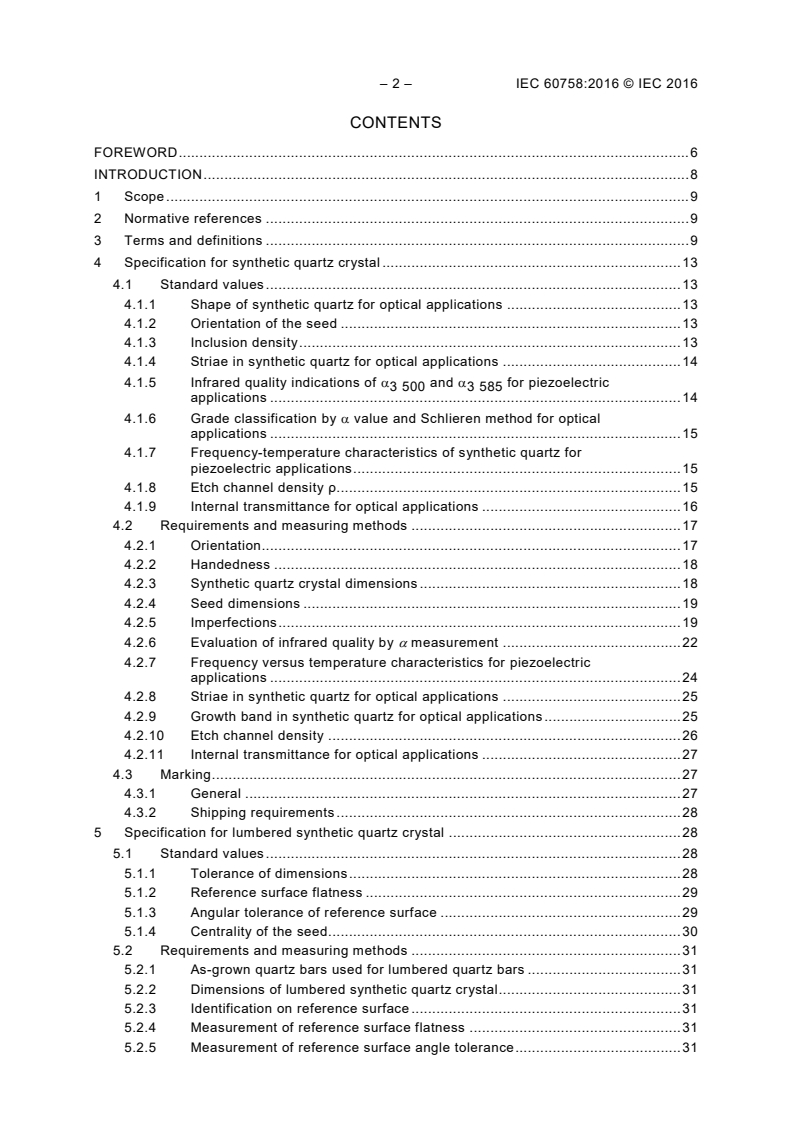
– 2 – IEC 60758:2016 © IEC 2016
CONTENTS
FOREWORD . 6
INTRODUCTION . 8
1 Scope . 9
2 Normative references. 9
3 Terms and definitions . 9
4 Specification for synthetic quartz crystal . 13
4.1 Standard values . 13
4.1.1 Shape of synthetic quartz for optical applications . 13
4.1.2 Orientation of the seed . 13
4.1.3 Inclusion density . 13
4.1.4 Striae in synthetic quartz for optical applications . 14
4.1.5 Infrared quality indications of α and α for piezoelectric
3 500 3 585
applications . 14
4.1.6 Grade classification by α value and Schlieren method for optical
applications . 15
4.1.7 Frequency-temperature characteristics of synthetic quartz for
piezoelectric applications . 15
4.1.8 Etch channel density ρ . 15
4.1.9 Internal transmittance for optical applications . 16
4.2 Requirements and measuring methods . 17
4.2.1 Orientation . 17
4.2.2 Handedness . 18
4.2.3 Synthetic quartz crystal dimensions . 18
4.2.4 Seed dimensions . 19
4.2.5 Imperfections . 19
4.2.6 Evaluation of infrared quality by α measurement . 22
4.2.7 Frequency versus temperature characteristics for piezoelectric
applications . 24
4.2.8 Striae in synthetic quartz for optical applications . 25
4.2.9 Growth band in synthetic quartz for optical applications . 25
4.2.10 Etch channel density . 26
4.2.11 Internal transmittance for optical applications . 27
4.3 Marking . 27
4.3.1 General . 27
4.3.2 Shipping requirements . 28
5 Specification for lumbered synthetic quartz crystal . 28
5.1 Standard values . 28
5.1.1 Tolerance of dimensions . 28
5.1.2 Reference surface flatness . 29
5.1.3 Angular tolerance of reference surface . 29
5.1.4 Centrality of the seed . 30
5.2 Requirements and measuring methods . 31
5.2.1 As-grown quartz bars used for lumbered quartz bars . 31
5.2.2 Dimensions of lumbered synthetic quartz crystal . 31
5.2.3 Identification on reference surface . 31
5.2.4 Measurement of reference surface flatness . 31
5.2.5 Measurement of reference surface angle tolerance . 31
5.2.6 Centrality of the seed . 31
5.3 Delivery conditions . 32
5.3.1 General . 32
5.3.2 Marking . 32
5.3.3 Packing . 32
5.3.4 Making batch . 32
6 Inspection rule for synthetic quartz crystal and lumbered synthetic quartz crystal . 32
6.1 Inspection rule for as-grown synthetic quartz crystal . 32
6.1.1 Inspection . 32
6.1.2 Lot-by-lot test . 32
6.2 Inspection rule for lumbered synthetic quartz crystal . 33
6.2.1 General . 33
6.2.2 Lot-by-lot test . 34
7 Guidelines for the use of synthetic quartz crystal for piezoelectric applications . 34
7.1 General . 34
7.1.1 Overview . 34
7.1.2 Synthetic quartz crystal . 34
7.2 Shape and size of synthetic quartz crystal . 35
7.2.1 Crystal axis and face designation . 35
7.2.2 Seed . 36
7.2.3 Shapes and dimensions . 36
7.2.4 Growth zones . 37
7.3 Standard method for evaluating the quality of synthetic quartz crystal . 37
7.4 Other methods for checking the quality of synthetic quartz crystal . 38
7.4.1 General . 38
7.4.2 Visual inspection . 38
7.4.3 Infrared radiation absorption method . 38
7.4.4 Miscellaneous . 39
7.5 α grade for piezoelectric quartz . 40
7.6 Optional grading (only as ordered), in inclusions, etch channels, Al content . 40
7.6.1 Inclusions . 40
7.6.2 Etch channels . 40
7.6.3 Al content . 40
7.6.4 Swept quartz . 41
7.7 Ordering . 42
Annex A (informative) Frequently used sampling procedures . 43
A.1 Complete volume counting . 43
A.2 Commodity Y-bar sampling – Method 1 . 43
A.3 Commodity Y-bar sampling – Method 2 . 43
A.4 Use of comparative standards for 100 % crystal inspection . 44
Annex B (informative) Numerical example . 45
Annex C (informative) Example of reference sample selection . 46
Annex D (informative) Explanations of point callipers . 47
Annex E (informative) Infrared absorbance α value compensation . 48
E.1 General . 48
E.2 Sample preparation, equipment set-up and measuring procedure . 48
E.2.1 General . 48
– 4 – IEC 60758:2016 © IEC 2016
E.2.2 Sample preparation . 48
E.2.3 Equipment set-up . 48
E.2.4 Measurement procedure . 49
E.3 Procedure to establish correction terms . 49
E.4 Calculation of compensated (corrected) absorbance values . 51
Annex F (informative) Differences of the orthogonal axial system for quartz between
IEC standard and IEEE standard . 52
Annex G (informative) α value measurement consistency between dispersive infrared
spectrometer and fourier transform infrared spectrometer . 54
G.1 General . 54
G.2 Experiment . 54
G.3 Experimental result . 55
Bibliography . 58
Figure 1 – Quartz crystal axis and cut direction . 17
Figure 2 – Idealized sections of a synthetic quartz crystal grown on a Z-cut seed . 19
Figure 3 – Typical example of cutting wafers of AT-cut plate, minor rhombohedral-cut
plate, X-cut plate, Y-cut plate and Z-cut plate . 21
Figure 4 – Frequency-temperature characteristics deviation rate of the test specimen . 25
Figure 5 – Typical schlieren system setup . 25
Figure 6 – Lumbered synthetic quartz crystal outline and dimensions along X-, Y- and
Z-axes . 29
Figure 7 – Angular deviation for reference surface . 30
Figure 8 – Centrality of the seed with respect to the dimension along the Z- or Z'-axis . 31
Figure 9 – Quartz crystal axis and face designation . 36
Figure 10 – Synthetic quartz crystal grown on a Z-cut seed of small X-dimensions . 37
Figure 11 – Example of a relation between the αvalue and the Q value at wave number
-1
3 500 cm . 39
Figure D.1 – Point callipers . 47
Figure D.2 – Digital point callipers . 47
Figure E.1 – Schematic of measurement set-up . 49
Figure E.2 – Graph relationship between averaged α and measured α at two wave
numbers of α and α . 50
3 500 3 585
Figure F.1 – Left- and right-handed quartz crystals . 53
Figure G.1 – Relationship of α between measuring value and reference value . 57
Table 1 – Inclusion density grades for piezoelectric applications . 14
Table 2 – Inclusion density grades for optical applications . 14
Table 3 – Infrared absorbance coefficient grades for piezoelectric applications . 14
Table 4 – Infrared absorbance coefficient grades and Schlieren method for optical
applications . 15
Table 5 – Etch channel density grades for piezoelectric applications . 16
Table 6 – Test conditions and requirements for the lot-by-Iot test for group A . 33
Table 7 – Test conditions and requirements for the lot-by-lot test for group B . 33
Table 8 – Test conditions and requirements for the lot-by-lot test . 34
Table B.1 – Commodity bar sampling, method 1 . 45
Table B.2 – Commodity bar sampling . 45
Table E.1 – Example of calibration data at α . 50
3 585
Table E.2 – Example of calibration data at α . 50
3 500
– 6 – IEC 60758:2016 © IEC 2016
INTERNATIONAL ELECTROTECHNICAL COMMISSION
____________
SYNTHETIC QUARTZ CRYSTAL –
SPECIFICATIONS AND GUIDELINES FOR USE
FOREWORD
1) The International Electrotechnical Commission (IEC) is a worldwide organization for standardization comprising
all national electrotechnical committees (IEC National Committees). The object of IEC is to promote international
co-operation on all questions concerning standardization in the electrical and electronic fields. To this end and in
addition to other activities, IEC publishes International Standards, Technical Specifications, Technical Reports,
Publicly Available Specifications (PAS) and Guides (hereafter referred to as “IEC Publication(s)”). Their
preparation is entrusted to technical committees; any IEC National Committee interested in the subject dealt with
may participate in this preparatory work. International, governmental and non-governmental organizations liaising
with the IEC also participate in this preparation. IEC collaborates closely with the International Organization for
Standardization (ISO) in accordance with conditions determined by agreement between the two organizations.
2) The formal decisions or agreements of IEC on technical matters express, as nearly as possible, an international
consensus of opinion on the relevant subjects since each technical committee has representation from all
interested IEC National Committees.
3) IEC Publications have the form of recommendations for international use and are accepted by IEC National
Committees in that sense. While all reasonable efforts are made to ensure that the technical content of IEC
Publications is accurate, IEC cannot be held responsible for the way in which they are used or for any
misinterpretation by any end user.
4) In order to promote international uniformity, IEC National Committees undertake to apply IEC Publications
transparently to the maximum extent possible in their national and regional publications. Any divergence between
any IEC Publication and the corresponding national or regional publication shall be clearly indicated in the latter.
5) IEC itself does not provide any attestation of conformity. Independent certification bodies provide conformity
assessment services and, in some areas, access to IEC marks of conformity. IEC is not responsible for any
services carried out by independent certification bodies.
6) All users should ensure that they have the latest edition of this publication.
7) No liability shall attach to IEC or its directors, employees, servants or agents including individual experts and
members of its technical committees and IEC National Committees for any personal injury, property damage or
other damage of any nature whatsoever, whether direct or indirect, or for costs (including legal fees) and expenses
arising out of the publication, use of, or reliance upon, this IEC Publication or any other IEC Publications.
8) Attention is drawn to the Normative references cited in this publication. Use of the referenced publications is
indispensable for the correct application of this publication.
9) Attention is drawn to the possibility that some of the elements of this IEC Publication may be the subject of patent
rights. IEC shall not be held responsible for identifying any or all such patent rights.
International Standard IEC 60758 has been prepared by IEC technical committee 49:
Piezoelectric, dielectric and electrostatic devices and associated materials for frequency
control, selection and detection.
This fifth edition cancels and replaces the fourth edition, published in 2008. This edition
constitutes a technical revision.
This edition includes the following significant technical changes with respect to the previous
edition:
• order rearrangement and review of terms and definitions;
• abolition as a standard of the infrared absorbance coefficient α
3 410;
• addition of the α value measurement explanation by FT-IR equipment in annex;
• addition of the synthetic quartz crystal standards for optical applications.
The text of this standard is based on the following documents:
FDIS Report on voting
49/1185/FDIS 49/1190/RVD
Full information on the voting for the approval of this standard can be found in the report on
voting indicated in the above table.
This publication has been drafted in accordance with the ISO/IEC Directives, Part 2.
The committee has decided that the contents of this publication will remain unchanged until the
stability date indicated on the IEC website under "http://webstore.iec.ch" in the data related to
the specific publication. At this date, the publication will be
• reconfirmed,
• withdrawn,
• replaced by a revised edition, or
• amended.
A bilingual version of this publication may be issued at a later date.
– 8 – IEC 60758:2016 © IEC 2016
INTRODUCTION
The reason for adding synthetic quartz crystal for optical application to this International
Standard is as follows.
Quartz crystal produced for optical applications is produced by many of the same suppliers
manufacturing quartz for electronic applications. The equipment and methods to produce
optical quartz are similar to those used in the production of electronic quartz. Also, with a few
exceptions the characterization methods of electronic and optical material are similar.
Therefore, IEC 60758 serves as the proper basis for including addenda related to quartz crystal
for optical applications.
SYNTHETIC QUARTZ CRYSTAL –
SPECIFICATIONS AND GUIDELINES FOR USE
1 Scope
This International Standard applies to synthetic quartz single crystals intended for
manufacturing piezoelectric elements for frequency control, selection and optical applications.
2 Normative references
The following documents, in whole or in part, are normatively referenced in this document and
are indispensable for its application. For dated references, only the edition cited applies. For
undated references, the latest edition of the referenced document (including any amendments)
applies.
IEC 60068-1:2013, Environmental testing – Part 1: General and guidance
IEC 60122-1:2002, Quartz crystal units of assessed quality – Part 1: Generic specification
IEC 60410, Sampling plans and procedures for inspection by attributes
IEC 61994 (all parts), Piezoelectric and dielectric devices for frequency control and selection –
Glossary
3 Terms and definitions
For the purposes of this document, the terms and definitions given in IEC 61994 and the
following apply.
3.1
hydrothermal crystal growth
crystal growth in the presence of water, elevated temperatures and pressures by a crystal
growth process believed to proceed geologically within the earth's crust
Note 1 to entry: The industrial synthetic quartz growth processes utilize alkaline water solutions confined within
autoclaves at supercritical temperatures (330 °C to 400 °C) and pressures (700 to 2 000 atmospheres).
Note 2 to entry: The autoclave is divided into two chambers: the dissolving chamber, containing raw quartz chips at
the higher temperature; the growing chamber, containing cut seeds at the lower temperature (see 7.1.2).
3.2
synthetic quartz crystal
single crystal of α quartz grown by the hydrothermal method
Note 1 to entry: Cultured quartz has the same meaning as synthetic quartz crystal.
3.3
as-grown synthetic quartz crystal
state of synthetic quartz crystal prior to grinding or cutting
3.4
as-grown Y-bar
crystals which are grown by using long stick seed in the Y-direction
– 10 – IEC 60758:2016 © IEC 2016
3.5
as-grown Z-bar
crystals which are grown by using Z-cut seed
3.6
synthetic quartz crystal batch
synthetic quartz crystals grown at the same time in one autoclave
3.7
seed
rectangular parallelepiped quartz plate or bar to be used as a nucleus for crystal growth
3.8
growth zones
regions of a synthetic quartz crystal resulting from growth along different crystallographic
directions
SEE: Figure 2.
3.9
orientation of a synthetic quartz crystal
orientation of the seed of a synthetic quartz crystal with respect to the orthogonal axes specified
in 3.7
3.10
orthogonal axial system of α quartz crystal
orthogonal axis system consisting of three axes with a mutually vertical X axis, Y axis and Z axis
as illustrated in Figure 1
Note 1 to entry: The z-cut seed may be oriented at an angle of less than 20°to the Y-axis, in this case the axial system
becomes X, Y', Z'.
3.11
AT-cut plate
rotated Y-cut crystal plate oriented at an angle of about +35° around the X-axis or about −3° from
the z (minor rhombohedral)-face
SEE: Figure 3
3.12
X-cut plate
crystal plate perpendicular to the X-axis
SEE: Figure 3b
3.13
Y-cut plate
crystal plate perpendicular to the Y-axis
SEE:Figure 3b
3.14
Z-cut plate
crystal plate perpendicular to the Z-axis
SEE:Figure 3b
3.15
z (minor rhombohedral)-cut plate
crystal plate parallel to the z (minor rhombohedral)-face
SEE: Figure 3a
3.16
dimensions
dimensions pertaining to growth on Z-cut seed rotated less than 20°from the Y-axis
3.17
effective Z-dimension
°
as-grown effective Z dimension defined as the minimum measure in the Z (𝜃 = 0 ) or Z' direction
in usable Y or Y' area of an as-grown crystal and described by Z
eff
SEE: Figure 2
3.18
minimum Z-dimension
minimum distance from seed surface to Z-surface described by Z
min
SEE: Figure 2d
3.19
inclusions
any foreign material within a synthetic quartz crystal, visible by examination of scattered light
from a bright source with the crystal immersed in a refractive index-matching liquid
Note 1 to entry: A particularly common inclusion is mainly the minerals called acmite and emeleusite.
3.20
seed veil
array of inclusions or voids at the surface of the seed upon which a crystal has been grown
3.21
etch channel
roughly cylindrical void that is present along the dislocation line after etching a quartz crystal
3.22
dopant
additive used in the growth process which may change the crystal habit, chemical composition,
physical or electrical properties of the synthetic quartz batch
3.23
pre-dimensioned bar
bar whose as-grown dimensions have been altered by sawing, grinding, lapping, etc., to meet a
particular dimensional requirement
3.24
impurity concentration
concentration of impurities relative to silicon atoms
3.25
dislocations
linear defects in the crystal due to misplaced planes of atoms
3.26
autoclave
vessel for the high-pressure and high-temperature condition required for growth of a synthetic
quartz crystal
– 12 – IEC 60758:2016 © IEC 2016
3.27
right-handed quartz or left-handed quartz
handedness of quartz crystal as determined by observing the sense of handedness of the
optical rotation in the polarized light
Note 1 to entry: Right-handed quartz is the crystal of dextrorotatory and left-handed quartz is the crystal of
levorotary
3.28
twins
two or more same single crystals which are combined together by the low of symmetrical plane
or axis
Note 1 to entry: The following twin types have been identified in synthetic quartz crystals:
a) Electrical twins
Quartz crystal in which regions with the common Z-axis exist showing a polarity reversal of the electrical X-axis.
b) Optical twins
Quartz crystal in which regions with the common Z-axis exhibit handedness reversal of the optical Z-axis.
3.29
infrared absorption coefficient α value
coefficient (referred to as the α value) established by determining the relationship between
absorption of two wave numbers
Note 1 to entry: One wave number is minimal absorption due to OH impurity, the other is high absorption due to
presence of OH impurities in the crystal lattice. The OH impurity creates mechanical loss in resonators and its
presence is correlated to the presence of other loss-inducing impurities. The α value is a measure of OH concentration
and is correlated with expected mechanical losses due to material impurities.
Note 2 to entry: For the coefficient defined here, the logarithm base 10 is used. The infrared absorption coefficient
value α is determined using the following equation:
1 𝑇
α = 𝑙𝑙𝑙 � �
𝑡 𝑇
where
α is the infrared absorption coefficient;
𝑡 is the thickness of Y-cut sample, in cm;
–1 –1
T is the per cent transmission at a wave number of 3 800 cm or 3 979 cm ;
–1 –1
T is the per cent transmission at a wave number of 3 500 cm , or 3 585 cm .
3.30
lumbered synthetic quartz crystal
synthetic quartz crystal whose X- and Z- or Z'- surfaces in the as-grown condition have been
processed flat and parallel by sawing, grinding, lapping, etc., to meet specified dimensions and
orientation
3.31
reference surface
surface of the lumbered bar prepared to specific flatness and orientation with respect to a
crystallographic direction (typically the X-direction)
3.32
synthetic quartz for optical applications
synthetic quartz which satisfies the requirements for the use of optical pickups, optical lowpass
filters (OLPF) and wave plates for digital single-lens reflex camera, monitoring camera, digital
video camera and optical communication module operating in the 300 nm – 1 700 nm wave
-1 -1
length (5 882 cm -33 333 cm )
3.33
internal transmittance
internal transmittance which does not include loss of surface refraction
Note 1 to entry: This definition applies to synthetic quartz for optical applications only. Internal transmission values
require statement of sample thickness for which the value is calculated, e.g. 2 mm.
3.34
striae
short range deviations of refractive index in quartz, growing defects in which the refractive index
fluctuates with a typical period of fractions of one millimetre to several millimetres
Note 1 to entry: This definition applies to synthetic quartz for optical applications only.
3.35
growth band
contrasting density band that can be observed in the Y-cut crystal by Schlieren and similar
optical method
Note 1 to entry: The cause of this contrast is that elements such as aluminium, sodium, lithium and iron are trapped
in the crystal when a crystal is growing.
Note 2 to entry: Larger amounts of trapped impurities typically cause an increase in α.
Note 3 to entry: Growth bands cannot be observed when α is less than 0,160 or α is less than 0,120.
3 585 3 500
Note 4 to entry: This definition applies to synthetic quartz for optical applications only.
4 Specification for synthetic quartz crystal
4.1 Standard values
4.1.1 Shape of synthetic quartz for optical applications
A seed crystal is removed and the growth faces are machined to a specified uniform surface
roughness and to a specified flatness with the specified crystallographic orientation.
4.1.2 Orientation of the seed
Standard orientation for the seeds are Z-cuts and rotated X-cuts, minor rhombohedral (z-minor)
° ° ° °
cut, 1 30' rotated Z-cut, 2 rotated Z-cut, 5 rotated Z-cut, and 8 30' rotated Z-cut, the Z'-axis of the
latter three seeds being rotated as shown in Figure 1.
4.1.3 Inclusion density
4.1.3.1 Inclusion density of synthetic quartz for piezoelectric applications
The inclusion density (measured as in 4.2.5.3) for each grade shall not exceed the figures in any
required size range for that grade listed in Table 1.
– 14 – IEC 60758:2016 © IEC 2016
Table 1 – Inclusion density grades for piezoelectric applications
Grade/size Densities per cm
Range
µm 10-30 >30-70 >70-100 >100
I a 2 1 0 0
I b 3 2 1 1
I 6 4 2 2
II 9 5 4 3
III 12 8 6 4
Users requiring a grade in only one or more of the size ranges may designate their requirement
as the grade followed by the appropriate size range.
4.1.3.2 Inclusion density of synthetic quartz for optical applications
The inclusion density grade of synthetic quartz for optical applications shall be shown at Table 2.
Table 2 – Inclusion density grades for optical applications
Grade/size
Densities per 100 cm
Range
µm 10-100
OPT I 0-9
OPT II 10-20
OPT III 21-39
4.1.4 Striae in synthetic quartz for optical applications
A size, contrasting density and quantity should not exceed a limit sample. A limit sample should
be defined between the manufacturer and the user.
4.1.5 Infrared quality indications of α and α for piezoelectric applications
3 500 3 585
An infrared extinction coefficient value (α value) of synthetic quartz (measured as in 4.2.6) shall
be as listed under the appropriate heading for α or α in Table 3 for the various grades:
3 500 3 585
Table 3 – Infrared absorbance coefficient grades for piezoelectric applications
Maxima a
Pre-1987
Grade
Q・10 units
α α
3 500 3585
Aa 0,026 0,015 3,8
A 0,033 0,024 3,0
B 0,045 0,050 2,4
C 0,060 0,069 1,8
D 0,080 0,100 1,4
E 0,120 0,160 1,0
a
These Q values were obtained from α measurements and empirical correlation, and were in common usage
prior to 1987. These are included here as the previous labels to maintain continuity through the change in
emphasizing α labels. α is the physical measurement now used to control and specify quality in synthetic
quartz.
The test limits above either correspond to or are unchanged (except in the cases of grades B and
D) from the α Iimits that correspond to the Q value grades listed IEC 60758:1983. This fifth
3 500
edition of IEC 60758 designated some of the same grades in terms of minimum indicated Q's in
10 units, as follows:
Aa = 3,8;
A = 3,0;
B = 2,2 (basis used herein), changed from 2,4 in the 1983 edition;
C = 1,8;
D = 1,4 (revised);
E = 1,0 (the same as the earlier D-grade).
4.1.6 Grade classification by α value and Schlieren method for optical applications
Grade classification is shown at Table 4.
Table 4 – Infrared absorbance coefficient grades
and Schlieren method for optical applications
Grade Schlieren method
α α
3 500 3 585
OPT A <0,033 <0,024 –
OPT B –
<0,060 <0,069
OPT C <0,120 <0,160 –
not observed growthband
OPT D ≥0,120 ≥0,160
by Schlieren method
4.1.7 Frequency-temperature characteristics of synthetic quartz for piezoelectric
applications
The frequency-temperature characteristics of synthetic quartz crystal units shall be assessed
by determination of the fractional frequency deviation measured at 15 °C and 35 °C with
respect to the series resonance frequency at 25 °C. The fractional deviation shall satisfy the
following:
–6
• fractional frequency deviation at 15 °C: +0,5 to +1,5 × 10 ;
–6
• fractional frequency deviation at 35 °C: –0,5 to -1,5 × 10 .
Measurement shall be made in accordance with 4.7.3 of IEC 60122-1:2002.
4.1.8 Etch channel density ρ
4.1.8.1 Etch channel density ρ for piezoelectric applications
When required, the etch channel density, ρ, per cm (measured as in 4.2.8) for each grade,
shall comply with the listings in Table 3.
– 16 – IEC 60758:2016 © IEC 2016
Table 5 – Etch channel density grades for piezoelectric applications
Grade Maximum number ρ per cm
1aa 2
1a 5
1 10
2 30
3 100
4 300
4.1.8.2 Etch channel density ρ for optical applications
Etch channel density (measured as in 4.2.8) should be ρ ≦ 100 per cm .
4.1.9 Internal transmittance for optical applications
At the wavelengths 400 nm, 550 nm, 650 nm and 1 550 nm, internal transmittance should be
0,998 or more for a 2 mm thick sample.
z
z
r
r
z
z
r
Y-axis Y-axis
r
r
r
z
z
+X-axis +X-axis
Z-axis Z-axis
z (minor
rhombohedral)
z (minor
r (major rhombohedral) face
face
rhombohedral)
face
r r
z z
s s
x x
AT AT
BT BT
CT
CT
DT DT
X-cut
Z′
Rotated Z′cut seed
z minor rhomb
cut seed (AT-cut)
Z-axis Z-axis
z z
r r
m m
m m
r r
z z
Y-axis Y-axis
a) – Left-handed quartz b) – Right-handed quartz
In conoscope: contracting rings Expanding rings (eyepiece rotating
(eyepiece rotating clockwise) clockwise)
In polariscope: analyser rotated Analyser rotated clockwise
counterclockwise
IEC
Figure 1 – Quartz crystal axis and cut direction
4.2 Requirements and measuring methods
4.2.1 Orientation
The orientation of the seed shall be along specified directions, with a deviation of less than
30 min from nominal.
– 18 – IEC 60758:2016 © IEC 2016
4.2.2 Handedness
The handedness of the seed shall be specified, either right-hand or left-hand (see Figure 1).
4.2.3 Synthetic quartz crystal dimensions
4.2.3.1 General
The dimension shall be measured by callipers or point callipers which enable the hollow point
of a synthetic quartz crystal to be measured (see Annex D).
4.2.3.2 Dimension along Y or Y'- axis
The dimension shall be as specified (see Figure 2d).
4.2.3.3 Dimension along Z or Z'-axis
The dimension along the Z or Z'-axis shall be measured by a point calliper and it shall be
specified as the maximum dimension along the Z or Z'-axis in the greater X zone (see
Figure 2c).
4.2.3.4 Dimension Z or Z'
eff eff
The Z or Z' dimension shall be specified as the minimum dimension along the Z or Z'-axis
eff eff
(see Figure 2c).
4.2.3.5 Dimension Z or Z'
min min
The dimension shall be as specified (see Figures 2c and 2d).
z (minor rhombohedral) face
S-zone
Z
Z-zone Z-zone
Z
Lesser
Seed
Seed
+X
X-zone
Y
Z-zone
Z-zone
Greater
X-zone
r (major rhombohedral) face
IEC
S-zone
IEC
a) – Section ⊥ to Y-axis b) – Section ⊥ to X-axis
Y
Z or Z’
Z or Z’
min min
Z
+X
Y or Y’
IEC
X
IEC
c) – Illustration of dimensions Z and Z d) – Illustration of dimension Z
eff min
Figure 2 – Idealized sections of a synthetic quartz crystal grown on a Z-cut seed
4.2.3.6 Dimension along X-axis
The gross dimension along the X-axis shall be as specified (see Figure 2c).
4.2.4 Seed dimensions
4.2.4.1 Z or Z' dimension
The Z or Z'-dimension (i.e. thickness) of the Z-cut or rotated Z-cut seed shall be less than 3 mm,
unless otherwise specified.
4.2.4.2 X-dimension
The dimension X of the seed shall be as specified.
4.2.5 Imperfections
4.2.5.1 Twinning
There shall be no electrical or optical twinning in the usable region. The existence of twinning
shall be checked by visual inspection.
4.2.5.2 Cracks and fractures
There shall be no cracks or fractures in the usable region. The existence of cracks and
fractures shall be checked by visual inspection.
Z Z’
or
eff eff
Z Z’
or
– 20 – IEC 60758:2016 © IEC 2016
4.2.5.3 Inclusion density
4.2.5.3.1 General
The following two measuring methods are used and either one may be chosen:
a) Method 1
Inclusions within stated ranges are counted visually per cm in sample volumes within a
crystal using a stereo binocular microscope operating at 30× to 40× magnification equipped
for counting within either a circular or a square field and with a calibrated reticule scale for
determining particle sizes, intense side illumination (such as halogen lamps) over a
recessed black matt background, an index matching liquid (n = 1,55, approximately) for
transparency, and means of measuring the dimensions of the sample volumes counted. An
example for the reference sample selection procedure is given in Annex B.
b) Method 2
In case it is difficult to apply method 1, crystals are compared with reference samples
appropriately representing each grade range, immersing within an index matching liquid
(n = 1,55 approximately) for transparency, or applying such liquid to the surface. The
reference samples shall be agreed upon between the supplier and the user. An example for
the reference sample selection procedure is given in Annex C.
4.2.5.3.2 Sampling
Because of the considerable costs in time, labour and money, some plan for sampling both bars
and regions within the bars is normally used by agreement between the supplier and the buyer
when quality control of either inclusion density or etch channel density is required.
Clearly, the preferable low-cost inspection situation is the one in which the densities of
inclusions or etch channels are well below the test limits, and infrequent samples can be
justified. Since
...
IEC 60758 ®
Edition 5.0 2016-05
INTERNATIONAL
STANDARD
NORME
INTERNATIONALE
Synthetic quartz crystal – Specifications and guidelines for use
Cristal de quartz synthétique – Spécifications et lignes directrices d'utilisation
All rights reserved. Unless otherwise specified, no part of this publication may be reproduced or utilized in any form
or by any means, electronic or mechanical, including photocopying and microfilm, without permission in writing from
either IEC or IEC's member National Committee in the country of the requester. If you have any questions about IEC
copyright or have an enquiry about obtaining additional rights to this publication, please contact the address below or
your local IEC member National Committee for further information.
Droits de reproduction réservés. Sauf indication contraire, aucune partie de cette publication ne peut être reproduite
ni utilisée sous quelque forme que ce soit et par aucun procédé, électronique ou mécanique, y compris la photocopie
et les microfilms, sans l'accord écrit de l'IEC ou du Comité national de l'IEC du pays du demandeur. Si vous avez des
questions sur le copyright de l'IEC ou si vous désirez obtenir des droits supplémentaires sur cette publication, utilisez
les coordonnées ci-après ou contactez le Comité national de l'IEC de votre pays de résidence.
IEC Central Office Tel.: +41 22 919 02 11
3, rue de Varembé Fax: +41 22 919 03 00
CH-1211 Geneva 20 info@iec.ch
Switzerland www.iec.ch
About the IEC
The International Electrotechnical Commission (IEC) is the leading global organization that prepares and publishes
International Standards for all electrical, electronic and related technologies.
About IEC publications
The technical content of IEC publications is kept under constant review by the IEC. Please make sure that you have the
latest edition, a corrigenda or an amendment might have been published.
IEC Catalogue - webstore.iec.ch/catalogue Electropedia - www.electropedia.org
The stand-alone application for consulting the entire The world's leading online dictionary of electronic and
bibliographical information on IEC International Standards, electrical terms containing 20 000 terms and definitions in
Technical Specifications, Technical Reports and other English and French, with equivalent terms in 16 additional
documents. Available for PC, Mac OS, Android Tablets and languages. Also known as the International Electrotechnical
iPad. Vocabulary (IEV) online.
IEC publications search - www.iec.ch/searchpub IEC Glossary - std.iec.ch/glossary
The advanced search enables to find IEC publications by a 65 000 electrotechnical terminology entries in English and
variety of criteria (reference number, text, technical French extracted from the Terms and Definitions clause of
committee,…). It also gives information on projects, replaced IEC publications issued since 2002. Some entries have been
and withdrawn publications. collected from earlier publications of IEC TC 37, 77, 86 and
CISPR.
IEC Just Published - webstore.iec.ch/justpublished
Stay up to date on all new IEC publications. Just Published IEC Customer Service Centre - webstore.iec.ch/csc
details all new publications released. Available online and If you wish to give us your feedback on this publication or
also once a month by email. need further assistance, please contact the Customer Service
Centre: csc@iec.ch.
A propos de l'IEC
La Commission Electrotechnique Internationale (IEC) est la première organisation mondiale qui élabore et publie des
Normes internationales pour tout ce qui a trait à l'électricité, à l'électronique et aux technologies apparentées.
A propos des publications IEC
Le contenu technique des publications IEC est constamment revu. Veuillez vous assurer que vous possédez l’édition la
plus récente, un corrigendum ou amendement peut avoir été publié.
Catalogue IEC - webstore.iec.ch/catalogue Electropedia - www.electropedia.org
Application autonome pour consulter tous les renseignements
Le premier dictionnaire en ligne de termes électroniques et
bibliographiques sur les Normes internationales,
électriques. Il contient 20 000 termes et définitions en anglais
Spécifications techniques, Rapports techniques et autres
et en français, ainsi que les termes équivalents dans 16
documents de l'IEC. Disponible pour PC, Mac OS, tablettes
langues additionnelles. Egalement appelé Vocabulaire
Android et iPad.
Electrotechnique International (IEV) en ligne.
Recherche de publications IEC - www.iec.ch/searchpub
Glossaire IEC - std.iec.ch/glossary
65 000 entrées terminologiques électrotechniques, en anglais
La recherche avancée permet de trouver des publications IEC
en utilisant différents critères (numéro de référence, texte, et en français, extraites des articles Termes et Définitions des
comité d’études,…). Elle donne aussi des informations sur les publications IEC parues depuis 2002. Plus certaines entrées
projets et les publications remplacées ou retirées. antérieures extraites des publications des CE 37, 77, 86 et
CISPR de l'IEC.
IEC Just Published - webstore.iec.ch/justpublished
Service Clients - webstore.iec.ch/csc
Restez informé sur les nouvelles publications IEC. Just
Published détaille les nouvelles publications parues. Si vous désirez nous donner des commentaires sur cette
Disponible en ligne et aussi une fois par mois par email. publication ou si vous avez des questions contactez-nous:
csc@iec.ch.
IEC 60758 ®
Edition 5.0 2016-05
INTERNATIONAL
STANDARD
NORME
INTERNATIONALE
Synthetic quartz crystal – Specifications and guidelines for use
Cristal de quartz synthétique – Spécifications et lignes directrices d'utilisation
INTERNATIONAL
ELECTROTECHNICAL
COMMISSION
COMMISSION
ELECTROTECHNIQUE
INTERNATIONALE
ICS 31.140 ISBN 978-2-8322-5053-2
– 2 – IEC 60758:2016 © IEC 2016
CONTENTS
FOREWORD . 6
INTRODUCTION . 8
1 Scope . 9
2 Normative references . 9
3 Terms and definitions . 9
4 Specification for synthetic quartz crystal . 13
4.1 Standard values . 13
4.1.1 Shape of synthetic quartz for optical applications . 13
4.1.2 Orientation of the seed . 13
4.1.3 Inclusion density . 13
4.1.4 Striae in synthetic quartz for optical applications . 14
4.1.5 Infrared quality indications of α and α for piezoelectric
3 500 3 585
applications . 14
4.1.6 Grade classification by α value and Schlieren method for optical
applications . 15
4.1.7 Frequency-temperature characteristics of synthetic quartz for
piezoelectric applications . 15
4.1.8 Etch channel density ρ. 15
4.1.9 Internal transmittance for optical applications . 16
4.2 Requirements and measuring methods . 17
4.2.1 Orientation . 17
4.2.2 Handedness . 18
4.2.3 Synthetic quartz crystal dimensions . 18
4.2.4 Seed dimensions . 19
4.2.5 Imperfections . 19
4.2.6 Evaluation of infrared quality by α measurement . 22
4.2.7 Frequency versus temperature characteristics for piezoelectric
applications . 24
4.2.8 Striae in synthetic quartz for optical applications . 25
4.2.9 Growth band in synthetic quartz for optical applications . 25
4.2.10 Etch channel density . 26
4.2.11 Internal transmittance for optical applications . 27
4.3 Marking . 27
4.3.1 General . 27
4.3.2 Shipping requirements . 28
5 Specification for lumbered synthetic quartz crystal . 28
5.1 Standard values . 28
5.1.1 Tolerance of dimensions . 28
5.1.2 Reference surface flatness . 29
5.1.3 Angular tolerance of reference surface . 29
5.1.4 Centrality of the seed. 30
5.2 Requirements and measuring methods . 31
5.2.1 As-grown quartz bars used for lumbered quartz bars . 31
5.2.2 Dimensions of lumbered synthetic quartz crystal . 31
5.2.3 Identification on reference surface . 31
5.2.4 Measurement of reference surface flatness . 31
5.2.5 Measurement of reference surface angle tolerance . 31
5.2.6 Centrality of the seed. 31
5.3 Delivery conditions . 32
5.3.1 General . 32
5.3.2 Marking . 32
5.3.3 Packing . 32
5.3.4 Making batch . 32
6 Inspection rule for synthetic quartz crystal and lumbered synthetic quartz crystal . 32
6.1 Inspection rule for as-grown synthetic quartz crystal . 32
6.1.1 Inspection . 32
6.1.2 Lot-by-lot test . 32
6.2 Inspection rule for lumbered synthetic quartz crystal . 33
6.2.1 General . 33
6.2.2 Lot-by-lot test . 34
7 Guidelines for the use of synthetic quartz crystal for piezoelectric applications . 34
7.1 General . 34
7.1.1 Overview . 34
7.1.2 Synthetic quartz crystal . 34
7.2 Shape and size of synthetic quartz crystal . 35
7.2.1 Crystal axis and face designation . 35
7.2.2 Seed . 36
7.2.3 Shapes and dimensions . 36
7.2.4 Growth zones . 37
7.3 Standard method for evaluating the quality of synthetic quartz crystal . 37
7.4 Other methods for checking the quality of synthetic quartz crystal. 38
7.4.1 General . 38
7.4.2 Visual inspection . 38
7.4.3 Infrared radiation absorption method . 38
7.4.4 Miscellaneous . 39
7.5 α grade for piezoelectric quartz . 40
7.6 Optional grading (only as ordered), in inclusions, etch channels, Al content . 40
7.6.1 Inclusions . 40
7.6.2 Etch channels . 40
7.6.3 Al content . 40
7.6.4 Swept quartz . 41
7.7 Ordering . 42
Annex A (informative) Frequently used sampling procedures . 43
A.1 Complete volume counting . 43
A.2 Commodity Y-bar sampling – Method 1 . 43
A.3 Commodity Y-bar sampling – Method 2 . 43
A.4 Use of comparative standards for 100 % crystal inspection . 44
Annex B (informative) Numerical example . 45
Annex C (informative) Example of reference sample selection . 46
Annex D (informative) Explanations of point callipers . 47
Annex E (informative) Infrared absorbance α value compensation . 48
E.1 General . 48
E.2 Sample preparation, equipment set-up and measuring procedure . 48
E.2.1 General . 48
E.2.2 Sample preparation . 48
– 4 – IEC 60758:2016 © IEC 2016
E.2.3 Equipment set-up . 48
E.2.4 Measurement procedure . 49
E.3 Procedure to establish correction terms . 49
E.4 Calculation of compensated (corrected) absorbance values . 51
Annex F (informative) Differences of the orthogonal axial system for quartz between
IEC standard and IEEE standard . 52
Annex G (informative) α value measurement consistency between dispersive infrared
spectrometer and fourier transform infrared spectrometer . 54
G.1 General . 54
G.2 Experiment . 54
G.3 Experimental result . 55
Bibliography . 58
Figure 1 – Quartz crystal axis and cut direction . 17
Figure 2 – Idealized sections of a synthetic quartz crystal grown on a Z-cut seed . 19
Figure 3 – Typical example of cutting wafers of AT-cut plate, minor rhombohedral-cut
plate, X-cut plate, Y-cut plate and Z-cut plate . 21
Figure 4 – Frequency-temperature characteristics deviation rate of the test specimen . 25
Figure 5 – Typical schlieren system setup . 25
Figure 6 – Lumbered synthetic quartz crystal outline and dimensions along X-, Y- and
Z-axes . 29
Figure 7 – Angular deviation for reference surface . 30
Figure 8 – Centrality of the seed with respect to the dimension along the Z- or Z'-axis . 31
Figure 9 – Quartz crystal axis and face designation . 36
Figure 10 – Synthetic quartz crystal grown on a Z-cut seed of small X-dimensions . 37
Figure 11 – Example of a relation between the αvalue and the Q value at wave number
-1
3 500 cm . 39
Figure D.1 – Point callipers . 47
Figure D.2 – Digital point callipers . 47
Figure E.1 – Schematic of measurement set-up . 49
Figure E.2 – Graph relationship between averaged α and measured α at two wave
numbers of α and α . 50
3 500 3 585
Figure F.1 – Left- and right-handed quartz crystals . 53
Figure G.1 – Relationship of α between measuring value and reference value . 57
Table 1 – Inclusion density grades for piezoelectric applications . 14
Table 2 – Inclusion density grades for optical applications . 14
Table 3 – Infrared absorbance coefficient grades for piezoelectric applications . 14
Table 4 – Infrared absorbance coefficient grades and Schlieren method for optical
applications . 15
Table 5 – Etch channel density grades for piezoelectric applications . 16
Table 6 – Test conditions and requirements for the lot-by-Iot test for group A . 33
Table 7 – Test conditions and requirements for the lot-by-lot test for group B . 33
Table 8 – Test conditions and requirements for the lot-by-lot test. 34
Table B.1 – Commodity bar sampling, method 1 . 45
Table B.2 – Commodity bar sampling . 45
Table E.1 – Example of calibration data at α . 50
3 585
Table E.2 – Example of calibration data at α . 50
3 500
– 6 – IEC 60758:2016 © IEC 2016
INTERNATIONAL ELECTROTECHNICAL COMMISSION
____________
SYNTHETIC QUARTZ CRYSTAL –
SPECIFICATIONS AND GUIDELINES FOR USE
FOREWORD
1) The International Electrotechnical Commission (IEC) is a worldwide organization for standardization comprising
all national electrotechnical committees (IEC National Committees). The object of IEC is to promote international
co-operation on all questions concerning standardization in the electrical and electronic fields. To this end and in
addition to other activities, IEC publishes International Standards, Technical Specifications, Technical Reports,
Publicly Available Specifications (PAS) and Guides (hereafter referred to as “IEC Publication(s)”). Their
preparation is entrusted to technical committees; any IEC National Committee interested in the subject dealt with
may participate in this preparatory work. International, governmental and non-governmental organizations liaising
with the IEC also participate in this preparation. IEC collaborates closely with the International Organization for
Standardization (ISO) in accordance with conditions determined by agreement between the two organizations.
2) The formal decisions or agreements of IEC on technical matters express, as nearly as possible, an international
consensus of opinion on the relevant subjects since each technical committee has representation from all
interested IEC National Committees.
3) IEC Publications have the form of recommendations for international use and are accepted by IEC National
Committees in that sense. While all reasonable efforts are made to ensure that the technical content of IEC
Publications is accurate, IEC cannot be held responsible for the way in which they are used or for any
misinterpretation by any end user.
4) In order to promote international uniformity, IEC National Committees undertake to apply IEC Publications
transparently to the maximum extent possible in their national and regional publications. Any divergence between
any IEC Publication and the corresponding national or regional publication shall be clearly indicated in the latter.
5) IEC itself does not provide any attestation of conformity. Independent certification bodies provide conformity
assessment services and, in some areas, access to IEC marks of conformity. IEC is not responsible for any
services carried out by independent certification bodies.
6) All users should ensure that they have the latest edition of this publication.
7) No liability shall attach to IEC or its directors, employees, servants or agents including individual experts and
members of its technical committees and IEC National Committees for any personal injury, property damage or
other damage of any nature whatsoever, whether direct or indirect, or for costs (including legal fees) and expenses
arising out of the publication, use of, or reliance upon, this IEC Publication or any other IEC Publications.
8) Attention is drawn to the Normative references cited in this publication. Use of the referenced publications is
indispensable for the correct application of this publication.
9) Attention is drawn to the possibility that some of the elements of this IEC Publication may be the subject of patent
rights. IEC shall not be held responsible for identifying any or all such patent rights.
International Standard IEC 60758 has been prepared by IEC technical committee 49:
Piezoelectric, dielectric and electrostatic devices and associated materials for frequency
control, selection and detection.
This bilingual version (2017-11) corresponds to the monolingual English version, published in
2016-05.
This fifth edition cancels and replaces the fourth edition, published in 2008. This edition
constitutes a technical revision.
This edition includes the following significant technical changes with respect to the previous
edition:
• order rearrangement and review of terms and definitions;
• abolition as a standard of the infrared absorbance coefficient α
3 410;
• addition of the α value measurement explanation by FT-IR equipment in annex;
• addition of the synthetic quartz crystal standards for optical applications.
The text of this standard is based on the following documents:
FDIS Report on voting
49/1185/FDIS 49/1190/RVD
Full information on the voting for the approval of this standard can be found in the report on
voting indicated in the above table.
The French version of this standard has not been voted upon.
This publication has been drafted in accordance with the ISO/IEC Directives, Part 2.
The committee has decided that the contents of this publication will remain unchanged until the
stability date indicated on the IEC website under "http://webstore.iec.ch" in the data related to
the specific publication. At this date, the publication will be
• reconfirmed,
• withdrawn,
• replaced by a revised edition, or
• amended.
– 8 – IEC 60758:2016 © IEC 2016
INTRODUCTION
The reason for adding synthetic quartz crystal for optical application to this International
Standard is as follows.
Quartz crystal produced for optical applications is produced by many of the same suppliers
manufacturing quartz for electronic applications. The equipment and methods to produce
optical quartz are similar to those used in the production of electronic quartz. Also, with a few
exceptions the characterization methods of electronic and optical material are similar.
Therefore, IEC 60758 serves as the proper basis for including addenda related to quartz crystal
for optical applications.
SYNTHETIC QUARTZ CRYSTAL –
SPECIFICATIONS AND GUIDELINES FOR USE
1 Scope
This International Standard applies to synthetic quartz single crystals intended for
manufacturing piezoelectric elements for frequency control, selection and optical applications.
2 Normative references
The following documents, in whole or in part, are normatively referenced in this document and
are indispensable for its application. For dated references, only the edition cited applies. For
undated references, the latest edition of the referenced document (including any amendments)
applies.
IEC 60068-1:2013, Environmental testing – Part 1: General and guidance
IEC 60122-1:2002, Quartz crystal units of assessed quality – Part 1: Generic specification
IEC 60410, Sampling plans and procedures for inspection by attributes
IEC 61994 (all parts), Piezoelectric and dielectric devices for frequency control and selection –
Glossary
3 Terms and definitions
For the purposes of this document, the terms and definitions given in IEC 61994 and the
following apply.
3.1
hydrothermal crystal growth
crystal growth in the presence of water, elevated temperatures and pressures by a crystal
growth process believed to proceed geologically within the earth's crust
Note 1 to entry: The industrial synthetic quartz growth processes utilize alkaline water solutions confined within
autoclaves at supercritical temperatures (330 °C to 400 °C) and pressures (700 to 2 000 atmospheres).
Note 2 to entry: The autoclave is divided into two chambers: the dissolving chamber, containing raw quartz chips at
the higher temperature; the growing chamber, containing cut seeds at the lower temperature (see 7.1.2).
3.2
synthetic quartz crystal
single crystal of α quartz grown by the hydrothermal method
Note 1 to entry: Cultured quartz has the same meaning as synthetic quartz crystal.
3.3
as-grown synthetic quartz crystal
state of synthetic quartz crystal prior to grinding or cutting
3.4
as-grown Y-bar
crystals which are grown by using long stick seed in the Y-direction
– 10 – IEC 60758:2016 © IEC 2016
3.5
as-grown Z-bar
crystals which are grown by using Z-cut seed
3.6
synthetic quartz crystal batch
synthetic quartz crystals grown at the same time in one autoclave
3.7
seed
rectangular parallelepiped quartz plate or bar to be used as a nucleus for crystal growth
3.8
growth zones
regions of a synthetic quartz crystal resulting from growth along different crystallographic
directions
SEE: Figure 2.
3.9
orientation of a synthetic quartz crystal
orientation of the seed of a synthetic quartz crystal with respect to the orthogonal axes specified
in 3.7
3.10
orthogonal axial system of α quartz crystal
orthogonal axis system consisting of three axes with a mutually vertical X axis, Y axis and Z axis
as illustrated in Figure 1
Note 1 to entry: The z-cut seed may be oriented at an angle of less than 20°to the Y-axis, in this case the axial system
becomes X, Y', Z'.
3.11
AT-cut plate
rotated Y-cut crystal plate oriented at an angle of about +35° around the X-axis or about −3° from
the z (minor rhombohedral)-face
SEE: Figure 3.
3.12
X-cut plate
crystal plate perpendicular to the X-axis
SEE: Figure 3b.
3.13
Y-cut plate
crystal plate perpendicular to the Y-axis
SEE: Figure 3b.
3.14
Z-cut plate
crystal plate perpendicular to the Z-axis
SEE: Figure 3b.
3.15
z (minor rhombohedral)-cut plate
crystal plate parallel to the z (minor rhombohedral)-face
SEE: Figure 3a.
3.16
dimensions
dimensions pertaining to growth on Z-cut seed rotated less than 20°from the Y-axis
3.17
effective Z-dimension
°
as-grown effective Z dimension defined as the minimum measure in the Z (𝜃 = 0 ) or Z' direction
in usable Y or Y' area of an as-grown crystal and described by Z
eff
SEE: Figure 2.
3.18
minimum Z-dimension
minimum distance from seed surface to Z-surface described by Z
min
SEE: Figure 2d.
3.19
inclusions
any foreign material within a synthetic quartz crystal, visible by examination of scattered light
from a bright source with the crystal immersed in a refractive index-matching liquid
Note 1 to entry: A particularly common inclusion is mainly the minerals called acmite and emeleusite.
3.20
seed veil
array of inclusions or voids at the surface of the seed upon which a crystal has been grown
3.21
etch channel
roughly cylindrical void that is present along the dislocation line after etching a quartz crystal
3.22
dopant
additive used in the growth process which may change the crystal habit, chemical composition,
physical or electrical properties of the synthetic quartz batch
3.23
pre-dimensioned bar
bar whose as-grown dimensions have been altered by sawing, grinding, lapping, etc., to meet a
particular dimensional requirement
3.24
impurity concentration
concentration of impurities relative to silicon atoms
3.25
dislocations
linear defects in the crystal due to misplaced planes of atoms
3.26
autoclave
vessel for the high-pressure and high-temperature condition required for growth of a synthetic
quartz crystal
– 12 – IEC 60758:2016 © IEC 2016
3.27
right-handed quartz or left-handed quartz
handedness of quartz crystal as determined by observing the sense of handedness of the
optical rotation in the polarized light
Note 1 to entry: Right-handed quartz is the crystal of dextrorotatory and left-handed quartz is the crystal of
levorotary
3.28
twins
two or more same single crystals which are combined together by the low of symmetrical plane
or axis
Note 1 to entry: The following twin types have been identified in synthetic quartz crystals:
a) Electrical twins
Quartz crystal in which regions with the common Z-axis exist showing a polarity reversal of the electrical X-axis.
b) Optical twins
Quartz crystal in which regions with the common Z-axis exhibit handedness reversal of the optical Z-axis.
3.29
infrared absorption coefficient α value
coefficient (referred to as the α value) established by determining the relationship between
absorption of two wave numbers
Note 1 to entry: One wave number is minimal absorption due to OH impurity, the other is high absorption due to
presence of OH impurities in the crystal lattice. The OH impurity creates mechanical loss in resonators and its
presence is correlated to the presence of other loss-inducing impurities. The α value is a measure of OH concentration
and is correlated with expected mechanical losses due to material impurities.
Note 2 to entry: For the coefficient defined here, the logarithm base 10 is used. The infrared absorption coefficient
value α is determined using the following equation:
1 𝑇
α = 𝑙𝑙𝑙 � �
𝑡 𝑇
where
α is the infrared absorption coefficient;
𝑡 is the thickness of Y-cut sample, in cm;
–1 –1
T is the per cent transmission at a wave number of 3 800 cm or 3 979 cm ;
–1 –1
T is the per cent transmission at a wave number of 3 500 cm , or 3 585 cm .
3.30
lumbered synthetic quartz crystal
synthetic quartz crystal whose X- and Z- or Z'- surfaces in the as-grown condition have been
processed flat and parallel by sawing, grinding, lapping, etc., to meet specified dimensions and
orientation
3.31
reference surface
surface of the lumbered bar prepared to specific flatness and orientation with respect to a
crystallographic direction (typically the X-direction)
3.32
synthetic quartz for optical applications
synthetic quartz which satisfies the requirements for the use of optical pickups, optical lowpass
filters (OLPF) and wave plates for digital single-lens reflex camera, monitoring camera, digital
video camera and optical communication module operating in the 300 nm to 1 700 nm wave
-1 -1
length (5 882 cm to 33 333 cm )
3.33
internal transmittance
internal transmittance which does not include loss of surface refraction
Note 1 to entry: This definition applies to synthetic quartz for optical applications only. Internal transmission values
require statement of sample thickness for which the value is calculated, e.g. 2 mm.
3.34
striae
short range deviations of refractive index in quartz, growing defects in which the refractive index
fluctuates with a typical period of fractions of one millimetre to several millimetres
Note 1 to entry: This definition applies to synthetic quartz for optical applications only.
3.35
growth band
contrasting density band that can be observed in the Y-cut crystal by Schlieren and similar
optical method
Note 1 to entry: The cause of this contrast is that elements such as aluminium, sodium, lithium and iron are trapped
in the crystal when a crystal is growing.
Note 2 to entry: Larger amounts of trapped impurities typically cause an increase in α.
Note 3 to entry: Growth bands cannot be observed when α is less than 0,160 or α is less than 0,120.
3 585 3 500
Note 4 to entry: This definition applies to synthetic quartz for optical applications only.
4 Specification for synthetic quartz crystal
4.1 Standard values
4.1.1 Shape of synthetic quartz for optical applications
A seed crystal is removed and the growth faces are machined to a specified uniform surface
roughness and to a specified flatness with the specified crystallographic orientation.
4.1.2 Orientation of the seed
Standard orientation for the seeds are Z-cuts and rotated X-cuts, minor rhombohedral (z-minor)
° ° ° °
cut, 1 30' rotated Z-cut, 2 rotated Z-cut, 5 rotated Z-cut, and 8 30' rotated Z-cut, the Z'-axis of the
latter three seeds being rotated as shown in Figure 1.
4.1.3 Inclusion density
4.1.3.1 Inclusion density of synthetic quartz for piezoelectric applications
The inclusion density (measured as in 4.2.5.3) for each grade shall not exceed the figures in any
required size range for that grade listed in Table 1.
– 14 – IEC 60758:2016 © IEC 2016
Table 1 – Inclusion density grades for piezoelectric applications
Grade/size Densities per cm
Range
µm 10-30 >30 to 70 >70 to 100 >100
I a 2 1 0 0
I b 3 2 1 1
I 6 4 2 2
II 9 5 4 3
III 12 8 6 4
Users requiring a grade in only one or more of the size ranges may designate their requirement
as the grade followed by the appropriate size range.
4.1.3.2 Inclusion density of synthetic quartz for optical applications
The inclusion density grade of synthetic quartz for optical applications shall be shown at Table 2.
Table 2 – Inclusion density grades for optical applications
Grade/size
Densities per 100 cm
Range
µm 10 to 100
OPT I 0 to 9
OPT II 10 to 20
OPT III 21 to 39
4.1.4 Striae in synthetic quartz for optical applications
A size, contrasting density and quantity should not exceed a limit sample. A limit sample should
be defined between the manufacturer and the user.
4.1.5 Infrared quality indications of α and α for piezoelectric applications
3 500 3 585
An infrared extinction coefficient value (α value) of synthetic quartz (measured as in 4.2.6) shall
be as listed under the appropriate heading for α or α in Table 3 for the various grades:
3 500 3 585
Table 3 – Infrared absorbance coefficient grades for piezoelectric applications
Maxima a
Pre-1987
Grade
Q・10 units
α α
3 500 3585
Aa 0,026 0,015 3,8
A 0,033 0,024 3,0
B 0,045 0,050 2,4
C 0,060 0,069 1,8
D 0,080 0,100 1,4
E 0,120 0,160 1,0
a
These Q values were obtained from α measurements and empirical correlation, and were in common usage
prior to 1987. These are included here as the previous labels to maintain continuity through the change in
emphasizing α labels. α is the physical measurement now used to control and specify quality in synthetic
quartz.
The test limits above either correspond to or are unchanged (except in the cases of grades B and
D) from the α Iimits that correspond to the Q value grades listed IEC 60758:1983. This fifth
3 500
edition of IEC 60758 designated some of the same grades in terms of minimum indicated Q's in
10 units, as follows:
Aa = 3,8;
A = 3,0;
B = 2,2 (basis used herein), changed from 2,4 in the 1983 edition;
C = 1,8;
D = 1,4 (revised);
E = 1,0 (the same as the earlier D-grade).
4.1.6 Grade classification by α value and Schlieren method for optical applications
Grade classification is shown at Table 4.
Table 4 – Infrared absorbance coefficient grades
and Schlieren method for optical applications
Grade α α Schlieren method
3 500 3 585
OPT A –
<0,033 <0,024
OPT B –
<0,060 <0,069
OPT C <0,120 <0,160 –
growthband not observed
OPT D
≥0,120 ≥0,160
by Schlieren method
4.1.7 Frequency-temperature characteristics of synthetic quartz for piezoelectric
applications
The frequency-temperature characteristics of synthetic quartz crystal units shall be assessed
by determination of the fractional frequency deviation measured at 15 °C and 35 °C with
respect to the series resonance frequency at 25 °C. The fractional deviation shall satisfy the
following:
–6
• fractional frequency deviation at 15 °C: +0,5 to +1,5 × 10 ;
–6
• fractional frequency deviation at 35 °C: –0,5 to -1,5 × 10 .
Measurement shall be made in accordance with 4.7.3 of IEC 60122-1:2002.
4.1.8 Etch channel density ρ
4.1.8.1 Etch channel density ρ for piezoelectric applications
When required, the etch channel density, ρ, per cm (measured as in 4.2.8) for each grade,
shall comply with the listings in Table 3.
– 16 – IEC 60758:2016 © IEC 2016
Table 5 – Etch channel density grades for piezoelectric applications
Grade Maximum number ρ per cm
1aa 2
1a 5
1 10
2 30
3 100
4 300
4.1.8.2 Etch channel density ρ for optical applications
Etch channel density (measured as in 4.2.8) should be ρ ≦ 100 per cm .
4.1.9 Internal transmittance for optical applications
At the wavelengths 400 nm, 550 nm, 650 nm and 1 550 nm, internal transmittance should be
0,998 or more for a 2 mm thick sample.
z
z
r
r
z
z
r
Y-axis r Y-axis
r
r
z
z
+X-axis +X-axis
Z-axis Z-axis
z (minor
rhombohedral)
z (minor
r (major rhombohedral) face
face
rhombohedral)
face
r r
z z
s s
x x
AT AT
BT BT
CT
CT
DT DT
X-cut
Z′
Rotated Z′cut seed
z minor rhomb
cut seed (AT-cut)
Z-axis Z-axis
z z
r r
m m
m m
r r
z z
Y-axis Y-axis
a) – Left-handed quartz b) – Right-handed quartz
In conoscope: contracting rings Expanding rings (eyepiece rotating
(eyepiece rotating clockwise) clockwise)
In polariscope: analyser rotated Analyser rotated clockwise
counterclockwise
IEC
Figure 1 – Quartz crystal axis and cut direction
4.2 Requirements and measuring methods
4.2.1 Orientation
The orientation of the seed shall be along specified directions, with a deviation of less than
30 min from nominal.
– 18 – IEC 60758:2016 © IEC 2016
4.2.2 Handedness
The handedness of the seed shall be specified, either right-hand or left-hand (see Figure 1).
4.2.3 Synthetic quartz crystal dimensions
4.2.3.1 General
The dimension shall be measured by callipers or point callipers which enable the hollow point
of a synthetic quartz crystal to be measured (see Annex D).
4.2.3.2 Dimension along Y or Y'- axis
The dimension shall be as specified (see Figure 2d).
4.2.3.3 Dimension along Z or Z'-axis
The dimension along the Z or Z'-axis shall be measured by a point calliper and it shall be
specified as the maximum dimension along the Z or Z'-axis in the g
...