

IEC 61851-23:2014
(Main)Electric vehicle conductive charging system - Part 23: DC electric vehicle charging station
General Information
- Abstract
IEC 61851-23:2014, gives the requirements for d.c. electric vehicle (EV) charging stations, herein also referred to as "DC charger", for conductive connection to the vehicle, with an a.c. or d.c. input voltage up to 1 000 V a.c. and up to 1 500 V d.c. according to IEC 60038. It provides the general requirements for the control communication between a d.c. EV charging station and an EV. The requirements for digital communication between d.c. EV charging station and electric vehicle for control of d.c. charging are defined in IEC 61851-24.
Due to further technical developments in the field of electric vehicles charging, the requirements in IEC 61851-23:2014 to fulfill the safety objective "protection against electric shock" under single fault condition by limiting the capacitance energy, may not cover all possible combinations of charging stations and vehicles. Since the charging process links the charging infrastructure with the electric vehicle, the requirements laid down in ISO 17409:2015 are also relevant for the electrical safety of the charging process. The approach of limiting the capacitance energy will not be sufficient for the safety objective "protection against electric shock" under single fault condition in all relevant cases. Therefore, this warning is issued for both standards. It is as always strongly recommended that users of standards additionally perform a risk assessment. Specifically in this case, standards users shall select proper means to fulfill safety requirements in the system of charging station and electric vehicle.
This publication is to be read in conjunction with IEC 61851-1:2010. The contents of the corrigendum of May 2016 have been included in this copy.
- Status
- Published
- Publication Date
- 10-Mar-2014
- Technical Committee
- TC 69 - Electrical power/energy transfer systems for electrically propelled road vehicles and industrial trucks
- Drafting Committee
- PT 61851-23 - TC 69/PT 61851-23
- Current Stage
- DELPUB - Deleted Publication
- Start Date
- 13-Dec-2023
- Completion Date
- 28-Aug-2026
Overview
IEC 61851-23:2014 is an international standard developed by the International Electrotechnical Commission (IEC) that specifies requirements for DC electric vehicle (EV) charging stations, commonly referred to as DC chargers. This standard applies to conductive charging systems with AC or DC input voltages up to 1000 V AC and 1500 V DC, governing the safe and efficient supply of electric power to EVs. It provides general requirements for control communication between the DC EV charging station and the electric vehicle to ensure interoperability and safety in the charging process.
IEC 61851-23:2014 is designed to complement IEC 61851-1:2010, which covers general requirements for EV conductive charging systems. Due to the evolving technical landscape of EV charging, this standard also advises compliance with ISO 17409:2015 to address the limitations of safety measures such as protection against electric shock under single fault conditions and capacitance energy limits. Users are encouraged to conduct risk assessments to implement proper safety measures for the integrated charging infrastructure and vehicle system.
Key Topics
Voltage Ratings and Supply Conditions
IEC 61851-23 defines permissible input voltage ranges for DC chargers, supporting up to 1000 V AC and 1500 V DC input according to IEC 60038. This ensures compatibility with a wide variety of power supplies and vehicle requirements.Communication Protocols for Charging Control
The standard specifies requirements for control communication between the charging station and the EV to regulate safe and reliable DC charging. For digital communication standards, IEC 61851-24 details protocols and methods for controlling DC charging.Safety and Protection Measures
Emphasizing protection against electric shock, IEC 61851-23 prescribes limitations on capacitance energy to reduce risk under single fault conditions. It includes fault detection mechanisms such as earth fault monitoring and leakage current detection.Connector and Cable Requirements
Specific provisions for vehicle couplers, charging cable assemblies, and electrical interface ensure secure, durable, and safe physical connections between EVs and charging stations.System Architectures and Charging Systems
The standard provides normative annexes outlining different DC charging system configurations (Systems A, B, C) including combined charging system schematics, typical systems, and component requirements. These models facilitate harmonization across manufacturers and regions.Performance and Testing
IEC 61851-23 establishes performance criteria such as ripple current limits, voltage dynamics, and response times to guarantee stable and efficient charging processes.
Applications
Public and Private DC Charging Stations
Manufacturers and operators designing or deploying DC fast charging stations for electric vehicles can apply this standard to ensure technical compliance, safety, and interoperability with a broad range of EV models.Electric Vehicle Manufacturers
EV designers use IEC 61851-23 to ensure vehicle systems are compatible with standardized DC conductive charging stations, facilitating seamless user experience and regulatory compliance.Infrastructure Development for EV Networks
Utilities and infrastructure planners utilize the standard in developing electric mobility ecosystems that integrate reliable, efficient, and safe DC charging facilities.Safety Certification and Testing Bodies
Certification agencies adopt IEC 61851-23 as a benchmark for testing and validating DC EV chargers against international safety and performance criteria.Research and Development
Innovators in electric mobility and charging technology use IEC 61851-23 as a reference framework to develop new products and enhancements for EV charging solutions.
Related Standards
IEC 61851-1:2010 – General Requirements for Electric Vehicle Conductive Charging Systems
Serves as the foundational document describing overarching requirements applicable to all conductive EV charging systems.IEC 61851-24 – Digital Communication Between DC EV Charging Station and Electric Vehicle
Defines communication protocols for digital control of DC charging processes to complement the control communication requirements of IEC 61851-23.ISO 17409:2015 – Safety Requirements for EV Conductive Charging System
Addresses electrical safety aspects during the EV charging process, especially for protection against electric shock, relevant alongside IEC 61851-23.IEC 60038 – Standard Voltages
Provides standardized voltage levels applicable to EV charging input supplies, referenced by IEC 61851-23 for voltage requirements.IEC 61851 Series – Electric Vehicle Conductive Charging System
A suite of standards covering different parts and aspects of conductive charging infrastructure and systems for electric vehicles.
Adhering to IEC 61851-23:2014 ensures that DC electric vehicle charging stations meet international safety, communication, and interoperability protocols, facilitating the evolution of sustainable electric mobility worldwide. Keywords: DC EV charging station, IEC 61851-23, electric vehicle charging standard, conductive charging, EV safety requirements, DC fast charging, electric vehicle infrastructure.
Relations
- Effective Date
- 25-Aug-2026
- Effective Date
- 25-Aug-2026
- Effective Date
- 08-Jul-2026
- Effective Date
- 13-May-2026
- Effective Date
- 05-Sep-2023
- Effective Date
- 05-Sep-2023
Get Certified
Connect with accredited certification bodies for this standard

TÜV Rheinland
TÜV Rheinland is a leading international provider of technical services.

TÜV SÜD
TÜV SÜD is a trusted partner of choice for safety, security and sustainability solutions.

DEKRA Certification Inc.
DEKRA US certification services.
Sponsored listings
Frequently Asked Questions
IEC 61851-23:2014 is a standard published by the International Electrotechnical Commission (IEC). Its full title is "Electric vehicle conductive charging system - Part 23: DC electric vehicle charging station". This standard covers: IEC 61851-23:2014, gives the requirements for d.c. electric vehicle (EV) charging stations, herein also referred to as "DC charger", for conductive connection to the vehicle, with an a.c. or d.c. input voltage up to 1 000 V a.c. and up to 1 500 V d.c. according to IEC 60038. It provides the general requirements for the control communication between a d.c. EV charging station and an EV. The requirements for digital communication between d.c. EV charging station and electric vehicle for control of d.c. charging are defined in IEC 61851-24. Due to further technical developments in the field of electric vehicles charging, the requirements in IEC 61851-23:2014 to fulfill the safety objective "protection against electric shock" under single fault condition by limiting the capacitance energy, may not cover all possible combinations of charging stations and vehicles. Since the charging process links the charging infrastructure with the electric vehicle, the requirements laid down in ISO 17409:2015 are also relevant for the electrical safety of the charging process. The approach of limiting the capacitance energy will not be sufficient for the safety objective "protection against electric shock" under single fault condition in all relevant cases. Therefore, this warning is issued for both standards. It is as always strongly recommended that users of standards additionally perform a risk assessment. Specifically in this case, standards users shall select proper means to fulfill safety requirements in the system of charging station and electric vehicle. This publication is to be read in conjunction with IEC 61851-1:2010. The contents of the corrigendum of May 2016 have been included in this copy.
IEC 61851-23:2014, gives the requirements for d.c. electric vehicle (EV) charging stations, herein also referred to as "DC charger", for conductive connection to the vehicle, with an a.c. or d.c. input voltage up to 1 000 V a.c. and up to 1 500 V d.c. according to IEC 60038. It provides the general requirements for the control communication between a d.c. EV charging station and an EV. The requirements for digital communication between d.c. EV charging station and electric vehicle for control of d.c. charging are defined in IEC 61851-24. Due to further technical developments in the field of electric vehicles charging, the requirements in IEC 61851-23:2014 to fulfill the safety objective "protection against electric shock" under single fault condition by limiting the capacitance energy, may not cover all possible combinations of charging stations and vehicles. Since the charging process links the charging infrastructure with the electric vehicle, the requirements laid down in ISO 17409:2015 are also relevant for the electrical safety of the charging process. The approach of limiting the capacitance energy will not be sufficient for the safety objective "protection against electric shock" under single fault condition in all relevant cases. Therefore, this warning is issued for both standards. It is as always strongly recommended that users of standards additionally perform a risk assessment. Specifically in this case, standards users shall select proper means to fulfill safety requirements in the system of charging station and electric vehicle. This publication is to be read in conjunction with IEC 61851-1:2010. The contents of the corrigendum of May 2016 have been included in this copy.
IEC 61851-23:2014 is classified under the following ICS (International Classification for Standards) categories: 43.120 - Electric road vehicles. The ICS classification helps identify the subject area and facilitates finding related standards.
IEC 61851-23:2014 has the following relationships with other standards: It is inter standard links to EN ISO 18246:2023, EN ISO 17409:2017, EN ISO 15118-2:2016, EN ISO 17409:2020, IEC 61851-23:2014/COR1:2016, IEC 61851-23:2023. Understanding these relationships helps ensure you are using the most current and applicable version of the standard.
IEC 61851-23:2014 is available in PDF format for immediate download after purchase. The document can be added to your cart and obtained through the secure checkout process. Digital delivery ensures instant access to the complete standard document.
Standards Content (Sample)
IEC 61851-23 ®
Edition 1.0 2014-03
INTERNATIONAL
STANDARD
NORME
INTERNATIONALE
colour
inside
Electric vehicle conductive charging system –
Part 23: DC electric vehicle charging station
Système de charge conductive pour véhicules électriques –
Partie 23: Borne de charge en courant continu pour véhicules électriques
All rights reserved. Unless otherwise specified, no part of this publication may be reproduced or utilized in any form
or by any means, electronic or mechanical, including photocopying and microfilm, without permission in writing from
either IEC or IEC's member National Committee in the country of the requester. If you have any questions about IEC
copyright or have an enquiry about obtaining additional rights to this publication, please contact the address below or
your local IEC member National Committee for further information.
Droits de reproduction réservés. Sauf indication contraire, aucune partie de cette publication ne peut être reproduite
ni utilisée sous quelque forme que ce soit et par aucun procédé, électronique ou mécanique, y compris la photocopie
et les microfilms, sans l'accord écrit de l'IEC ou du Comité national de l'IEC du pays du demandeur. Si vous avez des
questions sur le copyright de l'IEC ou si vous désirez obtenir des droits supplémentaires sur cette publication, utilisez
les coordonnées ci-après ou contactez le Comité national de l'IEC de votre pays de résidence.
IEC Central Office Tel.: +41 22 919 02 11
3, rue de Varembé Fax: +41 22 919 03 00
CH-1211 Geneva 20 info@iec.ch
Switzerland www.iec.ch
About the IEC
The International Electrotechnical Commission (IEC) is the leading global organization that prepares and publishes
International Standards for all electrical, electronic and related technologies.
About IEC publications
The technical content of IEC publications is kept under constant review by the IEC. Please make sure that you have the
latest edition, a corrigenda or an amendment might have been published.
IEC Catalogue - webstore.iec.ch/catalogue Electropedia - www.electropedia.org
The stand-alone application for consulting the entire The world's leading online dictionary of electronic and
bibliographical information on IEC International Standards, electrical terms containing more than 30 000 terms and
Technical Specifications, Technical Reports and other definitions in English and French, with equivalent terms in 14
documents. Available for PC, Mac OS, Android Tablets and additional languages. Also known as the International
iPad. Electrotechnical Vocabulary (IEV) online.
IEC publications search - www.iec.ch/searchpub IEC Glossary - std.iec.ch/glossary
The advanced search enables to find IEC publications by a More than 55 000 electrotechnical terminology entries in
variety of criteria (reference number, text, technical English and French extracted from the Terms and Definitions
committee,…). It also gives information on projects, replaced clause of IEC publications issued since 2002. Some entries
and withdrawn publications. have been collected from earlier publications of IEC TC 37,
77, 86 and CISPR.
IEC Just Published - webstore.iec.ch/justpublished
Stay up to date on all new IEC publications. Just Published IEC Customer Service Centre - webstore.iec.ch/csc
details all new publications released. Available online and If you wish to give us your feedback on this publication or
also once a month by email. need further assistance, please contact the Customer Service
Centre: csc@iec.ch.
A propos de l'IEC
La Commission Electrotechnique Internationale (IEC) est la première organisation mondiale qui élabore et publie des
Normes internationales pour tout ce qui a trait à l'électricité, à l'électronique et aux technologies apparentées.
A propos des publications IEC
Le contenu technique des publications IEC est constamment revu. Veuillez vous assurer que vous possédez l’édition la
plus récente, un corrigendum ou amendement peut avoir été publié.
Catalogue IEC - webstore.iec.ch/catalogue Electropedia - www.electropedia.org
Application autonome pour consulter tous les renseignements
Le premier dictionnaire en ligne de termes électroniques et
bibliographiques sur les Normes internationales,
électriques. Il contient plus de 30 000 termes et définitions en
Spécifications techniques, Rapports techniques et autres
anglais et en français, ainsi que les termes équivalents dans
documents de l'IEC. Disponible pour PC, Mac OS, tablettes
14 langues additionnelles. Egalement appelé Vocabulaire
Android et iPad.
Electrotechnique International (IEV) en ligne.
Recherche de publications IEC - www.iec.ch/searchpub
Glossaire IEC - std.iec.ch/glossary
La recherche avancée permet de trouver des publications IEC Plus de 55 000 entrées terminologiques électrotechniques, en
en utilisant différents critères (numéro de référence, texte, anglais et en français, extraites des articles Termes et
comité d’études,…). Elle donne aussi des informations sur les Définitions des publications IEC parues depuis 2002. Plus
projets et les publications remplacées ou retirées. certaines entrées antérieures extraites des publications des
CE 37, 77, 86 et CISPR de l'IEC.
IEC Just Published - webstore.iec.ch/justpublished
Service Clients - webstore.iec.ch/csc
Restez informé sur les nouvelles publications IEC. Just
Published détaille les nouvelles publications parues. Si vous désirez nous donner des commentaires sur cette
Disponible en ligne et aussi une fois par mois par email. publication ou si vous avez des questions contactez-nous:
csc@iec.ch.
IEC 61851-23 ®
Edition 1.0 2014-03
INTERNATIONAL
STANDARD
NORME
INTERNATIONALE
colour
inside
Electric vehicle conductive charging system –
Part 23: DC electric vehicle charging station
Système de charge conductive pour véhicules électriques –
Partie 23: Borne de charge en courant continu pour véhicules électriques
INTERNATIONAL
ELECTROTECHNICAL
COMMISSION
COMMISSION
ELECTROTECHNIQUE
PRICE CODE
INTERNATIONALE
CODE PRIX XC
ICS 43.120 ISBN 978-2-8322-1440-4
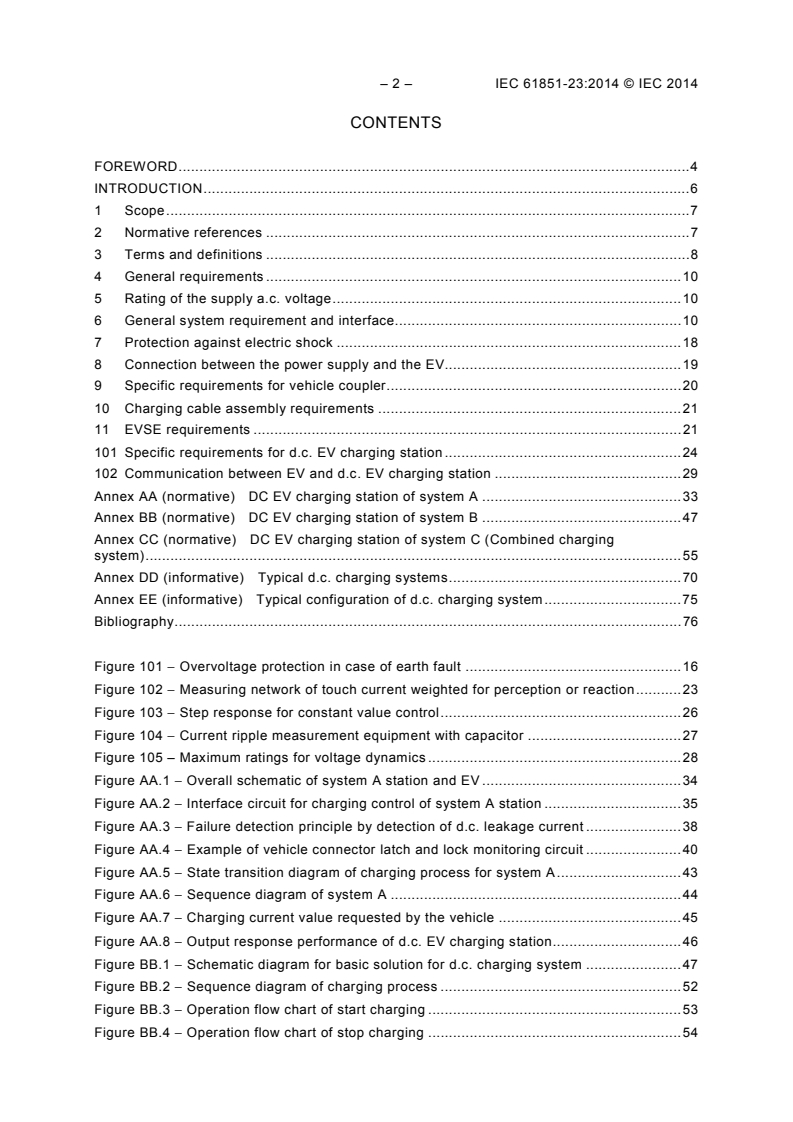
– 2 – IEC 61851-23:2014 © IEC 2014
CONTENTS
FO R EW O RD . 4
INT R O D UCT IO N . 6
1 Sc op e . . 7
2 Normative references . 7
3 Terms and definitions . 8
4 General requirements . 10
5 Rating of the supply a.c. voltage . 10
6 General system requirement and interface . 10
7 Protection against electric shock . 18
8 Connection between the power supply and the EV. 19
9 Specific requirements for vehicle coupler . 20
10 Charging cable assembly requirements . 21
11 EVSE requirements . 21
101 Specific requirements for d.c. EV charging station . 24
102 Communication between EV and d.c. EV charging station . 29
Annex AA (normative) DC EV charging station of system A . 33
Annex BB (normative) DC EV charging station of system B . 47
Annex CC (normative) DC EV charging station of system C (Combined charging
s ys t em ) . 55
Annex DD (informative) Typical d.c. charging systems . 70
Annex EE (informative) Typical configuration of d.c. charging system . 75
Bibliography . 76
Figure 101 − Overvoltage protection in case of earth fault . 16
Figure 102 − Measuring network of touch current weighted for perception or reaction . 23
Figure 103 − Step response for constant value control . 26
Figure 104 − Current ripple measurement equipment with capacitor . 27
Figure 105 – Maximum ratings for voltage dynamics . 28
Figure AA.1 − Overall schematic of system A station and EV . 34
Figure AA.2 − Interface circuit for charging control of system A station . 35
Figure AA.3 − Failure detection principle by detection of d.c. leakage current . 38
Figure AA.4 − Example of vehicle connector latch and lock monitoring circuit . 40
Figure AA.5 − State transition diagram of charging process for system A . 43
Figure AA.6 − Sequence diagram of system A . 44
Figure AA.7 − Charging current value requested by the vehicle . 45
Figure AA.8 − Output response performance of d.c. EV charging station . 46
Figure BB.1 − Schematic diagram for basic solution for d.c. charging system . 47
Figure BB.2 − Sequence diagram of charging process . 52
Figure BB.3 − Operation flow chart of start charging . 53
Figure BB.4 − Operation flow chart of stop charging . 54
Figure CC.1 − Sequence diagram for normal start up . 57
Figure CC.2 − Sequence diagram and description for normal shutdown . 59
Figure CC.3 – Sequence diagram for d.c. supply initiated emergency shutdown . 61
Figure CC.4 – Sequence diagram for EV initiated emergency shutdown. 63
Figure CC.5 − Special components for configurations CC and EE coupler . 66
Figure CC.6 − System schematics of combined d.c. charging system. 68
Figure D.1 − Example of typical isolated system . 70
Figure D.2 – Example of typical non-isolated system . 71
Figure D.3 − Example of simplified isolated system . 71
Figure D.4 − Example of DC mains system . 72
Figure E.1 − Typical configuration of d.c. charging system . 75
Table 101 − Current ripple limit of d.c. EV charging station . 27
Table 102 − Charging state of d.c. EV charging station . 30
Table 103 − Charging control process of d.c. EV charging station at system action level . 31
Table AA.1 − Definition of symbols in Figure AA.1 and Figure AA.2 . 36
Table AA.2 − Parameters and values for interface circuit in Figure AA.2 . 37
Table AA.3 − Principle of fault protection . 37
Table AA.4 − Requirements for earth fault monitoring . 39
Table AA.5 − Recommended specification of charging current requested by the vehicle . 45
Table AA.6 − Requirements for the output response performance of d.c. EV charging
station . 45
Table BB.1 − Definitions of charging states . 50
Table BB.2 − Recommended parameters of d.c. charging security system . 51
Table CC.1 − DC couplers and maximum system output voltage for combined charging
s ystem . 55
Table CC.2 − Definition of proximity resistor for configurations DD and FF . 55
Table CC.3 − Sequence description for normal start up . 58
Table CC.4 − Sequence description for normal shutdown . 60
Table CC.5 − Definition and description of symbols / terms . 69
Table D.1 − Example for categories of d.c. supply system to electric vehicles . 73
Table D.2 − Typical voltage ranges for isolated d.c. EV charging stations . 74
– 4 – IEC 61851-23:2014 © IEC 2014
INTERNATIONAL ELECTROTECHNICAL COMMISSION
____________
ELECTRIC VEHICLE CONDUCTIVE CHARGING SYSTEM –
Part 23: DC electric vehicle charging station
FOREWORD
1) The International Electrotechnical Commission (IEC) is a worldwide organization for standardization comprising
all national electrotechnical committees (IEC National Committees). The object of IEC is to promote
international co-operation on all questions concerning standardization in the electrical and electronic fields. To
this end and in addition to other activities, IEC publishes International Standards, Technical Specifications,
Technical Reports, Publicly Available Specifications (PAS) and Guides (hereafter referred to as “IEC
Publication(s)”). Their preparation is entrusted to technical committees; any IEC National Committee interested
in the subject dealt with may participate in this preparatory work. International, governmental and non-
governmental organizations liaising with the IEC also participate in this preparation. IEC collaborates closely
with the International Organization for Standardization (ISO) in accordance with conditions determined by
agreement between the two organizations.
2) The formal decisions or agreements of IEC on technical matters express, as nearly as possible, an international
consensus of opinion on the relevant subjects since each technical committee has representation from all
interested IEC National Committees.
3) IEC Publications have the form of recommendations for international use and are accepted by IEC National
Committees in that sense. While all reasonable efforts are made to ensure that the technical content of IEC
Publications is accurate, IEC cannot be held responsible for the way in which they are used or for any
misinterpretation by any end user.
4) In order to promote international uniformity, IEC National Committees undertake to apply IEC Publications
transparently to the maximum extent possible in their national and regional publications. Any divergence
between any IEC Publication and the corresponding national or regional publication shall be clearly indicated in
the latter.
5) IEC itself does not provide any attestation of conformity. Independent certification bodies provide conformity
assessment services and, in some areas, access to IEC marks of conformity. IEC is not responsible for any
services carried out by independent certification bodies.
6) All users should ensure that they have the latest edition of this publication.
7) No liability shall attach to IEC or its directors, employees, servants or agents including individual experts and
members of its technical committees and IEC National Committees for any personal injury, property damage or
other damage of any nature whatsoever, whether direct or indirect, or for costs (including legal fees) and
expenses arising out of the publication, use of, or reliance upon, this IEC Publication or any other IEC
Publications.
8) Attention is drawn to the Normative references cited in this publication. Use of the referenced publications is
indispensable for the correct application of this publication.
9) Attention is drawn to the possibility that some of the elements of this IEC Publication may be the subject of
patent rights. IEC shall not be held responsible for identifying any or all such patent rights.
International Standard IEC 61851-23 has been prepared by IEC technical committee 69:
Electric road vehicles and electric industrial trucks.
The text of this standard is based on the following documents:
FDIS Report on voting
69/272/FDIS 69/279/RVD
Full information on the voting for the approval of this standard can be found in the report on
voting indicated in the above table.
This publication has been drafted in accordance with the ISO/IEC Directives, Part 2.
This standard is to be read in conjunction with IEC 61851-1:2010. It was established on the
basis of the second edition (2010) of that standard.
The clauses of particular requirements in this standard supplement or modify the
corresponding clauses in IEC 61851-1:2010. Where the text of subsequent clauses indicates
an "addition" to or a "replacement" of the relevant requirement, test specification or
explanation of Part 1, these changes are made to the relevant text of Part 1, which then
becomes part of this standard. Where no change is necessary, the words "This clause of
Part 1 is applicable" are used. Additional clauses, tables and figures which are not included in
Part 1, have a number starting from 101. Additional annexes are lettered AA, BB etc.
A list of all parts in the IEC 61851 series, published under the general title Electric vehicle
conductive charging system, can be found on the IEC website.
In this standard, the following print types are used:
– test specifications and instructions regarding application of Part 1: italic type.
– notes: smaller roman type.
The committee has decided that the contents of this publication will remain unchanged until
the stability date indicated on the IEC web site under "http://webstore.iec.ch" in the data
related to the specific publication. At this date, the publication will be
• reconfirmed,
• withdrawn,
• replaced by a revised edition, or
• amended.
The contents of the corrigendum of May 2016 have been included in this copy.
IMPORTANT – The 'colour inside' logo on the cover page of this publication indicates
that it contains colours which are considered to be useful for the correct
understanding of its contents. Users should therefore print this document using a
colour printer.
– 6 – IEC 61851-23:2014 © IEC 2014
INTRODUCTION
The introduction and commercialisation of electric vehicles has been accelerated in the global
market, responding to the global concerns on CO reduction and energy security.
Concurrently, the development of charging infrastructure for electric vehicles has also been
expanding. As a complement to the a.c. charging system, d.c. charging is recognized as an
effective solution to extend the available range of electric vehicles. The international
standardization of charging infrastructure is indispensable for the diffusion of electric vehicles,
and this standard is developed for the manufacturers’ convenience by providing general and
basic requirements for d.c. EV charging stations for conductive connection to the vehicle.
ELECTRIC VEHICLE CONDUCTIVE CHARGING SYSTEM –
Part 23: DC electric vehicle charging station
1 Scope
This part of IEC 61851, together with IEC 61851-1:2010, gives the requirements for d.c.
electric vehicle (EV) charging stations, herein also referred to as "DC charger", for conductive
connection to the vehicle, with an a.c. or d.c. input voltage up to 1 000 V a.c. and up to 1 500
V d.c. according to IEC 60038.
NOTE 1 This standard includes information on EV for conductive connection, but limited to the necessary content
for describing the power and signaling interface.
This part covers d.c. output voltages up to 1 500 V.
Requirements for bi-directional power flow are under consideration.
NOTE 2 Typical diagrams and variation of d.c. charging systems are shown in Annex DD.
This standard does not cover all safety aspects related to maintenance.
This part specifies the d.c. charging systems A, B and C as defined in Annexes AA, BB and
CC.
NOTE 3 Typical configuration of d.c. EV charging system is shown in Annex EE.
EMC requirements for d.c. EV charging stations are defined in IEC 61851-21-2.
This standard provides the general requirements for the control communication between a d.c.
EV charging station and an EV. The requirements for digital communication between d.c. EV
charging station and electric vehicle for control of d.c. charging are defined in IEC 61851-24.
2 Normative references
This clause of Part 1 is applicable except as follows:
Addition:
IEC 60364-5-54:2011, Low-voltage electrical installations – Part 5-54: Selection and erection
of electrical equipment – Earthing arrangements and protective conductors
IEC/TS 60479-1:2005, Effects of current on human beings and livestock - Part 1: General
aspects
IEC 60950-1:2005, Information technology equipment - Safety - Part 1: General requirements
Amendment 1:2009
Amendment 2:2013
IEC 61140, Protection against electric shock – Common aspects for installation and
equipment
– 8 – IEC 61851-23:2014 © IEC 2014
IEC 61439-1:2011, Low voltage switchgear and controlgear assemblies – Part 1: General
rules
IEC 61557-8, Electrical safety in low voltage distribution systems up to 1 000 V a.c. and
1 500 V d.c. – Equipment for testing, measuring or monitoring of protective measures – Part
8: Insulation monitoring devices for IT systems
IEC 61558-1:2005, Safety of power transformers, power supplies, reactors and similar
products – Part 1: General requirements and tests
IEC 61851-1:2010, Electric vehicle conductive charging system – Part 1: General
requirements
IEC 61851-24:2014, Electric vehicle conductive charging system – Part 24: Digital
communication between a d.c. EV charging station and an electric vehicle for control of d.c.
charging
IEC 62052-11, Electricity metering equipment (AC) – General requirements, tests and test
conditions – Part 11: Metering equipment
IEC 62053-21, Electricity metering equipment (a.c.) – Particular requirements – Part 21: Static
meters for active energy (classes 1 and 2)
IEC 62196-3:— , Plugs, socket-outlets, and vehicle couplers – Conductive charging of electric
vehicles – Part 3: Dimensional compatibility and interchangeability requirements for d.c. and
a.c./d.c. pin and tube-type contact vehicle couplers
ISO/IEC 15118-2:— , Road Vehicles – Vehicle to grid communication interface – Part 2:
Technical protocol description and Open Systems Interconnections (OSI) layer requirements
ISO/IEC 15118-3:— , Road Vehicles – Vehicle to grid communication interface – Part 3:
Physical layer and data link layer requirements
ISO 11898-1, Road vehicles – Controller area network (CAN) – Part 1: Data link layer and
physical signalling
DIN SPEC 70121, Electromobility – Digital communication between a d.c. EV charging station
and an electric vehicle for control of d.c. charging in the Combined Charging System
3 Terms and definitions
For the purposes of this document, the terms and definitions given in IEC 61851-1 and
IEC 61668-1, as well as the following apply.
NOTE The definitions included in this part are those having general application herein. Definitions applying to
isolating transformers, safety isolating transformers, switch mode power supplies, and their construction are
included in IEC 61558-1.
3.101
d.c. EV charging system
system composed of a DC charger, cable assembly and the equipment on EV that is required
to fulfil the charging function including digital communication for charging control
3.102
isolated d.c. EV charging station
d.c. EV charging station with d.c. circuit on output side which is electrically separated by at
least basic insulation from a.c. circuit on power system side
3.103
non-isolated d.c. EV charging station
d.c. EV charging station with d.c. circuit on output side which is not electrically separated by
at least basic insulation from the supply system
3.104
regulated d.c. EV charging station
d.c. EV charging station that supplies vehicle battery with a charging current or charging
voltage in accordance with the request from vehicle
3.105
non-regulated d.c. EV charging station
under consideration
3.106
d.c. charging control function
DCCCF
function embedded in a d.c. EV charging station which controls d.c. power output following
VCCF direction
Note 1 to entry: This note applies to the French language only.
3.107
vehicle charging control function
VCCF
function in a vehicle which controls the charging parameters of off-board d.c. EV charging
station
Note 1 to entry: This note applies to the French language only.
3.108
CCC
controlled current charging
energy transfer method that the d.c. EV charging station regulates charging current according
to the current value requested by the vehicle
Note 1 to entry: This note applies to the French language only.
3.109
CVC
controlled voltage charging
energy transfer method that the d.c. EV charging station regulates charging voltage according
to the voltage value requested by the vehicle
Note 1 to entry: This note applies to the French language only.
3.110
control circuit
circuit for signal and digital communication with vehicle, and for the management of charging
control process
3.111
primary circuit
a circuit that is directly connected to the a.c. mains supply, and includes the primary windings
of transformers, other loading devices and the means of connection to the a.c. mains supply
– 10 – IEC 61851-23:2014 © IEC 2014
3.112
secondary circuit
circuit that has no direct connection to a primary circuit and derives its power from a
transformer, converter or equivalent isolation device
3.113
insulation
all the materials and parts used to insulate conductive elements of a device, or a set of
properties which characterize the ability of an insulation to provide its function
[SOURCE: IEC 60050-151:2001, 151.15.41 and IEC 60050-151:2001, 151.15.42, modified —
Both these definitions have been combined and the note to entry has been deleted.]
3.114
isolation
function intended to make dead for reasons of safety all or a discrete section of the electrical
installation by separating the electrical installation or section from every source of electric
energy
[SOURCE: IEC 60050-826:2004, 826.17.01]
3.115
maximum voltage limit
upper limit value of charging voltage that is notified by the vehicle to the d.c. EV charging
station, and is used for overvoltage protection of vehicle battery
3.116
protective conductor
PE
conductor provided for purposes of safety, for example protection against electric shock
Note 1 to entry: This note applies to the French language only.
[SOURCE: IEC 60050-195:1998, 195.02.09]
3.117
charging state
physical status of d.c. EV charging system
3.118
emergency shutdown
shutdown of d.c. EV charging station that results in the termination of charging, caused by a
failure detected by the d.c. EV charging station or the vehicle.
4 General requirements
This clause of Part 1 is applicable.
5 Rating of the supply a.c. voltage
This clause of Part 1 is applicable.
6 General system requirement and interface
This clause of Part 1 is applicable except as follows:
6.2 EV charging mode
Replacement:
EV charging mode of this standard is Mode 4.
Mode 4 charging in this part means the connection of the EV to the supply network utilizing a
d.c. EV charging station (e.g. off-board charger) where the control pilot function extends to
the d.c. EV charging station.
Pluggable d.c. EV charging stations, which are intended to be connected to the a.c. supply
network (mains) using standard plugs and socket outlets, shall be compatible with residual
current device with characteristics of type A. The pluggable d.c. EV charging station shall be
provided with an RCD, and may be equipped with an overcurrent protection device.
Further requirements for pluggable d.c. EV charging stations are under consideration.
NOTE 1 In some countries, the use of an RCD of Type AC for d.c. EV charging station (a.c. mains) is allowed: JP.
NOTE 2 In some countries, US and CA, the use of a system of protection is required that is intended to interrupt
the electric circuit to the load when:
a) a fault current to earth (ground) exceeds some predetermined value that is less than that required to operate
the overcurrent protective device of the supply circuit,
b) the earthing (grounding) path becomes open-circuited or of excessively high impedance, or
c) a path to earth (ground) is detected on an isolated (ungrounded) system.
Replacement:
6.3 Types of EV connection
Replacement:
6.3.1 General description
The connection of EVs using cables shall be carried out in case of C connection as specified
in Part 1.
6.3.3 Adaptors
Replacement:
Adaptors shall not be used to connect a vehicle connector to a vehicle inlet.
Replacement:
6.4 Functions provided in d.c. charging
The d.c. EV charging station shall supply a d.c. current or voltage to the vehicle battery in
accordance with a VCCF request.
For non-regulated charging: under consideration.
Replacement:
6.4.1 Mode 4 charging functions
These functions shall be provided by d.c. charging system as given below:
– 12 – IEC 61851-23:2014 © IEC 2014
– verification that the vehicle is properly connected;
– protective conductor continuity checking (6.4.3.2);
– energization of the system;
– de-energization of the system (6.4.3.4);
– d.c supply for EV (6.4.3.101);
– measuring current and voltage (6.4.3.102);
– retaining / releasing coupler (6.4.3.103);
– locking of the coupler (6.4.3.104);
– compatibility assessment (6.4.3.105);
– insulation test before charging (6.4.3.106);
– protection against overvoltage at the battery (6.4.3.107);
– verification of vehicle connector voltage (6.4.3.108);
– control circuit supply integrity (6.4.3.109);
– short circuit test before charging (6.4.3.110);
– user initiated shutdown (6.4.3.111);
– overload protection for parallel conductors (conditional function) (6.4.3.112);
– protection against temporary overvoltage (6.4.3.113);
– emergency shutdown (6.4.3.114).
Replacement:
6.4.2 Optional functions
These functions, if provided, should be provided by d.c. charging system as optional as given
below:
– determination of ventilation requirements of the charging area;
– detection/adjustment of the real time available load current of the DC charger;
– selection of charging current;
– wake up of d.c. EV charging station by EV (6.4.4.101);
– indicating means to notify users of locked status of vehicle coupler.
Other additional functions may be provided.
NOTE 1 Un-intentional live disconnect avoidance functions may be incorporated in the latching function interlock
system.
NOTE 2 A positive means to prevent unintentional disconnect is required in some countries: US
NOTE 3 Primary protection against overvoltage and overcurrent of vehicle battery is the responsibility of the
vehicle.
Replacement:
6.4.3 Details of functions for DC charging
Replacement:
6.4.3.2 Protective conductor continuity checking
For isolated systems, protective conductor continuity between the d.c. EV charging station
and the vehicle shall be monitored. For the rated voltage of d.c. 60 V or higher, the d.c. EV
charging station shall perform an emergency shutdown (see 6.4.3.114) within 10 s after a loss
of electrical continuity of the protective conductor between d.c. EV charging station and EV
(emergency shutdown).
For non-isolated systems, in case of loss of earthing conductor continuity, the non-isolated
d.c. EV charging station shall be disconnected from a.c supply network (mains). Earthing
conductor continuity between the d.c. EV charging station and the vehicle shall be monitored.
For the rated voltage of d.c. 60 V or higher, the d.c. EV charging station shall perform an
emergency shutdown within 5 s after a loss of electrical continuity of the protective conductor
between d.c. EV charging station and EV.
NOTE The isolated d.c. EV charging station can be disconnected from a.c. mains when protective conductor
continuity is lost.
6.4.3.4 De-energization of the system
Addition:
In the case of failure in control circuit of d.c. EV charging station, such as short-circuit, earth
leakage, CPU failure or excess temperature, the d.c. EV charging station shall terminate the
supply of charging current, and disconnect the supply of control circuit. In addition, the
conductor, in which earth fault or overcurrent is detected, shall be disconnected from its
supply.
Requirement for disconnection of EV is defined in 7.2.3.1.
Compliance check: under consideration.
Addition:
6.4.3.101 DC supply for EV
The d.c. EV charging station shall supply d.c. voltage and current to the vehicle battery in
accordance with VCCF’s controlling.
For regulated systems, the d.c. EV charging station shall supply regulated d.c. voltage or
current (not simultaneously, but as requested by the vehicle during charging) to the vehicle
battery in accordance with VCCF’s controlling. Requirements for charging performance of
regulated d.c. current / voltage are given in 101.2.1.1, 101.2.1.2 and 101.2.1.3 and 101.2.1.4.
In either case mentioned above, the maximum ratings of the d.c EV charging station shall not
be exceeded.
The vehicle can change the requested current and/or requested voltage.
6.4.3.102 Measuring current and voltage
The d.c. EV charging station shall measure the output current and output voltage. The
accuracy of output measurement is defined for each system in Annexes AA, BB and CC.
6.4.3.103 Retaining/releasing coupler
A means shall be provided to retain and release the vehicle coupler. Such means may be
mechanical, electrical interlock, or combination of interlock and latch.
– 14 – IEC 61851-23:2014 © IEC 2014
6.4.3.104 Locking of the coupler
A vehicle connector used for d.c. charging shall be locked on a vehicle inlet if the voltage is
higher than 60 V d.c.
The vehicle connector shall not be unlocked (if the locking mechanism is engaged) when
hazardous voltage is detected through charging process including after the end of charging. In
case of charging system malfunction, a means for safe disconnection may be provided.
NOTE 1 The actuation portion of the locking function can be in either the vehicle connector or the vehicle inlet. It
is configuration dependent.
The d.c. EV charging station shall have the following functions in case the locking is done by
the d.c. EV charging station:
– electrical or mechanical locking function to retain the locked status, and
– function to detect the disconnection of the electrical circuits for the locking function.
NOTE 2 The locking function for each system is defined in Annexes AA, BB and CC.
NOTE 3 An example of lock function and disconnection detection circuit is shown in Annex AA.
For the tests of mechanical strength, refer to IEC 62196-3.
6.4.3.105 Compatibility assessment
Compatibility of EV and d.c. EV charging station shall be checked with the information
exchanged at the initialization phase as specified in 102.5.1.
6.4.3.106 Insulation test before charging
The d.c. EV charging station shall confirm the insulation resistance between its d.c. output
circuit and protective conductor to the vehicle chassis, including the charging station
enclosure, before the EV contactors are allowed to close.
If the required value is not met, the d.c. EV charging station shall send the signal to the
vehicle that the charging is not allowed.
Conformance is determined by measuring the insulation resistance as follows:
Any relays in the d.c. output circuit of the d.c. EV charging station shall be closed during the
test.
The required value of insulation resistance R shall be as shown in Formula (1):
R ≥ 100 Ω/V × U (1)
where
U is rated output voltage of the d.c. EV charging station.
6.4.3.107 Protection against overvoltage at the battery
The d.c. EV charging station shall perform an emergency shutdown and disconnect its supply
to prevent overvoltage at the battery, if output voltage exceeds maximum voltage limit sent by
the vehicle. In case of vehicle failure, disconnection from a.c. mains may not be necessary.
Specific requirement for detection and shutdown are defined in Annexes AA, BB and CC.
The vehicle may change the maximum voltage limit during charging process.
Compliance is checked according to the following test.
The d.c. EV charging station is connected to a d.c. voltage source or artificial load.
The voltage of the d.c. voltage source or artificial load should be within the operating range of
the charging station.
The d.c. EV charging station is set to charge the d.c. voltage source at a current of more than
10 % of the maximum rated current of d.c. EV charging station.
A maximum voltage limit command lower than the voltage of the voltage source shall be sent
to the d.c. EV charging station.
Both the time between when the command is sent and the beginning of charging current
reduction, and the rate of reduction shall be measured.
The voltage of the voltage source, the way the command voltage limit is sent and the value of
the voltage limit can be chosen freely to comply with this test.
NOTE The selection of charging current can be made by the system or the user.
6.4.3.108 Verification of vehicle connector voltage
This clause is only applicable for charging stations which are responsible for locking of
vehicle connector, such as system A and system B.
The d.c. EV charging station shall not energize the charging cable when the vehicle
connector is unlocked. The voltage at which the vehicle connector unlocks shall be lower
than 60 V.
6.4.3.109 Control circuit supply integrity
If an earth fault, short circuit or overcurrent is detected in output circuit of d.c. EV charging
station, the power circuit shall be disconnected from its supply, but the power supply for
control circuit shall not be interrupted unless the power circuit interruption is due to a
loss of a.c. supply network (mains).
6.4.3.110 Short circuit test before charging
With the EV connected to the d.c. EV charging station and before the EV contactor is closed,
the d.c. EV charging station shall have a means to check for a short circuit between d.c.
output circuit positive and negative for the cable and vehicle coupler.
Compliance test specifications are defined in Annexes AA, BB and CC (under consideration).
6.4.3.111 User initiated shutdown
The d.c. EV charging station shall have a means to allow the user to shut down the charging
process.
6.4.3.112 Overload protection for parallel conductors (conditional function)
If more than one conductor or wire and/or vehicle connector contact is used in parallel for d.c.
current supply to the vehicle, the d.c. EV charging station shall have a mean to ensure, that
none of the conductors or wires will be overloaded.
NOTE For example, the currents on the different paths can be monitored or more than one power source can be
used.
– 16 – IEC 61851-23:2014 © IEC 2014
6.4.3.113 Protection against temporary overvoltage
For stations serving a maximum output voltage up to 500 V, no voltage higher than 550 V
shall occur for more than 5 s at the output between DC+ and PE or between DC- and PE.
For stations serving a maximum output voltage above 500 V and up to 1 000 V, no voltage
higher than 110 % of d.c. output voltage shall occur for more than 5 s at the output between
DC+ and PE or between DC- and PE. See Figure 101.
For voltage above 1 000 V: under consideration.
The d.c. EV charging station shall terminate the supply of charging current and disconnect the
d.c. power circuit from its supply within 5 s, to remove the source of overvoltage (see
5.3.3.2.3 in IEC 60664-1:2007). This shall also apply in case of a first earth fault within the
isolated output part of the d.c. EV charging station.
For U , as the minimum DC charger output voltage, the d.c. EV charging station shall limit the
n
voltage between DC+/- and PE at:
(2 U + 1 000) × 1,41 V or;
n
(U + 1 200) × 1,41 V, whichever is less.
n
NOTE The voltage can be limited by reducing the overvoltage category or by adding a surge protection device
with sufficient clamping voltage.
Isolation
transformer
DC+
Additional
DC output
stage
(if any)
DC−
Earth Earth
< 110% of maximun voltage limit send by EV
fault 1 fault 2
PE
IEC 0683/14
Figure 101 − Overvoltage protection in case of earth fault
6.4.3.114 Emergency shutdown
When the d.c. EV charging station detects an abnormality in the station and/or the vehicle, the
safety shall be ensured by the emergency shutdown as follows.
Stop charging by:
a) controlled expedited interruption of charging current or voltage to the vehicle, where d.c.
current descends with a controlled slope, and appropriate signaling to the vehicle, or
b) uncontrolled abrupt termination of charging under specific fault conditions, where there is
no control of current, and the vehicle may not be informed in time.
NOTE The d.c. EV charging station can achieve this requirement by exchange of information with the vehicle (see
102.4 and Annex AA, BB or CC).
Under specific conditions, the following disconnection, for example, is required according to
the risk assessment of the abnormality in the station or the vehicle:
– disconnection of the supply to the conductor
...