

IEC 60205:2001
(Main)Calculation of the effective parameters of magnetic piece parts
General Information
- Abstract
Lays down uniform rules for the calculation of the effective parameters of closed circuits of ferromagnetic material.
- Status
- Published
- Publication Date
- 09-Apr-2001
- Technical Committee
- TC 51 - Magnetic components, ferrite and magnetic powder materials
- Drafting Committee
- WG 1 - TC 51/WG 1
- Current Stage
- DELPUB - Deleted Publication
- Start Date
- 26-Apr-2006
- Completion Date
- 28-Aug-2026
Buy Documents
IEC 60205:2001 - Calculation of the effective parameters of magnetic piece parts Released:4/10/2001
IEC 60205:2001 - Calculation of the effective parameters of magnetic piece parts Released:4/10/2001
Overview
IEC 60205:2001 - "Calculation of the effective parameters of magnetic piece parts" provides uniform, internationally accepted rules for calculating the effective parameters of closed magnetic circuits made of ferromagnetic material. The standard defines how to derive the effective magnetic length (le), effective cross‑sectional area (Ae) and effective volume (Ve) from the core constants C1 and C2, and gives formulae for common core geometries used in magnetic components and transformers.
Key topics and technical requirements
- Scope: Applies only to component parts of closed magnetic circuits (ferromagnetic cores).
- Units & accuracy: All results in millimetres; values reported to three significant figures (C1 and C2 calculated to five significant figures to ensure reproducibility).
- Definitions: Effective parameters defined by relationships between core constants: le = C1/C2, Ae = C2/C3, Ve = le·Ae (using symbols as in the standard).
- Dimensional rules:
- Use mean dimensions within tolerance limits from drawings.
- Nominal smallest cross‑section (Amin) is the reference for Ae calculations.
- Small manufacturing irregularities (chamfers, notches, ridges) are ignored unless stated otherwise.
- Sharp corners: use mean circular flux path joining centres of adjacent areas; average adjacent areas for associated cross-section.
- Core geometries covered: Comprehensive formulae and procedures for ring cores, U‑cores (rectangular and rounded), E‑cores, ETD‑cores, pot‑cores, RM (square) cores, EP‑cores and PM‑cores.
- Corner and limb treatments: Explicit methods to compute mean lengths and mean areas for flux paths at corners and limbs, including analytic expressions for segments, arcs and winding distributions.
- Informative annex: Annex A explains the purpose of the revision and guidance for dealing with new effective parameter values.
Practical applications
IEC 60205:2001 is directly useful for:
- Magnetic component designers (transformers, inductors, chokes) needing consistent core parameter calculations for electromagnetic design and simulation.
- Manufacturers and tool designers who prepare part drawings and tolerance data used in parameter derivation.
- Electrical engineers performing finite‑element analysis (FEA) and circuit modelling who require standardized Le, Ae and Ve inputs.
- Test labs and quality control teams verifying design documentation and ensuring repeatable parameter reporting.
Related standards / users
- Prepared by IEC Technical Committee 51 (magnetic components and ferrite materials). Users include power‑electronics engineers, transformer/inductor manufacturers, magnetic materials specialists and CAD/CAE engineers requiring standardised magnetic core parameters for design, simulation and procurement.
Relations
- Corrected By
IEC 60205:2001/COR1:2002 - Corrigendum 1 - Calculation of the effective parameters of magnetic piece parts - Effective Date
- 05-Sep-2023
- Effective Date
- 05-Sep-2023
Buy Documents
IEC 60205:2001 - Calculation of the effective parameters of magnetic piece parts Released:4/10/2001
IEC 60205:2001 - Calculation of the effective parameters of magnetic piece parts Released:4/10/2001
Get Certified
Connect with accredited certification bodies for this standard

IMQ S.p.A. (Certification)
Italian electrical product certification.

SLG Prüf- und Zertifizierungs GmbH
German testing and certification body.

UL Solutions
Global safety science company with testing, inspection and certification.
Sponsored listings
Frequently Asked Questions
IEC 60205:2001 is a standard published by the International Electrotechnical Commission (IEC). Its full title is "Calculation of the effective parameters of magnetic piece parts". This standard covers: Lays down uniform rules for the calculation of the effective parameters of closed circuits of ferromagnetic material.
Lays down uniform rules for the calculation of the effective parameters of closed circuits of ferromagnetic material.
IEC 60205:2001 is classified under the following ICS (International Classification for Standards) categories: 29.100.10 - Magnetic components. The ICS classification helps identify the subject area and facilitates finding related standards.
IEC 60205:2001 has the following relationships with other standards: It is inter standard links to IEC 60205:2001/COR1:2002, IEC 60205:2006. Understanding these relationships helps ensure you are using the most current and applicable version of the standard.
IEC 60205:2001 is available in PDF format for immediate download after purchase. The document can be added to your cart and obtained through the secure checkout process. Digital delivery ensures instant access to the complete standard document.
Standards Content (Sample)
INTERNATIONAL IEC
STANDARD
Second edition
2001-04
Calculation of the effective parameters
of magnetic piece parts
Calcul des paramètres effectifs des pièces
ferromagnétiques
Reference number
Publication numbering
As from 1 January 1997 all IEC publications are issued with a designation in the
60000 series. For example, IEC 34-1 is now referred to as IEC 60034-1.
Consolidated editions
The IEC is now publishing consolidated versions of its publications. For example,
edition numbers 1.0, 1.1 and 1.2 refer, respectively, to the base publication, the
base publication incorporating amendment 1 and the base publication incorporating
amendments 1 and 2.
Further information on IEC publications
The technical content of IEC publications is kept under constant review by the IEC,
thus ensuring that the content reflects current technology. Information relating to
this publication, including its validity, is available in the IEC Catalogue of
publications (see below) in addition to new editions, amendments and corrigenda.
Information on the subjects under consideration and work in progress undertaken
by the technical committee which has prepared this publication, as well as the list
of publications issued, is also available from the following:
• IEC Web Site (www.iec.ch)
• Catalogue of IEC publications
The on-line catalogue on the IEC web site (www.iec.ch/catlg-e.htm) enables
you to search by a variety of criteria including text searches, technical
committees and date of publication. On-line information is also available on
recently issued publications, withdrawn and replaced publications, as well as
corrigenda.
• IEC Just Published
This summary of recently issued publications (www.iec.ch/JP.htm) is also
available by email. Please contact the Customer Service Centre (see below) for
further information.
• Customer Service Centre
If you have any questions regarding this publication or need further assistance,
please contact the Customer Service Centre:
Email: custserv@iec.ch
Tel: +41 22 919 02 11
Fax: +41 22 919 03 00
INTERNATIONAL IEC
STANDARD
Second edition
2001-04
Calculation of the effective parameters
of magnetic piece parts
Calcul des paramètres effectifs des pièces
ferromagnétiques
IEC 2001 Copyright - all rights reserved
No part of this publication may be reproduced or utilized in any form or by any means, electronic or
mechanical, including photocopying and microfilm, without permission in writing from the publisher.
International Electrotechnical Commission 3, rue de Varembé Geneva, Switzerland
Telefax: +41 22 919 0300 e-mail: inmail@iec.ch IEC web site http://www.iec.ch
Commission Electrotechnique Internationale
PRICE CODE
T
International Electrotechnical Commission
For price, see current catalogue
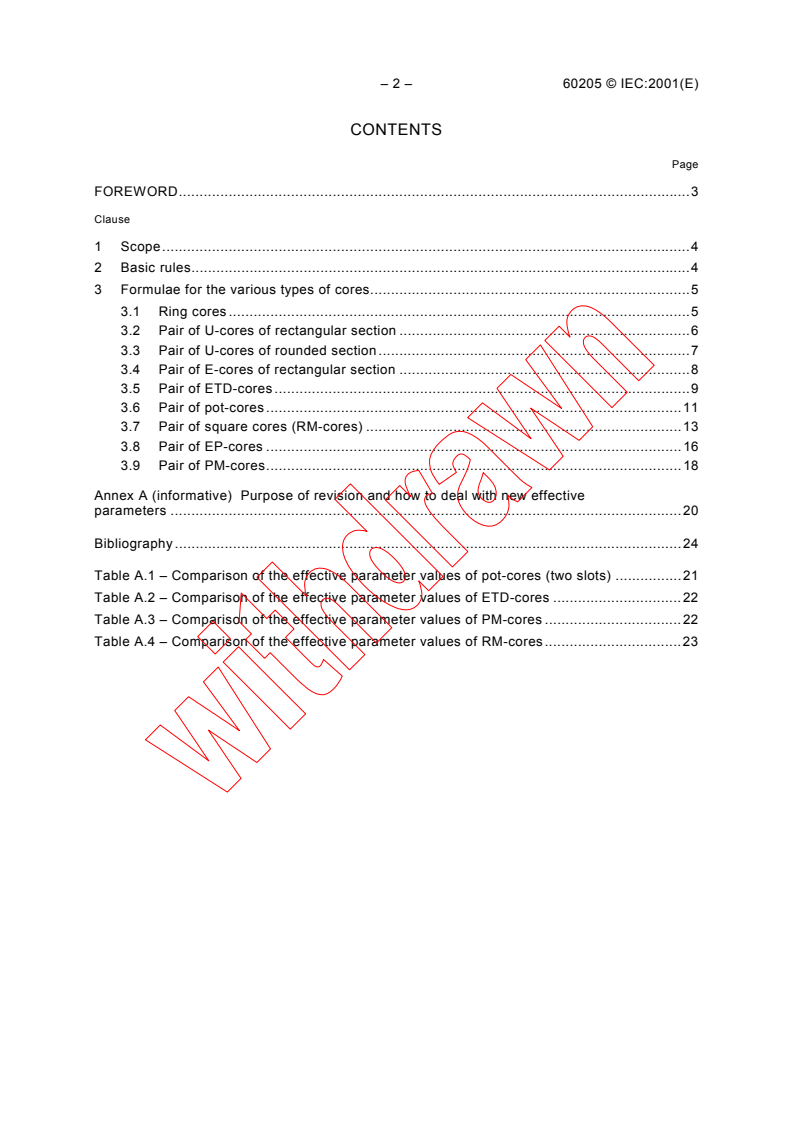
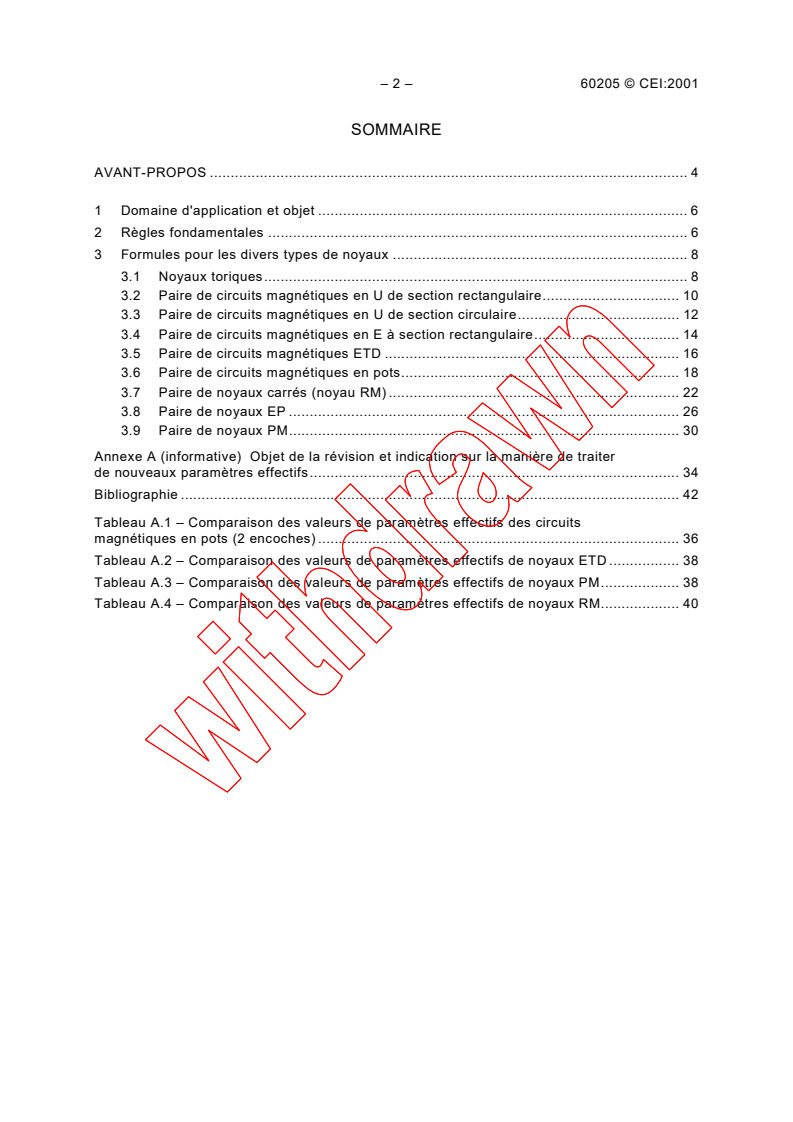
– 2 – 60205 © IEC:2001(E)
CONTENTS
Page
FOREWORD.3
Clause
1 Scope.4
2 Basic rules.4
3 Formulae for the various types of cores.5
3.1 Ring cores .5
3.2 Pair of U-cores of rectangular section .6
3.3 Pair of U-cores of rounded section.7
3.4 Pair of E-cores of rectangular section .8
3.5 Pair of ETD-cores .9
3.6 Pair of pot-cores .11
3.7 Pair of square cores (RM-cores) .13
3.8 Pair of EP-cores .16
3.9 Pair of PM-cores.18
Annex A (informative) Purpose of revision and how to deal with new effective
parameters .20
Bibliography .24
Table A.1 – Comparison of the effective parameter values of pot-cores (two slots) .21
Table A.2 – Comparison of the effective parameter values of ETD-cores .22
Table A.3 – Comparison of the effective parameter values of PM-cores .22
Table A.4 – Comparison of the effective parameter values of RM-cores.23
60205 © IEC:2001(E) – 3 –
INTERNATIONAL ELECTROTECHNICAL COMMISSION
____________
CALCULATION OF THE EFFECTIVE PARAMETERS
OF MAGNETIC PIECE PARTS
FOREWORD
1) The IEC (International Electrotechnical Commission) is a worldwide organization for standardization comprising
all national electrotechnical committees (IEC National Committees). The object of the IEC is to promote
international co-operation on all questions concerning standardization in the electrical and electronic fields. To
this end and in addition to other activities, the IEC publishes International Standards. Their preparation is
entrusted to technical committees; any IEC National Committee interested in the subject dealt with may
participate in this preparatory work. International, governmental and non-governmental organizations liaising
with the IEC also participate in this preparation. The IEC collaborates closely with the International Organization for
Standardization (ISO) in accordance with conditions determined by agreement between the two organizations.
2) The formal decisions or agreements of the IEC on technical matters express, as nearly as possible, an
international consensus of opinion on the relevant subjects since each technical committee has representation
from all interested National Committees.
3) The documents produced have the form of recommendations for international use and are published in the form
of standards, technical specifications, technical reports or guides and they are accepted by the National
Committees in that sense.
4) In order to promote international unification, IEC National Committees undertake to apply IEC International
Standards transparently to the maximum extent possible in their national and regional standards. Any
divergence between the IEC Standard and the corresponding national or regional standard shall be clearly
indicated in the latter.
5) The IEC provides no marking procedure to indicate its approval and cannot be rendered responsible for any
equipment declared to be in conformity with one of its standards.
6) Attention is drawn to the possibility that some of the elements of this International Standard may be the subject
of patent rights. The IEC shall not be held responsible for identifying any or all such patent rights.
International Standard IEC 60205 has been prepared by IEC technical committee 51: Magnetic
components and ferrite materials.
This second edition cancels and replaces the first edition published in 1966, amendment 1
(1976), amendment 2 (1981), first supplement (1968) and second supplement (1974). This
second edition constitutes a technical revision.
The text of this standard is based on the first edition, amendments 1 and 2, supplements A and
B and the following documents:
FDIS Report on voting
51/582/FDIS 51/594/RVD
Full information on the voting for the approval of this standard can be found in the report on
voting indicated in the above table.
This publication has been drafted in accordance with the ISO/IEC Directives, Part 3.
Annex A is for information only.
The committee has decided that the contents of this publication will remain unchanged until
2005. At this date, the publication will be
• reconfirmed;
• withdrawn;
• replaced by a revised edition, or
• amended.
A bilingual version of this publication may be issued at a later date.
– 4 – 60205 © IEC:2001(E)
CALCULATION OF THE EFFECTIVE PARAMETERS
OF MAGNETIC PIECE PARTS
1 Scope
This International Standard lays down uniform rules for the calculation of the effective
parameters of closed circuits of ferromagnetic material.
2 Basic rules
The following basic rules are applicable to this standard.
2.1 All results shall be expressed in units based on the millimetre and shall be accurate to
three significant figures, but to derive l , A , and V the values of C and C shall be calculated
e e e 1 2
to five significant figures.
NOTE The purpose of specifying this degree of accuracy is only to ensure that parameters calculated at different
establishments are identical, and it is not intended to imply that the parameters are capable of being determined to
this accuracy.
2.2 A is the nominal value of the smallest cross-section. All the dimensions used to
min
calculate A shall be the mean values between the tolerance limits quoted on the appropriate
min
piece part drawing.
2.3 Calculations are only applicable to the component parts of a closed magnetic circuit.
2.4 All dimensions used for the purpose of calculations shall be the mean value within the
tolerance limits quoted on the appropriate piece part drawing.
2.5 All irregularities in the outline of the core, such as small cut-outs, notches, chamfers, etc.
shall be ignored unless otherwise described.
2.6 When the calculation involves the sharp corner of a piece part, then the mean length of
flux path for that corner shall be taken as the mean circular path joining the centres of area of
the two adjacent uniform sections, and the cross-sectional area associated with that length
shall be taken as the average area of the two adjacent uniform sections.
Calculation of effective parameters l , A and V
e e e
The effective parameters can be defined as
2 3 2
l = C /C A = C /C V = l A = C /C
e 1 2 e 1 2 e e e 1 2
where
l is the effective magnetic length of the core (mm);
e
A is the effective cross-sectional area (mm );
e
V is the effective volume (mm );
e
–1
C is the core constant (mm );
–3
C is the core constant (mm ).
60205 © IEC:2001(E) – 5 –
3 Formulae for the various types of cores
3.1 Ring cores
X
α
d /2 d /2
1 1
d /2
β
d /2 d /2 d /2
2 2 2
r
0 r
4x
4x
r
ϕ
h h
h
X
Section X-X
IEC 345/01
2 π
C =
h ln()d d
e 1 2
4π()1 d − 1 d
2 1
C =
h ln()d d
e 1 2
3.1.1 For ring cores of rectangular cross-section with sharp corners
h = h
e
3.1.2 For ring cores of rectangular cross-section with an appreciable average rounding radius r
1,7168 r
h = h (1 – k ) k =
e 1
h()d − d
1 2
3.1.3 For ring cores of rectangular cross-section with sharp corners
h = h (1 – k )
e 2
h (tan α + tan β)
k =
d − d
1 2
3.1.4 For ring cores of trapezoidal cross-section with an appreciable average rounding radius r
h = (1 – k – k )
e 1 2
– 6 – 60205 © IEC:2001(E)
3.1.5 For ring cores of cross-section with circular arc frontal sides
d − d ϕ sinϕ ϕ
1 2
h = h − 2 sin − −
e
ϕ 2 2 2
2
4 sin
d − d
1 2
ϕ = 2arcsin ;
4r
ϕ, in radians.
NOTE When the winding is uniformly distributed over a ring core, it may be expected that, at all points inside the
ring core, the flux lines will be parallel to its surface.
No leakage flux will therefore leave or enter the ring core. This justifies the use of a theoretically more correct
derivation of the effective parameters which does not make use of the assumption that the flux is uniformly
distributed over the cross-section.
3.2 Pair of U-cores of rectangular section
l
q
l"
4 l'
X
A
Area
YY
h
A
Area
A
Area
Section Y-Y
X
l
l"
l'
Section X-X
IEC 346/01
Length of flux path associated with area A :
l = l′ + l″
2 2 2
Mean length of flux paths at corners:
π
l = l′ + l″ = (p + h)
4 4 4
π
l = l′ + l″ = (s + h)
5 5 5
Mean areas associated with l and l :
4 5
A + A
1 2
A =
A + A
2 3
A =
5 5
l l
i i
C = C =
1 ∑ ∑
A
A
i
1 1 i
q
l"
l'
p
s
60205 © IEC:2001(E) – 7 –
3.3 Pair of U-cores of rounded section
p
l
l"
l'
X
A
Area
h
YY
A
Area
A
Area
Section Y-Y
X
l
l' s
l"
5 5
Section X-X
IEC 347/01
In calculating A , ignore any ridges introduced for the purpose of facilitating manufacture.
Length of flux path associated with area A :
l = l′ + l″
2 2 2
Mean length of flux path at corners:
π
l = l′ + l″ = (p + h)
4 4 4
π
l = l′ + l″ = (s + h)
5 5 5
Mean areas associated with l and l :
4 5
A + A
1 2
A =
A + A
2 3
A =
5 5
l l
i
i
C = C =
1 ∑ ∑
A
A
i
1 i
s
l"
l'
– 8 – 60205 © IEC:2001(E)
3.4 Pair of E-cores of rectangular section
l
w
l
X
A
Area
Y
Y
A
l
h 3
Area
A
Area
l
A
Area
A
Area
Section Y-Y
X
Section X-X
IEC 348/01
Area of half the centre limb: A
Mean length of flux paths at corners:
π
l = (p + h)
π d
l = + h
8 2
Mean areas associated with l and l :
4 5
+
A A
1 2
A =
A + A
2 3
A =
5 5
l l
i i
C = C =
1 ∑ 2 ∑
A
2A
i
1 1 i
w
l
p
d / 2
60205 © IEC:2001(E) – 9 –
3.5 Pair of ETD-cores
l
b
X l
A
c
Y
Y Area
A'
Area
l
h A"
Area
A
l
Area
A
Area
A
Area
Section Y-Y
X
Section X-X
IEC 349/01
1
A is equal to the rectangle b a − c less the cap or segment A
1 c
1 b 1
2 2
A = d arcsin − b d − b
c 2 2
4 d 4
1 1 1 b
2 2
A = ab − b d − b − d arcsin
1 2 2
2 4 4 d
Mean length of flux path at back walls:
1 d
2 2 3
= + −
l d d b −
2 2 2
4 2
NOTE l is taken from the mean value of ()d − d and ()C − d /2 .
2 2 3 3
Area of half the centre limb:
A = A′ + A″
3 3 3
The condition to obtain A′ = A″ is
3 3
S = 0,2980 d
1 3
b
l
a
d
c
d /2
p
s
– 10 – 60205 © IEC:2001(E)
Mean length of flux path at corners:
π
l =()p + h
a d
where p = − l −
2 2
π
l =()2S + h
5 1
Mean areas associated with l and l :
4 5
A + A
1 2
A =
A + A
2 3
A =
5 5
l l
i i
C = C =
1 ∑ 2 ∑
A
2A
i
1 1 i
60205 © IEC:2001(E) – 11 –
3.6 Pair of pot-cores
l
h
a 1
l'
l"
A"
Area 1
X
Area
A'
Area A
d /2
l
Area
d /2 A
4 6
l" l'
5 5
d /2
d /2
Area
A"
Area
A'
X
Section X-X
IEC 350/01
Area of outer ring:
A = A′ + A″
1 1 1
The condition to obtain A′ = A″ is
1 1
d 1
2 2
S = − + (d + d )
2 1 2
2 8
Area of centre limb:
A = A′ + A″
3 3 3
The condition to obtain A′ = A″ is:
3 3
d 1
3 2 2
S = − (d + d )
1 3 4
2 8
Area of ring:
2b
2 2
A =()π − nθ()d − d θ = arcsin
1 1 2
d + d
1 2
b: slot width
n: number of slots
b
θ
l"
l"
2 6
s
l'
s
l'
– 12 – 60205 © IEC:2001(E)
Core factors associated with l :
l 1 a
= ln
A πh d
2 3
l a − d
2 3
=
2 2
A
π ad h
Area of centre limb:
π
2 2
A =()d − d
3 3 4
Mean length of flux paths at corners:
π
l = l′ + l″ = (2S + h)
4 4 4 2
π
l = l′ + l″ = (2S + h)
5 5 5 1
Areas associated with l and l :
4 5
1 π
2 2
A =()π − 2θ()d − d + d h
4 1 2 2
8 2
π
2 2
A =()d − d + 4d h
5 3 4 3
Core factors associated with l :
l
1 d
6 2
= ln
()
A π − nθ h a
l d − a
6 2
=
2 2
A
6 ad()π − nθ h
6 6
l l
i i
C = C =
1 ∑ 2 ∑
A
i A
1 1 i
60205 © IEC:2001(E) – 13 –
3.7 Pair of square cores (RM-cores)
Type 1 – RM6-S, RM6-R Type 2 – RM7
X
l'
A A l"
8 8 4 4
p p
X
ϕ
ϕ
l
A A
7 l 7 min
min l
A
A 3
α
α d /2
β
β
d /2
l"
l'
d /2 d /2 5
l
max
l
max
d /2
d /2
b
e
e
l
c
c 1
h
X
X
A /2 A /2
1 1
Section X-X
IEC 351/01
Type 3 – RM4, RM5, RM8, RM10, RM12, RM14
A
p
ϕ
A
l
min
A
β
l'
max
d /2
d /2
l"
max
α
d /2
e
c
A /2
l = l' + l"
max max max
...
NORME CEI
INTERNATIONALE IEC
INTERNATIONAL
Deuxième édition
STANDARD
Second edition
2001-04
Calcul des paramètres effectifs des pièces
ferromagnétiques
Calculation of the effective parameters
of magnetic piece parts
Numéro de référence
Reference number
CEI/IEC 60205:2001
Numérotation des publications Publication numbering
Depuis le 1er janvier 1997, les publications de la CEI As from 1 January 1997 all IEC publications are
sont numérotées à partir de 60000. Ainsi, la CEI 34-1 issued with a designation in the 60000 series. For
devient la CEI 60034-1. example, IEC 34-1 is now referred to as IEC 60034-1.
Editions consolidées Consolidated editions
Les versions consolidées de certaines publications de la The IEC is now publishing consolidated versions of its
CEI incorporant les amendements sont disponibles. Par publications. For example, edition numbers 1.0, 1.1
exemple, les numéros d’édition 1.0, 1.1 et 1.2 indiquent and 1.2 refer, respectively, to the base publication,
respectivement la publication de base, la publication de the base publication incorporating amendment 1 and
base incorporant l’amendement 1, et la publication de the base publication incorporating amendments 1
base incorporant les amendements 1 et 2. and 2.
Informations supplémentaires Further information on IEC publications
sur les publications de la CEI
Le contenu technique des publications de la CEI est The technical content of IEC publications is kept
constamment revu par la CEI afin qu'il reflète l'état under constant review by the IEC, thus ensuring that
actuel de la technique. Des renseignements relatifs à the content reflects current technology. Information
cette publication, y compris sa validité, sont dispo- relating to this publication, including its validity, is
nibles dans le Catalogue des publications de la CEI available in the IEC Catalogue of publications
(voir ci-dessous) en plus des nouvelles éditions, (see below) in addition to new editions, amendments
amendements et corrigenda. Des informations sur les and corrigenda. Information on the subjects under
sujets à l’étude et l’avancement des travaux entrepris consideration and work in progress undertaken by the
par le comité d’études qui a élaboré cette publication, technical committee which has prepared this
ainsi que la liste des publications parues, sont publication, as well as the list of publications issued,
également disponibles par l’intermédiaire de: is also available from the following:
• Site web de la CEI (www.iec.ch) • IEC Web Site (www.iec.ch)
• Catalogue des publications de la CEI • Catalogue of IEC publications
Le catalogue en ligne sur le site web de la CEI The on-line catalogue on the IEC web site
(www.iec.ch/catlg-f.htm) vous permet de faire des (www.iec.ch/catlg-e.htm) enables you to search
recherches en utilisant de nombreux critères, by a variety of criteria including text searches,
comprenant des recherches textuelles, par comité technical committees and date of publication. On-
d’études ou date de publication. Des informations line information is also available on recently
en ligne sont également disponibles sur les issued publications, withdrawn and replaced
nouvelles publications, les publications rempla- publications, as well as corrigenda.
cées ou retirées, ainsi que sur les corrigenda.
• IEC Just Published
• IEC Just Published
Ce résumé des dernières publications parues
This summary of recently issued publications
(www.iec.ch/JP.htm) est aussi disponible par
(www.iec.ch/JP.htm) is also available by email.
courrier électronique. Veuillez prendre contact
Please contact the Customer Service Centre (see
avec le Service client (voir ci-dessous) pour plus
below) for further information.
d’informations.
• Service clients
• Customer Service Centre
Si vous avez des questions au sujet de cette
If you have any questions regarding this
publication ou avez besoin de renseignements
publication or need further assistance, please
supplémentaires, prenez contact avec le Service
contact the Customer Service Centre:
clients:
Email: custserv@iec.ch
Email: custserv@iec.ch
Tél: +41 22 919 02 11
Tel: +41 22 919 02 11
Fax: +41 22 919 03 00
Fax: +41 22 919 03 00
.
NORME CEI
INTERNATIONALE IEC
INTERNATIONAL
Deuxième édition
STANDARD
Second edition
2001-04
Calcul des paramètres effectifs des pièces
ferromagnétiques
Calculation of the effective parameters
of magnetic piece parts
IEC 2001 Droits de reproduction réservés Copyright - all rights reserved
Aucune partie de cette publication ne peut être reproduite ni No part of this publication may be reproduced or utilized in
utilisée sous quelque forme que ce soit et par aucun procédé, any form or by any means, electronic or mechanical,
électronique ou mécanique, y compris la photocopie et les including photocopying and microfilm, without permission in
microfilms, sans l'accord écrit de l'éditeur. writing from the publisher.
International Electrotechnical Commission 3, rue de Varembé Geneva, Switzerland
Telefax: +41 22 919 0300 e-mail: inmail@iec.ch IEC web site http://www.iec.ch
CODE PRIX
Commission Electrotechnique Internationale
S
PRICE CODE
International Electrotechnical Commission
Pour prix, voir catalogue en vigueur
For price, see current catalogue
– 2 – 60205 © CEI:2001
SOMMAIRE
AVANT-PROPOS . 4
1 Domaine d'application et objet . 6
2 Règles fondamentales . 6
3 Formules pour les divers types de noyaux . 8
3.1 Noyaux toriques. 8
3.2 Paire de circuits magnétiques en U de section rectangulaire. 10
3.3 Paire de circuits magnétiques en U de section circulaire. 12
3.4 Paire de circuits magnétiques en E à section rectangulaire. 14
3.5 Paire de circuits magnétiques ETD . 16
3.6 Paire de circuits magnétiques en pots. 18
3.7 Paire de noyaux carrés (noyau RM) . 22
3.8 Paire de noyaux EP . 26
3.9 Paire de noyaux PM. 30
Annexe A (informative) Objet de la révision et indication sur la manière de traiter
de nouveaux paramètres effectifs. 34
Bibliographie . 42
Tableau A.1 – Comparaison des valeurs de paramètres effectifs des circuits
magnétiques en pots (2 encoches) . 36
Tableau A.2 – Comparaison des valeurs de paramètres effectifs de noyaux ETD . 38
Tableau A.3 – Comparaison des valeurs de paramètres effectifs de noyaux PM. 38
Tableau A.4 – Comparaison des valeurs de paramètres effectifs de noyaux RM. 40
60205 © IEC:2001 – 3 –
CONTENTS
FOREWORD . 5
1 Scope . 7
2 Basic rules . 7
3 Formulae for the various types of cores . 9
3.1 Ring cores . 9
3.2 Pair of U-cores of rectangular section. 11
3.3 Pair of U-cores of rounded section . 13
3.4 Pair of E-cores of rectangular section. 15
3.5 Pair of ETD-cores . 17
3.6 Pair of pot-cores . 19
3.7 Pair of square cores (RM-cores). 23
3.8 Pair of EP-cores. 27
3.9 Pair of PM-cores . 31
Annex A (informative) Purpose of revision and how to deal with new effective parameters. 35
Bibliography . 43
Table A.1 – Comparison of the effective parameter values of pot-cores (two slots) . 37
Table A.2 – Comparison of the effective parameter values of ETD-cores. 39
Table A.3 – Comparison of the effective parameter values of PM-cores. 39
Table A.4 – Comparison of the effective parameter values of RM-cores . 41
– 4 – 60205 © CEI:2001
COMMISSION ÉLECTROTECHNIQUE INTERNATIONALE
____________
CALCUL DES PARAMÈTRES EFFECTIFS DES PIÈCES
FERROMAGNÉTIQUES
AVANT-PROPOS
1) La CEI (Commission Électrotechnique Internationale) est une organisation mondiale de normalisation
composée de l'ensemble des comités électrotechniques nationaux (Comités nationaux de la CEI). La CEI a
pour objet de favoriser la coopération internationale pour toutes les questions de normalisation dans les
domaines de l'électricité et de l'électronique. A cet effet, la CEI, entre autres activités, publie des Normes
internationales. Leur élaboration est confiée à des comités d'études, aux travaux desquels tout Comité national
intéressé par le sujet traité peut participer. Les organisations internationales, gouvernementales et non
gouvernementales, en liaison avec la CEI, participent également aux travaux. La CEI collabore étroitement
avec l'Organisation Internationale de Normalisation (ISO), selon des conditions fixées par accord entre les
deux organisations.
2) Les décisions ou accords officiels de la CEI concernant les questions techniques représentent, dans la mesure
du possible, un accord international sur les sujets étudiés, étant donné que les Comités nationaux intéressés
sont représentés dans chaque comité d’études.
3) Les documents produits se présentent sous la forme de recommandations internationales. Ils sont publiés
comme normes, spécifications techniques, rapports techniques ou guides et agréés comme tels par les
Comités nationaux.
4) Dans le but d'encourager l'unification internationale, les Comités nationaux de la CEI s'engagent à appliquer de
façon transparente, dans toute la mesure possible, les Normes internationales de la CEI dans leurs normes
nationales et régionales. Toute divergence entre la norme de la CEI et la norme nationale ou régionale
correspondante doit être indiquée en termes clairs dans cette dernière.
5) La CEI n’a fixé aucune procédure concernant le marquage comme indication d’approbation et sa responsabilité
n’est pas engagée quand un matériel est déclaré conforme à l’une de ses normes.
6) L’attention est attirée sur le fait que certains des éléments de la présente Norme internationale peuvent faire
l’objet de droits de propriété intellectuelle ou de droits analogues. La CEI ne saurait être tenue pour
responsable de ne pas avoir identifié de tels droits de propriété et de ne pas avoir signalé leur existence
La Norme internationale CEI 60205 a été établie par le comité d'étude 51 de la CEI:
Composants magnétiques et ferrites.
Cette norme annule et remplace la première édition parue en 1966, amendement 1 (1976),
amendement 2 (1981), premier complément (1968) et second complément (1974). Cette
deuxième édition constitue une révision technique.
Cette version bilingue (2001-09) remplace la version monolingue anglaise.
Le texte anglais de cette norme est basé sur les documents 51/582/FDIS et 51/594/RVD. Le
rapport de vote 51/594/RVD donne toute information sur le vote ayant abouti à l'approbation
de cette norme.
La version française de cette norme n'a pas été soumise au vote.
Cette publication a été rédigée selon les Directives ISO/CEI, Partie 3.
L'annexe A est donnée uniquement à titre d'information.
Le comité a décidé que le contenu de cette publication ne sera pas modifié avant 2005.
A cette date, la publication sera
• reconduite;
• supprimée;
• remplacée par une édition révisée, ou
• amendée.
Le contenu du corrigendum de novembre 2002 a été pris en considération dans cet
exemplaire.
60205 © IEC:2001 – 5 –
INTERNATIONAL ELECTROTECHNICAL COMMISSION
____________
CALCULATION OF THE EFFECTIVE PARAMETERS
OF MAGNETIC PIECE PARTS
FOREWORD
1) The IEC (International Electrotechnical Commission) is a worldwide organization for standardization comprising
all national electrotechnical committees (IEC National Committees). The object of the IEC is to promote
international co-operation on all questions concerning standardization in the electrical and electronic fields. To
this end and in addition to other activities, the IEC publishes International Standards. Their preparation is
entrusted to technical committees; any IEC National Committee interested in the subject dealt with may
participate in this preparatory work. International, governmental and non-governmental organizations liaising
with the IEC also participate in this preparation. The IEC collaborates closely with the International Organization for
Standardization (ISO) in accordance with conditions determined by agreement between the two organizations.
2) The formal decisions or agreements of the IEC on technical matters express, as nearly as possible, an
international consensus of opinion on the relevant subjects since each technical committee has representation
from all interested National Committees.
3) The documents produced have the form of recommendations for international use and are published in the form
of standards, technical specifications, technical reports or guides and they are accepted by the National
Committees in that sense.
4) In order to promote international unification, IEC National Committees undertake to apply IEC International
Standards transparently to the maximum extent possible in their national and regional standards. Any
divergence between the IEC Standard and the corresponding national or regional standard shall be clearly
indicated in the latter.
5) The IEC provides no marking procedure to indicate its approval and cannot be rendered responsible for any
equipment declared to be in conformity with one of its standards.
6) Attention is drawn to the possibility that some of the elements of this International Standard may be the subject
of patent rights. The IEC shall not be held responsible for identifying any or all such patent rights.
International Standard IEC 60205 has been prepared by IEC technical committee 51: Magnetic
components and ferrite materials.
This standard cancels and replaces the first edition published in 1966, amendment 1 (1976),
amendment 2 (1981), first supplement (1968) and second supplement (1974). This second
edition constitutes a technical revision.
This bilingual version (2001-09) replaces the English version.
The text of this standard is based on the following documents:
FDIS Report on voting
51/582/FDIS 51/594/RVD
Full information on the voting for the approval of this standard can be found in the report on
voting indicated in the above table.
This publication has been drafted in accordance with the ISO/IEC Directives, Part 3.
Annex A is for information only.
The committee has decided that the contents of this publication will remain unchanged
until 2005. At this date, the publication will be
• reconfirmed;
• withdrawn;
• replaced by a revised edition, or
• amended.
The contents of the corrigendum of November 2002 have been included in this copy.
– 6 – 60205 © CEI:2001
CALCUL DES PARAMÈTRES EFFECTIFS DES PIÈCES
FERROMAGNÉTIQUES
1 Domaine d'application et objet
La présente Norme internationale établit des règles uniformes pour le calcul des paramètres
effectifs des circuits fermés de matériaux ferromagnétiques.
2 Règles fondamentales
Les règles fondamentales suivantes s'appliquent à cette norme.
2.1 Tous les résultats doivent être exprimés en unités basées sur le millimètre et l'exactitude
doit être de trois chiffres significatifs, mais pour déduire l , A , et V , le calcul des valeurs de
e e e
C et C doit être de cinq chiffres significatifs.
1 2
NOTE L'objet de la spécification de ce degré d'exactitude est uniquement de s'assurer que les paramètres
calculés en différents établissements sont identiques et on ne prévoit pas que les paramètres puissent être ainsi
déterminés selon cette exactitude.
2.2 A est la valeur nominale de la plus petite section transversale. Toutes les dimensions
min
utilisées pour calculer A doivent correspondre aux valeurs moyennes entre les limites de
min
tolérance citées sur le dessin de la pièce en question.
2.3 Les calculs sont uniquement applicables aux pièces de composants d'un circuit
magnétique fermé.
2.4 Chacune des dimensions utilisées pour les besoins des calculs doit être la valeur
moyenne dans les limites de tolérance citées sur le dessin de la pièce en question.
2.5 Toutes les irrégularités de la configuration du noyau, telles que des petits sillons,
rainures, chanfreins, etc. doivent être négligées, sauf description contraire.
2.6 Lorsque la pièce faisant l'objet du calcul comporte un angle vif, la longueur de la ligne
de force moyenne pour cet angle sera choisie comme le trajet circulaire moyen joignant les
centres des deux sections planes adjacentes, et la surface de la section transversale associée à
cette longueur doit être choisie comme la moyenne des deux sections planes adjacentes.
Calcul des paramètres effectifs l , A et V .
e e e
Les paramètres effectifs peuvent être définis comme suit:
2 3 2
l = C /C A = C /C V = l A = C /C
e 1 2 e 1 2 e e e 1 2
où
est la longueur effective magnétique du noyau (mm);
l
e
A est la surface effective de la section transversale (mm );
e
V est le volume effectif (mm );
e
–1
C est la constante du noyau (mm );
–3
C est la constante du noyau (mm ).
60205 © IEC:2001 – 7 –
CALCULATION OF THE EFFECTIVE PARAMETERS
OF MAGNETIC PIECE PARTS
1 Scope
This International Standard lays down uniform rules for the calculation of the effective
parameters of closed circuits of ferromagnetic material.
2 Basic rules
The following basic rules are applicable to this standard.
2.1 All results shall be expressed in units based on the millimetre and shall be accurate to
three significant figures, but to derive l , A , and V the values of C and C shall be calculated
e e e 1 2
to five significant figures.
NOTE The purpose of specifying this degree of accuracy is only to ensure that parameters calculated at different
establishments are identical, and it is not intended to imply that the parameters are capable of being determined to
this accuracy.
2.2 A is the nominal value of the smallest cross-section. All the dimensions used to
min
calculate A shall be the mean values between the tolerance limits quoted on the appropriate
min
piece part drawing.
2.3 Calculations are only applicable to the component parts of a closed magnetic circuit.
2.4 All dimensions used for the purpose of calculations shall be the mean value within the
tolerance limits quoted on the appropriate piece part drawing.
2.5 All irregularities in the outline of the core, such as small cut-outs, notches, chamfers, etc.
shall be ignored unless otherwise described.
2.6 When the calculation involves the sharp corner of a piece part, then the mean length of
flux path for that corner shall be taken as the mean circular path joining the centres of area of
the two adjacent uniform sections, and the cross-sectional area associated with that length
shall be taken as the average area of the two adjacent uniform sections.
Calculation of effective parameters l , A and V .
e e e
The effective parameters can be defined as
2 3 2
/ / /
l = C C A = C C V = l A = C C
e 1 2 e 1 2 e e e 1 2
where
l is the effective magnetic length of the core (mm);
e
A is the effective cross-sectional area (mm );
e
V is the effective volume (mm );
e
–1
C is the core constant (mm );
–3
C is the core constant (mm ).
– 8 – 60205 © CEI:2001
3 Formules pour les divers types de noyaux
3.1 Noyaux toriques
X
α
d /2 d /2
1 1
d /2
β
d /2 d /2 d /2
2 2 2
r
0 r
4x
4x
r
ϕ
h h
h
X
Section X-X
IEC 345/01
2 π
C =
()
h ln d d
e 1 2
4π()1 d − 1 d
2 1
C =
h ln()d d
e 1 2
3.1.1 Pour les noyaux toriques de section transversale rectangulaire à angles vifs
h = h
e
3.1.2 Pour les noyaux toriques de section transversale rectangulaire avec un rayon de
l'arrondi moyen appréciable r
1,7168 r
h = h (1 – k ) k =
e 1 1
h()d − d
1 2
3.1.3 Pour les noyaux toriques de section transversale trapézoïdale à angles vifs
h = h (1 – k )
e 2
h (tan α + tan β)
k =
d − d
1 2
3.1.4 Pour les noyaux toriques de section transversale trapézoïdale avec un rayon de
l'arrondi moyen appréciable r
h = (1 – k – k )
e 1 2
60205 © IEC:2001 – 9 –
3 Formulae for the various types of cores
3.1 Ring cores
X
α
d /2 d /2
1 1
d /2
β
d /2 d /2 d /2
2 2 2
r
0 r
4x
4x
r
ϕ
h
h h
X
Section X-X
IEC 345/01
2 π
C =
h ln()d d
e 1 2
4π()1 d − 1 d
2 1
C =
h ln()d d
e 1 2
3.1.1 For ring cores of rectangular cross-section with sharp corners
h = h
e
3.1.2 For ring cores of rectangular cross-section with an appreciable average rounding radius r
1,7168 r
h = h (1 – k ) k =
e 1 1
h()d − d
1 2
3.1.3 For ring cores of trapezoidal cross-section with sharp corners
h = h (1 – k )
e 2
h (tan α + tan β)
k =
d − d
1 2
3.1.4 For ring cores of trapezoidal cross-section with an appreciable average rounding radius r
h = (1 – k – k )
e 1 2
– 10 – 60205 © CEI:2001
3.1.5 Pour les noyaux toriques de section transversale à côtés frontaux à arc circulaire
d − d ϕ sinϕ ϕ
1 2
h = h − 2 sin − −
e
ϕ
2 2 2
4 sin
d − d
1 2
ϕ = 2arcsin ;
4r
ϕ, en radians.
NOTE Lorsque le bobinage est uniformément réparti sur un noyau torique, on peut prévoir que, en tous points à
l'intérieur du noyau torique, les lignes de force seront parallèles à sa surface.
Aucune fuite de flux ne sortira du noyau torique ni ne pénétrera dans celui-ci. Ceci justifie l'utilisation d'une
dérivation théoriquement plus correcte des paramètres effectifs qui ne fait pas cas de l'hypothèse d'après laquelle
la distribution du flux est dans la section transversale est uniforme.
3.2 Paire de circuits magnétiques en U de section rectangulaire
l
q
l"
4 l'
X
A
Aire
YY
h
A
Aire
A
Aire
Section Y-Y
X
l
l"
l'
Section X-X
IEC 346/01
Longueur de la ligne de force associée à l'aire A :
l = l′ + l″
2 2 2
Longueur moyenne des lignes de force aux angles:
π
l = l′ + l″ = (p + h)
4 4 4
π
l = l′ + l″ = (s + h)
5 5 5
Aires moyennes associées à l et l :
4 5
A + A
1 2
A =
A + A
2 3
A =
5 5
l l
i i
C = C =
1 ∑ 2 ∑
A
i A
1 1 i
q
l"
l'
p
s
60205 © IEC:2001 – 11 –
3.1.5 For ring cores of cross-section with circular arc frontal sides
d − d ϕ sinϕ ϕ
1 2
h = h − 2 sin − −
e
ϕ 2 2 2
2
4 sin
d − d
1 2
ϕ = 2arcsin ;
4r
ϕ, in radians.
NOTE When the winding is uniformly distributed over a ring core, it may be expected that, at all points inside the
ring core, the flux lines will be parallel to its surface.
No leakage flux will therefore leave or enter the ring core. This justifies the use of a theoretically more correct
derivation of the effective parameters which does not make use of the assumption that the flux is uniformly
distributed over the cross-section.
3.2 Pair of U-cores of rectangular section
l
q
l"
4 l'
X
A
Area
YY
h
A
Area
A
Area
Section Y-Y
X
l
l"
l'
Section X-X
IEC 346/01
Length of flux path associated with area A :
l = l′ + l″
2 2 2
Mean length of flux paths at corners:
π
l = l′ + l″ = (p + h)
4 4 4
π
l = l′ + l″ = (s + h)
5 5 5
Mean areas associated with l and l :
4 5
A + A
1 2
A =
A + A
2 3
A =
5 5
l l
i i
C = C =
1 ∑ 2 ∑
A
i A
1 1 i
q
l"
l'
p
s
– 12 – 60205 © CEI:2001
3.3 Paire de circuits magnétiques en U de section circulaire
p
l
l"
l'
X
A
Aire
h
YY
A
Aire
A
Aire
Section Y-Y
X
l
s
l" l'
Section X-X
IEC 347/01
Quand on calcule A , il ne faut pas tenir compte des irrégularités introduites pour faciliter la
fabrication.
Longueur de la ligne de force associée à l'aire A :
l = l′ + l″
2 2 2
Longueur moyenne de la ligne de force aux angles:
π
l = l′ + l″ = (p + h)
4 4 4
π
l = l′ + l″ = (s + h)
5 5 5
Aires moyennes associées à l et l :
4 5
A + A
1 2
A =
A + A
2 3
A =
5 5
l l
i i
C = C =
1 2
∑ ∑
A
A
i
1 1
i
s
l"
l'
60205 © IEC:2001 – 13 –
3.3 Pair of U-cores of rounded section
p
l
l"
l'
X
A
Area
h
YY
A
Area
A
Area
Section Y-Y
X
l
l' s
l"
5 5
Section X-X
IEC 347/01
In calculating A , ignore any ridges introduced for the purpose of facilitating manufacture.
Length of flux path associated with area A :
l = l′ + l″
2 2 2
Mean length of flux path at corners:
π
l = l′ + l″ = (p + h)
4 4 4
π
l = l′ + l″ = (s + h)
5 5 5
Mean areas associated with l and l :
4 5
A + A
1 2
A =
+
A A
2 3
A =
5 5
l l
i i
C = C =
1 ∑ 2 ∑
A
A
i
1 1
i
s
l"
l'
– 14 – 60205 © CEI:2001
3.4 Paire de circuits magnétiques en E à section rectangulaire
l
w
l
X
A
Aire
Y
Y
A
l
h 3
Aire
A
Aire
l
A
Aire
A
Aire
Section Y-Y
X
Section X-X
IEC 348/01
Aire de la moitié du noyau central: A
Longueur moyenne des lignes de force aux angles:
π
l = (p + h)
π d
l = + h
8 2
Aires moyennes associées à l et l :
4 5
A + A
1 2
A =
A + A
2 3
A =
5 5
l l
i i
C = C =
1 ∑ 2 ∑
A
i 2A
1 1 i
w
l
p
d / 2
60205 © IEC:2001 – 15 –
3.4 Pair of E-cores of rectangular section
l
w
l
X
A
Area
Y
Y
A
l
h 3
Area
A
Area
l
A
Area
A
Area
Section Y-Y
X
Section X-X
IEC 348/01
Area of half the centre limb: A
Mean length of flux paths at corners:
π
l = (p + h)
π d
l = + h
8 2
Mean areas associated with l and l :
4 5
A + A
1 2
A =
A + A
2 3
A =
5 5
l l
i i
C = C =
1 ∑ ∑
A
2A
i
1 1 i
w
l
p
d / 2
– 16 – 60205 © CEI:2001
3.5 Paire de circuits magnétiques ETD
l
b
l
X
A
c
Y
Y Aire
A'
Aire
l
h
A"
Aire
A
l
Aire
A
Aire
A
Aire
Section Y-Y
X
Section X-X
IEC 349/01
A est égal au rectangle b a − c moins la garniture ou le segment A
1 c
1 b 1
2 2 2
A = d arcsin − b d − b
c 2 2
4 d 4
2
1 1 1 b
2 2 2
A = ab − b d − b − d arcsin
1 2 2
2 4 4 d
2
Longueur moyenne de la ligne de force au niveau des semelles:
1 d
2 3
l = d + d − b −
2 2 2
4 2
NOTE l est relevé à partir de la valeur moyenne de ()d − d et ()C − d /2 .
2 2 3 3
Aire de la moitié du noyau central:
= ′ + ″
A A A
3 3 3
La condition pour obtenir A′ = A″ est
3 3
S = 0,2980 d
1 3
b
l
a
d
c
d /2
p
s
60205 © IEC:2001 – 17 –
3.5 Pair of ETD-cores
l
b
X l
A
c
Y
Y Area
A'
Area
l
h A"
Area
A
l
Area
A
Area
A
Area
Section Y-Y
X
Section X-X
IEC 349/01
1
A is equal to the rectangle b a − c less the cap or segment A
1 c
1 b 1
2 2
A = d arcsin − b d − b
c 2 2
4 d 4
1 1 1 b
2 2
A = ab − b d − b − d arcsin
1 2 2
2 4 4 d
Mean length of flux path at back walls:
1 d
2 2 3
l = d + d − b −
2 2 2
4 2
NOTE l is taken from the mean value of ()d − d and ()C − d /2 .
2 2 3 3
Area of half the centre limb:
A = A′ + A″
3 3 3
The condition to obtain A′ = A″ is
3 3
S = 0,2980 d
1 3
b
l
a
d
c
d /2
p
s
– 18 – 60205 © CEI:2001
Longueur moyenne de la ligne de force aux angles:
π
l =()p + h
a d
où p = − l −
2 2
π
l =()2S + h
5 1
Aires moyennes associées à l et l :
4 5
A + A
1 2
A =
A + A
2 3
A =
5 5
l l
i i
C = C =
1 ∑ 2 ∑
A
2A
i
1 1 i
3.6 Paire de circuits magnétiques en pots
l
a 1 h
l'
A" l"
Aire 1
X
Aire
A'
Aire A
d /2
l
Aire
d /2 A
4 6
l" l'
5 5
d /2
d /2
Aire
A"
Aire
A'
X
Section X-X
IEC 350/01
Aire de l'anneau extérieur:
A = A′ + A″
1 1 1
La condition pour obtenir A′ = A″ est
1 1
d 1
2 2 2
S = − +()d + d
1 1 2
2 8
b
θ
l"
l"
2 6
s
l' 1
s
l'
60205 © IEC:2001 – 19 –
Mean length of flux path at corners:
π
l =()p + h
a d
where p = − l −
2 2
π
l =()2S + h
5 1
Mean areas associated with l and l :
4 5
A + A
1 2
A =
A + A
2 3
A =
l l
i i
C = C =
1 2 ∑
∑
A
2A
i
1 1
i
3.6 Pair of pot-cores
l
1 h
a
l'
l"
A"
Area 1
X
Area
A'
Area A
d /2
l
Area
d /2 A
4 6
l" l'
5 5
d /2
d /2
Area
A"
Area
A'
X
Section X-X
IEC 350/01
Area of outer ring:
A = A′ + A″
1 1 1
The condition to obtain A′ = A″ is
1 1
d
2 2
S = − +()d + d
1 1 2
2 8
b
θ
l"
l"
2 6
s
l'
s
l'
– 20 – 60205 © CEI:2001
Aire du noyau central:
A = A′ + A″
3 3 3
La condition pour obtenir A′ = A″ est:
3 3
d 1
2 2
()
S = − d + d
2 3 4
2 8
Aire de l'anneau:
1 2b
2 2
A =()π − nθ()d − d θ = arcsin
1 1 2
4 d + d
1 2
b : Largeur d'encoche
n : nombre d'encoches
Facteurs de noyau associés à l :
l
1 a
= ln
A πh d
2 3
l a − d
2 3
=
2 2
A
π ad h
2 3
Aire du noyau central:
π
2 2
A =()d − d
3 3 4
Longueur moyenne des lignes de force aux angles:
π
′ ′′
l = l + l =()2S + h
4 4 4 1
π
′ ′′
l = l + l =()2S + h
5 5 5 2
Aires associées à l et l :
4 5
1 2 2 π
A =()π − nθ()d − d + d h
4 1 2 2
8 2
π
2 2
A =()d − d + 4d h
5 3 4 3
Facteurs de noyau associés à l :
l 1 d
6 2
= ln
A ()π − nθ h a
l d − a
6 2
=
A
ad()π − nθ h
6 6
l l
i i
C = C =
1 ∑ 2 ∑
A
i A
1 1 i
60205 © IEC:2001 – 21 –
Area of centre limb:
A = A′ + A″
3 3 3
The condition to obtain A′ = A″ is
3 3
d
2 2
S = −()d + d
2 3 4
2 8
Area of ring:
1 2b
2 2
A =()π − nθ()d − d θ = arcsin
1 1 2
4 d + d
1 2
b: slot width
n: number of slots
Core factors associated with l :
l
1 a
= ln
A πh d
2 3
l a − d
=
2 2
A
π ad h
2 3
Area of centre limb:
π
2 2
A =()d − d
3 3 4
Mean length of flux paths at corners:
π
′ ′′
l = l + l =()2S + h
4 4 4 1
π
′ ′′
l = l + l =()2S + h
5 5 5 2
Areas associated with l and l :
4 5
1 π
2 2
A =()π − nθ()d − d + d h
4 1 2 2
8 2
π
2 2
A =()d − d + 4d h
5 3 4 3
Core factors associated with l :
l 1 d
6 2
= ln
A ()π − nθ h a
l d − a
=
A
ad()π − nθ h
6 6
l l
i i
C = C =
1 ∑ 2 ∑
A
i A
1 1 i
– 22 – 60205 © CEI:2001
3.7 Paire de noyaux carrés (noyau RM)
Type 1 – RM6-S, RM6-R Type 2 – RM7
X
A A l" l'
8 8 4
p p
X
ϕ
ϕ
A A l
l 7 min
min l
A
A 3
α
α d /2
β
β d /2
l"
l'
d /2 d /2 5
l
max
l
max
d /2
d /2 2
b
e
e
l
c
c 1
h
X
X
A /2 A /2
1 1
Section X-X
IEC 351/01
Type 3 – RM4, RM5, RM8, RM10, RM12, RM14
A
p
ϕ
A
7 l
min
A
β
l'
max
d /2
d /2
l"
max
α
d /2
e
c
A /2
l = l' + l"
max max max
IEC 352/01
NOTE Ce calcul est également applicable au type de noyau sans trou.
Aire totale de jambe:
βπ
1 1
2 2 2
A = a{}1+ tan()β − 45 − d − p
1 2
2 360 2
e
où β = α − arcsin .
d
a
a
a
l"
l'
60205 © IEC:2001 – 23 –
3.7 Pair of square cores (RM-cores)
Type 1 – RM6-S, RM6-R Type 2 – RM7
X
l'
A A l"
8 8 4 4
p p
X
ϕ
ϕ
l
A A
7 l 7 min
min l
A
A 3
α
α d /2
β
β
d /2
l"
l'
d /2 d /2 5
l
max
l
max
d /2
d /2
b
e
e
l
c
c 1
h
X
X
A /2 A /2
1 1
Section X-X
IEC 351/01
Type 3 – RM4, RM5, RM8, RM10, RM12, RM14
A
p
ϕ
A
7 l
min
A
β
l'
max
d /2
d /2
l"
max
α
d /2
e
c
A /2
l = l' + l"
max max max
IEC 352/01
NOTE This calculation is also applicable to the core type without hole.
Total area of the leg:
1 βπ 1
2 2 2
A = a{}1+ tan()β − 45 − d − p
1 2
2 360 2
e
where β = α − arcsin .
d
a
a
a
l"
l'
– 24 – 60205 © CEI:2001
Facteurs de noyau associés à l :
d
f
ln
l d
2 3
=
A Dπh
l + l A
min max 7
où f = D =
l A
min 8
′ ″
l = l + l
2 2 2
Type 1:
1 1
2 2
l =()d + d − d d cos()α − β
max 2 3 2 3
4 2
Type 2:
1 1 b
2 2
l = (d + d )− d d ()α − β
cos −
max 2 3 2 3
ϕ
4 2
2sin
Type 3:
e 1 ϕ
l = + 1− sin ()d − c
max 2
2 2 2
l()1 d −1 d f
2 3 2
=
2 2
A ()Dπh
Type 1: RM 6-S:
1 βπ 1 1 ϕ π
2 2 2
A = d + e tanβ − e tan α − − d
7 2 3
4 360 2 2 2 4
Type 1: RM 6-R:
βπ ϕ
1 1 1 π
2 2 2
A = d + d d sin()α − β +()c − d tan − d
7 2 2 3 3 3
4 360 2 2 2 4
Type 2:
1 βπ π 1 ϕ 1
2 2
2 2 2
A = d − d +()b − e tan α − + e tanβ
7 2 3
4 360 4 2 2 2
Type 3:
βπ
1 π 1
2 2 2
A = d − d + c tan()α − β
7 2 3
4 360 4 2
α
π
2 2
A = ()d − d
8 2 3
60205 © IEC:2001 – 25 –
Core factors associated with l :
d
ln f
l d
2 3
=
A Dπh
l + l A
min max 7
where f = D =
2l A
min 8
l = l′ + l″
2 2 2
Type 1:
1 1
2 2
l = (d + d )− d d cos()α − β
max 2 3 2 3
4 2
Type 2:
1 1
b
2 2
)
l = (d + d − d d cos()α − β −
max 2 3 2 3
ϕ
4 2
2sin
Type 3:
e 1 ϕ
l = + 1− sin ()d − c
max 2
2 2 2
l()1 d −1 d f
2 3 2
=
A ()Dπh
Type 1: RM 6-S:
1 βπ 1 1 ϕ π
2
2 2 2
A d e e d
= + tanβ − tan α − −
7 2 3
4 360 2 2 2 4
Type 1: RM 6-R:
βπ ϕ
1 1 1 π
2 2 2
A = d + d d sin()α − β +()c − d tan − d
7 2 2 3 3 3
4 360 2 2 2 4
Type 2:
1 βπ π 1 ϕ 1
2 2
2 2 2
A = d − d +()b − e tan α − + e tanβ
7 2 3
4 360 4 2 2 2
Type 3:
βπ
1 π 1
2 2 2
A = d − d + c tan()α − β
7 2 3
4 360 4 2
απ
2 2
A = ()d − d
8 2 3
– 26 – 60205 © CEI:2001
Aire du noyau central:
π
2 2
A =()d − d
3 3 4
Longueur moyenne des lignes de force aux angles et aires moyennes associées avec celles-ci:
π 1 1
l = l′ + l″ = h + a − d
4 4 4 2
4 2 2
1 βπ
A = A + d h
4 1 2
2 90
π 1
2 2
()
l = l′ + l″ = d + h − d + d
5 5 5 3 3 4
4 2
1 π απ
2 2
)
A = (d − d + d h
5 3 4 3
2 4 90
5 5
l l
i i
= =
C C
1 2
∑ ∑
A
A
i
1 1
i
NOTE Ce calcul ne tient pas compte de l'effet des encoches à ressort et des encoches à tige. Celles-ci peuvent
influer sur le résultat du calcul, en particulier pour les noyaux plus petits.
3.8 Paire de noyaux EP
b
l' l l"
4 1
X
A
l
d /2
2 α
d /2
l'
l"
A
h
c 2
h
X
Section X-X
IEC 353/01
a
l'
l"
60205 © IEC:2001 – 27 –
Area of centre limb:
π
2 2
A =()d − d
3 3 4
Mean length of flux paths at corners and mean areas associated with these:
π 1 1
l = l′ + l″ = h + a − d
4 4 4 2
4 2 2
1 βπ
A = A + d h
4 1 2
2 90
π 1
2 2
()
l = l′ + l″ = d + h − d + d
5 5 5 3 3 4
4 2
1 π απ
2 2
A = (d − d ) + d h
5 3 4 3
2 4 90
5 5
l l
i i
C = C =
1 ∑ 2 ∑
A
i A
1 1 i
NOTE This calculation ignores the effect of spring recesses and stud recesses. These may have some influence
on the outcome of the calculation, especially for smaller cores.
3.8 Pair of EP-cores
b
l' l
4 l"
1 4
X
A
l
d /2
α
d /2
l'
l"
A
h
c
h
X
Section X-X
IEC 353/01
a
l'
l"
– 28 – 60205 © CEI:2001
En tant que paire:
l h
1 2
=
A
1 πd d d
1 1 2
ab − −
8 2
l h
1 2
=
2 2
A
π
d d d
1 1 2
ab − −
8 2
l d
2 1
= ln
A ()π −θ(h − h) d
2 1 2 2
l 4()d − d
2 1 2
=
2 2 2
A ()π −θ(h − h) d d
1 2 1 2
πα
où θ =
l 4h
3 2
=
A
πd
l 16h
3 2
=
2 2 4
A π d
3 2
Aires associées à l et l :
4 5
π d h − h
1 1 2
l = l′ + l″ = γ − +
4 4 4
2 2 4
d d
π
2 1 2
()π −θ d + 2 ab − d −
1 1
8 2
γ =
4()π −θ
où γ est un rayon hypothétique bissectant l'aire de section transversale de l'anneau:
d d h h
1 π
1 2 1 2
A = ab − d − +()π −θ d −
4 1 1
2 8 2 2 2
π d h − h
2 1 2
l = l′ + l″ = 0,292 89 +
5 5 5
2 2 4
π d d
2 2
A = + ()h − h
5 1 2
2 4 2
5 5
l l
i i
C = C =
1 2 ∑
∑
A
A
i
1 1
i
60205 © IEC:2001 – 29 –
As a pair:
l h
1 2
=
A
1 πd d d
1 1 2
ab − −
8 2
l h
1 2
=
A
πd d d
1 1 2
ab − −
8 2
l d
2 1
= ln
A ()π −θ(h − h) d
2 1 2 2
l 4()d − d
2 1 2
=
2 2 2
A ()π −θ(h − h) d d
1 2 1 2
πα
where θ =
l 4h
3 2
=
A
3 πd
l 16h
3 2
=
2 2 4
A π d
3 2
Areas associated with l and l :
4 5
π d h − h
1 1 2
l = l′ + l″ = γ − +
4 4 4
2 2 4
d d
π
2 1 2
()π −θ d + 2 ab − d −
1 1
8 2
γ =
4()π −θ
where γ is a hypothetical radius bisecting the cross-sectional area of the ring.
1 π d d h h
1 2 1 2
A = ab − d − +()π −θ d −
4 1 1
2 8 2 2 2
π d h − h
2 1 2
l = l′ + l″ = 0,292 89 +
5 5 5
2 2 4
π d d
2 2
A = + ()h − h
5 1 2
2 4 2
5 5
l l
i i
C = C =
1 ∑ 2 ∑
A
i A
1 1 i
– 30 – 60205 © CEI:2001
3.9 Paire de noyaux PM
c
h
b
h
X
e
d
ϕ
l
max
β
α
d
A
A
Section X-X
X
IEC 354/01
Aire totale de la jambe:
βπ
2 2
A = ()d − d −2bt
1 1 2
Facteurs de noyau associés à l :
d
ln g
l d
2 3
=
A Dπ()h − h
2 1 2
l + l
min max
où g =
2l
min
A
D =
A
l = l′ + l″
2 2 2
1 1
2 2
l =()d + d − d d cos()α − β
max 2 3 2 3
4 2
f
où β = α − arcsin
d
l ()1 d −1 d g
2 3 2
=
2 2
A{}Dπ()h − h 2
2 1 2
βπ 1 1 ϕ π
2 2
2 2
A = d + f tanβ − f tan α − − d
7 2 3
1440 8 8 2 16
βπ
2 2
A = ()d − d
8 2 3
l
min
t
f
d
d
d
60205 © IEC:2001 – 31 –
3.9 Pair of PM-cores
c
h
b
h
X
e
d
ϕ
l
max
β
α
d
A
A
Section X-X
X
IEC 354/01
Total area of the leg:
βπ
2 2
()
A = d − d −2bt
1 1 2
Core factors associated with l :
d
ln g
l d
=
A Dπ()h − h
2 1 2
l + l
min max
where g =
2l
min
A
D =
A
l = l′ + l″
2 2 2
1 1
2 2
l =()d + d − d d cos()α − β
max 2 3 2 3
4 2
f
where β = α − arcsin
d
l ()1 d −1 d g
2 3 2
=
2 2
A{}Dπ()h − h 2
2 1 2
βπ 1 1 ϕ π
2 2 2 2
A = d + f tanβ − f tanα − − d
7 2 3
1440 8 8 2 16
βπ
2 2
A = ()d − d
8 2 3
l
min
t
f
d
d
d
– 32 – 60205 © CEI:2001
Aire de noyau central:
π
2 2
A =()d − d
3 3 4
Longueur moyenne des lignes de force aux angles et surfaces moyennes associées à celles-ci:
π
l = l′ + l″ =()h − h + d − d
4 4 4 1 2 1 2
1 β
()
A = A + πd h − h
4 1 2 1 2
2 90
π 1
2 2
()
l = l′ + l″ = d + h − h − d + d
5 5 5 3 1 2 3 4
4 2
π απ
2 2
A ()d d d()h h
= − + −
5 3 4 3 1 2
8 180
5 5
l l
i i
C = C =
1 2
∑ ∑
A
A
i
1 1
i
60205 © IEC:2001 – 33 –
Area of centre limb:
π
2 2
A =()d − d
3 3 4
Mean length of flux paths at corners and mean areas associated with these:
π
= + =()h h d d
l l′ l″ − + −
4 4 4
1 2 1 2
1 β
()
A = A + πd h − h
4 1 2 1 2
2 90
π 1
2 2
l = l′ + l″ = d + h − h −()d + d
5 5 5 3 1 2 3 4
4 2
π απ
2 2
A =()d − d + d()h − h
5 3 4 3 1 2
8 180
5 5
l l
i i
C = C =
1 ∑ 2 ∑
A
i A
1 1 i
– 34 – 60205 © CEI:2001
Annexe A
(informative)
Objet de la révision et indication sur la manière de traiter
de nouveaux paramètres effectifs
L'objet de cette révision est de fournir une formule grâce à laquelle tout le monde peut
atteindre les mêmes valeurs de paramètres effectifs. En premier lieu, il est nécessaire d'avoir
un nombre suffisant de chiffres lorsque les chiffres sont arrondis dans le processus de calcul.
De plus, certaines formules de calcul ont été modifiées pour se rapprocher de la forme réelle.
Les formules de calcul de la portion A du noyau ETD et des encoches des circuits
c
magnétiques en pots ont été modifiées et les encoches se trouvent également dans le disque.
Une formule de noyaux RM a été modifiée pour atteindre la même valeur, étant donné que la
CEI 60205 B (deuxième complément, 1974) n'aboutit pas à une valeur. Une formule de
noyaux PM a été nouvellement formulée. Les formules de calcul des noyaux E à jambe
centrale circulaire et des noyaux X, qui sont de moins en moins requises, sont supprimées.
L'idée de base de calcul de cette révision n'a pas été modifiée. Récemment, l'analyse du
champ magnétique dans le noyau a été considérablement améliorée; ainsi, sur cette base, on
prévoit le développement de nouvelles approches et formules.
Les valeurs de paramètres calculés effectifs seront différentes étant donné que les formules
ont été modifiées. A titre d'exemple, la valeur C de P9/5 dans la CEI 60133 est de 1,25. Elle
est de 1,2643 lorsqu'on la calcule au moyen de la formule figurant dans la CEI 60205
(première édition 1966) et elle est de 1,2032 par le biais de celle de la présente norme. Il
n'est plus possible d'expliquer la première différence à présent, alors que la seconde
différence est due à la différence de formules de calcul sur les encoches dans le disque.
De nombreux utilisateurs font figurer cette valeur de 1,25 dans leurs catalogues et
spécifications, et de nombreux paramètres magnétiques ont été calculés à l'aide de cette
valeur. Par conséquent, si ces valeurs sont mod
...