

IEC 60601-1-2:2007
(Main)Medical electrical equipment - Part 1-2: General requirements for basic safety and essential performance - Collateral standard: Electromagnetic compatibility - Requirements and tests
General Information
- Abstract
This collateral standard applies to electromagnetic compatibility of medical electrical equipment and medical electrical systems. The object of this collateral standard is to specify general requirements and tests for electromagnetic compatibility of medical electrical equipment and medical electrical systems. They are in addition to the requirements of the general standard and serve as the basis for particular standards. This edition of IEC 60601-1-2 was revised to structurally align it with the 2005 edition of IEC 60601-1 and to implement the decision of IEC subcommittee 62A that the clause numbering structure of collateral standards written to IEC 60601-1:2005 would adhere to the form specified in ISO/IEC Directives, Part 2:2004. The principle technical changes are in Clause 4, which now recognizes that there is a general requirement for a risk management process in IEC 60601-1:2005. The contents of the interpretation sheet of March 2010 have been included in this copy.
- Status
- Published
- Publication Date
- 29-Mar-2007
- Technical Committee
- SC 62A - Common aspects of medical equipment, software, and systems
- Current Stage
- DELPUB - Deleted Publication
- Start Date
- 25-Feb-2014
- Completion Date
- 28-Aug-2026
Buy Documents
IEC 60601-1-2:2007 - Medical electrical equipment - Part 1-2: General requirements for basic safety and essential performance - Collateral standard: Electromagnetic compatibility - Requirements and tests Released:3/30/2007
IEC 60601-1-2:2007 - Appareils électromédicaux - Partie 1-2: Exigences générales pour la sécurité de base et les performances essentielles - Norme collatérale: Compatibilité électromagnétique - Exigences et essais Released:3/30/2007
IEC 60601-1-2:2007 - Medical electrical equipment - Part 1-2: General requirements for basic safety and essential performance - Collateral standard: Electromagnetic compatibility - Requirements and tests Released:3/30/2007
Overview
IEC 60601-1-2:2007 is the collateral standard to IEC 60601-1 that specifies electromagnetic compatibility (EMC) requirements and tests for medical electrical equipment (ME equipment) and medical electrical systems. This third edition was revised to align structurally with IEC 60601-1:2005 and ISO/IEC Directives (Part 2:2004), and it incorporates the March 2010 interpretation sheet. A principal change is Clause 4’s explicit recognition of the general requirement for a risk management process from IEC 60601-1:2005.
Key topics and requirements
- Scope and objective: General EMC requirements and test methods that supplement the IEC 60601-1 general standard and provide a basis for particular standards.
- Emissions and immunity: Defines requirements for electromagnetic emissions (to protect other equipment and services) and immunity (to ensure ME equipment performs safely in realistic electromagnetic environments).
- Risk management integration: Clause 4 recognizes that EMC assessment must be integrated into the overall risk management process required by IEC 60601-1:2005.
- Marking and documentation: Requirements for external marking, labelling and accompanying documents that inform users about EMC behavior and installation constraints.
- Manufacturer declarations & guidance tables: Tables (e.g., Tables 1–8) guide manufacturers in declaring emissions, immunity test levels, and recommended separation distances for portable/mobile RF sources, with special provisions for life‑supporting equipment and shielded environments.
- Test guidance and examples: Informative annexes provide rationale, example completed tables, guidance on test setups, electromagnetic environments, and mapping from earlier editions.
Applications and who uses it
IEC 60601-1-2:2007 is used by:
- Medical device manufacturers to design and test devices for EMC compliance and to prepare labelling and technical documentation.
- Regulatory bodies and conformity assessment labs for assessing safety and essential performance related to electromagnetic disturbances.
- Systems integrators and hospital biomedical engineers to evaluate compatibility of ME systems and to determine installation and separation requirements.
- Standards authors when writing particular standards that build on IEC 60601-1-2’s EMC requirements.
Practical uses include EMC test planning, integrating EMC into risk management files, preparing instructions for use that include separation distances, and ensuring life‑supporting devices meet stricter immunity criteria.
Related standards
- IEC 60601-1 (general safety and essential performance)
- CISPR series (electromagnetic emission classification referenced in guidance)
- ISO/IEC Directives Part 2:2004 (clause numbering/structure alignment)
Keywords: IEC 60601-1-2, electromagnetic compatibility, EMC, medical electrical equipment, immunity testing, emissions, risk management, life-supporting equipment, IEC 60601-1.
Relations
- Effective Date
- 25-Aug-2026
- Effective Date
- 25-Aug-2026
- Effective Date
- 25-Aug-2026
- Effective Date
- 25-Aug-2026
- Effective Date
- 25-Aug-2026
- Effective Date
- 25-Aug-2026
- Effective Date
- 25-Aug-2026
- Effective Date
- 25-Aug-2026
- Effective Date
- 25-Aug-2026
- Effective Date
- 25-Aug-2026
- Effective Date
- 25-Aug-2026
- Effective Date
- 25-Aug-2026
- Effective Date
- 05-Sep-2023
- Effective Date
- 05-Sep-2023
- Effective Date
- 05-Sep-2023
Buy Documents
IEC 60601-1-2:2007 - Medical electrical equipment - Part 1-2: General requirements for basic safety and essential performance - Collateral standard: Electromagnetic compatibility - Requirements and tests Released:3/30/2007
IEC 60601-1-2:2007 - Appareils électromédicaux - Partie 1-2: Exigences générales pour la sécurité de base et les performances essentielles - Norme collatérale: Compatibilité électromagnétique - Exigences et essais Released:3/30/2007
IEC 60601-1-2:2007 - Medical electrical equipment - Part 1-2: General requirements for basic safety and essential performance - Collateral standard: Electromagnetic compatibility - Requirements and tests Released:3/30/2007
Get Certified
Connect with accredited certification bodies for this standard

BSI Group
BSI (British Standards Institution) is the business standards company that helps organizations make excellence a habit.

TÜV Rheinland
TÜV Rheinland is a leading international provider of technical services.

TÜV SÜD
TÜV SÜD is a trusted partner of choice for safety, security and sustainability solutions.
Sponsored listings
Frequently Asked Questions
IEC 60601-1-2:2007 is a standard published by the International Electrotechnical Commission (IEC). Its full title is "Medical electrical equipment - Part 1-2: General requirements for basic safety and essential performance - Collateral standard: Electromagnetic compatibility - Requirements and tests". This standard covers: This collateral standard applies to electromagnetic compatibility of medical electrical equipment and medical electrical systems. The object of this collateral standard is to specify general requirements and tests for electromagnetic compatibility of medical electrical equipment and medical electrical systems. They are in addition to the requirements of the general standard and serve as the basis for particular standards. This edition of IEC 60601-1-2 was revised to structurally align it with the 2005 edition of IEC 60601-1 and to implement the decision of IEC subcommittee 62A that the clause numbering structure of collateral standards written to IEC 60601-1:2005 would adhere to the form specified in ISO/IEC Directives, Part 2:2004. The principle technical changes are in Clause 4, which now recognizes that there is a general requirement for a risk management process in IEC 60601-1:2005. The contents of the interpretation sheet of March 2010 have been included in this copy.
This collateral standard applies to electromagnetic compatibility of medical electrical equipment and medical electrical systems. The object of this collateral standard is to specify general requirements and tests for electromagnetic compatibility of medical electrical equipment and medical electrical systems. They are in addition to the requirements of the general standard and serve as the basis for particular standards. This edition of IEC 60601-1-2 was revised to structurally align it with the 2005 edition of IEC 60601-1 and to implement the decision of IEC subcommittee 62A that the clause numbering structure of collateral standards written to IEC 60601-1:2005 would adhere to the form specified in ISO/IEC Directives, Part 2:2004. The principle technical changes are in Clause 4, which now recognizes that there is a general requirement for a risk management process in IEC 60601-1:2005. The contents of the interpretation sheet of March 2010 have been included in this copy.
IEC 60601-1-2:2007 is classified under the following ICS (International Classification for Standards) categories: 11.040.01 - Medical equipment in general; 33.100.10 - Emission; 33.100.20 - Immunity. The ICS classification helps identify the subject area and facilitates finding related standards.
IEC 60601-1-2:2007 has the following relationships with other standards: It is inter standard links to EN ISO 11608-1:2015, EN ISO 11608-1:2012, EN ISO 80601-2-56:2012, EN ISO 20072:2013, EN ISO 80601-2-12:2011, EN ISO 27427:2019, EN ISO 17510-1:2009, EN ISO 10651-6:2009, EN ISO 20072:2010, EN ISO 80601-2-13:2012, EN ISO 80601-2-69:2014, EN ISO 80601-2-55:2011, IEC 60601-1-2:2014, IEC 60601-1-2:2001/AMD1:2004, IEC 60601-1-2:2001. Understanding these relationships helps ensure you are using the most current and applicable version of the standard.
IEC 60601-1-2:2007 is available in PDF format for immediate download after purchase. The document can be added to your cart and obtained through the secure checkout process. Digital delivery ensures instant access to the complete standard document.
Standards Content (Sample)
INTERNATIONAL IEC
STANDARD 60601-1-2
Third edition
2007-03
Medical electrical equipment –
Part 1-2:
General requirements for basic
safety and essential performance –
Collateral standard:
Electromagnetic compatibility –
Requirements and tests
This English-language version is derived from the original
bilingual publication by leaving out all French-language
pages. Missing page numbers correspond to the French-
language pages.
Reference number
Publication numbering
As from 1 January 1997 all IEC publications are issued with a designation in the
60000 series. For example, IEC 34-1 is now referred to as IEC 60034-1.
Consolidated editions
The IEC is now publishing consolidated versions of its publications. For example,
edition numbers 1.0, 1.1 and 1.2 refer, respectively, to the base publication, the
base publication incorporating amendment 1 and the base publication incorporating
amendments 1 and 2.
Further information on IEC publications
The technical content of IEC publications is kept under constant review by the IEC,
thus ensuring that the content reflects current technology. Information relating to
this publication, including its validity, is available in the IEC Catalogue of
publications (see below) in addition to new editions, amendments and corrigenda.
Information on the subjects under consideration and work in progress undertaken
by the technical committee which has prepared this publication, as well as the list
of publications issued, is also available from the following:
• IEC Web Site (www.iec.ch)
• Catalogue of IEC publications
The on-line catalogue on the IEC web site (www.iec.ch/searchpub) enables you to
search by a variety of criteria including text searches, technical committees
and date of publication. On-line information is also available on recently issued
publications, withdrawn and replaced publications, as well as corrigenda.
• IEC Just Published
This summary of recently issued publications (www.iec.ch/online_news/ justpub)
is also available by email. Please contact the Customer Service Centre (see
below) for further information.
• Customer Service Centre
If you have any questions regarding this publication or need further assistance,
please contact the Customer Service Centre:
Email: custserv@iec.ch
Tel: +41 22 919 02 11
Fax: +41 22 919 03 00
INTERNATIONAL IEC
STANDARD 60601-1-2
Third edition
2007-03
Medical electrical equipment –
Part 1-2:
General requirements for basic
safety and essential performance –
Collateral standard:
Electromagnetic compatibility –
Requirements and tests
© IEC 2007 Copyright - all rights reserved
No part of this publication may be reproduced or utilized in any form or by any means, electronic or mechanical,
including photocopying and microfilm, without permission in writing from the publisher.
International Electrotechnical Commission, 3, rue de Varembé, PO Box 131, CH-1211 Geneva 20, Switzerland
Telephone: +41 22 919 02 11 Telefax: +41 22 919 03 00 E-mail: inmail@iec.ch Web: www.iec.ch
PRICE CODE
XF
Commission Electrotechnique Internationale
International Electrotechnical Commission
МеждународнаяЭлектротехническаяКомиссия
For price, see current catalogue
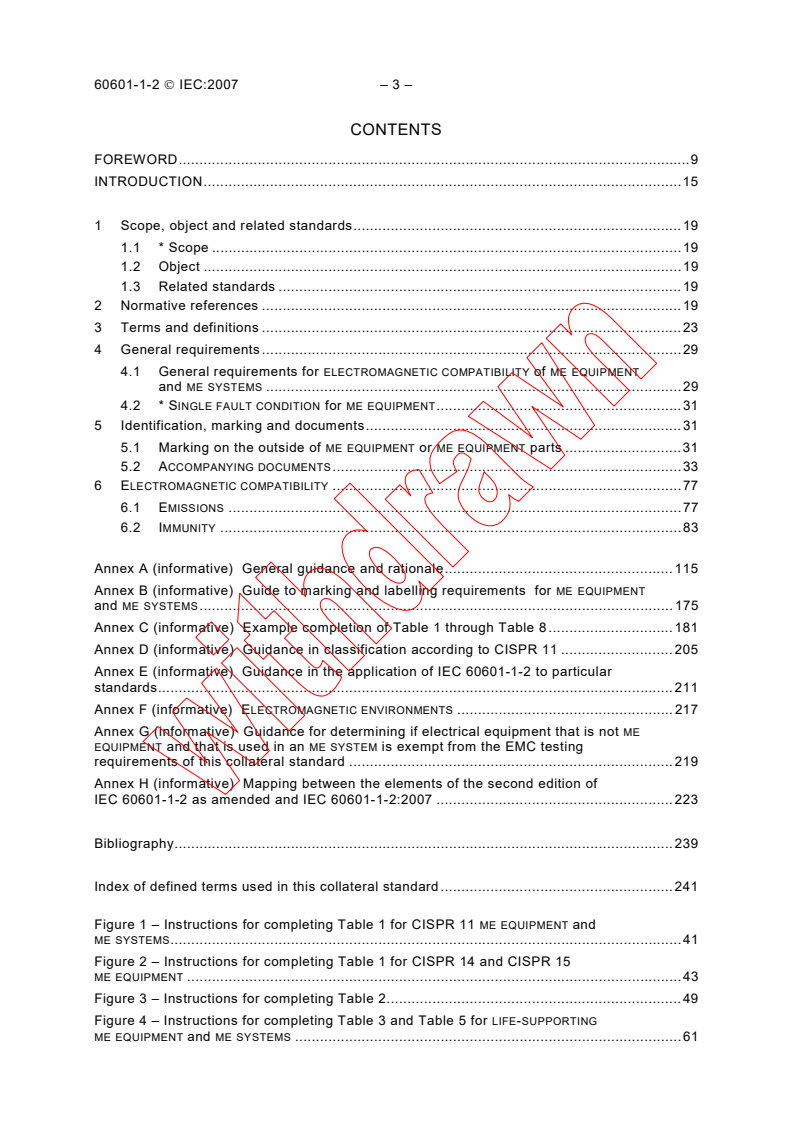
60601-1-2 © IEC:2007 – 3 –
CONTENTS
FOREWORD.9
INTRODUCTION.15
1 Scope, object and related standards.19
1.1 * Scope .19
1.2 Object .19
1.3 Related standards .19
2 Normative references .19
3 Terms and definitions .23
4 General requirements .29
4.1 General requirements for ELECTROMAGNETIC COMPATIBILITY of ME EQUIPMENT
and ME SYSTEMS .29
4.2 * SINGLE FAULT CONDITION for ME EQUIPMENT.31
5 Identification, marking and documents.31
5.1 Marking on the outside of ME EQUIPMENT or ME EQUIPMENT parts .31
5.2 ACCOMPANYING DOCUMENTS.33
6 ELECTROMAGNETIC COMPATIBILITY .77
6.1 EMISSIONS .77
6.2 IMMUNITY .83
Annex A (informative) General guidance and rationale.115
Annex B (informative) Guide to marking and labelling requirements for ME EQUIPMENT
and ME SYSTEMS.175
Annex C (informative) Example completion of Table 1 through Table 8 .181
Annex D (informative) Guidance in classification according to CISPR 11 .205
Annex E (informative) Guidance in the application of IEC 60601-1-2 to particular
standards.211
Annex F (informative) ELECTROMAGNETIC ENVIRONMENTS .217
Annex G (informative) Guidance for determining if electrical equipment that is not ME
EQUIPMENT and that is used in an ME SYSTEM is exempt from the EMC testing
requirements of this collateral standard .219
Annex H (informative) Mapping between the elements of the second edition of
IEC 60601-1-2 as amended and IEC 60601-1-2:2007 .223
Bibliography.239
Index of defined terms used in this collateral standard.241
Figure 1 – Instructions for completing Table 1 for CISPR 11 ME EQUIPMENT and
ME SYSTEMS.41
Figure 2 – Instructions for completing Table 1 for CISPR 14 and CISPR 15
ME EQUIPMENT .43
Figure 3 – Instructions for completing Table 2.49
Figure 4 – Instructions for completing Table 3 and Table 5 for LIFE-SUPPORTING
ME EQUIPMENT and ME SYSTEMS .61
60601-1-2 © IEC:2007 – 5 –
Figure 5 – Instructions for completing Table 4 and Table 6 for ME EQUIPMENT and
ME SYSTEMS that are not LIFE-SUPPORTING .63
Figure A.1 – Example of cable arrangement for radiated IMMUNITY test .171
Figure A.2 – Examples showing maximum dimension for ME EQUIPMENT with one and
with two cables .173
Figure G.1 – Procedure for determining if electrical equipment that is not ME EQUIPMENT
and that is used in an ME SYSTEM is exempt from the EMC testing requirements of this
collateral standard .221
Table 1 – Guidance and MANUFACTURER’S declaration – ELECTROMAGNETIC EMISSIONS –
for all ME EQUIPMENT and ME SYSTEMS .39
Table 2 – Guidance and MANUFACTURER’S declaration []– electromagnetic IMMUNITY –
for all ME EQUIPMENT and ME SYSTEMS .47
Table 3 – Guidance and MANUFACTURER’S declaration – electromagnetic IMMUNITY – for
LIFE-SUPPORTING ME EQUIPMENT and ME SYSTEMS .53
Table 4 – Guidance and MANUFACTURER’S declaration – electromagnetic IMMUNITY – for
ME EQUIPMENT and ME SYSTEMS that are not LIFE-SUPPORTING .55
Table 5 – Recommended separation distances between portable and mobile RF
communications equipment and the ME EQUIPMENT or ME SYSTEM – for LIFE-SUPPORTING
ME EQUIPMENT and ME SYSTEMS .57
Table 6 – Recommended separation distances between portable and mobile RF
communications equipment and the ME EQUIPMENT or ME SYSTEM – for ME EQUIPMENT
and ME SYSTEMS that are not LIFE-SUPPORTING.59
Table 7 – Guidance and MANUFACTURER’S declaration – electromagnetic IMMUNITY – for
LIFE-SUPPORTING ME EQUIPMENT and ME SYSTEMS that are specified for use only in a
shielded location.71
Table 8 – Guidance and MANUFACTURER’S declaration – electromagnetic IMMUNITY – for
ME EQUIPMENT and ME SYSTEMS that are not LIFE-SUPPORTING and are specified for use
only in a shielded location.73
Table 9 – Modulation frequency, PHYSIOLOGICAL SIMULATION FREQUENCY, and
OPERATING FREQUENCY .91
Table 10 – IMMUNITY TEST LEVELS for voltage dips .109
Table 11 – IMMUNITY TEST LEVEL for voltage interruption .109
Table B.1 – Marking on the outside of ME EQUIPMENT, ME SYSTEMS or their parts .175
Table B.2 – ACCOMPANYING DOCUMENTS, instructions for use .177
Table B.3 – ACCOMPANYING DOCUMENTS, technical description.179
Table C.1 – Example (1) of completed Table 1.181
Table C.2 – Example (2) of completed Table 1.183
Table C.3 – Example (3) of completed Table 1.185
Table C.4 – Example of completed Table 2 .187
Table C.5 – Example (1) test, IMMUNITY and COMPLIANCE LEVELS .189
Table C.6 – Example of completed Table 3 .191
Table C.7 – Example of completed Table 5 .193
Table C.8 – Example of completed Table 4 .195
Table C.9 – Example of completed Table 6 .197
Table C.10 – Example (2) test, IMMUNITY and COMPLIANCE LEVELS .197
60601-1-2 © IEC:2007 – 7 –
Table C.11 – Example of completed Table 7 .199
Table C.12 – Example (3) test, IMMUNITY and COMPLIANCE LEVELS .201
Table C.13 – Example of completed Table 8 .203
Table F.1 – ELECTROMAGNETIC ENVIRONMENTS .217
Table H.1 – Mapping between the elements of the eecond edition of IEC 60601-1-2 as
amended and IEC 60601-1-2:2007.223
60601-1-2 © IEC:2007 – 9 –
INTERNATIONAL ELECTROTECHNICAL COMMISSION
____________
MEDICAL ELECTRICAL EQUIPMENT –
Part 1-2: General requirements for basic safety
and essential performance –
Collateral standard:
Electromagnetic compatibility – Requirements and tests
FOREWORD
1) The International Electrotechnical Commission (IEC) is a worldwide organization for standardization comprising
all national electrotechnical committees (IEC National Committees). The object of IEC is to promote
international co-operation on all questions concerning standardization in the electrical and electronic fields. To
this end and in addition to other activities, IEC publishes International Standards, Technical Specifications,
Technical Reports, Publicly Available Specifications (PAS) and Guides (hereafter referred to as “IEC
Publication(s)”). Their preparation is entrusted to technical committees; any IEC National Committee interested
in the subject dealt with may participate in this preparatory work. International, governmental and non-
governmental organizations liaising with the IEC also participate in this preparation. IEC collaborates closely
with the International Organization for Standardization (ISO) in accordance with conditions determined by
agreement between the two organizations.
2) The formal decisions or agreements of IEC on technical matters express, as nearly as possible, an international
consensus of opinion on the relevant subjects since each technical committee has representation from all
interested IEC National Committees.
3) IEC Publications have the form of recommendations for international use and are accepted by IEC National
Committees in that sense. While all reasonable efforts are made to ensure that the technical content of IEC
Publications is accurate, IEC cannot be held responsible for the way in which they are used or for any
misinterpretation by any end user.
4) In order to promote international uniformity, IEC National Committees undertake to apply IEC Publications
transparently to the maximum extent possible in their national and regional publications. Any divergence
between any IEC Publication and the corresponding national or regional publication shall be clearly indicated in
the latter.
5) IEC provides no marking procedure to indicate its approval and cannot be rendered responsible for any
equipment declared to be in conformity with an IEC Publication.
6) All users should ensure that they have the latest edition of this publication.
7) No liability shall attach to IEC or its directors, employees, servants or agents including individual experts and
members of its technical committees and IEC National Committees for any personal injury, property damage or
other damage of any nature whatsoever, whether direct or indirect, or for costs (including legal fees) and
expenses arising out of the publication, use of, or reliance upon, this IEC Publication or any other IEC
Publications.
8) Attention is drawn to the Normative references cited in this publication. Use of the referenced publications is
indispensable for the correct application of this publication.
9) Attention is drawn to the possibility that some of the elements of this IEC Publication may be the subject of
patent rights. IEC shall not be held responsible for identifying any or all such patent rights.
International standard IEC 60601-1-2 has been prepared by IEC subcommittee 62A: Common
aspects of electrical equipment used in medical practice, of IEC technical committee 62:
Electrical equipment in medical practice.
This third edition constitutes a collateral standard to IEC 60601-1: Medical electrical
equipment – Part 1: General requirements for safety and essential performance hereafter
referred to as the general standard.
This document cancels and replaces the second edition of IEC 60601-1-2, and constitutes a
technical revision.
60601-1-2 © IEC:2007 – 13 –
− “should” means that compliance with a requirement or a test is recommended but is not
mandatory for compliance with this standard;
− “may” is used to describe a permissible way to achieve compliance with a requirement or
test.
Clauses, subclauses, items and definitions for which a rationale is provided in informative
Annex A are marked with an asterisk (*).
A list of all parts of the IEC 60601 series, under the general title: Medical electrical
equipment, can be found on the IEC website.
The committee has decided that the contents of this publication will remain unchanged until
the maintenance result date indicated on the IEC web site under "http://webstore.iec.ch" in
the data related to the specific publication. At this date, the publication will be
• reconfirmed;
• withdrawn;
• replaced by a revised edition, or
• amended.
60601-1-2 © IEC:2007 – 15 –
INTRODUCTION
The need for establishing specific ELECTROMAGNETIC COMPATIBILITY standards for MEDICAL
ELECTRICAL EQUIPMENT and MEDICAL ELECTRICAL SYSTEMS is well recognized.
In particular, the existence of ELECTROMAGNETIC EMISSION standards is essential for the
protection of:
− safety services;
MEDICAL ELECTRICAL EQUIPMENT and MEDICAL ELECTRICAL SYSTEMS;
− other
− electrical equipment that is not ME EQUIPMENT (e.g. computers);
− telecommunications (e.g. radio/TV, telephone, radio-navigation).
Of even more importance, the existence of ELECTROMAGNETIC IMMUNITY standards is essential
to assure safety of MEDICAL ELECTRICAL EQUIPMENT and MEDICAL ELECTRICAL SYSTEMS.
ELECTROMAGNETIC COMPATIBILITY (see Definition 3.4) differs from other aspects of safety
covered by IEC 60601-1 because the electromagnetic phenomena exist, with varying degrees
of severity, in the normal use environment of all MEDICAL ELECTRICAL EQUIPMENT and MEDICAL
ELECTRICAL SYSTEMS and by definition the equipment must “perform satisfactorily” within its
intended environment in order to establish ELECTROMAGNETIC COMPATIBILITY. This means that
the conventional single fault approach to safety is not appropriate for application to
ELECTROMAGNETIC COMPATIBILITY standards. The ELECTROMAGNETIC DISTURBANCE environment
can be compared to ambient temperature, humidity and atmospheric pressure. MEDICAL
ELECTRICAL EQUIPMENT and MEDICAL ELECTRICAL SYSTEMS may experience environmental
conditions within the expected range at any time, and for extended periods of time. As with
atmospheric pressure and humidity, the OPERATOR of the MEDICAL ELECTRICAL EQUIPMENT or
MEDICAL ELECTRICAL SYSTEM may not be aware of ambient levels on a continuous basis. The
IMMUNITY TEST LEVELS specified in this collateral standard (IEC 60601 TEST LEVELS) represent
the range found in the general medical use environment. Therefore, under these conditions,
the performance of the MEDICAL ELECTRICAL EQUIPMENT or MEDICAL ELECTRICAL SYSTEM would
also be expected to be normal.
MEDICAL ELECTRICAL EQUIPMENT and MEDICAL ELECTRICAL SYSTEMS are used in the practice of
medicine because they provide needed FUNCTIONS. If MEDICAL ELECTRICAL EQUIPMENT or a
MEDICAL ELECTRICAL SYSTEM does not provide its needed FUNCTION, because of a lack of
IMMUNITY to events expected in the normal use environment, this interferes with the practice of
medicine and cannot be considered an acceptable situation.
This edition recognizes that there is a shared responsibility between MANUFACTURERS,
RESPONSIBLE ORGANIZATIONS and OPERATORS to ensure that MEDICAL ELECTRICAL EQUIPMENT
and MEDICAL ELECTRICAL SYSTEMS are designed and operated as intended. The MEDICAL
ELECTRICAL EQUIPMENT or MEDICAL ELECTRICAL SYSTEM MANUFACTURER’S responsibility is to
design and manufacture to meet the requirements of this collateral standard and to disclose
information to the RESPONSIBLE ORGANIZATION or OPERATOR so that a compatible
ELECTROMAGNETIC ENVIRONMENT can be maintained in order that the MEDICAL ELECTRICAL
EQUIPMENT or MEDICAL ELECTRICAL SYSTEM will perform as intended.
60601-1-2 © IEC:2007 – 17 –
Because the practice of medicine involves many specialities, there will by necessity be
MEDICAL ELECTRICAL EQUIPMENT and MEDICAL ELECTRICAL SYSTEMS that are designed to perform
a variety of FUNCTIONS. Some FUNCTIONS involve, for example, measurement of signals from a
PATIENT that are of very low levels when compared to ELECTROMAGNETIC NOISE levels that can
be coupled into MEDICAL ELECTRICAL EQUIPMENT and MEDICAL ELECTRICAL SYSTEMS during the
ELECTROMAGNETIC IMMUNITY testing specified in this collateral standard. Because of the proven
benefits of many such MEDICAL ELECTRICAL EQUIPMENT and MEDICAL ELECTRICAL SYSTEMS, this
collateral standard allows the IMMUNITY TEST LEVELS to be lowered, provided there is sufficient
justification based on physical, technological or physiological limitations. In this case, the
MANUFACTURER is required to disclose the levels at which the MEDICAL ELECTRICAL EQUIPMENT
or MEDICAL ELECTRICAL SYSTEM meets the performance requirements of this collateral standard
and to specify the characteristics of the ELECTROMAGNETIC use environment and how this
environment is established, in which the MEDICAL ELECTRICAL EQUIPMENT or MEDICAL
ELECTRICAL SYSTEM will perform as intended.
This collateral standard also recognizes that for certain environments, higher IMMUNITY LEVELS
may be required. Research necessary to determine how to identify the environments that may
require higher IMMUNITY LEVELS, as well as what the levels should be, is in progress.
Finally, this collateral standard recognizes that for LIFE-SUPPORTING MEDICAL ELECTRICAL
EQUIPMENT and MEDICAL ELECTRICAL SYSTEMS, higher levels of IMMUNITY are necessary in order
to establish a broader safety margin, even for use in the general medical use environment.
Therefore, this collateral standard specifies additional requirements for LIFE-SUPPORTING
MEDICAL ELECTRICAL EQUIPMENT and MEDICAL ELECTRICAL SYSTEMS.
This collateral standard is based on existing IEC standards prepared by subcommittee 62A,
technical committee 77 (electromagnetic compatibility between electrical equipment including
networks) and CISPR (International special committee on radio interference).
The ELECTROMAGNETIC COMPATIBILITY requirements specified by this collateral standard are
generally applicable to MEDICAL ELECTRICAL EQUIPMENT and MEDICAL ELECTRICAL SYSTEMS as
defined in 3.63 and 3.64 in the general standard. For certain types of MEDICAL ELECTRICAL
EQUIPMENT and MEDICAL ELECTRICAL SYSTEMS, these requirements may need to be modified by
the special requirements of a particular standard. Writers of particular standards are
encouraged to refer to Annex E for guidance in the application of this collateral standard.
60601-1-2 © IEC:2007 – 19 –
MEDICAL ELECTRICAL EQUIPMENT –
Part 1-2: General requirements for basic safety
and essential performance –
Collateral standard:
Electromagnetic compatibility – Requirements and tests
1 Scope, object and related standards
1.1 * Scope
This International Standard applies to the BASIC SAFETY and ESSENTIAL PERFORMANCE of
MEDICAL ELECTRICAL EQUIPMENT and MEDICAL ELECTRICAL SYSTEMS, hereafter referred to as
ME EQUIPMENT and ME SYSTEMS.
This collateral standard applies to ELECTROMAGNETIC COMPATIBILITY of ME EQUIPMENT and
ME SYSTEMS.
1.2 Object
The object of this collateral standard is to specify general requirements and tests for
ELECTROMAGNETIC COMPATIBILITY of ME EQUIPMENT and ME SYSTEMS. They are in addition to the
requirements of the general standard and serve as the basis for particular standards.
1.3 Related standards
1.3.1 IEC 60601-1
For ME EQUIPMENT and ME SYSTEMS, this collateral standard complements IEC 60601-1.
When referring to IEC 60601-1 or to this collateral standard, either individually or in
combination, the following conventions are used:
– "the general standard" designates IEC 60601-1 alone;
– "this collateral standard" designates IEC 60601-1-2 alone;
– "this standard" designates the combination of the general standard and this collateral
standard.
1.3.2 Particular standards
A requirement in a particular standard takes priority over the corresponding requirement in
this collateral standard.
2 Normative references
The following referenced documents are indispensable for the application of this document.
For dated references, only the edition cited applies. For undated references, the latest edition
of the referenced document (including any amendments) applies.
IEC 60417, Graphical symbols for use on equipment
60601-1-2 © IEC:2007 – 21 –
IEC 60601-1:2005, Medical electrical equipment – Part 1: General requirements for basic
safety and essential performance
IEC 60601-1-8:2006, Medical electrical equipment – Part 1-8: General requirements for basic
safety and essential performance – Collateral standard: General requirements, tests and
guidance for alarm systems in medical electrical equipment and medical electrical systems
IEC 61000-3-2, Electromagnetic compatibility (EMC) – Part 3-2: Limits – Limits for harmonic
current emissions (equipment input current ≤ 16 A per phase)
IEC 61000-3-3, Electromagnetic compatibility (EMC) – Part 3-3: Limits – Limitation of voltage
fluctuations and flicker in low-voltage supply systems for equipment with rated current ≤ 16 A
IEC 61000-4-2, Electromagnetic compatibility (EMC) – Part 4-2: Testing and measurement
techniques – Electrostatic discharge immunity test
IEC 61000-4-3, Electromagnetic compatibility (EMC) – Part 4-3: Testing and measurement
techniques – Radiated, radio-frequency, electromagnetic field immunity test
IEC 61000-4-4, Electromagnetic compatibility (EMC) – Part 4-4: Testing and measurement
techniques – Electrical fast transient/burst immunity test
IEC 61000-4-5, Electromagnetic compatibility (EMC) – Part 4-5: Testing and measurement
techniques – Surge immunity test
IEC 61000-4-6:2003, Electromagnetic compatibility (EMC) – Part 4-6: Testing and
measurement techniques – Immunity to conducted disturbances, induced by radio-frequency
1)
fields
Amendment 1 (2004)
Amendment 2 (2006)
IEC 61000-4-8, Electromagnetic compatibility (EMC) – Part 4-8: Testing and measurement
techniques – Power frequency magnetic field immunity test
IEC 61000-4-11, Electromagnetic compatibility (EMC) – Part 4-11: Testing and measuring
techniques –Voltage dips, short interruptions and voltage variations immunity tests
CISPR 11, Industrial, scientific and medical (ISM) radio-frequency equipment –
Electromagnetic disturbance characteristics – Limits and methods of measurement
CISPR 14-1, Electromagnetic compatibility – Requirements for household appliances, electric
tools and similar apparatus – Part 1: Emission
CISPR 15, Limits and methods of measurement of radio disturbance characteristics of
electrical lighting and similar equipment
CISPR 16-1-2, Specification for radio disturbance and immunity measuring apparatus and
methods – Part 1-2: Radio disturbance and immunity measuring apparatus – Ancillary
equipment – Conducted disturbances
CISPR 22, Information technology equipment – Radio disturbance characteristics – Limits and
methods of measurement
___________
1)
There exists a consolidated edition 2.2 (2006) that includes IEC 61000-4-6 (2003) and its Amendment 1 (2004)
and Amendment 2 (2006).
60601-1-2 © IEC:2007 – 25 –
3.6
(ELECTROMAGNETIC) EMISSION
phenomenon by which electromagnetic energy emanates from a source
[IEV 161-01-08]
3.7
ELECTROMAGNETIC ENVIRONMENT
totality of electromagnetic phenomena existing at a given location
NOTE In general, the ELECTROMAGNETIC ENVIRONMENT is time dependent and its description may need a statistical
approach.
[IEV 161-01-01]
3.8
ELECTROMAGNETIC NOISE
time-varying electromagnetic phenomenon apparently not conveying information and which
may be superimposed on or combined with a wanted signal
[IEV 161-01-02]
3.9
ELECTROSTATIC DISCHARGE
ESD
transfer of electric charge between bodies of different electrostatic potential in proximity or
through direct contact
[IEV 161-01-22]
3.10
* EXCLUSION BAND
frequency band for intentional receivers of RF electromagnetic energy that extends from −5 %
to +5 % of the frequency, or frequency band, of reception for frequencies of reception greater
than or equal to 80 MHz and from −10 % to +10 % of the frequency, or frequency band, of
reception for frequencies of reception less than 80 MHz
NOTE Other definitions of this term are sometimes used for other purposes in national radio regulations.
3.11
* FUNCTION
clinically significant operation that the ME EQUIPMENT or ME SYSTEM is intended to perform in
the diagnosis, treatment or monitoring of a PATIENT or for compensation or alleviation of
disease, injury or disability
3.12
IEC 60601 TEST LEVEL
IMMUNITY TEST LEVEL specified in 6.2 by this collateral standard or a particular standard
3.13
IMMUNITY (to a disturbance)
*
ability of ME EQUIPMENT or an ME SYSTEM to perform without DEGRADATION in the presence of
an ELECTROMAGNETIC DISTURBANCE
[IEV 161-01-20, modified]
60601-1-2 © IEC:2007 – 27 –
3.14
IMMUNITY LEVEL
maximum level of a given ELECTROMAGNETIC DISTURBANCE incident on a particular device,
equipment or system for which it remains capable of operating at a required degree of
performance
[IEV 161-03-14]
3.15
IMMUNITY TEST LEVEL
level of a test signal used to simulate an ELECTROMAGNETIC DISTURBANCE when performing an
IMMUNITY test
[IEV 161-04-41]
3.16
INFORMATION TECHNOLOGY EQUIPMENT
ITE
equipment designed for the purpose of
a) receiving data from an external source (such as a data input line or via a keyboard);
b) performing some processing functions on the received data (such as computation, data
transformation or recording, filing, sorting, storage, transfer of data);
c) providing a data output (either to other equipment or by the reproduction of data or
images)
NOTE This definition includes electrical or electronic units or systems that predominantly generate a multiplicity
of periodic binary pulsed electrical or electronic waveforms and are designed to perform data processing functions
such as word processing, electronic computation, data transformation, recording, filing, sorting, storage, retrieval
and transfer, and reproduction of data as images.
[IEV 161-05-04]
3.17
* LARGE ME EQUIPMENT or ME SYSTEM
ME EQUIPMENT or ME SYSTEM that cannot fit within a 2 m × 2 m × 2,5 m volume, excluding
cables; this includes distributed ME SYSTEMS
3.18
* LIFE-SUPPORTING ME EQUIPMENT or ME SYSTEM
ME EQUIPMENT or ME SYSTEM that includes at least one FUNCTION that is intended to actively
keep alive or resuscitate PATIENTS and the failure of which to comply with the requirements of
6.2.1.10 is likely to lead to serious injury or death of a PATIENT
3.19
* LOW VOLTAGE
line-to-line or line-to-neutral voltage that is less than or equal to 1 000 V a.c. or 1 500 V d.c.
3.20
* OPERATING FREQUENCY
fundamental frequency of a signal, electrical or non-electrical, that is set in ME EQUIPMENT or
an ME SYSTEM intended to control a physiological parameter
60601-1-2 © IEC:2007 – 29 –
3.21
* PATIENT-COUPLED ME EQUIPMENT or ME SYSTEM
ME EQUIPMENT or ME SYSTEM that contains at least one APPLIED PART whereby contact with the
PATIENT provides a sensing or treatment point necessary for the normal operation of the
ME EQUIPMENT or ME SYSTEM and provides a path for electromagnetic energy, whether coupled
conductively, capacitively or inductively and whether intended or unintended
3.22
* PHYSIOLOGICAL SIMULATION FREQUENCY
fundamental frequency of a signal, electrical or non-electrical, used to simulate a
physiological parameter such that the ME EQUIPMENT or ME SYSTEM will operate in a manner
consistent with use on a PATIENT
3.23
* PROFESSIONAL ME EQUIPMENT or ME SYSTEM
ME EQUIPMENT or ME SYSTEM for use by healthcare professionals and that is not intended for
sale to the general public
[IEV 161-05-05, modified]
3.24
* PUBLIC MAINS NETWORK
LOW VOLTAGE electricity power lines to which all categories of consumers have access
3.25
* RADIO FREQUENCY
RF
frequency in the portion of the electromagnetic spectrum that is between the audio-frequency
portion and the infrared portion; frequency useful for radio transmission
NOTE The limits are generally accepted to be 9 kHz to 3 000 GHz.
3.26
TYPE A PROFESSIONAL ME EQUIPMENT or ME SYSTEM
PROFESSIONAL ME EQUIPMENT or ME SYSTEM that complies with CISPR 11 group 2 Class B
except for the third harmonic of the fundamental frequency of the ME EQUIPMENT or
ME SYSTEM, in which case the third harmonic complies with the group 2 Class A
electromagnetic radiation disturbance limit
NOTE See 6.1.1.1 f).
4 General requirements
4.1 General requirements for ELECTROMAGNETIC COMPATIBILITY of ME EQUIPMENT
and ME SYSTEMS
4.1.1 * ELECTROMAGNETIC COMPATIBILITY
ME EQUIPMENT and ME SYSTEMS shall not emit ELECTROMAGNETIC DISTURBANCES that could
affect radio services, other equipment or the ESSENTIAL PERFORMANCE of other ME EQUIPMENT
and ME SYSTEMS. ME EQUIPMENT and ME SYSTEMS shall have adequate IMMUNITY to be able to
provide its BASIC SAFETY and ESSENTIAL PERFORMANCE in the presence of ELECTROMAGNETIC
DISTURBANCES.
Consider compliance to exist if the requirements of this collateral standard are met.
60601-1-2 © IEC:2007 – 31 –
4.1.2 Electrical equipment that is not ME EQUIPMENT
Electrical equipment that is not ME EQUIPMENT and that is supplied as part of an ME SYSTEM is
exempt from the EMC testing requirements of this collateral standard provided all of the
following conditions are met (see also Annex G):
a) the electrical equipment that is not ME EQUIPMENT complies with applicable international
EMC standards;
b) both the EMISSIONS and IMMUNITY of the electrical equipment that is not ME EQUIPMENT have
been determined not to adversely affect the BASIC SAFETY or ESSENTIAL PERFORMANCE of
the ME SYSTEM; and
c) the EMISSIONS of the electrical equipment that is not ME EQUIPMENT have been determined
not to cause the EMISSIONS of the ME SYSTEM to exceed applicable limits.
Check compliance by inspection of the documents for this determination and other
appropriate documents or certificates or, if this determination is not performed, by inspection
of the documents to verify that the electrical equipment that is not ME EQUIPMENT has been
tested in accordance with this collateral standard.
4.2 * SINGLE FAULT CONDITION for ME EQUIPMENT
For EMC testing, the SINGLE FAULT CONDITION requirements of the general standard do not
apply.
5 Identification, marking and documents
5.1 Marking on the outside of ME EQUIPMENT or ME EQUIPMENT parts
5.1.1 * Marking on the outside of ME EQUIPMENT or ME EQUIPMENT parts that include RF
transmitters or that apply RF electromagnetic energy for diagnosis or treatment
ME EQUIPMENT and ME SYSTEMS that include RF transmitters or that intentionally apply RF
electromagnetic energy for diagnosis or treatment shall be labelled with symbol
IEC 60417-5140 (2003-04) for non-ionizing radiation. The symbol graphic is shown below.
5.1.2 Marking on the outside of ME EQUIPMENT or ME EQUIPMENT parts for which the
connector testing exemption specified in 6.2.2.2 c) is used
For ME EQUIPMENT and ME SYSTEMS for which the connector testing exemption specified in
6.2.2.2 c) is used, symbol IEC 60417-5134 (2003-04) for ESD sensitivity shall be applied
adjacent to each connector for which the testing exemption is used. The symbol graphic is
shown below.
5.1.3 Marking on the outside of ME EQUIPMENT and ME SYSTEMS that are specified for
use only in a shielded location
E EQUIPMENT and ME SYSTEMS specified for use only in a shielded location shall be labelled
M
with a warning that they should be used only in the specified type of shielded location (see
5.2.2.3).
60601-1-2 © IEC:2007 – 33 –
Check compliance with the requirements of 5.1 by inspection.
5.2 ACCOMPANYING DOCUMENTS
5.2.1 Instructions for use
5.2.1.1 Requirements applicable to all ME EQUIPMENT and ME SYSTEMS
The instructions for use shall include the following:
a) a statement that MEDICAL ELECTRICAL EQUIPMENT needs special precautions regarding EMC
and needs to be installed and put into service according to the EMC information provided
in the ACCOMPANYING DOCUMENTS; and
b) a statement that portable and mobile RF communications equipment can affect MEDICAL
ELECTRICAL EQUIPMENT.
5.2.1.2 Requirements applicable to ME EQUIPMENT and ME SYSTEMS for which the
connector testing exemption specified in 6.2.2.2 c) is used
For ME EQUIPMENT and ME SYSTEMS for which the connector testing exemption specified in
6.2.2.2 c) is used, the instructions for use shall include the following:
a) a reproduction of the ESD warning symbol (IEC 60417-5134 (2003-04), as shown in
5.1.2);
b) a warning that pins of connectors identified with the ESD warning symbol should not be
touched and that connections should not be made to these connectors unless ESD
precautionary procedures are used;
c) * a specification of the ESD precautionary procedures;
d) * a recommendation that all staff involved receive an explanation of the ESD warning
symbol and training in ESD precautionary procedures; and
e) * a specification of the minimum contents of ESD precautionary procedure training.
5.2.1.3 Minimum amplitude or value of PATIENT physiological signal
For ME EQUIPMENT and ME SYSTEMS without a manual sensitivity adjustment and for which the
MANUFACTURER specifies a minimum amplitude or value of the PATIENT physiological signal
(see 6.2.1.7, first dash), the instructions for use shall include the following:
a) the minimum amplitude or value of PATIENT physiological signal; and
b) a warning that operation of the ME EQUIPMENT or ME SYSTEM below this amplitude or value
may cause inaccurate results.
5.2.1.4 * Requirements applicable to TYPE A PROFESSIONAL ME EQUIPMENT and
ME SYSTEMS
If TYPE A PROFESSIONAL ME EQUIPMENT or a TYPE A PROFESSIONAL ME SYSTEM is intended for use
in domestic establishments or connection to the PUBLIC MAINS NETWORK (see 6.1.1.1 f)), the
instructions for use shall include the following warning or equivalent:
Warning
This equipment/system is intended for use by healthcare professionals only. This
equipment/system may cause radio interference or may disrupt the operation of nearby
equipment. It may be necessary to take mitigation measures, such as re-orienting or
relocating the [ME EQUIPMENT or ME SYSTEM] or shielding the location.
60601-1-2 © IEC:2007 – 35 –
where “[me equipment or me system]” shall be replaced with the model or type reference of
the me equipment or me system.
Check compliance with the requirements of 5.2.1 by inspection of the instructions for use.
5.2.2 Technical description
5.2.2.1 Requirements applicable to all ME EQUIPMENT and ME SYSTEMS
For all ME EQUIPMENT and ME SYSTEMS, the ACCOMPANYING DOCUMENTS shall include the
following information:
a) * A list of all cables and maximum lengths of cables (if applicable), transducers and other
ACCESSORIES with which the MANUFACTURER of the ME EQUIPMENT and ME SYSTEMS claims
compliance with the requirements of 6.1 and 6.2. ACCESSORIES that do not affect
compliance with the requirements of these subclauses need not be listed. ACCESSORIES,
transducers and cables may be specified either generically (e.g. shielded serial cable,
load impedance) or specifically (e.g. by MANUFACTURER and model or part number).
NOTE Transducers and cables sold by the MANUFACTURER of the ME EQUIPMENT or ME SYSTEM as replacement
parts for internal components need not be listed.
b) * A warning that the use of ACCESSORIES, transducers and cables other than those
specified, with the exception of transducers and cables sold by the MANUFACTURER of the
ME EQUIPMENT or ME SYSTEM as replacement parts for internal components, may result in
increased EMISSIONS or decreased IMMUNITY of the ME EQUIPMENT or ME SYSTEM.
c) * Table 1, with the modifications specified below, which should be performed in the order
in which they appear. See Annex C for examples. The flowchart in Figure 1 is the
requirement in step-by-step graphical form for completion of Table 1 for CISPR 11
ME EQUIPMENT and ME SYSTEMS. The flowchart in Figure 2 is the requirement in step-by-
step graphical form for completion of Table 1 for CISPR 14 and CISPR 15 equipment.
– For CISPR 11 ME EQUIPMENT and ME SYSTEMS, “[ME EQUIPMENT or ME SYSTEM]” shall be
replaced with the MODEL OR TYPE REFERENCE of the ME EQUIPMENT or ME SYSTEM.
– For CISPR 14 and CISPR 15 ME EQUIPMENT, “[ME EQUIPMENT]” shall be replaced with
the MODEL OR TYPE REFERENCE of the ME EQUIPMENT.
– For CISPR 11 group 1 ME EQUIPMENT and ME SYSTEMS, rows 5, 12 and 13 shall be
deleted.
– For CISPR 11 group 2 ME EQUIPMENT and ME SYSTEMS, rows 4, 12 and 13 shall be
deleted.
– For ME EQUIPMENT that complies with CISPR 14-1, rows 4 through 6 and row 13 shall
be deleted
– For ME EQUIPMENT that complies with CISPR 15, rows 4 through 6 and row 12 shall be
deleted.
– For CISPR 11 ME EQUIPMENT and ME SYSTEMS that comply with Class A, including TYPE
A PROFESSIONAL ME EQUIPMENT and ME SYSTEMS, “[A or B]” in column 2 of row 6 shall
be replaced with “A”. For CISPR 11 ME EQUIPMENT and ME SYSTEMS that comply with
Class B, “[A or B]” shall be replaced with “B”.
60601-1-2 © IEC:2007 – 37 –
– For ME EQUIPMENT and ME SYSTEMS that comply with IEC 61000-3-2, “[Class A, B, C,
D, or Not applicable]” in column 2 of row 7 shall be replaced with the class of the
ME EQUIPMENT or ME SYSTEM according to IEC 61000-3-2. For ME EQUIPMENT and
ME SYSTEMS that comply with IEC 61000-3-3, “[Complies or Not applicable]” in column
2 of row 8 shall be replaced with “Complies”. For ME EQUIPMENT and ME SYSTEMS for
which IEC 61000-3-2 and IEC 61000-3-3 are not applicable, “[Class A, B, C, D, or Not
applicable]” and “[Complies or Not applicable]” shall each be replaced with “Not
applicable”.
– For CISPR 11 ME EQUIPMENT and ME SYSTEMS, column 3 of rows 6, 7 and 8 shall be
...
NORME CEI
INTERNATIONALE 60601-1-2
Troisième édition
2007-03
Appareils électromédicaux –
Partie 1-2:
Règles générales pour la sécurité
de base et les performances essentielles –
Norme collatérale:
Compatibilité électromagnétique –
Exigences et essais
Cette version française découle de la publication d’origine
bilingue dont les pages anglaises ont été supprimées.
Les numéros de page manquants sont ceux des pages
supprimées.
Numéro de référence
CEI 60601-1-2:2007(F)
Numérotation des publications
Depuis le 1er janvier 1997, les publications de la CEI sont numérotées à partir de
60000. Ainsi, la CEI 34-1 devient la CEI 60034-1.
Editions consolidées
Les versions consolidées de certaines publications de la CEI incorporant les
amendements sont disponibles. Par exemple, les numéros d’édition 1.0, 1.1 et 1.2
indiquent respectivement la publication de base, la publication de base incorporant
l’amendement 1, et la publication de base incorporant les amendements 1 et 2
Informations supplémentaires sur les publications de la CEI
Le contenu technique des publications de la CEI est constamment revu par la CEI
afin qu'il reflète l'état actuel de la technique. Des renseignements relatifs à cette
publication, y compris sa validité, sont disponibles dans le Catalogue des
publications de la CEI (voir ci-dessous) en plus des nouvelles éditions, amende-
ments et corrigenda. Des informations sur les sujets à l’étude et l’avancement des
travaux entrepris par le comité d’études qui a élaboré cette publication, ainsi que la
liste des publications parues, sont également disponibles par l’intermédiaire de:
• Site web de la CEI (www.iec.ch)
• Catalogue des publications de la CEI
Le catalogue en ligne sur le site web de la CEI (www.iec.ch/searchpub) vous permet
de faire des recherches en utilisant de nombreux critères, comprenant des
recherches textuelles, par comité d’études ou date de publication. Des informations
en ligne sont également disponibles sur les nouvelles publications, les publications
remplacées ou retirées, ainsi que sur les corrigenda.
• IEC Just Published
Ce résumé des dernières publications parues (www.iec.ch/online_news/justpub)
est aussi disponible par courrier électronique. Veuillez prendre contact avec le
Service client (voir ci-dessous) pour plus d’informations.
• Service clients
Si vous avez des questions au sujet de cette publication ou avez besoin de
renseignements supplémentaires, prenez contact avec le Service clients:
Email: custserv@iec.ch
Tél: +41 22 919 02 11
Fax: +41 22 919 03 00
NORME CEI
INTERNATIONALE 60601-1-2
Troisième édition
2007-03
Appareils électromédicaux –
Partie 1-2:
Règles générales pour la sécurité
de base et les performances essentielles –
Norme collatérale:
Compatibilité électromagnétique –
Exigences et essais
© IEC 2007 Droits de reproduction réservés
Aucune partie de cette publication ne peut être reproduite ni utilisée sous quelque forme que ce soit et par aucun
procédé, électronique ou mécanique, y compris la photocopie et les microfilms, sans l'accord écrit de l'éditeur.
International Electrotechnical Commission, 3, rue de Varembé, PO Box 131, CH-1211 Geneva 20, Switzerland
Telephone: +41 22 919 02 11 Telefax: +41 22 919 03 00 E-mail: inmail@iec.ch Web: www.iec.ch
CODE PRIX
XF
Commission Electrotechnique Internationale
International Electrotechnical Commission
МеждународнаяЭлектротехническаяКомиссия
Pour prix, voir catalogue en vigueur
– 2 – 60601-1-2 © CEI:2007
SOMMAIRE
AVANT-PROPOS.8
INTRODUCTION.14
1 Domaine d'application, objet et normes connexes .18
1.1 * Domaine d’application.18
1.2 Objet .18
1.3 Normes connexes.18
2 Références normatives.18
3 Termes et définitions .22
4 Exigences générales .28
4.1 Exigences générales concernant la COMPATIBILITÉ ÉLECTROMAGNÉTIQUE des
APPAREILS et des SYSTÈMES EM .28
4.2 * CONDITION DE PREMIER DÉFAUT pour les APPAREILS EM.30
5 Identification, marquage et documentation .30
5.1 Marquage sur l’extérieur des APPAREILS EM ou des parties d’APPAREIL EM.30
5.2 DOCUMENTS D'ACCOMPAGNEMENT .32
6 COMPATIBILITÉ ÉLECTROMAGNÉTIQUE .76
6.1 EMISSIONS .76
6.2 IMMUNITÉ .82
Annexe A (informative) Guide général et justifications .114
Annexe B (informative) Guide pour le marquage et exigences d'étiquetage pour les
APPAREILS EM et les SYSTÈMES EM .174
Annexe C (informative) Exemple pour remplir les Tableaux 1 à 8.180
Annexe D (informative) Lignes directrices relatives à la classification selon la
CISPR 11.204
Annexe E (informative) Lignes directrices pour l’application de la CEI 60601-1-2 aux
normes particulières .210
Annexe F (informative) ENVIRONNEMENTS ÉLECTROMAGNÉTIQUES .216
Annexe G (informative) Lignes directrices pour déterminer si un appareil électrique qui
n’est pas un APPAREIL EM et qui est utilisé dans un SYSTÈME EM est exempt des
exigences d’essai CEM de la présente norme collatérale .218
Annexe H (informative) Correspondance entre les éléments de la deuxième édition de
la CEI 60601-1-2 amendée et la CEI 60601-1-2:2007 .222
Bibliographie.238
Index des termes définis dans la présente norme collatérale .240
Figure 1 – Instructions pour remplir le Tableau 1 pour les APPAREILS ET SYSTÈMES EM CISPR
11 .40
Figure 2 – Instructions pour remplir le Tableau 1 pour les APPAREILS EM CISPR 14 et
CISPR 15.42
Figure 3 – Instructions pour remplir le Tableau 2 .48
Figure 4 – Instructions pour remplir le Tableau 3 et le Tableau 5 pour les APPAREILS et
les SYSTÈMES EM DE MAINTIEN DE LA VIE .60
– 4 – 60601-1-2 © CEI:2007
Figure 5 – Instructions pour remplir le Tableau 4 et le Tableau 6 pour les APPAREILS et
les SYSTÈMES EM autres que DE MAINTIEN DE LA VIE .62
Figure A.1 – Exemple de disposition de câbles pour l'essai D'IMMUNITÉ aux
rayonnements .170
Figure A.2 – Exemples montrant la dimension maximale pour un APPAREIL EM avec un
ou deux câbles .172
Figure G.1 – Procédure pour déterminer si un appareil électrique qui n’est pas un
APPAREIL EM et qui est utilisé dans un SYSTÈME EM est exempt des exigences d’essai
CEM de la présente norme collatérale .220
Tableau 1 – Directives et déclaration du FABRICANT – ÉMISSIONS ÉLECTROMAGNÉTIQUES
– pour tous les APPAREILS et SYSTÈMES EM.38
Tableau 2 – Directives et déclaration du FABRICANT – IMMUNITÉ électromagnétique –
pour tous les APPAREILS et SYSTÈMES EM .46
Tableau 3 – Directives et déclaration du FABRICANT – IMMUNITÉ électromagnétique –
pour tous les APPAREILS et SYSTÈMES EM DE MAINTIEN DE LA VIE .52
Tableau 4 – Directives et déclaration du FABRICANT – IMMUNITÉ électromagnétique –
pour tous les APPAREILS et SYSTÈMES EM DE MAINTIEN DE LA VIE .54
Tableau 5 – Distances de séparation recommandées entre les appareils portatifs et
mobiles de communications RF et l’APPAREIL ou le SYSTÈME EM – pour les APPAREILS et
les SYSTÈME EM DE MAINTIEN DE LA VIE .56
Tableau 6 – Distances de séparation recommandées entre les appareils portatifs et
mobiles de communications RF et l’APPAREIL ou le SYSTÈME EM – pour les APPAREILS et
les SYSTÈME EM autres que DE MAINTIEN DE LA VIE .58
Tableau 7 – Directives et déclaration du FABRICANT – IMMUNITÉ électromagnétique –
pour les APPAREILS et SYSTÈMES EM DE MAINTIEN DE LA VIE destinés à être utilisés
uniquement dans un emplacement blindé .70
Tableau 8 – Directives et déclaration du FABRICANT – IMMUNITÉ électromagnétique –
pour les APPAREILS et SYSTÈMES EM autres que DE MAINTIEN DE LA VIE destinés à être
utilisés uniquement dans un emplacement blindé .72
Tableau 9 – Fréquence de modulation, FRÉQUENCE DE SIMULATION PHYSIOLOGIQUE, et
FRÉQUENCE DE FONCTIONNEMENT .90
Tableau 10 – NIVEAUX D'ESSAI D'IMMUNITÉ relatifs aux creux de tension .108
Tableau 11 – NIVEAU D'ESSAI D'IMMUNITÉ relatif à une coupure de tension.108
Tableau B.1 – Marquage sur l’extérieur de L’APPAREIL EM, des SYSTÈMES EM ou de
leurs parties.174
Tableau B.2 – DOCUMENTS D’ACCOMPAGNEMENT, instructions d’utilisation.176
Tableau B.3 – DOCUMENTS D'ACCOMPAGNEMENT, description technique.178
Tableau C.1 – Exemple (1) de Tableau 1 complété .180
Tableau C.2 – Exemple (2) de Tableau 1 complété .182
Tableau C.3 – Exemple (3) de Tableau 1 complété .184
Tableau C.4 – Exemple de Tableau 2 complété .186
Tableau C.5 – Essai exemple (1), IMMUNITÉ et NIVEAUX DE CONFORMITÉ .188
Tableau C.6 – Exemple de Tableau 3 complété .190
Tableau C.7 – Exemple de Tableau 5 complété .192
Tableau C.8 – Exemple de Tableau 4 complété .194
Tableau C.9 – Exemple de Tableau 6 complété .196
Tableau C.10 – Essai exemple (2), IMMUNITÉ et NIVEAUX DE CONFORMITÉ .196
– 6 – 60601-1-2 © CEI:2007
Tableau C.11 – Exemple de Tableau 7 complété .198
Tableau C.12 – Essai exemple (3), IMMUNITÉ et NIVEAUX DE CONFORMITÉ .200
Tableau C.13 – Exemple de Tableau 8 complété .202
Tableau F.1 – ENVIRONNEMENTS ÉLECTROMAGNÉTIQUES .216
Tableau H.1 – Correspondance entre les éléments de la deuxième édition de la
CEI 60601-1-2 amendée et la CEI 60601-1-2:2007 .222
– 8 – 60601-1-2 © CEI:2007
COMMISSION ÉLECTROTECHNIQUE INTERNATIONALE
____________
APPAREILS ÉLECTROMÉDICAUX –
Partie 1-2: Exigences générales pour la sécurité de base
et les performances essentielles –
Norme collatérale:
Compatibilité électromagnétique – Exigences et essais
AVANT-PROPOS
1) La Commission Électrotechnique Internationale (CEI) est une organisation mondiale de normalisation
composée de l'ensemble des comités électrotechniques nationaux (Comités nationaux de la CEI). La CEI a
pour objet de favoriser la coopération internationale pour toutes les questions de normalisation dans les
domaines de l'électricité et de l'électronique. A cet effet, la CEI – entre autres activités – publie des Normes
internationales, des Spécifications techniques, des Rapports techniques, des Spécifications accessibles au
public (PAS) et des Guides (ci-après dénommés "Publication(s) de la CEI"). Leur élaboration est confiée à des
comités d'études, aux travaux desquels tout Comité national intéressé par le sujet traité peut participer. Les
organisations internationales, gouvernementales et non gouvernementales, en liaison avec la CEI, participent
également aux travaux. La CEI collabore étroitement avec l'Organisation Internationale de Normalisation (ISO),
selon des conditions fixées par accord entre les deux organisations.
2) Les décisions ou accords officiels de la CEI concernant les questions techniques représentent, dans la mesure
du possible, un accord international sur les sujets étudiés, étant donné que les Comités nationaux de la CEI
intéressés sont représentés dans chaque comité d’études.
3) Les Publications de la CEI se présentent sous la forme de recommandations internationales et sont agréées
comme telles par les Comités nationaux de la CEI. Tous les efforts raisonnables sont entrepris afin que la CEI
s'assure de l'exactitude du contenu technique de ses publications; la CEI ne peut pas être tenue responsable
de l'éventuelle mauvaise utilisation ou interprétation qui en est faite par un quelconque utilisateur final.
4) Dans le but d'encourager l'uniformité internationale, les Comités nationaux de la CEI s'engagent, dans toute la
mesure possible, à appliquer de façon transparente les Publications de la CEI dans leurs publications
nationales et régionales. Toutes divergences entre toutes Publications de la CEI et toutes publications
nationales ou régionales correspondantes doivent être indiquées en termes clairs dans ces dernières.
5) La CEI n’a prévu aucune procédure de marquage valant indication d’approbation et n'engage pas sa
responsabilité pour les équipements déclarés conformes à une de ses Publications.
6) Tous les utilisateurs doivent s'assurer qu'ils sont en possession de la dernière édition de cette publication.
7) Aucune responsabilité ne doit être imputée à la CEI, à ses administrateurs, employés, auxiliaires ou
mandataires, y compris ses experts particuliers et les membres de ses comités d'études et des Comités
nationaux de la CEI, pour tout préjudice causé en cas de dommages corporels et matériels, ou de tout autre
dommage de quelque nature que ce soit, directe ou indirecte, ou pour supporter les coûts (y compris les frais
de justice) et les dépenses découlant de la publication ou de l'utilisation de cette Publication de la CEI ou de
toute autre Publication de la CEI, ou au crédit qui lui est accordé.
8) L'attention est attirée sur les références normatives citées dans cette publication. L'utilisation de publications
référencées est obligatoire pour une application correcte de la présente publication.
9) L’attention est attirée sur le fait que certains des éléments de la présente Publication de la CEI peuvent faire
l’objet de droits de propriété intellectuelle ou de droits analogues. La CEI ne saurait être tenue pour
responsable de ne pas avoir identifié de tels droits de propriété et de ne pas avoir signalé leur existence.
La Norme internationale CEI 60601-1-2 a été établie par le sous–comité 62A: Aspects
généraux des équipements utilisés en pratique médicale, du comité d’études 62 de la CEI:
Equipements électriques dans la pratique médicale.
Cette troisième édition constitue une norme collatérale de la CEI 60601-1: Appareils
électromédicaux – Partie 1: Exigences générales pour la sécurité de base et les
performances essentielles, appelée norme générale dans la suite du texte.
Ce document annule et remplace la deuxième édition de la CEI 60601-1-2, dont elle constitue
une révision technique.
– 12 – 60601-1-2 © CEI:2007
– “il convient/il est recommandé” signifie que la satisfaction à une exigence ou à un essai
est recommandée mais n’est pas obligatoire pour la conformité à la présente norme;
– “pouvoir” mis au présent de l’indicatif est utilisé pour décrire un moyen admissible pour
satisfaire à une exigence ou à un essai.
Les articles, les paragraphes et les définitions pour lesquels une justification est donnée dans
l'Annexe informative A sont repérés par un astérisque (*).
Une liste de toutes les parties de la CEI 60601, sous le titre général: Appareils
électromédicaux, est disponible sur le site web de la CEI.
Le comité a décidé que le contenu de cette publication ne sera pas modifié avant la date de
maintenance indiquée sur le site web de la CEI sous «http://webstore.iec.ch» dans les
données relatives à la publication recherchée. A cette date, la publication sera
• reconduite;
• supprimée;
• remplacée par une édition révisée, ou
• amendée.
– 14 – 60601-1-2 © CEI:2007
INTRODUCTION
La nécessité d'établir des normes spécifiques de COMPATIBILITÉ ÉLECTROMAGNÉTIQUE pour les
APPAREILS et les SYSTÈMES ÉLECTROMÉDICAUX est manifeste.
En particulier, l'existence de normes d'ÉMISSION ÉLECTROMAGNÉTIQUE est essentielle pour la
protection des:
– dispositifs de sécurité;
– autres APPAREILS et SYSTÈMES ÉLECTROMÉDICAUX;
– appareils électriques qui ne sont pas des APPAREIL EM (par exemple les ordinateurs);
– télécommunications (par exemple radio/TV, téléphone, radio-navigation).
Bien plus important encore, l'existence des normes d'IMMUNITÉ ÉLECTROMAGNÉTIQUE est
essentielle pour assurer la sécurité des APPAREILS et des SYSTÈMES ÉLECTROMÉDICAUX. La
COMPATIBILITÉ ÉLECTROMAGNÉTIQUE (voir la Définition 3.4) diffère des autres aspects de
sécurité couverts par la CEI 60601-1 par le fait que les phénomènes électromagnétiques
existent, avec divers degrés de sévérité, dans l'environnement d'utilisation normal de tous les
APPAREILS et SYSTÈMES ÉLECTROMÉDICAUX et, par définition, il faut que l'appareil "aie des
performances satisfaisantes" dans son environnement prévu, afin de garantir la COMPATIBILITÉ
ÉLECTROMAGNÉTIQUE. Cela signifie que l'approche conventionnelle de premier défaut, vis-à-vis
de la sécurité, n'est pas appropriée pour l'application des normes de COMPATIBILITÉ
ÉLECTROMAGNÉTIQUE. L'environnement de PERTURBATION ÉLECTROMAGNÉTIQUE peut être
comparé à la température ambiante, à l'humidité et à la pression atmosphérique. Les
APPAREILS et les SYSTÈMES ÉLECTROMÉDICAUX peuvent être soumis à tout moment à des
conditions d'environnement correspondant au domaine prévu et pendant des durées
prolongées. Comme pour la pression atmosphérique et l'humidité, l'OPÉRATEUR de l'APPAREIL
ou du SYSTÈME ELECTROMÉDICAL peut ne pas se rendre compte, de manière permanente, des
niveaux ambiants. Les NIVEAUX D'ESSAI D'IMMUNITÉ spécifiés dans cette norme collatérale
(NIVEAUX D'ESSAI SELON LA CEI 60601) représentent le domaine rencontré dans
l'environnement général de l'utilisation médicale. On s'attendrait donc, dans ces conditions, à
ce que les performances des APPAREILS ou SYSTÈMES ÉLECTROMÉDICAUX soient également
normales.
Les APPAREILS et les SYSTÈMES ÉLECTROMÉDICAUX sont utilisés dans la pratique médicale,
parce qu'ils fournissent les FONCTIONS dont on a besoin. Si un APPAREIL ou un SYSTÈME
ÉLECTROMÉDICAL ne fournit pas la FONCTION dont on a besoin en raison d'une lacune
d'IMMUNITÉ vis-à-vis des événements attendus dans le cadre de son environnement normal
d'utilisation, cela ne permet pas une bonne pratique médicale et ne peut pas être considéré
comme une situation acceptable.
Cette édition admet que les FABRICANTS, les ORGANISMES RESPONSABLES et les OPÉRATEURS se
partagent la responsabilité de s'assurer que les APPAREILS et les SYSTÈMES ÉLECTROMÉDICAUX
sont conçus et exploités comme prévu. La responsabilité du FABRICANT d'un APPAREIL ou d'un
SYSTÈME ÉLECTROMÉDICAL est de le concevoir et de le fabriquer pour qu'il satisfasse aux
exigences de cette norme collatérale et de diffuser des informations à L’ORGANISME
RESPONSABLE et à L’OPÉRATEUR de sorte qu'un ENVIRONNEMENT ÉLECTROMAGNÉTIQUE
APPAREIL ou le SYSTÈME ÉLECTROMÉDICAL
compatible puisse être maintenu, afin que l'
fonctionne comme prévu.
– 16 – 60601-1-2 © CEI:2007
Du fait que la pratique médicale implique de nombreuses spécialités, les APPAREILS et les
SYSTÈMES ÉLECTROMÉDICAUX seront, par nécessité, conçus pour assurer diverses FONCTIONS.
Certaines FONCTIONS impliquent, par exemple, le mesurage de signaux de très faibles niveaux
issus d'un PATIENT, comparés aux niveaux du BRUIT ÉLECTROMAGNÉTIQUE, ce dernier pouvant
être couplé aux APPAREILS et aux SYSTÈMES ÉLECTROMÉDICAUX pendant les essais d'IMMUNITÉ
ÉLECTROMAGNÉTIQUE spécifiés dans cette norme collatérale. En raison des avantages
démontrés de nombreux APPAREILS et SYSTÈMES ÉLECTROMÉDICAUX, cette norme collatérale
admet un abaissement des NIVEAUX D'ESSAI D'IMMUNITÉ, à condition qu'une justification
suffisante soit donnée, cette dernière étant basée sur des limitations physiques,
technologiques ou physiologiques. Dans ce cas, il est exigé du FABRICANT qu'il fasse
connaître les niveaux auxquels l'APPAREIL ou le SYSTÈME ÉLECTROMÉDICAL satisfait aux
exigences de performances de cette norme collatérale et qu'il spécifie les caractéristiques de
l'environnement ÉLECTROMAGNÉTIQUE d'utilisation et la manière dont cet environnement est
établi, environnement dans lequel l'APPAREIL ou le SYSTÈME ÉLECTROMÉDICAL fonctionnera
comme prévu.
Cette norme collatérale admet également que pour certains environnements, des NIVEAUX
D'IMMUNITÉ plus élevés peuvent être exigés. Des recherches nécessaires sont en cours pour
déterminer comment identifier les environnements pouvant exiger des NIVEAUX D'IMMUNITÉ
plus élevés, ainsi que ce qu'il convient qu'ils soient.
Enfin, cette norme collatérale reconnaît que pour les APPAREILS et les SYSTÈMES
ÉLECTROMÉDICAUX DE MAINTIEN DE LA VIE, des niveaux d'IMMUNITÉ plus élevés sont nécessaires,
afin d'établir une marge de sécurité plus importante, même pour un usage dans un
environnement général d'utilisation médicale. Par conséquent, cette norme collatérale
spécifie des exigences supplémentaires pour les APPAREILS et les SYSTÈMES ÉLECTROMÉDICAUX
DE MAINTIEN DE LA VIE.
Cette norme collatérale est basée sur des normes existantes de la CEI, préparées par le
sous-comité 62A, le comité d’études 77 (compatibilité électromagnétique entre appareils
électriques incluant les réseaux) et le CISPR (Comité international spécial des perturbations
radioélectriques).
Les exigences de COMPATIBILITÉ ÉLECTROMAGNÉTIQUE spécifiées par cette norme collatérale
sont généralement applicables aux APPAREILS et aux SYSTÈMES ÉLECTROMÉDICAUX comme cela
est défini en 3.63 et 3.64 de la norme générale. Pour certains types D'APPAREILS et de
SYSTÈMES ÉLECTROMÉDICAUX, ces exigences peuvent nécessiter d’être modifiées par les
exigences spécifiques d'une norme particulière. Les rédacteurs des normes particulières sont
incités à se référer à l'Annexe E pour prendre connaissance des lignes directrices relatives à
l'application de cette norme collatérale.
– 18 – 60601-1-2 © CEI:2007
APPAREILS ÉLECTROMÉDICAUX –
Partie 1-2: Exigences générales pour la sécurité de base et les
performances essentielles –
Norme collatérale:
Compatibilité électromagnétique – Exigences et essais
1 Domaine d'application, objet et normes connexes
1.1 * Domaine d’application
La présente Norme internationale s'applique à la SÉCURITÉ DE BASE et aux PERFORMANCES
ESSENTIELLES des APPAREILS et des SYSTÈMES ÉLECTROMÉDICAUX, désignés ci-après sous le
terme APPAREILS et SYSTÈMES EM.
Cette norme collatérale s’applique à la COMPATIBILITÉ ÉLECTROMAGNÉTIQUE des APPAREILS et
des SYSTÈMES EM.
1.2 Objet
La présente norme collatérale a pour objet de spécifier les exigences générales ainsi que les
essais pour la COMPATIBILITÉ ÉLECTROMAGNÉTIQUE des APPAREILS et des SYSTÈMES EM. Elles
viennent en complément des exigences de la norme générale et servent de base pour les
normes particulières.
1.3 Normes connexes
1.3.1 CEI 60601-1
Pour les APPAREILS et les SYSTÈMES EM, la présente norme collatérale complète la
CEI 60601-1.
Lorsqu'il est fait référence à la CEI 60601-1 ou à la présente norme collatérale, soit
individuellement soit combinées, les conventions suivantes sont utilisées:
– "la norme générale" désigne la CEI 60601-1 seule;
– "la présente norme collatérale" désigne la CEI 60601-1-2 seule;
– "la présente norme" désigne la combinaison de la norme générale et de la présente norme
collatérale.
1.3.2 Normes particulières
Une exigence donnée dans une norme particulière prévaut sur l'exigence correspondante
contenue dans la présente norme collatérale.
2 Références normatives
Les documents de référence suivants sont indispensables pour l'application du présent
document. Pour les références datées, seule l'édition citée s'applique. Pour les références
non datées, la dernière édition du document de référence s'applique (y compris les éventuels
amendements).
CEI 60417, Symboles graphiques utilisables sur le matériel
– 20 – 60601-1-2 © CEI:2007
CEI 60601-1:2005, Appareils électromédicaux – Partie 1: Exigences générales pour la
sécurité de base et les performances essentielles
CEI 60601-1-8 :2006, Appareils électromédicaux – Partie 1-8: Exigences générales pour la
sécurité de base et les performances essentielles – Norme collatérale: Exigences générales,
essais et guide pour les systèmes d'alarme des appareils et des systèmes électromédicaux
CEI 61000-3-2, Compatibilité électromagnétique (CEM) – Partie 3-2: Limites – Limites pour
les émissions de courant harmonique (courant appelé par les appareils ≤ 16 A par phase)
CEI 61000-3-3, Compatibilité électromagnétique (CEM) – Partie 3-3: Limites – Limitation des
fluctuations de tension et du flicker dans les réseaux basse tension pour les équipements
ayant un courant appelé ≤ 16 A
CEI 61000-4-2, Compatibilité électromagnétique (CEM) – Partie 4-2: Techniques d'essai et de
mesure – Essai d'immunité aux décharges électrostatiques
CEI 61000-4-3, Compatibilité électromagnétique (CEM) – Partie 4-3: Techniques d'essai et de
mesure – Essai d'immunité aux champs électromagnétiques rayonnés aux fréquences
radioélectriques
CEI 61000-4-4, Compatibilité électromagnétique (CEM) – Partie 4-4: Techniques d'essai et de
mesure – Essais d'immunité aux transitoires électriques rapides en salves
CEI 61000-4-5, Compatibilité électromagnétique (CEM) – Partie 4-5: Techniques d'essai et de
mesure – Essai d'immunité aux ondes de choc
CEI 61000-4-6 :2003, Compatibilité électromagnétique (CEM) – Partie 4-6: Techniques
d'essai et de mesure – Immunité aux perturbations conduites, induites par les champs
1)
radioélectriques
Amendement 1 (2004)
Amendement 2 (2006)
CEI 61000-4-8, Compatibilité électromagnétique (CEM) – Partie 4-8: Techniques d'essai et de
mesure – Essai d'immunité au champ magnétique à la fréquence du réseau
CEI 61000-4-11, Compatibilité électromagnétique (CEM) – Partie 4-11: Techniques d'essai et
de mesure – Essais d'immunité aux creux de tension, coupures brèves et variations de
tension
CISPR 11, Appareils industriels, scientifiques et médicaux (ISM) à fréquence radioélectrique
– Caractéristiques de perturbations électromagnétiques – Limites et méthodes de mesure
CISPR 14-1, Compatibilité électromagnétique – Exigences pour les appareils
électrodomestiques, outillages électriques et appareils analogues – Partie 1: Émission
CISPR 15, Limites et méthodes de mesure des perturbations radioélectriques produites par
les appareils électriques d'éclairage et les appareils analogues
CISPR 16-1-2, Spécifications des méthodes et des appareils de mesure des perturbations
radioélectriques et de l'immunité aux perturbations radioélectriques – Partie 1-2: Appareils de
mesure des perturbations radioélectriques et de l'immunité aux perturbations radioélectriques
– Matériels auxiliaires – Perturbations conduites
CISPR 22, Appareils de traitement de l'information – Caractéristiques des perturbations
radioélectriques – Limites et méthodes de mesure
___________
1)
Il existe une édition consolidée 2.2 (2006), comprenant la CEI 61000-4-6 (2003), son Amendement 1 (2004) et
son Amendement 2 (2006).
– 24 – 60601-1-2 © CEI:2007
3.6
ÉMISSION (ÉLECTROMAGNÉTIQUE)
processus par lequel une source fournit de l'énergie électromagnétique vers l'extérieur
[VEI 161-01-08]
3.7
ENVIRONNEMENT ÉLECTROMAGNÉTIQUE
ensemble des phénomènes électromagnétiques existant à un endroit donné
NOTE L'ENVIRONNEMENT ÉLECTROMAGNÉTIQUE dépend en général du temps et sa description peut exiger une
approche statistique.
[VEI 161-01-01]
3.8
BRUIT ÉLECTROMAGNÉTIQUE
phénomène électromagnétique variable, ne portant apparemment pas d'informations et
susceptible de se superposer ou de se combiner à un signal utile
[VEI 161-01-02]
3.9
DÉCHARGE ÉLECTROSTATIQUE
DES
transfert de charges électriques entre des corps à des potentiels électriques différents
lorsqu'ils sont proches ou mis en contact direct
[VEI 161-01-22]
3.10
* BANDE D'EXCLUSION
bande de fréquences relative aux récepteurs intentionnels d'énergie électromagnétique RF
s'étendant de –5 % à +5 % de la fréquence centrale ou bande de fréquences de réception
relative, aux fréquences de réception supérieures ou égales à 80 MHz, et qui s'étend de
–10 % à +10 % de la fréquence centrale ou bande de fréquences de réception relative aux
fréquences de réception inférieures à 80 MHz
NOTE D'autres définitions de ce terme sont parfois utilisées dans d'autres buts dans les règlements
radioélectriques nationaux.
3.11
* FONCTION
opération significative d’un point de vue clinique que L’APPAREIL ou le SYSTÈME EM est destiné
à assurer dans le cadre d’un diagnostic, d’un traitement ou de la surveillance d’un PATIENT ou
pour l'atténuation d'une maladie, la compensation ou l'atténuation d'une blessure ou d'une
incapacité
3.12
NIVEAU D'ESSAI SELON LA CEI 60601
NIVEAU D'ESSAI D'IMMUNITÉ spécifié en 6.2, par la présente norme collatérale ou par une norme
particulière
3.13
* IMMUNITÉ (à une perturbation)
aptitude d'un APPAREIL ou d'un SYSTÈME EM à fonctionner sans DÉGRADATION, en présence
d'une PERTURBATION ÉLECTROMAGNÉTIQUE
[VEI 161-01-20, modifié]
– 26 – 60601-1-2 © CEI:2007
3.14
NIVEAU D'IMMUNITÉ
niveau maximal d'une PERTURBATION ÉLECTROMAGNÉTIQUE de forme donnée agissant sur un
dispositif, un appareil ou un système particulier, pour lequel celui-ci demeure capable de
fonctionner avec la qualité voulue
[VEI 161-03-14]
3.15
NIVEAU D'ESSAI D'IMMUNITÉ
niveau d'un signal d'essai utilisé pour simuler une PERTURBATION ÉLECTROMAGNÉTIQUE pendant
l'exécution d'un essai d'IMMUNITÉ
[VEI 161-04-41]
3.16
APPAREILS DE TRAITEMENT DE L'INFORMATION
ATI
appareil conçu dans le but
a) de recevoir des données d'une source externe (comme d’une ligne d'entrée de données
ou d'un clavier);
b) d’accomplir des fonctions de traitement sur les données reçues (telles que calcul,
transformation de données ou enregistrement, archivage, tri, mémorisation, transfert de
données);
c) de fournir des données de sortie (soit par transfert à un autre appareil ou par reproduction
de données ou d'images)
NOTE Cette définition inclut des unités ou systèmes électriques ou électroniques qui produisent principalement
des impulsions électriques ou électroniques périodiques binaires de formes multiples et qui sont destinés à
accomplir des fonctions de traitement de données telles que traitement de texte, calculs électroniques,
transformation de données, enregistrement, archivage, tri, mémorisation, recherche et transfert, et reproduction de
données telles que des images.
[VEI 161-05-04]
3.17
* GROS APPAREIL ou GROS SYSTÈME EM
APPAREIL ou SYSTÈME EM ne pouvant pas entrer dans un volume de 2 m × 2 m × 2,5 m, à
l'exclusion des câbles; cela inclut les SYSTÈMES EM répartis
3.18
* APPAREIL ou SYSTÈME EM DE MAINTIEN DE LA VIE
APPAREIL ou SYSTÈME EM incluant au moins une FONCTION destinée à maintenir activement en
vie ou à réanimer des PATIENTS et dont la défaillance de conformité aux exigences de 6.2.1.10
est susceptible de conduire à de graves lésions ou à la mort d'un PATIENT
3.19
* BASSE TENSION
tension entre phases ou entre phase et neutre inférieure ou égale à 1 000 V en courant
alternatif ou 1 500 V en courant continu
3.20
* FRÉQUENCE DE FONCTIONNEMENT
APPAREIL ou
fréquence fondamentale d'un signal, électrique ou non électrique, établi dans un
dans un SYSTÈME EM et destiné à commander un paramètre physiologique
– 28 – 60601-1-2 © CEI:2007
3.21
* APPAREIL ou SYSTÈME EM COUPLÉ AU PATIENT
APPAREIL ou SYSTÈME EM qui contient au moins une PARTIE APPLIQUÉE par laquelle le contact
avec le PATIENT procure un point de capture d'informations ou de traitement nécessaire au
fonctionnement normal de l'APPAREIL ou du SYSTÈME EM et qui ouvre une voie d'accès pour
l'énergie électromagnétique, si elle est couplée par conduction, par capacité ou par induction
qu’elle soit intentionnelle ou fortuite
3.22
* FRÉQUENCE DE SIMULATION PHYSIOLOGIQUE
fréquence fondamentale d'un signal, électrique ou non électrique, utilisé pour simuler un
paramètre physiologique, tel que l'APPAREIL ou le SYSTÈME EM fonctionnera d'une manière
cohérente lors de son utilisation sur un PATIENT
3.23
* APPAREIL ou SYSTÈME EM PROFESSIONNEL
APPAREIL ou SYSTÈME EM utilisé par les professionnels de santé et qui n’est pas destiné à être
venu au grand public
[VEI 161-05-05, modifié]
3.24
* RÉSEAU ÉLECTRIQUE PUBLIC
lignes d'énergie électrique BASSE TENSION auxquelles toutes les catégories de consommateurs
ont accès
3.25
* RADIOFRÉQUENCE
RF
domaine de fréquences du spectre électromagnétique qui est entre les domaines
audiofréquence et infrarouge; fréquence utile pour les transmissions par radio
NOTE Les limites admises s'étendent généralement de 9 kHz à 3 000 GHz.
3.26
APPAREIL ou SYSTÈME EM PROFESSIONNEL DE TYPE A
APPAREIL ou SYSTÈME EM PROFESSIONNEL qui est conforme à la classe B du groupe 2 de la
APPREIL ou du
CISPR 11 sauf pour la troisième harmonique de la fréquence fondamentale de l’
SYSTÈME EM, auquel cas la troisième harmonique est conforme à la limite de perturbation de
rayonnement électromagnétique de la Classe A du groupe 2
NOTE Voir 6.1.1.1 f).
4 Exigences générales
4.1 Exigences générales concernant la COMPATIBILITÉ ÉLECTROMAGNÉTIQUE des
APPAREILS et des SYSTÈMES EM
4.1.1 * COMPATIBILITÉ ÉLECTROMAGNÉTIQUE
Les APPAREILS et les SYSTÈMES EM ne doivent pas émettre de PERTURBATIONS
ÉLECTROMAGNÉTIQUES qui pourraient affecter les services radio, tout autre appareil ou les
PERFORMANCES ESSENTIELLES d'autres APPAREILS et SYSTÈMES EM. Les APPAREILS et les
SYSTÈMES EM doivent présenter une IMMUNITÉ appropriée leur permettant de conserver leur
SÉCURITÉ DE BASE et leurs PERFORMANCES ESSENTIELLES en présence de PERTURBATIONS
ÉLECTROMAGNÉTIQUES.
La conformité est considérée comme acquise si les exigences de la présente norme
collatérale sont satisfaites.
– 30 – 60601-1-2 © CEI:2007
4.1.2 Appareil électrique autre qu’un APPAREIL EM
Les appareils électriques qui ne sont pas des APPAREILS EM et qui sont fournis comme partie
d’un SYSTÈME EM sont exempts des exigences d’essai de CEM de la présente norme
collatérale si l’ensemble des conditions suivantes sont satisfaites (voir aussi l’Annexe G):
a) les appareils électriques qui ne sont pas des APPAREILS EM sont conformes aux normes
internationales de CEM applicables;
b) il a été déterminé que les ÉMISSIONS et l’IMMUNITÉ des appareils électriques qui ne sont
pas des APPAREILS EM n’affectent pas défavorablement la SÉCURITÉ DE BASE ou les
PERFORMANCES ESSENTIELLES du SYSTÈME EM; et
c) il a été déterminé que les ÉMISSIONS des appareils électriques qui ne sont pas des
APPAREILS EM n’entraînent pas le dépassement des limites applicables par les ÉMISSIONS
du SYSTÈME EM.
Vérifier la conformité par l'examen des documents relatifs à cette détermination et d'autres
documents ou certificats appropriés ou, si cette détermination n'est pas effectuée, par
l’examen de documents destinés à vérifier que l'appareil électrique qui n’est pas un APPAREIL
EM a été soumis aux essais conformément à la présente norme collatérale.
4.2 * CONDITION DE PREMIER DÉFAUT pour les APPAREILS EM
Pour les essais de CEM, les exigences de CONDITION DE PREMIER DÉFAUT de la norme
générale ne s’appliquent pas.
5 Identification, marquage et documentation
5.1 Marquage sur l’extérieur des APPAREILS EM ou des parties d’APPAREIL EM
5.1.1 * Marquage sur l'extérieur des APPAREILS EM ou sur les parties d'APPAREIL EM,
incluant des émetteurs RF ou mettant en jeu de l'énergie électromagnétique RF
pour diagnostic ou traitement
Les APPAREILS et les SYSTÈMES EM qui incluent des émetteurs RF ou qui appliquent
intentionnellement de l'énergie électromagnétique RF pour le diagnostic ou le traitement
doivent être marqués du symbole CEI 60417-5140 (2003-04) relatif aux rayonnements non
ionisants. Ce symbole graphique est représenté ci-dessous.
5.1.2 Marquage sur l'extérieur des APPAREILS EM ou sur les parties d'APPAREIL EM, pour
lesquels l'exemption des essais de connecteur spécifiée en 6.2.2.2 c) est
utilisée
APPAREILS et les SYSTÈMES EM pour lesquels l'exemption des essais de
En ce qui concerne les
connecteur spécifiée en 6.2.2.2 c) est utilisée, le symbole CEI 60417-5134 (2003-04), relatif à
la sensibilité aux DES, doit être appliqué à côté de chaque connecteur pour lequel
l'exemption d'essai est utilisée. Ce symbole graphique est représenté ci-dessous.
5.1.3 Marquage sur l'extérieur des APPAREILS et des SYSTÈMES EM spécifiés pour une
utilisation uniquement dans un emplacement blindé
Les APPAREILS et les SYSTÈMES EM spécifiés pour être utilisés uniquement dans un
emplacement blindé doivent être marqués d'un avertissement indiquant qu'il convient de les
utiliser seulement dans le type d'emplacement blindé spécifié (voir 5.2.2.3).
– 32 – 60601-1-2 © CEI:2007
Vérifier la conformité aux exigences de 5.1 par examen.
5.2 DOCUMENTS D'ACCOMPAGNEMENT
5.2.1 Instructions d'utilisation
5.2.1.1 Exigences applicables à tous les APPAREILS et SYSTÈMES EM
Les instructions d’utilisation doivent inclure ce qui suit:
a) une mention indiquant que les APPAREILS ÉLECTROMÉDICAUX nécessitent des précautions
spéciales vis-à-vis de la CEM et qu'ils doivent être installés et être mis en service selon
les informations CEM fournies par les DOCUMENTS D'ACCOMPAGNEMENT; et
b) une mention indiquant que les appareils de communications RF portatifs et mobiles
peuvent affecter les APPAREILS ÉLECTROMÉDICAUX.
5.2.1.2 Exigences applicables aux APPAREILS et aux SYSTÈMES EM pour lesquels
l'exemption des essais de connecteur spécifiée en 6.2.2.2 c) est utilisée
Pour les APPAREILS et les SYSTÈMES EM pour lesquels l'exemption des essais de connecteur
spécifiée en 6.2.2.2 c) est utilisée, les instructions d'utilisation doivent inclure ce qui suit:
a) une reproduction du symbole d'avertissement DES (CEI 60417-5134 (2003-04), comme en
5.1.2);
b) un avertissement indiquant qu'il convient que les broches des connecteurs identifiés avec
le symbole d'avertissement DES ne soient pas touchées et qu'il convient que les
raccordements de ces connecteurs ne soient pas faits à moins d’utiliser les procédures
relatives aux précautions DES;
c) * une spécification des procédures relatives aux précautions DES;
d) * une recommandation indiquant que tout le personnel impliqué doit recevoir une
explication concernant le symbole d'avertissement DES et une formation sur les
procédures relatives aux précautions DES; et
e) * une spécification du contenu minimal de la formation aux procédures relatives aux
précautions DES.
5.2.1.3 Amplitude ou valeur minimale du signal physiologique du PATIENT
Pour les APPAREILS et les SYSTÈMES EM sans réglage manuel de sensibilité et pour lesquels le
FABRICANT spécifie une amplitude ou valeur minimale du signal physiologique du PATIENT (voir
6.2.1.7, premier tiret), les instructions d'utilisation doivent inclure ce qui suit:
a) l'amplitude ou la valeur minimale du signal physiologique du PATIENT; et
b) un avertissement indiquant que le fonctionnement de l'APPAREIL ou du SYSTÈME EM en
dessous de cette amplitude ou de cette valeur peut conduire à des résultats imprécis.
5.2.1.4 * Exigences applicables aux APPAREILS et SYSTÈMES EM PROFESSIONNELS DE TYPE A
Si un APPAREIL ou un SYSTÈME EM PROFESSIONNEL DE TYPE A est destiné à être utilisé dans des
locaux domestiques ou en étant raccordé au RÉSEAU ÉLECTRIQUE PUBLIC (voir 6.1.1.1 f), les
instructions d’utilisation doivent inclure l’avertissement suivant ou un avertissement
équivalent:
Avertissement
Cet appareil/ce système est destiné à être utilisé uniquement par des professionnels de
la santé. Cet appareil/ce système peut causer des perturbations radioélectriques ou il
peut perturber le fonctionnement d’un appareil situé à proximité. Il peut être nécessaire
de prendre des mesures d’atténuation, comme la réorientation ou l’installation à un autre
endroit de [L’APPAREIL ou du SYSTÈME EM] ou le blindage de l’emplacement.
...
IEC 60601-1-2
Edition 3.0 2007-03
INTERNATIONAL
STANDARD
NORME
INTERNATIONALE
Medical electrical equipment –
Part 1-2: General requirements for basic safety and essential performance –
Collateral standard: Electromagnetic compatibility – Requirements and tests
Appareils électromédicaux –
Partie 1-2: Exigences générales pour la sécurité de base et les performances
essentielles – Norme collatérale: Compatibilité électromagnétique –
Exigences et essais
All rights reserved. Unless otherwise specified, no part of this publication may be reproduced or utilized in any form or by
any means, electronic or mechanical, including photocopying and microfilm, without permission in writing from either IEC or
IEC's member National Committee in the country of the requester.
If you have any questions about IEC copyright or have an enquiry about obtaining additional rights to this publication,
please contact the address below or your local IEC member National Committee for further information.
Droits de reproduction réservés. Sauf indication contraire, aucune partie de cette publication ne peut être reproduite
ni utilisée sous quelque forme que ce soit et par aucun procédé, électronique ou mécanique, y compris la photocopie
et les microfilms, sans l'accord écrit de la CEI ou du Comité national de la CEI du pays du demandeur.
Si vous avez des questions sur le copyright de la CEI ou si vous désirez obtenir des droits supplémentaires sur cette
publication, utilisez les coordonnées ci-après ou contactez le Comité national de la CEI de votre pays de résidence.
IEC Central Office
3, rue de Varembé
CH-1211 Geneva 20
Switzerland
Email: inmail@iec.ch
Web: www.iec.ch
About the IEC
The International Electrotechnical Commission (IEC) is the leading global organization that prepares and publishes
International Standards for all electrical, electronic and related technologies.
About IEC publications
The technical content of IEC publications is kept under constant review by the IEC. Please make sure that you have the
latest edition, a corrigenda or an amendment might have been published.
ƒ Catalogue of IEC publications: www.iec.ch/searchpub
The IEC on-line Catalogue enables you to search by a variety of criteria (reference number, text, technical committee,…).
It also gives information on projects, withdrawn and replaced publications.
ƒ IEC Just Published: www.iec.ch/online_news/justpub
Stay up to date on all new IEC publications. Just Published details twice a month all new publications released. Available
on-line and also by email.
ƒ Electropedia: www.electropedia.org
The world's leading online dictionary of electronic and electrical terms containing more than 20 000 terms and definitions
in English and French, with equivalent terms in additional languages. Also known as the International Electrotechnical
Vocabulary online.
ƒ Customer Service Centre: www.iec.ch/webstore/custserv
If you wish to give us your feedback on this publication or need further assistance, please visit the Customer Service
Centre FAQ or contact us:
Email: csc@iec.ch
Tel.: +41 22 919 02 11
Fax: +41 22 919 03 00
A propos de la CEI
La Commission Electrotechnique Internationale (CEI) est la première organisation mondiale qui élabore et publie des
normes internationales pour tout ce qui a trait à l'électricité, à l'électronique et aux technologies apparentées.
A propos des publications CEI
Le contenu technique des publications de la CEI est constamment revu. Veuillez vous assurer que vous possédez
l’édition la plus récente, un corrigendum ou amendement peut avoir été publié.
ƒ Catalogue des publications de la CEI: www.iec.ch/searchpub/cur_fut-f.htm
Le Catalogue en-ligne de la CEI vous permet d’effectuer des recherches en utilisant différents critères (numéro de référence,
texte, comité d’études,…). Il donne aussi des informations sur les projets et les publications retirées ou remplacées.
ƒ Just Published CEI: www.iec.ch/online_news/justpub
Restez informé sur les nouvelles publications de la CEI. Just Published détaille deux fois par mois les nouvelles
publications parues. Disponible en-ligne et aussi par email.
ƒ Electropedia: www.electropedia.org
Le premier dictionnaire en ligne au monde de termes électroniques et électriques. Il contient plus de 20 000 termes et
définitions en anglais et en français, ainsi que les termes équivalents dans les langues additionnelles. Egalement appelé
Vocabulaire Electrotechnique International en ligne.
ƒ Service Clients: www.iec.ch/webstore/custserv/custserv_entry-f.htm
Si vous désirez nous donner des commentaires sur cette publication ou si vous avez des questions, visitez le FAQ du
Service clients ou contactez-nous:
Email: csc@iec.ch
Tél.: +41 22 919 02 11
Fax: +41 22 919 03 00
IEC 60601-1-2
Edition 3.0 2007-03
INTERNATIONAL
STANDARD
NORME
INTERNATIONALE
Medical electrical equipment –
Part 1-2: General requirements for basic safety and essential performance –
Collateral standard: Electromagnetic compatibility – Requirements and tests
Appareils électromédicaux –
Partie 1-2: Exigences générales pour la sécurité de base et les performances
essentielles – Norme collatérale: Compatibilité électromagnétique –
Exigences et essais
INTERNATIONAL
ELECTROTECHNICAL
COMMISSION
COMMISSION
ELECTROTECHNIQUE
PRICE CODE
INTERNATIONALE
XF
CODE PRIX
ICS 11.040.01; 33.100.10; 33.100.20 ISBN 2-8318-9050-0
– 1 –
SC 62A/Publication IEC 60601-1-2 (2007), Third edition/I-SH 01
MEDICAL ELECTRICAL EQUIPMENT –
Part 1-2: General requirements for
basic safety and essential performance –
Collateral standard: Electromagnetic compatibility –
Requirements and tests
INTERPRETATION SHEET
This interpretation sheet has been prepared by SC 62A: Common aspects of electrical
equipment used in medical practice.
The text of this interpretation sheet is based on the following documents:
ISH Report on voting
62A/685/ISH 62A/694/RVD
Full information on the voting for the approval of this interpretation sheet can be found in the
report on voting indicated in the above table.
___________
Subclause 6.2.2.2 e) (ESD IMMUNITY)
1)
(This is also applicable to Subclause 36.202.2 b) 5) in IEC 60601-1-2:2001 .)
This subclause states the following:
The test may be performed with the ME EQUIPMENT or ME SYSTEM powered at any one of its
NOMINAL input voltages and frequencies.
This is clarified by the following:
The test may be performed at any input power voltage and frequency within the ME
EQUIPMENT or ME SYSTEM RATED voltage and frequency range. If the ME EQUIPMENT or ME
SYSTEM is tested at one power input voltage and one power input frequency meeting this
specification, it is not necessary to re-test at additional voltages or frequencies.
Subclause 6.2.3.2 j) (Radiated RF IMMUNITY)
(This is also applicable to Subclause 36.202.3 b) 10) in IEC 60601-1-2:2001.)
This subclause states the following:
The test may be performed with the ME EQUIPMENT or ME SYSTEM powered at any one of its
NOMINAL input voltages and frequencies.
This is clarified by the following:
—————————
1)
A consolidated edition 2.1 exists (withdrawn) including IEC 60601-1-2:2001 and its Amendment 1 (2004).
March 2010 ICS 11.040.01; 33.100.10; 33.100.20 French text overleaf
– 2 –
The test may be performed at any power input voltage and frequency within the ME
EQUIPMENT or ME SYSTEM RATED voltage and frequency range. If the EQUIPMENT or SYSTEM is
tested at one power input voltage and one power input frequency meeting this
specification, it is not necessary to re-test at additional voltages or frequencies.
Subclause 6.2.4.2 e) (EFT/burst IMMUNITY)
(This is also applicable to Subclause 36.202.4 b) 5) in IEC 60601-1-2:2001.)
This subclause states the following:
For ME EQUIPMENT and ME SYSTEMS that have, for power input, multiple voltage settings or
autoranging voltage capability, the test is performed at the minimum and maximum RATED
input voltages. The test may be performed with the ME EQUIPMENT or ME SYSTEM powered at
any one of its NOMINAL power frequencies.
This is clarified by the following:
For ME EQUIPMENT and ME SYSTEMS that have, for power input, multiple voltage settings or
autoranging voltage capability, the test shall be performed at the minimum and maximum
ME EQUIPMENT or ME SYSTEM RATED power input voltages. The test may be performed at any
power input frequency within the ME EQUIPMENT or ME SYSTEM RATED range. If the ME
EQUIPMENT or ME SYSTEM is tested at power input voltages and a power input frequency
meeting these specifications, it is not necessary to re-test at additional voltages or
frequencies.
Subclause 6.2.5.2 f) (Surge IMMUNITY)
(This is also applicable to Subclause 36.202.5 b) 6) in IEC 60601-1-2:2001.)
This subclause states the following:
For ME EQUIPMENT and ME SYSTEMS that have, for power input, multiple voltage settings or
autoranging voltage capability, the test is performed at the minimum and maximum RATED
input voltages. The test may be performed with the ME EQUIPMENT or ME SYSTEM powered at
any one of its NOMINAL power frequencies.
This is clarified by the following:
For ME EQUIPMENT and ME SYSTEMS that have, for power input, multiple voltage settings or
autoranging voltage capability, the test shall be performed at the minimum and maximum
ME EQUIPMENT or ME SYSTEM RATED power input voltages. The test may be performed at any
power input frequency within the ME EQUIPMENT or ME SYSTEM RATED range. If the ME
EQUIPMENT or ME SYSTEM is tested at power input voltages and a power input frequency
meeting these specifications, it is not necessary to re-test at additional voltages or
frequencies.
Subclause 6.2.6.2 j) (Conducted RF IMMUNITY)
(This is also applicable to Subclause 36.202.6 b) 10) in IEC 60601-1-2:2001.)
This subclause states the following:
The test may be performed with the ME EQUIPMENT or ME SYSTEM powered at any one of its
NOMINAL input voltages and frequencies.
This is clarified by the following:
The test may be performed at any power input voltage and frequency within the ME
EQUIPMENT or ME SYSTEM RATED voltage and frequency range. If the EQUIPMENT or SYSTEM is
March 2010 ICS 11.040.01; 33.100.10; 33.100.20 French text overleaf
– 3 –
tested at one power input voltage and one power input frequency meeting this
specification, it is not necessary to re-test at additional voltages or frequencies.
Subclause 6.2.7.2 c) (Voltage dips and interruptions IMMUNITY)
(This is also applicable to Subclause 36.202.7 b) 4) in IEC 60601-1-2:2001.)
This subclause states the following:
For ME EQUIPMENT and ME SYSTEMS that have, for power input, multiple voltage settings or
autoranging voltage capability, the test is performed at the minimum and maximum RATED
input voltages. The test is performed at the minimum RATED power frequency.
This is clarified by the following:
For ME EQUIPMENT and ME SYSTEMS that have, for power input, multiple voltage settings or
autoranging voltage capability, the test shall be performed at the minimum and maximum
ME EQUIPMENT or ME SYSTEM RATED input voltages. The test shall be performed with the ME
EQUIPMENT or ME SYSTEM powered at the minimum RATED power frequency. If the ME
EQUIPMENT or ME SYSTEM is tested at power input voltages and a power input frequency
meeting these specifications, it is not necessary to re-test at additional voltages or
frequencies.
Subclause 6.2.8.1.2 (Power-frequency magnetic field IMMUNITY)
(This is also applicable to Subclause 36.202.8.1 b) in IEC 60601-1-2:2001.)
This subclause states the following:
a) (Item 1) in IEC 60601-1-2:2001)
Only the continuous field test shall be performed.
– The test is performed at both 50 Hz and 60 Hz, with the exception that ME
EQUIPMENT and ME SYSTEMS RATED for use only at one of these frequencies need
only be tested at that frequency. In either case, during the test, the ME EQUIPMENT or
ME SYSTEM is powered at the same frequency as the applied magnetic field.
– If the ME EQUIPMENT or ME SYSTEM is INTERNALLY POWERED or powered from an
external d.c. supply, the test is performed at both 50 Hz and 60 Hz, with the
exception that ME EQUIPMENT and ME SYSTEMS intended for use only in areas
supplied at one of these frequencies need be tested only at that frequency.
b) (Item 2) in IEC 60601-1-2:2001))
The test may be performed with the ME EQUIPMENT or ME SYSTEM powered at any one of
its NOMINAL power voltages.
Item b) is clarified by the following:
The test may be performed at any power input voltage within the ME EQUIPMENT or ME
SYSTEM RATED power input voltage range. If the EQUIPMENT or SYSTEM is tested at one
power input voltage, it is not necessary to re-test at additional voltages.
For EMISSIONS, IEC 60601-1-2 references CISPR 11. IEC 60601-1-2 does not add any
clarification regarding the power input voltage and frequency during EMISSIONS testing.
Subclause 7.5.3 of CISPR 11:2009 states the following:
Mains power at the nominal voltage shall be supplied.
This is clarified by the following:
March 2010 ICS 11.040.01; 33.100.10; 33.100.20 French text overleaf
– 4 –
The test may be performed at any input power voltage and frequency within the ME
EQUIPMENT or ME SYSTEM RATED voltage and frequency range. If the ME EQUIPMENT or ME
SYSTEM is tested at one power input voltage and one power input frequency meeting this
specification, it is not necessary to re-test at additional voltages or frequencies.
Subclause 9.1 of CISPR 11:2009 states the following:
Power at the nominal voltage shall be supplied.
This is clarified by the following:
The test may be performed at any input power voltage and frequency within the ME
EQUIPMENT or ME SYSTEM RATED voltage and frequency range. If the ME EQUIPMENT or ME
SYSTEM is tested at one power input voltage and one power input frequency meeting this
specification, it is not necessary to re-test at additional voltages or frequencies.
These clarifications will remain valid until a new version of IEC 60601-1-2 is published.
March 2010 ICS 11.040.01; 33.100.10; 33.100.20 French text overleaf
– 2 – 60601-1-2 © IEC:2007
CONTENTS
FOREWORD.5
INTRODUCTION.8
1 Scope, object and related standards.10
1.1 * Scope .10
1.2 Object .10
1.3 Related standards .10
2 Normative references .10
3 Terms and definitions .12
4 General requirements .15
4.1 General requirements for ELECTROMAGNETIC COMPATIBILITY of ME EQUIPMENT
and ME SYSTEMS .15
4.2 * SINGLE FAULT CONDITION for ME EQUIPMENT.16
5 Identification, marking and documents.16
5.1 Marking on the outside of ME EQUIPMENT or ME EQUIPMENT parts .16
5.2 ACCOMPANYING DOCUMENTS.17
6 ELECTROMAGNETIC COMPATIBILITY .39
6.1 EMISSIONS .39
6.2 IMMUNITY .42
Annex A (informative) General guidance and rationale.58
Annex B (informative) Guide to marking and labelling requirements for ME EQUIPMENT
and ME SYSTEMS.88
Annex C (informative) Example completion of Table 1 through Table 8 .91
Annex D (informative) Guidance in classification according to CISPR 11 . 103
Annex E (informative) Guidance in the application of IEC 60601-1-2 to particular
standards.106
Annex F (informative) ELECTROMAGNETIC ENVIRONMENTS .109
Annex G (informative) Guidance for determining if electrical equipment that is not ME
EQUIPMENT and that is used in an ME SYSTEM is exempt from the EMC testing
requirements of this collateral standard .110
Annex H (informative) Mapping between the elements of the second edition of
IEC 60601-1-2 as amended and IEC 60601-1-2:2007 . 112
Bibliography.120
Index of defined terms used in this collateral standard.121
Figure 1 – Instructions for completing Table 1 for CISPR 11 ME EQUIPMENT and
ME SYSTEMS.21
Figure 2 – Instructions for completing Table 1 for CISPR 14 and CISPR 15
ME EQUIPMENT .22
Figure 3 – Instructions for completing Table 2.25
Figure 4 – Instructions for completing Table 3 and Table 5 for LIFE-SUPPORTING
ME EQUIPMENT and ME SYSTEMS .31
60601-1-2 © IEC:2007 – 3 –
Figure 5 – Instructions for completing Table 4 and Table 6 for ME EQUIPMENT and
ME SYSTEMS that are not LIFE-SUPPORTING .32
Figure A.1 – Example of cable arrangement for radiated IMMUNITY test .86
Figure A.2 – Examples showing maximum dimension for ME EQUIPMENT with one and
with two cables .87
Figure G.1 – Procedure for determining if electrical equipment that is not ME EQUIPMENT
and that is used in an ME SYSTEM is exempt from the EMC testing requirements of this
collateral standard .111
Table 1 – Guidance and MANUFACTURER’S declaration – ELECTROMAGNETIC EMISSIONS –
for all ME EQUIPMENT and ME SYSTEMS .20
Table 2 – Guidance and MANUFACTURER’S declaration []– electromagnetic IMMUNITY –
for all ME EQUIPMENT and ME SYSTEMS .24
Table 3 – Guidance and MANUFACTURER’S declaration – electromagnetic IMMUNITY – for
LIFE-SUPPORTING ME EQUIPMENT and ME SYSTEMS .27
Table 4 – Guidance and MANUFACTURER’S declaration – electromagnetic IMMUNITY – for
ME EQUIPMENT and ME SYSTEMS that are not LIFE-SUPPORTING .28
Table 5 – Recommended separation distances between portable and mobile RF
communications equipment and the ME EQUIPMENT or ME SYSTEM – for LIFE-SUPPORTING
ME EQUIPMENT and ME SYSTEMS .29
Table 6 – Recommended separation distances between portable and mobile RF
communications equipment and the ME EQUIPMENT or ME SYSTEM – for ME EQUIPMENT
and ME SYSTEMS that are not LIFE-SUPPORTING.30
Table 7 – Guidance and MANUFACTURER’S declaration – electromagnetic IMMUNITY – for
LIFE-SUPPORTING ME EQUIPMENT and ME SYSTEMS that are specified for use only in a
shielded location.36
Table 8 – Guidance and MANUFACTURER’S declaration – electromagnetic IMMUNITY – for
ME EQUIPMENT and ME SYSTEMS that are not LIFE-SUPPORTING and are specified for use
only in a shielded location.37
Table 9 – Modulation frequency, PHYSIOLOGICAL SIMULATION FREQUENCY, and
OPERATING FREQUENCY .46
Table 10 – IMMUNITY TEST LEVELS for voltage dips .55
Table 11 – IMMUNITY TEST LEVEL for voltage interruption .55
Table B.1 – Marking on the outside of ME EQUIPMENT, ME SYSTEMS or their parts .88
Table B.2 – ACCOMPANYING DOCUMENTS, instructions for use .89
Table B.3 – ACCOMPANYING DOCUMENTS, technical description.90
Table C.1 – Example (1) of completed Table 1.91
Table C.2 – Example (2) of completed Table 1.92
Table C.3 – Example (3) of completed Table 1.93
Table C.4 – Example of completed Table 2 .94
Table C.5 – Example (1) test, IMMUNITY and COMPLIANCE LEVELS .95
Table C.6 – Example of completed Table 3 .96
Table C.7 – Example of completed Table 5 .97
Table C.8 – Example of completed Table 4 .98
Table C.9 – Example of completed Table 6 .99
Table C.10 – Example (2) test, IMMUNITY and COMPLIANCE LEVELS .99
– 4 – 60601-1-2 © IEC:2007
Table C.11 – Example of completed Table 7 .100
Table C.12 – Example (3) test, IMMUNITY and COMPLIANCE LEVELS .101
Table C.13 – Example of completed Table 8 .102
Table F.1 – ELECTROMAGNETIC ENVIRONMENTS .109
Table H.1 – Mapping between the elements of the eecond edition of IEC 60601-1-2 as
amended and IEC 60601-1-2:2007.112
60601-1-2 © IEC:2007 – 5 –
INTERNATIONAL ELECTROTECHNICAL COMMISSION
____________
MEDICAL ELECTRICAL EQUIPMENT –
Part 1-2: General requirements for basic safety
and essential performance –
Collateral standard:
Electromagnetic compatibility – Requirements and tests
FOREWORD
1) The International Electrotechnical Commission (IEC) is a worldwide organization for standardization comprising
all national electrotechnical committees (IEC National Committees). The object of IEC is to promote
international co-operation on all questions concerning standardization in the electrical and electronic fields. To
this end and in addition to other activities, IEC publishes International Standards, Technical Specifications,
Technical Reports, Publicly Available Specifications (PAS) and Guides (hereafter referred to as “IEC
Publication(s)”). Their preparation is entrusted to technical committees; any IEC National Committee interested
in the subject dealt with may participate in this preparatory work. International, governmental and non-
governmental organizations liaising with the IEC also participate in this preparation. IEC collaborates closely
with the International Organization for Standardization (ISO) in accordance with conditions determined by
agreement between the two organizations.
2) The formal decisions or agreements of IEC on technical matters express, as nearly as possible, an international
consensus of opinion on the relevant subjects since each technical committee has representation from all
interested IEC National Committees.
3) IEC Publications have the form of recommendations for international use and are accepted by IEC National
Committees in that sense. While all reasonable efforts are made to ensure that the technical content of IEC
Publications is accurate, IEC cannot be held responsible for the way in which they are used or for any
misinterpretation by any end user.
4) In order to promote international uniformity, IEC National Committees undertake to apply IEC Publications
transparently to the maximum extent possible in their national and regional publications. Any divergence
between any IEC Publication and the corresponding national or regional publication shall be clearly indicated in
the latter.
5) IEC provides no marking procedure to indicate its approval and cannot be rendered responsible for any
equipment declared to be in conformity with an IEC Publication.
6) All users should ensure that they have the latest edition of this publication.
7) No liability shall attach to IEC or its directors, employees, servants or agents including individual experts and
members of its technical committees and IEC National Committees for any personal injury, property damage or
other damage of any nature whatsoever, whether direct or indirect, or for costs (including legal fees) and
expenses arising out of the publication, use of, or reliance upon, this IEC Publication or any other IEC
Publications.
8) Attention is drawn to the Normative references cited in this publication. Use of the referenced publications is
indispensable for the correct application of this publication.
9) Attention is drawn to the possibility that some of the elements of this IEC Publication may be the subject of
patent rights. IEC shall not be held responsible for identifying any or all such patent rights.
International standard IEC 60601-1-2 has been prepared by IEC subcommittee 62A: Common
aspects of electrical equipment used in medical practice, of IEC technical committee 62:
Electrical equipment in medical practice.
This third edition constitutes a collateral standard to IEC 60601-1: Medical electrical
equipment – Part 1: General requirements for safety and essential performance hereafter
referred to as the general standard.
This document cancels and replaces the second edition of IEC 60601-1-2, and constitutes a
technical revision.
– 6 – 60601-1-2 © IEC:2007
This edition of IEC 60601-1-2 was revised to structurally align it with the 2005 edition of
IEC 60601-1 and to implement the decision of IEC subcommittee 62A that the clause
numbering structure of collateral standards written to IEC 60601-1:2005 would adhere to the
form specified in ISO/IEC Directives, Part 2:2004. The principle technical changes are in
Clause 4, which now recognizes that there is a general requirement for a risk management
process in IEC 60601-1:2005.
The text of this standard is based on the following documents:
FDIS Report on voting
62A/560/FDIS 62A/567/RVD
Full information on the voting for the approval of this standard can be found in the report on
voting indicated in the above table.
This publication has been drafted in accordance with the ISO/IEC Directives, Part 2.
In the 60601 series of publications, collateral standards specify general requirements for
safety applicable to:
– a subgroup of MEDICAL ELECTRICAL EQUIPMENT (e.g. radiological equipment); or
– a specific characteristic of all MEDICAL ELECTRICAL EQUIPMENT, not fully addressed in the
general standard (e.g. alarm systems).
In this collateral standard, the following print types are used:
– requirements and definitions: roman type.
– test specifications: italic type.
– informative material appearing outside of tables, such as notes, examples and references: in smaller type.
Normative text of tables is also in a smaller type.
– TERMS DEFINED IN CLAUSE 3 OF THE GENERAL STANDARD, IN THIS COLLATERAL STANDARD OR AS
NOTED: SMALL CAPITALS.
NOTE Defined terms are not printed in SMALL CAPITALS in Table 1 through Table 8, in the tables in Annex C and in
statements required to appear in the technical description or instructions for use because they are intended for the
OPERATOR or RESPONSIBLE ORGANIZATION, who may not be familiar with the defined terms of IEC 60601 standards.
In referring to the structure of this standard, the term
– “clause” means one of the six numbered divisions within the table of contents, inclusive of
all subdivisions (e.g. Clause 6 includes 6.1, 6.2, etc.);
– “subclause” means a numbered subdivision of a clause (e.g. 6.1, 6.2 and 6.2.1 are all
subclauses of Clause 6).
References to clauses within this standard are preceded by the term “Clause” followed by the
clause number. References to subclauses within this standard are by number only.
In this standard, the conjunctive “or” is used as an “inclusive or” so a statement is true if any
combination of the conditions is true.
The verbal forms used in this standard conform to usage described in Annex H of the ISO/IEC
Directives, Part 2. For the purposes of this standard, the auxiliary verb:
− “shall” means that compliance with a requirement or a test is mandatory for compliance
with this standard;
60601-1-2 © IEC:2007 – 7 –
− “should” means that compliance with a requirement or a test is recommended but is not
mandatory for compliance with this standard;
− “may” is used to describe a permissible way to achieve compliance with a requirement or
test.
Clauses, subclauses, items and definitions for which a rationale is provided in informative
Annex A are marked with an asterisk (*).
A list of all parts of the IEC 60601 series, under the general title: Medical electrical
equipment, can be found on the IEC website.
The committee has decided that the contents of this publication will remain unchanged until
the maintenance result date indicated on the IEC web site under "http://webstore.iec.ch" in
the data related to the specific publication. At this date, the publication will be
• reconfirmed;
• withdrawn;
• replaced by a revised edition, or
• amended.
– 8 – 60601-1-2 © IEC:2007
INTRODUCTION
The need for establishing specific ELECTROMAGNETIC COMPATIBILITY standards for MEDICAL
ELECTRICAL EQUIPMENT and MEDICAL ELECTRICAL SYSTEMS is well recognized.
In particular, the existence of ELECTROMAGNETIC EMISSION standards is essential for the
protection of:
− safety services;
MEDICAL ELECTRICAL EQUIPMENT and MEDICAL ELECTRICAL SYSTEMS;
− other
− electrical equipment that is not ME EQUIPMENT (e.g. computers);
− telecommunications (e.g. radio/TV, telephone, radio-navigation).
Of even more importance, the existence of ELECTROMAGNETIC IMMUNITY standards is essential
to assure safety of MEDICAL ELECTRICAL EQUIPMENT and MEDICAL ELECTRICAL SYSTEMS.
ELECTROMAGNETIC COMPATIBILITY (see Definition 3.4) differs from other aspects of safety
covered by IEC 60601-1 because the electromagnetic phenomena exist, with varying degrees
of severity, in the normal use environment of all MEDICAL ELECTRICAL EQUIPMENT and MEDICAL
ELECTRICAL SYSTEMS and by definition the equipment must “perform satisfactorily” within its
intended environment in order to establish ELECTROMAGNETIC COMPATIBILITY. This means that
the conventional single fault approach to safety is not appropriate for application to
ELECTROMAGNETIC COMPATIBILITY standards. The ELECTROMAGNETIC DISTURBANCE environment
can be compared to ambient temperature, humidity and atmospheric pressure. MEDICAL
ELECTRICAL EQUIPMENT and MEDICAL ELECTRICAL SYSTEMS may experience environmental
conditions within the expected range at any time, and for extended periods of time. As with
atmospheric pressure and humidity, the OPERATOR of the MEDICAL ELECTRICAL EQUIPMENT or
MEDICAL ELECTRICAL SYSTEM may not be aware of ambient levels on a continuous basis. The
IMMUNITY TEST LEVELS specified in this collateral standard (IEC 60601 TEST LEVELS) represent
the range found in the general medical use environment. Therefore, under these conditions,
the performance of the MEDICAL ELECTRICAL EQUIPMENT or MEDICAL ELECTRICAL SYSTEM would
also be expected to be normal.
MEDICAL ELECTRICAL EQUIPMENT and MEDICAL ELECTRICAL SYSTEMS are used in the practice of
medicine because they provide needed FUNCTIONS. If MEDICAL ELECTRICAL EQUIPMENT or a
MEDICAL ELECTRICAL SYSTEM does not provide its needed FUNCTION, because of a lack of
IMMUNITY to events expected in the normal use environment, this interferes with the practice of
medicine and cannot be considered an acceptable situation.
This edition recognizes that there is a shared responsibility between MANUFACTURERS,
RESPONSIBLE ORGANIZATIONS and OPERATORS to ensure that MEDICAL ELECTRICAL EQUIPMENT
and MEDICAL ELECTRICAL SYSTEMS are designed and operated as intended. The MEDICAL
ELECTRICAL EQUIPMENT or MEDICAL ELECTRICAL SYSTEM MANUFACTURER’S responsibility is to
design and manufacture to meet the requirements of this collateral standard and to disclose
information to the RESPONSIBLE ORGANIZATION or OPERATOR so that a compatible
ELECTROMAGNETIC ENVIRONMENT can be maintained in order that the MEDICAL ELECTRICAL
EQUIPMENT or MEDICAL ELECTRICAL SYSTEM will perform as intended.
60601-1-2 © IEC:2007 – 9 –
Because the practice of medicine involves many specialities, there will by necessity be
MEDICAL ELECTRICAL EQUIPMENT and MEDICAL ELECTRICAL SYSTEMS that are designed to perform
a variety of FUNCTIONS. Some FUNCTIONS involve, for example, measurement of signals from a
PATIENT that are of very low levels when compared to ELECTROMAGNETIC NOISE levels that can
be coupled into MEDICAL ELECTRICAL EQUIPMENT and MEDICAL ELECTRICAL SYSTEMS during the
ELECTROMAGNETIC IMMUNITY testing specified in this collateral standard. Because of the proven
benefits of many such MEDICAL ELECTRICAL EQUIPMENT and MEDICAL ELECTRICAL SYSTEMS, this
collateral standard allows the IMMUNITY TEST LEVELS to be lowered, provided there is sufficient
justification based on physical, technological or physiological limitations. In this case, the
MANUFACTURER is required to disclose the levels at which the MEDICAL ELECTRICAL EQUIPMENT
or MEDICAL ELECTRICAL SYSTEM meets the performance requirements of this collateral standard
and to specify the characteristics of the ELECTROMAGNETIC use environment and how this
environment is established, in which the MEDICAL ELECTRICAL EQUIPMENT or MEDICAL
ELECTRICAL SYSTEM will perform as intended.
This collateral standard also recognizes that for certain environments, higher IMMUNITY LEVELS
may be required. Research necessary to determine how to identify the environments that may
require higher IMMUNITY LEVELS, as well as what the levels should be, is in progress.
Finally, this collateral standard recognizes that for LIFE-SUPPORTING MEDICAL ELECTRICAL
EQUIPMENT and MEDICAL ELECTRICAL SYSTEMS, higher levels of IMMUNITY are necessary in order
to establish a broader safety margin, even for use in the general medical use environment.
Therefore, this collateral standard specifies additional requirements for LIFE-SUPPORTING
MEDICAL ELECTRICAL EQUIPMENT and MEDICAL ELECTRICAL SYSTEMS.
This collateral standard is based on existing IEC standards prepared by subcommittee 62A,
technical committee 77 (electromagnetic compatibility between electrical equipment including
networks) and CISPR (International special committee on radio interference).
The ELECTROMAGNETIC COMPATIBILITY requirements specified by this collateral standard are
generally applicable to MEDICAL ELECTRICAL EQUIPMENT and MEDICAL ELECTRICAL SYSTEMS as
defined in 3.63 and 3.64 in the general standard. For certain types of MEDICAL ELECTRICAL
EQUIPMENT and MEDICAL ELECTRICAL SYSTEMS, these requirements may need to be modified by
the special requirements of a particular standard. Writers of particular standards are
encouraged to refer to Annex E for guidance in the application of this collateral standard.
– 10 – 60601-1-2 © IEC:2007
MEDICAL ELECTRICAL EQUIPMENT –
Part 1-2: General requirements for basic safety
and essential performance –
Collateral standard:
Electromagnetic compatibility – Requirements and tests
1 Scope, object and related standards
1.1 * Scope
This International Standard applies to the BASIC SAFETY and ESSENTIAL PERFORMANCE of
MEDICAL ELECTRICAL EQUIPMENT and MEDICAL ELECTRICAL SYSTEMS, hereafter referred to as
ME EQUIPMENT and ME SYSTEMS.
This collateral standard applies to ELECTROMAGNETIC COMPATIBILITY of ME EQUIPMENT and
ME SYSTEMS.
1.2 Object
The object of this collateral standard is to specify general requirements and tests for
ELECTROMAGNETIC COMPATIBILITY of ME EQUIPMENT and ME SYSTEMS. They are in addition to the
requirements of the general standard and serve as the basis for particular standards.
1.3 Related standards
1.3.1 IEC 60601-1
For ME EQUIPMENT and ME SYSTEMS, this collateral standard complements IEC 60601-1.
When referring to IEC 60601-1 or to this collateral standard, either individually or in
combination, the following conventions are used:
– "the general standard" designates IEC 60601-1 alone;
– "this collateral standard" designates IEC 60601-1-2 alone;
– "this standard" designates the combination of the general standard and this collateral
standard.
1.3.2 Particular standards
A requirement in a particular standard takes priority over the corresponding requirement in
this collateral standard.
2 Normative references
The following referenced documents are indispensable for the application of this document.
For dated references, only the edition cited applies. For undated references, the latest edition
of the referenced document (including any amendments) applies.
IEC 60417, Graphical symbols for use on equipment
60601-1-2 © IEC:2007 – 11 –
IEC 60601-1:2005, Medical electrical equipment – Part 1: General requirements for basic
safety and essential performance
IEC 60601-1-8:2006, Medical electrical equipment – Part 1-8: General requirements for basic
safety and essential performance – Collateral standard: General requirements, tests and
guidance for alarm systems in medical electrical equipment and medical electrical systems
IEC 61000-3-2, Electromagnetic compatibility (EMC) – Part 3-2: Limits – Limits for harmonic
current emissions (equipment input current ≤ 16 A per phase)
IEC 61000-3-3, Electromagnetic compatibility (EMC) – Part 3-3: Limits – Limitation of voltage
fluctuations and flicker in low-voltage supply systems for equipment with rated current ≤ 16 A
IEC 61000-4-2, Electromagnetic compatibility (EMC) – Part 4-2: Testing and measurement
techniques – Electrostatic discharge immunity test
IEC 61000-4-3, Electromagnetic compatibility (EMC) – Part 4-3: Testing and measurement
techniques – Radiated, radio-frequency, electromagnetic field immunity test
IEC 61000-4-4, Electromagnetic compatibility (EMC) – Part 4-4: Testing and measurement
techniques – Electrical fast transient/burst immunity test
IEC 61000-4-5, Electromagnetic compatibility (EMC) – Part 4-5: Testing and measurement
techniques – Surge immunity test
IEC 61000-4-6:2003, Electromagnetic compatibility (EMC) – Part 4-6: Testing and
measurement techniques – Immunity to conducted disturbances, induced by radio-frequency
1)
fields
Amendment 1 (2004)
Amendment 2 (2006)
IEC 61000-4-8, Electromagnetic compatibility (EMC) – Part 4-8: Testing and measurement
techniques – Power frequency magnetic field immunity test
IEC 61000-4-11, Electromagnetic compatibility (EMC) – Part 4-11: Testing and measuring
techniques –Voltage dips, short interruptions and voltage variations immunity tests
CISPR 11, Industrial, scientific and medical (ISM) radio-frequency equipment –
Electromagnetic disturbance characteristics – Limits and methods of measurement
CISPR 14-1, Electromagnetic compatibility – Requirements for household appliances, electric
tools and similar apparatus – Part 1: Emission
CISPR 15, Limits and methods of measurement of radio disturbance characteristics of
electrical lighting and similar equipment
CISPR 16-1-2, Specification for radio disturbance and immunity measuring apparatus and
methods – Part 1-2: Radio disturbance and immunity measuring apparatus – Ancillary
equipment – Conducted disturbances
CISPR 22, Information technology equipment – Radio disturbance characteristics – Limits and
methods of measurement
___________
1)
There exists a consolidated edition 2.2 (2006) that includes IEC 61000-4-6 (2003) and its Amendment 1 (2004)
and Amendment 2 (2006).
– 12 – 60601-1-2 © IEC:2007
3 Terms and definitions
For the purposes of this document, the terms and definitions given in IEC 60601-1:2005,
IEC 60601-1-8:2006 and the following definitions apply.
NOTE 1 Where the terms “voltage” and “current” are used in this document, they mean the r.m.s. values of an
alternating, direct or composite voltage or current unless stated otherwise.
NOTE 2 The term “electrical equipment” is used to mean ME EQUIPMENT or other electrical equipment. This
standard also uses the term “equipment” to mean ME EQUIPMENT or other electrical or non-electrical equipment in
the context of an ME SYSTEM.
NOTE 3 An index of defined terms is found beginning on page 121.
3.1
(IMMUNITY) COMPLIANCE LEVEL
level less than or equal to the IMMUNITY LEVEL for which the ME EQUIPMENT or ME SYSTEM meets
the requirements of the applicable subclause of 6.2
NOTE Additional requirements for COMPLIANCE LEVELS are specified in 5.2.2.
3.2
* DEGRADATION (of performance)
undesired departure in the operational performance of ME EQUIPMENT or an ME SYSTEM from its
intended performance
NOTE The term "DEGRADATION" can apply to temporary or permanent failure.
[IEV 161-01-19, modified]
3.3
* EFFECTIVE RADIATED POWER
ERP
power required at the input of a lossless reference antenna to produce, in a given direction at
any specified distance, the same power flux density as that radiated by a given device
NOTE As
...