

IEC 63067:2020
(Main)Electrical installations for lighting and beaconing of aerodromes - Connecting devices - General requirements and tests
General Information
- Abstract
IEC 63067:2020 applies to plugs and receptacles for single or multiple pole connecting devices used for aeronautical ground lighting applications.
Additional requirements and usage of connecting devices are given in different parts of IEC 61820 series.
Connecting devices complying with this document are suitable for use in environmental class E11 according to IEC 61820-1.
- Status
- Published
- Publication Date
- 23-Jun-2020
- Technical Committee
- TC 97 - Electrical installations for lighting and beaconing of aerodromes
- Drafting Committee
- PT 63067 - TC 97/PT 63067
- Current Stage
- PPUB - Publication issued
- Start Date
- 24-Jun-2020
- Completion Date
- 17-Jul-2020
Overview
IEC 63067:2020 is an international standard developed by the International Electrotechnical Commission (IEC) that establishes general requirements and testing procedures for connecting devices used in electrical installations for lighting and beaconing at aerodromes. Specifically, this standard applies to plugs and receptacles for single or multiple-pole connecting devices tailored for aeronautical ground lighting applications. It ensures the reliability, safety, and interoperability of these devices in harsh environmental conditions typically found in aerodrome operations.
The standard aligns with environmental class E11 as defined in IEC 61820-1, which covers environmental and operational performance. IEC 63067:2020 also references the broader IEC 61820 series for additional requirements related to the use and specification of connecting devices in this field.
Key Topics
Scope and Applicability
IEC 63067 addresses single and multiple pole plugs and receptacles used for aerodrome lighting and beaconing installations, focusing on electrical and mechanical performance to assure operational safety.General Requirements
The standard specifies general construction, marking, and documentation requirements to ensure device traceability, compatibility, and user safety.Testing Procedures
Comprehensive tests include insulation resistance, electrical connection integrity, mechanical durability, water ingress protection, and resistance to weathering, corrosion, and UV radiation. These tests guarantee dependable performance in environmental class E11 conditions, which include exposure to moisture, temperature variations, and dust.Ratings and Classification
Devices are classified according to voltage rating, current rating, and environmental protection level. This classification helps in selecting appropriate connecting devices for specific aerodrome lighting applications.Protection and Safety
IEC 63067 covers electrical protection against shock, continuity provisions for screened cables, and dimension checking to ensure connectors fit and function safely.Construction Details
Detailed requirements for housing, pins and sockets, caps, and assemblies ensure robust mechanical design capable of withstanding field conditions.Cabling and Terminations
The standard defines acceptable methods for conductor termination, including crimped connections consistent with IEC 60352-2, ensuring secure electrical and mechanical connectivity.
Applications
IEC 63067:2020 connecting devices are essential components in aerodrome ground lighting systems, which include runway lights, taxiway lights, and beaconing systems critical for aircraft guidance. Typical applications include:
Aeronautical Ground Lighting Installations
Providing secure and reliable electrical connections for low-voltage lighting circuits in airports and heliports.Beaconing Systems
Ensuring continuity and protection of cables and connectors powering airport beacons used to signal aircraft position and status.Maintenance and Field Operations
Designed for ease of installation and replacement under field conditions. The devices satisfy environmental and mechanical stresses encountered during maintenance activities in airports.Compliance and Safety Assurance
Meeting international standards like IEC 63067 supports compliance with regulatory aviation and electrical safety requirements, thus promoting interoperability across global aerodrome infrastructures.
Related Standards
IEC 61820 Series
Provides additional requirements and usage guidelines for electrical installations in aeronautical ground lighting. It complements IEC 63067 by covering fundamental principles, construction, and operational aspects.IEC 60352-2
Addresses solderless crimped connections, a key terminations method referenced by IEC 63067, ensuring reliable cable-to-connector interfaces.IEC 60529 (IP Code)
Specifies degrees of protection provided by enclosures against solids and liquids, relevant for connector ingress protection classification.ISO 2859-1
Defines sampling procedures for inspection by attributes, used for production test plans ensuring consistent quality compliance.
Keywords: IEC 63067, aerodrome lighting, connecting devices, plugs and receptacles, aeronautical ground lighting, electrical installations, connector standards, IEC 61820, environmental class E11, electrical safety, connector testing, aviation ground lighting compliance.
Get Certified
Connect with accredited certification bodies for this standard

DVS-ZERT GmbH
German welding certification society.

IMQ S.p.A. (Certification)
Italian electrical product certification.

SLG Prüf- und Zertifizierungs GmbH
German testing and certification body.
Sponsored listings
Frequently Asked Questions
IEC 63067:2020 is a standard published by the International Electrotechnical Commission (IEC). Its full title is "Electrical installations for lighting and beaconing of aerodromes - Connecting devices - General requirements and tests". This standard covers: IEC 63067:2020 applies to plugs and receptacles for single or multiple pole connecting devices used for aeronautical ground lighting applications. Additional requirements and usage of connecting devices are given in different parts of IEC 61820 series. Connecting devices complying with this document are suitable for use in environmental class E11 according to IEC 61820-1.
IEC 63067:2020 applies to plugs and receptacles for single or multiple pole connecting devices used for aeronautical ground lighting applications. Additional requirements and usage of connecting devices are given in different parts of IEC 61820 series. Connecting devices complying with this document are suitable for use in environmental class E11 according to IEC 61820-1.
IEC 63067:2020 is classified under the following ICS (International Classification for Standards) categories: 25.040.40 - Industrial process measurement and control; 29.140.50 - Lighting installation systems; 93.120 - Construction of airports. The ICS classification helps identify the subject area and facilitates finding related standards.
IEC 63067:2020 is available in PDF format for immediate download after purchase. The document can be added to your cart and obtained through the secure checkout process. Digital delivery ensures instant access to the complete standard document.
Standards Content (Sample)
IEC 63067 ®
Edition 1.0 2020-06
INTERNATIONAL
STANDARD
NORME
INTERNATIONALE
Electrical installations for lighting and beaconing of aerodromes – Connecting
devices – General requirements and tests
Installations électriques pour l'éclairage et le balisage des aérodromes –
Dispositifs de connexion – Exigences générales et essais
All rights reserved. Unless otherwise specified, no part of this publication may be reproduced or utilized in any form
or by any means, electronic or mechanical, including photocopying and microfilm, without permission in writing from
either IEC or IEC's member National Committee in the country of the requester. If you have any questions about IEC
copyright or have an enquiry about obtaining additional rights to this publication, please contact the address below or
your local IEC member National Committee for further information.
Droits de reproduction réservés. Sauf indication contraire, aucune partie de cette publication ne peut être reproduite
ni utilisée sous quelque forme que ce soit et par aucun procédé, électronique ou mécanique, y compris la photocopie
et les microfilms, sans l'accord écrit de l'IEC ou du Comité national de l'IEC du pays du demandeur. Si vous avez des
questions sur le copyright de l'IEC ou si vous désirez obtenir des droits supplémentaires sur cette publication, utilisez
les coordonnées ci-après ou contactez le Comité national de l'IEC de votre pays de résidence.
IEC Central Office Tel.: +41 22 919 02 11
3, rue de Varembé info@iec.ch
CH-1211 Geneva 20 www.iec.ch
Switzerland
About the IEC
The International Electrotechnical Commission (IEC) is the leading global organization that prepares and publishes
International Standards for all electrical, electronic and related technologies.
About IEC publications
The technical content of IEC publications is kept under constant review by the IEC. Please make sure that you have the
latest edition, a corrigendum or an amendment might have been published.
IEC publications search - webstore.iec.ch/advsearchform Electropedia - www.electropedia.org
The advanced search enables to find IEC publications by a The world's leading online dictionary on electrotechnology,
variety of criteria (reference number, text, technical containing more than 22 000 terminological entries in English
committee,…). It also gives information on projects, replaced and French, with equivalent terms in 16 additional languages.
and withdrawn publications. Also known as the International Electrotechnical Vocabulary
(IEV) online.
IEC Just Published - webstore.iec.ch/justpublished
Stay up to date on all new IEC publications. Just Published IEC Glossary - std.iec.ch/glossary
details all new publications released. Available online and 67 000 electrotechnical terminology entries in English and
once a month by email. French extracted from the Terms and Definitions clause of
IEC publications issued since 2002. Some entries have been
IEC Customer Service Centre - webstore.iec.ch/csc collected from earlier publications of IEC TC 37, 77, 86 and
If you wish to give us your feedback on this publication or CISPR.
need further assistance, please contact the Customer Service
Centre: sales@iec.ch.
A propos de l'IEC
La Commission Electrotechnique Internationale (IEC) est la première organisation mondiale qui élabore et publie des
Normes internationales pour tout ce qui a trait à l'électricité, à l'électronique et aux technologies apparentées.
A propos des publications IEC
Le contenu technique des publications IEC est constamment revu. Veuillez vous assurer que vous possédez l’édition la
plus récente, un corrigendum ou amendement peut avoir été publié.
Recherche de publications IEC - Electropedia - www.electropedia.org
webstore.iec.ch/advsearchform Le premier dictionnaire d'électrotechnologie en ligne au
La recherche avancée permet de trouver des publications IEC monde, avec plus de 22 000 articles terminologiques en
en utilisant différents critères (numéro de référence, texte, anglais et en français, ainsi que les termes équivalents dans
comité d’études,…). Elle donne aussi des informations sur les 16 langues additionnelles. Egalement appelé Vocabulaire
projets et les publications remplacées ou retirées. Electrotechnique International (IEV) en ligne.
IEC Just Published - webstore.iec.ch/justpublished Glossaire IEC - std.iec.ch/glossary
Restez informé sur les nouvelles publications IEC. Just 67 000 entrées terminologiques électrotechniques, en anglais
Published détaille les nouvelles publications parues. et en français, extraites des articles Termes et Définitions des
Disponible en ligne et une fois par mois par email. publications IEC parues depuis 2002. Plus certaines entrées
antérieures extraites des publications des CE 37, 77, 86 et
Service Clients - webstore.iec.ch/csc CISPR de l'IEC.
Si vous désirez nous donner des commentaires sur cette
publication ou si vous avez des questions contactez-nous:
sales@iec.ch.
IEC 63067 ®
Edition 1.0 2020-06
INTERNATIONAL
STANDARD
NORME
INTERNATIONALE
Electrical installations for lighting and beaconing of aerodromes – Connecting
devices – General requirements and tests
Installations électriques pour l'éclairage et le balisage des aérodromes –
Dispositifs de connexion – Exigences générales et essais
INTERNATIONAL
ELECTROTECHNICAL
COMMISSION
COMMISSION
ELECTROTECHNIQUE
INTERNATIONALE
ICS 29.140.50; 93.120 ISBN 978-2-8322-8516-9
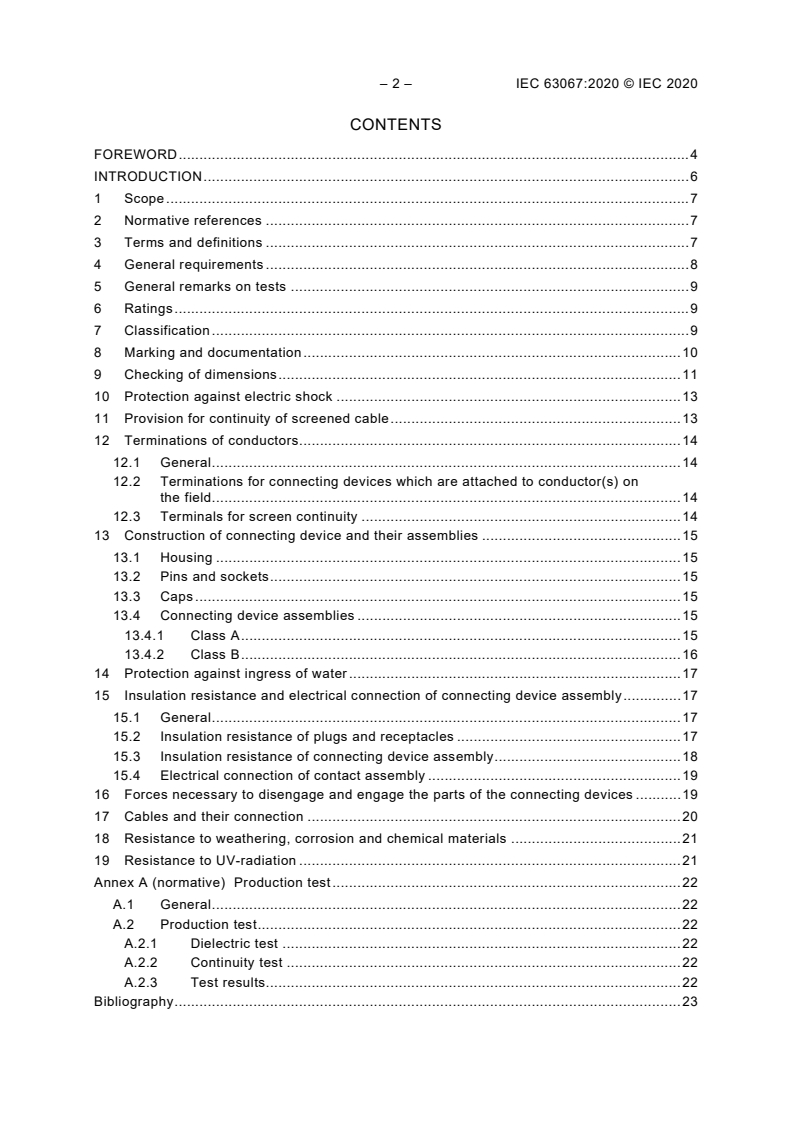
– 2 – IEC 63067:2020 © IEC 2020
CONTENTS
FOREWORD . 4
INTRODUCTION . 6
1 Scope . 7
2 Normative references . 7
3 Terms and definitions . 7
4 General requirements . 8
5 General remarks on tests . 9
6 Ratings . 9
7 Classification . 9
8 Marking and documentation . 10
9 Checking of dimensions . 11
10 Protection against electric shock . 13
11 Provision for continuity of screened cable . 13
12 Terminations of conductors . 14
12.1 General . 14
12.2 Terminations for connecting devices which are attached to conductor(s) on
the field. 14
12.3 Terminals for screen continuity . 14
13 Construction of connecting device and their assemblies . 15
13.1 Housing . 15
13.2 Pins and sockets . 15
13.3 Caps . 15
13.4 Connecting device assemblies . 15
13.4.1 Class A . 15
13.4.2 Class B . 16
14 Protection against ingress of water . 17
15 Insulation resistance and electrical connection of connecting device assembly . 17
15.1 General . 17
15.2 Insulation resistance of plugs and receptacles . 17
15.3 Insulation resistance of connecting device assembly . 18
15.4 Electrical connection of contact assembly . 19
16 Forces necessary to disengage and engage the parts of the connecting devices . 19
17 Cables and their connection . 20
18 Resistance to weathering, corrosion and chemical materials . 21
19 Resistance to UV-radiation . 21
Annex A (normative) Production test . 22
A.1 General . 22
A.2 Production test . 22
A.2.1 Dielectric test . 22
A.2.2 Continuity test . 22
A.2.3 Test results. 22
Bibliography . 23
Figure 1 – Primary plug (IEC 61823) . 11
Figure 2 – Primary receptacle (IEC 61823) . 11
Figure 3 – Secondary plug . 12
Figure 4 – Secondary receptacle. 12
Figure 5 – Secondary receptacle with moulded frangible coupler . 13
Figure 6 – Example of test arrangement to verify the fixation of pins in the body of the
insertion piece . 17
Figure 7 – Example of voltage drop test arrangement . 19
Figure 8 – Example of apparatus for verification of withdrawal force . 20
Table 1 – Classification of connecting devices . 10
Table 2 – Interface dimensions of primary plug and receptacle . 12
Table 3 – Interface dimensions for secondary plugs and receptacles . 13
– 4 – IEC 63067:2020 © IEC 2020
INTERNATIONAL ELECTROTECHNICAL COMMISSION
____________
ELECTRICAL INSTALLATIONS
FOR LIGHTING AND BEACONING OF AERODROMES –
CONNECTING DEVICES – GENERAL REQUIREMENTS AND TESTS
FOREWORD
1) The International Electrotechnical Commission (IEC) is a worldwide organization for standardization comprising
all national electrotechnical committees (IEC National Committees). The object of IEC is to promote
international co-operation on all questions concerning standardization in the electrical and electronic fields. To
this end and in addition to other activities, IEC publishes International Standards, Technical Specifications,
Technical Reports, Publicly Available Specifications (PAS) and Guides (hereafter referred to as "IEC
Publication(s)"). Their preparation is entrusted to technical committees; any IEC National Committee interested
in the subject dealt with may participate in this preparatory work. International, governmental and non-
governmental organizations liaising with the IEC also participate in this preparation. IEC collaborates closely
with the International Organization for Standardization (ISO) in accordance with conditions determined by
agreement between the two organizations.
2) The formal decisions or agreements of IEC on technical matters express, as nearly as possible, an international
consensus of opinion on the relevant subjects since each technical committee has representation from all
interested IEC National Committees.
3) IEC Publications have the form of recommendations for international use and are accepted by IEC National
Committees in that sense. While all reasonable efforts are made to ensure that the technical content of IEC
Publications is accurate, IEC cannot be held responsible for the way in which they are used or for any
misinterpretation by any end user.
4) In order to promote international uniformity, IEC National Committees undertake to apply IEC Publications
transparently to the maximum extent possible in their national and regional publications. Any divergence
between any IEC Publication and the corresponding national or regional publication shall be clearly indicated in
the latter.
5) IEC itself does not provide any attestation of conformity. Independent certification bodies provide conformity
assessment services and, in some areas, access to IEC marks of conformity. IEC is not responsible for any
services carried out by independent certification bodies.
6) All users should ensure that they have the latest edition of this publication.
7) No liability shall attach to IEC or its directors, employees, servants or agents including individual experts and
members of its technical committees and IEC National Committees for any personal injury, property damage or
other damage of any nature whatsoever, whether direct or indirect, or for costs (including legal fees) and
expenses arising out of the publication, use of, or reliance upon, this IEC Publication or any other IEC
Publications.
8) Attention is drawn to the Normative references cited in this publication. Use of the referenced publications is
indispensable for the correct application of this publication.
9) Attention is drawn to the possibility that some of the elements of this IEC Publication may be the subject of
patent rights. IEC shall not be held responsible for identifying any or all such patent rights.
International Standard IEC 63067 has been prepared by IEC technical committee 97:
Electrical installations for lighting and beaconing of aerodromes.
The text of this International Standard is based on the following documents:
FDIS Report on voting
97/216/FDIS 97/217/RVD
Full information on the voting for the approval of this International Standard can be found in
the report on voting indicated in the above table.
This document has been drafted in accordance with the ISO/IEC Directives, Part 2.
In this document, the following print types are used:
– conformity statements: in italic type.
The committee has decided that the contents of this document will remain unchanged until the
stability date indicated on the IEC website under "http://webstore.iec.ch" in the data related to
the specific document. At this date, the document will be
• reconfirmed,
• withdrawn,
• replaced by a revised edition, or
• amended.
– 6 – IEC 63067:2020 © IEC 2020
INTRODUCTION
This document is based on the Federal Aviation Administration circular AC No. 150/5345-26D,
which is listed in the bibliography for convenience.
ELECTRICAL INSTALLATIONS
FOR LIGHTING AND BEACONING OF AERODROMES –
CONNECTING DEVICES – GENERAL REQUIREMENTS AND TESTS
1 Scope
This document applies to plugs and receptacles for single or multiple pole connecting devices
used for aeronautical ground lighting applications.
Additional requirements and usage of connecting devices are given in different parts of
IEC 61820 series.
Connecting devices complying with this document are suitable for use in environmental class
E11 according to IEC 61820-1.
2 Normative references
The following documents are referred to in the text in such a way that some or all of their
content constitutes requirements of this document. For dated references, only the edition
cited applies. For undated references, the latest edition of the referenced document (including
any amendments) applies.
IEC 60352-2:2006, Solderless connections – Part 2: Crimped connections – General
requirements, test methods and practical guidance
IEC 60529, Degrees of protection provided by enclosures (IP Code)
IEC 61820-1, Electrical installations for aeronautical ground lighting at aerodromes – Part 1:
Fundamental principles
ISO 2859-1, Sampling procedures for inspection by attributes – Part 1: Sampling schemes
indexed by acceptance quality limit (AQL) for lot-by-lot inspection
3 Terms and definitions
For the purposes of this document, the terms and definitions given in IEC 61820-1, and the
following apply.
NOTE Where the terms "voltage" and "current" are used in this document, they are RMS values, unless otherwise
specified.
ISO and IEC maintain terminological databases for use in standardization at the following
addresses:
• IEC Electropedia: available at http://www.electropedia.org/
• ISO Online browsing platform: available at http://www.iso.org/obp
3.1
plug
accessory having pin(s) designed to engage with the socket contact(s) of a receptacle,
incorporating means for the electrical connection and insulated mechanical casting for
retention of cable or wires
– 8 – IEC 63067:2020 © IEC 2020
[SOURCE: IEC 60050-442:1998, 442-03-01, modified – "socket-outlet" was replaced by
"receptacle", “mechanical retention” was replaced by “insulated mechanical casting for
retention” and "cords" was replaced by "wires".]
3.2
receptacle
accessory having socket contact(s) designed to engage with the pin(s) of a plug, incorporating
means for the electrical connection and insulated mechanical casting for retention of cables
and wires
3.3
type test
conformity test made on one or more items representative of the production
3.4
production test
test that is carried out for samples of certain lot according to ISO 2859-1
3.5
class A connecting device
accessory that is completed by insulating material moulded around pre-assembled
components that are terminated to cable(s) or wire(s) in factory
3.6
class B connecting device
accessory consisting of a pre-moulded housing and interface contacts that are meant to be
assembled on the field
3.7
primary circuit
electric circuit that transfers energy from a power source to the primary winding of an AGL
transformer
3.8
secondary circuit
electric circuit that transfers energy from the secondary winding of the AGL transformer to a
load
3.9
screen continuity conductor
copper wire used to make a connection to the screen of a cable for the purpose of continuity
or earthing
4 General requirements
Plugs and receptacles shall be so designed and constructed that, in normal use, their
performance is reliable, and safety is achieved by reducing risk to a tolerable level in airfield
environment.
Compliance is checked by meeting all the relevant requirements and tests specified in this
document.
5 General remarks on tests
5.1 Tests shall be carried out to check compliance with the relevant requirements of this
document.
Tests are as follows:
– type tests shall be made on representative specimens of each type of connecting device;
– production tests shall be made according to Annex A.
Conditions of 5.2 to 5.5 are applicable to type tests.
5.2 Tests shall be carried out at 23 °C ± 3 °C unless otherwise defined.
5.3 Test shall be performed on six pairs (plugs and receptacles) of samples of each style to
demonstrate compliance with the requirements in this document.
All tested connecting devices shall pass all the relevant tests of this document. Failure of any
one of the connecting devices in any one of the tests shall indicate failure of this product to
comply with this specification unless otherwise noted in a particular test.
5.4 Assembled connecting devices of class A, shall be subjected to all the relevant tests of
this document.
5.5 Class B connecting devices shall be assembled in accordance with the manufacturer’s
instructions to lengths of wire or cable, as appropriate, of at least 0,6 m for all the relevant
tests of this document.
6 Ratings
Rated values for receptacles and plugs are according to IEC 61820-1 voltage classes.
NOTE For connecting devices different rating voltages are used. E.g. 600 V or 750 V between phases and
1 500 V between ground and phase.
7 Classification
Connecting devices are classified as shown in Table 1.
– 10 – IEC 63067:2020 © IEC 2020
Table 1 – Classification of connecting devices
Type Class Interface Figure Style Cable Type Dimensions
Figure 1 Style 2 One-core cable
Plug
Figure 1 Style 15 Screened/Shielded
Class A
(Factory moulded)
Type I
Figure 2 Style 9 One-core cable
(1 conductor,
Receptacle
25 A, 5 000 V) Figure 2 Style 16 Screened/Shielded
Table 2
Primary
Figure 1 Style 3 One-core cable
Plug
connecting
Figure 1 Style 13 Screened/Shielded
devices
Class B
(Field assembled)
Figure 2 Style 10 One-core cable
Receptacle
Figure 2 Style 14 Screened/Shielded
Figure 3 Style 1 Two single wires
Plug
Figure 3 Style 6 Two single wires
Class A
(Factory moulded)
Type II
Figure 4 Style 7 Two-core cable
(2 conductor,
Receptacle
Figure 5 Style 8 Two-core cable
20 A, 1 000 V)
Table 3
Secondary Plug Figure 3 Style 4 Two single wires
connecting
Receptacle Figure 4 Style 11 Two single wires
devices
Class B
(Field assembled)
Plug Figure 3 Style 5 Two-core cable
Figure 4 Two-core cable
Receptacle Style 12
NOTE 1 Figures refer only to the interface of the connecting devices.
NOTE 2 If a new type of connecting device is required, new configurations will be introduced on this table.
NOTE 3 A new system for connecting devices of secondary circuit, parallel circuits, ELV systems including
multipole constructions, which defines arrangement of contacts and their combinations including earthing
(grounding) contact and pilot/signalling contacts, if any, will be introduced in future as systems become
available.
NOTE 4 Column "Style" is for information and it refers to different configurations of connecting devices which
are given in Federal Aviation Administration circular AC No. 150/5345-26D.
8 Marking and documentation
8.1 Connecting devices shall be marked with manufacturer’s name, product identification or
catalogue number, style and type reference of a product.
Compliance is checked by inspection.
8.2 Markings shall be readily visible. Minimum height of letters/symbols shall be 3 mm.
Compliance is checked by inspection.
8.3 Markings shall be made impression, moulding, pressing or engraving or any other
method that provides legibility over life time of the product.
Compliance is checked by inspection.
8.4 The manufacturer’s installation instructions shall be furnished with each class B
connecting device.
8.5 The manufacturer’s installation instructions for class A connecting devices shall include
instructions how to ensure that counter parts of primary connecting devices do not separate
from each other after installation.
8.6 The manufacturer’s installation instructions shall include necessary instructions for
maintenance of connecting devices.
9 Checking of dimensions
9.1 Each plug and receptacle shall conform to the dimensions of appropriate Figure 1,
Figure 2, Figure 3, Figure 4 or Figure 5 and Table 2 and Table 3.
Compliance is checked by inspection and measurement.
NOTE The sketch is not intended to govern design except as regards the dimensions shown.
Figure 1 – Primary plug (IEC 61823)
NOTE The sketch is not intended to govern design except as regards the dimensions shown.
Figure 2 – Primary receptacle (IEC 61823)
– 12 – IEC 63067:2020 © IEC 2020
Table 2 – Interface dimensions of primary plug and receptacle
Dimension Dimension
mm
D 27,00 ± 0,2
E 4,70 ± 0,05
F 27,43 min
I 15,2 ± 0,1
J 15,4 0/+0,2
a
K 23,5 ± 0,5
L 14,3 0/+0,3
M 15,3 −0,1/+0,2
b
P 4,8 ± 0/+0,2
a
Dimension K shall remain unchanged within a
distance of 15 mm from the interface (behind
dimension I towards the cable).
b
Diameter before splitting.
NOTE The sketch is not intended to govern design except as regards the dimensions shown.
Figure 3 – Secondary plug
NOTE The sketch is not intended to govern design except as regards the dimensions shown.
Figure 4 – Secondary receptacle
NOTE The sketch is not intended to govern design except as regards the dimensions shown.
Figure 5 – Secondary receptacle with moulded frangible coupler
Table 3 – Interface dimensions for secondary plugs and receptacles
Dimension Dimension
mm
a 3,94 ± 0,05
b 3,15 ± 0,05
c 15,90 −0,4/0
d 8,7 ± 0,4
e 11,0 ± 0,2
f 18,4 0/ +0,2
g 25,0 ± 0,4
a
h 4,0 ± 0,05
a
j 3,20 ± 0,05
k 16,3 min
l 9,1 0/+0,4
m 17,5 ± 0,2
n 28,6 ± 0,8
o 38,1 ± 0,8
p 44,4 ± 0,8
a
Diameter before splitting.
10 Protection against electric shock
Protective measures against electric shock shall be practiced according to national safety
regulations and electrical maintenance instructions of airports.
11 Provision for continuity of screened cable
11.1 Plug and receptacle for screened cables shall be provided with screen continuity
conductors. The length of each screen continuity conductor shall be at least 300 mm in order
to ensure the continuity of the circuit when the main circuit is opened.
– 14 – IEC 63067:2020 © IEC 2020
11.2 Screen continuity conductor can be insulated or bare.
11.3 Minimum cross-section area of screen continuity conductors shall be at least 2,5 mm .
Compliance of 11.1 to 11.3 is checked by inspection.
11.4 The connection between the screen and the screen continuity conductor shall be of low
resistance.
The total voltage drop across the clamping unit from screen to continuity conductor shall be
less than 7,5 mV at a current of 6,6 A.
Compliance is checked by the following test.
Test current of 6,6 A shall be passed from the screen through the clamping unit to the
earthing continuity conductor (as close as possible to the clamping unit) for a minimum of
5 min. At the end of that period the voltage drop shall be less than 7,5 mV.
12 Terminations of conductors
12.1 General
Conductors shall be connected to connecting devices with terminations (welded, soldered,
crimped). Crimped connections shall fulfil the requirements of IEC 60352-2.
NOTE Table 1 of IEC 60352-2:2006 gives separation forces and Clause 7 gives tool information.
Screw terminals, screwless terminals or spring loaded terminals for main conductors shall not
be used.
12.2 Terminations for connecting devices which are attached to conductor(s) on the
field
Connecting devices shall have provisions for crimping.
Connecting devices for primary circuits shall accept stranded or flexible conductors. Nominal
2 2 2
cross-section areas are 6 mm , 10 mm and 16 mm .
Connecting devices for secondary circuits shall accept flexible conductors. Nominal cross-
2 2 2 2
section areas are 1,5 mm , 2,5 mm , 4 mm and 6 mm .
2 2
NOTE In some countries also 8 mm is used for connecting devices for primary circuits and 3,5 mm for
connecting devices for secondary circuits: JP.
Compliance is checked by inspection.
12.3 Terminals for screen continuity
Connecting capacity of terminals intended for screen continuity conductors shall be 6 mm .
Compliance is checked by inspection.
13 Construction of connecting device and their assemblies
13.1 Housing
The plug/receptacle housing interface shall conform to the dimensional and construction
requirements as indicated on the applicable Table 2 and Table 3.
For field attached connect kits the housing plug/receptacle interface shall comply with
dimension of Table 2 and Table 3 as indicated.
The connecting device housing/encapsulation shall fully enclose the pins of the plug and
sockets of the receptacle of the engaged assembly except for the mating interface surfaces.
The material shall comply with the environmental criteria of IEC 61820-1.
Interface surfaces of connecting devices shall be smooth (shall be free of parting lines) and
perpendicular in order to ensure water tightness when plug and receptacle are connected
together.
Compliance is checked by test of 14.2.
13.2 Pins and sockets
The pins and sockets shall conform to the dimensional and construction requirements as
indicated on the applicable Table 2 and Table 3.
The sockets shall be slotted and have sufficient contact pressure to ensure good electrical
contact as required by 15.4.
Pins and sockets shall be made of materials that contain at least 60 % copper.
For field attached connecting devices, the contact shall be annealed in the crimp area to
prevent fracturing the crimp barrel during installation. The remainder of the contact shall
remain at its original hardness.
The pin and socket shall be electroplated with tin or other suitable material to provide good
electrical contact and corrosion resistance as required by 15.4.
Compliance is checked by inspection.
13.3 Caps
Caps shall be supplied with class A connecting devices to protect plugs and receptacles prior
to final connection.
Compliance is checked by inspection.
13.4 Connecting device assemblies
13.4.1 Class A
13.4.1.1 Pins and sockets shall be perpendicular to the face of the connecting device.
Suitable electrical conductors shall be mechanically and electrically connected to the pin(s) or
socket(s). The housing of the connecting device shall be moulded as specified in 13.1. After
moulding, the space between the pins of Type II plugs shall be not less than 3 mm when the
pins are pinched together with a force of 25 N applied 12,7 mm out from the face of the plug.
Also, the space between the ends of the pin of the Type II plugs shall not be greater than
14,3 mm when the pins are pulled apart with a force of 25 N applied 12,7 mm out from the
face of the plug. The force is applied to the pins only. The plug is to be held only to keep it
from turning.
– 16 – IEC 63067:2020 © IEC 2020
13.4.1.2 Type II, class A connecting device assemblies shall have colour coded insulation
on each conductor, neutral (usually blue) to be connected to the large pin and/or socket, and
the line (usually brown or black) to be connected to the small pin and/or socket.
NOTE Colour codes for conductors are specified in IEC 60445.
13.4.2 Class B
13.4.2.1 Type I (both screened and unscreened)
Connecting device shall be furnished with suitable dielectric compound in order to avoid
corrosion and corona phenomena. Provision shall be made in order to prevent dielectric
compound access into the socket contact in order to ensure that contact surface remain
clean.
Compliance is checked by visual inspection and in case of doubt with test 15.4.
13.4.2.2 Type II
Pins and sockets have to be secured into an insertion piece.
Compliance is checked by inspection and by manual test as follows:
This test is made on new specimens.
The insertion piece is placed on a rigid steel plate provided with holes suitable for the pins as
shown as an example in Figure 6.
The distances between the centres of the holes shall be the same as the distances between
pins.
Each hole shall have a diameter of (8 ± 0,5) mm.
The insertion piece is positioned on the steel plate in such a way that centres of the pins
coincide with the centres of the holes.
A pull P equal to the maximum withdrawal force as shown in 16.1 (45 N), is applied, without
jerks, for 1 min on each pin in turn, in the direction of the longitudinal axis of the pin.
The pull is applied within a heating cabinet at a temperature of (65 ± 2) °C, 1 h after the
insertion piece has been placed in the heating cabinet.
After the test, the insertion piece is allowed to cool down to ambient temperature and it shall
be verified that no pin has been displaced in the body of the insertion piece by more than
0,8 mm.
Figure 6 – Example of test arrangement to verify the fixation
of pins in the body of the insertion piece
14 Protection against ingress of water
14.1 A watertight seal shall be provided between the elastomeric and metal parts of the plug
and receptacle.
Compliance is checked by the following test.
Class A connecting devices are checked so that plug and receptacle placed in water, with
1,4 bar air pressure applied from the free end of the cable, for a period of 10 min. No air
bubbles shall be observed in the water.
14.2 When assembled the plug and receptacle assemblies shall provide a watertight seal
which shall prevent moisture from entering the housing.
The environmental conditions shall comply class E11 according to IEC 61820-1 when plug
and receptacle are fully mated.
Compliance is checked according to IEC 60529.
15 Insulation resistance and electrical connection of connecting device
assembly
15.1 General
The insulation resistance of plugs and receptacles as well as the electrical connection of
connecting device assembly shall be in accordance with the values detailed in the following
clauses.
Compliance is checked by tests 15.2, 15.3 and 15.4.
15.2 Insulation resistance of plugs and receptacles
Six test plugs made of nylon, or a material of equivalent dielectric strength, and having the
most unfavourable dimensions shall be provided for the test. Each receptacle, under test,
shall be mated with one of the test plugs and allowed to soak for 24 h in a tap water bath the
ambient temperature being 23 °C ± 3 °C.
– 18 – IEC 63067:2020 © IEC 2020
At the end of the soaking period, with the receptacle still immersed, apply a test voltage of
5 kV DC for 5 min to Types II connecting devices and 15 kV DC to Type I connecting devices.
One minute after the test voltage has been applied the 500 V DC test is to be carried out
between the conductors and water, and between conductors. The minimum insulation
resistance between the conductors and water, and between conductors for both Type I and
Type II connecting devices shall be 25 000 MΩ. The insulation resistance test shall be applied
for minimum of 5 s or until the reading becomes stable.
NOTE Increasing of the values for minimum insulation resistance between the conductors and water, and
between conductors are under consideration.
The receptacles having passed this test are now used for testing the corresponding plugs in a
like test.
After these treatments, the specimens shall show no damage within the meaning of this
document.
Compliance is checked by visual inspection.
15.3 Insulation resistance of connecting device assembly
After the conclusion of the test in 15.2, each plug and receptacle being tested shall be mated
and immersed in a tap water bath the ambient temperature being 23 °C ± 3 °C.
Immerse 0,6 m of cable, 0,3 m ± 0,1 m of the plug, and 0,3 m ± 0,1 m of the receptacle. While
immersed, each connecting device assembly shall be manually flexed for 2 min and then left
immersed for a minimum of 24 h with its cable leads flexed and maintained 180°±15° from its
longitudinal axis.
Measure insulation resistance between conductors of each connected assembly after the 24 h
soaking period. The resistance measurements shall be taken with a test voltage of 5 kV DC
applied for 5 min to Type II connecting devices and 15 kV DC to Type I connecting device.
One minute after the test voltage has been applied the 500 V DC test is to be carried out
between the conductors and water, and between conductors. The minimum insulation
resistance between the conductors and water, and between conductors for both Type I and
Type II connecting devices shall be 25 000 MΩ. The insulation resistance test shall be applied
for minimum of 5 s or until the reading becomes stable.
NOTE 1 Increasing of the values for minimum insulation resistance between the conductors and water, and
between conductors are under consideration.
Heat the tap water to a 65 °C without removing the assemblies and maintain this temperature
for at least 1 h. Again measure the resistance between the conductor(s) and water, and
between conductors.
The minimum insulation resistance between the conductors and water, and between
conductors for both Type I and Type II connecting devices shall be 10 000 MΩ. The insulation
resistance test shall be applied for minimum of 5 s or until the reading becomes stable.
NOTE 2 Increasing of the values for minimum insulation resistance between the conductors and water, and
between conductors are under consideration.
After these treatments, the specimens shall show no damage within the meaning of this
document.
Compliance is checked by inspection.
15.4 Electrical connection of contact assembly
The total voltage drop across a connected pin and a socket shall not exceed 7,5 mV for Type I
contact assembly, or 6,0 mV for Type II contact assembly, with current according to Table 1.
Compliance is measured e.g. by the arrangement shown in Figure 7.
Figure 7 – Example of voltage drop test arrangement
16 Forces necessary to disengage and engage the parts of the connecting
devices
16.1 Each connected plug and receptacle shall withstand a static pull load of 45 N without
showing evidence of separation. The static pull load is carried out to counter parts. Any
evidence of separation of the connection shall be caused for rejection.
No damage shall occur to the mating components when the connected plug and receptacle
are separated by static pull load up to 200 N.
Example of a test arrangement is shown in Figure 8.
– 20 – IEC 63067:2020 © IEC 2020
Figure 8 – Example of apparatus for verification of withdrawal force
17 Cables and their connection
17.1 Connecting devices shall be capable of being fitted with types of cables and cross-
sectional areas specified by the manufacturer of the connecting device.
Compliance is checked by inspection.
17.2 The completed class A connecting device assembly shall withstand a longitudinal pull
of at least 200 N/mm (200 MPa).
The moulded bond between cable and class A connecting device shall be subjected to a static
longitudinal pull load of the magnitude specified above.
Separation between the moulded on connecting device and the cable shall be less than
0,8 mm.
When testing Style 6 connecting devices, or Style 1 with two individual conductors, the two
conductors shall be pulled as a single cable, not as individual conductors. The connecting
device shall be held in a manner that does not impart a crimping or clamping action to the
connecting device that would affect the pull test. The connecting device moulding cavity, or a
similarly shaped fixture, is acceptable for holding the connecting device.
Separation between the moulded on connecting device and the conductor shall be less than
1,5 mm.
Pull test for three and more conductors is under consideration.
17.3 Class B connecting devices shall be capable of being fitted with types of cables and
cross-sectional areas specified the manufacturer of the connecting device.
18 Resistance to weathering, corrosion and chemical materials
18.1 Material of connecting devices shall have a resistance to weathering, corrosion and
chemical material as defined in IEC 61820-1.
19 Resistance to UV-radiation
19.1 Material of connecting devices shall have a resistance to UV-radiation as defined in
IEC 61820-1.
– 22 – IEC 63067:2020 © IEC 2020
Annex A
(normative)
Production test
A.1 General
Products manufactured in a facility certified to ISO 9001 shall be subject to the standard tests
of the manufacturer. Products manufactured in a facility not so certified shall be tested as in
Clause A.2.
A.2 Production test
A.2.1 Dielectric test
Each plug and receptacle (class A) shall be subjected to a dielectric test. The insulation
resistance test voltage shall be 500 V DC for Type II connecting devices and for Type I
(screened and unscreened) connecting devices. The minimum insulation resistance between
the conductors and the outside of the connecting device body, and between conductors for
Type I and Type II connecting devices (screened and unscreened) shall be 25 000 MΩ.
NOTE Increasing of the values for minimum insulation resistance are under consideration.
The time of application of the test voltage may be reduced to 1 s. The connecting devices do
not have to be mated or immersed in water for the production test.
A.2.2 Continuity test
Each plug and receptacle (Class A) shall be continuity tested after moulding.
A.2.3 Test results
All individual production test result values shall be recorded and identified per production
batch.
Bibliography
IEC 60050-442:1998, International Electrotechnical Vocabulary (IEV) – Part 442: Electrical
accessories
IEC 60445, Basic and safety principles for man-machine interface, marking and identification
– Identification of equipment terminals, conductor terminations and conductors
IEC 61820 (all parts), Electrical installations for aeronautical ground lighting at aerodromes
IEC 61823, Electrical installations for lighting and beaconing of aerodromes – AGL series
transforme
...