

IEC 62153-4-8:2018
(Main)Metallic cables and other passive components - Test methods - Part 4-8: Electromagnetic compatibility (EMC) - Capacitive coupling admittance
General Information
- Abstract
IEC 62153-4-8:2018 specifies a test method for determining the capacitive coupling admittance, the capacitive coupling impedance and the coupling capacitance by the use of a triaxial set-up in a similar manner as for the measurement of the transfer impedance (see IEC 62153-4-3). Most cables have negligible capacitive coupling; however, in the case of cables with loose single-braids, the coupling through the holes in the screen shall be determined by the measurement of the capacitive coupling admittance. This second edition cancels and replaces the first edition published in 2006. This edition constitutes a technical revision. This edition includes the following significant technical changes with respect to the previous edition:
a) use of the triaxial set-up in a similar manner as for the measurement of the transfer impedance (see IEC 62153-4-3),
b) use of vector network analyser instead of capacitance bridge or pulse generator.
- Status
- Published
- Publication Date
- 24-Jun-2018
- Technical Committee
- TC 46 - Cables, wires, waveguides, RF connectors, RF and microwave passive components and accessories
- Drafting Committee
- WG 5 - TC 46/WG 5
- Current Stage
- PPUB - Publication issued
- Start Date
- 25-Jun-2018
- Completion Date
- 06-Jul-2018
Buy Documents
IEC 62153-4-8:2018 RLV - Metallic cables and other passive components - Test methods - Part 4-8: Electromagnetic compatibility (EMC) - Capacitive coupling admittance Released:6/25/2018
IEC 62153-4-8:2018 - Metallic cables and other passive components - Test methods - Part 4-8: Electromagnetic compatibility (EMC) - Capacitive coupling admittance Released:6/25/2018
Overview
IEC 62153-4-8:2018 is an IEC test-method standard for measuring capacitive coupling admittance, capacitive coupling impedance and coupling capacitance of metallic communication cables and other passive components. The second edition (2018) updates the 2006 edition and introduces a triaxial test set-up (aligned with IEC 62153-4-3 transfer-impedance methods) and modern measurement instrumentation such as the vector network analyser (VNA) in place of older capacitance-bridge or pulse-generator techniques. The standard is focused on electromagnetic compatibility (EMC) aspects of cable screening, particularly where capacitive coupling through screen holes (e.g., loose single-braids) can be significant.
Key Topics and Requirements
- Scope: Applies to metallic communication cables; specifies test procedures to determine through capacitance and derive capacitive coupling admittance/impedance.
- Triaxial set-up: Uses a triaxial arrangement similar to the transfer-impedance measurement (IEC 62153-4-3) to separate inner and outer circuits and control measurement environments.
- Measurement parameters: Defines how to obtain coupling capacitance, capacitive coupling admittance and capacitive coupling impedance from measured through-capacitance.
- Instrumentation: Recommends use of a vector network analyser (VNA) for frequency-domain measurement; replaces capacitance bridge and pulse methods used in the prior edition.
- Test procedures: Covers sample preparation, coupling length selection, cut-off frequency considerations, calibration, measurement sequence and evaluation of results.
- Reporting: Requires documented test reports including setup, calibration, measured admittance/impedance, and relevant environmental/test conditions.
- Special cases: Emphasises testing for cables with loose single-braids or screens with holes where capacitive coupling may not be negligible.
Applications and Who Uses This Standard
- Cable manufacturers validating EMC screening and shielding performance.
- Third‑party test laboratories performing compliance and qualification testing for communication cables and passive components.
- EMC engineers assessing coupling paths and interference risks in cable assemblies, data centers and telecom infrastructure.
- Designers of screened cables and connectors who need to quantify capacitive coupling effects for system-level EMC mitigation.
- Compliance officers and procurement teams specifying testable EMC performance criteria for cable products.
Keywords naturally integrated: IEC 62153-4-8:2018, capacitive coupling admittance, capacitive coupling impedance, coupling capacitance, triaxial set-up, vector network analyser, EMC testing, metallic communication cables, transfer impedance, cable screening.
Related Standards
- IEC 62153-4-3 - Surface transfer impedance (triaxial method)
- IEC 62153-4-1 - Introduction to EMC screening measurements
- IEC 61196-1 - Coaxial communication cables - Generic specification
- IEC 60050-726 - IEV terms for transmission lines and waveguides
This standard provides a practical, repeatable methodology for quantifying capacitive coupling in metallic cables-essential when screening imperfections may affect EMC performance.
Relations
- Effective Date
- 05-Sep-2023
Buy Documents
IEC 62153-4-8:2018 RLV - Metallic cables and other passive components - Test methods - Part 4-8: Electromagnetic compatibility (EMC) - Capacitive coupling admittance Released:6/25/2018
IEC 62153-4-8:2018 - Metallic cables and other passive components - Test methods - Part 4-8: Electromagnetic compatibility (EMC) - Capacitive coupling admittance Released:6/25/2018
Get Certified
Connect with accredited certification bodies for this standard

ANCE
Mexican certification and testing association.

Intertek Slovenia
Intertek testing, inspection, and certification services in Slovenia.

LNE (Laboratoire National de Métrologie et d'Essais)
French national laboratory for metrology and testing.
Sponsored listings
Frequently Asked Questions
IEC 62153-4-8:2018 is a standard published by the International Electrotechnical Commission (IEC). Its full title is "Metallic cables and other passive components - Test methods - Part 4-8: Electromagnetic compatibility (EMC) - Capacitive coupling admittance". This standard covers: IEC 62153-4-8:2018 specifies a test method for determining the capacitive coupling admittance, the capacitive coupling impedance and the coupling capacitance by the use of a triaxial set-up in a similar manner as for the measurement of the transfer impedance (see IEC 62153-4-3). Most cables have negligible capacitive coupling; however, in the case of cables with loose single-braids, the coupling through the holes in the screen shall be determined by the measurement of the capacitive coupling admittance. This second edition cancels and replaces the first edition published in 2006. This edition constitutes a technical revision. This edition includes the following significant technical changes with respect to the previous edition: a) use of the triaxial set-up in a similar manner as for the measurement of the transfer impedance (see IEC 62153-4-3), b) use of vector network analyser instead of capacitance bridge or pulse generator.
IEC 62153-4-8:2018 specifies a test method for determining the capacitive coupling admittance, the capacitive coupling impedance and the coupling capacitance by the use of a triaxial set-up in a similar manner as for the measurement of the transfer impedance (see IEC 62153-4-3). Most cables have negligible capacitive coupling; however, in the case of cables with loose single-braids, the coupling through the holes in the screen shall be determined by the measurement of the capacitive coupling admittance. This second edition cancels and replaces the first edition published in 2006. This edition constitutes a technical revision. This edition includes the following significant technical changes with respect to the previous edition: a) use of the triaxial set-up in a similar manner as for the measurement of the transfer impedance (see IEC 62153-4-3), b) use of vector network analyser instead of capacitance bridge or pulse generator.
IEC 62153-4-8:2018 is classified under the following ICS (International Classification for Standards) categories: 33.100.10 - Emission; 33.120.10 - Coaxial cables. Waveguides. The ICS classification helps identify the subject area and facilitates finding related standards.
IEC 62153-4-8:2018 has the following relationships with other standards: It is inter standard links to IEC 62153-4-8:2006. Understanding these relationships helps ensure you are using the most current and applicable version of the standard.
IEC 62153-4-8:2018 is available in PDF format for immediate download after purchase. The document can be added to your cart and obtained through the secure checkout process. Digital delivery ensures instant access to the complete standard document.
Standards Content (Sample)
IEC 62153-4-8 ®
Edition 2.0 2018-06
REDLINE VERSION
INTERNATIONAL
STANDARD
colour
inside
Metallic communication cables and other passive components –
Test methods –
Part 4-8: Electromagnetic compatibility (EMC) – Capacitive coupling admittance
All rights reserved. Unless otherwise specified, no part of this publication may be reproduced or utilized in any form
or by any means, electronic or mechanical, including photocopying and microfilm, without permission in writing from
either IEC or IEC's member National Committee in the country of the requester. If you have any questions about IEC
copyright or have an enquiry about obtaining additional rights to this publication, please contact the address below or
your local IEC member National Committee for further information.
IEC Central Office Tel.: +41 22 919 02 11
3, rue de Varembé info@iec.ch
CH-1211 Geneva 20 www.iec.ch
Switzerland
About the IEC
The International Electrotechnical Commission (IEC) is the leading global organization that prepares and publishes
International Standards for all electrical, electronic and related technologies.
About IEC publications
The technical content of IEC publications is kept under constant review by the IEC. Please make sure that you have the
latest edition, a corrigenda or an amendment might have been published.
IEC Catalogue - webstore.iec.ch/catalogue Electropedia - www.electropedia.org
The stand-alone application for consulting the entire The world's leading online dictionary of electronic and
bibliographical information on IEC International Standards, electrical terms containing 21 000 terms and definitions in
Technical Specifications, Technical Reports and other English and French, with equivalent terms in 16 additional
documents. Available for PC, Mac OS, Android Tablets and languages. Also known as the International Electrotechnical
iPad. Vocabulary (IEV) online.
IEC publications search - webstore.iec.ch/advsearchform IEC Glossary - std.iec.ch/glossary
The advanced search enables to find IEC publications by a 67 000 electrotechnical terminology entries in English and
variety of criteria (reference number, text, technical French extracted from the Terms and Definitions clause of
committee,…). It also gives information on projects, replaced IEC publications issued since 2002. Some entries have been
and withdrawn publications. collected from earlier publications of IEC TC 37, 77, 86 and
CISPR.
IEC Just Published - webstore.iec.ch/justpublished
Stay up to date on all new IEC publications. Just Published IEC Customer Service Centre - webstore.iec.ch/csc
details all new publications released. Available online and If you wish to give us your feedback on this publication or
also once a month by email. need further assistance, please contact the Customer Service
Centre: sales@iec.ch.
IEC 62153-4-8 ®
Edition 2.0 2018-06
REDLINE VERSION
INTERNATIONAL
STANDARD
colour
inside
Metallic communication cables and other passive components –
Test methods –
Part 4-8: Electromagnetic compatibility (EMC) – Capacitive coupling admittance
INTERNATIONAL
ELECTROTECHNICAL
COMMISSION
ICS 33.100.10; 33.120.10 ISBN 978-2-8322-5851-4
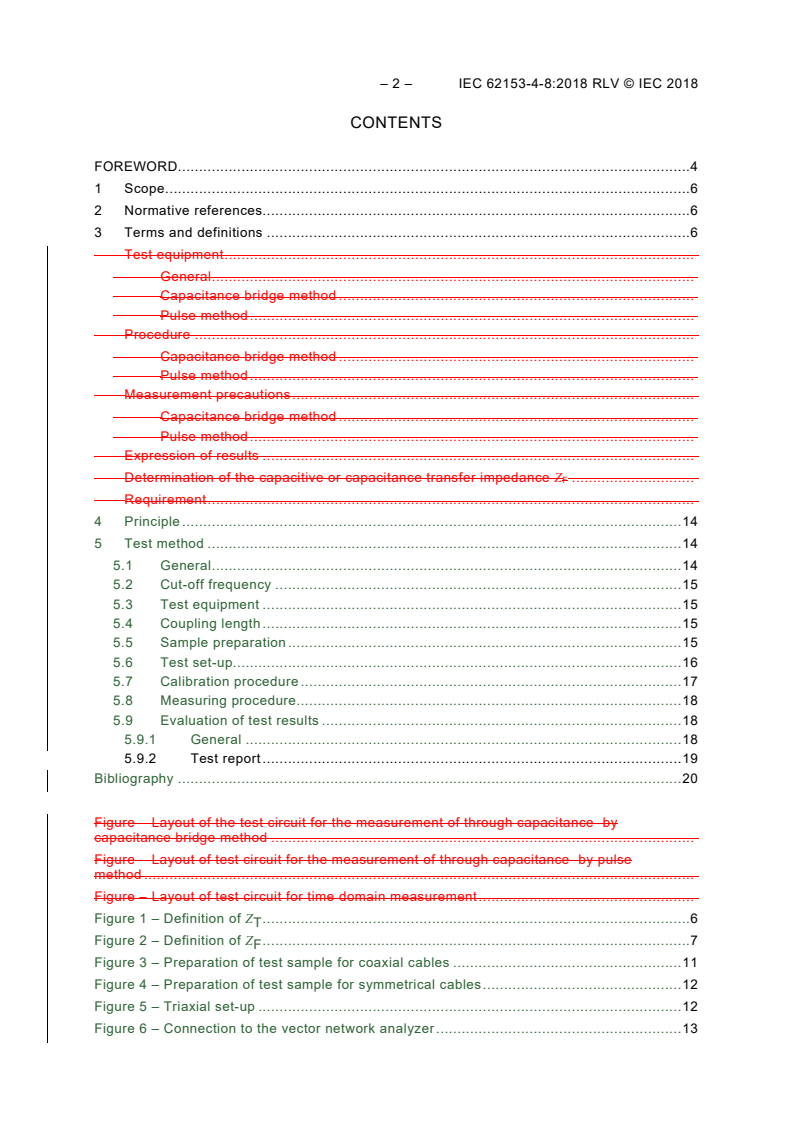
– 2 – IEC 62153-4-8:2018 RLV © IEC 2018
CONTENTS
FOREWORD . 4
1 Scope . 6
2 Normative references. 6
3 Terms and definitions . 6
Test equipment .
General .
Capacitance bridge method .
Pulse method .
Procedure .
Capacitance bridge method .
Pulse method .
Measurement precautions .
Capacitance bridge method .
Pulse method .
Expression of results .
Determination of the capacitive or capacitance transfer impedance Z .
F
Requirement .
4 Principle . 14
5 Test method . 14
5.1 General . 14
5.2 Cut-off frequency . 15
5.3 Test equipment . 15
5.4 Coupling length . 15
5.5 Sample preparation . 15
5.6 Test set-up. 16
5.7 Calibration procedure . 17
5.8 Measuring procedure . 18
5.9 Evaluation of test results . 18
5.9.1 General . 18
5.9.2 Test report . 19
Bibliography . 20
Figure – Layout of the test circuit for the measurement of through capacitance by
capacitance bridge method .
Figure – Layout of test circuit for the measurement of through capacitance by pulse
method .
Figure – Layout of test circuit for time domain measurement .
Figure 1 – Definition of Z . 6
T
Figure 2 – Definition of Z . 7
F
Figure 3 – Preparation of test sample for coaxial cables . 11
Figure 4 – Preparation of test sample for symmetrical cables . 12
Figure 5 – Triaxial set-up . 12
Figure 6 – Connection to the vector network analyzer . 13
INTERNATIONAL ELECTROTECHNICAL COMMISSION
____________
METALLIC COMMUNICATION CABLES
AND OTHER PASSIVE COMPONENTS –
TEST METHODS –
Part 4-8: Electromagnetic compatibility (EMC) –
Capacitive coupling admittance
FOREWORD
1) The International Electrotechnical Commission (IEC) is a worldwide organization for standardization comprising
all national electrotechnical committees (IEC National Committees). The object of IEC is to promote
international co-operation on all questions concerning standardization in the electrical and electronic fields. To
this end and in addition to other activities, IEC publishes International Standards, Technical Specifications,
Technical Reports, Publicly Available Specifications (PAS) and Guides (hereafter referred to as “IEC
Publication(s)”). Their preparation is entrusted to technical committees; any IEC National Committee interested
in the subject dealt with may participate in this preparatory work. International, governmental and non-
governmental organizations liaising with the IEC also participate in this preparation. IEC collaborates closely
with the International Organization for Standardization (ISO) in accordance with conditions determined by
agreement between the two organizations.
2) The formal decisions or agreements of IEC on technical matters express, as nearly as possible, an international
consensus of opinion on the relevant subjects since each technical committee has representation from all
interested IEC National Committees.
3) IEC Publications have the form of recommendations for international use and are accepted by IEC National
Committees in that sense. While all reasonable efforts are made to ensure that the technical content of IEC
Publications is accurate, IEC cannot be held responsible for the way in which they are used or for any
misinterpretation by any end user.
4) In order to promote international uniformity, IEC National Committees undertake to apply IEC Publications
transparently to the maximum extent possible in their national and regional publications. Any divergence
between any IEC Publication and the corresponding national or regional publication shall be clearly indicated in
the latter.
5) IEC itself does not provide any attestation of conformity. Independent certification bodies provide conformity
assessment services and, in some areas, access to IEC marks of conformity. IEC is not responsible for any
services carried out by independent certification bodies.
6) All users should ensure that they have the latest edition of this publication.
7) No liability shall attach to IEC or its directors, employees, servants or agents including individual experts and
members of its technical committees and IEC National Committees for any personal injury, property damage or
other damage of any nature whatsoever, whether direct or indirect, or for costs (including legal fees) and
expenses arising out of the publication, use of, or reliance upon, this IEC Publication or any other IEC
Publications.
8) Attention is drawn to the Normative references cited in this publication. Use of the referenced publications is
indispensable for the correct application of this publication.
9) Attention is drawn to the possibility that some of the elements of this IEC Publication may be the subject of
patent rights. IEC shall not be held responsible for identifying any or all such patent rights.
This redline version of the official IEC Standard allows the user to identify the changes
made to the previous edition. A vertical bar appears in the margin wherever a change
has been made. Additions are in green text, deletions are in strikethrough red text.
– 4 – IEC 62153-4-8:2018 RLV © IEC 2018
International Standard IEC 62153-4-8 has been prepared by IEC technical committee 46:
Cables, wires, waveguides, RF connectors, RF and microwave passive components and
accessories.
This second edition cancels and replaces the first edition published in 2006. This edition
constitutes a technical revision.
Future standards in this series will carry the new general title as cited above. Titles of existing
standards in this series will be updated at the time of the next edition.
This edition includes the following significant technical changes with respect to the previous
edition:
a) use of the triaxial set-up in a similar manner as for the measurement of the transfer
impedance (see IEC 62153-4-3),
b) use of vector network analyser instead of capacitance bridge or pulse generator.
The text of this International Standard is based on the following documents:
FDIS Report on voting
46/684/FDIS 46/690/RVD
Full information on the voting for the approval of this International Standard can be found in
the report on voting indicated in the above table.
This document has been drafted in accordance with the ISO/IEC Directives, Part 2.
A list of all parts of the IEC 62153 series, under the general title: Metallic cables and other
passive components – Test methods, can be found on the IEC website.
The committee has decided that the contents of this document will remain unchanged until the
stability date indicated on the IEC website under "http://webstore.iec.ch" in the data related to
the specific document. At this date, the document will be
• reconfirmed,
• withdrawn,
• replaced by a revised edition, or
• amended.
IMPORTANT – The 'colour inside' logo on the cover page of this publication indicates
that it contains colours which are considered to be useful for the correct
understanding of its contents. Users should therefore print this document using a
colour printer.
METALLIC COMMUNICATION CABLES
AND OTHER PASSIVE COMPONENTS –
TEST METHODS –
Part 4-8: Electromagnetic compatibility (EMC) –
Capacitive coupling admittance
1 Scope
This part of IEC 62153 applies to metallic communications cables. It specifies a test method
for determining the capacitive coupling admittance by the measurement of through
capacitance using either a capacitance bridge or by a pulse method the capacitive coupling
impedance and the coupling capacitance by the use of a triaxial set-up in a similar manner as
for the measurement of the transfer impedance (see IEC 62153-4-3). Most cables have
negligible capacitive coupling; however, in the case of cables with loose single-braids, the
coupling through the holes in the screen shall be determined by the measurement of the
capacitive coupling admittance.
2 Normative references
The following documents are referred to in the text in such a way that some or all of their
content constitutes requirements of this document. For dated references, only the edition
cited applies. For undated references, the latest edition of the referenced document (including
any amendments) applies.
IEC 60050-726, International Electrotechnical Vocabulary (IEV) – Part 726: Transmission
lines and wave guides
IEC 61196-1, Coaxial communication cables – Part 1: Generic specification – General,
definitions and requirements
IEC 62153-4-1, Metallic communication cable test methods – Part 4-1: Electromagnetic
Compatibility (EMC) – Introduction to electromagnetic (EMC) screening measurements
IEC 62153-4-3, Metallic communication cable test methods – Part 4-3: Electromagnetic
compatibility (EMC) – Surface transfer impedance – Triaxial method
3 Terms and definitions
For the purposes of this document the following terms and definitions given in IEC 60050-726,
IEC 61196-1 and IEC 62153-4-1, as well as the following apply.
ISO and IEC maintain terminological databases for use in standardization at the following
addresses:
• IEC Electropedia: available at http://www.electropedia.org/
• ISO Online browsing platform: available at http://www.iso.org/obp.
—————————
To be published.
– 6 – IEC 62153-4-8:2018 RLV © IEC 2018
3.1
inner circuit
circuit consisting of the screens and the conductor(s) of the test specimen
Note 1 to entry: Quantities relating to the inner circuit are denoted by the subscript “1”. See Figure 1 and
Figure 2.
3.2
outer circuit
circuit consisting of the screen surface and the inner surface of a surrounding test jig
Note 1 to entry: Quantities relating to the outer circuit are denoted by the subscript “2”. See Figure 1 and
Figure 2.
3.3
transfer impedance
Z
T
quotient of the longitudinal voltage induced in the matched outer circuit – formed by the
screen under test and the measuring jig – and the current fed into the inner circuit or vice
versa (see Figure 1)
U U
2 2
Z U = Z U =
2 2n 2 2f Z
2 2
Z
T
Z
Z
I
u
1f
E U
I
1n
l << λ
IEC
Key
Z , Z characteristic impedance of the inner and the outer circuits
1 2
U , U voltages in the inner and the outer circuits (n: near end, f: far end)
1 2
I current in the inner circuit (n: near end, f: far end)
l length of the cable, respectively the length of the screen under test
λ wavelength in free space
U
Z = (1)
T
I
where
Z is the transfer impedance;
T
U is the voltage in the inner and the outer circuits (n: near end, f: far end);
I is the current in the inner circuit (n: near end, f: far end).
Figure 1 – Definition of Z
T
Note 1 to entry: Transfer impedance is expressed in mΩ/m.
3.4
capacitive coupling impedance
Z
F
quotient of twice the voltage induced to the terminating impedance Z of the matched outer
circuit by a current I fed (without returning over the screen) to the inner circuit and the
current I or vice versa (see Figure 2)
I I
2n 2f
I
Z U Z U
2 2n 2 2f Z
C
T
I I
1 1
Z
Z1
u
U Z
1f 1
U
1n
l << λ
IEC
Key
Z , Z characteristic impedance of the inner and the outer circuits
1 2
U , U voltages in the inner and the outer circuits (n: near end, f: far end)
1 2
I , I current in the inner and the outer circuits (n: near end, f: far end)
1 2
l length of the cable, respectively the length of the screen under test
λ wavelength in free space
I = I
2n 2f
U = U
1n 1f
I = I = (1/2) × I = I /2
2n 2f 2 2
I = I + I
2 2n 2f
U +U 2U
2n 2f 2f
Z = = = Z Z × jωC
F 1 2 T
(2)
I I
1 1
where
Z is the capacitive coupling impedance;
F
Z , Z is the characteristic impedance of the inner and the outer circuits;
1 2
U is the voltage in the outer circuit (n: near end, f: far end);
I is the current in the inner circuit (n: near end, f: far end);
C is the coupling capacitance.
T
Figure 2 – Definition of Z
F
Note 1 to entry: Capacitive coupling impedance is expressed in mΩ/m.
Note 2 to entry: For multiconductor cables, the inner conductors are shorted together.
Note 3 to entry: The coupling capacitance C is dependent on the dielectric permittivity and geometry of the outer
T
circuit, whereas the capacitive coupling impedance is invariant with respect to the geometry of the outer circuit and
nearly invariant with respect to the dielectric permittivity.
– 8 – IEC 62153-4-8:2018 RLV © IEC 2018
ε ε
r1 r2
Z = Z Z jωC = jωC (3)
F 1 2 T T
C c C c
1 0 2 0
where
Z is the capacitive coupling impedance;
F
C is the coupling capacitance;
T
ω is the circular frequency;
c is the speed of light, 3 × 10 m/s;
ε is the relative dielectric permittivity of the inner circuit (CUT);
r1
ε is the relative dielectric permittivity of the outer circuit (tube);
r2
Z is the impedance of the inner circuit (CUT);
Z is the impedance of the outer circuit (tube);
C is the capacitance of the inner circuit (CUT);
C is the capacitance of the outer circuit (tube).
ε ε ε ε
C C
r1 r2 r1 r2
1 2
As C ∝ one gets Z ∝ ; and ≈ 0,5 for relative dielectric permittivity in the
T F
ε + ε ε + ε ε + ε
r1 r2 r1 r2 r1 r2
inner and outer circuit in the range from 1 to 3.
3.5
capacitive coupling admittance
Y
C
quotient of the current induced in the secondary (inner) circuit to the voltage development in
the primary (outer) circuit. For electrically short uniform cables
Y = jωC (4)
C T
NOTE 1 Although most cables have negligible capacitive coupling, in the case of a loose single-braided cable, the
coupling through the holes in the screen is described in terms of the through capacitance C or the capacitive
T
coupling admittance Y .
C
NOTE 2 For multiconductor cables, the inner conductors are shorted together.
3.6
effective transfer impedance
Z
TE
maximum absolute value of the sum or difference of the Z and Z at every frequency
F T
Z = max Z ± Z
(5)
TE F T
Note 1 to entry: The effective transfer impedance is expressed in Ω.
3.7
effective transfer impedance related to a reference impedance of 1 Ω
Z
TE
maximum absolute value of the sum or difference of the Z and Z at every frequency
F T
expressed in dB (Ω)
Z
TE
Z = + 20 × log (6)
TE 10
Z
T,ref
where
Z is the reference transfer impedance with a value of 1 Ω
T,ref
Note 1 to entry: The effective transfer impedance is expressed in dB (Ω).
3.8
coupling length
L
c
length of cable which is inside the test jig, i.e. the length of the screen under test
3.9
cut-off frequency
maximum frequency up to which the capacitive coupling admittance can be measured
3.2
capacitive or capacitance transfer impedance
the capacitive or capacitance transfer impedance is derived as:
Z = jωC Z Z
F T 01 02
where
Z is the characteristic impedance of the primary circuit (outer braid or tube and screen of
the test sample);
Z is the characteristic impedance of the secondary circuit (test sample).
NOTE For multiconductor cables, the inner conductors are shorted together.
4 Test equipment
4.1 General
The apparatus is of the “triple coaxial” form. The inner conductor(s) of the test sample is
shielded at one end by means of a metal disc connected to the screen or by means of a
screened termination without its resistor. The test sample is coaxially mounted inside a test
jig. The outer conductor of the test jig is either a metal tube or is formed by applying a braid
over the sheath of the test sample (or over a further insulating tube if the test sample has no
sheath). The tube of braid is open-ended at the side opposite the metal disc.
4.2 Capacitance bridge method
The screen of the test sample is connected to the middle of a capacitance bridge, see
Figure 1.
– 10 – IEC 62153-4-8:2018 RLV © IEC 2018
Screen under test
Outer coaxial system
Inner coaxial system
IEC 1968/06
Figure 1 – Layout of the test circuit for the measurement of through capacitance
by capacitance bridge method
4.3 Pulse method
The equipment combinations given in Table 1 are suggested to achieve a sensitivity of about
–15
1 division on an oscilloscope screen for a value of C equal to 10 F/m, which is typically
T
equivalent to a resolution of 1 mΩ/m in the derived value of Z .
F
Table 1 – Equipment combinations
Pulse generator Oscilloscope
Output pulse Rise-time Sensitivity Bandwidth
10 V 100 ns 100 µV/div 1 MHz
100 V 100 ns 1 µV/div 1 MHz
5 Procedure
5.1 Capacitance bridge method
At a frequency of approximately 1 kHz, the capacitance is measured between the inner
conductor(s) of the test sample and the metal tube or outer braid.
5.2 Pulse method
The signal from a pulse generator is fed to the outer coaxial system (exciting circuit) and to
one channel of the oscilloscope (V ) (see Figure 2). The inner conductor(s) of the test sample
is connected to the other channel of the oscilloscope (V ). In order to avoid reflections from
connector mismatch, V is recorded as mean pulse height displayed 1 µs to 2 µs after the
initiation of the pulse.
Pulse
Oscilloscope
generator
V
V
R
C
Braid
C
Screen outer conductor I
IEC 1969/06
termination
Calibration
capacitor
Attenuator
1/B
1 pF
IEC 1970/06
Figure 2 – Layout of test circuit for the measurement of through capacitance
by pulse method
6 Measurement precautions
6.1 Capacitance bridge method
The screen under test shall have a length of between 0,5 m and 5 m to ensure that
corrections for the connecting cable capacitance and measuring instrument capacitance do
not unduly degrade the system accuracy.
6.2 Pulse method
The measuring circuit is not terminated in its characteristic impedance at either end so the
overall length should be kept short to allow resonances to die away before the measurement
is taken. The cable end is screened to avoid crosstalk from the pulse generator output. The
exciting circuit is terminated to limit any resonances to the measuring circuit. The terminating
resistance is placed at the drive end to avoid possible error from the surface transfer
impedance contributions should any significant current flow in the screen under test.
To determine the sensitivity and calibrate the test equipment, an attenuator and a small
calibration capacitor are used. To avoid introducing additional error, calibration can be
effected at any level by substituting the calibration capacitor in place of the screened open
circuit termination and connecting the pulse generator to it via the attenuator. In this way, the
total measuring circuit capacitance is unchanged and the calibration level is C /B , the
3 3
attenuator again being 1/B .
– 12 – IEC 62153-4-8:2018 RLV © IEC 2018
If the pulse is correctly terminated before calibration there will be no change in the value of
V , otherwise there will be a small change in V as shown on the oscilloscope trace when the
1 1
attenuator is substituted in place of the load resistor R .
Crosstalk sensitivity, which may limit the minimum detectable signal, is established by
disconnecting at point P and observing the V oscilloscope trace with other settings normal.
3 2
Care should be taken to screen the open end of the measuring cable, to maintain screen
continuity by touching the connector bodies together and to set the pulse generator and the
oscilloscope gain for the maximum desired sensitivity.
7 Expression of results
If the bridge method is used, the value of C in pF/m is the bridge reading divided by the
T
length of the test sample.
If the pulse method is used the value of the through capacitance C is determined from:
T
C = (C + C / l) V /V
T 2 0 2 1
where
C is the capacitance of the inner dielectric of the test sample in pF/m;
l is the length of the test sample under the injection braid in m;
C is the stray capacitance in pF/m;
V is the reference pulse voltage;
V is the coupled pulse voltage.
The stray capacitance consists of coupling capacitance, the oscilloscope input capacitance
and the additional capacitance of the test sample outside the test length.
The capacitive coupling admittance Y in S/m is derived from:
C
Y = 2πfC / l
C T
where
C is the through capacitance in pF/m;
T
l is the length of the test sample in m;
f is the frequency in Hz.
8 Determination of the capacitive or capacitance transfer impedance Z
F
The capacitive or capacitance transfer impedance can be readily derived from a measurement
of the through capacitance of a braid if the characteristic impedance of the inner and outer
coaxial lines are known. Both Z and Z can be obtained using the equipment assembled
01 02
(see Figure 3) as a time domain reflectometer (TDR) so long as the pulse generator rise-time
and the oscilloscope response are sufficiently fast.
NOTE For a 1 m test sample, the signal delay (go and return) is about 10 ns. A pulse generator with a rise-time of
4 ns and an oscilloscope with a bandwidth of 100 MHz gives a net rise-time of 5,5 ns which is sensibly shorter than
the pulse length from the cable.
Oscilloscope
Pulse
generator
Connecting cable
Selected
resistor
R
IEC 1971/06
Figure 3 – Layout of test circuit for time domain measurement
The terminating resistor which is adjusted for minimum reflection becomes equivalent to the
characteristic impedance of the circuit under test.
The capacitive or capacitance transfer impedance Z is derived from
F
Z = jωC Z Z
F T 01 02
9 Requirement
The capacitive coupling admittance of the test sample shall comply with that indicated in the
relevant cable specification.
4 Principle
The test determines the screening effectiveness of a shielded cable by applying a well-
defined voltage to the screen of the cable and measuring the induced voltage in a secondary
circuit in order to determine the capacitive coupling admittance. This test measures only the
electrostatic component of the effective transfer impedance Z . To measure the magnetic
TE
component (the surface transfer impedance), the method described in IEC 62153-4-3 shall be
used.
5 Test method
5.1 General
If not otherwise specified, the measurements shall be carried out at the temperature of
(23 ± 3) °C.
– 14 – IEC 62153-4-8:2018 RLV © IEC 2018
The test method determines the capacitive coupling admittance of a cable screen by
measuring the cable in a triaxial test set-up. A test configuration with an open circuit in the
inner and outer circuit shall be used. This emphasizes the capacitive coupling compared to
the magnetic coupling and results in a 6 dB higher signal compared to a configuration where
the inner circuit is matched.
The test results are valid in a frequency range up to about 25 MHz, see 5.2. The coupling
capacitance C is independent on the frequency. Therefore for frequencies above the cut-off
T
frequency, the test results of the capacitive coupling admittance can be extrapolated with
20 dB/decade, see 3.5.
5.2 Cut-off frequency
The cut-off frequency length product is roughly:
c
f × l ≈ (7)
cut
2π
ε + ε
r1 r2
where
l is the coupling length of the cable under test;
c is the speed of light, 3 × 10 m/s;
ε is the relative dielectric permittivity of the inner circuit (CUT);
r1
ε is the relative dielectric permittivity of the outer circuit (tube).
r2
I.e. for a coupling length of 1 m and dielectric permittivities of 2,3 and 1,1 in the inner
respectively outer circuit, the maximum frequency for the measurement of the capacitive
coupling admittance is 25 MHz.
Another way to obtain the cut-off frequency is to observe the phase of the capacitive coupling
admittance respectively measured forward transmission scattering parameter S , see 5.8.
The cut-off frequency is reached when the phase starts to deviate from 90 degrees.
5.3 Test equipment
The measurement shall be performed using a vector network analyser.
5.4 Coupling length
The coupling length shall be not shorter than 0,5 m and not longer than 1,0 m.
5.5 Sample preparation
The test sample shall have a length not more than 50 % longer than the coupling length.
Coaxial cables are prepared as shown in Figure 3.
IEC
Figure 3 – Preparation of test sample for coaxial cables
One end of the coaxial cable is prepared with a connector to make a connection to the
receiver. The other end of the coaxial cable is prepared with a well screened open circuit. The
open circuit shall be made in a way resulting in a small stray capacitance. To minimize
unwanted coupling into the tube, the exceeding length outside the tube shall be screened with
an additional tight screen, which shall be in contact with the cable screen (e.g. by wrapping a
metal foil with minimum 20 % overlap around the cable screen).
All connections shall be made RF tight and with low RF-contact resistance so that the impact
of the sample preparation is negligible compared to the test results.
Screened symmetrical cables are treated as a quasi coaxial system, see Figure 4. Therefore
the conductors of all pairs/quads shall be connected together at both ends. All screens,
including those of individually screened pairs/quads, shall be connected together at both
ends. The screens shall be connected over the whole circumference.
IEC
Figure 4 – Preparation of test sample for symmetrical cables
5.6 Test set-up
The test sample shall be fitted to the test set-up. The test set-up is an apparatus of a triple
coaxial form. The cable screen forms both the outer conductor of the inner circuit and the
inner conductor of the outer circuit. The outer conductor of the outer circuit is a well
conductive tube of non-ferromagnetic metal (for example brass, copper or aluminium) with an
open-circuit to the screen on the receiver side of the cable (see Figure 5). The test sample
shall be well centered in the tube.
– 16 – IEC 62153-4-8:2018 RLV © IEC 2018
IEC
Figure 5 – Triaxial set-up
Due to the open circuit in the outer circuit (tube), external disturbers may couple into the tube.
Therefore the generator signal is feeding the outer circuit (tube), guaranteeing a high signal to
noise ratio. The coupled signal is measured in the inner circuit (cable), see Figure 6. The
connection from the triaxial set-up to the vector network analyzer (VNA) shall be done with
well screened cables, e.g. double braided cables, having a screening attenuation of minimum
80 dB up to 1 GHz and a transfer impedance of maximum 10 mΩ/m at 100 MHz. The
connecting cables shall be as short as possible. The use of ferrites on the connecting cables
is recommended in order to suppress resonance effects.
IEC
Figure 6 – Connection to the vector network analyzer
5.7 Calibration procedure
The calibration shall be established at the same frequency points at which the measurement
of the transfer impedance is done, i.e. in a logarithmic frequency sweep over the whole
frequency range, which is specified for the capacitive coupling admittance.
A full two-port calibration – including isolation – shall be established including the connecting
cables used to connect the test set-up to the test equipment. The reference planes for the
calibration are the connector interface of the connecting cables. Further details on how to
perform a full two port calibration are found in the manual of the vector network analyzer.
5.8 Measuring procedure
The outer circuit (tube) of the triaxial set-up shall be connected to port 1 of the VNA. The
inner circuit (sample) shall be connected to port 2 of the VNA, see Figure 6. The connection
to the VNA shall be done with the same cables as used during the calibration, see 5.6 and
5.7.
The forward transmission scattering parameter S shall be measured in a logarithmic
frequency sweep over the whole frequency range, which is specified for the capacitive
coupling admittance and at the same frequency points as for the calibration procedure:
P
a = 20log = −20log S (8)
( )
meas 10 10 21
P
where
P is the fictive unreflected power fed to outer circuit;
P is the power in the inner circuit.
5.9 Evaluation of test results
5.9.1 General
The conversion from the measured attenuation to the capacitive coupling admittance is given
by the following formulae:
a
meas
−
Y = 10 (9)
C
Z ⋅ L
0 c
Z = Z Z Y (10)
F 1 2 T
Y
T
C = (11)
T
ω
where
Y is the capacitive coupling admittance;
C
Z is the capacitive coupling impedance;
F
Z is the impedance of the inner circuit;
Z is the impedance of the outer circuit;
C is the coupling capacitance;
T
Z is the system impedance (in general 50 Ω);
L is the coupling length;
c
a is the attenuation measured at the measuring procedure;
meas
ω is the circular frequency.
– 18 – IEC 62153-4-8:2018 RLV © IEC 2018
5.9.2 Test report
The test report shall give the test conditions:
– the used method (pulse or bridge);
– the length of the test sample;
– the frequency used to determine the capacitive coupling admittance,
and record the result of the measurement according to Clause 7 and Clause 8 of this part of
IEC 62153.
The test report shall conclude if the requirements of the relevant cable specification are met
and include:
a) graph with logarithmic frequency scale of the magnitude (in dB) of the measured forward
transmission scattering parameter S
21;
a) graph with logarithmic frequency scale of the phase (in degree) of the measured forward
transmission scattering parameter S
21;
b) graph with double logarithmic scale of the derived capacitive coupling admittance Y
T;
c) graph with double logarithmic scale of the derived capacitive coupling impedance Z
F;
d) graph with double logarithmic scale of the derived coupling capacitance C
T;
e) value of the impedance and capacitance of the inner and outer circuit;
f) value of the coupling length.
Bibliography
Optimierte Kabelschirme – Theorie und Messung; DISS. ETH Nr. 9354; Thomas Kley
___________
IEC 62153-4-8 ®
Edition 2.0 2018-06
INTERNATIONAL
STANDARD
NORME
INTERNATIONALE
colour
inside
Metallic cables and other passive components – Test methods –
Part 4-8: Electromagnetic compatibility (EMC) – Capacitive coupling admittance
Câbles métalliques et autres composants passifs – Méthodes d’essai –
Partie 4-8: Compatibilité électromagnétique (CEM) – Admittance de couplage
capacitif
– 2 – IEC 62153-4-8:2018 © IEC 2018
CONTENTS
FOREWORD . 3
1 Scope . 5
2 Normative references. 5
3 Terms and definitions . 5
4 Principle . 9
5 Test method . 9
5.1 General . 9
5.2 Cut-off frequency . 9
5.3 Test equipment . 9
5.4 Coupling length . 9
5.5 Sample preparation . 10
5.6 Test set-up. 11
5.7 Calibration procedure . 12
5.8 Measuring procedure . 12
5.9 Evaluation of test results . 12
5.9.1 General . 12
5.9.2 Test report . 13
Bibliography . 14
Figure 1 – Definition of Z . 6
T
Figure 2 – Definition of Z . 7
F
Figure 3 – Preparation of test sample for coaxial cables . 10
Figure 4 – Preparation of test sample for symmetrical cables . 10
Figure 5 – Triaxial set-up . 11
Figure 6 – Connection to the vector network analyzer . 11
INTERNATIONAL ELECTROTECHNICAL COMMISSION
____________
METALLIC CABLES AND OTHER PASSIVE COMPONENTS –
TEST METHODS –
Part 4-8: Electromagnetic compatibility (EMC) –
Capacitive coupling admittance
FOREWORD
1) The International Electrotechnical Commission (IEC) is a worldwide organization for standardization comprising
all national electrotechnical committees (IEC National Committees). The object of IEC is to promote
international co-operation on all questions concerning standardization in the electrical and electronic fields. To
this end and in addition to other activities, IEC publishes International Standards, Technical Specifications,
Technical Reports, Publicly Available Specifications (PAS) and Guides (hereafter referred to as “IEC
Publication(s)”). Their preparation is entrusted to technical committees; any IEC National Committee interested
in the subject dealt with may participate in this preparatory work. International, governmental and non-
governmental organizations liaising with the IEC also participate in this preparation. IEC collaborates closely
with the International Organization for Standardization (ISO) in accordance with conditions determined by
agreement between the two organizations.
2) The formal decisions or agreements of IEC on technical matters express, as nearly as possible, an international
consensus of opinion on the relevant subjects since each technical committee has representation from all
interested IEC National Committees.
3) IEC Publications have the form of recommendations for international use and are accepted by IEC National
Committees in that sense. While all reasonable efforts are made to ensure that the technical content of IEC
Publications is accurate, IEC cannot be held responsible for the way in which they are used or for any
misinterpretation by any end user.
4) In order to promote international uniformity, IEC National Committees undertake to apply IEC Publications
transparently to the maximum extent possible in their national and regional publications. Any divergence
between any IEC Publication and the corresponding national or regional publication shall be clearly indicated in
the latter.
5) IEC itself does not provide any attestation of conformity. Independent certification bodies provide conformity
assessment services and, in some areas, access to IEC mark
...
IEC 62153-4-8 ®
Edition 2.0 2018-06
INTERNATIONAL
STANDARD
NORME
INTERNATIONALE
colour
inside
Metallic cables and other passive components – Test methods –
Part 4-8: Electromagnetic compatibility (EMC) – Capacitive coupling admittance
Câbles métalliques et autres composants passifs – Méthodes d’essai –
Partie 4-8: Compatibilité électromagnétique (CEM) – Admittance de couplage
capacitif
All rights reserved. Unless otherwise specified, no part of this publication may be reproduced or utilized in any form
or by any means, electronic or mechanical, including photocopying and microfilm, without permission in writing from
either IEC or IEC's member National Committee in the country of the requester. If you have any questions about IEC
copyright or have an enquiry about obtaining additional rights to this publication, please contact the address below or
your local IEC member National Committee for further information.
Droits de reproduction réservés. Sauf indication contraire, aucune partie de cette publication ne peut être reproduite
ni utilisée sous quelque forme que ce soit et par aucun procédé, électronique ou mécanique, y compris la photocopie
et les microfilms, sans l'accord écrit de l'IEC ou du Comité national de l'IEC du pays du demandeur. Si vous avez des
questions sur le copyright de l'IEC ou si vous désirez obtenir des droits supplémentaires sur cette publication, utilisez
les coordonnées ci-après ou contactez le Comité national de l'IEC de votre pays de résidence.
IEC Central Office Tel.: +41 22 919 02 11
3, rue de Varembé info@iec.ch
CH-1211 Geneva 20 www.iec.ch
Switzerland
About the IEC
The International Electrotechnical Commission (IEC) is the leading global organization that prepares and publishes
International Standards for all electrical, electronic and related technologies.
About IEC publications
The technical content of IEC publications is kept under constant review by the IEC. Please make sure that you have the
latest edition, a corrigenda or an amendment might have been published.
IEC Catalogue - webstore.iec.ch/catalogue Electropedia - www.electropedia.org
The stand-alone application for consulting the entire The world's leading online dictionary of electronic and
bibliographical information on IEC International Standards, electrical terms containing 21 000 terms and definitions in
Technical Specifications, Technical Reports and other English and French, with equivalent terms in 16 additional
documents. Available for PC, Mac OS, Android Tablets and languages. Also known as the International Electrotechnical
iPad. Vocabulary (IEV) online.
IEC publications search - webstore.iec.ch/advsearchform IEC Glossary - std.iec.ch/glossary
The advanced search enables to find IEC publications by a 67 000 electrotechnical terminology entries in English and
variety of criteria (reference number, text, technical French extracted from the Terms and Definitions clause of
committee,…). It also gives information on projects, replaced IEC publications issued since 2002. Some entries have been
and withdrawn publications. collected from earlier publications of IEC TC 37, 77, 86 and
CISPR.
IEC Just Published - webstore.iec.ch/justpublished
Stay up to date on all new IEC publications. Just Published IEC Customer Service Centre - webstore.iec.ch/csc
details all new publications released. Available online and If you wish to give us your feedback on this publication or
also once a month by email. need further assistance, please contact the Customer Service
Centre: sales@iec.ch.
A propos de l'IEC
La Commission Electrotechnique Internationale (IEC) est la première organisation mondiale qui élabore et publie des
Normes internationales pour tout ce qui a trait à l'électricité, à l'électronique et aux technologies apparentées.
A propos des publications IEC
Le contenu technique des publications IEC est constamment revu. Veuillez vous assurer que vous possédez l’édition la
plus récente, un corrigendum ou amendement peut avoir été publié.
Catalogue IEC - webstore.iec.ch/catalogue Electropedia - www.electropedia.org
Application autonome pour consulter tous les renseignements
Le premier dictionnaire en ligne de termes électroniques et
bibliographiques sur les Normes internationales,
électriques. Il contient 21 000 termes et définitions en anglais
Spécifications techniques, Rapports techniques et autres
et en français, ainsi que les termes équivalents dans 16
documents de l'IEC. Disponible pour PC, Mac OS, tablettes
langues additionnelles. Egalement appelé Vocabulaire
Android et iPad.
Electrotechnique International (IEV) en ligne.
Recherche de publications IEC -
Glossaire IEC - std.iec.ch/glossary
webstore.iec.ch/advsearchform
67 000 entrées terminologiques électrotechniques, en anglais
La recherche avancée permet de trouver des publications IEC et en français, extraites des articles Termes et Définitions des
en utilisant différents critères (numéro de référence, texte, publications IEC parues depuis 2002. Plus certaines entrées
comité d’études,…). Elle donne aussi des informations sur les antérieures extraites des publications des CE 37, 77, 86 et
projets et les publications remplacées ou retirées. CISPR de l'IEC.
IEC Just Published - webstore.iec.ch/justpublished Service Clients - webstore.iec.ch/csc
Restez informé sur les nouvelles publications IEC. Just Si vous désirez nous donner des commentaires sur cette
Published détaille les nouvelles publications parues. publication ou si vous avez des questions contactez-nous:
Disponible en ligne et aussi une fois par mois par email. sales@iec.ch.
IEC 62153-4-8 ®
Edition 2.0 2018-06
INTERNATIONAL
STANDARD
NORME
INTERNATIONALE
colour
inside
Metallic cables and other passive components – Test methods –
Part 4-8: Electromagnetic compatibility (EMC) – Capacitive coupling admittance
Câbles métalliques et autres composants passifs – Méthodes d’essai –
Partie 4-8: Compatibilité électromagnétique (CEM) – Admittance de couplage
capacitif
INTERNATIONAL
ELECTROTECHNICAL
COMMISSION
COMMISSION
ELECTROTECHNIQUE
INTERNATIONALE
ICS 33.100.10; 33.120.10 ISBN 978-2-8322-5805-7
– 2 – IEC 62153-4-8:2018 © IEC 2018
CONTENTS
FOREWORD . 3
1 Scope . 5
2 Normative references. 5
3 Terms and definitions . 5
4 Principle . 9
5 Test method . 9
5.1 General . 9
5.2 Cut-off frequency . 9
5.3 Test equipment . 9
5.4 Coupling length . 9
5.5 Sample preparation . 10
5.6 Test set-up. 11
5.7 Calibration procedure . 12
5.8 Measuring procedure . 12
5.9 Evaluation of test results . 12
5.9.1 General . 12
5.9.2 Test report . 13
Bibliography . 14
Figure 1 – Definition of Z . 6
T
Figure 2 – Definition of Z . 7
F
Figure 3 – Preparation of test sample for coaxial cables . 10
Figure 4 – Preparation of test sample for symmetrical cables . 10
Figure 5 – Triaxial set-up . 11
Figure 6 – Connection to the vector network analyzer . 11
INTERNATIONAL ELECTROTECHNICAL COMMISSION
____________
METALLIC CABLES AND OTHER PASSIVE COMPONENTS –
TEST METHODS –
Part 4-8: Electromagnetic compatibility (EMC) –
Capacitive coupling admittance
FOREWORD
1) The International Electrotechnical Commission (IEC) is a worldwide organization for standardization comprising
all national electrotechnical committees (IEC National Committees). The object of IEC is to promote
international co-operation on all questions concerning standardization in the electrical and electronic fields. To
this end and in addition to other activities, IEC publishes International Standards, Technical Specifications,
Technical Reports, Publicly Available Specifications (PAS) and Guides (hereafter referred to as “IEC
Publication(s)”). Their preparation is entrusted to technical committees; any IEC National Committee interested
in the subject dealt with may participate in this preparatory work. International, governmental and non-
governmental organizations liaising with the IEC also participate in this preparation. IEC collaborates closely
with the International Organization for Standardization (ISO) in accordance with conditions determined by
agreement between the two organizations.
2) The formal decisions or agreements of IEC on technical matters express, as nearly as possible, an international
consensus of opinion on the relevant subjects since each technical committee has representation from all
interested IEC National Committees.
3) IEC Publications have the form of recommendations for international use and are accepted by IEC National
Committees in that sense. While all reasonable efforts are made to ensure that the technical content of IEC
Publications is accurate, IEC cannot be held responsible for the way in which they are used or for any
misinterpretation by any end user.
4) In order to promote international uniformity, IEC National Committees undertake to apply IEC Publications
transparently to the maximum extent possible in their national and regional publications. Any divergence
between any IEC Publication and the corresponding national or regional publication shall be clearly indicated in
the latter.
5) IEC itself does not provide any attestation of conformity. Independent certification bodies provide conformity
assessment services and, in some areas, access to IEC marks of conformity. IEC is not responsible for any
services carried out by independent certification bodies.
6) All users should ensure that they have the latest edition of this publication.
7) No liability shall attach to IEC or its directors, employees, servants or agents including individual experts and
members of its technical committees and IEC National Committees for any personal injury, property damage or
other damage of any nature whatsoever, whether direct or indirect, or for costs (including legal fees) and
expenses arising out of the publication, use of, or reliance upon, this IEC Publication or any other IEC
Publications.
8) Attention is drawn to the Normative references cited in this publication. Use of the referenced publications is
indispensable for the correct application of this publication.
9) Attention is drawn to the possibility that some of the elements of this IEC Publication may be the subject of
patent rights. IEC shall not be held responsible for identifying any or all such patent rights.
International Standard IEC 62153-4-8 has been prepared by IEC technical committee 46:
Cables, wires, waveguides, RF connectors, RF and microwave passive components and
accessories.
This second edition cancels and replaces the first edition published in 2006. This edition
constitutes a technical revision.
Future standards in this series will carry the new general title as cited above. Titles of existing
standards in this series will be updated at the time of the next edition.
This edition includes the following significant technical changes with respect to the previous
edition:
– 4 – IEC 62153-4-8:2018 © IEC 2018
a) use of the triaxial set-up in a similar manner as for the measurement of the transfer
impedance (see IEC 62153-4-3),
b) use of vector network analyser instead of capacitance bridge or pulse generator.
The text of this International Standard is based on the following documents:
FDIS Report on voting
46/684/FDIS 46/690/RVD
Full information on the voting for the approval of this International Standard can be found in
the report on voting indicated in the above table.
This document has been drafted in accordance with the ISO/IEC Directives, Part 2.
A list of all parts of the IEC 62153 series, under the general title: Metallic cables and other
passive components – Test methods, can be found on the IEC website.
The committee has decided that the contents of this document will remain unchanged until the
stability date indicated on the IEC website under "http://webstore.iec.ch" in the data related to
the specific document. At this date, the document will be
• reconfirmed,
• withdrawn,
• replaced by a revised edition, or
• amended.
IMPORTANT – The 'colour inside' logo on the cover page of this publication indicates
that it contains colours which are considered to be useful for the correct
understanding of its contents. Users should therefore print this document using a
colour printer.
METALLIC CABLES AND OTHER PASSIVE COMPONENTS –
TEST METHODS –
Part 4-8: Electromagnetic compatibility (EMC) –
Capacitive coupling admittance
1 Scope
This part of IEC 62153 specifies a test method for determining the capacitive coupling
admittance, the capacitive coupling impedance and the coupling capacitance by the use of a
triaxial set-up in a similar manner as for the measurement of the transfer impedance (see
IEC 62153-4-3). Most cables have negligible capacitive coupling; however, in the case of
cables with loose single-braids, the coupling through the holes in the screen shall be
determined by the measurement of the capacitive coupling admittance.
2 Normative references
The following documents are referred to in the text in such a way that some or all of their
content constitutes requirements of this document. For dated references, only the edition
cited applies. For undated references, the latest edition of the referenced document (including
any amendments) applies.
IEC 62153-4-3, Metallic communication cable test methods – Part 4-3: Electromagnetic
compatibility (EMC) – Surface transfer impedance – Triaxial method
3 Terms and definitions
For the purposes of this document, the following terms and definitions apply.
ISO and IEC maintain terminological databases for use in standardization at the following
addresses:
• IEC Electropedia: available at http://www.electropedia.org/
• ISO Online browsing platform: available at http://www.iso.org/obp.
3.1
inner circuit
circuit consisting of the screens and the conductor(s) of the test specimen
Note 1 to entry: Quantities relating to the inner circuit are denoted by the subscript “1”. See Figure 1 and
Figure 2.
3.2
outer circuit
circuit consisting of the screen surface and the inner surface of a surrounding test jig
Note 1 to entry: Quantities relating to the outer circuit are denoted by the subscript “2”. See Figure 1 and
Figure 2.
– 6 – IEC 62153-4-8:2018 © IEC 2018
3.3
transfer impedance
Z
T
quotient of the longitudinal voltage induced in the matched outer circuit – formed by the
screen under test and the measuring jig – and the current fed into the inner circuit or vice
versa (see Figure 1)
U U
2 2
Z U = Z U =
Z
2 2n 2 2f
2 2
Z
T
Z
Z
I
u
1f
U
E
I
1n
l << λ
IEC
Key
Z , Z characteristic impedance of the inner and the outer circuits
1 2
U , U voltages in the inner and the outer circuits (n: near end, f: far end)
1 2
I current in the inner circuit (n: near end, f: far end)
l length of the cable, respectively the length of the screen under test
λ wavelength in free space
U
Z = (1)
T
I
where
Z is the transfer impedance;
T
U is the voltage in the inner and the outer circuits (n: near end, f: far end);
I is the current in the inner circuit (n: near end, f: far end).
Figure 1 – Definition of Z
T
Note 1 to entry: Transfer impedance is expressed in mΩ/m.
3.4
capacitive coupling impedance
Z
F
quotient of twice the voltage induced to the terminating impedance Z of the matched outer
circuit by a current I fed (without returning over the screen) to the inner circuit and the
current I or vice versa (see Figure 2)
I I
2n 2f
I
Z U Z U
2 2n 2 2f Z
C
T
I I
1 1
Z
Z1
u
U Z
1f 1
U
1n
l << λ
IEC
Key
Z , Z characteristic impedance of the inner and the outer circuits
1 2
U , U voltages in the inner and the outer circuits (n: near end, f: far end)
1 2
I , I current in the inner and the outer circuits (n: near end, f: far end)
1 2
l length of the cable, respectively the length of the screen under test
λ wavelength in free space
I = I
2n 2f
U = U
1n 1f
I = I = (1/2) × I = I /2
2n 2f 2 2
I = I + I
2 2n 2f
U +U 2U
2n 2f 2f
Z = = = Z Z × jωC
F 1 2 T
(2)
I I
1 1
where
Z is the capacitive coupling impedance;
F
Z , Z is the characteristic impedance of the inner and the outer circuits;
1 2
U is the voltage in the outer circuit (n: near end, f: far end);
I is the current in the inner circuit (n: near end, f: far end);
C is the coupling capacitance.
T
Figure 2 – Definition of Z
F
Note 1 to entry: Capacitive coupling impedance is expressed in mΩ/m.
Note 2 to entry: For multiconductor cables, the inner conductors are shorted together.
Note 3 to entry: The coupling capacitance C is dependent on the dielectric permittivity and geometry of the outer
T
circuit, whereas the capacitive coupling impedance is invariant with respect to the geometry of the outer circuit and
nearly invariant with respect to the dielectric permittivity.
ε ε
r1 r2
Z = Z Z jωC = jωC (3)
F 1 2 T T
C c C c
1 0 2 0
where
Z is the capacitive coupling impedance;
F
C is the coupling capacitance;
T
ω is the circular frequency;
– 8 – IEC 62153-4-8:2018 © IEC 2018
c is the speed of light, 3 × 10 m/s;
ε is the relative dielectric permittivity of the inner circuit (CUT);
r1
ε is the relative dielectric permittivity of the outer circuit (tube);
r2
Z is the impedance of the inner circuit (CUT);
Z is the impedance of the outer circuit (tube);
C is the capacitance of the inner circuit (CUT);
C is the capacitance of the outer circuit (tube).
ε ε ε ε
C C
r1 r2 r1 r2
1 2
As C ∝ one gets Z ∝ ; and ≈ 0,5 for relative dielectric permittivity in the
T F
ε +ε ε +ε ε +ε
r1 r2 r1 r2 r1 r2
inner and outer circuit in the range from 1 to 3.
3.5
capacitive coupling admittance
Y
C
quotient of the current induced in the secondary (inner) circuit to the voltage development in
the primary (outer) circuit. For electrically short uniform cables
Y = jωC (4)
C T
3.6
effective transfer impedance
Z
TE
maximum absolute value of the sum or difference of the Z and Z at every frequency
F T
Z = max Z ± Z
(5)
TE F T
Note 1 to entry: The effective transfer impedance is expressed in Ω.
3.7
effective transfer impedance related to a reference impedance of 1 Ω
Z
TE
maximum absolute value of the sum or difference of the Z and Z at every frequency
F T
expressed in dB (Ω)
Z
TE
Z =+ 20× log (6)
TE 10
Z
T,ref
where
Z is the reference transfer impedance with a value of 1 Ω
T,ref
Note 1 to entry: The effective transfer impedance is expressed in dB (Ω).
3.8
coupling length
L
c
length of cable which is inside the test jig, i.e. the length of the screen under test
3.9
cut-off frequency
maximum frequency up to which the capacitive coupling admittance can be measured
4 Principle
The test determines the screening effectiveness of a shielded cable by applying a well-
defined voltage to the screen of the cable and measuring the induced voltage in a secondary
circuit in order to determine the capacitive coupling admittance. This test measures only the
electrostatic component of the effective transfer impedance Z . To measure the magnetic
TE
component (the surface transfer impedance), the method described in IEC 62153-4-3 shall be
used.
5 Test method
5.1 General
If not otherwise specified, the measurements shall be carried out at the temperature of
(23 ± 3) °C.
The test method determines the capacitive coupling admittance of a cable screen by
measuring the cable in a triaxial test set-up. A test configuration with an open circuit in the
inner and outer circuit shall be used. This emphasizes the capacitive coupling compared to
the magnetic coupling and results in a 6 dB higher signal compared to a configuration where
the inner circuit is matched.
The test results are valid in a frequency range up to about 25 MHz, see 5.2. The coupling
capacitance C is independent on the frequency. Therefore for frequencies above the cut-off
T
frequency, the test results of the capacitive coupling admittance can be extrapolated with
20 dB/decade, see 3.5.
5.2 Cut-off frequency
The cut-off frequency length product is roughly:
1 c
f × l≈ (7)
cut
2π
ε +ε
r1 r2
where
l is the coupling length of the cable under test;
c is the speed of light, 3 × 10 m/s;
ε is the relative dielectric permittivity of the inner circuit (CUT);
r1
ε is the relative dielectric permittivity of the outer circuit (tube).
r2
I.e. for a coupling length of 1 m and dielectric permittivities of 2,3 and 1,1 in the inner
respectively outer circuit, the maximum frequency for the measurement of the capacitive
coupling admittance is 25 MHz.
Another way to obtain the cut-off frequency is to observe the phase of the capacitive coupling
admittance respectively measured forward transmission scattering parameter S , see 5.8.
The cut-off frequency is reached when the phase starts to deviate from 90 degrees.
5.3 Test equipment
The measurement shall be performed using a vector network analyser.
5.4 Coupling length
The coupling length shall be not shorter than 0,5 m and not longer than 1,0 m.
– 10 – IEC 62153-4-8:2018 © IEC 2018
5.5 Sample preparation
The test sample shall have a length not more than 50 % longer than the coupling length.
Coaxial cables are prepared as shown in Figure 3.
IEC
Figure 3 – Preparation of test sample for coaxial cables
One end of the coaxial cable is prepared with a connector to make a connection to the
receiver. The other end of the coaxial cable is prepared with a well screened open circuit. The
open circuit shall be made in a way resulting in a small stray capacitance. To minimize
unwanted coupling into the tube, the exceeding length outside the tube shall be screened with
an additional tight screen, which shall be in contact with the cable screen (e.g. by wrapping a
metal foil with minimum 20 % overlap around the cable screen).
All connections shall be made RF tight and with low RF-contact resistance so that the impact
of the sample preparation is negligible compared to the test results.
Screened symmetrical cables are treated as a quasi coaxial system, see Figure 4. Therefore
the conductors of all pairs/quads shall be connected together at both ends. All screens,
including those of individually screened pairs/quads, shall be connected together at both
ends. The screens shall be connected over the whole circumference.
IEC
Figure 4 – Preparation of test sample for symmetrical cables
5.6 Test set-up
The test sample shall be fitted to the test set-up. The test set-up is an apparatus of a triple
coaxial form. The cable screen forms both the outer conductor of the inner circuit and the
inner conductor of the outer circuit. The outer conductor of the outer circuit is a well
conductive tube of non-ferromagnetic metal (for example brass, copper or aluminium) with an
open-circuit to the screen on the receiver side of the cable (see Figure 5). The test sample
shall be well centered in the tube.
IEC
Figure 5 – Triaxial set-up
Due to the open circuit in the outer circuit (tube), external disturbers may couple into the tube.
Therefore the generator signal is feeding the outer circuit (tube), guaranteeing a high signal to
noise ratio. The coupled signal is measured in the inner circuit (cable), see Figure 6. The
connection from the triaxial set-up to the vector network analyzer (VNA) shall be done with
well screened cables, e.g. double braided cables, having a screening attenuation of minimum
80 dB up to 1 GHz and a transfer impedance of maximum 10 mΩ/m at 100 MHz. The
connecting cables shall be as short as possible. The use of ferrites on the connecting cables
is recommended in order to suppress resonance effects.
IEC
Figure 6 – Connection to the vector network analyzer
– 12 – IEC 62153-4-8:2018 © IEC 2018
5.7 Calibration procedure
The calibration shall be established at the same frequency points at which the measurement
of the transfer impedance is done, i.e. in a logarithmic frequency sweep over the whole
frequency range, which is specified for the capacitive coupling admittance.
A full two-port calibration – including isolation – shall be established including the connecting
cables used to connect the test set-up to the test equipment. The reference planes for the
calibration are the connector interface of the connecting cables. Further details on how to
perform a full two port calibration are found in the manual of the vector network analyzer.
5.8 Measuring procedure
The outer circuit (tube) of the triaxial set-up shall be connected to port 1 of the VNA. The
inner circuit (sample) shall be connected to port 2 of the VNA, see Figure 6. The connection
to the
...