

IEC TS 63050:2019
(Main)Radiation protection instrumentation - Dosemeters for pulsed fields of ionizing radiation
General Information
- Abstract
IEC TS 63050:2019 applies to all types of dosemeters, irrespective of the type of radiation intended to be measured. Tests according to this document determine whether a single radiation pulse can be measured correctly even if the dosemeter is in the internal state relevant for measuring background or environmental radiation.
The annex in the document gives some parameter values for typical workplaces where pulsed radiation occurs.
This document considers the pulsation of the radiation field as an additional influence quantity like particle energy and direction of radiation incidence. Therefore, the tests described are additional to all the tests in the instrument specific standards. This document describes methods to determine the following characteristic parameters of the dosemeters:
the maximum measurable dose rate in the pulse, Hmeas,max
the maximum measurable dose in the pulse, Hmeas,max
the minimal pulse duration, tmeas,min and
the range for the pulse repetition frequency, fmeas,min to fmeas,max
- Status
- Published
- Publication Date
- 21-Oct-2019
- Technical Committee
- SC 45B - Radiation protection instrumentation
- Drafting Committee
- WG 8 - TC 45/SC 45B/WG 8
- Current Stage
- PPUB - Publication issued
- Start Date
- 22-Oct-2019
- Completion Date
- 21-Oct-2019
Overview - IEC TS 63050:2019 (Dosemeters for pulsed fields)
IEC TS 63050:2019 is an IEC Technical Specification for radiation protection instrumentation that addresses the performance and type‑test methods for dosemeters used in pulsed fields of ionizing radiation. Published in 2019, it applies to all dosemeter types and defines how to verify whether a single radiation pulse can be measured correctly even when the instrument is in a state intended for background or environmental monitoring. Pulsation of the radiation field is treated as an additional influence quantity (like particle energy or incidence direction), so tests in this document are supplemental to existing instrument‑specific standards. An informative annex provides parameter values for typical workplaces where pulsed radiation occurs.
Key topics and technical requirements
- Scope and purpose
- Tests determine suitability of dosemeters for single and repeated radiation pulses.
- Pulsation is considered alongside other influence quantities.
- Characteristic parameters to be determined
- Maximum measurable dose rate in the pulse (Hmeas,max)
- Maximum measurable dose in the pulse (Hmeas,max)
- Minimal pulse duration (tmeas,min)
- Pulse repetition frequency range (fmeas,min to fmeas,max)
- Test methods and interpretation
- Procedures for type testing, reference/standard test conditions and criteria for pass/fail.
- Methods cover pulse dose rate overload alarms, overload behavior, environmental, mechanical and electromagnetic influences, plus required documentation and type test reports.
- Instrumentation behaviors considered
- Finite detector dead time, internal range switching, software corrections and proprietary algorithms, cycle time adjustments, and EMC or mechanical mitigation - all can affect pulsed‑field performance and are explicitly considered.
- Documentation
- Requirements for operation/maintenance manuals and type test reporting are specified.
Practical applications and users
- Who uses this standard
- Manufacturers of personal and environmental dosemeters, conformity test laboratories, radiation protection officers, procurement/specification teams, and regulators.
- Where it applies
- Workplaces with pulsed ionizing radiation such as medical, industrial and research facilities and other environments where pulsed sources are used. Annex A supplies representative workplace parameter ranges to help users judge instrument suitability.
- Why it matters
- Ensures reliable dose measurement for safety compliance and worker protection when radiation arrives in pulses rather than continuously, enabling robust instrument selection and type approval.
Related standards
- IEC TS 63050:2019 is a generalized update of earlier guidance (for example IEC TS 62743) and is intended to be used in conjunction with instrument‑specific IEC standards for personal and environmental dosemeters.
Get Certified
Connect with accredited certification bodies for this standard

CIS Institut d.o.o.
Personal Protective Equipment (PPE) certification body. Notified Body NB-2890 for EU Regulation 2016/425 PPE.

Kiwa BDA Testing
Building and construction product certification.
Kmetijski inštitut Slovenije
Agricultural Institute of Slovenia. Soil testing, plant health, agricultural product analysis.
Sponsored listings
Frequently Asked Questions
IEC TS 63050:2019 is a technical specification published by the International Electrotechnical Commission (IEC). Its full title is "Radiation protection instrumentation - Dosemeters for pulsed fields of ionizing radiation". This standard covers: IEC TS 63050:2019 applies to all types of dosemeters, irrespective of the type of radiation intended to be measured. Tests according to this document determine whether a single radiation pulse can be measured correctly even if the dosemeter is in the internal state relevant for measuring background or environmental radiation. The annex in the document gives some parameter values for typical workplaces where pulsed radiation occurs. This document considers the pulsation of the radiation field as an additional influence quantity like particle energy and direction of radiation incidence. Therefore, the tests described are additional to all the tests in the instrument specific standards. This document describes methods to determine the following characteristic parameters of the dosemeters: the maximum measurable dose rate in the pulse, Hmeas,max the maximum measurable dose in the pulse, Hmeas,max the minimal pulse duration, tmeas,min and the range for the pulse repetition frequency, fmeas,min to fmeas,max
IEC TS 63050:2019 applies to all types of dosemeters, irrespective of the type of radiation intended to be measured. Tests according to this document determine whether a single radiation pulse can be measured correctly even if the dosemeter is in the internal state relevant for measuring background or environmental radiation. The annex in the document gives some parameter values for typical workplaces where pulsed radiation occurs. This document considers the pulsation of the radiation field as an additional influence quantity like particle energy and direction of radiation incidence. Therefore, the tests described are additional to all the tests in the instrument specific standards. This document describes methods to determine the following characteristic parameters of the dosemeters: the maximum measurable dose rate in the pulse, Hmeas,max the maximum measurable dose in the pulse, Hmeas,max the minimal pulse duration, tmeas,min and the range for the pulse repetition frequency, fmeas,min to fmeas,max
IEC TS 63050:2019 is classified under the following ICS (International Classification for Standards) categories: 13.280 - Radiation protection. The ICS classification helps identify the subject area and facilitates finding related standards.
IEC TS 63050:2019 is available in PDF format for immediate download after purchase. The document can be added to your cart and obtained through the secure checkout process. Digital delivery ensures instant access to the complete standard document.
Standards Content (Sample)
IEC TS 63050 ®
Edition 1.0 2019-10
TECHNICAL
SPECIFICATION
colour
inside
Radiation protection instrumentation – Dosemeters for pulsed fields of ionizing
radiation
All rights reserved. Unless otherwise specified, no part of this publication may be reproduced or utilized in any form
or by any means, electronic or mechanical, including photocopying and microfilm, without permission in writing from
either IEC or IEC's member National Committee in the country of the requester. If you have any questions about IEC
copyright or have an enquiry about obtaining additional rights to this publication, please contact the address below or
your local IEC member National Committee for further information.
IEC Central Office Tel.: +41 22 919 02 11
3, rue de Varembé info@iec.ch
CH-1211 Geneva 20 www.iec.ch
Switzerland
About the IEC
The International Electrotechnical Commission (IEC) is the leading global organization that prepares and publishes
International Standards for all electrical, electronic and related technologies.
About IEC publications
The technical content of IEC publications is kept under constant review by the IEC. Please make sure that you have the
latest edition, a corrigendum or an amendment might have been published.
IEC publications search - webstore.iec.ch/advsearchform Electropedia - www.electropedia.org
The advanced search enables to find IEC publications by a The world's leading online dictionary on electrotechnology,
variety of criteria (reference number, text, technical containing more than 22 000 terminological entries in English
committee,…). It also gives information on projects, replaced and French, with equivalent terms in 16 additional languages.
and withdrawn publications. Also known as the International Electrotechnical Vocabulary
(IEV) online.
IEC Just Published - webstore.iec.ch/justpublished
Stay up to date on all new IEC publications. Just Published IEC Glossary - std.iec.ch/glossary
details all new publications released. Available online and 67 000 electrotechnical terminology entries in English and
once a month by email. French extracted from the Terms and Definitions clause of
IEC publications issued since 2002. Some entries have been
IEC Customer Service Centre - webstore.iec.ch/csc collected from earlier publications of IEC TC 37, 77, 86 and
If you wish to give us your feedback on this publication or CISPR.
need further assistance, please contact the Customer Service
Centre: sales@iec.ch.
IEC TS 63050 ®
Edition 1.0 2019-10
TECHNICAL
SPECIFICATION
colour
inside
Radiation protection instrumentation – Dosemeters for pulsed fields of ionizing
radiation
INTERNATIONAL
ELECTROTECHNICAL
COMMISSION
ICS 13.280 ISBN 978-2-8322-7421-7
– 2 – IEC TS 63050:2019 © IEC 2019
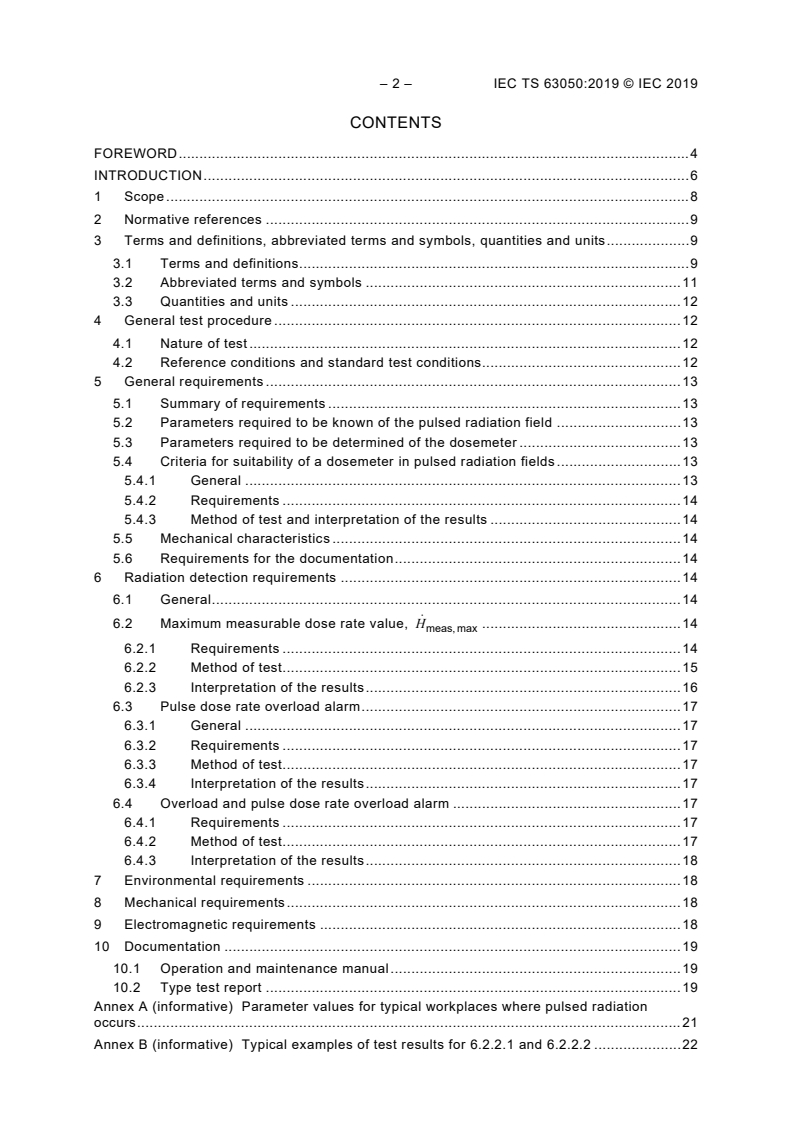
CONTENTS
FOREWORD . 4
INTRODUCTION . 6
1 Scope . 8
2 Normative references . 9
3 Terms and definitions, abbreviated terms and symbols, quantities and units . 9
3.1 Terms and definitions . 9
3.2 Abbreviated terms and symbols . 11
3.3 Quantities and units . 12
4 General test procedure . 12
4.1 Nature of test . 12
4.2 Reference conditions and standard test conditions . 12
5 General requirements . 13
5.1 Summary of requirements . 13
5.2 Parameters required to be known of the pulsed radiation field . 13
5.3 Parameters required to be determined of the dosemeter . 13
5.4 Criteria for suitability of a dosemeter in pulsed radiation fields . 13
5.4.1 General . 13
5.4.2 Requirements . 14
5.4.3 Method of test and interpretation of the results . 14
5.5 Mechanical characteristics . 14
5.6 Requirements for the documentation . 14
6 Radiation detection requirements . 14
6.1 General . 14
6.2 Maximum measurable dose rate value, H . 14
meas, max
6.2.1 Requirements . 14
6.2.2 Method of test. 15
6.2.3 Interpretation of the results . 16
6.3 Pulse dose rate overload alarm . 17
6.3.1 General . 17
6.3.2 Requirements . 17
6.3.3 Method of test. 17
6.3.4 Interpretation of the results . 17
6.4 Overload and pulse dose rate overload alarm . 17
6.4.1 Requirements . 17
6.4.2 Method of test. 17
6.4.3 Interpretation of the results . 18
7 Environmental requirements . 18
8 Mechanical requirements . 18
9 Electromagnetic requirements . 18
10 Documentation . 19
10.1 Operation and maintenance manual . 19
10.2 Type test report . 19
Annex A (informative) Parameter values for typical workplaces where pulsed radiation
occurs . 21
Annex B (informative) Typical examples of test results for 6.2.2.1 and 6.2.2.2 . 22
Bibliography . 23
Figure B.1 – Typical test results for an electronic personal dosemeter using radiation
pulses with constant dose rate and various pulse durations, i.e. varying dose
equivalents per radiation pulse . 22
Figure B.2 – Typical test results for three personal dosemeters using radiation pulses
with constant dose of 1 mSv and various pulse durations, i.e. various pulse dose
equivalent rates . 22
Table 1 – Abbreviated terms and symbols . 12
Table 2 – Reference conditions and standard test conditions for tests using pulsed
radiation . 19
Table 3 – Characteristics of dosemeters used in pulsed fields of ionizing radiation . 20
Table A.1 – Parameter values for workplaces where pulsed radiation occurs . 21
– 4 – IEC TS 63050:2019 © IEC 2019
INTERNATIONAL ELECTROTECHNICAL COMMISSION
____________
RADIATION PROTECTION INSTRUMENTATION – DOSEMETERS
FOR PULSED FIELDS OF IONIZING RADIATION
FOREWORD
1) The International Electrotechnical Commission (IEC) is a worldwide organization for standardization comprising
all national electrotechnical committees (IEC National Committees). The object of IEC is to promote
international co-operation on all questions concerning standardization in the electrical and electronic fields. To
this end and in addition to other activities, IEC publishes International Standards, Technical Specifications,
Technical Reports, Publicly Available Specifications (PAS) and Guides (hereafter referred to as “IEC
Publication(s)”). Their preparation is entrusted to technical committees; any IEC National Committee interested
in the subject dealt with may participate in this preparatory work. International, governmental and non-
governmental organizations liaising with the IEC also participate in this preparation. IEC collaborates closely
with the International Organization for Standardization (ISO) in accordance with conditions determined by
agreement between the two organizations.
2) The formal decisions or agreements of IEC on technical matters express, as nearly as possible, an international
consensus of opinion on the relevant subjects since each technical committee has representation from all
interested IEC National Committees.
3) IEC Publications have the form of recommendations for international use and are accepted by IEC National
Committees in that sense. While all reasonable efforts are made to ensure that the technical content of IEC
Publications is accurate, IEC cannot be held responsible for the way in which they are used or for any
misinterpretation by any end user.
4) In order to promote international uniformity, IEC National Committees undertake to apply IEC Publications
transparently to the maximum extent possible in their national and regional publications. Any divergence
between any IEC Publication and the corresponding national or regional publication shall be clearly indicated in
the latter.
5) IEC itself does not provide any attestation of conformity. Independent certification bodies provide conformity
assessment services and, in some areas, access to IEC marks of conformity. IEC is not responsible for any
services carried out by independent certification bodies.
6) All users should ensure that they have the latest edition of this publication.
7) No liability shall attach to IEC or its directors, employees, servants or agents including individual experts and
members of its technical committees and IEC National Committees for any personal injury, property damage or
other damage of any nature whatsoever, whether direct or indirect, or for costs (including legal fees) and
expenses arising out of the publication, use of, or reliance upon, this IEC Publication or any other IEC
Publications.
8) Attention is drawn to the Normative references cited in this publication. Use of the referenced publications is
indispensable for the correct application of this publication.
9) Attention is drawn to the possibility that some of the elements of this IEC Publication may be the subject of
patent rights. IEC shall not be held responsible for identifying any or all such patent rights.
The main task of IEC technical committees is to prepare International Standards. In
exceptional circumstances, a technical committee may propose the publication of a Technical
Specification when
• the required support cannot be obtained for the publication of an International Standard,
despite repeated efforts, or
• the subject is still under technical development or where, for any other reason, there is the
future but no immediate possibility of an agreement on an International Standard.
Technical Specifications are subject to review within three years of publication to decide
whether they can be transformed into International Standards.
IEC 63050, which is a technical specification, has been prepared by subcommittee 45B:
Radiation protection instrumentation, of IEC technical committee 45: Nuclear instrumentation.
The text of this Technical Specification is based on the following documents:
Draft TS Report on voting
45B/903/DTS 45B/925A/RVDTS
Full information on the voting for the approval of this Technical Specification can be found in
the report on voting indicated in the above table.
This document has been drafted in accordance with the ISO/IEC Directives, Part 2.
The committee has decided that the contents of this document will remain unchanged until the
stability date indicated on the IEC website under "http://webstore.iec.ch" in the data related to
the specific document. At this date, the document will be
• reconfirmed,
• withdrawn,
• replaced by a revised edition, or
• amended.
A bilingual version of this publication may be issued at a later date.
IMPORTANT – The 'colour inside' logo on the cover page of this publication indicates
that it contains colours which are considered to be useful for the correct
understanding of its contents. Users should therefore print this document using a
colour printer.
– 6 – IEC TS 63050:2019 © IEC 2019
INTRODUCTION
The specification and determination of the special characteristics required for dosemeters to
be used in pulsed fields of ionizing radiation have been excluded from all standards for direct
reading personal and environmental dosemeters issued before 2015 for radiation protection
purposes. These standards only specify characteristics for continuous radiation. This Techni-
cal Specification provides the necessary information for the measurement of one single radia-
tion pulse, which is the most difficult situation to be measured. The characteristics of a dose-
meter for repeated pulses is expected to be better than for one single radiation pulse with the
same parameters but worse than for continuous radiation, i.e., in between of the characteris-
tics for these two extreme conditions.
The concept is similar to the concept used for other influence quantities, e.g., radiation
energy. The workplace is characterized by the parameter range occurring at that workplace,
i.e., in the case of energy the expected possible values of radiation energy. It can then be
determined if the dosemeter under consideration can be used. The required parameters for a
workplace where pulsed radiation occurs are:
– the maximum dose rate during the radiation pulse, H , occurring at the workplace,
pulse,max
– the maximum dose per radiation pulse, H , occurring at the workplace,
pulse,max
– the minimum radiation pulse duration, t , occurring at the workplace, and
pulse,min
– the range of the pulse repetition frequency, f , occurring at the workplace.
pulse
The instrument parameters to be determined during type test of the dosemeter are:
– the maximum measurable dose rate in the pulse, H ,
meas,max
– the maximum measurable dose in the pulse, H ,
meas,max
– the minimal pulse duration, t , and
meas,min
– the range for the pulse repetition frequency, f to f .
meas,min meas,max
NOTE These parameters may be inter-related depending on the detector used.
In principle, the parameters resulting from the type test could be determined using continuous
radiation fields if the detector is connected to simple, linear and straight forward electronics.
But nearly any dosemeter exhibits one or more of the following properties. It:
– has a finite dead time,
– uses internal range switching,
– uses software to correct for known deficiencies, e.g., the dead time or the radiation
energy,
– uses special, proprietary algorithms,
– adjusts the measurement cycle time, T , to the dose rate, G , measured by the
cycle dose
dosemeter,
– mitigates the effect of EMC-pulses and mechanical drops.
All these properties could affect the results when determining the characteristics for pulsed
radiation fields by using continuous radiation fields. The conclusion is that measurements
using pulsed radiation fields are required for testing of dosemeters.
As a help to the user to judge whether or not the dosemeter under consideration can be used,
Table A.1 in the informative Annex A gives some parameter values for typical workplaces
where pulsed radiation occurs. They are based on the knowledge available in 2019 and may
change with the next generation of pulsed radiation generating equipment.
This Technical Specification is a generalized version of IEC TS 62743 and not limited to
dosemeters using pulse counting techniques. This Technical Specification might replace IEC
TS 62743 in the future. This Technical Specification contains much information for which
worldwide experience is not available at the date of its development. Therefore, it was
decided to publish it as a Technical Specification. It is expected that within the next years this
experience will be gained and then maintenance of this publication could lead to an
International Standard.
– 8 – IEC TS 63050:2019 © IEC 2019
RADIATION PROTECTION INSTRUMENTATION – DOSEMETERS
FOR PULSED FIELDS OF IONIZING RADIATION
1 Scope
This document applies to all types of dosemeters, irrespective of the type of radiation
intended to be measured. Tests according to this document determine whether a single
radiation pulse can be measured correctly even if the dosemeter is in the internal state
relevant for measuring background or environmental radiation. The characteristics of the
dosemeter for repeated pulses is expected to be better than for one single radiation pulse
with the same parameters but worse than for continuous radiation, i.e., in between of the
characteristics for these two extreme conditions.
The pulsed radiation source is characterized by the parameters:
– the maximum dose rate during the radiation pulse, H , occurring at the workplace,
pulse,max
– the maximum dose per radiation pulse, H , occurring at the workplace,
pulse,max
– the minimum radiation pulse duration, t , occurring at the workplace, and
pulse,min
– the range of the pulse repetition frequency, f , occurring at the workplace.
pulse
Annex A gives some parameter values for typical workplaces where pulsed radiation occurs.
This document considers the pulsation of the radiation field as an additional influence quantity
like particle energy and direction of radiation incidence. Therefore, the tests described are
additional to all the tests in the instrument specific standards.
This document describes methods to determine the following characteristic parameters of the
dosemeters:
– the maximum measurable dose rate in the pulse, H ,
meas,max
– the maximum measurable dose in the pulse, H ,
meas,max
– the minimal pulse duration, t , and
meas,min
– the range for the pulse repetition frequency, f to f .
meas,min meas,max
NOTE These parameters may be inter-related depending on the detector used.
It is applicable to photon radiation but basically can be adapted to all types of radiation for
which a suitable pulsed reference field is available. The term dose is used in this document in
the sense of dose equivalent, but the requirements can also be adapted to air kerma,
exposure or other quantities expressing the amount of radiation.
The parameter pulse repetition frequency, f , is included in the testing procedures, but for
pulse
this inclusion additional work has to be done. Especially, reference fields for radiation
conditions in surrounding fields of accelerators are missing (high pulse repetition frequency,
ultra-short pulses).
2 Normative references
The following documents are referred to in the text in such a way that some or all of their
content constitutes requirements of this document. For dated references, only the edition
cited applies. For undated references, the latest edition of the referenced document (including
any amendments) applies.
IEC 60050-395, International Electrotechnical Vocabulary (IEV) – Part 395: Nuclear
instrumentation – Physical phenomena, basic concepts, instruments, systems, equipment and
detectors
IEC 61267:2005, Medical diagnostic X-ray equipment – Radiation conditions for use in the
determination of characteristics
ISO 4037-3:2019, Radiological protection – X and gamma reference radiation for calibrating
dosemeters and doserate meters and for determining their response as a function of photon
energy – Part 3: Calibration of area and personal dosemeters and the measurement of their
response as a function of energy and angle of incidence
ISO TS 18090-1:2015, Radiological protection – Characteristics of reference pulsed
radiation – Part 1: Photon radiation
3 Terms and definitions, abbreviated terms and symbols, quantities and units
3.1 Terms and definitions
For the purposes of this document, the terms and definitions given in IEC 60050-395,
ISO TS 18090-1 and the following apply.
ISO and IEC maintain terminological databases for use in standardization at the following
addresses:
• IEC Electropedia: available at http://www.electropedia.org/
• ISO Online browsing platform: available at http://www.iso.org/obp
3.1.1
continuous radiation
ionizing radiation with a constant dose rate at a given point in
space for time intervals longer than 10 s
[SOURCE: ISO TS 18090-1:2015, 3.2]
3.1.2
dose equivalent per radiation pulse
H
pulse
dose equivalent value of one radiation pulse at a point in the radiation field
[SOURCE: ISO TS 18090-1:2015, 3.3 modified: The term “photon radiation field” has been
replaced by “radiation field”.]
3.1.3
dose indication
G
dose
indication of the dosemeter in terms of dose
– 10 – IEC TS 63050:2019 © IEC 2019
3.1.4
dose rate indication
G
dose
indication of the dosemeter in terms of dose rate
3.1.5
internal state
soft and hardware parameters set internally (by the dosemeter)
EXAMPLE: When the dosemeter is for a long time span not exposed to any artificial radiation then the sensitivity
and the cycle time are set to the maximum values to indicate the dose value with the highest resolution possible
and to reduce the coefficient of variation of the indication.
3.1.6
maximum measurable dose in the radiation pulse
H
meas, max
maximum value of one radiation pulse dose which can be measured by the dosemeter without
exceeding stated maximum errors
3.1.7
maximum measurable dose rate in the radiation pulse
H
meas, max
maximum value of one radiation pulse dose rate which can be measured by the dosemeter
without exceeding stated maximum errors
3.1.8
maximum radiation pulse dose
H
pulse,max
maximum dose of one radiation pulse occurring at a point in the radiation field
3.1.9
maximum radiation pulse dose rate
H
pulse, max
maximum radiation pulse dose rate occurring at a point in the radiation field
3.1.10
measurement cycle time
T
cycle
time interval required by the counting dosemeter for one sequence of the repeated operations
to determine the actual value of the indication
3.1.11
pulsed radiation
ionizing radiation which never has a constant dose rate at a
given point in space for time intervals longer than 10 s
[SOURCE: ISO TS 18090-1:201
...