

IEC 62065:2014
(Main)Maritime navigation and radiocommunication equipment and systems - Track control systems - Operational and performance requirements, methods of testing and required test results
General Information
- Abstract
IEC 62065:2014 specifies the minimum operational and performance requirements, methods of testing and required test results conforming to performance standards adopted by the IMO in resolution MSC.74(69) Annex 2 Recommendation on Performance Standards for Track Control Systems. In addition, it takes into account IMO resolution A.694(17) to which IEC 60945 is associated. When a requirement of this standard is different from IEC 60945, the requirement in this standard takes precedence. Also it takes into account IMO resolution MSC.302(87) on bridge alert management (BAM). This second edition cancels and replaces the first edition published in 2002 and constitutes a technical revision. This edition includes the following significant technical changes with respect to the previous edition:
- alarms and warnings have been brought into line with the requirements for Bridge Alert Management;
- requirements for the category B system have been revised;
- the parameters of the ship models of Annex I have been adjusted to resemble more Newtonian-like behaviour and the tidal current has been modelled;
- a new Annex K has been added with interface requirements.
- Status
- Published
- Publication Date
- 05-Feb-2014
- Technical Committee
- TC 80 - Maritime navigation and radiocommunication equipment and systems
- Drafting Committee
- MT 4 - TC 80/MT 4
Buy Documents


IEC 62065:2014 - Maritime navigation and radiocommunication equipment and systems - Track control systems - Operational and performance requirements, methods of testing and required test results Released:2/6/2014


IEC 62065:2014 - Maritime navigation and radiocommunication equipment and systems - Track control systems - Operational and performance requirements, methods of testing and required test results Released:2/6/2014
Overview
IEC 62065:2014 (Edition 2.0) is the international performance standard for maritime track control systems - systems that automatically maintain a ship’s route or track. It specifies the minimum operational and performance requirements, the methods of testing, and the required test results adopted by the IMO (see MSC.74(69) Annex 2). This second edition (2014) replaces the 2002 edition and introduces significant technical revisions including alignment of alarms with Bridge Alert Management (BAM), revised Category B system requirements, more Newtonian-like ship models with tidal currents, and a new Annex K covering interface requirements.
Key Topics and Technical Requirements
- Operational requirements: functionality, accuracy, performance constraints, alerts and warnings (now aligned with BAM).
- Performance testing methods: defined test scenarios, ship motion simulator inputs/outputs, environmental tests, and acceptance criteria.
- Ship modelling: Annex I provides standardized ship models and parameters adjusted for realistic (Newtonian-like) behaviour and tidal current modelling.
- Interface and data protocols: Annex K (normative) defines IEC 61162 logical interfaces and sentence sets for integration with bridge systems and sensors.
- Ergonomics and human factors: operational controls, presentation of information, and alert management to support safe bridge operations.
- Fallback and redundancy: requirements for fail-over modes (position, heading, speed sensor failures) and manual changeover procedures.
- Sensor error and noise models: guidance in Annex H to simulate realistic sensor behaviours during testing.
- Documentation and declarations: required technical documentation, test reports, and performance declarations for compliance.
Practical Applications and Who Uses This Standard
IEC 62065 is used for:
- Manufacturers of track control/autopilot systems and integrated navigation systems to design and validate products to IMO-adopted performance standards.
- Test laboratories and certification bodies performing type-approval, factory acceptance tests, and independent verification of performance.
- Shipyards and integrators implementing track control into bridge systems and ensuring proper interfacing (IEC 61162) with GPS, heading and speed sensors.
- Class societies, flag administrations and regulators assessing compliance with IMO resolutions (MSC.74(69), MSC.302(87)) and approving equipment for service.
- Ship operators and system engineers evaluating system behaviour, fallback strategies, and human-machine interfaces to support operational safety.
Related Standards (if applicable)
- IEC 60945 - General maritime navigation equipment requirements (where differences exist, IEC 62065 takes precedence).
- IEC 61162 - Digital interfaces for navigational equipment (referenced in Annex K).
- IMO resolutions MSC.74(69) (Performance Standards for Track Control Systems), MSC.302(87) (Bridge Alert Management), and A.694(17).
Keywords: IEC 62065, track control systems, maritime navigation, performance testing, Bridge Alert Management, IEC 61162, ship models, IMO performance standards.
Relations
- Effective Date
- 05-Sep-2023
- Effective Date
- 05-Sep-2023
Buy Documents
IEC 62065:2014 - Maritime navigation and radiocommunication equipment and systems - Track control systems - Operational and performance requirements, methods of testing and required test results Released:2/6/2014
IEC 62065:2014 - Maritime navigation and radiocommunication equipment and systems - Track control systems - Operational and performance requirements, methods of testing and required test results Released:2/6/2014
Get Certified
Connect with accredited certification bodies for this standard

DNV
DNV is an independent assurance and risk management provider.

Lloyd's Register
Lloyd's Register is a global professional services organisation specialising in engineering and technology.

FSC International
Forest Stewardship Council certification.
Sponsored listings
Frequently Asked Questions
IEC 62065:2014 is a standard published by the International Electrotechnical Commission (IEC). Its full title is "Maritime navigation and radiocommunication equipment and systems - Track control systems - Operational and performance requirements, methods of testing and required test results". This standard covers: IEC 62065:2014 specifies the minimum operational and performance requirements, methods of testing and required test results conforming to performance standards adopted by the IMO in resolution MSC.74(69) Annex 2 Recommendation on Performance Standards for Track Control Systems. In addition, it takes into account IMO resolution A.694(17) to which IEC 60945 is associated. When a requirement of this standard is different from IEC 60945, the requirement in this standard takes precedence. Also it takes into account IMO resolution MSC.302(87) on bridge alert management (BAM). This second edition cancels and replaces the first edition published in 2002 and constitutes a technical revision. This edition includes the following significant technical changes with respect to the previous edition: - alarms and warnings have been brought into line with the requirements for Bridge Alert Management; - requirements for the category B system have been revised; - the parameters of the ship models of Annex I have been adjusted to resemble more Newtonian-like behaviour and the tidal current has been modelled; - a new Annex K has been added with interface requirements.
IEC 62065:2014 specifies the minimum operational and performance requirements, methods of testing and required test results conforming to performance standards adopted by the IMO in resolution MSC.74(69) Annex 2 Recommendation on Performance Standards for Track Control Systems. In addition, it takes into account IMO resolution A.694(17) to which IEC 60945 is associated. When a requirement of this standard is different from IEC 60945, the requirement in this standard takes precedence. Also it takes into account IMO resolution MSC.302(87) on bridge alert management (BAM). This second edition cancels and replaces the first edition published in 2002 and constitutes a technical revision. This edition includes the following significant technical changes with respect to the previous edition: - alarms and warnings have been brought into line with the requirements for Bridge Alert Management; - requirements for the category B system have been revised; - the parameters of the ship models of Annex I have been adjusted to resemble more Newtonian-like behaviour and the tidal current has been modelled; - a new Annex K has been added with interface requirements.
IEC 62065:2014 is classified under the following ICS (International Classification for Standards) categories: 47.020.70 - Navigation and control equipment. The ICS classification helps identify the subject area and facilitates finding related standards.
IEC 62065:2014 has the following relationships with other standards: It is inter standard links to IEC 62065:2002, IEC 62065:2025. Understanding these relationships helps ensure you are using the most current and applicable version of the standard.
IEC 62065:2014 is available in PDF format for immediate download after purchase. The document can be added to your cart and obtained through the secure checkout process. Digital delivery ensures instant access to the complete standard document.
Standards Content (Sample)
IEC 62065 ®
Edition 2.0 2014-02
INTERNATIONAL
STANDARD
colour
inside
Maritime navigation and radiocommunication equipment and systems – Track
control systems – Operational and performance requirements, methods of
testing and required test results
All rights reserved. Unless otherwise specified, no part of this publication may be reproduced or utilized in any form
or by any means, electronic or mechanical, including photocopying and microfilm, without permission in writing from
either IEC or IEC's member National Committee in the country of the requester. If you have any questions about IEC
copyright or have an enquiry about obtaining additional rights to this publication, please contact the address below or
your local IEC member National Committee for further information.
IEC Central Office Tel.: +41 22 919 02 11
3, rue de Varembé Fax: +41 22 919 03 00
CH-1211 Geneva 20 info@iec.ch
Switzerland www.iec.ch
About the IEC
The International Electrotechnical Commission (IEC) is the leading global organization that prepares and publishes
International Standards for all electrical, electronic and related technologies.
About IEC publications
The technical content of IEC publications is kept under constant review by the IEC. Please make sure that you have the
latest edition, a corrigenda or an amendment might have been published.
IEC Catalogue - webstore.iec.ch/catalogue Electropedia - www.electropedia.org
The stand-alone application for consulting the entire The world's leading online dictionary of electronic and
bibliographical information on IEC International Standards, electrical terms containing more than 30 000 terms and
Technical Specifications, Technical Reports and other definitions in English and French, with equivalent terms in 14
documents. Available for PC, Mac OS, Android Tablets and additional languages. Also known as the International
iPad. Electrotechnical Vocabulary (IEV) online.
IEC publications search - www.iec.ch/searchpub IEC Glossary - std.iec.ch/glossary
The advanced search enables to find IEC publications by a More than 55 000 electrotechnical terminology entries in
variety of criteria (reference number, text, technical English and French extracted from the Terms and Definitions
committee,…). It also gives information on projects, replaced clause of IEC publications issued since 2002. Some entries
and withdrawn publications. have been collected from earlier publications of IEC TC 37,
77, 86 and CISPR.
IEC Just Published - webstore.iec.ch/justpublished
Stay up to date on all new IEC publications. Just Published IEC Customer Service Centre - webstore.iec.ch/csc
details all new publications released. Available online and If you wish to give us your feedback on this publication or
also once a month by email. need further assistance, please contact the Customer Service
Centre: csc@iec.ch.
IEC 62065 ®
Edition 2.0 2014-02
INTERNATIONAL
STANDARD
colour
inside
Maritime navigation and radiocommunication equipment and systems – Track
control systems – Operational and performance requirements, methods of
testing and required test results
INTERNATIONAL
ELECTROTECHNICAL
COMMISSION
PRICE CODE
XD
ICS 47.020.70 ISBN 978-2-8322-1381-0
– 2 – 62065 © IEC:2014(E)
CONTENTS
FOREWORD . 5
1 Scope . 7
2 Normative references . 7
3 Terms, definitions and abbreviations . 8
3.1 Terms and definitions . 8
3.2 Abbreviations . 12
4 Application of this standard . 12
5 Requirements . 14
5.1 Operational requirements . 14
5.1.1 Functionality . 14
5.1.2 Accuracy and performance constraint documentation . 17
5.1.3 Alerts . 18
5.2 Ergonomic criteria . 20
5.2.1 Operational controls . 20
5.2.2 Presentation of information . 21
5.3 Design and installation . 21
5.4 Interfacing . 22
5.4.1 Sensors . 22
5.4.2 Status information . 22
5.4.3 Standards . 22
5.5 Fall-back arrangements . 22
5.5.1 Failure of track control . 22
5.5.2 Failure of position sensor . 23
5.5.3 Failure of the heading measuring system . 23
5.5.4 Failure of the speed sensor . 24
6 Test requirements and results . 25
6.1 General . 25
6.2 General requirements . 25
6.2.1 Environmental tests . 25
6.2.2 Documentation . 26
6.2.3 Declarations . 27
6.3 Environment setup . 27
6.3.1 General . 27
6.3.2 Ship motion simulator . 29
6.3.3 Test scenarios . 30
6.3.4 Planning . 30
6.4 Test execution . 31
6.4.1 General . 31
6.4.2 Check the track . 31
6.4.3 Execution of the scenarios . 33
6.4.4 Execution of additional tests . 39
6.4.5 Monitoring and alerts . 41
6.4.6 Fallback and manual change over . 47
6.4.7 Display of information . 50
6.4.8 Operational controls . 50
Annex A (normative) Graphical description of sequences . 51
62065 © IEC:2014(E) – 3 –
Annex B (informative) Speed control . 53
Annex C (informative) Track control systems with dual controllers . 55
Annex D (informative) Management of static and dynamic data. 56
Annex E (informative) Limits . 58
Annex F (informative) Data flow diagram . 59
Annex G (normative) Scenario definitions and plots . 61
Annex H (informative) Sensor errors and noise models . 67
Annex I (normative) Ship model specification . 73
Annex J (informative) Explanation of adaptation tests (6.4.4.1) . 94
Annex K (normative) IEC 61162 interfaces . 97
Bibliography . 100
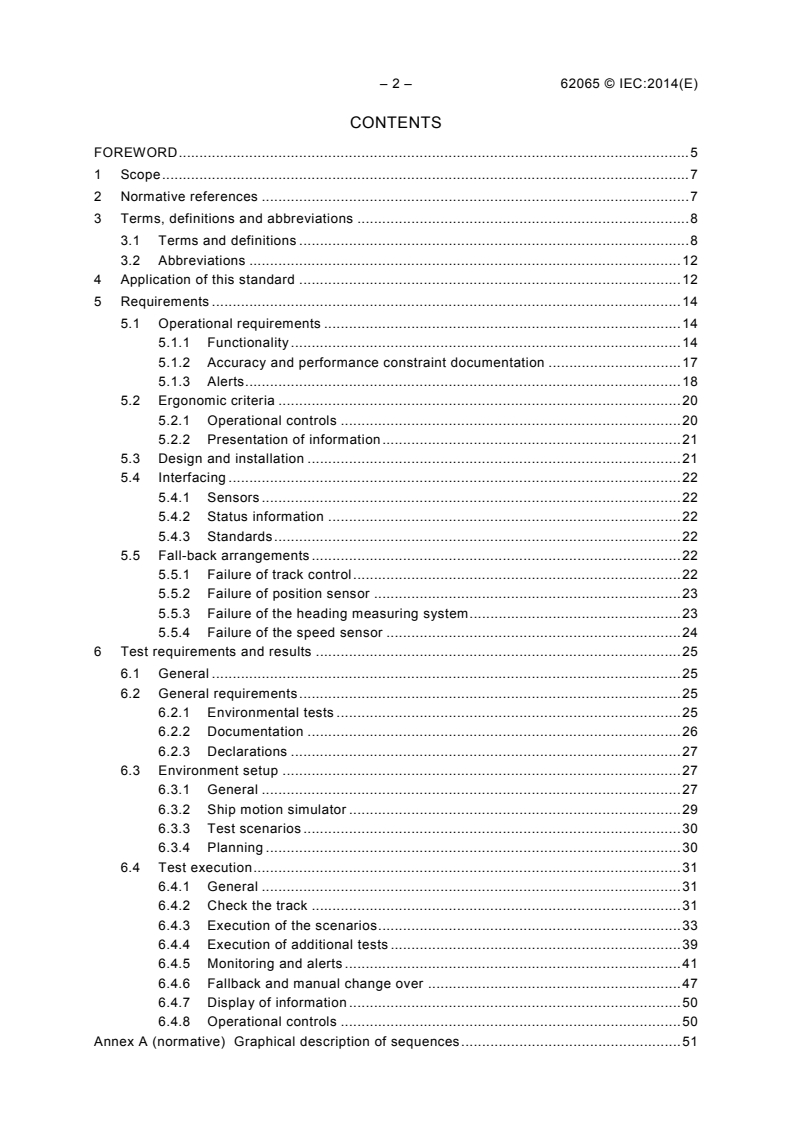
Figure 1 – Functional model of track control as part of an integrated navigation system . 26
Figure 2 – Block diagram . 28
Figure 3 – High level block diagram . 29
Figure A.1 – Sequence of course change alerts (~A) . 51
Figure A.2 – Handling of the Back-up Navigator Alarm (NA) . 52
Figure G.1 – Scenario 1 plot . 62
Figure G.2 – Scenario 2 plot . 63
Figure G.3 – Scenario 3 plot . 64
Figure G.4 – Scenario 4 plot . 66
Figure H.1 – Spectral distribution of modelled GPS errors . 68
Figure H.2 – Wave sequence – sea state 5 . 70
Figure H.3 – Wave spectrum – sea state 5 . 70
Figure H.4 – Supertanker – sea state 5 . 71
Figure H.5 – Container ship – sea state 5 . 71
Figure H.6 – Fast ferry – sea state 5 . 71
Figure H.7 – Container ship – sea state 2 . 72
Figure I.1 – High level model block diagram . 74
Figure I.2 – Model block diagram . 86
Figure I.3 – Application with simple follow-up . 87
Figure I.4 – Control system using actuator outputs and feedback . 87
Figure I.5 – System with actuator mechanism, bypassing the rudder response model . 88
Figure I.6 – System with actuator mechanism using a fast rudder response time in the
model . 88
Figure I.7 – Turning circle manoeuvre – Ferry . 91
Figure I.8 – Turning circle manoeuvre – Container ship . 92
Figure I.9 – Turning circle manoeuvre – Tanker . 93
Figure J.1 – Adaptation to speed change . 94
Figure J.2 – Adaptation to changes along a leg . 95
Figure J.3 – Adaptation to current changes during turn . 95
Figure J.4 – Adaptation to sea state during turn . 96
Figure J.5 – Adaptation to sea state change on a leg . 96
– 4 – 62065 © IEC:2014(E)
Figure K.1 – Track control system logical interfaces . 97
Table 1 – Simulator input rate . 29
Table 2 – Simulator output rate . 30
Table E.1 – Limits . 58
Table G.1 – Scenario 1 . 61
Table G.2 – Scenario 2 . 62
Table G.3 – Scenario 3 . 63
Table G.4 – Scenario 4 . 65
Table H.1 – Heights and periods for half-waves . 69
Table I.1 – Relationship between thrust lever and rudder models . 76
Table I.2 – Constant parameters of the model . 83
Table I.3 – Run-time inputs . 85
Table I.4 – Model outputs . 85
Table I.5 – Parameter sets for three ships . 89
Table I.6 – Results from turning circle manoeuvres . 90
Table K.1 – IEC 61162-1 sentences transmitted by the track control system . 97
Table K.2 – IEC 61162-1 sentences received by the track control system . 98
62065 © IEC:2014(E) – 5 –
INTERNATIONAL ELECTROTECHNICAL COMMISSION
____________
MARITIME NAVIGATION AND
RADIOCOMMUNICATION EQUIPMENT AND SYSTEMS –
TRACK CONTROL SYSTEMS –
Operational and performance requirements,
methods of testing and required test results
FOREWORD
1) The International Electrotechnical Commission (IEC) is a worldwide organization for standardization comprising
all national electrotechnical committees (IEC National Committees). The object of IEC is to promote
international co-operation on all questions concerning standardization in the electrical and electronic fields. To
this end and in addition to other activities, IEC publishes International Standards, Technical Specifications,
Technical Reports, Publicly Available Specifications (PAS) and Guides (hereafter referred to as “IEC
Publication(s)”). Their preparation is entrusted to technical committees; any IEC National Committee interested
in the subject dealt with may participate in this preparatory work. International, governmental and non-
governmental organizations liaising with the IEC also participate in this preparation. IEC collaborates closely
with the International Organization for Standardization (ISO) in accordance with conditions determined by
agreement between the two organizations.
2) The formal decisions or agreements of IEC on technical matters express, as nearly as possible, an international
consensus of opinion on the relevant subjects since each technical committee has representation from all
interested IEC National Committees.
3) IEC Publications have the form of recommendations for international use and are accepted by IEC National
Committees in that sense. While all reasonable efforts are made to ensure that the technical content of IEC
Publications is accurate, IEC cannot be held responsible for the way in which they are used or for any
misinterpretation by any end user.
4) In order to promote international uniformity, IEC National Committees undertake to apply IEC Publications
transparently to the maximum extent possible in their national and regional publications. Any divergence
between any IEC Publication and the corresponding national or regional publication shall be clearly indicated in
the latter.
5) IEC itself does not provide any attestation of conformity. Independent certification bodies provide conformity
assessment services and, in some areas, access to IEC marks of conformity. IEC is not responsible for any
services carried out by independent certification bodies.
6) All users should ensure that they have the latest edition of this publication.
7) No liability shall attach to IEC or its directors, employees, servants or agents including individual experts and
members of its technical committees and IEC National Committees for any personal injury, property damage or
other damage of any nature whatsoever, whether direct or indirect, or for costs (including legal fees) and
expenses arising out of the publication, use of, or reliance upon, this IEC Publication or any other IEC
Publications.
8) Attention is drawn to the Normative references cited in this publication. Use of the referenced publications is
indispensable for the correct application of this publication.
9) Attention is drawn to the possibility that some of the elements of this IEC Publication may be the subject of
patent rights. IEC shall not be held responsible for identifying any or all such patent rights.
International Standard IEC 62065 has been prepared by IEC technical committee 80: Maritime
navigation and radiocommunication equipment and systems.
This second edition cancels and replaces the first edition published in 2002 and constitutes a
technical revision.
This edition includes the following significant technical changes with respect to the previous
edition:
– alarms and warnings have been brought into line with the requirements for Bridge Alert
Management;
– requirements for the category B system have been revised;
– 6 – 62065 © IEC:2014(E)
– the parameters of the ship models of Annex I have been adjusted to resemble more
Newtonian-like behaviour and the tidal current has been modelled;
– a new Annex K has been added with interface requirements.
The text of this standard is based on the following documents:
FDIS Report on voting
80/716/FDIS 80/729/RVD
Full information on the voting for the approval of this standard can be found in the report on
voting indicated in the above table.
This publication has been drafted in accordance with the ISO/IEC Directives, Part 2.
All text of this standard that is identical to that in IMO resolution MSC.74(69), Annex 2, is
printed in italics and the resolution (abbreviated to – A2) and paragraph numbers are
indicated in brackets i.e. (A2/3.3).
The committee has decided that the contents of this publication will remain unchanged until
the stability date indicated on the IEC web site under "http://webstore.iec.ch" in the data
related to the specific publication. At this date, the publication will be
• reconfirmed,
• withdrawn,
• replaced by a revised edition, or
• amended.
A bilingual version of this publication may be issued at a later date.
IMPORTANT – The 'colour inside' logo on the cover page of this publication indicates
that it contains colours which are considered to be useful for the correct
understanding of its contents. Users should therefore print this document using a
colour printer.
62065 © IEC:2014(E) – 7 –
MARITIME NAVIGATION AND
RADIOCOMMUNICATION EQUIPMENT AND SYSTEMS –
TRACK CONTROL SYSTEMS –
Operational and performance requirements,
methods of testing and required test results
1 Scope
This International Standard specifies the minimum operational and performance requirements,
methods of testing and required test results conforming to performance standards adopted by
the IMO in resolution MSC.74(69) Annex 2 Recommendation on Performance Standards for
Track Control Systems. In addition, it takes into account IMO resolution A.694(17) to which
IEC 60945 is associated.
When a requirement of this standard is different from IEC 60945, the requirement in this
standard takes precedence. Also it takes into account IMO resolution MSC.302(87) on bridge
alert management (BAM).
2 Normative references
The following documents, in whole or in part, are normatively referenced in this document and
are indispensable for its application. For dated references, only the edition cited applies. For
undated references, the latest edition of the referenced document (including any
amendments) applies.
IEC 60945, Maritime navigation and radiocommunication equipment and systems – General
requirements – Methods of testing and required test results
IEC 61162 (all parts), Maritime navigation and radiocommunication equipment and systems –
Digital interfaces
IEC 61162-1, Maritime navigation and radiocommunication equipment and systems – Digital
interfaces – Part 1: Single talker and multiple listeners
IEC 61162-2, Maritime navigation and radiocommunication equipment and systems – Digital
interfaces – Part 2: Single talker and multiple listeners, high-speed transmission
IEC 61924-2, Maritime navigation and radiocommunication equipment and systems –
Integrated navigation systems – Part 2: Modular structure for INS – Operational and
performance requirements, methods of testing and required test results
IEC 62288, Maritime navigation and radiocommunication equipment and systems –
Presentation of navigation-related information on shipborne navigational displays – General
requirements, methods of testing and required test results
IEC 62616, Maritime navigation and radiocommunication equipment and systems – Bridge
navigational watch alarm system (BNWAS)
IMO MSC.74(69) Annex 2, Recommendation on Performance Standards for Track Control
Systems
– 8 – 62065 © IEC:2014(E)
IMO resolution A.694(17), General requirements for shipborne radio equipment forming part
of the Global Maritime Distress and Safety System (GMDSS) and for electronic navigational
aids
IMO MSC.302(87), Performance standards for bridge alert management (BAM)
3 Terms, definitions and abbreviations
3.1 Terms and definitions
For the purposes of this standard, the following terms and definitions apply
3.1.1
active track
track activated for track control
3.1.2
alarm
high-priority alert
Note 1 to entry: Condition requiring immediate attention and action by the bridge team, to maintain the safe
navigation of the ship.
3.1.3
alert
announcement of abnormal situations and conditions requiring attention
Note 1 to entry: Alerts are divided in four priorities: emergency alarms, alarms, warnings and cautions.
Note 2 to entry: Alerts are additionally classified in two different categories for navigational purposes: category A
and category B as described in IMO resolution MSC.302(87).
Note 3 to entry: An alert provides information about a defined state change in connection with information about
how to announce this event in a defined way to the system and the operator.
3.1.4
along-track speed control
automatic control of the ship's speed during track control based on a pre-planned track
3.1.5
assisted turn
manoeuvre of a ship automatically controlled by a pre-set radius or rate of turn but not based
on the ship's position to perform an approximation of a curved track
3.1.6
back-up navigator
any individual, generally an officer, who has been designated by the ships master to be on
call if assistance is needed on the bridge
3.1.7
back-up navigator alarm
signal automatically sent from the TCS to call assistance to the bridge when the officer of the
watch fails to acknowledge certain alarms within a defined time period
Note 1 to entry: Note that the back-up navigator alarm does not represent an alarm as defined in 3.1.2.
3.1.8
consistent common reference system
sub-system or function of a TCS for acquisition, processing, storage, surveillance and
distribution of data and information providing identical and obligatory reference to sub-
62065 © IEC:2014(E) – 9 –
systems and subsequent functions within a TCS and to other connected equipment, if
available
3.1.9
course
for marine navigation, horizontal direction in which a vessel is steered or intended to be
steered, expressed as angular distance from north, usually 000° at north, clockwise through
360°
Note 1 to entry: 360° is indicated as 000°.
3.1.10
course difference limit
maximum difference between track course and heading before a warning is activated
3.1.11
cross-track distance
cross-track error
perpendicular distance of a predefined point on the ship from the track including direction
(negative if the ship is left of the intended track)
3.1.12
cross-track limit
maximum cross-track distance before an alarm is activated
3.1.13
curved track
non-straight track between two legs
3.1.14
fall-back arrangements
automatic reaction of the TCS by using data, function or hardware of degraded quality in
relation to the failed one
EXAMPLE Dead reckoning for position information, heading control in case of a failure of track control.
3.1.15
FROM-waypoint
last passed waypoint
3.1.16
great circle sailing
sailing on the intersection of the earth surface and a plane containing the points A, B and the
centre of the sphere
3.1.17
heading
horizontal direction in which a ship actually points or heads at any instant, expressed in
angular units from a reference direction, usually from 000° at the reference direction
clockwise through 360°
Note 1 to entry: 360° is indicated as 000°.
3.1.18
heading control
control of the ship's heading
– 10 – 62065 © IEC:2014(E)
3.1.19
heading monitor function
monitoring of the actual heading sensor by an independent second source
3.1.20
leg
straight line between two waypoints and/or curved track(s)
3.1.21
main conning position
place on the bridge with a commanding view providing the necessary information and
equipment for the conning officer to carry out his functions
3.1.22
minimum manoeuvring speed for track control
lowest fore/aft speed through the water at which the track control system is capable of
maintaining its performance within the specified accuracy limits
Note 1 to entry: The value depends on the ship's design and loading and on the present environmental
conditions.
3.1.23
NEXT-waypoint
waypoint following the TO-waypoint
3.1.24
override facility
control to perform the override function
3.1.25
override function
intentional fast change-over from automatic to temporary manual control
3.1.26
position monitor function
monitoring of the actual position sensor by an independent second source
3.1.27
primary position-fixing system
electronic position-fixing system (EPFS) used for track control and approved by the
International Maritime Organization (see 5.1.1.3)
3.1.28
radius of turn
radius of a curved track
3.1.29
rate of turn
change of heading per time unit
3.1.30
rhumb line sailing
sailing on a line on the surface of the earth making the same angle with each meridian
crossed
3.1.31
ship manoeuvring characteristics
range-of-manoeuvre possible for the ship
62065 © IEC:2014(E) – 11 –
Note 1 to entry: Examples of the range-of-manouvres are: maximum rate of turn, minimum radius of turn,
maximum turn acceleration and deceleration.
3.1.32
single operator action
procedure achieved by no more than one hard-key or soft-key action, excluding any
necessary cursor movements, or voice actuation using programmed codes
3.1.33
speed
absolute value of velocity
Note 1 to entry: May either be the ship's speed through the water, or the speed made good over the ground.
3.1.34
steering mode selector
switch provided for the selection of manual steering modes and automatic steering devices
3.1.35
surge
forward component of ship motion
3.1.36
sway
athwartships component of ship motion (positive to starboard)
3.1.37
temporary track
track that originates at the current position of the ship and joins the pre-planned track
Note 1 to entry: The temporary track may include temporary waypoints which can be identified as different from
the waypoints of the pre-planned track.
3.1.38
TO-waypoint
waypoint which the ship is approaching
3.1.39
track
path to be followed over ground
3.1.40
track control
control of the ship's movement along a track, where corrections made by the controller to
compensate for wind, drift and other influences, are based on the cross-track error and not
only on the bearing to the destination waypoint (TO-waypoint)
3.1.41
track course
direction from one waypoint to the next, a constant course on a rhumb line track and a varying
course on a Great Circle track
3.1.42
warning
alert for condition requiring immediate attention, but no immediate action by the bridge team
Note 1 to entry: Warnings are presented for precautionary reasons to make the bridge team aware of changed
conditions which are not immediately hazardous, but may become so if no action is taken.
– 12 – 62065 © IEC:2014(E)
3.1.43
waypoint
geographic position together with its associated data
3.1.44
wheel-over-line
WOL
line where the ship has to initiate a curved track to eliminate the effect of any offset with
respect to the new course, taking into consideration the distance required for the ship to build
up the necessary rate of turn
3.1.45
wheel-over-time
WOT
point in time when the track control system initiates the planned course change
3.1.46
yaw
rate of turn (positive to starboard)
3.2 Abbreviations
~A Not applicable for category A systems
ACCA Actual course change alarm
ACCW Actual course change warning
BAM Bridge alert management
CCRP Consistent common reference point
CCRS Consistent common reference system
COG Course over ground
DGPS Differential GPS
DR Dead reckoning
ECCA Early course change alarm
ECCW Early course change warning
ENC Electronic navigational chart
EPFS Electronic position fixing system
EUT Equipment under test
GC Great circle
GPS Global positioning system
INS Integrated navigation system
NA (Back up) Navigator alarm
RL Rhumb line
ROT Rate-of-turn
SDME Speed and distance measuring equipment
SWH Significant wave height
TCS Track control system
WOL Wheel-over-line
WOT Wheel-over-time
4 Application of this standard
The application of this standard is as follows.
62065 © IEC:2014(E) – 13 –
a) (A2/1) Track control systems in conjunction with their sources of position, heading and
speed information are intended to keep a ship automatically on a pre-planned track over
ground under various conditions and within the limits related to the ship's manoeuvrability.
A track control system may additionally include or be combined with
– heading control;
– along-track speed control (see Annex B).
b) Planning the track by waypoints may be performed
– as part of the track control system, or
– by importing waypoint or track data.
c) The track control system shall ensure the integrity of the geodetic datum, the ship
manoeuvring characteristics and the curved tracks of the imported data.
d) This standard applies for track control systems which can exchange data with a heading
sensor, speed sensor, EPFS and/or heading controller but excludes waypoint data
exchange.
e) If a track control system automatically receives additional data, including waypoints, from
other navigational aids, the requirements of IEC 61924-2 for this data exchange shall also
apply.
f) If a track control system is integrated into an INS, the corresponding requirements of INS
(as defined in IEC 61924-2) shall apply, for example concerning
– route planning by waypoints,
– data transfer of safety-checked waypoints and
– monitoring of navigational safety for example by charts.
g) Track control does not necessarily require that ENC or other geographic data such as
shallow area information be taken into consideration by the track control system.
h) (A2/2.1) These IMO Performance Standards are applicable for track control systems
working
– at ship's speed from minimum manoeuvring speed up to 30 kn; and
– at ship's maximum rate of turn not greater than 10°/s.
i) These performance standards do not apply to High Speed Craft as defined by SOLAS
chapter 10.
j) (A2/2.2)Track control systems fitted on ships shall meet all requirements of the IMO
Performance Standards (MSC.74(69) Annex 2 Recommendation on Performance
Standards for Track Control Systems) relating to straight tracks.
k) Systems fitted on ships requiring curved track control shall additionally meet all the
requirements relating to curved tracks (category C).
l) This standard applies to three categories of track control systems:
Category A: Single leg track control or multiple leg track control without assisted turns
between legs;
Category B: Multiple leg track control with assisted turns between legs;
Category C: Full track control on legs and turns.
Some requirements contained in this clause cannot be verified by objective measurements.
The manufacturer shall declare that compliance to these requirements is achieved and shall
provide relevant documentation. The declaration(s), documentation and, where necessary, the
equipment shall be checked. The manufacturer shall also declare the general hardware and
functional composition of the equipment and the relevant category of IEC 60945 for each unit.
– 14 – 62065 © IEC:2014(E)
5 Requirements
5.1 Operational requirements
5.1.1 Functionality
5.1.1.1 Track control steering modes
(See 6.4.3.2)
(A2/5.1.1) A track control system shall be able to steer the ship from its position
.1 to a single waypoint; or
.2 along a track containing a sequence of waypoints
using rhumb line or great circle sailing.
5.1.1.2 Starting requirements
(See 6.4.2.1, 6.4.2.2, 6.4.2.3, 6.4.2.4, 6.4.3.1)
(A2/5.1.2) The system shall allow the officer of the watch (user) to start or restart track
control only if
– the required position, heading and speed sensor data are valid and selected.
– the pre-planned track has been checked for plausibility and correctness of geometric and
ship-dependent limits (see Annex E) before becoming the active track
and if
– the ship's position relative to the selected track,
– the difference between track course and actual heading,
– the ship's manoeuvrability
will result in a safe approach manoeuvre to the track. A safe approach manoeuvre is a
planned manoeuvre which is within the manoeuvring characteristics of the vessel and which
does not result in an unexpected turning direction.
For this purpose, the system shall allow the user at least one of the following options:
a) to select the TO-waypoint or a leg on a pre-planned track and to select the maximum
allowable difference between the bearing to the TO-waypoint and the actual heading;
or
b) to define a temporary track to go to the pre-planned track. The temporary track shall meet
all ship manoeuvring characteristics which apply to a pre-planned track (~A).
5.1.1.3 Primary position-fixing system
(See 6.2.2.2)
(A2/5.1.3) The primary position-fixing system used for track control shall be an electronic
position-fixing system (EPFS) approved by the International Maritime Organization.
5.1.1.4 Position monitoring
(See 6.4.5.3)
(A2/5.1.4) The ship's position shall be continuously monitored by a second or additional
independent position source. If the ship is fitted with a second EPFS and position is available
from this EPFS its position shall be used for position monitoring. Otherwise, estimated
position by dead reckoning (DR) as a minimum shall be used as the second position source
for position monitoring. The DR position shall be derived from a shipborne heading sensor
62065 © IEC:2014(E) – 15 –
and a speed and distance measuring equipment (SDME). Means shall be provided to adapt
the acceptable deviation to the required steering accuracy. This monitoring need not be an
integral part of the track control system.
5.1.1.5 Early course change warning (~A)
(See 6.4.5.12)
A graphical description of the sequences described here is given in Annex A Figure A.1.
(A2/5.1.5) In the case of track control by a sequence of waypoints, an 'early course change
warning' shall be given up to 6 min, and no later than 3 min, before the wheel-over time.
If the early course change warning is not acknowledged within 30 s, at the latest 2 min 30 s
before the wheel-over-time, the alert priority shall change from warning to alarm.
The early course change alarm is defined to be associated with NA activation (see 5.1.3.11).
5.1.1.6 Actual course change warning (~A)
(See 6.4.5.12)
A graphical description of the sequences described here is given in Annex A Figure A.1.
(A2/5.1.6.1) In the case of track control by a sequence of waypoints an actual course
change warning shall be given 30 s before the wheel-over time.
If the actual course change warning is not confirmed/acknowledged by the officer of the watch
(user) within 30 s the alert priority shall change from warning to alarm.
NOTE This warning is superfluous, if the NA from the unacknowledged early course change alarm is already
active.
(A2/5.1.6.2) The system shall provide means for the officer of the watch (user) to
confirm/acknowledge the actual course change alerts.
(A2/5.1.6.3) With or without the confirmation/acknowledgement, the ship shall follow
automatically the track.
(A2/5.1.6.4) If the actual course change alarm is not confirmed/acknowledged by the officer
of the watch (user) within 30 s of wheel-over a back-up navigator alarm shall be given as fully
described in 5.1.3.11.
5.1.1.7 Change of waypoints
(See 6.4.2.2, 6.4.2.3, 6.4.2.4, 6.4.2.5, 6.4.3.1.6, 6.4.3.1.8, 6.4.3.1.9)
(A2/5.1.7) In the case of track control by a pre-planned sequence of waypoints, it shall not
be possible to modify the TO-waypoint, the FROM-waypoint and (~A) the NEXT-waypoint of
the active track and their relevant associated waypoint data while in the track control mode
without creating a new track and until:
a) the pre-planning of the new track is completed;
and
b) the starting requirements (5.1.1.2) are fulfilled.
5.1.1.8 Turn performance (~A)
(See 6.4.3.2)
– 16 – 62065 © IEC:2014(E)
(A2/5.1.8) The track control shall enable the ship to sail from one leg to another by turns
based:
a) on a preset radius of turn;
or
b) on a radius calculated on the base of a preset rate of turn and the planned speed;
and
within the turning capability of the ship.
The planned track shall be checked for plausibility and correctness of geometry and of ship-
dependent limits before becoming the active track.
5.1.1.9 Adaptation to steering characteristics
(See 6.4.4.1, 6.4.4.3)
(A2/5.1.9) The track control shall be capable of manual or automatic adjustment to different
steering characteristics of the ship under various weather, speed and loading conditions.
5.1.1.10 Permitted tolerance
(See 6.4.4.2)
(A2/5.1.10) Means shall be incorporated to prevent unnecessary activation of the rudder due
to normal yaw or sway motion, sensor data resolution and statistically scattered position
errors.
The quality of the track control shall be so that overshoot, oscillation and constant track
deviation are within tolerable limits both for straight and curved tracks.
Category B TCS shall comply with the requirements for curved track TCS, except that, after
having passed the wheel-over, the actual cross-track distance is merely used for monitoring
until completion of the automatic course change manoeuvre. Manual or automatic means shall
be provided to adapt to variable drift and speed changes during a turn (e.g. facilitating manual
adjustments of rate of turn or radius of turn).
5.1.1.11 Override function
(See 6.4.6.5, 6.4.8)
(A2/5.1.11) A track control system shall be able to accept a signal from the override facilities
to terminate track control mode and switch to these override facilities. After change-over to
override, return to track control shall require user intervention (see 5.1.1.2).
5.1.1.12 Heading control mode
(A2/5.1.12) A track control system may be operated in heading control mode. In this case,
the performance standards of heading control systems are to be applied.
NOTE The IMO performance standards for heading control are given in IMO resolution MSC.64(67) annex 3 and
these are incorporated into ISO 11674.
5.1.1.13 Manual change over from track control to manual steering
(See 6.4.6.5)
(A2/5.1.13.1) Change over from track control to manual steering shall be possible at any
rudder angle.
62065 © IEC:2014(E) – 17 –
(A2/5.1.13.2) Change over from track control to manual steering shall be possible under any
conditions, including any failure in the track control system.
(A2/5.1.13.3) After change over to manual control, return to automatic control shall require
operator (user) intervention.
5.1.1.14 Manual change over from track control to heading control
(See 6.4.6.6)
This subclause only applies if the heading control is included in the track control system.
(A2/5.1.14.1) Any change over from track control to heading control shall be possible under
all conditions of normal operation.
(A2/5.1.14.2) To maintain the course, the heading control system
...
IEC 62065 ®
Edition 2.0 2014-02
INTERNATIONAL
STANDARD
NORME
INTERNATIONALE
colour
inside
Maritime navigation and radiocommunication equipment and systems – Track
control systems – Operational and performance requirements, methods of
testing and required test results
Matériels et systèmes de navigation et de radiocommunication maritimes –
Systèmes de contrôle de route – Exigences opérationnelles et de
fonctionnement, méthodes d'essai et résultats exigibles
All rights reserved. Unless otherwise specified, no part of this publication may be reproduced or utilized in any form
or by any means, electronic or mechanical, including photocopying and microfilm, without permission in writing from
either IEC or IEC's member National Committee in the country of the requester. If you have any questions about IEC
copyright or have an enquiry about obtaining additional rights to this publication, please contact the address below or
your local IEC member National Committee for further information.
Droits de reproduction réservés. Sauf indication contraire, aucune partie de cette publication ne peut être reproduite
ni utilisée sous quelque forme que ce soit et par aucun procédé, électronique ou mécanique, y compris la photocopie
et les microfilms, sans l'accord écrit de l'IEC ou du Comité national de l'IEC du pays du demandeur. Si vous avez des
questions sur le copyright de l'IEC ou si vous désirez obtenir des droits supplémentaires sur cette publication, utilisez
les coordonnées ci-après ou contactez le Comité national de l'IEC de votre pays de résidence.
IEC Central Office Tel.: +41 22 919 02 11
3, rue de Varembé Fax: +41 22 919 03 00
CH-1211 Geneva 20 info@iec.ch
Switzerland www.iec.ch
About the IEC
The International Electrotechnical Commission (IEC) is the leading global organization that prepares and publishes
International Standards for all electrical, electronic and related technologies.
About IEC publications
The technical content of IEC publications is kept under constant review by the IEC. Please make sure that you have the
latest edition, a corrigenda or an amendment might have been published.
IEC Catalogue - webstore.iec.ch/catalogue Electropedia - www.electropedia.org
The stand-alone application for consulting the entire The world's leading online dictionary of electronic and
bibliographical information on IEC International Standards, electrical terms containing 20 000 terms and definitions in
Technical Specifications, Technical Reports and other English and French, with equivalent terms in 16 additional
documents. Available for PC, Mac OS, Android Tablets and languages. Also known as the International Electrotechnical
iPad. Vocabulary (IEV) online.
IEC publications search - www.iec.ch/searchpub IEC Glossary - std.iec.ch/glossary
The advanced search enables to find IEC publications by a 65 000 electrotechnical terminology entries in English and
variety of criteria (reference number, text, technical French extracted from the Terms and Definitions clause of
committee,…). It also gives information on projects, replaced IEC publications issued since 2002. Some entries have been
and withdrawn publications. collected from earlier publications of IEC TC 37, 77, 86 and
CISPR.
IEC Just Published - webstore.iec.ch/justpublished
Stay up to date on all new IEC publications. Just Published IEC Customer Service Centre - webstore.iec.ch/csc
details all new publications released. Available online and If you wish to give us your feedback on this publication or
also once a month by email. need further assistance, please contact the Customer Service
Centre: csc@iec.ch.
A propos de l'IEC
La Commission Electrotechnique Internationale (IEC) est la première organisation mondiale qui élabore et publie des
Normes internationales pour tout ce qui a trait à l'électricité, à l'électronique et aux technologies apparentées.
A propos des publications IEC
Le contenu technique des publications IEC est constamment revu. Veuillez vous assurer que vous possédez l’édition la
plus récente, un corrigendum ou amendement peut avoir été publié.
Catalogue IEC - webstore.iec.ch/catalogue Electropedia - www.electropedia.org
Application autonome pour consulter tous les renseignements
Le premier dictionnaire en ligne de termes électroniques et
bibliographiques sur les Normes internationales,
électriques. Il contient 20 000 termes et définitions en anglais
Spécifications techniques, Rapports techniques et autres
et en français, ainsi que les termes équivalents dans 16
documents de l'IEC. Disponible pour PC, Mac OS, tablettes
langues additionnelles. Egalement appelé Vocabulaire
Android et iPad.
Electrotechnique International (IEV) en ligne.
Recherche de publications IEC - www.iec.ch/searchpub
Glossaire IEC - std.iec.ch/glossary
65 000 entrées terminologiques électrotechniques, en anglais
La recherche avancée permet de trouver des publications IEC
en utilisant différents critères (numéro de référence, texte, et en français, extraites des articles Termes et Définitions des
comité d’études,…). Elle donne aussi des informations sur les publications IEC parues depuis 2002. Plus certaines entrées
projets et les publications remplacées ou retirées. antérieures extraites des publications des CE 37, 77, 86 et
CISPR de l'IEC.
IEC Just Published - webstore.iec.ch/justpublished
Service Clients - webstore.iec.ch/csc
Restez informé sur les nouvelles publications IEC. Just
Published détaille les nouvelles publications parues. Si vous désirez nous donner des commentaires sur cette
Disponible en ligne et aussi une fois par mois par email. publication ou si vous avez des questions contactez-nous:
csc@iec.ch.
IEC 62065 ®
Edition 2.0 2014-02
INTERNATIONAL
STANDARD
NORME
INTERNATIONALE
colour
inside
Maritime navigation and radiocommunication equipment and systems – Track
control systems – Operational and performance requirements, methods of
testing and required test results
Matériels et systèmes de navigation et de radiocommunication maritimes –
Systèmes de contrôle de route – Exigences opérationnelles et de
fonctionnement, méthodes d'essai et résultats exigibles
INTERNATIONAL
ELECTROTECHNICAL
COMMISSION
COMMISSION
ELECTROTECHNIQUE
INTERNATIONALE
ICS 47.020.70 ISBN 978-2-8322-4858-4
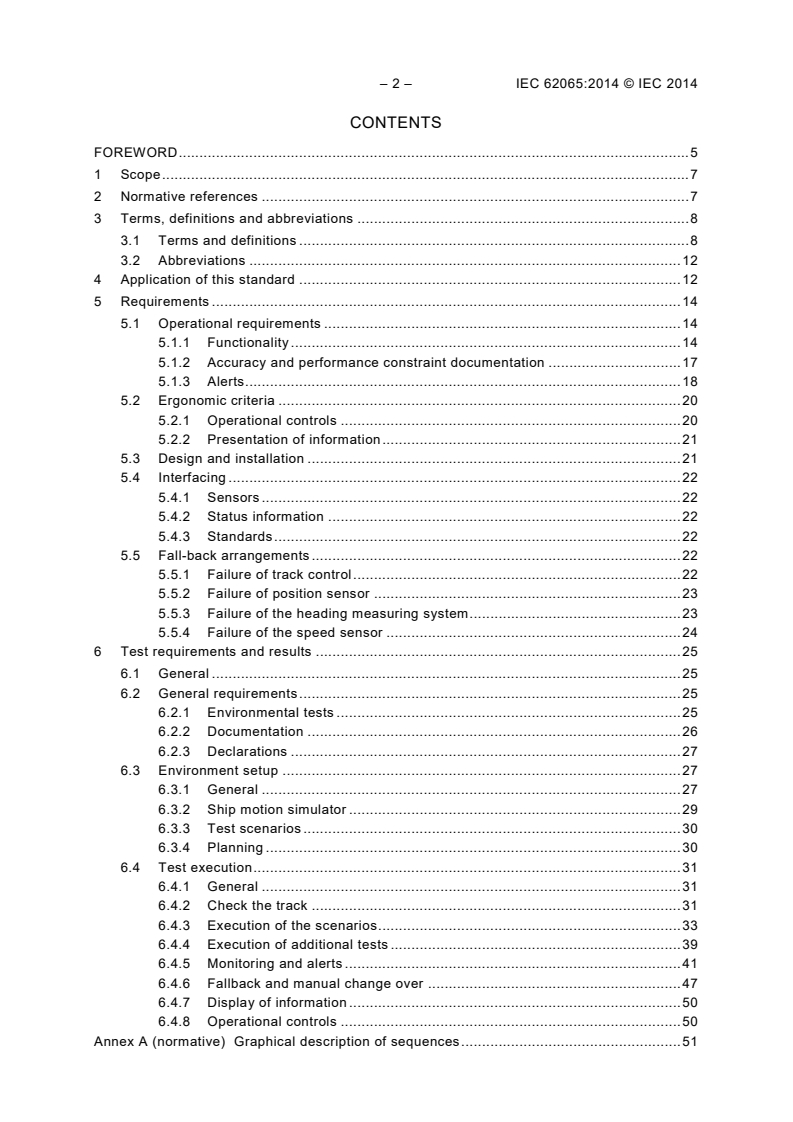
– 2 – IEC 62065:2014 © IEC 2014
CONTENTS
FOREWORD . 5
1 Scope . 7
2 Normative references . 7
3 Terms, definitions and abbreviations . 8
3.1 Terms and definitions . 8
3.2 Abbreviations . 12
4 Application of this standard . 12
5 Requirements . 14
5.1 Operational requirements . 14
5.1.1 Functionality . 14
5.1.2 Accuracy and performance constraint documentation . 17
5.1.3 Alerts . 18
5.2 Ergonomic criteria . 20
5.2.1 Operational controls . 20
5.2.2 Presentation of information . 21
5.3 Design and installation . 21
5.4 Interfacing . 22
5.4.1 Sensors . 22
5.4.2 Status information . 22
5.4.3 Standards . 22
5.5 Fall-back arrangements . 22
5.5.1 Failure of track control . 22
5.5.2 Failure of position sensor . 23
5.5.3 Failure of the heading measuring system . 23
5.5.4 Failure of the speed sensor . 24
6 Test requirements and results . 25
6.1 General . 25
6.2 General requirements . 25
6.2.1 Environmental tests . 25
6.2.2 Documentation . 26
6.2.3 Declarations . 27
6.3 Environment setup . 27
6.3.1 General . 27
6.3.2 Ship motion simulator . 29
6.3.3 Test scenarios . 30
6.3.4 Planning . 30
6.4 Test execution . 31
6.4.1 General . 31
6.4.2 Check the track . 31
6.4.3 Execution of the scenarios . 33
6.4.4 Execution of additional tests . 39
6.4.5 Monitoring and alerts . 41
6.4.6 Fallback and manual change over . 47
6.4.7 Display of information . 50
6.4.8 Operational controls . 50
Annex A (normative) Graphical description of sequences . 51
Annex B (informative) Speed control . 53
Annex C (informative) Track control systems with dual controllers . 55
Annex D (informative) Management of static and dynamic data. 56
Annex E (informative) Limits . 58
Annex F (informative) Data flow diagram . 59
Annex G (normative) Scenario definitions and plots . 61
Annex H (informative) Sensor errors and noise models . 67
Annex I (normative) Ship model specification . 73
Annex J (informative) Explanation of adaptation tests (6.4.4.1) . 94
Annex K (normative) IEC 61162 interfaces . 97
Bibliography . 100
Figure 1 – Functional model of track control as part of an integrated navigation system . 26
Figure 2 – Block diagram . 28
Figure 3 – High level block diagram . 29
Figure A.1 – Sequence of course change alerts (~A) . 51
Figure A.2 – Handling of the Back-up Navigator Alarm (NA) . 52
Figure G.1 – Scenario 1 plot . 62
Figure G.2 – Scenario 2 plot . 63
Figure G.3 – Scenario 3 plot . 64
Figure G.4 – Scenario 4 plot . 66
Figure H.1 – Spectral distribution of modelled GPS errors . 68
Figure H.2 – Wave sequence – sea state 5 . 70
Figure H.3 – Wave spectrum – sea state 5 . 70
Figure H.4 – Supertanker – sea state 5 . 71
Figure H.5 – Container ship – sea state 5 . 71
Figure H.6 – Fast ferry – sea state 5 . 71
Figure H.7 – Container ship – sea state 2 . 72
Figure I.1 – High level model block diagram . 74
Figure I.2 – Model block diagram . 86
Figure I.3 – Application with simple follow-up . 87
Figure I.4 – Control system using actuator outputs and feedback . 87
Figure I.5 – System with actuator mechanism, bypassing the rudder response model . 88
Figure I.6 – System with actuator mechanism using a fast rudder response time in the
model . 88
Figure I.7 – Turning circle manoeuvre – Ferry . 91
Figure I.8 – Turning circle manoeuvre – Container ship . 92
Figure I.9 – Turning circle manoeuvre – Tanker . 93
Figure J.1 – Adaptation to speed change . 94
Figure J.2 – Adaptation to changes along a leg . 95
Figure J.3 – Adaptation to current changes during turn . 95
Figure J.4 – Adaptation to sea state during turn . 96
Figure J.5 – Adaptation to sea state change on a leg . 96
– 4 – IEC 62065:2014 © IEC 2014
Figure K.1 – Track control system logical interfaces . 97
Table 1 – Simulator input rate . 29
Table 2 – Simulator output rate . 30
Table E.1 – Limits . 58
Table G.1 – Scenario 1 . 61
Table G.2 – Scenario 2 . 62
Table G.3 – Scenario 3 . 63
Table G.4 – Scenario 4 . 65
Table H.1 – Heights and periods for half-waves . 69
Table I.1 – Relationship between thrust lever and rudder models . 76
Table I.2 – Constant parameters of the model . 83
Table I.3 – Run-time inputs . 85
Table I.4 – Model outputs . 85
Table I.5 – Parameter sets for three ships . 89
Table I.6 – Results from turning circle manoeuvres . 90
Table K.1 – IEC 61162-1 sentences transmitted by the track control system . 97
Table K.2 – IEC 61162-1 sentences received by the track control system . 98
INTERNATIONAL ELECTROTECHNICAL COMMISSION
____________
MARITIME NAVIGATION AND
RADIOCOMMUNICATION EQUIPMENT AND SYSTEMS –
TRACK CONTROL SYSTEMS –
Operational and performance requirements,
methods of testing and required test results
FOREWORD
1) The International Electrotechnical Commission (IEC) is a worldwide organization for standardization comprising
all national electrotechnical committees (IEC National Committees). The object of IEC is to promote
international co-operation on all questions concerning standardization in the electrical and electronic fields. To
this end and in addition to other activities, IEC publishes International Standards, Technical Specifications,
Technical Reports, Publicly Available Specifications (PAS) and Guides (hereafter referred to as “IEC
Publication(s)”). Their preparation is entrusted to technical committees; any IEC National Committee interested
in the subject dealt with may participate in this preparatory work. International, governmental and non-
governmental organizations liaising with the IEC also participate in this preparation. IEC collaborates closely
with the International Organization for Standardization (ISO) in accordance with conditions determined by
agreement between the two organizations.
2) The formal decisions or agreements of IEC on technical matters express, as nearly as possible, an international
consensus of opinion on the relevant subjects since each technical committee has representation from all
interested IEC National Committees.
3) IEC Publications have the form of recommendations for international use and are accepted by IEC National
Committees in that sense. While all reasonable efforts are made to ensure that the technical content of IEC
Publications is accurate, IEC cannot be held responsible for the way in which they are used or for any
misinterpretation by any end user.
4) In order to promote international uniformity, IEC National Committees undertake to apply IEC Publications
transparently to the maximum extent possible in their national and regional publications. Any divergence
between any IEC Publication and the corresponding national or regional publication shall be clearly indicated in
the latter.
5) IEC itself does not provide any attestation of conformity. Independent certification bodies provide conformity
assessment services and, in some areas, access to IEC marks of conformity. IEC is not responsible for any
services carried out by independent certification bodies.
6) All users should ensure that they have the latest edition of this publication.
7) No liability shall attach to IEC or its directors, employees, servants or agents including individual experts and
members of its technical committees and IEC National Committees for any personal injury, property damage or
other damage of any nature whatsoever, whether direct or indirect, or for costs (including legal fees) and
expenses arising out of the publication, use of, or reliance upon, this IEC Publication or any other IEC
Publications.
8) Attention is drawn to the Normative references cited in this publication. Use of the referenced publications is
indispensable for the correct application of this publication.
9) Attention is drawn to the possibility that some of the elements of this IEC Publication may be the subject of
patent rights. IEC shall not be held responsible for identifying any or all such patent rights.
International Standard IEC 62065 has been prepared by IEC technical committee 80: Maritime
navigation and radiocommunication equipment and systems.
This second edition cancels and replaces the first edition published in 2002 and constitutes a
technical revision.
This edition includes the following significant technical changes with respect to the previous
edition:
– alarms and warnings have been brought into line with the requirements for Bridge Alert
Management;
– requirements for the category B system have been revised;
– 6 – IEC 62065:2014 © IEC 2014
– the parameters of the ship models of Annex I have been adjusted to resemble more
Newtonian-like behaviour and the tidal current has been modelled;
– a new Annex K has been added with interface requirements.
This bilingual version (2017-09) corresponds to the monolingual English version, published in
2014-02.
The text of this standard is based on the following documents:
FDIS Report on voting
80/716/FDIS 80/729/RVD
Full information on the voting for the approval of this standard can be found in the report on
voting indicated in the above table.
The French version of this standard has not been voted upon.
This publication has been drafted in accordance with the ISO/IEC Directives, Part 2.
All text of this standard that is identical to that in IMO resolution MSC.74(69), Annex 2, is
printed in italics and the resolution (abbreviated to – A2) and paragraph numbers are
indicated in brackets i.e. (A2/3.3).
The committee has decided that the contents of this publication will remain unchanged until
the stability date indicated on the IEC web site under "http://webstore.iec.ch" in the data
related to the specific publication. At this date, the publication will be
• reconfirmed,
• withdrawn,
• replaced by a revised edition, or
• amended.
IMPORTANT – The 'colour inside' logo on the cover page of this publication indicates
that it contains colours which are considered to be useful for the correct
understanding of its contents. Users should therefore print this document using a
colour printer.
MARITIME NAVIGATION AND
RADIOCOMMUNICATION EQUIPMENT AND SYSTEMS –
TRACK CONTROL SYSTEMS –
Operational and performance requirements,
methods of testing and required test results
1 Scope
This International Standard specifies the minimum operational and performance requirements,
methods of testing and required test results conforming to performance standards adopted by
the IMO in resolution MSC.74(69) Annex 2 Recommendation on Performance Standards for
Track Control Systems. In addition, it takes into account IMO resolution A.694(17) to which
IEC 60945 is associated.
When a requirement of this standard is different from IEC 60945, the requirement in this
standard takes precedence. Also it takes into account IMO resolution MSC.302(87) on bridge
alert management (BAM).
2 Normative references
The following documents, in whole or in part, are normatively referenced in this document and
are indispensable for its application. For dated references, only the edition cited applies. For
undated references, the latest edition of the referenced document (including any
amendments) applies.
IEC 60945, Maritime navigation and radiocommunication equipment and systems – General
requirements – Methods of testing and required test results
IEC 61162 (all parts), Maritime navigation and radiocommunication equipment and systems –
Digital interfaces
IEC 61162-1, Maritime navigation and radiocommunication equipment and systems – Digital
interfaces – Part 1: Single talker and multiple listeners
IEC 61162-2, Maritime navigation and radiocommunication equipment and systems – Digital
interfaces – Part 2: Single talker and multiple listeners, high-speed transmission
IEC 61924-2, Maritime navigation and radiocommunication equipment and systems –
Integrated navigation systems – Part 2: Modular structure for INS – Operational and
performance requirements, methods of testing and required test results
IEC 62288, Maritime navigation and radiocommunication equipment and systems –
Presentation of navigation-related information on shipborne navigational displays – General
requirements, methods of testing and required test results
IEC 62616, Maritime navigation and radiocommunication equipment and systems – Bridge
navigational watch alarm system (BNWAS)
IMO MSC.74(69) Annex 2, Recommendation on Performance Standards for Track Control
Systems
– 8 – IEC 62065:2014 © IEC 2014
IMO resolution A.694(17), General requirements for shipborne radio equipment forming part
of the Global Maritime Distress and Safety System (GMDSS) and for electronic navigational
aids
IMO MSC.302(87), Performance standards for bridge alert management (BAM)
3 Terms, definitions and abbreviations
3.1 Terms and definitions
For the purposes of this standard, the following terms and definitions apply
3.1.1
active track
track activated for track control
3.1.2
alarm
high-priority alert
Note 1 to entry: Condition requiring immediate attention and action by the bridge team, to maintain the safe
navigation of the ship.
3.1.3
alert
announcement of abnormal situations and conditions requiring attention
Note 1 to entry: Alerts are divided in four priorities: emergency alarms, alarms, warnings and cautions.
Note 2 to entry: Alerts are additionally classified in two different categories for navigational purposes: category A
and category B as described in IMO resolution MSC.302(87).
Note 3 to entry: An alert provides information about a defined state change in connection with information about
how to announce this event in a defined way to the system and the operator.
3.1.4
along-track speed control
automatic control of the ship's speed during track control based on a pre-planned track
3.1.5
assisted turn
manoeuvre of a ship automatically controlled by a pre-set radius or rate of turn but not based
on the ship's position to perform an approximation of a curved track
3.1.6
back-up navigator
any individual, generally an officer, who has been designated by the ships master to be on
call if assistance is needed on the bridge
3.1.7
back-up navigator alarm
signal automatically sent from the TCS to call assistance to the bridge when the officer of the
watch fails to acknowledge certain alarms within a defined time period
Note 1 to entry: Note that the back-up navigator alarm does not represent an alarm as defined in 3.1.2.
3.1.8
consistent common reference system
sub-system or function of a TCS for acquisition, processing, storage, surveillance and
distribution of data and information providing identical and obligatory reference to sub-
systems and subsequent functions within a TCS and to other connected equipment, if
available
3.1.9
course
for marine navigation, horizontal direction in which a vessel is steered or intended to be
steered, expressed as angular distance from north, usually 000° at north, clockwise through
360°
Note 1 to entry: 360° is indicated as 000°.
3.1.10
course difference limit
maximum difference between track course and heading before a warning is activated
3.1.11
cross-track distance
cross-track error
perpendicular distance of a predefined point on the ship from the track including direction
(negative if the ship is left of the intended track)
3.1.12
cross-track limit
maximum cross-track distance before an alarm is activated
3.1.13
curved track
non-straight track between two legs
3.1.14
fall-back arrangements
automatic reaction of the TCS by using data, function or hardware of degraded quality in
relation to the failed one
EXAMPLE Dead reckoning for position information, heading control in case of a failure of track control.
3.1.15
FROM-waypoint
last passed waypoint
3.1.16
great circle sailing
sailing on the intersection of the earth surface and a plane containing the points A, B and the
centre of the sphere
3.1.17
heading
horizontal direction in which a ship actually points or heads at any instant, expressed in
angular units from a reference direction, usually from 000° at the reference direction
clockwise through 360°
Note 1 to entry: 360° is indicated as 000°.
3.1.18
heading control
control of the ship's heading
– 10 – IEC 62065:2014 © IEC 2014
3.1.19
heading monitor function
monitoring of the actual heading sensor by an independent second source
3.1.20
leg
straight line between two waypoints and/or curved track(s)
3.1.21
main conning position
place on the bridge with a commanding view providing the necessary information and
equipment for the conning officer to carry out his functions
3.1.22
minimum manoeuvring speed for track control
lowest fore/aft speed through the water at which the track control system is capable of
maintaining its performance within the specified accuracy limits
Note 1 to entry: The value depends on the ship's design and loading and on the present environmental
conditions.
3.1.23
NEXT-waypoint
waypoint following the TO-waypoint
3.1.24
override facility
control to perform the override function
3.1.25
override function
intentional fast change-over from automatic to temporary manual control
3.1.26
position monitor function
monitoring of the actual position sensor by an independent second source
3.1.27
primary position-fixing system
electronic position-fixing system (EPFS) used for track control and approved by the
International Maritime Organization (see 5.1.1.3)
3.1.28
radius of turn
radius of a curved track
3.1.29
rate of turn
change of heading per time unit
3.1.30
rhumb line sailing
sailing on a line on the surface of the earth making the same angle with each meridian
crossed
3.1.31
ship manoeuvring characteristics
range-of-manoeuvre possible for the ship
Note 1 to entry: Examples of the range-of-manouvres are: maximum rate of turn, minimum radius of turn,
maximum turn acceleration and deceleration.
3.1.32
single operator action
procedure achieved by no more than one hard-key or soft-key action, excluding any
necessary cursor movements, or voice actuation using programmed codes
3.1.33
speed
absolute value of velocity
Note 1 to entry: May either be the ship's speed through the water, or the speed made good over the ground.
3.1.34
steering mode selector
switch provided for the selection of manual steering modes and automatic steering devices
3.1.35
surge
forward component of ship motion
3.1.36
sway
athwartships component of ship motion (positive to starboard)
3.1.37
temporary track
track that originates at the current position of the ship and joins the pre-planned track
Note 1 to entry: The temporary track may include temporary waypoints which can be identified as different from
the waypoints of the pre-planned track.
3.1.38
TO-waypoint
waypoint which the ship is approaching
3.1.39
track
path to be followed over ground
3.1.40
track control
control of the ship's movement along a track, where corrections made by the controller to
compensate for wind, drift and other influences, are based on the cross-track error and not
only on the bearing to the destination waypoint (TO-waypoint)
3.1.41
track course
direction from one waypoint to the next, a constant course on a rhumb line track and a varying
course on a Great Circle track
3.1.42
warning
alert for condition requiring immediate attention, but no immediate action by the bridge team
Note 1 to entry: Warnings are presented for precautionary reasons to make the bridge team aware of changed
conditions which are not immediately hazardous, but may become so if no action is taken.
– 12 – IEC 62065:2014 © IEC 2014
3.1.43
waypoint
geographic position together with its associated data
3.1.44
wheel-over-line
WOL
line where the ship has to initiate a curved track to eliminate the effect of any offset with
respect to the new course, taking into consideration the distance required for the ship to build
up the necessary rate of turn
3.1.45
wheel-over-time
WOT
point in time when the track control system initiates the planned course change
3.1.46
yaw
rate of turn (positive to starboard)
3.2 Abbreviations
~A Not applicable for category A systems
ACCA Actual course change alarm
ACCW Actual course change warning
BAM Bridge alert management
CCRP Consistent common reference point
CCRS Consistent common reference system
COG Course over ground
DGPS Differential GPS
DR Dead reckoning
ECCA Early course change alarm
ECCW Early course change warning
ENC Electronic navigational chart
EPFS Electronic position fixing system
EUT Equipment under test
GC Great circle
GPS Global positioning system
INS Integrated navigation system
NA (Back up) Navigator alarm
RL Rhumb line
ROT Rate-of-turn
SDME Speed and distance measuring equipment
SWH Significant wave height
TCS Track control system
WOL Wheel-over-line
WOT Wheel-over-time
4 Application of this standard
The application of this standard is as follows.
a) (A2/1) Track control systems in conjunction with their sources of position, heading and
speed information are intended to keep a ship automatically on a pre-planned track over
ground under various conditions and within the limits related to the ship's manoeuvrability.
A track control system may additionally include or be combined with
– heading control;
– along-track speed control (see Annex B).
b) Planning the track by waypoints may be performed
– as part of the track control system, or
– by importing waypoint or track data.
c) The track control system shall ensure the integrity of the geodetic datum, the ship
manoeuvring characteristics and the curved tracks of the imported data.
d) This standard applies for track control systems which can exchange data with a heading
sensor, speed sensor, EPFS and/or heading controller but excludes waypoint data
exchange.
e) If a track control system automatically receives additional data, including waypoints, from
other navigational aids, the requirements of IEC 61924-2 for this data exchange shall also
apply.
f) If a track control system is integrated into an INS, the corresponding requirements of INS
(as defined in IEC 61924-2) shall apply, for example concerning
– route planning by waypoints,
– data transfer of safety-checked waypoints and
– monitoring of navigational safety for example by charts.
g) Track control does not necessarily require that ENC or other geographic data such as
shallow area information be taken into consideration by the track control system.
h) (A2/2.1) These IMO Performance Standards are applicable for track control systems
working
– at ship's speed from minimum manoeuvring speed up to 30 kn; and
– at ship's maximum rate of turn not greater than 10°/s.
i) These performance standards do not apply to High Speed Craft as defined by SOLAS
chapter 10.
j) (A2/2.2)Track control systems fitted on ships shall meet all requirements of the IMO
Performance Standards (MSC.74(69) Annex 2 Recommendation on Performance
Standards for Track Control Systems) relating to straight tracks.
k) Systems fitted on ships requiring curved track control shall additionally meet all the
requirements relating to curved tracks (category C).
l) This standard applies to three categories of track control systems:
Category A: Single leg track control or multiple leg track control without assisted turns
between legs;
Category B: Multiple leg track control with assisted turns between legs;
Category C: Full track control on legs and turns.
Some requirements contained in this clause cannot be verified by objective measurements.
The manufacturer shall declare that compliance to these requirements is achieved and shall
provide relevant documentation. The declaration(s), documentation and, where necessary, the
equipment shall be checked. The manufacturer shall also declare the general hardware and
functional composition of the equipment and the relevant category of IEC 60945 for each unit.
– 14 – IEC 62065:2014 © IEC 2014
5 Requirements
5.1 Operational requirements
5.1.1 Functionality
5.1.1.1 Track control steering modes
(See 6.4.3.2)
(A2/5.1.1) A track control system shall be able to steer the ship from its position
.1 to a single waypoint; or
.2 along a track containing a sequence of waypoints
using rhumb line or great circle sailing.
5.1.1.2 Starting requirements
(See 6.4.2.1, 6.4.2.2, 6.4.2.3, 6.4.2.4, 6.4.3.1)
(A2/5.1.2) The system shall allow the officer of the watch (user) to start or restart track
control only if
– the required position, heading and speed sensor data are valid and selected.
– the pre-planned track has been checked for plausibility and correctness of geometric and
ship-dependent limits (see Annex E) before becoming the active track
and if
– the ship's position relative to the selected track,
– the difference between track course and actual heading,
– the ship's manoeuvrability
will result in a safe approach manoeuvre to the track. A safe approach manoeuvre is a
planned manoeuvre which is within the manoeuvring characteristics of the vessel and which
does not result in an unexpected turning direction.
For this purpose, the system shall allow the user at least one of the following options:
a) to select the TO-waypoint or a leg on a pre-planned track and to select the maximum
allowable difference between the bearing to the TO-waypoint and the actual heading;
or
b) to define a temporary track to go to the pre-planned track. The temporary track shall meet
all ship manoeuvring characteristics which apply to a pre-planned track (~A).
5.1.1.3 Primary position-fixing system
(See 6.2.2.2)
(A2/5.1.3) The primary position-fixing system used for track control shall be an electronic
position-fixing system (EPFS) approved by the International Maritime Organization.
5.1.1.4 Position monitoring
(See 6.4.5.3)
(A2/5.1.4) The ship's position shall be continuously monitored by a second or additional
independent position source. If the ship is fitted with a second EPFS and position is available
from this EPFS its position shall be used for position monitoring. Otherwise, estimated
position by dead reckoning (DR) as a minimum shall be used as the second position source
for position monitoring. The DR position shall be derived from a shipborne heading sensor
and a speed and distance measuring equipment (SDME). Means shall be provided to adapt
the acceptable deviation to the required steering accuracy. This monitoring need not be an
integral part of the track control system.
5.1.1.5 Early course change warning (~A)
(See 6.4.5.12)
A graphical description of the sequences described here is given in Annex A Figure A.1.
(A2/5.1.5) In the case of track control by a sequence of waypoints, an 'early course change
warning' shall be given up to 6 min, and no later than 3 min, before the wheel-over time.
If the early course change warning is not acknowledged within 30 s, at the latest 2 min 30 s
before the wheel-over-time, the alert priority shall change from warning to alarm.
The early course change alarm is defined to be associated with NA activation (see 5.1.3.11).
5.1.1.6 Actual course change warning (~A)
(See 6.4.5.12)
A graphical description of the sequences described here is given in Annex A Figure A.1.
(A2/5.1.6.1) In the case of track control by a sequence of waypoints an actual course
change warning shall be given 30 s before the wheel-over time.
If the actual course change warning is not confirmed/acknowledged by the officer of the watch
(user) within 30 s the alert priority shall change from warning to alarm.
NOTE This warning is superfluous, if the NA from the unacknowledged early course change alarm is already
active.
(A2/5.1.6.2) The system shall provide means for the officer of the watch (user) to
confirm/acknowledge the actual course change alerts.
(A2/5.1.6.3) With or without the confirmation/acknowledgement, the ship shall follow
automatically the track.
(A2/5.1.6.4) If the actual course change alarm is not confirmed/acknowledged by the officer
of the watch (user) within 30 s of wheel-over a back-up navigator alarm shall be given as fully
described in 5.1.3.11.
5.1.1.7 Change of waypoints
(See 6.4.2.2, 6.4.2.3, 6.4.2.4, 6.4.2.5, 6.4.3.1.6, 6.4.3.1.8, 6.4.3.1.9)
(A2/5.1.7) In the case of track control by a pre-planned sequence of waypoints, it shall not
be possible to modify the TO-waypoint, the FROM-waypoint and (~A) the NEXT-waypoint of
the active track and their relevant assoc
...