

IEC 60068-2-80:2005
(Main)Environmental testing - Part 2-80: Tests - Test Fi: Vibration - Mixed mode
General Information
- Abstract
IEC 60068-2-80:2005 Intended for general application for testing specimens when simulation is required of vibration excitation of a complex and mixed nature. The purpose of the test is to demonstrate the adequacy of the specimen to resist the specified mixed mode excitation without unacceptable degradation of its functional and/or structural performance. It is particularly useful for tailoring mixed mode environments where measured data are available for the real life environment. The test also helps reveal the accumulated effects of stress induced by random vibration, mixed with sine and/or random, and the resulting mechanical weakness and degradation in specified performances, and to use this information, in conjunction with the relevant specification, to assess the acceptability of specimens. In some cases, this standard may also be used to demonstrate the mechanical robustness of specimens. This standard is applicable to specimens which may be subjected to vibration of a random and/or a combination of random and deterministic nature resulting from transportation or real life environments, for example in aircraft, space vehicles and for items in their transportation container when the latter may be considered as part of the specimen itself. Although primarily intended for electrotechnical specimens, this standard is not restricted to such specimens and may be used in other fields where desired.
- Status
- Published
- Publication Date
- 11-May-2005
- Technical Committee
- TC 104 - Environmental conditions, classification and methods of test
- Drafting Committee
- MT 17 - TC 104/MT 17
- Current Stage
- PPUB - Publication issued
- Start Date
- 12-May-2005
- Completion Date
- 15-Nov-2005

Overview
IEC 60068-2-80:2005 is an international standard published by the International Electrotechnical Commission (IEC) that defines methods for environmental testing, specifically focusing on vibration testing in a mixed mode. This standard addresses the testing of specimens subjected to complex vibration excitations that combine random and deterministic (sine and/or random) vibration types. The main objective of this test is to evaluate a specimen's ability to withstand mixed vibration environments without experiencing unacceptable degradation of its functional or structural integrity.
Primarily intended for electrotechnical specimens, IEC 60068-2-80 is applicable across various industries, including aerospace, space vehicles, and transportation. It is especially useful when it is necessary to tailor mixed-mode environments based on measured real-life environmental data. This standard provides crucial guidance for assessing mechanical robustness and performance stability under vibration stresses that reflect operational or transport conditions.
Key Topics
Scope of Testing: The standard applies to specimens exposed to random and combined (random plus sine) vibration environments. These vibrations may arise during transportation or real-life operational conditions, such as airborne or space environments.
Test Purpose: Demonstrate the specimen’s capability to resist complex vibration without significant functional or structural performance degradation.
Mixed Mode Excitation: Combines multiple vibration types (random and sinusoidal) to simulate realistic environmental conditions more accurately than single mode vibration tests.
Test Procedures: Specifies methods for preconditioning specimens, mounting techniques, control and measurement of vibrations including basic and cross-axis motions, and detailed criteria for evaluating vibration tolerances.
Measurement and Control: Defines measurement systems and control strategies to maintain accurate excitation spectra and ensure test repeatability.
Severity Levels: Guidance on vibration severity including broadband random vibration, narrowband random components, and sine tone excitations.
Response Investigations: Strategies for initial and final vibration response studies to understand specimen behavior under mixed-mode vibration.
Documentation and Reporting: Requirements for information to be included in test specifications and detailed test reports, promoting consistency and transparency.
Applications
Electrotechnical Equipment: Used to validate electronic components, devices, and assemblies exposed to operational vibration stresses ensuring long-term reliability.
Aerospace and Space Vehicles: Critical for certifying aircraft systems and spacecraft components that face complex vibration environments from launch, flight, and landing or docking phases.
Transportation Packaging: Ensures packaging robustness for fragile or sensitive items during shipping, where mixed vibration patterns reflect real transport dynamics.
Mechanical and Structural Components: Applicable to a wide range of specimens beyond electrotechnical fields, such as automotive parts, precision instruments, and industrial machinery components.
Quality Assurance and Safety: Supports manufacturers and testing labs in demonstrating product compliance with international safety and performance benchmarks under realistic vibration conditions.
Related Standards
IEC 60068 Series: IEC 60068-2-xx standards provide a comprehensive set of environmental test methods including temperature, humidity, shock, and vibration tests, complementing IEC 60068-2-80 with diverse excitation scenarios.
ISO/TR 10816: Guidelines for evaluating machine vibration severity, useful when considering mechanical robustness in conjunction with electrical specimen testing.
MIL-STD-810: U.S. Military Standard detailing environmental engineering considerations and laboratory tests including vibration testing for military equipment.
RTCA DO-160: Environmental Conditions and Test Procedures for Airborne Equipment, relevant for aerospace applications and mixed vibration testing.
Keywords: IEC 60068-2-80, environmental testing, vibration mixed mode test, random vibration, sine vibration, electrotechnical specimen testing, aerospace vibration standards, mechanical robustness, vibration test methodology, transportation vibration simulation, mixed mode excitation, vibration tolerances, vibration response, IEC environmental standards.
Relations
- Effective Date
- 25-Aug-2026
- Effective Date
- 25-Aug-2026
Get Certified
Connect with accredited certification bodies for this standard

IMQ S.p.A. (Certification)
Italian electrical product certification.

SLG Prüf- und Zertifizierungs GmbH
German testing and certification body.

UL Solutions
Global safety science company with testing, inspection and certification.
Sponsored listings
Frequently Asked Questions
IEC 60068-2-80:2005 is a standard published by the International Electrotechnical Commission (IEC). Its full title is "Environmental testing - Part 2-80: Tests - Test Fi: Vibration - Mixed mode". This standard covers: IEC 60068-2-80:2005 Intended for general application for testing specimens when simulation is required of vibration excitation of a complex and mixed nature. The purpose of the test is to demonstrate the adequacy of the specimen to resist the specified mixed mode excitation without unacceptable degradation of its functional and/or structural performance. It is particularly useful for tailoring mixed mode environments where measured data are available for the real life environment. The test also helps reveal the accumulated effects of stress induced by random vibration, mixed with sine and/or random, and the resulting mechanical weakness and degradation in specified performances, and to use this information, in conjunction with the relevant specification, to assess the acceptability of specimens. In some cases, this standard may also be used to demonstrate the mechanical robustness of specimens. This standard is applicable to specimens which may be subjected to vibration of a random and/or a combination of random and deterministic nature resulting from transportation or real life environments, for example in aircraft, space vehicles and for items in their transportation container when the latter may be considered as part of the specimen itself. Although primarily intended for electrotechnical specimens, this standard is not restricted to such specimens and may be used in other fields where desired.
IEC 60068-2-80:2005 Intended for general application for testing specimens when simulation is required of vibration excitation of a complex and mixed nature. The purpose of the test is to demonstrate the adequacy of the specimen to resist the specified mixed mode excitation without unacceptable degradation of its functional and/or structural performance. It is particularly useful for tailoring mixed mode environments where measured data are available for the real life environment. The test also helps reveal the accumulated effects of stress induced by random vibration, mixed with sine and/or random, and the resulting mechanical weakness and degradation in specified performances, and to use this information, in conjunction with the relevant specification, to assess the acceptability of specimens. In some cases, this standard may also be used to demonstrate the mechanical robustness of specimens. This standard is applicable to specimens which may be subjected to vibration of a random and/or a combination of random and deterministic nature resulting from transportation or real life environments, for example in aircraft, space vehicles and for items in their transportation container when the latter may be considered as part of the specimen itself. Although primarily intended for electrotechnical specimens, this standard is not restricted to such specimens and may be used in other fields where desired.
IEC 60068-2-80:2005 is classified under the following ICS (International Classification for Standards) categories: 19.040 - Environmental testing; 29.020 - Electrical engineering in general. The ICS classification helps identify the subject area and facilitates finding related standards.
IEC 60068-2-80:2005 has the following relationships with other standards: It is inter standard links to EN ISO 10374:1997, EN 15859:2010. Understanding these relationships helps ensure you are using the most current and applicable version of the standard.
IEC 60068-2-80:2005 is available in PDF format for immediate download after purchase. The document can be added to your cart and obtained through the secure checkout process. Digital delivery ensures instant access to the complete standard document.
Standards Content (Sample)
NORME CEI
INTERNATIONALE
IEC
60068-2-80
INTERNATIONAL
Première édition
STANDARD
First edition
2005-05
PUBLICATION FONDAMENTALE DE SÉCURITÉ
BASIC SAFETY PUBLICATION
Essais d’environnement –
Partie 2-80:
Essais – Essai Fi: Vibration – Mode mixte
Environmental testing –
Part 2-80:
Tests – Test Fi: Vibration – Mixed mode
Numéro de référence
Reference number
CEI/IEC 60068-2-80:2005
Copyright © 1993 IEC, Geneva, Switzerland
All rights reserved. Unless otherwise specified, no part of this publication may be reproduced or utilized in any form
or by any means, electronic or mechanical, including photocopying and microfilm, without permission in writing from
either IEC or IEC's member National Committee in the country of the requester.
If you have any questions about IEC copyright or have an enquiry about obtaining additional rights to this publication,
please contact the address below or your local IEC member National Committee for further information.
Droits de reproduction réservés. Sauf indication contraire, aucune partie de cette publication ne peut être reproduite
ni utilisée sous quelque forme que ce soit et par aucun procédé, électronique ou mécanique, y compris la photocopie
et les microfilms, sans l'accord écrit de la CEI ou du Comité national de la CEI du pays du demandeur.
Si vous avez des questions sur le copyright de la CEI ou si vous désirez obtenir des droits supplémentaires sur cette
publication, utilisez les coordonnées ci-après ou contactez le Comité national de la CEI de votre pays de résidence.
IEC Central Office
3, rue de Varembé
CH-1211 Geneva 20
Switzerland
Email: inmail@iec.ch
Web: www.iec.ch
About the IEC
The International Electrotechnical Commission (IEC) is the leading global organization that prepares and publishes
International Standards for all electrical, electronic and related technologies.
About IEC publications
The technical content of IEC publications is kept under constant review by the IEC. Please make sure that you have the
latest edition, a corrigenda or an amendment might have been published.
ƒ Catalogue of IEC publications: www.iec.ch/searchpub
The IEC on-line Catalogue enables you to search by a variety of criteria (reference number, text, technical committee,…).
It also gives information on projects, withdrawn and replaced publications.
ƒ IEC Just Published: www.iec.ch/online_news/justpub
Stay up to date on all new IEC publications. Just Published details twice a month all new publications released. Available
on-line and also by email.
ƒ Customer Service Centre: www.iec.ch/webstore/custserv
If you wish to give us your feedback on this publication or need further assistance, please visit the Customer Service
Centre FAQ or contact us:
Email: csc@iec.ch
Tel.: +41 22 919 02 11
Fax: +41 22 919 03 00
A propos de la CEI
La Commission Electrotechnique Internationale (CEI) est la première organisation mondiale qui élabore et publie des
normes internationales pour tout ce qui a trait à l'électricité, à l'électronique et aux technologies apparentées.
A propos des publications CEI
Le contenu technique des publications de la CEI est constamment revu. Veuillez vous assurer que vous possédez
l’édition la plus récente, un corrigendum ou amendement peut avoir été publié.
ƒ Catalogue des publications de la CEI: www.iec.ch/searchpub/cur_fut-f.htm
Le Catalogue en-ligne de la CEI vous permet d’effectuer des recherches en utilisant différents critères (numéro de
référence, texte, comité d’études,…). Il donne aussi des informations sur les projets et les publications retirées ou
remplacées.
ƒ Just Published CEI: www.iec.ch/online_news/justpub
Restez informé sur les nouvelles publications de la CEI. Just Published détaille deux fois par mois les nouvelles
publications parues. Disponible en-ligne et aussi par email.
ƒ Service Clients: www.iec.ch/webstore/custserv/custserv_entry-f.htm
Si vous désirez nous donner des commentaires sur cette publication ou si vous avez des questions, visitez le FAQ du
Service clients ou contactez-nous:
Email: csc@iec.ch
Tél.: +41 22 919 02 11
Fax: +41 22 919 03 00
NORME CEI
INTERNATIONALE
IEC
60068-2-80
INTERNATIONAL
Première édition
STANDARD
First edition
2005-05
BASIC SAFETY PUBLICATION
PUBLICATION FONDAMENTALE DE SÉCURITÉ
Essais d’environnement –
Partie 2-80:
Essais – Essai Fi: Vibration – Mode mixte
Environmental testing –
Part 2-80:
Tests – Test Fi: Vibration – Mixed mode
CODE PRIX
X
Commission Electrotechnique Internationale
PRICE CODE
International Electrotechnical Commission
МеждународнаяЭлектротехническаяКомиссия
For price, see current catalogue
Pour prix, voir catalogue en vigueur
– 2 – 60068-2-80 CEI:2005
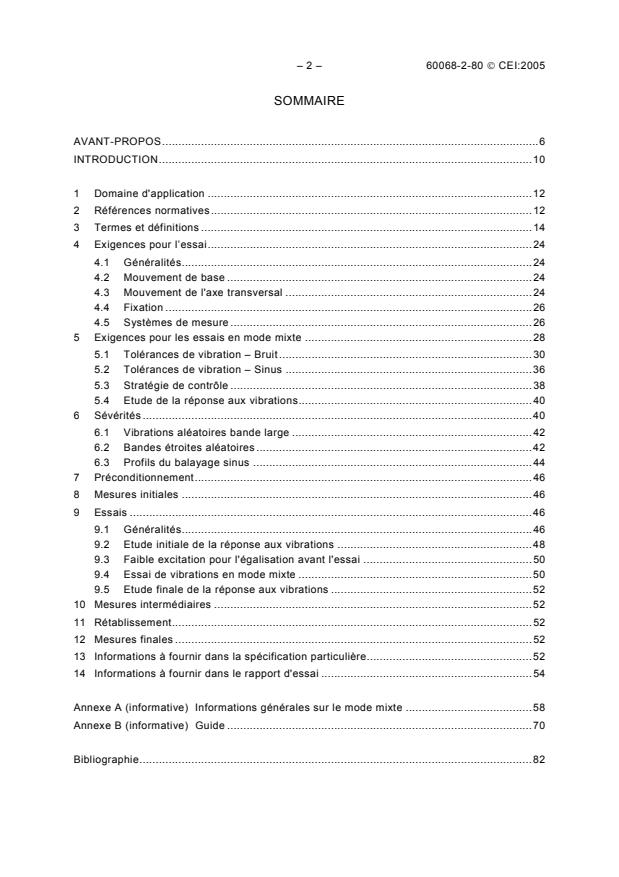
SOMMAIRE
AVANT-PROPOS.6
INTRODUCTION.10
1 Domaine d'application .12
2 Références normatives.12
3 Termes et définitions .14
4 Exigences pour l’essai.24
4.1 Généralités.24
4.2 Mouvement de base .24
4.3 Mouvement de l'axe transversal .24
4.4 Fixation .26
4.5 Systèmes de mesure .26
5 Exigences pour les essais en mode mixte .28
5.1 Tolérances de vibration – Bruit.30
5.2 Tolérances de vibration – Sinus .36
5.3 Stratégie de contrôle .38
5.4 Etude de la réponse aux vibrations.40
6 Sévérités .40
6.1 Vibrations aléatoires bande large .42
6.2 Bandes étroites aléatoires .42
6.3 Profils du balayage sinus .44
7 Préconditionnement.46
8 Mesures initiales .46
9 Essais .46
9.1 Généralités.46
9.2 Etude initiale de la réponse aux vibrations .48
9.3 Faible excitation pour l'égalisation avant l'essai .50
9.4 Essai de vibrations en mode mixte .50
9.5 Etude finale de la réponse aux vibrations .52
10 Mesures intermédiaires .52
11 Rétablissement.52
12 Mesures finales .52
13 Informations à fournir dans la spécification particulière.52
14 Informations à fournir dans le rapport d'essai .54
Annexe A (informative) Informations générales sur le mode mixte .58
Annexe B (informative) Guide .70
Bibliographie.82
60068-2-80 IEC:2005 – 3 –
CONTENTS
FOREWORD.7
INTRODUCTION.11
1 Scope.13
2 Normative references .13
3 Terms and definitions .15
4 Requirements for testing .25
4.1 General .25
4.2 Control systems .25
4.3 Basic motion .25
4.4 Cross axis motion.25
4.5 Mounting .27
4.6 Measuring systems.27
5 Requirements for testing mixed mode.29
5.1 Vibration tolerances – Random.31
5.2 Vibration tolerances – Sine.37
5.3 Control strategy.39
5.4 Vibration response investigation.41
6 Severities .41
6.1 Broadband random vibration.43
6.2 Random narrowbands .43
6.3 Sine tones .45
7 Preconditioning .47
8 Initial measurements .47
9 Testing .47
9.1 General .47
9.2 Initial vibration response investigation .49
9.3 Low-level excitation for equalization prior to testing.51
9.4 Mixed mode testing .51
9.5 Final vibration response investigation.53
10 Intermediate measurements .53
11 Recovery.53
12 Final measurements .53
13 Information to be given in the relevant specification .53
14 Information to be given in the test report .55
Annex A (informative) Mixed mode general information.59
Annex B (informative) Guidance.71
Bibliography.83
– 4 – 60068-2-80 CEI:2005
Figure 1 – Limites pour la densité spectrale d'accélération (voir également 5.1.1) .28
Figure 2 – Excitation stochastique, représentation de l'écrêtage du signal et de la
densité de probabilité gaussienne (normale) .30
Figure 3 – Exactitude statistique de la densité spectrale d'accélération en fonction des
degrés de liberté pour différents niveaux de confiance.32
Figure 4 – Distribution (densité de probabilité) des signaux sinus, sinus sur bruit et
aléatoire .34
Figure 5 – Vitesse de balayage sinusoïdale recommandée en tant que fonction du
rapport de puissance en sinus sur bruit dépendant de E .46
sor
Figure A.1 – Sinus à 160 Hz .62
Figure A.2 – Sinus à 380 Hz .64
Figure A.3 – Autocorrélation – Sinus à 160 Hz.64
Tableau A.1 – Détermination d'une onde sinusoïdale par calcul APD.66
Tableau A.2 – Détermination d'une onde sinusoïdale par calcul d'autocorrélation .68
60068-2-80 IEC:2005 – 5 –
Figure 1 – Boundaries for acceleration spectral density (see also 5.1.1) .29
Figure 2 – Stochastical excitation, representation of signal clipping and Gaussian
(normal) probability.31
Figure 3 – Statistical accuracy of acceleration spectral density versus degrees of
freedom for different confidence levels .33
Figure 4 – Distribution (probability density) of sine, sine-on-random and random signals .35
Figure 5 – Recommended sinusoidal sweep rate as a function of power ratio for sine
on random depending on E .47
sor
Figure A.1 – Sine at 160 Hz .63
Figure A.2 – Sine at 380 Hz .65
Figure A.3 – Auto correlation – Sine at 160 Hz .65
Table A.1 – Determination of sine wave with APD calculation .67
Table A.2 – Determination of sine wave with autocorrelation calculation .69
– 6 – 60068-2-80 © CEI:2005
COMMISSION ÉLECTROTECHNIQUE INTERNATIONALE
____________
ESSAIS D'ENVIRONNEMENT –
Partie 2-80: Essais – Essai Fi: Vibration – Mode mixte
AVANT-PROPOS
1) La Commission Electrotechnique Internationale (CEI) est une organisation mondiale de normalisation
composée de l'ensemble des comités électrotechniques nationaux (Comités nationaux de la CEI). La CEI a
pour objet de favoriser la coopération internationale pour toutes les questions de normalisation dans les
domaines de l'électricité et de l'électronique. A cet effet, la CEI – entre autres activités – publie des Normes
internationales, des Spécifications techniques, des Rapports techniques, des Spécifications accessibles au
public (PAS) et des Guides (ci-après dénommés "Publication(s) de la CEI"). Leur élaboration est confiée à des
comités d'études, aux travaux desquels tout Comité national intéressé par le sujet traité peut participer. Les
organisations internationales, gouvernementales et non gouvernementales, en liaison avec la CEI, participent
également aux travaux. La CEI collabore étroitement avec l'Organisation Internationale de Normalisation (ISO),
selon des conditions fixées par accord entre les deux organisations.
2) Les décisions ou accords officiels de la CEI concernant les questions techniques représentent, dans la mesure
du possible, un accord international sur les sujets étudiés, étant donné que les Comités nationaux de la CEI
intéressés sont représentés dans chaque comité d’études.
3) Les Publications de la CEI se présentent sous la forme de recommandations internationales et sont agréées
comme telles par les Comités nationaux de la CEI. Tous les efforts raisonnables sont entrepris afin que la CEI
s'assure de l'exactitude du contenu technique de ses publications; la CEI ne peut pas être tenue responsable
de l'éventuelle mauvaise utilisation ou interprétation qui en est faite par un quelconque utilisateur final.
4) Dans le but d'encourager l'uniformité internationale, les Comités nationaux de la CEI s'engagent, dans toute la
mesure possible, à appliquer de façon transparente les Publications de la CEI dans leurs publications
nationales et régionales. Toutes divergences entre toutes Publications de la CEI et toutes publications
nationales ou régionales correspondantes doivent être indiquées en termes clairs dans ces dernières.
5) La CEI n’a prévu aucune procédure de marquage valant indication d’approbation et n'engage pas sa
responsabilité pour les équipements déclarés conformes à une de ses Publications.
6) Tous les utilisateurs doivent s'assurer qu'ils sont en possession de la dernière édition de cette publication.
7) Aucune responsabilité ne doit être imputée à la CEI, à ses administrateurs, employés, auxiliaires ou
mandataires, y compris ses experts particuliers et les membres de ses comités d'études et des Comités
nationaux de la CEI, pour tout préjudice causé en cas de dommages corporels et matériels, ou de tout autre
dommage de quelque nature que ce soit, directe ou indirecte, ou pour supporter les coûts (y compris les frais
de justice) et les dépenses découlant de la publication ou de l'utilisation de cette Publication de la CEI ou de
toute autre Publication de la CEI, ou au crédit qui lui est accordé.
8) L'attention est attirée sur les références normatives citées dans cette publication. L'utilisation de publications
référencées est obligatoire pour une application correcte de la présente publication.
9) L’attention est attirée sur le fait que certains des éléments de la présente Publication de la CEI peuvent faire
l’objet de droits de propriété intellectuelle ou de droits analogues. La CEI ne saurait être tenue pour
responsable de ne pas avoir identifié de tels droits de propriété et de ne pas avoir signalé leur existence.
La Norme internationale CEI 60068-2-80 a été établie par le comité d'études 104 de la CEI:
Conditions, classification et essais d'environnement.
Le texte de cette norme est issu des documents suivants:
FDIS Rapport de vote
104/363/FDIS 104/368/RVD
Le rapport de votre indiqué dans le tableau ci-dessus donne toute information sur le vote
ayant abouti à l'approbation de cette norme.
Cette publication a été rédigée selon les Directives ISO/CEI, Partie 2.
Elle a le statut d’une publication fondamentale de sécurité conformément au Guide CEI 104.
60068-2-80 © IEC:2005 – 7 –
INTERNATIONAL ELECTROTECHNICAL COMMISSION
____________
ENVIRONMENTAL TESTING –
Part 2-80: Tests – Test Fi: Vibration – Mixed mode
FOREWORD
1) The International Electrotechnical Commission (IEC) is a worldwide organization for standardization comprising
all national electrotechnical committees (IEC National Committees). The object of IEC is to promote
international co-operation on all questions concerning standardization in the electrical and electronic fields. To
this end and in addition to other activities, IEC publishes International Standards, Technical Specifications,
Technical Reports, Publicly Available Specifications (PAS) and Guides (hereafter referred to as “IEC
Publication(s)”). Their preparation is entrusted to technical committees; any IEC National Committee interested
in the subject dealt with may participate in this preparatory work. International, governmental and non-
governmental organizations liaising with the IEC also participate in this preparation. IEC collaborates closely
with the International Organization for Standardization (ISO) in accordance with conditions determined by
agreement between the two organizations.
2) The formal decisions or agreements of IEC on technical matters express, as nearly as possible, an international
consensus of opinion on the relevant subjects since each technical committee has representation from all
interested IEC National Committees.
3) IEC Publications have the form of recommendations for international use and are accepted by IEC National
Committees in that sense. While all reasonable efforts are made to ensure that the technical content of IEC
Publications is accurate, IEC cannot be held responsible for the way in which they are used or for any
misinterpretation by any end user.
4) In order to promote international uniformity, IEC National Committees undertake to apply IEC Publications
transparently to the maximum extent possible in their national and regional publications. Any divergence
between any IEC Publication and the corresponding national or regional publication shall be clearly indicated in
the latter.
5) IEC provides no marking procedure to indicate its approval and cannot be rendered responsible for any
equipment declared to be in conformity with an IEC Publication.
6) All users should ensure that they have the latest edition of this publication.
7) No liability shall attach to IEC or its directors, employees, servants or agents including individual experts and
members of its technical committees and IEC National Committees for any personal injury, property damage or
other damage of any nature whatsoever, whether direct or indirect, or for costs (including legal fees) and
expenses arising out of the publication, use of, or reliance upon, this IEC Publication or any other IEC
Publications.
8) Attention is drawn to the Normative references cited in this publication. Use of the referenced publications is
indispensable for the correct application of this publication.
9) Attention is drawn to the possibility that some of the elements of this IEC Publication may be the subject of
patent rights. IEC shall not be held responsible for identifying any or all such patent rights.
International Standard IEC 60068-2-80 has been prepared by IEC technical committee 104:
Environmental conditions, classification and methods of test.
The text of this standard is based on the following documents:
FDIS Report on voting
104/363/FDIS 104/368/RVD
Full information on the voting for the approval of this standard can be found in the report on
voting indicated in the above table.
This publication has been drafted in accordance with the ISO/IEC Directives, Part 2.
It has the status of a basic safety publication in accordance with IEC Guide 104.
– 8 – 60068-2-80 CEI:2005
Cette norme constitue la Partie 2-80 de la CEI 60068 qui comportent les parties principales
suivantes, présentées sous le titre général Essais d'environnement:
Partie 1: Généralités et guide
Partie 2: Essais
Partie 3: Documentation d'accompagnement et guide
Partie 4: Renseignements destinés aux rédacteurs de spécification
Partie 5: Guide pour la rédaction des méthodes d'essais
Le comité a décidé que le contenu de cette publication ne sera pas modifié avant la date de
maintenance indiquée sur le site web de la CEI sous «http://webstore.iec.ch» dans les
données relatives à la publication recherchée. A cette date, la publication sera
• reconduite;
• supprimée;
• remplacée par une édition révisée, ou
• amendée.
60068-2-80 IEC:2005 – 9 –
This standard forms Part 2-80 of IEC 60068 which consists of the following major parts, under
the general title Environmental testing:
Part 1: General and guidance
Part 2: Tests
Part 3: Supporting documentation and guidance
Part 4: Information for specification writers
Part 5: Guide to drafting of test methods
The committee has decided that the contents of this publication will remain unchanged until
the maintenance result date indicated on the IEC web site under "http://webstore.iec.ch" in
the data related to the specific publication. At this date, the publication will be
• reconfirmed;
• withdrawn;
• replaced by a revised edition, or
• amended.
– 10 – 60068-2-80 CEI:2005
INTRODUCTION
La présente méthode d'essais de vibrations en mode mixte exige l'asservissement numérique
des vibrations aléatoires large bande et des techniques associées à la combinaison de
vibrations sinusoïdales et/ou de vibrations aléatoires bande étroite spécifiées sur une base
aléatoire bande large.
La présente norme est destinée à une application générale aux composants, matériel et
autres produits, désignés ci-après «spécimens», lorsqu'une simulation des réponses à bande
large de nature complexe est nécessaire pour les spécimens.
La méthode d'essai est principalement basée sur l'utilisation d'un générateur de vibrations
servo-hydraulique ou électrodynamique relié à un système asservi informatisé fonctionnant
comme un système d'essais de vibrations.
Il est important de souligner que les essais en mode mixte exigent toujours un certain niveau
d'expertise technique et il est recommandé que le fournisseur comme l'acheteur soient
informés. L'auteur de la spécification concernée est censé sélectionner la procédure d'essai
et les valeurs de sévérité adaptées au spécimen et à son utilisation.
60068-2-80 IEC:2005 – 11 –
INTRODUCTION
This method for mixed mode vibration testing requires the digital control of broadband random
vibrations and techniques associated with the combination of sinusoidal vibration and/or
specified narrowband random with a broadband random background.
This standard is intended for general application to components, equipment and other
products, hereinafter referred to as ”specimens”, when simulation is required of broadband
responses of a complex nature for the specimens.
The test method is based primarily on the use of an electrodynamic or a servo-hydraulic
vibration generator with an associated computer based control system used as a vibration
testing system.
It is emphasized that mixed mode testing always demands a certain degree of engineering
judgement and both supplier and purchaser should be fully aware of this fact. The writer
of the relevant specification is expected to select the testing procedure and the values of
severity appropriate to the specimen and its use.
– 12 – 60068-2-80 CEI:2005
ESSAIS D'ENVIRONNEMENT –
Partie 2-80: Essais – Essai Fi: Vibration – Mode mixte
1 Domaine d'application
La présente partie de la CEI 60068 est destinée à une application générale aux essais des
spécimens lorsqu'une simulation d'excitation de vibrations complexes et mixtes est
nécessaire.
L'objectif de l'essai est de prouver l'adéquation du spécimen à résister aux excitations
spécifiées en mode mixte sans provoquer de dégradation inacceptable de ses performances
fonctionnelles et/ou structurelles. Cet essai est particulièrement utile pour adapter des
environnements en mode mixte à l'environnement réel lorsque les données mesurées sont
disponibles.
L’essai permet également de révéler les effets accumulés des contraintes induites par les
vibrations aléatoires, combinées sinus et/ou bruit, ainsi que la faiblesse et la dégradation
mécaniques qui en résultent au niveau de la performance spécifiée, et d'utiliser ces
informations associées aux spécifications particulières pour évaluer l'acceptabilité des
spécimens. Dans certains cas, la présente norme peut également servir à prouver la
robustesse mécanique des spécimens.
La présente norme s'applique à des spécimens qui peuvent être soumis à des vibrations
aléatoires et/ou à une combinaison de vibrations aléatoires et déterministes dues à l'environ-
nement de transport ou à l'environnement réel, par exemple dans les avions ou les véhicules
spatiaux ou dans les éléments du conteneur de transport lorsque celui-ci est considéré
comme partie intégrante du spécimen.
Bien qu'elle soit principalement destinée aux spécimens électrotechniques, la présente norme
ne se limite pas à ces derniers et peut être utilisée dans d'autres domaines le cas échéant.
2 Références normatives
Les documents de référence suivants sont indispensables pour l'application du présent
document. Pour les références datées, seule l'édition citée s'applique. Pour les références
non datées, la dernière édition du document de référence s'applique (y compris les éventuels
amendements).
CEI 60050(300):2001, Vocabulaire Electrotechnique International (VEI) – Mesures et
appareils de mesure électriques et électroniques –
Partie311: Termes généraux concernant les mesures
Partie 312: Termes généraux concernant les mesures électroniques
Partie 313: Types d’appareils électriques de mesure
Partie 314: Termes spécifiques selon le type d’appareil
CEI 60068-1:1988, Essais d'environnement – Partie 1: Généralités et guide
CEI 60068-2-6:1995, Essais d'environnement – Partie 2-6: Essais – Essai Fc: Vibrations
(sinusoïdales)
CEI 60068-2-47:1999, Essais d'environnement – Partie 2-47: Méthodes d’essai – Fixation de
composants, matériels et autres articles pour essais dynamiques de vibrations, d'impacts et
autres essais similaires
60068-2-80 IEC:2005 – 13 –
ENVIRONMENTAL TESTING –
Part 2-80: Tests – Test Fi: Vibration – Mixed mode
1 Scope
This part of IEC 60068 is intended for general application for testing specimens when
simulation is required of vibration excitation of a complex and mixed nature.
The purpose of the test is to demonstrate the adequacy of the specimen to resist the specified
mixed mode excitation without unacceptable degradation of its functional and/or structural
performance. It is particularly useful for tailoring mixed mode environments where measured
data are available for the real life environment.
The test also helps reveal the accumulated effects of stress induced by random vibration,
mixed with sine and/or random, and the resulting mechanical weakness and degradation in
specified performances, and to use this information, in conjunction with the relevant
specification, to assess the acceptability of specimens. In some cases, this standard may also
be used to demonstrate the mechanical robustness of specimens.
This standard is applicable to specimens which may be subjected to vibration of a random
and/or a combination of random and deterministic nature resulting from transportation or real
life environments, for example in aircraft, space vehicles and for items in their transportation
container when the latter may be considered as part of the specimen itself.
Although primarily intended for electrotechnical specimens, this standard is not restricted to
such specimens and may be used in other fields where desired.
2 Normative references
The following referenced documents are indispensable for the application of this document.
For dated references, only the edition cited applies. For undated references, the latest edition
of the referenced document (including any amendments) applies.
IEC 60050(300):2001, International Electrotechnical Vocabulary (IEV) – Electrical and
electronic measurements and measuring instruments –
Part 311: General terms relating to measurements
Part 312: General terms relating to electrical measurements
Part 313: Types of electrical measuring instruments
Part 314: Specific terms according to the type of instrument
IEC 60068-1:1988, Environmental testing – Part 1: General and guidance
IEC 60068-2-6:1995, Environmental testing – Part 2-6: Tests -Test Fc: Vibration (sinusoidal)
IEC 60068-2-47:1999, Environmental testing – Part 2-47: Test methods – Mounting of
components, equipment and other articles for vibration, impact and similar dynamic tests
– 14 – 60068-2-80 CEI:2005
CEI 60068-2-64:1993, Essais d'environnement – Partie 2-64: Méthodes d'essai – Essai Fh:
Vibrations aléatoires à large bande (asservissement numérique) et guide
CEI 60068-3-8:2003, Essais d'environnement – Partie 3-8: Documentation d’accompagnement
et lignes directrices – Sélection d’essais de vibrations
CEI 60068-5-2:1990, Essais d'environnement – Partie 5-2: Guide pour la rédaction des
méthodes d'essais – Termes et définitions
ISO 2041:1990, Vibrations et chocs – Vocabulaire
3 Termes et définitions
Pour les besoins du présent document, les termes et définitions suivants sont généralement
définis dans l’ISO 2041, la CEI 60050(300), la CEI 60068-1, la CEI 60068-2-6, CEI 60068-2-
64 et la CEI 60068-5-2. Lorsqu'une définition tirée de l'une de ces sources est indiquée pour
la commodité du lecteur, les dérivations sont indiquées, de même que les exceptions à ces
définitions.
Les termes et définitions supplémentaires suivants s'appliquent également.
3.1
mouvement de l'axe transversal
mouvement effectué dans une direction autre que celle de l'excitation externe, généralement
spécifié sur les deux axes orthogonaux
3.2
mouvement réel
mouvement représenté par le signal à large bande renvoyé par le transducteur du point de
référence
3.3
point de fixation
partie du spécimen en contact avec le montage d'essai ou la table de vibration à un endroit
auquel le spécimen est normalement attaché lors de son utilisation
NOTE Si le montage s'effectue avec une pièce de la structure réelle de fixation, les points de fixation considérés
sont ceux de la structure et non ceux du spécimen.
3.4
point de contrôle
3.4.1
contrôle en un seul point
méthode de contrôle utilisant le signal du transducteur au point de référence pour maintenir
ce dernier au niveau de vibration spécifié
3.4.2
contrôle multipoint
méthode de contrôle utilisant les signaux du transducteur de chaque point de contrôle. Les
signaux sont soit soumis à une moyenne arithmétique continue, soit traités à l'aide de
techniques de comparaison, en fonction de la spécification particulière, voir aussi 3.9
3.5
g
n
accélération normale due à la gravité terrestre qui varie en fonction de l'altitude et de la
latitude géographique
NOTE Pour les besoins de la présente norme, la valeur de g est arrondie au nombre entier immédiatement
n
supérieur, à savoir 10 m/s .
60068-2-80 IEC:2005 – 15 –
IEC 60068-2-64:1993, Environmental testing – Part 2-64: Test methods – Test Fh: Vibration,
broadband random (digital control) and guidance
IEC 60068-3-8:2003, Environmental testing – Part 3-8: Supporting documentation and
guidance – Selecting amongst vibration tests
IEC 60068-5-2:1990, Environmental testing – Part 5-2: Guide to drafting of test methods –
Terms and definitions
ISO 2041:1990, Vibration and shock – Vocabulary
3 Terms and definitions
For the purposes of this document, the following terms and definitions are generally defined in
ISO 2041, IEC 60050(300), IEC 60068-1, IEC 60068-2-6, IEC 60068-2-64 and IEC 60068-5-2.
Where, for the convenience of the reader, a definition from one of those sources is included
here, the derivation is indicated and departures from the definitions in those sources are also
indicated.
The additional terms and definitions that follow are also applicable.
3.1
cross axis motion
motion not in the direction of the external stimulus, generally specified in the two orthogonal
axes
3.2
actual motion
motion represented by the wideband signal returned from the reference point transducer
3.3
fixing point
part of the specimen in contact with the fixture or vibration table at a point where the
specimen is normally fastened in service
NOTE If a part of the real mounting structure is used as the fixture, the fixing points are taken as those of the
mounting structure and not of the specimen.
3.4
control point
3.4.1
single point control
control method using the signal from the transducer at the reference point in order to maintain
this point at the specified vibration level
3.4.2
multipoint control
control method using the signals from each of the transducers at the check points. The
signals are either continuously averaged arithmetically or processed by using comparison
techniques, depending upon the relevant specification, see also 3.9
3.5
g
n
standard acceleration due to the earth's gravity, which itself varies with altitude and geo-
graphical latitude
NOTE For the purposes of this standard, the value of g is rounded up to the nearest whole number, i.e. 10 m/s .
n
– 16 – 60068-2-80 CEI:2005
3.6
points de mesure
points spécifiques sur lesquels les données sont collectées pour la réalisation de l'essai.
Il existe trois types de points, comme défini ci-dessous
3.6.1
point de vérification
point situé sur le montage, la table de vibration ou le spécimen, aussi près que possible d'un
de ses points de fixation, et, dans tous les cas, solidement relié au spécimen
NOTE 1 Un grand nombre de points de vérification sont utilisés pour garantir que les exigences de l'essai sont
remplies.
NOTE 2 S'il existe au maximum quatre points de fixation, ils sont tous utilisés comme points de vérification.
S'il en existe plus de quatre, quatre points de fixation représentatifs seront définis comme points de vérification
dans la spécification particulière
NOTE 3 Dans des cas particuliers, pour des spécimens complexes ou de grande taille par exemple, les points de
vérification seront déterminés par la spécification particulière s'ils sont éloignés des points de fixation.
NOTE 4 Si un grand nombre de petits spécimens sont fixés sur un seul montage d'essai, ou dans le cas d'un petit
spécimen qui aurait de nombreux points de fixation, un point de vérification unique (le point de référence) peut être
choisi pour la dérivation du signal de contrôle. Ce signal est alors associé au montage d'essai et non aux points de
fixation du ou des spécimens. Cette procédure n'est valable que si la fréquence de résonance la plus basse du
montage d'essai chargé est bien supérieure à la fréquence la plus haute de l'essai.
3.6.2
point de référence
point choisi parmi les points de vérification et dont le signal est utilisé pour maîtriser l'essai de
façon à remplir les exigences de la présente norme
3.6.3
point de référence fictif
point obtenu manuellement ou automatiquement à partir de points de vérification multiples et
utilisé pour maîtriser l'essai de façon à remplir les exigences de la présente norme
3.6.4
points de réponse
points spécifiques du spécimen sur lesquels les données sont collectées pour les besoins de
l'étude de la réponse aux vibrations
NOTE Ces points ne sont ni des points de vérification ni des points de référence
3.7
axes privilégiés de l'essai
trois axes orthogonaux qui correspondent aux axes les plus vulnérables du spécimen
3.8
fréquence d'échantillonnage
nombre des valeurs intermédiaires de magnitude relevées chaque seconde pour enregistrer
ou représenter un historique sous forme numérique
3.9
stratégies de contrôle multipoint
méthode de calcul du signal de contrôle de référence lors du contrôle multipoint. Les
stratégies suivantes de contrôle en domaine fréquentiel sont possibles, voir aussi 3.4.2
3.9.1
moyenne
processus définissant la valeur de contrôle comme moyenne arithmétique des valeurs du
signal, voir aussi 3.31, à chaque fréquence de plusieurs points de vérification
60068-2-80 IEC:2005 – 17 –
3.6
measuring points
specific points at which data are gathered for conducting the test. These points are of three
types, as defined below
3.6.1
check point
point located on the fixture, on the vibration table or on the specimen as close as possible to
one of its fixing points, and in any case rigidly connected to it
NOTE 1 A number of check points are used as a means of ensuring that the test requirements are satisfied.
NOTE 2 If four or fewer fixing points exist, each is used as a check point. If more than four fixing points exist, four
representative fixing points will be defined in the relevant specification to be used as check points.
NOTE 3 In special cases, for example for large or complex specimens, the check points will be prescribed by the
relevant specification if not close to the fixing points.
NOTE 4 Where a large number of small specimens are mounted on one fixture, or in the case of a small specimen
where there are a number of fixing points, a single check point (that is the reference point) may be selected for the
derivation of the control signal. This signal is then related to the fixture rather than to the fixing points of
the specimen(s). This procedure is only valid when the lowest resonance frequency of the loaded fixture is well
above the upper frequency of the test.
3.6.2
reference point
point, chosen from the check points, signal of which is used to control the test, such that the
requirements of this standard are satisfied
3.6.3
fictitious reference point
point derived from multiple check points either manually or automatically, the result of which
is used to control the test, so that the requirements of this standard are satisfied
3.6.4
response points
specific points on the specimen from which data is gathered for the purpose of the vibration
response investigation
NOTE These points are not check or reference points
3.7
preferred testing axes
three orthogonal axes that correspond to the most vulnerable axes of the specimen
3.8
sampling frequency
number of discrete magnitude values taken per second to record or represen
...