

IEC 61881-3:2012
(Main)Railway applications - Rolling stock equipment - Capacitors for power electronics - Part 3: Electric double-layer capacitors
General Information
- Abstract
IEC 61881-3:2012 applies to d.c. electric double-layer capacitors (cell, module and bank) for power electronics intended to be used on rolling stock. It specifies quality requirements and tests, safety requirements, and describes installation and operation information.
- Status
- Published
- Publication Date
- 15-Sep-2013
- Technical Committee
- TC 9 - Electrical equipment and systems for railways
- Drafting Committee
- WG 47 - TC 9/WG 47
- Current Stage
- PPUB - Publication issued
- Start Date
- 08-Aug-2012
- Completion Date
- 31-Aug-2012
Buy Documents
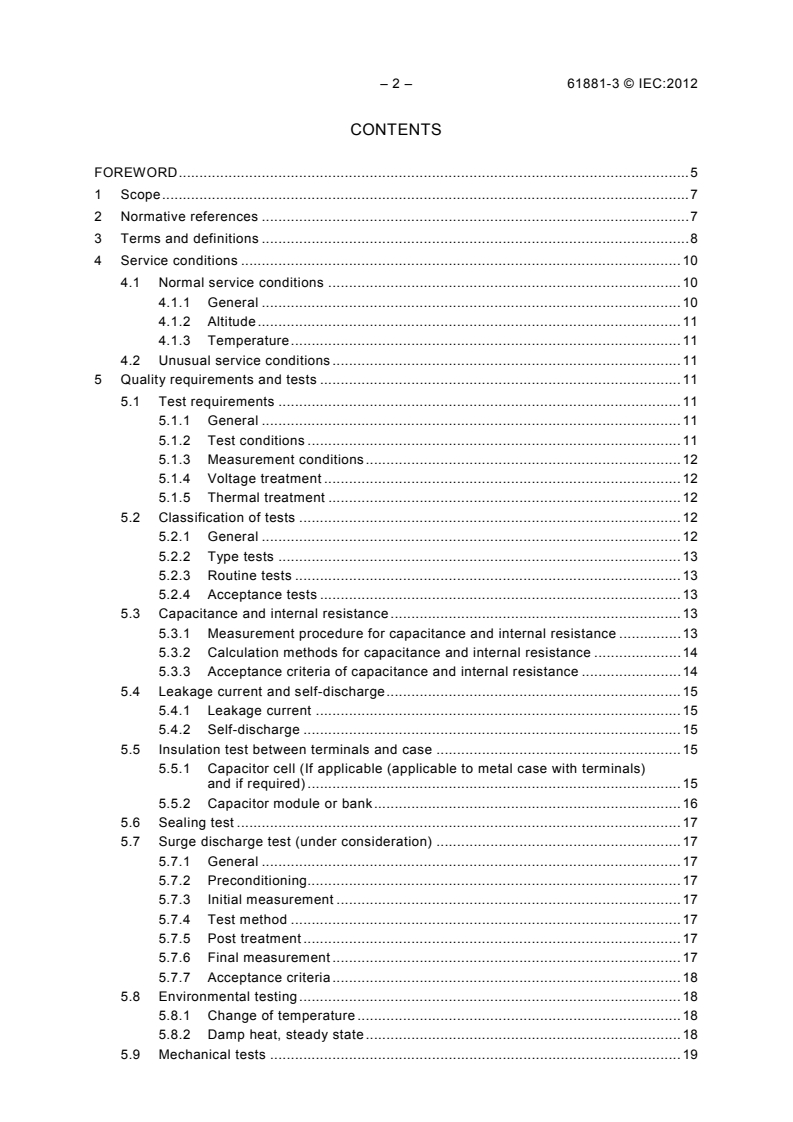
IEC 61881-3:2012 - Railway applications - Rolling stock equipment - Capacitors for power electronics - Part 3: Electric double-layer capacitors Released:8/8/2012

IEC 61881-3:2012+AMD1:2013 CSV - Railway applications - Rolling stock equipment - Capacitors forpower electronics - Part 3: Electric double-layer capacitors Released:9/16/2013
Overview
IEC 61881-3:2012 is an international standard developed by the International Electrotechnical Commission (IEC) that addresses the use of electric double-layer capacitors (EDLCs) in railway rolling stock power electronics. This standard specifically applies to direct current (d.c.) EDLCs at the cell, module, and bank levels. It provides comprehensive specifications for quality, safety, installation, and operational use of capacitors designed to meet the unique demands of railway applications. Maintaining reliability, durability, and safety within harsh railway environments is a key focus of IEC 61881-3.
Key Topics
Scope and Service Conditions
- Application to d.c. electric double-layer capacitors for railway rolling stock
- Defines normal and unusual service conditions including altitude and temperature variations
Quality and Testing Requirements
- Detailed classification of tests: type tests, routine tests, and acceptance tests
- Measurement procedures and acceptance criteria for capacitance and internal resistance
- Tests for leakage current, self-discharge, insulation, sealing, and environmental endurance
- Mechanical testing including vibration, shock, and terminal robustness
- Specialized electrical tests such as short-circuit and endurance cycling tests
- EMC (Electromagnetic Compatibility) testing to ensure interference resistance
Safety Requirements
- Mandates inclusion of discharge devices to safely dissipate stored energy
- Specifies grounding and case connection protocols
- Addresses environmental protection including materials and handling precautions
- Outlines safeguards against potential failures and overloads
Marking and Documentation
- Requirements for clear capacitor cell, module, or bank marking with relevant data
- Guidelines on datasheet content to assist users in correct installation and operation
Installation and Operation Guidance
- Recommendations on rated voltage selection, operating temperature ranges, and cooling methods
- Instructions on protection from overvoltage and overload currents
- Advice on proper switching and protective device selection
- Criteria for safe series and parallel connections of capacitors
- Consideration of magnetic losses and eddy currents during system design
Applications
IEC 61881-3 capacitors are integral components in the power electronics systems of modern railway rolling stock. Their applications include:
- Energy storage and power smoothing in traction converters and inverters
- Power backup during regenerative braking and acceleration phases
- Enhancing reliability of on-board electrical systems under dynamic railway conditions
- Supporting energy-efficient operation in electric multiple units (EMUs), locomotives, and metro trains
By conforming to IEC 61881-3, manufacturers and operators ensure that capacitors installed in rolling stock meet rigorous performance and safety standards, thereby improving overall train system availability and reducing maintenance costs.
Related Standards
For comprehensive coverage of capacitors in railway power electronics and rolling stock equipment, IEC 61881-3 should be used alongside related IEC standards including:
- IEC 61881-1: Capacitors for power electronics - Part 1: General specifications and definitions
- IEC 61881-2: Capacitors for power electronics - Part 2: Electrolytic capacitors
- IEC 60068 Series: Environmental testing standards applicable to railway components
- IEC 61373: Rolling stock equipment - Shock and vibration testing
- IEC 61000 Series: Electromagnetic compatibility standards
Combining these standards supports a holistic approach to the design, testing, installation, and maintenance of capacitors and related power electronic components in railway systems.
Keywords: IEC 61881-3, electric double-layer capacitors, EDLC, railway rolling stock, power electronics capacitors, capacitor testing, capacitor safety, railway power systems, energy storage, capacitor installation, capacitor operation guidance, IEC standards for railway equipment.
Relations
- Effective Date
- 05-Sep-2023
Buy Documents
IEC 61881-3:2012 - Railway applications - Rolling stock equipment - Capacitors for power electronics - Part 3: Electric double-layer capacitors Released:8/8/2012
IEC 61881-3:2012+AMD1:2013 CSV - Railway applications - Rolling stock equipment - Capacitors forpower electronics - Part 3: Electric double-layer capacitors Released:9/16/2013
Get Certified
Connect with accredited certification bodies for this standard

IRIS Certification (UNIFE)
International Railway Industry Standard certification.

TÜV SÜD Rail GmbH
TÜV SÜD railway certification services.

Bureau Veritas Railway Certification
Railway and transportation certification.
Sponsored listings
Frequently Asked Questions
IEC 61881-3:2012 is a standard published by the International Electrotechnical Commission (IEC). Its full title is "Railway applications - Rolling stock equipment - Capacitors for power electronics - Part 3: Electric double-layer capacitors". This standard covers: IEC 61881-3:2012 applies to d.c. electric double-layer capacitors (cell, module and bank) for power electronics intended to be used on rolling stock. It specifies quality requirements and tests, safety requirements, and describes installation and operation information.
IEC 61881-3:2012 applies to d.c. electric double-layer capacitors (cell, module and bank) for power electronics intended to be used on rolling stock. It specifies quality requirements and tests, safety requirements, and describes installation and operation information.
IEC 61881-3:2012 is classified under the following ICS (International Classification for Standards) categories: 45.060.01 - Railway rolling stock in general. The ICS classification helps identify the subject area and facilitates finding related standards.
IEC 61881-3:2012 has the following relationships with other standards: It is inter standard links to IEC 61881-3:2012/AMD1:2013. Understanding these relationships helps ensure you are using the most current and applicable version of the standard.
IEC 61881-3:2012 is available in PDF format for immediate download after purchase. The document can be added to your cart and obtained through the secure checkout process. Digital delivery ensures instant access to the complete standard document.
Standards Content (Sample)
IEC 61881-3 ®
Edition 1.0 2012-08
INTERNATIONAL
STANDARD
NORME
INTERNATIONALE
Railway applications – Rolling stock equipment – Capacitors for power
electronics –
Part 3: Electric double-layer capacitors
Applications ferroviaires – Matériel roulant – Condensateurs pour électronique
de puissance –
Partie 3: Condensateurs électriques à double couche
All rights reserved. Unless otherwise specified, no part of this publication may be reproduced or utilized in any form
or by any means, electronic or mechanical, including photocopying and microfilm, without permission in writing from
either IEC or IEC's member National Committee in the country of the requester.
If you have any questions about IEC copyright or have an enquiry about obtaining additional rights to this publication,
please contact the address below or your local IEC member National Committee for further information.
Droits de reproduction réservés. Sauf indication contraire, aucune partie de cette publication ne peut être reproduite ni
utilisée sous quelque forme que ce soit et par aucun procédé, électronique ou mécanique, y compris la photocopie et les
microfilms, sans l'accord écrit de la CEI ou du Comité national de la CEI du pays du demandeur.
Si vous avez des questions sur le copyright de la CEI ou si vous désirez obtenir des droits supplémentaires sur cette
publication, utilisez les coordonnées ci-après ou contactez le Comité national de la CEI de votre pays de résidence.
IEC Central Office Tel.: +41 22 919 02 11
3, rue de Varembé Fax: +41 22 919 03 00
CH-1211 Geneva 20 info@iec.ch
Switzerland www.iec.ch
About the IEC
The International Electrotechnical Commission (IEC) is the leading global organization that prepares and publishes
International Standards for all electrical, electronic and related technologies.
About IEC publications
The technical content of IEC publications is kept under constant review by the IEC. Please make sure that you have the
latest edition, a corrigenda or an amendment might have been published.
Useful links:
IEC publications search - www.iec.ch/searchpub Electropedia - www.electropedia.org
The advanced search enables you to find IEC publications The world's leading online dictionary of electronic and
by a variety of criteria (reference number, text, technical electrical terms containing more than 30 000 terms and
committee,…). definitions in English and French, with equivalent terms in
It also gives information on projects, replaced and additional languages. Also known as the International
withdrawn publications. Electrotechnical Vocabulary (IEV) on-line.
IEC Just Published - webstore.iec.ch/justpublished Customer Service Centre - webstore.iec.ch/csc
Stay up to date on all new IEC publications. Just Published If you wish to give us your feedback on this publication
details all new publications released. Available on-line and or need further assistance, please contact the
also once a month by email. Customer Service Centre: csc@iec.ch.
A propos de la CEI
La Commission Electrotechnique Internationale (CEI) est la première organisation mondiale qui élabore et publie des
Normes internationales pour tout ce qui a trait à l'électricité, à l'électronique et aux technologies apparentées.
A propos des publications CEI
Le contenu technique des publications de la CEI est constamment revu. Veuillez vous assurer que vous possédez
l’édition la plus récente, un corrigendum ou amendement peut avoir été publié.
Liens utiles:
Recherche de publications CEI - www.iec.ch/searchpub Electropedia - www.electropedia.org
La recherche avancée vous permet de trouver des Le premier dictionnaire en ligne au monde de termes
publications CEI en utilisant différents critères (numéro de électroniques et électriques. Il contient plus de 30 000
référence, texte, comité d’études,…). termes et définitions en anglais et en français, ainsi que
Elle donne aussi des informations sur les projets et les les termes équivalents dans les langues additionnelles.
publications remplacées ou retirées. Egalement appelé Vocabulaire Electrotechnique
International (VEI) en ligne.
Just Published CEI - webstore.iec.ch/justpublished
Service Clients - webstore.iec.ch/csc
Restez informé sur les nouvelles publications de la CEI.
Just Published détaille les nouvelles publications parues. Si vous désirez nous donner des commentaires sur
Disponible en ligne et aussi une fois par mois par email. cette publication ou si vous avez des questions
contactez-nous: csc@iec.ch.
IEC 61881-3 ®
Edition 1.0 2012-08
INTERNATIONAL
STANDARD
NORME
INTERNATIONALE
Railway applications – Rolling stock equipment – Capacitors for power
electronics –
Part 3: Electric double-layer capacitors
Applications ferroviaires – Matériel roulant – Condensateurs pour électronique
de puissance –
Partie 3: Condensateurs électriques à double couche
INTERNATIONAL
ELECTROTECHNICAL
COMMISSION
COMMISSION
ELECTROTECHNIQUE
PRICE CODE
INTERNATIONALE
CODE PRIX U
ICS 45.060 ISBN 978-2-83220-252-4
– 2 – 61881-3 © IEC:2012
CONTENTS
FOREWORD . 5
1 Scope . 7
2 Normative references . 7
3 Terms and definitions . 8
4 Service conditions . 10
4.1 Normal service conditions . 10
4.1.1 General . 10
4.1.2 Altitude . 11
4.1.3 Temperature . 11
4.2 Unusual service conditions . 11
5 Quality requirements and tests . 11
5.1 Test requirements . 11
5.1.1 General . 11
5.1.2 Test conditions . 11
5.1.3 Measurement conditions . 12
5.1.4 Voltage treatment . 12
5.1.5 Thermal treatment . 12
5.2 Classification of tests . 12
5.2.1 General . 12
5.2.2 Type tests . 13
5.2.3 Routine tests . 13
5.2.4 Acceptance tests . 13
5.3 Capacitance and internal resistance . 13
5.3.1 Measurement procedure for capacitance and internal resistance . 13
5.3.2 Calculation methods for capacitance and internal resistance . 14
5.3.3 Acceptance criteria of capacitance and internal resistance . 14
5.4 Leakage current and self-discharge . 15
5.4.1 Leakage current . 15
5.4.2 Self-discharge . 15
5.5 Insulation test between terminals and case . 15
5.5.1 Capacitor cell (If applicable (applicable to metal case with terminals)
and if required) . 15
5.5.2 Capacitor module or bank . 16
5.6 Sealing test . 17
5.7 Surge discharge test (under consideration) . 17
5.7.1 General . 17
5.7.2 Preconditioning. 17
5.7.3 Initial measurement . 17
5.7.4 Test method . 17
5.7.5 Post treatment . 17
5.7.6 Final measurement . 17
5.7.7 Acceptance criteria . 18
5.8 Environmental testing . 18
5.8.1 Change of temperature . 18
5.8.2 Damp heat, steady state . 18
5.9 Mechanical tests . 19
61881-3 © IEC:2012 – 3 –
5.9.1 Mechanical tests of terminals . 19
5.9.2 External inspection . 20
5.9.3 Vibration and shocks . 20
5.10 Endurance test . 20
5.10.1 General . 20
5.10.2 Preconditioning. 20
5.10.3 Initial measurements . 20
5.10.4 Test methods . 20
5.10.5 Post treatment . 21
5.10.6 Final measurement . 21
5.10.7 Acceptance criteria . 21
5.11 Endurance cycling test . 21
5.11.1 General . 21
5.11.2 Preconditioning. 21
5.11.3 Initial measurements . 21
5.11.4 Test method . 21
5.11.5 End of test criteria . 22
5.11.6 Post treatment . 22
5.11.7 Final measurement . 22
5.11.8 Acceptance criteria . 22
5.12 Pressure relief test . 22
5.13 Passive flammability . 22
5.14 EMC test . 23
6 Overloads . 23
7 Safety requirements . 23
7.1 Discharge device . 23
7.2 Case connections (grounding) . 23
7.3 Protection of the environment . 23
7.4 Other safety requirements . 24
8 Marking . 24
8.1 Marking of the capacitor . 24
8.1.1 Capacitor cell . 24
8.1.2 Capacitor module or bank . 24
8.2 Data sheet . 25
9 Guidance for installation and operation . 25
9.1 General . 25
9.2 Choice of rated voltage . 25
9.3 Operating temperature . 25
9.3.1 Life time of capacitor . 25
9.3.2 Installation . 26
9.3.3 Unusual cooling conditions . 26
9.4 Over voltages . 26
9.5 Overload currents . 26
9.6 Switching and protective devices . 26
9.7 Dimensioning of creepage distance and clearance . 26
9.8 Connections . 27
9.9 Parallel connections of capacitors . 27
9.10 Series connections of capacitors . 27
– 4 – 61881-3 © IEC:2012
9.11 Magnetic losses and eddy currents . 27
9.12 Guide for unprotected capacitors . 27
Annex A (informative) Terms and definitions of capacitors . 28
Bibliography . 29
Figure 1 – The voltage – time characteristics between capacitor terminals in
capacitance and internal resistance measurement . 14
Figure 2 – V block . 16
Figure A.1 – Example of capacitor application in capacitor equipment . 28
Table 1 – Classification of tests . 12
Table 2 – Damp heat steady-state test . 19
Table 3 – Testing the robustness of terminals . 20
61881-3 © IEC:2012 – 5 –
INTERNATIONAL ELECTROTECHNICAL COMMISSION
____________
RAILWAY APPLICATIONS –
ROLLING STOCK EQUIPMENT –
CAPACITORS FOR POWER ELECTRONICS –
Part 3: Electric double-layer capacitors
FOREWORD
1) The International Electrotechnical Commission (IEC) is a worldwide organization for standardization comprising
all national electrotechnical committees (IEC National Committees). The object of IEC is to promote
international co-operation on all questions concerning standardization in the electrical and electronic fields. To
this end and in addition to other activities, IEC publishes International Standards, Technical Specifications,
Technical Reports, Publicly Available Specifications (PAS) and Guides (hereafter referred to as “IEC
Publication(s)”). Their preparation is entrusted to technical committees; any IEC National Committee interested
in the subject dealt with may participate in this preparatory work. International, governmental and non-
governmental organizations liaising with the IEC also participate in this preparation. IEC collaborates closely
with the International Organization for Standardization (ISO) in accordance with conditions determined by
agreement between the two organizations.
2) The formal decisions or agreements of IEC on technical matters express, as nearly as possible, an international
consensus of opinion on the relevant subjects since each technical committee has representation from all
interested IEC National Committees.
3) IEC Publications have the form of recommendations for international use and are accepted by IEC National
Committees in that sense. While all reasonable efforts are made to ensure that the technical content of IEC
Publications is accurate, IEC cannot be held responsible for the way in which they are used or for any
misinterpretation by any end user.
4) In order to promote international uniformity, IEC National Committees undertake to apply IEC Publications
transparently to the maximum extent possible in their national and regional publications. Any divergence
between any IEC Publication and the corresponding national or regional publication shall be clearly indicated in
the latter.
5) IEC itself does not provide any attestation of conformity. Independent certification bodies provide conformity
assessment services and, in some areas, access to IEC marks of conformity. IEC is not responsible for any
services carried out by independent certification bodies.
6) All users should ensure that they have the latest edition of this publication.
7) No liability shall attach to IEC or its directors, employees, servants or agents including individual experts and
members of its technical committees and IEC National Committees for any personal injury, property damage or
other damage of any nature whatsoever, whether direct or indirect, or for costs (including legal fees) and
expenses arising out of the publication, use of, or reliance upon, this IEC Publication or any other IEC
Publications.
8) Attention is drawn to the Normative references cited in this publication. Use of the referenced publications is
indispensable for the correct application of this publication.
9) Attention is drawn to the possibility that some of the elements of this IEC Publication may be the subject of
patent rights. IEC shall not be held responsible for identifying any or all such patent rights.
International Standard IEC 61881-3 has been prepared by subcommittee 9: Electrical
equipment and systems for railways.
The text of this standard is based on the following documents:
FDIS Report on voting
9/1680/FDIS 9/1708/RVD
Full information on the voting for the approval of this standard can be found in the report on
voting indicated in the above table.
This publication has been drafted in accordance with the ISO/IEC Directives, Part 2.
A list of all parts of IEC 61881 series, under the general title Railway applications – Rolling
stock equipment – Capacitors for power electronics, can be found on the IEC website.
– 6 – 61881-3 © IEC:2012
The committee has decided that the contents of this publication will remain unchanged until
the stability date indicated on the IEC web site under "http://webstore.iec.ch" in the data
related to the specific publication. At this date, the publication will be
• reconfirmed,
• withdrawn,
• replaced by a revised edition, or
• amended.
61881-3 © IEC:2012 – 7 –
RAILWAY APPLICATIONS –
ROLLING STOCK EQUIPMENT –
CAPACITORS FOR POWER ELECTRONICS –
Part 3: Electric double-layer capacitors
1 Scope
This part of IEC 61881 applies to d.c. electric double-layer capacitors (cell, module and bank)
for power electronics intended to be used on rolling stock.
This standard specifies quality requirements and tests, safety requirements, and describes
installation and operation information.
NOTE Example of the application for capacitors specified in this Standard; d.c. energy storage, etc.
Capacitors not covered by this Standard:
– IEC 61881-1: Paper/plastic film capacitors;
– IEC 61881-2: Aluminium electrolytic capacitors with non-solid electrolyte.
Guidance for installation and operation is given in Clause 9.
2 Normative references
The following documents, in whole or in part, are normatively referenced in this document and
are indispensable for its application. For dated references, only the edition cited applies. For
undated references, the latest edition of the referenced document (including any
amendments) applies.
IEC 60068-1:1988, Environmental testing – Part 1: General and guidance
and Amendment 1:1992
IEC 60068-2-14:2009, Environmental testing – Part 2-14: Tests – Test N: Change of
temperature
IEC 60068-2-17:1994, Environmental testing – Part 2-17: Tests. Test Q: Sealing
IEC 60068-2-20, Environmental testing – Part 2-20: Tests – Test T: Test methods for
solderability and resistance to soldering heat of devices with leads
IEC 60068-2-21, Environmental testing – Part 2-21: Tests – Test U: Robustness of
terminations and integral mounting devices
IEC 60068-2-78, Environmental testing – Part 2-78: Tests – Test Cab: Damp heat, steady
state
IEC 60571:1998, Electronic equipment used on rail vehicles
and Amendment 1:2006
IEC 60721-3-5, Classification of environmental conditions – Part 3: Classification of groups of
environmental parameters and their severities – Section 5: Ground vehicle installations
– 8 – 61881-3 © IEC:2012
IEC 61373:2010, Railway applications – Rolling stock equipment – Shock and vibration tests
IEC 62236-3-2, Railway applications – Electromagnetic compatibility – Part 3-2: Rolling stock
– Apparatus
IEC 62391-1:2006, Fixed electric double-layer capacitors for use in electronic equipment –
Part 1: Generic specification
IEC 62391-2:2006, Fixed electric double-layer capacitors for use in electronic equipment –
Part 2: Sectional specification – Electric double-layer capacitors for power application
IEC 62497-1, Railway applications – Insulation coordination – Part 1: Basic requirements –
Clearances and creepage distances for all electrical and electronic equipment
IEC 62498-1:2010, Railway applications – Environmental conditions for equipment – Part 1:
Equipment on board rolling stock
IEC 62576:2009, Electric double-layer capacitors for use in hybrid electric vehicles – Test
methods for electrical characteristics
3 Terms and definitions
For the purposes of this document, the following terms and definitions apply.
3.1
capacitor element
indivisible part of a capacitor consisting of two electrodes (typically made of carbon)
separated by an electrolyte impregnated separator
Note 1 to entry: In the literature this type of capacitor element is often called EDLC (Electric double layer
capacitor) element. An electric double-layer capacitor element utilizes the ability to accumulate electric charge in
an electric double layer which is formed at the boundary surface between an electrode material (electronic
conductor) and an electrolyte. This capacitor is essentially designed for operation with direct current voltage.
3.2
capacitor cell
one or more capacitor elements, packaged in the same enclosure with terminals brought out
SEE: Annex A
3.3
capacitor module
assembly of two or more capacitor cells, electrically connected to each other with or without
additional electronics
SEE: Annex A
3.4
capacitor bank
assembly of two or more capacitor modules
SEE: Annex A
3.5
capacitor
general term used when it is not necessary to state whether a reference is made to capacitor
cell, module or bank
[SOURCE: IEC 61881-1:2010, 3, modified]
61881-3 © IEC:2012 – 9 –
3.6
capacitor equipment
assembly of capacitor banks and their accessories intended for connection to a network
SEE: Annex A
3.7
capacitor for power electronics
capacitor intended to be used in power electronic equipment and capable of operating
continuously under sinusoidal and non-sinusoidal current and voltage
Note 1 to entry: Capacitor in this standard is d.c. capacitor.
3.8
pressure relief structure
mechanism to release internal pressure of capacitor cell when exceeding specified value
3.9
discharge device
device capable of reducing the voltage between the terminals practically to zero, within a
given time, after the capacitor has been disconnected from a network
3.10
rated voltage (d.c.) (U )
R
maximum d.c. voltage which may be applied continuously to a capacitor at any temperature
between the lower category temperature and the upper category temperature
[SOURCE: IEC 60384-1:2008, 2.2.16, modified]
Note 1 to entry: In typical traction application, the maximum voltage is the sum of the d.c. voltage and peak a.c.
voltage or peak pulse voltage applied to the capacitor.
3.11
insulation voltage (U )
i
r.m.s. value of the sine wave voltage designed for the insulation between terminals of
capacitors to case or earth. If not specified, r.m.s. value of the insulating voltage is equivalent
to the rated voltage divided by √2
3.12
maximum peak current (I )
P
maximum peak current that can occur during continuous operation
3.13
rated current (I )
R
r.m.s. value of the maximum allowable current at which the capacitor may be operated
continuously at a specified temperature
Note 1 to entry: The cooling conditions of the module should be defined by the manufacturer.
3.14
maximum surge current (I )
S
peak non-repetitive current induced by switching or any other disturbance of the system which
is allowed for a limited number of times
3.15
operating temperature
temperature of the hottest point on the case of the capacitor when in steady-state conditions
of temperature
SEE: 3.22
– 10 – 61881-3 © IEC:2012
3.16
ambient temperature
temperature of the air surrounding the non-heat dissipating capacitor or temperature of the air
in free air conditions at such a distance from the heat dissipating capacitor that the effect of
the dissipation is negligible
3.17
upper category temperature
highest ambient temperature including internal heating in which a capacitor is designed to
operate continuously
Note 1 to entry: Depending on the application the upper category temperature can be different. For traction
energy storage application the continuous operation is based on the rated current, for other applications like board
net stabilising it is based on the rated voltage.
3.18
lower category temperature
lowest ambient temperature including internal heating in which a capacitor is designed to
operate continuously
Note 1 to entry: Depending on the application the lower category temperature can be different. For traction
energy storage application the continuous operation is based on the rated current, for other applications like board
net stabilising it is based on the rated voltage.
3.19
case temperature rise (∆T )
case
difference between the temperature of the hottest point of the case and the temperature of the
cooling air under the steady-state conditions of temperature
3.20
cooling air temperature (T )
amb
temperature of the cooling air measured at the inlet, under the steady-state conditions of
temperature
3.21
maximum operating temperature (T )
max
highest temperature of the case at which the capacitor may be operated
Note 1 to entry: The operating temperature is different from upper category temperature.
3.22
steady-state conditions of temperature
thermal equilibrium attained by the capacitor at constant output and at constant coolant
temperature
3.23
internal resistance (R )
s
d.c resistance causing losses in a capacitor due to termination jointing, electrolyte, electrodes,
etc.
4 Service conditions
NOTE See IEC 60077-1.
4.1 Normal service conditions
4.1.1 General
This standard gives requirements for capacitors intended for use in the following conditions:
61881-3 © IEC:2012 – 11 –
4.1.2 Altitude
Not exceeding 1 400 m. See IEC 62498-1.
NOTE The effect of altitude on cooling air characteristics and insulation clearance should be taken into
consideration, if the altitude exceeds 1 400 m.
4.1.3 Temperature
The climatic ambient temperatures are derived from IEC 60721-3-5 class 5k2 which has a
range from –25 °C to 40 °C. Where ambient temperature lies outside this range, it shall be as
agreed between the purchaser and the manufacturer.
NOTE Classes of temperature are listed in IEC 62498-1:2010, Table 2.
4.2 Unusual service conditions
This standard does not apply to capacitors, whose service conditions are such as to be in
general incompatible with its requirements, unless otherwise agreed between the
manufacturer and the purchaser.
Unusual service conditions require additional measurements, which ensure that the conditions
of this standard are complied with even under these unusual service conditions.
If such unusual service conditions exist then they shall be notified to the manufacturer of the
capacitor.
Unusual service conditions can include:
– unusual mechanical shocks and vibrations;
– corrosive and abrasive particles in the cooling air;
– dust in the cooling air, particularly if conductive;
– explosive dust or gas;
– oil or water vapour or corrosive substances;
– nuclear radiation;
– unusual storage or transport temperature;
– unusual humidity (tropical or subtropical region);
– excessive and rapid changes of temperature (more than 5 K/h) or of humidity (more than
5 %/h);
– service areas higher than 1 400 m above sea level;
– superimposed electromagnetic fields;
– excessive over voltages, as far as they exceed the limits given in Clause 6 and 9.4;
– airtight (poor change of air) installations.
5 Quality requirements and tests
5.1 Test requirements
5.1.1 General
This subclause gives the tests and requirements for capacitors.
5.1.2 Test conditions
Unless otherwise specified, the test conditions for capacitors shall be as in IEC 60068-1:1988,
5.3.
– 12 – 61881-3 © IEC:2012
NOTE IEC 60068-1:1988, 5.3 specifies the following standard atmospheric conditions for measurements and tests.
Temperature: 15 °C to 35 °C
Relative humidity: 25 % to 75 %
Air pressure: 86 kPa to 106 kPa
5.1.3 Measurement conditions
The measurement conditions (i.e. capacitance, internal resistance, leakage current, etc.) for
the capacitor shall be as in IEC 60068-1:1988, 5.3 with following exception.
The temperature shall be 25 °C ± 2 °C.
5.1.4 Voltage treatment
The capacitor shall be charged up to U and be held for 30 min by means of a d.c. source.
R
Then the capacitor shall be discharged through a suitable discharge device.
5.1.5 Thermal treatment
The capacitor shall be placed in the environment at the temperature defined in 5.1.3 for a
suitable soak period for thermal equalization.
5.2 Classification of tests
5.2.1 General
The tests are classified as type tests, routine tests, and acceptance tests.
The type tests and the routine tests consist of the tests shown in Table 1.
Table 1 – Classification of tests
No. Tests Item Type tests Routine tests
Cell Module or bank Cell Module or bank
1A Capacitance 5.3 5.3 5.3 5.3
1B Internal resistance 5.3 5.3 5.3 5.3
2A Leakage current 5.4.1
a
2B Self-discharge 5.4.2 5.4.2
a a
3 Insulation test between 5.5.1.1 5.5.2.1 5.5.1.2 5.5.2.2
terminals and case (if applicable and (if applicable)
required)
4 Sealing test 5.6
5 Surge discharge test 5.7 5.7
6 Change of temperature 5.8.1 5.8.1
7 Damp heat, steady state 5.8.2 5.8.2
(if applicable) (module only)
a
8 Mechanical tests of 5.9.1 5.9.1
terminals (if applicable)
9 External inspection 5.9.2 5.9.2 5.9.2 5.9.2
10 Vibration and shocks 5.9.3 5.9.3
11 Endurance test 5.10
b
12 Endurance cycling test 5.11 5.11
13 Pressure relief test 5.12
61881-3 © IEC:2012 – 13 –
No. Tests Item Type tests Routine tests
Cell Module or bank Cell Module or bank
14 Passive flammability 5.13
15 EMC test 5.14
a
This test may be substituted by capacitor module or bank test, when agreed between the manufacturer and the
purchaser.
b
This test may be substituted by capacitor cell test, when agreed between the manufacturer and the purchaser.
5.2.2 Type tests
Type tests are intended to prove the soundness and safety of the design of the capacitor and
its suitability for operation under the conditions detailed in this standard.
The type tests shall be carried out by the manufacturer, and the purchaser shall, on request,
be supplied with a certificate, detailing the results of such tests.
These tests shall be made upon capacitors which are designed identical to that of the
capacitors defined in the contract.
In agreement between the manufacturer and the purchaser, a capacitor of a similar design
can be used, when the same or more severe test conditions can be applied.
It is not essential that all type tests be carried out on the same capacitor sample. The choice
is left to the manufacturer.
5.2.3 Routine tests
The test sequence for quality requirements shall be as follows.
Routine tests shall be carried out by the manufacturer on every capacitor before delivery.
Upon request, the manufacturer shall deliver the capacitor with a certification detailing the
results of the tests.
5.2.4 Acceptance tests
All or a part of the type tests and the routine tests may be carried out by the manufacturer, on
agreement with the purchaser.
The number of samples that may be subjected to such repeat tests, the acceptance criteria,
as well as permission to deliver any of these capacitors shall be subject to the agreement
between the manufacturer and the purchaser, and shall be stated in the contract.
5.3 Capacitance and internal resistance
5.3.1 Measurement procedure for capacitance and internal resistance
The capacitance and internal resistance of the capacitor shall be measured in accordance
with IEC 62576:2009, 4.1.1 through 4.1.4 with following exceptions.
a) Unless otherwise specified, the capacitor preconditioning shall be carried out according to
5.1.4 and 5.1.5.
b) Unless otherwise specified, measurement temperature shall be 25 °C ± 2 °C (see 5.1.3).
c) Measuring for the voltage drop characteristics: down to 0,3 U
R.
The voltage–time characteristics between capacitor terminals during capacitance and internal
resistance measurement, is shown in Figure 1.
– 14 – 61881-3 © IEC:2012
U
R
∆U
U
∆U
U
Magnified figure
Time (s)
T
CV
IEC 1440/12
Key
U rated voltage (V)
R
U calculation start voltage (V)
U calculation end voltage (V)
∆U voltage drop (V)
T constant voltage charging duration (s)
CV
Figure 1 – The voltage–time characteristics between capacitor terminals in capacitance
and internal resistance measurement
5.3.2 Calculation methods for capacitance and internal resistance
a) The capacitance of the capacitor shall be calculated in accordance with IEC 62576:2009,
4.1.5 with the following exception.
W: measured discharged energy (J) from calculation start voltage (U = 0,9U ) to
1 R
calculation end voltage (U = 0,4U ).
2 R
b) The internal resistance of the capacitor shall be calculated in accordance with
IEC 62576:2009, 4.1.6 with the following exceptions.
∆U : Apply the straight-line approximation to the voltage drop characteristics from the
calculation start voltage (U = 0,9U ) to the calculation end voltage (U = 0,4U ) by using
1 R 2 R
the least squares method. Obtain the intercept (voltage value) of the straight line at the
discharge start time. ∆U is the difference of voltages (V) between the intercept voltage
value and the set value of constant voltage charging.
5.3.3 Acceptance criteria of capacitance and internal resistance
The capacitance of the capacitor shall be within the values as agreed between the
manufacturer and the purchaser.
The internal resistance of the capacitor shall not exceed the value as agreed between the
manufacturer and the purchaser.
Voltage (V)
61881-3 © IEC:2012 – 15 –
5.4 Leakage current and self-discharge
5.4.1 Leakage current
The leakage current of the capacitor shall be measured in accordance with IEC 62391-1:2006,
4.7.1 with the following exceptions.
a) Test temperature: 25 °C ± 2 °C
b) Electrification time: 24 h, 48 h or 72 h
The leakage current of the capacitor shall not exceed the value agreed between the
manufacturer and the purchaser.
5.4.2 Self-discharge
The self-discharge test for the capacitor shall be carried out in accordance with
IEC 62391-1:2006, 4.8 with following exceptions.
a) Test temperature: 25 °C ± 2 °C
b) Measurement time: 16 h, 24 h or 48 h
The measured voltage after test shall exceed the value as agreed between the manufacturer
and the purchaser.
5.5 Insulation test between terminals and case
5.5.1 Capacitor cell (If applicable (applicable to metal case with terminals) and if required)
5.5.1.1 Type test
The test voltage shall be applied between the two terminals connected together and non-
metallic case or insulated case. Unless otherwise agreed between the manufacturer and the
purchaser, the test voltage shall be specified by the manufacturer.
Unless otherwise agreed between the manufacturer and the purchaser, the method shall be
selected from the following test methods by the manufacturer.
5.5.1.1.1 Foil method
A metal foil shall be closely wrapped around the body of the capacitor cell.
For the capacitor cell with axial terminations this foil shall extend beyond each end by not less
than 5 mm, provided that a minimum distance of 1 mm/kV can be maintained between the foil
and the terminations. If this minimum cannot be maintained, the extension of the foil shall be
reduced by as much as is necessary to establish the distance of 1 mm/kV of test voltage.
For the capacitor cell with unidirectional terminations, a minimum distance of 1 mm/kV shall
be maintained between the edge of the foil and each termination.
In no case shall the distance between the foil and the terminations be less than 1 mm.
For each of the specified test points there shall be no sign of breakdown or flashover during
the test period.
5.5.1.1.2 V block method
The capacitor cell shall be clamped in the trough of a 90° metallic V-block (see Figure 2) of
such a size that the capacitor cell body does not extend beyond the extremities of the block.
– 16 – 61881-3 © IEC:2012
The clamping force shall be such as to guarantee adequate contact between the capacitor cell
and the block.
The capacitor cell shall be positioned as follows:
– For cylindrical capacitors cell: the capacitor cell shall be positioned in the block so that the
termination furthest from the axis of the capacitor cell is nearest to one of the faces of the
block.
– For rectangular capacitors cell: the capacitor cell shall be positioned in the block so that
the termination nearest the edge of the capacitor cell is nearest to one of the faces of the
block.
For cylindrical and rectangular capacitor cell having axial terminations any out of centre
positioning of the termination at its emergence from the capacitor cell body shall be ignored.
The specified test voltage is applied instantaneously through the internal resistance of the
power source for the time specified in the relevant specification.
For each of the specified test points there shall be no sign of breakdown or flashover during
the test period.
IEC 1441/12
Figure 2 – V block
5.5.1.2 Routine test
Same as type test (see 5.5.1.1), with following details.
The test voltage shall be applied instantaneously through the internal resistance of the power
source. The test voltage and test duration shall be as agreed between the manufacturer and
the purchaser.
For each of the specified test points there shall be no sign of breakdown or flashover during
the test period.
5.5.2 Capacitor module or bank
5.5.2.1 Type test
Unless otherwise agreed between the manufacturer and the purchaser, the tests for the
capacitor module or bank shall be carried out in accordance with IEC 62497-1.
5.5.2.2 Routine test
Same as type test (see 5.5.2.1), with following exception.
The test duration shall be 10 s.
61881-3 © IEC:2012 – 17 –
5.6 Sealing test
Unless the sealing capability of the capacitor cell has been proved otherwise, the sealing test
shall be carried out according to test Qc, method 2 in IEC 60068-2-17:1994, using non-
conductive silicon oil or equivalent solvent as an examination solvent.
The capacitor cell shall be immersed in an examination solvent with the sealing parts of the
cell facing up. The test temperature of the examination solvent shall be 5 °C higher than the
up
...
IEC 61881-3 ®
Edition 1.1 2013-09
CONSOLIDATED VERSION
INTERNATIONAL
STANDARD
NORME
INTERNATIONALE
colour
inside
Railway applications – Rolling stock equipment – Capacitors for power
electronics –
Part 3: Electric double-layer capacitors
Applications ferroviaires – Matériel roulant – Condensateurs pour électronique
de puissance –
Partie 3: Condensateurs électriques à double couche
All rights reserved. Unless otherwise specified, no part of this publication may be reproduced or utilized in any form
or by any means, electronic or mechanical, including photocopying and microfilm, without permission in writing from
either IEC or IEC's member National Committee in the country of the requester. If you have any questions about IEC
copyright or have an enquiry about obtaining additional rights to this publication, please contact the address below or
your local IEC member National Committee for further information.
Droits de reproduction réservés. Sauf indication contraire, aucune partie de cette publication ne peut être reproduite
ni utilisée sous quelque forme que ce soit et par aucun procédé, électronique ou mécanique, y compris la photocopie
et les microfilms, sans l'accord écrit de l'IEC ou du Comité national de l'IEC du pays du demandeur. Si vous avez des
questions sur le copyright de l'IEC ou si vous désirez obtenir des droits supplémentaires sur cette publication, utilisez
les coordonnées ci-après ou contactez le Comité national de l'IEC de votre pays de résidence.
IEC Central Office Tel.: +41 22 919 02 11
3, rue de Varembé info@iec.ch
CH-1211 Geneva 20 www.iec.ch
Switzerland
About the IEC
The International Electrotechnical Commission (IEC) is the leading global organization that prepares and publishes
International Standards for all electrical, electronic and related technologies.
About IEC publications
The technical content of IEC publications is kept under constant review by the IEC. Please make sure that you have the
latest edition, a corrigendum or an amendment might have been published.
IEC publications search - webstore.iec.ch/advsearchform IEC online collection - oc.iec.ch
The advanced search enables to find IEC publications by a Discover our powerful search engine and read freely all the
variety of criteria (reference number, text, technical publications previews. With a subscription you will always
committee, …). It also gives information on projects, replaced have access to up to date content tailored to your needs.
and withdrawn publications.
Electropedia - www.electropedia.org
IEC Just Published - webstore.iec.ch/justpublished
The world's leading online dictionary on electrotechnology,
Stay up to date on all new IEC publications. Just Published
containing more than 22 000 terminological entries in English
details all new publications released. Available online and
and French, with equivalent terms in 18 additional languages.
once a month by email.
Also known as the International Electrotechnical Vocabulary
(IEV) online.
IEC Customer Service Centre - webstore.iec.ch/csc
If you wish to give us your feedback on this publication or
need further assistance, please contact the Customer Service
Centre: sales@iec.ch.
A propos de l'IEC
La Commission Electrotechnique Internationale (IEC) est la première organisation mondiale qui élabore et publie des
Normes internationales pour tout ce qui a trait à l'électricité, à l'électronique et aux technologies apparentées.
A propos des publications IEC
Le contenu technique des publications IEC est constamment revu. Veuillez vous assurer que vous possédez l’édition la
plus récente, un corrigendum ou amendement peut avoir été publié.
Recherche de publications IEC - IEC online collection - oc.iec.ch
webstore.iec.ch/advsearchform Découvrez notre puissant moteur de recherche et consultez
La recherche avancée permet de trouver des publications IEC gratuitement tous les aperçus des publications. Avec un
en utilisant différents critères (numéro de référence, texte, abonnement, vous aurez toujours accès à un contenu à jour
comité d’études, …). Elle donne aussi des informations sur adapté à vos besoins.
les projets et les publications remplacées ou retirées.
Electropedia - www.electropedia.org
IEC Just Published - webstore.iec.ch/justpublished
Le premier dictionnaire d'électrotechnologie en ligne au
Restez informé sur les nouvelles publications IEC. Just
monde, avec plus de 22 000 articles terminologiques en
Published détaille les nouvelles publications parues.
anglais et en français, ainsi que les termes équivalents dans
Disponible en ligne et une fois par mois par email.
16 langues additionnelles. Egalement appelé Vocabulaire
Electrotechnique International (IEV) en ligne.
Service Clients - webstore.iec.ch/csc
Si vous désirez nous donner des commentaires sur cette
publication ou si vous avez des questions contactez-nous:
sales@iec.ch.
IEC 61881-3 ®
Edition 1.1 2013-09
CONSOLIDATED VERSION
INTERNATIONAL
STANDARD
NORME
INTERNATIONALE
colour
inside
Railway applications – Rolling stock equipment – Capacitors for power
electronics –
Part 3: Electric double-layer capacitors
Applications ferroviaires – Matériel roulant – Condensateurs pour électronique
de puissance –
Partie 3: Condensateurs électriques à double couche
INTERNATIONAL
ELECTROTECHNICAL
COMMISSION
COMMISSION
ELECTROTECHNIQUE
INTERNATIONALE
ICS 45.060 ISBN 978-2-8322-1106-9
IEC 61881-3 ®
Edition 1.1 2013-09
CONSOLIDATED VERSION
REDLINE VERSION
VERSION REDLINE
colour
inside
Railway applications – Rolling stock equipment – Capacitors for power
electronics –
Part 3: Electric double-layer capacitors
Applications ferroviaires – Matériel roulant – Condensateurs pour électronique
de puissance –
Partie 3: Condensateurs électriques à double couche
– 2 – 61881-3 © IEC:2012
+A1:2013
CONTENTS
FOREWORD. 5
1 Scope . 7
2 Normative references . 7
3 Terms and definitions . 8
4 Service conditions . 10
4.1 Normal service conditions . 10
4.1.1 General . 10
4.1.2 Altitude . 11
4.1.3 Temperature . 11
4.2 Unusual service conditions . 11
5 Quality requirements and tests . 11
5.1 Test requirements . 11
5.1.1 General . 11
5.1.2 Test conditions . 11
5.1.3 Measurement conditions . 12
5.1.4 Voltage treatment . 12
5.1.5 Thermal treatment . 12
5.2 Classification of tests . 12
5.2.1 General . 12
5.2.2 Type tests . 13
5.2.3 Routine tests . 13
5.2.4 Acceptance tests . 13
5.3 Capacitance and internal resistance . 13
5.3.1 Measurement procedure for capacitance and internal resistance . 13
5.3.2 Calculation methods for capacitance and internal resistance . 14
5.3.3 Acceptance criteria of capacitance and internal resistance . 14
5.4 Leakage current and self-discharge . 15
5.4.1 Leakage current . 15
5.4.2 Self-discharge . 15
5.5 Insulation test between terminals and case . 15
5.5.1 Capacitor cell (If applicable (applicable to metal case with terminals)
and if required) . 15
5.5.2 Capacitor module or bank . 16
5.6 Sealing test . 17
5.7 Surge discharge test (under consideration)Short-circuit test . 17
5.7.1 General . 17
5.7.2 Preconditioning . 17
5.7.3 Initial measurement . 17
5.7.4 Test method . 17
5.7.5 Post treatment . 17
5.7.6 Final measurement . 18
5.7.7 Acceptance criteria . 18
5.8 Environmental testing . 18
5.8.1 Change of temperature . 18
5.8.2 Damp heat, steady state . 19
61881-3 © IEC:2012 – 3 –
+A1:2013
5.9 Mechanical tests . 19
5.9.1 Mechanical tests of terminals . 19
5.9.2 External inspection . 20
5.9.3 Vibration and shocks . 20
5.10 Endurance test . 20
5.10.1 General . 20
5.10.2 Preconditioning . 20
5.10.3 Initial measurements . 20
5.10.4 Test methods . 20
5.10.5 Post treatment . 21
5.10.6 Final measurement . 21
5.10.7 Acceptance criteria . 21
5.11 Endurance cyc ling t e s t . 21
5.11.1 General . 21
5.11.2 Preconditioning . 21
5.11.3 Initial measurements . 21
5.11.4 Test method . 21
5.11.5 End of test criteria . 23
5.11.6 Post treatment . 23
5.11.7 Final measurement . 23
5.11.8 Acceptance criteria . 23
5.12 Pressure relief test . 24
5.13 Passive flammability . 24
5.14 EMC test . 24
6 Overloads . 24
7 Safety requirements . 24
7.1 Discharge device . 24
7.2 Case connections (grounding) . 25
7.3 Protection of the environment . 25
7.4 Other safety requirements . 25
8 Marking . . 25
8.1 Marking of the capacitor . 25
8.1.1 Capacitor cell . 25
8.1.2 Capacitor module or bank . 25
8.2 Data sheet . 26
9 Guidance for installation and operation . 26
9.1 General . 26
9.2 Choice of rated voltage . 26
9.3 Operating temperature . 27
9.3.1 Life time of capacitor . 27
9.3.2 Installation . 27
9.3.3 Unusual cooling conditions . 27
9.4 Over voltages . 27
9.5 Overload currents . 27
9.6 Switching and protective devices . 28
9.7 Dimensioning of creepage distance and clearance . 28
9.8 Connections . 28
9.9 Parallel connections of capacitors . 28
– 4 – 61881-3 © IEC:2012
+A1:2013
9.10 Series connections of capacitors . 28
9.11 Magnetic losses and eddy currents . 28
9.12 Guide for unprotected capacitors . 29
Annex A (informative) Terms and definitions of capacitors . 30
Bibliography . . 31
Figure 1 – The voltage – time characteristics between capacitor terminals in
capacitance and internal resistance measurement . 14
Figure 2 – V block . 16
Figure 3 – Endurance cycling test steps . 22
Figure A.1 – Example of capacitor application in capacitor equipment . 30
Table 1 – Classification of tests . 12
Table 2 – Damp heat steady-state test . 19
Table 3 – Testing the robustness of terminals . 20
61881-3 © IEC:2012 – 5 –
+A1:2013
INTERNATIONAL ELECTROTECHNICAL COMMISSION
____________
RAILWAY APPLICATIONS –
ROLLING STOCK EQUIPMENT –
CAPACITORS FOR POWER ELECTRONICS –
Part 3: Electric double-layer capacitors
FOREWORD
1) The International Electrotechnical Commission (IEC) is a worldwide organization for standardization comprising
all national electrotechnical committees (IEC National Committees). The object of IEC is to promote
international co-operation on all questions concerning standardization in the electrical and electronic fields. To
this end and in addition to other activities, IEC publishes International Standards, Technical Specifications,
Technical Reports, Publicly Available Specifications (PAS) and Guides (hereafter referred to as “IEC
Publication(s)”). Their preparation is entrusted to technical committees; any IEC National Committee interested
in the subject dealt with may participate in this preparatory work. International, governmental and non-
governmental organizations liaising with the IEC also participate in this preparation. IEC collaborates closely
with the International Organization for Standardization (ISO) in accordance with conditions determined by
agreement between the two organizations.
2) The formal decisions or agreements of IEC on technical matters express, as nearly as possible, an international
consensus of opinion on the relevant subjects since each technical committee has representation from all
interested IEC National Committees.
3) IEC Publications have the form of recommendations for international use and are accepted by IEC National
Committees in that sense. While all reasonable efforts are made to ensure that the technical content of IEC
Publications is accurate, IEC cannot be held responsible for the way in which they are used or for any
misinterpretation by any end user.
4) In order to promote international uniformity, IEC National Committees undertake to apply IEC Publications
transparently to the maximum extent possible in their national and regional publications. Any divergence
between any IEC Publication and the corresponding national or regional publication shall be clearly indicated in
the latter.
5) IEC itself does not provide any attestation of conformity. Independent certification bodies provide conformity
assessment services and, in some areas, access to IEC marks of conformity. IEC is not responsible for any
services carried out by independent certification bodies.
6) All users should ensure that they have the latest edition of this publication.
7) No liability shall attach to IEC or its directors, employees, servants or agents including individual experts and
members of its technical committees and IEC National Committees for any personal injury, property damage or
other damage of any nature whatsoever, whether direct or indirect, or for costs (including legal fees) and
expenses arising out of the publication, use of, or reliance upon, this IEC Publication or any other IEC
Publications.
8) Attention is drawn to the Normative references cited in this publication. Use of the referenced publications is
indispensable for the correct application of this publication.
9) Attention is drawn to the possibility that some of the elements of this IEC Publication may be the subject of
patent rights. IEC shall not be held responsible for identifying any or all such patent rights.
This consolidated version of the official IEC Standard and its amendment has been
prepared for user convenience.
IEC 61881-3 edition 1.1 contains the first edition (2012) [documents 9/1680/FDIS and
9/1708/RVD] and its amendment 1 (2013) [documents 9/1819/FDIS and 9/1843/RVD].
In this Redline version, a vertical line in the margin shows where the technical content
is modified by amendment 1. Additions and deletions are displayed in red, with
deletions being struck through. A separate Final version with all changes accepted is
available in this publication.
– 6 – 61881-3 © IEC:2012
+A1:2013
International Standard IEC 61881-3 has been prepared by subcommittee 9: Electrical
equipment and systems for railways.
This publication has been drafted in accordance with the ISO/IEC Directives, Part 2.
A list of all parts of IEC 61881 series, under the general title Railway applications – Rolling
stock equipment – Capacitors for power electronics, can be found on the IEC website.
The committee has decided that the contents of the base publication and its amendment will
remain unchanged until the stability date indicated on the IEC web site under
"http://webstore.iec.ch" in the data related to the specific publication. At this date, the
publication will be
• reconfirmed,
• withdrawn,
• replaced by a revised edition, or
• amended.
IMPORTANT – The “colour inside” logo on the cover page of this publication indicates
that it contains colours which are considered to be useful for the correct understanding
of its contents. Users should therefore print this publication using a colour printer.
61881-3 © IEC:2012 – 7 –
+A1:2013
RAILWAY APPLICATIONS –
ROLLING STOCK EQUIPMENT –
CAPACITORS FOR POWER ELECTRONICS –
Part 3: Electric double-layer capacitors
1 Scope
This part of IEC 61881 applies to d.c. electric double-layer capacitors (cell, module and bank)
for power electronics intended to be used on rolling stock.
This standard specifies quality requirements and tests, safety requirements, and describes
installation and operation information.
NOTE Example of the application for capacitors specified in this Standard; d.c. energy storage, etc.
Capacitors not covered by this Standard:
– IEC 61881-1: Paper/plastic film capacitors;
– IEC 61881-2: Aluminium electrolytic capacitors with non-solid electrolyte.
Guidance for installation and operation is given in Clause 9.
2 Normative references
The following documents, in whole or in part, are normatively referenced in this document and
are indispensable for its application. For dated references, only the edition cited applies. For
undated references, the latest edition of the referenced document (including any
amendments) applies.
IEC 60068-1:1988, Environmental testing – Part 1: General and guidance
and Amendment 1:1992
IEC 60068-2-14:2009, Environmental testing – Part 2-14: Tests – Test N: Change of
temperature
IEC 60068-2-17:1994, Environmental testing – Part 2-17: Tests. Test Q: Sealing
IEC 60068-2-20, Environmental testing – Part 2-20: Tests – Test T: Test methods for
solderability and resistance to soldering heat of devices with leads
IEC 60068-2-21, Environmental testing – Part 2-21: Tests – Test U: Robustness of
terminations and integral mounting devices
IEC 60068-2-78, Environmental testing – Part 2-78: Tests – Test Cab: Damp heat, steady
state
IEC 60571:1998, Electronic equipment used on rail vehicles
and Amendment 1:2006
IEC 60721-3-5, Classification of environmental conditions – Part 3: Classification of groups of
environmental parameters and their severities – Section 5: Ground vehicle installations
– 8 – 61881-3 © IEC:2012
+A1:2013
IEC 61373:2010, Railway applications – Rolling stock equipment – Shock and vibration tests
IEC 62236-3-2, Railway applications – Electromagnetic compatibility – Part 3-2: Rolling stock
– Apparatus
IEC 62391-1:2006, Fixed electric double-layer capacitors for use in electronic equipment –
Part 1: Generic specification
IEC 62391-2:2006, Fixed electric double-layer capacitors for use in electronic equipment –
Part 2: Sectional specification – Electric double-layer capacitors for power application
IEC 62497-1, Railway applications – Insulation coordination – Part 1: Basic requirements –
Clearances and creepage distances for all electrical and electronic equipment
IEC 62498-1:2010, Railway applications – Environmental conditions for equipment – Part 1:
Equipment on board rolling stock
IEC 62576:2009, Electric double-layer capacitors for use in hybrid electric vehicles – Test
methods for electrical characteristics
3 Terms and definitions
For the purposes of this document, the following terms and definitions apply.
3.1
capacitor element
indivisible part of a capacitor consisting of two electrodes (typically made of carbon)
separated by an electrolyte impregnated separator
Note 1 to entry: In the literature this type of capacitor element is often called EDLC (Electric double layer
capacitor) element. An electric double-layer capacitor element utilizes the ability to accumulate electric charge in
an electric double layer which is formed at the boundary surface between an electrode material (electronic
conductor) and an electrolyte. This capacitor is essentially designed for operation with direct current voltage.
3.2
capacitor cell
one or more capacitor elements, packaged in the same enclosure with terminals brought out
SEE: Annex A
3.3
capacitor module
assembly of two or more capacitor cells, electrically connected to each other with or without
additional electronics
SEE: Annex A
3.4
capacitor bank
assembly of two or more capacitor modules
SEE: Annex A
3.5
capacitor
general term used when it is not necessary to state whether a reference is made to capacitor
cell, module or bank
[SOURCE: IEC 61881-1:2010, 3, modified]
61881-3 © IEC:2012 – 9 –
+A1:2013
3.6
capacitor equipment
assembly of capacitor banks and their accessories intended for connection to a network
SEE: Annex A
3.7
capacitor for power electronics
capacitor intended to be used in power electronic equipment and capable of operating
continuously under sinusoidal and non-sinusoidal current and voltage
Note 1 to entry: Capacitor in this standard is d.c. capacitor.
3.8
pressure relief structure
mechanism to release internal pressure of capacitor cell when exceeding specified value
3.9
discharge device
device capable of reducing the voltage between the terminals practically to zero, within a
given time, after the capacitor has been disconnected from a network
3.10
rated voltage (d.c.) (U )
R
maximum d.c. voltage which may be applied continuously to a capacitor at any temperature
between the lower category temperature and the upper category temperature
[SOURCE: IEC 60384-1:2008, 2.2.16, modified]
Note 1 to entry: In typical traction application, the maximum voltage is the sum of the d.c. voltage and peak a.c.
voltage or peak pulse voltage applied to the capacitor.
3.11
insulation voltage (U )
i
r.m.s. value of the sine wave voltage designed for the insulation between terminals of
capacitors to case or earth. If not specified, r.m.s. value of the insulating voltage is equivalent
to the rated voltage divided by √2
3.12
maximum peak current (I )
P
maximum peak current that can occur during continuous operation
3.13
rated current (I )
R
r.m.s. value of the maximum allowable current at which the capacitor may be operated
continuously at a specified temperature
Note 1 to entry: The cooling conditions of the module should be defined by the manufacturer.
3.14
maximum surge current (I )
S
peak non-repetitive current induced by switching or any other disturbance of the system which
is allowed for a limited number of times
3.15
operating temperature
temperature of the hottest point on the case of the capacitor when in steady-state conditions
of temperature
SEE: 3.22
– 10 – 61881-3 © IEC:2012
+A1:2013
3.16
ambient temperature
temperature of the air surrounding the non-heat dissipating capacitor or temperature of the air
in free air conditions at such a distance from the heat dissipating capacitor that the effect of
the dissipation is negligible
3.17
upper category temperature
highest ambient temperature including internal heating in which a capacitor is designed to
operate continuously
Note 1 to entry: Depending on the application the upper category temperature can be different. For traction
energy storage application the continuous operation is based on the rated current, for other applications like board
net stabilising it is based on the rated voltage.
3.18
lower category temperature
lowest ambient temperature including internal heating in which a capacitor is designed to
operate continuously
Note 1 to entry: Depending on the application the lower category temperature can be different. For traction
energy storage application the continuous operation is based on the rated current, for other applications like board
net stabilising it is based on the rated voltage.
3.19
case temperature rise (∆T )
case
difference between the temperature of the hottest point of the case and the temperature of the
cooling air under the steady-state conditions of temperature
3.203.19
cooling air temperature (T )
amb
temperature of the cooling air measured at the inlet, under the steady-state conditions of
temperature
3.213.20
maximum operating temperature (T )
max
highest temperature of the case at which the capacitor cell may be operated
Note 1 to entry: The operating temperature is different from upper category temperature.
3.223.21
steady-state conditions of temperature
thermal equilibrium attained by the capacitor at constant output and at constant coolant
temperature
3.233.22
internal resistance (R )
s
d.c resistance causing losses in a capacitor due to termination jointing, electrolyte, electrodes,
etc.
4 Service conditions
NOTE See IEC 60077-1.
4.1 Normal service conditions
4.1.1 General
This standard gives requirements for capacitors intended for use in the following conditions:
61881-3 © IEC:2012 – 11 –
+A1:2013
4.1.2 Altitude
Not exceeding 1 400 m. See IEC 62498-1.
NOTE The effect of altitude on cooling air characteristics and insulation clearance should be taken into
consideration, if the altitude exceeds 1 400 m.
4.1.3 Temperature
The climatic ambient temperatures are derived from IEC 60721-3-5 class 5k2 which has a
range from –25 °C to 40 °C. Where ambient temperature lies outside this range, it shall be as
agreed between the purchaser and the manufacturer.
NOTE Classes of temperature are listed in IEC 62498-1:2010, Table 2.
4.2 Unusual service conditions
This standard does not apply to capacitors, whose service conditions are such as to be in
general incompatible with its requirements, unless otherwise agreed between the
manufacturer and the purchaser.
Unusual service conditions require additional measurements, which ensure that the conditions
of this standard are complied with even under these unusual service conditions.
If such unusual service conditions exist then they shall be notified to the manufacturer of the
capacitor.
Unusual service conditions can include:
– unusual mechanical shocks and vibrations;
– corrosive and abrasive particles in the cooling air;
– dust in the cooling air, particularly if conductive;
– explosive dust or gas;
– oil or water vapour or corrosive substances;
– nuclear radiation;
– unusual storage or transport temperature;
– unusual humidity (tropical or subtropical region);
– excessive and rapid changes of temperature (more than 5 K/h) or of humidity (more than
5 %/h);
– service areas higher than 1 400 m above sea level;
– superimposed electromagnetic fields;
– excessive over voltages, as far as they exceed the limits given in Clause 6 and 9.4;
– airtight (poor change of air) installations.
5 Quality requirements and tests
5.1 Test requirements
5.1.1 General
This subclause gives the tests and requirements for capacitors.
5.1.2 Test conditions
Unless otherwise specified, the test conditions for capacitors shall be as in IEC 60068-1:1988,
5.3.
– 12 – 61881-3 © IEC:2012
+A1:2013
NOTE IEC 60068-1:1988, 5.3 specifies the following standard atmospheric conditions for measurements and tests.
Temperature: 15 °C to 35 °C
Relative humidity: 25 % to 75 %
Air pressure: 86 kPa to 106 kPa
5.1.3 Measurement conditions
The measurement conditions (i.e. capacitance, internal resistance, leakage current, etc.) for
the capacitor shall be as in IEC 60068-1:1988, 5.3 with following exception.
The temperature shall be 25 °C ± 2 °C.
5.1.4 Voltage treatment
The capacitor shall be charged up to U and be held for 30 min by means of a d.c. source.
R
Then the capacitor shall be discharged through a suitable discharge device.
5.1.5 Thermal treatment
The capacitor shall be placed in the environment at the temperature defined in 5.1.3 for a
suitable soak period for thermal equalization.
5.2 Classification of tests
5.2.1 General
The tests are classified as type tests, routine tests, and acceptance tests.
The type tests and the routine tests consist of the tests shown in Table 1.
Table 1 – Classification of tests
No. Tests Item Type tests Routine tests
Cell Module or bank Cell Module or bank
1A Capacitance 5.3 5.3 5.3 5.3
1B Internal resistance 5.3 5.3 5.3 5.3
2A Leakage current 5.4.1
a
2B Self-discharge 5.4.2 5.4.2
a a
3 Insulation test between 5.5.1.1 5.5.2.1 5.5.1.2 5.5.2.2
terminals and case (if applicable and (if applicable)
required)
4 Sealing test 5.6
5 Surge discharge 5.7 5.7
Short-circuit test
6 Change of temperature 5.8.1 5.8.1
7 Damp heat, steady state 5.8.2 5.8.2
(if applicable) (module only)
a
8 Mechanical tests of 5.9.1 5.9.1
terminals (if applicable)
9 External inspection 5.9.2 5.9.2 5.9.2 5.9.2
10 Vibration and shocks 5.9.3 5.9.3
11 Endurance test 5.10
b
12 Endurance cycling test 5.11 5.11
13 Pressure relief test 5.12
61881-3 © IEC:2012 – 13 –
+A1:2013
No. Tests Item Type tests Routine tests
Cell Module or bank Cell Module or bank
14 Passive flammability 5.13
15 EMC test 5.14
a
This test may be substituted by capacitor module or bank test, when agreed between the manufacturer and the
purchaser.
b
This test may be substituted by capacitor cell test, when agreed between the manufacturer and the purchaser.
5.2.2 Type tests
Type tests are intended to prove the soundness and safety of the design of the capacitor and
its suitability for operation under the conditions detailed in this standard.
The type tests shall be carried out by the manufacturer, and the purchaser shall, on request,
be supplied with a certificate, detailing the results of such tests.
These tests shall be made upon capacitors which are designed identical to that of the
capacitors defined in the contract.
In agreement between the manufacturer and the purchaser, a capacitor of a similar design
can be used, when the same or more severe test conditions can be applied.
It is not essential that all type tests be carried out on the same capacitor sample. The choice
is left to the manufacturer.
5.2.3 Routine tests
The test sequence for quality requirements shall be as follows.
Routine tests shall be carried out by the manufacturer on every capacitor before delivery.
Upon request, the manufacturer shall deliver the capacitor with a certification detailing the
results of the tests.
5.2.4 Acceptance tests
All or a part of the type tests and the routine tests may be carried out by the manufacturer, on
agreement with the purchaser.
The number of samples that may be subjected to such repeat tests, the acceptance criteria,
as well as permission to deliver any of these capacitors shall be subject to the agreement
between the manufacturer and the purchaser, and shall be stated in the contract.
5.3 Capacitance and internal resistance
5.3.1 Measurement procedure for capacitance and internal resistance
The capacitance and internal resistance of the capacitor shall be measured in accordance
with IEC 62576:2009, 4.1.1 through 4.1.4 with following exceptions.
a) Unless otherwise specified, the capacitor preconditioning shall be carried out according to
5.1.4 and 5.1.5.
b) Unless otherwise specified, measurement temperature shall be 25 °C ± 2 °C (see 5.1.3).
c) Measuring for the voltage drop characteristics: down to 0,3 U
R.
The voltage–time characteristics between capacitor terminals during capacitance and internal
resistance measurement, is shown in Figure 1.
– 14 – 61881-3 © IEC:2012
+A1:2013
U
R
∆U
U
∆U
U
Magnified figure
Time (s)
T
CV
IEC 1440/12
Key
U rated voltage (V)
R
U calculation start voltage (V)
U calculation end voltage (V)
∆U voltage drop (V)
T constant voltage charging duration (s)
CV
Figure 1 – The voltage–time characteristics between capacitor terminals in capacitance
and internal resistance measurement
5.3.2 Calculation methods for capacitance and internal resistance
a) The capacitance of the capacitor shall be calculated in accordance with IEC 62576:2009,
4.1.5 with the following exception.
W: measured discharged energy (J) from calculation start voltage (U = 0,9U ) to
1 R
calculation end voltage (U = 0,4U ).
2 R
b) The internal resistance of the capacitor shall be calculated in accordance with
IEC 62576:2009, 4.1.6 with the following exceptions.
∆U : Apply the straight-line approximation to the voltage drop characteristics from the
calculation start voltage (U = 0,9U ) to the calculation end voltage (U = 0,4U ) by using
1 R 2 R
the least squares method. Obtain the intercept (voltage value) of the straight line at the
discharge start time. ∆U is the difference of voltages (V) between the intercept voltage
value and the set value of constant voltage charging.
5.3.3 Acceptance criteria of capacitance and internal resistance
The capacitance of the capacitor shall be within the values as agreed between the
manufacturer and the purchaser.
The internal resistance of the capacitor shall not exceed the value as agreed between the
manufacturer and the purchaser.
Voltage (V)
61881-3 © IEC:2012 – 15 –
+A1:2013
5.4 Leakage current and self-discharge
5.4.1 Leakage current
The leakage current of the capacitor shall be measured in accordance with IEC 62391-1:2006,
4.7.1 with the following exceptions.
a) Test temperature: 25 °C ± 2 °C
b) Electrification time: 24 h, 48 h or 72 h
The leakage current of the capacitor shall not exceed the value agreed between the
manufacturer and the purchaser.
5.4.2 Self-discharge
The self-discharge test for the capacitor shall be carried out in accordance with
IEC 62391-1:2006, 4.8 with following exceptions.
a) Test temperature: 25 °C ± 2 °C
b) Measurement time: 16 h, 24 h or 48 h
The measured voltage after test shall exceed the value as agreed between the manufacturer
and the purchaser.
5.5 Insulation test between terminals and case
5.5.1 Capacitor cell (If applicable (applicable to metal case with terminals) and if required)
5.5.1.1 Type test
The test voltage shall be applied between the two terminals connected together and non-
metallic case or insulated case. Unless otherwise agreed between the manufacturer and the
purchaser, the test voltage shall be specified by the manufacturer.
Unless otherwise agreed between the manufacturer and the purchaser, the method shall be
selected from the following test methods by the manufacturer.
5.5.1.1.1 Foil method
A metal foil shall be closely wrapped around the body of the capacitor cell.
For the capacitor cell with axial terminations this foil shall extend beyond each end by not less
than 5 mm, provided that a minimum distance of 1 mm/kV can be maintained between the foil
and the terminations. If this minimum cannot be maintained, the extension of the foil shall be
reduced by as much as is necessary to establish the distance of 1 mm/kV of test voltage.
For the capacitor cell with unidirectional terminations, a minimum distance of 1 mm/kV shall
be maintained between the edge of the foil and each termination.
In no case shall the distance between the foil and the terminations be less than 1 mm.
For each of the specified test points there shall be no sign of breakdown or flashover during
the test period.
5.5.1.1.2 V block method
The capacitor cell shall be clamped in the trough of a 90° metallic V-block (see Figure 2) of
such a size that the capacitor cell body does not extend beyond the extremities of the block.
– 16 – 61881-3 © IEC:2012
+A1:2013
The clamping force shall be such as to guarantee adequate contact between the capacitor cell
and the block.
The capacitor cell shall be positioned as follows:
– For cylindrical capacitors cell: the capacitor cell shall be positioned in the block so that the
termination furthest from the axis of the capacitor cell is nearest to one of the faces of the
block.
– For rectangular capacitors cell: the capacitor cell shall be positioned in the block so that
the termination nearest the edge of the capacitor cell is nearest to one of the faces of the
block.
For cylindrical and rectangular ca
...