


IEC 61727:2004
(Main)Photovoltaic (PV) systems - Characteristics of the utility interface
General Information
- Abstract
Applies to utility-interconnected photovoltaic (PV) power systems operating in parallel with the utility and utilizing static (solid-state) non-islanding inverters for the conversion of DC to AC. Lays down requirements for interconnection of PV systems to the utility distribution system.
- Status
- Published
- Publication Date
- 13-Dec-2004
- Technical Committee
- TC 82 - Solar photovoltaic energy systems
- Drafting Committee
- WG 3 - TC 82/WG 3
- Current Stage
- PPUB - Publication issued
- Start Date
- 14-Dec-2004
- Completion Date
- 31-Mar-2005
Overview
IEC 61727:2004 is an international standard developed by the International Electrotechnical Commission (IEC) that specifies the characteristics and requirements for the utility interface of photovoltaic (PV) systems. This standard applies to utility-interconnected PV power systems that operate parallel to the utility grid using static (solid-state) inverters for converting DC power into AC power. It sets out essential conditions to ensure safe, reliable, and efficient interconnection of PV systems with the utility distribution network.
The second edition of IEC 61727, published in 2004, updates and replaces the original 1995 edition. It incorporates technical revisions to align with evolving PV technologies and grid compatibility needs.
Key Topics
Utility Interface Characteristics
The standard defines the electrical parameters for voltage, current, and frequency that PV systems must comply with to maintain compatibility with the utility grid.Normal Operating Ranges
It specifies the acceptable ranges for voltage and frequency under normal operating conditions, ensuring PV systems can operate without causing disturbances.Power Quality Requirements
IEC 61727 addresses factors such as harmonics, waveform distortion, flicker, and DC injection to minimize power quality issues on the utility side.Power Factor and Reactive Power
Requirements related to power factor compensation are detailed, with clear guidelines for power factor values and behavior under varying load conditions.Safety and Protection Measures
The standard outlines safety protocols including protection against islanding (unintentional isolation from the grid), appropriate earthing, short circuit protection, and response to grid disturbances such as voltage and frequency excursions.Inverter Functionality
Definitions and requirements for static inverters, including anti-islanding features, are emphasized to maintain grid stability and personnel safety.
Applications
Grid-Connected Photovoltaic Systems
IEC 61727 is essential for manufacturers, designers, and installers of PV systems that connect to public utility grids, ensuring standardized interfaces that facilitate interconnection.Utility Distribution Network Integration
The standard serves utility companies in defining acceptable parameters and protection strategies for incorporating distributed PV power generation into their grids.Compliance and Certification
Adherence to IEC 61727 helps in regulatory compliance, enabling product testing and certification processes for PV inverters and associated equipment.System Design and Engineering
Electrical engineers and system integrators use the requirements to design PV installations that maintain power quality and safety while optimizing energy delivery to the grid.
Related Standards
IEC 62116 - Test Procedure of Islanding Prevention Measures
Complements IEC 61727 by defining specific testing for anti-islanding capabilities of inverter-based PV systems.IEC 61000 Series - Electromagnetic Compatibility (EMC)
Addresses electromagnetic emissions and immunity, supporting power quality requirements in PV system interconnections.IEC 60364 Series - Electrical Installations
Guides safe electrical installation practices for PV systems including earthing and protection devices.ISO/IEC Directives Part 2
Provides procedural guidance for preparing international standards like IEC 61727.
Practical Value
Implementing IEC 61727 helps ensure that photovoltaic systems are compatible with utility grids, minimizing operational risks such as voltage disturbances, frequency instability, and safety hazards. This contributes to increased grid reliability, facilitates higher PV penetration, and supports the global transition toward sustainable energy. Adherence to this standard also reduces liability risks and enhances market acceptance of PV products and systems.
By following IEC 61727:2004, stakeholders in the photovoltaic industry can achieve streamlined grid integration, improved system safety, and compliance with international best practices - vital for the proliferation and technical success of solar energy solutions worldwide.
Get Certified
Connect with accredited certification bodies for this standard

DNV
DNV is an independent assurance and risk management provider.

Lloyd's Register
Lloyd's Register is a global professional services organisation specialising in engineering and technology.
DNV Energy Systems
Energy and renewable energy certification.
Sponsored listings
Frequently Asked Questions
IEC 61727:2004 is a standard published by the International Electrotechnical Commission (IEC). Its full title is "Photovoltaic (PV) systems - Characteristics of the utility interface". This standard covers: Applies to utility-interconnected photovoltaic (PV) power systems operating in parallel with the utility and utilizing static (solid-state) non-islanding inverters for the conversion of DC to AC. Lays down requirements for interconnection of PV systems to the utility distribution system.
Applies to utility-interconnected photovoltaic (PV) power systems operating in parallel with the utility and utilizing static (solid-state) non-islanding inverters for the conversion of DC to AC. Lays down requirements for interconnection of PV systems to the utility distribution system.
IEC 61727:2004 is classified under the following ICS (International Classification for Standards) categories: 27.160 - Solar energy engineering. The ICS classification helps identify the subject area and facilitates finding related standards.
IEC 61727:2004 is available in PDF format for immediate download after purchase. The document can be added to your cart and obtained through the secure checkout process. Digital delivery ensures instant access to the complete standard document.
Standards Content (Sample)
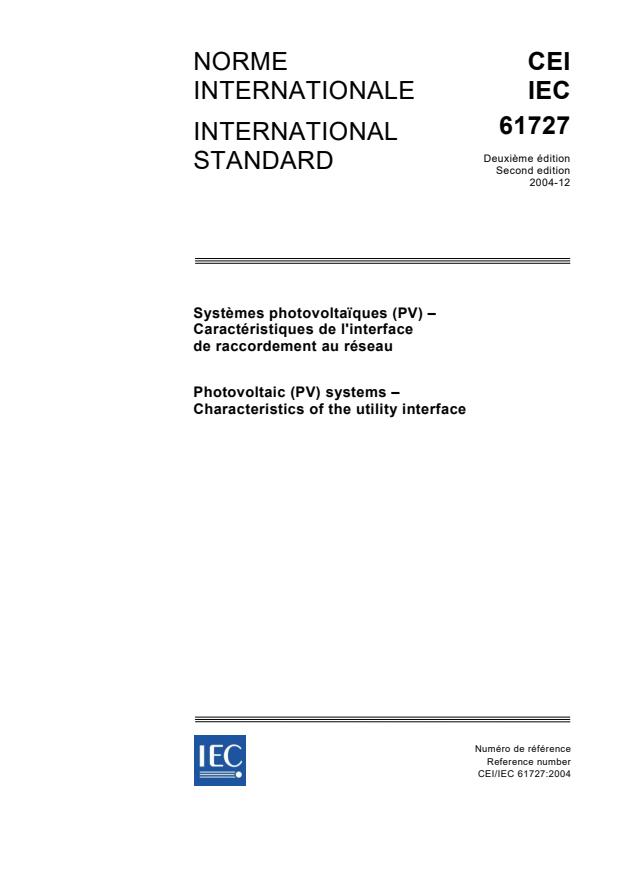
NORME CEI
INTERNATIONALE IEC
INTERNATIONAL
Deuxième édition
STANDARD
Second edition
2004-12
Systèmes photovoltaïques (PV) –
Caractéristiques de l'interface
de raccordement au réseau
Photovoltaic (PV) systems –
Characteristics of the utility interface
Numéro de référence
Reference number
CEI/IEC 61727:2004
Numérotation des publications Publication numbering
Depuis le 1er janvier 1997, les publications de la CEI As from 1 January 1997 all IEC publications are
sont numérotées à partir de 60000. Ainsi, la CEI 34-1 issued with a designation in the 60000 series. For
devient la CEI 60034-1. example, IEC 34-1 is now referred to as IEC 60034-1.
Editions consolidées Consolidated editions
Les versions consolidées de certaines publications de la The IEC is now publishing consolidated versions of its
CEI incorporant les amendements sont disponibles. Par publications. For example, edition numbers 1.0, 1.1
exemple, les numéros d’édition 1.0, 1.1 et 1.2 indiquent and 1.2 refer, respectively, to the base publication,
respectivement la publication de base, la publication de the base publication incorporating amendment 1 and
base incorporant l’amendement 1, et la publication de the base publication incorporating amendments 1
base incorporant les amendements 1 et 2. and 2.
Informations supplémentaires Further information on IEC publications
sur les publications de la CEI
Le contenu technique des publications de la CEI est The technical content of IEC publications is kept
constamment revu par la CEI afin qu'il reflète l'état under constant review by the IEC, thus ensuring that
actuel de la technique. Des renseignements relatifs à the content reflects current technology. Information
cette publication, y compris sa validité, sont dispo- relating to this publication, including its validity, is
nibles dans le Catalogue des publications de la CEI available in the IEC Catalogue of publications
(voir ci-dessous) en plus des nouvelles éditions, (see below) in addition to new editions, amendments
amendements et corrigenda. Des informations sur les and corrigenda. Information on the subjects under
sujets à l’étude et l’avancement des travaux entrepris consideration and work in progress undertaken by the
par le comité d’études qui a élaboré cette publication, technical committee which has prepared this
ainsi que la liste des publications parues, sont publication, as well as the list of publications issued,
également disponibles par l’intermédiaire de: is also available from the following:
• Site web de la CEI (www.iec.ch) • IEC Web Site (www.iec.ch)
• Catalogue des publications de la CEI • Catalogue of IEC publications
Le catalogue en ligne sur le site web de la CEI The on-line catalogue on the IEC web site
(www.iec.ch/searchpub) vous permet de faire des (www.iec.ch/searchpub) enables you to search by a
recherches en utilisant de nombreux critères, variety of criteria including text searches,
comprenant des recherches textuelles, par comité technical committees and date of publication. On-
d’études ou date de publication. Des informations en line information is also available on recently
ligne sont également disponibles sur les nouvelles issued publications, withdrawn and replaced
publications, les publications remplacées ou retirées, publications, as well as corrigenda.
ainsi que sur les corrigenda.
• IEC Just Published • IEC Just Published
Ce résumé des dernières publications parues This summary of recently issued publications
(www.iec.ch/online_news/justpub) est aussi dispo- (www.iec.ch/online_news/justpub) is also available
nible par courrier électronique. Veuillez prendre by email. Please contact the Customer Service
contact avec le Service client (voir ci-dessous) Centre (see below) for further information.
pour plus d’informations.
• Service clients • Customer Service Centre
Si vous avez des questions au sujet de cette If you have any questions regarding this
publication ou avez besoin de renseignements publication or need further assistance, please
supplémentaires, prenez contact avec le Service contact the Customer Service Centre:
clients:
Email: custserv@iec.ch Email: custserv@iec.ch
Tél: +41 22 919 02 11 Tel: +41 22 919 02 11
Fax: +41 22 919 03 00 Fax: +41 22 919 03 00
.
NORME CEI
INTERNATIONALE IEC
INTERNATIONAL
Deuxième édition
STANDARD
Second edition
2004-12
Systèmes photovoltaïques (PV) –
Caractéristiques de l'interface
de raccordement au réseau
Photovoltaic (PV) systems –
Characteristics of the utility interface
� IEC 2004 Droits de reproduction réservés � Copyright - all rights reserved
Aucune partie de cette publication ne peut être reproduite ni No part of this publication may be reproduced or utilized in any
utilisée sous quelque forme que ce soit et par aucun procédé, form or by any means, electronic or mechanical, including
électronique ou mécanique, y compris la photocopie et les photocopying and microfilm, without permission in writing from
microfilms, sans l'accord écrit de l'éditeur. the publisher.
International Electrotechnical Commission, 3, rue de Varembé, PO Box 131, CH-1211 Geneva 20, Switzerland
Telephone: +41 22 919 02 11 Telefax: +41 22 919 03 00 E-mail: inmail@iec.ch Web: www.iec.ch
CODE PRIX
PRICE CODE L
Commission Electrotechnique Internationale
International Electrotechnical Commission
Pour prix, voir catalogue en vigueur
For price, see current catalogue
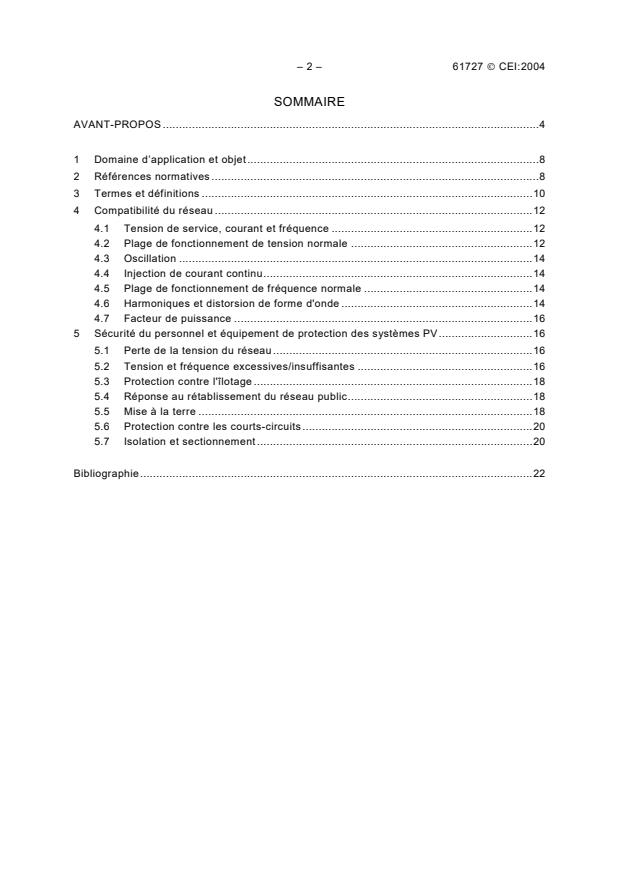
– 2 – 61727 � CEI:2004
SOMMAIRE
AVANT-PROPOS .4
1 Domaine d’application et objet.8
2 Références normatives .8
3 Termes et définitions .10
4 Compatibilité du réseau .12
4.1 Tension de service, courant et fréquence .12
4.2 Plage de fonctionnement de tension normale .12
4.3 Oscillation .14
4.4 Injection de courant continu.14
4.5 Plage de fonctionnement de fréquence normale .14
4.6 Harmoniques et distorsion de forme d'onde .14
4.7 Facteur de puissance .16
5 Sécurité du personnel et équipement de protection des systèmes PV.16
5.1 Perte de la tension du réseau .16
5.2 Tension et fréquence excessives/insuffisantes .16
5.3 Protection contre l'îlotage .18
5.4 Réponse au rétablissement du réseau public.18
5.5 Mise à la terre .18
5.6 Protection contre les courts-circuits.20
5.7 Isolation et sectionnement .20
Bibliographie.22
61727 � IEC:2004 – 3 –
CONTENTS
FOREWORD.5
1 Scope and object.9
2 Normative references .9
3 Terms and definitions .11
4 Utility compatibility.13
4.1 Voltage, current and frequency.13
4.2 Normal voltage operating range.13
4.3 Flicker .15
4.4 DC injection.15
4.5 Normal frequency operating range.15
4.6 Harmonics and waveform distortion .15
4.7 Power factor .17
5 Personnel safety and equipment protection .17
5.1 Loss of utility voltage.17
5.2 Over/under voltage and frequency.17
5.3 Islanding protection .19
5.4 Response to utility recovery.19
5.5 Earthing.19
5.6 Short circuit protection.21
5.7 Isolation and switching .21
Bibliography.23
– 4 – 61727 � CEI:2004
COMMISSION ÉLECTROTECHNIQUE INTERNATIONALE
____________
SYSTÈMES PHOTOVOLTAÏQUES (PV) –
CARACTÉRISTIQUES DE L'INTERFACE
DE RACCORDEMENT AU RÉSEAU
AVANT-PROPOS
1) La Commission Electrotechnique Internationale (CEI) est une organisation mondiale de normalisation
composée de l'ensemble des comités électrotechniques nationaux (Comités nationaux de la CEI). La CEI a
pour objet de favoriser la coopération internationale pour toutes les questions de normalisation dans les
domaines de l'électricité et de l'électronique. A cet effet, la CEI – entre autres activités – publie des Normes
internationales, des Spécifications techniques, des Rapports techniques, des Spécifications accessibles au
public (PAS) et des Guides (ci-après dénommés "Publication(s) de la CEI"). Leur élaboration est confiée à des
comités d'études, aux travaux desquels tout Comité national intéressé par le sujet traité peut participer. Les
organisations internationales, gouvernementales et non gouvernementales, en liaison avec la CEI, participent
également aux travaux. La CEI collabore étroitement avec l'Organisation Internationale de Normalisation (ISO),
selon des conditions fixées par accord entre les deux organisations.
2) Les décisions ou accords officiels de la CEI concernant les questions techniques représentent, dans la mesure
du possible, un accord international sur les sujets étudiés, étant donné que les Comités nationaux de la CEI
intéressés sont représentés dans chaque comité d’études.
3) Les Publications de la CEI se présentent sous la forme de recommandations internationales et sont agréées
comme telles par les Comités nationaux de la CEI. Tous les efforts raisonnables sont entrepris afin que la CEI
s'assure de l'exactitude du contenu technique de ses publications; la CEI ne peut pas être tenue responsable
de l'éventuelle mauvaise utilisation ou interprétation qui en est faite par un quelconque utilisateur final.
4) Dans le but d'encourager l'uniformité internationale, les Comités nationaux de la CEI s'engagent, dans toute la
mesure possible, à appliquer de façon transparente les Publications de la CEI dans leurs publications
nationales et régionales. Toutes divergences entre toutes Publications de la CEI et toutes publications
nationales ou régionales correspondantes doivent être indiquées en termes clairs dans ces dernières.
5) La CEI n’a prévu aucune procédure de marquage valant indication d’approbation et n'engage pas sa
responsabilité pour les équipements déclarés conformes à une de ses Publications.
6) Tous les utilisateurs doivent s'assurer qu'ils sont en possession de la dernière édition de cette publication.
7) Aucune responsabilité ne doit être imputée à la CEI, à ses administrateurs, employés, auxiliaires ou
mandataires, y compris ses experts particuliers et les membres de ses comités d'études et des Comités
nationaux de la CEI, pour tout préjudice causé en cas de dommages corporels et matériels, ou de tout autre
dommage de quelque nature que ce soit, directe ou indirecte, ou pour supporter les coûts (y compris les frais
de justice) et les dépenses découlant de la publication ou de l'utilisation de cette Publication de la CEI ou de
toute autre Publication de la CEI, ou au crédit qui lui est accordé.
8) L'attention est attirée sur les références normatives citées dans cette publication. L'utilisation de publications
référencées est obligatoire pour une application correcte de la présente publication.
9) L’attention est attirée sur le fait que certains des éléments de la présente Publication de la CEI peuvent faire
l’objet de droits de propriété intellectuelle ou de droits analogues. La CEI ne saurait être tenue pour
responsable de ne pas avoir identifié de tels droits de propriété et de ne pas avoir signalé leur existence.
La Norme internationale CEI 61727 a été établie par le comité d'études 82 de la CEI:
Systèmes de conversion photovoltaïque de l’énergie solaire.
Le texte de cette norme est issu des documents suivants:
FDIS Rapport de vote
82/367/FDIS 82/372/RVD
Le rapport de vote indiqué dans le tableau ci-dessus donne toute information sur le vote ayant
abouti à l'approbation de cette norme.
Cette deuxième édition annule et remplace la première édition, parue en 1995. Elle constitue
une révision technique.
61727 � IEC:2004 – 5 –
INTERNATIONAL ELECTROTECHNICAL COMMISSION
____________
PHOTOVOLTAIC (PV) SYSTEMS –
CHARACTERISTICS OF THE UTILITY INTERFACE
FOREWORD
1) The International Electrotechnical Commission (IEC) is a worldwide organization for standardization comprising
all national electrotechnical committees (IEC National Committees). The object of IEC is to promote
international co-operation on all questions concerning standardization in the electrical and electronic fields. To
this end and in addition to other activities, IEC publishes International Standards, Technical Specifications,
Technical Reports, Publicly Available Specifications (PAS) and Guides (hereafter referred to as “IEC
Publication(s)”). Their preparation is entrusted to technical committees; any IEC National Committee interested
in the subject dealt with may participate in this preparatory work. International, governmental and non-
governmental organizations liaising with the IEC also participate in this preparation. IEC collaborates closely
with the International Organization for Standardization (ISO) in accordance with conditions determined by
agreement between the two organizations.
2) The formal decisions or agreements of IEC on technical matters express, as nearly as possible, an international
consensus of opinion on the relevant subjects since each technical committee has representation from all
interested IEC National Committees.
3) IEC Publications have the form of recommendations for international use and are accepted by IEC National
Committees in that sense. While all reasonable efforts are made to ensure that the technical content of IEC
Publications is accurate, IEC cannot be held responsible for the way in which they are used or for any
misinterpretation by any end user.
4) In order to promote international uniformity, IEC National Committees undertake to apply IEC Publications
transparently to the maximum extent possible in their national and regional publications. Any divergence
between any IEC Publication and the corresponding national or regional publication shall be clearly indicated in
the latter.
5) IEC provides no marking procedure to indicate its approval and cannot be rendered responsible for any
equipment declared to be in conformity with an IEC Publication.
6) All users should ensure that they have the latest edition of this publication.
7) No liability shall attach to IEC or its directors, employees, servants or agents including individual experts and
members of its technical committees and IEC National Committees for any personal injury, property damage or
other damage of any nature whatsoever, whether direct or indirect, or for costs (including legal fees) and
expenses arising out of the publication, use of, or reliance upon, this IEC Publication or any other IEC
Publications.
8) Attention is drawn to the Normative references cited in this publication. Use of the referenced publications is
indispensable for the correct application of this publication.
9) Attention is drawn to the possibility that some of the elements of this IEC Publication may be the subject of
patent rights. IEC shall not be held responsible for identifying any or all such patent rights.
International Standard IEC 61727 has been prepared by IEC technical committee 82: Solar
photovoltaic energy systems.
The text of this standard is based on the following documents:
FDIS Report on voting
82/367/FDIS 82/372/RVD
Full information on the voting for the approval of this standard can be found in the report on
voting indicated in the above table.
This second edition cancels and replaces the first edition published in 1995. It constitutes a
technical revision.
– 6 – 61727 � CEI:2004
Les modifications principales par rapport à l’édition précédente (1995) sont décrites ci-
dessous:
a) l’article concernant le disjoncteur de l’interface de raccordement au réseau a été
supprimé;
b) la définition des onduleurs à fonction anti-îlotage a été ajoutée à la liste des termes et
définitions;
c) le point de couplage commun pour l’interface de raccordement au réseau a été ajouté afin
de faciliter la compréhension;
d) il a été clarifié que le facteur de puissance est en retard pour des valeurs dépassant 0,9.
Cette publication a été rédigée selon les Directives ISO/CEI, Partie 2.
Le comité a décidé que le contenu de cette publication ne sera pas modifié avant la date de
maintenance indiquée sur le site web de la CEI sous "http://webstore.iec.ch" dans les
données relatives à la publication recherchée. A cette date, la publication sera
reconduite,
supprimée,
remplacée par une édition révisée, ou
amendée.
61727 � IEC:2004 – 7 –
The main changes with respect to the previous edition (published in 1995) are detailed below:
a) the clause on the utility interface disconnect switch has been removed;
b) the definition of non-islanding inverters has been added to the list of terms and definitions;
c) the point of common coupling for the utility interface has been added to improve
understanding;
d) it has been clarified that the power factor is lagging for values greater than 0,9.
This publication has been drafted in accordance with the ISO/IEC Directives, Part 2.
The committee has decided that the contents of this publication will remain unchanged until
the maintenance result date indicated on the IEC web site under "http://webstore.iec.ch" in
the data related to the specific publication. At this date, the publication will be
reconfirmed;
withdrawn;
replaced by a revised edition, or
amended.
– 8 – 61727 � CEI:2004
SYSTÈMES PHOTOVOLTAÏQUES (PV) –
CARACTÉRISTIQUES DE L'INTERFACE
DE RACCORDEMENT AU RÉSEAU
1 Domaine d’application et objet
La présente Norme internationale s'applique aux systèmes PV interconnectés au réseau
public qui fonctionnent en parallèle avec celui-ci et qui utilisent des onduleurs statiques (à
semi-conducteurs) à fonction anti-îlotages pour la conversion du courant continu en courant
alternatif. Le présent document décrit des recommandations spécifiques aux réseaux de
puissance inférieure ou égale à 10 kVA, tels que ceux qui peuvent être utilisés en monophasé
ou en triphasé dans les résidences individuelles. La présente norme s'applique à
l'interconnexion avec des systèmes de distribution basse tension.
La présente norme est destinée à établir les exigences d'interconnexion des systèmes PV à
un réseau public de distribution de l'électricité.
NOTE 1Un onduleur répondant à une certification conformément aux conditions de la présente norme devra être
considéré comme acceptable pour son installation sans autres essais supplémentaires.
La présente norme ne concerne pas la CEM ni les systèmes de protection contre l'îlotage.
NOTE 2 Les exigences d'interface peuvent varier lorsque des systèmes de stockage sont incorporés ou lorsque
les signaux de commande pour le fonctionnement sont fournis par le réseau public.
2 Références normatives
Les documents de référence suivants sont indispensables pour l'application du présent
document. Pour les références datées, seule l'édition citée s'applique. Pour les références
non datées, la dernière édition du document de référence s'applique (y compris les éventuels
amendements).
CEI 60364-7-712:2002, Installations électriques des bâtiments – Partie 7-712: Règles pour les
installations et emplacements spéciaux – Alimentations photovoltaïques solaires (PV)
CEI 61000-3-3:1994, Compatibilité électromagnétique (CEM) – Partie 3-3: Limites – Limitation
des variations de tension, des fluctuations de tension et du papillotement dans les réseaux
publics d'alimentation basse tension, pour les matériels ayant un courant assigné <= 16 A par
phase et non soumis à un raccordement conditionnel
CEI 61000-3-5:1994, Compatibilité électromagnétique (CEM) – Partie 3: Limites – Section 5:
Limitation des fluctuations de tension et du flicker dans les réseaux basse tension pour les
équipements ayant un courant appelé supérieur à 16 A
CEI 61277:1995, Systèmes photovoltaïques (PV) terrestres – Généralités et guide
CEI 61836:1997, Systèmes de conversion photovoltaïque de l’énergie solaire – Termes et
symboles
___________
Il existe une édition consolidée 1.1 (2002) qui inclut l’amendement 1 (2001).
61727 � IEC:2004 – 9 –
PHOTOVOLTAIC (PV) SYSTEMS –
CHARACTERISTICS OF THE UTILITY INTERFACE
1 Scope and object
This International Standard applies to utility-interconnected photovoltaic (PV) power systems
operating in parallel with the utility and utilizing static (solid-state) non-islanding inverters for
the conversion of DC to AC. This document describes specific recommendations for systems
rated at 10 kVA or less, such as may be utilized on individual residences single or three
phase. This standard applies to interconnection with the low-voltage utility distribution system.
The object of this standard is to lay down requirements for interconnection of PV systems to
the utility distribution system.
NOTE 1An inverter with type certification meeting the standards as detailed in this standard should be deemed
acceptable for installation without any futher testing.
This standard does not deal with EMC or protection mechanisms against islanding.
NOTE 2 Interface requirements may vary when storage systems are incorporated or when control signals for PV
system operation are supplied by the utility.
2 Normative references
The following referenced documents are indispensable for the application of this document.
For dated references, only the edition cited applies. For undated references, the latest edition
of the referenced document (including any amendments) applies.
IEC 60364-7-712:2002, Electrical installations of buildings – Part 7-712: Requirements for
special installations or locations – Solar photovoltaic (PV) power supply systems
IEC 61000-3-3:1994, Electromagnetic compatibility (EMC) – Part 3-3: Limits – Limitation of
voltage changes, voltage fluctuations and flicker in public low-voltage supply systems, for
equipment with rated current <= 16 A per phase and not subject to conditional connection
IEC 61000-3-5:1994, Electromagnetic compatibility (EMC) – Part 3: Limits – Section 5:
Limitation of voltage fluctuations and flicker in low-voltage power supply systems for
equipment with rated current greater than 16 A
IEC 61277:1995, Terrestrial photovoltaic (PV) power generating systems – General and guide
IEC 61836:1997, Solar photovoltaic energy systems – Terms and symbols
___________
A consolidated edition 1.1 (2002) which includes amendment 1 (2001) exists.
– 10 – 61727 � CEI:2004
3 Termes et définitions
Pour les besoins du présent document, les termes et définitions suivants s'appliquent.
3.1
facteur de puissance
le facteur de puissance (power factor – PF) moyen est calculé en divisant les kilowatt-heures
(kWh) par la racine carrée de la somme des carrés des kilowatt-heures et des kilovarheures
(kVARh) sur une période
Le facteur de puissance (PF) moyen sur une période est donné par:
E
REAL
PF
2 2
EE
REAL REACTIVE
où E est l'énergie en kWh et E est l'énergie réactive en kVARh
REAL REACTIVE
3.2
champ photovoltaïque
ensemble des champs de modules solaires faisant partie d'un système photovoltaïque donné
(voir la CEI 61277)
3.3
interface courant continu (c.c.)
raccordement entre le champ photovoltaïque et l'entrée de l'onduleu
...