

IEC 63180:2020
(Main)Methods of measurement and declaration of the detection range of detectors - Passive infrared detectors for major and minor motion detection
General Information
- Abstract
IEC 63180:2020 provides a methodology and test procedures to be able to declare and verify the detection area for motion detectors using passive infrared technology in electronic control devices and appliance switches, whether stand-alone (direct control of one or more applications) or as part of home and building electronic systems or building automation control systems (HBES/BACS) or similar.
- Status
- Published
- Publication Date
- 22-May-2025
- Technical Committee
- SC 23B - Plugs, socket-outlets and switches
- Drafting Committee
- PT 63180 - TC 23/SC 23B/PT 63180
- Current Stage
- PPUB - Publication issued
- Start Date
- 24-Jun-2020
- Completion Date
- 17-Jul-2020
Buy Documents


IEC 63180:2020+AMD1:2025 CSV - Methods of measurement and declaration of the detection range of detectors - Passive infrared detectors for major and minor motion detection Released:5/23/2025


IEC 63180:2020 - Methods of measurement and declaration of the detection range of detectors - Passive infrared detectors for major and minor motion detection Released:6/24/2020
Overview
IEC 63180:2020 specifies standardized methods of measurement and declaration of the detection range for passive infrared (PIR) detectors used for major and minor motion detection. It defines test environments, test equipment, procedures and result presentation so manufacturers and test laboratories can declare and verify the detection area of PIR motion detectors used in stand‑alone electronic controls or as part of home and building electronic systems and building automation (HBES/BACS).
This standard supports consistent, reproducible detection range information for PIR products to improve energy efficiency, occupant comfort and system integration.
Key topics and technical requirements
- Scope and purpose
- Covers PIR motion detectors used to detect person movement (major and minor motion) in electronic control devices and appliance switches, standalone or within HBES/BACS.
- Test types
- Distinguishes major motion (walking) and minor motion (small local movements) and prescribes separate procedures for each.
- Defines both human walking tests and automated test system procedures to determine radial and tangential detection coverage.
- Test equipment and artefacts
- Specifies use of test persons, scaled and full‑size test dummies, and a test arm for minor motion, including guidance on mounting heights and movement dynamics for reproducible results.
- Test environment and pre‑conditioning
- Sets general environmental tolerances and pre‑conditioning steps, including performance checks at declared ambient temperatures.
- Procedure detail
- Provides test grids, movement patterns, boundary determination methods and alternative procedures for large tangential detection areas.
- Results and declaration
- Standardizes how to present test results - radial and tangential areas, minor motion area, symbols identifying test method used, and options for creating 3D detection‑area models for product documentation.
- Amendment highlights
- Updates include improved tolerances, definition of test arm rotation point, recommended mounting heights, acceleration/deceleration for scaled dummies, refined pre‑conditioning criteria, and alternative test procedure for large tangential areas.
Practical applications and users
IEC 63180 is practical for:
- PIR detector manufacturers - to declare detection ranges and support product datasheets.
- Independent test laboratories and certification bodies - to perform reproducible verification tests.
- System integrators and specifiers - to select devices with confirmed coverage for lighting, HVAC, security and energy‑management applications.
- Building automation designers - to model sensor placement and ensure occupancy detection meets energy and comfort targets.
Keywords: IEC 63180, PIR detectors, passive infrared, detection range, motion detection, HBES, BACS, test procedures, detection area, building automation.
Related standards
- IEC 63180 contains no normative references within the document; users should consult other IEC publications and national regulations relevant to electrical accessories, HBES/BACS and product conformity. For authoritative cross‑references and latest editions, search the IEC Webstore or Electropedia.
Relations
- Effective Date
- 05-Sep-2023
Buy Documents
IEC 63180:2020+AMD1:2025 CSV - Methods of measurement and declaration of the detection range of detectors - Passive infrared detectors for major and minor motion detection Released:5/23/2025
IEC 63180:2020 - Methods of measurement and declaration of the detection range of detectors - Passive infrared detectors for major and minor motion detection Released:6/24/2020
Get Certified
Connect with accredited certification bodies for this standard

IMQ S.p.A. (Certification)
Italian electrical product certification.

SLG Prüf- und Zertifizierungs GmbH
German testing and certification body.

UL Solutions
Global safety science company with testing, inspection and certification.
Sponsored listings
Frequently Asked Questions
IEC 63180:2020 is a standard published by the International Electrotechnical Commission (IEC). Its full title is "Methods of measurement and declaration of the detection range of detectors - Passive infrared detectors for major and minor motion detection". This standard covers: IEC 63180:2020 provides a methodology and test procedures to be able to declare and verify the detection area for motion detectors using passive infrared technology in electronic control devices and appliance switches, whether stand-alone (direct control of one or more applications) or as part of home and building electronic systems or building automation control systems (HBES/BACS) or similar.
IEC 63180:2020 provides a methodology and test procedures to be able to declare and verify the detection area for motion detectors using passive infrared technology in electronic control devices and appliance switches, whether stand-alone (direct control of one or more applications) or as part of home and building electronic systems or building automation control systems (HBES/BACS) or similar.
IEC 63180:2020 is classified under the following ICS (International Classification for Standards) categories: 29.120.40 - Switches. The ICS classification helps identify the subject area and facilitates finding related standards.
IEC 63180:2020 has the following relationships with other standards: It is inter standard links to IEC 63180:2020/AMD1:2025. Understanding these relationships helps ensure you are using the most current and applicable version of the standard.
IEC 63180:2020 is available in PDF format for immediate download after purchase. The document can be added to your cart and obtained through the secure checkout process. Digital delivery ensures instant access to the complete standard document.
Standards Content (Sample)
IEC 63180 ®
Edition 1.1 2025-05
CONSOLIDATED VERSION
INTERNATIONAL
STANDARD
Methods of measurement and declaration of the detection range of detectors –
Passive infrared detectors for major and minor motion detection
ICS 29.120.40 ISBN 978-2-8327-0463-9
All rights reserved. Unless otherwise specified, no part of this publication may be reproduced or utilized in any form or
by any means, electronic or mechanical, including photocopying and microfilm, without permission in writing from either
IEC or IEC's member National Committee in the country of the requester. If you have any questions about IEC copyright
or have an enquiry about obtaining additional rights to this publication, please contact the address below or your local
IEC member National Committee for further information.
IEC Secretariat Tel.: +41 22 919 02 11
3, rue de Varembé info@iec.ch
CH-1211 Geneva 20 www.iec.ch
Switzerland
About the IEC
The International Electrotechnical Commission (IEC) is the leading global organization that prepares and publishes
International Standards for all electrical, electronic and related technologies.
About IEC publications
The technical content of IEC publications is kept under constant review by the IEC. Please make sure that you have the
latest edition, a corrigendum or an amendment might have been published.
IEC publications search - IEC Products & Services Portal - products.iec.ch
webstore.iec.ch/advsearchform Discover our powerful search engine and read freely all the
The advanced search enables to find IEC publications by a publications previews, graphical symbols and the glossary.
variety of criteria (reference number, text, technical With a subscription you will always have access to up to date
committee, …). It also gives information on projects, content tailored to your needs.
replaced and withdrawn publications.
Electropedia - www.electropedia.org
The world's leading online dictionary on electrotechnology,
IEC Just Published - webstore.iec.ch/justpublished
Stay up to date on all new IEC publications. Just Published containing more than 22 500 terminological entries in English
details all new publications released. Available online and and French, with equivalent terms in 25 additional languages.
once a month by email. Also known as the International Electrotechnical Vocabulary
(IEV) online.
IEC Customer Service Centre - webstore.iec.ch/csc
If you wish to give us your feedback on this publication or
need further assistance, please contact the Customer
Service Centre: sales@iec.ch.
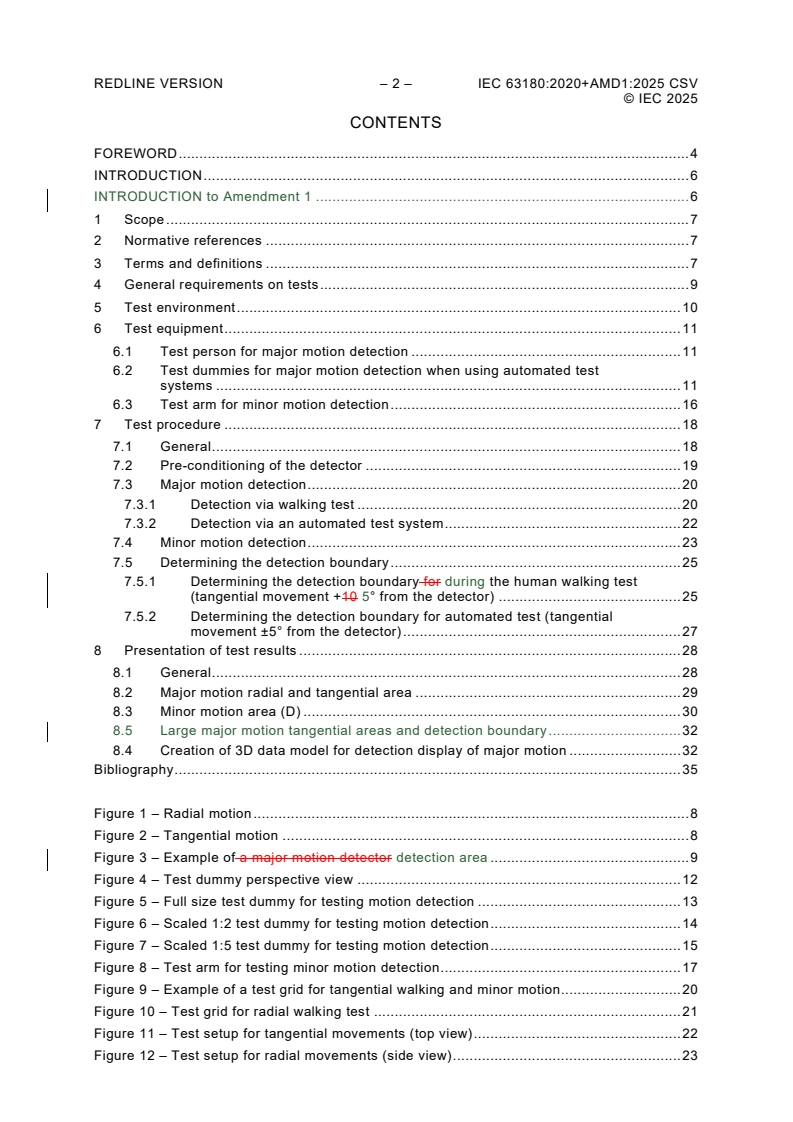
REDLINE VERSION – 2 – IEC 63180:2020+AMD1:2025 CSV
© IEC 2025
CONTENTS
FOREWORD . 4
INTRODUCTION . 6
INTRODUCTION to Amendment 1 . 6
1 Scope . 7
2 Normative references . 7
3 Terms and definitions . 7
4 General requirements on tests . 9
5 Test environment . 10
6 Test equipment . 11
6.1 Test person for major motion detection . 11
6.2 Test dummies for major motion detection when using automated test
systems . 11
6.3 Test arm for minor motion detection . 16
7 Test procedure . 18
7.1 General . 18
7.2 Pre-conditioning of the detector . 19
7.3 Major motion detection . 20
7.3.1 Detection via walking test . 20
7.3.2 Detection via an automated test system . 22
7.4 Minor motion detection . 23
7.5 Determining the detection boundary . 25
7.5.1 Determining the detection boundary for during the human walking test
(tangential movement +10 5° from the detector) . 25
7.5.2 Determining the detection boundary for automated test (tangential
movement ±5° from the detector) . 27
8 Presentation of test results . 28
8.1 General . 28
8.2 Major motion radial and tangential area . 29
8.3 Minor motion area (D) . 30
8.5 Large major motion tangential areas and detection boundary . 32
8.4 Creation of 3D data model for detection display of major motion . 32
Bibliography . 35
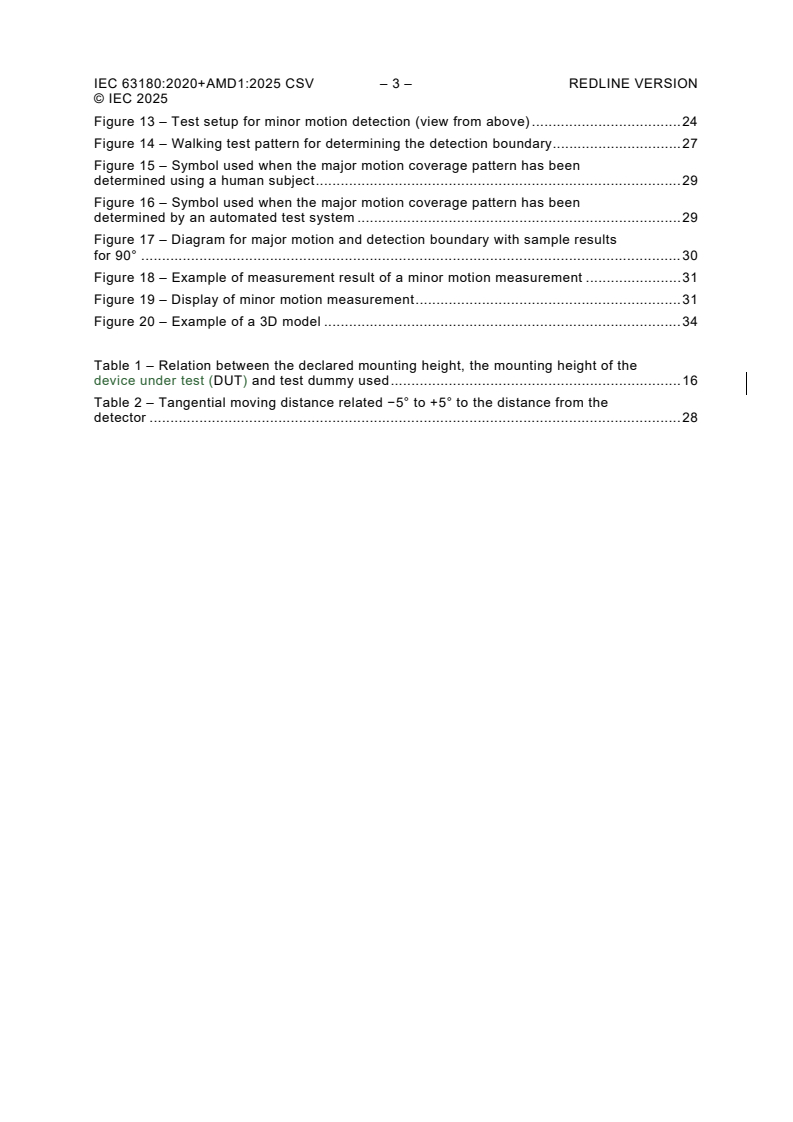
Figure 1 – Radial motion . 8
Figure 2 – Tangential motion . 8
Figure 3 – Example of a major motion detector detection area . 9
Figure 4 – Test dummy perspective view . 12
Figure 5 – Full size test dummy for testing motion detection . 13
Figure 6 – Scaled 1:2 test dummy for testing motion detection . 14
Figure 7 – Scaled 1:5 test dummy for testing motion detection . 15
Figure 8 – Test arm for testing minor motion detection . 17
Figure 9 – Example of a test grid for tangential walking and minor motion. 20
Figure 10 – Test grid for radial walking test . 21
Figure 11 – Test setup for tangential movements (top view) . 22
Figure 12 – Test setup for radial movements (side view) . 23
© IEC 2025
Figure 13 – Test setup for minor motion detection (view from above) . 24
Figure 14 – Walking test pattern for determining the detection boundary. 27
Figure 15 – Symbol used when the major motion coverage pattern has been
determined using a human subject . 29
Figure 16 – Symbol used when the major motion coverage pattern has been
determined by an automated test system . 29
Figure 17 – Diagram for major motion and detection boundary with sample results
for 90° . 30
Figure 18 – Example of measurement result of a minor motion measurement . 31
Figure 19 – Display of minor motion measurement . 31
Figure 20 – Example of a 3D model . 34
Table 1 – Relation between the declared mounting height, the mounting height of the
device under test (DUT) and test dummy used . 16
Table 2 – Tangential moving distance related −5° to +5° to the distance from the
detector . 28
REDLINE VERSION – 4 – IEC 63180:2020+AMD1:2025 CSV
© IEC 2025
INTERNATIONAL ELECTROTECHNICAL COMMISSION
____________
METHODS OF MEASUREMENT AND DECLARATION
OF THE DETECTION RANGE OF DETECTORS –
Passive infrared detectors for major and minor motion detection
FOREWORD
1) The International Electrotechnical Commission (IEC) is a worldwide organization for standardization comprising
all national electrotechnical committees (IEC National Committees). The object of IEC is to promote
international co-operation on all questions concerning standardization in the electrical and electronic fields. To
this end and in addition to other activities, IEC publishes International Standards, Technical Specifications,
Technical Reports, Publicly Available Specifications (PAS) and Guides (hereafter referred to as “IEC
Publication(s)”). Their preparation is entrusted to technical committees; any IEC National Committee interested
in the subject dealt with may participate in this preparatory work. International, governmental and non-
governmental organizations liaising with the IEC also participate in this preparation. IEC collaborates closely
with the International Organization for Standardization (ISO) in accordance with conditions determined by
agreement between the two organizations.
2) The formal decisions or agreements of IEC on technical matters express, as nearly as possible, an international
consensus of opinion on the relevant subjects since each technical committee has representation from all
interested IEC National Committees.
3) IEC Publications have the form of recommendations for international use and are accepted by IEC National
Committees in that sense. While all reasonable efforts are made to ensure that the technical content of IEC
Publications is accurate, IEC cannot be held responsible for the way in which they are used or for any
misinterpretation by any end user.
4) In order to promote international uniformity, IEC National Committees undertake to apply IEC Publications
transparently to the maximum extent possible in their national and regional publications. Any divergence
between any IEC Publication and the corresponding national or regional publication shall be clearly indicated in
the latter.
5) IEC itself does not provide any attestation of conformity. Independent certification bodies provide conformity
assessment services and, in some areas, access to IEC marks of conformity. IEC is not responsible for any
services carried out by independent certification bodies.
6) All users should ensure that they have the latest edition of this publication.
7) No liability shall attach to IEC or its directors, employees, servants or agents including individual experts and
members of its technical committees and IEC National Committees for any personal injury, property damage or
other damage of any nature whatsoever, whether direct or indirect, or for costs (including legal fees) and
expenses arising out of the publication, use of, or reliance upon, this IEC Publication or any other IEC
Publications.
8) Attention is drawn to the Normative references cited in this publication. Use of the referenced publications is
indispensable for the correct application of this publication.
9) IEC draws attention to the possibility that the implementation of this document may involve the use of (a)
patent(s). IEC takes no position concerning the evidence, validity or applicability of any claimed patent rights in
respect thereof. As of the date of publication of this document, IEC had not received notice of (a) patent(s),
which may be required to implement this document. However, implementers are cautioned that this may not
represent the latest information, which may be obtained from the patent database available at
https://patents.iec.ch [and/or] www.iso.org/patents. IEC shall not be held responsible for identifying any or all
such patent rights.
This consolidated version of the official IEC Standard and its amendment has been
prepared for user convenience.
IEC 60730-1 edition 1.1 contains the first edition (2020-06) [documents 23B/1319/FDIS
and 23B/1320/RVD] and its amendment 1 (2025-05) [documents 23B/1491/CDV and
23B/1509A/RVC].
In this Redline version, a vertical line in the margin shows where the technical content
is modified by amendment 1. Additions are in green text, deletions are in strikethrough
red text. A separate Final version with all changes accepted is available in this
publication.
© IEC 2025
International Standard IEC 63180 has been prepared by subcommittee 23B: Plugs, socket-
outlets and switches, of IEC technical committee 23: Electrical accessories.
The text of this International Standard is based on the following documents:
FDIS Report on voting
23B/1319/FDIS 23B/1320/RVD
Full information on the voting for the approval of this International Standard can be found in
the report on voting indicated in the above table.
This document has been drafted in accordance with the ISO/IEC Directives, Part 2.
The committee has decided that the contents of this document and its amendment will remain
unchanged until the stability date indicated on the IEC website under webstore.iec.ch in the
data related to the specific document. At this date, the document will be
• reconfirmed,
• withdrawn, or
• revised.
REDLINE VERSION – 6 – IEC 63180:2020+AMD1:2025 CSV
© IEC 2025
INTRODUCTION
Passive infrared detectors are an important element in an energy efficient building. They allow
for switching on and off and for controlling loads in order to achieve an optimum degree of
comfort and energy efficiency.
The detectors covered in this document are motion detectors using passive infrared (PIR)
technology in electronic control devices and appliance switches whether stand-alone (direct
control of one or more applications) or as part of home and building electronic systems or
building automation control systems (HBES/BACS) or similar. In the case of HBES/BACS, the
resulting action depends on the programming of the relevant HBES/BACS.
The purpose of these detectors is to detect the movement of persons.
Detectors linked to a system may also be assigned other tasks: state reporting, power
consumption, event reporting, scenarios, etc. These additional functions are not part of this
document.
In order to achieve the energy efficiency targets and comfort, the detectors should operate
accurately. In addition, the detection area will need to be provided with sufficient accuracy in
order to allow integrators to choose the correct detectors for the needed action.
This document provides a methodology and test procedures for a manufacturer to declare and
verify the detection performance of these devices with respect to the detection area.
INTRODUCTION to Amendment 1
This amendment includes the following significant technical changes with respect to the base
edition:
a) improvement of general tolerances of the test environment and test equipment;
b) definition of the rotating point of the test arm;
c) addition of the recommended mounting heights for performing the tests;
d) addition of acceleration and deceleration speeds for scaled dummies;
e) modification of the pre-conditioning test at minimum and maximum declared ambient
temperature with new performance criteria;
f) addition of an alternative test procedure for large tangential major motion detection areas.
© IEC 2025
METHODS OF MEASUREMENT AND DECLARATION
OF THE DETECTION RANGE OF DETECTORS –
Passive infrared detectors for major and minor motion detection
1 Scope
This document provides a methodology and test procedures to be able to declare and verify
the detection area for motion detectors using passive infrared technology in electronic control
devices and appliance switches, whether stand-alone (direct control of one or more
applications) or as part of home and building electronic systems or building automation
control systems (HBES/BACS) or similar.
It also provides a uniform way to present the test results.
The purpose of these detectors is to detect the major and minor movements of persons.
2 Normative references
There are no normative references in this document.
3 Terms and definitions
For the purposes of this document, the following terms and definitions apply.
ISO and IEC maintain terminological databases for use in standardization at the following
addresses:
• IEC Electropedia: available at http://www.electropedia.org/
• ISO Online browsing platform: available at http://www.iso.org/obp
3.1
infrared
IR
optical radiation for which the wavelengths in vacuum are longer than those for visible
radiation, that is approximately between 780 nm and 1 mm
[SOURCE: IEC 60050-731:1991, 731-01-05]
3.2
passive infrared detector
electronic detector that measures infrared (IR) light radiating from humans in its field of view
3.3
motion detector
unit detecting motion that can be part of an electronic control device or an appliance switch
Note 1 to entry: "Electronic control device" is used as a general term to cover electronic switches, HBES/BACS
switches and electronic extension units.
3.4
major motion
movement of a person walking into an area or walking within an area
REDLINE VERSION – 8 – IEC 63180:2020+AMD1:2025 CSV
© IEC 2025
3.5
radial motion
motion directly toward the motion detector
EXAMPLE See the example given in Figure 1.
Figure 1 – Radial motion
3.6
tangential motion
motion laterally or obliquely to the motion detector
EXAMPLE See the example given in Figure 2.
Figure 2 – Tangential motion
3.7
minor motion
small movements of a person or a part of a person within an area
Note 1 to entry: Typical examples of minor motion are in working areas, for example, offices, classrooms, meeting
rooms, where the attendance time is long, and the motions of the persons are small (e.g. sitting activities with arm
movements).
Note 2 to entry: Non-standardized terms for a minor motion detector are "presence detector" or "occupancy
detector".
3.8
detection area
surface area in which the detector is specified to detect the motion of a person
EXAMPLE See the example given in Figure 3.
© IEC 2025
Figure 3 – Example of a major motion detector detection area
3.9
non-detection area
surface area where detection is not expected
Note 1 to entry: Although it becomes unlikely that detection of persons will occur, triggering of the detector is not
excluded in this area.
3.10
sensitivity
degree of response of a detector to an incoming signal
Note 1 to entry: Depending on the technology, sensitivity can be adjusted for certain parameters (e.g. range,
amplification of infrared signal).
3.11
delay-time
duration of time from the moment the motion was last detected until the status of the
controlled load is changed
3.12
dead time
time during which the detector is unable to detect after the delay-time and at start up
4 General requirements on tests
Detectors shall be mounted and installed according to the manufacturer's instructions.
Manufacturer's instructions regarding operation shall be applied to all tests, where applicable.
It is allowed to set the delay-time of detectors at minimum setting or in test mode. The
sensitivity is set at maximum.
NOTE 1 A modification of the detector software with a minimum value of 5 s for the delay-time can be necessary
to shorten the test time in total.
During the test, the detectors shall be able to activate the load independently of the light level
in the test room.
The dead time of the detector shall be considered according to the manufacturer's
instructions. The timing of any persons' (dummy) movement and any test arm movement shall
be adjusted accordingly.
Tests according to this document are type tests.
NOTE 2 Type tests are defined in IEC 60050-581:2008, 581-21-08.
REDLINE VERSION – 10 – IEC 63180:2020+AMD1:2025 CSV
© IEC 2025
For detectors installed in an HBES/BACS, a minimum configuration is built to test the
performance of the detectors. The digital output signal is monitored to verify the activation of
the detectors or a load can be switched in the HBES/BACS. In the latter case the dead time of
the HBES/BACS shall be taken into consideration.
The major motion test can be executed via a human walking test or via an automated test
system as described in this document. For more repeatable measurements it is recommended
to use the automated test procedure.
5 Test environment
The general ambient conditions in the test room shall be as follows:
– temperature 18 °C to 23 °C;
– relative humidity maximum 70 % RH.
The size of the room shall be large enough in order not to influence the test result.
The walls of the test room, if located within the coverage area of the detector, shall not
influence the result.
NOTE 1 This can be achieved by covering the detection area of the detector towards the wall or by covering the
wall with a coating or a curtain.
During the tests, air movement (for example, air-conditioning) shall not affect the results; and
the walls, floor and ceilings shall have a negligible effect on the reflection in the infrared
range.
The room shall be a closed room and daylight entrance shall be limited. Direct sunlight on the
test area is not allowed.
The use of artificial light shall not contain an IR component.
NOTE 2 Artificial light without an IR component can be achieved using LED technology.
The supply voltage to the detector shall meet the following requirements:
– voltage stability ±3 %;
– frequency stability ±2 %;
– total harmonic distortion 5 %.
The temperature measurements shall be taken at 1,7 m ± 5 cm height from the floor. The
temperature measurement shall be performed as close as possible to the centre of the
expected detection area.
The temperature of walls, ceiling and floor of the test room shall be allowed to stabilize prior
to testing.
NOTE 3 It can be required to set the test room temperature several hours prior to testing.
The test room temperature and the temperature of the walls, ceiling and floor shall be stable
within a tolerance of ±2 K during the tests within a tolerance of:
– ±2 K for manual tests;
– ±1,5 K for automated tests.
© IEC 2025
When using test dummies and test arms to perform the tests, the difference between the
temperature of these tools and that of the test room shall be stable during the tests within a
tolerance of ±2 K.
There shall be no other people or moving objects in the coverage area.
6 Test equipment
6.1 Test person for major motion detection
The test person shall meet the following criteria:
– height: 1,7 m ± 10 cm;
– weight: 70 kg ± 10 kg.
The test person shall be dressed in tight fitting clothes with the hands and head exposed (e.g.
bicycling clothes, running clothes) in such a way that, when measured with infrared camera on
one point of the body, in the vicinity of the belly button, the test person achieves a
temperature average of 7 K ± 2 K above the ambient temperature of the room.
NOTE The 7 K delta value was found to be the average surface temperature of people with only the head and
hands exposed.
6.2 Test dummies for major motion detection when using automated test systems
For testing the detection area, a test dummy as given in Figure 4 shall be used.
REDLINE VERSION – 12 – IEC 63180:2020+AMD1:2025 CSV
© IEC 2025
Figure 4 – Test dummy perspective view
For detectors with an installation height up to and including 3 m, a full-size test dummy as
given in Figure 5 shall be used. Providing that a sufficiently large testing room is available, a
full-size dummy can also be used for testing higher installation heights. If the test room is not
large enough, smaller test dummies can be used as given in Figure 6 and Figure 7, and shall
be chosen according to Table 1.
© IEC 2025
Dimensions in millimetres (tolerance ± 3 mm)
The temperature of the zone between the head and the shoulders, within 50 mm, is undefined.
Figure 5 – Full size test dummy for testing motion detection
REDLINE VERSION – 14 – IEC 63180:2020+AMD1:2025 CSV
© IEC 2025
Dimensions in millimetres (tolerance ± 3 mm)
The temperature of the zone between the head and the shoulders, within 30 mm, is undefined.
Figure 6 – Scaled 1:2 test dummy for testing motion detection
© IEC 2025
Dimensions in millimetres (tolerance ± 3 mm)
The temperature of the zone between the head and the shoulders, within 20 mm, is undefined.
Figure 7 – Scaled 1:5 test dummy for testing motion detection
The test dummies are built in accordance with Figure 5 to Figure 7. The temperature of each
zone (head, body and legs) can be controlled separately as follows:
The head is heated to a temperature of 14 K ± 1 K above the ambient temperature of the test
room.
The body and legs are heated to a temperature of (7 K ± 1) K above the ambient temperature
of the test room.
NOTE The shoulders are part of the body.
All test sides of the dummies shall be heated except the back side and the bottom side, which
are is not relevant for the test.
The temperature of the surface for each zone of the dummy shall be homogeneous and the
spread shall be ≤ 1,5 K.
NOTE The dummy can be made of aluminium, painted black and heated by heating plates
placed inside the dummy.
The temperature of the dummy shall be stable within 1 K for a minimum of 10 min prior to
testing and for the duration of the tests.
Stability can be verified by measuring the temperature during the test at one reference point
at each zone.
The weight of the test dummy is irrelevant.
REDLINE VERSION – 16 – IEC 63180:2020+AMD1:2025 CSV
© IEC 2025
A full size dummy can be used for testing real installation height, providing that a sufficiently
large testing room is available; otherwise, for testing different mounting heights or simulated
mounting heights, the test dummy shall be chosen according Table 1.
Table 1 – Relation between the declared mounting height,
the mounting height of the device under test (DUT) and test dummy used
Declared mounting Mounting height of the Test dummy used
height of the DUT (H) DUT during the test
0,9 m to 15 m H Figure 5: Scale 1:1
Above 3 m up to and H/2 Figure 6: Scale 1:2
including 6 m
Above 6 m up to and H/5 Figure 7: Scale 1:5
including 15 m
6.3 Test arm for minor motion detection
The test arm to be used for the minor motion detection test shall be a robotic arm with
dimensions (76 mm × 76 mm × 380 mm) ±2 mm, mounted at a height of 750 mm ± 20 mm
above the ground reference level.
For manual tests the reference level is the floor.
For automated tests the reference level is the mounting surface of the test dummy as given in
Figure 4.
NOTE The test arm can be made of aluminium, painted black and heated by heating plates
placed inside the test arm.
The height is measured from the centre of the horizontal axis.
The test arm shall be able to move at a velocity of 90°/s.
The test arm shall be able to rotate in the horizontal x-y axis anticlockwise for 90°, followed by
a vertical y-z axis movement upwards and back to the starting position following the same
path as given in Figure 8.
The rotating point of the test arm is placed between 0 mm and 60 mm behind the heated parts
of the test arm.
In order To simplify the test equipment, it is allowed permitted to perform the test separately
in a horizontal and a vertical plane. When using this approach, the test arm can be built to
cover separately the horizontal and vertical plane planes separately.
© IEC 2025
Figure 8 – Test arm for testing minor motion detection
During the test, the temperature of all sides of the test arm (except rotating axis and/or back
area that is not relevant) shall be (14 K ± 1) K above the ambient temperature of the test
room.
The temperature of the test arm shall be stable within 1 K for a minimum of 10 min prior to
and during the tests.
Stability can be verified by measuring the temperature during the test at one reference point.
REDLINE VERSION – 18 – IEC 63180:2020+AMD1:2025 CSV
© IEC 2025
7 Test procedure
7.1 General
The test procedure defines the following tests:
– major motion detection;
– minor motion detection;
– detection boundary.
The tests that are applicable depend on the type of detector.
The detectors shall be installed according to the manufacturer's instructions.
A ceiling mounted detector is mounted on a horizontal mounting plate and a wall mounted
detector is mounted on a vertical mounting plate.
The mounting plate for detectors is fixed to a turntable for automated test systems.
For a ceiling mounted detector, the mounting height:
– for the human walking test is the distance between the floor and the mounting plate on
which the detector is mounted;
– for automated test systems is the distance between the top of the test dummy's mounting
plate and the mounting plate on which the detector is mounted.
For a wall mounted detector and for all other mounting types, the mounting height:
– for the human walking test is the distance between the floor and the centre of the lens of
the detector;
– for automated test systems is the distance between the top of the test dummy's mounting
plate and the centre of the lens of the detector.
For all other mounting types, the mounting height is the distance between the top of the test
dummy’s mounting plate and the centre of the lens of the detector.
The turntable, if any, shall not move or turn when the test person or dummy moves.
The detector shall be mounted at a height as declared by the manufacturer in the technical
documentation. For the automated test procedure, the use of a scaled dummy allows
installing the detector at a scaled height corresponding to Table 1.
In the event that the manufacturer declares a range of mounting heights in the technical
documentation, the mounting height used during the test shall be within that range.
It is recommended to use the following mounting heights during the tests, if these are within
the ranges defined by the manufacturer:
– for ceiling mounted detectors, the standard mounting height of the DUT is 2,5 m. Other
mounting heights may be tested in addition.
– for wall mounted detectors the standard mounting height of the DUT is:
• 1,1 m for detectors to be mounted in installation boxes replacing, for example,
switches;
• 2,5 m for all other types of detectors, for example, independent surface mounted
detectors for indoors or outdoors.
The mounting height shall not be changed during the whole measurement time.
© IEC 2025
The tests may be repeated at least at minimum and maximum mounting heights within the
declared range.
In the case of automated tests and for testing different mounting heights, the tests can be
performed at one mounting height and the test dummies can be chosen as given in Table 1.
Before starting the test, the test dummy for the automated test or the test arm need to be
brought to the correct temperature and the detector is energized with sufficient time to reflect
normal operation.
Ceiling mounted detectors are tested in a full 360° circle. Orientation with respect to the 0°
line shall be recorded in the test report for detectors.
For wall mounted detectors the maximum angle according to the manufacturer's instructions
shall be used.
If the room is not large enough to cover the complete expected detection range, a specific
segment can be drawn, and the detector shall be rotated to test each segment to cover the
complete range.
When performing the tests, the dead time of the detector shall be taken into account.
When moving the test dummy for automated test systems the following three bullet point list
items shall be fulfilled:
– the moving speed shall be:
• for the full-size test dummy, 1 m/s with a tolerance of ±0,1 m/s.
• for the scaled 1:2 test dummy, 0,5 m/s with a tolerance of ±0,05 m/s.
• for the scaled 1:5 test dummy, 0,2 m/s with a tolerance of ±0,02 m/s.
– the acceleration shall be:
2 2
• for the full-size test dummy, 0,8 m/s with a tolerance of ±0,1 m/s .
2 2
• for the scaled 1:2 test dummy, 0,4 m/s with a tolerance of ±0,05 m/s .
2 2
• for the scaled 1:5 test dummy, 0,16 m/s with a tolerance of ±0,02 m/s .
– the deceleration shall be:
2 2
with a tolerance of ±0,1 m/s .
• for the full-size test dummy, 1,5 m/s
2 2
• for the scaled 1:2 test dummy, 0,75 m/s with a tolerance of ±0,05 m/s .
2 2
• for the scaled 1:5 test dummy, 0,3 m/s with a tolerance of ±0,02 m/s .
NOTE For scaled dummies, the acceleration and deceleration values and tolerances are under consideration.
7.2 Pre-conditioning of the detector
To ensure that the detector DUT does not false trigger during the test, the following procedure
shall be followed.
The detector DUT is placed in an enclosure such that it is shielded from all external triggering
influences such as air drafts, electromagnetic fields, and mains disturbances. The supply
voltage and the climatic conditions within the enclosure shall comply with Clause 5.
The test is performed at the minimum and maximum ambient temperature declared by the
manufacturer.
No evaluation is made during the temperature change.
REDLINE VERSION – 20 – IEC 63180:2020+AMD1:2025 CSV
© IEC 2025
Before closing the enclosure, the threshold of the detector (if any) is set to maximum
sensitivity to reflect the worst case. The detector is energized, and the proper functioning of
the detector is checked.
The detector sensing activity is monitored for at least 12 24 h.
During the each monitored period, no detection the number of false triggers shall be
measured maximum 2.
7.3 Major motion detection
7.3.1 Detection via walking test
7.3.1.1 Tangential motion within the detection area (movement 1 m)
Tangential motion testing according to this Subclause 7.3.1 is limited to 400 measurements,
for example, 20 m × 20 m.
For larger areas the detection area is defined following the procedure of 7.5, using the
performance criteria as defined in 8.5 for large major motion detection areas.
A grid with cells of 1 m × 1 m as shown in Figure 9 is drawn on the floor of the test room.
Figure 9 – Example of a test grid for tangential walking and minor motion
The test person starts at a grid area outside of the expected operating range.
The test person shall stand with arms close to the body, at the border of the cell.
The test person shall then take 2 steps within the cell in a tangential direction in relation to
the detector, to cover a distance of 1 m through the centre point of the cell.
© IEC 2025
After 1 s, the test person returns backwards to the start position on the same line. The arms
shall remain close to the body when performing the test.
The test shall be performed within maximum 4 s. If the detection is positive, the cell on the
grid map is marked as given in 8.2 (area B of Figure 17). If the result is not positive, the test
is repeated one more time. If still no detection occurs, the cell on the grid map shall be left
blank.
The above procedure shall be repeated in the next cell taking the dead time of the detector
into consideration. The grid shall be checked completely, excluding the minor motion area.
7.3.1.2 Radial motion within the detection area
Lines are drawn on the floor from the detector to outside of the detection area for each 10° as
shown in Figure 10.
Figure 10 – Test grid for radial walking test
The test person starts outside of the expected operating range at 0°.
The test person shall walk as straight as possible, radially towards the detector at a speed of
1 m/s ± 0,2 m/s. The arms shall remain close to the body when walking.
On detection the test person stops.
The distance towards the detector is recorded.
The procedure is then repeated once twice. The average value of the two three
measurements recorded shall be marked according to 8.2 (area C of Figure 17).
REDLINE VERSION – 22 – IEC 63180:2020+AMD1:2025 CSV
© IEC 2025
The procedure shall be repeated for each 10° of the detection area. No larger angles are
allowed.
The test can be made using smaller angles for higher resolution, such as 5°.
7.3.2 Detection via an automated test system
7.3.2.1 Tangential motion within the detection area (movement 1 m)
The test setup is given for information. Any other automated test setup can be used providing
identical results are obtained.
Tangential motion testing according to this Subclause 7.3.2 is limited to 400 measurements,
e.g., 20 m × 20 m.
For larger areas the detection area is defined following the procedure of 7.5, using the
performance criteria as defined in 8.5 for large major motion detection areas.
The test setup according to this document shall be built according to Figure 11 to be able to
measure all the grid cells given in Figure 9.
Figure 11 – Test setup for tangential movements (top view)
The test setup shall be built so that the test dummy can be moved between positions 1 and 2
according to Figure 11. The span shall be 1 m, centred towards the detector and the grid cell.
The test dummy is positioned on the mounting plate so that the side area is facing the
detector.
The test dummy is placed at a starting position 1 to cover a specific grid cell outside the
expected detection distance.
The test dummy shall be moved for 1 m from position 1 to position 2 and it shall stay at this
point for approximately 1 s and then return backwards to position 1.
If no detection is registered during the above test, the test is repeated once. The result is
recorded.
If the detection is positive, the cell on the grid map is marked as given in 8.2 (area B of
Figure 17). If the result is not positive, the test is repeated. If still no detection occurs, the cell
on the grid map shall be left blank.
Then the turntable moves to cover the next grid cell closer to the detector and the test is
repeated.
The grid is checked completely excluding the minor motion area.
© IEC 2025
The detection is marked on a grid diagram as given in 8.2 (area B of Figure 17).
If no detection occurs, the cell on the grid map shall be left blank.
The grid is checked completely. The area covered by the minor motion tests can be omitted to
reduce test time. When using a scaled dummy, the grid sizes shall be calculated accordingly.
The span for tangential movements will reduce from 1 m to 0,5 m when using the 1:2 test
dummy or from 1 m to 0,2 m when using the 1:5 test dummy.
7.3.2.2 Radial motion within the detection area
The test setup is given for information. Any other automated test setup can be used providing
identical results are obtained.
The test setup according to this document shall be built according to Figure 12.
Figure 12 – Test setup for radial movements (side view)
The test setup shall be built so that the test dummy can be moved between position 1 and
position 2 towards the detector.
The test dummy is positioned on the mounting plate so that the front area is facing the
detector.
The test dummy is placed at a starting position outside the expected detection distance.
The test dummy shall be moved between position 1 and position 2 until detection occurs. This
is repeated once done three times, and the average value is recorded.
The detection is marked on a polar diagram as given in 8.2 (area C of Figure 17).
The turntable turns 10° to the next measured angle and the procedure is repeated until the
complete detection range is covered as given in Figure 10.
7.4 Minor motion detection
The minor motion tests shall be performed in a pattern of maximum 1 m × 1 m for detectors
, or maximum 0,5 m × 0,5 m for detectors with a presence range
with presence range > 25 m
≤ 25 m as given in Figure 9. No grid with larger cells is allowed. The permitted grid size shall
be 1 m/n (n = 1,2,5).The test shall be carried out with the grid described in 7.3.1.1.
The test can be carried out using a smaller grid for higher resolution, such as with
50 cm × 50 cm cells.
REDLINE VERSION – 24 – IEC 63180:2020+AMD1:2025 CSV
© IEC 2025
The test setup shall be according to Figure 13.
Figure 13 – Test setup for minor motion detection (view from above)
The test arm is positioned within the grid cell in such a way that the pivot point for the
horizontal movement is in the middle of the grid cell, the test arm in the starting position is in
a horizontal plane and pointing towards the detector as given in position 1. The test arm
assembly shall not be changed during the test.
To cover all positions in the detection area, the detector or the test arm shall be movable.
With this approach, each position in the grid can be covered.
The test arm shall move at a velocity of 90°/s. In order not to influence the test results the test
person shall leave the test area.
The test arm shall be moved first in the horizontal plane anticlockwise for 90° towards
position 2, from this end position it will pause for 1 s, then it shall be moved in a vertical
direction upwards for 90° towards position 3, pause for 1 s, and then it shall return to the
starting posi
...
IEC 63180 ®
Edition 1.0 2020-06
INTERNATIONAL
STANDARD
NORME
INTERNATIONALE
colour
inside
Methods of measurement and declaration of the detection range of detectors –
Passive infrared detectors for major and minor motion detection
Méthodes de mesure et qualification de la plage de détection des détecteurs –
Détecteurs infrarouges passifs pour la détection de mouvements de forte
et de faible amplitude
All rights reserved. Unless otherwise specified, no part of this publication may be reproduced or utilized in any form
or by any means, electronic or mechanical, including photocopying and microfilm, without permission in writing from
either IEC or IEC's member National Committee in the country of the requester. If you have any questions about IEC
copyright or have an enquiry about obtaining additional rights to this publication, please contact the address below or
your local IEC member National Committee for further information.
Droits de reproduction réservés. Sauf indication contraire, aucune partie de cette publication ne peut être reproduite
ni utilisée sous quelque forme que ce soit et par aucun procédé, électronique ou mécanique, y compris la photocopie
et les microfilms, sans l'accord écrit de l'IEC ou du Comité national de l'IEC du pays du demandeur. Si vous avez des
questions sur le copyright de l'IEC ou si vous désirez obtenir des droits supplémentaires sur cette publication, utilisez
les coordonnées ci-après ou contactez le Comité national de l'IEC de votre pays de résidence.
IEC Central Office Tel.: +41 22 919 02 11
3, rue de Varembé info@iec.ch
CH-1211 Geneva 20 www.iec.ch
Switzerland
About the IEC
The International Electrotechnical Commission (IEC) is the leading global organization that prepares and publishes
International Standards for all electrical, electronic and related technologies.
About IEC publications
The technical content of IEC publications is kept under constant review by the IEC. Please make sure that you have the
latest edition, a corrigendum or an amendment might have been published.
IEC publications search - webstore.iec.ch/advsearchform Electropedia - www.electropedia.org
The advanced search enables to find IEC publications by a The world's leading online dictionary on electrotechnology,
variety of criteria (reference number, text, technical containing more than 22 000 terminological entries in English
committee,…). It also gives information on projects, replaced and French, with equivalent terms in 16 additional languages.
and withdrawn publications. Also known as the International Electrotechnical Vocabulary
(IEV) online.
IEC Just Published - webstore.iec.ch/justpublished
Stay up to date on all new IEC publications. Just Published IEC Glossary - std.iec.ch/glossary
details all new publications released. Available online and 67 000 electrotechnical terminology entries in English and
once a month by email. French extracted from the Terms and Definitions clause of
IEC publications issued since 2002. Some entries have been
IEC Customer Service Centre - webstore.iec.ch/csc collected from earlier publications of IEC TC 37, 77, 86 and
If you wish to give us your feedback on this publication or CISPR.
need further assistance, please contact the Customer Service
Centre: sales@iec.ch.
A propos de l'IEC
La Commission Electrotechnique Internationale (IEC) est la première organisation mondiale qui élabore et publie des
Normes internationales pour tout ce qui a trait à l'électricité, à l'électronique et aux technologies apparentées.
A propos des publications IEC
Le contenu technique des publications IEC est constamment revu. Veuillez vous assurer que vous possédez l’édition la
plus récente, un corrigendum ou amendement peut avoir été publié.
Recherche de publications IEC - Electropedia - www.electropedia.org
webstore.iec.ch/advsearchform Le premier dictionnaire d'électrotechnologie en ligne au
La recherche avancée permet de trouver des publications IEC monde, avec plus de 22 000 articles terminologiques en
en utilisant différents critères (numéro de référence, texte, anglais et en français, ainsi que les termes équivalents dans
comité d’études,…). Elle donne aussi des informations sur les 16 langues additionnelles. Egalement appelé Vocabulaire
projets et les publications remplacées ou retirées. Electrotechnique International (IEV) en ligne.
IEC Just Published - webstore.iec.ch/justpublished Glossaire IEC - std.iec.ch/glossary
Restez informé sur les nouvelles publications IEC. Just 67 000 entrées terminologiques électrotechniques, en anglais
Published détaille les nouvelles publications parues. et en français, extraites des articles Termes et Définitions des
Disponible en ligne et une fois par mois par email. publications IEC parues depuis 2002. Plus certaines entrées
antérieures extraites des publications des CE 37, 77, 86 et
Service Clients - webstore.iec.ch/csc CISPR de l'IEC.
Si vous désirez nous donner des commentaires sur cette
publication ou si vous avez des questions contactez-nous:
sales@iec.ch.
IEC 63180 ®
Edition 1.0 2020-06
INTERNATIONAL
STANDARD
NORME
INTERNATIONALE
colour
inside
Methods of measurement and declaration of the detection range of detectors –
Passive infrared detectors for major and minor motion detection
Méthodes de mesure et qualification de la plage de détection des détecteurs –
Détecteurs infrarouges passifs pour la détection de mouvements de forte
et de faible amplitude
INTERNATIONAL
ELECTROTECHNICAL
COMMISSION
COMMISSION
ELECTROTECHNIQUE
INTERNATIONALE
ICS 29.120.40 ISBN 978-2-8322-8525-1
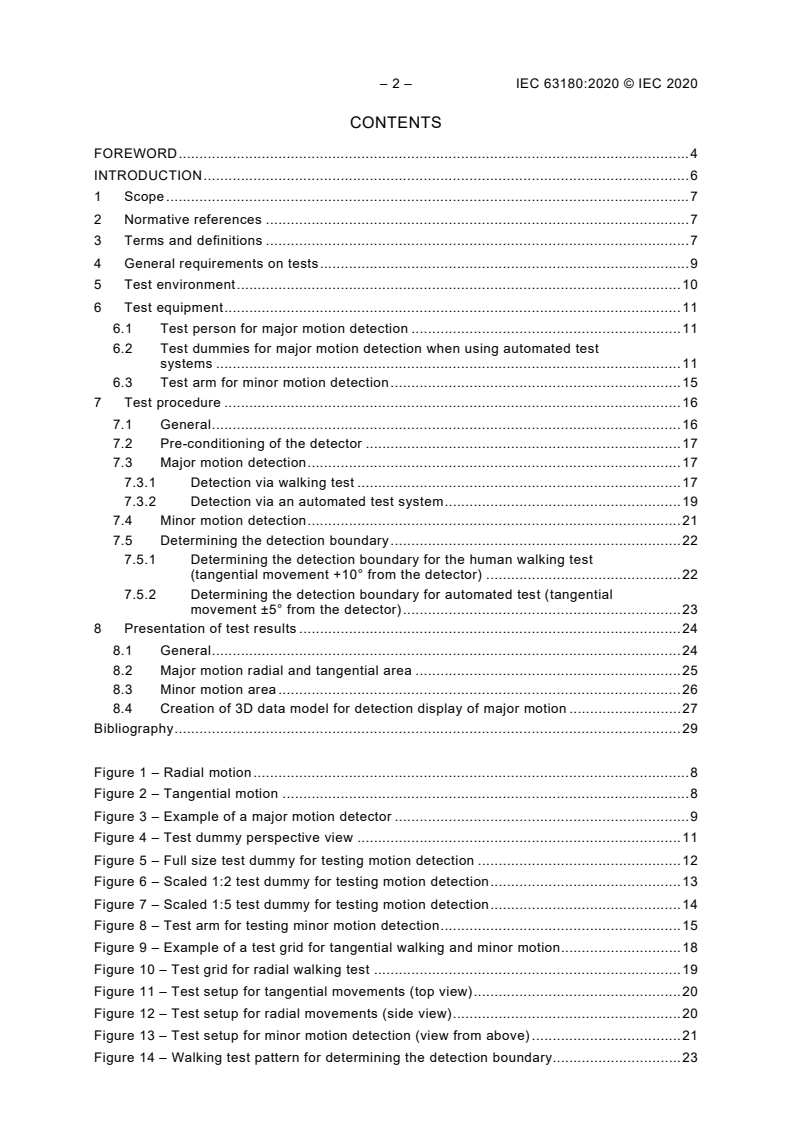
– 2 – IEC 63180:2020 © IEC 2020
CONTENTS
FOREWORD . 4
INTRODUCTION . 6
1 Scope . 7
2 Normative references . 7
3 Terms and definitions . 7
4 General requirements on tests . 9
5 Test environment . 10
6 Test equipment . 11
6.1 Test person for major motion detection . 11
6.2 Test dummies for major motion detection when using automated test
systems . 11
6.3 Test arm for minor motion detection . 15
7 Test procedure . 16
7.1 General . 16
7.2 Pre-conditioning of the detector . 17
7.3 Major motion detection . 17
7.3.1 Detection via walking test . 17
7.3.2 Detection via an automated test system . 19
7.4 Minor motion detection . 21
7.5 Determining the detection boundary . 22
7.5.1 Determining the detection boundary for the human walking test
(tangential movement +10° from the detector) . 22
7.5.2 Determining the detection boundary for automated test (tangential
movement ±5° from the detector) . 23
8 Presentation of test results . 24
8.1 General . 24
8.2 Major motion radial and tangential area . 25
8.3 Minor motion area . 26
8.4 Creation of 3D data model for detection display of major motion . 27
Bibliography . 29
Figure 1 – Radial motion . 8
Figure 2 – Tangential motion . 8
Figure 3 – Example of a major motion detector . 9
Figure 4 – Test dummy perspective view . 11
Figure 5 – Full size test dummy for testing motion detection . 12
Figure 6 – Scaled 1:2 test dummy for testing motion detection . 13
Figure 7 – Scaled 1:5 test dummy for testing motion detection . 14
Figure 8 – Test arm for testing minor motion detection . 15
Figure 9 – Example of a test grid for tangential walking and minor motion. 18
Figure 10 – Test grid for radial walking test . 19
Figure 11 – Test setup for tangential movements (top view) . 20
Figure 12 – Test setup for radial movements (side view) . 20
Figure 13 – Test setup for minor motion detection (view from above) . 21
Figure 14 – Walking test pattern for determining the detection boundary. 23
Figure 15 – Symbol used when the major motion coverage pattern has been
determined using a human subject . 24
Figure 16 – Symbol used when the major motion coverage pattern has been
determined by an automated test system . 25
Figure 17 – Diagram for major motion and detection boundary with sample results for 90° . 26
Figure 18 – Example of measurement result of a minor motion measurement . 27
Figure 19 – Display of minor motion measurement . 27
Figure 20 – Example of a 3D model . 28
Table 1 – Relation between the declared mounting height, the mounting height of the
DUT and test dummy used . 15
Table 2 – Tangential moving distance related −5° to +5° to the distance from the
detector . 24
– 4 – IEC 63180:2020 © IEC 2020
INTERNATIONAL ELECTROTECHNICAL COMMISSION
____________
METHODS OF MEASUREMENT AND DECLARATION
OF THE DETECTION RANGE OF DETECTORS –
Passive infrared detectors for major and minor motion detection
FOREWORD
1) The International Electrotechnical Commission (IEC) is a worldwide organization for standardization comprising
all national electrotechnical committees (IEC National Committees). The object of IEC is to promote
international co-operation on all questions concerning standardization in the electrical and electronic fields. To
this end and in addition to other activities, IEC publishes International Standards, Technical Specifications,
Technical Reports, Publicly Available Specifications (PAS) and Guides (hereafter referred to as “IEC
Publication(s)”). Their preparation is entrusted to technical committees; any IEC National Committee interested
in the subject dealt with may participate in this preparatory work. International, governmental and non-
governmental organizations liaising with the IEC also participate in this preparation. IEC collaborates closely
with the International Organization for Standardization (ISO) in accordance with conditions determined by
agreement between the two organizations.
2) The formal decisions or agreements of IEC on technical matters express, as nearly as possible, an international
consensus of opinion on the relevant subjects since each technical committee has representation from all
interested IEC National Committees.
3) IEC Publications have the form of recommendations for international use and are accepted by IEC National
Committees in that sense. While all reasonable efforts are made to ensure that the technical content of IEC
Publications is accurate, IEC cannot be held responsible for the way in which they are used or for any
misinterpretation by any end user.
4) In order to promote international uniformity, IEC National Committees undertake to apply IEC Publications
transparently to the maximum extent possible in their national and regional publications. Any divergence
between any IEC Publication and the corresponding national or regional publication shall be clearly indicated in
the latter.
5) IEC itself does not provide any attestation of conformity. Independent certification bodies provide conformity
assessment services and, in some areas, access to IEC marks of conformity. IEC is not responsible for any
services carried out by independent certification bodies.
6) All users should ensure that they have the latest edition of this publication.
7) No liability shall attach to IEC or its directors, employees, servants or agents including individual experts and
members of its technical committees and IEC National Committees for any personal injury, property damage or
other damage of any nature whatsoever, whether direct or indirect, or for costs (including legal fees) and
expenses arising out of the publication, use of, or reliance upon, this IEC Publication or any other IEC
Publications.
8) Attention is drawn to the Normative references cited in this publication. Use of the referenced publications is
indispensable for the correct application of this publication.
9) Attention is drawn to the possibility that some of the elements of this IEC Publication may be the subject of
patent rights. IEC shall not be held responsible for identifying any or all such patent rights.
International Standard IEC 63180 has been prepared by subcommittee 23B: Plugs, socket-
outlets and switches, of IEC technical committee 23: Electrical accessories.
The text of this International Standard is based on the following documents:
FDIS Report on voting
23B/1319/FDIS 23B/1320/RVD
Full information on the voting for the approval of this International Standard can be found in
the report on voting indicated in the above table.
This document has been drafted in accordance with the ISO/IEC Directives, Part 2.
The committee has decided that the contents of this document will remain unchanged until the
stability date indicated on the IEC website under "http://webstore.iec.ch" in the data related to
the specific document. At this date, the document will be
• reconfirmed,
• withdrawn,
• replaced by a revised edition, or
• amended.
IMPORTANT – The 'colour inside' logo on the cover page of this publication indicates
that it contains colours which are considered to be useful for the correct
understanding of its contents. Users should therefore print this document using a
colour printer.
– 6 – IEC 63180:2020 © IEC 2020
INTRODUCTION
Passive infrared detectors are an important element in an energy efficient building. They allow
for switching on and off and for controlling loads in order to achieve an optimum degree of
comfort and energy efficiency.
The detectors covered in this document are motion detectors using passive infrared (PIR)
technology in electronic control devices and appliance switches whether stand-alone (direct
control of one or more applications) or as part of home and building electronic systems or
building automation control systems (HBES/BACS) or similar. In the case of HBES/BACS, the
resulting action depends on the programming of the relevant HBES/BACS.
The purpose of these detectors is to detect the movement of persons.
Detectors linked to a system may also be assigned other tasks: state reporting, power
consumption, event reporting, scenarios, etc. These additional functions are not part of this
document.
In order to achieve the energy efficiency targets and comfort, the detectors should operate
accurately. In addition, the detection area will need to be provided with sufficient accuracy in
order to allow integrators to choose the correct detectors for the needed action.
This document provides a methodology and test procedures for a manufacturer to declare and
verify the detection performance of these devices with respect to the detection area.
METHODS OF MEASUREMENT AND DECLARATION
OF THE DETECTION RANGE OF DETECTORS –
Passive infrared detectors for major and minor motion detection
1 Scope
This document provides a methodology and test procedures to be able to declare and verify
the detection area for motion detectors using passive infrared technology in electronic control
devices and appliance switches, whether stand-alone (direct control of one or more
applications) or as part of home and building electronic systems or building automation
control systems (HBES/BACS) or similar.
It also provides a uniform way to present the test results.
The purpose of these detectors is to detect the major and minor movements of persons.
2 Normative references
There are no normative references in this document.
3 Terms and definitions
For the purposes of this document, the following terms and definitions apply.
ISO and IEC maintain terminological databases for use in standardization at the following
addresses:
• IEC Electropedia: available at http://www.electropedia.org/
• ISO Online browsing platform: available at http://www.iso.org/obp
3.1
infrared
IR
optical radiation for which the wavelengths in vacuum are longer than those for visible
radiation, that is approximately between 780 nm and 1 mm
[SOURCE: IEC 60050-731:1991, 731-01-05]
3.2
passive infrared detector
electronic detector that measures infrared (IR) light radiating from humans in its field of view
3.3
motion detector
unit detecting motion that can be part of an electronic control device or an appliance switch
Note 1 to entry: "Electronic control device" is used as a general term to cover electronic switches, HBES/BACS
switches and electronic extension units.
3.4
major motion
movement of a person walking into an area or walking within an area
– 8 – IEC 63180:2020 © IEC 2020
3.5
radial motion
motion directly toward the motion detector
EXAMPLE See the example given in Figure 1.
Figure 1 – Radial motion
3.6
tangential motion
motion laterally or obliquely to the motion detector
EXAMPLE See the example given in Figure 2.
Figure 2 – Tangential motion
3.7
minor motion
small movements of a person or a part of a person within an area
Note 1 to entry: Typical examples of minor motion are in working areas, for example, offices, classrooms, meeting
rooms, where the attendance time is long, and the motions of the persons are small (e.g. sitting activities with arm
movements).
Note 2 to entry: Non-standardized terms for a minor motion detector are "presence detector" or "occupancy
detector".
3.8
detection area
surface area in which the detector is specified to detect the motion of a person
EXAMPLE See the example given in Figure 3.
Figure 3 – Example of a major motion detector
3.9
non-detection area
surface area where detection is not expected
Note 1 to entry: Although it becomes unlikely that detection of persons will occur, triggering of the detector is not
excluded in this area.
3.10
sensitivity
degree of response of a detector to an incoming signal
Note 1 to entry: Depending on the technology, sensitivity can be adjusted for certain parameters (e.g. range,
amplification of infrared signal).
3.11
delay-time
duration of time from the moment the motion was last detected until the status of the
controlled load is changed
3.12
dead time
time during which the detector is unable to detect after the delay-time and at start up
4 General requirements on tests
Detectors shall be mounted and installed according to the manufacturer's instructions.
Manufacturer's instructions regarding operation shall be applied to all tests, where applicable.
It is allowed to set the delay-time of detectors at minimum setting or in test mode. The
sensitivity is set at maximum.
NOTE A modification of the detector software with a minimum value of 5 s for the delay-time can be necessary to
shorten the test time in total.
During the test, the detectors shall be able to activate the load independently of the light level
in the test room.
The dead time of the detector shall be considered according to the manufacturer's
instructions. The timing of any persons' (dummy) movement and any test arm movement shall
be adjusted accordingly.
Tests according to this document are type tests.
NOTE Type tests are defined in IEC 60050-581:2008, 581-21-08.
– 10 – IEC 63180:2020 © IEC 2020
For detectors installed in an HBES/BACS, a minimum configuration is built to test the
performance of the detectors. The digital output signal is monitored to verify the activation of
the detectors or a load can be switched in the HBES/BACS. In the latter case the dead time of
the HBES/BACS shall be taken into consideration.
The major motion test can be executed via a human walking test or via an automated test
system as described in this document.
5 Test environment
The general ambient conditions in the test room shall be as follows:
– temperature 18 °C to 23 °C;
– relative humidity maximum 70 % RH.
The size of the room shall be large enough in order not to influence the test result.
The walls of the test room, if located within the coverage area of the detector, shall not
influence the result.
NOTE This can be achieved by covering the detection area of the detector towards the wall or by covering the
wall with a coating or a curtain.
During the tests, air movement (for example, air-conditioning) shall not affect the results; and
the walls, floor and ceilings shall have a negligible effect on the reflection in the infrared
range.
The room shall be a closed room and daylight entrance shall be limited. Direct sunlight on the
test area is not allowed.
The use of artificial light shall not contain an IR component.
NOTE Artificial light without an IR component can be achieved using LED technology.
The supply voltage to the detector shall meet the following requirements:
– voltage stability ±3 %;
– frequency stability ±2 %;
– total harmonic distortion 5 %.
The temperature measurements shall be taken at 1,7 m ± 5 cm height from the floor. The
temperature measurement shall be performed as close as possible to the centre of the
expected detection area.
The temperature of walls, ceiling and floor of the test room shall be allowed to stabilize prior
to testing.
NOTE It can be required to set the test room temperature several hours prior to testing.
The test room temperature and the temperature of the walls, ceiling and floor shall be stable
within a tolerance of ±2 K during the tests.
When using test dummies and test arms to perform the tests, the difference between the
temperature of these tools and that of the test room shall be stable during the tests within a
tolerance of ±2 K.
There shall be no other people or moving objects in the coverage area.
6 Test equipment
6.1 Test person for major motion detection
The test person shall meet the following criteria:
– height: 1,7 m ± 10 cm;
– weight: 70 kg ± 10 kg.
The test person shall be dressed in tight fitting clothes with the hands and head exposed (e.g.
bicycling clothes, running clothes) in such a way that, when measured with infrared camera on
one point of the body, in the vicinity of the belly button, the test person achieves a
temperature average of 7 K ± 2 K above the ambient temperature of the room.
NOTE The 7 K delta value was found to be the average surface temperature of people with only the head and
hands exposed.
6.2 Test dummies for major motion detection when using automated test systems
For testing the detection area, a test dummy as given in Figure 4 shall be used.
Figure 4 – Test dummy perspective view
For detectors with an installation height up to and including 3 m, a full-size test dummy as
given in Figure 5 shall be used. Providing that a sufficiently large testing room is available, a
full-size dummy can also be used for testing higher installation heights. If the test room is not
large enough, smaller test dummies can be used as given in Figure 6 and Figure 7, and shall
be chosen according to Table 1.
– 12 – IEC 63180:2020 © IEC 2020
Dimensions in millimetres (tolerance ± 3 mm)
The temperature of the zone between the head and the shoulders, within 50 mm, is undefined.
Figure 5 – Full size test dummy for testing motion detection
Dimensions in millimetres (tolerance ± 3 mm)
The temperature of the zone between the head and the shoulders, within 30 mm, is undefined.
Figure 6 – Scaled 1:2 test dummy for testing motion detection
– 14 – IEC 63180:2020 © IEC 2020
Dimensions in millimetres (tolerance ± 3 mm)
The temperature of the zone between the head and the shoulders, within 20 mm, is undefined.
Figure 7 – Scaled 1:5 test dummy for testing motion detection
The test dummies are built in accordance with Figure 5 to Figure 7. The temperature of each
zone (head, body and legs) can be controlled separately as follows:
The head is heated to a temperature of 14 K ± 1 K above the ambient temperature of the test
room.
The body and legs are heated to a temperature of 7 K ± 1 K above the ambient temperature of
the test room.
All test sides of the dummies shall be heated except the back side and the bottom side, which
are not relevant for the test.
The temperature of the surface for each zone of the dummy shall be homogeneous and the
spread shall be ≤ 1,5 K.
NOTE The dummy can be made of aluminium, painted black and heated by heating plates placed inside the
dummy.
The temperature of the dummy shall be stable for a minimum of 10 min prior to testing and for
the duration of the tests.
The weight of the test dummy is irrelevant.
A full size dummy can be used for testing real installation height, providing that a sufficiently
large testing room is available; otherwise, for testing different mounting heights or simulated
mounting heights, the test dummy shall be chosen according Table 1.
Table 1 – Relation between the declared mounting height,
the mounting height of the DUT and test dummy used
Declared mounting Mounting height of the Test dummy used
height of the DUT (H) DUT during the test
0,9 m to 15 m H Figure 5: Scale 1:1
Above 3 m up to and H/2 Figure 6: Scale 1:2
including 6 m
Above 6 m up to and H/5 Figure 7: Scale 1:5
including 15 m
6.3 Test arm for minor motion detection
The test arm to be used for the minor motion detection test shall be a robotic arm with
dimensions (76 mm × 76 mm × 380 mm) ±2 mm, mounted at a height of 750 mm ± 20 mm
above the ground.
NOTE The test arm can be made of aluminium, painted black and heated by heating plates placed inside the test
arm.
The test arm shall be able to move at a velocity of 90°/s.
The test arm shall be able to rotate in the horizontal x-y axis anticlockwise for 90°, followed by
a vertical y-z axis movement upwards and back to the starting position following the same
path as given in Figure 8.
In order to simplify the test equipment, it is allowed to perform the test separately in a
horizontal and a vertical plane. When using this approach, the test arm can be built to cover
separately the horizontal and vertical plane.
Figure 8 – Test arm for testing minor motion detection
– 16 – IEC 63180:2020 © IEC 2020
During the test, the temperature of all sides of the test arm (except rotating axis and/or back
area that is not relevant) shall be 14 K ± 1 K above the ambient temperature of the test room.
The temperature of the test arm shall be stable within 1 K for a minimum of 10 min prior to
and during the tests.
7 Test procedure
7.1 General
The test procedure defines the following tests:
– major motion detection;
– minor motion detection;
– detection boundary.
The tests that are applicable depend on the type of detector.
The detectors shall be installed according to the manufacturer's instructions.
A ceiling mounted detector is mounted on a horizontal mounting plate and a wall mounted
detector is mounted on a vertical mounting plate.
The mounting plate for detectors is fixed to a turntable for automated test systems.
For a ceiling mounted detector, the mounting height:
– for the human walking test is the distance between the floor and the mounting plate on
which the detector is mounted;
– for automated test systems is the distance between the top of the test dummy's mounting
plate and the mounting plate on which the detector is mounted.
For a wall mounted detector, the mounting height:
– for the human walking test is the distance between the floor and the centre of the lens of
the detector;
– for automated test systems is the distance between the top of the test dummy's mounting
plate and the centre of the lens of the detector.
The turntable, if any, shall not move or turn when the test person or dummy moves.
The detector shall be mounted at a height as declared by the manufacturer in the technical
documentation. For the automated test procedure, the use of a scaled dummy allows
installing the detector at a scaled height corresponding to Table 1.
In the event that the manufacturer declares a range of mounting heights in the technical
documentation, the mounting height used during the test shall be within that range.
The mounting height shall not be changed during the whole measurement time.
The tests may be repeated at least at minimum and maximum mounting heights within the
declared range.
In the case of automated tests and for testing different mounting heights, the tests can be
performed at one mounting height and the test dummies can be chosen as given in Table 1.
Before starting the test, the test dummy for the automated test or the test arm need to be
brought to the correct temperature and the detector is energized with sufficient time to reflect
normal operation.
Ceiling mounted detectors are tested in a full 360° circle. Orientation with respect to the 0°
line shall be recorded in the test report for detectors.
For wall mounted detectors the maximum angle according to the manufacturer's instructions
shall be used.
If the room is not large enough to cover the complete expected detection range, a specific
segment can be drawn, and the detector shall be rotated to test each segment to cover the
complete range.
When performing the tests, the dead time of the detector shall be taken into account.
When moving the test dummy for automated test systems the following three bullet point list
items shall be fulfilled:
• the moving speed shall be:
– for the full-size test dummy, 1 m/s with a tolerance of ± 0,1 m/s.
– for the scaled 1:2 test dummy, 0,5 m/s with a tolerance of ± 0,05 m/s.
– for the scaled 1:5 test dummy, 0,2 m/s with a tolerance of ± 0,02 m/s.
• the acceleration shall be:
2 2
– for the full-size test dummy, 0,8 m/s with a tolerance of ± 0,1 m/s .
• the deceleration shall be:
2 2
– for the full-size test dummy, 1,5 m/s tolerance of ± 0,1 m/s .
NOTE For scaled dummies, the acceleration and deceleration values and tolerances are under consideration.
7.2 Pre-conditioning of the detector
To ensure that the detector does not false trigger during the test, the following procedure shall
be followed.
The detector is placed in an enclosure such that it is shielded from all external triggering
influences such as air drafts, electromagnetic fields and mains disturbances. The supply
voltage and the climatic conditions within the enclosure shall comply with Clause 5.
Before closing the enclosure, the threshold of the detector (if any) is set to maximum
sensitivity to reflect the worst case. The detector is energized, and the proper functioning of
the detector is checked.
The detector sensing activity is monitored for at least 12 h.
During the monitored period, no detection shall be measured.
7.3 Major motion detection
7.3.1 Detection via walking test
7.3.1.1 Tangential motion within the detection area (movement 1 m)
A grid with cells of 1 m × 1 m as shown in Figure 9 is drawn on the floor of the test room.
– 18 – IEC 63180:2020 © IEC 2020
Figure 9 – Example of a test grid for tangential walking and minor motion
The test person starts at a grid area outside of the expected operating range.
The test person shall stand with arms close to the body, at the border of the cell.
The test person shall then take 2 steps within the cell in a tangential direction in relation to
the detector, to cover a distance of 1 m through the centre point of the cell.
After 1 s, the test person returns backwards to the start position on the same line. The arms
shall remain close to the body when performing the test.
The test shall be performed within maximum 4 s. If the detection is positive, the cell on the
grid map is marked as given in 8.2 (area B of Figure 17). If the result is not positive, the test
is repeated one more time. If still no detection occurs, the cell on the grid map shall be left
blank.
The above procedure shall be repeated in the next cell taking the dead time of the detector
into consideration. The grid shall be checked completely, excluding the minor motion area.
7.3.1.2 Radial motion within the detection area
Lines are drawn on the floor from the detector to outside of the detection area for each 10° as
shown in Figure 10.
Figure 10 – Test grid for radial walking test
The test person starts outside of the expected operating range at 0°.
The test person shall walk as straight as possible, radially towards the detector at a speed of
1 m/s ± 0,2 m/s. The arms shall remain close to the body when walking.
On detection the test person stops.
The distance towards the detector is recorded.
The procedure is then repeated once. The average value of the two measurements recorded
shall be marked according to 8.2 (area C of Figure 17).
The procedure shall be repeated for each 10° of the detection area. No larger angles are
allowed.
The test can be made using smaller angles for higher resolution, such as 5°.
7.3.2 Detection via an automated test system
7.3.2.1 Tangential motion within the detection area (movement 1 m)
The test setup is given for information. Any other automated test setup can be used providing
identical results are obtained.
The test setup according to this document shall be built according to Figure 11 to be able to
measure all the grid cells given in Figure 9.
– 20 – IEC 63180:2020 © IEC 2020
Figure 11 – Test setup for tangential movements (top view)
The test setup shall be built so that the test dummy can be moved between positions 1 and 2
according to Figure 11. The span shall be 1 m centred towards the detector and the grid cell.
The test dummy is positioned on the mounting plate so that the side area is facing the
detector.
The test dummy is placed at a starting position 1 to cover a specific grid cell outside the
expected detection distance.
The test dummy shall be moved for 1 m from position 1 to position 2 and it shall stay at this
point for approximately 1 s and then return backwards to position 1.
If no detection is registered during the above test, the test is repeated once. The result is
recorded.
Then the turntable moves to cover the next grid cell closer to the detector and the test is
repeated.
The grid is checked completely excluding the minor motion area.
The detection is marked on a grid diagram as given in 8.2 (area B of Figure 17).
If no detection occurs, the cell on the grid map shall be left blank.
7.3.2.2 Radial motion within the detection area
The test setup shall be built according to Figure 12.
Figure 12 – Test setup for radial movements (side view)
The test setup shall be built so that the test dummy can be moved between position 1 and
position 2 towards the detector.
The test dummy is positioned on the mounting plate so that the front area is facing the
detector.
The test dummy is placed at a starting position outside the expected detection distance.
The test dummy shall be moved between position 1 and position 2 until detection occurs. This
is repeated once, and the average value is recorded.
The detection is marked on a polar diagram as given in 8.2 (area C of Figure 17).
The turntable turns 10° to the next measured angle and the procedure is repeated until the
complete detection range is covered as given in Figure 10.
7.4 Minor motion detection
Minor motion tests shall be performed in a pattern of 1 m × 1 m as given in Figure 9. No grid
with larger cells is allowed.
The test shall be carried out with the grid described in 7.3.1.1.
The test can be carried out using a smaller grid for higher resolution, such as with
50 cm × 50 cm cells.
The test setup shall be according to Figure 13.
Figure 13 – Test setup for minor motion detection (view from above)
The test arm is positioned within the grid cell in such a way that the pivot point is in the
middle of the grid cell, the test arm in the starting position is in a horizontal plane and pointing
towards the detector as given in position 1. The test arm assembly shall not be changed
during the test.
To cover all positions in the detection area, the detector or the test arm shall be movable.
With this approach, each position in the grid can be covered.
– 22 – IEC 63180:2020 © IEC 2020
The test arm shall move at a velocity of 90°/s. In order not to influence the test results the test
person shall leave the test area.
The test arm shall be moved first in the horizontal plane anticlockwise for 90° towards
position 2, from this end position it will pause for 1 s, then it shall be moved in a vertical
direction upwards for 90° towards position 3, pause for 1 s, and then it shall return to the
starting position via the same way, making the same pauses in between moves. This
procedure is repeated once if no detection occurs the first time.
To simplify the test equipment, it is allowed to perform the test separately in a horizontal
plane (from position 1 to position 2) and a vertical plane (from position 2 to position 3) to
cover the same area and to combine both test results. If the detection is positive on the first
axis, the cell on the grid map is marked as given in 8.3, and the second axis does not need to
be tested at this cell.
The detection is recorded on a pattern diagram as given in 8.3.
If no detection occurs, the cell on the grid map shall be left blank.
The turntable or the test arm is then moved and turned to the next position in the grid of the
pattern diagram and the procedure is repeated.
This procedure shall be repeated to reach every grid cell to cover the detection area.
7.5 Determining the detection boundary
7.5.1 Determining the detection boundary for the human walking test (tangential
movement +10° from the detector)
The detection boundary is outside the specified detection area.
The test person shall stand with arms close to the body at position 1 as given in Figure 14.
The test person shall move from position 1 to position 2 at a speed of 1 m/s ± 0,2 m/s and
shall stay at position 2 for approximately 1 s and then return backwards with the same speed
as before to position 1. The arms shall remain close to the body when performing the test. In
no case shall the moving distance of the test person be less than 1 m.
If no detection is recorded at this position, the test is repeated once.
If still no detection is recorded at this position, the test person moves to the next closer
distance to the detector (n − 1 m) and the test is repeated.
NOTE For more accurate results, distance steps of 0,5 m can be used.
After a positive result, the result is marked and shall be displayed according to 8.2 (area A of
Figure 17). This procedure shall be repeated for every 10°.
Figure 14 – Walking test pattern for determining the detection boundary
7.5.2 Determining the detection boundary for automated test (tangential movement
±5° from the detector)
The test dummy is placed at a starting position 1 outside the expected detection distance as
given in Figure 11.
The test dummy shall be moved from position 1 to position 2 to obtain an angle of −5° to +5°
related to the distance of the detector and shall stay at position 2 for approximately 1 s, then
return backwards to position 1. In no case shall the moving distance of the test dummy be
less than 1 m. See Table 2 for indicative values.
If no detection is registered at this position,
...