

IEC 60721-3-1:1997
(Main)Classification of environmental conditions - Part 3 Classification of groups of environmental parameters and their severities - Section 1: Storage
General Information
- Abstract
IEC 60721-3-1:1997 Classifies groups of environmental parameters and their severities to which products together with their packaging, if any, are subjected when stored.
- Status
- Published
- Publication Date
- 27-Feb-1997
- Technical Committee
- TC 104 - Environmental conditions, classification and methods of test
- Drafting Committee
- MT 19 - TC 104/MT 19
- Current Stage
- DELPUB - Deleted Publication
- Start Date
- 23-Feb-2018
- Completion Date
- 28-Aug-2026
Buy Documents
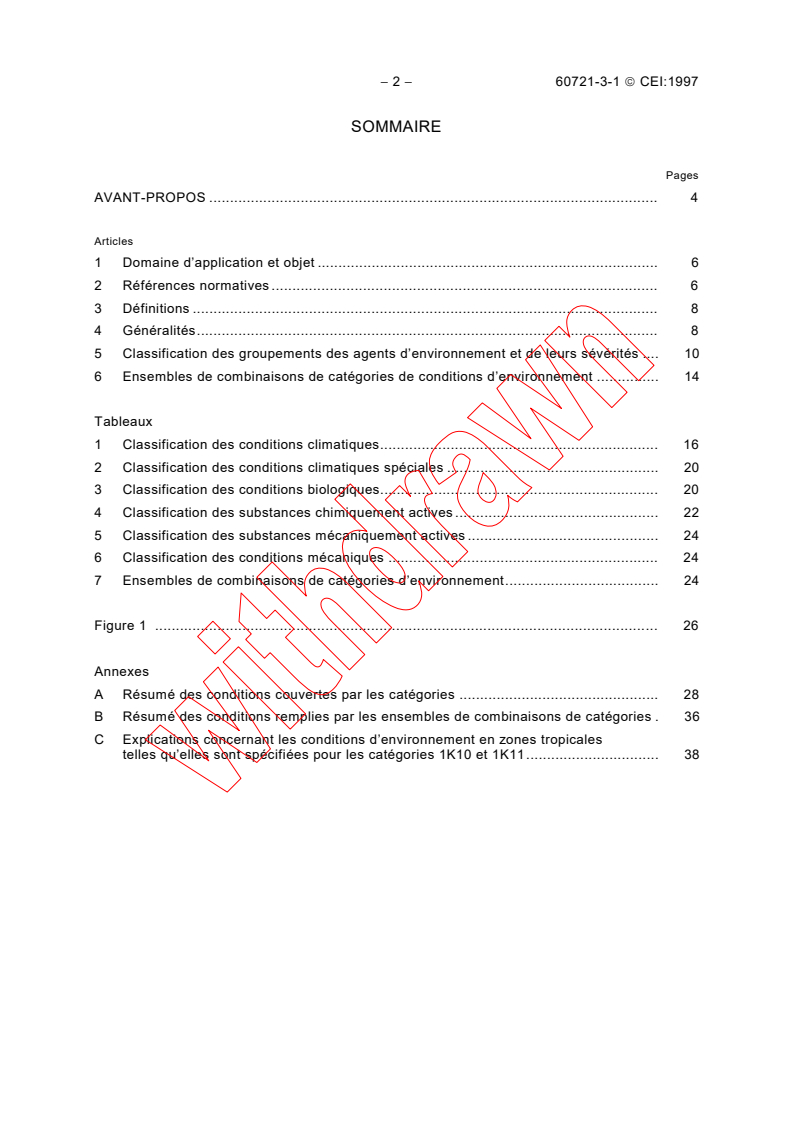
IEC 60721-3-1:1997 - Classification of environmental conditions - Part 3 Classification of groups of environmental parameters and their severities - Section 1: Storage Released:2/28/1997
Overview
IEC 60721-3-1:1997 is an international standard published by the International Electrotechnical Commission (IEC) that provides a comprehensive classification system for environmental conditions related to the storage of products. This standard specifically categorizes groups of environmental parameters and their severity levels that products, together with their packaging if applicable, may encounter during storage. The document excludes conditions related to fire, explosion risks, ionizing radiation, and unpredictable incidents but focuses on environmental factors which directly influence the product's physical condition or subsequent performance.
Part of the broader IEC 60721 series, IEC 60721-3-1 complements other parts that classify environmental agents during use or transport. It serves as a crucial guideline to ensure product integrity, safety, and longevity during storage by defining standardized environmental classifications.
Key Topics
Classification of Environmental Parameters: The standard defines various groups of environmental agents such as climatic conditions, chemical substances, mechanical stresses, and biological factors, all of which could impact stored products.
Severity Levels: For each environmental parameter group, IEC 60721-3-1 specifies severity levels that describe the extent or intensity of exposure to environmental conditions.
Applicability to Products and Packaging: It considers the product as well as any packaging, acknowledging that packaging may provide some protection or modification of environmental effects during storage.
Exclusions: The standard does not cover fire or explosion-related conditions, ionizing radiation environments, and locations at sea. It also excludes conditions during transportation or in-use scenarios which are addressed in other sections of IEC 60721-3.
Environmental Condition Sets: The document includes predefined sets of combinations for these classifications to help users select appropriate environmental classes matching their specific storage scenarios.
Terminology and Symbols: Consistent with IEC's conventions, the standard references the International Electrotechnical Vocabulary (IEV) for terminology and employs recognized IEC graphical and letter symbols.
Applications
IEC 60721-3-1:1997 is widely applicable across industries and sectors concerned with the storage of electrical and electronic products, as well as other goods sensitive to environmental conditions. Key applications include:
Product Design and Testing: Manufacturers use these classifications to design packaging and storage conditions that mitigate environmental risks and preserve product quality.
Quality Assurance: Storage facilities employ the standard to monitor and maintain environmental parameters that prevent degradation or failure of products during storage.
Supply Chain and Logistics: Helps in defining storage protocols for warehouses and distribution centers, ensuring compliance with product-specific storage requirements.
Risk Management: Enables assessment and management of environmental risks related to storage, improving reliability and reducing product loss.
Standardization and Regulatory Compliance: Facilitates adherence to international standards by harmonizing environmental classification methods in global trade and certification.
Related Standards
IEC 60721-3-1:1997 is part of the IEC 60721 series on the classification of environmental conditions:
- IEC 60721-3-2: Classification for environmental conditions during operation.
- IEC 60721-3-3: Classification during transportation and handling.
- IEC 60721-1: Defines environmental parameters and severity codes.
- IEC 60721-2: Describes environmental conditions appearing in nature.
Additionally, it aligns with other IEC standards relating to graphical symbols (IEC 27, IEC 417, IEC 617, IEC 878) and terminology (IEC 50: International Electrotechnical Vocabulary). It collaborates closely with ISO standards to ensure comprehensive and unified global standardization in electrotechnical environments.
By adhering to IEC 60721-3-1:1997, organizations can ensure product robustness and reliability through well-defined environmental classifications for storage, enhancing international cooperation, quality assurance, and risk management in environmental sustainability and product lifecycle management.
Relations
- Effective Date
- 05-Sep-2023
Buy Documents
IEC 60721-3-1:1997 - Classification of environmental conditions - Part 3 Classification of groups of environmental parameters and their severities - Section 1: Storage Released:2/28/1997
Get Certified
Connect with accredited certification bodies for this standard

IMP NDT d.o.o.
Non-destructive testing services. Radiography, ultrasonic, magnetic particle, penetrant, visual inspection.
Inštitut za kovinske materiale in tehnologije
Institute of Metals and Technology. Materials testing, metallurgical analysis, NDT.
Q Techna d.o.o.
NDT and quality assurance specialist. 30+ years experience. NDT personnel certification per ISO 9712, nuclear and thermal power plant inspections, QA/
Sponsored listings
Frequently Asked Questions
IEC 60721-3-1:1997 is a standard published by the International Electrotechnical Commission (IEC). Its full title is "Classification of environmental conditions - Part 3 Classification of groups of environmental parameters and their severities - Section 1: Storage". This standard covers: IEC 60721-3-1:1997 Classifies groups of environmental parameters and their severities to which products together with their packaging, if any, are subjected when stored.
IEC 60721-3-1:1997 Classifies groups of environmental parameters and their severities to which products together with their packaging, if any, are subjected when stored.
IEC 60721-3-1:1997 is classified under the following ICS (International Classification for Standards) categories: 19.040 - Environmental testing. The ICS classification helps identify the subject area and facilitates finding related standards.
IEC 60721-3-1:1997 has the following relationships with other standards: It is inter standard links to IEC 60721-3-1:2018. Understanding these relationships helps ensure you are using the most current and applicable version of the standard.
IEC 60721-3-1:1997 is available in PDF format for immediate download after purchase. The document can be added to your cart and obtained through the secure checkout process. Digital delivery ensures instant access to the complete standard document.
Standards Content (Sample)
NORME CEI
INTERNATIONALE
IEC
60721-3-1
INTERNATIONAL
Deuxième édition
STANDARD
Second edition
1997-02
Classification des conditions d’environnement –
Partie 3:
Classification des groupements des agents
d’environnement et de leurs sévérités –
Section 1: Stockage
Classification of environmental conditions –
Part 3:
Classification of groups of environmental parameters
and their severities –
Section 1: Storage
Numéro de référence
Reference number
CEI/IEC 60721-3-1: 1997
Validité de la présente publication Validity of this publication
Le contenu technique des publications de la CEI est cons- The technical content of IEC publications is kept under
tamment revu par la CEI afin qu'il reflète l'état actuel de constant review by the IEC, thus ensuring that the content
la technique. reflects current technology.
Des renseignements relatifs à la date de reconfirmation de Information relating to the date of the reconfirmation of the
la publication sont disponibles auprès du Bureau Central de publication is available from the IEC Central Office.
la CEI.
Les renseignements relatifs à ces révisions, à l'établis- Information on the revision work, the issue of revised
sement des éditions révisées et aux amendements peuvent editions and amendments may be obtained from IEC
être obtenus auprès des Comités nationaux de la CEI et National Committees and from the following IEC
dans les documents ci-dessous: sources:
• Bulletin de la CEI • IEC Bulletin
• Annuaire de la CEI • IEC Yearbook
Publié annuellement Published yearly
• Catalogue des publications de la CEI • Catalogue of IEC publications
Publié annuellement et mis à jour régulièrement Published yearly with regular updates
Terminologie Terminology
En ce qui concerne la terminologie générale, le lecteur se For general terminology, readers are referred to IEC 50:
reportera à la CEI 50: Vocabulaire Electrotechnique Inter- International Electrotechnical Vocabulary (IEV), which is
national (VEI), qui se présente sous forme de chapitres issued in the form of separate chapters each dealing
séparés traitant chacun d'un sujet défini. Des détails with a specific field. Full details of the IEV will be
complets sur le VEI peuvent être obtenus sur demande. supplied on request. See also the IEC Multilingual
Voir également le dictionnaire multilingue de la CEI. Dictionary.
Les termes et définitions figurant dans la présente publi- The terms and definitions contained in the present publi-
cation ont été soit tirés du VEI, soit spécifiquement cation have either been taken from the IEV or have been
approuvés aux fins de cette publication. specifically approved for the purpose of this publication.
Symboles graphiques et littéraux Graphical and letter symbols
Pour les symboles graphiques, les symboles littéraux et les For graphical symbols, and letter symbols and signs
signes d'usage général approuvés par la CEI, le lecteur approved by the IEC for general use, readers are referred to
consultera: publications:
– la CEI 27: Symboles littéraux à utiliser en – IEC 27: Letter symbols to be used in electrical
électrotechnique; technology;
– la CEI 417: Symboles graphiques utilisables – IEC 417: Graphical symbols for use on
sur le matériel. Index, relevé et compilation des equipment. Index, survey and compilation of the
feuilles individuelles; single sheets;
– la CEI 617: Symboles graphiques pour schémas; – IEC 617: Graphical symbols for diagrams;
et pour les appareils électromédicaux, and for medical electrical equipment,
– la CEI 878: Symboles graphiques pour – IEC 878: Graphical symbols for electromedical
équipements électriques en pratique médicale. equipment in medical practice.
Les symboles et signes contenus dans la présente publi- The symbols and signs contained in the present publication
cation ont été soit tirés de la CEI 27, de la CEI 417, de la have either been taken from IEC 27, IEC 417, IEC 617
CEI 617 et/ou de la CEI 878, soit spécifiquement approuvés and/or IEC 878, or have been specifically approved for the
aux fins de cette publication. purpose of this publication.
Publications de la CEI établies par le IEC publications prepared by the same
même comité d'études technical committee
L'attention du lecteur est attirée sur les listes figurant à la fin The attention of readers is drawn to the end pages of this
de cette publication, qui énumèrent les publications de la publication which list the IEC publications issued by the
CEI préparées par le comité d'études qui a établi la technical committee which has prepared the present
présente publication. publication.
NORME
CEI
INTERNATIONALE
IEC
60721-3-1
INTERNATIONAL
Deuxième édition
STANDARD
Second edition
1997-02
Classification des conditions d’environnement –
Partie 3:
Classification des groupements des agents
d’environnement et de leurs sévérités –
Section 1: Stockage
Classification of environmental conditions –
Part 3:
Classification of groups of environmental parameters
and their severities –
Section 1: Storage
IEC 1997 Droits de reproduction réservés Copyright - all rights reserved
Aucune partie de cette publication ne peut être reproduite ni utilisée No part of this publication may be reproduced or utilized in
sous quelque forme que ce soit et par aucun procédé, électronique any form or by any means, electronic or mechanical, including
ou mécanique, y compris la photocopie et les microfilms, sans photocopying and microfilm, without permission in writing from
l'accord écrit de l'éditeur. the publisher.
International Electrotechnical Commission 3, rue de Varembé Geneva, Switzerland
Telefax: +41 22 919 0300 e-mail: inmail@iec.ch IEC web site http: //www.iec.ch
CODE PRIX
Commission Electrotechnique Internationale
PRICE CODE S
International Electrotechnical Commission
Pour prix, voir catalogue en vigueur
For price, see current catalogue
− 2 − 60721-3-1 CEI:1997
SOMMAIRE
Pages
AVANT-PROPOS . 4
Articles
1 Domaine d’application et objet . 6
2 Références normatives . 6
3 Définitions . 8
4 Généralités. 8
5 Classification des groupements des agents d’environnement et de leurs sévérités . 10
6 Ensembles de combinaisons de catégories de conditions d’environnement . 14
Tableaux
1 Classification des conditions climatiques. 16
2 Classification des conditions climatiques spéciales . 20
3 Classification des conditions biologiques. 20
4 Classification des substances chimiquement actives . 22
5 Classification des substances mécaniquement actives . 24
6 Classification des conditions mécaniques . 24
7 Ensembles de combinaisons de catégories d’environnement. 24
Figure 1 . 26
Annexes
A Résumé des conditions couvertes par les catégories . 28
B Résumé des conditions remplies par les ensembles de combinaisons de catégories . 36
C Explications concernant les conditions d’environnement en zones tropicales
telles qu’elles sont spécifiées pour les catégories 1K10 et 1K11. 38
60721-3-1 IEC:1997 − 3 −
CONTENTS
Page
FOREWORD . 5
Clause
1 Scope and object. 7
2 Normative references . 7
3 Definitions . 9
4 General . 9
5 Classification of groups of environmental parameters and their severities. 11
6 Sets of environmental condition class combinations . 15
Tables
1 Classification of climatic conditions. 17
2 Classification of special climatic conditions . 21
3 Classification of biological conditions . 21
4 Classification of chemically active substances. 23
5 Classification of mechanically active substances. 25
6 Classification of mechanical conditions . 25
7 Sets of environmental class combinations. 25
Figure 1 . 27
Annexes
A Summary of conditions covered by the classes . 29
B Summary of conditions covered by the sets of class combinations. 37
C Explanation of the environmental conditions in tropical areas as specified
in classes 1K10 and 1K11. 39
− 4 − 60721-3-1 CEI:1997
COMMISSION ÉLECTROTECHNIQUE INTERNATIONALE
_________
CLASSIFICATION DES CONDITIONS D’ENVIRONNEMENT –
Partie 3: Classification des groupements des agents
d’environnement et de leurs sévérités –
Section 1: Stockage
AVANT-PROPOS
1) La CEI (Commission Electrotechnique Internationale) est une organisation mondiale de normalisation
composée de l'ensemble des comités électrotechniques nationaux (Comités nationaux de la CEI). La CEI a
pour objet de favoriser la coopération internationale pour toutes les questions de normalisation dans les
domaines de l'électricité et de l'électronique. A cet effet, la CEI, entre autres activités, publie des Normes
Internationales. Leur élaboration est confiée à des comités d'études, aux travaux desquels tout Comité
national intéressé par le sujet traité peut participer. Les organisations internationales, gouvernementales et
non gouvernementales, en liaison avec la CEI, participent également aux travaux. La CEI collabore
étroitement avec l'Organisation Internationale de Normalisation (ISO), selon des conditions fixées par accord
entre les deux organisations.
2) Les décisions ou accords officiels de la CEI concernant les questions techniques, représentent, dans la
mesure du possible un accord international sur les sujets étudiés, étant donné que les Comités nationaux
intéressés sont représentés dans chaque comité d’études.
3) Les documents produits se présentent sous la forme de recommandations internationales. Ils sont publiés
comme normes, rapports techniques ou guides et agréés comme tels par les Comités nationaux.
4) Dans le but d'encourager l'unification internationale, les Comités nationaux de la CEI s'engagent à appliquer
de façon transparente, dans toute la mesure possible, les Normes internationales de la CEI dans leurs normes
nationales et régionales. Toute divergence entre la norme de la CEI et la norme nationale ou régionale
correspondante doit être indiquée en termes clairs dans cette dernière.
5) La CEI n’a fixé aucune procédure concernant le marquage comme indication d’approbation et sa
responsabilité n’est pas engagée quand un matériel est déclaré conforme à l’une de ses normes.
6) L’attention est attirée sur le fait que certains des éléments de la présente Norme internationale peuvent faire
l’objet de droits de propriété intellectuelle ou de droits analogues. La CEI ne saurait être tenue pour
responsable de ne pas avoir identifié de tels droits de propriété et de ne pas avoir signalé leur existence.
La Norme internationale CEI 60721-3-1 a été établie par le comité d’études 75 de la CEI:
Classification des conditions d’environnement.
Cette deuxième édition annule et remplace la première édition parue en 1987, l’amendement 1
(1991) et l’amendement 2 (1993). Le troisième amendement a conduit à la publication de cette
édition consolidée.
Le texte de cette norme est issu de la première édition, des amendements 1 et 2, et des
documents suivants:
FDIS Rapport de vote
75/277/FDIS 75/296/RVD
Le rapport de vote indiqué dans le tableau ci-dessus donne toute information sur le vote ayant
abouti à l'approbation de cette norme.
La CEI 721 comprend les parties suivantes, présentées sous le titre général Classification des
conditions d’environnement:
− Partie 1: 1990, Agents d’environnement et leurs sévérités
− Partie 2: Conditions d’environnement présentes dans la nature
− Partie 3: Classification des groupements des agents d’environnement et de leurs sévérités.
Les annexes A, B et C sont données uniquement à titre d’information.
60721-3-1 IEC:1997 − 5 −
INTERNATIONAL ELECTROTECHNICAL COMMISSION
___________
CLASSIFICATION OF ENVIRONMENTAL CONDITIONS –
Part 3: Classification of groups of environmental parameters
and their severities –
Section 1: Storage
FOREWORD
1) The IEC (International Electrotechnical Commission) is a worldwide organization for standardization
comprising all national electrotechnical committees (IEC National Committees). The object of the IEC is to
promote international co-operation on all questions concerning standardization in the electrical and electronic
fields. To this end and in addition to other activities, the IEC publishes International Standards. Their
preparation is entrusted to technical committees; any IEC National Committee interested in the subject dealt
with may participate in this preparatory work. International, governmental and non-governmental organizations
liaising with the IEC also participate in this preparation. The IEC collaborates closely with the International
Organization for Standardization (ISO) in accordance with conditions determined by agreement between the
two organizations.
2) The formal decisions or agreements of the IEC on technical matters express, as nearly as possible, an
international consensus of opinion on the relevant subjects since each technical committee has representation
from all interested National Committees.
3) The documents produced have the form of recommendations for international use and are published in the
form of standards, technical reports or guides and they are accepted by the National Committees in that
sense.
4) In order to promote international unification, IEC National Committees undertake to apply IEC International
Standards transparently to the maximum extent possible in their national and regional standards. Any
divergence between the IEC Standard and the corresponding national or regional standard shall be clearly
indicated in the latter.
5) The IEC provides no marking procedure to indicate its approval and cannot be rendered responsible for any
equipment declared to be in conformity with one of its standards.
6) Attention is drawn to the possibility that some of the elements of this International Standard may be the
subject of patent rights. The IEC shall not be held responsible for identifying any or all such patent rights.
International Standard IEC 60721-3-1 has been prepared by IEC technical committee 75:
Classification of environmental conditions.
This second edition cancels and replaces the first edition published in 1987, amendment 1
(1991) and amendment 2 (1993). The third amendment led to the publication of this
consolidated edition.
The text of this standard is based on the following documents:
FDIS Report on voting
75/277/FDIS 75/296/RVD
Full information on the voting for the approval this standard can be found in the report on
voting indicated in the above table.
IEC 721 consists of the following parts, under the general title Classification of environmental
conditions:
−
Part 1: 1990, Environmental parameters and their severities
− Part 2: Environmental conditions appearing in nature
− Part 3: Classification of groups of environmental parameters and their severities.
Annexes A, B and C are for information only.
− 6 − 60721-3-1 CEI:1997
CLASSIFICATION DES CONDITIONS D’ENVIRONNEMENT –
Partie 3: Classification des groupements des agents
d’environnement et de leurs sévérités –
Section 1: Stockage
1 Domaine d’application et objet
La présente section de la CEI 60721-3 classifie les groupements d’agents d’environnement et
leurs sévérités auxquels des produits, éventuellement emballés, sont soumis lorsqu’ils sont
stockés.
Les conditions d’environnement spécifiées dans la présente norme se limitent à celles qui
peuvent influencer directement les produits ou leur comportement ultérieur. Seules de telles
conditions sont prises en considération, aucune description particulière de leurs effets sur les
produits n’étant donnée.
Les transferts en cours de stockage ne sont pas compris dans la classification.
Les conditions d’environnement qui sont directement liées aux risques d’incendie ou
d’explosion et celles qui sont liées au rayonnement ionisant sont exclues. Sont également
exclus tous les autres incidents imprévisibles. Il convient de prendre en considération la
possibilité que de tels incidents surviennent dans certains cas particuliers. Les emplacements
en mer ne sont pas compris dans le domaine d’application.
Les conditions pour une utilisation à poste fixe ou en déplacement, à bord de véhicules ou de
navires, et les conditions de transport sont données dans d’autres sections de la CEI 60721-3.
La présente norme a pour objet de classifier les agents d’environnement et leurs sévérités
auxquels un produit peut être exposé pendant qu’il est stocké.
Un nombre limité de catégories de conditions d’environnement, qui couvre un large champ
d’application, est donné. L’utilisateur de la présente norme choisira les catégories les plus
basses exigées pour couvrir les conditions du stockage prévu.
2 Références normatives
Les documents normatifs suivants contiennent des dispositions qui, par suite de la référence qui
y est faite, constituent des dispositions valables pour la présente section de la CEI 60721-3. Au
moment de la publication, les éditions indiquées étaient en vigueur. Tout document normatif
est sujet à révision et les parties prenantes aux accords fondés sur la présente section de la
CEI 60721-3 sont invitées à rechercher la possibilité d’appliquer les éditions les plus récentes
des documents normatifs indiqués ci-après. Les membres de la CEI et de l’ISO possèdent le
registre des Normes internationales en vigueur.
CEI 721-1: 1990, Classification des conditions d’environnement − Partie 1: Agents
d’environnement et leurs sévérités
Amendement 1 (1992)
CEI 721-2-1: 1982, Classification des conditions d’environnement − Partie 2: Conditions
d’environnement présentes dans la nature − Température et humidité
Modification 1 (1987)
60721-3-1 IEC:1997 − 7 −
CLASSIFICATION OF ENVIRONMENTAL CONDITIONS –
Part 3: Classification of groups of environmental parameters
and their severities –
Section 1: Storage
1 Scope and object
This section of IEC 60721-3 classifies the groups of environmental parameters and their
severities to which products, together with their packaging if any, are subjected when stored.
The environmental conditions specified in this standard are limited to those which may directly
affect the products or their ultimate performance. Only environmental conditions as such are
considered. No special description of the effects of these conditions on the products is given.
Transfer during storage is not included in the classification.
Environmental conditions directly related to fire or explosion and conditions related to ionizing
radiation are excluded. Any other unforeseen incidents are also excluded. The possibility of
their occurrence should be taken into account in special cases. Offshore locations are not
included.
Conditions of stationary use, portable and non-stationary use, use in vehicles and ships, and
conditions of transportation are given in other sections of IEC 60721-3.
The object of this standard is to classify environmental parameters and their severities to which
a product may be exposed during storage.
A limited number of classes of environmental conditions is given, covering a broad field of
application. The user of this standard should select the lowest classification necessary for
covering the conditions of intended storage.
2 Normative references
The following normative documents contain provisions which, through reference in this text,
constitute provisions of this section of IEC 60721-3. At the time of publication, the editions
indicated were valid. All normative documents are subject to revision, and parties to
agreements based on this section of IEC 60721-3 are encouraged to investigate the possibility
of applying the most recent editions of the normative documents indicated below. Members of
IEC and ISO maintain registers of currently valid International Standards.
IEC 721-1: 1990,
Classification of environmental conditions − Part 1: Environmental
parameters and their severities
Amendment 1 (1992)
IEC 721-2-1: 1982, Classification of environmental conditions − Part 2: Environmental
conditions appearing in nature − Temperature and humidity
Amendment 1 (1987)
− 8 − 60721-3-1 CEI:1997
CEI 721-3-0: 1984, Classification des conditions d’environnement − Partie 3: Classification des
groupements des agents d’environnement et de leurs sévérités − Introduction
Modification 1 (1987)
CEI 60721-3-2: 1997, Classification des conditions d’environnement − Partie 3: Classification
des groupements des agents d’environnement et de leurs sévérités − Section 2: Transport
CEI 721-3-3: 1994, Classification des conditions d’environnement − Partie 3: Classification des
groupements des agents d’environnement et de leurs sévérités − Section 3: Utilisation à poste
fixe, protégé contre les intempéries
CEI 721-3-4: 1995, Classification des conditions d’environnement − Partie 3: Classification des
groupements des agents d’environnement et de leurs sévérités − Section 4: Utilisation à poste
fixe, non protégé contre les intempéries
3 Définitions
Pour les besoins de la présente section de la CEI 721-3, les définitions suivantes sont
applicables, en plus des définitions figurant à l’article 3 de la CEI 721-1:
3.1 stockage: Le produit est placé dans un certain site pour de longues périodes, mais son
utilisation n’est pas prévue pendant ces périodes.
3.2 endroit protégé contre les intempéries: Endroit où le produit est protégé contre les
influences météorologiques:
− endroit totalement protégé: les influences directes des conditions météorologiques
(endroit fermé) sont totalement exclues;
− endroit partiellement protégé: les influences directes des conditions météorologiques
(endroit abrité) ne sont pas totalement exclues.
3.3 endroit non protégé contre les intempéries: Endroit où le produit n’est pas protégé
contre les influences météorologiques directes.
4 Généralités
Pour une information générale complémentaire, voir la CEI 721-3-0.
Les sévérités spécifiées sont celles qui ont une faible probabilité d’être dépassées. Toutes les
sévérités spécifiées sont des valeurs maximales ou des valeurs limites. Ces sévérités peuvent
être atteintes mais ne se maintiennent pas de façon permanente. En fonction de la situation
locale, il peut y avoir différentes fréquences de survenance en liaison avec certaines périodes.
De telles fréquences de survenance n’ont pas été introduites dans la présente norme, mais
seront prises en considération pour tout agent d’environnement.
Elles seront spécifiées en complément, le cas échéant. Des indications sur la durée et la
fréquence de survenance sont données dans la modification 1 à la CEI 721-3-0, en tant
qu’article 6.
L’attention est attirée sur le fait que des combinaisons des agents d’environnement indiqués
peuvent accroître leurs effets sur un produit. Cela s’applique en particulier à la présence d’une
forte humidité relative à laquelle s’ajoutent des conditions biologiques, ou la présence de
substances chimiquement ou mécaniquement actives.
60721-3-1 IEC:1997 − 9 −
IEC 721-3-0: 1984, Classification of environmental conditions − Part 3: Classification of groups
of environmental parameters and their severities − Introduction
Amendment 1 (1987)
IEC 60721-3-2: 1997, Classification of environmental conditions − Part 3: Classification of
environmental parameters and their severities − Section 2: Transportation
IEC 721-3-3: 1994, Classification of environmental conditions − Part 3: Classification of
environmental parameters and their severities − Section 3: Stationary use at weatherprotected
locations
IEC 721-3-4: 1995, Classification of environmental conditions − Part 3: Classification of
environmental parameters and their severities − Section 4: Stationary use at non-
weatherprotected locations
3 Definitions
For the purposes of this section of IEC 721-3, the following definitions apply, in addition to the
definitions in clause 3 of IEC 721-1:
3.1 storage: The product is placed at a certain site for long periods, but not intended for use
during these periods.
3.2 weatherprotected location: A location at which the product is protected from weather
influences:
− totally weatherprotected location: direct weather influences are totally excluded;
(enclosed location)
− partially weatherprotected location: direct weather influences are not completely
(sheltered location) excluded
3.3 non-weatherprotected location: A location at which the product is not protected from
direct weather influences.
4 General
For further general guidance, see IEC 721-3-0.
The severities specified are those which will have a low probability of being exceeded. All
specified values are maximum or limit values. These values may be reached, but do not occur
permanently. Depending on the local situation, there may be different frequencies of
occurrence related to a certain period of time. Such frequencies of occurrence have not been
included in this standard, but should be considered for any environmental parameter.
They should additionally be specified, if applicable. Information on the duration and frequency
of occurrence is given, as clause 6, in amendment 1 to IEC 721-3-0.
Attention is drawn to the fact that combinations of the environmental parameters given may
increase the effect on a product. This applies especially to the presence of high relative
humidity in addition to biological conditions, or to the presence of chemically or mechanically
active substances.
− 10 − 60721-3-1 CEI:1997
Il est reconnu que des conditions d’environnement extrêmes ou spéciales peuvent exister. Les
spécifications relatives aux produits à stocker dans ces conditions spéciales feront l’objet de
négociations entre le fournisseur et l’utilisateur.
5 Classification des groupements des agents d’environnement et de leurs sévérités
Les tableaux 1 à 6 spécifient un certain nombre de catégories pour les conditions climatiques
(K), climatiques spéciales (Z) et biologiques (B), les substances chimiquement actives (C) et
mécaniquement actives (S), et les conditions mécaniques (M).
Cette classification permet un certain nombre de combinaisons possibles de conditions
d’environnement qui influent sur les produits, quel que soit l’endroit où ils sont stockés. Elle
représente la situation réelle pour des conditions universelles de stockage dues aux influences
locales du climat à l’air libre, etc.
Il n’a pas encore été possible de quantifier les sévérités de certains agents d’environnement.
Pour un produit ou un endroit donné, il convient de se référer à la série complète des
catégories, par exemple:
1K2/1Z1/1B1/1C2/1S1/1M3
Voir aussi l’article 6.
L’annexe A contient un résumé des conditions couvertes par chaque catégorie.
5.1 Conditions climatiques
Les conditions climatiques spécifiées pour les catégories 1K1 à 1K11 représentent les
conditions de stockage des produits. Elles ont été éprouvées universellement sur une longue
période, compte tenu de tous les agents pouvant les influencer, par exemple les conditions
climatiques extérieures (à l’air libre), le type de construction du bâtiment, les systèmes de
régulation de la température et de l’humidité, et les conditions à l’intérieur, par exemple la
dissipation de chaleur par d’autres équipements, la présence humaine, etc. Les conditions
couvrent tous les cas normaux mais pas les événements exceptionnels.
Les conditions climatiques en zones tropicales telles qu’elles sont spécifiées dans les
catégories 1K10 et 1K11 sont expliquées à l’annexe C.
Lors du choix des catégories appropriées, il convient d’être attentif au fait que les conditions
climatiques à l’intérieur des bâtiments dépendent des conditions extérieures (à l’air libre), en
particulier de la température de l’air et du rayonnement solaire, ainsi que du type de
construction du bâtiment. Des murs fournissant une bonne isolation thermique ou ayant une
bonne capacité thermique peuvent atténuer de manière appréciable les variations de la
température entre le jour et la nuit, ou celles se produisant exceptionnellement sur des
périodes de plus longue durée. Des murs de faible isolation thermique ou de faible capacité
thermique ne peuvent avoir cet effet, et les différences peuvent être accrues par le
rayonnement solaire pendant le jour et le rayonnement du bâtiment pendant la nuit. L’action du
rayonnement solaire peut être accrue par l’effet de piège à chaleur ou l’effet de serre.
60721-3-1 IEC:1997 − 11 −
It is recognized that extreme or special environmental conditions may exist. Specifications for
products to be stored under such special conditions are a matter of negotiation between
supplier and user.
5 Classification of groups of environmental parameters and their severities
A number of classes for climatic conditions (K), special climatic conditions (Z), biological
conditions (B), chemically active substances (C), mechanically active substances (S), and
mechanical conditions (M) are specified in tables 1 to 6.
This classification allows a number of possible combinations of environmental conditions which
bear upon products wherever stored. It represents the real situation concerning world-wide
conditions of storage, due to local influences of open-air climate, etc.
For certain environmental parameters, it has not yet been possible to specify quantitative
severities.
For a given location or product, reference should be made to the total set of classes, for
example:
1K2/1Z1/1B1/1C2/1S1/1M3
See also clause 6.
Annex A contains a summary of the conditions covered by each class.
5.1 Climatic conditions
The climatic conditions specified for classes 1K1 to 1K11 refer to the conditions of storage of
products. They have been experienced world-wide over a long period of time, taking into
account all the parameters that can influence them, such as external (open-air) climatic
conditions, type of building construction, temperature/humidity controlling systems, and internal
conditions, for example heat dissipation from other equipment, presence of humans, etc. The
conditions should cover all normal cases, but not exceptional events.
Climatic conditions in tropical areas, as specified in classes 1K10 and 1K11, are explained in
annex C.
When selecting appropriate classes, attention should be paid to the fact that the climatic
conditions inside buildings depend on the outside (open-air) conditions, especially air
temperature and solar radiation, and the type of building construction. Walls with good thermal
insulation or high thermal capacity can consistently smooth the peaks of outside air
temperature variations between day and night, or, exceptionally, those produced over a longer
period of time. Walls with poor thermal insulation or low thermal capacity cannot have this
effect, and peaks can be magnified due to the effect of solar radiation during the day, and to
the effect of building radiation at night. The effect of solar radiation can be increased by either
heat-trap or greenhouse effects.
− 12 − 60721-3-1 CEI:1997
Aux endroits non protégés contre les intempéries, l’influence de conditions climatiques
spéciales constitue une part plus significative des effets que subit un produit et ses éléments
fonctionnels qu’aux endroits protégés. En particulier les effets de changement de température,
rayonnement solaire, précipitations, vitesse de l’air et refroidissement dû au vent seront pris en
considération à ce propos.
Les sévérités de ces effets peuvent être influencées, par exemple, par des détails de
construction (composition et épaisseur du matériau, couleur de la surface, emballages scellés
ou perméables, etc.) et par des détails de stockage (choix du site, prise en considération du
vent et du temps dominant à l’endroit en question, etc.).
5.2 Conditions climatiques spéciales
Comme, dans la pratique, les agents tels que rayonnement de chaleur, mouvement de l’air
environnant et eau d’autre origine que la pluie peuvent survenir avec n’importe quelle sévérité,
en combinaison avec n’importe quelle autre condition climatique, ces conditions spéciales sont
spécifiées au tableau 2. Dans ce cas, une hypothèse sur la coïncidence d’événements de
sévérités croissantes conduirait à un surdimensionnement inutile.
5.3 Conditions biologiques
Des valeurs quantitatives n’ont pas été spécifiées pour ces conditions. Les agents spécifiés au
tableau 3 sont typiques, mais peuvent être incomplets.
5.4 Substances chimiquement actives
La contamination de l’atmosphère naturelle est causée principalement pas les effluents
chimiques des activités industrielles, des véhicules à moteur et des systèmes de chauffage.
Les aérosols salins constituent une autre influence chimique. La contamination peut affecter la
fonction et les matériaux des produits.
Les valeurs données dans la présente classification ont fait l’objet de relevés sur plusieurs
années. Des valeurs maximales sont données parce que l’influence directe de plus fortes
concentrations pendant un court intervalle de temps cause normalement plus de dégâts aux
matériaux, qui ne peuvent pas être réparés. Des valeurs moyennes sont données en outre
parce que leur influence peut être importante pour l’effet à long terme sur les éléments
intérieurs du produit.
En pratique, tous les agents contaminants classifiés dans la présente norme ne sont pas
présents simultanément. En outre, la probabilité est faible que les concentrations de ces
contaminants réellement présents augmentent de façon simultanée et homogène. En fonction
de la situation locale, il arrive fréquemment que les valeurs d’un seul contaminant soient plus
élevées. Normalement, les valeurs spécifiées pour la catégorie 1C1 ont été relevées dans des
zones rurales et dans des zones où les activités industrielles sont faibles. Les valeurs
spécifiées pour la catégorie 1C2 ont été relevées dans des zones urbaines. Par conséquent, la
sévérité de chacune de ces deux catégories doit être considérée comme l’exigence requise
pour l’effet combiné de tous les agents indiqués. Cependant, les sévérités de la catégorie 1C3
ne peuvent pas être considérées comme l’exigence requise pour l’effet combiné de tous les
agents indiqués, afin d’éviter tout surdimensionnement anti-économique. Pour cette catégorie,
il est possible de choisir uniquement les sévérités des agents particuliers qui peuvent
s’appliquer au cas considéré. Si des agents particuliers de la catégorie 1C3 sont choisis pour
la description des substances chimiquement actives présentes en un endroit, les sévérités de
la catégorie 1C2 sont valables pour tous les autres agents qui ne sont pas spécialement
mentionnés.
−
NOTE Les liquides chimiquement actifs et les solides chimiquement actifs autres que le sel marin ou le sel
employé sur les routes ne sont pas pris en considération dans cette norme.
60721-3-1 IEC:1997 − 13 −
At non-weatherprotected locations, the influence from special climatic conditions constitutes a
more significant share of the effects bearing upon a product and its functional parts than at
weatherprotected locations. The effects of temperature change, solar radiation, precipitation,
air velocity and wind-chill should be particularly considered in this respect.
The severity of these effects may be influenced, for example by constructional details (type and
thickness of material, colour of surfaces, sealing or breathing of casings, etc.), and by storage
details (selection of storage site, consideration of degrees of exposure to prevailing wind and
weather, etc.).
5.2 Special climatic conditions
As, in practice, parameters such as heat radiation, movement of the surrounding air, and water
from sources other than rain may occur with any severity, in combination with any of the other
climatic conditions, these special conditions are specified in table 2. In those cases, an
assumption of the coincidence of events of increasing severity would lead to unnecessary
overdesign.
5.3 Biological conditions
No quantitative severity has been specified for these conditions. The specified parameters of
table 3 are typical, but may not be complete.
5.4 Chemically active substances
The contamination of the natural atmosphere is mainly caused by chemical emissions from
industrial activities, motor-driven vehicles and heating systems. A further chemical influence is
caused by aerosols of sea and road salts. Contamination may affect the function and materials
of products.
The values given in this classification have been taken from surveys over several years.
Maximum values are given, because direct influence of higher concentrations over a short
period of time normally causes more damage to material, which cannot regenerate. Mean
values are given additionally, because their influence may be important for the long-term effect
on internal parts of the products.
In practice, not all contaminants (parameters) classified in this standard are present
simultaneously. Furthermore, the probability is low that the concentrations of those
contaminants actually present increase simultaneously and homogeneously. Depending on the
local situation, there are often higher values of one contaminant only. The values specified for
class 1C1 will normally be experienced in rural areas and areas with low industrial activity. The
values specified for class 1C2 are experienced in urban areas. Therefore the severity of each
of these two classes shall be considered as the requirements for the combined effect of all
parameters stated. The severities of class 1C3, however, cannot be combined as the
requirement for the combined effect of all parameters stated in order to avoid any
uneconomical overdesign. For that class, it is possible to select only the severities of those
single parameters which might be relevant in the case of application. If single parameters of
class 1C3 are selected for the description of the chemically active substances present at a
location, the severities of class 1C2 are valid for all other parameters which are not specially
named.
NOTE − Chemically active liquids and chemically active solids other than sea salts or road salts are not
considered in this standard.
− 14 − 60721-3-1 CEI:1997
5.5 Substances mécaniquement actives
Le sable et la poussière sont classifiés ensemble car les effets qu’exercent ces agents
d’environnement sont semblables.
5.6 Conditions mécaniques
Les conditions de vibrations (sinusoïdales) sont classifiées par niveaux de sévérité des
amplitudes de l’accélération et du déplacement dans les gammes de hautes et de basses
fréquences respectivement.
Les vibrations aléatoires ne sont pas prises en considération dans la présente norme. Elles
pourront être incluses quand une information suffisante sera disponible.
Les vibrations non stationnaires, y compris le choc, sont classifiées suivant l’utilisation du
spectre de réponses aux chocs maximax de premier ordre non amortis (voir figure 1).
6 Ensembles de combinaisons de catégories de conditions d’environnement
Comme cela a été indiqué à l’article 5, la classification permet un certain nombre de
combinaisons possibles de conditions d’environnement qui influent sur les produits, quel que
soit l’endroit où ils sont utilisés. Le nombre de possibilités et, dès lors, la flexibilité sont de ce
fait très grands. Cependant, en pratique, cette flexibilité n’est pas toujours un avantage quand,
par exemple, les spécifications sur les conditions d’environnement pour certains endroits sont
rédigées par des parties différentes, produisant de ce fait invariablement des divergences,
certes mineures mais néanmoins gênantes.
Afin de limiter les possibilités à des cas généraux, des ensembles normalisés de combinaisons
de catégories peuvent être choisis dans le tableau 7. Pour un endroit ou un produit donné, on
fait alors référence à cette norme, par exemple IE12. C’est uniquement dans le cas où les
conditions semblent ne pas être remplies par cette spécification que l’on fait référence à
chaque catégorie comme cela est précisé à l’article 5. Par ailleurs, si quelques sévérités des
agents s’écartent de celle(s) des combinaisons de catégories, il convient de l’exprimer en
ajoutant la phrase suivante à la désignation de l’ensemble «mais pour le . (agent) . (sévérité
et unité)», par exemple IE12 mais pour le sable 300 mg/m .
L’annexe B donne un résumé des conditions remplies par les ensembles de combinaisons de
catégories.
60721-3-1 IEC:1997 − 15 −
5.5 Mechanically active substances
Sand and dust are classified together, as the effects caused by these environmental conditions
are similar.
5.6 Mechanical conditions
The conditions of vibration (sinusoidal) are classified by severity levels of acceleration, and
displacement amplitudes in high and low frequency range, respectively.
Random vibration is not considered in this standard. It may be included when sufficient
information is available.
Non-stationary vibration including shock is classified by using the first order undamped
maximax shock response spectrum (see figure 1).
6 Sets of environmental condition class combinations
As indicated in clause 5, the classification allows a number of possible combinations of
environmental conditions bearing on products wherever used. The number of possibilities, and
thus the flexibility, is therefore very great. In practice, however, this flexibility is not always an
advantage when, for instance, environmental condition specifications for a certain location are
drawn up by different parties, invariably producing small but disturbing divergences.
In order to limit the possibilities to general cases, standard sets of class combinations may be
selected from table 7. For a given location or product, reference then may be made to this
standa
...