

IEC 61010-1:2001
(Main)Safety requirements for electrical equipment for measurement, control, and laboratory use - Part 1: General requirements
General Information
- Abstract
Specifies general safety requirements for electrical equipment intended for professional, industrial process, and educational use. It applies to 4 main groups of equipment: (a) Electrical test and measurement equipment such as signal generators, measurement standards, power supplies, transducers, transmitters, etc. (b) Electrical control equipment to control specific values by manual setting, programming or by input variables. (c) Electrical laboratory equipment to measure, indicate, monitor or analyse substances, including in vitro diagnostic (IVD) equipment. (d) Accessories for use with the above (for example, sample handling equipment). It has the status of a group safety publication in accordance with IEC Guide 104. The contents of the corrigenda of May 2002 and April 2003 have been included in this copy.
- Status
- Published
- Publication Date
- 12-Feb-2001
- Technical Committee
- TC 66 - Safety of measuring, control and laboratory equipment
- Drafting Committee
- WG 1 - TC 66/WG 1
- Current Stage
- DELPUB - Deleted Publication
- Start Date
- 10-Jun-2010
- Completion Date
- 28-Aug-2026
Buy Documents
IEC 61010-1:2001 - Safety requirements for electrical equipment for measurement, control, and laboratory use - Part 1: General requirements Released:2/13/2001
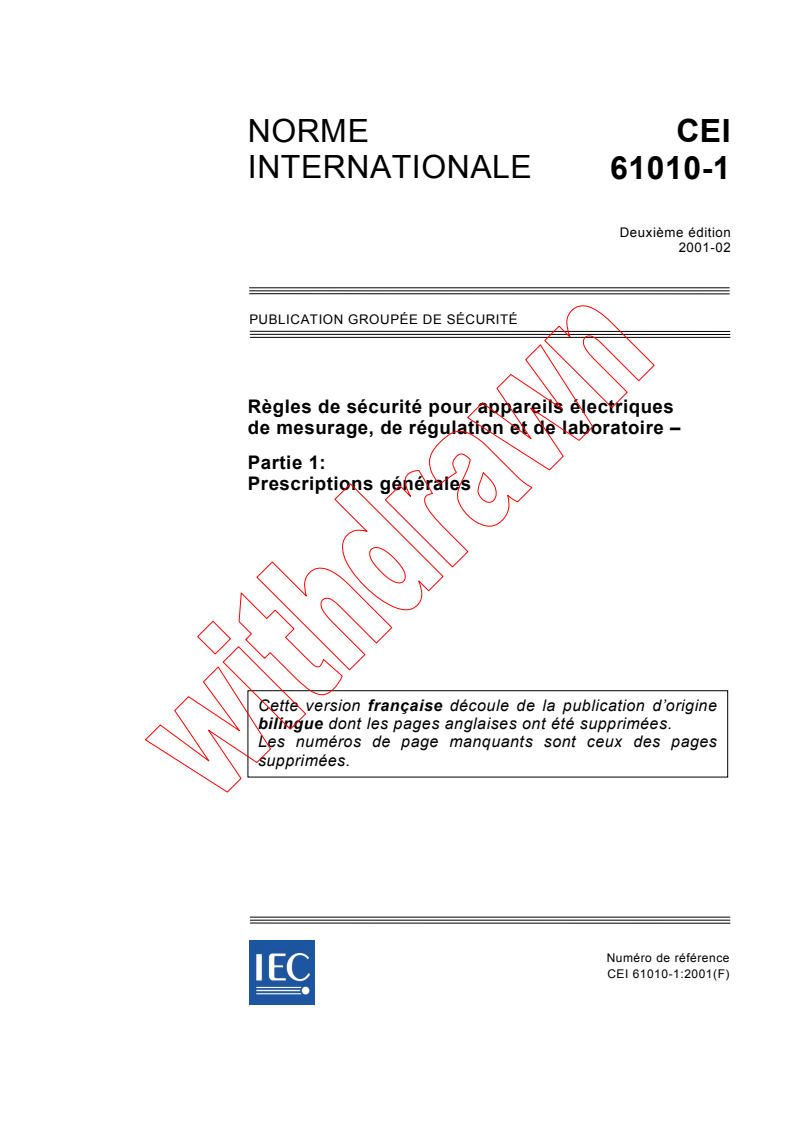
IEC 61010-1:2001 - Regles de sécurité pour appareils électriques de mesurage, de régulation et de laboratoire - Partie 1: Prescriptions générales Released:2/13/2001
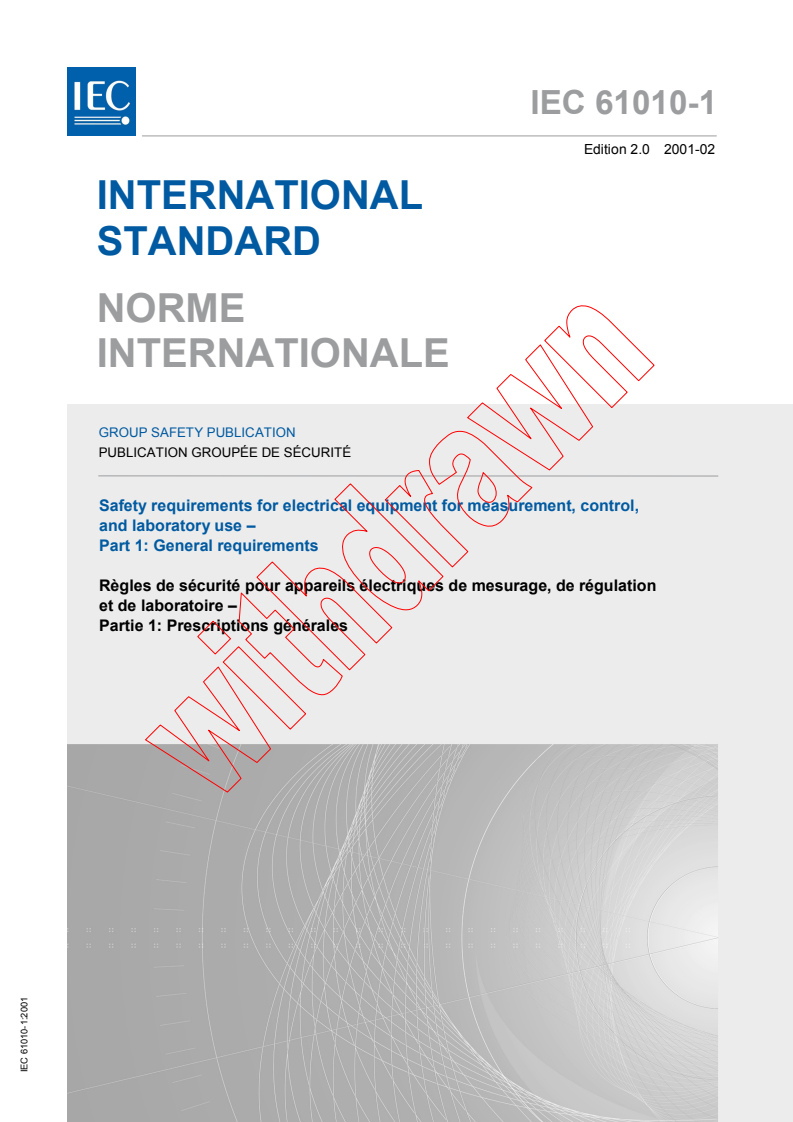
IEC 61010-1:2001 - Safety requirements for electrical equipment for measurement, control, and laboratory use - Part 1: General requirements Released:2/13/2001
Overview
IEC 61010-1:2001 - Safety requirements for electrical equipment for measurement, control, and laboratory use (Part 1: General requirements) is an international group safety publication that establishes general safety principles and test requirements for electrical equipment intended for professional, industrial process and educational environments. It applies to four main groups:
- electrical test and measurement equipment (signal generators, power supplies, transducers, etc.),
- electrical control equipment (manual, programmed or input-variable control devices),
- electrical laboratory equipment (analysers, monitors, including in vitro diagnostic equipment), and
- accessories (for example, sample handling devices).
This edition incorporates the corrigenda of May 2002 and April 2003 and is published in accordance with IEC Guide 104.
Key topics and technical requirements
IEC 61010-1 defines a comprehensive set of safety topics and verification procedures. Major technical areas covered include:
- Scope, object and environmental conditions for applying the standard.
- Marking and documentation requirements (including warnings, durability and user information).
- Electrical safety: protection against electric shock, determination of accessible parts, insulation, clearances and creepage distances, dielectric strength tests, single-fault condition considerations.
- Mechanical safety: protection against moving parts, stability, mechanical shock and impact tests (enclosure rigidity, drop tests).
- Fire and thermal safety: requirements to limit ignition sources, contain fire, surface temperature limits and temperature testing.
- Fluid, gas and pressure hazards: spillage/overflow, battery electrolyte, pressure and leakage tests.
- Radiation and acoustic hazards: controls for ionizing/UV/microwave radiation, lasers, sonic/ultrasonic pressure.
- Components and subassemblies: requirements for motors, transformers, printed circuit boards, fuses, and high-integrity components.
- Interlocks and reliability: protection by interlocks, prevention of hazardous reactivation, reliability testing.
- Test procedures and annexes: normative measurement circuits, test fingers, measuring methods for clearances/creepage, routine tests and conformity verification.
Applications and users
IEC 61010-1 is essential for:
- Product designers and electrical engineers developing measurement, control or laboratory equipment to ensure safe design.
- Manufacturers and suppliers seeking conformity assessment and market access for professional and lab devices.
- Test laboratories and certification bodies performing type and routine tests against international safety criteria.
- Procurement, safety officers and laboratory managers who must specify compliant equipment for industrial and educational settings.
Adopting IEC 61010-1 supports consistent safety design, risk reduction, and conformity documentation for devices used in testing, control systems and laboratory environments.
Related standards
- IEC 61010 series (other parts for specific equipment types)
- IEC Guide 104 (group safety publication status)
Keywords: IEC 61010-1:2001, safety requirements, electrical equipment, measurement and control, laboratory equipment, clearances, creepage, dielectric strength, marking and documentation, single-fault condition.
Relations
- Effective Date
- 25-Aug-2026
- Effective Date
- 25-Aug-2026
- Effective Date
- 25-Aug-2026
- Effective Date
- 25-Aug-2026
- Effective Date
- 03-Jun-2026
- Referred By
EN 1012-2:1996+A1:2009 - Compressors and vacuum pumps - Safety requirements - Part 2: Vacuum pumps - Effective Date
- 01-Apr-2026
- Effective Date
- 05-Sep-2023
- Effective Date
- 05-Sep-2023
- Effective Date
- 05-Sep-2023
- Effective Date
- 05-Sep-2023
Buy Documents
IEC 61010-1:2001 - Safety requirements for electrical equipment for measurement, control, and laboratory use - Part 1: General requirements Released:2/13/2001
IEC 61010-1:2001 - Regles de sécurité pour appareils électriques de mesurage, de régulation et de laboratoire - Partie 1: Prescriptions générales Released:2/13/2001
IEC 61010-1:2001 - Safety requirements for electrical equipment for measurement, control, and laboratory use - Part 1: General requirements Released:2/13/2001
Get Certified
Connect with accredited certification bodies for this standard

ECOCERT
Organic and sustainability certification.

Eurofins Food Testing Global
Global leader in food, environment, and pharmaceutical product testing.

IMP NDT d.o.o.
Non-destructive testing services. Radiography, ultrasonic, magnetic particle, penetrant, visual inspection.
Sponsored listings
Frequently Asked Questions
IEC 61010-1:2001 is a standard published by the International Electrotechnical Commission (IEC). Its full title is "Safety requirements for electrical equipment for measurement, control, and laboratory use - Part 1: General requirements". This standard covers: Specifies general safety requirements for electrical equipment intended for professional, industrial process, and educational use. It applies to 4 main groups of equipment: (a) Electrical test and measurement equipment such as signal generators, measurement standards, power supplies, transducers, transmitters, etc. (b) Electrical control equipment to control specific values by manual setting, programming or by input variables. (c) Electrical laboratory equipment to measure, indicate, monitor or analyse substances, including in vitro diagnostic (IVD) equipment. (d) Accessories for use with the above (for example, sample handling equipment). It has the status of a group safety publication in accordance with IEC Guide 104. The contents of the corrigenda of May 2002 and April 2003 have been included in this copy.
Specifies general safety requirements for electrical equipment intended for professional, industrial process, and educational use. It applies to 4 main groups of equipment: (a) Electrical test and measurement equipment such as signal generators, measurement standards, power supplies, transducers, transmitters, etc. (b) Electrical control equipment to control specific values by manual setting, programming or by input variables. (c) Electrical laboratory equipment to measure, indicate, monitor or analyse substances, including in vitro diagnostic (IVD) equipment. (d) Accessories for use with the above (for example, sample handling equipment). It has the status of a group safety publication in accordance with IEC Guide 104. The contents of the corrigenda of May 2002 and April 2003 have been included in this copy.
IEC 61010-1:2001 is classified under the following ICS (International Classification for Standards) categories: 19.080 - Electrical and electronic testing; 71.040.10 - Chemical laboratories. Laboratory equipment. The ICS classification helps identify the subject area and facilitates finding related standards.
IEC 61010-1:2001 has the following relationships with other standards: It is inter standard links to EN ISO 8655-1:2002, EN ISO 15197:2003, EN ISO 11143:2008, EN ISO 15212-1:1999, EN ISO 15212-2:2002, EN 1012-2:1996+A1:2009, IEC 61010-1:2001/COR1:2002, IEC 61010-1:2001/COR2:2003, IEC 61010-1:1990/COR1:1999, IEC 61010-1:2010. Understanding these relationships helps ensure you are using the most current and applicable version of the standard.
IEC 61010-1:2001 is available in PDF format for immediate download after purchase. The document can be added to your cart and obtained through the secure checkout process. Digital delivery ensures instant access to the complete standard document.
Standards Content (Sample)
INTERNATIONAL IEC
STANDARD
61010-1
Second edition
2001-02
GROUP SAFETY PUBLICATION
Safety requirements for electrical equipment
for measurement, control, and laboratory use –
Part 1:
General requirements
This English-language version is derived from the original
bilingual publication by leaving out all French-language
pages. Missing page numbers correspond to the French-
language pages.
Reference number
Publication numbering
As from 1 January 1997 all IEC publications are issued with a designation in the
60000 series. For example, IEC 34-1 is now referred to as IEC 60034-1.
Consolidated editions
The IEC is now publishing consolidated versions of its publications. For example,
edition numbers 1.0, 1.1 and 1.2 refer, respectively, to the base publication, the base
publication incorporating amendment 1 and the base publication incorporating
amendments 1 and 2.
Further information on IEC publications
The technical content of IEC publications is kept under constant review by the IEC,
thus ensuring that the content reflects current technology. Information relating to this
publication, including its validity, is available in the IEC Catalogue of publications
(see below) in addition to new editions, amendments and corrigenda. Information on
the subjects under consideration and work in progress undertaken by the technical
committee which has prepared this publication, as well as the list of publications
issued, is also available from the following:
• IEC Web Site (www.iec.ch)
• Catalogue of IEC publications
The on-line catalogue on the IEC web site (www.iec.ch/searchpub) enables you to
search by a variety of criteria including text searches, technical committees and
date of publication. On-line information is also available on recently issued
publications, withdrawn and replaced publications, as well as corrigenda.
• IEC Just Published
This summary of recently issued publications (www.iec.ch/online_news/ justpub) is
also available by email. Please contact the Customer Service Centre (see below)
for further information.
• Customer Service Centre
If you have any questions regarding this publication or need further assistance,
please contact the Customer Service Centre:
Email: custserv@iec.ch
Tel: +41 22 919 02 11
Fax: +41 22 919 03 00
INTERNATIONAL IEC
STANDARD
61010-1
Second edition
2001-02
GROUP SAFETY PUBLICATION
Safety requirements for electrical equipment
for measurement, control, and laboratory use –
Part 1:
General requirements
IEC 2001 Copyright - all rights reserved
No part of this publication may be reproduced or utilized in any form or by any means, electronic or mechanical,
including photocopying and microfilm, without permission in writing from the publisher.
International Electrotechnical Commission, 3, rue de Varembé, PO Box 131, CH-1211 Geneva 20, Switzerland
Telephone: +41 22 919 02 11 Telefax: +41 22 919 03 00 E-mail: inmail@iec.ch Web: www.iec.ch
PRICE CODE
XE
Commission Electrotechnique Internationale
International Electrotechnical Commission
Международная Электротехническая Комиссия
For price, see current catalogue
61010-1 © IEC:2001 – 3 –
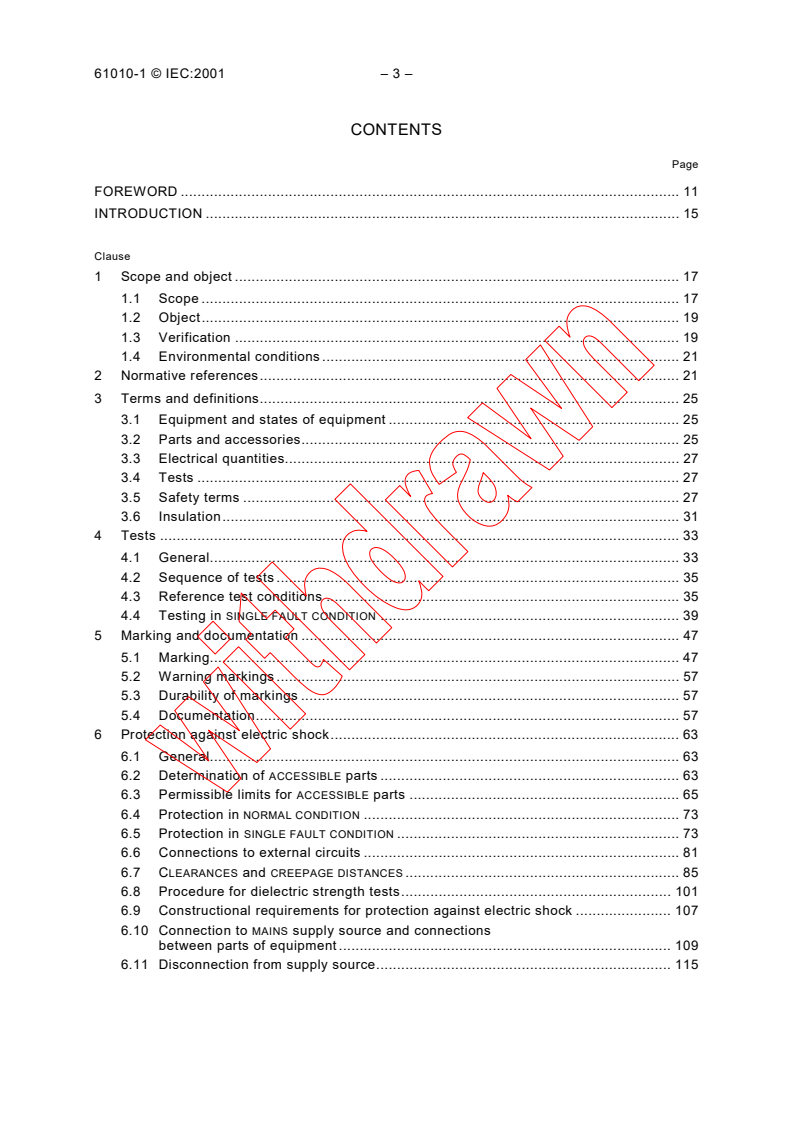
CONTENTS
Page
FOREWORD .11
INTRODUCTION . 15
Clause
1 Scope and object . 17
1.1 Scope . 17
1.2 Object. 19
1.3 Verification . 19
1.4 Environmental conditions . 21
2 Normative references. 21
3 Terms and definitions. 25
3.1 Equipment and states of equipment . 25
3.2 Parts and accessories. 25
3.3 Electrical quantities. 27
3.4 Tests . 27
3.5 Safety terms . 27
3.6 Insulation. 31
4 Tests . 33
4.1 General. 33
4.2 Sequence of tests . 35
4.3 Reference test conditions . 35
4.4 Testing in SINGLE FAULT CONDITION . 39
5 Marking and documentation . 47
5.1 Marking. 47
5.2 Warning markings . 57
5.3 Durability of markings . 57
5.4 Documentation. 57
6 Protection against electric shock. 63
6.1 General. 63
6.2 Determination of ACCESSIBLE parts . 63
6.3 Permissible limits for ACCESSIBLE parts . 65
6.4 Protection in NORMAL CONDITION . 73
6.5 Protection in SINGLE FAULT CONDITION . 73
6.6 Connections to external circuits . 81
LEARANCES CREEPAGE DISTANCES
6.7 C and . 85
6.8 Procedure for dielectric strength tests. 101
6.9 Constructional requirements for protection against electric shock . 107
6.10 Connection to MAINS supply source and connections
between parts of equipment . 109
6.11 Disconnection from supply source. 115
61010-1 © IEC:2001 – 5 –
Clause Page
7 Protection against mechanical HAZARDS . 119
7.1 General. 119
7.2 Moving parts . 119
7.3 Stability . 121
7.4 Provisions for lifting and carrying . 123
7.5 Wall mounting. 123
7.6 Expelled parts. 123
8 Mechanical resistance to shock and impact. 125
8.1 ENCLOSURE rigidity test . 125
8.2 Drop test. 129
9 Protection against the spread of fire. 131
9.1 Eliminating or reducing the sources of ignition within the equipment . 135
9.2 Containment of fire within the equipment, should it occur. 135
9.3 Limited-energy circuit. 139
9.4 Requirements for equipment containing or using flammable liquids. 141
9.5 Overcurrent protection . 143
10 Equipment temperature limits and resistance to heat . 145
10.1 Surface temperature limits for protection against burns. 145
10.2 Temperatures of windings. 145
10.3 Other temperature measurements. 147
10.4 Conduct of temperature tests . 147
10.5 Resistance to heat . 149
11 Protection against HAZARDS from fluids. 153
11.1 General. 153
11.2 Cleaning . 153
11.3 Spillage . 153
11.4 Overflow . 153
11.5 Battery electrolyte. 155
11.6 Specially protected equipment . 155
11.7 Fluid pressure and leakage. 155
12 Protection against radiation, including laser sources, and against sonic and
ultrasonic pressure . 161
12.1 General. 161
12.2 Equipment producing ionizing radiation. 161
12.3 Ultraviolet (UV) radiation. 161
12.4 Microwave radiation. 163
12.5 Sonic and ultrasonic pressure. 163
12.6 Laser sources . 165
13 Protection against liberated gases, explosion and implosion . 165
13.1 Poisonous and injurious gases. 165
13.2 Explosion and implosion . 165
14 Components . 169
14.1 General. 169
14.2 Motors . 173
14.3 Overtemperature protection devices. 173
14.4 Fuse holders. 175
14.5 MAINS voltage selecting devices. 175
61010-1 © IEC:2001 – 7 –
Clause Page
14.6 HIGH INTEGRITY components.175
14.7 MAINS transformers tested outside equipment.175
14.8 Printed circuit boards .175
14.9 Circuits or components used as transient overvoltage limiting devices .177
15 Protection by interlocks .179
15.1 General .179
15.2 Prevention of reactivating.179
15.3 Reliability .179
16 Test and measurement equipment.179
16.1 Current measuring circuits.179
16.2 Multifunction meters and similar equipment .181
Annex A (normative) Measuring circuits for ACCESSIBLE current .183
Annex B (normative) Standard test finger .189
Annex C (normative) Measurement of CLEARANCES and CREEPAGE DISTANCES .193
Annex D (normative) Parts between which insulation requirements are specified .201
Annex E (normative) Reduction of POLLUTION degrees .209
Annex F (normative) ROUTINE TESTS .211
Annex G (informative) Leakage and rupture from fluids under pressure .215
Annex H (informative) Index of defined terms.227
Bibliography.229
Figure 1 – Maximum duration of short-term temporary ACCESSIBLE voltages
in SINGLE FAULT CONDITION .69
Figure 2 – Charged capacitance level in NORMAL CONDITION and SINGLE FAULT CONDITION .71
Figure 3 – Detachable MAINS supply cords and connections .111
Figure 4 – Impact test using sphere .127
Figure 5 – Flow chart to explain the requirements for protection against the spread of fire.133
Figure 6 – Baffle .137
Figure 7 – Area of the bottom of an ENCLOSURE to be constructed as specified
in 9.2.1 b)1) .139
Figure 8 – Ball-pressure test apparatus .151
Figure 9 – Ratio between hydraulic test pressure and RATED maximum working pressure .159
Figure 10 – Flow chart for conformity options 14.1 a), b), c) and d).171
Figure A.1 – Measuring circuit for a.c. with frequencies up to 1 MHz and for d.c. .183
Figure A.2 – Measuring circuits for a.c. with sinusoidal frequencies up to 100 Hz
and for d.c. .185
Figure A.3 – Current measuring circuit for electrical burns .187
Figure A.4 – Current measuring circuit for wet contact .187
61010-1 © IEC:2001 – 9 –
Page
Figure B.1 – Rigid test finger (test probe 11 of IEC 61032). 189
Figure B.2 – Jointed test finger (test probe B of IEC 61032) . 191
Figure C.1 – Examples of methods of measuring CLEARANCE and CREEPAGE DISTANCES . 199
Figures D.1 a) to D.1 d) – Protection between HAZARDOUS LIVE circuits and circuits not
exceeding the values of 6.3.2 in NORMAL CONDITION and having external TERMINALS of
ACCESSIBLE parts . 203
Figures D.1 e) to D.1 h) – Protection between HAZARDOUS LIVE circuits and other
circuits which do not exeeed the values of 6.3.2 in NORMAL CONDITION
and which have external TERMINALS . 203
Figure D.2 a) and D.2 b) – Protection from a HAZARDOUS LIVE internal circuit
for an ACCESSIBLE part which is not bonded to other ACCESSIBLE parts . 205
HAZARDOUS LIVE
Figure D.2 c) and D.2 d) – Protection from a primary circuit for
ACCESSIBLE TERMINALS of a secondary circuit which does not exceed the values
of 6.3.2 in NORMAL CONDITION. 205
Figure D.3 – Protection of external ACCESSIBLE TERMINALS of two HAZARDOUS LIVE circuits . 207
Figure G.1 – Conformity verification process . 217
Table 1 – Symbols. 51
Table 2 – Tightening torque for screw assemblies . 77
Table 3 – Multiplication factors for CLEARANCE for altitudes up to 5 000 m . 87
Table 4 – CLEARANCES and CREEPAGE DISTANCES for MAINS CIRCUITS . 89
Table 5 – CLEARANCES for circuits derived from MAINS CIRCUITS . 91
Table 6 – CLEARANCE values for the calculation of 6.7.3.2 . 95
Table 7 – CREEPAGE DISTANCES . 97
Table 8 – CLEARANCES for measurement categories II, III and IV . 99
Table 9 – Test voltages for BASIC INSULATION . 105
Table 10 – Correction factors for test voltage according to test site altitude. 107
Table 11 – Physical tests on power supply cords. 113
Table 12 – Acceptable perforation of the bottom of an ENCLOSURE. 137
Table 13 – Limits of maximum available current . 141
Table 14 – Overcurrent protective device . 141
NORMAL CONDITION
Table 15 – Surface temperature limits in . 145
Table 16 – Insulation material of windings . 147
Table 17 – Impulse withstand voltages . 177
Table 18 – Output impedance for impulse generators. 177
POLLUTION
Table E.1 – Reduction of the degree of internal environment through
the use of additional protection. 209
Table G.1 – Test pressures for equipment with pressures above 14 MPa . 221
61010-1 © IEC:2001 – 11 –
INTERNATIONAL ELECTROTECHNICAL COMMISSION
–––––––––––
SAFETY REQUIREMENTS FOR ELECTRICAL EQUIPMENT FOR
MEASUREMENT, CONTROL, AND LABORATORY USE –
Part 1: General requirements
FOREWORD
1) The IEC (International Electrotechnical Commission) is a worldwide organization for standardization comprising
all national electrotechnical committees (IEC National Committees). The object of the IEC is to promote
international co-operation on all questions concerning standardization in the electrical and electronic fields. To
this end and in addition to other activities, the IEC publishes International Standards. Their preparation is
entrusted to technical committees; any IEC National Committee interested in the subject dealt with may
participate in this preparatory work. International, governmental and non-governmental organizations liaising
with the IEC also participate in this preparation. The IEC collaborates closely with the International
Organization for Standardization (ISO) in accordance with conditions determined by agreement between the
two organizations.
2) The formal decisions or agreements of the IEC on technical matters express, as nearly as possible, an
international consensus of opinion on the relevant subjects since each technical committee has representation
from all interested National Committees.
3) The documents produced have the form of recommendations for international use and are published in the form
of standards, technical specifications, technical reports or guides and they are accepted by the National
Committees in that sense.
4) In order to promote international unification, IEC National Committees undertake to apply IEC International
Standards transparently to the maximum extent possible in their national and regional standards. Any
divergence between the IEC Standard and the corresponding national or regional standard shall be clearly
indicated in the latter.
5) The IEC provides no marking procedure to indicate its approval and cannot be rendered responsible for any
equipment declared to be in conformity with one of its standards.
6) Attention is drawn to the possibility that some of the elements of this International Standard may be the subject
of patent rights. The IEC shall not be held responsible for identifying any or all such patent rights.
International Standard IEC 61010-1 has been prepared by IEC technical committee 66: Safety
of measuring, control and laboratory equipment.
It has the status of a group safety publication, as specified in IEC Guide 104.
This second edition cancels and replaces the first edition published in 1990, amendment 1
(1992) and amendment 2 (1995). It constitutes a technical revision.
The text of this standard is based on the following documents:
FDIS Report on voting
66/233/FDIS 66/244/RVD
Full information on the voting for the approval of this standard can be found in the report on
voting indicated in the above table.
This publication has been drafted in accordance with the ISO/IEC Directives, Part 3.
61010-1 © IEC:2001 – 13 –
Annexes A to H form an integral part of this standard.
In this standard, the following print types are used:
– requirements and definitions: in roman type;
– NOTES: in smaller roman type;
– conformity: in italic type;
– terms used throughout this standard which have been defined in clause 3: SMALL ROMAN
CAPITALS.
The committee has decided that the contents of this publication will remain unchanged until
2002. At this date, the publication will be
• reconfirmed;
• withdrawn;
• replaced by a revised edition, or
• amended.
The contents of the corrigenda of May 2002 and April 2003 have been included in this copy.
61010-1 © IEC:2001 – 15 –
INTRODUCTION
This part 1 specifies the safety requirements that are generally applicable to all equipment
within its scope. For certain types of equipment, these requirements will be supplemented or
modified by the special requirements of one, or more than one, particular part 2 of the
standard which must be read in conjunction with the part 1 requirements.
61010-1 © IEC:2001 – 17 –
SAFETY REQUIREMENTS FOR ELECTRICAL EQUIPMENT FOR
MEASUREMENT, CONTROL, AND LABORATORY USE –
Part 1: General requirements
1 Scope and object
1.1 Scope
1.1.1 Equipment included in scope
This part of IEC 61010 specifies general safety requirements for electrical equipment intended
for professional, industrial process, and educational use, any of which may incorporate
computing devices, as defined in a) to d) below, when used under the environmental
conditions of 1.4.
a) Electrical test and measurement equipment
This is equipment which by electrical means tests, measures, indicates or records one or
more electrical or non-electrical quantities, also non-measuring equipment such as signal
generators, measurement standards, power supplies, transducers, transmitters, etc.
NOTE All indicating and recording electrical measuring instruments (except those excluded in 1.1.2) fall
within the scope of IEC 61010 unless they are panel meters designed only for building-in to other equipment.
Built-in panel meters are considered to be components and only need to meet the relevant requirements of
IEC 61010, or other standards, as part of the equipment into which they are built.
b) Electrical control equipment
This is equipment which controls one or more output quantities to specific values, with
each value determined by manual setting, by local or remote programming, or by one or
more input variables.
c) Electrical laboratory equipment
This is equipment which measures, indicates, monitors or analyses substances, or is used
to prepare materials, and includes in vitro diagnostic (IVD) equipment
This equipment may also be used in areas other than laboratories, for example self-test
IVD equipment may be used in the home.
d) Accessories intended for use with the above (for example, sample handling equipment).
1.1.2 Equipment excluded from scope
This standard does not apply to equipment within the scope of
a) IEC 60065 (Safety requirements for audio, video and similar electronic apparatus);
b) IEC 60204 (Controls for electrical machines);
c) IEC 60335 (Safety of household and similar electrical appliances);
d) IEC 60364 (Electrical installations of buildings);
e) IEC 60439-1 (Low-voltage switchgear and controlgear assemblies);
f) IEC 60521 (Class 0,5; 1 and 2 alternating current watthour meters);
g) IEC 60601 (Medical electrical equipment);
61010-1 © IEC:2001 – 19 –
h) IEC 60950 (Safety of information technology equipment including electrical business
equipment, except as specified in 1.1.3);
i) IEC 61558 (Power transformers, power supply units and similar).
1.1.3 Computing equipment
This standard applies only to computers, processors, etc. which form part of equipment within
the scope of this standard or are designed for use exclusively with the equipment.
NOTE Computing devices and similar equipment within the scope of IEC 60950 and conforming to its
requirements are considered to be suitable for use with equipment within the scope of this standard. However,
some of the requirements of IEC 60950 for resistance to moisture and liquids are less stringent than those in this
standard. If HAZARDS from moisture or liquids could affect equipment that conforms to IEC 60950 and is used with
equipment which conforms to this standard, the instructions for use should specify any additional precautions
required.
1.2 Object
1.2.1 Aspects included in scope
The purpose of the requirements of this part 1 is to ensure that the design and methods of
construction used provide adequate protection for the OPERATOR and the surrounding area
against
a) electric shock or burn (see clause 6);
b) mechanical HAZARDS (see clauses 7 and 8);
c) excessive temperature (see clauses 9 and 10);
d) spread of fire from the equipment (see clause 9);
e) effects of fluids and fluid pressure (see clause 11);
f) effects of radiation, including lasers sources, and sonic and ultrasonic pressure (see
clause 12);
g) liberated gases, explosion and implosion (see clause 13).
NOTE Attention is drawn to the existence of additional requirements which may be specified by national
authorities responsible for the health and safety of labour forces.
1.2.2 Aspects excluded from scope
This standard does not cover
a) reliable function, performance or other properties of the equipment not related to safety;
b) effectiveness of transport packaging;
c) EMC requirements, which are covered by IEC 61326;
d) protective measures for explosive atmospheres (see IEC 60079);
e) servicing (repair);
f) protection of servicing (repair) personnel.
NOTE Servicing personnel are expected to be reasonably careful in dealing with obvious HAZARDS, but the
design should protect against mishap by the use of warning labels, shields for hazardous voltage TERMINALS,
segregation of low-voltage circuits from hazardous voltages, etc. More important, servicing personnel should
HAZARDS
be trained to recognize unexpected and to react accordingly.
1.3 Verification
This standard also specifies methods of verifying, through inspection and type testing, that
the equipment meets the requirements of this standard.
NOTE Requirements for ROUTINE TESTs are given in annex F.
61010-1 © IEC:2001 – 21 –
1.4 Environmental conditions
1.4.1 Normal environmental conditions
This standard applies to equipment designed to be safe at least under the following
conditions:
a) indoor use;
b) altitude up to 2 000 m;
c) temperature 5 °C to 40 °C;
d) maximum relative humidity 80 % for temperatures up to 31 °C decreasing linearly to 50 %
relative humidity at 40 °C;
e) MAINS supply voltage fluctuations up to ±10 % of the nominal voltage;
f) transient overvoltages typically present on the MAINS supply.
NOTE The normal level of transient overvoltages is impulse withstand (overvoltage) category II of IEC 60364-4-443.
RATED POLLUTION
g) applicable degree.
1.4.2 Extended environmental conditions
This standard applies to equipment designed to be safe not only in the environmental
conditions specified in 1.4.1, but also in any of the following conditions for which the
equipment is RATED by the manufacturer:
a) outdoor use;
b) altitude above 2 000 m;
c) ambient temperatures below 5 °C or above 40 °C;
d) relative humidity above the levels specified in 1.4.1;
e) MAINS supply voltage fluctuations exceeding ±10 % of the nominal voltage.
2 Normative references
The following normative documents contain provisions which, through reference in this text,
constitute provisions of this part of IEC 61010. For dated references, subsequent
amendments to, or revisions of, any of these publications do not apply. However, parties to
agreements based on this part of IEC 61010 are encouraged to investigate the possibility of
applying the most recent editions of the normative documents indicated below. For undated
references, the latest edition of the normative document referred to applies. Members of ISO
and IEC maintain registers of currently valid International Standards.
IEC 60027, Letter symbols to be used in electrical technology
IEC 60060, High-voltage test techniques
IEC 60065, Audio, video and similar electronic apparatus – Safety requirements
IEC 60085, Thermal evaluation and classification of electrical insulation
61010-1 © IEC:2001 – 23 –
IEC 60227, Polyvinyl chloride insulated cables of rated voltages up to and including
450/750 V
IEC 60245, Rubber insulated cables – Rated voltages up to and including 450/750 V
IEC 60309, Plugs, socket-outlets and couplers for industrial purposes
IEC 60335, Safety of household and similar electrical appliances
IEC 60529, Degrees of protection provided by enclosures (IP Code)
IEC 60651, Sound level meters
IEC 60664-3, Insulation coordination for equipment within low-voltage systems – Part 3: Use
of coatings to achieve insulation coordination of printed board assemblies
IEC 60707, Flammability of solid non-metallic materials when exposed to flame sources – List
of test methods
IEC 60799, Electrical accessories – Cord sets and interconnection cord sets
IEC 60804, Integrating-averaging sound level meters
IEC 60825-1, Safety of laser products – Part 1: Equipment classification, requirements and
user’s guide
IEC 60947-1, Low-voltage switchgear and controlgear – Part 1: General rules
IEC 60947-3, Low-voltage switchgear and controlgear – Part 3: Switches, disconnectors,
switch-disconnectors and fuse-combination units
ISO 306:1994, Plastics – Thermoplastic materials – Determination of Vicat softening
temperature (VST)
ISO 3746, Acoustics – Determination of sound power levels of noise sources using sound
pressure – Survey method using an enveloping measurement surface over a reflecting plane
ISO 4126-1, Safety valves – Part 1: General requirements
ISO 9614-1, Acoustics – Determination of sound power levels of noise sources using sound
intensity – Part 1: Measurement at discrete points
61010-1 © IEC:2001 – 25 –
3 Terms and definitions
For the purpose of this part of IEC 61010 the following definitions apply.
Unless otherwise specified, values of "voltage" and "current" are the r.m.s. values of an
alternating, direct or composite voltage or current.
NOTE An index of defined terms is given in annex H.
3.1 Equipment and states of equipment
3.1.1
fixed equipment
equipment fastened to a support, or otherwise secured in a specific location [IEV 826-07-07]
3.1.2
PERMANENTLY CONNECTED EQUIPMENT
equipment that is electrically connected to a supply by means of a permanent connection
which can be detached only by the use of a TOOL
3.1.3
PORTABLE EQUIPMENT
equipment intended to be carried by hand
3.1.4
HAND-HELD EQUIPMENT
PORTABLE EQUIPMENT intended to be supported by one hand during NORMAL USE
3.1.5
TOOL
external device, including keys and coins, used to aid a person to perform a mechanical
function
3.2 Parts and accessories
3.2.1
TERMINAL
a component provided for the connection of a device (equipment) to external conductors
[IEV 151-01-03, modified]
NOTE TERMINALS can contain one or several contacts and the term therefore includes sockets, connectors, etc.
3.2.2
FUNCTIONAL EARTH TERMINAL
TERMINAL by which electrical connection is made direct to a point of a measuring or control
circuit or to a screening part and which is intended to be earthed for any functional purpose
other than safety
NOTE For measuring equipment, this TERMINAL is often termed measuring earth TERMINAL.
3.2.3
PROTECTIVE CONDUCTOR TERMINAL
TERMINAL
which is bonded to conductive parts of an equipment for safety purposes and is
intended to be connected to an external protective earthing system
61010-1 © IEC:2001 – 27 –
3.2.4
ENCLOSURE
part providing protection of equipment against certain external influences and, in any
direction, protection against direct contact
3.2.5
BARRIER
part providing protection against direct contact from any usual direction of access
NOTE ENCLOSURES and BARRIERS may provide protection against the spread of fire (see 9.2.1 b)).
3.3 Electrical quantities
3.3.1
RATED (value)
quantity value assigned, generally by a manufacturer, to a specified operating condition of a
component, device or equipment [IEV 151-04-03]
3.3.2
RATING
set of RATED values and operating conditions [IEV 151-04-04]
3.3.3
WORKING VOLTAGE
highest r.m.s. value of the a.c. or d.c. voltage across any particular insulation which can occur
when the equipment is supplied at RATED voltage
NOTE 1 Transients are disregarded.
NOTE 2 Both open-circuit conditions and normal operating conditions are taken into account.
3.4 Tests
3.4.1
TYPE TEST
test of one or more samples of equipment (or parts of equipment) made to a particular design,
to show that the design and construction meet one or more requirements of this standard
[IEV 151-04-15, modified]
NOTE This is an amplification of the IEV 151-04-15 definition to cover both design and construction requirements.
3.4.2
ROUTINE TEST
test to which each individual device (equipment) is subjected during or after manufacture to
ascertain whether it conforms to certain criteria [IEV 151-04-16, modified] (See annex F)
3.5 Safety terms
3.5.1
ACCESSIBLE (of a part)
able to be touched with a standard test finger or test pin, when used as specified in 6.2
3.5.2
HAZARD
potential source of harm
61010-1 © IEC:2001 – 29 –
3.5.3
HAZARDOUS LIVE
capable of rendering an electric shock or electric burn in NORMAL CONDITION or SINGLE FAULT
CONDITION
NOTE See 6.3.1 for values applicable to NORMAL CONDITION and 6.3.2 for the higher values deemed to be
appropriate in SINGLE FAULT CONDITION.
3.5.4
HIGH INTEGRITY
not liable to become defective in such a manner at to cause a risk of HAZARD; a HIGH INTEGRITY
part is considered as not subject to failure when tests under fault conditions are made
3.5.5
MAINS
low-voltage electricity supply system (above the values of 6.3.2 a)) to which the equipment
concerned is designed to be connected for the purpose of powering the equipment
NOTE Some measuring circuits may also be connected to the MAINS for measuring purposes.
3.5.6
MAINS CIRCUIT
circuit which is intended to be conductively connected to the MAINS for the purpose of
powering the equipment
MAINS CIRCUITS MAINS CIRCUITS
NOTE Measuring circuits and circuits that are inductively derived from are not .
3.5.7
PROTECTIVE IMPEDANCE
component, assembly of components or the combination of BASIC INSULATION and a current or
voltage-limiting device, whose impedance, construction and reliability are such that, when
connected between ACCESSIBLE conductive parts and parts which are HAZARDOUS LIVE, it
provides protection to the extent required by this standard in NORMAL CONDITION and SINGLE
FAULT CONDITION
3.5.8
PROTECTIVE BONDING
electrical connection of ACCESSIBLE conductive parts or protective screening to provide
electrical continuity to the means for connection of an external protective conductor
3.5.9
NORMAL USE
operation, including stand-by, according to the instructions for use or for the obvious intended
purpose
NOTE In most cases, NORMAL USE also implies NORMAL CONDITION, because the instructions for use will warn
against using the equipment when it is not in NORMAL CONDITION.
3.5.10
NORMAL CONDITION
HAZARDS
condition in which all means for protection against are intact
3.5.11
SINGLE FAULT CONDITION
condition in which one means for protection against HAZARD is defective or one fault is present
which could cause a HAZARD
NOTE If a SINGLE FAULT CONDITION results unavoidably in another SINGLE FAULT CONDITION, the two failures are
considered as one SINGLE FAULT CONDITION
61010-1 © IEC:2001 – 31 –
3.5.12
OPERATOR
person operating equipment for its intended purpose
NOTE The OPERATOR should have received training appropriate for this purpose.
3.5.13
RESPONSIBLE BODY
individual or group responsible for the use and maintenance of equipment and for ensuring
that OPERATORS are adequately trained
3.5.14
WET LOCATION
location where water or another conductive liquid may be present and is likely to cause
reduced human body impedance due to wetting of the contact between the human body and
the equipment, or wetting of the contact between the human body and the environment
3.6 Insulation
3.6.1
BASIC INSULATION
insulation, the failure of which could cause a risk of electric shock
NOTE BASIC INSULATION may serve also for functional purposes.
3.6.2
SUPPLEMENTARY INSULATION
independent insulation applied in addition to BASIC INSULATION in order to provide protection
against electric shock in the event of a failure of BASIC INSULATION
3.6.3
DOUBLE INSULATION
insulation comprising both BASIC INSULATION and SUPPLEMENTARY INSULATION
3.6.4
REINFORCED INSULATION
insulation which provides protection against electric shock not less than that provided by
DOUBLE INSULATION. It may comprise several layers which cannot be tested singly as SUPPLE-
MENTARY INSULATION or BASIC INSULATION
3.6.5
POLLUTION
addition of foreign matter, solid, liquid or gaseous (ionized gases), that may produce a
reduction of dielectric strength or surface resistivity
3.6.6
POLLUTION degree
for the purpose of evaluating spacings, the following degrees of POLLUTION in the micro-
environment are defined
3.6.6.1
POLLUTION DEGREE 1
no POLLUTION or only dry, non-conductive POLLUTION occurs. The POLLUTION has no influence
61010-1 © IEC:2001 – 33 –
3.6.6.2
POLLUTION DEGREE 2
normally only non-conductive POLLUTION occurs. Occasionally, however, a temporary
conductivity caused by condensation must be expected
3.6.6.3
POLLUTION DEGREE 3
conductive POLLUTION occurs, or dry, non-conductive POLLUTION occurs which becomes
conductive due to condensation which is expected
NOTE In such conditions, equipment is normally protected against exposure to direct sunlight, precipitation, and
full wind pressure, but neither temperature nor humidity is controlled.
3.6.7
CLEARANCE
shortest distance in air between two conductive parts
3.6.8
CREEPAGE DISTANCE
shortest distance along the surface of the insulating material between two conductive parts
[IEV 151-03-37]
4 Tests
4.1 General
Tests in this standard are TYPE TESTS to be carried out on samples of equipment or parts.
Their only purpose is to check that the design and construction ensure conformity with this
standard. In addition, manufacturers shall perform the ROUTINE TESTS of annex F on 100 % of
equipment produced which has both HAZARDOUS LIVE parts and ACCESSIBLE conductive parts.
Tests on subassemblies of the equipment meeting the requirements of the relevant standards
specified in this standard and used in accordance with them, need not be repeated during
TYPE TESTS of the whole equipment.
Conformity with the requirements of this standard is checked by carrying out all applicable
tests, except that a test may be omitted if examination of the equipment demonstrates
conclusively that the equipment would pass the test. Tests are carried out under
a) reference test conditions (see
...
NORME CEI
INTERNATIONALE
61010-1
Deuxième édition
2001-02
PUBLICATION GROUPÉE DE SÉCURITÉ
Règles de sécurité pour appareils électriques
de mesurage, de régulation et de laboratoire –
Partie 1:
Prescriptions générales
Cette version française découle de la publication d’origine
bilingue dont les pages anglaises ont été supprimées.
Les numéros de page manquants sont ceux des pages
supprimées.
Numéro de référence
CEI 61010-1:2001(F)
Numérotation des publications
Depuis le 1er janvier 1997, les publications de la CEI sont numérotées à partir de
60000. Ainsi, la CEI 34-1 devient la CEI 60034-1.
Editions consolidées
Les versions consolidées de certaines publications de la CEI incorporant les
amendements sont disponibles. Par exemple, les numéros d’édition 1.0, 1.1 et 1.2
indiquent respectivement la publication de base, la publication de base incorporant
l’amendement 1, et la publication de base incorporant les amendements 1 et 2
Informations supplémentaires sur les publications de la CEI
Le contenu technique des publications de la CEI est constamment revu par la CEI
afin qu'il reflète l'état actuel de la technique. Des renseignements relatifs à cette
publication, y compris sa validité, sont disponibles dans le Catalogue des
publications de la CEI (voir ci-dessous) en plus des nouvelles éditions, amende-
ments et corrigenda. Des informations sur les sujets à l’étude et l’avancement des
travaux entrepris par le comité d’études qui a élaboré cette publication, ainsi que la
liste des publications parues, sont également disponibles par l’intermédiaire de:
• Site web de la CEI (www.iec.ch)
• Catalogue des publications de la CEI
Le catalogue en ligne sur le site web de la CEI (www.iec.ch/searchpub) vous permet
de faire des recherches en utilisant de nombreux critères, comprenant des
recherches textuelles, par comité d’études ou date de publication. Des informations
en ligne sont également disponibles sur les nouvelles publications, les publications
remplacées ou retirées, ainsi que sur les corrigenda.
• IEC Just Published
Ce résumé des dernières publications parues (www.iec.ch/online_news/justpub)
est aussi disponible par courrier électronique. Veuillez prendre contact avec le
Service client (voir ci-dessous) pour plus d’informations.
• Service clients
Si vous avez des questions au sujet de cette publication ou avez besoin de
renseignements supplémentaires, prenez contact avec le Service clients:
Email: custserv@iec.ch
Tél: +41 22 919 02 11
Fax: +41 22 919 03 00
NORME CEI
INTERNATIONALE
61010-1
Deuxième édition
2001-02
PUBLICATION GROUPÉE DE SÉCURITÉ
Règles de sécurité pour appareils électriques
de mesurage, de régulation et de laboratoire –
Partie 1:
Prescriptions générales
IEC 2001 Droits de reproduction réservés
Aucune partie de cette publication ne peut être reproduite ni utilisée sous quelque forme que ce soit et par aucun
procédé, électronique ou mécanique, y compris la photocopie et les microfilms, sans l'accord écrit de l'éditeur.
International Electrotechnical Commission, 3, rue de Varembé, PO Box 131, CH-1211 Geneva 20, Switzerland
Telephone: +41 22 919 02 11 Telefax: +41 22 919 03 00 E-mail: inmail@iec.ch Web: www.iec.ch
CODE PRIX
XE
Commission Electrotechnique Internationale
International Electrotechnical Commission
Международная Электротехническая Комиссия
Pour prix, voir catalogue en vigueur
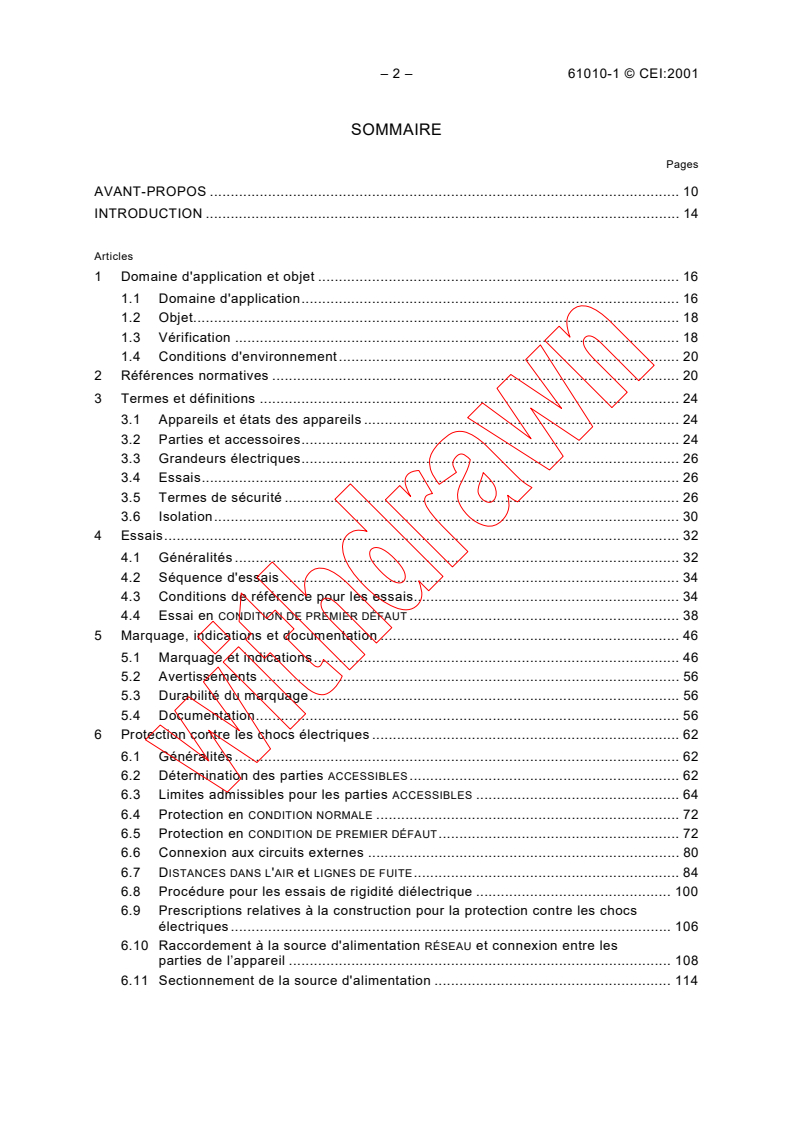
– 2 – 61010-1 © CEI:2001
SOMMAIRE
Pages
AVANT-PROPOS . 10
INTRODUCTION . 14
Articles
1 Domaine d'application et objet . 16
1.1 Domaine d'application. 16
1.2 Objet. 18
1.3 Vérification . 18
1.4 Conditions d'environnement. 20
2 Références normatives . 20
3 Termes et définitions . 24
3.1 Appareils et états des appareils . 24
3.2 Parties et accessoires. 24
3.3 Grandeurs électriques. 26
3.4 Essais. 26
3.5 Termes de sécurité . 26
3.6 Isolation. 30
4 Essais. 32
4.1 Généralités . 32
4.2 Séquence d'essais. 34
4.3 Conditions de référence pour les essais. 34
4.4 Essai en CONDITION DE PREMIER DÉFAUT . 38
5 Marquage, indications et documentation . 46
5.1 Marquage et indications. 46
5.2 Avertissements . 56
5.3 Durabilité du marquage. 56
5.4 Documentation. 56
6 Protection contre les chocs électriques . 62
6.1 Généralités . 62
6.2 Détermination des parties ACCESSIBLES. 62
6.3 Limites admissibles pour les parties ACCESSIBLES . 64
6.4 Protection en CONDITION NORMALE . 72
6.5 Protection en CONDITION DE PREMIER DÉFAUT. 72
6.6 Connexion aux circuits externes . 80
ISTANCES DANS L AIR LIGNES DE FUITE
6.7 D ' et . 84
6.8 Procédure pour les essais de rigidité diélectrique . 100
6.9 Prescriptions relatives à la construction pour la protection contre les chocs
électriques . 106
6.10 Raccordement à la source d'alimentation RÉSEAU et connexion entre les
parties de l’appareil . 108
6.11 Sectionnement de la source d'alimentation . 114
– 4 – 61010-1 © CEI:2001
Articles Pages
7 Protection contre les risques mécaniques . 118
7.1 Généralités . 118
7.2 Parties mobiles . 118
7.3 Stabilité . 120
7.4 Moyens de levage et de transport . 122
7.5 Montage mural. 122
7.6 Parties éjectées . 122
8Résistance mécanique aux chocs et aux vibrations. 124
8.1 Essai de rigidité de l’ENVELOPPE. 124
8.2 Essai de chute . 128
9 Protection contre la propagation du feu. 130
9.1 Elimination ou réduction de l’inflammation à l’intérieur de l’appareil . 134
9.2 Retenue du feu à l’intérieur de l’appareil s’il se déclare . 134
9.3 Circuit à énergie limitée . 138
9.4 Prescriptions pour les appareils contenant des liquides inflammables. 140
9.5 Protection contre les surintensités . 142
10 Limites de température de l’appareil et résistance à la chaleur . 144
10.1 Limites de température des surfaces pour la protection contre les brûlures. 144
10.2 Température des bobinages. 144
10.3 Autres mesures de température . 146
10.4 Réalisation des essais de température. 146
10.5 Résistance à la chaleur. 148
11 Protection contre les DANGERS des fluides. 152
11.1 Généralités . 152
11.2 Nettoyage . 152
11.3 Déversement . 152
11.4 Débordement . 152
11.5 Electrolyte de batterie. 154
11.6 Appareils spécialement protégés . 154
11.7 Fluide sous pression et fuites . 154
12 Protection contre les radiations, y compris les sources laser, et contre la pression
acoustique et ultrasonique . 160
12.1 Généralités . 160
12.2 Appareils produisant un rayonnement ionisant . 160
12.3 Rayonnement ultraviolet (UV) . 160
12.4 Rayonnement hyperfréquences. 162
12.5 Pression acoustique et ultrasonique. 162
12.6 Sources laser. 164
13 Protection contre les émissions de gaz, les explosions et les implosions . 164
13.1 Gaz toxiques et nocifs . 164
13.2 Explosion et implosion . 164
14 Composants. 168
14.1 Généralités . 168
14.2 Moteurs . 172
14.3 Dispositifs de protection contre les surtempératures . 172
14.4 Porte-fusibles . 174
14.5 Sélecteurs de tension RÉSEAU . 174
– 6 – 61010-1 © CEI:2001
Articles Pages
14.6 Composants de HAUTE INTÉGRITÉ .174
14.7 Transformateurs d'alimentation RÉSEAU testés en dehors de l’appareil .174
14.8 Circuits imprimés.174
14.9 Circuits ou composants utilisés comme dispositifs de limitation des
surtensions transitoires .176
15 Protection par systèmes de verrouillage .178
15.1 Généralités.178
15.2 Prévention de réactivation .178
15.3 Fiabilité .178
16 Appareils de mesure et d’essais .178
16.1 Circuits de mesure de courant.178
16.2 Multimètres et appareils similaires.180
Annex A (normative) Circuits de mesure du courant ACCESSIBLE .182
Annex B (normative) Doigts d'épreuve normalisés .188
Annex C (normative) Mesure des distances dans l’air et des lignes des fuite .192
Annex D (normative) Parties entre lesquelles des prescriptions d'isolement sont
spécifiées .200
Annex E (normative) Réduction du degré de POLLUTION .208
Annex F (normative) Essais individuels de série .210
Annex G (informative) Fuite et rupture des fluides sous pression.214
Annex H (informative) Index des termes définis .226
Bibliographie.228
Figure 1 – Durée maximale des tensions accessibles transitoires en CONDITION DE
PREMIER DÉFAUT .68
Figure 2 – Niveau de capacité chargée en CONDITION NORMALE
et en CONDITION DE PREMIER DÉFAUT.70
Figure 3 – Cordons et connexions RÉSEAUX détachables .110
Figure 4 – Essai d’impact utilisant une sphère .126
Figure 5 – Diagramme expliquant les prescriptions pour la protection contre la
propagation du feu.132
Figure 6 – Chicane .136
Figure 7 – Emplacement du fond de l’enveloppe à construire comme spécifié en 9.2.1b)1).138
Figure 8 – Appareil d’essai de pression à la bille .150
Figure 9 – Relation entre la pression hydraulique d'essai et la pression ASSIGNÉE de
service maximale .158
Figure 10 – Diagramme des options de conformité 14.1 a), b), c) et d) .170
Figure A.1 – Circuit de mesure du courant alternatif de fréquence jusqu'à 1 MHz et du
courant continu .182
Figure A.2 – Circuits de mesure du courant alternatif sinusoïdal de fréquence jusqu'à
100 Hz et du courant continu .184
Figure A.3 – Circuit de mesure du courant pour brûlures électriques.186
Figure A.4 – Circuit de mesure du courant pour contact en ambiance humide.186
– 8 – 61010-1 © CEI:2001
Pages
Figure B.1 – Doigt d'épreuve rigide (sonde d’essai 11 de la CEI 61032) . 188
Figure B.2 – Doigt d'épreuve articulé (sonde d'essai B de la CEI 61032). 190
Figure C.1 – Exemples des méthodes de mesure des DISTANCES DANS L'AIR et des
LIGNES DE FUITE. 198
Figures D.1 a) à D.1 d) – Protection entre des circuits sous TENSION DANGEREUSE et
CONDITION NORMALE
d'autres circuits qui ne dépassent pas les valeurs du 6.3.2 en et
qui ont des parties ACCESSIBLES non reliées à la BORNE. 202
Figure D.1 e) à D.1 h) – Protection entre des circuits sous TENSION DANGEREUSE et
d'autres circuits qui ne dépassent pas les valeurs du 6.3.2 en CONDITION NORMALE et
qui ont des BORNES externes . 202
Figures D.2 a) et D.2 b) – Protection contre un circuit interne sous TENSION
DANGEREUSE pour une partie ACCESSIBLE qui n'est pas reliée à d'autres parties
ACCESSIBLES . 204
Figure D.2 a) à D.2 d) – Protection contre un circuit primaire sous TENSION
DANGEREUSE pour les BORNES ACCESSIBLES d'un circuit secondaire qui ne dépasse pas
les valeurs du 6.3.2 en CONDITION NORMALE . 204
Figure D.3 – Protection des BORNES externes ACCESSIBLES de deux circuits sous
TENSION DANGEREUSE . 206
Figure G.1 – Processus de vérification de la conformité . 216
Tableau 1 – Symboles. 50
Tableau 2 – Couples de serrage pour les assemblages vissés . 76
Tableau 3 – Coefficient multiplicateur pour les DISTANCES DANS L’AIR jusqu’à 5 000 m
d’altitude . 86
Tableau 4 – DISTANCE DANS L’AIR et LIGNES DE FUITE pour les circuits RÉSEAUX. 88
Tableau 5 – DISTANCES DANS L’AIR pour les circuits dérivés des CIRCUITS RÉSEAUX . 90
Tableau 6 – Valeurs des distances dans l’air pour le calcul de 6.7.3.2 . 94
Tableau 7 – Lignes de fuite . 96
Tableau 8 – DISTANCES DANS L’AIR pour les catégories de mesure II, III et IV . 98
Table 9 – Tensions d’essai pour l’ISOLATION PRINCIPALE . 104
Tableau 10 – Coefficients de correction pour tension d’essai selon l’altitude du site
d’essai . 106
Tableau 11 – Essais mécaniques sur les cordons d’alimentation . 112
Tableau 12 – Perforation acceptable du fond de l’enveloppe . 136
Tableau 13 – Limites du courant maximal disponible . 140
Tableau 14 – Dispositif de protection contre les surintensités. 140
Tableau 15 – Limites des températures de surface en CONDITION NORMALE. 144
Tableau 16 – Matériaux d’isolation des bobinages. 146
Tableau 17 – Tensions de tenue aux chocs. 176
Tableau 18 – Impédance de sortie des générateurs d’impulsion . 176
Tableau E.1 – Réduction du degré de POLLUTION de l'environnement interne grâce à
l’utilisation de protections supplémentaires. . 208
Tableau G.1 – Essai de pression pour les appareils avec des pressions supérieures à
14 MPa . 220
– 10 – 61010-1 © CEI:2001
COMMISSION ÉLECTROTECHNIQUE INTERNATIONALE
___________
RÈGLES DE SÉCURITÉ POUR APPAREILS ÉLECTRIQUES
DE MESURAGE, DE RÉGULATION ET DE LABORATOIRE –
Partie 1: Prescriptions générales
AVANT-PROPOS
1) La CEI (Commission Électrotechnique Internationale) est une organisation mondiale de normalisation
composée de l'ensemble des comités électrotechniques nationaux (Comités nationaux de la CEI). La CEI a
pour objet de favoriser la coopération internationale pour toutes les questions de normalisation dans les
domaines de l'électricité et de l'électronique. A cet effet, la CEI, entre autres activités, publie des Normes
internationales. Leur élaboration est confiée à des comités d'études, aux travaux desquels tout Comité national
intéressé par le sujet traité peut participer. Les organisations internationales, gouvernementales et non
gouvernementales, en liaison avec la CEI, participent également aux travaux. La CEI collabore étroitement
avec l'Organisation Internationale de Normalisation (ISO), selon des conditions fixées par accord entre les
deux organisations.
2) Les décisions ou accords officiels de la CEI concernant les questions techniques représentent, dans la mesure
du possible, un accord international sur les sujets étudiés, étant donné que les Comités nationaux intéressés
sont représentés dans chaque comité d’études.
3) Les documents produits se présentent sous la forme de recommandations internationales. Ils sont publiés
comme normes, spécifications techniques, rapports techniques ou guides et agréés comme tels par les
Comités nationaux.
4) Dans le but d'encourager l'unification internationale, les Comités nationaux de la CEI s'engagent à appliquer de
façon transparente, dans toute la mesure possible, les Normes internationales de la CEI dans leurs normes
nationales et régionales. Toute divergence entre la norme de la CEI et la norme nationale ou régionale
correspondante doit être indiquée en termes clairs dans cette dernière.
5) La CEI n’a fixé aucune procédure concernant le marquage comme indication d’approbation et sa responsabilité
n’est pas engagée quand un matériel est déclaré conforme à l’une de ses normes.
6) L’attention est attirée sur le fait que certains des éléments de la présente Norme internationale peuvent faire
l’objet de droits de propriété intellectuelle ou de droits analogues. La CEI ne saurait être tenue pour
responsable de ne pas avoir identifié de tels droits de propriété et de ne pas avoir signalé leur existence.
La Norme internationale CEI 61010-1 a été établie par le comité d'études 66 de la CEI:
Sécurité des appareils de mesure, de commande et de laboratoire.
Cette norme a le statut de publication groupée de sécurité, conformément au Guide 104 de
la CEI.
Cette deuxième édition annule et remplace la première édition parue en 1990, l'amende-
ment 1 (1992) et l'amendement 2 (1995). Elle constitue une révision technique.
Le texte de cette norme est issu des documents suivants:
FDIS Rapport de vote
66/233/FDIS 66/244/RVD
Le rapport de vote indiqué dans le tableau ci-dessus donne toute information sur le vote ayant
abouti à l'approbation de cette norme.
Cette publication a été rédigée selon les Directives ISO/CEI, Partie 3.
– 12 – 61010-1 © CEI:2001
Les annexes A à H font partie intégrante de cette norme.
Dans la présente norme, les caractères d'imprimerie suivants sont employés:
– prescriptions et définitions: caractères romains;
– NOTES: petits caractères romains;
– conformité: caractères italiques;
– termes définis à l'article 3 et utilisés dans toute cette norme: PETITES CAPITALES ROMAINES.
Le comité a décidé que le contenu de cette publication ne sera pas modifié avant 2002.
A cette date, la publication sera
• reconduite;
• supprimée;
• remplacée par une édition révisée, ou
• amendée.
Le contenu des corrigenda de mai 2002 et avril 2003 a été pris en considération dans cet
exemplaire.
– 14 – 61010-1 © CEI:2001
INTRODUCTION
La présente partie 1 spécifie les règles de sécurité qui sont d'application générale à tous les
appareils qu'elle concerne. Pour certains types d'appareils, ces règles seront complétées ou
modifiées par les prescriptions particulières d'une ou plus d'une normes particulières partie 2,
qu'il faut lire conjointement avec les règles de la partie 1.
– 16 – 61010-1 © CEI:2001
RÈGLES DE SÉCURITÉ POUR APPAREILS ÉLECTRIQUES
DE MESURAGE, DE RÉGULATION ET DE LABORATOIRE –
Partie 1: Prescriptions générales
1 Domaine d'application et objet
1.1 Domaine d'application
1.1.1 Appareils inclus dans le domaine d’application
La présente partie de la CEI 61010 spécifie les prescriptions générales de sécurité pour les
appareils électriques destinés aux usages professionnels, industriels (processus) et éducatifs,
chacun de ces appareils pouvant incorporer un calculateur, définis de a) à d) ci-dessous,
lorsqu’ils sont utilisés dans les conditions d’environnement de 1.4.
a) Appareils électriques d'essai et de mesurage
Il s'agit d'appareils qui, par des moyens d'ordre électrique, mesurent, indiquent ou
enregistrent une ou plusieurs grandeurs électriques ou non électriques, ainsi que des
appareils non-mesureurs tels que générateurs de signaux, étalons de mesure,
alimentations, transducteurs, transmetteurs, etc.
NOTE Tous les appareils de mesure indicateurs et enregistreurs (sauf ceux qui sont exclus en 1.1.2) relèvent
du domaine d’application de la CEI 61010, à moins qu’ils ne soient des indicateurs de tableau conçus
uniquement pour être incorporés à d’autres équipements. Les appareils de tableau d’incorporation sont
considérés comme des composants, et ont seulement besoin d’être conforme aux prescriptions applicables de
la CEI 61010, ou à d’autres normes, comme partie de l’appareil dans lequel ils sont incorporés.
b) Appareils électriques de régulation
Il s'agit d'appareils qui règlent une ou plusieurs grandeurs de sortie selon des valeurs
spécifiques, chaque valeur étant déterminée par réglage manuel, par programmation
locale ou à distance, ou par une ou plusieurs variables d'entrée.
c) Appareils électriques de laboratoire
Il s'agit d'appareils qui mesurent, indiquent, surveillent ou analysent des substances, ou
qui servent à préparer des matériaux y compris les appareils de diagnostic in vitro (DIV).
Ces appareils peuvent également être utilisés ailleurs que dans des laboratoires, par
exemple les appareils DIV d’auto-test personnel peuvent être utilisés dans une habitation.
d) Accessoires conçus pour être utilisés avec les appareils ci-dessus (par exemple les
appareils pour manipuler les échantillons).
1.1.2 Appareils exclus du domaine d'application
Cette norme n'est pas applicable aux appareils des domaines d’application de:
a) CEI 60065 (Exigences de sécurité pour les appareils audio, vidéo et appareils
électroniques analogues);
b) CEI 60204 (Régulations pour les machines électriques);
c) CEI 60335 (Sécurité des appareils électrodomestiques et analogues);
d) CEI 60364 (Installation électrique des bâtiments);
e) CEI 60439-1 (Ensemble d’appareillage à basse tension);
f) CEI 60521 (Compteurs d’énergie active à courant alternatif des classes 0,5, 1 et 2);
g) CEI 60601 (Appareils électromédicaux);
– 18 – 61010-1 © CEI:2001
h) CEI 60950 (Sécurité des matériels de traitement de l’information y compris les matériels
de bureau électriques, sauf pour ce qui est défini en 1.1.3);
i) CEI 61558 (Transformateurs, blocs d’alimentation et analogues).
1.1.3 Appareils calculateurs
Cette norme n'est applicable qu'aux ordinateurs, processeurs, etc. qui font partie des
appareils visés par la présente norme ou qui sont conçus pour être utilisés exclusivement
avec ces appareils.
NOTE Les calculateurs et appareils similaires visés par la CEI 60950 et conformes à ses prescriptions sont
considérés comme pouvant être utilisés avec les appareils visés par le domaine d'application de cette norme.
Cependant, certaines prescriptions de la CEI 60950 pour la tenue à l’humidité et aux liquides sont moins sévères
que celles de cette norme. Si un DANGER dû à de l’humidité ou à un liquide peut affecter un matériel conforme à la
CEI 60950, utilisé avec un matériel qui est conforme à cette norme, il convient que les instructions d’emploi
spécifient toutes les précautions supplémentaires exigées.
1.2 Objet
1.2.1 Aspects inclus dans le domaine d’application
Les prescriptions de la présente partie 1 ont pour objet de garantir que la conception et la
construction assurent une protection adéquate de l'OPÉRATEUR et de la zone environnante:
a) contre les chocs électriques et les brûlures (voir article 6);
b) contre les DANGERS d'ordre mécanique (voir articles 7 et 8);
c) contre les températures excessives (voir article 9 et 10);
d) contre la propagation du feu à partir des appareils (voir article 9);
e) contre les effets des liquides et fluides sous pression (voir article 11);
f) contre les effets des radiations, y compris ceux des sources laser, et de la pression
acoustique et ultrasonique (voir article 12);
g) contre les émissions de gaz, les explosions et les implosions (voir article 13).
NOTE L'attention est attirée sur l'existence de règles supplémentaires qui peuvent être spécifiées par les
responsables nationaux de la santé et de la sécurité des travailleurs.
1.2.2 Aspects exclus du domaine d’application
Cette norme ne couvre pas:
a) la fiabilité de fonctionnement, les qualités de fonctionnement ni les autres caractéristiques
des appareils qui ne sont pas liées à la sécurité;
b) l’efficacité de l’emballage de transport;
c) les prescriptions CEM qui sont couvertes par la CEI 61326;
d) les mesures de protection dans les atmosphères explosives (voir CEI 60079);
e) la maintenance (réparations);
f) la protection du personnel de maintenance (réparations).
NOTE Il est attendu du personnel de maintenance qu'il prenne des précautions raisonnables pour faire face
DANGERS
aux évidents; mais il y a lieu que les appareils soient conçus de façon à protéger contre les
incidents, au moyen de plaques d'avertissement, de blindages des BORNES sous tension dangereuse, de
séparation des circuits à basse tension et des circuits sous tensions dangereuses, etc. Qui plus est, il convient
que le personnel de maintenance soit formé contre les risques imprévus et qu'il agisse en conséquence.
1.3 Vérification
Cette norme spécifie également les méthodes de vérification, par contrôle et par essais de
type, de la conformité des appareils aux prescriptions de cette norme.
NOTE Les prescriptions relatives aux ESSAIS INDIVIDUELS DE SÉRIE sont données à l'annexe F.
– 20 – 61010-1 © CEI:2001
1.4 Conditions d'environnement
1.4.1 Conditions d’environnement normales
Cette norme est applicable aux appareils conçus pour être sûrs au moins dans les conditions
suivantes:
a) utilisation en intérieur;
b) altitude jusqu'à 2 000 m;
c) température de 5 °C à 40 °C;
d) humidité relative maximale de 80 % pour des températures allant jusqu'à 31 °C, avec
décroissance linéaire jusqu'à 50 % d'humidité relative à 40 °C;
e) fluctuations de la tension du RÉSEAU d'alimentation ne dépassant pas ±10 % de la tension
nominale;
f) présence normale de surtensions transitoires sur l'alimentation par le RÉSEAU;
NOTE Le niveau habituel de surtension transitoire correspond à la catégorie II de la tenue en impulsion
(surtension) de la CEI 60364-4-443.
g) DEGRÉ DE POLLUTION assigné applicable.
1.4.2 Conditions d’environnement étendues
Cette norme s’applique aux appareils conçus pour être sûrs, non seulement dans les
conditions d’environnement spécifiées en 1.4.1, mais aussi dans chacune des conditions
suivantes pour lesquelles l’appareil est ASSIGNÉ par le constructeur:
a) utilisation à l’extérieur;
b) altitude supérieure à 2000 m;
c) températures ambiantes inférieures à 5 °C et supérieures à 40 °C;
d) humidité relative supérieure aux valeurs spécifiées en 1.4.1;
e) fluctuation de la tension du RÉSEAU de distribution supérieure à ±10 % de la valeur
nominale.
2 Références normatives
Les documents normatifs suivants contiennent des dispositions qui, par suite de la référence
qui y est faite, constituent des dispositions valables pour la présente partie de la CEI 61010.
Pour les références datées, les amendements ultérieurs ou les révisions de ces publications
ne s’appliquent pas. Toutefois, les parties prenantes aux accords fondés sur la présente
partie de la CEI 61010 sont invitées à rechercher la possibilité d'appliquer les éditions les
plus récentes des documents normatifs indiqués ci-après. Pour les références non datées, la
dernière édition du document normatif en référence s’applique. Les membres de la CEI et de
l'ISO possèdent le registre des Normes internationales en vigueur.
CEI 60027, Symboles littéraux à utiliser en électrotechnique
CEI 60060, Techniques des essais à haute tension
CEI 60065, Appareils audio, vidéo et appareils électroniques analogues – Exigences de
sécurité
CEI 60085, Evaluation et classification thermiques de l'isolation électrique
– 22 – 61010-1 © CEI:2001
CEI 60227, Conducteurs et câbles isolés au polychlorure de vinyle, de tension nominale au
plus égale à 450/750 V
CEI 60245, Conducteurs et câbles isolés au caoutchouc – Tension assignée au plus égale à
450/750 V
CEI 60309, Prises de courant pour usages industriels
CEI 60335, Sécurité des appareils électrodomestiques et analogues
CEI 60529, Degrés de protection procurés par les enveloppes (Code IP)
CEI 60651, Sonomètres
CEI 60664-3, Coordination de l'isolement des matériels dans les systèmes (réseaux) à basse
tension – Partie 3: Utilisation de revêtements pour réaliser la coordination de l'isolement des
cartes imprimées équipées
CEI 60707, Inflammabilité des matériaux solides non métalliques soumis à des sources
d'allumage à flamme – Liste des méthodes d’essai
CEI 60799, Petit appareillage électrique – Cordons-connecteurs et cordons d’interconnexion
CEI 60804, Sonomètres intégrateurs-moyenneurs
CEI 60825-1, Sécurité des appareils à laser – Partie 1: Classification des matériels,
prescriptions et guide de l'utilisateur
CEI 60947-1, Appareillage à basse tension – Partie 1: Règles générales
CEI 60947-3, Appareillage à basse tension – Partie 3: Interrupteurs, sectionneurs,
interrupteurs-sectionneurs et combinés-fusibles
ISO 306:1994, Plastiques – Matières thermoplastiques – Détermination de la température de
ramollissement Vicat (VST)
ISO 3746, Acoustique – Détermination des niveaux de puissance acoustique émis par les
sources de bruit à partir de la pression acoustique – Méthode de contrôle employant une
surface de mesure enveloppante au-dessus d’un plan réfléchissant
ISO 4126-1, Soupapes de sûreté – Partie 1: Prescriptions générales
ISO 9614-1, Acoustique – Détermination par intensimétrie des niveaux de puissance
acoustique émis par les sources de bruit – Partie 1: Mesurages par points
– 24 – 61010-1 © CEI:2001
3 Termes et définitions
Pour les besoins de la présente partie de la CEI 61010, les définitions suivantes s'appliquent.
Sauf spécification contraire, les termes «tension» et «courant» signifient les valeurs efficaces
d'une tension ou d'un courant alternatif, continu ou composé.
NOTE Voir l’index des termes définis dans l’annexe H.
3.1 Appareils et états des appareils
3.1.1
APPAREIL FIXE
appareil fixé à un support ou fixé autrement à un emplacement spécifique
3.1.2
APPAREIL BRANCHÉ EN PERMANENCE
appareil qui est raccordé électriquement à une alimentation au moyen d'un branchement
permanent qui ne peut être défait que par l'utilisation d'un OUTIL
3.1.3
APPAREIL PORTABLE
appareil destiné à être porté à la main
3.1.4
APPAREIL PORTATIF (À MAIN)
APPAREIL PORTABLE destiné à être tenu d'une main en UTILISATION NORMALE
3.1.5
OUTIL
dispositif extérieur utilisé pour aider quelqu'un à réaliser une fonction mécanique. Le terme
OUTIL englobe les clés et les pièces de monnaie
3.2 Parties et accessoires
3.2.1
BORNE
composant destiné à raccorder un dispositif (appareil) à des conducteurs extérieurs
[VEI 151-01-03, modifié]
NOTE Une BORNE peut comporter un ou plusieurs contacts et ce terme inclus donc les prises, les connecteurs,
etc.
3.2.2
BORNE DE TERRE FONCTIONNELLE
BORNE par laquelle un branchement électrique est effectué directement à un circuit de mesure
ou de commande, ou à un organe de blindage, qui est destinée à être mise à la terre à toute
fin fonctionnelle autre que la sécurité
NOTE Pour les appareils de mesure, cette BORNE est souvent appelée BORNE de terre de mesure.
3.2.3
BORNE DE TERRE DE PROTECTION
BORNE qui est connectée à des pièces conductrices d'un appareil à des fins de sécurité et qui
est destinée à être connectée à un système extérieur de mise à la terre de protection
– 26 – 61010-1 © CEI:2001
3.2.4
ENVELOPPE
partie assurant la protection d'un appareil contre certaines influences extérieures et la
protection contre le contact direct à partir de n'importe quelle direction
3.2.5
BARRIÈRE
partie assurant la protection contre le contact direct à partir de n'importe quel sens habituel
d'accès
NOTE Des ENVELOPPES et des BARRIÈRES peuvent assurer la protection contre la propagation du feu (voir 9.2.1 b)).
3.3 Grandeurs électriques
3.3.1
(valeur) ASSIGNÉE
valeur d'une grandeur fixée, généralement par le constructeur, pour un fonctionnement
spécifié d'un composant, d'un dispositif ou d'un matériel [VEI 151-04-03]
3.3.2
CARACTÉRISTIQUES ASSIGNÉES
ensemble des valeurs ASSIGNÉES et des conditions de fonctionnement [VEI 151-04-04]
3.3.3
TENSION DE SERVICE
valeur efficace la plus élevée de la tension alternative ou continue au travers de chacun des
isolants particuliers que l’on puisse trouver lorsque l’appareil est alimenté sous la tension
assignée
NOTE 1 Les transitoires ne sont pas considérés.
NOTE 2 Les deux conditions, circuit ouvert et fonctionnement normal sont considérées.
3.4 Essais
3.4.1
ESSAI DE TYPE
essai effectué sur un ou plusieurs échantillons d'appareil ou de parties d'appareil réalisés
selon une conception donnée, pour vérifier que cette conception et la construction répondent
à une ou plusieurs conditions de cette norme [VEI 151-04-15, modifié]
NOTE Cette définition développe celle du VEI 151-04-15 pour tenir compte des exigences de conception comme
de construction.
3.4.2
ESSAI INDIVIDUEL DE SÉRIE
essai auquel est soumis chaque dispositif (appareil) individuel en cours ou en fin de
fabrication pour vérifier qu'il satisfait à des critères définis [VEI 151-04-16, modifié] (voir
annexe F)
3.5 Termes de sécurité
3.5.1
ACCESSIBLE (partie)
susceptible d'être atteinte avec une broche d'essai ou un doigt d'épreuve normalisés et
utilisés comme spécifié en 6.2
3.5.2
DANGER
source potentielle de mal
– 28 – 61010-1 © CEI:2001
3.5.3
sous TENSION DANGEREUSE
capable de causer un choc électrique ou une brûlure électrique en CONDITION NORMALE ou en
CONDITION DE PREMIER DÉFAUT
NOTE Voir 6.3.1 pour les valeurs applicables aux CONDITIONS NORMALES et 6.3.2 pour les valeurs plus élevées qui
sont jugées appropriées en CONDITION DE PREMIER DÉFAUT.
3.5.4
HAUTE INTÉGRITÉ
non susceptible, en devenant défectueux, de présenter un risque de DANGER au sens de cette
norme; une partie à HAUTE INTÉGRITÉ est considérée comme non sujette à défaillance lorsque
des essais en condition de défaut sont effectués
3.5.5
RÉSEAU (de distribution)
alimentation électrique basse tension (au-dessus des valeurs de 6.3.2 a)) auquel l’appareil
concerné est conçu pour être relié afin de l’alimenter
NOTE Des circuits de mesure peuvent aussi être reliés au RÉSEAU pour mesure.
3.5.6
CIRCUIT RÉSEAU (de distribution)
circuit conçu pour être relié par conduction au RÉSEAU afin d’alimenter l’appareil
NOTE Les circuits de mesure et les circuits qui sont dérivés des circuits RÉSEAUX par couplage inductif ne sont
pas des circuits RÉSEAUX
3.5.7
IMPÉDANCE DE PROTECTION
composant, ensemble de composants ou combinaison d'une isolation principale et d'un
dispositif de limitation de courant ou de tension, dont l'impédance, la construction et la
fiabilité sont telles que, lorsqu'ils sont raccordés entre des parties qui sont sous TENSION
DANGEREUSE et des parties conductrices ACCESSIBLES, la protection, dans les limites de ce qui
est exigé par cette norme, est assurée en CONDITION NORMALE et en CONDITION DE PREMIER
DÉFAUT
3.5.8
LIAISON PROTECTRICE
connexion électrique de parties conductrices ACCESSIBLES et/ou d'écrans de protection pour
assurer une continuité électrique jusqu'au moyen de connexion d'un conducteur de protection
extérieure
3.5.9
UTILISATION NORMALE
fonctionnement, y compris en position d'attente, conformément au mode d'emploi ou usage
prévu évident
NOTE Dans la plupart des cas, l'UTILISATION NORMALE implique également la CONDITION NORMALE, car les modes
CONDITION NORMALE
d'emploi mettront en garde contre l'utilisation de l'appareil lorsque ce dernier n'est pas en .
3.5.10
CONDITION NORMALE
état dans lequel tous les moyens de p
...
IEC 61010-1
Edition 2.0 2001-02
INTERNATIONAL
STANDARD
NORME
INTERNATIONALE
GROUP SAFETY PUBLICATION
PUBLICATION GROUPÉE DE SÉCURITÉ
Safety requirements for electrical equipment for measurement, control,
and laboratory use –
Part 1: General requirements
Règles de sécurité pour appareils électriques de mesurage, de régulation
et de laboratoire –
Partie 1: Prescriptions générales
All rights reserved. Unless otherwise specified, no part of this publication may be reproduced or utilized in any form or by
any means, electronic or mechanical, including photocopying and microfilm, without permission in writing from either IEC or
IEC's member National Committee in the country of the requester.
If you have any questions about IEC copyright or have an enquiry about obtaining additional rights to this publication,
please contact the address below or your local IEC member National Committee for further information.
Droits de reproduction réservés. Sauf indication contraire, aucune partie de cette publication ne peut être reproduite
ni utilisée sous quelque forme que ce soit et par aucun procédé, électronique ou mécanique, y compris la photocopie
et les microfilms, sans l'accord écrit de la CEI ou du Comité national de la CEI du pays du demandeur.
Si vous avez des questions sur le copyright de la CEI ou si vous désirez obtenir des droits supplémentaires sur cette
publication, utilisez les coordonnées ci-après ou contactez le Comité national de la CEI de votre pays de résidence.
IEC Central Office
3, rue de Varembé
CH-1211 Geneva 20
Switzerland
Email: inmail@iec.ch
Web: www.iec.ch
About the IEC
The International Electrotechnical Commission (IEC) is the leading global organization that prepares and publishes
International Standards for all electrical, electronic and related technologies.
About IEC publications
The technical content of IEC publications is kept under constant review by the IEC. Please make sure that you have the
latest edition, a corrigenda or an amendment might have been published.
ƒ Catalogue of IEC publications: www.iec.ch/searchpub
The IEC on-line Catalogue enables you to search by a variety of criteria (reference number, text, technical committee,…).
It also gives information on projects, withdrawn and replaced publications.
ƒ IEC Just Published: www.iec.ch/online_news/justpub
Stay up to date on all new IEC publications. Just Published details twice a month all new publications released. Available
on-line and also by email.
ƒ Electropedia: www.electropedia.org
The world's leading online dictionary of electronic and electrical terms containing more than 20 000 terms and definitions
in English and French, with equivalent terms in additional languages. Also known as the International Electrotechnical
Vocabulary online.
ƒ Customer Service Centre: www.iec.ch/webstore/custserv
If you wish to give us your feedback on this publication or need further assistance, please visit the Customer Service
Centre FAQ or contact us:
Email: csc@iec.ch
Tel.: +41 22 919 02 11
Fax: +41 22 919 03 00
A propos de la CEI
La Commission Electrotechnique Internationale (CEI) est la première organisation mondiale qui élabore et publie des
normes internationales pour tout ce qui a trait à l'électricité, à l'électronique et aux technologies apparentées.
A propos des publications CEI
Le contenu technique des publications de la CEI est constamment revu. Veuillez vous assurer que vous possédez
l’édition la plus récente, un corrigendum ou amendement peut avoir été publié.
ƒ Catalogue des publications de la CEI: www.iec.ch/searchpub/cur_fut-f.htm
Le Catalogue en-ligne de la CEI vous permet d’effectuer des recherches en utilisant différents critères (numéro de référence,
texte, comité d’études,…). Il donne aussi des informations sur les projets et les publications retirées ou remplacées.
ƒ Just Published CEI: www.iec.ch/online_news/justpub
Restez informé sur les nouvelles publications de la CEI. Just Published détaille deux fois par mois les nouvelles
publications parues. Disponible en-ligne et aussi par email.
ƒ Electropedia: www.electropedia.org
Le premier dictionnaire en ligne au monde de termes électroniques et électriques. Il contient plus de 20 000 termes et
définitions en anglais et en français, ainsi que les termes équivalents dans les langues additionnelles. Egalement appelé
Vocabulaire Electrotechnique International en ligne.
ƒ Service Clients: www.iec.ch/webstore/custserv/custserv_entry-f.htm
Si vous désirez nous donner des commentaires sur cette publication ou si vous avez des questions, visitez le FAQ du
Service clients ou contactez-nous:
Email: csc@iec.ch
Tél.: +41 22 919 02 11
Fax: +41 22 919 03 00
IEC 61010-1
Edition 2.0 2001-02
INTERNATIONAL
STANDARD
NORME
INTERNATIONALE
GROUP SAFETY PUBLICATION
PUBLICATION GROUPÉE DE SÉCURITÉ
Safety requirements for electrical equipment for measurement, control,
and laboratory use –
Part 1: General requirements
Règles de sécurité pour appareils électriques de mesurage, de régulation
et de laboratoire –
Partie 1: Prescriptions générales
INTERNATIONAL
ELECTROTECHNICAL
COMMISSION
COMMISSION
ELECTROTECHNIQUE
PRICE CODE
INTERNATIONALE
XE
CODE PRIX
ICS 19.080; 71.040.10 ISBN 2-8318-5553-5
61010-1 © IEC:2001 – 3 –
– 2 – 61010-1 © IEC:2001
CONTENTS
Page
FOREWORD .6
INTRODUCTION . 8
Clause
1 Scope and object . 9
1.1 Scope . 9
1.2 Object. 10
1.3 Verification . 10
1.4 Environmental conditions . 11
2 Normative references. 11
3 Terms and definitions. 13
3.1 Equipment and states of equipment . 13
3.2 Parts and accessories. 13
3.3 Electrical quantities. 14
3.4 Tests . 14
3.5 Safety terms . 14
3.6 Insulation. 16
4 Tests . 17
4.1 General. 17
4.2 Sequence of tests . 18
4.3 Reference test conditions . 18
4.4 Testing in SINGLE FAULT CONDITION . 20
5 Marking and documentation . 24
5.1 Marking. 24
5.2 Warning markings . 29
5.3 Durability of markings . 29
5.4 Documentation. 29
6 Protection against electric shock. 32
6.1 General. 32
6.2 Determination of ACCESSIBLE parts . 32
6.3 Permissible limits for ACCESSIBLE parts . 33
6.4 Protection in NORMAL CONDITION . 37
6.5 Protection in SINGLE FAULT CONDITION . 37
6.6 Connections to external circuits . 41
LEARANCES CREEPAGE DISTANCES
6.7 C and . 43
6.8 Procedure for dielectric strength tests. 51
6.9 Constructional requirements for protection against electric shock . 54
6.10 Connection to MAINS supply source and connections
between parts of equipment . 55
6.11 Disconnection from supply source. 58
61010-1 © IEC:2001 – 5 –
61010-1 © IEC:2001 – 3 –
Clause Page
7 Protection against mechanical HAZARDS . 60
7.1 General. 60
7.2 Moving parts . 60
7.3 Stability . 61
7.4 Provisions for lifting and carrying . 62
7.5 Wall mounting. 62
7.6 Expelled parts. 62
8 Mechanical resistance to shock and impact. 63
8.1 ENCLOSURE rigidity test . 63
8.2 Drop test. 65
9 Protection against the spread of fire. 66
9.1 Eliminating or reducing the sources of ignition within the equipment . 68
9.2 Containment of fire within the equipment, should it occur. 68
9.3 Limited-energy circuit. 70
9.4 Requirements for equipment containing or using flammable liquids. 71
9.5 Overcurrent protection . 72
10 Equipment temperature limits and resistance to heat . 73
10.1 Surface temperature limits for protection against burns. 73
10.2 Temperatures of windings. 73
10.3 Other temperature measurements. 74
10.4 Conduct of temperature tests . 74
10.5 Resistance to heat . 75
11 Protection against HAZARDS from fluids. 77
11.1 General. 77
11.2 Cleaning . 77
11.3 Spillage . 77
11.4 Overflow . 77
11.5 Battery electrolyte. 78
11.6 Specially protected equipment . 78
11.7 Fluid pressure and leakage. 78
12 Protection against radiation, including laser sources, and against sonic and
ultrasonic pressure . 81
12.1 General. 81
12.2 Equipment producing ionizing radiation. 81
12.3 Ultraviolet (UV) radiation. 81
12.4 Microwave radiation. 82
12.5 Sonic and ultrasonic pressure. 82
12.6 Laser sources . 83
13 Protection against liberated gases, explosion and implosion . 83
13.1 Poisonous and injurious gases. 83
13.2 Explosion and implosion . 83
14 Components . 85
14.1 General. 85
14.2 Motors . 87
14.3 Overtemperature protection devices. 87
14.4 Fuse holders. 88
14.5 MAINS voltage selecting devices. 88
61010-1 © IEC:2001 – 7 –
– 4 – 61010-1 © IEC:2001
Clause Page
14.6 HIGH INTEGRITY components.88
14.7 MAINS transformers tested outside equipment.88
14.8 Printed circuit boards .88
14.9 Circuits or components used as transient overvoltage limiting devices .89
15 Protection by interlocks .90
15.1 General . 90
15.2 Prevention of reactivating. 90
15.3 Reliability .90
16 Test and measurement equipment.90
16.1 Current measuring circuits.90
16.2 Multifunction meters and similar equipment .91
Annex A (normative) Measuring circuits for ACCESSIBLE current .92
Annex B (normative) Standard test finger .95
Annex C (normative) Measurement of CLEARANCES and CREEPAGE DISTANCES .97
Annex D (normative) Parts between which insulation requirements are specified .101
Annex E (normative) Reduction of POLLUTION degrees .105
Annex F (normative) ROUTINE TESTS .106
Annex G (informative) Leakage and rupture from fluids under pressure .108
Annex H (informative) Index of defined terms.114
Bibliography.115
Figure 1 – Maximum duration of short-term temporary ACCESSIBLE voltages
in SINGLE FAULT CONDITION .35
Figure 2 – Charged capacitance level in NORMAL CONDITION and SINGLE FAULT CONDITION .36
Figure 3 – Detachable MAINS supply cords and connections .56
Figure 4 – Impact test using sphere .64
Figure 5 – Flow chart to explain the requirements for protection against the spread of fire.67
Figure 6 – Baffle .69
Figure 7 – Area of the bottom of an ENCLOSURE to be constructed as specified
in 9.2.1 b)1) .70
Figure 8 – Ball-pressure test apparatus .76
Figure 9 – Ratio between hydraulic test pressure and RATED maximum working pressure .80
Figure 10 – Flow chart for conformity options 14.1 a), b), c) and d).86
Figure A.1 – Measuring circuit for a.c. with frequencies up to 1 MHz and for d.c. .92
Figure A.2 – Measuring circuits for a.c. with sinusoidal frequencies up to 100 Hz
and for d.c. .93
Figure A.3 – Current measuring circuit for electrical burns .94
Figure A.4 – Current measuring circuit for wet contact .94
61010-1 © IEC:2001 – 9 –
61010-1 © IEC:2001 – 5 –
Page
Figure B.1 – Rigid test finger (test probe 11 of IEC 61032). 95
Figure B.2 – Jointed test finger (test probe B of IEC 61032) . 96
Figure C.1 – Examples of methods of measuring CLEARANCE and CREEPAGE DISTANCES . 100
Figures D.1 a) to D.1 d) – Protection between HAZARDOUS LIVE circuits and circuits not
exceeding the values of 6.3.2 in NORMAL CONDITION and having external TERMINALS of
ACCESSIBLE parts . 102
Figures D.1 e) to D.1 h) – Protection between HAZARDOUS LIVE circuits and other
circuits which do not exeeed the values of 6.3.2 in NORMAL CONDITION
and which have external TERMINALS . 102
Figure D.2 a) and D.2 b) – Protection from a HAZARDOUS LIVE internal circuit
for an ACCESSIBLE part which is not bonded to other ACCESSIBLE parts . 103
HAZARDOUS LIVE
Figure D.2 c) and D.2 d) – Protection from a primary circuit for
ACCESSIBLE TERMINALS of a secondary circuit which does not exceed the values
of 6.3.2 in NORMAL CONDITION. 103
Figure D.3 – Protection of external ACCESSIBLE TERMINALS of two HAZARDOUS LIVE circuits . 104
Figure G.1 – Conformity verification process . 109
Table 1 – Symbols.26
Table 2 – Tightening torque for screw assemblies .39
Table 3 – Multiplication factors for CLEARANCE for altitudes up to 5 000 m .44
Table 4 – CLEARANCES and CREEPAGE DISTANCES for MAINS CIRCUITS . 45
Table 5 – CLEARANCES for circuits derived from MAINS CIRCUITS .46
Table 6 – CLEARANCE values for the calculation of 6.7.3.2 .48
Table 7 – CREEPAGE DISTANCES .48
Table 8 – CLEARANCES for measurement categories II, III and IV .50
Table 9 – Test voltages for BASIC INSULATION . 53
Table 10 – Correction factors for test voltage according to test site altitude. 54
Table 11 – Physical tests on power supply cords. 57
Table 12 – Acceptable perforation of the bottom of an ENCLOSURE. 69
Table 13 – Limits of maximum available current . 71
Table 14 – Overcurrent protective device . 71
NORMAL CONDITION
Table 15 – Surface temperature limits in . 73
Table 16 – Insulation material of windings . 74
Table 17 – Impulse withstand voltages . 89
Table 18 – Output impedance for impulse generators. 89
POLLUTION
Table E.1 – Reduction of the degree of internal environment through
the use of additional protection.105
Table G.1 – Test pressures for equipment with pressures above 14 MPa . 111
61010-1 © IEC:2001 – 11 –
– 6 – 61010-1 © IEC:2001
INTERNATIONAL ELECTROTECHNICAL COMMISSION
–––––––––––
SAFETY REQUIREMENTS FOR ELECTRICAL EQUIPMENT FOR
MEASUREMENT, CONTROL, AND LABORATORY USE –
Part 1: General requirements
FOREWORD
1) The IEC (International Electrotechnical Commission) is a worldwide organization for standardization comprising
all national electrotechnical committees (IEC National Committees). The object of the IEC is to promote
international co-operation on all questions concerning standardization in the electrical and electronic fields. To
this end and in addition to other activities, the IEC publishes International Standards. Their preparation is
entrusted to technical committees; any IEC National Committee interested in the subject dealt with may
participate in this preparatory work. International, governmental and non-governmental organizations liaising
with the IEC also participate in this preparation. The IEC collaborates closely with the International
Organization for Standardization (ISO) in accordance with conditions determined by agreement between the
two organizations.
2) The formal decisions or agreements of the IEC on technical matters express, as nearly as possible, an
international consensus of opinion on the relevant subjects since each technical committee has representation
from all interested National Committees.
3) The documents produced have the form of recommendations for international use and are published in the form
of standards, technical specifications, technical reports or guides and they are accepted by the National
Committees in that sense.
4) In order to promote international unification, IEC National Committees undertake to apply IEC International
Standards transparently to the maximum extent possible in their national and regional standards. Any
divergence between the IEC Standard and the corresponding national or regional standard shall be clearly
indicated in the latter.
5) The IEC provides no marking procedure to indicate its approval and cannot be rendered responsible for any
equipment declared to be in conformity with one of its standards.
6) Attention is drawn to the possibility that some of the elements of this International Standard may be the subject
of patent rights. The IEC shall not be held responsible for identifying any or all such patent rights.
International Standard IEC 61010-1 has been prepared by IEC technical committee 66: Safety
of measuring, control and laboratory equipment.
It has the status of a group safety publication, as specified in IEC Guide 104.
This second edition cancels and replaces the first edition published in 1990, amendment 1
(1992) and amendment 2 (1995). It constitutes a technical revision.
The text of this standard is based on the following documents:
FDIS Report on voting
66/233/FDIS 66/244/RVD
Full information on the voting for the approval of this standard can be found in the report on
voting indicated in the above table.
This publication has been drafted in accordance with the ISO/IEC Directives, Part 3.
61010-1 © IEC:2001 – 13 –
61010-1 © IEC:2001 – 7 –
Annexes A to H form an integral part of this standard.
In this standard, the following print types are used:
– requirements and definitions: in roman type;
– NOTES: in smaller roman type;
– conformity: in italic type;
– terms used throughout this standard which have been defined in clause 3: SMALL ROMAN
CAPITALS.
The committee has decided that the contents of this publication will remain unchanged until
2002. At this date, the publication will be
• reconfirmed;
• withdrawn;
• replaced by a revised edition, or
• amended.
The contents of the corrigenda of May 2002 and April 2003 have been included in this copy.
61010-1 © IEC:2001 – 15 –
– 8 – 61010-1 © IEC:2001
INTRODUCTION
This part 1 specifies the safety requirements that are generally applicable to all equipment
within its scope. For certain types of equipment, these requirements will be supplemented or
modified by the special requirements of one, or more than one, particular part 2 of the
standard which must be read in conjunction with the part 1 requirements.
61010-1 © IEC:2001 – 17 –
61010-1 © IEC:2001 – 9 –
SAFETY REQUIREMENTS FOR ELECTRICAL EQUIPMENT FOR
MEASUREMENT, CONTROL, AND LABORATORY USE –
Part 1: General requirements
1 Scope and object
1.1 Scope
1.1.1 Equipment included in scope
This part of IEC 61010 specifies general safety requirements for electrical equipment intended
for professional, industrial process, and educational use, any of which may incorporate
computing devices, as defined in a) to d) below, when used under the environmental
conditions of 1.4.
a) Electrical test and measurement equipment
This is equipment which by electrical means tests, measures, indicates or records one or
more electrical or non-electrical quantities, also non-measuring equipment such as signal
generators, measurement standards, power supplies, transducers, transmitters, etc.
NOTE All indicating and recording electrical measuring instruments (except those excluded in 1.1.2) fall
within the scope of IEC 61010 unless they are panel meters designed only for building-in to other equipment.
Built-in panel meters are considered to be components and only need to meet the relevant requirements of
IEC 61010, or other standards, as part of the equipment into which they are built.
b) Electrical control equipment
This is equipment which controls one or more output quantities to specific values, with
each value determined by manual setting, by local or remote programming, or by one or
more input variables.
c) Electrical laboratory equipment
This is equipment which measures, indicates, monitors or analyses substances, or is used
to prepare materials, and includes in vitro diagnostic (IVD) equipment
This equipment may also be used in areas other than laboratories, for example self-test
IVD equipment may be used in the home.
d) Accessories intended for use with the above (for example, sample handling equipment).
1.1.2 Equipment excluded from scope
This standard does not apply to equipment within the scope of
a) IEC 60065 (Safety requirements for audio, video and similar electronic apparatus);
b) IEC 60204 (Controls for electrical machines);
c) IEC 60335 (Safety of household and similar electrical appliances);
d) IEC 60364 (Electrical installations of buildings);
e) IEC 60439-1 (Low-voltage switchgear and controlgear assemblies);
f) IEC 60521 (Class 0,5; 1 and 2 alternating current watthour meters);
g) IEC 60601 (Medical electrical equipment);
61010-1 © IEC:2001 – 19 –
– 10 – 61010-1 © IEC:2001
h) IEC 60950 (Safety of information technology equipment including electrical business
equipment, except as specified in 1.1.3);
i) IEC 61558 (Power transformers, power supply units and similar).
1.1.3 Computing equipment
This standard applies only to computers, processors, etc. which form part of equipment within
the scope of this standard or are designed for use exclusively with the equipment.
NOTE Computing devices and similar equipment within the scope of IEC 60950 and conforming to its
requirements are considered to be suitable for use with equipment within the scope of this standard. However,
some of the requirements of IEC 60950 for resistance to moisture and liquids are less stringent than those in this
standard. If HAZARDS from moisture or liquids could affect equipment that conforms to IEC 60950 and is used with
equipment which conforms to this standard, the instructions for use should specify any additional precautions
required.
1.2 Object
1.2.1 Aspects included in scope
The purpose of the requirements of this part 1 is to ensure that the design and methods of
construction used provide adequate protection for the OPERATOR and the surrounding area
against
a) electric shock or burn (see clause 6);
b) mechanical HAZARDS (see clauses 7 and 8);
c) excessive temperature (see clauses 9 and 10);
d) spread of fire from the equipment (see clause 9);
e) effects of fluids and fluid pressure (see clause 11);
f) effects of radiation, including lasers sources, and sonic and ultrasonic pressure (see
clause 12);
g) liberated gases, explosion and implosion (see clause 13).
NOTE Attention is drawn to the existence of additional requirements which may be specified by national
authorities responsible for the health and safety of labour forces.
1.2.2 Aspects excluded from scope
This standard does not cover
a) reliable function, performance or other properties of the equipment not related to safety;
b) effectiveness of transport packaging;
c) EMC requirements, which are covered by IEC 61326;
d) protective measures for explosive atmospheres (see IEC 60079);
e) servicing (repair);
f) protection of servicing (repair) personnel.
NOTE Servicing personnel are expected to be reasonably careful in dealing with obvious HAZARDS, but the
design should protect against mishap by the use of warning labels, shields for hazardous voltage TERMINALS,
segregation of low-voltage circuits from hazardous voltages, etc. More important, servicing personnel should
HAZARDS
be trained to recognize unexpected and to react accordingly.
1.3 Verification
This standard also specifies methods of verifying, through inspection and type testing, that
the equipment meets the requirements of this standard.
NOTE Requirements for ROUTINE TESTs are given in annex F.
61010-1 © IEC:2001 – 21 –
61010-1 © IEC:2001 – 11 –
1.4 Environmental conditions
1.4.1 Normal environmental conditions
This standard applies to equipment designed to be safe at least under the following
conditions:
a) indoor use;
b) altitude up to 2 000 m;
c) temperature 5 °C to 40 °C;
d) maximum relative humidity 80 % for temperatures up to 31 °C decreasing linearly to 50 %
relative humidity at 40 °C;
e) MAINS supply voltage fluctuations up to ±10 % of the nominal voltage;
f) transient overvoltages typically present on the MAINS supply.
NOTE The normal level of transient overvoltages is impulse withstand (overvoltage) category II of IEC 60364-4-443.
RATED POLLUTION
g) applicable degree.
1.4.2 Extended environmental conditions
This standard applies to equipment designed to be safe not only in the environmental
conditions specified in 1.4.1, but also in any of the following conditions for which the
equipment is RATED by the manufacturer:
a) outdoor use;
b) altitude above 2 000 m;
c) ambient temperatures below 5 °C or above 40 °C;
d) relative humidity above the levels specified in 1.4.1;
e) MAINS supply voltage fluctuations exceeding ±10 % of the nominal voltage.
2 Normative references
The following normative documents contain provisions which, through reference in this text,
constitute provisions of this part of IEC 61010. For dated references, subsequent
amendments to, or revisions of, any of these publications do not apply. However, parties to
agreements based on this part of IEC 61010 are encouraged to investigate the possibility of
applying the most recent editions of the normative documents indicated below. For undated
references, the latest edition of the normative document referred to applies. Members of ISO
and IEC maintain registers of currently valid International Standards.
IEC 60027, Letter symbols to be used in electrical technology
IEC 60060, High-voltage test techniques
IEC 60065, Audio, video and similar electronic apparatus – Safety requirements
IEC 60085, Thermal evaluation and classification of electrical insulation
61010-1 © IEC:2001 – 23 –
– 12 – 61010-1 © IEC:2001
IEC 60227, Polyvinyl chloride insulated cables of rated voltages up to and including
450/750 V
IEC 60245, Rubber insulated cables – Rated voltages up to and including 450/750 V
IEC 60309, Plugs, socket-outlets and couplers for industrial purposes
IEC 60335, Safety of household and similar electrical appliances
IEC 60529, Degrees of protection provided by enclosures (IP Code)
IEC 60651, Sound level meters
IEC 60664-3, Insulation coordination for equipment within low-voltage systems – Part 3: Use
of coatings to achieve insulation coordination of printed board assemblies
IEC 60707, Flammability of solid non-metallic materials when exposed to flame sources – List
of test methods
IEC 60799, Electrical accessories – Cord sets and interconnection cord sets
IEC 60804, Integrating-averaging sound level meters
IEC 60825-1, Safety of laser products – Part 1: Equipment classification, requirements and
user’s guide
IEC 60947-1, Low-voltage switchgear and controlgear – Part 1: General rules
IEC 60947-3, Low-voltage switchgear and controlgear – Part 3: Switches, disconnectors,
switch-disconnectors and fuse-combination units
ISO 306:1994, Plastics – Thermoplastic materials – Determination of Vicat softening
temperature (VST)
ISO 3746, Acoustics – Determination of sound power levels of noise sources using sound
pressure – Survey method using an enveloping measurement surface over a reflecting plane
ISO 4126-1, Safety valves – Part 1: General requirements
ISO 9614-1, Acoustics – Determination of sound power levels of noise sources using sound
intensity – Part 1: Measurement at discrete points
61010-1 © IEC:2001 – 25 –
61010-1 © IEC:2001 – 13 –
3 Terms and definitions
For the purpose of this part of IEC 61010 the following definitions apply.
Unless otherwise specified, values of "voltage" and "current" are the r.m.s. values of an
alternating, direct or composite voltage or current.
NOTE An index of defined terms is given in annex H.
3.1 Equipment and states of equipment
3.1.1
fixed equipment
equipment fastened to a support, or otherwise secured in a specific location [IEV 826-07-07]
3.1.2
PERMANENTLY CONNECTED EQUIPMENT
equipment that is electrically connected to a supply by means of a permanent connection
which can be detached only by the use of a TOOL
3.1.3
PORTABLE EQUIPMENT
equipment intended to be carried by hand
3.1.4
HAND-HELD EQUIPMENT
PORTABLE EQUIPMENT intended to be supported by one hand during NORMAL USE
3.1.5
TOOL
external device, including keys and coins, used to aid a person to perform a mechanical
function
3.2 Parts and accessories
3.2.1
TERMINAL
a component provided for the connection of a device (equipment) to external conductors
[IEV 151-01-03, modified]
NOTE TERMINALS can contain one or several contacts and the term therefore includes sockets, connectors, etc.
3.2.2
FUNCTIONAL EARTH TERMINAL
TERMINAL by which electrical connection is made direct to a point of a measuring or control
circuit or to a screening part and which is intended to be earthed for any functional purpose
other than safety
NOTE For measuring equipment, this TERMINAL is often termed measuring earth TERMINAL.
3.2.3
PROTECTIVE CONDUCTOR TERMINAL
TERMINAL
which is bonded to conductive parts of an equipment for safety purposes and is
intended to be connected to an external protective earthing system
61010-1 © IEC:2001 – 27 –
– 14 – 61010-1 © IEC:2001
3.2.4
ENCLOSURE
part providing protection of equipment against certain external influences and, in any
direction, protection against direct contact
3.2.5
BARRIER
part providing protection against direct contact from any usual direction of access
NOTE ENCLOSURES and BARRIERS may provide protection against the spread of fire (see 9.2.1 b)).
3.3 Electrical quantities
3.3.1
RATED (value)
quantity value assigned, generally by a manufacturer, to a specified operating condition of a
component, device or equipment [IEV 151-04-03]
3.3.2
RATING
set of RATED values and operating conditions [IEV 151-04-04]
3.3.3
WORKING VOLTAGE
highest r.m.s. value of the a.c. or d.c. voltage across any particular insulation which can occur
when the equipment is supplied at RATED voltage
NOTE 1 Transients are disregarded.
NOTE 2 Both open-circuit conditions and normal operating conditions are taken into account.
3.4 Tests
3.4.1
TYPE TEST
test of one or more samples of equipment (or parts of equipment) made to a particular design,
to show that the design and construction meet one or more requirements of this standard
[IEV 151-04-15, modified]
NOTE This is an amplification of the IEV 151-04-15 definition to cover both design and construction requirements.
3.4.2
ROUTINE TEST
test to which each individual device (equipment) is subjected during or after manufacture to
ascertain whether it conforms to certain criteria [IEV 151-04-16, modified] (See annex F)
3.5 Safety terms
3.5.1
ACCESSIBLE (of a part)
able to be touched with a standard test finger or test pin, when used as specified in 6.2
3.5.2
HAZARD
potential source of harm
61010-1 © IEC:2001 – 29 –
61010-1 © IEC:2001 – 15 –
3.5.3
HAZARDOUS LIVE
capable of rendering an electric shock or electric burn in NORMAL CONDITION or SINGLE FAULT
CONDITION
NOTE See 6.3.1 for values applicable to NORMAL CONDITION and 6.3.2 for the higher values deemed to be
appropriate in SINGLE FAULT CONDITION.
3.5.4
HIGH INTEGRITY
not liable to become defective in such a manner at to cause a risk of HAZARD; a HIGH INTEGRITY
part is considered as not subject to failure when tests under fault conditions are made
3.5.5
MAINS
low-voltage electricity supply system (above the values of 6.3.2 a)) to which the equipment
concerned is designed to be connected for the purpose of powering the equipment
NOTE Some measuring circuits may also be connected to the MAINS for measuring purposes.
3.5.6
MAINS CIRCUIT
circuit which is intended to be conductively connected to the MAINS for the purpose of
powering the equipment
MAINS CIRCUITS MAINS CIRCUITS
NOTE Measuring circuits and circuits that are inductively derived from are not .
3.5.7
PROTECTIVE IMPEDANCE
component, assembly of components or the combination of BASIC INSULATION and a current or
voltage-limiting device, whose impedance, construction and reliability are such that, when
connected between ACCESSIBLE conductive parts and parts which are HAZARDOUS LIVE, it
provides protection to the extent required by this standard in NORMAL CONDITION and SINGLE
FAULT CONDITION
3.5.8
PROTECTIVE BONDING
electrical connection of ACCESSIBLE conductive parts or protective screening to provide
electrical continuity to the means for connection of an external protective conductor
3.5.9
NORMAL USE
operation, including stand-by, according to the instructions for use or for the obvious intended
purpose
NOTE In most cases, NORMAL USE also implies NORMAL CONDITION, because the instructions for use will warn
against using the equipment when it is not in NORMAL CONDITION.
3.5.10
NORMAL CONDITION
HAZARDS
condition in which all means for protection against are intact
3.5.11
SINGLE FAULT CONDITION
condition in which one means for protection against HAZARD is defective or one fault is present
which could cause a HAZARD
NOTE If a SINGLE FAULT CONDITION results unavoidably in another SINGLE FAULT CONDITION, the two failures are
considered as one SINGLE FAULT CONDITION
61010-1 © IEC:2001 – 31 –
– 16 – 61010-1 © IEC:2001
3.5.12
OPERATOR
person operating equipment for its intended purpose
NOTE The OPERATOR should have received training appropriate for this purpose.
3.5.13
RESPONSIBLE BODY
individual or group responsible for the use and maintenance of equipment and for ensuring
that OPERATORS are adequately trained
3.5.14
WET LOCATION
location where water or another conductive liquid may be present and is likely to cause
reduced human body impedance due to wetting of the contact between the human body and
the equipment, or wetting of the contact between the human body and the environment
3.6 Insulation
3.6.1
BASIC INSULATION
insulation, the failure of which could cause a risk of electric shock
NOTE BASIC INSULATION may serve also for functional purposes.
3.6.2
SUPPLEMENTARY INSULATION
independent insulation applied in addition to BASIC INSULATION in orde
...