

IEC 60034-14:2018
(Main)Rotating electrical machines - Part 14: Mechanical vibration of certain machines with shaft heights 56 mm and higher - Measurement, evaluation and limits of vibration severity
General Information
- Abstract
IEC 60034-14:2018 specifies the factory acceptance vibration test procedures and vibration limits for certain electrical machines under specified conditions, when uncoupled from any load or prime mover. It is applicable to DC and three-phase AC machines, with shaft heights 56 mm and higher and a rated output up to 50 MW, at operational speeds from 120 min–1 up to and including 15 000 min–1. This new edition includes the following significant technical changes with respect to the previous edition:
- Improved explanation of the definition “free suspension”.
- Addition of an alternative method of rigid mount
- Definition of an improved option for shaft key.
- Status
- Published
- Publication Date
- 16-Aug-2018
- Technical Committee
- TC 2 - Rotating machinery
- Drafting Committee
- MT 7 - TC 2/MT 7
- Current Stage
- PPUB - Publication issued
- Start Date
- 17-Aug-2018
- Completion Date
- 03-Aug-2018
Buy Documents
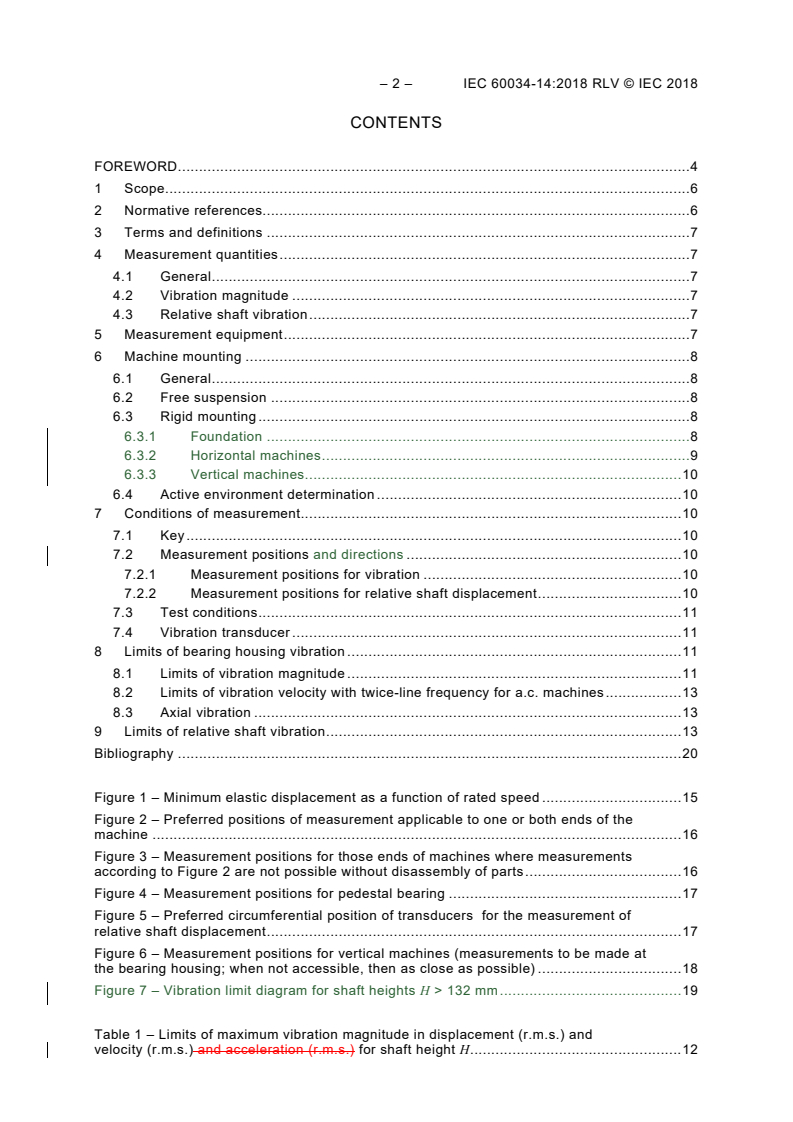
IEC 60034-14:2018 RLV - Rotating electrical machines - Part 14: Mechanical vibration of certain machines with shaft heights 56 mm and higher - Measurement, evaluation and limits of vibration severity Released:8/17/2018

IEC 60034-14:2018 - Rotating electrical machines - Part 14: Mechanical vibration of certain machines with shaft heights 56 mm and higher - Measurement, evaluation and limits of vibration severity Released:8/17/2018
Overview
IEC 60034-14:2018 defines factory acceptance procedures, measurement methods and vibration severity limits for rotating electrical machines with shaft heights 56 mm and higher. It applies to DC and three‑phase AC machines up to 50 MW rated output and running speeds from 120 min⁻¹ to 15 000 min⁻¹, tested uncoupled from any load or prime mover. The fourth edition improves the definition of free suspension, adds an alternative rigid mounting method, refines the shaft key option and harmonizes vibration limits with industry practice.
Keywords: IEC 60034-14:2018, rotating electrical machines, mechanical vibration, vibration measurement, vibration limits.
Key topics and technical requirements
- Scope & exclusions: For factory tests only. Not applicable to in‑situ machines, three‑phase commutator motors, single‑phase machines, machines on single‑phase systems, large turbine generators (>20 MW), machines with magnetic bearings or series‑wound machines.
- Measurement quantities: Broadband r.m.s. values of vibration displacement, velocity and acceleration at bearing housings, plus relative shaft displacement (p‑p) measured within or near bearings.
- Measurement equipment: Instruments shall provide a flat response over at least 10 Hz to 1 000 Hz (referenced standards such as ISO 2954).
- Mounting conditions: Defines free suspension and rigid mounting options (including a new alternative rigid mount) and procedures to determine active test environment.
- Test conditions & positions: Prescribed measurement positions and directions-primarily at bearing housings and shaft locations-plus sampling guidance to capture phenomena like twice‑slip frequency beating.
- Limits & evaluation: Clause 8 and associated Tables/Figures specify maximum permissible vibration magnitudes and relative shaft vibration criteria; the 2018 edition aligns more closely with NEMA MG 1, IEEE 841 and API 541 practices.
Practical applications - who uses this standard
- Manufacturers and OEMs performing factory acceptance vibration tests.
- Test laboratories and quality assurance teams executing vibration measurement and acceptance checks.
- Reliability and rotating‑equipment engineers, vibration analysts and procurement/specification authors who need standardized acceptance criteria.
- Useful when specifying vibration limits in contracts, FAT reports, commissioning documentation and warranty acceptance.
Related standards
- IEC 60034 series (general rotating machines)
- IEC 60034-1 (rating and performance)
- IEC 60034-7 (mounting and IM code)
- ISO 7919-1, ISO 20816-1 (shaft and machine vibration measurement/evaluation)
- ISO 2954, ISO 10817-1, ISO 21940-32 (measurement instruments, shaft sensing, key conventions)
- Industry references for alignment: NEMA MG 1, IEEE 841, API 541
IEC 60034-14:2018 helps ensure consistent, reproducible factory vibration testing and acceptance for medium to large rotating machines, improving reliability and lowering commissioning risk.
Relations
- Effective Date
- 05-Sep-2023
- Effective Date
- 05-Sep-2023
Buy Documents
IEC 60034-14:2018 RLV - Rotating electrical machines - Part 14: Mechanical vibration of certain machines with shaft heights 56 mm and higher - Measurement, evaluation and limits of vibration severity Released:8/17/2018
IEC 60034-14:2018 - Rotating electrical machines - Part 14: Mechanical vibration of certain machines with shaft heights 56 mm and higher - Measurement, evaluation and limits of vibration severity Released:8/17/2018
Get Certified
Connect with accredited certification bodies for this standard

IMQ S.p.A. (Certification)
Italian electrical product certification.

SLG Prüf- und Zertifizierungs GmbH
German testing and certification body.

UL Solutions
Global safety science company with testing, inspection and certification.
Sponsored listings
Frequently Asked Questions
IEC 60034-14:2018 is a standard published by the International Electrotechnical Commission (IEC). Its full title is "Rotating electrical machines - Part 14: Mechanical vibration of certain machines with shaft heights 56 mm and higher - Measurement, evaluation and limits of vibration severity". This standard covers: IEC 60034-14:2018 specifies the factory acceptance vibration test procedures and vibration limits for certain electrical machines under specified conditions, when uncoupled from any load or prime mover. It is applicable to DC and three-phase AC machines, with shaft heights 56 mm and higher and a rated output up to 50 MW, at operational speeds from 120 min–1 up to and including 15 000 min–1. This new edition includes the following significant technical changes with respect to the previous edition: - Improved explanation of the definition “free suspension”. - Addition of an alternative method of rigid mount - Definition of an improved option for shaft key.
IEC 60034-14:2018 specifies the factory acceptance vibration test procedures and vibration limits for certain electrical machines under specified conditions, when uncoupled from any load or prime mover. It is applicable to DC and three-phase AC machines, with shaft heights 56 mm and higher and a rated output up to 50 MW, at operational speeds from 120 min–1 up to and including 15 000 min–1. This new edition includes the following significant technical changes with respect to the previous edition: - Improved explanation of the definition “free suspension”. - Addition of an alternative method of rigid mount - Definition of an improved option for shaft key.
IEC 60034-14:2018 is classified under the following ICS (International Classification for Standards) categories: 29.160.01 - Rotating machinery in general. The ICS classification helps identify the subject area and facilitates finding related standards.
IEC 60034-14:2018 has the following relationships with other standards: It is inter standard links to IEC 60034-14:2003/AMD1:2007, IEC 60034-14:2003. Understanding these relationships helps ensure you are using the most current and applicable version of the standard.
IEC 60034-14:2018 is available in PDF format for immediate download after purchase. The document can be added to your cart and obtained through the secure checkout process. Digital delivery ensures instant access to the complete standard document.
Standards Content (Sample)
IEC 60034-14 ®
Edition 4.0 2018-08
REDLINE VERSION
INTERNATIONAL
STANDARD
colour
inside
Rotating electrical machines –
Part 14: Mechanical vibration of certain machines with shaft heights 56 mm
and higher – Measurement, evaluation and limits of vibration severity
All rights reserved. Unless otherwise specified, no part of this publication may be reproduced or utilized in any form
or by any means, electronic or mechanical, including photocopying and microfilm, without permission in writing from
either IEC or IEC's member National Committee in the country of the requester. If you have any questions about IEC
copyright or have an enquiry about obtaining additional rights to this publication, please contact the address below or
your local IEC member National Committee for further information.
IEC Central Office Tel.: +41 22 919 02 11
3, rue de Varembé info@iec.ch
CH-1211 Geneva 20 www.iec.ch
Switzerland
About the IEC
The International Electrotechnical Commission (IEC) is the leading global organization that prepares and publishes
International Standards for all electrical, electronic and related technologies.
About IEC publications
The technical content of IEC publications is kept under constant review by the IEC. Please make sure that you have the
latest edition, a corrigenda or an amendment might have been published.
IEC Catalogue - webstore.iec.ch/catalogue Electropedia - www.electropedia.org
The stand-alone application for consulting the entire The world's leading online dictionary of electronic and
bibliographical information on IEC International Standards, electrical terms containing 21 000 terms and definitions in
Technical Specifications, Technical Reports and other English and French, with equivalent terms in 16 additional
documents. Available for PC, Mac OS, Android Tablets and languages. Also known as the International Electrotechnical
iPad. Vocabulary (IEV) online.
IEC publications search - webstore.iec.ch/advsearchform IEC Glossary - std.iec.ch/glossary
The advanced search enables to find IEC publications by a 67 000 electrotechnical terminology entries in English and
variety of criteria (reference number, text, technical French extracted from the Terms and Definitions clause of
committee,…). It also gives information on projects, replaced IEC publications issued since 2002. Some entries have been
and withdrawn publications. collected from earlier publications of IEC TC 37, 77, 86 and
CISPR.
IEC Just Published - webstore.iec.ch/justpublished
Stay up to date on all new IEC publications. Just Published IEC Customer Service Centre - webstore.iec.ch/csc
details all new publications released. Available online and If you wish to give us your feedback on this publication or
also once a month by email. need further assistance, please contact the Customer Service
Centre: sales@iec.ch.
IEC 60034-14 ®
Edition 4.0 2018-08
REDLINE VERSION
INTERNATIONAL
STANDARD
colour
inside
Rotating electrical machines –
Part 14: Mechanical vibration of certain machines with shaft heights 56 mm
and higher – Measurement, evaluation and limits of vibration severity
INTERNATIONAL
ELECTROTECHNICAL
COMMISSION
ICS 29.160.01 ISBN 978-2-8322-5995-5
– 2 – IEC 60034-14:2018 RLV © IEC 2018
CONTENTS
FOREWORD . 4
1 Scope . 6
2 Normative references. 6
3 Terms and definitions . 7
4 Measurement quantities . 7
4.1 General . 7
4.2 Vibration magnitude . 7
4.3 Relative shaft vibration . 7
5 Measurement equipment . 7
6 Machine mounting . 8
6.1 General . 8
6.2 Free suspension . 8
6.3 Rigid mounting . 8
6.3.1 Foundation . 8
6.3.2 Horizontal machines . 9
6.3.3 Vertical machines . 10
6.4 Active environment determination . 10
7 Conditions of measurement. 10
7.1 Key . 10
7.2 Measurement positions and directions . 10
7.2.1 Measurement positions for vibration . 10
7.2.2 Measurement positions for relative shaft displacement . 10
7.3 Test conditions . 11
7.4 Vibration transducer . 11
8 Limits of bearing housing vibration . 11
8.1 Limits of vibration magnitude . 11
8.2 Limits of vibration velocity with twice-line frequency for a.c. machines . 13
8.3 Axial vibration . 13
9 Limits of relative shaft vibration . 13
Bibliography . 20
Figure 1 – Minimum elastic displacement as a function of rated speed . 15
Figure 2 – Preferred positions of measurement applicable to one or both ends of the
machine . 16
Figure 3 – Measurement positions for those ends of machines where measurements
according to Figure 2 are not possible without disassembly of parts . 16
Figure 4 – Measurement positions for pedestal bearing . 17
Figure 5 – Preferred circumferential position of transducers for the measurement of
relative shaft displacement . 17
Figure 6 – Measurement positions for vertical machines (measurements to be made at
the bearing housing; when not accessible, then as close as possible) . 18
Figure 7 – Vibration limit diagram for shaft heights H > 132 mm . 19
Table 1 – Limits of maximum vibration magnitude in displacement (r.m.s.) and
velocity (r.m.s.) and acceleration (r.m.s.) for shaft height H. 12
Table 2 – Limits for the maximum shaft vibration (S ) and the maximum run-out . 14
p-p
– 4 – IEC 60034-14:2018 RLV © IEC 2018
INTERNATIONAL ELECTROTECHNICAL COMMISSION
____________
ROTATING ELECTRICAL MACHINES –
Part 14: Mechanical vibration of certain machines
with shaft heights 56 mm and higher – Measurement,
evaluation and limits of vibration severity
FOREWORD
1) The International Electrotechnical Commission (IEC) is a worldwide organization for standardization comprising
all national electrotechnical committees (IEC National Committees). The object of IEC is to promote
international co-operation on all questions concerning standardization in the electrical and electronic fields. To
this end and in addition to other activities, IEC publishes International Standards, Technical Specifications,
Technical Reports, Publicly Available Specifications (PAS) and Guides (hereafter referred to as “IEC
Publication(s)”). Their preparation is entrusted to technical committees; any IEC National Committee interested
in the subject dealt with may participate in this preparatory work. International, governmental and non-
governmental organizations liaising with the IEC also participate in this preparation. IEC collaborates closely
with the International Organization for Standardization (ISO) in accordance with conditions determined by
agreement between the two organizations.
2) The formal decisions or agreements of IEC on technical matters express, as nearly as possible, an international
consensus of opinion on the relevant subjects since each technical committee has representation from all
interested IEC National Committees.
3) IEC Publications have the form of recommendations for international use and are accepted by IEC National
Committees in that sense. While all reasonable efforts are made to ensure that the technical content of IEC
Publications is accurate, IEC cannot be held responsible for the way in which they are used or for any
misinterpretation by any end user.
4) In order to promote international uniformity, IEC National Committees undertake to apply IEC Publications
transparently to the maximum extent possible in their national and regional publications. Any divergence
between any IEC Publication and the corresponding national or regional publication shall be clearly indicated in
the latter.
5) IEC itself does not provide any attestation of conformity. Independent certification bodies provide conformity
assessment services and, in some areas, access to IEC marks of conformity. IEC is not responsible for any
services carried out by independent certification bodies.
6) All users should ensure that they have the latest edition of this publication.
7) No liability shall attach to IEC or its directors, employees, servants or agents including individual experts and
members of its technical committees and IEC National Committees for any personal injury, property damage or
other damage of any nature whatsoever, whether direct or indirect, or for costs (including legal fees) and
expenses arising out of the publication, use of, or reliance upon, this IEC Publication or any other IEC
Publications.
8) Attention is drawn to the Normative references cited in this publication. Use of the referenced publications is
indispensable for the correct application of this publication.
9) Attention is drawn to the possibility that some of the elements of this IEC Publication may be the subject of
patent rights. IEC shall not be held responsible for identifying any or all such patent rights.
This redline version of the official IEC Standard allows the user to identify the changes
made to the previous edition. A vertical bar appears in the margin wherever a change
has been made. Additions are in green text, deletions are in strikethrough red text.
International Standard IEC 60034-14 has been prepared by IEC technical committee 2:
Rotating machinery.
This fourth edition cancels and replaces the third edition, published in 2003, and its
amendment 1, published in 2007. It constitutes a technical revision.
The significant technical changes with respect to the previous edition are:
a) 6.2 is significantly changed to better explain the definition “free suspension”.
b) 6.3: a second method of rigid mount is added since the first method is not always possible
on the test floor.
c) 7.1: an improved option for shaft key is defined.
d) Clause 8: considerable effort to harmonize with NEMA MG 1 and IEEE 841 and API 541,
and also establish levels which are achievable and more in line with best practices.
Table 1 is reduced to two shaft-height range sections.
e) 8.2: definition of twice line frequency simplified along with Figure 7 added.
The text of this International Standard is based on the following documents:
FDIS Report on voting
2/1906/FDIS 2/1914/RVD
Full information on the voting for the approval of this International Standard can be found in
the report on voting indicated in the above table.
This document has been drafted in accordance with the ISO/IEC Directives, Part 2.
A list of all parts in the IEC 60034 series, published under the general title Rotating electrical
machines, can be found on the IEC website.
NOTE For A table of cross-references of all IEC TC 2 publications can be found in the IEC TC 2 dashboard on the
IEC website.
The committee has decided that the contents of this document will remain unchanged until the
stability date indicated on the IEC website under "http://webstore.iec.ch" in the data related to
the specific document. At this date, the document will be
• reconfirmed,
• withdrawn,
• replaced by a revised edition, or
• amended.
IMPORTANT – The “colour inside” logo on the cover page of this publication indicates
that it contains colours which are considered to be useful for the correct understanding
of its contents. Users should therefore print this publication using a colour printer.
– 6 – IEC 60034-14:2018 RLV © IEC 2018
ROTATING ELECTRICAL MACHINES –
Part 14: Mechanical vibration of certain machines
with shaft heights 56 mm and higher – Measurement,
evaluation and limits of vibration severity
1 Scope
This part of IEC 60034 specifies the factory acceptance vibration test procedures and
vibration limits for certain electrical machines under specified conditions, when uncoupled
from any load or prime mover.
It is applicable to DC and three-phase AC machines, with shaft heights 56 mm and higher and
–1
a rated output up to 50 MW, at operational speeds from 120 min up to and including
–1
15 000 min .
This document is not applicable to machines mounted in situ (on site), three-phase
commutator motors, single-phase machines, three-phase machines operated on single-phase
systems, vertical waterpower generators, turbine generators greater than 20 MW and
machines with magnetic bearings or series-wound machines.
NOTE For machines measured in situ, refer to applicable parts of ISO 20816, ISO 10816 and ISO 7919.
2 Normative references
The following documents are referred to in the text in such a way that some or all of their
content constitutes requirements of this document. For dated references, only the edition
cited applies. For undated references, the latest edition of the referenced document (including
any amendments) applies.
IEC 60034-1, Rotating electrical machines – Part 1: Rating and performance
IEC 60034-7, Rotating electrical machines – Part 7: Classification of types ofconstructions
and mounting arrangements and terminal box position (IM Code)
ISO 2954, Mechanical vibration of rotating and reciprocating machinery – Requirements for
instruments for measuring vibration severity
ISO 7919-1, Mechanical vibration of non-reciprocating machines – Measurements on rotating
shafts and evaluation criteria – Part 1: General guidelines
ISO 8821, Mechanical vibration – Balancing – Shaft and fitment key convention
ISO 10817-1, Rotating shaft vibration measuring systems – Part 1: Relative and absolute
sensing of radial vibration from rotating shafts
ISO 20816-1, Mechanical vibration – Measurement and evaluation of machine vibration –
Part 1: General guidelines
ISO 21940-32, Mechanical vibration – Rotor balancing – Part 32: Shaft and fitment key
convention
3 Terms and definitions
For the purposes of this document, the terms and definitions given in IEC 60034-1 apply.
ISO and IEC maintain terminological databases for use in standardization at the following
addresses:
• IEC Electropedia: available at http://www.electropedia.org/
• ISO Online browsing platform: available at http://www.iso.org/obp
4 Measurement quantities
4.1 General
Measurement quantities are the vibration displacement, vibration acceleration and vibration
velocity at the machine bearings and the relative shaft vibration displacement within or near to
the machine bearings.
4.2 Vibration magnitude
The criterion for the vibration magnitude at the machine bearings shall be the broadband
r.m.s. value of the vibration displacement in micrometres or the vibration velocity in
millimeters per second and the vibration acceleration in meters per second squared in the
frequency range specified in Clause 5. The greatest maximum value, determined at the
prescribed measurement positions and prescribed measuring variable, according to this
standard, characterizes the vibration magnitude of the machine.
Induction motors (especially of two pole type) frequently show vibration beating at twice slip
frequency. In these cases, the decisive vibration magnitude shall be determined from the
relationship:
2 2
x + x
max min
x =
r.m.s.
where
x is the maximum r.m.s. value of vibration displacement or vibration velocity or
max
acceleration;
x is the minimum r.m.s. value of vibration displacement or vibration velocity or
min
acceleration.
The sample rate shall be chosen large enough to reliably capture the maximum and minimum
values of the vibration.
NOTE Large AC induction machines running at very low slip values at no load may require several minutes to
more than ten minutes for such measurements to be completed at each vibration measuring position.
4.3 Relative shaft vibration
The criterion adopted for the relative shaft vibration shall be the vibratory displacement S in
p-p
the direction of measurement from ISO 7919-1 ISO 20816-1.
5 Measurement equipment
The measurement equipment shall be capable of measuring broadband r.m.s. vibration with
flat response over a frequency range of at least 10 Hz to 1 000 Hz, in accordance with the
– 8 – IEC 60034-14:2018 RLV © IEC 2018
requirements of ISO 2954. However, for machines with speeds approaching or below
–1
600 min , the lower limit of the flat response frequency range shall not be greater than 2 Hz.
Measurement equipment for relative shaft vibration measurements shall comply with the
requirements in ISO 10817-1.
Multi-directional vibration sensors shall not be used.
NOTE Multi-directional sensors do not provide proper vibration measurement in all directions when mounted in
only one location.
6 Machine mounting
6.1 General
The vibration of an electrical machine is closely linked with the mounting of the machine. To
permit evaluation as far as balance and vibration of rotating electrical machines are
concerned, it is necessary to measure the vibration on the machine alone, under properly
determined test conditions, to enable reproducible tests to be carried out and to provide
comparable measurements.
6.2 Free suspension
This condition is achieved by suspending the machine on a spring or by mounting on an
elastic support (springs, rubber, etc.).
The highest natural oscillation frequency (f ) of the suspension system and machine, in the
no
six possible degrees of freedom, shall be less than 1/3 of the frequency f corresponding to
the speed of the machine under test, as defined in 7.3. Based on the mass of the machine
being tested, the necessary elasticity of the suspension system as a function of nominal rated
–1 –1
speed from 600 min to 3 600 min can be determined from Figure 1. For speeds lower
–1
than 600 min measurements in free suspension are not practical. For speeds greater than 3
–1 –1
600 min , the static displacement Z should be not less than the value for 3 600 min .
The curve in Figure 1 presents the minimum elastic displacement to attain the necessary
vertical rigid body natural oscillation, which is usually the highest rigid body natural frequency.
Static displacement Z is expressed as:
𝑎𝑎𝑔𝑔 𝑓𝑓
𝑍𝑍 = ,𝑎𝑎 = ; 𝑎𝑎≥ 3
(2𝜋𝜋𝜋𝜋) 𝑓𝑓
𝑛𝑛𝑛𝑛
where
Z is the displacement in m,
–1
n is the rated speed in units of s , and
g is the acceleration of gravity (9,81 m/s ).
When a is set to 3, then the curve in Figure 1 is generated.
6.3 Rigid mounting
6.3.1 Foundation
6.3.1.1 General
The maximum vibration velocity measured in the horizontal and vertical directions at the
machine feet (or at the base frame near to the bearing pedestals or stator feet) shall not
exceed 25 % of the maximum velocity, which is measured at the adjacent bearing housing in
the same measurement direction.
NOTE 1 This requirement ensures that the horizontal and vertical natural frequencies of the complete test
arrangement do not coincide within:
a) ±10 % of the rotational frequency of the machine;
b) ± 5 % of twice the rotational frequency, or
c) ± 5 % of once and twice the electrical line frequency,
NOTE 2 The ratio of 25 % of foot to bearing vibration velocities is valid for once per revolution vibration and the
vibration at twice the line frequency (if the latter is being evaluated).
During the shop running test of the assembled machine, vibration measurements shall be
made with the machine properly shimmed and securely fastened to a massive foundation or
test floor stand. Elastic mounts are not permitted.
The horizontal and vertical natural frequencies of the complete test arrangement shall not
coincide within:
a) ± 10 % of the rotational frequency of the machine;
b) ± 5 % of twice the rotational frequency, or
c) ± 5 % of once and twice the electrical line frequency.
Either one of the following two mounting conditions may be chosen by the manufacturer.
6.3.1.2 Rigid mounting on massive foundation
One indication of massive foundation is when the vibration velocity measured in the horizontal
and vertical directions at the machine feet (or at the base frame near to the bearing pedestals
or stator feet) does not exceed 30 % of the maximum velocity, which is measured at the
adjacent bearing housing in the same measurement direction. The ratio of foot to bearing
vibration velocities is valid for the rotational frequency component or twice-line frequency
component (if the latter is being evaluated).
NOTE 1 The rigidity of a foundation is a relative quantity. It is compared with the rigidity of the machine bearing
system. The ratio of bearing housing vibration to foundation vibration is a characteristic quantity for the evaluation
of foundation flexibility.
NOTE 2 If the machine is to be supported in the field by a structure other than a massive foundation, it may be
necessary to perform a system dynamic analysis to make the necessary changes to the foundation dynamic
stiffness.
6.3.1.3 Rigid mounting on test floor stand
This condition is achieved by mounting the machine on an adequately rigid test foundation
free of resonances at forcing frequencies, see 6.3.1.1.
NOTE This mounting is the most used in manufacturers test labs.
6.3.2 Horizontal machines
The machine under test shall be:
• clamped directly to a solid floor, or
• through its mounting base plate to a solid floor, or
• to a rigid plate that meets the requirements of 6.3.1.
The machine under test shall be bolted or clamped using all bolt-hole positions to a
foundation that meets the requirements of 6.3.1.2 or 6.3.1.3.
– 10 – IEC 60034-14:2018 RLV © IEC 2018
There are constructions and mountings in which the above fixing conditions cannot be met,
such as single-bearing machines. In those cases there should be an agreement between the
supplier and customer.
6.3.3 Vertical machines
Vertical machines shall be mounted onto a solid rectangular or circular steel plate with a bore
hole in the centre of the shaft extension, a machined surface for the flange of electrical
machine being measured and tapped holes for the flange bolts holes provided for fasteners or
clamps. The steel plate thickness shall be at least three times greater than the machine
flange thickness, five times is preferable recommended. The edge length respective to the
diameter shall be at least equal to the height of the top bearing, L. Figure 6 is an example for
IM V1 (see IEC 60034-7).
The mounting steel base shall be clamped firmly and tilt safe to a solid floor and meet the
requirements to 6.3.1.2 or 6.3.1.3. The flange connection shall use the correct number and
diameter of fasteners or clamps. If the above method of mounting is not reasonable, other
arrangements can be per agreement between supplier and customer.
6.4 Active environment determination
The support systems described in 6.2 and 6.3 are considered passive, admitting insignificant
external disturbances to the machine. When, for the same measurement position, the
vibration magnitude with the machine at standstill exceeds 25 % of the value when the
machine is running, then an active environment is said to exist and this standard does not
apply (see ISO 10816-1 ISO 20816-1).
7 Conditions of measurement
7.1 Key
For the balancing and measurement of vibration on machines provided with a shaft extension
keyway, the keyway shall be filled with a half key, be considered according to ISO 8821
ISO 21940-32.
7.2 Measurement positions and directions
7.2.1 Measurement positions for vibration
The location of the preferred measurement positions and directions to which the levels of
vibration magnitude apply are shown in Figure 2 for machines with end-shield bearings and in
Figure 4 for machines with pedestal bearings. Figure 3 applies to those machines where
measurement positions according to Figure 2 are not possible without disassembly of parts.
When measurements cannot be performed per Figure 2 or Figure 3, there should be an
agreement between supplier and customer.
Figure 6 applies to machines mounted in the vertical position.
NOTE 1 Measurement according to Figure 3 might be on the frame as close to the bearing housing as possible.
NOTE 2 Axial vibration measurement may not be possible without disassembly on both ends. If a machine has
thrust bearings, this may be per agreement between supplier and customer, see 8.3.
7.2.2 Measurement positions for relative shaft displacement
Non-contacting transducers shall be installed inside the bearing, measuring directly the
relative shaft journal displacement, or (when inside mounting is not possible) adjacent to the
bearing shell. The preferred radial positions are as indicated in Figure 5.
7.3 Test conditions
Machines shall be tested at no-load with all relevant quantities at their rated value.
Fixed speed AC machines shall be run with a virtually sinusoidal waveform sinusoidal supply
voltage according to IEC 60034-1.
The test shall be performed at each rated fixed speed or over the rated speed range for
variable frequency drives. For all tested speeds, the values shall not exceed the
corresponding limit in Table 1.
Machines intended for variable frequency drives shall be tested at the speeds for which the
machine is intended during type tests. In order to discern the mechanically induced vibration
from other vibration excitation forces, it is recommended that DC machines are tested with a
low current ripple supply or pure DC.
NOTE Tests with variable-frequency power supply normally only confirm mechanically induced vibrations. It is
possible that electrically induced vibrations will be different. To have complete factory tests it is necessary to test
with the converter to be installed with the motor in-situ. If possible, the tests with the actual converter to be
installed with the motor on site will provide better information about vibration behaviour.
For routine testing of variable-speed machines, it is permitted to test at a single speed based
upon information obtained during type test.
For machines that are bi-directional, the vibration limits apply for both directions of rotation,
but need to be measured in only one direction.
7.4 Vibration transducer
The mounting of the transducer used for vibration measurement and on the machine surface
shall be as specified by the manufacturer of the transducer and shall not disturb the vibratory
condition of the machine under test.
For this, it is necessary that the total coupled mass of the transducer assembly is less than
1/50 of the mass of the machine.
8 Limits of bearing housing vibration
8.1 Limits of vibration magnitude
The limits apply to the measured broadband r.m.s. vibration velocity and displacement and
acceleration in the frequency range specified in Clause 5. Decisive for the evaluation of
vibration magnitude is the highest value of these three measurement quantities.
–1 –1
NOTE For routine tests of standard machines with speeds between 600 min and 3 600 min it is sufficient to
measure only vibration velocity.
The vibration magnitude for DC and three phase AC machines with shaft heights 56 mm and
higher and, for one of either of the two mounting conditions according to Clause 6, shall not
exceed the limits specified in Table 1. Values Limits are given for two vibration grades. When
no grade is specified, machines complying with this standard shall be grade A.
–1
For routine tests of standard machines with rotational speeds less than 600 min , vibration is
–1
to be expressed in units of displacement. For rotational speeds from 600 min up to
–1
15 000 min , vibration is to be expressed in units of velocity.
When the routine test is made with a free-suspension mounting condition, the type test should
also include testing with rigid mounting. This is valid for the whole speed range of this
standard.
– 12 – IEC 60034-14:2018 RLV © IEC 2018
Table 1 – Limits of maximum vibration magnitude in
displacement (r.m.s.) and velocity (r.m.s.) and acceleration (r.m.s.) for shaft height H
Shaft height,
56 ≤ H ≤ 132 132 < H ≤ 280 H > 280
mm
Vibration
grade
Mounting Displac. Vel. Acc. Displac. Vel. Acc. Displac. Vel. Acc.
2 2 2
µm mm/s m/s µm mm/s m/s µm mm/s m/s
A Free suspension 25 1,6 2,5 35 2,2 3,5 45 2,8 4,4
Rigid mounting 21 1,3 2,0 29 1,8 2,8 37 2,3 3,6
B Free suspension 11 0,7 1,1 18 1,1 1,7 29 1,8 2,8
Rigid mounting – 14 0,9 1,4 24 1,5 2,4
Vibration Shaft height, 56 ≤ H ≤ 132 H > 132
grade
mm
Mounting Displacement Velocity Displacement Velocity
µm mm/s µm mm/s
A Free suspension 45 2,8 45 2,8
Rigid mounting – – 37 2,3
2,8*
B Free suspension 18 1,1 29 1,8
Rigid mounting – – 24 1,5
1,8*
Grade A applies to machines with no special vibration requirements.
Grade B applies to machines with special vibration requirements.
Rigid mounting is not considered acceptable for machines with shaft heights less than or equal to 132 mm.
The interface frequencies for displacement/velocity and velocity/acceleration are 10 Hz and 250 Hz respectively.
Vibration at frequencies above 1 000 Hz should be filtered out.
The shaft height of a machine without feet, or a machine with raised feet, or any vertical machine is to be taken as the
shaft height of a machine in the same basic frame, but of the horizontal shaft foot-mounting type.
* This level is the limit when the twice line frequency vibration level is dominant as defined in 8.2 and explained in
Figure 7.
NOTE 1 The manufacturer and the purchaser should take into account that the instrumentation can have a
measurement tolerance of ± 10 %.
NOTE The shaft height of a machine without feet, or a machine with raised feet, or any vertical machine is to be
taken as the shaft height of a machine in the same basic frame, but of the horizontal shaft foot-mounting type.
NOTE 2 A machine which is well-balanced in itself and of a grade conforming with Table 1 may exhibit large
vibrations when installed in-situ on site arising from various causes, such as unsuitable foundations, reaction of the
driven machine, current ripple from the power supply, etc. Vibration may also be caused by driving elements with a
natural oscillation frequency very close to the excitation due to the small residual unbalance of the rotating masses
of the machine. In such cases, checks should can be carried out on site not only on the machine, but also on each
element of the installation. (See ISO 10816-3.)
NOTE 3 As mentioned for onsite operation in ISO 20816-1, special agreements can be made. The values given in
ISO 20816-1 are the basis for the ease of discussion and agreement between the supplier and the user. The values
ensure in most applications that major errors or unrealistic requirements are avoided. Special agreements are also
made for acceleration and deceleration ramps. Short term vibration limits and reduced bearing life time as a
function of vibration velocity can be given by the manufacturer.
8.2 Limits of vibration velocity with twice-line frequency for a.c. machines
Two-pole induction machines may have electromagnetic excited vibration at twice the
frequency of the power system. The correct evaluation of these vibration components requires
a rigid mounting of the machine, which complies with the requirements given in 6.3.
When type tests demonstrate a dominant twice line frequency component for machines having
H > 280 132 mm, the vibration magnitude limit in Table 1 (for Grade A) is increased to
2,8 mm/s (r.m.s.) from 2,3 mm/s (r.m.s.) or (for Grade B) is increased to 1,8 mm/s (r.m.s.)
from 1,5 mm/s (r.m.s.). Greater values are subject to prior agreement. A twice line frequency
component is considered dominant when type tests demonstrate it to be greater than 70 % of
2,3 mm/s (r.m.s.) (for Grade A) or 70 % of 1,5 mm/s (r.m.s.) (for Grade B). Graphical
interpretation of the definition above is shown in Figure 7.
NOTE 1 With respect to the twice-line frequency component agreements between the supplier and the customer
can be made.
NOTE 2 70 % approximates 100 %, where the rms values of rotational and twice-line frequency are equal.
√2
8.3 Axial vibration
The evaluation of axial bearing vibration depends on the bearing function and bearing
construction.
In the case of thrust bearings, axial vibration correlates with thrust pulsations, which could
cause damage to the metal liner of sleeve bearings or to parts of antifriction bearings. Axial
vibration of these bearings shall be evaluated in the same manner as transverse vibration and
Table 1 limits apply.
For bearings having no axial limiting construction such as sleeve bearings with no axial thrust
bearing, the requirement may be relaxed by prior agreement.
9 Limits of relative shaft vibration
Relative shaft vibration measurements are recommended only for sleeve bearing machines
–1
with speeds >1 200 min ; rated power >1 000 kW; and shall be subject to prior agreement
with respect to the necessary provisions regarding the installation of shaft measurement
transducers.
When machines with sleeve bearings have special provisions for the installation of shaft
vibration measurement transducers, the limits for the relative shaft vibration displacement are
specified in Table 2. These limits are in addition to those required in Clause 8.
– 14 – IEC 60034-14:2018 RLV © IEC 2018
Table 2 – Limits for the maximum shaft vibration (S ) and
p-p
the maximum run-out
Vibration grade Speed range Maximum relative shaft Maximum combined
displacement mechanical and electrical
run-out
–1
min
µm µm
A > 1 800 65 16
≤ 1 800 90 23
B > 1 800 50 12,5
≤ 1 800 65 16
NOTE 1 machines with vibration grade "B" are frequently specified for high speed drives in critical installations.
Grade B applies to machines with special vibration requirements.
NOTE 2 The maximum relative shaft displacement limits include the run-out. For the definition of the run-out see
ISO 7919-1 ISO 20816-1.
600 900 1 200 1 500 1 800 2 100 2 400 2 700 3 000 3 300 3 600
–1
Rated speed min
A
A
IEC
Key
A machine under test
Z displacement
Figure 1 – Minimum elastic displacement as a function of rated speed
NOTE To reduce the influence of the mass and the moments of inertia of the suspension
system on the vibration level, the effective mass of the elastic support should shall be not
greater than 1/10 of that of the machine.
Displacement Z (mm)
Z
Z
– 16 – IEC 60034-14:2018 RLV © IEC 2018
IEC
Figure 2 – Preferred positions of measurement applicable to
one or both ends of the machine
IEC
Figure 3 – Measurement positions for those ends of machines where measurements
according to Figure 2 are not possible without disassembly of parts
IEC
Figure 4 – Measurement positions for pedestal bearing
A
45° 45°
B
IEC
Key
A signal conditioner
B transducer
Figure 5 – Preferred circumferential position of transducers
for the measurement of relative shaft displacement
– 18 – IEC 60034-14:2018 RLV © IEC 2018
> L
IEC
Figure 6 – Measurement positions for vertical machines (measurements to be made
at the bearing housing; when not accessible, then as close as possible)
L
2,5
1,5
0,5
0 0,5 1 1,5 2 2,5 3
2f-component (mm/s)
IEC
Figure 7 – Vibration limit diagram for shaft heights H > 132 mm
All other components (unbalance, etc …) (mm/s)
– 20 – IEC 60034-14:2018 RLV © IEC 2018
Bibliography
ISO 2041, Vibration and shock vocabulary
ISO 7919-3, Mechanical vibration of non-reciprocating machines – Measurements on rotating
shafts and evaluation criteria – Part 3: Coupled industrial machines
ISO 10816-1, Mechanical vibration – Evaluation of machine vibration by measurement on non
rotating parts – Part 1: General guidelines
ISO 10816-3, Mechanical vibration – Evaluation of machine vibration by measurements on
non-rotating parts – Part 3: Industrial machines with nominal rated power above 15 kW and
nominal rated speeds between 120 r/min and 15 000 r/min when measured in situ
API Standard 541:1995 2014, Form-wound squirrel cage induction motors – 250 horsepower
and larger
API Standard 546:1997 2008, Brushless synchronous machines – 500 horsepower and larger
API Standard 547:2017, General Purpose Form-wound Squirrel Cage Induction Motors –
185 kW (250 hp) and through 2240 kW (3 000 hp)
IEEE Standard for Petroleum and Chemical Industry 841:2009, Premium-Efficiency,
Severe-Duty, Totally Enclosed, Fan-Cooled (TEFC) Squirrel Cage Induction Motors-Up to and
Including 370 kW (500 hp)
NEMA MG 1:2016, Motors and Generators – Part 7: Mechanical vibration measurement,
evaluation and limits
___________
IEC 60034-14 ®
Edition 4.0 2018-08
INTERNATIONAL
STANDARD
NORME
INTERNATIONALE
Rotating electrical machines –
Part 14: Mechanical vibration of certain machines with shaft heights 56 mm
and higher – Measurement, evaluation and limits of vibration severity
Machines électriques tournantes –
Partie 14: Vibrations mécaniques de certaines machines de hauteur d’axe
supérieure ou égale à 56 mm – Mesurage, évaluation et limites de l’intensité
vibratoire
– 2 – IEC 60034-14:2018 © IEC 2018
CONTENTS
FOREWORD . 4
1 Scope . 6
2 Normative references. 6
3 Terms and definitions . 6
4 Measurement quantities . 7
4.1 General . 7
4.2 Vibration magnitude . 7
4.3 Relative shaft vibration . 7
5 Measurement equipment . 7
6 Machine mounting . 8
6.1 General . 8
6.2 Free suspension . 8
6.3 Rigid mounting . 8
6.3.1 Foundation . 8
6.3.2 Horizontal machines . 9
6.3.3 Vertical machines . 9
6.4 Active environment determination . 9
7 Conditions of measurement. 10
7.1 Key . 10
7.2 Measurement positions and directions . 10
7.2.1 Measurement positions for vibration . 10
7.2.2 Measurement positions for relative shaft displacement . 10
7.3 Test conditions .
...
IEC 60034-14 ®
Edition 4.0 2018-08
INTERNATIONAL
STANDARD
NORME
INTERNATIONALE
Rotating electrical machines –
Part 14: Mechanical vibration of certain machines with shaft heights 56 mm
and higher – Measurement, evaluation and limits of vibration severity
Machines électriques tournantes –
Partie 14: Vibrations mécaniques de certaines machines de hauteur d’axe
supérieure ou égale à 56 mm – Mesurage, évaluation et limites de l’intensité
vibratoire
All rights reserved. Unless otherwise specified, no part of this publication may be reproduced or utilized in any form
or by any means, electronic or mechanical, including photocopying and microfilm, without permission in writing from
either IEC or IEC's member National Committee in the country of the requester. If you have any questions about IEC
copyright or have an enquiry about obtaining additional rights to this publication, please contact the address below or
your local IEC member National Committee for further information.
Droits de reproduction réservés. Sauf indication contraire, aucune partie de cette publication ne peut être reproduite
ni utilisée sous quelque forme que ce soit et par aucun procédé, électronique ou mécanique, y compris la photocopie
et les microfilms, sans l'accord écrit de l'IEC ou du Comité national de l'IEC du pays du demandeur. Si vous avez des
questions sur le copyright de l'IEC ou si vous désirez obtenir des droits supplémentaires sur cette publication, utilisez
les coordonnées ci-après ou contactez le Comité national de l'IEC de votre pays de résidence.
IEC Central Office Tel.: +41 22 919 02 11
3, rue de Varembé info@iec.ch
CH-1211 Geneva 20 www.iec.ch
Switzerland
About the IEC
The International Electrotechnical Commission (IEC) is the leading global organization that prepares and publishes
International Standards for all electrical, electronic and related technologies.
About IEC publications
The technical content of IEC publications is kept under constant review by the IEC. Please make sure that you have the
latest edition, a corrigenda or an amendment might have been published.
IEC Catalogue - webstore.iec.ch/catalogue Electropedia - www.electropedia.org
The stand-alone application for consulting the entire The world's leading online dictionary of electronic and
bibliographical information on IEC International Standards, electrical terms containing 21 000 terms and definitions in
Technical Specifications, Technical Reports and other English and French, with equivalent terms in 16 additional
documents. Available for PC, Mac OS, Android Tablets and languages. Also known as the International Electrotechnical
iPad. Vocabulary (IEV) online.
IEC publications search - webstore.iec.ch/advsearchform IEC Glossary - std.iec.ch/glossary
The advanced search enables to find IEC publications by a 67 000 electrotechnical terminology entries in English and
variety of criteria (reference number, text, technical French extracted from the Terms and Definitions clause of
committee,…). It also gives information on projects, replaced IEC publications issued since 2002. Some entries have been
and withdrawn publications. collected from earlier publications of IEC TC 37, 77, 86 and
CISPR.
IEC Just Published - webstore.iec.ch/justpublished
Stay up to date on all new IEC publications. Just Published IEC Customer Service Centre - webstore.iec.ch/csc
details all new publications released. Available online and If you wish to give us your feedback on this publication or
also once a month by email. need further assistance, please contact the Customer Service
Centre: sales@iec.ch.
A propos de l'IEC
La Commission Electrotechnique Internationale (IEC) est la première organisation mondiale qui élabore et publie des
Normes internationales pour tout ce qui a trait à l'électricité, à l'électronique et aux technologies apparentées.
A propos des publications IEC
Le contenu technique des publications IEC est constamment revu. Veuillez vous assurer que vous possédez l’édition la
plus récente, un corrigendum ou amendement peut avoir été publié.
Catalogue IEC - webstore.iec.ch/catalogue Electropedia - www.electropedia.org
Application autonome pour consulter tous les renseignements
Le premier dictionnaire en ligne de termes électroniques et
bibliographiques sur les Normes internationales,
électriques. Il contient 21 000 termes et définitions en anglais
Spécifications techniques, Rapports techniques et autres
et en français, ainsi que les termes équivalents dans 16
documents de l'IEC. Disponible pour PC, Mac OS, tablettes
langues additionnelles. Egalement appelé Vocabulaire
Android et iPad.
Electrotechnique International (IEV) en ligne.
Recherche de publications IEC -
Glossaire IEC - std.iec.ch/glossary
webstore.iec.ch/advsearchform
67 000 entrées terminologiques électrotechniques, en anglais
La recherche avancée permet de trouver des publications IEC et en français, extraites des articles Termes et Définitions des
en utilisant différents critères (numéro de référence, texte, publications IEC parues depuis 2002. Plus certaines entrées
comité d’études,…). Elle donne aussi des informations sur les antérieures extraites des publications des CE 37, 77, 86 et
projets et les publications remplacées ou retirées. CISPR de l'IEC.
IEC Just Published - webstore.iec.ch/justpublished Service Clients - webstore.iec.ch/csc
Restez informé sur les nouvelles publications IEC. Just Si vous désirez nous donner des commentaires sur cette
Published détaille les nouvelles publications parues. publication ou si vous avez des questions contactez-nous:
Disponible en ligne et aussi une fois par mois par email. sales@iec.ch.
IEC 60034-14 ®
Edition 4.0 2018-08
INTERNATIONAL
STANDARD
NORME
INTERNATIONALE
Rotating electrical machines –
Part 14: Mechanical vibration of certain machines with shaft heights 56 mm
and higher – Measurement, evaluation and limits of vibration severity
Machines électriques tournantes –
Partie 14: Vibrations mécaniques de certaines machines de hauteur d’axe
supérieure ou égale à 56 mm – Mesurage, évaluation et limites de l’intensité
vibratoire
INTERNATIONAL
ELECTROTECHNICAL
COMMISSION
COMMISSION
ELECTROTECHNIQUE
INTERNATIONALE
ICS 29.160.01 ISBN 978-2-8322-5902-3
– 2 – IEC 60034-14:2018 © IEC 2018
CONTENTS
FOREWORD . 4
1 Scope . 6
2 Normative references. 6
3 Terms and definitions . 6
4 Measurement quantities . 7
4.1 General . 7
4.2 Vibration magnitude . 7
4.3 Relative shaft vibration . 7
5 Measurement equipment . 7
6 Machine mounting . 8
6.1 General . 8
6.2 Free suspension . 8
6.3 Rigid mounting . 8
6.3.1 Foundation . 8
6.3.2 Horizontal machines . 9
6.3.3 Vertical machines . 9
6.4 Active environment determination . 9
7 Conditions of measurement. 10
7.1 Key . 10
7.2 Measurement positions and directions . 10
7.2.1 Measurement positions for vibration . 10
7.2.2 Measurement positions for relative shaft displacement . 10
7.3 Test conditions . 10
7.4 Vibration transducer . 10
8 Limits of bearing housing vibration . 11
8.1 Limits of vibration magnitude . 11
8.2 Limits of vibration velocity with twice-line frequency for a.c. machines . 12
8.3 Axial vibration . 12
9 Limits of relative shaft vibration . 12
Bibliography . 18
Figure 1 – Minimum elastic displacement as a function of rated speed . 13
Figure 2 – Preferred positions of measurement applicable to one or both ends of the
machine . 14
Figure 3 – Measurement positions for those ends of machines where measurements
according to Figure 2 are not possible without disassembly of parts . 14
Figure 4 – Measurement positions for pedestal bearing . 15
Figure 5 – Preferred circumferential position of transducers for the measurement of
relative shaft displacement . 15
Figure 6 – Measurement positions for vertical machines (measurements to be made at
the bearing housing; when not accessible, then as close as possible) . 16
Figure 7 – Vibration limit diagram for shaft heights H > 132 mm . 17
Table 1 – Limits of maximum vibration magnitude in displacement (r.m.s.) and
velocity (r.m.s.) for shaft height H . 11
Table 2 – Limits for the maximum shaft vibration (S ) and the maximum run-out . 13
p-p
– 4 – IEC 60034-14:2018 © IEC 2018
INTERNATIONAL ELECTROTECHNICAL COMMISSION
____________
ROTATING ELECTRICAL MACHINES –
Part 14: Mechanical vibration of certain machines
with shaft heights 56 mm and higher – Measurement,
evaluation and limits of vibration severity
FOREWORD
1) The International Electrotechnical Commission (IEC) is a worldwide organization for standardization comprising
all national electrotechnical committees (IEC National Committees). The object of IEC is to promote
international co-operation on all questions concerning standardization in the electrical and electronic fields. To
this end and in addition to other activities, IEC publishes International Standards, Technical Specifications,
Technical Reports, Publicly Available Specifications (PAS) and Guides (hereafter referred to as “IEC
Publication(s)”). Their preparation is entrusted to technical committees; any IEC National Committee interested
in the subject dealt with may participate in this preparatory work. International, governmental and non-
governmental organizations liaising with the IEC also participate in this preparation. IEC collaborates closely
with the International Organization for Standardization (ISO) in accordance with conditions determined by
agreement between the two organizations.
2) The formal decisions or agreements of IEC on technical matters express, as nearly as possible, an international
consensus of opinion on the relevant subjects since each technical committee has representation from all
interested IEC National Committees.
3) IEC Publications have the form of recommendations for international use and are accepted by IEC National
Committees in that sense. While all reasonable efforts are made to ensure that the technical content of IEC
Publications is accurate, IEC cannot be held responsible for the way in which they are used or for any
misinterpretation by any end user.
4) In order to promote international uniformity, IEC National Committees undertake to apply IEC Publications
transparently to the maximum extent possible in their national and regional publications. Any divergence
between any IEC Publication and the corresponding national or regional publication shall be clearly indicated in
the latter.
5) IEC itself does not provide any attestation of conformity. Independent certification bodies provide conformity
assessment services and, in some areas, access to IEC marks of conformity. IEC is not responsible for any
services carried out by independent certification bodies.
6) All users should ensure that they have the latest edition of this publication.
7) No liability shall attach to IEC or its directors, employees, servants or agents including individual experts and
members of its technical committees and IEC National Committees for any personal injury, property damage or
other damage of any nature whatsoever, whether direct or indirect, or for costs (including legal fees) and
expenses arising out of the publication, use of, or reliance upon, this IEC Publication or any other IEC
Publications.
8) Attention is drawn to the Normative references cited in this publication. Use of the referenced publications is
indispensable for the correct application of this publication.
9) Attention is drawn to the possibility that some of the elements of this IEC Publication may be the subject of
patent rights. IEC shall not be held responsible for identifying any or all such patent rights.
International Standard IEC 60034-14 has been prepared by IEC technical committee 2:
Rotating machinery.
This fourth edition cancels and replaces the third edition, published in 2003, and its
amendment 1, published in 2007. It constitutes a technical revision.
The significant technical changes with respect to the previous edition are:
a) 6.2 is significantly changed to better explain the definition “free suspension”.
b) 6.3: a second method of rigid mount is added since the first method is not always possible
on the test floor.
c) 7.1: an improved option for shaft key is defined.
d) Clause 8: considerable effort to harmonize with NEMA MG 1 and IEEE 841 and API 541,
and also establish levels which are achievable and more in line with best practices.
Table 1 is reduced to two shaft-height range sections.
e) 8.2: definition of twice line frequency simplified along with Figure 7 added.
The text of this International Standard is based on the following documents:
FDIS Report on voting
2/1906/FDIS 2/1914/RVD
Full information on the voting for the approval of this International Standard can be found in
the report on voting indicated in the above table.
This document has been drafted in accordance with the ISO/IEC Directives, Part 2.
A list of all parts in the IEC 60034 series, published under the general title Rotating electrical
machines, can be found on the IEC website.
NOTE For A table of cross-references of all IEC TC 2 publications can be found in the IEC TC 2 dashboard on the
IEC website.
The committee has decided that the contents of this document will remain unchanged until the
stability date indicated on the IEC website under "http://webstore.iec.ch" in the data related to
the specific document. At this date, the document will be
• reconfirmed,
• withdrawn,
• replaced by a revised edition, or
• amended.
– 6 – IEC 60034-14:2018 © IEC 2018
ROTATING ELECTRICAL MACHINES –
Part 14: Mechanical vibration of certain machines
with shaft heights 56 mm and higher – Measurement,
evaluation and limits of vibration severity
1 Scope
This part of IEC 60034 specifies the factory acceptance vibration test procedures and
vibration limits for certain electrical machines under specified conditions, when uncoupled
from any load or prime mover.
It is applicable to DC and three-phase AC machines, with shaft heights 56 mm and higher and
–1
a rated output up to 50 MW, at operational speeds from 120 min up to and including
–1
15 000 min .
This document is not applicable to machines mounted in situ (on site), three-phase
commutator motors, single-phase machines, three-phase machines operated on single-phase
systems, vertical waterpower generators, turbine generators greater than 20 MW and
machines with magnetic bearings or series-wound machines.
NOTE For machines measured in situ, refer to applicable parts of ISO 20816, ISO 10816 and ISO 7919.
2 Normative references
The following documents are referred to in the text in such a way that some or all of their
content constitutes requirements of this document. For dated references, only the edition
cited applies. For undated references, the latest edition of the referenced document (including
any amendments) applies.
IEC 60034-1, Rotating electrical machines – Part 1: Rating and performance
IEC 60034-7, Rotating electrical machines – Part 7: Classification of types of constructions
and mounting arrangements (IM Code)
ISO 2954, Mechanical vibration of rotating and reciprocating machinery – Requirements for
instruments for measuring vibration severity
ISO 10817-1, Rotating shaft vibration measuring systems – Part 1: Relative and absolute
sensing of radial vibration from rotating shafts
ISO 20816-1, Mechanical vibration – Measurement and evaluation of machine vibration –
Part 1: General guidelines
ISO 21940-32, Mechanical vibration – Rotor balancing – Part 32: Shaft and fitment key
convention
3 Terms and definitions
For the purposes of this document, the terms and definitions given in IEC 60034-1 apply.
ISO and IEC maintain terminological databases for use in standardization at the following
addresses:
• IEC Electropedia: available at http://www.electropedia.org/
• ISO Online browsing platform: available at http://www.iso.org/obp
4 Measurement quantities
4.1 General
Measurement quantities are the vibration displacement and vibration velocity at the machine
bearings and the relative shaft vibration displacement within or near to the machine bearings.
4.2 Vibration magnitude
The criterion for the vibration magnitude at the machine bearings shall be the broadband
r.m.s. value of the vibration displacement in micrometres or the vibration velocity in
millimeters per second in the frequency range specified in Clause 5. The maximum value,
determined at the prescribed measurement positions and prescribed measuring variable,
according to this standard, characterizes the vibration magnitude of the machine.
Induction motors (especially of two pole type) frequently show vibration beating at twice slip
frequency. In these cases, the decisive vibration magnitude shall be determined from the
relationship:
2 2
x + x
max min
x =
r.m.s.
where
x is the maximum r.m.s. value of vibration displacement or vibration velocity;
max
x is the minimum r.m.s. value of vibration displacement or vibration velocity.
min
The sample rate shall be chosen large enough to reliably capture the maximum and minimum
values of the vibration.
NOTE Large AC induction machines running at very low slip values at no load may require several minutes to
more than ten minutes for such measurements to be completed at each vibration measuring position.
4.3 Relative shaft vibration
The criterion adopted for the relative shaft vibration shall be the vibratory displacement S in
p-p
the direction of measurement from ISO 20816-1.
5 Measurement equipment
The measurement equipment shall be capable of measuring broadband r.m.s. vibration with
flat response over a frequency range of 10 Hz to 1 000 Hz, in accordance with the
requirements of ISO 2954. However, for machines with speeds approaching or below
–1
600 min , the lower limit of the flat response frequency range shall not be greater than 2 Hz.
Measurement equipment for relative shaft vibration measurements shall comply with the
requirements in ISO 10817-1.
Multi-directional vibration sensors shall not be used.
– 8 – IEC 60034-14:2018 © IEC 2018
NOTE Multi-directional sensors do not provide proper vibration measurement in all directions when mounted in
only one location.
6 Machine mounting
6.1 General
The vibration of an electrical machine is closely linked with the mounting of the machine. To
permit evaluation as far as balance and vibration of rotating electrical machines are
concerned, it is necessary to measure the vibration on the machine alone, under properly
determined test conditions, to enable reproducible tests to be carried out and to provide
comparable measurements.
6.2 Free suspension
This condition is achieved by suspending the machine on a spring or by mounting on an
elastic support (springs, rubber, etc.).
The hi ghe s t natural oscillation frequency (f ) of the suspension system and machine, shall
no
be less than 1/3 of the frequency f corresponding to the speed of the machine under test, as
defined in 7.3. Based on the mass of the machine being tested, the necessary elasticity of the
–1 –1
suspension system as a function of rated speed from 600 min to 3 600 min can be
–1
determined from Figure 1. For speeds lower than 600 min measurements in free suspension
–1
are not practical. For speeds greater than 3 600 min , the static displacement Z should be
–1
not less than the value for 3 600 min .
The curve in Figure 1 presents the minimum elastic displacement to attain the necessary
vertical rigid body natural oscillation, which is usually the highest rigid body natural frequency.
Static displacement Z is expressed as:
𝑎𝑎𝑔𝑔 𝑓𝑓
𝑍𝑍 = ,𝑎𝑎 = ; 𝑎𝑎≥ 3
(2𝜋𝜋𝜋𝜋) 𝑓𝑓
𝑛𝑛𝑛𝑛
where
Z is the displacement in m,
–1
n is the rated speed in units of s , and
g is the acceleration of gravity (9,81 m/s ).
When a is set to 3, then the curve in Figure 1 is generated.
6.3 Rigid mounting
6.3.1 Foundation
6.3.1.1 General
During the shop running test of the assembled machine, vibration measurements shall be
made with the machine properly shimmed and securely fastened to a massive foundation or
test floor stand. Elastic mounts are not permitted.
The horizontal and vertical natural frequencies of the complete test arrangement shall not
coincide within:
a) ± 10 % of the rotational frequency of the machine;
b) ± 5 % of twice the rotational frequency, or
c) ± 5 % of once and twice the electrical line frequency.
Either one of the following two mounting conditions may be chosen by the manufacturer.
6.3.1.2 Rigid mounting on massive foundation
One indication of massive foundation is when the vibration velocity measured in the horizontal
and vertical directions at the machine feet (or at the base frame near to the bearing pedestals
or stator feet) does not exceed 30 % of the maximum velocity, which is measured at the
adjacent bearing housing in the same measurement direction. The ratio of foot to bearing
vibration velocities is valid for the rotational frequency component or twice-line frequency
component (if the latter is being evaluated).
NOTE 1 The rigidity of a foundation is a relative quantity. It is compared with the rigidity of the machine bearing
system. The ratio of bearing housing vibration to foundation vibration is a characteristic quantity for the evaluation
of foundation flexibility.
NOTE 2 If the machine is to be supported in the field by a structure other than a massive foundation, it may be
necessary to perform a system dynamic analysis to make the necessary changes to the foundation dynamic
stiffness.
6.3.1.3 Rigid mounting on test floor stand
This condition is achieved by mounting the machine on an adequately rigid test foundation
free of resonances at forcing frequencies, see 6.3.1.1.
NOTE This mounting is the most used in manufacturers test labs.
6.3.2 Horizontal machines
The machine under test shall be bolted or clamped using all bolt-hole positions to a
foundation that meets the requirements of 6.3.1.2 or 6.3.1.3.
There are constructions and mountings in which the above fixing conditions cannot be met,
such as single-bearing machines. In those cases there should be an agreement between the
supplier and customer.
6.3.3 Vertical machines
Vertical machines shall be mounted onto a solid rectangular or circular steel plate with a bore
hole in the centre of the shaft extension, a machined surface for the flange of electrical
machine being measured and holes provided for fasteners or clamps. The steel plate
thickness shall be at least three times greater than the machine flange thickness, five times is
recommended. The edge length respective to the diameter shall be at least equal to the
height of the top bearing, L. Figure 6 is an example for IM V1 (see IEC 60034-7).
The steel base shall be clamped firmly and tilt safe to a solid floor and meet the requirements
to 6.3.1.2 or 6.3.1.3. The flange connection shall use the correct number of fasteners or
clamps. If the above method of mounting is not reasonable, other arrangements can be per
agreement between supplier and customer.
6.4 Active environment determination
The support systems described in 6.2 and 6.3 are considered passive, admitting insignificant
external disturbances to the machine. When, for the same measurement position, the
vibration magnitude with the machine at standstill exceeds 25 % of the value when the
machine is running, then an active environment is said to exist and this standard does not
apply (see ISO 20816-1).
– 10 – IEC 60034-14:2018 © IEC 2018
7 Conditions of measurement
7.1 Key
For the balancing and measurement of vibration on machines provided with a shaft extension
keyway, the keyway shall be considered according to ISO 21940-32.
7.2 Measurement positions and directions
7.2.1 Measurement positions for vibration
The location of the preferred measurement positions and directions to which the levels of
vibration magnitude apply are shown in Figure 2 for machines with end-shield bearings and in
Figure 4 for machines with pedestal bearings. Figure 3 applies to those machines where
measurement positions according to Figure 2 are not possible without disassembly of parts.
When measurements cannot be performed per Figure 2 or Figure 3, there should be an
agreement between supplier and customer.
Figure 6 applies to machines mounted in the vertical position.
NOTE 1 Measurement according to Figure 3 might be on the frame as close to the bearing housing as possible.
NOTE 2 Axial vibration measurement may not be possible without disassembly on both ends. If a machine has
thrust bearings, this may be per agreement between supplier and customer, see 8.3.
7.2.2 Measurement positions for relative shaft displacement
Non-contacting transducers shall be installed inside the bearing, measuring directly the
relative shaft journal displacement, or (when inside mounting is not possible) adjacent to the
bearing shell. The preferred radial positions are as indicated in Figure 5.
7.3 Test conditions
Machines shall be tested at no-load with all relevant quantities at their rated value.
Fixed speed AC machines shall be run with a sinusoidal supply voltage according to
IEC 60034-1.
The test shall be performed at each rated fixed speed or over the rated speed range for
variable frequency drives. For all tested speeds, the values shall not exceed the
corresponding limit in Table 1.
In order to discern the mechanically induced vibration from other vibration excitation forces, it
is recommended that DC machines are tested with a low current ripple supply or pure DC.
NOTE Tests with variable-frequency power supply normally only confirm mechanically induced vibrations. It is
possible that electrically induced vibrations will be different. If possible, the tests with the actual converter to be
installed with the motor on site will provide better information about vibration behaviour.
For routine testing of variable-speed machines, it is permitted to test at a single speed based
upon information obtained during type test.
For machines that are bi-directional, the vibration limits apply for both directions of rotation,
but need to be measured in only one direction.
7.4 Vibration transducer
The mounting of the transducer used for vibration measurement on the machine surface shall
be as specified by the manufacturer of the transducer and shall not disturb the vibratory
condition of the machine under test.
For this, it is necessary that the total coupled mass of the transducer assembly is less than
1/50 of the mass of the machine.
8 Limits of bearing housing vibration
8.1 Limits of vibration magnitude
The limits apply to the measured broadband r.m.s. vibration velocity and displacement in the
frequency range specified in Clause 5.
The vibration magnitude for DC and three phase AC machines with shaft heights 56 mm and
higher, for one of either of the two mounting conditions according to Clause 6, shall not
exceed the limits specified in Table 1. Limits are given for two vibration grades. When no
grade is specified, machines complying with this standard shall be grade A.
–1
For routine tests of standard machines with rotational speeds less than 600 min , vibration is
–1
to be expressed in units of displacement. For rotational speeds from 600 min up to
–1
15 000 min , vibration is to be expressed in units of velocity.
When the routine test is made with a free-suspension mounting condition, the type test should
also include testing with rigid mounting. This is valid for the whole speed range of this
standard.
Table 1 – Limits of maximum vibration magnitude in
displacement (r.m.s.) and velocity (r.m.s.) for shaft height H
Vibration Shaft height, 56 ≤ H ≤ 132 H > 132
grade
mm
Mounting Displacement Velocity Displacement Velocity
µm mm/s µm mm/s
A Free suspension 45 2,8 45 2,8
Rigid mounting – – 37 2,3
2,8*
B Free suspension 18 1,1 29 1,8
Rigid mounting – – 24 1,5
1,8*
Grade A applies to machines with no special vibration requirements.
Grade B applies to machines with special vibration requirements.
Rigid mounting is not considered acceptable for machines with shaft heights less than or equal to 132 mm.
Vibration at frequencies above 1 000 Hz should be filtered out.
The shaft height of a machine without feet, or a machine with raised feet, or any vertical machine is to be taken
as the shaft height of a machine in the same basic frame, but of the horizontal shaft foot-mounting type.
* This level is the limit when the twice line frequency vibration level is dominant as defined in 8.2 and
explained in Figure 7.
NOTE 1 The manufacturer and the purchaser take into account that the instrumentation can have a measurement
tolerance of ± 10 %.
NOTE 2 A machine which is well-balanced in itself and of a grade conforming with Table 1 may exhibit large
vibrations when installed on site arising from various causes, such as unsuitable foundations, reaction of the driven
machine, current ripple from the power supply, etc. Vibration may also be caused by driving elements with a
natural oscillation frequency very close to the excitation due to the small residual unbalance of the rotating masses
– 12 – IEC 60034-14:2018 © IEC 2018
of the machine. In such cases, checks can be carried out on site not only on the machine, but also on each
element of the installation. (See ISO 10816-3.)
NOTE 3 As mentioned for onsite operation in ISO 20816-1, special agreements can be made. The values given in
ISO 20816-1 are the basis for the ease of discussion and agreement between the supplier and the user. The values
ensure in most applications that major errors or unrealistic requirements are avoided. Special agreements are also
made for acceleration and deceleration ramps. Short term vibration limits and reduced bearing life time as a
function of vibration velocity can be given by the manufacturer.
8.2 Limits of vibration velocity with twice-line frequency for a.c. machines
Two-pole induction machines may have electromagnetic excited vibration at twice the
frequency of the power system. The correct evaluation of these vibration components requires
a rigid mounting of the machine, which complies with the requirements given in 6.3.
When type tests demonstrate a dominant twice line frequency component for machines having
H > 132 mm, the vibration magnitude limit in Table 1 (for Grade A) is increased to
2,8 mm/s (r.m.s.) from 2,3 mm/s (r.m.s.) or (for Grade B) is increased to 1,8 mm/s (r.m.s.)
from 1,5 mm/s (r.m.s.). Greater values are subject to prior agreement. A twice line frequency
component is considered dominant when type tests demonstrate it to be greater than 70 % of
2,3 mm/s (r.m.s.)(for Grade A) or 70 % of 1,5 mm/s (r.m.s.) (for Grade B). Graphical
interpretation of the definition above is shown in Figure 7.
NOTE 1 With respect to the twice-line frequency component agreements between the supplier and the customer
can be made.
NOTE 2 70 % approximates 100 %, where the rms values of rotational and twice-line frequency are equal.
√
8.3 Axial vibration
The evaluation of axial bearing vibration depends on the bearing function and bearing
construction.
In the case of thrust bearings, axial vibration correlates with thrust pulsations, which could
cause damage to the metal liner of sleeve bearings or to parts of antifriction bearings. Axial
vibration of these bearings shall be evaluated in the same manner as transverse vibration and
Table 1 limits apply.
For bearings having no axial limiting construction such as sleeve bearings with no axial thrust
bearing, the requirement may be relaxed by prior agreement.
9 Limits of relative shaft vibration
Relative shaft vibration measurements are recommended only for sleeve bearing machines
–1
with speeds >1 200 min ; rated power >1 000 kW; and shall be subject to prior agreement
with respect to the necessary provisions regarding the installation of shaft measurement
transducers.
When machines with sleeve bearings have special provisions for the installation of shaft
vibration measurement transducers, the limits for the relative shaft vibration displacement are
specified in Table 2. These limits are in addition to those required in Clause 8.
Table 2 – Limits for the maximum shaft vibration (S ) and
p-p
the maximum run-out
Vibration grade Speed range Maximum relative shaft Maximum combined
displacement mechanical and electrical
run-out
–1
min
µm µm
A > 1 800 65 16
≤ 1 800 90 23
B > 1 800 50 12,5
≤ 1 800 65 16
Grade B applies to machines with special vibration requirements.
out see
The maximum relative shaft displacement limits include the run-out. For the definition of the run-
ISO 20816-1.
600 900 1 200 1 500 1 800 2 100 2 400 2 700 3 000 3 300 3 600
–1
Rated speed min
A
A
IEC
Key
A machine under test
Z displacement
Figure 1 – Minimum elastic displacement as a function of rated speed
To reduce the influence of the mass and the moments of inertia of the suspension system on
the vibration level, the effective mass of the elastic support shall be not greater than 1/10 of
that of the machine.
Displacement Z (mm)
Z
Z
– 14 – IEC 60034-14:2018 © IEC 2018
IEC
Figure 2 – Preferred positions of measurement applicable to
one or both ends of the machine
IEC
Figure 3 – Measurement positions for those ends of machines where measurements
according to Figure 2 are not possible without disassembly of parts
IEC
Figure 4 – Measurement positions for pedestal bearing
A
45° 45°
B
IEC
Key
A signal conditioner
B transducer
Figure 5 – Preferred circumferential position of transducers
for the measurement of relative shaft displacement
– 16 – IEC 60034-14:2018 © IEC 2018
> L
IEC
Figure 6 – Measurement positions for vertical machines (measurements to be made
at the bearing housing; when not accessible, then as close as possible)
L
2,5
1,5
0,5
0 0,5 1 1,5 2 2,5 3
2f-component (mm/s)
IEC
Figure 7 – Vibration limit diagram for shaft heights H > 132 mm
All other components (unbalance, etc …) (mm/s)
– 18 – IEC 60034-14:2018 © IEC 2018
Bibliography
ISO 2041, Vibration and shock vocabulary
ISO 7919-3, Mechanical vibration of non-reciprocating machines – Measurements on rotating
shafts and evaluation criteria – Part 3: Coupled industrial machines
ISO 10816-3, Mechanical vibration – Evaluation of machine vibration by measurements on
non-rotating parts – Part 3: Industrial machines with rated power above 15 kW and rated
speeds between 120 r/min and 15 000 r/min when measured in situ
API Standard 541:2014, Form-wound squirrel cage induction motors – 250 horsepower and
larger
API Standard 546:2008, Brushless synchronous machines – 500 horsepower and larger
API Standard 547:2017, General Purpose Form-wound Squirrel Cage Induction Motors –
185 kW (250 hp) and through 2240 kW (3 000 hp)
IEEE Standard for Petroleum and Chemical Industry 841:2009, Premium-Efficiency,
Severe-Duty, Totally Enclosed, Fan-Cooled (TEFC) Squirrel Cage Induction Motors-Up to and
Including 370 kW (500 hp)
NEMA MG 1:2016, Motors and Generators – Part 7: Mechanical vibration measurement,
evaluation and limits
___________
– 20 – IEC 60034-14:2018 © IEC 2018
SOMMAIRE
AVANT-PROPOS . 22
1 Domaine d’application. 24
2 Références normatives . 24
3 Termes et définitions . 25
4 Grandeurs mesurées . 25
4.1 Généralités . 25
4.2 Amplitude vibratoire . 25
4.3 Vibration relative de l'arbre . 25
5 Appareillage de mesure . 25
6 Montage de la machine . 26
6.1 Généralités . 26
6.2 Suspension libre . 26
6.3 Montage rigide . 27
6.3.1 Massif . 27
6.3.2 Machines horizontales . 27
6.3.3 Machines verticales . 27
6.4 Détermination des perturbations dynamiques dans l’environnement . 28
7 Conditions de mesure . 28
7.1 Clavette . 28
7.2 Positions et directions de mesure . 28
7.2.1 Positions de mesure de la vitesse vibratoire . 28
7.2.2 Positions de mesure du déplacement relatif de l'arbre . 28
7.3 Conditions d’essai . 28
7.4 Capteur de vibration . 29
8 Limites de vibration du logement de palier . 29
8.1 Limites d'amplitude vibratoire . 29
8.2 Limites de vitesse vibratoire à deux fois la fréquence de ligne pour des
machines à courant alternatif . 30
8.3 Vibration axiale . 31
9 Limites de vibration relative de l'arbre . 31
Bibliographie . 37
Figure 1 – Déplacement élastique minimal en fonction de la vitesse assignée . 32
Figure 2 – Positions de mesure préférentielles applicables à une seule ou aux deux
extrémités de la machine . 33
Figure 3 – Positions de mesure pour les extrémités de machines pour lesquelles les
...